Category Archives: China

Kunming in the aftermath of the train station attack

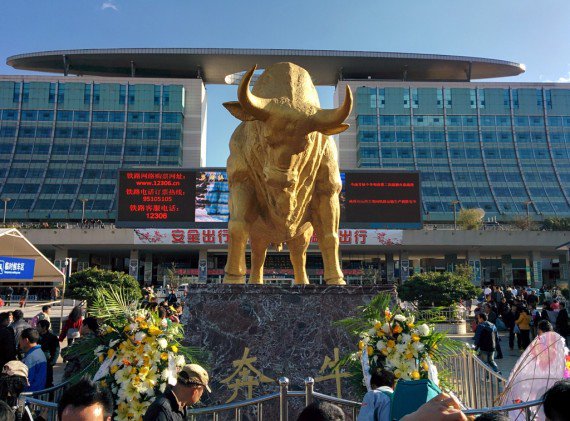
Memorials in front of the Kunming Train Station

Memorials in front of the Kunming Train Station

In the aftermath of the attack on the Kunming train station, in which official sources say at least 29 people lost their lives and 143 were injured, I went to sniff around the city for stories and reactions. People were stoic, supportive of their fellow citizens and seem to steer clear of any racial violence.

In general, the city felt ridiculously normal for the day after the attack . The people manning the gate at my compound greeted me as cheerily as I scooted down the hill and the only armed police I saw were hanging around a major interchange. Most people ambled lazily around Green Lake park, gazing at the flocks of sea gulls on their way back to Siberia as if nothing had happened. Not a SWAT team to be seen, even though this would be a potential spot for carnage. Kunming’s 1st People’s Hospital also had only a few law enforcers stationed outside, a shrill contrast to the mob of police inside that was trying to keep nosy journalists at bay.
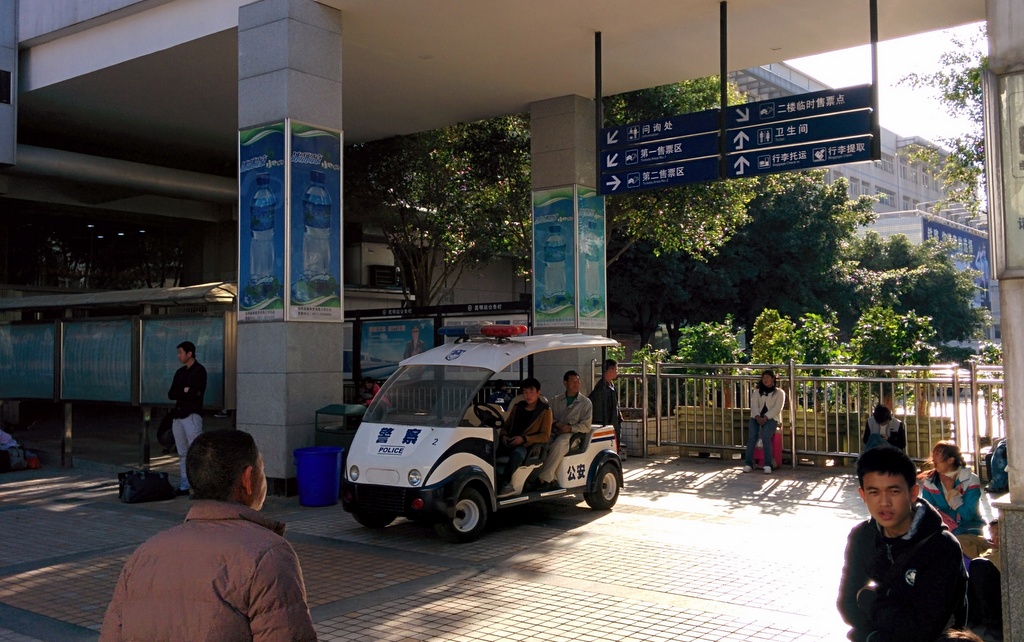
Unmanned police vehicle manned by local kids — right in front of the train station ticket office

Unmanned police vehicle manned by local kids — right in front of the train station ticket office

Even the train station felt relatively normal. On the left side of the square, a large part was sectioned off with police line and a dozen or so armed SWAT policemen were swarming around. In the middle of the square, under the large gilded bull, people were taking pictures of flowery memorials, one of which had already fallen down and torn. The ticket hall, the goriest place from Saturday’s attack, had been properly cleaned and was again filled to the brim with people queuing to buy tickets.

A young man cheekily ran behind me to measure himself against my height, so I used that as a pretext to ask him some questions. Whether he was afraid? “If I were afraid I wouldn’t be here”. Any other questions resulted in him uneasily shooting his eyes around so I left it at that.
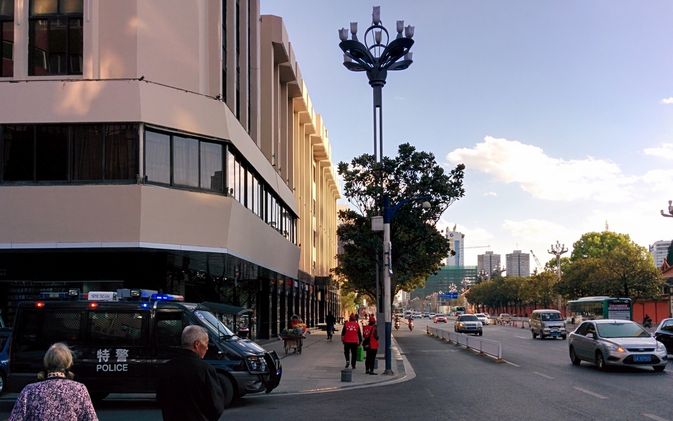
A SWAT vehicle on Beijing Lu

A SWAT vehicle on Beijing Lu

The cigarette lady was more helpful. She had already closed the shop and gone home for the night when the killings happened, but she was dead afraid to come to work on Sunday. She had wanted to stay home, but her boss and the need for a salary made her show up. She added that the extra security made her feel safer, though. A Bai minority woman in traditional dress was waiting for her daughter to pick her up. When I asked her if she was worried about coming here, given yesterday’s events, she replied: “which events?” Apparently the news had not reached rural Dali.

I also visit one of the mobile blood donation centers that the government had set up at twelve different locations all over the city. They must have rushed them in, as the containers still sported a sign for a previous blood-donating event at New Year’s day and make no mention of the stabbings the day before. That didn’t seem to stop people from flocking to the cabin. I am told that at least 150 people had already donated blood at this point and another 60 people were waiting to give.
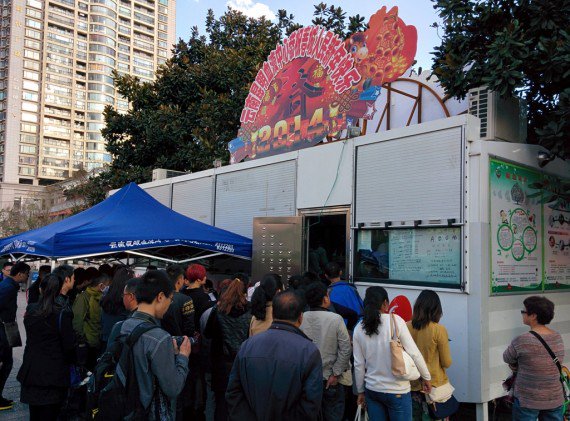
Mobile blood donation center – caption reads: "Kunming blood donation center wishes Spring City residents a happy new year"

Mobile blood donation center – caption reads: “Kunming blood donation center wishes Spring City residents a happy new year”

I met Miss Wu (25) and her two friends at the mobile blood bank. She herself is not able to donate, but her two male companions are. While the two men were inside, I struck up a conversation. ”We’re here to help our fellow citizens after yesterday’s massacre,” she beams. Solidarity and stoicism obviously go hand in hand in Yunnan. “I don’t think this will affect how I see Muslims,” she explains, “and I don’t think it will the view of most other Chinese, either. The attackers were a violent group who had nothing to do with other Muslims. There have even been a lot of Muslims coming in to donate blood. Wherever you have people, you have bad ones.”

A Chinese journalist asked me my opinion and added that he had not been able to interview any Uighur people. “Perhaps they’re afraid for retaliation [from Han majority people], but they really needn’t be, there doesn’t seem to be a strong anti-Muslim sentiment among the people.”
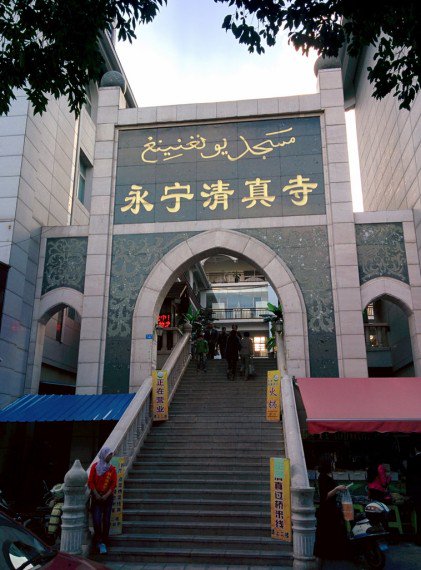
Business as usual at a Kunming mosque

Business as usual at a Kunming mosque

At the nearby mosque at Jinbi square, too, everything seemed to be business as usual. No signs of Islamophobic rioting, just people cooking all kinds of Halal cuisine for visitors. I talked to Ma Jun, a Hui (ethnic Han Muslim) woman from Inner Mongolia. While roasting some Erkuai pancakes, a local Yunnan delicacy, she told me she had seen some Uighur people coming in today for food and prayer, like on any other day. She made a plea for stronger feeling of unity among the Chinese people and says all will always be welcome under the roof of the mosque.

Questions remain, though, which no one currently has an answer to. One such question is: why Kunming? Of all places of importance to the government, was Kunming just the one with the weakest security? Were the attackers simply locals? Were they after tourists or after a particular train (the train to Shanghai was about to leave)? Kunming has almost no history of violence in the contemporary era, with the only notable event being the bombing of a bus in 2008. Then, too, Uighurs were initially blamed until it was later revealed that the lone bomber belonged to theHui minority.

Editor’s noteThis article was written by Kunming transplant Sander Van de Moortel and originally published on his blog A World of Nonging, on March 2.
1 Comment

Filed under China, Current Events, Kunming Train Station Attack, SLIDER, Uncategorized, Yunnan Province

Kunming Train Station Attacks: The Media’s Response


luggage

It’s Monday night, local time, and more than a day has passed since Kunmingers and the rest of the world awoke to news of Saturday night’s terrorist attack at the Kunming Railway Station. In that time, local residents, concerned citizens, the media and the world at large have begun the process of digesting what happened and what it all means. In this short time, reports have gone from panicked messages on mobile chat apps to full articles in the international press and an ongoing discussion on Twitter and Weibo. A few narratives have emerged, each with their distinct angle on the attack and some focused solely on the reaction to them.

Many of the first stories that were published were strict accounts what happened, such as this report from the BBC. The BBC story is representative in describing only the scene at the train station and eyewitness accounts of the attack. Similar stories were found on the websites of most news outlets.

The Chinese press, like the international press, only reported accounts of the scene at first, but stressed the official response, with most articles carrying quotes from President Xi Jinping and Premier Li Keqiang. Today, much of the coverage focused around security measures,  the efforts of medical teams in Kunming, and Chinese citizens’ response to the attacks.

Another narrative in the Chinese press was one of anger towards the foreign media for their treatment of the incident. One hotly discussed essay was this one from Xinhua News. Both the US Embassy and CNN drew Xinhua’s ire for downplaying the importance of the attacks. CNN put quotation marks around the word ‘terrorists’ in its first article on the incident while the US Embassy’s official statement failed to identify the attackers as terrorist. Xinhua was not the only one angry with the US Embassy, with thousands of Chinese criticizing the US online as well. In addition, this graphic from the People’s Daily online edition made for an intense discussion on both Twitter and Weibo.

A third strain of coverage of the incident centered around the bigger picture for China’s minority populations going forward. This article from Reuters looks at the possibility for increased tension between Uighurs and the majority Han population. A 2013 ChinaFile article by James Palmer, republished yesterday by Foreign Policy, was another article looking at ethnic tensions in Xinjiang that made the rounds on Twitter over the past 36 hours. The discussion around both articles has focused on whether or not the Kunming attacks are a harbinger for a new wave of crackdowns in Xinjiang and it’s a conversation that is sure to develop over the next days and weeks.

One line of discourse that has been missing from coverage is that of local Kunmingers. As often happens with events like these, the details and reactions of those most affected are discarded for larger implications and trends. Whether it be another short-lived skirmish over media bias towards China or the continuation of a long discussion on ethnic tensions in China, what locals think might be lost in the shuffle. Some interesting storylines that should be followed are: how Kunming as a city heals from the attacks; the language locals use to talk about the attack and what we can learn from that; how Kunming’s Uighur and Hui Muslim populations have been affected by the attacks; and how these attacks fit in the larger picture of ethnic relations in Yunnan. These are all critical questions and East by Southeast will do its best to find answers to them in the coming days. At the same time, we encourage our readers to reach out and tell us how they have been affected by the attacks what they see as important in the aftermath of such an event.

1 Comment

Filed under China, Current Events, Kunming Train Station Attack, SLIDER

Deadly Kunming Knife Attack Leaves 33 Dead, 130+ Wounded

luggage

Kunming is a city known for its sleepy nature and a perfect climate that promotes a casual urban way of life.  In many ways it offers an alternative to the busy competitive nature of China’s first and second tier cities.  As the capital of Yunnan province, the city also prides itself as a peaceful melting pot of ethnic unity in one of the most ethnically diverse areas of the world.

The Spring City’s reputation was irrevocably changed on the evening of Saturday March 1 as a group of five to ten knife-wielding attackers entered the Kunming Railway Station and engaged in a stabbing rampage that killed 28 passengers and wounded more than 100. The Chinese government is labeling the assailants as a Uyghur separatist terrorist group although very little is known of the actual identities of the assailants and their motives.

This horrifying incident is the bloodiest in recent memory to occur outside of Xinjiang, a territory that has seen an increase in restive ethnic activity over the past five years. The domestic Chinese media and international media are providing plenty of coverage of the incident, but many questions remain unanswered and facts surrounding the incident are sketchy at best.

Most importantly, who are the assailants?  Why was Kunming and its train station chosen as a site for the attack? And how could security at the train station be so lax to permit this unprecedented violence?

Official reports confirmed late Saturday evening that security forces killed four of five assailants and apprehended a fifth female attacker.  In the firefight one or more of Kunming’s SWAT force was injured with undisclosed levels of injuries.  Phoenix TV reported three of the assailants fled northward on Beijing Road (Kunming’s central north to south thoroughfare) out of the train station and continued to stab innocent bystanders until they met a police blockade several hundred meters from the station. Two were shot on sight and one apprehended, allegedly a woman five months pregnant.  Photos show the assailants were wearing the same black head to toe uniforms and were said to have their heads covered. Early Sunday morning March 2, photographs of a short sleeve black t-shirt with a crescent moon and Arabic script began to circulate Chinese social media channels; the t-shirt was the alleged uniform of the attackers – however, photos of the apprehended and assailants killed on site suggest they were wearing long sleeve shirts.

photo

On Sunday morning March 2, the official Chinese media labeled the incident as a terrorist attack laying the blame on Uyghur separatists groups.  At the point of this publication no names, photos, or information on the assailants have been released to the public. Identifying the assailants as Uyghur did confirm the initial messages that hit popular Chinese social media channels around 10pm on Saturday evening.  Concerned Chinese citizens are calling for the release of information on the assailants by the public security forces, but due process in China does not require the release of such information.  It is possible that we will never know the true identity and motivations of the attackers.

At noon on March 2, a list of 11 Uyghur men with names and headshots began to circulate Chinese social media sites.  The men are labeled as suspects fleeing the scene of the crime and no information has been released about their specific connection to the incident.  Were these men identified by close circuit cameras in the train station? Were their names divulged by the apprehended fifth attacker? Were they simply men who failed to show up to work on Sunday and reported by their Han Chinese employers as missing or by local observers as suspicious figures? Again Chinese criminal and legal processes help to shed little light on the identity of these men who apparently are still at large.

Kunmingers are in a state of fear and disbelief as news of the incident unfolds. Of the few people interviewed by ExSE most state that it is important to stay indoors since suspects were still on the run. The municipal public security bureau has asked all housing complexes, public venues, and university campuses to increase security surveillance methods. Property management companies of housing complexes are encouraging residents to blanket report sightings of any Uyghurs to local police stations.

Photos from the Kunming No. 1 Hospital located in the center of the city show the wounded recovering in gurneys, occupying hallways in the already crowded and resource strapped facility. A Sina Weibo user reported in an unverified report that a migrant family cannot afford the 50000 RMB required for treatment of their critically injured child.

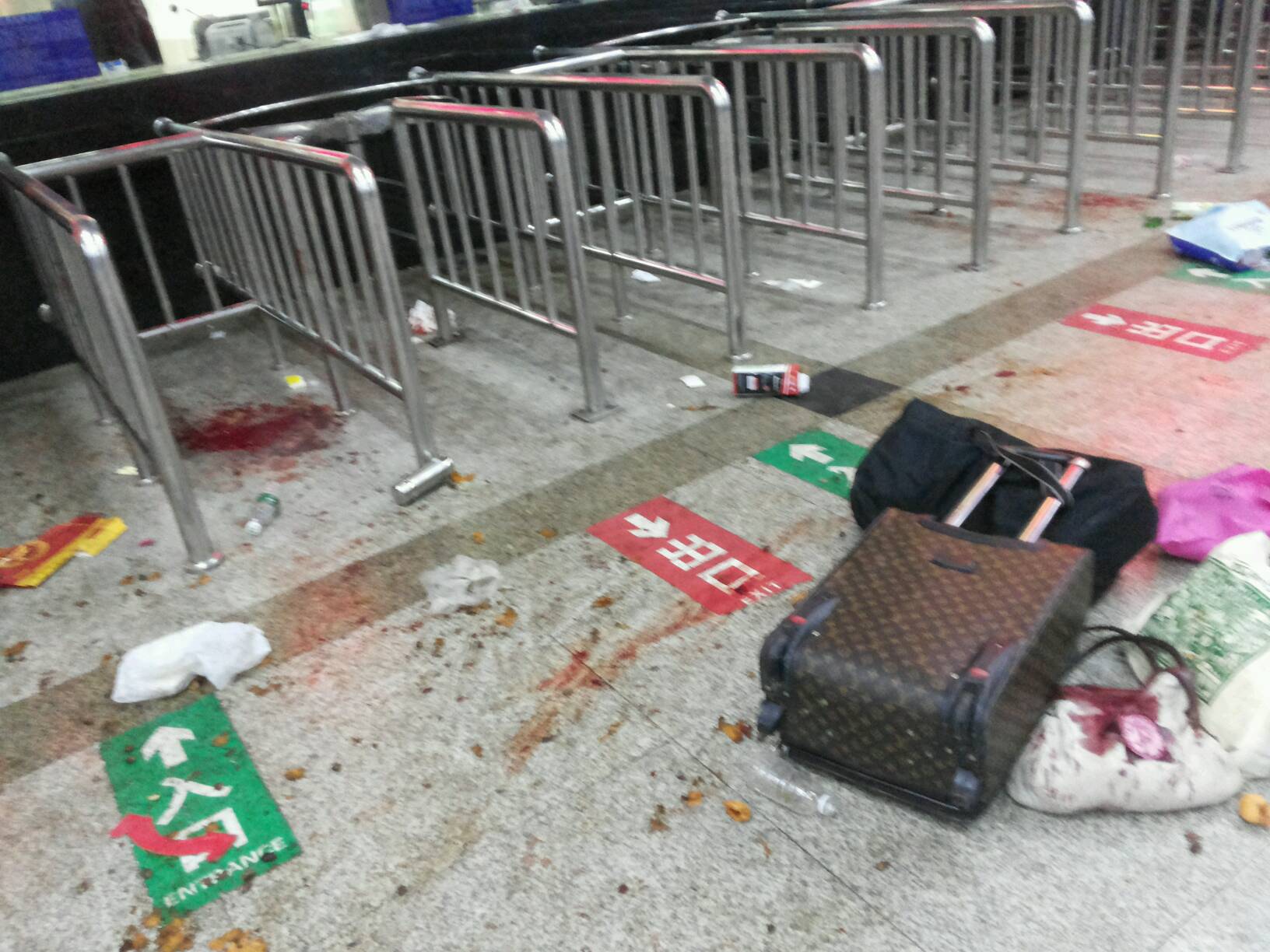
Chinese train stations are often crowded and packed with passengers into the late evening as passengers board overnight trains to destinations throughout the country. Kunming’s station last night was no exception. The mix of people in the train station was likely comprised of various walks of life from migrant workers, to middle-class tourists, to foreign backpackers heading to the popular tourism destinations of Lijiang and Dali as well as points north in inland China.  One photo showed a bag of golf clubs against a wall towering above a pool of blood.  Gruesome photos of the scene also show luggage left strewn throughout the scene of the violence, a rampage that occurred in many of the stations waiting halls in addition to the main ticketing room.

Anyone who travels on China’s rails and bus system knows the security at train and bus stations is extremely lax. Poorly trained guards – really hired help in shabby blue uniforms – man posts at metal detectors and luggage scanners placed in station entryways more for show than to serve a security purpose. At peak times train and bus stations are much more crowded than airports in China and metal detectors are constantly sounding as passengers walk through without any recourse or further pat downs. With the exception of Xinjiang and Tibet were security has been increasingly tightened over the past five years, the quality of procedures to safeguard the security of public places wanes as one gets farther  away from Beijing.

This lax security culture is likely to, and hopefully will change as a result of the incident in which locals are dubbing as Kunming’s 9/11. China’s President Xi Jinping dispatched top domestic security official Meng Jianzhu to Kunming to oversee the investigation that comes days before the opening of critical government meetings in Beijing. This incident will surely cast a cloud over the meetings which are a critical platform for Xi to further deepen his reform policies for China – or the incident will force the agenda to be more focused on security concerns, an already expressed concern for the new leadership. Meng Jianzhu said in a public statement today, “This gang of terrorists were cruel without any humanity. They completely abandoned their conscience. We must strike hard against them according to the law.”

Perhaps the known factor of a lax security environment and a municipal government famous for slow responses and public relations nightmares made Kunming an easy target for the assailants – if they were as the official Chinese media claims from western Xinjiang. We are all still grappling to understand why Kunming was chosen as a target for an attack of such scale. The last time an incident of this nature – although admittedly we are still trying to figure out the exact nature of the incident – happened was a series of two bombings in 2008 when a local man, a former convict disgruntled and unable to find a place and job in China’s competitive society bombed a bus killing two and then unintentionally killed himself in a second bombing inside the popular Salvador’s Café in the city’s university district.  The two incidents were spread out over a five month period. Prior to the bomber’s death in the second December 2008 bombing, authorities blamed the first bombings on Uyghur separatists until they could forensically link the two incidents. The bomber was Hui Muslim but not Uyghur and religion ties or ethnic suppression were not revealed as motivations for the incident.

Today on the streets of Kunming, many were reluctant to discuss the incident.  Known acquaintances opened conversations with “the thing on TV” or “what was in the news,” a reaction that displays the shock and disbelief that this could happen in their city or a willingness to distance themselves from the incident in self-protective behavior. A local fruit vendor was angry beyond words and could only mutter, to my disbelief, that all Uyghurs should be corralled and shot. Another local suggested that as a foreigner I should pack my bags and go back to the West where “you don’t have to worry about terrorism.”  Similar responses and sentiments pervade the Chinese population

As the city begins to piece itself back together with the start of the work week tomorrow, ExSE will continue its discussion of this horrible incident, continuing to comment on official media response, the discussion of Uyghur separatism and its link to the incident. In addition to the broader topics above which the mainstream media has already defined as its main narrative surrounding the incident, ExSE, a Kunming based website is interested in exploring issues on the ground here in the city as they unfold and from a long term, more connected perspective.

With so little information released on the true identities of the assailants as well as the identity of those slain in the attack, how does an urban society process and respond to such a violent incident? We are also curious and concerned to the way an urban society heals from the shock and grief that now holds sway over Kunming and to what effect security will be raised in the city in both the short and long term. Importantly how will the ethnically diverse but general peaceful and non-restive ethnic groups of Yunnan respond to an attack labeled with ethnic motivations by an outside separatist group?  And will angry Chinese nationals seek retaliation against Uyghurs and Muslims in all patterns of ethnic and nationalist tension that are becoming more and more predictable in China?

Please feel free to leave comments to this post or if you have contributions, contact us at eastbystheastmail@gmail.com.

2 Comments

Filed under China, Current Events, Kunming Train Station Attack, SLIDER, Uncategorized, Yunnan Province

Attack at Kunming train station leaves 27 dead and more than 100 injured

Late Saturday evening March 1, unknown attackers used knives to randomly kill passengers waiting at the Kunming train station. Xinhua News has reported 27 killed with 109 injured. A local hospital has seen more than 170 patients apparently injured in the incident.

The assailants are of unknown origin and motivation although Chinese social media sites are flying with rumors of ethnic affiliation. The state media has officially called this incident a terrorist attack.

While details are extremely sketchy photos from the incident are circulating as the story hits the international media. To keep up with the story as it breaks follow this live blog.

20140302-024335.jpg

Leave a Comment

Filed under China, Current Events, Kunming Train Station Attack, SLIDER, Uncategorized

New Addition: Country Profiles on East by Southeast

ExSE is excited to announce the addition of a new section to our website!  Country profiles are now available for Cambodia, Laos, Myanmar/Burma, Thailand, and Vietnam.  These profiles introduce the historical, political, and economic milieu of countries in Southeast Asia and provide you with up to date analysis of current events and developing trends in the region.  You will find links to economic and environmental data as well as a discussion of each country’s regional connections (including the China connection!) in a greater context.

These country profiles are authored by undergraduate students enrolled in the Regional Development in China and Southeast Asia program at the IES Kunming center.  Each semester new students will have the opportunity to update, edit, or add to the existing reports so be sure to check for updates frequently.

Country reports can also be accessed via the site’s top menu bar under Profiles.

If you have suggestions, contributions, or photos to provide for the country reports, please feel free to contact us at eastbysoutheastmail@gmail.com.

Leave a Comment

Filed under ASEAN, Cambodia, China, Current Events, Laos, Myanmar/Burma, SLIDER, Thailand, Uncategorized, Vietnam

A Quick Glance at Yunnan’s 2013 GDP

Below is the translation of a recent media release on Yunnan’s GDP and breakdown by sector and source.  I’m still tracking down some explanatory data (like why imports decreased by 10%) before I provide analysis and representations, but observe that total debt is greater than 2013 GDP as well as debt/total savings ratio is approximately 77%.  Investment growth was double consumption and real estate investment grew by 40%!   Lastly, there seems to be a mistake with total fixed capital investments listed at nearly 85% of GDP. 

Yunnan Wangxun – January 17, 2014 (author: Lei Suyue): Experts at the Yunnan province Bureau of Statistics report the province’s 2013 GDP totaled 1.17 trillion RMB (193 million USD).  The province’s GDP growth rate ranked third in China at 12.1% and is demonstrating a stable and positive trend. 

The data show the agricultural sector contributing 305bn RMB and growing by 7% on the previous year.  Grain harvests were the highest in five years totaling 18.24mn tons and a YOY growth rate of 4.3% (.749mn tons).  Additionally, special agriculture industries (agro-forestry, livestock, and fisheries) from upland areas (高原特色农业) are contributing strongly to this growth in terms of improvements in quality and quantity.

Industrial output rose to 347Bn RMB and grew by 12.3%.  Light industry contributed 152.8bn RMB and grew by 7.4%.  Growth in heavy industry rose to 194.3bn RMB demonstrating a significant growth rate of 16.3%.  These industries consumed 675.2bn tons of coal (8.1% growth), and the entire province consumed 145.9bn KWH of electricity (10.9%).

Investment in fixed capital assets (not including farm investments) increased by 27.4% reaching a total of 962bn RMB (translators note: this looks too high, could be a typo).  Real estate investment totaled 248.8bn RMB (39.6% growth).  The province added a total of 182mn square meters (27.1% growth) and sales of 33mn square meters (2.2% growth) at a total value of 14.87bn RMB (9.1% growth).

Total government expenditure for 2013 was 278.5bn RMB. Total government revenues for Yunnan province totaled 161bn RMB (20.4% increase).  Tax revenue totaled 121.5bn RMB (increase 14.2%); Non-tax revenue totaled 38.56bn RMB (44.3% increase)

Provincial government expenditures (including locality expenditure) totaled 409.65bn RMB (14.7% increase)with 278.46bn RMB spent on education, social welfare and employment programs, agro-forestry and water resources, transportation shipping, and social housing programs.  This expenditure rose 34.4BN RMB from last year and totals 68% of provincial public expenditure.

Total Consumption reached 403.6bn RMB – a 14% increase over 2012. Urban consumption totaled 324bn RMB growing by 13.8%; rural consumption totaled 79.5bn RMB (growth 14.5%) 7 percentage points higher than urban consumption growth rates.

Yunnan’s international trade (exports + imports) totaled 125bn RMB (25bn USD)

Total trade rose by 22.9% in 2013 – the province’s growth rate is 15.3 points higher than the national trade growth percentage.  Among this exports totaled 15.96bn USD (59.3% growth); Imports totaled 9.87bn USD representing a decrease of 10.2%.

By the end of December, 2013, total savings of provincial financial institutions totaled 2.06 trillion RMB, an increase of 271.84bn RMB (15.2% increase); total debt of Yunnan’s financial institutions is 1.58 trillion RMB an increase of 192bn RMB (14% increase)

GDP breakdown by sector: Primary sector GDP totaled 189.5Bn RMB (6.8% growth), secondary sector GDP totaled 492.8bn RMB (13.3% growth) where industry contributed 376.7bn RMB (12% growth) and construction totaled 116bn RMB (18.4% growth);  Tertiary industry totaled 489.8bn RMB (12.4% growth).

Yunnan has made progress in navigating its development through the pressures of the complex global economic climate through the promotion of a “Stability provides progress, stability provides effectiveness, stability provides expedience” program.  Success in Yunnan has come from promoting stable growth, institutional restructuring, promoting reform.


2 Comments

Filed under China, Current Events, Economic development, SLIDER, Yunnan Province

The Unlikely Story of Pastor Yang Congguang

Pastor Yang Congguang and his wife

Pastor Yang Congguang and his wife

It’s lunchtime in Mae Salong, a small village perched on the spine of mountains that trail south from China’s Yunnan province to divide Thailand and Myanmar. The restaurant sign is in Thai, but the menu is written in traditional Chinese, offering peanut-flecked pad-thai noodles and steamed chicken jiaozi dumplings finished with tea grown in the surrounding hills.

Throughout the meal, English, Thai, Mandarin, and a local Akha dialect mingle along with the food, a cultural confluence that reflects the town’s unique history. Officially now called Santakhiri by the Thai government, Mae Salong is perhaps best known for its role as a heroin trading outpost and as a base for remnants of Chinese Kuomintang forces who refused to surrender to the Communists. Even today, the village has a distinctly Chinese flavor, where a dialect similar to Yunnan’s is spoken at stores, restaurants serve Yunnan-style food, and Mandarin language instruction is an option for public education.

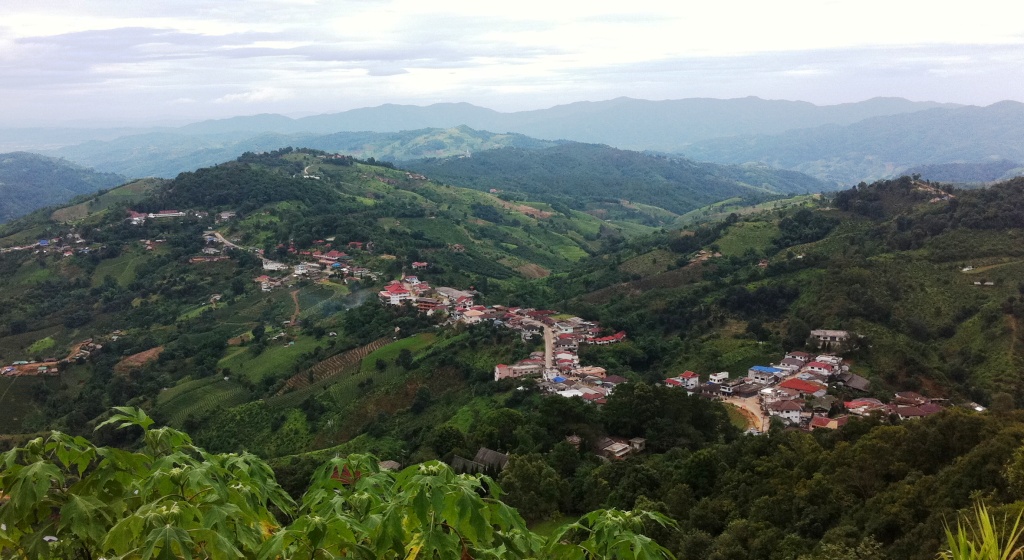
The village of Mae Salong

The village of Mae Salong

The local economy now relies on tea production and cultural tourism surrounding the local Akha highland hill tribes rather than heroin, however the Kuomintang heritage of many villagers remains an enduring legacy. Pastor Yang Congguang of the local Baptist Church is one such resident of Mae Salong.

Pastor Yang was born in 1956 in Luxi County in Yunnan Province, during what he calls “an era of war” that followed him around through childhood and much of his adult life. By the time he was two years old, Yang had already been registered by the government to join the army upon adulthood, along with his two older sisters. Yang’s parents decided to flee to Burma, hoping to escape increasingly dismal prospects in China.

Yang’s father, a farm veterinarian, went first in 1957 to a village in Kokang in northern Burma settled by other ethnic Chinese. The head of the village there owned some 3000 horses, and his father’s skills were highly sought after. However, the Chinese population of the village were not the majority Han ethnic group like Yang’s family, but the Lisu people, one of the many ethnic groups of upland Southeast Asia.

Yang’s father found the Lisu not at all as he had imagined “backwards” minority people to be. He was impressed how many of the Lisu, especially the Christian population, did not smoke, drink or gamble, and furthermore were educated enough to read. Yang’s father told the chief that he wanted to bring his family to the safety of Kokang, and that if the villagers prayed for the family’s safe passage, they would all convert to Christianity.

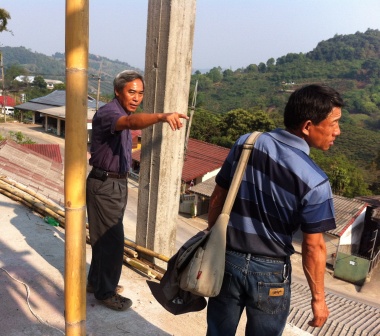
Yang supervising construction of his new church.

Yang supervising construction of his new church.

By this time it was 1958, and leaving China had become increasingly difficult and dangerous. Yang’s extended family, numbering sixteen people in total, required three trips and traveling only at night through the forests. During the final trip, it rained hard all night just before they were to cross the border and the group lost the right path. When the sun came up, his father realized they were very close to the only road across the border, manned by a PLA checkpoint. Despite the danger of trying to cross during the day, Yang’s father decided to take the risk. At the border, chance had it that checkpoint patrol house was empty, although the stationed soldiers had built a small fire. Yang’s uncle stopped briefly to warm his hands, telling the group to go on ahead. Today, Yang estimates that his family must have had only a few minutes’ window of time to sneak across the border.  His uncle did not rejoin the group and was never seen nor heard from again.

Once in Burma, the Yang family reached Kokang safely and converted to Christianity as promised. The Kokang authorities did not permit education in Chinese, so Yang learned through studying the Bible. In Kokang the family had a few years of peace, until 1966 when the Burmese Communist party swept into the northern border region, beginning a period of civil unrest as well as tumult in Yang’s life. The family moved further south, to an area in Burma populated by the Shan (Dai) ethnic minority, where they stayed for three years until once again the Burmese communists arrived. The Yang family to Lashio in the eastern Shan state, and then again even further south to an area with very few ethnic Chinese.

Yang’s adolescence occupies a murky place both in memory and time, a period of transience and uncertainty that also coincided with the rise of the heroin trade in Southeast Asia. Former Kuomintang soldiers clashed with Burmese communists, with unrest and violence spilling across the borders of Thailand, Burma, and Yunnan. During these years, Mae Salong sprung up as both a drug trading outpost and a refuge for Kuomintang soldiers recruited by the Thai government to counter Communist threats.

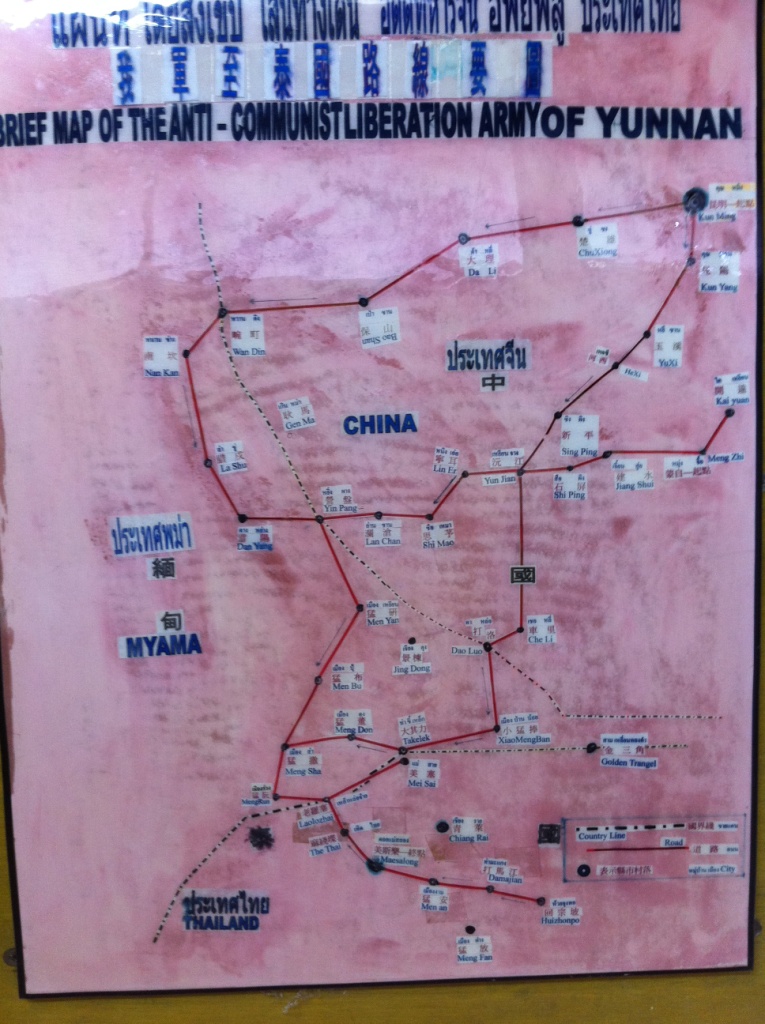
A homegrown depiction of the KMT's path of flight from China to Mae Salong

A homegrown depiction of the KMT’s path of flight from China to Mae Salong

“It was like trying to escape from a jaguar only to run into a tiger,” says Yang. “My parents didn’t want me or my siblings to grow up to be soldiers, so every time the armies came we left. But everywhere we went, they kept coming.” In 1973 he reluctantly joined the Kuomintang for a little over a year and fought against the Burmese. During this time, his faith kept pushing him to seek a different path. “I kept thinking some verses were especially speaking to me – that I should rather be a guard outside the house of God than live in the opulent tent of an evil person. The army for me meant living in an evil person’s tent,” he remembers on his decision to desert.

Yang escaped across the Salween river to Thailand at great personal cost. His commander came to his family’s house, and threatened Yang’s father to make him return. Yang’s father refused, and was taken away by the army along with nearly everything from their house, which was then burned. Yang’s brother escaped to the forests, but Yang found out later that the army shot his father by the side of the road.

For six years Yang drifted, stateless and without identity like many Yunnanese refugees in Thailand, feeling both immense guilt at the death of his father and a responsibility to lift his family back on their feet. He worked odd jobs to try and make money, “but life had no color, and I thought God had perhaps forgotten me.” But in 1981 he received an opportunity to enroll in Bible college in Bangkok, and a new beginning. His first job afterward was working at a church in Mae Salong, the village known for its KMT heritage.

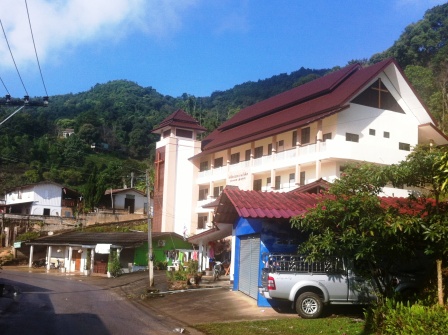
Today Yang is the pastor at the Mae Salong Baptist Church and with a wide smile proudly shows off a gleaming new building opened just this past year.  Over the past three decades, Pastor Yang has developed his own parish into a congregation made up of two hundred families who travel over the hills and footpaths to his church for worship, schooling, and community programming.  In the early 1990s, Pastor Yang and his wife built a single room church with the little donations they could gather from local villagers and began offering free Chinese language education to Yunnanese, Akha, and Lisu families who could not afford tuition at the state sponsored school.


Mae Salong's new Baptist Church

Mae Salong’s new Baptist Church

The newly built church has eight large classrooms for free Chinese language and free primary education classes taught by a cohort of regional volunteer teachers from Thailand, Singapore, Malaysia, and mainland China. Many of the students are Akha, as most of the Chinese residents of Mae Salong can now afford to attend school further down the mountain, reflecting a growing assimilation with Thai culture as more and more move away from the village to bigger cities. Yet Yang remains confident that his church and school can serve as a bridge between the past and present, as well as provide opportunities to educate the Akha residents of Mae Salong. Yang says the students are not required to be Christians to attend the school.  The Baptist Church also has a healthy relationship with the small Yunnanese Muslim population of Mae Salong, sharing access to public water resources and cooperating to bring a new pipe to the village. Yang is content, and although his life is modest he finds fulfillment serving his community.

Pastor Yang and Mae Salong may share a history that began in an era of war, but more importantly they both have a future supporting a community where multiple cultures can mix, and peacefully coexist.  “Life is good,” he smiles while looking over the town, across the green ridges of tea terraces and mist-covered mountains towards the border of Myanmar some fifteen kilometers away.

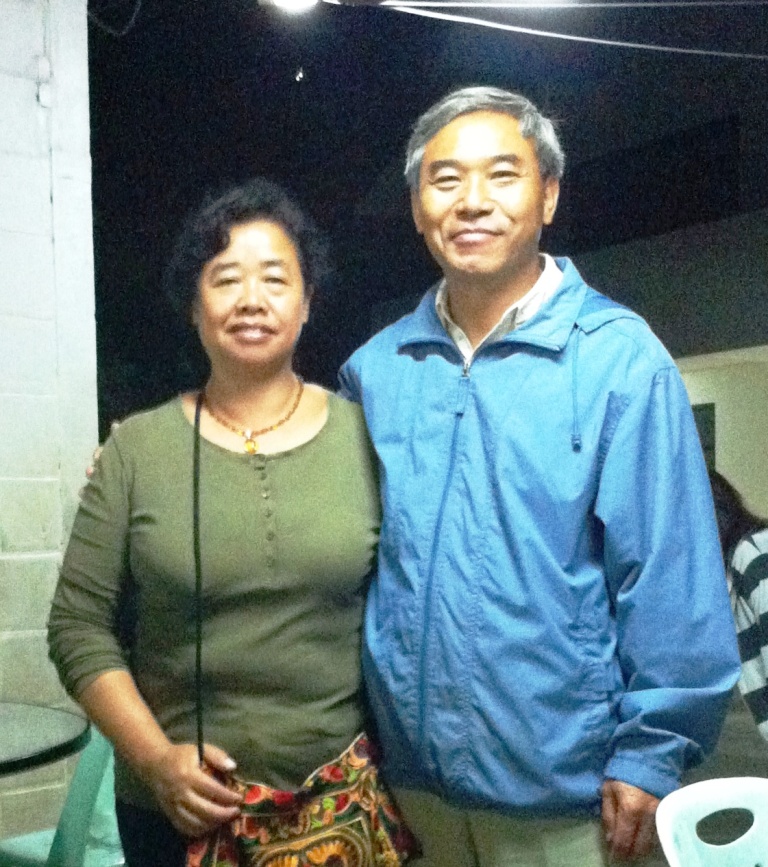
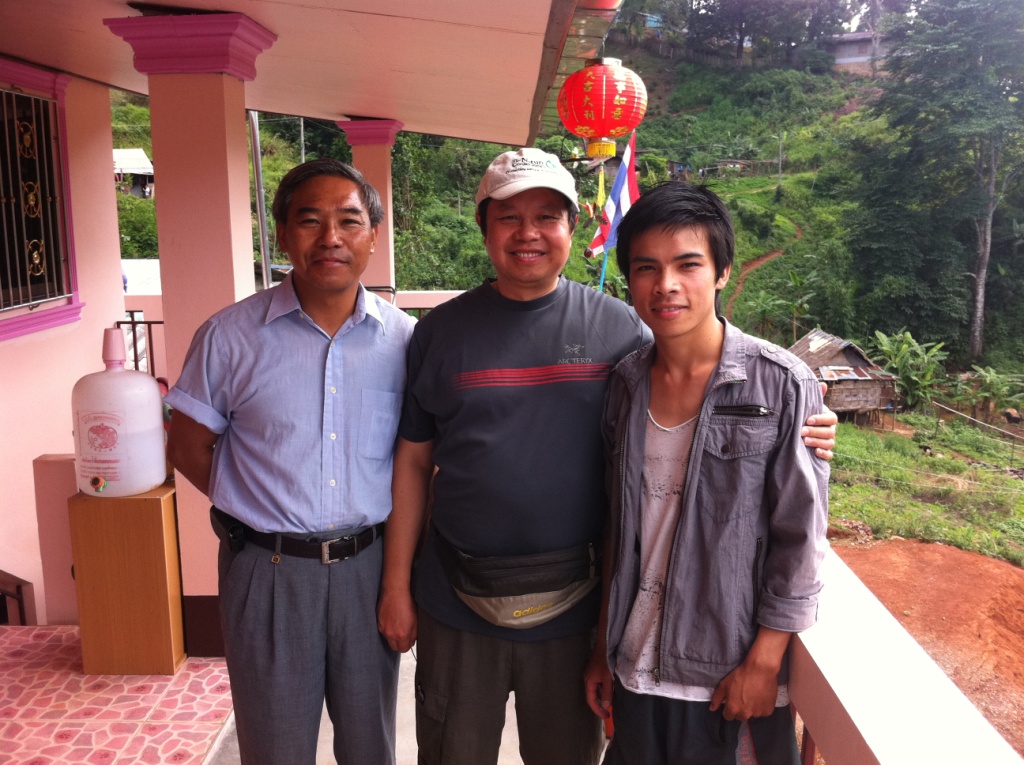
(from left) Pastor Yang with ExSE contributor Zhou Dequn and Ashi, the first of his family to attend college after matriculating through Yang's school

(from left) Pastor Yang with ExSE contributor Zhou Dequn and Ashi, the first of his family to attend college after matriculating through Yang’s school

Leave a Comment

Filed under China, Culture, Myanmar/Burma, SLIDER, Thailand, Uncategorized, Yunnan Province

China’s Humanitarian Policy in the Philippines: Politics Over People?

Image courtesy Bruce Reyes-Chow

Image courtesy Bruce Reyes-Chow

China has been no stranger to territorial conflict throughout its long and complex history, having met plenty of resistance while spreading its dynamic culture near and far. Today is no different, as intense disputes over tiny island chains in the South and East China Seas have left China in a state of particularly poor relations with some of its most important neighbors. These disputes, of course, do not bode well for maintaining reasonable terms over some of the region’s most important geopolitical issues. However, what has become equally as apparent—and potentially more important—is the way these conflicts are currently affecting the way China conducts humanitarian policies in the region. As China continues to rise toward the top of global power and influence, many assert that with it comes a rising role of global responsibility. What we have found thus far is that China does not appear interested in taking up that challenge.

After Typhoon Haiyan—an exceptionally powerful storm—roared through Southeast Asia in early November and devastated parts of the Philippines, leaving the country’s death toll at over 6,000, China surprised the global community by offering a meager $100,000 in humanitarian aid. This, compared to the tens of millions of dollars in aid offered by many of the world’s most powerful countries, was perceived as particularly frugal and, to some, downright disrespectful. Understandably, China received quite a bit of backlash for its decision and soon thereafter increased its contribution to $1.6 million and committed state medical resources to the areas of the Philippines most affected by the disaster. However, China’s initial contribution seemed to clearly define its true opinion on the issue.

Despite China’s late arrival to the hard-hit Philippines, its aid and assistance was, of course, still received warmly and excitedly by the victims. When a natural disaster afflicts a nation, political relations no longer seem to matter to many. Filipino residents greatly embraced China’s support. Gina Tubigon expressed her appreciation after China’s arrival ensured the survival of her sister-in-law, Elesea. A 75-year-old suffering from a chronic respiratory ailment that worsened in the wake of the typhoon, Elesea may not have lived through the storm’s aftermath had it not been for the assistance of the Chinese medical team. Relieved about her sister-in-law’s stabilized condition, Gina expressed her appreciation, noting, “I know the relationship between the Philippines and China is not good, but we’re very thankful for the help.” This purely honest and non-politically calculated sentiment sums up the importance of cooperative relations between the two nations. It also suggests the possibility that a lack of increased aid and assistance from the Chinese government may have caused Gina to lose her sister-in-law.

 Relations between the two countries have been tumultuous for some time. As China continues its unprecedented rise, with an increasingly strong military accompanying extraordinary economic development, its Southeast Asian neighbors have become more and more anxious about territorial integrity. As China’s claims to the region become more extensive, the Philippines has been bolstering its defense and maritime law enforcement—with the help of US support—and has sought endorsements from ASEAN during the process. The Philippines, just like many of its regional neighbors, has endorsed the US’s recent pivot to Asia, as a mechanism to balance against Beijing’s increased maritime objectives.

These exhaustive disputes have occurred between the two countries for decades, but have become further amplified in recent years, as China’s claim to maritime territory off the coast of the Philippines—the 200 nautical mile radius that makes up its Exclusive Economic Zone (EEZ)—has continued to expand. This includes a tiny rock called the Scarborough Shoal, which is no bigger that the size of a relatively small raft, yet vital to the two countries, as it holds important designation for charting territorial boundaries. The dispute between the two countries serves as a microcosm for a more general trend of tension and insecurity that has existed between China and its neighbors further south.

Though these tensions have persisted for many years, amplified to greater extents during certain periods more so than others, they have ceased to have a highly significant or long-term impact on trade relations in the region. Yet, China’s frugal initial response to Haiyan relief reflected a new realm of implications—that these strained relations are having a negative impact on how China is handling its humanitarian policy in the region. As the countries of East Asia continue developing economically, their regional interdependence grows in import. They must be prepared to support one another in combatting natural international crises that extend beyond politics, such as typhoons of the magnitude of Haiyan, especially when these crises have potential for mutually severe impact on multiple countries in the region.

China’s interest in extended control and influence over the region of the South China Sea—and East China Sea as well—has caused many to ponder whether Beijing also plans to embrace a wider role of responsibility regarding international crises. By offering such a small amount of financial aid during the immediate aftermath of this horrific storm, Beijing has implied that—at least for the time being—national interests remain the focal point of its current objectives, clearly trumping the need to be an international leader.

Of course, China’s stance toward the Haiyan relief effort is certainly not simple—with a range of complex considerations likely at play throughout the decision-making process. One fundamental question posed in response to China’s position is whether China is currently choosing not to emphasize the importance of more intimate relations with its neighbors—and the international community more generally—in order to instead commit more focus inward. As the Chinese government creates very carefully calculated strategies regarding domestic economic growth and infrastructural development, large numbers of financial resources and assets are presently committed to various projects throughout the country.

Indeed, China’s current national economic milieu is one of many different parts. These parts include initiatives such as western economic expansion, raising the standard of living for larger populations, developing the nation’s energy sector in a push for cleaner sources of fuel to drive the country’s future development, further establishing modern industries throughout different parts of the country (i.e. financial, technological, and creative/cultural sectors)—and many others. In addition, unprecedented economic progress has also instigated a range of complex social strains, some of which have never before been seen. Actively seeking to deal with these increasingly pronounced issues, such as frustration with appallingly high levels of pollution, larger interest in individual freedoms and self-expression among Chinese citizens, and rapidly evolving national identity—to list only a few—the Chinese government is carefully undertaking its national strategy.

As China consciously addresses these economic and social factors, simultaneous emphasis on non-political/economic international issues may not be on the immediate agenda. National leadership may currently ascertain that, still in an infant state of modern global importance and influence, this complex and highly dynamic country is not in a position to fully involve itself financially and logistically in these types of crises. However, regardless of China’s strategy with respect to regional and international stability—which at this point can only be speculated—what is clear is that China’s highly active position in geopolitical affairs has caused its western counterparts to expect a greater level of support from the rising giant towards these types of crises. Most important will be how China responds to this increased level of pressure and expected responsibility from its global economic partners as similar issues come about into the future.

Nevertheless, in the case of Haiyan, this is only but one event in the midst of a lengthy modern history of strained relations between these two countries that has fluctuated in degree over the years. Therefore, only time will tell if China’s increasingly powerful international role will cause the economic powerhouse to engage the international community differently into the future. In the meantime, the aid and assistance that China did eventually provide to the Haiyan relief effort was effective and surely prevented many from severe illness or death. The victims of the storm as well as those on the medical relief team were not considering regional political tensions as lives were saved. This kind of understanding and expectation will hopefully be at the core of decision-making between China and its Southeast Asian neighbors into the future, as a rapidly changing world seeks to prioritize people over politics.


Leave a Comment

Filed under China, Current Events, Foreign policy, Philippines, Regional Relations, SLIDER, South China Seas

The Kunming-Bangkok Highway’s Final Link Opens over the Mekong

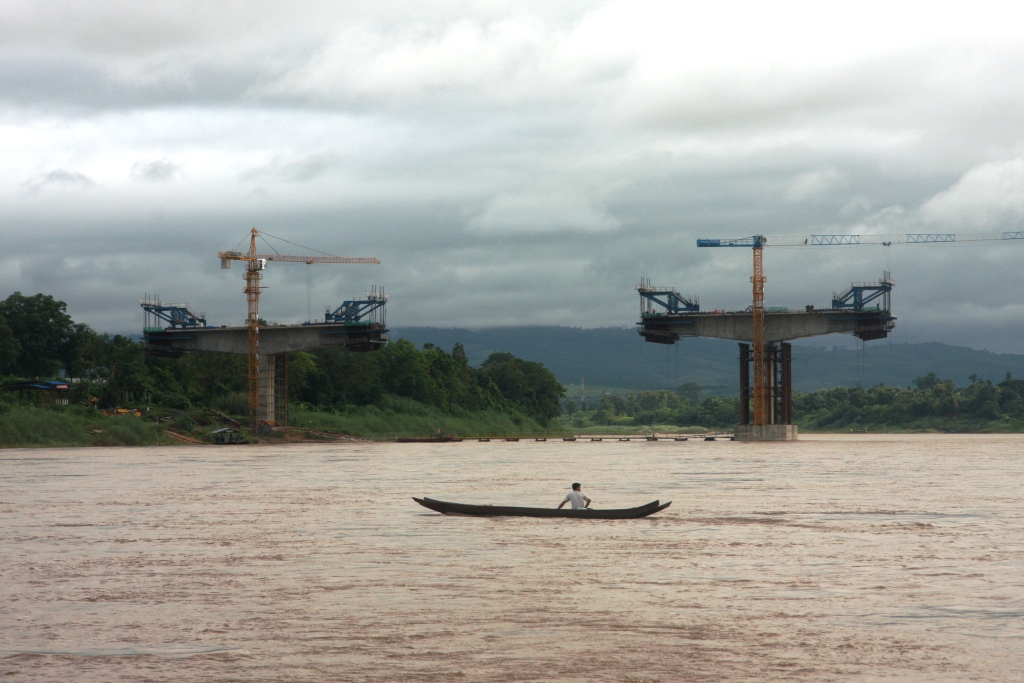
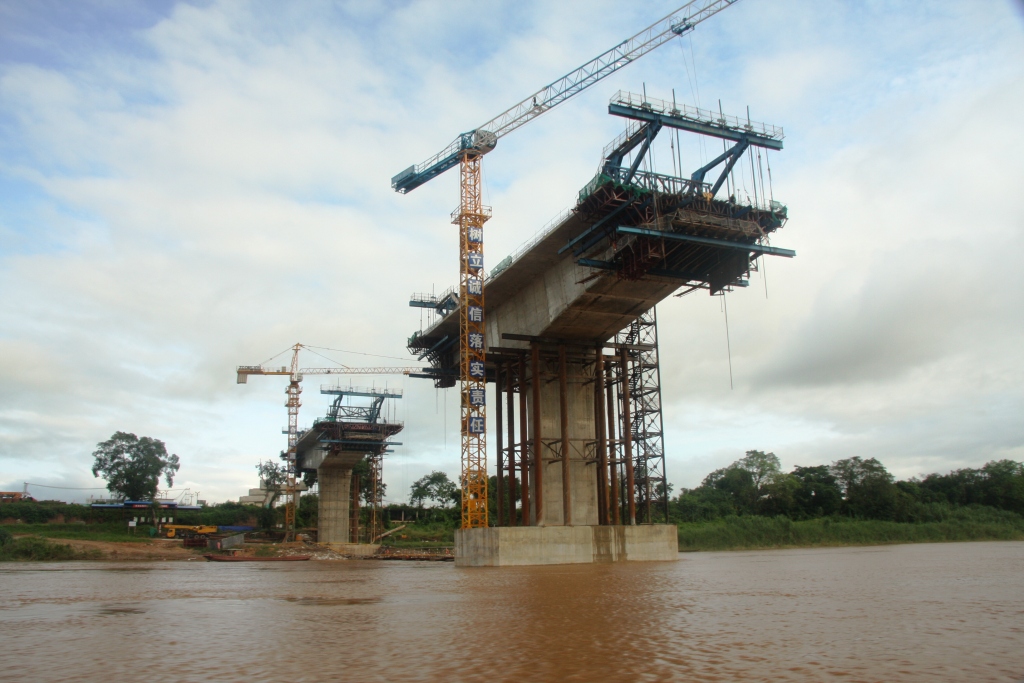
The Fourth Thai-Lao Friendship bridge which connects Thailand’s Chiang Rai province to Lao PDR’s Bokeo province officially opened for business yesterday.  Although the bridge, which stretches 400 meters across the Mekong river, and surrounding customs and inspection infrastructure have been completed for a few months, the two countries set the auspicious date of December 11, 2013 or 11/12/13 as written in the international form for the bridge’s opening ceremony conducted by Thailand’s highly respected Princess Sirindhorn.


A local fisherman navigates the Mekong downstream of the new bridge (July 2012)

A local fisherman navigates the Mekong downstream of the new bridge (July 2012)

The prime benefactor from the bridge’s opening is not Thailand or Laos, but rather China as the bridge serves as the final link in the Kunming-Bangkok highway, a 1900km series of connected highways that will facilitate significant increases in container shipping trade between China and Thailand.  Six years ago overland transport between Kunming and Bangkok for container shipping was virtually impossible due to the poor quality of roads.  In China’s southwestern Yunnan province, a drive from Kunming to Jinghong, the Dai cultural capital of Sipsongpanna (Xishuangbanna) prefecture took up to 24 hours and another six hours to the Lao PDR border at Boten.   China completed its portion of the highway to in late 2007.

The Lao PDR segment of the highway connects Boten to the 4th Friendship bridge in Huayxai and cuts through 180km of the most remote parts of Laos.  In the summer rainy season of 2004 I hitched a ride on a pickup truck to travel the 180km segment which then was a single lane mud track.  We completed the tiresome 10 hour drive only after averting a serious accident and certain death when the truck spun out of control nearly pitched over a 400 meter cliffside.    China, Thailand, and the Asian Development Bank invested equal thirds in the Laos portion of the highway which opened in 2010 and dropped transportation time to three hours.

By design, the highway system links the friendship bridge to Bangkok, but despite being the strongest economy on mainland Southeast Asia, Thailand’s highway system lags behind in quality compared to China and the stretch running through northern Laos.  Improvements to Thailand’s R3 highway system which will link Chiang Rai province to all points in Thailand is ongoing but far from complete.  Thailand has promised to upgrade its national transportation and highway infrastructure but political roadblocks, corruption, and a perceived lack of momentum for regional integration at many levels of Thai government and society has discouraged those plans from synching up with China’s outwardly stretching infrastructure linkages.   When the Thai roads are finished, a container truck will be able to travel from Kunming to Bangkok in less than 18 hours.

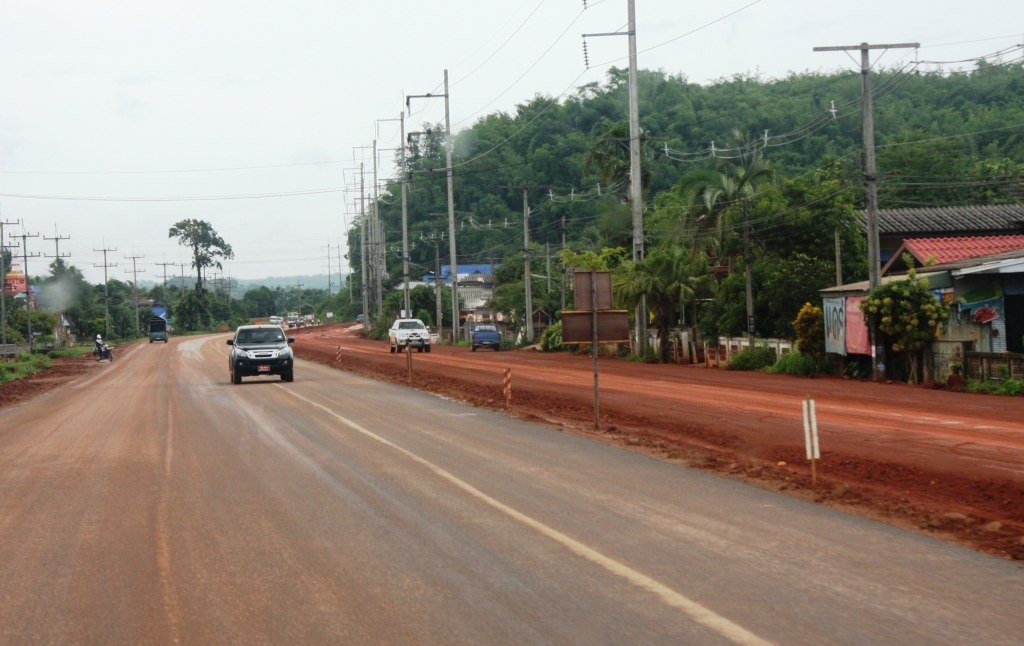
Road widening construction on Thailand's R3 in Chiang Rai province

Road widening construction on Thailand’s R3 in Chiang Rai province

The 14 hour drive from Kunming to the friendship bridge feels like a leapfrog journey from bridge to tunnel and tunnel to bridge as the road makes its 1800 meter descent.  These two roads cut through some of the most difficult terrain on the planet and link the Chinese state to the Thai state while passing through the most ethnically diverse region in Asia.

The roads not only to build regional commercial connections between China, Thailand, and Laos through the increases of trade and investment but they also assist in expanding each of these state’s interests and systems into the once impenetrable regions of upland southeast Asia by introducing national education systems, agricultural techniques that promote mono-cropping over traditional subsistence farming, and creating avenues for ethnic and rural peoples to leave their homes and link up to national labor markets.   The opening of the bridge will increase trade in the region and will intensify and quicken the pace of social change in upland Southeast Asia and reshuffle the cultural milieu of peoples who have sought refuge from the expansionary Chinese and Thai states for centuries.

Under construction, July 2012

Under construction, July 2012

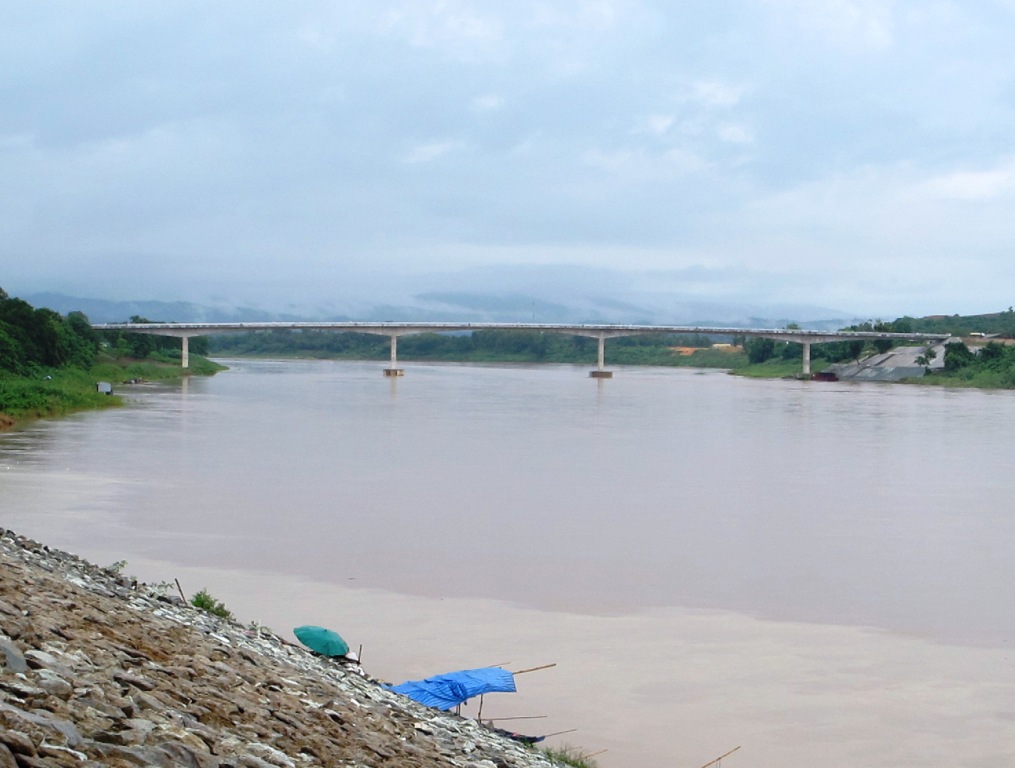
Bridge completion, December 2013

Bridge completion, December 2013

The bridge’s construction has also caused an influx of Chinese investment in Chiang Rai province mostly in real estate development, speculation on future industrial estates for manufacturing of intra-industry goods passing between China and Thailand, and the buying up of agricultural lands.  While this investment is encouraged and welcomed at the national level and by the Chiang Rai Chamber of Commerce, locals are wary of the fast and growing levels of investment in the Golden Triangle Area by Chinese firms and often cite a “Chinese invasion.”  The mayor of Pak Ying Tai village, a small fishing community of 100 households located less than one kilometer south of the bridge has lamented to me on several occasions about China’s footprint in Chiang Rai as he observes year on year decreases in freshwater fish catches and sends more and more of his villagers looking for work in urban areas.

A local farmer from Pak Ying Tai village discusses his worries about community impacts of economic development

A local farmer from Pak Ying Tai village discusses his worries about community impacts of economic development

In many ways the bridge and its construction serve to represent the challenges of regional cooperation between China, Thailand, and the rest of mainland Southeast Asia.  From its conception in the late 1990s to its completion yesterday, the bridge has gone through stalled and failed rounds of negotiation and has not lacked controversy.  Groundbreaking for the 1 billion Thai baht project which is equally invested by China, Laos, and Thailand did not occur until 2010 despite a scheduled start for as early as 2006. In May 2011 Thailand pulled its portion of the construction team in order to settle a land dispute with the local Thai government accusing Chinese commercial interests of illegally purchasing land on the Thai side of the bridge.

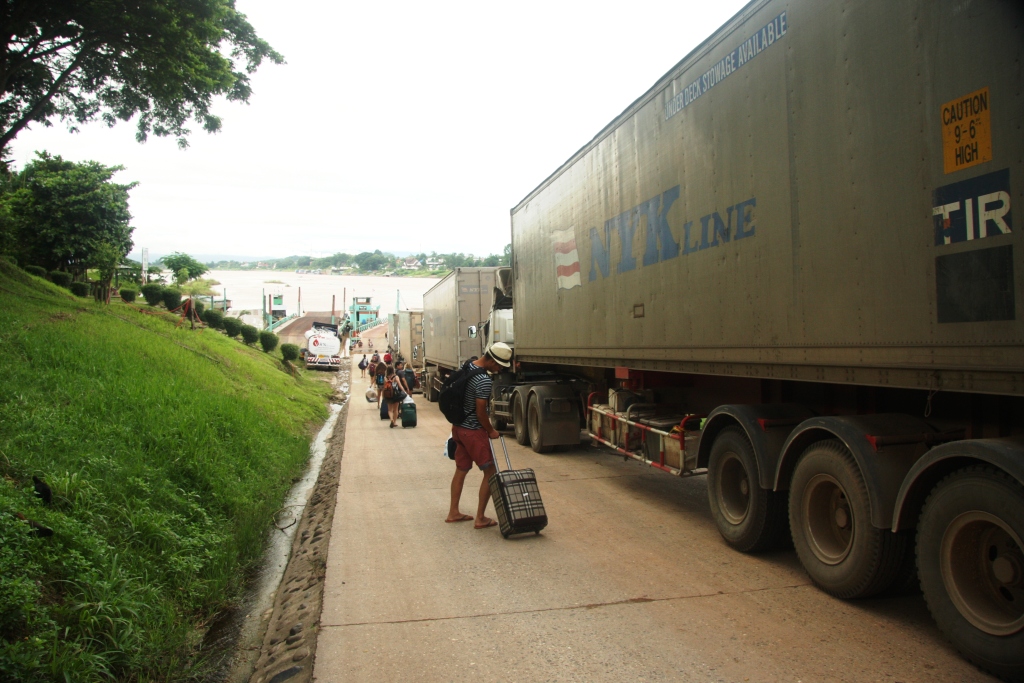
Container trucks will no longer have to wait in line for the Mekong ferry at Huayxai in Laos.

Container trucks will no longer have to wait in line for the Mekong ferry at Huayxai in Laos.

Another obstacle to regional cooperation demonstrated by the bridge is the ease of passage through customs and inspection for both container trucks and individual travelers or tourists to the region.  Chinese trucks are not permitted to drive in Thailand, nor are Thai trucks allowed to travel through China; thus the speed of transport is slowed by the need to repackage goods at one of the border crossing points. Despite efforts of the ADB in to facilitate a shared cross border trade and transport protocol to streamline logistical flows at regional border checks in China and mainland Southeast Asia, states have been slow to adopt the measures in order to protect national markets and logistics industries.  New customs and inspections facilities at the bridge are fitted to increase the speed of transport and ease of people movement and will serve as a testing ground for these promised increases in logistical efficiencies.

Looking forward to the first six months after the bridge’s opening, the verdict will be clear on whether the bridge will serve as a strategic choke point, a gateway for win-win trade and economic development between two regional powers , or a conduit that will further challenge the structure of rural livelihoods in upland Southeast Asia.

Looking upstream at the completed bridge from Pak Ying Tai village.

Looking upstream at the completed bridge from Pak Ying Tai village.

Leave a Comment

Filed under China, Current Events, Economic development, GMS, Mekong River, Regional Relations, SLIDER, Thailand, Uncategorized, Yunnan Province

Gary Locke, US Ambassador to China visits Kunming one day after announcing resignation

photo 1

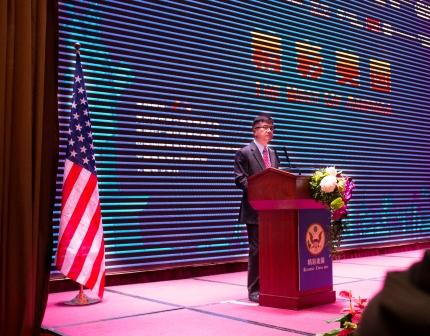
US Ambassador to China Gary Locke paid his third visit to Yunnan province on Thursday, November 21, one day after the announcement of his unexpected resignation.  His visit was part of an investment promotion roadshow entitled “The Best of America” traveling around China’s southwestern provinces and organized by the US consulates in Chengdu and Guangzhou.  The event was hosted by provincial vice-governor Gao Feng and attended by Yunnanese business interests and officials from the provincial international trade promotion department, tourism department and public health departments.   Core economic strengths of the US were represented by CEOs and officers of Deliotte, GE, Motorola, CISCO systems, Intel, and Miller Canfield Law firm in addition to other firms.  United Airlines was also in attendance and eager to promote its new direct flight from Chengdu-San Francisco opening early 2014.

Opening remarks were given by both Ambassador Locke and Vice Governor Gao. Both speeches highlighted the United States’ and Yunnan’s shared history of cooperation through the Flying Tigers, as well as the need for present day economic cooperation. In his remarks, Ambassador Locke boasted of the increase of China-to-US FDI under his tenure. In the past 21 months, investments from China totaled USD 18 billion, more than the past 10 years combined, an accomplishment Locke can only take partial credit for, as larger macroeconomic trends in the US and China were also important factors. Locke was also able to highlight the increase of Chinese students in the US in recent years. According to the ambassador, the number of Chinese students in the US reached 280,000 in 2012. In addition, Ambassador Locke was also able to point to decrease in wait time for US visas and a new, expanded visa office at the Chengdu consulate as notable achievements under his tenure.  Aside from pushing investment in America, Locke also promoted core American values like legal transparency, free trade and intellectual property rights, issues that have been divisive for the two countries in past years.

Photo courtesy of Allie Horick

Photo courtesy of Allie Horick

Speaking directly after Ambassador Locke, Yunnan’s Vice Governor Gao Feng also promoted bilateral trade and cooperation. In his remarks, Vice Governor Gao emphasized Yunnan’s role as China’s gateway to South Asia and Southeast Asia and its fast pace of the its economic growth. Gao pointed to the recent China-South Asia Expo as a marker of Yunnan’s rise in national and regional importance. The US delegation noted that Locke’s visit to Yunnan went very smoothly and all requests for visits to companies and government ministries were granted, including a visit to Yunnan University, where the Ambassador met with students and professors. This is in contrast to the difficulty encountered when US delegations request access in other provinces and autonomous regions in southwest China, particularly Tibet.

The roadshow was planned with the specific purpose of promoting Chinese FDI to the US, the export of medical technology to Yunnan’s developing healthcare sector, and tourism to the US.  After the Green Lake Hotel event, the delegation met mostly with potential investors from the agriculture and mining sectors reflective of these two sectors as two core pillars of Yunnan’s economy – tourism.  Locke also encouraged US investment in Yunnan tourism management systems – something sorely needed in Yunnan, and China at large, as localities struggle to protect cultural capital bases and natural endowments from the damaging onslaught of mass Chinese tourism.

photo 2

The inability of Yunnan’s medical infrastructure to keep up with the demand for medical services was apparent when the delegation was shown MRI scanner purchased from the US that had been use for 10 years at the Kunming Number One Hospital.  The machine was being used 70-80 times per day non-stop for seven days per week.  Cumulative cost of parts and supplies maintenance, all imported from the US, had greatly exceeded the original cost of the machine.

Lastly, Chinese tourism to the US was high on the list of promotion for the delegation.  In 2012, tourism to the US was the US’s top service sector export with Chinese tourists leading the way in number of tourists visiting the US in a by country breakdown.  In international trade accounting, foreign tourist visits are counted as an export due to the positive accumulation of foreign income.

Locke’s visit is recognition of the fruits of the China’s Western development program – namely economic progress to the degree that US investors are now drawn to the fast growth rates coming out of China’s southwestern provinces.  And as a result of that economic progress, Yunnanese investors have reached levels of wealth garnering capabilities to invest in the US, half a globe away.  His visit is also reinforcement of Yunnan’s strategic location as a gateway for regional investment to Southeast Asia and South Asia – a key point mentioned by both the US delegation and the provincial hosts.

Later in the day, Locke’s diplomatic rock star status was confirmed by an exuberant crowd of students at Yunnan University proud of their shared heritage with the US ambassador.  Locke returned that exuberance with hugs.   With Locke stepping down it may be a while until another US ambassador to China receives the kind of welcome received in Thursday in Yunnan.

Consensus among some of the ExSE members is that Locke may be stepping down in preparation for a high appointment related to the 2016 presidential election.  He is an extremely successful career politician with experience managing Americans’ most important bilateral relationship, domestic economic and international trade relations as US Commerce Secretary, and a successful run as governor of Washington State.  This portfolio positions Locke as a strong candidate for VP or Secretary of State under a future Democratic presidency.  Gary Locke will step down as US Ambassador to China early 2014 after taking up the post in August, 2011.


Leave a Comment

Filed under China, Current Events, Economic development, Regional Relations, SLIDER, Uncategorized, USA, Yunnan Province