
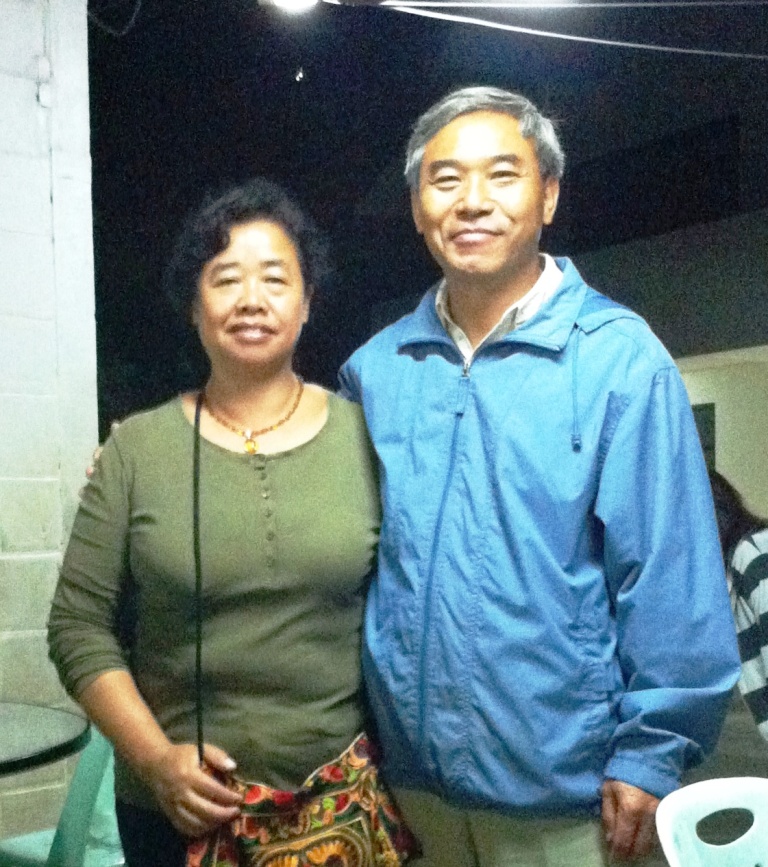
Pastor Yang Congguang and his wife
It’s lunchtime in Mae Salong, a small village perched on the spine of mountains that trail south from China’s Yunnan province to divide Thailand and Myanmar. The restaurant sign is in Thai, but the menu is written in traditional Chinese, offering peanut-flecked pad-thai noodles and steamed chicken jiaozi dumplings finished with tea grown in the surrounding hills.
Throughout the meal, English, Thai, Mandarin, and a local Akha dialect mingle along with the food, a cultural confluence that reflects the town’s unique history. Officially now called Santakhiri by the Thai government, Mae Salong is perhaps best known for its role as a heroin trading outpost and as a base for remnants of Chinese Kuomintang forces who refused to surrender to the Communists. Even today, the village has a distinctly Chinese flavor, where a dialect similar to Yunnan’s is spoken at stores, restaurants serve Yunnan-style food, and Mandarin language instruction is an option for public education.
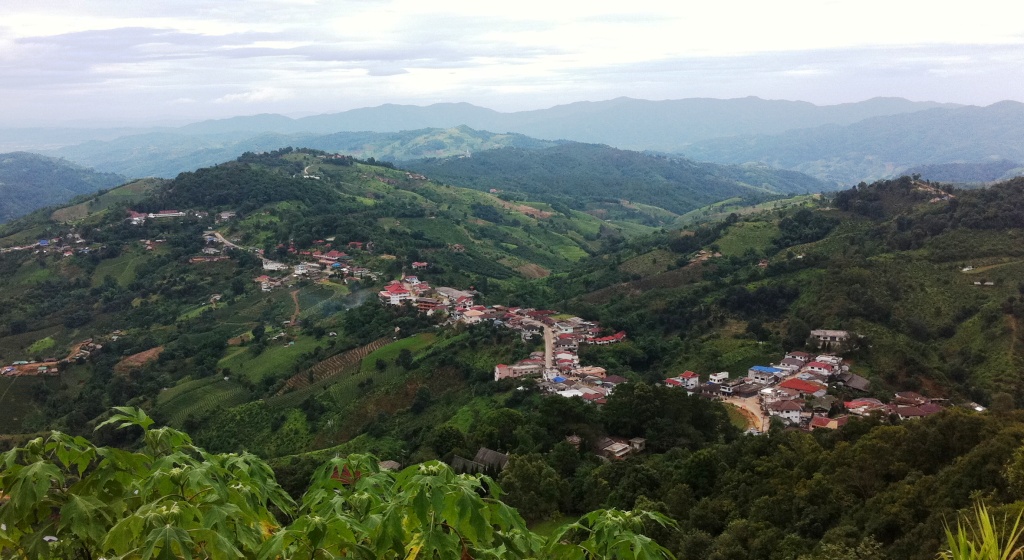
The village of Mae Salong
The local economy now relies on tea production and cultural tourism surrounding the local Akha highland hill tribes rather than heroin, however the Kuomintang heritage of many villagers remains an enduring legacy. Pastor Yang Congguang of the local Baptist Church is one such resident of Mae Salong.
Pastor Yang was born in 1956 in Luxi County in Yunnan Province, during what he calls “an era of war” that followed him around through childhood and much of his adult life. By the time he was two years old, Yang had already been registered by the government to join the army upon adulthood, along with his two older sisters. Yang’s parents decided to flee to Burma, hoping to escape increasingly dismal prospects in China.
Yang’s father, a farm veterinarian, went first in 1957 to a village in Kokang in northern Burma settled by other ethnic Chinese. The head of the village there owned some 3000 horses, and his father’s skills were highly sought after. However, the Chinese population of the village were not the majority Han ethnic group like Yang’s family, but the Lisu people, one of the many ethnic groups of upland Southeast Asia.
Yang’s father found the Lisu not at all as he had imagined “backwards” minority people to be. He was impressed how many of the Lisu, especially the Christian population, did not smoke, drink or gamble, and furthermore were educated enough to read. Yang’s father told the chief that he wanted to bring his family to the safety of Kokang, and that if the villagers prayed for the family’s safe passage, they would all convert to Christianity.
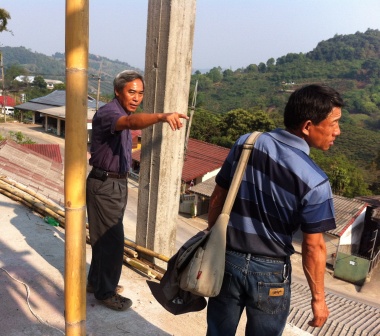
Yang supervising construction of his new church.
By this time it was 1958, and leaving China had become increasingly difficult and dangerous. Yang’s extended family, numbering sixteen people in total, required three trips and traveling only at night through the forests. During the final trip, it rained hard all night just before they were to cross the border and the group lost the right path. When the sun came up, his father realized they were very close to the only road across the border, manned by a PLA checkpoint. Despite the danger of trying to cross during the day, Yang’s father decided to take the risk. At the border, chance had it that checkpoint patrol house was empty, although the stationed soldiers had built a small fire. Yang’s uncle stopped briefly to warm his hands, telling the group to go on ahead. Today, Yang estimates that his family must have had only a few minutes’ window of time to sneak across the border. His uncle did not rejoin the group and was never seen nor heard from again.
Once in Burma, the Yang family reached Kokang safely and converted to Christianity as promised. The Kokang authorities did not permit education in Chinese, so Yang learned through studying the Bible. In Kokang the family had a few years of peace, until 1966 when the Burmese Communist party swept into the northern border region, beginning a period of civil unrest as well as tumult in Yang’s life. The family moved further south, to an area in Burma populated by the Shan (Dai) ethnic minority, where they stayed for three years until once again the Burmese communists arrived. The Yang family to Lashio in the eastern Shan state, and then again even further south to an area with very few ethnic Chinese.
Yang’s adolescence occupies a murky place both in memory and time, a period of transience and uncertainty that also coincided with the rise of the heroin trade in Southeast Asia. Former Kuomintang soldiers clashed with Burmese communists, with unrest and violence spilling across the borders of Thailand, Burma, and Yunnan. During these years, Mae Salong sprung up as both a drug trading outpost and a refuge for Kuomintang soldiers recruited by the Thai government to counter Communist threats.
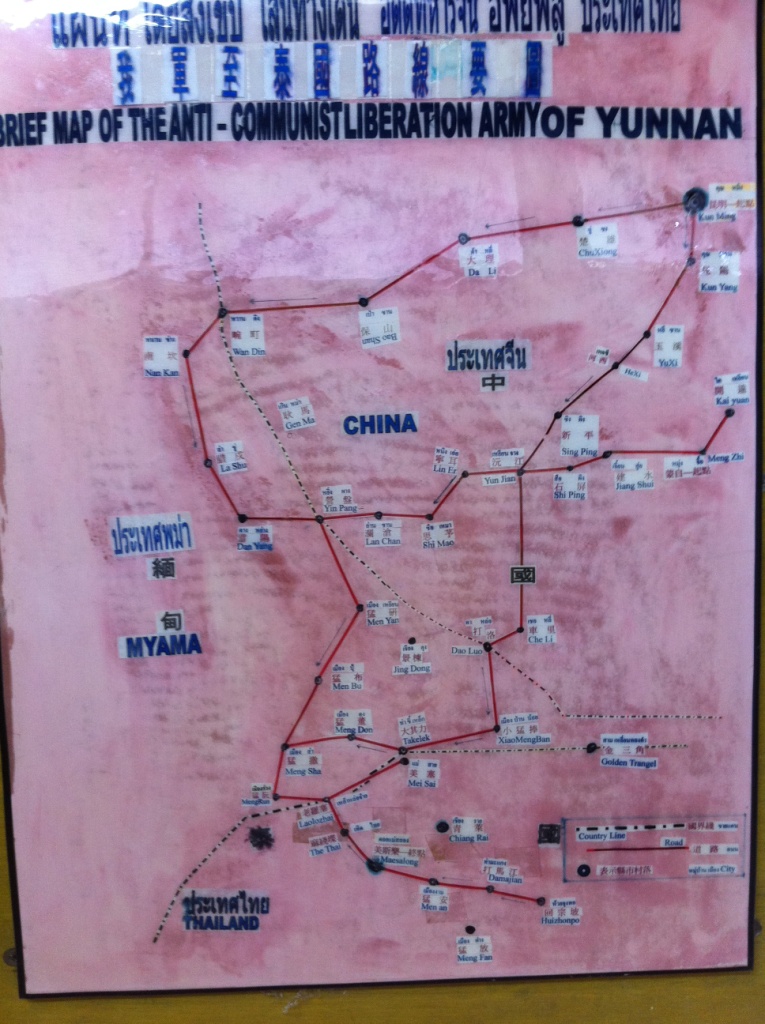
A homegrown depiction of the KMT’s path of flight from China to Mae Salong
“It was like trying to escape from a jaguar only to run into a tiger,” says Yang. “My parents didn’t want me or my siblings to grow up to be soldiers, so every time the armies came we left. But everywhere we went, they kept coming.” In 1973 he reluctantly joined the Kuomintang for a little over a year and fought against the Burmese. During this time, his faith kept pushing him to seek a different path. “I kept thinking some verses were especially speaking to me – that I should rather be a guard outside the house of God than live in the opulent tent of an evil person. The army for me meant living in an evil person’s tent,” he remembers on his decision to desert.
Yang escaped across the Salween river to Thailand at great personal cost. His commander came to his family’s house, and threatened Yang’s father to make him return. Yang’s father refused, and was taken away by the army along with nearly everything from their house, which was then burned. Yang’s brother escaped to the forests, but Yang found out later that the army shot his father by the side of the road.
For six years Yang drifted, stateless and without identity like many Yunnanese refugees in Thailand, feeling both immense guilt at the death of his father and a responsibility to lift his family back on their feet. He worked odd jobs to try and make money, “but life had no color, and I thought God had perhaps forgotten me.” But in 1981 he received an opportunity to enroll in Bible college in Bangkok, and a new beginning. His first job afterward was working at a church in Mae Salong, the village known for its KMT heritage.
Today Yang is the pastor at the Mae Salong Baptist Church and with a wide smile proudly shows off a gleaming new building opened just this past year. Over the past three decades, Pastor Yang has developed his own parish into a congregation made up of two hundred families who travel over the hills and footpaths to his church for worship, schooling, and community programming. In the early 1990s, Pastor Yang and his wife built a single room church with the little donations they could gather from local villagers and began offering free Chinese language education to Yunnanese, Akha, and Lisu families who could not afford tuition at the state sponsored school.
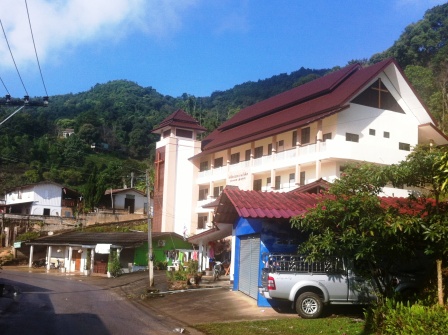
Mae Salong’s new Baptist Church
The newly built church has eight large classrooms for free Chinese language and free primary education classes taught by a cohort of regional volunteer teachers from Thailand, Singapore, Malaysia, and mainland China. Many of the students are Akha, as most of the Chinese residents of Mae Salong can now afford to attend school further down the mountain, reflecting a growing assimilation with Thai culture as more and more move away from the village to bigger cities. Yet Yang remains confident that his church and school can serve as a bridge between the past and present, as well as provide opportunities to educate the Akha residents of Mae Salong. Yang says the students are not required to be Christians to attend the school. The Baptist Church also has a healthy relationship with the small Yunnanese Muslim population of Mae Salong, sharing access to public water resources and cooperating to bring a new pipe to the village. Yang is content, and although his life is modest he finds fulfillment serving his community.
Pastor Yang and Mae Salong may share a history that began in an era of war, but more importantly they both have a future supporting a community where multiple cultures can mix, and peacefully coexist. “Life is good,” he smiles while looking over the town, across the green ridges of tea terraces and mist-covered mountains towards the border of Myanmar some fifteen kilometers away.
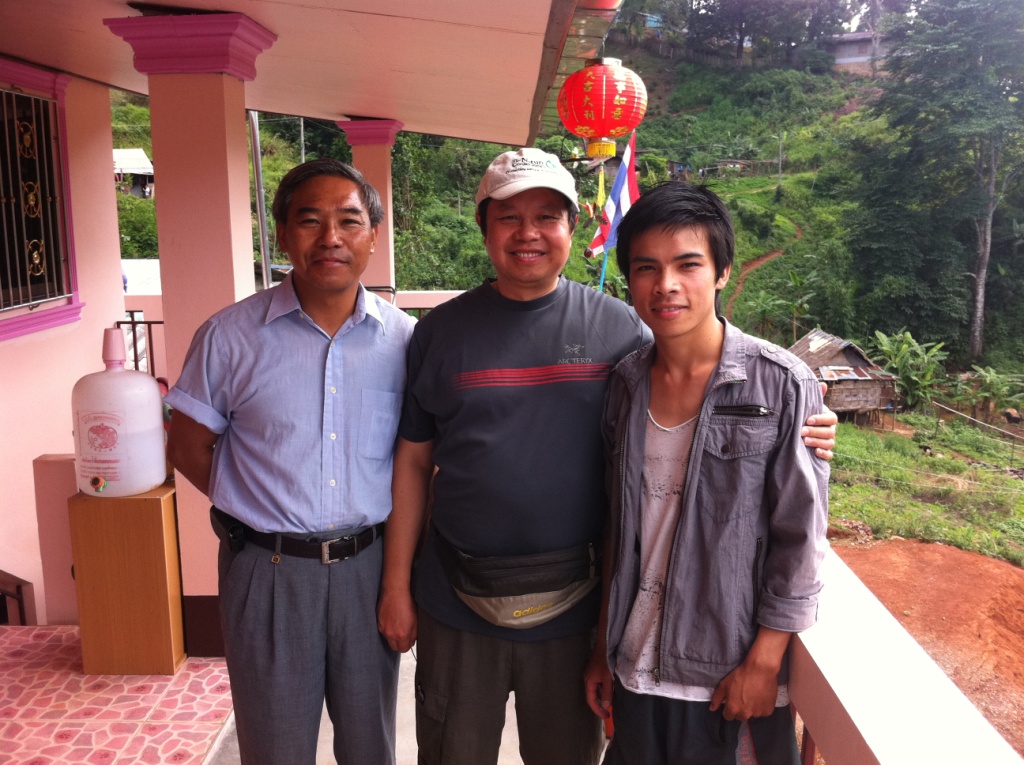
(from left) Pastor Yang with ExSE contributor Zhou Dequn and Ashi, the first of his family to attend college after matriculating through Yang’s school
 The Kunming-Bangkok Highway’s Final Link Opens over the Mekong
 Tibetan Wine Boom Threatens Food Security
 Fire, Spirits and Ritual Self-Injury in Phuket: The Vegetarian Festival


