Tag Archives: day after Kunming attacks

The Economics of the Kunming Massacre

In the wake of the Kunming massacre, the mood in Beijing is more choleric than somber. President Xi Jinping immediately announced a nationwide crackdown on terrorism and military troops were rapidly posted at train and bus stations throughout the country. Armored vehicles now patrol Kunming, Xinjiang natives have been told to register themselves at local police stations in Qinghai province and in Guangxi province authorities have asked citizens to report if they see anyone from Xinjiang — anyone at all.

President Xi also issued a gag order on local reporting, with coverage in Kunming Daily and Yunnan Daily provided by Xinhua reporters in Beijing. Meanwhile China Daily featured a front page photograph of President Xi shaking hands with an ethnic Uighur member of the PCC (China’s Senate). But strengthening national unity goes beyond public cries for concord and front page handshakes. It also involves eliminating the perceived cause of the conflict, and the national narrative is that this cause has more to do with nomadism or Islamist ideology than the fact that employment opportunities for Uighur people, even in their homeland province, are dismally inadequate. In 2009 Ilham Tohti, economics professor at Beijing’s Central Nationalities University and an ethnic Uighur, spoke with Radio Free Asia and suggested jobs might be the key to settling unrest.

But rather than address economic pressures, the government continues to focus on Islam as the catalyst. In 2013 police in Xinjiang began harassing women in head scarves and men with beards. Radio Free Asia reported how one man, with no prior record of violence, stabbed a police officer when he was forced to shave. Ehmetjan Niyaz, an intelligence agent with the local security bureau, commented that they had been advised to investigate men with beards. In Xinjiang, that essentially means all Uighur men.

In other words, the more Beijing singles out Muslims as a means of burking separatism, the more separatist Xinjiang Muslims become. Gardner Bovingdon, Professor of Central Eurasian Studies at Indiana University and author of The Uyghurs: Strangers in Their Own Land, writes “the closure of mosques, supervision and dismissal of clerics, and the prevention of religious practice by the young — has made Islam in Xinjiang more rather than less political”.

Another government strategy has been to manipulate the demographics of the region. Of the 60% of Xinjiang’s population that is not Uighur, Kazakhs constitute 7% with Hui being another 4.5%. The remaining dozen or so minority groups collectively make up 8.5% while the final 40% is entirely ethnic Han. According to Dr Stanley Toops of Miami University, from 1953 to 1964 the presence of ethnic Han rose from 7% to 33%. Since the 1970s, this number has remained stable at around 40%, making it one of the fastest demographic shifts in Chinese history.

In 2007 Gaël Raballand and Agnès Andrésy published an article entitled “Why Should Trade between Central Asia and China Continue to Expand?” In it, the authors describe how the Xinjiang Construction and Production Corps, also known as the bingtuan, was created in 1954 to encourage the movement of Han Chinese into the region by creating infrastructure there. In addition to creating an ethnic Han workforce to outnumber local Uighurs, the bingtuan also helps ensure locals remain calm with a security force of more than 120,000 heavily-armed troops. As The Economist points out, propaganda is par for the course:

“A museum in Shihezi, a city in northern Xinjiang controlled by the corps, displays a photograph of members of the bingtuan militia armed with rifles, crouching behind a wall during a 1990 uprising by Uighurs near the city of Kashgar. The militia, says the caption, played an important role in crushing the unrest. Amnesty International, a human-rights group, says 50 Uighurs were killed in the incident, including some who were shot while running away.”

Morris Rossabi, who teaches History at Columbia University, points to the Tang Dynasty as the origin of the bingtuan. Famously cosmopolitan, the Tang Dynasty celebrated the Turkic culture of present-day Xinjiang, staffing its frontier armies with Turkic soldiers and even allowing some, like the great Ashina Se’er, to rise to the rank of Tang general. This helped frontier lands become self-reliant and even afforded some measure of political autonomy. The bingtuan follows this tradition by providing Xinjiang the means for economic self-reliance, yet deviates sharply by staffing its workforce with ethnic Han rather than local Uighurs.

With Xinjiang currently contributing roughly 4% of the nation’s GDP (primarily through oil reserves) as well as Beijing’s Western Development policy, which hopes to see China’s western provinces contribute greatly to the nation’s economy, Uighurs will remain a minority in Xinjiang for the foreseeable future. Dr Ilham Tohti has stated he is not opposed to state-orchestrated migration policies, but that these policies need to be carefully reviewed, pointing that if there are enough jobs to warrant the migration of millions of ethnic Han into the region, then why aren’t there enough jobs for the people already living there?

In 2006 Dr Tohti launched a website promoting understanding between ethnic Han and Uighurs, but in 2009 it was shut down and Dr Tohti was arrested. He was released shortly before President Obama’s visit to Beijing but in January 2014 the BBC reported he had again disappeared, that his family had no knowledge of his whereabouts and that the government was charging him with separatism — a crime punishable by death.

For now, events like the Kunming massacre serve to further Beijing’s program of economic development in Xinjiang by providing carte blanche to those who view ethnic identity as a major roadblock to China’s economic future and by giving Xinjiang politicians an easy scapegoat when they fail to provide economic paths of opportunity.
Leave a Comment

Filed under China, Current Events, ethnic policy, Kunming Train Station Attack, SLIDER, Yunnan Province

Kunming in the aftermath of the train station attack

Memorials in front of the Kunming Train Station

Memorials in front of the Kunming Train Station

In the aftermath of the attack on the Kunming train station, in which official sources say at least 29 people lost their lives and 143 were injured, I went to sniff around the city for stories and reactions. People were stoic, supportive of their fellow citizens and seem to steer clear of any racial violence.

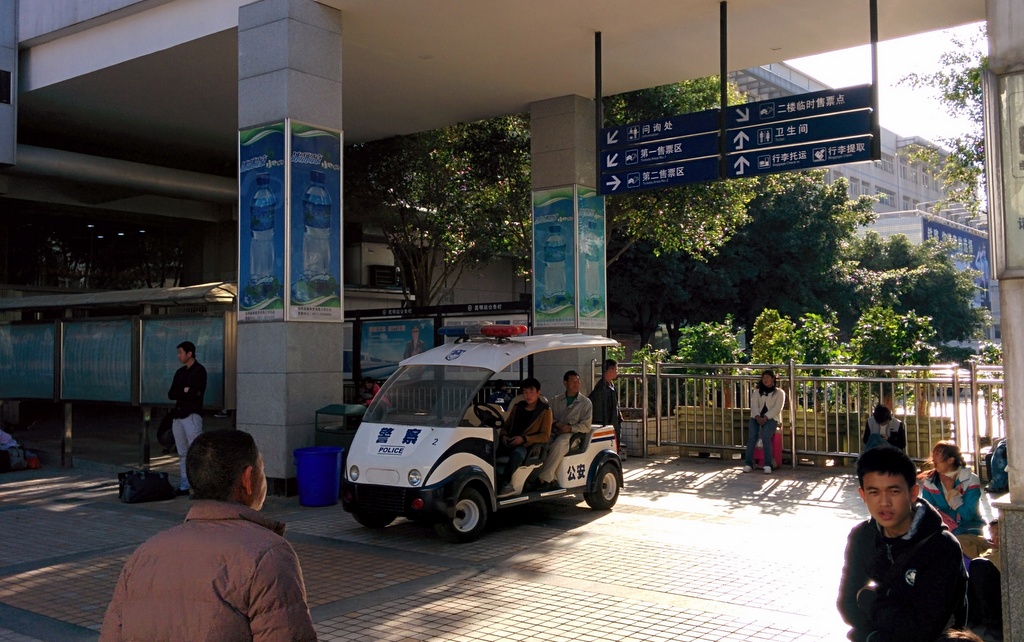
In general, the city felt ridiculously normal for the day after the attack . The people manning the gate at my compound greeted me as cheerily as I scooted down the hill and the only armed police I saw were hanging around a major interchange. Most people ambled lazily around Green Lake park, gazing at the flocks of sea gulls on their way back to Siberia as if nothing had happened. Not a SWAT team to be seen, even though this would be a potential spot for carnage. Kunming’s 1st People’s Hospital also had only a few law enforcers stationed outside, a shrill contrast to the mob of police inside that was trying to keep nosy journalists at bay.

Unmanned police vehicle manned by local kids — right in front of the train station ticket office

Unmanned police vehicle manned by local kids — right in front of the train station ticket office

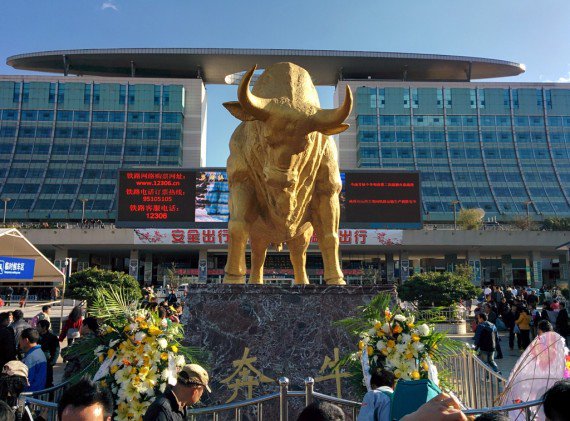
Even the train station felt relatively normal. On the left side of the square, a large part was sectioned off with police line and a dozen or so armed SWAT policemen were swarming around. In the middle of the square, under the large gilded bull, people were taking pictures of flowery memorials, one of which had already fallen down and torn. The ticket hall, the goriest place from Saturday’s attack, had been properly cleaned and was again filled to the brim with people queuing to buy tickets.

A young man cheekily ran behind me to measure himself against my height, so I used that as a pretext to ask him some questions. Whether he was afraid? “If I were afraid I wouldn’t be here”. Any other questions resulted in him uneasily shooting his eyes around so I left it at that.

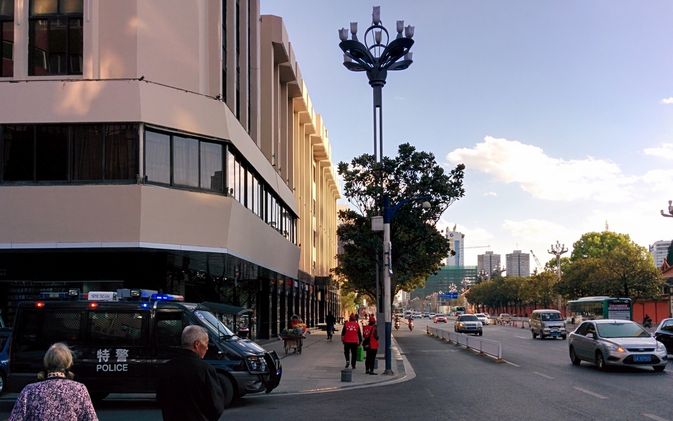
A SWAT vehicle on Beijing Lu

A SWAT vehicle on Beijing Lu

The cigarette lady was more helpful. She had already closed the shop and gone home for the night when the killings happened, but she was dead afraid to come to work on Sunday. She had wanted to stay home, but her boss and the need for a salary made her show up. She added that the extra security made her feel safer, though. A Bai minority woman in traditional dress was waiting for her daughter to pick her up. When I asked her if she was worried about coming here, given yesterday’s events, she replied: “which events?” Apparently the news had not reached rural Dali.

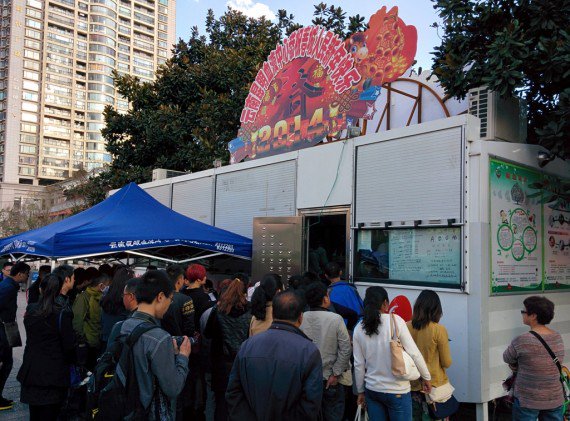
I also visit one of the mobile blood donation centers that the government had set up at twelve different locations all over the city. They must have rushed them in, as the containers still sported a sign for a previous blood-donating event at New Year’s day and make no mention of the stabbings the day before. That didn’t seem to stop people from flocking to the cabin. I am told that at least 150 people had already donated blood at this point and another 60 people were waiting to give.

Mobile blood donation center – caption reads: "Kunming blood donation center wishes Spring City residents a happy new year"

Mobile blood donation center – caption reads: “Kunming blood donation center wishes Spring City residents a happy new year”

I met Miss Wu (25) and her two friends at the mobile blood bank. She herself is not able to donate, but her two male companions are. While the two men were inside, I struck up a conversation. ”We’re here to help our fellow citizens after yesterday’s massacre,” she beams. Solidarity and stoicism obviously go hand in hand in Yunnan. “I don’t think this will affect how I see Muslims,” she explains, “and I don’t think it will the view of most other Chinese, either. The attackers were a violent group who had nothing to do with other Muslims. There have even been a lot of Muslims coming in to donate blood. Wherever you have people, you have bad ones.”

A Chinese journalist asked me my opinion and added that he had not been able to interview any Uighur people. “Perhaps they’re afraid for retaliation [from Han majority people], but they really needn’t be, there doesn’t seem to be a strong anti-Muslim sentiment among the people.”

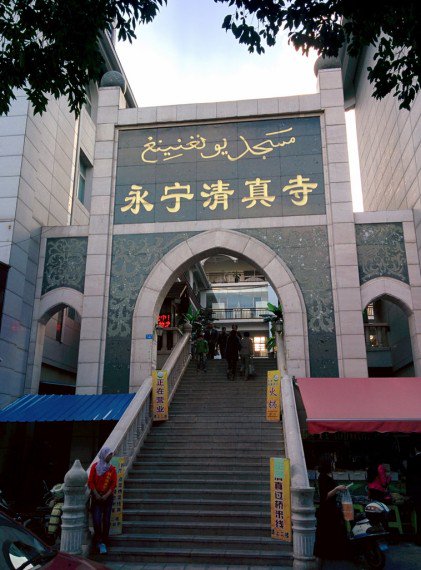
Business as usual at a Kunming mosque

Business as usual at a Kunming mosque

At the nearby mosque at Jinbi square, too, everything seemed to be business as usual. No signs of Islamophobic rioting, just people cooking all kinds of Halal cuisine for visitors. I talked to Ma Jun, a Hui (ethnic Han Muslim) woman from Inner Mongolia. While roasting some Erkuai pancakes, a local Yunnan delicacy, she told me she had seen some Uighur people coming in today for food and prayer, like on any other day. She made a plea for stronger feeling of unity among the Chinese people and says all will always be welcome under the roof of the mosque.

Questions remain, though, which no one currently has an answer to. One such question is: why Kunming? Of all places of importance to the government, was Kunming just the one with the weakest security? Were the attackers simply locals? Were they after tourists or after a particular train (the train to Shanghai was about to leave)? Kunming has almost no history of violence in the contemporary era, with the only notable event being the bombing of a bus in 2008. Then, too, Uighurs were initially blamed until it was later revealed that the lone bomber belonged to theHui minority.

Editor’s noteThis article was written by Kunming transplant Sander Van de Moortel and originally published on his blog A World of Nonging, on March 2.

1 Comment

Filed under China, Current Events, Kunming Train Station Attack, SLIDER, Uncategorized, Yunnan Province