Category Archives: China

The weak vs. the strong: Ethnic villagers, the government, and hydropower firms

As China increases its hydropower development plans into the 21st century, an estimated 8 million ethnic people in southwest China, many of them Tibetan, Miao, and Yi will be forced to leave their remote mountain homes. My previous posts this week focused on unjust and inappropriate compensation ethnic villagers in the Yalong River valley have received during the relocation process.  During this process, local government and hydropower development firms give very little consideration to the rights of ethnic villagers.  They also give very little consideration to  existing laws protecting these marginalized people.

In the valley between the Kala and Yangfanggou dam sites, two large billboards sport eye-catching slogans.  One says, “Maximize people’s benefits within the limits of law and policy” and the other “Crack down swiftly with the heavy hand of the law against illegal acts disturbing public affairs.”

牌 打击阻工扰工

To address the second billboard, in the eyes of the law there are two kinds of illegal acts.  One kind is simply a violation of the law.  The other constitutes a crime punishable by swift and heavy measures.  Legal expert Zhou Yong of Norway University, Oslo questions the legal grounds for the Public Security Bureau to erect this billboard.  Specifically, which law is the billboard referring to?  And to what extent do swift and heavy measures apply? He continues his critique of the local public security bureau’s abuse of the law by adding that the final judicial organ deciding cases are courts, not the public security bureau.

Citizens have the right to act and react to changes going on around them especially in ethnic areas where China’s Law of Ethnic Autonomous Areas applies.  Citizens should be aware of their rights and enjoy their rights. The role of NGOs should be to ensure that people can be protected by certain laws and regulations in ethnic areas.  In addition, basic rights of personal safety and right of property should be guaranteed.

Yang Lin, an expert in social impact assessment adds that the billboards are very thought provoking.  Reading them together seems to suggest that the government will provide you with what you need, so there’s nothing to worry about.  But on the flipside, the sign indicates that if the government does not give you what it has promised, you shouldn’t ask for it again.  This kind of ex-post behavior by relocated villagers is illegal and will be punished.

Article 27 of the UN Declaration on the Rights of Indigenous People declares:

States shall establish and implement, in conjunction with indigenous peoples concerned, a fair, independent, impartial, open and transparent process, giving due recognition to indigenous peoples’ laws, traditions, customs and land tenure systems, to recognize and adjudicate the rights of indigenous peoples pertaining to their lands, territories and resources,  including those which were traditionally owned or otherwise occupied or used. Indigenous peoples shall have the right to participate in this process.

Today China is the building more hydropower projects than any other country in the world.  In the new energy development plan, over 60 major hydropower dams and several hundred small and medium sized ones will be built along the Jinsha River (Yangtze), Lancang River (Mekong), Nu River (Salween), Yalong River, Min River Brahmaputra river, and the main stem of The number of ethnic minority people resettled will soon reach eight million. This will be the largest-scale involuntary resettlement in China’s history.

A promotional film for the Ertan dam says that all Chinese people will benefit from hydropower and that China will reach through to new heights from which all mankind will benefit.

A local villager from Danbo disagrees.

“We had to go away for seven days to attend the review and assessment process.  Each family had to send a representative.  We are uneducated and had no idea who might be in charge of the assessment.  All we got were review forms.”  During our meeting she produced a thin stack of official looking forms.  “My husband became mentally ill because of this.  He is still taking medicine to control the illness.”

As a country, China has a plan for the development of the national economy and will try its best to realize the goal of energy security and sustainable resource development.  But hydropower development firms only seek to maximize profits.  The country has power, and the firms have money.  When power and money come together they will inevitably put a third party at disadvantage.

When “weak” individuals face a “strong” government and hydropower firm, the interests and needs of these individuals usually cannot be protected or heard. The Chinese government should fulfill its obligations by exercising its administrative powers within the framework of law. It should solve this issue according to the current laws, regulations, and the international conventions that China has approved.  For example the UN Human Rights Convention requires that China follow related international law and assume international obligations. When solving conflicts between three parties, the most important thing is to make sure that concerns of the people can be heard. Throughout this process, people should be able to make use of various channels and platforms to raise their concerns.
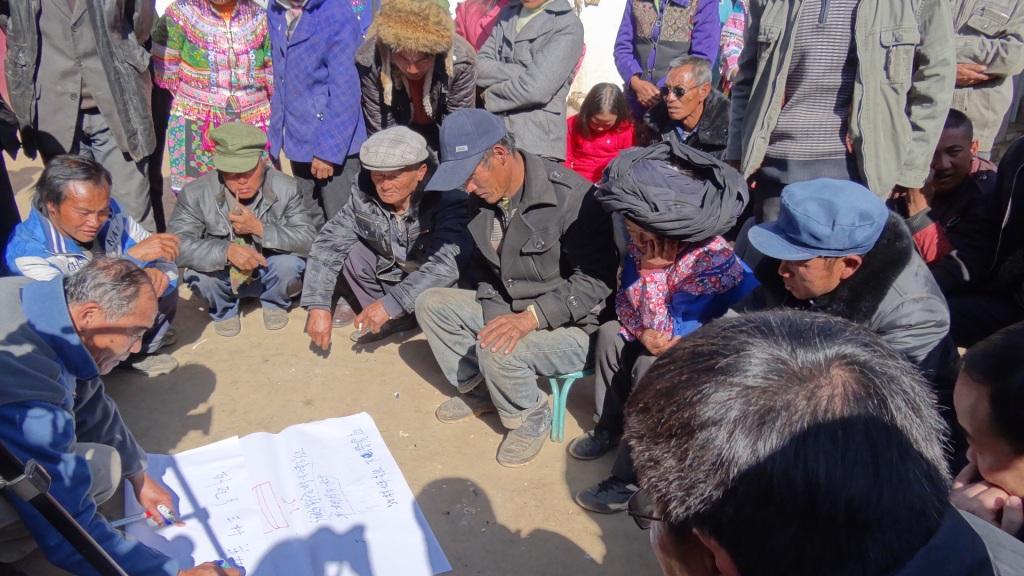
Yu Xiaogang surveys a group of relocated villagers in the Yalong River Valley

Yu Xiaogang surveys a group of relocated villagers in the Yalong River Valley

During our surveying, countless villagers vented their frustration to my research team. “We can’t sleep at night.  We can’t concentrate on our work during the day, and why is that? Back then, though we were poor, we had enough food and warm clothes.  If we move to a new place, we will lose these.”

Another shared, “We can’t afford to leave, but we can’t afford to stay.  We are sorry to cause such troubles for the Party, but this is a really big problem.”

“They used dynamite this time.  The gods of the mountains and the Buddhist spirits all left.  Some people will die now.  Some will fall ill.  Some will go crazy.”

This is the 2nd in a five part series on ethnic resettlement and the impacts of hydropower development by Yu Xiaogang.  Link here to part 5 and here to link back to part 1.
 

Leave a Comment

Filed under China, Current Events, Economic development, Energy, Environment and sustainability, ethnic policy, Governance, Hydropower & Ethnic Resettlement in China's Yalong River Valley, SLIDER, water

Ethnic Resettlement: Resistance & Villagers’ Rights:

The pain of resettlement

The pain of resettlement

For years in China’s southwest, water engineering and hydropower firms companies have been fanatical about building more dams.  Plans of demolition and removal of villages and structures obstructing dam design are always being put in place before plans for resettlement and compensation are appropriately thought out. Ordinary people can only wait in passive anxiety for the uncertainties related to resettlement and their future to be resolved. They are destined to make sacrifices for so-called development.

“Back there are our mountains, our meadows, our fields, and our villages,” says a villager in Shangpu village downstream of the Kala hydropower plant on the Yalong River as she points to her former home up the valley. “The fog is because of the pollution, it’s heartbreaking to see this place become polluted,” The dam’s designer wanted to use the flat land of the village as a location for a construction camp.  Eighty people were relocated to an alluvial terrace two kilometers away.

“The local government told us to do whatever the Ertan company people say,” adds the villager.

Most villagers saw little sense in moving since their village, a place they lived in for generations would not be displaced by the rising reservoir created by the dam. Many resisted.

“The elder in my family, my father, held my hand on his deathbed, holding on to his last breath. I told him ‘we will not leave here, don’t you worry, just go without regret.’ Hearing these words, he let go and passed away. I said these words myself. Only these words could comfort him,” says a Shangpu villager who has refused to move to the resettlement.   In all, eighty families signed a pact with their fingerprints to resist relocation and are still resisting to this day.

“My father said the water we drink comes from the Himalayas.  Drink the water and our children will be blessed.” The villagers are connected to their land in ways that urban city dwellers and lowland farmers fail to comprehend.  “Our ancestors left this place for us, and we have lived here for generations. The mountains and water are all wonderful. The trees, every family has walnut trees and apple trees. We don’t have to go out to work for money. The families that live here are already living a good life, that’s why no one wants to leave.”

When my research team conducted a focus group discussion with the Shangpu villagers, the trauma associated with relocation was palpable.  A group of village women sobbed openly and angrily.

Shangpu villagers weeping uncontrollably at the thought of relocation

Shangpu villagers weeping uncontrollably at the thought of relocation

A local villager added through her tears, “The Immigration Office said that we have to move no matter what, but we can’t afford to move. We are just poor farmers, we have a hard life. We can’t afford to move.  Nothing will change no matter how hard they cry.  Nothing will change if the policy has already been made. When the people of Immigration Office came here, our people asked them to please let us stay here, please think of something to help us. Many old people started to cry and got ill.”

Yang Lin, an expert in social impact assessment admits exploiting 3000 megawatts while only having to resettle a small group of people is a good bargain on paper.  But there is no reason for resettlement not to be done properly.  China does not lack the resources to justly compensate these villagers.  When securing the benefits for hydropower and construction firms, the government spares no effort.  So why can’t villagers receive the similar treatment?

The government’s official response is to prioritize the successful construction of major development projects to ensure development targets are met.  Yet the reality is proper resettlement of displaced peoples will not impede construction.  Many social and economic problems, many of them unnecessary, arise when the government seeks to solely protect the profits of the developers.  In the end, the Chinese people have to pay for the government to solve these problems and conflicts that are neglected in the early phases of construction and planning.

In 2007 China became a signatory to the UN Declaration on the Rights of Indigenous Peoples which  says:

States shall consult and cooperate in good faith with the indigenous peoples concerned through their own representative institutions in order to obtain their free and informed consent prior to the approval of any project affecting their lands or territories and other resources, particularly in connection with the development, utilization or exploitation of mineral, water or other resources. (Article 32)

Villagers’ rights to consent, participate, and be informed in the resettlement process or the project design process is always neglected.  A case in point is Danbo Village, the first village to be resettled as a result of the Yanfanggou dam. The villagers have lived in anxiety of resettlement for years.  They had no prior notification of the dam project, and one day surveyors hired by the hydropower firm showed up unannounced to measure and assess the “value” of the village.

In a focus group discussion, a villager recalled the process.  “No one has explained resettlement to us. Our people are very confused. See, like that,” as he pointed to unidentifiable chalk scribblings on his home.  “They taped measured here, and there, and drew some lines and left. We had no idea what happened.”

None of the villagers was satisfied with the result.  Many remember the surveyors measuring very little during their time and noted that much property was left out of the assessment.  Another villager added, “They came here but did not take the measuring seriously. They only measured for a little while and concluded ‘That will do.’ They didn’t measure as they promised, at all! I have worked my land day after day, all by myself, until my hair turned white, but did they measure the land? The trees, I planted them one by one and the rice fields. Did they count them? No.”

Danbo villagers will be resettled to Muli in Xianyuan township where purchasing a house costs five to six hundred thousand yuan (USD $80,000 to $95,000), in addition relocated villagers must purchase land to cultivate at the cost of RMB 110,000 with a potential yield of RMB 200,000 per year.  “All they offer us for compensation is two to three hundred thousand yuan in total! We can’t start a new life with that little bit of money.  What we need is fairness, equity, and justice.”

The Danbo villagers recall another time a group of government officials and hydropower firm representatives came to the village.  Again arriving unannounced, this time at eight or nine o’clock at night, the group held a two hour meeting where they lectured to the villagers.  There were forty or fifty of them and the director general gave the first speech followed by the deputy general and further on down the line.  The officials held documents in their hand and read directly from them speaking only in official language and speaking only in Mandarin.

Most villagers had no clue as to what the officials were reading.  After two hours, the meeting concluded and the officials went for dinner.  Some stayed behind and measured the land and the houses the following day.   “They were all over the mountain, like ants.  In our language when we say they are like ants, it means the kind of insect that crowds together when it finds a bug,” concluded one villager.

When discussing resettlement with the group anxiety and tension levels immediately intensified.  Many noted that they cannot focus on their work with the uncertain outcomes associated with resettlement and compensation occupying their minds.  Part of my team’s approach to social impact assessment is to conduct a legal briefing with the village group.  A colleague Zhou Yong, Professor of Law at Norway University, Oslo informed the group of one of their most important legal rights: a citizen’s right to know. All Chinese citizens enjoy this right, just as citizens likewise have the right to request information.

The villagers have the right to know the time frame for the dam’s construction.  It is unjust to create an environment where villagers are waiting in limbo for resettlement.  Sometimes projects are postponed for five to ten years while the affected people live in anxiety.

 Social impact expert Yang Lin advocates that in order to guarantee the right to know, the first thing to do is to inform the citizens before the launch of a project. Local governments or hydropower firms cannot only tell them to accept it after the plan has been made. This will give them the time to think about the projects, to raise suggestions and objections. Second, people should know about the overall plan, including the standard of the compensation and the overall plan for resettlement. Third, in ethnic minority areas, simply making an announcement or issuing a notice does not amount to the “guarantee the right of informed consent.” The related department should offer a detailed explanation to the people, answer their questions, and let them truly understand the related information.

Citizens should have the chance to participate in the whole process, from planning to the completion of the whole project. A system needs to be established to make sure people’s voices can be heard. A processing and a feedback system to guarantee citizens’ opinions will be taken into consideration and influence the making of the final decision. Without these systems, participation is just a meaningless and mere formality.

What happens to villagers who refuse to resettle?   A Danbo villager recounted her experience:

“I told them that we could not afford to move. They said moving or not was my own business, but they had to measure the house anyway. Then I told them to stop measuring the house, and some of them replied that if I didn’t allow them to measure this time, next time people from a higher level would be sent and force would be used. Most of us were frightened by the threat.”

This is the 3rd in a five part series on ethnic resettlement and the impacts of hydropower development by Yu Xiaogang. Link here to part 4 and here to link back to part 1.


1 Comment

Filed under China, Economic development, Energy, Environment and sustainability, ethnic policy, Governance, Hydropower & Ethnic Resettlement in China's Yalong River Valley, SLIDER, water

Terrorists or Refugees?: Case of ‘Uighur’ Migrants Unsolved in Thailand

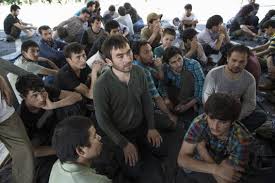
Detained Uighurs in Thailand. Photo: Reuters

Detained Uighurs in Thailand. Photo: Reuters

In the past two weeks, close to 300 suspected Uighur migrants were discovered in the jungles of southern Thailand. Since their discovery and apprehension by Thai authorities, accusations of terrorism and rebuttals to these claims have flown.

Quoting an unnamed source attached with Thai police, the Bangkok Post published an article claiming that the migrants were indeed Uighurs. They intended to use Thailand as a transit point to go to Turkey, where they would be trained in terror tactics that could be used in their native China and elsewhere.

Recently, two groups of migrants have been found in the south of Thailand. The first, discovered March 12 at a rubber plantation near Songkhla, was a group of 219 people, containing dozens of women and children. Another group of 77 were arrested near a school in Sadao district on the 20th of March.

The same source alleged that the migrants were identified as Chinese Uighurs and not Turks, as they have claimed, by bus tickets and items that had Chinese writing on them. “Immigration police are not stupid,” the police source added.

Turkey has sent diplomats to southern Thailand to verify the migrants’ claims of Turkish nationality. The migrants were able to speak with diplomats when interviewed, however when met by an interpreter from the Thai Immigration Bureau they could not communicate well. “The interpreter believed they could not speak Turkish,” the source said.

A named source, Thai Immigration Bureau chief Lt. General Panu Kerdlarppol, refused to give any specific details regarding the migrants’ nationality or ethnicity. However, historically and geographically, it would make more sense that they were Uighur. Thai authorities have been aware of a Uighur migrant presence in the country since last year.

In December 2013, 112 refugees were arrested in the country’s south and are now being held at a detention center. Thirty of the migrants have so far been positively identified as Uighurs. Following the arrests, Lt. General Panu met with Chinese authorities in Kunming about the issue.

There are some, however, that dispute claims of the migrants’ nefarious motives. Speaking through the Phuket Wan Tourism News, the New York-based Human Rights Watch dismissed the accusations.

‘The groups in question are composed of significant numbers of small children, and more than a few pregnant women,” Phil Robertson, Deputy Director, Asia Division, Human Rights Watch, said today, ”so one wonders how unnamed police sources have suddenly somehow jumped to a conclusion that these people are ‘terrorists.”

Mr. Robertson links these claims of terrorism to Thailand’s treatment of asylum seekers in the past. Starting in 2009, hundreds of Muslim Rohingya refugees from Myanmar began regularly washing ashore on Thailand’s western coast. These refugees, fleeing ethnic violence in their home, were also labelled as terrorists. Oftentimes, they were pushed back out to sea by units of the Thai navy.

”It seems pretty clear that Thai officials have some ulterior motives in trying to tar this entire group with the ‘terrorist’ label,” Mr Robertson said.

He believes the end game is to deport the migrants to China, ”I suspect that such ‘terrorist’ accusations are a prelude to some Thai government officials trying to force these groups back to China in what would be a clear violation of international law,” Mr Robertson surmised.

Migrants claiming Turkish nationality were also arrested in Malaysia this month, though no further word on their situation has been released.


1 Comment

Filed under China, Current Events, ethnic policy, Kunming Train Station Attack, Regional Relations, SLIDER, Thailand

Misunderstanding land use, traditional values, & resettlement compensation

Yu Xiaogang meeting with villagers scheduled for resettlement in Muli

Yu Xiaogang meeting with villagers scheduled for resettlement in Muli

Due to the onslaught of hydropower construction in the upper reaches of the Yangtze River watershed, tens of thousands of ethnic Yi and Miao peoples have relocated from mountainside villages deep in the Yalong River valley into lowland resettlements in China’s Sichuan province.    A shared result of all peoples forced to leave their homes due to China’s development plans is a substandard compensation package due to the failure of local governments and hydropower firms to properly assess the impact of relocation on the villagers. In the case of ethnic peoples relocated from the Yalong River valley, the distribution of land parcels for agricultural purposes to individual households in resettlements falls short of matching the land use patterns enjoyed by villagers in their remote mountain homes. A villager in the Gubai resettlement commented that in the mountains he “used to fish at night and could usually get five, six, seven, to eight pounds of fish.  If we were lucky we might even get ten pounds.  We would boil them – it was such a good time.”

The Yi mountain village of Muli had groves of walnut trees each two to three hundred years old.  Villagers could earn extra income of more than 1000 RMB per year from each tree.  In the Gubai resettlement few opportunities like this exist.  Each household is only given two mu of irrigable land and less than one mu of paddy field for rice cultivation. Ma Erzi, Director of the Liang Shan Yi Minority Culture Research Institute identifies four functional areas of land use in Yi mountain villages each abundant with food resources and used throughout the year in the Yalong river valley.  He comments that traditional Yi people from Liang Shan autonomous prefecture lived by traditional farming methods and taking animals to pasture.  With their houses at the center, they divided land into pasture land 禾普, farming land 么普, forests for collecting timber and food like fruits and mushrooms 斯普, and water areas for fishing and fetching drinking water 日普. These areas formed a special distribution pattern each linked to the other, none of them dispensable.

Local governments may compensate resettled villagers for houses and land, but the water areas, forests, and pastures cannot be compensated.  These missing links will provide a major challenge for resettlement. There are two common misconceptions about resettlement. First the Chinese government believes that as long as compensation standards are followed, resettled villagers will be compensated appropriately and once compensated there is no need for follow-up.  In actuality resettled peoples think their losses are far from covered.  The products and services provided by mountains and forests where they could dig wild herbs and mushrooms, their religious facilities, the loss of community – all of these losses should be compensated for.  Second, the government economic compensation will solve all problems, but in actuality what people need is to be taught a new way to make a living and to build a new social network.  Only in this way can the resettled truly build a new life. The Yalong River valley is an ancient corridor for the movement and settlement of Tibetans, Yi, Pumi, and Miao (Hmong) peoples who have all lived to the south of Hengduan mountains for generations.  Will the demand for hydropower development cause us to turn a blind eye to the historical and cultural value of this corridor?  When resettlement separates the people from hundreds if not thousands of years of traditions, how will it harm the people who have lived there for generations?

Conducting a social impact assessment a resettlement

Conducting a social impact assessment a resettlement

To illustrate the loss of culture and the lack of recognition of the cultural values of indigenous peoples by local governments and hydropower developers, we should examine the near desecration of Yi family graves in the Liang Shan autonomous prefecture.  Over the last decade, the development of dams on the Yalong, Dadu, and Jinsha Rivers has sent countless criss-crosses of electricity lines through the blue skies of Liang Shan.  In 2009, a series of the electricity towers was scheduled for construction on a mountain specified for placing the Ji, Mu, Wu, and Qi family graves – the core ancestral clan of the Liang Shan Yi people. “To build an electric tower on our mountain is like hammering a nail into someone’s head – it will hurt for sure!” recalls Feng Gebo, a local leader and representative of the Ji-Mu-Wu-Qi clans.  “That tower is hammered into the head of our mountain, it gives us a feeling that we can never develop again because we are being stepped on.” Feng took my research team to a hole five to six meters deep, dug initially to support an electricity tower. “We filled this hole in on our own after the ground breaking ceremony for the tower network.  (The hydropower firm) didn’t do anything.”

The Ji-Mu-Wu-Qi ancestral tombs date back to 1556 and play a key role in maintaining and preserving Yi identity and historical understanding.  Feng pleaded to the local government to move the towers to an adjacent ridge without tombs. But his original pleas fell on deaf ears as local officials failed to understand his request or cited state development as a priority over local needs.  “They believe it’s for the construction of the state and the stated outcome of this hydropower project is to help us overcome poverty and achieve prosperity.  But we know what’s good for us, and we believe the best thing to do is to let this place stay just the way it was.” Feng acknowledged during his initial pleas to the local government he discovered that officials held different views.  He discovered some officials understood the importance of protecting the social customs, religions, and cultures of minority peoples. “At that time, I managed to arrange more than 100 people to help me, to make sure construction would not start until I finished the negotiations.”  He was only asking for the two towers to be built 200 meters away so his ancestors could rest in peace.  To keep vigil over their movement, farmers would spend nights at the construction site warming themselves by a fire in the subzero autumn temperatures to prevent construction from starting up.

This lasted until February 2010 when the local party secretary ended negotiations with Feng and asked him to send the farmers home due to exposure the extreme temperatures.   “The secretary promised me the construction would not start without the permission of the farmers.  In the end, the provincial design institute redesigned the towers and removed them.” Prior to the establishment of the PRC in 1949, ethnic groups in the mountainous regions of southwest China defended their culture, lands, and traditions with arms and kept the expanding Chinese state at arms’ length.  Feng noted, “At that time if you built something like that on top of a mountain, you would be in real trouble and make enemies for sure.” The Yi people have a saying often asserted in a quarrel or argument, “Are you an Apukeh or not?”  An Apukeh refers both to the ancestral tomb and the essence of an honorable person.  “You can mess with anything you like, but you simply cannot mess with an Apukeh – it’s a matter of life.  As a part of the next generation if you cannot protect the ancestral tomb, then you can’t protect anything.  You don’t call yourself a man or even a person.  That’s how important the Apukeh is – more important than our lives.” In September 2010, Feng Gebo’s efforts and the collective efforts of Yi people in the Ji-Mu-Wu-Qi clan successfully saved their ancestral tombs.  But how many other ancestral mountains will be flooded due to rising reservoirs behind dams or destroyed by the construction of electricity towers or roads that support the hydropower projects?

This is the 2nd in a five part series on ethnic resettlement and the impacts of hydropower development by Yu Xiaogang.  Link here to part 3 and here to link back to part 1.


2 Comments

Filed under China, Culture, Economic development, Energy, Environment and sustainability, ethnic policy, Hydropower & Ethnic Resettlement in China's Yalong River Valley, SLIDER, water

Hydropower and ethnic resettlement in the Yalong River valley

Sichuan's Yalong River Valley.  Image: josephrock.net

Sichuan’s Yalong River Valley. Image: josephrock.net

The Yalong river is one of the largest tributaries of China’s Yangtze river watershed.  Originating in Qinghai province, the 1368 kilometer long river system creates some of the deepest gorges in the world falling 3180 meters in elevation before flowing into the Yangtze at Panzhihua in southern Sichuan province.  According to the 2013 Twelfth Five Year Plan for resources management issued by the Chinese National Energy Administration, 21 dams will be built on the mainstream of the Yalong River and two of the dams will be the highest in the world.  The Plan also includes the completion of several hydropower projects which have been on hold since 2005 due to concerns about the fragility of the local ecosystem and culture. Continue reading

5 Comments

Filed under China, Current Events, Economic development, Energy, Environment and sustainability, ethnic policy, Governance, Health, Hydropower & Ethnic Resettlement in China's Yalong River Valley, SLIDER, water

A Casino at the Khone Falls in Laos?

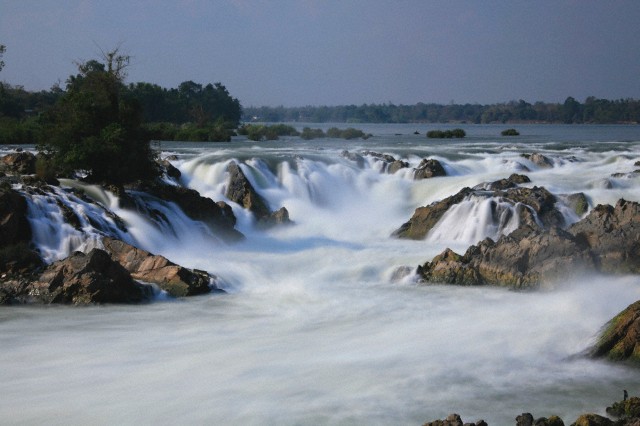
Khone Falls in Siphandone, Laos.  Image: Corbis

Khone Falls in Siphandone, Laos. Image: Corbis

At the end of March 2014 the Lao PDR government will consider a proposal to build a special economic zone slated for tourism development and other unspecified commercial uses in Siphandone, one of the world’s most pristine and biodiverse areas.  The SEZ will showcase a casino located less than one kilometer from the famed Khone Falls, the largest in Southeast Asia.

“The Siphandone area is set to become a more sought after tourism destination with many more activities to experience,” remarked Buasone Vongsongkhone, Deputy Governor of Laos’ southern Champassak province on Monday, March 17 after a meeting to discuss the proposal.

Vongsongkhone said the plans for the SEZ will include a casino and other facilities in keeping up with developing tourism trends in the Siphandone and Khone Falls area while protecting the environment.

“At the meeting we discussed how to regulate the casino to ensure the zone has proper security.”

What Vongsongkhone did not discuss was the impact of the new SEZ on the relatively untouched ecosystem of the Siphandone area.  Siphandone, translated as “four thousand islands” is where the Mekong River fans out into a waterfall and islet ridden expanse more than 15 kilometers wide.  The sparsely populated area has been described as an environmental oasis and is home to numerous native fish and bird species.  The Khone falls area is the perhaps the last habitat where endangered freshwater Irrawaddy dolphin can be found in the wild.

Satellite image of Siphandone.  Khone falls is the on left side of the image.  Google Earth

Satellite image of Siphandone. Khone falls is the on left side of the image. Google Earth

Laos’ growing reputation of holding some of our world’s last untouched natural areas and idyllic vacation spots has brought increases in international tourists to Siphandone area.  With the increase in tourism, the need for regulation and protection is obvious, but is marking a zone for economic development first and environmental protection second a sustainable approach or is it just another way for local Lao officials and outside investors to gain quick wealth through the exploitation of Laos’ abundance of resources?

Last week in an article in the Vientiane Times, the official English language outlet for Laos’ state controlled media reported “the government attaches great importance to developing SEZs to boost the country’s growth, which is crucial to lifting people out of poverty and enabling Laos to graduate from the list of least developed countries by 2020.”

Mock-up of the That Luang Marsh SEZ in Vientiane.

Mock-up of the That Luang Marsh SEZ in Vientiane.

The track record for SEZs in Laos, often dominated by Chinese and Vietnamese investment, is sketchy at best.  In Vientiane, construction of the That Luang Marsh SEZ (yet to begin commercial activities) has negatively impacted the local urban environment.  The natural wetland filters and holds the capital city’s waste water acting as a terminus of the city’s century-old waste canal system; many of these canals are now blocked by construction.  Much of the That Luang wetland areas has been filled in and long-time residents have noticed an average rise in temperatures as water is removed from the ecosystem. 

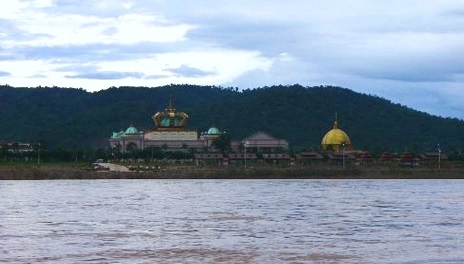
In Laos’ northern Bokeo province, the Golden Triangle SEZ dominated by the Chinese owned King Roman Casino complex has a seedy reputation as a conduit for money laundering from China and zone of human trafficking. The SEZ has scarred the scenic views of the Golden Triangle area, also known for its tourism, with open quarry mining and industrial development.

King Roman Casino along the Mekong in Bokeo Province, Laos

King Roman Casino along the Mekong in Bokeo Province, Laos

To make matters worse, the Siphandone area is slated for the construction of the 260 megawatt Don Sahong dam located  on the only of Siphandone’s Mekong channels that allows for the passage of hundreds of species of migratory fish.  In September 2013, the Lao PDR government notified the Mekong River Commission that the Don Sahong dam project would begin construction in 2014 despite years of protest and opposition by local and international environmental NGOs.

Eco-tourism opportunities such as river cruises, dolphin sighting tours, village homestays, and fishing demonstrations have brought sustainable sources of income to local communities in the Siphandone area for years.  Investors interested in building large resorts and casino complexes will likely be majority Chinese and Vietnamese taking more than they provide while leaving a stained and irreversible mark on one of the Earth’s most scenic spots.

3 Comments

Filed under China, Economic development, Energy, Environment and sustainability, GMS, Laos, Mekong River, SLIDER, Sustainability and Resource Management, water

The Economics of the Kunming Massacre

In the wake of the Kunming massacre, the mood in Beijing is more choleric than somber. President Xi Jinping immediately announced a nationwide crackdown on terrorism and military troops were rapidly posted at train and bus stations throughout the country. Armored vehicles now patrol Kunming, Xinjiang natives have been told to register themselves at local police stations in Qinghai province and in Guangxi province authorities have asked citizens to report if they see anyone from Xinjiang — anyone at all.

President Xi also issued a gag order on local reporting, with coverage in Kunming Daily and Yunnan Daily provided by Xinhua reporters in Beijing. Meanwhile China Daily featured a front page photograph of President Xi shaking hands with an ethnic Uighur member of the PCC (China’s Senate). But strengthening national unity goes beyond public cries for concord and front page handshakes. It also involves eliminating the perceived cause of the conflict, and the national narrative is that this cause has more to do with nomadism or Islamist ideology than the fact that employment opportunities for Uighur people, even in their homeland province, are dismally inadequate. In 2009 Ilham Tohti, economics professor at Beijing’s Central Nationalities University and an ethnic Uighur, spoke with Radio Free Asia and suggested jobs might be the key to settling unrest.

But rather than address economic pressures, the government continues to focus on Islam as the catalyst. In 2013 police in Xinjiang began harassing women in head scarves and men with beards. Radio Free Asia reported how one man, with no prior record of violence, stabbed a police officer when he was forced to shave. Ehmetjan Niyaz, an intelligence agent with the local security bureau, commented that they had been advised to investigate men with beards. In Xinjiang, that essentially means all Uighur men.

In other words, the more Beijing singles out Muslims as a means of burking separatism, the more separatist Xinjiang Muslims become. Gardner Bovingdon, Professor of Central Eurasian Studies at Indiana University and author of The Uyghurs: Strangers in Their Own Land, writes “the closure of mosques, supervision and dismissal of clerics, and the prevention of religious practice by the young — has made Islam in Xinjiang more rather than less political”.

Another government strategy has been to manipulate the demographics of the region. Of the 60% of Xinjiang’s population that is not Uighur, Kazakhs constitute 7% with Hui being another 4.5%. The remaining dozen or so minority groups collectively make up 8.5% while the final 40% is entirely ethnic Han. According to Dr Stanley Toops of Miami University, from 1953 to 1964 the presence of ethnic Han rose from 7% to 33%. Since the 1970s, this number has remained stable at around 40%, making it one of the fastest demographic shifts in Chinese history.

In 2007 Gaël Raballand and Agnès Andrésy published an article entitled “Why Should Trade between Central Asia and China Continue to Expand?” In it, the authors describe how the Xinjiang Construction and Production Corps, also known as the bingtuan, was created in 1954 to encourage the movement of Han Chinese into the region by creating infrastructure there. In addition to creating an ethnic Han workforce to outnumber local Uighurs, the bingtuan also helps ensure locals remain calm with a security force of more than 120,000 heavily-armed troops. As The Economist points out, propaganda is par for the course:

“A museum in Shihezi, a city in northern Xinjiang controlled by the corps, displays a photograph of members of the bingtuan militia armed with rifles, crouching behind a wall during a 1990 uprising by Uighurs near the city of Kashgar. The militia, says the caption, played an important role in crushing the unrest. Amnesty International, a human-rights group, says 50 Uighurs were killed in the incident, including some who were shot while running away.”

Morris Rossabi, who teaches History at Columbia University, points to the Tang Dynasty as the origin of the bingtuan. Famously cosmopolitan, the Tang Dynasty celebrated the Turkic culture of present-day Xinjiang, staffing its frontier armies with Turkic soldiers and even allowing some, like the great Ashina Se’er, to rise to the rank of Tang general. This helped frontier lands become self-reliant and even afforded some measure of political autonomy. The bingtuan follows this tradition by providing Xinjiang the means for economic self-reliance, yet deviates sharply by staffing its workforce with ethnic Han rather than local Uighurs.

With Xinjiang currently contributing roughly 4% of the nation’s GDP (primarily through oil reserves) as well as Beijing’s Western Development policy, which hopes to see China’s western provinces contribute greatly to the nation’s economy, Uighurs will remain a minority in Xinjiang for the foreseeable future. Dr Ilham Tohti has stated he is not opposed to state-orchestrated migration policies, but that these policies need to be carefully reviewed, pointing that if there are enough jobs to warrant the migration of millions of ethnic Han into the region, then why aren’t there enough jobs for the people already living there?

In 2006 Dr Tohti launched a website promoting understanding between ethnic Han and Uighurs, but in 2009 it was shut down and Dr Tohti was arrested. He was released shortly before President Obama’s visit to Beijing but in January 2014 the BBC reported he had again disappeared, that his family had no knowledge of his whereabouts and that the government was charging him with separatism — a crime punishable by death.

For now, events like the Kunming massacre serve to further Beijing’s program of economic development in Xinjiang by providing carte blanche to those who view ethnic identity as a major roadblock to China’s economic future and by giving Xinjiang politicians an easy scapegoat when they fail to provide economic paths of opportunity.

Leave a Comment

Filed under China, Current Events, ethnic policy, Kunming Train Station Attack, SLIDER, Yunnan Province

‘Uighur’ Refugees Arrested in Thailand, Malaysia: Part of a Larger Trend?

Detained Uighurs in Thailand. Photo: Reuters

Detained Uighurs in Thailand. Photo: Reuters

Last week, East by Southeast, in a piece hypothesizing the motives of the Kunming train station attackers, made the connection between Uighur asylum seekers, Yunnan and Southeast Asia. In the analysis, ExSE posited that Thailand was a likely destination for Uighur refugees as they made their way from Xinjiang, through Yunnan and into Myanmar or Laos. This past week, two separate incidents in near the border of Thailand and Malaysia occurred that appear to confirm this hypothesis.

News was released on Thursday that Thai authorities had rescued 200 people from a human smuggling camp in the south of Thailand. During a raid on Wednesday, police discovered 200 people imprisoned in a camp suspected to be used for human trafficking.

The group, which includes 78 men, 60 women and 82 children, at first claimed to be Turkish, despite having no documents to confirm that. However, they have now been identified as ethnic Uighurs from China by a US-based organization.

With their identities confirmed, Thailand has faced calls to not to deport the refugees, with the US State Department also weighing in.

“We are concerned about Uighurs generally (and) welcome reports that these Uighurs were rescued,” State Department spokeswoman Marie Harf told reporters Friday. “We’re encouraging Thailand to make sure their humanitarian needs are met.”

US-based Human Rights watch also urged the Thai government not to deport the refugees. “Thai authorities should realize that Uighurs forced back to China disappear into a black hole,” Brad Adams, the organization’s Asia director said in a statement.  “They need to allow all members of this group access to a fair process to determine their claims based on their merits, not on Beijing’s demands.”

Refugees on the way to a Thai detention center

Refugees on the way to a Thai detention center

Despite these calls, dozens of the refugees were sentenced for illegal entry by a Thai court on Saturday, with each person assessed a fine of 4,000 baht ($124). For now, the men will be taken to an immigration detention center and the women and children will be taken to a shelter, according to Police Major General Thatchai Pitaneelaboot.

In a possibly related story, 62 people were arrested just across the border in Malaysia last week. Like the group caught in Thailand, the Malaysian also claimed to be Turkish refugees. The group of alleged Turks were found near the border fence during routine patrols early Thursday morning Deputy Superintendent Sivam of Malaysia’s General Operations Force said in a statement.

Despite their claims of Turkish nationality, those arrested were not carrying valid travel documents or identification papers and historically, there has been a small, if nonexistent presence of illegal Turkish immigrants in the region. In light of this and the arrests in Thailand, some in the media believe that the alleged Turks might in fact be Uighurs from China. If so, this would mark the largest number found in Southeast Asia to date.

If both groups arrested are indeed Uighur refugees, their escape to Southeast Asia wouldn’t be without precedent. Since Cambodia deported 20 Uighurs back to China in 2009, there have been a string of similar deportations in the region. In 2010, Lao PDR deported a group of seven Uighur refugees back to their native Xinjiang in northwest China and in 2011 and 2012, Malaysia deported separate groups of refugees to China. Each deportation case has been heavily criticized by rights groups like Amnesty International and Human Rights Watch. Human rights groups fear that once repatriated, Uighurs face a grim future of long prison sentences and possible torture. Refugees deported back to China from places like Pakistan and Cambodia have all faced life prison terms upon their return.

The threat of prison is likely a reason why those arrested in Thailand and Malaysia have claimed to be Turks when discovered. Instead of admitting to Chinese nationality and facing the possibility of deportation back to China and likely prison time, the refugees opted for claiming another nationality. Seeing that the Uighur population is nearly all Muslim and speaks a Turkic language, claiming Turkish citizenship was a natural choice.

However, as is the case with both groups of refugees, these people’s true identities have yet to be discovered. If they aren’t Turks, are they really Uighurs? If they are Uighurs, how did they get to the Thai-Malaysian border and why did they come this far? Was Malaysia, a Muslim-majority country with labor shortages, the final destination? If both groups are indeed Uighur, this would mark a new level of southward migration for Uighur refugees. Might this also tie them to Kunming train station attackers, as East by Southeast hypothesized? For now, these are only questions, but ExSE will be searching for answers.


1 Comment

Filed under China, Current Events, ethnic policy, Kunming Train Station Attack, Malaysia, Regional Relations, SLIDER, Thailand, Uncategorized

The Kunming Train Station Attack: A Hypothesis

In answering the question “Why was Kunming chosen as the site of last Saturday’s attack?”consider the following:

In response to a police crackdown in Hotan, Xinjiang beginning in the summer of 2013, a large group of Uighurs attempted to make their way to Laos through Yunnan. Instead of escaping to Southeast Asia as refugees as planned, thirty were arrested at the border along with dozens of others throughout the province. Warrants were issued for those who were not immediately caught, and a detailed most wanted list was made public. At least eight remained at large and as time passed, hope for the release of their compatriots or relatives and their own escape to a foreign refuge grew smaller. With warrants out for their arrest and a heavy police presence in Xinjiang, returning home was impossible. Without local ID cards, settling down in Yunnan would prove just as difficult. Out of viable options, the group of eight decided to make a brutal last stand, taking out vengeance on the province where their plans failed. Gathering what little resources they could find in Kunming, the group planned to strike where they would be able to cause the most damage. And so on March 1, 2014, five people walked into the Kunming Train Station with knives and terror ensued. Continue reading

5 Comments

Filed under China, Current Events, Kunming Train Station Attack, SLIDER, Yunnan Province

On Xinjiang’s Freedom Struggle and Oppression

Uyghur woman facing a police cordon during protests in Xinjiang in 2009. Photo: REUTERS

Uyghur woman facing a police cordon during protests in Xinjiang in 2009. Photo: REUTERS

I never intended to write a background article on the Xinjiang situation, simply because I feel I’m not nearly an expert on the field. But inevitably, when you’re researching a subject and trying to form an idea, article after article pops up, and important people all over the world voice opinion after opinion. And that’s how it’s suddenly noon and you’re still sitting in your underwear on the couch with your head stuck deep into the internet.

Even though I have become a lot wiser about the Xinjiang issue, I am not in a place to make socio-political analysis. However, this terror attack, this fight for freedom, and this cultural and economic oppression are not confined to Kunming, Xinjiang or China. They are not isolated events. And neither are reactions from the opposite side, which slowly but surely tighten the noose of public opinion around the neck of a culture, a religion and a people until it has been stripped of its humanity and hunting season is declared open to shoot down – verbally or literally – anyone connected with it. It’s easy to draw a few parallels to the intolerant climate in Europe in the 1930′s and the world doesn’t need another such occurrence. With this opinion piece I want to contribute, however little, to halt this mass demonisation.

People have been rightfully pointing out that many western media used quotes (such as CNN, now removed) around terrorism, as if terrorism is some sort of privilege of the West to suffer. Of course, the definition of terrorism is problematic, even the UN hasn’t properly outlined it yet. I would define terrorism as an act of violence with a political motive which, rather than targeting the political bodies it is in conflict with, targets a group of unrelated people in the hope that their fear will cause them to put political pressure on the targeted government. By this definition, the Kunming knife incident is very likely to be a terror attack (very likely, because the attack hasn’t been claimed by anyone, and because the authorities have not made the perpetrators’ identities public yet).

The Washington Post has published an article in which it looks for motives and where it blames Chinese oppression. As terrorism and freedom struggles are a global issue, this comes across as hypocritical. The author probably doesn’t mean it as such, but if you read between the lines, he’s saying that while terrorism in the West is to blame on freedom-hating thugs, terrorism in China is the result of government oppression. In my opinion, naturally only the latter is true and the West ought to learn a lesson from this. It should also apply its China logic to how it judges insurgent groups, and not only in the Muslim world.

That brings me to the next issue: can it simply be blamed on government oppression?

There has been a lot of outrage about the statement of Dilxat Rexit, the head of the World Uyghur Congresswhich strives for Uyghur self-determination. In an e-mailed statement to the New York Times, he said: ”We oppose any form of violence, and we also urge the Chinese government to ease systematic repression. If this incident was really the work of Uyghurs, then I can only say that it may be an extreme act by people who feel they cannot take it anymore.” Some (e.g. Kaiser Kuo on his Facebook page) argue this is basically a defence of the barbaric acts of last Saturday.

Yet what do you expect the head of the World Uyghur Congress to say? He’s the head of an organisation that promotes the cultural and political freedom of Uyghur people all around the world. Do you expect him not to give his take on the motives? And do you not think that he will find those motives rooted in the cultural and violent oppression by the Han in Xinjiang? Do you expect him to merely condemn the attacks without following up with a ‘but’ clause? Of course not, that’s why he’s the leader of the WUC. What he is saying is: “I could see that coming.”

I am for once agreeing with Mao Zedong, in that there is no hatred without a reason. I strongly recommend taking ten minutes to read Chinachange.org’s translation of an opinion piece written by Wang Lixiong (王力雄), Beijing-based political dissident and writer of “My West China, Your East Turkestan” (我的西域,你的东土). In it, the author argues that the problem is political at its core and therefore cannot be solved with economic solutions such as Beijing’s knee-jerk response of ‘developing’ China’s far west.

Mr. Wang writes that Uyghur people in Xinjiang are at a disadvantage on many levels. They often do not speak Mandarin well enough, have their own cultural and religious values and are therefore completely left out of the political process. At the same time, the government is siphoning away Xinjiang’s riches to the east. Social and economic segregation results in Uyghurs only getting the crumbles of a cake that the Han (who are now more or less equal in numbers in Xinjiang) have divided among themselves. The perpetual circle of violence and repression will lead to the ultimate exclusion of Uyghurs from society and, ultimately, to ‘Palestinisation‘ (a word the writer uses to mean the full mobilisation of a people against another). These pariahs will turn to their neighbours Afghanistan or Pakistan for their religious identity. This includes the risk that Uyghur people, who normally adhere a milder strain of Sunni Islam, will be converted to fundamentalists. The comparison to another Palestine or even Chechnya is indeed not far off.

It is easy for us to say something along the lines of “the Muslims are at it again.” It’s an old mantra repeated by ever more people all over the world. Yet I doubt that it’s right to blame religion. In fact, I’d even make the case that Islam doesn’t even play a real role in the knife attacks. It just happens to be the religious background of a people that want their land back, or at least want to be treated as equals in what once was their land. Possibly only the modus operandi changes: the IRA or the ETA would have planted a bomb.

Therefore, blaming religion is wrong and dangerous, because it would condemn a group far larger than the one engaging in violent activity. At the same time, it cannot be denied that the rise of radical Islam all over the globe is playing and will be playing an ever more important role in the lives of Xinjiang Uyghurs.

In light of the radicalisation of the entire Muslim world, if you don’t come to the conclusion that outsiders have created an environment in which they feel oppressed and which therefore allows terrorism to flourish, then your conclusion can only be that there is no chance of ever abating their extremism. Then you must conclude that Muslims are an evil group that needs to be eradicated or at least fought until they give up. I think history has taught us that that is not the way the cookie crumbles.

Editor’s Note: Sander originally published this post on his blog www.worldofnonging.com on 3/4/14.

1 Comment

Filed under China, Current Events, Kunming Train Station Attack, SLIDER