Category Archives: China

Kunming railway station attackers charged in mass stabbings

Image: CCTV

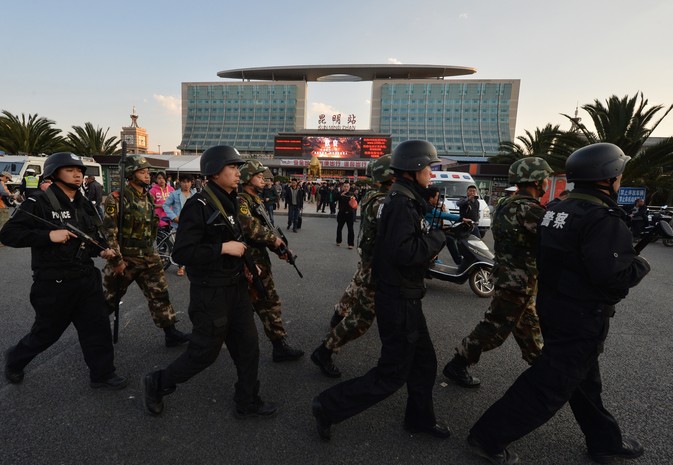
A SWAT team patrols the Kunming train station. Image: CCTV

In March of this year, a group of men and women armed with knives descended on the crowded Kunming Railway Station. Their ensuing rampage left 29 civilians dead and 143 injured in what is one of the most violent coordinated attacks to occur in China in recent memory. Four people accused of perpetrating the violence have been formally charged and will soon stand trial, Xinhuais reporting.

Official accounts of the attack state that six men and two women participated in the train station assault. Of those, four were shot and killed at the scene by police. One woman was subdued and arrested at the station, while three other suspects remained at large for 36 hours before being captured. No details of the manhunt or exactly how, where and when the fugitives were caught have ever been made public.

The four defendants stand accused of multiple crimes and will presumably face the death penalty if convicted. They have each been charged by the Kunming People’s Procuratorate, the city’s highest court, with participating in a terrorist organization, carrying out violent terrorist activities and premeditated homicide. No date has been publicly announced for a trial.

The outcome of the case is likely a foregone conclusion. Defendants tried by the government, especially in high-profile proceedings such as this, are generally found guilty following extremely short, closed-door judicial proceedings. A short, terse statement by prosecutors trying the four defendants appears to confirm this. It read, “The facts are clear and the evidence is ample. The four [suspects] should be investigated for criminal responsibility according to law and then prosecuted according to law.”

The defendants are all ethnic Uighurs from China’s Xinjiang Autonomous Region and prosecutors maintain the March 1 attack was religiously and politically motivated. In a statement made shortly after the suspects were apprehended, Yunnan Party Secretary, Qin Guangrong,characterized the captured men and woman as Muslim terrorists, adding one had confessed to the crime and admitted the group wanted “to join jihad”.

China has significantly ramped up law enforcement and ‘anti-terror’ efforts following the bloodshed in Kunming. In many cities around the country, police officers are now permitted to carry sidearms for the first time in decades. Trials involving suspected militants have also increased, and 113 people were recently jailed for terrorism-related crimes by Xinjiang courts.

Click here to link to this article written by Patrick Scally, first published on July, 1 on the GoKunming website.

Leave a Comment

Filed under China, Current Events, ethnic policy, Governance, Kunming Train Station Attack, SLIDER, Yunnan Province

Carrots, Sticks & the TIP Report: Understanding the US Government’s Anti-Trafficking Efforts in Southeast Asia

Last week the US State Department issued its annual Trafficking In Persons (TIP) Report, which ranks every country in the world according to their adherence to the US government’s anti-trafficking mandate. For the first time, Thailand was designated “Tier 3,” the lowest “rung” on the TIP Report’s ladder.

The report, which is published by the Office to Monitor and Combat Trafficking, describes “Tier 1” countries as those demonstrating sufficient anti-trafficking efforts; “Tier 2” as those that have begun to demonstrate such efforts but still have improvements to make; and “Tier 3” as countries demonstrating little to no effort to combat trafficking. Countries that receive the Tier 3 ranking are subject to sanctions by the US government. Continue reading

Leave a Comment

Filed under Cambodia, China, Current Events, ethnic policy, Foreign policy, GMS, Governance, Health, Malaysia, Mekong River, Philippines, Regional Relations, Singapore, Uncategorized, water, Yunnan Province

Laos extradites drug suspects to Yunnan

Editors note: This article was originally written by Cissy Yu and published on Go Kunming. It is reprinted on Exse in its entirety. 

Yunnan has long been the country’s main entry point for illegal drugs. Despite increased interdiction efforts, international law enforcement cooperation and recent large-scale busts, it appears the province’s ‘Drug War‘ is becoming more costly and having only a small effect on the overall flow of narcotics across the border.

Last week, Lao police transferred five suspected members of a drug ring to Kunming in a display of cooperation between the two countries. Authorities originally detained the suspects in a joint police raid conducted on March 19, 2013, when a naval patrol seized more than 500 million yuan (US$82.3 million) worth of methamphetamines on the Mekong River.

China has been conducting patrols such as this with the help of Thailand, Laos and Myanmar since the “Mekong River Massacre” of October 2011. The attack, which killed 13 Chinese sailors, spurred Beijing to begin interdiction patrols along the river. Institution of the policy, although sanctioned by neighboring Southeast Asian countries, was the first time in three decades that Chinese forces have operated outside the nation’s borders without a United Nations mandate.

Although the drug lord responsible for the killings, Naw Kham, was sentenced and publicly executed in Kunming last year, illegal drug trafficking continues to run rampant in the border regions between Yunnan, Laos, Myanmar and Thailand. Known as the Golden Triangle, the area supplies an estimated 60 to 70 percent of all drugs consumed in China. A United Nations surveyconducted last year reported that opium cultivation in the Triangle rose by 22 percent in 2013, largely driven by mounting demand from the mainland.

Yunnan’s 4,060-kilometer border with Golden Triangle nations presents a grim challenge for anti-drug personnel. According to Yunnan Net, 70 percent of methamphetamines confiscated in China last year were seized in Yunnan. Currently, there are 1.7 million registered drug addicts in the province, although the government acknowledges the actual numbers are much higher.

While heroin remains the most commonly smuggled drug on the border, methamphetamines — also known as ‘ice’ — are a fast-growing second. In Ruili, a border town infamous in the past for its heroin trade, methamphetamines now dominate the market. One dose of the crystals — known as bingdu (冰毒) in Chinese — reportedly costs as little as five yuan.

Yunnan’s narcotics officials, meanwhile, claim they have redoubled efforts to combat the drug trade. Provincial courts sentenced more than 5,020 suspects for drug crimes in 2013. Yet some officials have complained that the record numbers on trial have led to more lenient judgments. “A suspect who would get the death penalty elsewhere [in China] only gets several years of jail in Yunnan,” said a National People’s Congress deputy. “The judicial system should be punishing these people with an iron hand.”

Image: China Radio International

Leave a Comment

Filed under China, GMS, Health, Laos, Mekong River, Regional Relations, SLIDER, Yunnan Province

Hekou’s 600 million yuan “boondoggle”

Editor’s noteThe following article was written by Patrick Scally and originally published on the website Go Kunming. It is reprinted here in its entirety.

The media in Yunnan, and around the country, is often overly fond of splashy headlines containing enormous investment figures. The articles that follow are generally paeans to a modernizing society and the wonders of Chinese-style capitalism. Failure is rarely chronicled. That is far from the case in Hekou (河口), which is currently receiving plenty of negative journalistic buzz due to a development project provincial officials have deemed an embarrassing and costly “boondoggle”.

At issue is a 270 million yuan (US$43 million) construction project on the banks of the Honghe River (红河). The China-Asean International Tourist Cultural Scenic Corridor had been under construction since 2011, when the government approved development on the site, a kilometer-long stretch of uninhabited land.

Designed to be a showpiece of the city’s economic growth, the enterprise has become an object of public scorn and a symbol of miserable urban planning. The entire riverside development is now slated to be torn down at a cost surpassing that of its construction. Conservatively estimated at 300 million yuan (US$48 million), demolition costs include the projected expenses of paying back investors and cleaning up the site.

Although the corridor was nearly finished, its 150 mixed-use shopping and business venues are currently being razed and will eventually be converted into public green space. The decision to halt and ultimately destroy the venture is a “policy adjustment” by the local government, according to a South China Morning Post (SCMP) report.

Concerns over poor planning and improper waste disposal were raised by local residents as the project neared completion. Complaints increased and the endeavor, which was hoped to complement and augment natural scenery, became a blight that authorities describe as a “negative influence” on the riverside.

Investors, shop owners and even low-level government planners were apparently surprised when the announcement came to dismantle the corridor. “It never occurred to us that a new order [for demolition] would come so soon,” an unnamed city planner told the SCMP. Locals have taken things more in stride, using a still-standing plaza for ballroom dancing in the evenings.

Hekou sits on the shore of the Honghe River and is joined with the Vietnamese city of Lào Cai by bridge. For most of the past decade, provincial developers have been throwing money at the area in hopes of turning the city into a major trade depot connecting China, Vietnam and other Southeast Asian countries.

In 2008, a highway connecting Hekou County to major cities in neighboring countries was completed and work is well underway on a railway project linking Kunming to Hekou and, eventually, Hanoi. For now, however, it appears the 80,000 residents of Hekou will have to wait to see a venue that properly expresses their town’s importance as a regional trade hub.

ImagesXinhua

Leave a Comment

Filed under China, Economic development, SLIDER, Vietnam, Yunnan Province

Monsters in the Mekong

Construction of the Xayaburi Dam in Laos

Construction of the Xayaburi Dam in Laos

It will be a giant, stretching across the mighty Mekong River. Standing 32.6 metres tall and 820m wide, the $3.8 billion Xayaburi dam in Laos could supply electricity to more than three quarters of a million homes in Thailand. And when it’s completed in 2019, it will be the most controversial power project in the region.

Since the plan was released in 2010 to construct the hydroelectric plant, geologists and environmentalists have voiced concerns about safety and the effects the mega-dam will have on neighbours Cambodia, Vietnam and Thailand. They have highlighted the risks of seismic activity in the area and the threat to the fishing industry on the 3,100-mile long (4,900 kilometres) Mekong River, which flows from the Tibetan steppes into southern China on its way to Myanmar, Laos, Thailand, Cambodia and Vietnam. Continue reading

1 Comment

Filed under China, Current Events, Laos, Mekong River, Regional Relations, SLIDER, Thailand, water

The anti-Vietnam protest that didn’t happen

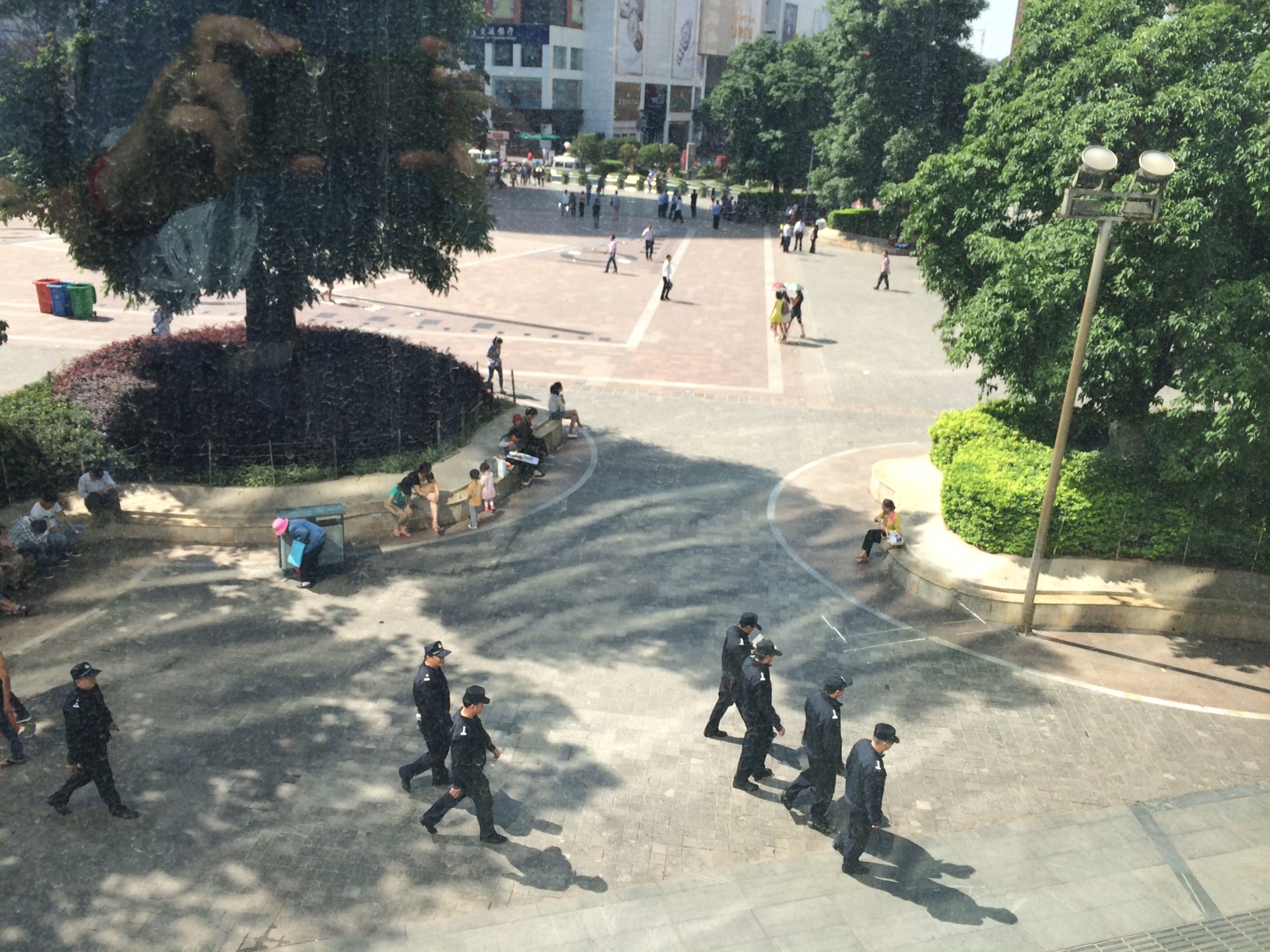
Kunming’s Nanping Jie Square, the site of Sunday’s non-protest.

The ringtone on my wife’s cell phone abruptly called us awake at 8:30am on Saturday. The caller ID displayed the name of one of my closest friends and colleagues in Kunming, yet I wondered why he was calling my wife. “Comrade, good morning,” rang out his thick Sichuanese accent.  This was a standard greeting among my circle of friends, but calling someone comrade in China has long gone out of fashion.

“There’s something I have to tell you.”

So it turns out he spent the previous day at his workplace, a local university, holding meetings with top administration and security brass discussing how to prevent the university’s students from attending a protest scheduled for Sunday, the next day. He told me that a group of Vietnam war veterans from China’s 1979 punitive invasion of Vietnam received approval from the local civil affairs bureau and the local public security bureau to march on the Vietnamese consulate in downtown Kunming.  The scheduled march was in reaction to the growing movement of anti-Chinese protests in Vietnam that left more than 20 Chinese, Taiwanese, and Vietnamese dead in the previous week.

The starting point was the city’s main pedestrian square at Nanping Street; the march would commence at 9am and finish at 2pm at the consulate.  His call was a warning for me to lay low – for all foreigners to lay low – because foreigners, especially Caucasian foreigners could serve as a potential target for angry, nationalistic protesters.  He was also calling to warn me to stay far away from the protest.  He knew I had a penchant for observing and writing about protests in Kunming, and my actions in the past had landed me and subsequently him only by guilt of association in a little trouble with local security officials.

To help place the gravity of the situation squarely on my shoulders, he told me of how he spent the previous evening having meetings with the students under his supervision, pleading them not to attend the protest – even though it was a legal protest – for fear that it may turn violent or take a turn toward other issues that were suppressed and mulling around in the hearts and on the minds of disgruntled people in Kunming.  In fact, his work group in cooperation with a successful commercial real estate form had arranged a 5 kilometer eco-walk scheduled for Sunday morning, but due to the protest he decided to cancel the event.  His university and the firm apparently poured a good deal of money into the event so he was quite put out by the cancellation.  “Right now, we will do what it takes to ensure stability at any cost.” I had heard those words too many times in the last 18 months living in Kunming.

His parting words before hanging up were also ones familiar to me: “Stay at home and have a good time with your wife.”

This season of South China Sea’s flare-ups and shenanigans is heating up once again.  To provide a quick rundown of the last 10 days: China parks it’s billion dollar oil rig 150 miles off the coast of Vietnam near Da Nang; rams a few curious Vietnamese ships, super soaks other onlookers with high pressure water hoses; foreign ministries respond with sabers rattling; protests broil in Vietnam; Chinese, Korean, and Taiwanese factories burn; people die unnecessarily due to this tricky, inane, orderless, yet extremely critical game of cartography, resource grabbing, and interpretation of the current world order.  And to round out the week, the first organized civil response in China comes from….Kunming?

In some ways Kunming makes sense.  The pathway of China’s 1979 spring invasion of Vietnam cut through southeastern Yunnan province into Vietnam’s Lao Cai province.  The three month war was a tough decision for the newly installed Deng Xiaoping.  He sought to punish Vietnam for its humanitarian invasion of Cambodia to take out the Khmer Rouge and install a new caretaker government, in some ways Deng thought this would help make good on his warming commitment to US-China relations.  Many of the troops sent to Vietnam were stationed in Yunnan, Kunming specifically.  Many did not return.  In total approximately 70,000 soldiers and civilians died in the three month conflict.

Both sides claimed pieces of victory.  In the end, China chalked up fewer casualties and proclaimed the incursion’s main purpose was to scare the Vietnamese before retreating.  The Vietnamese army valiantly as always pushed back most of the encroaching forces as the PLA entered the provinces to the north of Hanoi.  The caretaker government in Cambodia was not handed over to the Khmer people 1979.  Officially the caretaker government left in the early 1990s, and some argue that the pro-Vietnamese caretaker government is still in power.  To me a China’s claim to victory holds little water – just like its 9 dash line that lays claim to the near entirety of the South China Sea (which by the way holds a ton of water, fish, and most importantly energy resources.)

But then again there is little about Vietnam’s South China Seas claims that make much sense either.

From my experience interacting with locals, very few Kunmingers, and Chinese people in general, under the age of 50 know the story and context of the 1979 war.   I was not surprised to learn that a group of organized veterans still operated in Kunming given that veteran groups from WWII were still active in Yunnan and much is done in this city to preserve WWII related heritage. But how many were there and how many would show up for the march on Sunday? An organized effort that received government approval and raised the alarms of state related institutions like my friend’s university would likely bring out at least one hundred people. Would they be able to rally more than 1000 Kunmingers under the intense midday sun similar to the anti-PX protests (not government sanctioned) of nearly exactly one year ago?

Would the protesters flip and set cars alight?  Wait, Vietnam doesn’t produce cars.  Would they target people who appeared to be Vietnamese? Wait, I won’t finish that sentence.

On Saturday evening, a crowd of Kunming’s expats gathered for the soft opening of a New York style pizzeria.  The chatter was (sort of) abuzz with talk of the next day’s scheduled march and protest.  Over the previous two days word of the march had spread, for better or worse, among the community via the popular Chinese social media app WeChat, and now the gathering enabled the conversation to go from digital form to the soon-to-be-obsolete vocal communication style characterized by eye contact and hand gestures.

“Did you see how close China’s oil rig is to Vietnam’s shoreline?  It’s totally in Vietnam’s Exclusive Economic Zone.”

“What’s an Exclusive Economic Zone?”

“Yo, this South China Sea shit’s been going on for years.  All these countries play around with each other like they’re still in middle school.”

“That 9 dashed line just showed up in on China’s official maps in 1954.”

“Why Kunming?”

“Maybe the anti-PXers will show up to the protest again and then it could get really ugly.  Wait…maybe the Uighers will plan another attack?  And do you think things will be different now that Kunming’s police forces can carry armed weapons?  What’s happening to our city?  This used to be a really cool place to live!”

“Those Vietnamese love to play games, they learned how from the Soviets.”

“I’m totally going to wear my bright red “Made in Vietnam” shirt with the big yellow star tomorrow.”

“Maybe that’s not the best idea.”

“What’s an Exclusive Economic Zone? And dude, where’s my beer?”


Those who watch the Sino-Vietnamese relationship closely know that the situation is not getting any better despite the rosy accolades of year-on-year bilateral trade increases, strengthened cooperation on the (lately not-so-successful) repatriation of illegal Uighur immigrants from Vietnam back to China, and a new high-speed rail and road network connecting Vietnam to China.  Watching the relationship from Yunnan province only amplifies the growing crevasses.

Looking locally and outside of the South China Sea conflict, foreign direct investment between Yunnan and Vietnam is on the decline and according to the Vietnam Ministry of Industry and Trade office in Kunming, several key Yunnanese invested projects in Vietnam have been put on hold.  Last year Vietnam Airlines suddenly cancelled its daily flight from Kunming to Hanoi.  Two years ago you could readily buy Vietnamese Banh My sandwiches from food carts in downtown Kunming, and now none are to be found.  Enrollments of Vietnamese nationals into Kunming’s university level Chinese language programs are on the decline and are eclipsed by students from Thailand and Laos.  This spring, neighboring Guangxi province closed the border to watermelon imports from Vietnam which gouged prices at home in Vietnam and angered many farmers.

The list goes on, but I must mention that the yearly China-Vietnam Friendship Tennis Tournament which traditionally ushers in Kunming’s Southeast Asia Expo has been suspended for the last two years.  Both sides suspect each other of stacking the line-up with semi-pro players and accuse each other of foul play.

Waking on Sunday morning, the day of the march, I pondered the deterioration of this relationship. It was clear that more were losing than winning, but how many of Kunming’s everyday citizens are directly affected by the recent cooling and would the protesting veterans be able to gather enough onlookers into their fold in order to make an impactful statement?

I also pondered my friend’s advice on whether or not to go observe the march – but only for a few seconds.  With my smart phone charged to the max and ready to live-tweet the march as I had done for the past anti-PX protests in Kunming, I mounted my electric motorbike and made way to the protest zone, picking up a concerned friend along the way.  He promised to help navigate the security arrangements citing experience recently gained on a week-long trip to Pakistan.

I’ve learned in the past 18 months that the signals of a protest in China begin to appear well before arriving on site, and given this sanctioned protest site was staged for the same site as last year’s initial anti-PX protest, I had a well developed strategy to lay low and observe from afar lest I be spotted and photographed by the local security apparatus.  As we approached the downtown pedestrian square at 9:15 just after the march was scheduled to begin, we saw very little increased security presence.  From 100 meters away it was easy to see the center of the pedestrian square was cordoned off by local police forces to create a space the size of two football pitches.  Local police mingled in and out of the zone, and some middle-aged men sat in the shade of some trees on the periphery of the zone.

So far no sign of a protest presented itself.  No banners, no t-shirts, no slogans, no face masks, just a nearly empty square.  In fact, the most conspicuous aspect was the plain clothes policemen scattered around the square.  Always slightly overweight, deep tan, same crew-cut, off-color collared polo, and the signature man bag containing who knows what – the uniform of the Chinese plain clothes policeman is always easy to spot.  I also spotted a fellow blogger sitting in the shade inside the protest zone – his blond locks and European pedigree always stand above the crowd at Kunming’s protests in which he often finds himself smack in the middle of.

There still wasn’t any action, so my friend and I ducked into an adjacent shopping mall and rushed up to the a 2nd floor Starbucks to find a seat on a sofa beside a window overlooking the square.  Needless to say the position of our perch made us feel more like spectators at a sporting event than at China’s first anti-Vietnam protest of the 2014 season.  We were free to comment and tweet at will.  No security forces were going to bother us there.  My VPN was on line and the connection was kicking.

From our bird’s eye viewpoint, we observed a line of ten paddy wagons parked on the southern edge of the square. A small platoon of SWAT police in riot gear made rounds of the square.  Still no protesters.  A WeChat message popped up on my cell phone from the blond blogger sitting inside the zone.  “Situation normal, just loads of police presence, no sign of protesters….Another Kunming couldn’t care less story.”

And that was just it.  Kunming really couldn’t care less.  We estimate that fewer than ten veterans showed up.  Their t-shirts with Chinese flags gave them away.  At about 10:30am, the veterans formed a half-circle in the middle of the square and were escorted around half of the square by uniformed police. Their march lasted less than a minute.  A cameraman from the local television station sitting on a shaded bench missed the procession because his boredom turned to a brief chance to catch a nap.

At 10:45am, the cameraman picked up his bags and went home. Nothing to see here folks.  By 11am the temporary fences were removed, and the pedestrian square exposed to the intensity of the midday sun once again filled with local shoppers making their way through Kunming’s commercial downtown.

I was relieved that nothing happened.  Perhaps word came down from high for the veterans to cool their guns since the Vietnamese government was making good on its commitment to control the anti-Chinese movements and violence within its own borders.  The last thing our little city needs is to have its blue sky reputation tarnished by another incident making the international news and filling the Sinosphere and the South China Seas with flotsam and jetsam.

2 Comments

Filed under China, Current Events, Economic development, Energy, Foreign policy, GMS, Governance, Regional Relations, SLIDER, South China Seas, Uncategorized, Vietnam, water

Anti-Chinese Protests Shake China-Vietnam Relations

China's oil rig, the Haiyang Shiyou 981, sits 120 nautical miles from the Vietnamese coastline.  Photo: Xinhua.

China’s oil rig, the Haiyang Shiyou 981, sits 120 nautical miles from the Vietnamese coastline. Photo: Xinhua.

Following the deployment by China of an oil rig in disputed waters between China and Vietnam, anti-Chinese riots have swept Vietnam, bringing Chinese-Vietnamese relations to their lowest level in recent years.

The demonstrations started shortly after China moved an oil rig, referred to as Haiyang Shiyou 981, within 120 nautical miles off the coast of Vietnam. This position is also 17 nautical miles off of the disputed Paracel Islands.

The Paracel Islands lie at the heart of the controversy over the oil rig. The Paracel Islands are a group of small islands in the middle of the South China Sea with no native population. Both Vietnam and China place historical territorial claims to the islands. Prior to 1974, the islands were controlled by the navies of China and South Vietnam. Following a naval battle in 1974, China took the whole group of islands from South Vietnam.  Following the reunification of Vietnam in 1975, the government of the Socialist Republic of Vietnam renewed its claim to the Parcels, and the dispute has continued ever since.

The dispute over the oil rig and the Paracels also ties into different interpretations by Vietnam and China over the U.N. Convention on the Law of the Sea (UNCLOS), of which both Vietnam and China are signatories. Vietnam claims that the oil rig falls within the 200 nautical-mile exclusive economic zone (EEZ) granted to it by UNCLOS, and thus violates Vietnam’s territorial sovereignty along with UNCLOS. China claims that it falls within its territorial waters that are adjacent to the Paracel Islands it controls.

_74716789_china_vietnam_sprat_464

Regardless of the validity of each of the two country’s legal claims, one thing clear through all of these murky interpretations of international law is that the placement of the oil rig has raised significant anger on the Vietnamese side. Vietnam has declared that it will “apply all necessary and suitable measures to defend its rights and legitimate interests.” At the 24th ASEAN Summit in Burma, Vietnamese Prime Minister Nguyen Tan Dung declared that China’s placement of the rig was “brazen”, “ gravely violates the international law”, and that China’s action was “dangerous”.

In response, the Chinese side has been equally provocative. The state-run newspaper Global Times backed “non-peaceful” measures against Vietnam and the Phillipines, said that Vietnam should get a “lesson it deserves to get”, and declared that “many people believe that a forced war would convince some countries of China’s sincerely peaceful intentions”. Meanwhile, the chief of general staff of the People’s Liberation Army, Fang Fenghui, declared at a press conference that it was actually the Vietnamese who were being provocative, that the Paracels were “”border territory which has passed down from our ancestors into the hands of our generation – we cannot afford to lose an inch”, ending with “We do not make trouble. We do not create trouble. But we are not afraid of trouble.”

The situation around the rig has only gotten worse since it has been deployed, with both sides claiming the other side has rammed its ships and used water cannons, while the Chinese have deployed ships to protect the rig, and have accused the Vietnamese of erecting barricades and fishing nets around the rig in order to impede the rig.

Meanwhile, the situation on the ground on Vietnam has become violent. Anti-Chinese protests have erupted all across Vietnam in response to China’s actions, and the protestors have targeted foreign factories believed to be Chinese, but have also turned out to be Taiwanese, Singaporean, Malaysian or South Korean. More than 400 factories were damaged by the mobs. The casualties resulting from the protests are still unclear with the Chinese Foreign Ministry confirming that two Chinese nationals had been killed, while other sources said that 21 people had been killed. Over 100 are believed injured. China has charted planes and ships in order to evacuate 3000 Chinese nationals in Vietnam.

Photo: Kham/Reuters

Photo: Kham/Reuters

At the time of this writing, it seems that the protests have mostly calmed with over 1400 protestors having been arrested, and Vietnam having deployed massive numbers of security forces throughout the country. However, what’s clear is that the formerly cordial relations between the two states have been seriously damaged, with China’s Foreign Ministry declaring that the violent protests had “undermined the atmosphere and conditions for exchanges and cooperation between China and Vietnam” and that the Chinese side was suspending diplomatic contacts, along with issuing a warning against travel to Vietnam. Meanwhile, the Vietnamese Prime Minister sent out a mass text message warning people not to participate in the protests, but at the same time calling for Vietnamese to “to boost their patriotism to defend the fatherland’s sacred sovereignty with actions in line with the law”. As Vietnam continues to deal with China, the Vietnamese government will likely remember the consequences if it is seen as being soft on China by the Vietnamese populace. And unless China moves the rig, China has likely just given the US further reason to justify its pivot to Asia.

Leave a Comment

Filed under China, Current Events, Economic development, Energy, Foreign policy, GMS, Governance, Regional Relations, SLIDER, South China Seas, Vietnam

Trafficking of Women on the Burma-China Border & International Responsibility

Camp for internally displaced persons at Mai Ja Yang, Kachin State on the the Chinese border.

Camp for internally displaced persons at Mai Ja Yang, Kachin State on the the Chinese border.

In recent weeks, warfare in Burma’s Kachin State has increased and is now making its way closer to the Burma-China border. While the international community has paid little attention to the Kachin conflict over the past few years, understanding its complexity is now more important than ever. Failing to do so could have dire implications on the lives of Kachin women, and on diplomatic relations in the region.

Kachin State is an ethnic area in northern Burma that has long suffered from conflict with the central Burmese government. In 2011, a seventeen-year cease-fire was broken, resulting in the onset of active warfare. In spite of ongoing attempts at peace negotiations, the Burmese government has been committing atrocities– including rape, arbitrary arrest and torture– against civilians. The region has been documented to be an active conflict zone resulting in one of the worst humanitarian crises in the world. According to reports issued by the Kachin Independence Organization (KIO)—the political arm of the Kachin people– over 100,000 internally displaced persons (IDPs) have fled to border areas of Burma and China to escape the fighting, and these communities suffer from a lack of basic necessities and little to no foreign aid. Additionally, as the Kachin Women’s Association of Thailand has documented, the trafficking of women into China’s neighboring Yunnan province as forced brides has become a growing problem.

Recently, I traveled to Mai Ja Yang, the second largest city in KIO-controlled territory to interview women and men living amid the conflict about the issue of trafficking. I conducted interviews with over 25 trafficking survivors, female soldiers, women’s organizations, lawmakers, cultural leaders, IDP relief workers and administrators from the KIO. I was hosted by the Kachin Women’s Association of Thailand, an organization actively working on the issue.

A child in the Mai Ja Yang camp.

A child in the Mai Ja Yang camp.

My research revealed that gender discrimination, demand from China for brides due to the one-child policy and crippling conditions on the ground due to the military conflict within Kachin State contribute to the problem of trafficking. As former “forced brides” and others reported, the escalation of the military conflict has resulted in a sharp increase in irregular migration. Simultaneously, trafficking has become less of a priority for the KIO government, whose attention is focused on war strategy and the political process, rather than the empowerment of Kachin women.

Now, the Burma army is stepping up its attacks in a move that could increase women’s vulnerability to trafficking. As a recent article in the Irrawaddy Magazine revealed, last week the army launched an attack on a KIO military outpost near Mai Ja Yang, which shares its eastern border with China’s Yunnan province. Mai Ja Yang is home to a growing number of IDPs—men, women and children who have had to flee their homes after their villages were raided. Now, not only are these people’s homes destroyed, but their temporary camps are in danger, as well.

With fighting approaching the border areas, women living in the camps could become even more vulnerable. These women face insecurity in the form of food shortage, lack of infrastructure and basic sanitation. They also face circumstances of gender-based violence and rape. Additionally, lack of a means of income generation influences women to migrate to China to find work—a situation that leaves them vulnerable to labor exploitation and trafficking.

But the international community has been slow to respond to the conflict. As a recent Stimson Report revealed, the precarious nature of the US- China relationship has given American leaders pause in “interfering” in such a sensitive geo-political arena. Additionally, aid workers report having had difficulty accessing the IDP camps due to the ongoing warfare in surrounding areas.

Despite these cautions, it is in the interest of the Chinese, Burmese and Kachin governments to quell an increase in trafficking. Doing so would not only improve the lives of thousands of women, but it could prove beneficial for each country’s relationship with the United States. This is because the US State Department has made trafficking a primary agenda in its international policy. In fact, the State Department’s Trafficking In Persons (TIP) Report ranks every country in the world according to how well they comply with the US mandate against human trafficking. As a result, in recent years trafficking has become a number one priority on the US government’s agenda.

The policies associated with the US government’s anti-trafficking mandate are n0t always beneficial for the women they’re intended to help. As I discuss here, the US State Department sometimes gets it wrong, and trafficking continues to escalate. In the case of Burma and China, however, the US’s mandate could actually serve a useful—even diplomatic– function. Due to the transnational nature of human trafficking, cooperation between governments in the region is essential for the development and implementation of a robust anti-trafficking policy. Collaboration between the Chinese government and KIO, for example, is needed to resolve trafficking cases and bolster prevention efforts on both sides of the border. As wary as the US government is of getting involved in these relationships, the trafficking issue could potentially be an inroad yielding productive results.

Thus far, however, the only people seriously trying to combat trafficking along the Burma-China border are a handful of brave and talented activists on the ground. Mai Ja Yang is home to a number of women’s organizations dedicated to increasing the political and civil rights of women in Kachin society. These women work at great personal risk, while the Third Brigade of the KIA works to maintain their security.

But these organizations can only accomplish so much without international support. Instead of turning a blind eye to the conflict, Western governments should help them develop a robust anti-trafficking policy for Kachin State. Additionally, the US government should put pressure on the Burmese and Chinese governments to de-escalate the conflict in KIO-controlled areas. Failing to do so could not only exacerbate the precarious nature of diplomatic ties in the region, but it could lead to an increase in victims of human trafficking– the very people the US government says it is trying to help.

1 Comment

Filed under China, Current Events, ethnic policy, Myanmar/Burma, Regional Relations, SLIDER, Uncategorized, USA, Yunnan Province

Unexpected Waters: How Sudden Water Changes in the Mekong Affect Local Thai Livelihoods


The riverbank vegetable plot in Boong Kla sub-district, Boong Kla, Bueng Kan was completely inundated.  Ms. Jarin Kamghong had to replant the plot after flooding in December 2013.  Photo: March 8, Montree Chantawong

The riverbank vegetable plot in Boong Kla sub-district, Boong Kla, Bueng Kan was completely inundated. Ms. Jarin Kamghong had to replant the plot after flooding in December 2013. Photo: March 8, Montree Chantawong

On an early morning last December, Manee* (name changed to protect privacy), a woman of 73, woke to prepare offerings to the monks in Ban Viang Kook of Nongkhai Province in Thailand. A papaya in one hand, she steadied the knife in the other to make somtum – northeastern Thailand’s famed salad dish. Apart from unripened papaya, the other crucial ingredient is tomato. Manee walked to her backyard on the banks of the Mekong River to pick some. That’s when she realized that her riverbank crops had flooded overnight, as she lifted her sarong up above her knees to avoid the water. Continue reading

2 Comments

Filed under China, Economic development, Energy, Environment and sustainability, Food, GMS, Governance, Regional Relations, SLIDER, Thailand

Recommendations Regarding Hydropower Development and the Rights of China’s Ethnic Peoples

Most of China’s water resources are found in China’s western regions with 70% coming from China’s southwest.  Since the beginning of this century, the core of China’s hydropower development focused on middle and upstream portions of rivers in southwest China. This region also serves as the central native land of many of China’s ethnic minorities.  In early 2013, China’s State Council issued a plan for resource development in its 12th five year plan with details to design and begin construction on more than 60 major hydropower projects between 2011 and 2015.  China is entering into an explosive period of rapid and unprecedented development of its hydropower industry.

For the next twenty years more than 8 million ethnic minorities will be affected by the development and planning of dams.  With the expressed state agenda of establishing a sustainable hydropower industry, achieving social stability in ethnic minorities areas, and realizing the “Chinese dream” for all of China’s citizens, how will the Central government guide law and policy to provide rational standardization, coordination, and management to the interests of the state, industry, and of ethnic minority groups?

According to the principles of “Encouraging the Benefits of Ethnic Autonomous Areas” set forth by the Chinese Constitution, the Law of Ethnic Autonomous Zones advanced a new regulation in 2005 to “encourage the production and livelihood of local ethnic minorities.”  This broad-based regulation passed as part of one of three items in the addendum to the State Council’s PRC Legislation on the Autonomy of Ethnic Regions. Yet to date, there is no specific clarification to the rights of local ethnic minorities or details concerning the autonomy of ethnic areas within the language of the basic law.  The administrative regulations of the State Council list only one related clause: The regulation of peaceful migration should respect the production methods, the lifestyle, and customs of ethnic minorities.

A new policy promulgated in 2012 by the National Development and Reform Commission (NDRC) requiring state sponsored development projects to first oversee the migration of peoples before beginning construction has no mention of protecting the rights of local ethnic minorities. Laws and regulations related to the issue of ethnic minority protection do indeed exist, but because there is no guarantee on the methods of protecting procedural justice or monitoring processes, these laws and regulation cannot reach efficient levels of execution.  Not long ago, the publications of the Third Plenary Session of the 18th Party Congress emphasized the Chinese Communist Party’s views of ethnic policy, guaranteeing the legal benefits of ethnic minorities and bolstering and developing the equal unity and mutual harmonious relations of socialist peoples.

In past years, researchers carrying out investigative field study on the beneficial effects of hydropower development toward the ethnic peoples of the Jinsha River, Lancang (Mekong) River, Nu (Salween) River, Yalong River, Min River, and the Dadu River discovered that the everyday livelihoods and production methods of ethnic peoples living along these rivers are immensely affected by the development of hydropower projects.  In the early development and planning stages, hydropower projects are requested to maintain a holding status before beginning construction.  For many unknown reasons this holding status could continue for many years.  The clearing of roads with dynamite creates air and noise pollution and along with the risks of falling rocks and landslides, greatly affects the safety of people and livestock and the volume of agricultural harvests.  Dam construction and rising waters force people to move.  This uprooting destroys longstanding social networks, privately held assets and shared natural resources such as traditional collecting, fishing, and grazing methods that rely on forests, pasture lands and wetlands.  What is lost is not justly compensated for.

The rights of ethnic groups to be informed, to participate, to express views, and to monitor procedures are not respected or guaranteed with the development of hydropower projects and in many ways these rights are illegally violated.  The relevant institutions of local governments cannot realistically carry out existing laws and regulations, and hydropower firms ignore the law failing to take social responsibility for the protection of vulnerable groups.  Large scale hydropower firms – particularly central level hydropower firms – exact great profits from local areas but remit taxes to the major cities in which they are registered.  The benefits received by localities are greatly out of proportion with the costs borne.


In consideration to the issues raised above and to the demands of the 18th Party Congress, the suggestions below should be considered. Generally, the Central government should re-examine existing hydropower projects and immediately clarify and formulate policy that guarantees the benefits of ethnic peoples in China’s western regions affected the by hydropower development.

1.       Clarify policy and approaches suitable for Western ethnic regions

In western ethnic regions, the Central government should incorporate a guarantee of the basic rights of ethnic peoples as an indicator of sustainable development. The Central government should coordinate development of hydropower projects in ethnic areas giving basic consideration to resource safety, economic development, guarantees of the rights of ethnic peoples, and ecological protection. The activities surrounding hydropower development should respect and guaranteed the basic rights of ethnic people including political, economic, and cultural rights. In accordance to law, ethnic peoples should not be discriminated against and should equally participate in and enjoy the benefits of resulting from economic development in their localities.  They also have the rights to maintain their value systems, religious observance, and unique ways of living.  Moreover they have rights to protect the natural resources such as the land, rivers, forests, and pastureland on which they have existed for many years.

Moreover, the Central government should amend the legal and policy framework on the Law of Ethnic Autonomous Zones within the Chinese Constitution to protect the basic rights of citizens and ethnic peoples.  While strengthening relevant polices, the Central government should expedite policy on formulating specific guarantees of the protection of peoples affected by hydropower development and ensure the implementation and execution of these policies.

2.       Guarantee procedural justice in the processes of hydropower development

In the development of hydropower projects, firms and local governments should respect and protect the rights of ethnic groups and individuals to be informed, participate, make decisions, and monitor procedures. Hydropower firms should establish corporate social responsibility systems that pay particular attention to respecting and protecting the rights of ethnic peoples while operating.  Firms should incorporate this kind of responsibility into their specific duties and make public record of their CSR work on a regular basis.  Firms should also take initiative in accepting monitoring presences of multiple levels of society.

The Central government should establish systems for assessing the impact on the rights of ethnic peoples.  Results of the impact assessment should serve as key findings for the approval of hydropower projects.

The Central government should monitor the entire process of relocation of people related to hydropower development and provide support and effective relief to ethnic peoples whose rights are violated.  The government should establish and open various channels of complaints mechanisms, provide various forms of legal assistance, and eliminate obstacles that prevent ethnic groups and their members in accessing these systemic mechanisms to realize their rights and receive relief.


3.       Guarantee mutual benefit for ethnic people and hydropower development

In ethnic areas, large-scale hydropower firms and central level hydropower firms, by principle, should register for license in the locale in which they operate and pay taxes to that locale.  An alternative could be for the hydropower firm and the autonomous local government should come to agreement on an appropriate distribution of taxes to the locale under the supervision of relevant managing government organizations,

Hydropower firms and local governments should make best efforts to reduce the relocation of people due to hydropower construction and resolutely block forced migration.  Hydropower firms and local governments should make best efforts to reduce the negative impacts of hydropower development on ethnic people’s environment, economy, society, culture, and spirit.  Hydropower firms and local governments should provide fair and appropriate compensation to ethnic groups and individuals for the material, physical, and spiritual damage and impacts caused by activities related to hydropower development.

Hydropower firms and local governments should appropriately provide accordant compensation for negative social, economic, and cultural impacts of past hydropower projects on the basis of social impact assessment and an impact assessment on ethnic people’s rights. Hydropower firms should provide monies for the protection of resources and development funds in affected communities. Firms should provide compensation to and protect the resources and development of intangible assets, communally shared natural resources, and collective impacts that are difficult to compensate at the individual level.

Local governments should adopt measures to protect the cultural heritage of ethnic peoples, to aid ethnic peoples in the passing down and development of their own history, culture, language, traditions, and customs and guarantee the protection of their own cultural heritage and historical traditions.

4.       Fully utilize the function of social organizations

In the realm of social administration, the diversification of social administration is a common and successful experience of developed countries.  It is also a mainstream trend of modern social administration.  Popularized global “New Administration” philosophies purport:

“Governments are not the only pillar of public rights. rather citizens, individuals, and non-government organizations can become pillars of public management.  Under a set of shared goals non-government organizations can participate in public policy making processes and provide public services.  The responsibilities of public affairs administration and the advocacy for the satisfaction of social and economic needs can be collectively shared through the cooperation between social groups and government.”

With the reforms of China’s government institutions and new rounds of innovation in public administration, the function of social organizations in public administration and social life becomes more apparent on a daily basis.  The government should make full use of social organizations in regard to the protection of ethnic peoples and western hydropower development.  The Central government should encourage relevant social organizations to participate in the activities of local hydropower development, participate in the ecological impact assessment, social impact assessment, and social monitoring of hydropower development.  Finally the Central government should utilize the contracting of services to support positive contributions and innovative practices that social organizations can make toward the social administration of ethnic areas.

This is the final part of a 5 part series on hydropower and the rights of ethnic minorities living in the upper Yangtze River valley.  Link here to part 1.  

1 Comment

Filed under China, Economic development, Energy, Environment and sustainability, ethnic policy, GMS, Governance, Hydropower & Ethnic Resettlement in China's Yalong River Valley, Mekong River, SLIDER, Sustainability and Resource Management, water