Category Archives: China

Fire, Spirits and Ritual Self-Injury in Phuket: The Vegetarian Festival

Photograph by Amy Devlin (2013).

Fireworks explode in a loud cascade in the middle of the street, but no one flinches. I watch as a young barefooted man passes me – a pair of guns are impaled in his face, the barrels poking into the open flesh of his cheeks and out of his open mouth. He’s dressed in a black costume embroidered with Chinese symbols.

He is a mah song, a spirit medium, and he’s not the only one. Throngs of men and women are parading down the street, with metal skewers, needles, and even weapons inserted into their cheeks, arms, torsos and elsewhere on their bodies. They are in trances – their heads are twitching rhythmically, eyes rolled back, and their hands are clenched. Groups of devotees reverently carry statues of the gods. As far as the eye can see, everyone is clad in white. Continue reading

Leave a Comment

Filed under China, Culture, Current Events, Reviews, SLIDER, Thailand

China’s Bridgehead Strategy and Yunnan Province

Editor’s note: Liu Jinxin wrote this essay to debunk the myth that China’s bridgehead strategy is militaristic or expansionary in nature.  As a chief architect of this strategy, he seeks to demonstrate that developing Yunnan province into a bridgehead will increase international trade flows and deliver long-term regional security.  This translated essay currently guides top-level foreign policy makers in China in implementing economic strategies along its borders with Southeast Asia.  


Yunnan province's border crossing with Vietnam at Hekou/Lao Cai

Yunnan province’s border crossing with Vietnam at Hekou/Lao Cai

The definition of a bridgehead?

According to the Modern Chinese Dictionary, a bridgehead (桥头堡) is a military term that refers to a strategic chokepoint on the field of battle and particularly refers to a fortified structure that defends and controls a bridge or ferry crossing. In economic terms, bridgehead refers to a strategic forward position on a political or economic front line. The term bridgehead appeared for the first time in an official national level Chinese policy document called “Eastern Bridgeheads” in July 1994 which confirmed the Shandong cities of Rizhao and Lianyugang as the bridgehead terminus of the Eurasian landbridge.

In the economic research of landbridges, a bridgehead is a key concept that acts as a port and facilitates the ease of transportation. Bridgeheads are also international centers of shipping, finance, and information which together form an integrated international center of trade. From a logistical and supply chain system perspective, a bridgehead serves basic support to the Eurasian landmass. It is a city or a region that sits on a strategic position on the logistical and supply chain and serves the specific purpose of controlling the flow of resources along international trade routes. The basic characteristics of a bridgehead are its powers to control, develop, and influence.

The power to control

The power to control suggests capabilities levels of secure logistical flows. This can be understood in narrow and broad senses. From a narrow sense, secure logistical flows are conditional to the degree of market openness.  The survival and development of logistical flows must not be threatened by the power of a government to regulate or control it. From a broad sense, a state’s security and international security are guaranteed by engaging in logistical activities. The capability of a state’s secure logistic flows is determined by its capacity to control strategic resources, logistics routes, linkages, and its industrial supply chain.

Linking with the similar strategic logistic routes, resources, and supply chain structures of neighboring states, a concerted logistics system can deliver harmony and mutual trust as well as a collective security that realizes long term stability. Fostering mutual trust, mutual benefit, and equality work together to form a new worldview for security and protects the security of individual states as well as respects the security concerns of other states.  Mutual trust also promotes collective security.


The power to develop 

Developmental power is preconditioned by the construction of logistic routes, linkages and supply chain structures, the developmental needs of economic corridors, and mutual benefit and cooperation. This power can help states share development trajectories, share prosperity and harmonious development, and eliminate security threats at their root. States should place the promotion of shared development as the method for solving global development imbalances and fostering sustainable development. To revolutionize international financial systems, oppose trade protectionism, and promote regional economic cooperation, developing countries should establish development modes that foster interdependence, deliver effective beneficial outcomes, and seek to erase poverty. Developing countries should expand trade with each other, open markets to each other, and increase the level of south-south cooperation.


The power to influence

Influential capabilities rely on a state’s degree of openness and tolerance, strengthening of the construction of a national culture, making positive contributions in international cooperation, solidification of geo-cultural space, promotion of geo-cultural integration, ability to cooperate harmoniously, and mutual progress with its neighbors. States should respect the rights of other states to determining their own development paths by admitting differences in cultural traditions, social systems, and value systems. States should actively promote and provide guarantees to human rights, and increase dialogue to eliminate misunderstandings. States should initiate a spirit of openness and tolerance, make use of the development modes of other states in a comparative and competitive fashion, and seek collective development despite differences.


The functionality of China’s bridgeheads

The central government has required Xinjiang Uyghur Autonomous Zone, Yunnan province, and other frontier provinces and zones to open the construction bridgeheads along national borders to implement a stable and prosperous frontier region. To deliver prosperity, the bridgeheads should:

1) Be a foundation of protecting border security and stability

2) Take measures under the conditions of high technology to serve as a front line in partial wars and non-traditional security issues

3) Support efforts to rapidly develop ethnic and national zones through new economic modeling

4) Expand the promotion of international/regional cooperation with neighboring states and extend degrees of openness by forging ahead as zones of experimentation.

5) Serve as a transit and storage point for national energy resources.

From a spatial perspective, Xinjiang acts as a bridge between the East and the West; it is the new Eurasian landbridge’s thoroughfare, and as a “west gate,” it serves the opening of China’s northwest region to Central Asia and Europe.

Yunnan opens China to the Southwest connecting two oceans, the Pacific and the Indian as well as East Asia, Southeast Asia, and South Asia. It is the linkage point between China’s southwest, the Southeast Asian peninsula, and the South Asian Subcontinent, and is the starting point of the Yangtze River Delta economic zone as well as the Pearl River Delta economic zone. Yunnan acts as the core belt of the China-South Asia Economic Circle and the China-Southeast Asia economic circle. It is the main connective channel between China and the Indian Ocean and is China’s core zone in the Greater Mekong Subregion. More importantly the province serves as a key trade passageway for goods and services passing from China to South Asia and the Southeast Asian peninsula.

gms_map_large

Core Values

China’s bridgeheads are a result of major changes in geo-strategic international structure. The concept is part of China’s key diplomatic principles which pledge to be a good neighbor, a prosperous neighbor, and a secure neighbor. It is also reflective of China’s active pursuit of being a responsible world power. The core values of the bridgehead strategy are:

1) To foster an infrastructure development strategy that expands participation in the world market and establishes interdependence, while constructing mutually beneficial win-win relations with its neighbors

2) To highly prioritize unity among ethnic peoples and social stability by promoting cultural diversity and shared developmental progress

3) To respect  public opinion and the will of peoples in neighboring countries, and respect their value systems by promoting cooperation and exchange between peoples and democratic equality

4) To acknowledge the guidance of international voices and place equal importance on China’s international image and economic benefit

5) To safeguard the benefit of overseas Chinese and Chinese businessmen abroad

6) To value strategic resources, strategic routes, the shared security of strategic industrial supply line

7) To promote the construction of low carbon footprint urban areas and the use of clean energy by promoting an economic society that delivers harmonious, stable, and secure sustainable development

8) To promote the construction of a harmonious new world order and the active promotion of new kinds of partnerships with neighboring countries

9) To resolutely protect free and fair global trade and investment climates, and maintain the free flow of products, investment and services

10) In the long term, to promote sustainable growth, coordinated concerns, advocate tolerance to total adjustment, and promote balanced growth

Global economic balances can only be reached through sharing benefits and needs between developing and developed states.


Yunnan province as China’s southwest bridgehead

The southwest bridgehead is the front line of China’s interaction with the Indian Ocean, and its purpose is to construct a series of overland pathways given China’s southwest connects to South Asia and Southeast Asia trade routes. The bridgehead’s purpose is also to construct a base facing South Asia and Southeast Asia that supports export processing and the facilitation of international and domestic production, and the Kunming international land port economic zone.

Establishing Kunming as an inland economic zone will strengthen logistical flows coming from South Asia and Southeast Asia, create a tourism base for national culture, a commerce base, export processing base, and modern agriculture base as well as an information platform. This platform will come together through the increased progress of the yearly Kunming trade fair, China-South Asia fair, and the creation of different cooperation forums. The central objective is to turn Yunnan province into China’s platform for communicating with Southeast Asia and South Asia. Through creating this window, Yunnan can facilitate the building of trust between China and South Asia and Southeast Asia, and demonstrate the fruits of reform as well as Chinese culture by promoting mutual understanding and friendship. Yunnan can become a demonstration zone for how China can open to its neighbors.

The influence of a bridgehead extends outwards and is continuously stretching its limits. In China this includes two major regions.


A bridgehead to Southeast Asia

Southeast Asia includes the 10 ASEAN states of Malaysia, Philippines, Singapore, Thailand, Indonesia, Brunei, Vietnam, Lao PDR, Cambodia, and Myanmar and the non-ASEAN state of East Timor. In total this region covers 4.5 million square kilometers, supports a population of 580 million, has a combined GDP of $1.9 trillion USD and a total trade of approximately 2 trillion USD. The creation of the ASEAN-China Free Trade Zone in 2010 created a free trade area of 13 million square kilometers and a combined population of 1.9 billion. It is the largest populated free trade zone in the world and the largest free trade zone among developing countries.

China and ASEAN states are linked by mountains and rivers and share advantages by having varied distribution of resources, differences in specialization of industrial processes, complementary strengths, and an enormous potential for cooperation. As trade between China and ASEAN states increases at a rapid rate so are rates of investment. China is ASEAN’s 4th largest trading partner and ASEAN is China’s 5th largest trading partner. ASEAN has been established as a priority zone for attracting Chinese FDI and is one of the outward investment zones for Chinese industries. ASEAN is also a major market for Chinese labor, and China is winning an increasing amount of engineering contracts in ASEAN.

To date China and ASEAN trade relations have already entered a “Golden Era” and as China and ASEAN open their markets to each other, the ASEAN-China Free Trade Zone will enter a substantive phase. These contributions will bring robust commercial opportunities as the Southeast Asian peninsula is a major global agricultural production area and a critical zone of emerging industries.


A bridgehead to South Asia

The South Asian subcontinent (by way of the BCIM economic zone which includes Bangladesh, China, India, and Myanmar) is the geo-strategic fulcrum between the Indian Ocean and the Arabian Sea. At the same time, it is zone of choice for the secure channeling of China’s energy resources. The South Asian Subcontinent is also known as the Indian Subcontinent and is comprised of the Indian peninsula, the Indus river plateau, and the downstream plains of the Ganges and Brahmaputra rivers covering an area of 4.3 million square kilometers. It supports a population of 1.2 billion on 10% of the Asian continent. Its northern reaches are formed by the Himalayan and Karakoram mountain ranges and its southern limits are the Arabian Sea and the Bay of Bengal. Its western borders are limited by the Iranian plateau, and its eastern frontiers are the mountainous eastern regions of India, Bangladesh, and Myanmar.

The severity of South Asia’s natural landscape has prevented integration and the historically its cultures have been relatively closed-off to each other. This has produced divergent sentiments of independence in the region. The South Asian subcontinent includes India, Pakistan, Bangladesh, Nepal, Bhutan and does not include Sri Lanka or the Maldives. Its major rivers are the Indus, Ganges, and the Brahmaputra. Major agricultural products are wheat, rice, cotton, hemp, cane sugar and tea. Resource endowments include coal, mica, zinc, and gold.

An international pathway can be built from Yunnan through Myanmar to give China direct access to the Indian Ocean and its benefits will promote good neighborliness and the strengthening of border areas. Frontiers serve the specific functions of national defense and economic and cultural exchange. Sharing borders with Myanmar, Lao PDR, and Vietnam, Yunnan province serves as the connective link between China, South Asia, and Southeast Asia. It offers an alternate route to the passage of goods through the Straits of Malacca and is the fastest land route for goods to travel from China to South Asia, the Indian Ocean, Europe, and Africa.

Due to its advantageous geographical position, the province can facilitate huge market potential with partners in South Asia, Southeast Asia, and the Middle East. Lastly, because of its history of friendly exchange with its neighbors, Yunnan province serves as the ideal representative for diplomatic connections.

The construction of international pathways will do much to improve the state of transportation and shipping and can only expand and deepen the political, economic, and cultural cooperation between China and Southeast Asian states. Building these pathways and supporting the bridgehead strategy will develop regional economic cooperation between China, Southeast Asian, and South Asian states, strengthen the relationship of good neighborliness, and bring stability and peace to China’s border areas.

4 Comments

Filed under ASEAN, China, DOCUMENTS, Economic development, GMS, Laos, Mekong River, Myanmar/Burma, Regional Relations, SLIDER, Thailand, Vietnam

The Godfather of the Golden Triangle: Lo Hsing Han, Obituary

Most crime bosses and drug barons never reach old age, unless they end up behind bars serving a life sentence. More often than not they are eliminated in a hail of bullets fired by either a police sharp-shooters or from a rival gang.

But  Lo Hsing Han ,the former ‘King of the Golden Triangle’ heroin trade  who survived several decades of opium wars in the Shan state and became one of the world’s ‘Most Wanted Men’, amazingly defied the odds to become an octogenarian. He died in Yangon on July 6th 2013 aged 80.

Nor did this legendary drug-trafficker die in lonely obscurity shunned by society. His lavish funeral was a VIP affair attended by former generals, two cabinet ministers, and hundreds of well-wishers from Burmese high society.

They paid tribute to his rare metamorphosis from a notorious drug-kingpin to a respected business tycoon, the founder of the Asia World Group that has become a dominating pillar of the Myanmar economy. He is also credited with being the key player in establishing the nation’s economic dependence on narco-profits in the 1990s.

Lo was born around 1935 into a poor ethnic Chinese family in the Kokang district of the Shan state northern Myanmar.

His career in the opium trade began in the 1960s not as an outlaw, but as the leader of a Yangon–sanctioned militia, the KKY, under the auspices of General Ne Win’s dictatorship.

The militias were supposed to fight Shan rebel armies and the Burmese communist guerrillas but expended most of their energy on taxing and protecting mule convoys carrying huge sacks of opium. Thanks to a complex chess-board of   nationalist rebels, opium warlords, the Burmese army and communist guerrillas backed by China, anarchy reigned supreme in the Shan state.

After the 1967 Opium War, Lo Hsing Han emerged as the big winner and consolidated much of the opium trade under his command, still enjoying the blessings of the Ne Win regime.

But the regime came to realise that their home guard KKY militias were a failure and started to disband them in 1973, prompting Lo to abruptly change sides and team up with his former enemies the SSA rebels –the Shan State Army.

During the next 20 years the Lo Hsing Han real–life story was packed with more intrigues, changing allegiances and betrayals, than a John Le Carre novel.

British film-maker Adrian Cowell filmed his classic ‘Opium Warlords’ (‘screened on ITV in 1974), after spending more than nine months trapped in the Shan jungles. It featured for the first time an interview with Lo, the legendary warlord.

Lo, the drug trafficker warlord, unexpectedly offered a diplomatic deal to end the narcotics trade in Burma, by offering to sell the whole opium harvest to the US government in exchange for a mere $12 million. It was taken seriously in Washington by a US congressional committee.

DEA agents based in Thailand arranged for Thai Police to pick him up inside Burma with a message that high-ranking US officials had agreed to talks in Chiangmai.  However after the Thai helicopter collected him from inside Burma, he was stunned to be immediately arrested upon arrival in Thailand July 1973.

US law enforcement plans were confounded by the sudden deportation of the prize catch to Yangon. Some Thai officials clearly wanted to stop Lo Hsing Han from talking. Many high-ranking Thai police and military officials were on Lo’s extensive payroll, which helped to grease the smooth transportation of narcotics delivery by road from the Shan state to Thai ports, without being intercepted by police checkpoints.

The Ne Win regime promptly indicted him for treason and he was sentenced to death. In another twist to the saga, the verdict was soon set aside in favour of an 8 years jail term, much of it served comfortably under house arrest. Then in 1980 amnesty was granted and he returned to Lashio in Shan state.

The military junta’s intelligence chief General Khin Nyunt had spotted an opportunity to recycle the resourceful man from Kokang, who had contacts with everybody in the ethnic mosaic of the Shan state, to work for the regime in a new capacity.

A 1989 mutiny inside the communist BCP proved to be a major game-changer, which allowed Lo Hsing Han to play his newly assigned role as a broker of ceasefires.

His contacts with all the Shan, Kokang and Wa rebel armies helped General Khin Nyunt to conclude a series of ceasefire agreements, and in return the military junta happily re-licensed Lo to resume the opium and heroin trade in opposition to rival drug warlord Khun Sa, who was still fighting the government under the banner of Shan nationalism.

In 1992 Asia World Corporation was set up in Yangon as a family partnership between Lo Hsing Han the chairman and his son US- educated Steven Law, the managing director.

The company’s portfolio included: import-export business, bus transport, property development and Rangoon’s port development.

But it was Singapore ‘s decision to get into bed with the Lo family’s Asia world conglomerate with a stake in two new luxury hotel through the government’s investment arm GIS, that garnered most international attention.

According to research based on all the available date of Myanmar’s trade investment and revenue in the fiscal year 1995-6, no less than US$600 million income in the state treasury could not be accounted for.

This conspicuous gap in Myanmar’s bookkeeping at a time when their official economy was on the rocks, points to only one plausible explanation–a generous infusion of narco-dollars from the Golden Triangle coming from Lo. One of the country’s most successful entrepreneurs had come to the rescue of a faltering economy in dire straits.

The grand wedding of  Steven Law to Singaporean business partner Cecilia Ng in 1996  clearly helped to cement the growing ties between the military junta, Asia World, and Singapore investors..

The Lo family’s guest of honour was Hotels and Tourism Minister Lieut. General Kyaw Ba, accompanied by four more cabinet ministers, and two planeloads of wedding guests from Singapore. The special charter flights not only carried the bride’s relatives, but also investors from representing one of Asia’s most important financial hubs.

US officials claimed that half of Singapore’s investments in Myanmar have been tied to Lo’s family.

It was far more than a grand wedding bash. It symbolised Lo Hsing Han’s metamorphosis from a drug baron to a corporate respectability, and his acceptance by investors from a key member of the Asean business community.

Asia World established three subsidiaries in Singapore jointly run by Steven Law and his wife Cecilia Ng (Ng Sor Hong) she allegedly also runs an underground banking system facilitating money-laundering and safe tax havens for narco-dollars.

Although Singapore is proud of its mandatory death penalty for small-time narcotics couriers and heroin addicts, both father and son travelled freely in and out of the island city state.

Steven Law and his father had become VIPs in Burma, and welcome business partners in Singapore, but they were forbidden to enter the United States since 1996 on “suspicion of involvement in narcotics trafficking.”

Under new US sanctions imposed in 2008 Asia World and six of its subsidiaries were blacklisted and similar sanctions were applied by the UK.

But these sanctions have done little to hinder Asia World‘s dynamic expansion. The company built on the illicit black economy has thrived,  and currently  partners major companies from mainland China in several mega-projects including an oil and gas pipeline, a deep sea port at Kyaukpyu, and the controversial Myitsone dam project.

Another irony is that Lo was closely connected to Taiwan’s military intelligence for 30 years, and deployed his Shan and Kokang soldiers to fight against Beijing-backed Burmese communist party.

Asia World has its financial foundations built on the law of the Burmese jungle and the 3 Gs :Guns, Gold and Goons. But  Lo’ s legacy will casts a long shadow over the aspirations of many groups to move the economy out of the hands of the cronies, and towards a respect for environment, human rights and the development of a democracy.

This account of the Life and Times of Lo Hsin Han provided the basis for the obituary published in The Economist in July, 2013.

2 Comments

Filed under China, Cold War, Mekong River, Myanmar/Burma, Singapore, SLIDER

Tibetan Wine Boom Threatens Food Security

The growing Tibetan wine industry raises concerns about local food supplies and pesticide use.

Many familiar with China and Tibet, may have heard about China’s “Shangri-La,” a region in the northwest of China’s Yunnan Province bordering Tibet and Sichuan that was officially renamed in 2001 after the location of a mystical Himalayan paradise in James Hilton’s 1933 novel, Lost Horizon.  The goal of this naming campaign was to heavily promote and extend tourism throughout the region, a strategy that has proved highly effective for the local government with the number of both Chinese and foreign visitors continuing to grow annually and with the increasing expansion of a tourism industry catering to the desires of travelers wanting to experience both Tibetan culture and local natural wonders.


Grapes on vine in a village near the Yunnan Tibet border

Grapes on vine in a village near the Yunnan Tibet border

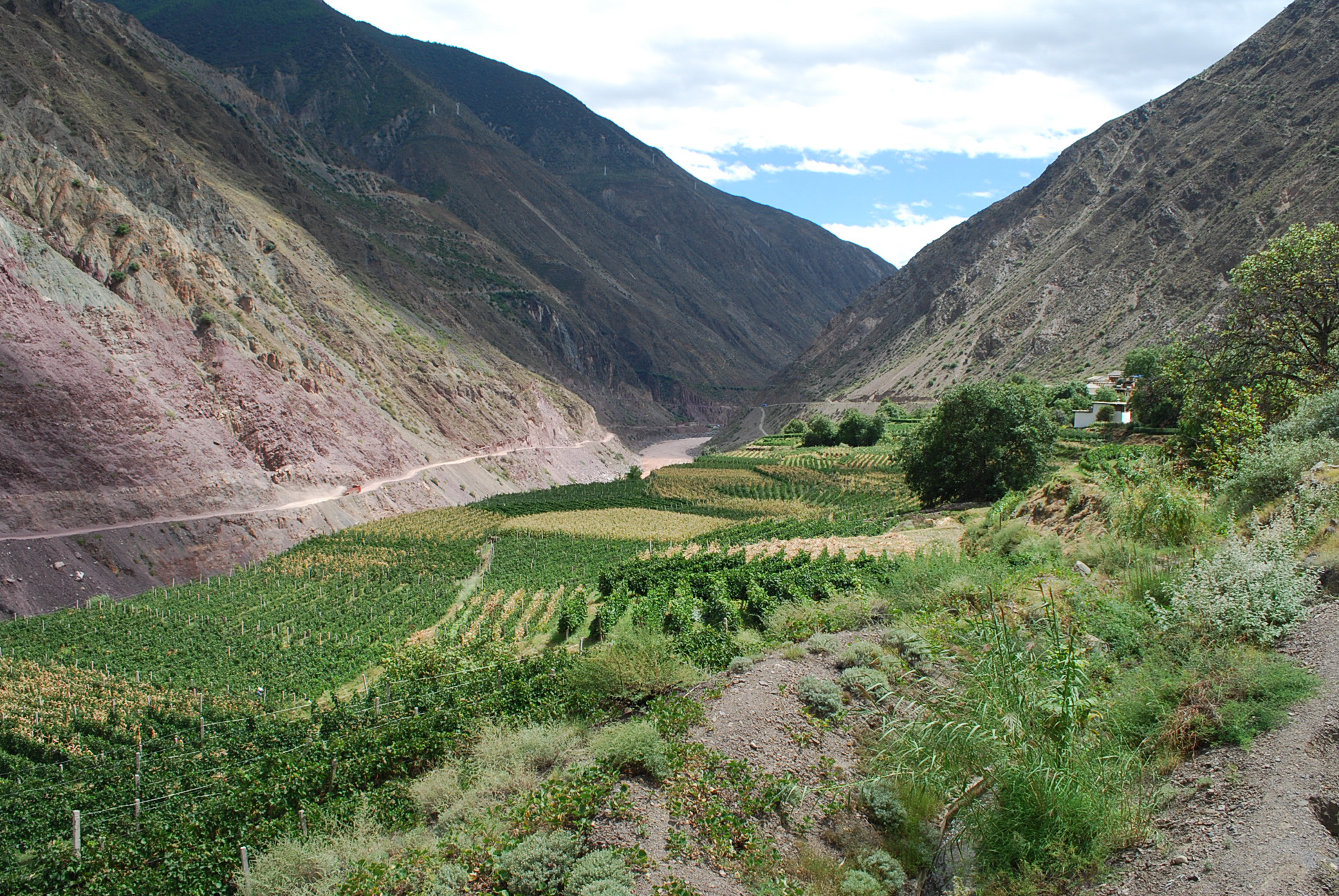
Over the last decade, a significant corporate and agricultural development project in the region has involved the growth of a Tibetan wine industry among rural villages on the upper Lancang (Mekong) and Jinsha (Yangtze) rivers.  About nine years ago, the provincial government approached villagers across the region’s warm and dry rivers valleys and encouraged them to begin growing grapes to annually sell to the newly established Shangri-La Red Wine Company, a new corporation with close government ties that markets its wine as being distinctly Tibetan and coming from “Shangri-La.”  As part of this program, villagers were given grape seedlings and concrete trellises to support their new vineyards.  Slowly, more and more villages have caught on to this practice and pattern of agriculture to the point that in several areas, fields have been transformed into monocrops, though this is not the case is all locations.  Indeed in some of the region’s villages, a diversity of crops including wheat, barley, buckwheat, corn, and in the southernmost areas rice, are all grown.


The government introduced Cabernet Sauvignon vineyards to the  village along the Upper Lancang in Yunnan close to Tibet.

The government introduced Cabernet Sauvignon vineyards to the
village along the Upper Lancang in Yunnan close to Tibet.

Though I had been traveling and studying in this region for seven years and had indeed witnessed grape growing, it was not until 2011 when I arrived to conduct research on the potential impacts of hydropower resettlement in the region for my master’s degree that I began to realize what a large undertaking has occurred with grape agriculture and the major impacts that this has had on local livelihoods.  Discovering these issues, I began to explore them more deeply, writing a chapter in my MA thesis focused on the topic (which is soon to be published as an academic article), and now looking at this grape agriculture, its history, and the changes associated with it in great depth for my doctoral research.


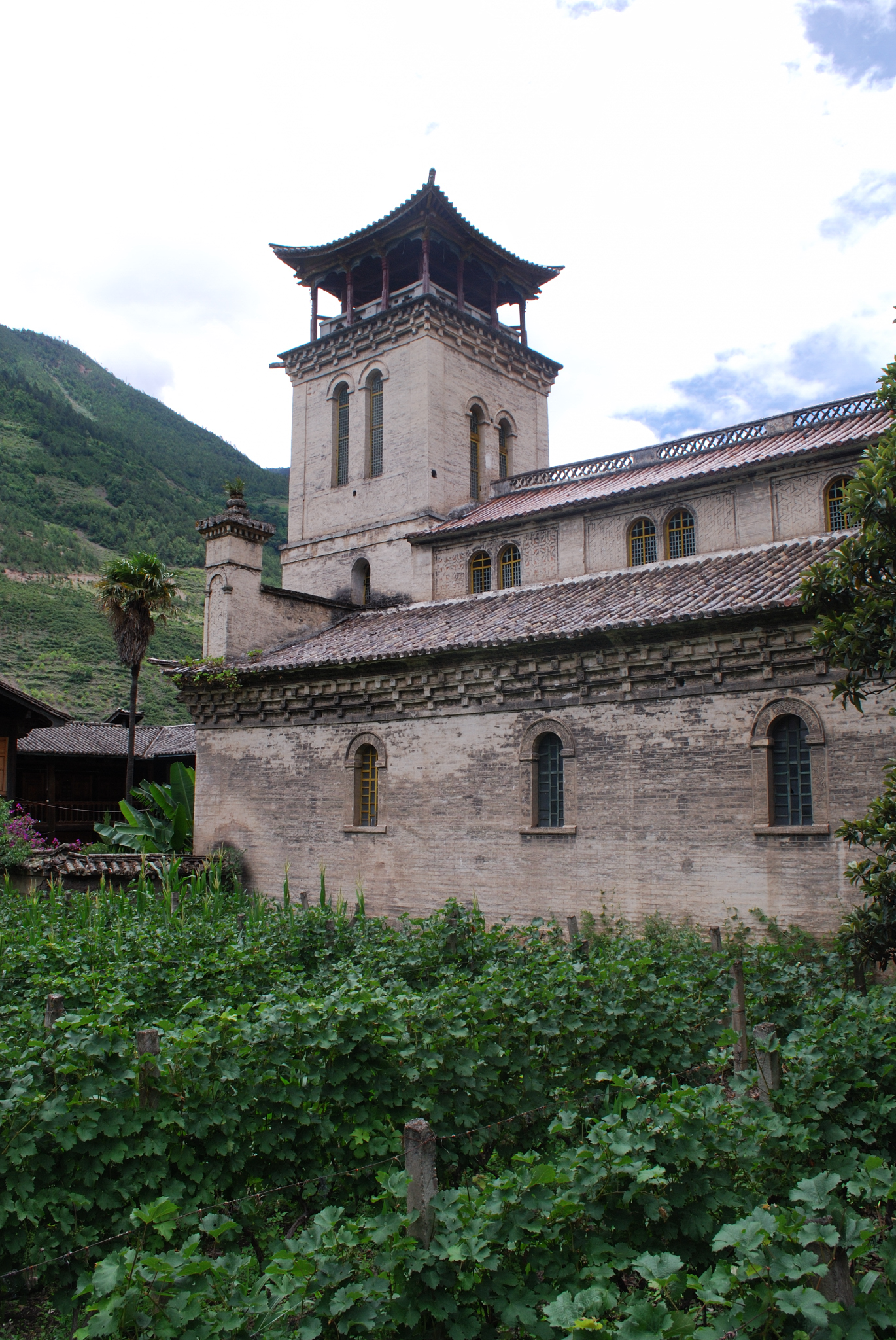
Original Rose Honey vines in the church yard at Cizhong in the  south of Yunnan’s Tibetan region

Original Rose Honey vines in the church yard at Cizhong in the
south of Yunnan’s Tibetan region

Despite their recent expansion across the region, grapes and wine actually have a long and interesting history in the region in isolated areas.  In the late 1800’s, French Catholic missionaries established a strong presence in the region, primarily in the neighboring Nu (Salween) river valley but with a few successful churches and Tibetan converts in the Lancang as well.  While establishing their churches, the French also began to plant grapes and to produce wine, a practice which is still carried on to this day by villagers in Yunnan’s southern most Tibetan villages in Cizhong.  Unique to Cizhong on the upper Lancang is also a variety of grapes known as Rose Honey, a strain that was thought to have been completely wiped out by a blight in France but was found preserved within the church walls at Cizhong.


Township government Cabernet vineyards planted outside of Cizhong’ s church

Township government Cabernet vineyards planted outside of Cizhong’
s church

Based on my own interviews and ethnographic work in the region, the Rose Honey grapes are in fact only grown by a limited number of villagers and today are primarily unique to Cizhong alone.  When the prefectural government and Shangri-La Red Wine Company introduced and encouraged grape growing throughout the region approximately eight years ago, they provided a new variety of Cabernet Sauvignon grapes, which is the only variety that this company will purchase.  Therefore the majority of the communities in the region grow and sell these grapes, though in some cases around Cizhong they also produce some wine to sell to tourists themselves, though this is not the case everywhere, especially in the most upstream areas closest to Tibet where some villages have no knowledge of wine making.  Unlike the Rose Honey grapes, the Cabernet variety also requires significant chemical inputs by way of fertilizers and pesticides.


From a sustainability standpoint, this increasing reliance on chemicals is one of two major areas of concern and interest – the second is food security.  Villagers themselves are not unaware that they are becoming increasingly reliant on chemicals and that this may be causing problems either.  In one village where I work, only two years ago it was a very common practice among households to intercrop vegetables for personal consumption among grape vines.  However starting this year I both noticed that the practice has decreased and was informed that this was due to villagers own worries about eating foods exposed to too many chemicals and possibly now toxic soils.  Similarly, one of my informants in Cizhong prides himself on two features of his grapes: they are completely organic, and he only grows the Rose Honey variety he obtained from the church yards.  This man has pointed out that most people in Cizhong use many chemicals because the Cabernet grapes introduced by the government won’t grow without them, while the Rose Honey grapes can be grown without any inputs.  Using these characteristics he markets the wine he makes as being both organic and of the historically significant Rose Honey variety, and has managed to develop a very good income for himself by selling wine to local government officials for banquets and to a restaurant in the famous tourism city of Lijiang to the south.


Cizhong villager tending his organic Rose Honey vines.  He makes and sells wine  himself rather than selling grapes to a company.

Cizhong villager tending his organic Rose Honey vines. He makes and sells wine
himself rather than selling grapes to a company.

Food security and changes in traditional cropping patterns and ways of life are also a major issue created by grape growing.  In the downstream regions around Cizhong, the majority of villagers still grow large amounts of grain including rice (the northernmost rice in the Mekong and the only rice grown by Tibetans), wheat, barley, corn, and buckwheat to fulfill their own subsistence and livestock needs.  This is not the case upstream however where villagers now grow little to no grain in exchange for grapes as a monocrop; by doing so they then rely on the profits from grape sales to purchase grain for subsistence and also fertilizers and pesticides.  This has brought about two issues.  The first is major changes in diet, as people who traditionally subsisted on wheat and barley are now purchasing rice and in a sense becoming “Hanified” by their diets as they move away from eating traditional Tibetan foods.  Second, there is now a great reliance on the government and the Shangri-La Red Wine Company to purchase grapes, which are the number one income source and thus hugely important in securing funds to purchase adequate amounts of food to eat.  However from year to year, selling grapes is a major issue of concern, particularly being able to sell them at the ideal time when they are first ready to be harvested because if one waits too long they begin to rot on the vines and lose weight which is how they are measured for sales.


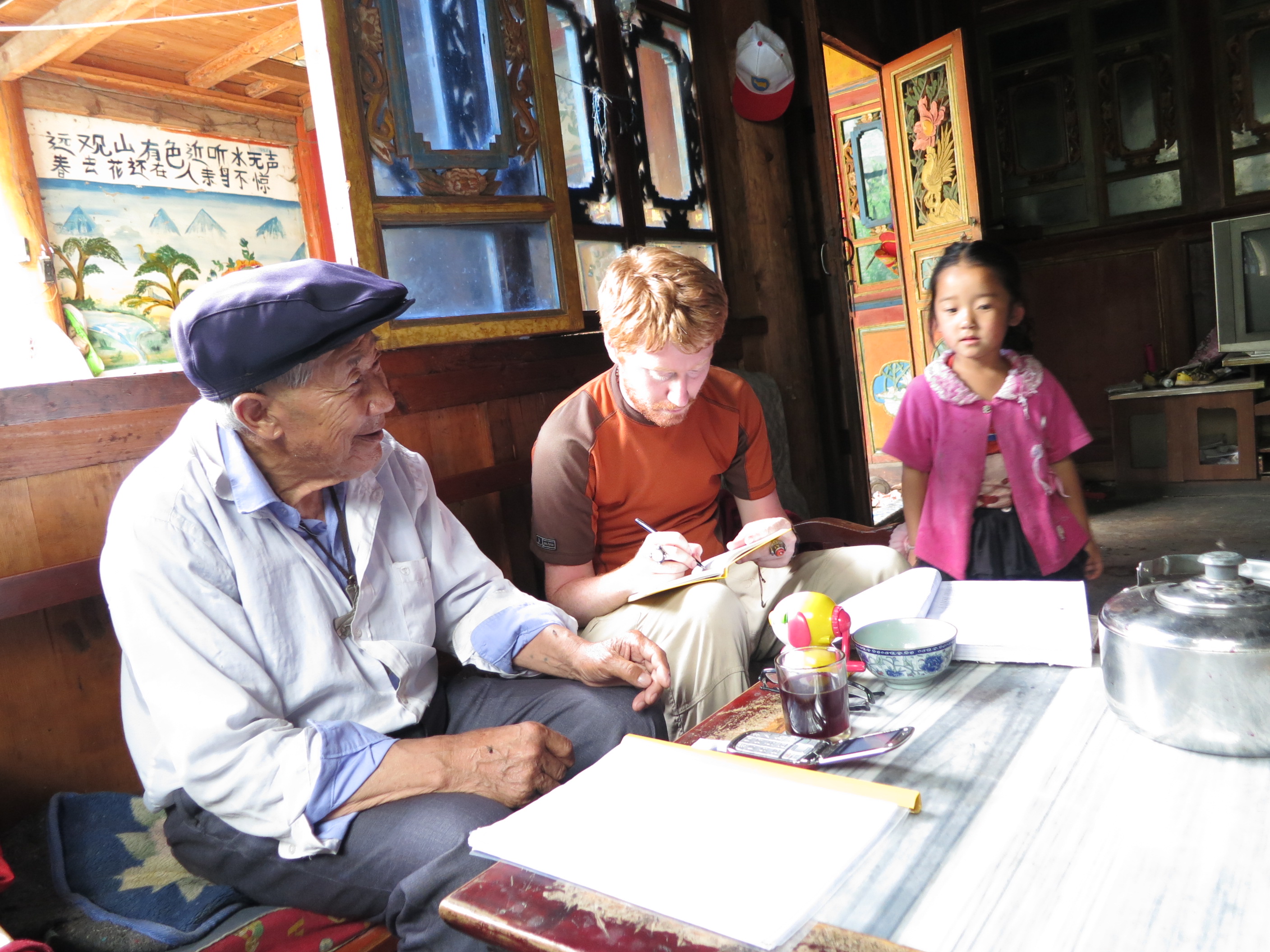
Interview with an 85 year old Cizhong villager who learned to make wine from French Catholics in the 1930s (photo by Sun Fei).

Interview with an 85 year old Cizhong villager who learned to make wine from French Catholics in the 1930s (photo by Sun Fei).

Since the harvest season of 2011 when I first began studying these issues, the company purchases have consistently arrived late every year, which has created serious worries among villagers about their ability to sell the crop.  Despite government assurances that the company is guaranteed to arrive by a certain date each year, this has not appeared to actually be the case, and securing maximum prices and value from grapes from year to year is a constant struggle for villagers as well as the new reliance on outside food purchase which are well captured in the following quotes from interviews:


“Before we planted grapes we didn’t have to buy corn and pesticides, but now we do.  However our income is still better growing grapes. If you plant grapes your income will increase, but you also have to spend more money to buy food.”


More or less, villages fully recognize the vulnerabilities involved in switching their cropping to grapes, but have still chosen to do and have invested much time and energy in doing so because of the high monetary returns that they provide.

An abbreviated version was posted here earlier this week on thethirdpole.net


Leave a Comment

Filed under China, Food, Mekong River, SLIDER, Uncategorized, Yunnan Province

China Sea Territory Disputes (source: Money Morning, NPR, google news)

0912ChinaSeaTerritory2

Leave a Comment

Filed under Brunei, China, Foreign policy, Malaysia, Myanmar/Burma, Philippines, USA, Vietnam, VISUALS, water

Yunnan Province and Its City Circles and Border Economic Zones

Map1

This is a map of Yunnan province, its city circles, and border economic zones.  Yunnan borders Vietnam, Laos, and Myanmar.

Leave a Comment

Filed under China, Economic development, GMS, VISUALS, Yunnan Province

Art Exhibition: Yin Xiuzhen, Nowhere to Land (Pace Beijing)

IMG_0457

It’s a microcosm of how rapid consumer-driven development has taken root in modern China: 798 Art District, once an esoteric artists’ enclave on the fringes of the city, has emerged as a prime tourist destination in Beijing, replete with international galleries.  Fashioned from a former military factory complex from the Mao era, industrial Bauhaus-inspired spaces serve as stark galleries for an array of contemporary Chinese artists.

Among these, the name of Pace Gallery may ring a familiar bell – earlier this summer, their sister gallery in NYC made a splash when Jay-Z rapped for six hours as part of a performance art piece.

In slightly more subdued fashion – but no less telling for the times – the irregular arches of Pace Gallery Beijing make a striking backdrop for Chinese artist Yin Xiuzhen’s current exhibition. In evoking the human aspects of globalization, Nowhere to Land is especially timely in the dynamic Chinese context, and Yin’s work gives a compelling account of what the view from inside the seismic changes of the country might look like.

Yin (b. 1963), a true Beijing native, presumably bears the perfect vantage point from which to witness the massive Chinese economic transformation. Since graduating from Capital Normal University in Beijing in 1989 with a B.A. in oil painting, the artist’s work has been featured internationally. Recent exhibitions include solo showings at the Groninger Museum in the Netherlands (2012) and New York’s MoMA (2010), as well as a smattering of group exhibitions in cities across the world, including Moscow, Shanghai, Venice, Sydney, Sao Paolo and San Francisco.

Yin’s work is all about the art of looking and deciphering. Incorporating homely, intimate and personal items into larger constructions, she emphasizes the superficial qualities of what seem at first impression to be straightforward sculptures. And in doing so, she problematizes the underlying assumptions behind glossy Chinese narratives of progress and globalization.

Yin Xiuzhen 2012_Nowhere-to-land

Yin Xiuzhen. Nowhere to Land. 2012. Mixed media.
Image courtesy of Pace Gallery. Continue reading

Leave a Comment

Filed under China, Culture, Reviews, SLIDER

The 3rd Annual ICIRD Conference, Part II

Previously, I introduced ICIRD 2013, a Bangkok-based conference exploring issues of development, greater economic integration, and the idea of the regional commons. This blog post will delve more deeply into the background of the commons, an alternative way of organizing public goods that circumvents the hungry advance of neoliberal globalization. 

By way of illustrating, one of the most pressing current issues surrounds the Mekong River, the classic example of a regional – and transboundary – commons in Southeast Asia. Crossing six countries, laden with social and historical significance, and layered with overlapping claims and uses, millions depend on its shared resources, while growing hydropower development threatens large-scale devastation and destruction of riparian ecosystems. But forms of the commons can range in scale from municipal parks and shared community fishing sites along river banks, to oceans and digital commons on the far end.

The Commons as Social and Historical

Certainly in the context of greater regional integration augured by the ASEAN Economic Community (AEC), the concept of the commons becomes an increasingly important, if imperiled, way of organizing assets and resources within communities. Introducing the Focus on the Global South Round Table I, Shalmali Guttal offered the following definition of the commons: it is a collection of assets that are actively managed for the good of the collective and should be accessible by everyone. They include not only natural and physical resources, but social, cultural, political (e.g., concepts like justice) and intellectual wealth as well.

But that’s not all that the concept offers: there can be no commons without a certain type of social relations based on sharing. It’s important to remember that the commons are entwined within the history of Southeast Asia, just as its growing commodification is embedded within the larger context of globalization. As Dr. Victor Savage (National University of Singapore) mentioned in an earlier panel, historically the Southeast Asian region has lacked traditional notions of private land ownership. Here, instead, usufruct rights guaranteed the rights of access for communities, and the commons functioned as safety net and social insurance.

But over time, as  Dr. Walden Bello (Member of the Philippines’ House of Representatives) reviewed, the transition to capitalism became inextricable from the plunder of non-Western societies, in a process that continues even now. He argued, for example, that the ADB and World Bank are central in enforcing ideologies of private property and codes to delegitimize communal traditions.

The tension between these divergent worldviews, one based upon the primacy of private property and the other upon the social relations upholding the commons, is ultimately not about choosing between a given set of choices, but rather about entire ideological frameworks brought together in one current, historically-informed confrontation.

Resistance and Alternatives

Pervasive throughout the ICIRD panels was the idea that everywhere the commons are being threatened by a neoliberal logic that seeks its enclosure and commercialization. The growing commodification of nature makes itself readily felt in the rise of issues like land grabbing, water privatization, and rampant hydropower development in the region, all of which were repeatedly raised in the course of the conference.

Neoliberalism, in Dr. Bello’s account, lost much of its legitimacy, due in part to the role of research organizations and scholars who documented its high human costs, as well as the internal crises of neoliberalism, erupting spectacularly in the Asian financial crisis of 1997 and the global crisis in 2008. He argues that while neoliberalism has been largely discredited, the lack of alternative paradigms means that it remains a source of default strategies for technocrats.

It may be partially true that business as usual continues for lack of other competing visions. But power also incentivizes its own perpetuation. And raising alternative possibilities is one way to counter the naturalization and legitimacy of dominant neoliberal globalization as it is taking place.

In seeking alternative forms of state-community relationships, it makes sense to step back from the lens of the nation-state. Yong Ming Li’s presentation (subtitled “Seeing like a chao baan/neak tonle,” in reference to James C. Scott’s seminal tome) offers one such narrative. By shifting down to the scale of the local, social-natural relations take on a new centrality that includes “a multiplicity of grounded perspectives and practices from the chao baan (villagers) of Chiang Khong, Thailand and the neak tonle (villagers living on the Tonle Sap lake)” (from ICIRD paper abstract). These social-natural relationships defy conceptualization based solely on market relations with nature.

The role of the research and academic communities seems clear – to keep giving voice to critical analyses of the changes taking place in the region and what’s at stake. To illustrate, the “Encouraging Green Growth in Thailand” forum was based on the appealing premise that “green economies will lead to higher resource efficiency, and investments in green innovation will benefit green pioneers with new markets, higher productivity, and human capital development” (from panel summary). Yet the forum ended in a robust debate about whether green growth (with its undeniable focus on growth) represents merely another reconfiguration of capitalism being pushed towards a new frontier.

Ultimately, as former Philippines Senator Dr. Orlando S. Mercado (who holds the distinction of being the first permanent representative of the country to ASEAN) told me after the Focus panel:

“We have to struggle to have our voices heard. But we should not only just be making our voices heard. We have to be able to move within the system to affect changes by taking advantage of various crises that erupt. To me, as a scholar interested in disaster mis-management, I feel that the cause of protecting the commons is served very well by making sure that each crisis, each disaster, each calamity, is taken advantage of to show that there must be people championing the cause of those who are adversely affected by its lack of management and the privatization that is ongoing as a consequence of economic development – all on the altar of creating a community that is ‘prosperous’.”

2 Comments

Filed under ASEAN, China, Current Events, Economic development, Environment and sustainability, Governance, Mekong River, Reviews, SLIDER, Thailand, water

A Restart for the Myitsone Dam?

This September 30 will mark the two years anniversary of the suspension of the Myitsone Dam and once again, there is talk of resuming the project. In 2011, the controversial dam, built by state-owned China Power Investment (CPI) was shelved by Burmese President Thein Sein until 2015.  Since the project’s suspension there have been intermittent reports that construction will begin again, but despite much anticipation on the Chinese side, none of these rumors have led to any action on the project. However, reports in the last month hint at a greater possibility of resuming construction. Does Myitsone really have a future?

This latest round of discussion of Myitsone’s revival started last month with China’s Ambassador to Burma, Yang Houlan. In an interview with the Irrawaddy Magazine, published August 15, Ambassador Yang stated that the Chinese government supported a resumption of construction on the $3.6 billion project. However, while he made clear that the Chinese are for the completion of the dam, the Ambassador added that any action on the project would have to be approved by the Burmese. “China’s view is that we hope we can revive the project,” he said. “But of course, we respect the Myanmar government’s decision and we also respect the people’s views.”  The hydropower project, which is located in northeast Burma’s Kachin State, was suspended in 2011 after intense public disapproval of the project and nationwide protests. It is unknown whether or not further construction on the dam would lead to public outcry like that seen in 2010 and 2011.

Continue reading

Leave a Comment

Filed under China, Myanmar/Burma, SLIDER, Sustainability and Resource Management, water

The 3rd Annual ICIRD Conference, Part I

With the ASEAN Economic Community set to launch in 2015, it’s not surprising to see a heightened level of uncertainty, concern, and even apprehension about what this enhanced sphere of regional integration will mean for Southeast Asian nations.

Holding this backdrop firmly in mind, the 3rd Annual International Conference on International Relations and Development (ICIRD) recently commenced at Chulalongkorn University in Bangkok, on August 22-23, 2013. This year’s timely theme, “Beyond Borders: Building a Regional Commons in SE Asia,” showcased established voices, civil society organizations, and a new generation of scholars rising to the challenges of this historical moment. Over forty panels traversed diverse but interrelated topics from environmental justice and human rights, to sustainable economic growth.

While few would deny the problems of development in Asia as they have manifested so far (e.g., environmental degradation, growing income disparity, and resettlement), finding a consensus on a way forward proves much more difficult. As Dr. Siriporn Wajjwalku (Assoc. Prof., Thammasat University) noted with some urgency in the opening remarks, “2015 for us in the region is approaching… It’s extremely important for us to think about the commons and go beyond the borders that we are facing now.”

Dialogue and discussion are a good place to start. Thus Dr. Carl Middleton (Lect., Chulalongkorn University), a member of the ICIRD Executive Committee that organized the event, proclaimed the conference “a success in that there was plenty of sharing of knowledge, experience and ideas amongst the participants, and a wide range of examples of the commons and how they support peoples well-being and create public space were discussed.” Continue reading

1 Comment

Filed under ASEAN, China, Current Events, Economic development, Environment and sustainability, Governance, Mekong River, Thailand, water