
In what is becoming a more and more frequent occurrence, an earthquake hit southwestern China’s Yunnan Province yesterday (Saturday, August 31). The earthquake, measured at a 5.9 on the Richter scale, struck near the town of Benzilan, located in Yunnan’s Deqin Tibetan Autonomous Region.  Continue reading
Category Archives: China
Earthquake hits Northwestern Yunnan: Update & Implications
Filed under China, Current Events, water, Yunnan Province
China & Southeast Asia: Unbalanced Development in the Greater Mekong Subregion
By Xiangming Chen and Curtis Stone
Integrating with Southeast Asia is a key component of China’s multi-pronged regionalisation around its borders as its global rise continues. Below, Xiangming Chen and Curtis Stone consider the ambition of China’s ‘Go Southwest’ strategy to extend its economic interests and influence into Southeast Asia, and explore how China’s regional assertion reinforces the larger trend of new spatial configurations in light of increasing globalisation. The authors show how simultaneous globalisation and regionalisation unleashes a dual process of de-bordering and re-bordering where the traditional barrier role of borders is yielding more to that of bridges, as small, marginal, and remote border cities and towns become larger centers of trade and tourism. This article examines China’s effort to engage Southeast Asia and many of China’s footprints within and beyond the cities of the Greater Mekong Subregion (GMS). Inter-country and intra-regional trade provides the starting point for examining the extent of economic integration in the GMS, and also its unbalanced development.
Going Southwest
In a coffee shop in central Vientiane on a hot summer day in 2012, two young Chinese businessmen from northwestern China, sipping ice-cold Latte, talked about the prospect of a new venture to explore copper in the mountains of northern Laos: ‘If we make $100 and they [Laotians] get $5, they should be happy’. On the outskirts of Yunnan’s capital city of Kunming, China’s fourth largest airport behind Beijing, Shanghai, and Guangzhou (also the world’s fifth largest airport in occupied area), Changshui International Airport, which is expected to have flown 38 million passengers by 2020 and 65 million by 2040, was opened with much fanfare in June 2012. While seemingly disparate, this pair of anecdotes reveals the ambition of China’s ‘Go Southwest’ strategy to extend its economic interests and influence into Southeast Asia.
Integrating with Southeast Asia is a key component of China’s multi-pronged regionalisation around its borders as its global rise continues. China’s regional assertion reinforces a larger trend of new spatial configuration as an inherent part of increasing globalisation driven by China. This simultaneous globalisation and regionalisation unleashes a dual process of de-bordering and re-bordering where the traditional barrier role of borders is yielding more to that of bridges (Chen). As a result, once small, marginal, and remote border cities and towns have become larger and lively centers of trade, tourism, and other flows. China’s effort to engage Southeast Asia leaves many striking footprints within and beyond the cities of the Asian Development Bank (ADB) facilitated Greater Mekong Subregion (GMS), which was launched in 1992 and consists of China’s Yunnan Province (with the later addition of Guangxi Zhuang Auto-nomous Region), Cambodia, Laos, Myanmar, Thailand, and Vietnam.
Trade with the GMS Countries
Inter-country and intra-regional trade provides the starting point for examining the extent of economic integration in the GMS as well as its unbalanced development. China’s trade with each of the GMS countries has grown since 1990, most rapidly since 2000 (see Figure 1). Given the size of their economies, Thailand, followed by Vietnam, led the smaller GMS countries in trade with China. However, the total volume of China-Myanmar trade rose by $5.9 billion from 2001 to 2011, while China-Laos trade increased by $1.2 billion (Figure 1). Much of China’s growing trade with Myanmar and Laos occurred through cooperation across international boundaries. The role of Yunnan and its capital city of Kunming in China-GMS trade cannot be understated. Yunnan’s GDP skyrocketed from $33 billion in 2000 to $160 billion in 2012, and the province aims to double that to $320 billion by 2017 through even stronger cross-border economic and trade ties. Kunming acts as the origin and core of economic activities that reach into the bordering countries of Laos, Myanmar, Vietnam, and beyond.

Myanmar-China Natural Gas Pipeline Complete, But Complications Remain

Last Monday, Chinese press outlets announced the long-awaited opening of the Myanmar-China Natural Gas Pipeline. The project, which has been in construction for almost four years, is part of a larger plan to import both natural gas and oil from the Bay of Bengal, through Myanmar and into China. The twin natural gas and oil pipelines are a project of great national importance as it is expected that the output from these pipelines will ease China’s growing energy needs. It is little wonder then that the opening of the natural gas pipeline was met with such fanfare.
On the day of its opening, July 29, the announcement was the top story on China Central Television’s evening news and stories ran in national and local newspapers celebrating the pipeline’s completion. The opening ceremony itself was supposedly an affair of great jubilation as well. Xinhua News reported, “”When torches flamed in the sky of Namkham Measuring Station of the Myanmar-China Gas Pipeline, a storm of applause and cheers broke out…”
Celebratory voices were not the only ones to be heard in the days surrounding the pipeline’s completion. This editorial in the English version of the People’s Daily argued that “Irresponsible remarks on the Myanmar-China oil and gas Pipeline should stop as the scientifically feasible project has benefited multiple parties.” According to the editorial, Western criticism of the pipeline stems from a “shady mentality”. These critics are “unwilling to see an intimate relationship between Myanmar and China” and are uncomfortable with the thought of China being energy secure. Continue reading
Filed under China, Current Events, Energy, Health, Myanmar/Burma, Regional Relations
A Perfect Storm: Kunming’s downtown floods after record rainfall, killing two

48 hours of continuously hard rain pounded Kunming’s downtown area late last week dropping more than 40 cm of water and flooding the city’s north and central business districts. Two city residents were killed and one still remains missing. Tens of thousands of Kunmingers woke up on Friday morning to find their cars submerged, and the inventories of hundreds of downtown shops were ruined. Four kilometers of Beijing Road, the city’s main north-south artery were shut down, crippling city traffic through Sunday.
Late Thursday night, the remnants of the easterly moving Typhoon Soulik clashed with the westerly wet seasonal monsoons directly above the city’s center and the rain did not let up until early Sunday morning. Kunming, which has been in a state of constant dry season drought for the past five years, had unseasonably low levels of rain this summer prior to the two day storm. The low levels likely prompted city officials to continue maintenance on the Panlong river, a canal that runs parallel to Beijing Road and serves as the city’s main drainage channel. The maintenance project cut off more than half of the canal’s waterway in key segments and when the rains hit, the canal spilled over into the city streets. Subway construction underneath Beijing Road likely blocked key drainage channels further exacerbating the situation. By Saturday, the city’s main flood manager declared a total failure of Kunming’s flood prevention system. Continue reading
Filed under China, Current Events, Uncategorized, water, Yunnan Province
China needs to change its energy strategy in the Mekong region
This op-ed was first published at ChinaDialogue and thethirdpole.net on 7/16.

At the end of this year cars and container trucks loaded with goods from China and Thailand will finally be able to drive across a multi-lane bridge spanning the Mekong River (known as the Lancang in China). The bridge will connect Chiang Rai province in Thailand to Bokeo province in Laos, effectively linking China’s highways stretching south from Beijing and Shanghai to those coming north from Singapore, Kuala Lumpur and Bangkok.
Funded by equal investment from the Chinese and Thai government, the completion of the bridge, which took ten years of planning and two years to build, is not without controversy. For many years Thailand held back investment due to an uneven distribution of benefits between China, Laos and Thailand. Also on the Thai side, the NGO Rak Chiang Khong claim the bridge negatively impacts the local Golden Triangle economy and will ruin Mekong fisheries.
The Golden Triangle Bridge serves to highlight the challenges facing China, as the country’s new leadership attempts to balance its slowing and volatile economy and deliver domestic stability by maintaining peaceful economic relations with its neighbours.
China’s regional strategy
“In 2012 China’s growth in trade and outward investment with the five other Mekong countries of Myanmar, Laos, Thailand, Cambodia, and Vietnam surpassed its trade and investment growth in ASEANcountries,” said Xu Ningning, chairman of the Greater Mekong Subregion (GMS) Business Council. “Greater growth rates will continue with increases in regional cooperation and win-win investment opportunities.”
For the past three years China’s GMS provinces of Yunnan and Guangxi have posted growth rates of 12-15%, the highest of China’s localities, and arguably China’s economic rise has also helped deliver high growth rates among Mekong countries.
The end of the Cold War in the 1990s created a favourable environment for China to develop its economic cooperation strategies toward the Mekong region. The blurring and opening of once inviolable borders encouraged traders on both sides of the China-Southeast Asia frontier to appeal to local and national governments for better conditions for trade and migration. The Chinese government responded with twenty years of state-led trade liberalisation and investment policies to promote regional cooperation in state and private sectors.
China’s economic cooperation strategies towards its four Mekong neighbours has dovetailed nicely into a strategy that fits China’s current development needs. Liu Jinxin, a policy analyst and logistics expert says, “Unlike the US which leads the world in finance and IT, both high-value service-oriented industries, China is the world’s factory, producing goods to drive the growth of its growing middle class and serving export markets around the world. To survive, the Chinese ‘factory’ needs inputs like energy and raw materials.” Continue reading
The Code of Conduct for the South China Sea: A Waiting Game
On June 30, 2013, following the China-ASEAN Foreign Ministers’ Meeting held in Bandar Seri Begawan, capital of Brunei, China released a joint-statement with ASEAN in a post-meeting press conference, indicating that they have agreed to hold “official consultations” on a proposed Code of Conduct (CoC) to govern South China Sea “naval actions”. All parties agreed to move forward with consultations in upcoming meetings to be held in China during September later this year.
Misleadingly or mistakenly billed as a significant paradigm shift by many English language news outlets, this development should not have come as a surprise to anyone. As early as November 2012, China already issued a joint statement with ASEAN at the 15th ASEAN-China Summit in Phnom Penh, Cambodia, marking the 10th anniversary of the Declaration on the Conduct of Parties in the South China Sea (DOC) and agreeing to “keep momentum of dialogue” in moving towards a formal Code of Conduct (COC). China also reiterated this commitment in April this year, following the 19th China-ASEAN Senior Officials’ Consultation.
For the casual observer, keeping track of the ins-and-outs of numerous ASEAN-China agreements and cryptic diplomatic sparring over South China Sea (SCS) disputes can be daunting. News reporting differs greatly depending on its country of origin and the same story can be told in a hundred different ways leaving entirely different impressions of what happened. The following is a breakdown of the important historical, political, and legal considerations necessary to understand what the Code of Conduct for the SCS is, why it is important, and how it may eventually come about. Continue reading
Filed under ASEAN, Brunei, Cambodia, China, Current Events, Energy, Foreign policy, Indonesia, Laos, Malaysia, Myanmar/Burma, Philippines, Regional Relations, Singapore, Thailand, Vietnam, water
Burmese Teak: Turning a New Leaf
It’s prized the world over for its durability and beauty and has long been a status symbol; to own something made from teak really means something. But what is teak and why does it matter today?
Teak, or Tectona Grandis, is a large, deciduous, hardwood species found throughout Southeast Asia in environments under 900m in elevation that receive over 500mm of annual rainfall. Teak is known is primarily known for its durability; it is naturally water-resistant and contains resins that repel and termites and slows rot. Because of these qualities, teak wood is valued for its ability to resist the natural elements and is often used in outdoor furniture and yacht and sailboat building.
Teak is native only to India, Indonesia, Lao PDR, Malaysia, Myanmar and Thailand. Of the estimated 29 million hectares of naturally occurring teak forests, almost half are found in Myanmar. It is important to note that only Myanmar does not enforce a logging or export ban on teak, so all legally-harvested natural teak on today’s market is Burmese. The cost of this Burmese teak can be quite high – the market price for some wood can reach than $4,000/m3. This represents the most expensive teak, as natural teak is valued higher than its planted counterpart. There are several reasons for this disparity. First, plantation teak has smaller dimensions than natural teak and rarely reaches the size of a natural tree. Secondly, there is a perception among many buyers that plantation teak is less dense than natural timber and thus is of a lower quality. In addition, natural teak is a rare resource. As mentioned, Myanmar is currently the only country exporting natural teak and its forests are decreasing every year, making prized Burmese wood rarer and more expensive.

Why Can’t We Protect China’s Cleanest Freshwater Lake?

Fuxian Lake, located in Yunnan Province’s Yuxi municipality sixty kilometers southeast of Kunming, sits at the headwaters of the Pearl River, China’s third longest river. It is the largest alpine freshwater lake in China, and its water storage capacity accounts for nearly 10% of all freshwater lakes in China. Fuxian is twelve times larger than the water volume of its western neighbor, Kunming’s Dianchi Lake. Most importantly, the lake’s water quality is rated at Class I meaning it is directly drinkable.
In order to protect Fuxian Lake’s water quality and local ecosystem, the Yunnan Provincial Government issued a set of “Protection Regulations on Fuxian Lake of Yunnan Province” on September 1, 2007. It declares the entire lake, its watershed, and adjacent lakeside area extending 100m range from the shore are within the first protection zone, a red line under strict protection and monitoring. In accordance with the local regulations, washing clothes and bathing in the lake are strictly prohibited. Even motor-driven boats have been replaced with manpower-driven pedal ones. Furthermore, conditions on the use of cultivated land, shoals and vegetation around the lake are also defined by the regulations.
Also, clearly banned are “the unauthorized expansion or alteration or creation of new buildings or structures; unauthorized pumping of water from the lake or violation of water permit provisions for pumping water; other destructive practices to the ecological system and pollution behavior.”
Since 2005, August 26th of every year has been designated by Yuxi City as the Fuxian Lake Protection Action Day. All of these measures seem to favor the lake’s protection and its aquatic ecosystem. But in practice, is it really true?
A June 7 China Central Television (CCTV) report disclosed the unregulated construction of eleven real estate projects around the lake that threaten to destroy its aquatic ecosystem and degrade its water quality. The numerous luxury lake-view villas, five stars hotels such as Hilton Hotel, and golf courses were built or under construction within Fuxian Lake protection area. For sales promotion, these ‘Big Mac’ projects were crowned as resorts, sports parks, among other flashy names.
For example, Longhu Lake Park project is located in Mackerel Bay with an area of 147 hm2 size and an investment footprint of USD 730 million. A realtor for the project boasted that its size is as big as one-fifth of Kunming metropolitan area. To my surprise, this project even passed its environmental impact assessment. The EIA report said “impact of the project construction on the environment is slight and controllable. The project meets the regulations and the environmental management standards of construction project of the national construction projects in listed in Yunnan Province’s environmental regulations. The project location is feasible.”
A further embarrassing fact is that some projects broke ground before their EIAs were processed. The Kowloon Bay, Kowloon Sheng Jing Project is located in the upper reaches of lake’s western banks. In its promotional materials, the developer dared to say “the project site offers the nearest resort-style apartments to Fuxian Lake so far. It is only 50m away from the shoreline.” Most of these European style villas come with a lake view. The project includes luxury hotels, lake view hotel apartments and villas.
In September 2009, Yuxi Municipal Party Committee and Government issued “A Decision for Accelerating Tourism and Cultural Industries Development.” Citing “from 2010 onwards, the municipal government will invest 30 million RMB to promote tourism development…. Each subordinate district and county should set up special budget for tourism development.” The cited purpose of the decision is to “encourage the introduction of high-star hotel projects” and “local governments will be awarded with 10 million RMB for the successful introduction of well-known international brand five-star hotel projects exceeding investment levels 300 million RMB after the project’s completion.”
In this decision, the projects mentioned above were highlighted one by one. The Yuxi municipal government vowed to “create conditions to facilitate the projects’ construction as soon as possible”.
Around Fuxian Lake, many developers promote new commercial buildings and hotels connecting project names to the beauty and quality of the lake. For instance, “Holy Water Lake Phase II” advocated that they built a “wetland park” in Fuxian Lake, exclusively open to the residence owners and the hotel guests.
Locals from surrounding villages told a CCTV reporter that the residential developments were discharging excessive levels of black, smelly sewage directly into the lake! The local villagers angrily said that protecting the Fuxian Lake was merely spoken of on the lips of leaders and the regulations were useless.
The CCTV report further pointed out that although the country already banned golf course construction in national level water resource protection zones, golf courses were being constructed around the lake. It also mentioned that most real estate projects were initiated via oral permission from the local governmental leaders without environmental impact assessment.
Naturally one cannot help asking the following questions regarding the protection of Fuxian Lake:
- Which is really more powerful and effective, the political agendas of leaders OR the rule of law when a collision between environmental conservation and economic development occurs?
- Why do we often repeat these inane practices, namely sacrificing environmental quality for economic development? Do these mistakes really pay off?
- Why do not we try best to maintain our blue skies, clean water and a hygienic environment for ourselves and also for our next generations? Do we fear our next generations will rebuke us if we are too selfish?
- Is it fair to dirty the environment dirty leave the bill for our next generations?
- Despite the CCTV report which by the nature of its broadcast, passed muster of national censors and by the eyes of national leaders, why do local environmental protection agencies continue to maintain silence about the Fuxian Lake case?
After the CCTV report, Yuxi government issued a moratorium on the processing of new real estate development projects around Fuxian lake.
Nowhere to Kowtow in Barren Fields
ExSE Commentary: Below is a translated feature from the Thursday, June 13 Southern Weekend, a Chinese newspaper known for its excellence in reporting and pushing the envelope on key social and political issues in China.
The article calls for the need to officially memorialize and add to the historical record the sacrifice of 100,000 fallen soldiers of the Chinese Expeditionary Force (CEF), one of two Chinese military excursions outside of sovereign Chinese territory sent to repel Japanese forces occupying Burma during World War II. But this is not a simple task for the PRC government who currently proclaims its military forces have never operated across borders; the fact that the CEF troops were later identified with the Nationalist army and persecuted during the Cultural Revolution only complicates the cause. The author cites the lack of Chinese government participation in recognizing its own history and respecting China’s war veterans through a comparison of Britain and Japan’s official treatment of soldiers killed in action and veterans still living.
In addition, the article stokes nationalist sentiments, by reminding the reader of China’s history of crushing Japanese aggression abroad (although the victory at the Battle of Myitkyina was a result of Sino-US military cooperation, a factor the article fails to mention). Lastly, this feature, which pits China as positive and contributory force in the creation of a modern Myanmar, is interestingly published at a tenuous time for China-Myanmar relations.
Photos, maps, and details on the CEF can be found here.
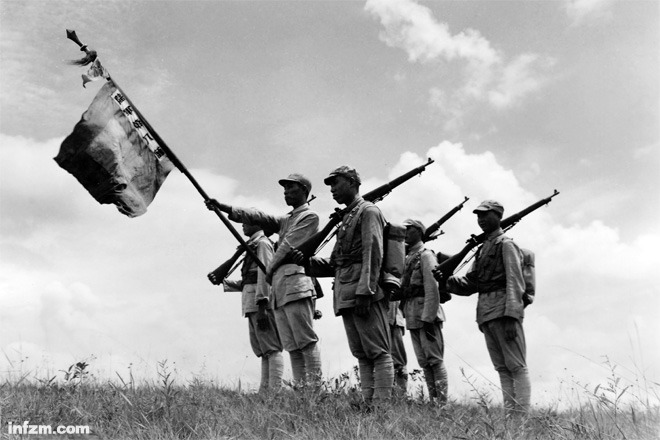
“Nowhere to Kowtow in Barren Fields: Chinese Citizens Erect Monuments to China’s WWII Expeditionary Forces in Burma. ” By Zeng Ming
During the 2013 Qingming Grave Sweeping Festival, 17 Chinese citizens arrived in the border town of Myitkyina, Burma. While walking under the war-torn clouds of the capital of the Kachin state, they stopped at a plot of barren farmland and laid chrysanthemums on the ground.
This movement called “Return to the Burmese Battlefield” is the first large scale non-government organized movement of its kind to memorialize the remains of the 100,000 fallen soldiers of the China Expeditionary Force (CEF). It was here that the CEF initiated the most intense battle of World War II outside of Chinese soil and achieved the first victory of Chinese expeditionary forces since the Sino-Japanese war of 1894-1895.
However, the historical record of this battle is dim and pallid. Standing on this desolate ground, they pay respect to too many things unknown and gauche that have sunken into the ground. They do not know for whom they cry, and they do not know the faces or names of those buried here.
In more than half a century the skeletons of 10,000 soldiers of the China expeditionary force have been brushed over by history, destroyed by human forces, and sent into oblivion in the forests of northern Burma. With the exception of the little that has sunken into the historical record, for their entire journey, the participants of this movement are shaken by a single fact: The British and Japanese have erected grand cemeteries to their fallen soldiers. Each of these soldiers has received the highest degree of respect, and even the names of war horses are carved in stone.
Presently the Burmese know more about the distant victories of colonials and invaders than they do of the CEF even though the latter made a great sacrifice for the sake of peace. This is a competition to reveal the true events of the last century that have since fallen silently off the historical record. This group of volunteers believes China cannot again be left out of the history of this battle. They have decided to do something – to erect a monument to the war of their fathers’ generation. Continue reading
Filed under China, Governance, Myanmar/Burma
A Day at the Fair: Impressions from the China-South Asia Expo
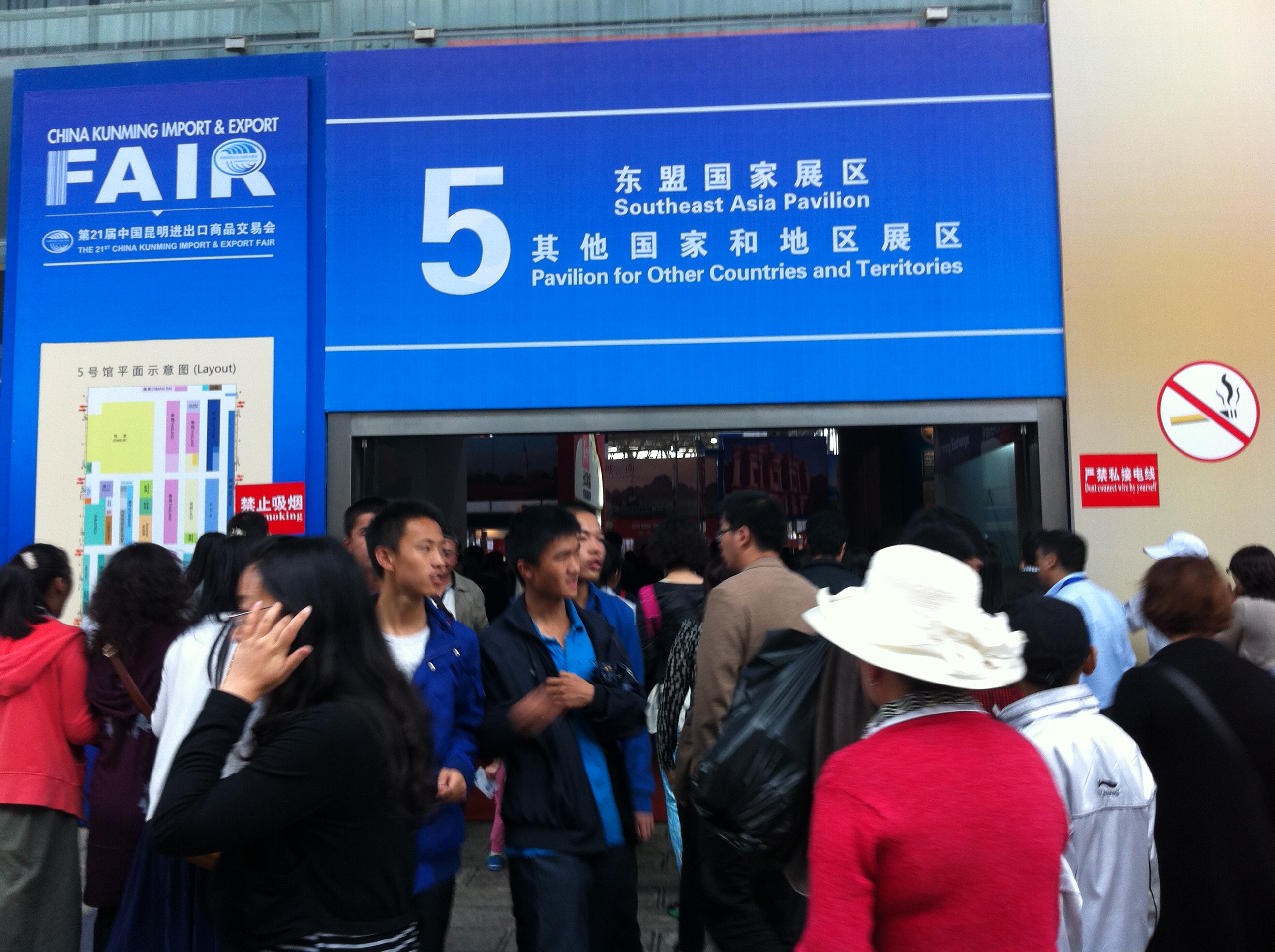
After much excitement on the part of merchants and nervous anticipation on the part of the local authorities, Kunming’s 1st Annual China-South Asia Expo came to a close on Monday. By all accounts the Expo was a great success and went off without a hitch. Fellow ExSE blogger Brian Eyler and I both attended the trade expo on Monday afternoon; the following is a record of our visit.
Monday was not only our most ideal time to attend the Expo, but it also was perfect for most other Kunmingers as they had the day off in honor of Dragon Boat Festival. Therefore, the lines were long and pavilions packed, and it took us more than 45 minutes to finally enter the Expo itself. Our first stop was the Main Hall, where the opening ceremonies were held. Flags from every country represented at the Expo and throngs of visitors taking a rest on the floor. A looped video promoting China-South Asia ties was playing in English with Chinese subtitles. However the English was worded awkwardly and sounded like it was copied directly from Google Translate. Both Brian and I agreed that future consideration towards the translation of materials might make a better impression on international visitors to the Expo given English is designated as the normative language communication between China and South Asia. In the Main Hall we were stopped by a friendly group of local Expo volunteers who wanted us to be part of their souvenir photo collection. Continue reading
Filed under ASEAN, Brunei, Cambodia, China, Culture, Current Events, Laos, Myanmar/Burma, Yunnan Province


