Category Archives: Yunnan Province

The Economics of the Kunming Massacre

In the wake of the Kunming massacre, the mood in Beijing is more choleric than somber. President Xi Jinping immediately announced a nationwide crackdown on terrorism and military troops were rapidly posted at train and bus stations throughout the country. Armored vehicles now patrol Kunming, Xinjiang natives have been told to register themselves at local police stations in Qinghai province and in Guangxi province authorities have asked citizens to report if they see anyone from Xinjiang — anyone at all.

President Xi also issued a gag order on local reporting, with coverage in Kunming Daily and Yunnan Daily provided by Xinhua reporters in Beijing. Meanwhile China Daily featured a front page photograph of President Xi shaking hands with an ethnic Uighur member of the PCC (China’s Senate). But strengthening national unity goes beyond public cries for concord and front page handshakes. It also involves eliminating the perceived cause of the conflict, and the national narrative is that this cause has more to do with nomadism or Islamist ideology than the fact that employment opportunities for Uighur people, even in their homeland province, are dismally inadequate. In 2009 Ilham Tohti, economics professor at Beijing’s Central Nationalities University and an ethnic Uighur, spoke with Radio Free Asia and suggested jobs might be the key to settling unrest.

But rather than address economic pressures, the government continues to focus on Islam as the catalyst. In 2013 police in Xinjiang began harassing women in head scarves and men with beards. Radio Free Asia reported how one man, with no prior record of violence, stabbed a police officer when he was forced to shave. Ehmetjan Niyaz, an intelligence agent with the local security bureau, commented that they had been advised to investigate men with beards. In Xinjiang, that essentially means all Uighur men.

In other words, the more Beijing singles out Muslims as a means of burking separatism, the more separatist Xinjiang Muslims become. Gardner Bovingdon, Professor of Central Eurasian Studies at Indiana University and author of The Uyghurs: Strangers in Their Own Land, writes “the closure of mosques, supervision and dismissal of clerics, and the prevention of religious practice by the young — has made Islam in Xinjiang more rather than less political”.

Another government strategy has been to manipulate the demographics of the region. Of the 60% of Xinjiang’s population that is not Uighur, Kazakhs constitute 7% with Hui being another 4.5%. The remaining dozen or so minority groups collectively make up 8.5% while the final 40% is entirely ethnic Han. According to Dr Stanley Toops of Miami University, from 1953 to 1964 the presence of ethnic Han rose from 7% to 33%. Since the 1970s, this number has remained stable at around 40%, making it one of the fastest demographic shifts in Chinese history.

In 2007 Gaël Raballand and Agnès Andrésy published an article entitled “Why Should Trade between Central Asia and China Continue to Expand?” In it, the authors describe how the Xinjiang Construction and Production Corps, also known as the bingtuan, was created in 1954 to encourage the movement of Han Chinese into the region by creating infrastructure there. In addition to creating an ethnic Han workforce to outnumber local Uighurs, the bingtuan also helps ensure locals remain calm with a security force of more than 120,000 heavily-armed troops. As The Economist points out, propaganda is par for the course:

“A museum in Shihezi, a city in northern Xinjiang controlled by the corps, displays a photograph of members of the bingtuan militia armed with rifles, crouching behind a wall during a 1990 uprising by Uighurs near the city of Kashgar. The militia, says the caption, played an important role in crushing the unrest. Amnesty International, a human-rights group, says 50 Uighurs were killed in the incident, including some who were shot while running away.”

Morris Rossabi, who teaches History at Columbia University, points to the Tang Dynasty as the origin of the bingtuan. Famously cosmopolitan, the Tang Dynasty celebrated the Turkic culture of present-day Xinjiang, staffing its frontier armies with Turkic soldiers and even allowing some, like the great Ashina Se’er, to rise to the rank of Tang general. This helped frontier lands become self-reliant and even afforded some measure of political autonomy. The bingtuan follows this tradition by providing Xinjiang the means for economic self-reliance, yet deviates sharply by staffing its workforce with ethnic Han rather than local Uighurs.

With Xinjiang currently contributing roughly 4% of the nation’s GDP (primarily through oil reserves) as well as Beijing’s Western Development policy, which hopes to see China’s western provinces contribute greatly to the nation’s economy, Uighurs will remain a minority in Xinjiang for the foreseeable future. Dr Ilham Tohti has stated he is not opposed to state-orchestrated migration policies, but that these policies need to be carefully reviewed, pointing that if there are enough jobs to warrant the migration of millions of ethnic Han into the region, then why aren’t there enough jobs for the people already living there?

In 2006 Dr Tohti launched a website promoting understanding between ethnic Han and Uighurs, but in 2009 it was shut down and Dr Tohti was arrested. He was released shortly before President Obama’s visit to Beijing but in January 2014 the BBC reported he had again disappeared, that his family had no knowledge of his whereabouts and that the government was charging him with separatism — a crime punishable by death.

For now, events like the Kunming massacre serve to further Beijing’s program of economic development in Xinjiang by providing carte blanche to those who view ethnic identity as a major roadblock to China’s economic future and by giving Xinjiang politicians an easy scapegoat when they fail to provide economic paths of opportunity.
Leave a Comment

Filed under China, Current Events, ethnic policy, Kunming Train Station Attack, SLIDER, Yunnan Province

The Kunming Train Station Attack: A Hypothesis

In answering the question “Why was Kunming chosen as the site of last Saturday’s attack?”consider the following:

In response to a police crackdown in Hotan, Xinjiang beginning in the summer of 2013, a large group of Uighurs attempted to make their way to Laos through Yunnan. Instead of escaping to Southeast Asia as refugees as planned, thirty were arrested at the border along with dozens of others throughout the province. Warrants were issued for those who were not immediately caught, and a detailed most wanted list was made public. At least eight remained at large and as time passed, hope for the release of their compatriots or relatives and their own escape to a foreign refuge grew smaller. With warrants out for their arrest and a heavy police presence in Xinjiang, returning home was impossible. Without local ID cards, settling down in Yunnan would prove just as difficult. Out of viable options, the group of eight decided to make a brutal last stand, taking out vengeance on the province where their plans failed. Gathering what little resources they could find in Kunming, the group planned to strike where they would be able to cause the most damage. And so on March 1, 2014, five people walked into the Kunming Train Station with knives and terror ensued. Continue reading →

5 Comments

Filed under China, Current Events, Kunming Train Station Attack, SLIDER, Yunnan Province

Kunming in the aftermath of the train station attack

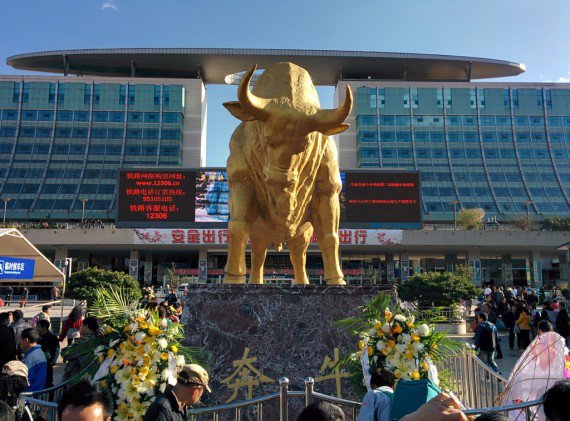
Memorials in front of the Kunming Train Station

Memorials in front of the Kunming Train Station

In the aftermath of the attack on the Kunming train station, in which official sources say at least 29 people lost their lives and 143 were injured, I went to sniff around the city for stories and reactions. People were stoic, supportive of their fellow citizens and seem to steer clear of any racial violence.

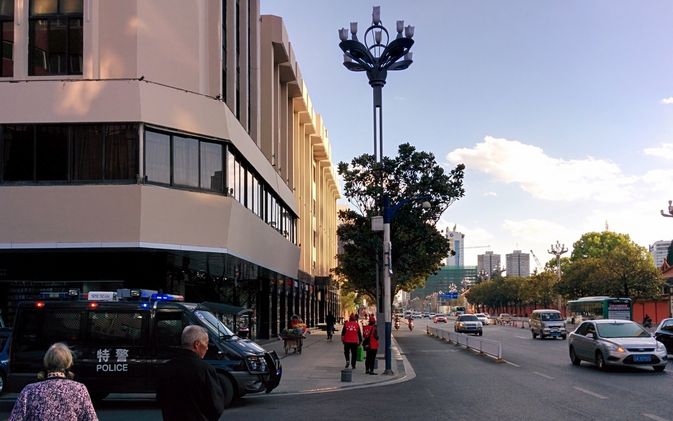
In general, the city felt ridiculously normal for the day after the attack . The people manning the gate at my compound greeted me as cheerily as I scooted down the hill and the only armed police I saw were hanging around a major interchange. Most people ambled lazily around Green Lake park, gazing at the flocks of sea gulls on their way back to Siberia as if nothing had happened. Not a SWAT team to be seen, even though this would be a potential spot for carnage. Kunming’s 1st People’s Hospital also had only a few law enforcers stationed outside, a shrill contrast to the mob of police inside that was trying to keep nosy journalists at bay.

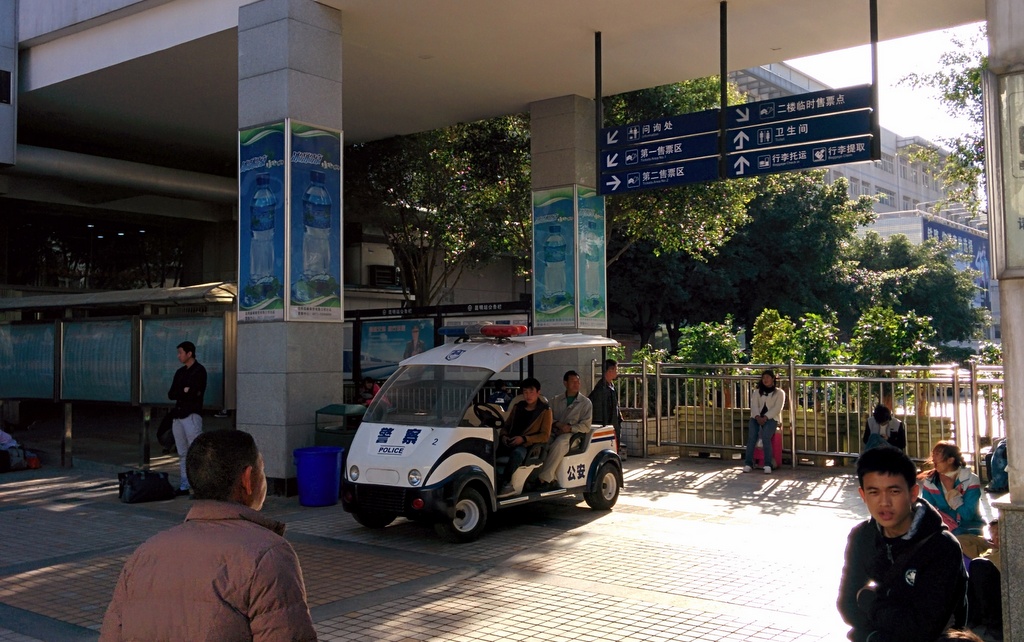
Unmanned police vehicle manned by local kids — right in front of the train station ticket office

Unmanned police vehicle manned by local kids — right in front of the train station ticket office

Even the train station felt relatively normal. On the left side of the square, a large part was sectioned off with police line and a dozen or so armed SWAT policemen were swarming around. In the middle of the square, under the large gilded bull, people were taking pictures of flowery memorials, one of which had already fallen down and torn. The ticket hall, the goriest place from Saturday’s attack, had been properly cleaned and was again filled to the brim with people queuing to buy tickets.

A young man cheekily ran behind me to measure himself against my height, so I used that as a pretext to ask him some questions. Whether he was afraid? “If I were afraid I wouldn’t be here”. Any other questions resulted in him uneasily shooting his eyes around so I left it at that.

A SWAT vehicle on Beijing Lu

A SWAT vehicle on Beijing Lu

The cigarette lady was more helpful. She had already closed the shop and gone home for the night when the killings happened, but she was dead afraid to come to work on Sunday. She had wanted to stay home, but her boss and the need for a salary made her show up. She added that the extra security made her feel safer, though. A Bai minority woman in traditional dress was waiting for her daughter to pick her up. When I asked her if she was worried about coming here, given yesterday’s events, she replied: “which events?” Apparently the news had not reached rural Dali.

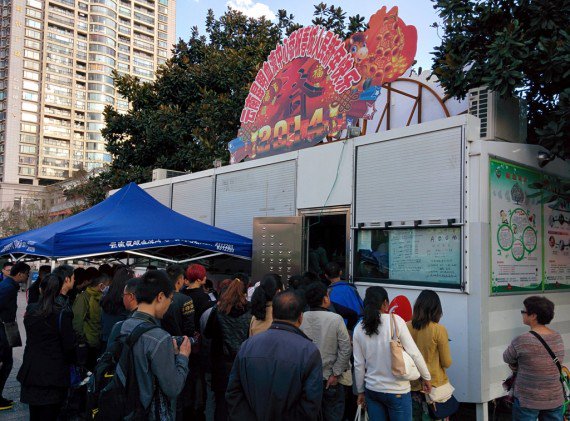
I also visit one of the mobile blood donation centers that the government had set up at twelve different locations all over the city. They must have rushed them in, as the containers still sported a sign for a previous blood-donating event at New Year’s day and make no mention of the stabbings the day before. That didn’t seem to stop people from flocking to the cabin. I am told that at least 150 people had already donated blood at this point and another 60 people were waiting to give.

Mobile blood donation center – caption reads: "Kunming blood donation center wishes Spring City residents a happy new year"

Mobile blood donation center – caption reads: “Kunming blood donation center wishes Spring City residents a happy new year”

I met Miss Wu (25) and her two friends at the mobile blood bank. She herself is not able to donate, but her two male companions are. While the two men were inside, I struck up a conversation. ”We’re here to help our fellow citizens after yesterday’s massacre,” she beams. Solidarity and stoicism obviously go hand in hand in Yunnan. “I don’t think this will affect how I see Muslims,” she explains, “and I don’t think it will the view of most other Chinese, either. The attackers were a violent group who had nothing to do with other Muslims. There have even been a lot of Muslims coming in to donate blood. Wherever you have people, you have bad ones.”

A Chinese journalist asked me my opinion and added that he had not been able to interview any Uighur people. “Perhaps they’re afraid for retaliation [from Han majority people], but they really needn’t be, there doesn’t seem to be a strong anti-Muslim sentiment among the people.”

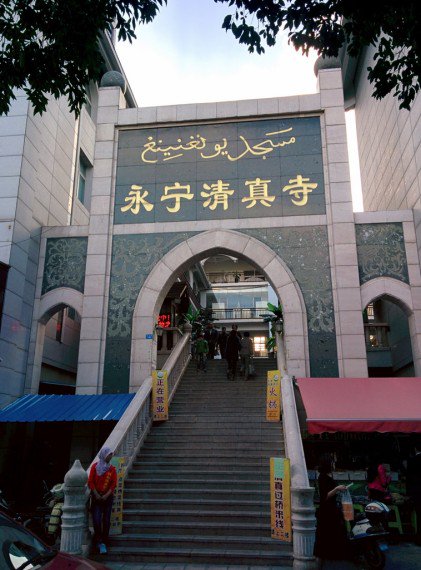
Business as usual at a Kunming mosque

Business as usual at a Kunming mosque

At the nearby mosque at Jinbi square, too, everything seemed to be business as usual. No signs of Islamophobic rioting, just people cooking all kinds of Halal cuisine for visitors. I talked to Ma Jun, a Hui (ethnic Han Muslim) woman from Inner Mongolia. While roasting some Erkuai pancakes, a local Yunnan delicacy, she told me she had seen some Uighur people coming in today for food and prayer, like on any other day. She made a plea for stronger feeling of unity among the Chinese people and says all will always be welcome under the roof of the mosque.

Questions remain, though, which no one currently has an answer to. One such question is: why Kunming? Of all places of importance to the government, was Kunming just the one with the weakest security? Were the attackers simply locals? Were they after tourists or after a particular train (the train to Shanghai was about to leave)? Kunming has almost no history of violence in the contemporary era, with the only notable event being the bombing of a bus in 2008. Then, too, Uighurs were initially blamed until it was later revealed that the lone bomber belonged to theHui minority.

Editor’s note: This article was written by Kunming transplant Sander Van de Moortel and originally published on his blog A World of Nonging, on March 2.

1 Comment

Filed under China, Current Events, Kunming Train Station Attack, SLIDER, Uncategorized, Yunnan Province

Deadly Kunming Knife Attack Leaves 33 Dead, 130+ Wounded

luggage

Kunming is a city known for its sleepy nature and a perfect climate that promotes a casual urban way of life.  In many ways it offers an alternative to the busy competitive nature of China’s first and second tier cities.  As the capital of Yunnan province, the city also prides itself as a peaceful melting pot of ethnic unity in one of the most ethnically diverse areas of the world.

The Spring City’s reputation was irrevocably changed on the evening of Saturday March 1 as a group of five to ten knife-wielding attackers entered the Kunming Railway Station and engaged in a stabbing rampage that killed 28 passengers and wounded more than 100. The Chinese government is labeling the assailants as a Uyghur separatist terrorist group although very little is known of the actual identities of the assailants and their motives.

This horrifying incident is the bloodiest in recent memory to occur outside of Xinjiang, a territory that has seen an increase in restive ethnic activity over the past five years. The domestic Chinese media and international media are providing plenty of coverage of the incident, but many questions remain unanswered and facts surrounding the incident are sketchy at best.

Most importantly, who are the assailants?  Why was Kunming and its train station chosen as a site for the attack? And how could security at the train station be so lax to permit this unprecedented violence?

Official reports confirmed late Saturday evening that security forces killed four of five assailants and apprehended a fifth female attacker.  In the firefight one or more of Kunming’s SWAT force was injured with undisclosed levels of injuries.  Phoenix TV reported three of the assailants fled northward on Beijing Road (Kunming’s central north to south thoroughfare) out of the train station and continued to stab innocent bystanders until they met a police blockade several hundred meters from the station. Two were shot on sight and one apprehended, allegedly a woman five months pregnant.  Photos show the assailants were wearing the same black head to toe uniforms and were said to have their heads covered. Early Sunday morning March 2, photographs of a short sleeve black t-shirt with a crescent moon and Arabic script began to circulate Chinese social media channels; the t-shirt was the alleged uniform of the attackers – however, photos of the apprehended and assailants killed on site suggest they were wearing long sleeve shirts.

photo

On Sunday morning March 2, the official Chinese media labeled the incident as a terrorist attack laying the blame on Uyghur separatists groups.  At the point of this publication no names, photos, or information on the assailants have been released to the public. Identifying the assailants as Uyghur did confirm the initial messages that hit popular Chinese social media channels around 10pm on Saturday evening.  Concerned Chinese citizens are calling for the release of information on the assailants by the public security forces, but due process in China does not require the release of such information.  It is possible that we will never know the true identity and motivations of the attackers.

At noon on March 2, a list of 11 Uyghur men with names and headshots began to circulate Chinese social media sites.  The men are labeled as suspects fleeing the scene of the crime and no information has been released about their specific connection to the incident.  Were these men identified by close circuit cameras in the train station? Were their names divulged by the apprehended fifth attacker? Were they simply men who failed to show up to work on Sunday and reported by their Han Chinese employers as missing or by local observers as suspicious figures? Again Chinese criminal and legal processes help to shed little light on the identity of these men who apparently are still at large.

Kunmingers are in a state of fear and disbelief as news of the incident unfolds. Of the few people interviewed by ExSE most state that it is important to stay indoors since suspects were still on the run. The municipal public security bureau has asked all housing complexes, public venues, and university campuses to increase security surveillance methods. Property management companies of housing complexes are encouraging residents to blanket report sightings of any Uyghurs to local police stations.

Photos from the Kunming No. 1 Hospital located in the center of the city show the wounded recovering in gurneys, occupying hallways in the already crowded and resource strapped facility. A Sina Weibo user reported in an unverified report that a migrant family cannot afford the 50000 RMB required for treatment of their critically injured child.

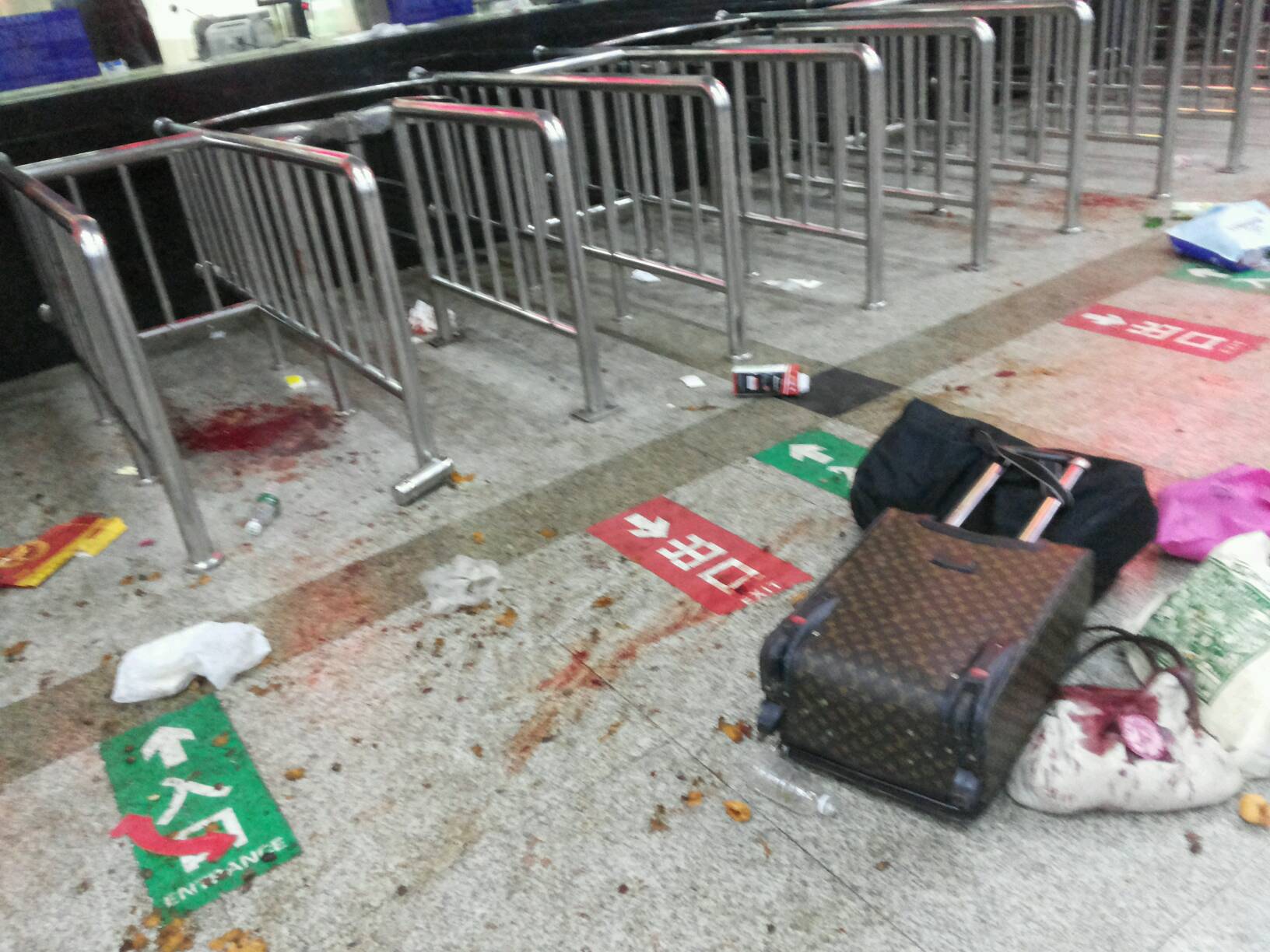
Chinese train stations are often crowded and packed with passengers into the late evening as passengers board overnight trains to destinations throughout the country. Kunming’s station last night was no exception. The mix of people in the train station was likely comprised of various walks of life from migrant workers, to middle-class tourists, to foreign backpackers heading to the popular tourism destinations of Lijiang and Dali as well as points north in inland China.  One photo showed a bag of golf clubs against a wall towering above a pool of blood.  Gruesome photos of the scene also show luggage left strewn throughout the scene of the violence, a rampage that occurred in many of the stations waiting halls in addition to the main ticketing room.

Anyone who travels on China’s rails and bus system knows the security at train and bus stations is extremely lax. Poorly trained guards – really hired help in shabby blue uniforms – man posts at metal detectors and luggage scanners placed in station entryways more for show than to serve a security purpose. At peak times train and bus stations are much more crowded than airports in China and metal detectors are constantly sounding as passengers walk through without any recourse or further pat downs. With the exception of Xinjiang and Tibet were security has been increasingly tightened over the past five years, the quality of procedures to safeguard the security of public places wanes as one gets farther  away from Beijing.

This lax security culture is likely to, and hopefully will change as a result of the incident in which locals are dubbing as Kunming’s 9/11. China’s President Xi Jinping dispatched top domestic security official Meng Jianzhu to Kunming to oversee the investigation that comes days before the opening of critical government meetings in Beijing. This incident will surely cast a cloud over the meetings which are a critical platform for Xi to further deepen his reform policies for China – or the incident will force the agenda to be more focused on security concerns, an already expressed concern for the new leadership. Meng Jianzhu said in a public statement today, “This gang of terrorists were cruel without any humanity. They completely abandoned their conscience. We must strike hard against them according to the law.”

Perhaps the known factor of a lax security environment and a municipal government famous for slow responses and public relations nightmares made Kunming an easy target for the assailants – if they were as the official Chinese media claims from western Xinjiang. We are all still grappling to understand why Kunming was chosen as a target for an attack of such scale. The last time an incident of this nature – although admittedly we are still trying to figure out the exact nature of the incident – happened was a series of two bombings in 2008 when a local man, a former convict disgruntled and unable to find a place and job in China’s competitive society bombed a bus killing two and then unintentionally killed himself in a second bombing inside the popular Salvador’s Café in the city’s university district.  The two incidents were spread out over a five month period. Prior to the bomber’s death in the second December 2008 bombing, authorities blamed the first bombings on Uyghur separatists until they could forensically link the two incidents. The bomber was Hui Muslim but not Uyghur and religion ties or ethnic suppression were not revealed as motivations for the incident.

Today on the streets of Kunming, many were reluctant to discuss the incident.  Known acquaintances opened conversations with “the thing on TV” or “what was in the news,” a reaction that displays the shock and disbelief that this could happen in their city or a willingness to distance themselves from the incident in self-protective behavior. A local fruit vendor was angry beyond words and could only mutter, to my disbelief, that all Uyghurs should be corralled and shot. Another local suggested that as a foreigner I should pack my bags and go back to the West where “you don’t have to worry about terrorism.”  Similar responses and sentiments pervade the Chinese population

As the city begins to piece itself back together with the start of the work week tomorrow, ExSE will continue its discussion of this horrible incident, continuing to comment on official media response, the discussion of Uyghur separatism and its link to the incident. In addition to the broader topics above which the mainstream media has already defined as its main narrative surrounding the incident, ExSE, a Kunming based website is interested in exploring issues on the ground here in the city as they unfold and from a long term, more connected perspective.

With so little information released on the true identities of the assailants as well as the identity of those slain in the attack, how does an urban society process and respond to such a violent incident? We are also curious and concerned to the way an urban society heals from the shock and grief that now holds sway over Kunming and to what effect security will be raised in the city in both the short and long term. Importantly how will the ethnically diverse but general peaceful and non-restive ethnic groups of Yunnan respond to an attack labeled with ethnic motivations by an outside separatist group?  And will angry Chinese nationals seek retaliation against Uyghurs and Muslims in all patterns of ethnic and nationalist tension that are becoming more and more predictable in China?

Please feel free to leave comments to this post or if you have contributions, contact us at eastbystheastmail@gmail.com.

2 Comments

Filed under China, Current Events, Kunming Train Station Attack, SLIDER, Uncategorized, Yunnan Province

A Quick Glance at Yunnan’s 2013 GDP

Below is the translation of a recent media release on Yunnan’s GDP and breakdown by sector and source.  I’m still tracking down some explanatory data (like why imports decreased by 10%) before I provide analysis and representations, but observe that total debt is greater than 2013 GDP as well as debt/total savings ratio is approximately 77%.  Investment growth was double consumption and real estate investment grew by 40%!   Lastly, there seems to be a mistake with total fixed capital investments listed at nearly 85% of GDP. 

Yunnan Wangxun – January 17, 2014 (author: Lei Suyue): Experts at the Yunnan province Bureau of Statistics report the province’s 2013 GDP totaled 1.17 trillion RMB (193 million USD).  The province’s GDP growth rate ranked third in China at 12.1% and is demonstrating a stable and positive trend. 

The data show the agricultural sector contributing 305bn RMB and growing by 7% on the previous year.  Grain harvests were the highest in five years totaling 18.24mn tons and a YOY growth rate of 4.3% (.749mn tons).  Additionally, special agriculture industries (agro-forestry, livestock, and fisheries) from upland areas (高原特色农业) are contributing strongly to this growth in terms of improvements in quality and quantity.

Industrial output rose to 347Bn RMB and grew by 12.3%.  Light industry contributed 152.8bn RMB and grew by 7.4%.  Growth in heavy industry rose to 194.3bn RMB demonstrating a significant growth rate of 16.3%.  These industries consumed 675.2bn tons of coal (8.1% growth), and the entire province consumed 145.9bn KWH of electricity (10.9%).

Investment in fixed capital assets (not including farm investments) increased by 27.4% reaching a total of 962bn RMB (translators note: this looks too high, could be a typo).  Real estate investment totaled 248.8bn RMB (39.6% growth).  The province added a total of 182mn square meters (27.1% growth) and sales of 33mn square meters (2.2% growth) at a total value of 14.87bn RMB (9.1% growth).

Total government expenditure for 2013 was 278.5bn RMB. Total government revenues for Yunnan province totaled 161bn RMB (20.4% increase).  Tax revenue totaled 121.5bn RMB (increase 14.2%); Non-tax revenue totaled 38.56bn RMB (44.3% increase)

Provincial government expenditures (including locality expenditure) totaled 409.65bn RMB (14.7% increase)with 278.46bn RMB spent on education, social welfare and employment programs, agro-forestry and water resources, transportation shipping, and social housing programs.  This expenditure rose 34.4BN RMB from last year and totals 68% of provincial public expenditure.

Total Consumption reached 403.6bn RMB – a 14% increase over 2012. Urban consumption totaled 324bn RMB growing by 13.8%; rural consumption totaled 79.5bn RMB (growth 14.5%) 7 percentage points higher than urban consumption growth rates.

Yunnan’s international trade (exports + imports) totaled 125bn RMB (25bn USD)

Total trade rose by 22.9% in 2013 – the province’s growth rate is 15.3 points higher than the national trade growth percentage.  Among this exports totaled 15.96bn USD (59.3% growth); Imports totaled 9.87bn USD representing a decrease of 10.2%.

By the end of December, 2013, total savings of provincial financial institutions totaled 2.06 trillion RMB, an increase of 271.84bn RMB (15.2% increase); total debt of Yunnan’s financial institutions is 1.58 trillion RMB an increase of 192bn RMB (14% increase)

GDP breakdown by sector: Primary sector GDP totaled 189.5Bn RMB (6.8% growth), secondary sector GDP totaled 492.8bn RMB (13.3% growth) where industry contributed 376.7bn RMB (12% growth) and construction totaled 116bn RMB (18.4% growth);  Tertiary industry totaled 489.8bn RMB (12.4% growth).

Yunnan has made progress in navigating its development through the pressures of the complex global economic climate through the promotion of a “Stability provides progress, stability provides effectiveness, stability provides expedience” program.  Success in Yunnan has come from promoting stable growth, institutional restructuring, promoting reform.


2 Comments

Filed under China, Current Events, Economic development, SLIDER, Yunnan Province

The Unlikely Story of Pastor Yang Congguang

Pastor Yang Congguang and his wife

Pastor Yang Congguang and his wife

It’s lunchtime in Mae Salong, a small village perched on the spine of mountains that trail south from China’s Yunnan province to divide Thailand and Myanmar. The restaurant sign is in Thai, but the menu is written in traditional Chinese, offering peanut-flecked pad-thai noodles and steamed chicken jiaozi dumplings finished with tea grown in the surrounding hills.

Throughout the meal, English, Thai, Mandarin, and a local Akha dialect mingle along with the food, a cultural confluence that reflects the town’s unique history. Officially now called Santakhiri by the Thai government, Mae Salong is perhaps best known for its role as a heroin trading outpost and as a base for remnants of Chinese Kuomintang forces who refused to surrender to the Communists. Even today, the village has a distinctly Chinese flavor, where a dialect similar to Yunnan’s is spoken at stores, restaurants serve Yunnan-style food, and Mandarin language instruction is an option for public education.

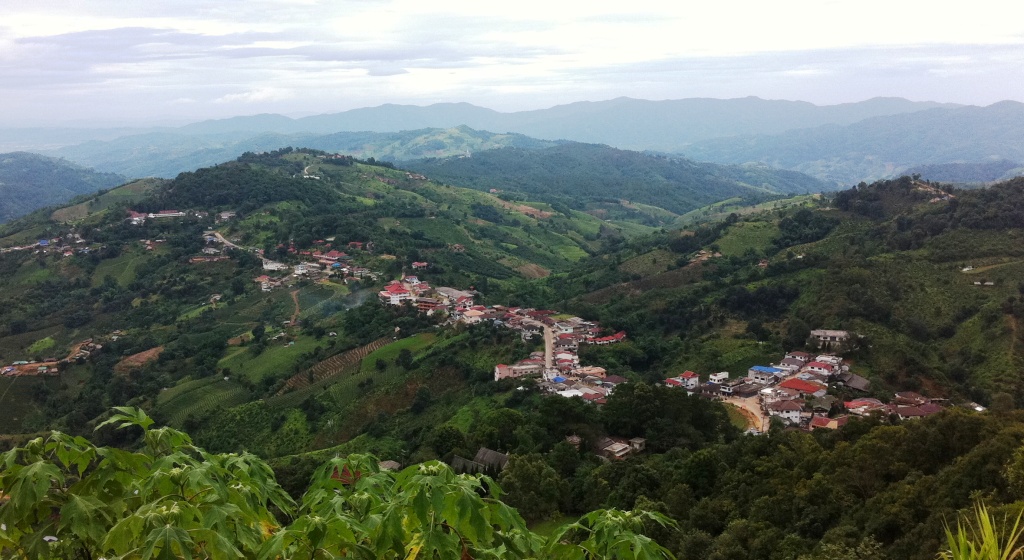
The village of Mae Salong

The village of Mae Salong

The local economy now relies on tea production and cultural tourism surrounding the local Akha highland hill tribes rather than heroin, however the Kuomintang heritage of many villagers remains an enduring legacy. Pastor Yang Congguang of the local Baptist Church is one such resident of Mae Salong.

Pastor Yang was born in 1956 in Luxi County in Yunnan Province, during what he calls “an era of war” that followed him around through childhood and much of his adult life. By the time he was two years old, Yang had already been registered by the government to join the army upon adulthood, along with his two older sisters. Yang’s parents decided to flee to Burma, hoping to escape increasingly dismal prospects in China.

Yang’s father, a farm veterinarian, went first in 1957 to a village in Kokang in northern Burma settled by other ethnic Chinese. The head of the village there owned some 3000 horses, and his father’s skills were highly sought after. However, the Chinese population of the village were not the majority Han ethnic group like Yang’s family, but the Lisu people, one of the many ethnic groups of upland Southeast Asia.

Yang’s father found the Lisu not at all as he had imagined “backwards” minority people to be. He was impressed how many of the Lisu, especially the Christian population, did not smoke, drink or gamble, and furthermore were educated enough to read. Yang’s father told the chief that he wanted to bring his family to the safety of Kokang, and that if the villagers prayed for the family’s safe passage, they would all convert to Christianity.

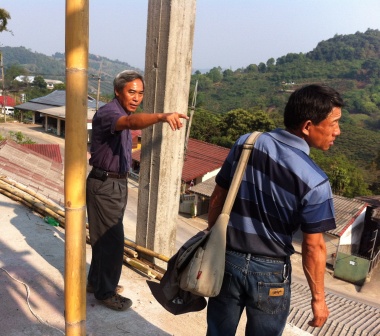
Yang supervising construction of his new church.

Yang supervising construction of his new church.

By this time it was 1958, and leaving China had become increasingly difficult and dangerous. Yang’s extended family, numbering sixteen people in total, required three trips and traveling only at night through the forests. During the final trip, it rained hard all night just before they were to cross the border and the group lost the right path. When the sun came up, his father realized they were very close to the only road across the border, manned by a PLA checkpoint. Despite the danger of trying to cross during the day, Yang’s father decided to take the risk. At the border, chance had it that checkpoint patrol house was empty, although the stationed soldiers had built a small fire. Yang’s uncle stopped briefly to warm his hands, telling the group to go on ahead. Today, Yang estimates that his family must have had only a few minutes’ window of time to sneak across the border.  His uncle did not rejoin the group and was never seen nor heard from again.

Once in Burma, the Yang family reached Kokang safely and converted to Christianity as promised. The Kokang authorities did not permit education in Chinese, so Yang learned through studying the Bible. In Kokang the family had a few years of peace, until 1966 when the Burmese Communist party swept into the northern border region, beginning a period of civil unrest as well as tumult in Yang’s life. The family moved further south, to an area in Burma populated by the Shan (Dai) ethnic minority, where they stayed for three years until once again the Burmese communists arrived. The Yang family to Lashio in the eastern Shan state, and then again even further south to an area with very few ethnic Chinese.

Yang’s adolescence occupies a murky place both in memory and time, a period of transience and uncertainty that also coincided with the rise of the heroin trade in Southeast Asia. Former Kuomintang soldiers clashed with Burmese communists, with unrest and violence spilling across the borders of Thailand, Burma, and Yunnan. During these years, Mae Salong sprung up as both a drug trading outpost and a refuge for Kuomintang soldiers recruited by the Thai government to counter Communist threats.

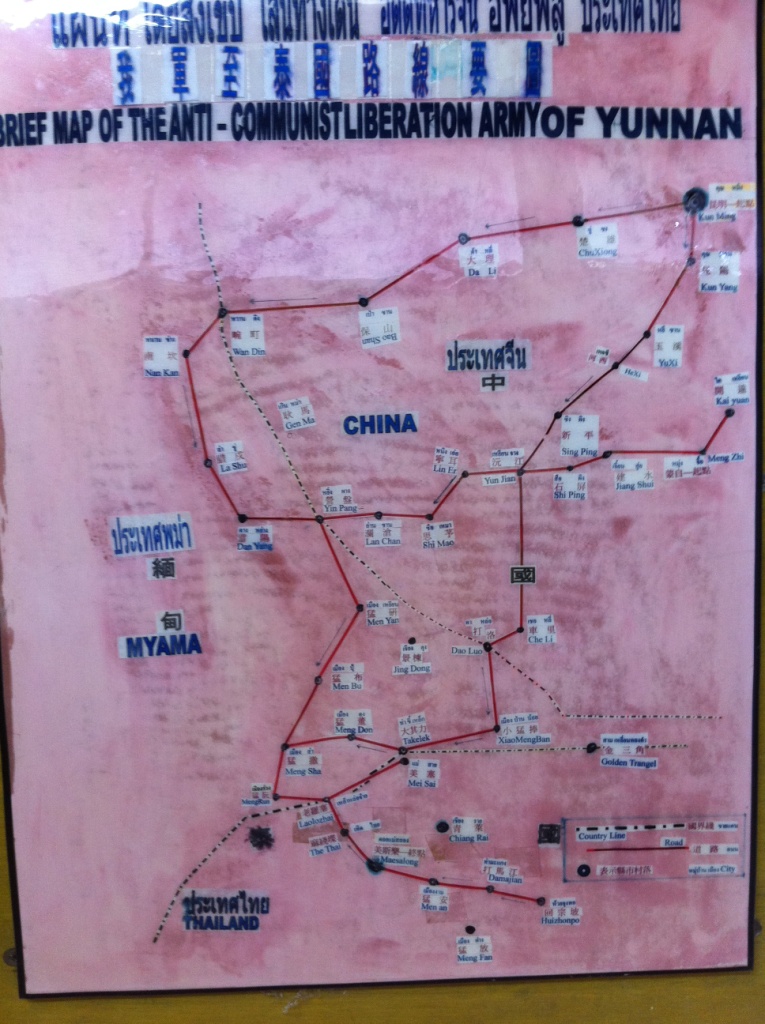
A homegrown depiction of the KMT's path of flight from China to Mae Salong

A homegrown depiction of the KMT’s path of flight from China to Mae Salong

“It was like trying to escape from a jaguar only to run into a tiger,” says Yang. “My parents didn’t want me or my siblings to grow up to be soldiers, so every time the armies came we left. But everywhere we went, they kept coming.” In 1973 he reluctantly joined the Kuomintang for a little over a year and fought against the Burmese. During this time, his faith kept pushing him to seek a different path. “I kept thinking some verses were especially speaking to me – that I should rather be a guard outside the house of God than live in the opulent tent of an evil person. The army for me meant living in an evil person’s tent,” he remembers on his decision to desert.

Yang escaped across the Salween river to Thailand at great personal cost. His commander came to his family’s house, and threatened Yang’s father to make him return. Yang’s father refused, and was taken away by the army along with nearly everything from their house, which was then burned. Yang’s brother escaped to the forests, but Yang found out later that the army shot his father by the side of the road.

For six years Yang drifted, stateless and without identity like many Yunnanese refugees in Thailand, feeling both immense guilt at the death of his father and a responsibility to lift his family back on their feet. He worked odd jobs to try and make money, “but life had no color, and I thought God had perhaps forgotten me.” But in 1981 he received an opportunity to enroll in Bible college in Bangkok, and a new beginning. His first job afterward was working at a church in Mae Salong, the village known for its KMT heritage.

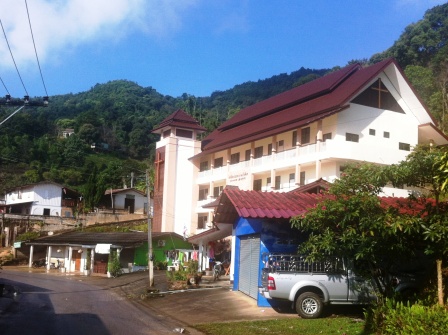
Today Yang is the pastor at the Mae Salong Baptist Church and with a wide smile proudly shows off a gleaming new building opened just this past year.  Over the past three decades, Pastor Yang has developed his own parish into a congregation made up of two hundred families who travel over the hills and footpaths to his church for worship, schooling, and community programming.  In the early 1990s, Pastor Yang and his wife built a single room church with the little donations they could gather from local villagers and began offering free Chinese language education to Yunnanese, Akha, and Lisu families who could not afford tuition at the state sponsored school.


Mae Salong's new Baptist Church

Mae Salong’s new Baptist Church

The newly built church has eight large classrooms for free Chinese language and free primary education classes taught by a cohort of regional volunteer teachers from Thailand, Singapore, Malaysia, and mainland China. Many of the students are Akha, as most of the Chinese residents of Mae Salong can now afford to attend school further down the mountain, reflecting a growing assimilation with Thai culture as more and more move away from the village to bigger cities. Yet Yang remains confident that his church and school can serve as a bridge between the past and present, as well as provide opportunities to educate the Akha residents of Mae Salong. Yang says the students are not required to be Christians to attend the school.  The Baptist Church also has a healthy relationship with the small Yunnanese Muslim population of Mae Salong, sharing access to public water resources and cooperating to bring a new pipe to the village. Yang is content, and although his life is modest he finds fulfillment serving his community.

Pastor Yang and Mae Salong may share a history that began in an era of war, but more importantly they both have a future supporting a community where multiple cultures can mix, and peacefully coexist.  “Life is good,” he smiles while looking over the town, across the green ridges of tea terraces and mist-covered mountains towards the border of Myanmar some fifteen kilometers away.

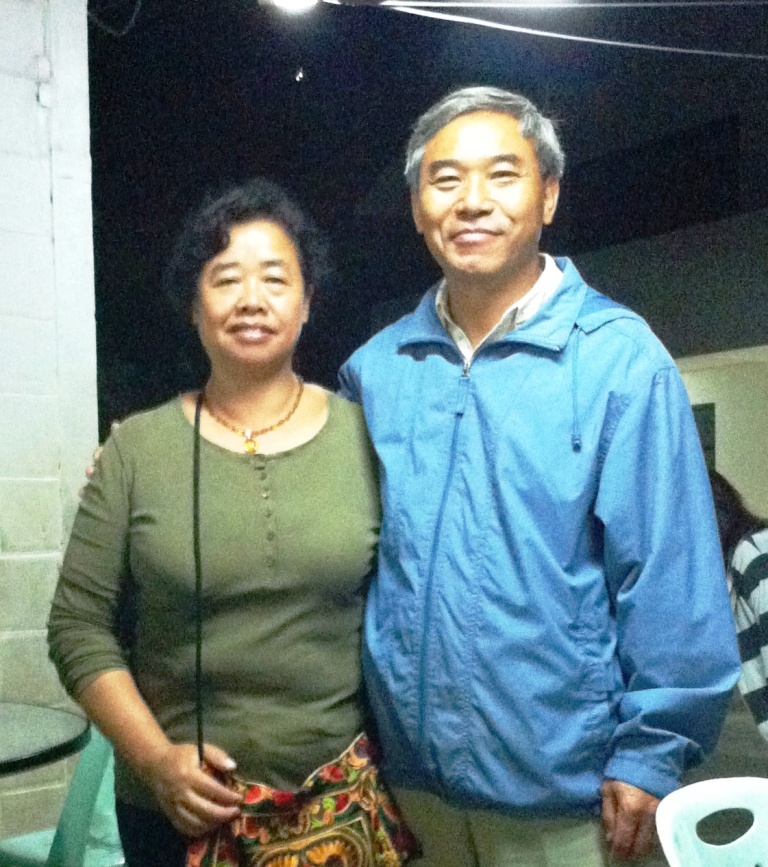
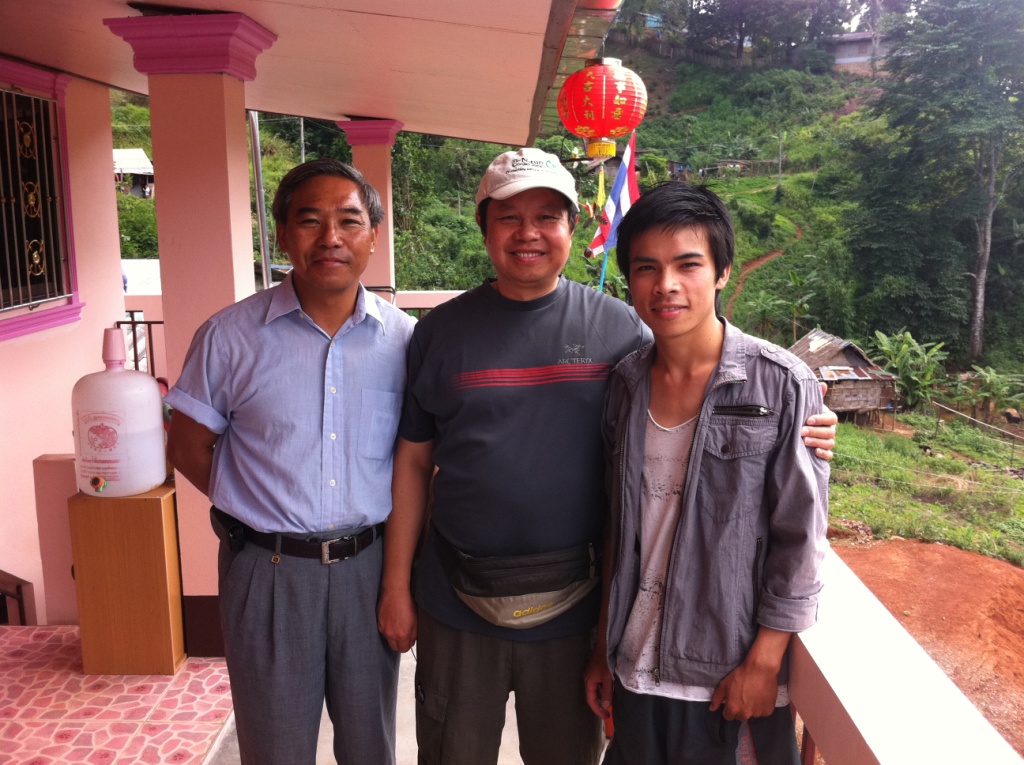
(from left) Pastor Yang with ExSE contributor Zhou Dequn and Ashi, the first of his family to attend college after matriculating through Yang's school

(from left) Pastor Yang with ExSE contributor Zhou Dequn and Ashi, the first of his family to attend college after matriculating through Yang’s school

Leave a Comment

Filed under China, Culture, Myanmar/Burma, SLIDER, Thailand, Uncategorized, Yunnan Province

The Kunming-Bangkok Highway’s Final Link Opens over the Mekong

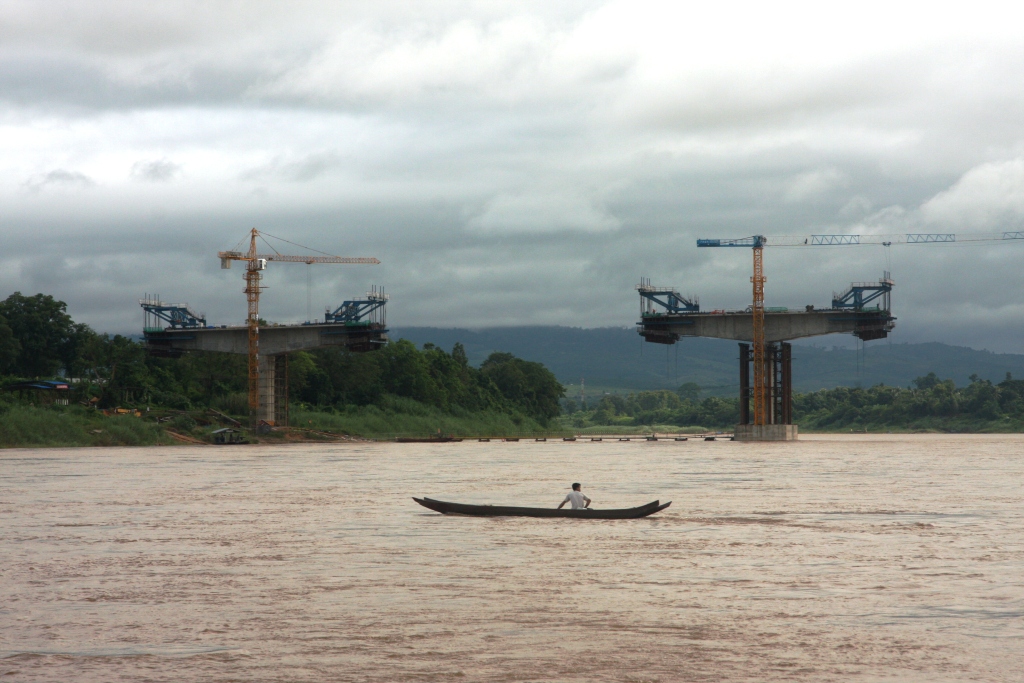
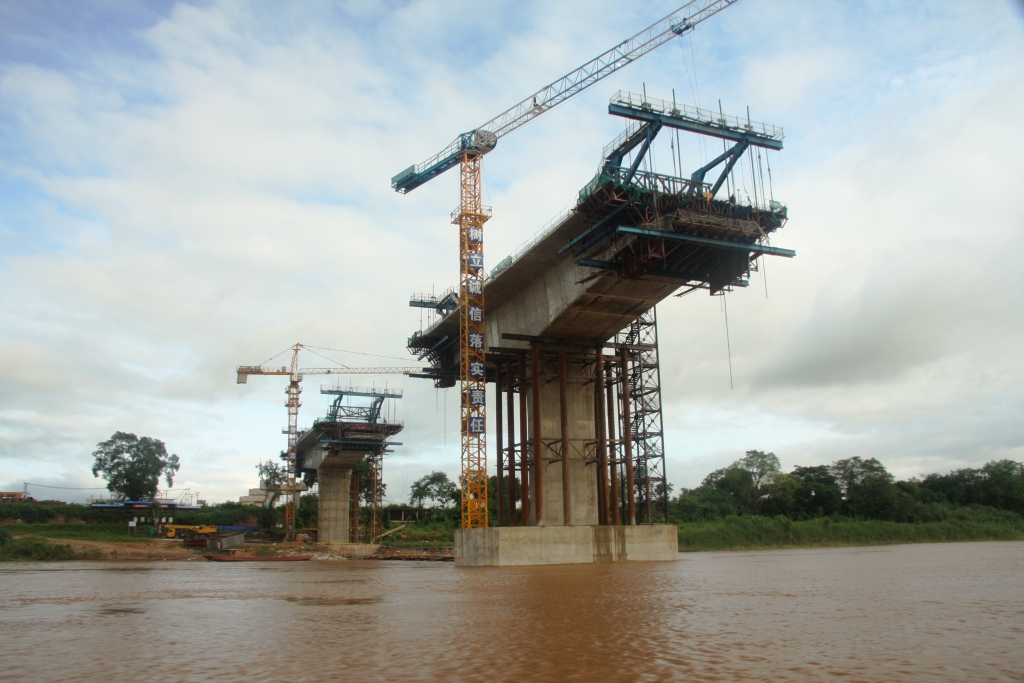
The Fourth Thai-Lao Friendship bridge which connects Thailand’s Chiang Rai province to Lao PDR’s Bokeo province officially opened for business yesterday.  Although the bridge, which stretches 400 meters across the Mekong river, and surrounding customs and inspection infrastructure have been completed for a few months, the two countries set the auspicious date of December 11, 2013 or 11/12/13 as written in the international form for the bridge’s opening ceremony conducted by Thailand’s highly respected Princess Sirindhorn.


A local fisherman navigates the Mekong downstream of the new bridge (July 2012)

A local fisherman navigates the Mekong downstream of the new bridge (July 2012)

The prime benefactor from the bridge’s opening is not Thailand or Laos, but rather China as the bridge serves as the final link in the Kunming-Bangkok highway, a 1900km series of connected highways that will facilitate significant increases in container shipping trade between China and Thailand.  Six years ago overland transport between Kunming and Bangkok for container shipping was virtually impossible due to the poor quality of roads.  In China’s southwestern Yunnan province, a drive from Kunming to Jinghong, the Dai cultural capital of Sipsongpanna (Xishuangbanna) prefecture took up to 24 hours and another six hours to the Lao PDR border at Boten.   China completed its portion of the highway to in late 2007.

The Lao PDR segment of the highway connects Boten to the 4th Friendship bridge in Huayxai and cuts through 180km of the most remote parts of Laos.  In the summer rainy season of 2004 I hitched a ride on a pickup truck to travel the 180km segment which then was a single lane mud track.  We completed the tiresome 10 hour drive only after averting a serious accident and certain death when the truck spun out of control nearly pitched over a 400 meter cliffside.    China, Thailand, and the Asian Development Bank invested equal thirds in the Laos portion of the highway which opened in 2010 and dropped transportation time to three hours.

By design, the highway system links the friendship bridge to Bangkok, but despite being the strongest economy on mainland Southeast Asia, Thailand’s highway system lags behind in quality compared to China and the stretch running through northern Laos.  Improvements to Thailand’s R3 highway system which will link Chiang Rai province to all points in Thailand is ongoing but far from complete.  Thailand has promised to upgrade its national transportation and highway infrastructure but political roadblocks, corruption, and a perceived lack of momentum for regional integration at many levels of Thai government and society has discouraged those plans from synching up with China’s outwardly stretching infrastructure linkages.   When the Thai roads are finished, a container truck will be able to travel from Kunming to Bangkok in less than 18 hours.

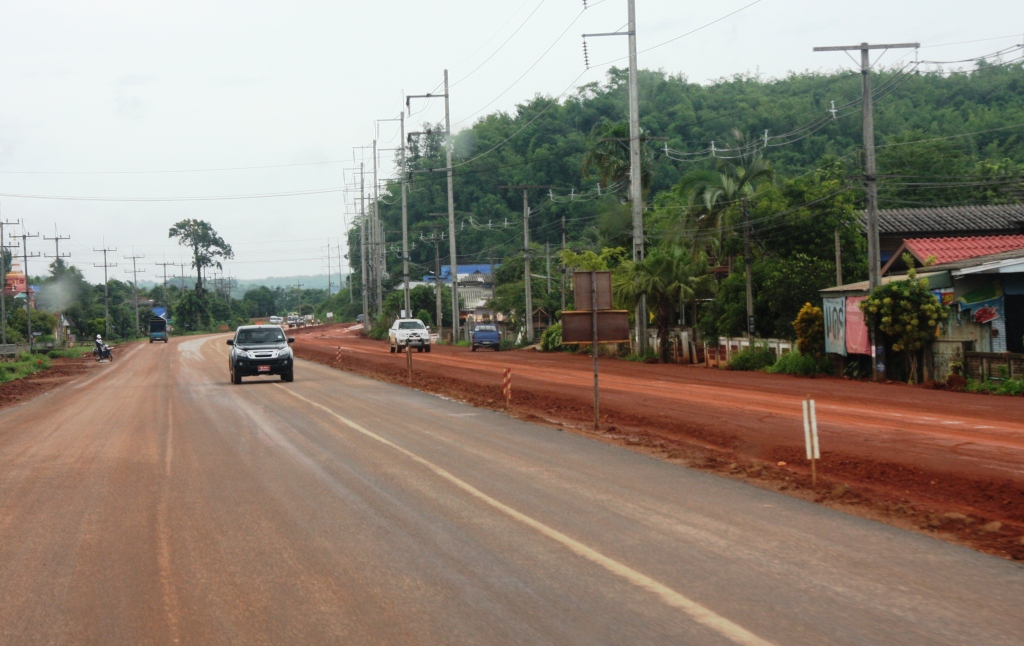
Road widening construction on Thailand's R3 in Chiang Rai province

Road widening construction on Thailand’s R3 in Chiang Rai province

The 14 hour drive from Kunming to the friendship bridge feels like a leapfrog journey from bridge to tunnel and tunnel to bridge as the road makes its 1800 meter descent.  These two roads cut through some of the most difficult terrain on the planet and link the Chinese state to the Thai state while passing through the most ethnically diverse region in Asia.

The roads not only to build regional commercial connections between China, Thailand, and Laos through the increases of trade and investment but they also assist in expanding each of these state’s interests and systems into the once impenetrable regions of upland southeast Asia by introducing national education systems, agricultural techniques that promote mono-cropping over traditional subsistence farming, and creating avenues for ethnic and rural peoples to leave their homes and link up to national labor markets.   The opening of the bridge will increase trade in the region and will intensify and quicken the pace of social change in upland Southeast Asia and reshuffle the cultural milieu of peoples who have sought refuge from the expansionary Chinese and Thai states for centuries.

Under construction, July 2012

Under construction, July 2012

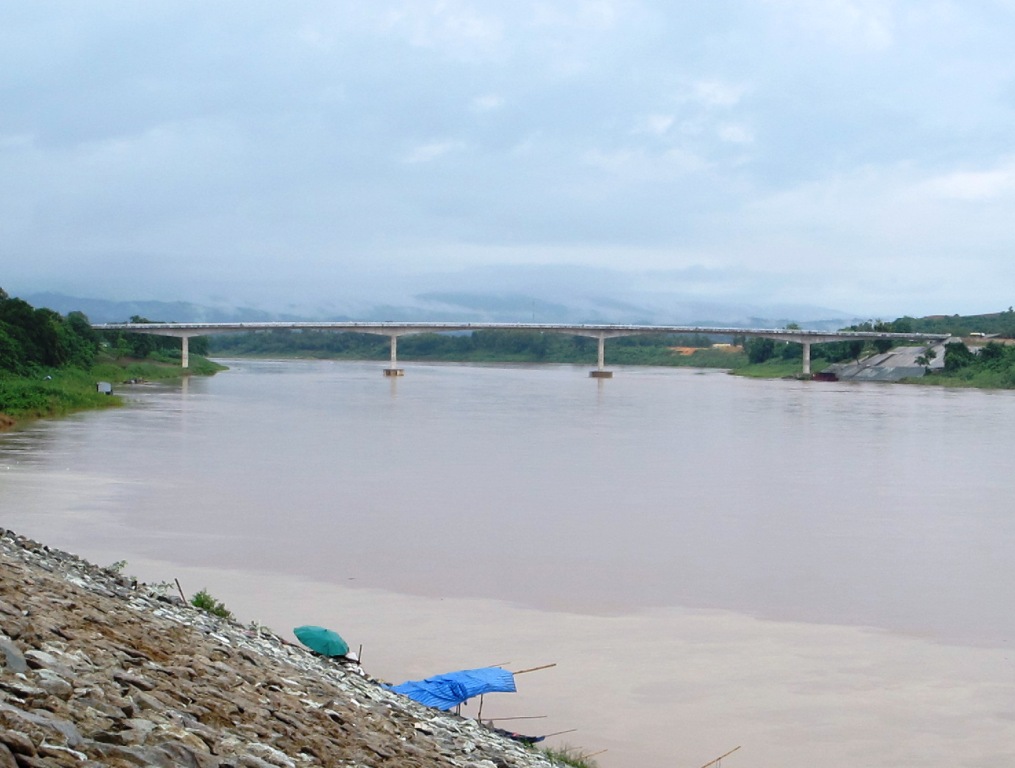
Bridge completion, December 2013

Bridge completion, December 2013

The bridge’s construction has also caused an influx of Chinese investment in Chiang Rai province mostly in real estate development, speculation on future industrial estates for manufacturing of intra-industry goods passing between China and Thailand, and the buying up of agricultural lands.  While this investment is encouraged and welcomed at the national level and by the Chiang Rai Chamber of Commerce, locals are wary of the fast and growing levels of investment in the Golden Triangle Area by Chinese firms and often cite a “Chinese invasion.”  The mayor of Pak Ying Tai village, a small fishing community of 100 households located less than one kilometer south of the bridge has lamented to me on several occasions about China’s footprint in Chiang Rai as he observes year on year decreases in freshwater fish catches and sends more and more of his villagers looking for work in urban areas.

A local farmer from Pak Ying Tai village discusses his worries about community impacts of economic development

A local farmer from Pak Ying Tai village discusses his worries about community impacts of economic development

In many ways the bridge and its construction serve to represent the challenges of regional cooperation between China, Thailand, and the rest of mainland Southeast Asia.  From its conception in the late 1990s to its completion yesterday, the bridge has gone through stalled and failed rounds of negotiation and has not lacked controversy.  Groundbreaking for the 1 billion Thai baht project which is equally invested by China, Laos, and Thailand did not occur until 2010 despite a scheduled start for as early as 2006. In May 2011 Thailand pulled its portion of the construction team in order to settle a land dispute with the local Thai government accusing Chinese commercial interests of illegally purchasing land on the Thai side of the bridge.

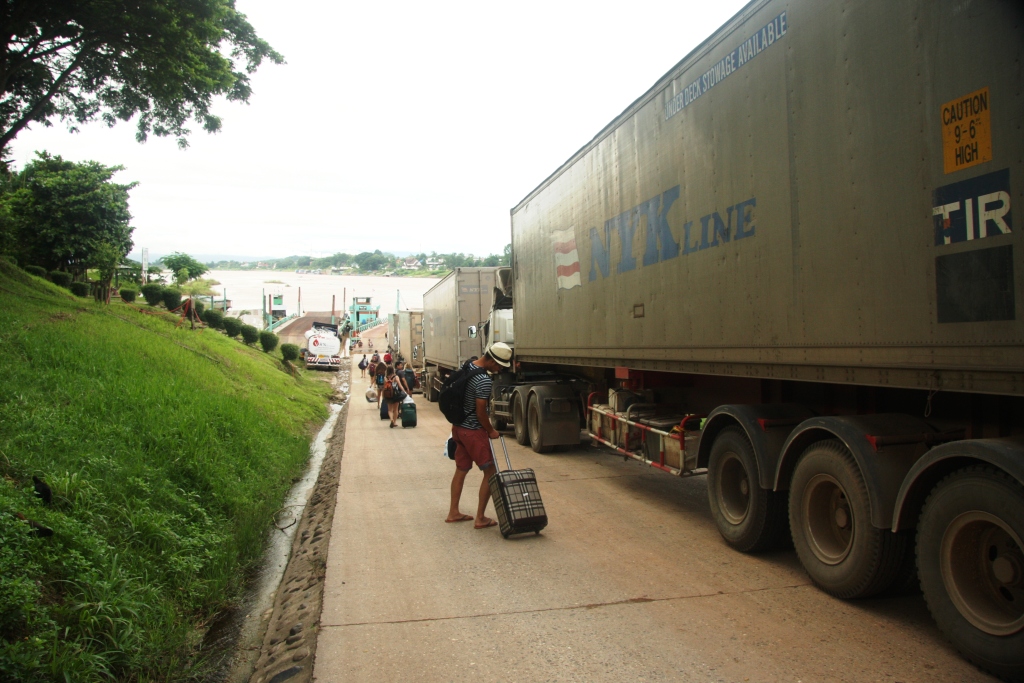
Container trucks will no longer have to wait in line for the Mekong ferry at Huayxai in Laos.

Container trucks will no longer have to wait in line for the Mekong ferry at Huayxai in Laos.

Another obstacle to regional cooperation demonstrated by the bridge is the ease of passage through customs and inspection for both container trucks and individual travelers or tourists to the region.  Chinese trucks are not permitted to drive in Thailand, nor are Thai trucks allowed to travel through China; thus the speed of transport is slowed by the need to repackage goods at one of the border crossing points. Despite efforts of the ADB in to facilitate a shared cross border trade and transport protocol to streamline logistical flows at regional border checks in China and mainland Southeast Asia, states have been slow to adopt the measures in order to protect national markets and logistics industries.  New customs and inspections facilities at the bridge are fitted to increase the speed of transport and ease of people movement and will serve as a testing ground for these promised increases in logistical efficiencies.

Looking forward to the first six months after the bridge’s opening, the verdict will be clear on whether the bridge will serve as a strategic choke point, a gateway for win-win trade and economic development between two regional powers , or a conduit that will further challenge the structure of rural livelihoods in upland Southeast Asia.

Looking upstream at the completed bridge from Pak Ying Tai village.

Looking upstream at the completed bridge from Pak Ying Tai village.

Leave a Comment

Filed under China, Current Events, Economic development, GMS, Mekong River, Regional Relations, SLIDER, Thailand, Uncategorized, Yunnan Province

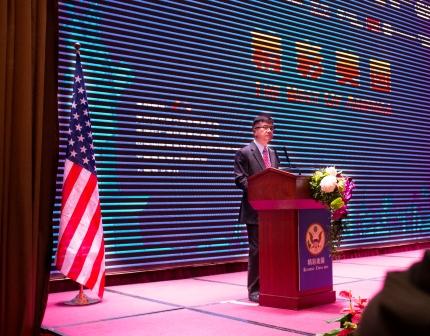
Gary Locke, US Ambassador to China visits Kunming one day after announcing resignation

photo 1

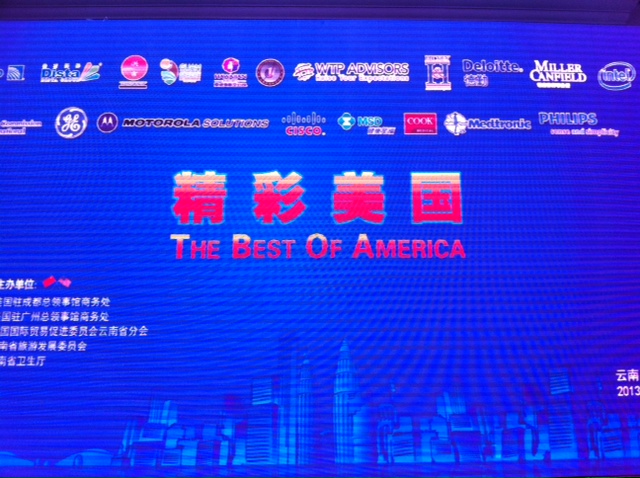
US Ambassador to China Gary Locke paid his third visit to Yunnan province on Thursday, November 21, one day after the announcement of his unexpected resignation.  His visit was part of an investment promotion roadshow entitled “The Best of America” traveling around China’s southwestern provinces and organized by the US consulates in Chengdu and Guangzhou.  The event was hosted by provincial vice-governor Gao Feng and attended by Yunnanese business interests and officials from the provincial international trade promotion department, tourism department and public health departments.   Core economic strengths of the US were represented by CEOs and officers of Deliotte, GE, Motorola, CISCO systems, Intel, and Miller Canfield Law firm in addition to other firms.  United Airlines was also in attendance and eager to promote its new direct flight from Chengdu-San Francisco opening early 2014.

Opening remarks were given by both Ambassador Locke and Vice Governor Gao. Both speeches highlighted the United States’ and Yunnan’s shared history of cooperation through the Flying Tigers, as well as the need for present day economic cooperation. In his remarks, Ambassador Locke boasted of the increase of China-to-US FDI under his tenure. In the past 21 months, investments from China totaled USD 18 billion, more than the past 10 years combined, an accomplishment Locke can only take partial credit for, as larger macroeconomic trends in the US and China were also important factors. Locke was also able to highlight the increase of Chinese students in the US in recent years. According to the ambassador, the number of Chinese students in the US reached 280,000 in 2012. In addition, Ambassador Locke was also able to point to decrease in wait time for US visas and a new, expanded visa office at the Chengdu consulate as notable achievements under his tenure.  Aside from pushing investment in America, Locke also promoted core American values like legal transparency, free trade and intellectual property rights, issues that have been divisive for the two countries in past years.

Photo courtesy of Allie Horick

Photo courtesy of Allie Horick

Speaking directly after Ambassador Locke, Yunnan’s Vice Governor Gao Feng also promoted bilateral trade and cooperation. In his remarks, Vice Governor Gao emphasized Yunnan’s role as China’s gateway to South Asia and Southeast Asia and its fast pace of the its economic growth. Gao pointed to the recent China-South Asia Expo as a marker of Yunnan’s rise in national and regional importance. The US delegation noted that Locke’s visit to Yunnan went very smoothly and all requests for visits to companies and government ministries were granted, including a visit to Yunnan University, where the Ambassador met with students and professors. This is in contrast to the difficulty encountered when US delegations request access in other provinces and autonomous regions in southwest China, particularly Tibet.

The roadshow was planned with the specific purpose of promoting Chinese FDI to the US, the export of medical technology to Yunnan’s developing healthcare sector, and tourism to the US.  After the Green Lake Hotel event, the delegation met mostly with potential investors from the agriculture and mining sectors reflective of these two sectors as two core pillars of Yunnan’s economy – tourism.  Locke also encouraged US investment in Yunnan tourism management systems – something sorely needed in Yunnan, and China at large, as localities struggle to protect cultural capital bases and natural endowments from the damaging onslaught of mass Chinese tourism.

photo 2

The inability of Yunnan’s medical infrastructure to keep up with the demand for medical services was apparent when the delegation was shown MRI scanner purchased from the US that had been use for 10 years at the Kunming Number One Hospital.  The machine was being used 70-80 times per day non-stop for seven days per week.  Cumulative cost of parts and supplies maintenance, all imported from the US, had greatly exceeded the original cost of the machine.

Lastly, Chinese tourism to the US was high on the list of promotion for the delegation.  In 2012, tourism to the US was the US’s top service sector export with Chinese tourists leading the way in number of tourists visiting the US in a by country breakdown.  In international trade accounting, foreign tourist visits are counted as an export due to the positive accumulation of foreign income.

Locke’s visit is recognition of the fruits of the China’s Western development program – namely economic progress to the degree that US investors are now drawn to the fast growth rates coming out of China’s southwestern provinces.  And as a result of that economic progress, Yunnanese investors have reached levels of wealth garnering capabilities to invest in the US, half a globe away.  His visit is also reinforcement of Yunnan’s strategic location as a gateway for regional investment to Southeast Asia and South Asia – a key point mentioned by both the US delegation and the provincial hosts.

Later in the day, Locke’s diplomatic rock star status was confirmed by an exuberant crowd of students at Yunnan University proud of their shared heritage with the US ambassador.  Locke returned that exuberance with hugs.   With Locke stepping down it may be a while until another US ambassador to China receives the kind of welcome received in Thursday in Yunnan.

Consensus among some of the ExSE members is that Locke may be stepping down in preparation for a high appointment related to the 2016 presidential election.  He is an extremely successful career politician with experience managing Americans’ most important bilateral relationship, domestic economic and international trade relations as US Commerce Secretary, and a successful run as governor of Washington State.  This portfolio positions Locke as a strong candidate for VP or Secretary of State under a future Democratic presidency.  Gary Locke will step down as US Ambassador to China early 2014 after taking up the post in August, 2011.


Leave a Comment

Filed under China, Current Events, Economic development, Regional Relations, SLIDER, Uncategorized, USA, Yunnan Province

Tibetan Wine Boom Threatens Food Security

The growing Tibetan wine industry raises concerns about local food supplies and pesticide use.

Many familiar with China and Tibet, may have heard about China’s “Shangri-La,” a region in the northwest of China’s Yunnan Province bordering Tibet and Sichuan that was officially renamed in 2001 after the location of a mystical Himalayan paradise in James Hilton’s 1933 novel, Lost Horizon.  The goal of this naming campaign was to heavily promote and extend tourism throughout the region, a strategy that has proved highly effective for the local government with the number of both Chinese and foreign visitors continuing to grow annually and with the increasing expansion of a tourism industry catering to the desires of travelers wanting to experience both Tibetan culture and local natural wonders.


Grapes on vine in a village near the Yunnan Tibet border

Grapes on vine in a village near the Yunnan Tibet border

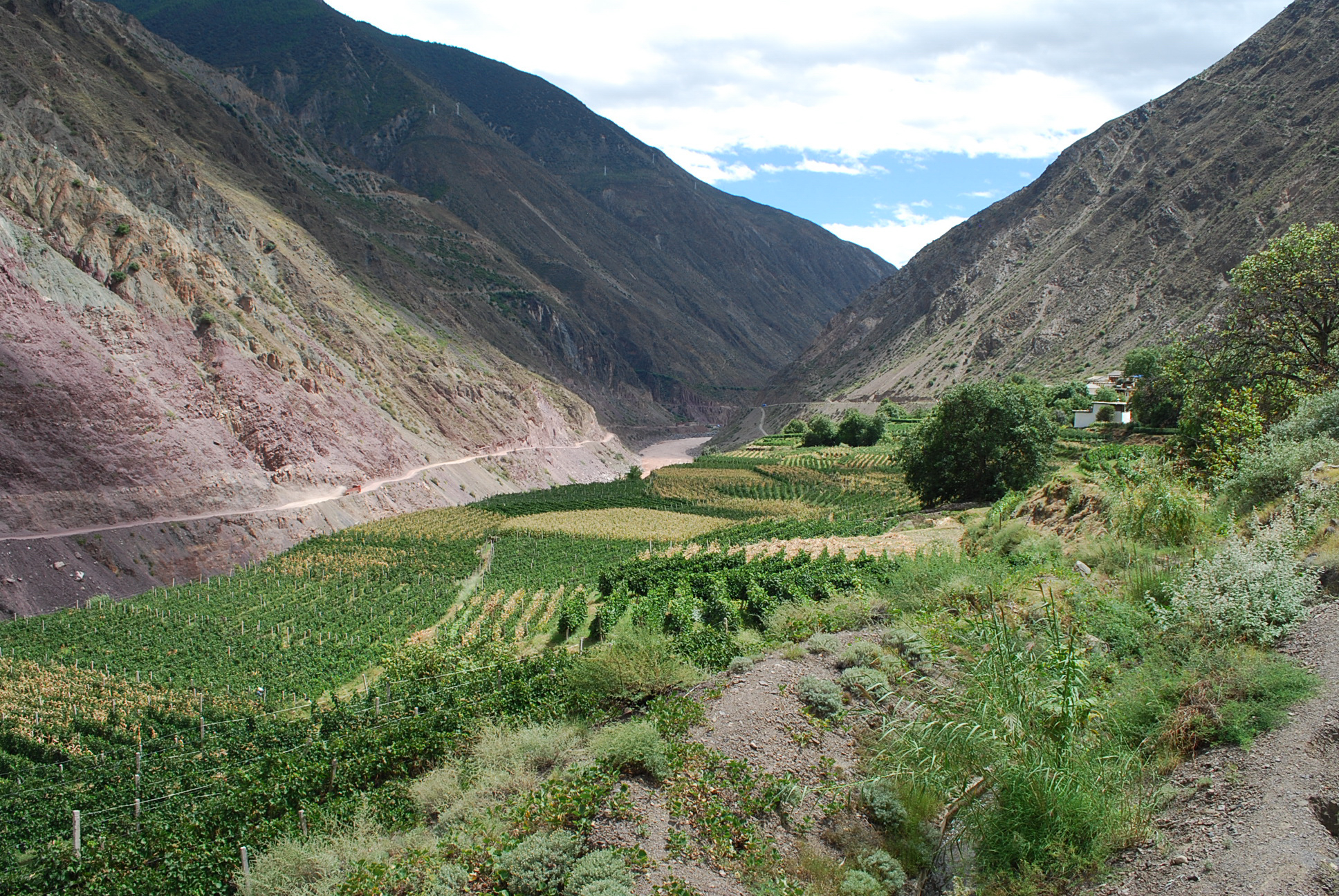
Over the last decade, a significant corporate and agricultural development project in the region has involved the growth of a Tibetan wine industry among rural villages on the upper Lancang (Mekong) and Jinsha (Yangtze) rivers.  About nine years ago, the provincial government approached villagers across the region’s warm and dry rivers valleys and encouraged them to begin growing grapes to annually sell to the newly established Shangri-La Red Wine Company, a new corporation with close government ties that markets its wine as being distinctly Tibetan and coming from “Shangri-La.”  As part of this program, villagers were given grape seedlings and concrete trellises to support their new vineyards.  Slowly, more and more villages have caught on to this practice and pattern of agriculture to the point that in several areas, fields have been transformed into monocrops, though this is not the case is all locations.  Indeed in some of the region’s villages, a diversity of crops including wheat, barley, buckwheat, corn, and in the southernmost areas rice, are all grown.


The government introduced Cabernet Sauvignon vineyards to the  village along the Upper Lancang in Yunnan close to Tibet.

The government introduced Cabernet Sauvignon vineyards to the
village along the Upper Lancang in Yunnan close to Tibet.

Though I had been traveling and studying in this region for seven years and had indeed witnessed grape growing, it was not until 2011 when I arrived to conduct research on the potential impacts of hydropower resettlement in the region for my master’s degree that I began to realize what a large undertaking has occurred with grape agriculture and the major impacts that this has had on local livelihoods.  Discovering these issues, I began to explore them more deeply, writing a chapter in my MA thesis focused on the topic (which is soon to be published as an academic article), and now looking at this grape agriculture, its history, and the changes associated with it in great depth for my doctoral research.


Original Rose Honey vines in the church yard at Cizhong in the  south of Yunnan’s Tibetan region

Original Rose Honey vines in the church yard at Cizhong in the
south of Yunnan’s Tibetan region

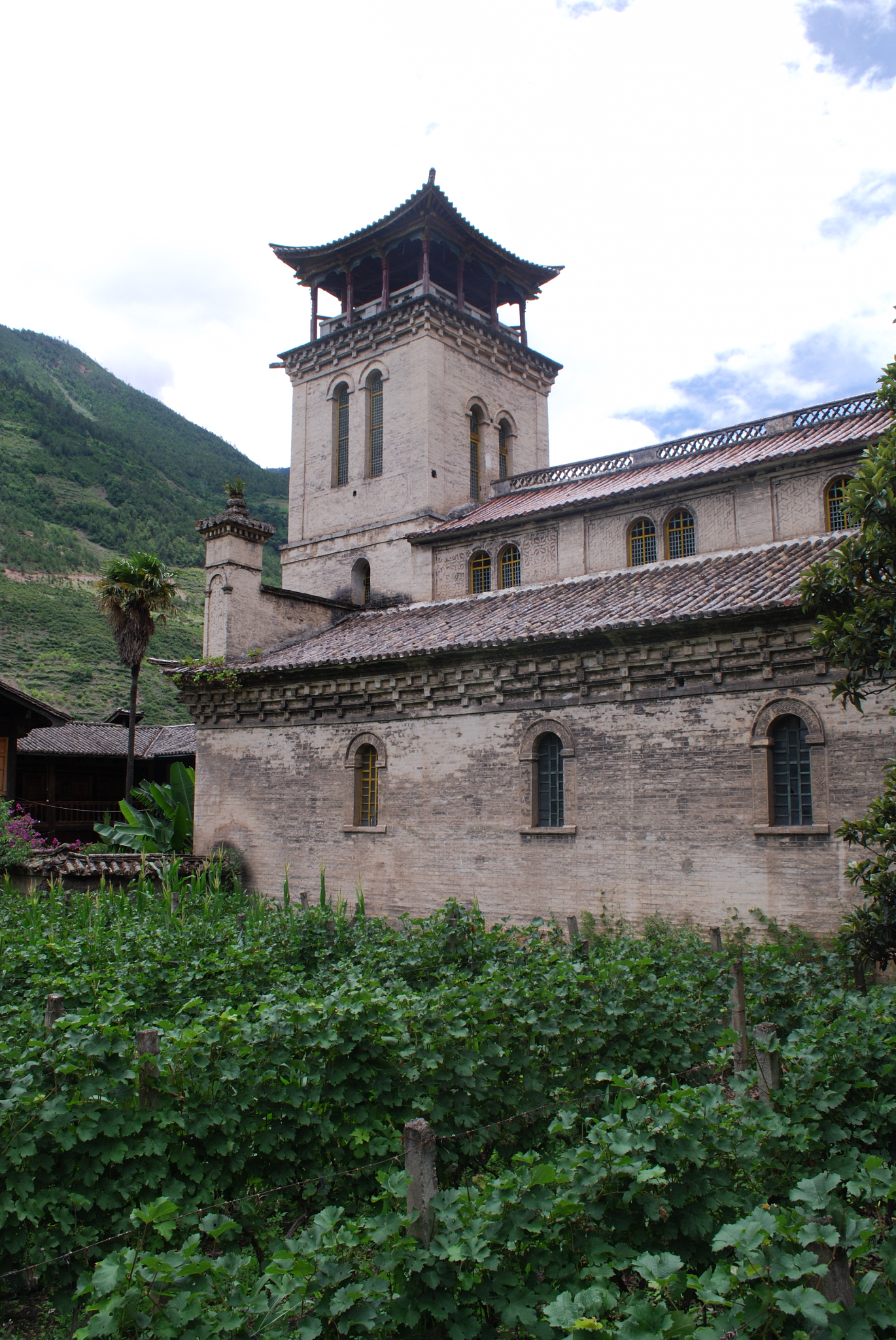
Despite their recent expansion across the region, grapes and wine actually have a long and interesting history in the region in isolated areas.  In the late 1800’s, French Catholic missionaries established a strong presence in the region, primarily in the neighboring Nu (Salween) river valley but with a few successful churches and Tibetan converts in the Lancang as well.  While establishing their churches, the French also began to plant grapes and to produce wine, a practice which is still carried on to this day by villagers in Yunnan’s southern most Tibetan villages in Cizhong.  Unique to Cizhong on the upper Lancang is also a variety of grapes known as Rose Honey, a strain that was thought to have been completely wiped out by a blight in France but was found preserved within the church walls at Cizhong.


Township government Cabernet vineyards planted outside of Cizhong’ s church

Township government Cabernet vineyards planted outside of Cizhong’
s church

Based on my own interviews and ethnographic work in the region, the Rose Honey grapes are in fact only grown by a limited number of villagers and today are primarily unique to Cizhong alone.  When the prefectural government and Shangri-La Red Wine Company introduced and encouraged grape growing throughout the region approximately eight years ago, they provided a new variety of Cabernet Sauvignon grapes, which is the only variety that this company will purchase.  Therefore the majority of the communities in the region grow and sell these grapes, though in some cases around Cizhong they also produce some wine to sell to tourists themselves, though this is not the case everywhere, especially in the most upstream areas closest to Tibet where some villages have no knowledge of wine making.  Unlike the Rose Honey grapes, the Cabernet variety also requires significant chemical inputs by way of fertilizers and pesticides.


From a sustainability standpoint, this increasing reliance on chemicals is one of two major areas of concern and interest – the second is food security.  Villagers themselves are not unaware that they are becoming increasingly reliant on chemicals and that this may be causing problems either.  In one village where I work, only two years ago it was a very common practice among households to intercrop vegetables for personal consumption among grape vines.  However starting this year I both noticed that the practice has decreased and was informed that this was due to villagers own worries about eating foods exposed to too many chemicals and possibly now toxic soils.  Similarly, one of my informants in Cizhong prides himself on two features of his grapes: they are completely organic, and he only grows the Rose Honey variety he obtained from the church yards.  This man has pointed out that most people in Cizhong use many chemicals because the Cabernet grapes introduced by the government won’t grow without them, while the Rose Honey grapes can be grown without any inputs.  Using these characteristics he markets the wine he makes as being both organic and of the historically significant Rose Honey variety, and has managed to develop a very good income for himself by selling wine to local government officials for banquets and to a restaurant in the famous tourism city of Lijiang to the south.


Cizhong villager tending his organic Rose Honey vines.  He makes and sells wine  himself rather than selling grapes to a company.

Cizhong villager tending his organic Rose Honey vines. He makes and sells wine
himself rather than selling grapes to a company.

Food security and changes in traditional cropping patterns and ways of life are also a major issue created by grape growing.  In the downstream regions around Cizhong, the majority of villagers still grow large amounts of grain including rice (the northernmost rice in the Mekong and the only rice grown by Tibetans), wheat, barley, corn, and buckwheat to fulfill their own subsistence and livestock needs.  This is not the case upstream however where villagers now grow little to no grain in exchange for grapes as a monocrop; by doing so they then rely on the profits from grape sales to purchase grain for subsistence and also fertilizers and pesticides.  This has brought about two issues.  The first is major changes in diet, as people who traditionally subsisted on wheat and barley are now purchasing rice and in a sense becoming “Hanified” by their diets as they move away from eating traditional Tibetan foods.  Second, there is now a great reliance on the government and the Shangri-La Red Wine Company to purchase grapes, which are the number one income source and thus hugely important in securing funds to purchase adequate amounts of food to eat.  However from year to year, selling grapes is a major issue of concern, particularly being able to sell them at the ideal time when they are first ready to be harvested because if one waits too long they begin to rot on the vines and lose weight which is how they are measured for sales.


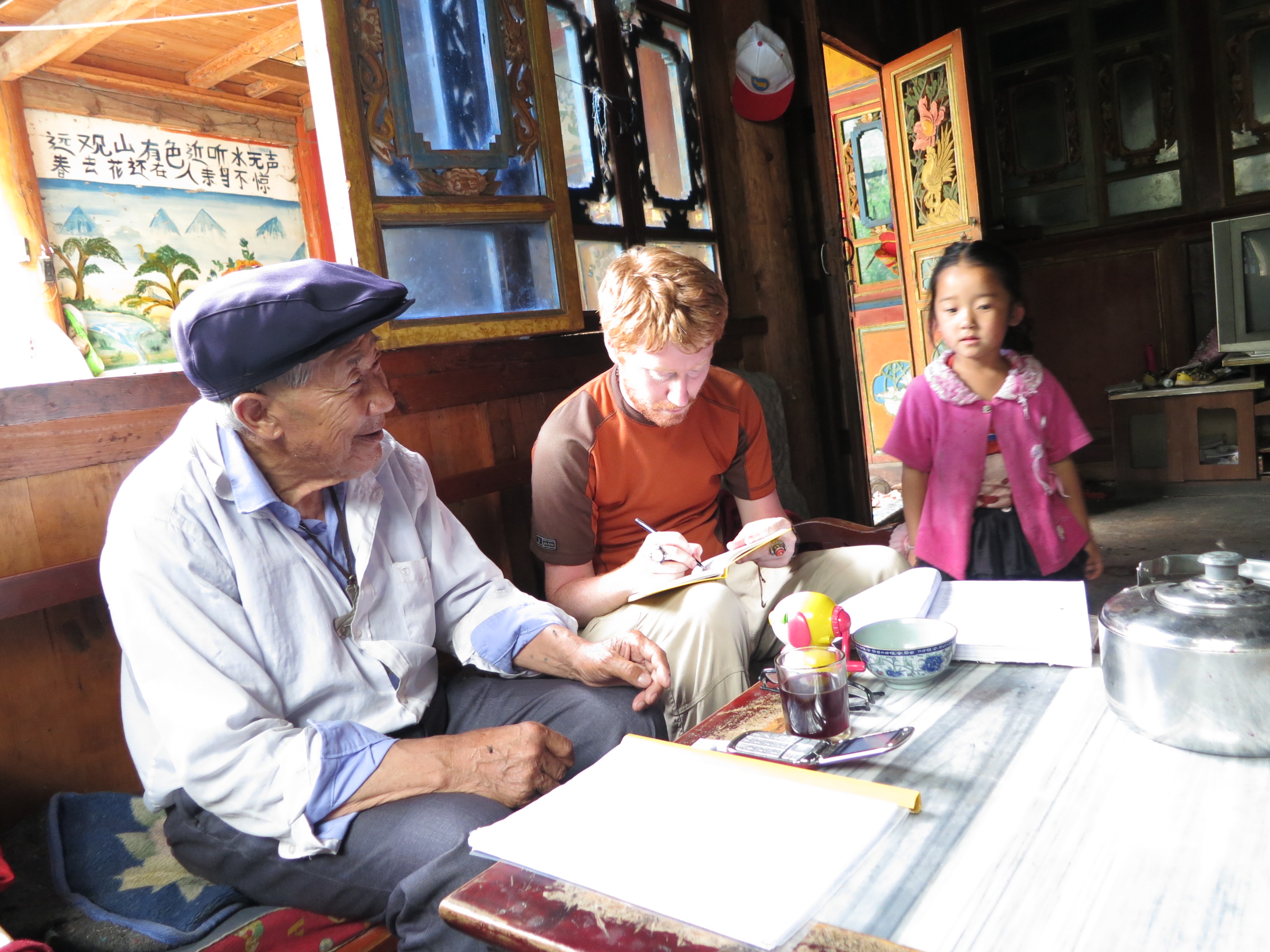
Interview with an 85 year old Cizhong villager who learned to make wine from French Catholics in the 1930s (photo by Sun Fei).

Interview with an 85 year old Cizhong villager who learned to make wine from French Catholics in the 1930s (photo by Sun Fei).

Since the harvest season of 2011 when I first began studying these issues, the company purchases have consistently arrived late every year, which has created serious worries among villagers about their ability to sell the crop.  Despite government assurances that the company is guaranteed to arrive by a certain date each year, this has not appeared to actually be the case, and securing maximum prices and value from grapes from year to year is a constant struggle for villagers as well as the new reliance on outside food purchase which are well captured in the following quotes from interviews:


“Before we planted grapes we didn’t have to buy corn and pesticides, but now we do.  However our income is still better growing grapes. If you plant grapes your income will increase, but you also have to spend more money to buy food.”


More or less, villages fully recognize the vulnerabilities involved in switching their cropping to grapes, but have still chosen to do and have invested much time and energy in doing so because of the high monetary returns that they provide.

An abbreviated version was posted here earlier this week on thethirdpole.net


Leave a Comment

Filed under China, Food, Mekong River, SLIDER, Uncategorized, Yunnan Province

Rubber and Sustainability in Southern Yunnan: A Tale of Two Villages

Will Feinberg compares Xishuangbanna’s rubber and sustainabilty in two of southern Yunnan’s ethnic villages. One monocrops while the other hedges.

Driving past new stores and half-built housing developments, you take a right into the forest. Keep going. The farther you drive, the worse the road gets until you burst through another patch of palms trees and cross a stream. Where are you? You’re in Mandian Village, just outside Jinghong, Yunnan and  right in the heart of Chinese rubber country.

Introduced to the area in the 1960s by the central government, rubber is big business in southern Yunnan. Large state plantations have steadily given way to private enterprises and the region has seen a proliferation of rubber planting in the past twenty years. Today in Xishuangbanna Dai Autonomous Region, which Jinghong is the seat of, rubber plantations already make up almost one fifth of all land.

While the environmental costs have been heavy, the rubber explosion has done wonders for Xishuangbanna’s economy. For rubber farmers in Mengla Country, for instance, the average household income is close to $30,000/year, comparable to places like Shanghai or Guangzhou. The economic benefits of rubber harvesting were quite clear to me while traveling through the region late last month. During the trip, I visited two villages that I had been to in 2011. In both cases, rubber has transformed the local economy, however one village was clearly better off than the other. Why?

The first village I visited was the aforementioned Mandian Village. Mandian is largely inhabited by people of the Dai ethnicity, with a 20-family group of Yi people living in an adjacent settlement. Mandian, like many other villages in the area, practices rubber cultivation and relies on rubber as its main source of income. According to villagers there, the Dai started harvesting rubber over a decade ago, while the Yi settlement began their rubber industry only within the last few years. For the village economy as a whole, rubber has had a positive influence. Per capita incomes have risen as well as household consumption and the money from rubber has allowed the town to build a new school.

However, as rubber is Mandian’s only cash crop, the village’s fortunes are now beholden to the world rubber market. Nothing illustrates this better than what happened to the village in 2012. Last year, the bottom fell out on the rubber market and the price of raw rubber dropped by half, going from 30 yuan per pound (1 US dollar is roughly equal to 6 Chinese yuan ) to 15 yuan per pound. Two villagers that I interviewed described the effects. One, a middle-aged Dai woman told of how most of the villagers who harvest rubber had to work overtime to scratch out living and the quality of life dropped for many families. Though because the Dai also plant rice, no one in the village went hungry. A young Yi woman that I spoke to also described how the economic hardships as a result of the rubber crash delayed the building of their house. The Yi, who were recently resettled as a result of the building of the Jinghong Dam, were forced to return to their old fields as a way of producing food during 2012 crash and without these fields, many villagers might have gone hungry. The fall of the rubber price in 2012 was not isolated just to Mandian village. The drop was felt in villages like Mandian all over southern Yunnan and in other rubber producing areas like Malaysia and Brazil. But there was at least one village that was comparatively isolated from the crash’s effects.

Nanpanzhong Village sits on the slope of a ridge just an hour’s drive from the Burmese border. A collection of some 120 families, Nanpanzhong is an Aini village. The Aini are a branch of the Hani/Akha minority, a nomadic, transboundary ethnicity that typically practice subsistence agriculture in the mountains of Southeast Asia. What makes the Aini of Nanpanzhong special, aside from their incredible hospitality, is their economy. Like the Dai and Yi of Mandian, the Aini also harvest rubber, but the role that rubber plays in the village’s economy is quite different. In an interview with the village mayor, I learned that money from rubber harvesting makes up only 30% of the town’s income. Instead, their primary source of income, by a long shot, is pigs. The town raises hundreds of short-eared swine which command quite a high price in China’s metropolises. According to the mayor, his pigs’ pork sells for 130 yuan/pound, many times higher than the price of normal pork. In fact, most of the village’s pork can only be found in places like Beijing, Chongqing and Shanghai; people in Jinghong can’t even afford it.

Pork sales now net the village almost sixty percent of its total income, but Nanpanzhong’s foray into the meat industry is a rather recent affair: villagers only began raising pigs in 2003. Its impact, however, has been astounding. According to the mayor, the average household income was hovering around 500 yuan per year at the turn of the millennium. Thirteen years later, that number as skyrocketed to almost 8,000 yuan and now, the mayor claims, Nanpanzhongcun is the envy of the surrounding valleys.

 When the rubber price plummeted last year, Nanpanzhong was largely unaffected. Of course, the mayor explains, villagers feel the effects when the rubber price fluctuates, but certainly less so than other places. The village is largely self-sustaining for food and the money earned from rubber, livestock and tea (which makes up a tenth of the village’s income) is used for electronics, vehicles and building materials. Both the mayor and villagers that I spoke with were convinced of the Nanpanzhong model’s superiority.

The evidence is hard to disagree with. Not considering the environmental concerns, of which there are many, rubber can be an unsustainable enterprise. Mandian, and hundreds of villages like it, have had a mixed experience with rubber. While it brought the village a new school and the villagers a higher standard of living, Mandian’s reliance on rubber and the fluctuations of the global market brought hardships to the village last year, forcing some villagers to leave in search of food. On the other hand is Nanpanzhong’s model. Rubber, while an important source of income for villagers, is part of a healthy balance. With families growing their own food and relying on two cash crops (rubber and tea) and livestock for their income, the villagers of Nanpanzhong are largely insulated from greater trends in the rubber market. The village’s exact model may not be able to be replicated in every village in Yunnan, but its general ideas can. Pairing rubber with a second cash crop and agricultural self-reliance are concepts that could give protection to villages like Mandian and offer a more economically sustainable path for thousands of people in the region.


Leave a Comment

Filed under Economic development, Food, SLIDER, Sustainability and Resource Management, Yunnan Province