Category Archives: Yunnan Province

China and South Asia: Contention and Cooperation Between Giant Neighbors

Are China and India allies or enemies in the South Asian economy? Well, it seems they are both; working together in healthy and profitable partnerships while maintaining armies in the contested China-India borders. This article explains the paradoxical nature of the China-India relationship and its impact and implications for the smaller countries in South Asia and neighboring Southeast Asia.

The rise of China and India over the last two or three decades continues to make global news headlines. Competition between these two global powers in economic, political and diplomatic domains has garnered scholarly and media attention. Yet we know much less about China’s growing ties and contention with India that are also spreading across the South Asia subcontinent and beyond. As China-India trade has grown, India in 2006 opened the historical trade route, Nathula Pass, which had remained closed for almost 50 years as a result of a border war with China in 1962. Today in the presence of several persistently disputed border zones in South Asia (see Map 1), China is beginning to build dams on the rivers in the Tibetan Plateau, including the upper Brahmaputra (yarlung tsangpo or Yarlung River), which could impact populations living downstream in India and Bangladesh (see Map 1). China has taken over the construction of Gwadar Port in the Pakistani province of Baluchistan, on the Arabian Sea. China has also begun building the Gwadar road corridor all the way north to Xinjiang. Continue reading →

Leave a Comment

Filed under China, Economic development, Energy, Foreign policy, GMS, Mekong River, Myanmar/Burma, Regional Relations, SLIDER, Uncategorized, Yunnan Province

Yunnan to Spend 70 Billion on Infrastructure Development

8420

Yunnan lawmakers were busy over the past seven days, earmarking billions of yuan for building projects across the province. The vast majority of the money will be used to fund the ongoing construction of 26 major highways. Other money has been set aside for waterway maintenance and “disaster mitigation” projects.

The Provincial Highway Bureau expects to initiate or continue work on 1,500 kilometers of highways in the next two years, it announced in a July 14 press release. In total, the new roadways will cost 100 billion yuan (US$16.1 billion), spaced out in annual 50 billion increments over the next two years.

Stretches of road scheduled for completion this year include highways connecting Lijiang toShangri-La, Ruili to Longling and Huaping to Lijiang — which is a segment of the road linking Lijiang to Chengdu.

Obtaining loans for massive infrastructure ventures has become increasingly difficult as China’s once-humming economy continues to slow. Statistics published by news outlet Kunming Information Hub show that in 2011, the province experienced a two billion yuan shortfallbetween toll road revenue and what it owed in loans for highway construction.

To avoid a repeat of that deficit, provincial planners voted to implement tolls on many of the new roads, effectually passing the bill on to automobile owners. People traveling by bus will also pay a share of the costs. Currently, a 0.5 yuan surcharge is attached to the price of every long-distance bus ticket purchased in Yunnan. That fee will now be raised to 0.9 yuan to help fund highway expansion. Long-distance transport trucks will also face higher fees based on load tonnage and distance traveled.

An additional twenty billion was pledged for waterway upgrades. Details have not been fully disclosed, but some monetary allocations will fund canals connecting rivers to reservoirs as well as maintenance on dams and hydropower stations across the province.

Although highways and water infrastructure projects comprise the lion’s share of the recently allocated money, two billion yuan (US$322 million) was also designated for the prevention of ecological disasters. Surveyors have identified thousands of “hazard points” in Yunnan — places where roadside cliffs are prone to rockslides or where villages are threatened by mudslides due to deforestation. Over the past fifteen years, Yunnan has suffered a reported 17,258 geological disasters. These claimed the lives of 1,394 people and led to more than seven billion yuan in economic losses.

This article written by Patrick Scally was first published here on 7/15 on GoKunming.

Leave a Comment

Filed under China, Economic development, Environment and sustainability, Governance, SLIDER, Yunnan Province

Burmese Hardwoods Logged to the Brink of Extinction

burmese logging

While swaths of virgin rainforests have been cleared to feed China’s growing appetite for luxury wood, there are some regions, like Myanmar’s remote northern forests, that have remained heretofore intact. This is about to change, predicts a new study, as loggers advance on the “final frontier” for tropical hardwoods in Southeast Asia.

A report from the Environmental Investigation Agency (EIA), published July 4, warns that soaring demand in China for valuable, endangered rosewood trees — known in Chinese as hongmu (红木) — is “completely unsustainable”. Based on current trends, the two most coveted rosewood species in Myanmar — Dalbergia oliveri/bariensis and Pterocarpus macrocarpus — could be “logged to commercial extinction in as little as three years”.

Recent demand for hongmu timber has spiked due to its use in high-value reproduction Qing and Ming Dynasty furniture. In 2013, China imported 237,000 cubic meters of rosewood logs from Myanmar at a value of two billion yuan (US$324 million), tripling the intake from the previous year. “Virtually overnight,” reports the EIA, “Myanmar has become the biggest log supplier to China worldwide.”

Seventy-eight percent of China’s hongmu imports come through Yunnan, although Myanmar has banned land-border exports of raw timber. Illegal logging, however, reportedly accounts for nearly three-fourths of the country’s wood exports. Financial rewards for smuggling the timber dwarf traditional incomes, and one trip, carrying up to 15 tons of timber, can reportedly earn a truck driver as much as nine million Burmese kyat (US$300,000).

A hongmu-made tea table can fetch 30,000 yuan (US$5,000) in China, where rumors of stricter import bans have led to sizable price spikes. In Kunming, where four-fifths of hongmu timber arrives from Myanmar, prices for the raw wood have risen 90 percent since this time last year. Interpreting Myanmar’s export ban as an economic move, commercial website Huaxia explained:

There is an important reason why Myanmar restricts the export of raw hongmu — they are asking foreign companies to invest in Myanmar, build wood-processing factories in the country, and export finished goods, thus adding value to their timber industry.

The EIA report urges the Convention on International Trade in Endangered Species (CITES) to assist Myanmar in protecting its remaining hongmu forests. An international treaty tasked with protecting more than 35,000 plants and animals, CITES enjoys some legitimacy with the Chinese government. To save the hongmu from imminent depletion, the EIA advises CITES to take action, and upgrade the species’ status to reflect that they “may become threatened with extinction unless trade is regulated”.

This article by Cissy Yu, was first published here on the GoKunming website  on 7/9/2014.

Leave a Comment

Filed under China, Environment and sustainability, Myanmar/Burma, Regional Relations, SLIDER, Sustainability and Resource Management, Yunnan Province

Scores of Kunming officials investigated for corruption

Image: The Irrawaddy

Image: The Irrawaddy

Graft is becoming an increasingly risky business for corrupt Kunming officials and those who enjoy their favors. Last year, the city charged 52 county-level cadres with corruption-related crimes. This year, however, The People’s Procuratorate of Kunming has already investigated three times that number, including several high-ranking bureaucrats.

From January to May of this year, provincial prosecutors opened inquiries involving 154 public officials suspected of corruption and bribery, newspaper Legal Daily is reporting. In a vague briefing, a representative from the Procuratorate described the vast majority of cases as “serious”, classifying eight as “highly serious” and seven others as “extremely serious”.

One of the “extremely serious” cases involves Wang Baoji (王宝基), former deputy inspector of the Yunnan Department of Transportation. Wang is charged with accepting 2.8 million yuan (US$450,000) in bribes from construction companies to develop highway projects from 2011 to 2013. In the same week, the Procuratorate sentenced Kang Xiaodong (康晓东), eight-year deputy director of the Yunnan Department of Justice, to fifteen years in prison for accepting five million yuan (US$806,000) in bribes.

The Legal Daily report made no mention of what punishment the other 152 officials may face if found guilty. However, penalties for bribe-taking and corruption can often be harsh. Previous high-profile Yunnan administrators convicted of such crimes have routinely faced long periods of incarceration, or worse. In 2007, a former Kunming deputy mayor was sentenced to life in prisonfor accepting kickbacks. Four years earlier, one-time governor Li Jiating was sentenced to death for taking bribes.

The current crackdown on official corruption can be traced back to Xi Jinping’s first speech as president of China, in which he pointedly said the Communist Party must adhere to “strict discipline”. In the wake of Xi’s comments, Beijing has reprimanded thousands of government officials around the country for lavish spending, fraud and taking payoffs.

Xi’s remarks have also led China’s central government to carry out a nationwide audit of towns and municipalities in all provinces. Although unfinished, the accounting inspection has uncovered wide-ranging and serious financial misdeeds, some of them in Yunnan. Last year in Luliang County (陆良县), it was discovered that officials had faked financial data to the tune of 5.2 billion yuan (US$850 million).

Click here to link to this article first posted on GoKunming on 6/30 and written by Cissy Yu.

Leave a Comment

Filed under China, Current Events, Economic development, Governance, SLIDER, Uncategorized, Yunnan Province

Kunming railway station attackers charged in mass stabbings

Image: CCTV

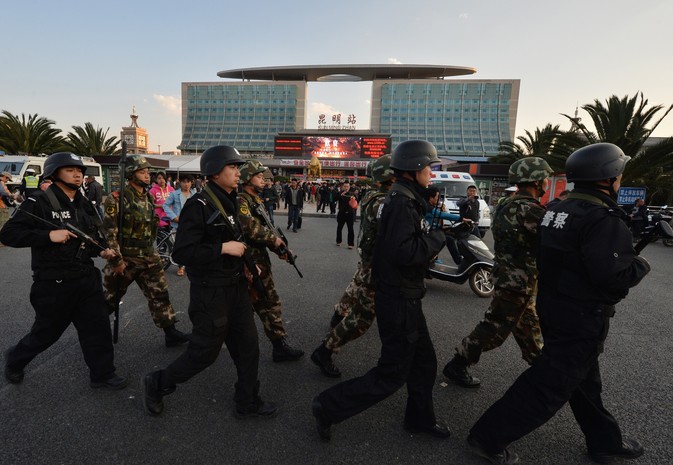
A SWAT team patrols the Kunming train station. Image: CCTV

In March of this year, a group of men and women armed with knives descended on the crowded Kunming Railway Station. Their ensuing rampage left 29 civilians dead and 143 injured in what is one of the most violent coordinated attacks to occur in China in recent memory. Four people accused of perpetrating the violence have been formally charged and will soon stand trial, Xinhuais reporting.

Official accounts of the attack state that six men and two women participated in the train station assault. Of those, four were shot and killed at the scene by police. One woman was subdued and arrested at the station, while three other suspects remained at large for 36 hours before being captured. No details of the manhunt or exactly how, where and when the fugitives were caught have ever been made public.

The four defendants stand accused of multiple crimes and will presumably face the death penalty if convicted. They have each been charged by the Kunming People’s Procuratorate, the city’s highest court, with participating in a terrorist organization, carrying out violent terrorist activities and premeditated homicide. No date has been publicly announced for a trial.

The outcome of the case is likely a foregone conclusion. Defendants tried by the government, especially in high-profile proceedings such as this, are generally found guilty following extremely short, closed-door judicial proceedings. A short, terse statement by prosecutors trying the four defendants appears to confirm this. It read, “The facts are clear and the evidence is ample. The four [suspects] should be investigated for criminal responsibility according to law and then prosecuted according to law.”

The defendants are all ethnic Uighurs from China’s Xinjiang Autonomous Region and prosecutors maintain the March 1 attack was religiously and politically motivated. In a statement made shortly after the suspects were apprehended, Yunnan Party Secretary, Qin Guangrong,characterized the captured men and woman as Muslim terrorists, adding one had confessed to the crime and admitted the group wanted “to join jihad”.

China has significantly ramped up law enforcement and ‘anti-terror’ efforts following the bloodshed in Kunming. In many cities around the country, police officers are now permitted to carry sidearms for the first time in decades. Trials involving suspected militants have also increased, and 113 people were recently jailed for terrorism-related crimes by Xinjiang courts.

Click here to link to this article written by Patrick Scally, first published on July, 1 on the GoKunming website.

Leave a Comment

Filed under China, Current Events, ethnic policy, Governance, Kunming Train Station Attack, SLIDER, Yunnan Province

Carrots, Sticks & the TIP Report: Understanding the US Government’s Anti-Trafficking Efforts in Southeast Asia

Last week the US State Department issued its annual Trafficking In Persons (TIP) Report, which ranks every country in the world according to their adherence to the US government’s anti-trafficking mandate. For the first time, Thailand was designated “Tier 3,” the lowest “rung” on the TIP Report’s ladder.

The report, which is published by the Office to Monitor and Combat Trafficking, describes “Tier 1” countries as those demonstrating sufficient anti-trafficking efforts; “Tier 2” as those that have begun to demonstrate such efforts but still have improvements to make; and “Tier 3” as countries demonstrating little to no effort to combat trafficking. Countries that receive the Tier 3 ranking are subject to sanctions by the US government. Continue reading →

Leave a Comment

Filed under Cambodia, China, Current Events, ethnic policy, Foreign policy, GMS, Governance, Health, Malaysia, Mekong River, Philippines, Regional Relations, Singapore, Uncategorized, water, Yunnan Province

Laos extradites drug suspects to Yunnan

Editors note: This article was originally written by Cissy Yu and published on Go Kunming. It is reprinted on Exse in its entirety. 

Yunnan has long been the country’s main entry point for illegal drugs. Despite increased interdiction efforts, international law enforcement cooperation and recent large-scale busts, it appears the province’s ‘Drug War‘ is becoming more costly and having only a small effect on the overall flow of narcotics across the border.

Last week, Lao police transferred five suspected members of a drug ring to Kunming in a display of cooperation between the two countries. Authorities originally detained the suspects in a joint police raid conducted on March 19, 2013, when a naval patrol seized more than 500 million yuan (US$82.3 million) worth of methamphetamines on the Mekong River.

China has been conducting patrols such as this with the help of Thailand, Laos and Myanmar since the “Mekong River Massacre” of October 2011. The attack, which killed 13 Chinese sailors, spurred Beijing to begin interdiction patrols along the river. Institution of the policy, although sanctioned by neighboring Southeast Asian countries, was the first time in three decades that Chinese forces have operated outside the nation’s borders without a United Nations mandate.

Although the drug lord responsible for the killings, Naw Kham, was sentenced and publicly executed in Kunming last year, illegal drug trafficking continues to run rampant in the border regions between Yunnan, Laos, Myanmar and Thailand. Known as the Golden Triangle, the area supplies an estimated 60 to 70 percent of all drugs consumed in China. A United Nations surveyconducted last year reported that opium cultivation in the Triangle rose by 22 percent in 2013, largely driven by mounting demand from the mainland.

Yunnan’s 4,060-kilometer border with Golden Triangle nations presents a grim challenge for anti-drug personnel. According to Yunnan Net, 70 percent of methamphetamines confiscated in China last year were seized in Yunnan. Currently, there are 1.7 million registered drug addicts in the province, although the government acknowledges the actual numbers are much higher.

While heroin remains the most commonly smuggled drug on the border, methamphetamines — also known as ‘ice’ — are a fast-growing second. In Ruili, a border town infamous in the past for its heroin trade, methamphetamines now dominate the market. One dose of the crystals — known as bingdu (冰毒) in Chinese — reportedly costs as little as five yuan.

Yunnan’s narcotics officials, meanwhile, claim they have redoubled efforts to combat the drug trade. Provincial courts sentenced more than 5,020 suspects for drug crimes in 2013. Yet some officials have complained that the record numbers on trial have led to more lenient judgments. “A suspect who would get the death penalty elsewhere [in China] only gets several years of jail in Yunnan,” said a National People’s Congress deputy. “The judicial system should be punishing these people with an iron hand.”

Image: China Radio International

Leave a Comment

Filed under China, GMS, Health, Laos, Mekong River, Regional Relations, SLIDER, Yunnan Province

Hekou’s 600 million yuan “boondoggle”

Editor’s note: The following article was written by Patrick Scally and originally published on the website Go Kunming. It is reprinted here in its entirety.

The media in Yunnan, and around the country, is often overly fond of splashy headlines containing enormous investment figures. The articles that follow are generally paeans to a modernizing society and the wonders of Chinese-style capitalism. Failure is rarely chronicled. That is far from the case in Hekou (河口), which is currently receiving plenty of negative journalistic buzz due to a development project provincial officials have deemed an embarrassing and costly “boondoggle”.

At issue is a 270 million yuan (US$43 million) construction project on the banks of the Honghe River (红河). The China-Asean International Tourist Cultural Scenic Corridor had been under construction since 2011, when the government approved development on the site, a kilometer-long stretch of uninhabited land.

Designed to be a showpiece of the city’s economic growth, the enterprise has become an object of public scorn and a symbol of miserable urban planning. The entire riverside development is now slated to be torn down at a cost surpassing that of its construction. Conservatively estimated at 300 million yuan (US$48 million), demolition costs include the projected expenses of paying back investors and cleaning up the site.

Although the corridor was nearly finished, its 150 mixed-use shopping and business venues are currently being razed and will eventually be converted into public green space. The decision to halt and ultimately destroy the venture is a “policy adjustment” by the local government, according to a South China Morning Post (SCMP) report.

Concerns over poor planning and improper waste disposal were raised by local residents as the project neared completion. Complaints increased and the endeavor, which was hoped to complement and augment natural scenery, became a blight that authorities describe as a “negative influence” on the riverside.

Investors, shop owners and even low-level government planners were apparently surprised when the announcement came to dismantle the corridor. “It never occurred to us that a new order [for demolition] would come so soon,” an unnamed city planner told the SCMP. Locals have taken things more in stride, using a still-standing plaza for ballroom dancing in the evenings.

Hekou sits on the shore of the Honghe River and is joined with the Vietnamese city of Lào Cai by bridge. For most of the past decade, provincial developers have been throwing money at the area in hopes of turning the city into a major trade depot connecting China, Vietnam and other Southeast Asian countries.

In 2008, a highway connecting Hekou County to major cities in neighboring countries was completed and work is well underway on a railway project linking Kunming to Hekou and, eventually, Hanoi. For now, however, it appears the 80,000 residents of Hekou will have to wait to see a venue that properly expresses their town’s importance as a regional trade hub.

Images: Xinhua

Leave a Comment

Filed under China, Economic development, SLIDER, Vietnam, Yunnan Province

Airport International Connectivity Ranking: China vs. US

Intraprovincial routes in Yunnan [click map to enlarge]

Intraprovincial routes in Yunnan [click map to enlarge]

In this era of time-space compression, people, goods, and ideas move about Earth faster and in greater numbers than ever before. Human civilization has always revolved around nodes and flows, as ancient trading centers and trade routes demonstrate. What makes the era we’re in now unique is the degree to which transportation and communications infrastructure have accelerated these flows, erasing the physical distance between the nodes. But much in our interconnected world, for instance most commodity chains, remains out of sight under the surface. Only when a factory collapse in Bangladesh splashes the headlines are we reminded of the long and convoluted paths that stuff takes on its way from raw materials to the shelves at Wal-Mart. Continue reading →

8 Comments

Filed under Economic development, SLIDER, Technology, Yunnan Province

Trafficking of Women on the Burma-China Border & International Responsibility

Camp for internally displaced persons at Mai Ja Yang, Kachin State on the the Chinese border.

Camp for internally displaced persons at Mai Ja Yang, Kachin State on the the Chinese border.

In recent weeks, warfare in Burma’s Kachin State has increased and is now making its way closer to the Burma-China border. While the international community has paid little attention to the Kachin conflict over the past few years, understanding its complexity is now more important than ever. Failing to do so could have dire implications on the lives of Kachin women, and on diplomatic relations in the region.

Kachin State is an ethnic area in northern Burma that has long suffered from conflict with the central Burmese government. In 2011, a seventeen-year cease-fire was broken, resulting in the onset of active warfare. In spite of ongoing attempts at peace negotiations, the Burmese government has been committing atrocities– including rape, arbitrary arrest and torture– against civilians. The region has been documented to be an active conflict zone resulting in one of the worst humanitarian crises in the world. According to reports issued by the Kachin Independence Organization (KIO)—the political arm of the Kachin people– over 100,000 internally displaced persons (IDPs) have fled to border areas of Burma and China to escape the fighting, and these communities suffer from a lack of basic necessities and little to no foreign aid. Additionally, as the Kachin Women’s Association of Thailand has documented, the trafficking of women into China’s neighboring Yunnan province as forced brides has become a growing problem.

Recently, I traveled to Mai Ja Yang, the second largest city in KIO-controlled territory to interview women and men living amid the conflict about the issue of trafficking. I conducted interviews with over 25 trafficking survivors, female soldiers, women’s organizations, lawmakers, cultural leaders, IDP relief workers and administrators from the KIO. I was hosted by the Kachin Women’s Association of Thailand, an organization actively working on the issue.

A child in the Mai Ja Yang camp.

A child in the Mai Ja Yang camp.

My research revealed that gender discrimination, demand from China for brides due to the one-child policy and crippling conditions on the ground due to the military conflict within Kachin State contribute to the problem of trafficking. As former “forced brides” and others reported, the escalation of the military conflict has resulted in a sharp increase in irregular migration. Simultaneously, trafficking has become less of a priority for the KIO government, whose attention is focused on war strategy and the political process, rather than the empowerment of Kachin women.

Now, the Burma army is stepping up its attacks in a move that could increase women’s vulnerability to trafficking. As a recent article in the Irrawaddy Magazine revealed, last week the army launched an attack on a KIO military outpost near Mai Ja Yang, which shares its eastern border with China’s Yunnan province. Mai Ja Yang is home to a growing number of IDPs—men, women and children who have had to flee their homes after their villages were raided. Now, not only are these people’s homes destroyed, but their temporary camps are in danger, as well.

With fighting approaching the border areas, women living in the camps could become even more vulnerable. These women face insecurity in the form of food shortage, lack of infrastructure and basic sanitation. They also face circumstances of gender-based violence and rape. Additionally, lack of a means of income generation influences women to migrate to China to find work—a situation that leaves them vulnerable to labor exploitation and trafficking.

But the international community has been slow to respond to the conflict. As a recent Stimson Report revealed, the precarious nature of the US- China relationship has given American leaders pause in “interfering” in such a sensitive geo-political arena. Additionally, aid workers report having had difficulty accessing the IDP camps due to the ongoing warfare in surrounding areas.

Despite these cautions, it is in the interest of the Chinese, Burmese and Kachin governments to quell an increase in trafficking. Doing so would not only improve the lives of thousands of women, but it could prove beneficial for each country’s relationship with the United States. This is because the US State Department has made trafficking a primary agenda in its international policy. In fact, the State Department’s Trafficking In Persons (TIP) Report ranks every country in the world according to how well they comply with the US mandate against human trafficking. As a result, in recent years trafficking has become a number one priority on the US government’s agenda.

The policies associated with the US government’s anti-trafficking mandate are n0t always beneficial for the women they’re intended to help. As I discuss here, the US State Department sometimes gets it wrong, and trafficking continues to escalate. In the case of Burma and China, however, the US’s mandate could actually serve a useful—even diplomatic– function. Due to the transnational nature of human trafficking, cooperation between governments in the region is essential for the development and implementation of a robust anti-trafficking policy. Collaboration between the Chinese government and KIO, for example, is needed to resolve trafficking cases and bolster prevention efforts on both sides of the border. As wary as the US government is of getting involved in these relationships, the trafficking issue could potentially be an inroad yielding productive results.

Thus far, however, the only people seriously trying to combat trafficking along the Burma-China border are a handful of brave and talented activists on the ground. Mai Ja Yang is home to a number of women’s organizations dedicated to increasing the political and civil rights of women in Kachin society. These women work at great personal risk, while the Third Brigade of the KIA works to maintain their security.

But these organizations can only accomplish so much without international support. Instead of turning a blind eye to the conflict, Western governments should help them develop a robust anti-trafficking policy for Kachin State. Additionally, the US government should put pressure on the Burmese and Chinese governments to de-escalate the conflict in KIO-controlled areas. Failing to do so could not only exacerbate the precarious nature of diplomatic ties in the region, but it could lead to an increase in victims of human trafficking– the very people the US government says it is trying to help.

1 Comment

Filed under China, Current Events, ethnic policy, Myanmar/Burma, Regional Relations, SLIDER, Uncategorized, USA, Yunnan Province