Category Archives: Economic development

Is there state complicity in the attacks on Myanmar Muslims communities?

The government of Myanmar’s President Thein Sein, so active in its efforts to assure Western audiences that the new Myanmar will never return to the dark days of the previous ruling military junta, has so far failed to display any commitment to ending the brutal spiral of attacks on Muslim communities, carried out in town after town by suspiciously well-organized Buddhist gangs.

Thein Sein’s periodic appeals for ”an end to communal violence” are less than convincing given the absence of any government measures or plan to stem the flood anti-Muslim propaganda being freely disseminated under the noses of the authorities.

Leaflets and magazines denigrating Muslims are being churned out every day across the country.

The monk Wirathu has spread a perniciously xenophobic version of Theravada Buddhism through inflammatory sermons directed against a Muslim minority that comprises only 5% of the population in this predominantly Buddhist nation of 60 million

Extremist Buddhist monks led by the publicity hungry U Wirathu, are preaching a brand of pure Buddhist nation-state and hatred of Islam, that cause consternation and disgust  among the true devotees of peace non-violence and the path of the Lord Buddha.
Muslim shops and homes in Lashio in Shan state were the most recent victims of a Buddhist motorbike gang in June. Shan researcher Sai Latt commented  “the government and the police are not doing anything at all to clamp down on extremist hate propaganda against Muslims.” Continue reading →

2 Comments

Filed under Current Events, Economic development, Foreign policy, Governance, Myanmar/Burma, Regional Relations

Mekong study tour update: 7.19.2013

Other than top-notch commentary on China and SE Asia, ExSE isn’t known for too much and it’s quite clear now that keeping promises isn’t a strongpoint of ours. If you were expecting regular updates on our excursion to Thailand and Laos, we deeply apologize for not delivering. However, if there’s any worthy excuse, it’s that Brian, Dequn, Tai and I have been too busy learning. The following is simply a recap of what’s been going on so far; the true implications of the things that we’ve learned are too much for me to explore in any one post.

Our first two days were spent rather relaxingly, and thankfully far away from a 3G or broadband connection, taking a cruise down the Chao Praya River with Traidhos Three Generations Barges. On the cruise, we learned the river’s watershed, conservation efforts on the river and its significance to Thailand. It was a wonderful introduction to the country through its principal waterway.

The next morning, we met with Pete Cutter at the World Wide Fund for Nature Greater Mekong Office in Bangkok. The WWF Bangkok Office is involved in some very important efforts to preserve more than a half-dozen endangered species in the region and coordinates often with other NGO’s and governments in the GMS.

Our two days in Chiang Mai, where I’m writing from now, have been our most fruitful. Thanks to our friend and ExSE team member Tom Fawrthrop, we were able to meet with many of the top journalists, NGO heads and scholars in northern Thailand. On the 16th we had a lunch talk with Tom himself and learned a ton on the region in general, and specifically the dangers of the 1250MW Xayabouri Dam in the Lao Mekong and the movement to resist its completion. We then two lectures by Professor Narut and Professor Panuwat from the Chiang Mai University Political Science Department on Thailand’s economic role in the GMS and democracy in Thailand, respectively. Afterwards, we met with the Forest Restoration Research Unit at Doi Suthep National Park and learned about their groundbreaking research on tropical forest care. Continue reading →

Leave a Comment

Filed under ASEAN, Culture, Economic development, Energy, GMS, Governance, Laos, Mekong River, Myanmar/Burma, Thailand, water

China needs to change its energy strategy in the Mekong region

This op-ed was first published at ChinaDialogue and thethirdpole.net on 7/16.

 Mekong bridge

At the end of this year cars and container trucks loaded with goods from China and Thailand will finally be able to drive across a multi-lane bridge spanning the Mekong River (known as the Lancang in China). The bridge will connect Chiang Rai province in Thailand to Bokeo province in Laos, effectively linking China’s highways stretching south from Beijing and Shanghai to those coming north from Singapore, Kuala Lumpur and Bangkok.

Funded by equal investment from the Chinese and Thai government, the completion of the bridge, which took ten years of planning and two years to build, is not without controversy. For many years Thailand held back investment due to an uneven distribution of benefits between China, Laos and Thailand. Also on the Thai side, the NGO Rak Chiang Khong claim the bridge negatively impacts the local Golden Triangle economy and will ruin Mekong fisheries.

The Golden Triangle Bridge serves to highlight the challenges facing China, as the country’s new leadership attempts to balance its slowing and volatile economy and deliver domestic stability by maintaining peaceful economic relations with its neighbours.

China’s regional strategy

“In 2012 China’s growth in trade and outward investment with the five other Mekong countries of Myanmar, Laos, Thailand, Cambodia, and Vietnam surpassed its trade and investment growth in ASEANcountries,” said Xu Ningning, chairman of the Greater Mekong Subregion (GMS) Business Council. “Greater growth rates will continue with increases in regional cooperation and win-win investment opportunities.”

For the past three years China’s GMS provinces of Yunnan and Guangxi have posted growth rates of 12-15%, the highest of China’s localities, and arguably China’s economic rise has also helped deliver high growth rates among Mekong countries.

The end of the Cold War in the 1990s created a favourable environment for China to develop its economic cooperation strategies toward the Mekong region. The blurring and opening of once inviolable borders encouraged traders on both sides of the China-Southeast Asia frontier to appeal to local and national governments for better conditions for trade and migration. The Chinese government responded with twenty years of state-led trade liberalisation and investment policies to promote regional cooperation in state and private sectors.

China’s economic cooperation strategies towards its four Mekong neighbours has dovetailed nicely into a strategy that fits China’s current development needs. Liu Jinxin, a policy analyst and logistics expert says, “Unlike the US which leads the world in finance and IT, both high-value service-oriented industries, China is the world’s factory, producing goods to drive the growth of its growing middle class and serving export markets around the world. To survive, the Chinese ‘factory’ needs inputs like energy and raw materials.” Continue reading →

1 Comment

Filed under ASEAN, China, Current Events, Economic development, Energy, Environment and sustainability, Food, Foreign policy, GMS, Governance, Laos, Mekong River, Myanmar/Burma, Sustainability and Resource Management, Thailand, Vietnam, water

Burmese Teak: Turning a New Leaf

It’s prized the world over for its durability and beauty and has long been a status symbol; to own something made from teak really means something. But what is teak and why does it matter today?

Teak, or Tectona Grandis, is a large, deciduous, hardwood species found throughout Southeast Asia in environments under 900m in elevation that receive over 500mm of annual rainfall. Teak is known is primarily known for its durability; it is naturally water-resistant and contains resins that repel and termites and slows rot. Because of these qualities, teak wood is valued for its ability to resist the natural elements and is often used in outdoor furniture and yacht and sailboat building.

Teak is native only to India, Indonesia, Lao PDR, Malaysia, Myanmar and Thailand. Of the estimated 29 million hectares of naturally occurring teak forests, almost half are found in Myanmar. It is important to note that only Myanmar does not enforce a logging or export ban on teak, so all legally-harvested natural teak on today’s market is Burmese. The cost of this Burmese teak can be quite high – the market price for some wood can reach than $4,000/m3. This represents the most expensive teak, as natural teak is valued higher than its planted counterpart. There are several reasons for this disparity. First, plantation teak has smaller dimensions than natural teak and rarely reaches the size of a natural tree. Secondly, there is a perception among many buyers that plantation teak is less dense than natural timber and thus is of a lower quality. In addition, natural teak is a rare resource. As mentioned, Myanmar is currently the only country exporting natural teak and its forests are decreasing every year, making prized Burmese wood rarer and more expensive.

teak 1 Continue reading →

2 Comments

Filed under China, Economic development, Environment and sustainability, Indonesia, Laos, Malaysia, Myanmar/Burma, Sustainability and Resource Management, Thailand

Remarks: Strengthening Cooperation & Promoting Cross-border Transport Logistics

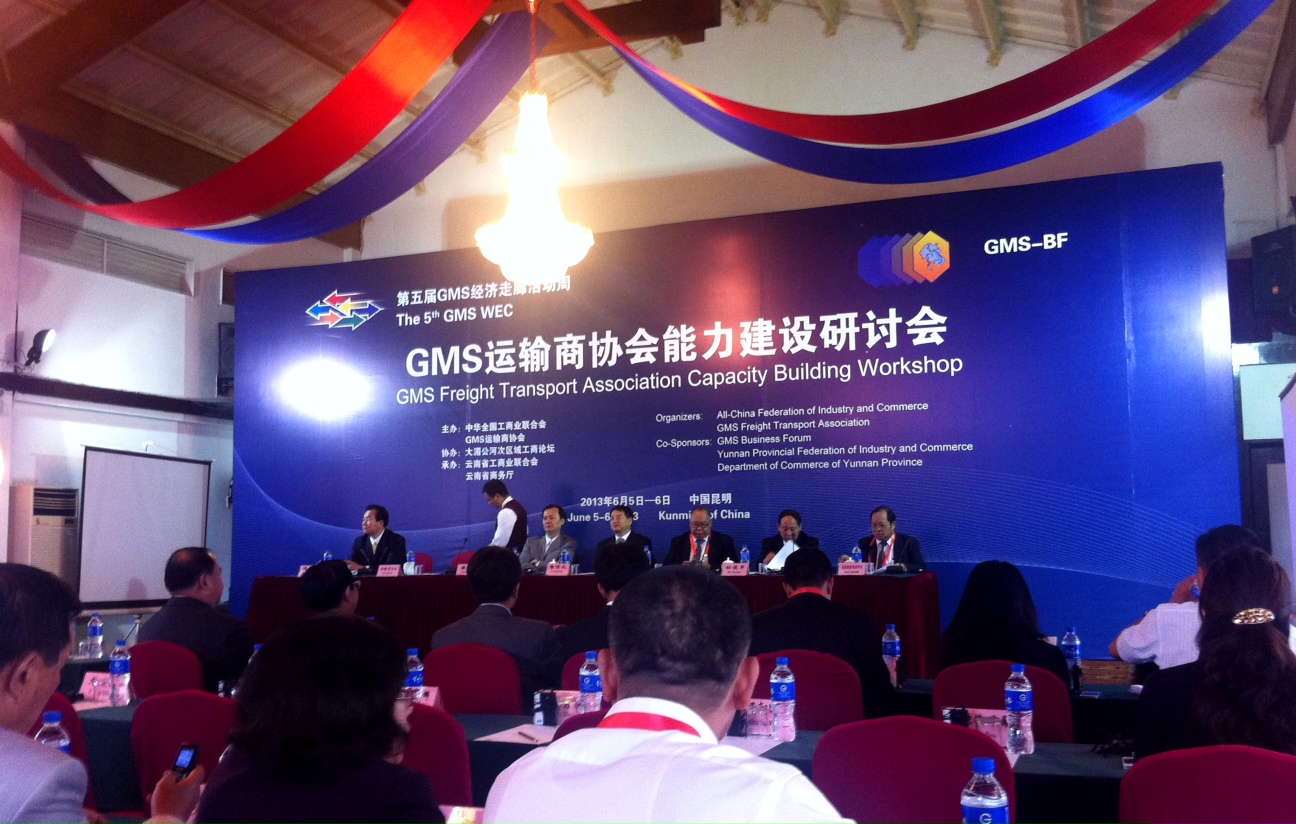
GMS workshop

NOTE: The following is the English language transcription of a speech by Yang Shiji, Vice Director of the Yunnan Provincial Government’s Research Office, presented on June 5, 2013 at a workshop on GMS (Greater Mekong Subregion) Freight Transport Association Capacity Building.  The first part contains an interesting portrayal of connectivity potentials and a brief history of transportation linkages between China and Southeast Asia.  The reader should keep in mind that the area in discussion contains some of the most difficult terrain in the world, but the speaker’s main concerns are inter-government cooperation and the harmonization of customs and trade procedures throughout the region.   The final portion of the speech provides a framework to improve connectivity and upgrade logistical services within the region. 

For reference, a map of the Greater Mekong Subregion is linked here. 

“Strengthening Cooperation and Promoting Cross-border Transport Logistics in the Greater Mekong Subregion”

Cross-border logistics is an emerging industry combining several composite services such as transport, warehousing, and information.  Connecting production with consumption and linking countries to the outside world, the industry is composed of tangible and intangible factors and covers the entire process from product manufacturing to commodity flow.  Therefore, giving full play to the function and role of transport and upgrading the efficiency of cross-border logistic transport will have significant impact on all aspects of the economic and social lives of the countries in the GMS.  With the maturation of China’s market economy, a professional and efficient logistic system has been an indispensible factor for upgrading the quality of its economic functions, the income of its enterprises, and an accelerator for its entire national economy.

Located at the junction of China and Southeast Asia, the South Asian Subcontinent, Yunnan borders with Laos, Vietnam, and Myanmar, and shares with them a 4060 km national boundary line, about one-fifth of China’s total land border.  It has 25 frontier counties, 23 national entry ports, and over 100 trading channels for border residents.  To its east Yunnan is linked to the Zhujiang River delta and the Yangtze River delta economic circles, and to its south it has direct access from three routes, east, central, and west, to Hanoi, Bangkok, Singapore, and Rangoon via the Kunming-Bangkok highway and the Pan-Asia Railway, currently under construction.  It is the gateway to the vast western hinterland of China to its north.  To its west, it has access to the Indian Ocean via Myanmar.  In a word, the province enjoys the locational advantage in “connecting with two oceans, the Pacific Ocean and Indian Ocean, and linking with three major markets in East Asia, Southeast Asia, and South Asia.” Continue reading →

Leave a Comment

Filed under China, DOCUMENTS, Economic development, GMS, Laos, Mekong River, Myanmar/Burma, Regional Relations, Technology, Thailand, Vietnam

What’s at Stake for the China-South Asia Expo?

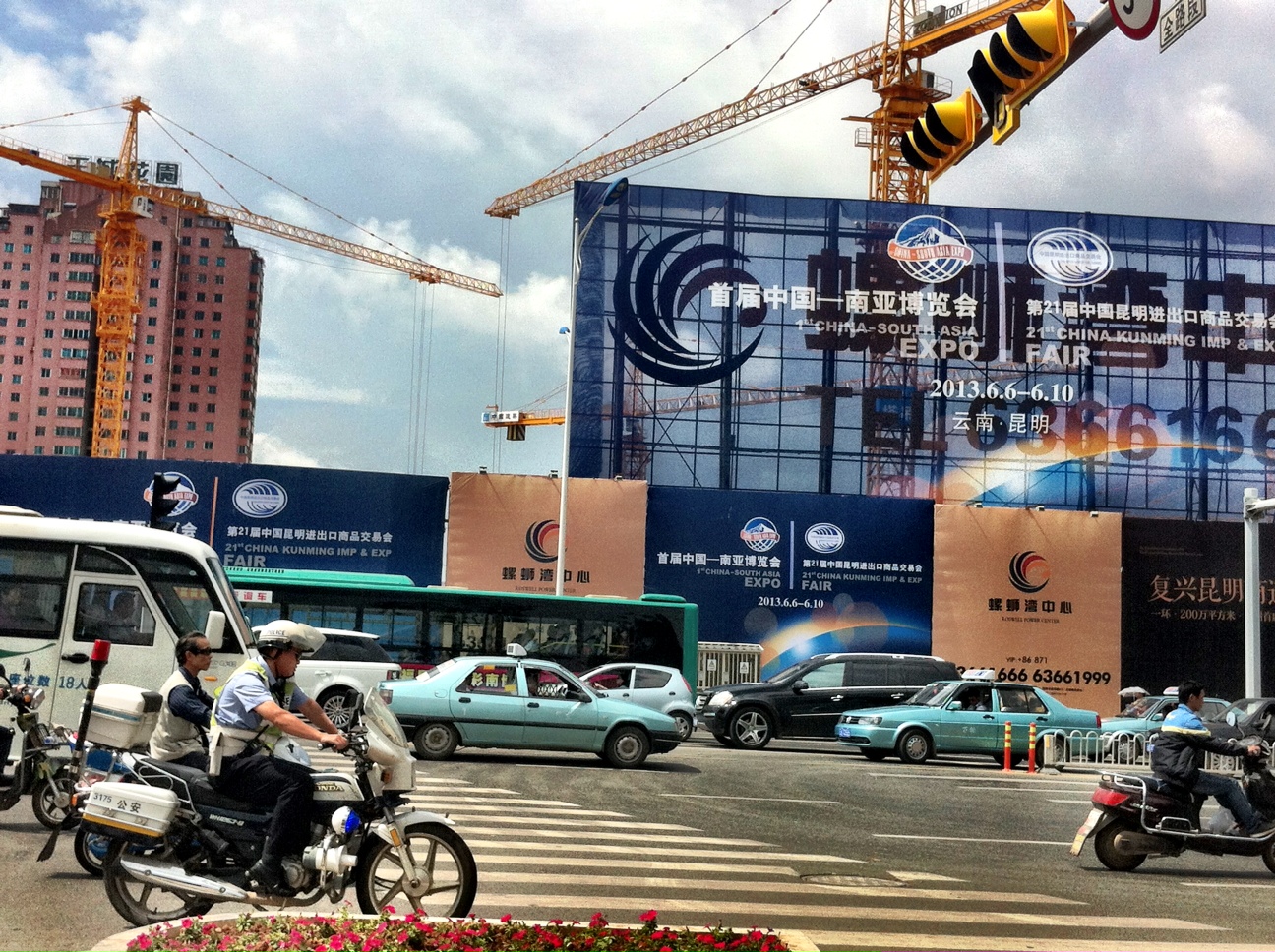
expo

The China-South Asia Expo opened without a hitch yesterday in Kunming despite online calls for a continuation of environmental protests outside of the Expo’s opening ceremony site.  It seems protesters decided to stay home due to a combination of sticks and carrots offered by local authorities.  On June 3, Kunming’s mayor announced the release of key environmental impact assessment data concerning the construction of a PetroChina oil refinery and PX chemical plant side project scheduled for construction 40 km from the city’s downtown area.  Also, the excessive presence of armed and unarmed public security officers lining the city’s streets and manning the Expo site also likely turned protesters away.

What is the rationale behind the excessive security measures?  What’s really at stake at the 1st China-South Asia Expo?

The Expo, a combination trade fair and high level forum for investment and trade promotion discussions between China, Southeast Asia, and now South Asia, is part of China’s “Bridgehead Construction” strategy to establish Kunming and Yunnan province as a gateway between China and its neighbors to the south and west.  A smoothly running Expo not only will seal multilateral agreements and high-value business deals that will streamline regional trade and investment, but it will also guarantee the continuation of soft-budget infrastructure development projects sponsored by Beijing to Kunming and Yunnan province that are part and parcel of the “Bridgehead” strategy.

Continue reading →

3 Comments

Filed under China, Current Events, Economic development, Energy, Environment and sustainability, Foreign policy, GMS, Laos, Myanmar/Burma, Vietnam

China’s media report on Kunming’s environmental protests

The English language discussion of Kunming’s ongoing environmental protests should not exclude China’s official media reports.  The translation below is of a 5/28 article from the Southern Weekend website.

Yunnan’s Anning City Retracts Notice on Face Mask Registration

from Southern Weekend (南方周末)May 28, 2013

More than 200 copies of a ‘Letter of Guarantee’ have been signed by vendors of advertising services, printing services, copy services, face masks, and t-shirts.  These vendors promise to strictly follow national laws and regulations regarding their commercial business and promise not to speak of rumors, create rumors, or spread rumors.  They promise not to participate in any form of information broadcasting, forwarding of messages, and not to participate in sit-ins, protests, or demonstrations of any kind.  They promise to not print, create, or publish things related to the Anning PetroChina Oil Refinery or the “China-South Asia “Expo or advertisements, propaganda materials, or any materials of negative influence.  This “Letter of Guarantee” goes into effect on the day of signing and is valid through June 30, 2013 and sales of all services above must also be accompanied by ID registration of the purchaser.  –Official statement from the Kunming Economic Development Zone Industry and Commerce Bureau. 

The exposure of Anning’s required ID registration of face mask purchases has stirred up considerable public debate.  On the evening of 5/25, the Anning City government’s press office issued a statement saying Anning’s Industry and Commerce Bureau will retract the notice on face mask registration.  But according to a report on 5/27, the “Procedure for registration of face mask purchases” was still in effect for much of the Kunming municipality and was not exclusive to Anning City.  Registration is still required for printing, copying, and publication services. Continue reading →

4 Comments

Filed under China, Current Events, Economic development, Energy, Environment and sustainability, Governance

Mr. Thein Sein Goes to Washington… Mr. Abe Goes to Naypidaw

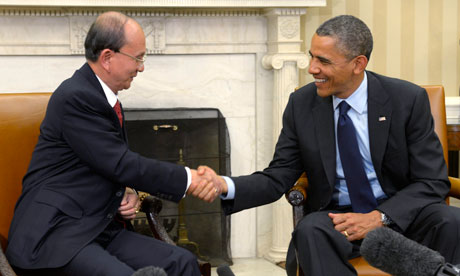
This past week saw big foreign policy news from Myanmar (Burma). Just days after meeting with US President Obama in Washington, Burmese President Thein Sein returned to Naypidaw to meet with Japanese Prime Minister Shinzo Abe. Both visits saw improvements in Burma’s respective relations with the two countries, but which of the two relationships remain closer? From whom did Burma gain the most, and vice versa? The clear answer is Japan.

President Thein Sein visited Washington at the beginning of last week, becoming the first Burmese leader to visit the US since Ne Win in 1966. The visit was a largely symbolic one, lacking many of the tangible economic benefits that are usually associated with these sort of state visits. Aside from agreements to strengthen bilateral trade relations with two US agencies, most of Myanmar’s benefits can be found in the language of US officials. Before the President arrived, US Press Secretary Jay Carney referred to the country as Myanmar, not Burma. Myanmar is the name used by the military junta since 1989, while Burma is an appellation preferred by opponents of the regime. President Obama also referred to the country as ‘Myanmar’ and while it does not mark an official policy change, it does reflect a change in attitude.

During his meeting with President Thein Sein, Obama raised the perennial issue of human rights, but at the same time expressed strong support for the leader. Also of note, US Senator Mitch McConnell, a long-time champion of sanctions against Myanmar, said he was no longer in support of continued sanctions against the country, paving the way for smoother relations in the future. The Burmese president’s visit to the US came without multi-million dollar contracts and major US investment in the country will have to wait, but Thein Sein’s visit did represent a further thawing of the relationship, and offers hope for the future.

Continue reading →

2 Comments

Filed under China, Current Events, Economic development, Foreign policy, Myanmar/Burma, Regional Relations

Air pollution and Kunming’s prevailing rainy season wind patterns

Anning PetroChina

Click to enlarge image.

This image shows prevailing wind patterns during Kunming’s rainy season which runs roughly from May to October.  Strong southwesterly winds bring monsoons from the Bay of Bengal over the Burmese landmass into Yunnan province.

The red rectangle in the southwest corner is the site of the PetroChina oil refinery, the focus of a series of recent environmental protests by concerned Kunming residents.  GoogleMaps has detailed imagery of construction site’s layout.  The purple area to the north is Kunming’s city center, determined by the area inside of Kunming’s 2nd ring road and home to a population of approximately 2.5mn.

Winds passing over the 10 million ton PetroChina oil refinery will send toxic pollutants directly over Anning city and Kunming’s most populated urban districts.  Anning is Kunming’s largest satellite city with an urban population of 100,000.  Kunmingers often drive to Anning to soak in its famous hot springs (also predictably in the pollution path), but in the last 10 years, most of Kunming’s heavy industry moved to Anning in an attempt to reduce pollution in the Dianchi Lake watershed.

After passing over Anning, winds become more concentrated and pick up speed to shoot through three passes in the Xishan (Western Hills) mountain range.  The solid line represents the most voluminous wind channel.  It doesn’t take an expert to see that the oil refinery site was chosen at the most optimal point for dumping pollution onto Kunming.  Perhaps this is why city officials are reluctant to release data from the project’s legally mandated environmental impact assessment.

To make matters worse, a strong southerly lake effect wind, constrained by Kunming’s eastern hills, pushes all westerly winds northward into the city center as they break over Xishan mountain range.  This guarantees that nearly all winds that pass over the oil refinery site through Kunming’s downtown and finally into the city’s north district, home of an additional 1.5mn residents.  Kunming’s north district, currently undergoing a major urban facelift, is planned as one of the city’s new core urban centers with a projected population of 3 to 4 million residents by 2020.

3 Comments

Filed under China, Current Events, Economic development, Energy, Environment and sustainability, Uncategorized, VISUALS

Law of large numbers: The growing gravity of Kunming’s environmental protests

Kunming’s ongoing protest against the construction of a 10mn ton petroleum refinery 40km from the city center continues to gather attention in China’s domestic media and in the international media.  Yet despite continuous coverage of the protest in China’s Global Times, South China Morning Post, the Telegraph, the Guardian, and most recently the Atlantic (among many other media outlets), questions concerning the gravity of the protests continue to pop up in online chat forums: Does a protest of 1000+ Chinese citizens in a city of 7 million have impact?  Given the numbers, does the average Kunming citizen know about this issue?  Can protests of this scale force changes to policy agendas?

ExSE’s answer to all three of those questions is an unequivocal YES.  Kunming mayor Li Wenrong would have not made an impromptu engagement with protesters last Thursday if he didn’t see the movement as a legitimate challenge to the status quo.  He followed through on his promise to open a Sina Weibo account by noon on 5/18 and since then he’s gathered more than 75000 followers.  Further, an online poll created after the initial 5/4 protest exceeded its limit of 100,000 responses within three days.  The poll asked a simple yes or no question: Should there be a PX plant in Anning? An overwhelming majority of 80% ticked “no.”  It’s no surprise that the poll’s weblink was eradicated last week.  Admittedly, there is no way of knowing whether Li Wenrong’s 75k followers are mostly from Kunming, and online polls are never without bias; but the large numbers undeniably say something and suggest that the 2000+ protesters are representative of a much larger group of concerned citizens. Continue reading →

3 Comments

Filed under China, Current Events, Economic development, Energy, Environment and sustainability, Governance, Myanmar/Burma, Yunnan Province