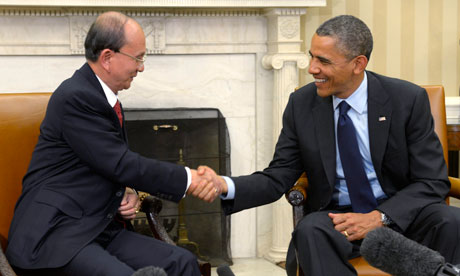
This past week saw big foreign policy news from Myanmar (Burma). Just days after meeting with US President Obama in Washington, Burmese President Thein Sein returned to Naypidaw to meet with Japanese Prime Minister Shinzo Abe. Both visits saw improvements in Burma’s respective relations with the two countries, but which of the two relationships remain closer? From whom did Burma gain the most, and vice versa? The clear answer is Japan.
President Thein Sein visited Washington at the beginning of last week, becoming the first Burmese leader to visit the US since Ne Win in 1966. The visit was a largely symbolic one, lacking many of the tangible economic benefits that are usually associated with these sort of state visits. Aside from agreements to strengthen bilateral trade relations with two US agencies, most of Myanmar’s benefits can be found in the language of US officials. Before the President arrived, US Press Secretary Jay Carney referred to the country as Myanmar, not Burma. Myanmar is the name used by the military junta since 1989, while Burma is an appellation preferred by opponents of the regime. President Obama also referred to the country as ‘Myanmar’ and while it does not mark an official policy change, it does reflect a change in attitude.
During his meeting with President Thein Sein, Obama raised the perennial issue of human rights, but at the same time expressed strong support for the leader. Also of note, US Senator Mitch McConnell, a long-time champion of sanctions against Myanmar, said he was no longer in support of continued sanctions against the country, paving the way for smoother relations in the future. The Burmese president’s visit to the US came without multi-million dollar contracts and major US investment in the country will have to wait, but Thein Sein’s visit did represent a further thawing of the relationship, and offers hope for the future.