Category Archives: Economic development

Unstoppable: Kunming’s environmental protest movement takes a powerful turn


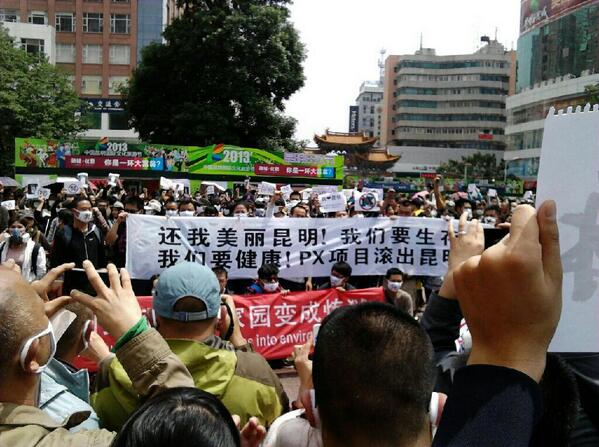
protest view

Kunming’s anti-PX protest movement broke through to new heights on Thursday as more than 2500 protesters took to the city’s downtown streets.  The unexpected success of this impressive NIMBY movement has empowered protesters to shift targets – what began two weeks ago as a movement opposing the construction of a polluting chemical plant attached to a PetroChina oil refinery 40km from the city center has evolved into a full blown protest against the entire 10mn ton oil refinery project.  Throughout the morning the protesters worked a powerful and persistent ground game breaking through rank after rank of public security forces to gain total control of Kunming’s downtown streets by noon.  Protesters marched in peaceful and non-violent demonstration for more than five hours under the intense Kunming sun and prompted an engaging appearance of Kunming mayor Li Wenrong who sympathized with protesters and promised immediate change – another breakthrough victory for this growing social movement. Continue reading →

5 Comments

Filed under China, Current Events, Economic development, Energy, Environment and sustainability, Myanmar/Burma, Uncategorized

Anatomy of a Protest: Kunming citizens voice concern over chemical plant

Saturday’s peaceful protest in Kunming may be the first of many against a polluting PX chemical plant slated for construction inside Kunming’s city limits. Nearly 2000 people participated in the well organized protest, and the crowd met zero resistance from the 200+ police and public security officers sent to the site to maintain order. For more than three hours, citizens wore “No PX” face masks and paraded around the protest site waving banners and posters sporting slogans like “PX project, get out of Kunming” and “I want green!” Different from other protests I’ve seen in China, the organizers divided the site into teach-in zones where crowds of hundreds could listen to those who had a message to deliver. In the end, no arrests were made and there were zero scuffles between protesters or with the police.

banners

Continue reading →

4 Comments

Filed under China, Current Events, Economic development, Environment and sustainability, Myanmar/Burma

Cleaning up Kunming’s Dianchi Lake, Part 2

Zhou Dequn’s post, “Cleaning up Kunming’s Dianchi Lake” discussed the origins of and contributing factors to the lake’s pollution.  His post also briefly discussed a few of the measures used to raise the quality of Dianchi’s water in recent years. The marked improvement of Kunming’s groundwater quality was recently profiled in this New York Times video.

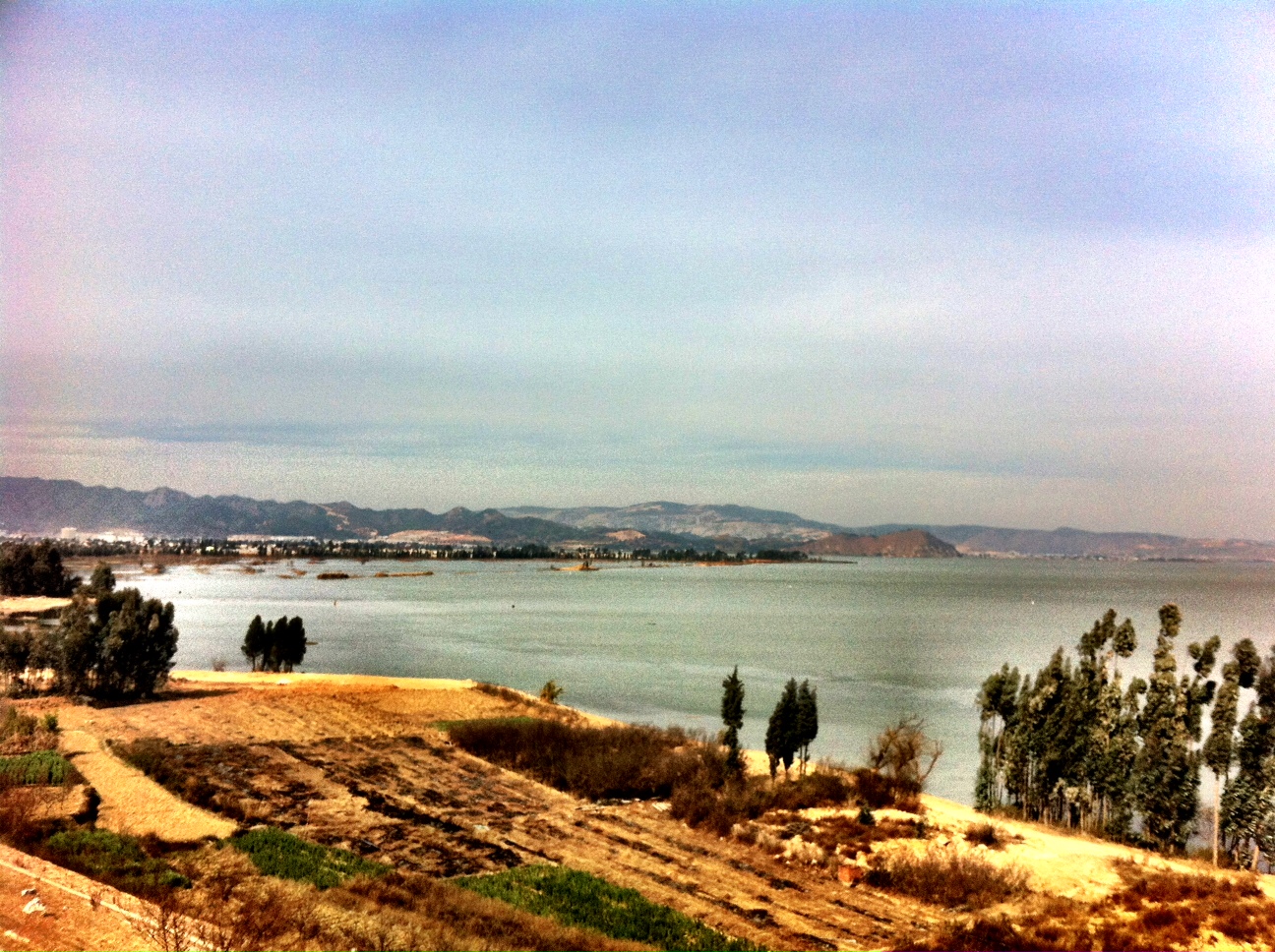
Dianchi south

PHOTO: Dianchi’s southern shoreline

Continue reading →

1 Comment

Filed under China, Economic development, Environment and sustainability, Sustainability and Resource Management, water

Where have all the fish gone? Killing the Mekong dam by dam

The Mekong, a river of wildly majestic fast-flowing currents flowing through six countries, has long enchanted explorers with its rich biodiversity second only to the Amazon.

It is home to the Giant Catfish, and at least 877 fish species sustaining food security for around 65 million people which make the Mekong the world’s most important centre of freshwater fisheries.

“For the people born on the Mekong, the river is like their blood—the principle of life,” says Dorn Bouttasing, a Lao environmental researcher.

Surely it is unthinkable that man would want to endanger or destroy the basis of such extraordinary natural wealth? Such invaluable natural resources, their infinite value defies any attempt to measure with a crude price tag.

My documentary Where Have All the Fish Gone? (Eureka Films) looks at the four Chinese hydropower dams that have been already built on the Lancang (The Chinese name for the upper Mekong), but its main focus is on the Lower Mekong basin shared by Laos, Myanmar, Thailand, Cambodia and Vietnam.

Continue reading →

Leave a Comment

Filed under Cambodia, China, Current Events, Economic development, Energy, Environment and sustainability, Food, Foreign policy, GMS, Governance, Laos, Mekong River, Sustainability and Resource Management, Thailand, Vietnam, water

Regional Roundup for Week of 4.18.2013

Just the news this week. Continue reading →

Leave a Comment

Filed under ASEAN, China, Cold War, Current Events, Economic development, Energy, Environment and sustainability, Foreign policy, Governance, Health, Laos, Mekong River, Myanmar/Burma, NEWS DIGEST, Thailand, Vietnam, water

The logic of China’s economic strategies in Southeast Asia

In so many ways, China’s strategies for its involvement in Southeast Asia are much more pragmatic, more predictable, and considerably less nefarious than any other rising global power that previous laid sight on region.  Moreover, those strategies, born in the 1990s, make even more economic sense now than at the time of their inception due to the current needs of its development trajectory.

Energy consumption and the speed of urbanization in China are rising at ever-increasing rates.  To keep pace, the central government must secure energy resources and safe, low-cost agricultural goods. Southeast Asian states, in a complementary fashion, have robust food export markets, as in the case of Thailand or Malaysia, or as in Laos and Myanmar, have abundant endowments of energy resources.  Chinese state owned enterprises and private business interests seek to access and integrate into these markets and new infrastructure linkages such as highways and high-speed railways are indicators of deeper market integration abroad. Continue reading →

Leave a Comment

Filed under China, Current Events, Economic development, Energy, Foreign policy, Governance, Laos, Malaysia, Myanmar/Burma, Singapore, Thailand, Uncategorized, Vietnam

About East by Southeast

WRITE FOR US!  JOIN THE ExSE TEAM, contact us at eastbysoutheastmail@gmail.com

The East by Southeast team is made up of scholars, development professionals, logistics experts, environmentalists, green entrepreneurs, and policy makers. We all live and work in the region – some were born here and some are implants. It is in the framework of the wide variety of our opinions that we seek to promote a deeper discussion of regional challenges. Some of us write under pen names to allow discussion to flow freely.

In addition to blog posts, look forward to weekly new digests, book reviews, and data that will help better inform your understanding of this dynamic region.


WHY WE WRITE:

There are many good blogs about China and many from Southeast Asia, but it is surprising that there are few blogs looking at the connections between China and Southeast Asia given shared development challenges, centuries of historical and cultural interaction, and rising volumes of trade and people movement between China and Southeast Asia.

In the 1990s, nations and ethnic groups that were cut off from cross-border interaction during the Cold War began to reunite as peace spread throughout the region, and arguably, China’s rise has reinforced stability within the region to deliver deepened integration.  Fast forward twenty years, the region is home to some of the fastest growing economies in the world and rapidly changing urban spaces. It is also known for its abundance in natural resources and biodiversity, and development trajectories are converting those resources into cash crops and energy commodities for trade and consumption. On mainland Southeast Asia, a lack of policy coordination and communication between governments and stakeholders has already created a variety of trans-boundary issues like fisheries depletion in the Mekong watershed.  As a result, for the first time, the region faces threats to food security and a potentially gross mismanagement of its resource endowment.

In addition to the growing connections between China and Southeast Asia, the East by Southeast blog team will examine China’s footprint across its southern borders to provide answers to some of the big questions surrounding China’s global rise. We seek to understand the effect and return of China’s outpouring of aid and investment to its Southeast Asian neighbors and monitor changes in China’s approach to foreign policy as its interests spread across the region. We want to know how China’s neighbors are adapting to its rise and how effectively China’s soft power is spreading. There is much room for discussion and exploration of the gaps between China’s rhetoric on its peaceful rise in the region and its ability to continue expanding its resource base to feed the needs of a rapidly growing economy. Lastly, we are concerned with China’s adaptation and response to a new and concerted US foreign policy toward Southeast Asia.

From a different perspective, the blog team will look at how the space between China and its Southeast Asian neighbors is decreasing at a rapid rate as transportation infrastructure, advances in information transfer, and trade linkages reach across borders and states use what Yale scholar James C. Scott calls in his 2009 watershed work The Art of Not Being Governed, “distance demolishing technologies” to connect areas that were once the frontiers beyond all frontiers. For example, energy from hydropower plants is sent from Laos to the China’s east coast development zones, you can now drive a container truck from Kunming to Bangkok in less than a day on what was once previous non-navigable terrain, and in 2015 the ASEAN Economic Community promises to drop the barriers to the movement of labor and goods through the region. In addition to understanding the trajectory and obstacles of regional integration,
we want to explore how rapid and sudden improvements in connectivity reshape individual livelihoods, communities, and regional relationships.

There are so many stories to tell of the people who are shaping the region for better or for worse and of the people who are affected
by regional decision making. Narratives from the varied and violent histories of the Cold War, colonial, and pre-colonial eras can help demonstrate how history can inform the present challenges. In addition, the blog will expore many regional question marks such as the tenuous path to democratization in Myanmar (and Thailand and Cambodia), Kunming’s rise as the Bangkok of the north, a high-speed rail system through Laos, and the effects of salinization in the Mekong Delta.  Can cities and rural areas in the region learn how to provide each other with sustainable solutions to development challenges? Are there lessons to be taught as countries like Thailand, China, and Indonesia seek to escape the middle income trap?

The East by Southeast team is made up of scholars, development professionals, logistics experts, environmentalists, green entrepreneurs, and policy makers. We all live and work in the region – some were born here and some are implants. It is in the framework of the wide variety of our opinions that we seek to promote a deeper discussion of regional challenges. Some of us write under pen names to allow discussion to flow freely.

In addition to blog posts, look forward to weekly new digests, book reviews, and data that will help better inform your understanding of this dynamic region.

If you’d like to join the discussion, feel free to leave a comment after our posts, or if you’d like to contribute to the blog by becoming a team member, send us a message to eastbysoutheastmail@gmail.com.

1 Comment

Filed under ASEAN, China, Cold War, Current Events, Economic development, Energy, Environment and sustainability, Foreign policy, Governance, water