
In recent years, two powerful narratives have emerged from mainland Southeast Asia. Generally speaking, discussions of the region focus around one of two topics: economic development and environmental degradation. For example, by typing “Mekong” into Google News the first page of results will show articles like this and this. As one can imagine, these two views of Southeast Asia are often in opposition and proponents of each rarely see eye to eye, sometimes going so far as to ignore the other side altogether. Recently, the battleground of these two narratives has been the construction sites of hydroelectric dams (both real and planned) that dot the Mekong River. Proponents of economic development see these dams as a necessary component to continued economic growth in the region. On the other hand, environmentalists point to the unknown ecological costs of the Mekong dams and argue that there are hidden costs to supposedly cheap hydropower. What is lost in the increasingly polarized game of right and wrong is a larger, more nuanced picture of the region and its needs. Some say that the Mekong needs dams while others argue that the region needs better protection measures for its natural resources. But what Southeast Asia really needs is for development fans and environmentalists to stop ignoring each other, and to restart the dialogue. Continue reading
Category Archives: Economic development
The Kunming-Bangkok Highway’s Final Link Opens over the Mekong
The Fourth Thai-Lao Friendship bridge which connects Thailand’s Chiang Rai province to Lao PDR’s Bokeo province officially opened for business yesterday. Although the bridge, which stretches 400 meters across the Mekong river, and surrounding customs and inspection infrastructure have been completed for a few months, the two countries set the auspicious date of December 11, 2013 or 11/12/13 as written in the international form for the bridge’s opening ceremony conducted by Thailand’s highly respected Princess Sirindhorn.
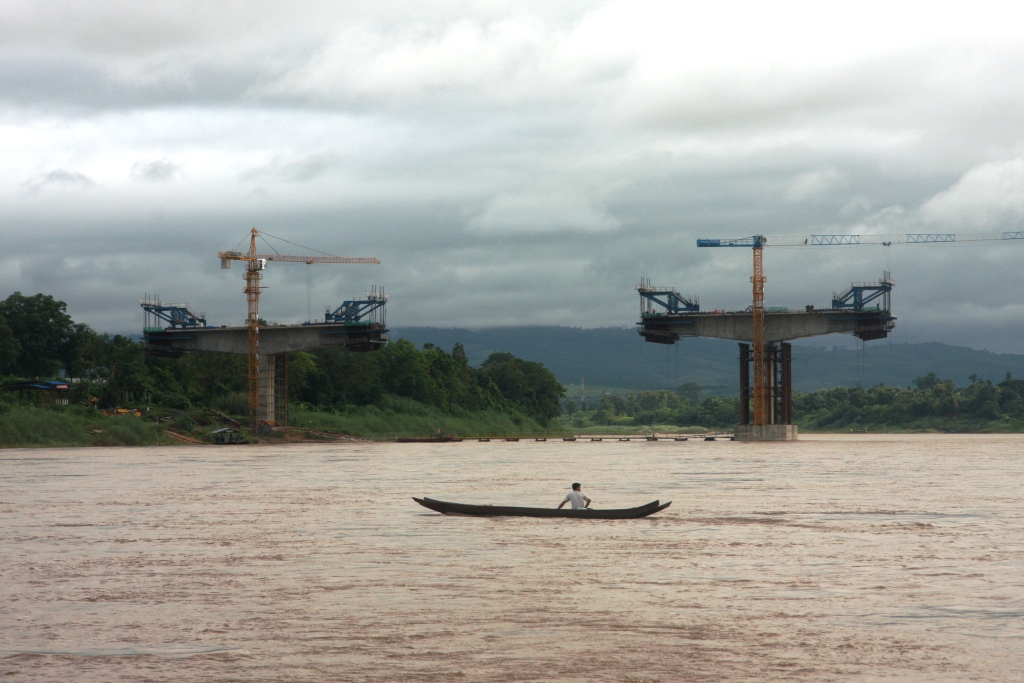
- A local fisherman navigates the Mekong downstream of the new bridge (July 2012)
The prime benefactor from the bridge’s opening is not Thailand or Laos, but rather China as the bridge serves as the final link in the Kunming-Bangkok highway, a 1900km series of connected highways that will facilitate significant increases in container shipping trade between China and Thailand. Six years ago overland transport between Kunming and Bangkok for container shipping was virtually impossible due to the poor quality of roads. In China’s southwestern Yunnan province, a drive from Kunming to Jinghong, the Dai cultural capital of Sipsongpanna (Xishuangbanna) prefecture took up to 24 hours and another six hours to the Lao PDR border at Boten. China completed its portion of the highway to in late 2007.
The Lao PDR segment of the highway connects Boten to the 4th Friendship bridge in Huayxai and cuts through 180km of the most remote parts of Laos. In the summer rainy season of 2004 I hitched a ride on a pickup truck to travel the 180km segment which then was a single lane mud track. We completed the tiresome 10 hour drive only after averting a serious accident and certain death when the truck spun out of control nearly pitched over a 400 meter cliffside. China, Thailand, and the Asian Development Bank invested equal thirds in the Laos portion of the highway which opened in 2010 and dropped transportation time to three hours.
By design, the highway system links the friendship bridge to Bangkok, but despite being the strongest economy on mainland Southeast Asia, Thailand’s highway system lags behind in quality compared to China and the stretch running through northern Laos. Improvements to Thailand’s R3 highway system which will link Chiang Rai province to all points in Thailand is ongoing but far from complete. Thailand has promised to upgrade its national transportation and highway infrastructure but political roadblocks, corruption, and a perceived lack of momentum for regional integration at many levels of Thai government and society has discouraged those plans from synching up with China’s outwardly stretching infrastructure linkages. When the Thai roads are finished, a container truck will be able to travel from Kunming to Bangkok in less than 18 hours.
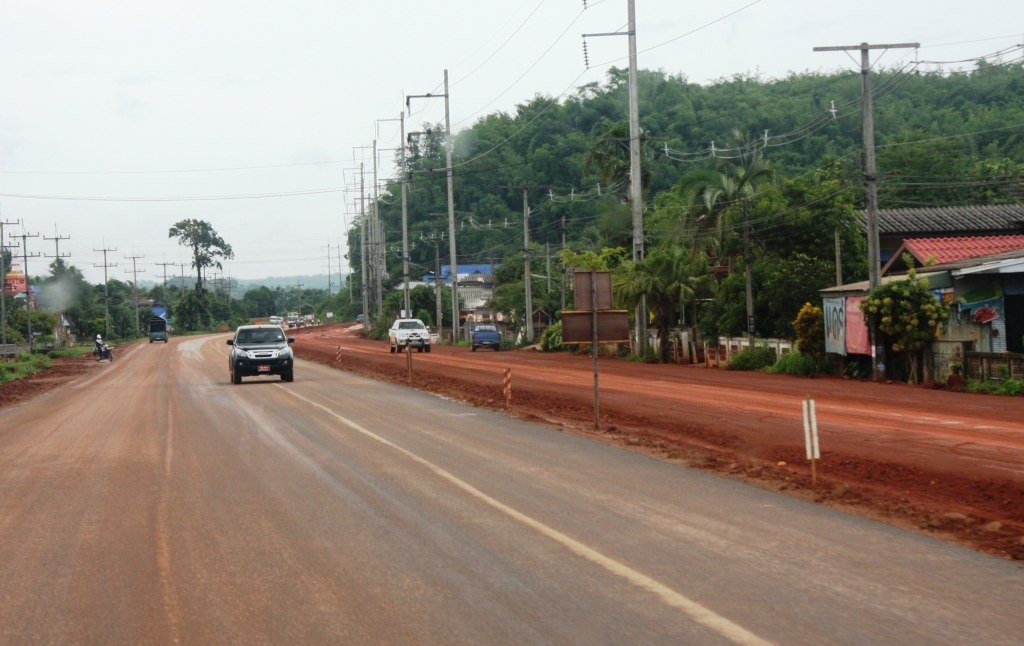
Road widening construction on Thailand’s R3 in Chiang Rai province
The 14 hour drive from Kunming to the friendship bridge feels like a leapfrog journey from bridge to tunnel and tunnel to bridge as the road makes its 1800 meter descent. These two roads cut through some of the most difficult terrain on the planet and link the Chinese state to the Thai state while passing through the most ethnically diverse region in Asia.
The roads not only to build regional commercial connections between China, Thailand, and Laos through the increases of trade and investment but they also assist in expanding each of these state’s interests and systems into the once impenetrable regions of upland southeast Asia by introducing national education systems, agricultural techniques that promote mono-cropping over traditional subsistence farming, and creating avenues for ethnic and rural peoples to leave their homes and link up to national labor markets. The opening of the bridge will increase trade in the region and will intensify and quicken the pace of social change in upland Southeast Asia and reshuffle the cultural milieu of peoples who have sought refuge from the expansionary Chinese and Thai states for centuries.
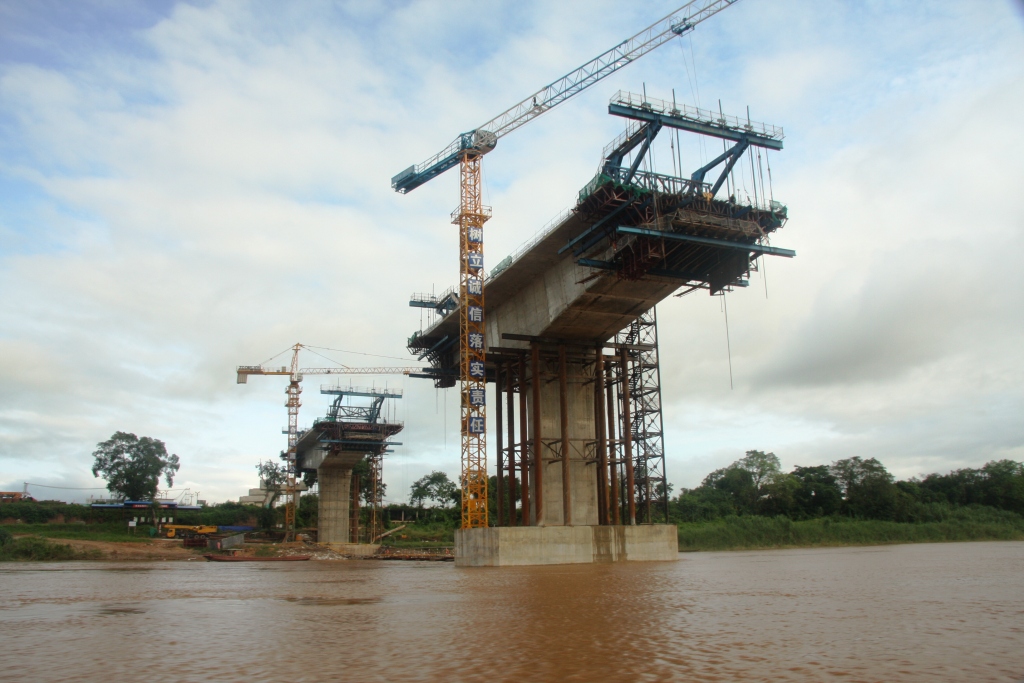
Under construction, July 2012

Bridge completion, December 2013
The bridge’s construction has also caused an influx of Chinese investment in Chiang Rai province mostly in real estate development, speculation on future industrial estates for manufacturing of intra-industry goods passing between China and Thailand, and the buying up of agricultural lands. While this investment is encouraged and welcomed at the national level and by the Chiang Rai Chamber of Commerce, locals are wary of the fast and growing levels of investment in the Golden Triangle Area by Chinese firms and often cite a “Chinese invasion.” The mayor of Pak Ying Tai village, a small fishing community of 100 households located less than one kilometer south of the bridge has lamented to me on several occasions about China’s footprint in Chiang Rai as he observes year on year decreases in freshwater fish catches and sends more and more of his villagers looking for work in urban areas.

A local farmer from Pak Ying Tai village discusses his worries about community impacts of economic development
In many ways the bridge and its construction serve to represent the challenges of regional cooperation between China, Thailand, and the rest of mainland Southeast Asia. From its conception in the late 1990s to its completion yesterday, the bridge has gone through stalled and failed rounds of negotiation and has not lacked controversy. Groundbreaking for the 1 billion Thai baht project which is equally invested by China, Laos, and Thailand did not occur until 2010 despite a scheduled start for as early as 2006. In May 2011 Thailand pulled its portion of the construction team in order to settle a land dispute with the local Thai government accusing Chinese commercial interests of illegally purchasing land on the Thai side of the bridge.
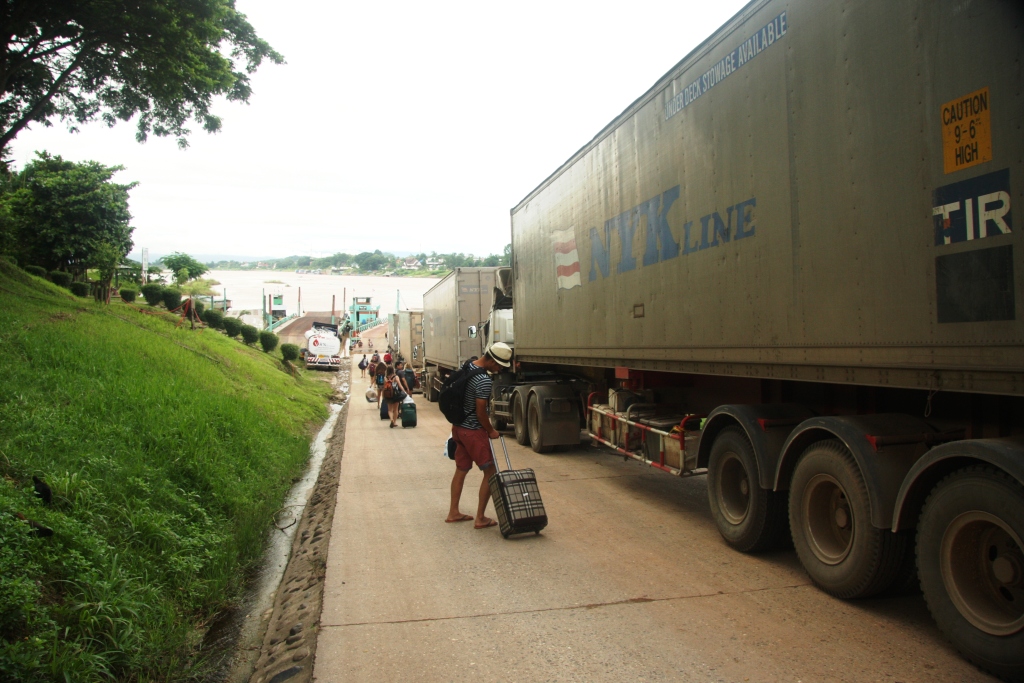
Container trucks will no longer have to wait in line for the Mekong ferry at Huayxai in Laos.
Another obstacle to regional cooperation demonstrated by the bridge is the ease of passage through customs and inspection for both container trucks and individual travelers or tourists to the region. Chinese trucks are not permitted to drive in Thailand, nor are Thai trucks allowed to travel through China; thus the speed of transport is slowed by the need to repackage goods at one of the border crossing points. Despite efforts of the ADB in to facilitate a shared cross border trade and transport protocol to streamline logistical flows at regional border checks in China and mainland Southeast Asia, states have been slow to adopt the measures in order to protect national markets and logistics industries. New customs and inspections facilities at the bridge are fitted to increase the speed of transport and ease of people movement and will serve as a testing ground for these promised increases in logistical efficiencies.
Looking forward to the first six months after the bridge’s opening, the verdict will be clear on whether the bridge will serve as a strategic choke point, a gateway for win-win trade and economic development between two regional powers , or a conduit that will further challenge the structure of rural livelihoods in upland Southeast Asia.
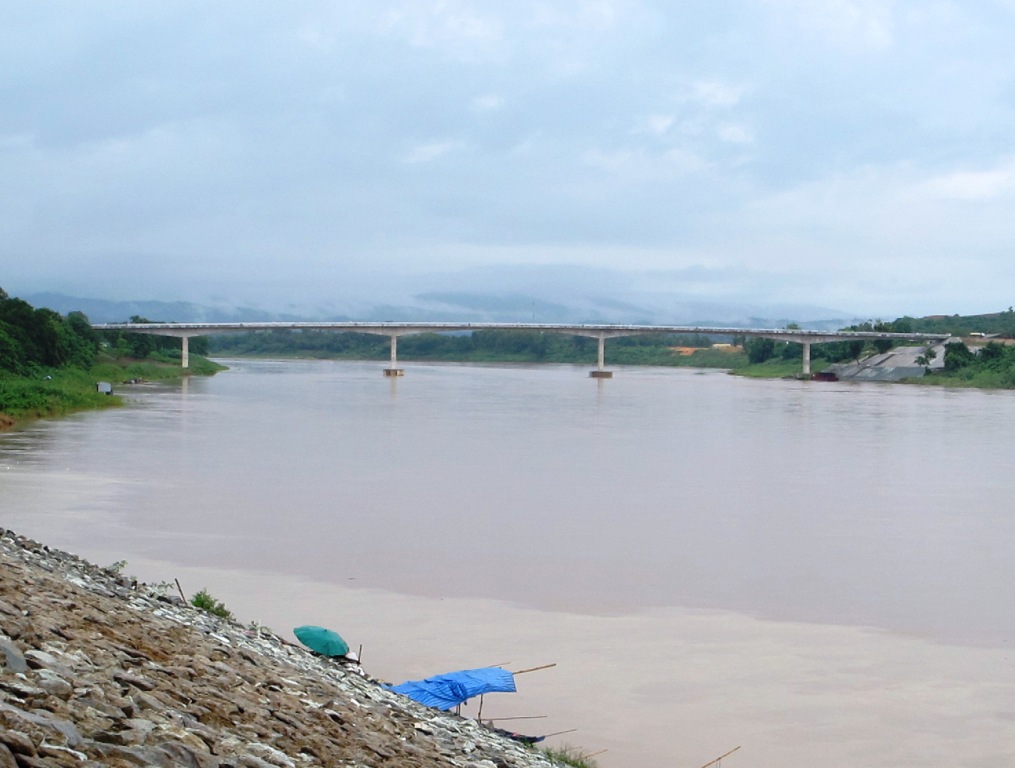
Looking upstream at the completed bridge from Pak Ying Tai village.
Gary Locke, US Ambassador to China visits Kunming one day after announcing resignation

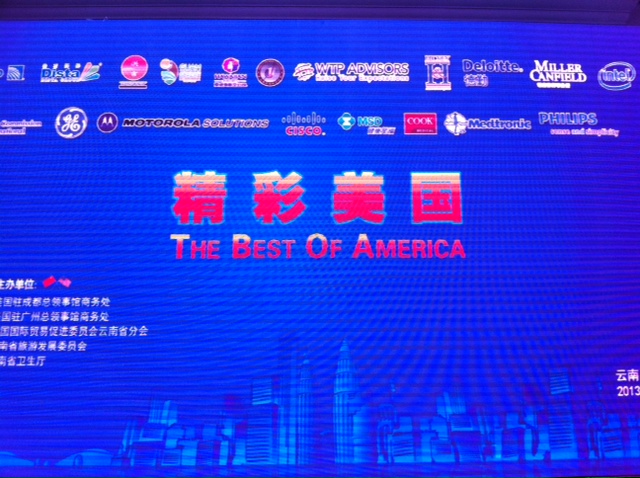
US Ambassador to China Gary Locke paid his third visit to Yunnan province on Thursday, November 21, one day after the announcement of his unexpected resignation. His visit was part of an investment promotion roadshow entitled “The Best of America” traveling around China’s southwestern provinces and organized by the US consulates in Chengdu and Guangzhou. The event was hosted by provincial vice-governor Gao Feng and attended by Yunnanese business interests and officials from the provincial international trade promotion department, tourism department and public health departments. Core economic strengths of the US were represented by CEOs and officers of Deliotte, GE, Motorola, CISCO systems, Intel, and Miller Canfield Law firm in addition to other firms. United Airlines was also in attendance and eager to promote its new direct flight from Chengdu-San Francisco opening early 2014.
Opening remarks were given by both Ambassador Locke and Vice Governor Gao. Both speeches highlighted the United States’ and Yunnan’s shared history of cooperation through the Flying Tigers, as well as the need for present day economic cooperation. In his remarks, Ambassador Locke boasted of the increase of China-to-US FDI under his tenure. In the past 21 months, investments from China totaled USD 18 billion, more than the past 10 years combined, an accomplishment Locke can only take partial credit for, as larger macroeconomic trends in the US and China were also important factors. Locke was also able to highlight the increase of Chinese students in the US in recent years. According to the ambassador, the number of Chinese students in the US reached 280,000 in 2012. In addition, Ambassador Locke was also able to point to decrease in wait time for US visas and a new, expanded visa office at the Chengdu consulate as notable achievements under his tenure. Aside from pushing investment in America, Locke also promoted core American values like legal transparency, free trade and intellectual property rights, issues that have been divisive for the two countries in past years.
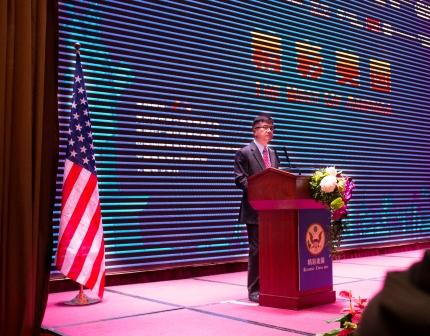
Photo courtesy of Allie Horick
Speaking directly after Ambassador Locke, Yunnan’s Vice Governor Gao Feng also promoted bilateral trade and cooperation. In his remarks, Vice Governor Gao emphasized Yunnan’s role as China’s gateway to South Asia and Southeast Asia and its fast pace of the its economic growth. Gao pointed to the recent China-South Asia Expo as a marker of Yunnan’s rise in national and regional importance. The US delegation noted that Locke’s visit to Yunnan went very smoothly and all requests for visits to companies and government ministries were granted, including a visit to Yunnan University, where the Ambassador met with students and professors. This is in contrast to the difficulty encountered when US delegations request access in other provinces and autonomous regions in southwest China, particularly Tibet.
The roadshow was planned with the specific purpose of promoting Chinese FDI to the US, the export of medical technology to Yunnan’s developing healthcare sector, and tourism to the US. After the Green Lake Hotel event, the delegation met mostly with potential investors from the agriculture and mining sectors reflective of these two sectors as two core pillars of Yunnan’s economy – tourism. Locke also encouraged US investment in Yunnan tourism management systems – something sorely needed in Yunnan, and China at large, as localities struggle to protect cultural capital bases and natural endowments from the damaging onslaught of mass Chinese tourism.
The inability of Yunnan’s medical infrastructure to keep up with the demand for medical services was apparent when the delegation was shown MRI scanner purchased from the US that had been use for 10 years at the Kunming Number One Hospital. The machine was being used 70-80 times per day non-stop for seven days per week. Cumulative cost of parts and supplies maintenance, all imported from the US, had greatly exceeded the original cost of the machine.
Lastly, Chinese tourism to the US was high on the list of promotion for the delegation. In 2012, tourism to the US was the US’s top service sector export with Chinese tourists leading the way in number of tourists visiting the US in a by country breakdown. In international trade accounting, foreign tourist visits are counted as an export due to the positive accumulation of foreign income.
Locke’s visit is recognition of the fruits of the China’s Western development program – namely economic progress to the degree that US investors are now drawn to the fast growth rates coming out of China’s southwestern provinces. And as a result of that economic progress, Yunnanese investors have reached levels of wealth garnering capabilities to invest in the US, half a globe away. His visit is also reinforcement of Yunnan’s strategic location as a gateway for regional investment to Southeast Asia and South Asia – a key point mentioned by both the US delegation and the provincial hosts.
Later in the day, Locke’s diplomatic rock star status was confirmed by an exuberant crowd of students at Yunnan University proud of their shared heritage with the US ambassador. Locke returned that exuberance with hugs. With Locke stepping down it may be a while until another US ambassador to China receives the kind of welcome received in Thursday in Yunnan.
Consensus among some of the ExSE members is that Locke may be stepping down in preparation for a high appointment related to the 2016 presidential election. He is an extremely successful career politician with experience managing Americans’ most important bilateral relationship, domestic economic and international trade relations as US Commerce Secretary, and a successful run as governor of Washington State. This portfolio positions Locke as a strong candidate for VP or Secretary of State under a future Democratic presidency. Gary Locke will step down as US Ambassador to China early 2014 after taking up the post in August, 2011.
China’s Bridgehead Strategy and Yunnan Province
Editor’s note: Liu Jinxin wrote this essay to debunk the myth that China’s bridgehead strategy is militaristic or expansionary in nature. As a chief architect of this strategy, he seeks to demonstrate that developing Yunnan province into a bridgehead will increase international trade flows and deliver long-term regional security. This translated essay currently guides top-level foreign policy makers in China in implementing economic strategies along its borders with Southeast Asia.

Yunnan province’s border crossing with Vietnam at Hekou/Lao Cai
The definition of a bridgehead?
According to the Modern Chinese Dictionary, a bridgehead (桥头堡) is a military term that refers to a strategic chokepoint on the field of battle and particularly refers to a fortified structure that defends and controls a bridge or ferry crossing. In economic terms, bridgehead refers to a strategic forward position on a political or economic front line. The term bridgehead appeared for the first time in an official national level Chinese policy document called “Eastern Bridgeheads” in July 1994 which confirmed the Shandong cities of Rizhao and Lianyugang as the bridgehead terminus of the Eurasian landbridge.
In the economic research of landbridges, a bridgehead is a key concept that acts as a port and facilitates the ease of transportation. Bridgeheads are also international centers of shipping, finance, and information which together form an integrated international center of trade. From a logistical and supply chain system perspective, a bridgehead serves basic support to the Eurasian landmass. It is a city or a region that sits on a strategic position on the logistical and supply chain and serves the specific purpose of controlling the flow of resources along international trade routes. The basic characteristics of a bridgehead are its powers to control, develop, and influence.
The power to control
The power to control suggests capabilities levels of secure logistical flows. This can be understood in narrow and broad senses. From a narrow sense, secure logistical flows are conditional to the degree of market openness. The survival and development of logistical flows must not be threatened by the power of a government to regulate or control it. From a broad sense, a state’s security and international security are guaranteed by engaging in logistical activities. The capability of a state’s secure logistic flows is determined by its capacity to control strategic resources, logistics routes, linkages, and its industrial supply chain.
Linking with the similar strategic logistic routes, resources, and supply chain structures of neighboring states, a concerted logistics system can deliver harmony and mutual trust as well as a collective security that realizes long term stability. Fostering mutual trust, mutual benefit, and equality work together to form a new worldview for security and protects the security of individual states as well as respects the security concerns of other states. Mutual trust also promotes collective security.
The power to develop
Developmental power is preconditioned by the construction of logistic routes, linkages and supply chain structures, the developmental needs of economic corridors, and mutual benefit and cooperation. This power can help states share development trajectories, share prosperity and harmonious development, and eliminate security threats at their root. States should place the promotion of shared development as the method for solving global development imbalances and fostering sustainable development. To revolutionize international financial systems, oppose trade protectionism, and promote regional economic cooperation, developing countries should establish development modes that foster interdependence, deliver effective beneficial outcomes, and seek to erase poverty. Developing countries should expand trade with each other, open markets to each other, and increase the level of south-south cooperation.
The power to influence
Influential capabilities rely on a state’s degree of openness and tolerance, strengthening of the construction of a national culture, making positive contributions in international cooperation, solidification of geo-cultural space, promotion of geo-cultural integration, ability to cooperate harmoniously, and mutual progress with its neighbors. States should respect the rights of other states to determining their own development paths by admitting differences in cultural traditions, social systems, and value systems. States should actively promote and provide guarantees to human rights, and increase dialogue to eliminate misunderstandings. States should initiate a spirit of openness and tolerance, make use of the development modes of other states in a comparative and competitive fashion, and seek collective development despite differences.
The functionality of China’s bridgeheads
The central government has required Xinjiang Uyghur Autonomous Zone, Yunnan province, and other frontier provinces and zones to open the construction bridgeheads along national borders to implement a stable and prosperous frontier region. To deliver prosperity, the bridgeheads should:
1) Be a foundation of protecting border security and stability
2) Take measures under the conditions of high technology to serve as a front line in partial wars and non-traditional security issues
3) Support efforts to rapidly develop ethnic and national zones through new economic modeling
4) Expand the promotion of international/regional cooperation with neighboring states and extend degrees of openness by forging ahead as zones of experimentation.
5) Serve as a transit and storage point for national energy resources.
From a spatial perspective, Xinjiang acts as a bridge between the East and the West; it is the new Eurasian landbridge’s thoroughfare, and as a “west gate,” it serves the opening of China’s northwest region to Central Asia and Europe.
Yunnan opens China to the Southwest connecting two oceans, the Pacific and the Indian as well as East Asia, Southeast Asia, and South Asia. It is the linkage point between China’s southwest, the Southeast Asian peninsula, and the South Asian Subcontinent, and is the starting point of the Yangtze River Delta economic zone as well as the Pearl River Delta economic zone. Yunnan acts as the core belt of the China-South Asia Economic Circle and the China-Southeast Asia economic circle. It is the main connective channel between China and the Indian Ocean and is China’s core zone in the Greater Mekong Subregion. More importantly the province serves as a key trade passageway for goods and services passing from China to South Asia and the Southeast Asian peninsula.

Core Values
China’s bridgeheads are a result of major changes in geo-strategic international structure. The concept is part of China’s key diplomatic principles which pledge to be a good neighbor, a prosperous neighbor, and a secure neighbor. It is also reflective of China’s active pursuit of being a responsible world power. The core values of the bridgehead strategy are:
1) To foster an infrastructure development strategy that expands participation in the world market and establishes interdependence, while constructing mutually beneficial win-win relations with its neighbors
2) To highly prioritize unity among ethnic peoples and social stability by promoting cultural diversity and shared developmental progress
3) To respect public opinion and the will of peoples in neighboring countries, and respect their value systems by promoting cooperation and exchange between peoples and democratic equality
4) To acknowledge the guidance of international voices and place equal importance on China’s international image and economic benefit
5) To safeguard the benefit of overseas Chinese and Chinese businessmen abroad
6) To value strategic resources, strategic routes, the shared security of strategic industrial supply line
7) To promote the construction of low carbon footprint urban areas and the use of clean energy by promoting an economic society that delivers harmonious, stable, and secure sustainable development
8) To promote the construction of a harmonious new world order and the active promotion of new kinds of partnerships with neighboring countries
9) To resolutely protect free and fair global trade and investment climates, and maintain the free flow of products, investment and services
10) In the long term, to promote sustainable growth, coordinated concerns, advocate tolerance to total adjustment, and promote balanced growth
Global economic balances can only be reached through sharing benefits and needs between developing and developed states.
Yunnan province as China’s southwest bridgehead
The southwest bridgehead is the front line of China’s interaction with the Indian Ocean, and its purpose is to construct a series of overland pathways given China’s southwest connects to South Asia and Southeast Asia trade routes. The bridgehead’s purpose is also to construct a base facing South Asia and Southeast Asia that supports export processing and the facilitation of international and domestic production, and the Kunming international land port economic zone.
Establishing Kunming as an inland economic zone will strengthen logistical flows coming from South Asia and Southeast Asia, create a tourism base for national culture, a commerce base, export processing base, and modern agriculture base as well as an information platform. This platform will come together through the increased progress of the yearly Kunming trade fair, China-South Asia fair, and the creation of different cooperation forums. The central objective is to turn Yunnan province into China’s platform for communicating with Southeast Asia and South Asia. Through creating this window, Yunnan can facilitate the building of trust between China and South Asia and Southeast Asia, and demonstrate the fruits of reform as well as Chinese culture by promoting mutual understanding and friendship. Yunnan can become a demonstration zone for how China can open to its neighbors.
The influence of a bridgehead extends outwards and is continuously stretching its limits. In China this includes two major regions.
A bridgehead to Southeast Asia
Southeast Asia includes the 10 ASEAN states of Malaysia, Philippines, Singapore, Thailand, Indonesia, Brunei, Vietnam, Lao PDR, Cambodia, and Myanmar and the non-ASEAN state of East Timor. In total this region covers 4.5 million square kilometers, supports a population of 580 million, has a combined GDP of $1.9 trillion USD and a total trade of approximately 2 trillion USD. The creation of the ASEAN-China Free Trade Zone in 2010 created a free trade area of 13 million square kilometers and a combined population of 1.9 billion. It is the largest populated free trade zone in the world and the largest free trade zone among developing countries.
China and ASEAN states are linked by mountains and rivers and share advantages by having varied distribution of resources, differences in specialization of industrial processes, complementary strengths, and an enormous potential for cooperation. As trade between China and ASEAN states increases at a rapid rate so are rates of investment. China is ASEAN’s 4th largest trading partner and ASEAN is China’s 5th largest trading partner. ASEAN has been established as a priority zone for attracting Chinese FDI and is one of the outward investment zones for Chinese industries. ASEAN is also a major market for Chinese labor, and China is winning an increasing amount of engineering contracts in ASEAN.
To date China and ASEAN trade relations have already entered a “Golden Era” and as China and ASEAN open their markets to each other, the ASEAN-China Free Trade Zone will enter a substantive phase. These contributions will bring robust commercial opportunities as the Southeast Asian peninsula is a major global agricultural production area and a critical zone of emerging industries.
A bridgehead to South Asia
The South Asian subcontinent (by way of the BCIM economic zone which includes Bangladesh, China, India, and Myanmar) is the geo-strategic fulcrum between the Indian Ocean and the Arabian Sea. At the same time, it is zone of choice for the secure channeling of China’s energy resources. The South Asian Subcontinent is also known as the Indian Subcontinent and is comprised of the Indian peninsula, the Indus river plateau, and the downstream plains of the Ganges and Brahmaputra rivers covering an area of 4.3 million square kilometers. It supports a population of 1.2 billion on 10% of the Asian continent. Its northern reaches are formed by the Himalayan and Karakoram mountain ranges and its southern limits are the Arabian Sea and the Bay of Bengal. Its western borders are limited by the Iranian plateau, and its eastern frontiers are the mountainous eastern regions of India, Bangladesh, and Myanmar.
The severity of South Asia’s natural landscape has prevented integration and the historically its cultures have been relatively closed-off to each other. This has produced divergent sentiments of independence in the region. The South Asian subcontinent includes India, Pakistan, Bangladesh, Nepal, Bhutan and does not include Sri Lanka or the Maldives. Its major rivers are the Indus, Ganges, and the Brahmaputra. Major agricultural products are wheat, rice, cotton, hemp, cane sugar and tea. Resource endowments include coal, mica, zinc, and gold.
An international pathway can be built from Yunnan through Myanmar to give China direct access to the Indian Ocean and its benefits will promote good neighborliness and the strengthening of border areas. Frontiers serve the specific functions of national defense and economic and cultural exchange. Sharing borders with Myanmar, Lao PDR, and Vietnam, Yunnan province serves as the connective link between China, South Asia, and Southeast Asia. It offers an alternate route to the passage of goods through the Straits of Malacca and is the fastest land route for goods to travel from China to South Asia, the Indian Ocean, Europe, and Africa.
Due to its advantageous geographical position, the province can facilitate huge market potential with partners in South Asia, Southeast Asia, and the Middle East. Lastly, because of its history of friendly exchange with its neighbors, Yunnan province serves as the ideal representative for diplomatic connections.
The construction of international pathways will do much to improve the state of transportation and shipping and can only expand and deepen the political, economic, and cultural cooperation between China and Southeast Asian states. Building these pathways and supporting the bridgehead strategy will develop regional economic cooperation between China, Southeast Asian, and South Asian states, strengthen the relationship of good neighborliness, and bring stability and peace to China’s border areas.
Filed under ASEAN, China, DOCUMENTS, Economic development, GMS, Laos, Mekong River, Myanmar/Burma, Regional Relations, SLIDER, Thailand, Vietnam
Rubber and Sustainability in Southern Yunnan: A Tale of Two Villages
Will Feinberg compares Xishuangbanna’s rubber and sustainabilty in two of southern Yunnan’s ethnic villages. One monocrops while the other hedges.
Driving past new stores and half-built housing developments, you take a right into the forest. Keep going. The farther you drive, the worse the road gets until you burst through another patch of palms trees and cross a stream. Where are you? You’re in Mandian Village, just outside Jinghong, Yunnan and right in the heart of Chinese rubber country.
Introduced to the area in the 1960s by the central government, rubber is big business in southern Yunnan. Large state plantations have steadily given way to private enterprises and the region has seen a proliferation of rubber planting in the past twenty years. Today in Xishuangbanna Dai Autonomous Region, which Jinghong is the seat of, rubber plantations already make up almost one fifth of all land.
While the environmental costs have been heavy, the rubber explosion has done wonders for Xishuangbanna’s economy. For rubber farmers in Mengla Country, for instance, the average household income is close to $30,000/year, comparable to places like Shanghai or Guangzhou. The economic benefits of rubber harvesting were quite clear to me while traveling through the region late last month. During the trip, I visited two villages that I had been to in 2011. In both cases, rubber has transformed the local economy, however one village was clearly better off than the other. Why?

The first village I visited was the aforementioned Mandian Village. Mandian is largely inhabited by people of the Dai ethnicity, with a 20-family group of Yi people living in an adjacent settlement. Mandian, like many other villages in the area, practices rubber cultivation and relies on rubber as its main source of income. According to villagers there, the Dai started harvesting rubber over a decade ago, while the Yi settlement began their rubber industry only within the last few years. For the village economy as a whole, rubber has had a positive influence. Per capita incomes have risen as well as household consumption and the money from rubber has allowed the town to build a new school.
However, as rubber is Mandian’s only cash crop, the village’s fortunes are now beholden to the world rubber market. Nothing illustrates this better than what happened to the village in 2012. Last year, the bottom fell out on the rubber market and the price of raw rubber dropped by half, going from 30 yuan per pound (1 US dollar is roughly equal to 6 Chinese yuan ) to 15 yuan per pound. Two villagers that I interviewed described the effects. One, a middle-aged Dai woman told of how most of the villagers who harvest rubber had to work overtime to scratch out living and the quality of life dropped for many families. Though because the Dai also plant rice, no one in the village went hungry. A young Yi woman that I spoke to also described how the economic hardships as a result of the rubber crash delayed the building of their house. The Yi, who were recently resettled as a result of the building of the Jinghong Dam, were forced to return to their old fields as a way of producing food during 2012 crash and without these fields, many villagers might have gone hungry. The fall of the rubber price in 2012 was not isolated just to Mandian village. The drop was felt in villages like Mandian all over southern Yunnan and in other rubber producing areas like Malaysia and Brazil. But there was at least one village that was comparatively isolated from the crash’s effects.
Nanpanzhong Village sits on the slope of a ridge just an hour’s drive from the Burmese border. A collection of some 120 families, Nanpanzhong is an Aini village. The Aini are a branch of the Hani/Akha minority, a nomadic, transboundary ethnicity that typically practice subsistence agriculture in the mountains of Southeast Asia. What makes the Aini of Nanpanzhong special, aside from their incredible hospitality, is their economy. Like the Dai and Yi of Mandian, the Aini also harvest rubber, but the role that rubber plays in the village’s economy is quite different. In an interview with the village mayor, I learned that money from rubber harvesting makes up only 30% of the town’s income. Instead, their primary source of income, by a long shot, is pigs. The town raises hundreds of short-eared swine which command quite a high price in China’s metropolises. According to the mayor, his pigs’ pork sells for 130 yuan/pound, many times higher than the price of normal pork. In fact, most of the village’s pork can only be found in places like Beijing, Chongqing and Shanghai; people in Jinghong can’t even afford it.
Pork sales now net the village almost sixty percent of its total income, but Nanpanzhong’s foray into the meat industry is a rather recent affair: villagers only began raising pigs in 2003. Its impact, however, has been astounding. According to the mayor, the average household income was hovering around 500 yuan per year at the turn of the millennium. Thirteen years later, that number as skyrocketed to almost 8,000 yuan and now, the mayor claims, Nanpanzhongcun is the envy of the surrounding valleys.

When the rubber price plummeted last year, Nanpanzhong was largely unaffected. Of course, the mayor explains, villagers feel the effects when the rubber price fluctuates, but certainly less so than other places. The village is largely self-sustaining for food and the money earned from rubber, livestock and tea (which makes up a tenth of the village’s income) is used for electronics, vehicles and building materials. Both the mayor and villagers that I spoke with were convinced of the Nanpanzhong model’s superiority.
The evidence is hard to disagree with. Not considering the environmental concerns, of which there are many, rubber can be an unsustainable enterprise. Mandian, and hundreds of villages like it, have had a mixed experience with rubber. While it brought the village a new school and the villagers a higher standard of living, Mandian’s reliance on rubber and the fluctuations of the global market brought hardships to the village last year, forcing some villagers to leave in search of food. On the other hand is Nanpanzhong’s model. Rubber, while an important source of income for villagers, is part of a healthy balance. With families growing their own food and relying on two cash crops (rubber and tea) and livestock for their income, the villagers of Nanpanzhong are largely insulated from greater trends in the rubber market. The village’s exact model may not be able to be replicated in every village in Yunnan, but its general ideas can. Pairing rubber with a second cash crop and agricultural self-reliance are concepts that could give protection to villages like Mandian and offer a more economically sustainable path for thousands of people in the region.
Yunnan Province and Its City Circles and Border Economic Zones

This is a map of Yunnan province, its city circles, and border economic zones. Yunnan borders Vietnam, Laos, and Myanmar.
Filed under China, Economic development, GMS, VISUALS, Yunnan Province
Book: The Mekong – Turbulent Past, Uncertain Future
The Mekong: Turbulent Past, Uncertain Future
Milton Osborne (Grove Press, 2000)
The Mekong, Turbulent Past, Uncertain Future, by Milton Osborne is a critical introduction to the history, geography, and a slate of current issues facing the Mekong River basin. Despite being written in 1999, the book is a must read for those looking for a primer to the myriad issues challenging the region. Those more familiar with the Mekong region will find interest in the anecdotal observations of locations like Luang Prabang and Phnom Penh by locals and outsiders through the centuries as well as the personal perspectives of the Milton Osborne himself, a seminal authority on the Mekong and Southeast Asia. PLUS, any book that begins with a description of drinking Beer Lao along the Mekong must be a good one.
Weaving the 2000 year history of a river and those living in its watershed into a 300 page narrative is no small task. As a basic approach, Osborne selects contemporary themes prevalent to the region such as violent exploitation by outside groups, biodiversity losses, the protection of local and indigenous cultures, and the establishment of independent state and regionalism. He then searches for the roots of these themes in both the historical record and contemporary experience. The composite product is a rich chronology that begins with the rise and fall of classic empires like Angkor Wat, transitions to the exploits of the European Colonials up the river as they search for a river road to China, and finally pits emerging Mekong states in a battle with a contemporary rising China over the Mekong’s abundant endowment of resources. The book by no means is a local history, but rather one of an outsider looking in, a familiar and recurrent theme utilized by Osborne to connect with his English speaking audience.
Part I of the book begins with the 13th century reflections of Chou Ta-kuan who made the only written documentation of the great Khmer kingdom at Angkor. Chou’s observations, calling the Khmer “a coarse people, ugly and deeply sunburnt,” reveal prejudices of the hegemonic Chinese empire toward lesser and classic rice cultivating states to the south. This reminds the reader at once of similar prejudices European colonials held toward Asians as well as the prevalent chauvinism that modern day Chinese often show toward their southern neighbors. Osborne’s description of the Khmer empire highlights the critical linkage of the seasonal ebb and flow of the Mekong watershed’s Tonle Sap lake to sustaining the life of a historically unprecedented empire. He accurately portrays that this natural phenomena of yearly flooding along the Mekong and its tributaries serves as lifeline to the abundance of fish species that nearly 60 million people rely on for sustenance in contemporary times.
The book excels as a historical narrative as Osborne introduces the steady stream of European influence over the region starting with exploits of the Portuguese and Spanish in the 16th century and then, across a few of the books chapters, giving a detailed account of a 19th century failed French exploratory mission to find a way to navigate the river from its delta at the sea to upstream into China. At the time of the book’s writing in 1999, Chinese engineers were blasting rapids in the upper reaches of the Mekong near the Golden Triangle to open trade river trade between China and Thailand, so the river exploration theme may have seemed more relevant then than now. Yet even today local communities struggle to cope with the costs of foreign investment and imposed development practices. The story of the not-so-successful Lagree-Garnier mission of the late 1850s reveals hubris of the French who discovered, at great cost of human life, that the river could not be used as a trade route to China. Yet their meticulously recorded 15-month expedition produced the region’s first accurate topographic map, and picturesque illustrations by the expeditions’ engraver, Louis DelaPorte detail the dynamic cornucopia of human culture that was found then (and still exists) along the course of the Mekong.
In Part II, Osborne tells of the political and social upheaval of the Mekong region of the 20th century through his own experiences and those of his friends and colleagues, some of whom met a violent end in the decades of Cold War conflicts that plagued Vietnam, Cambodia, and Laos. Arriving in Phnom Penh in 1959 on assignment by the Australian government, Osborn tells how he once (like many Southeast Asian leaders today) was excited about the prospects of the US’s plans to dam the Mekong. Through first-hand, detailed accounts he portrays how the Vietnam War and the Cambodian conflict put an end to American sponsored hydropower cascades on the river. This portion of the book also introduces readers not so familiar with the Vietnam War, the Killing Fields of the Khmer Rouge in Cambodia, and the US’s Secret War with Laos to key events, political leaders, and suggests literature for further reading.
The irony of Part III, an exposition on future concerns toward the Mekong, is although it was written 14 years ago, so little has changed of the rhetoric and concern towards the future of the Mekong. Much of this portion is spent discussing the details and impacts of China’s dams on the Mekong on downstream fisheries and communities – a theme that still pervades the current literature on Mekong issues. This suggests little progress has been made on issues that were not only apparent in the mid-1990s, but in retrospect, apparent in the 1950s when the US planned to dam the Mekong. Osborne discusses the lack of political gravitas displayed by the Mekong River Commission, the coordinating body responsible for the river’s maintenance and development made up of the four lower basin member states of Thailand, Laos, Cambodia, and Vietnam. He introduces salinization of the Mekong Delta and the potential costs that will be burdened by local communities through increases of regional transportation infrastructure such as highways and bridges built across the Mekong for the purpose of trade facilitation. Most Mekong scholars would agree that the circumstances surrounding these key contemporary issues have only worsened since the time of the book’s writing.
The Mekong: Turbulent Past, Troubled Future is a must read and good starting point for all students of the Mekong and its narrative is as significant now as it was in 2000 at the time of its publishing. More importantly, the book leads the reader to more exhaustive texts like the Cambridge History of Southeast Asia and sets the reader to explore a widening pathway of issues developing in the Mekong basin. The book also serves as an excellent travel companion for those backpacking through the region. Travelers will be surprised to see how much the urban spaces, like Phnom Penh, Jinghong, and Dali described in the book by its various characters throughout the centers have changed and enticed by how much cultural cores, like sleepy Luang Prabang, have not.
The 3rd Annual ICIRD Conference, Part I
With the ASEAN Economic Community set to launch in 2015, it’s not surprising to see a heightened level of uncertainty, concern, and even apprehension about what this enhanced sphere of regional integration will mean for Southeast Asian nations.
Holding this backdrop firmly in mind, the 3rd Annual International Conference on International Relations and Development (ICIRD) recently commenced at Chulalongkorn University in Bangkok, on August 22-23, 2013. This year’s timely theme, “Beyond Borders: Building a Regional Commons in SE Asia,” showcased established voices, civil society organizations, and a new generation of scholars rising to the challenges of this historical moment. Over forty panels traversed diverse but interrelated topics from environmental justice and human rights, to sustainable economic growth.
While few would deny the problems of development in Asia as they have manifested so far (e.g., environmental degradation, growing income disparity, and resettlement), finding a consensus on a way forward proves much more difficult. As Dr. Siriporn Wajjwalku (Assoc. Prof., Thammasat University) noted with some urgency in the opening remarks, “2015 for us in the region is approaching… It’s extremely important for us to think about the commons and go beyond the borders that we are facing now.”
Dialogue and discussion are a good place to start. Thus Dr. Carl Middleton (Lect., Chulalongkorn University), a member of the ICIRD Executive Committee that organized the event, proclaimed the conference “a success in that there was plenty of sharing of knowledge, experience and ideas amongst the participants, and a wide range of examples of the commons and how they support peoples well-being and create public space were discussed.” Continue reading
China & Southeast Asia: Unbalanced Development in the Greater Mekong Subregion
By Xiangming Chen and Curtis Stone
Integrating with Southeast Asia is a key component of China’s multi-pronged regionalisation around its borders as its global rise continues. Below, Xiangming Chen and Curtis Stone consider the ambition of China’s ‘Go Southwest’ strategy to extend its economic interests and influence into Southeast Asia, and explore how China’s regional assertion reinforces the larger trend of new spatial configurations in light of increasing globalisation. The authors show how simultaneous globalisation and regionalisation unleashes a dual process of de-bordering and re-bordering where the traditional barrier role of borders is yielding more to that of bridges, as small, marginal, and remote border cities and towns become larger centers of trade and tourism. This article examines China’s effort to engage Southeast Asia and many of China’s footprints within and beyond the cities of the Greater Mekong Subregion (GMS). Inter-country and intra-regional trade provides the starting point for examining the extent of economic integration in the GMS, and also its unbalanced development.
Going Southwest
In a coffee shop in central Vientiane on a hot summer day in 2012, two young Chinese businessmen from northwestern China, sipping ice-cold Latte, talked about the prospect of a new venture to explore copper in the mountains of northern Laos: ‘If we make $100 and they [Laotians] get $5, they should be happy’. On the outskirts of Yunnan’s capital city of Kunming, China’s fourth largest airport behind Beijing, Shanghai, and Guangzhou (also the world’s fifth largest airport in occupied area), Changshui International Airport, which is expected to have flown 38 million passengers by 2020 and 65 million by 2040, was opened with much fanfare in June 2012. While seemingly disparate, this pair of anecdotes reveals the ambition of China’s ‘Go Southwest’ strategy to extend its economic interests and influence into Southeast Asia.
Integrating with Southeast Asia is a key component of China’s multi-pronged regionalisation around its borders as its global rise continues. China’s regional assertion reinforces a larger trend of new spatial configuration as an inherent part of increasing globalisation driven by China. This simultaneous globalisation and regionalisation unleashes a dual process of de-bordering and re-bordering where the traditional barrier role of borders is yielding more to that of bridges (Chen). As a result, once small, marginal, and remote border cities and towns have become larger and lively centers of trade, tourism, and other flows. China’s effort to engage Southeast Asia leaves many striking footprints within and beyond the cities of the Asian Development Bank (ADB) facilitated Greater Mekong Subregion (GMS), which was launched in 1992 and consists of China’s Yunnan Province (with the later addition of Guangxi Zhuang Auto-nomous Region), Cambodia, Laos, Myanmar, Thailand, and Vietnam.
Trade with the GMS Countries
Inter-country and intra-regional trade provides the starting point for examining the extent of economic integration in the GMS as well as its unbalanced development. China’s trade with each of the GMS countries has grown since 1990, most rapidly since 2000 (see Figure 1). Given the size of their economies, Thailand, followed by Vietnam, led the smaller GMS countries in trade with China. However, the total volume of China-Myanmar trade rose by $5.9 billion from 2001 to 2011, while China-Laos trade increased by $1.2 billion (Figure 1). Much of China’s growing trade with Myanmar and Laos occurred through cooperation across international boundaries. The role of Yunnan and its capital city of Kunming in China-GMS trade cannot be understated. Yunnan’s GDP skyrocketed from $33 billion in 2000 to $160 billion in 2012, and the province aims to double that to $320 billion by 2017 through even stronger cross-border economic and trade ties. Kunming acts as the origin and core of economic activities that reach into the bordering countries of Laos, Myanmar, Vietnam, and beyond.


