Category Archives: China

Kunming party chief falls to corruption probe; held post for less than 8 months

ST_20150414_GAOJINSONG_1232589e

Former Kunming party secretary, Gao Jinsong


It’s official: there is no government posting more inauspicious than that of Kunming Communist Party Secretary.

On April 10, the Yunnan discipline inspection commission announced that current Kunming party chief Gao Jinsong (高劲松) is being investigated for “serious violations of party discipline and law,” official jargon for corruption. He had served as the Yunnan provincial capital’s party chief for less than eight months.

Gao, 51, is the third consecutive Kunming party chief to have fallen victim to President Xi Jinping’s anti-corruption campaign. His predecessor, Zhang Tianxin (张田欣) was forced to step down in July 2014 and Qiu He (仇和), who held the post from 2011-2014 was investigated just last month.

Before assuming his post in Kunming, Gao Jinsong was the Communist Party secretary of Yunnan’s Qujing prefecture from 2012 to 2014. Along with Kunming party secretary, Gao was also party secretary of the city’s garrison command. He was not, however a member of Yunnan’s standing committee, the top level of party leadership in the province.

According to a report by Caixin, Gao’s investigation is linked to the case against Bai Enpei (白恩培). The former Yunnan provincial party secretary, Bai was investigated for corruption and in August 2014. Gao reportedly gave Bai Enpei millions of yuan in bribes. “Bai and his wife confessed … regarding the bribes they took, which implicated many officials currently in office,” Caixin cited an anonymous Yunnan official as saying.

Gao’s investigation marks a new direction for the current anti-corruption drive. When Gao was announced as the replacement for the disgraced Zhang Tianxin in August 2014, many locals thought him to be a safe choice. It was assumed that the central government had properly vetted him and that his term as party secretary would last longer than eight months. It’s obvious now that something went wrong.

It is certainly possible that Gao’s investigation is directly related to the Bai Enpei case. However, the investigations and court proceedings in official corruption cases are done behind closed doors, the details of which are only released through state-run media.

Indeed, it would make sense that Gao Jinsong had corrupt dealings with Bai Enpei. Bai, who was the provincial secretary from 2001 to 2011, was a kingmaker of Yunnan’s party leadership and Gao’s political rise coincided with Bai’s tenure.

Regardless of the exact details of Gao’s case, what is becoming clearer with each disgraced official is that the central government is displeased with Yunnan. It is a troubling new face of the province’s relationship with Beijing.

In the early 2000’s provincial leaders took pride in their appointment to serve as China’s chief representatives for carrying out the country’s economic policies and cooperation initiatives with neighboring Southeast Asia.  Now the Yunnan provincial leadership’s role is tarnished and uncertain.

In an action plan for China’s One Belt, One Road Initiative revealed last month at the Bo’ao Forum, Yunnan province was not listed as a key province despite its geographic significance in the current and future development of the South Silk Road.  Furthermore, the future of Luosiwan International Trade City, which acts as a logistics hub for all Chinese goods travelling overland into Southeast Asia, is surrounded by uncertainty after its owner, Liu Weigao, was arrested for corruption earlier this year.

In the past thirteen months, the entire Communist Party leadership of Yunnan has fallen one by one to charges of corruption. That the man chosen to replace one of these fallen leaders has now been investigated himself for graft only reinforces the notion that something is wrong in Yunnan’s politics. Is it that the profits from province’s tin and copper mines are too tempting for these top officials? Is it their connections to the disgraced security czar Zhou Yongkang and his Sichuan-based clique? Or is it something else?

Whatever the reason, Yunnan’s relationship with the center is clearly troubled with no solution in sight. Those next in line for the province’s party leadership will be desperate to find one; their role in China’s development in Southeast Asia depends on it.

2 Comments

Filed under China, Governance, SLIDER, Yunnan Province

China’s Maritime Silk Road Gamble

Ever since Xi Jinping announced the creation of a Maritime Silk Road in an October 2013 speech to the Indonesian parliament, China’s vision for “one road” running through Southeast and South Asia has driven a significant portion of Chinese foreign policy in its periphery. This has led to both thecontroversial Asian Infrastructure Investment Bank (AIIB) (announced in the same speech) and complementary investment funds such as the Maritime Silk Road Bank, as well as high-level diplomatic visits by Chinese leaders to countries in the region. In addition, China sees its “Silk Road Economic Belt” among its Central Asian neighbors as indivisible from the “21st Century Maritime Silk Road,” as seen by China’s slogan 一带一路 (“one belt, one road”) and its public diplomacy effort to promote both policies together. All of this indicates that, like many Chinese foreign policy initiatives, the “21st Century Maritime Silk Road” is multi-pronged: it is intended to serve diplomatic, economic, and strategic purposes.

First and foremost, the Maritime Silk Road is designed to pacify neighboring countries threatened by China’s aggressive territorial claims in the South China Sea. Curiously, China has attempted to both aggravate tensions among its Southeast Asian neighbors and soothe them at the same time, contrary to its normal pattern of swinging back and forth between aggressive brinksmanship and diplomatic rapprochement (such as in China’s relationship with Taiwan or its cutting off and then reestablishing of military to military ties with the United States). Despite the idealistic claims of‘peaceful economic development absent political strings’ made by Chinese leaders and state media about the Maritime Silk Road, China has continued unabated to strengthen its unilateral claim to vast maritime territory in the South China Sea, turning reefs and other undersea maritime features into full-fledged islands, complete with airstrips that could be used by the People’s Liberation Army.

Conversely, the Maritime Silk Road is also designed to cement relationships with countries that are tacitly friendly to China such as Malaysia, Cambodia, Sri Lanka, and Pakistan. This will be accomplished primarily through economic incentives like infrastructure development and trade deals. In this sense, the Maritime Silk Road not only stands side by side with the Silk Road Economic Belt, but also as part of a historical continuum that includes China’s past investment in maritime-related infrastructure, which has been referred to by some as a “String of Pearls” policy. If one wants to know what kind of infrastructure projects China will fund in the future, look to what it has done in the past: oil and natural gas links to Myanmar’s port in Sittwe, ports in Sri Lanka such as the Hambantota and Colombo Port City projects, and the Pakistani port in Gwadar. Indeed, China and Malaysia have already announced a joint port project in Malacca. Meanwhile, China, which is already the largest trading partner for most countries in Southeast and South Asia, is also signing new free trade agreements with countries such as Sri Lanka.

Chinese infrastructure investment, intended primarily to strengthen China’s energy security and increase trade between China and its neighbors, will now get a huge boost with the creation of both the AIIB and more specialized investment vehicles such as the Maritime Silk Road Bank and the Silk Road Fund. While the AIIB has had the flashiest rollout with China contributing $50 billion USD to a planned $100 billion USD in capital, the other two funds are no slouches: the Silk Road Fund has plans for $40 billion USD in capital, while the Maritime Silk Road Bank hopes to attract$100 billion RMB in investment.

Finally, unmentioned in authoritative Chinese sources is that the Maritime Silk Road, and especially Chinese infrastructure investment, is implicitly intended to facilitate more frequent People’s Liberation Army Navy (PLAN) deployments in the Indian Ocean and beyond. The PLAN needs reliable logistics chains across Sea Lines of Communication (SLOCs) throughout Southeast and South Asia; ships cannot go far without a reliable supply of fuel, food, and armaments. But for the foreseeable future, China is at a serious disadvantage in this regard: the US Navy and allied navies have such a preponderance of force and ability to project power throughout the region that the PLAN is ill-equipped to compete. Given the PLANs current capabilities, China’s logistics capacity would only be dependable during peacetime; they would not survive in a contested environment, particularly if the US decided to close off key chokepoints like the Malacca and Sunda Straits. Therefore, the first step to strengthen the PLAN’s capabilities is to build reliable logistical infrastructure in key friendly states, such as the aforementioned projects in Malaysia, Sri Lanka, and Pakistan. These logistical links would still be quite vulnerable in a conflict scenario, given the tenuous relationship China would have with even putatively friendly countries if China went to war. Therefore, the primary benefit for the PLAN is to demonstrate presence in peacetime, and to show that it can operate far from its own shores.

The Maritime Silk Road, along with the attendant Silk Road Economic Belt, is truly a multi-headed dragon, so large that it is difficult to disaggregate its many parts. The most difficult challenge for China, however, will not be building infrastructure and signing trade deals—these are no doubt massive undertakings, but they are fundamentally instrumental tasks that will not receive much opposition from countries in the region. The more difficult objective for China is translating investment and trade into building a coalition of states in the region that align their values and foreign policy goals with those of China, and indeed identify with China at the expense of competitors like the US. China will likely find this kind of bandwagoning hard to pull off—when it comes down to it, the Maritime Silk Road may wash away like sand.

Leave a Comment

Filed under China, Economic development, Foreign policy, Regional Relations

Qiu He, top Yunnan official, ousted for corrupt land deals

Qiu He

Qiu He, Former Vice Party Secretary of Yunnan Province Photo: GoKunming

The Ides of March did not bode well for Yunnan province’s most controversial official.  Qiu He, Yunnan’s Vice Party Secretary  is being investigated for alleged corruption by the government’s corruption watchdog agency for “serious violations of discipline and law”, a common euphemism for graft.

State media reported the opening of the Central Commission for Discipline Inspection (CCDI) investigation into Qiu on Sunday March, 15.

Qiu He was in Beijing at the time of the announcement, attending the yearly National People’s Congress there, along with the rest of the Party leadership from Yunnan.

He is the latest in a number of top Yunnan officials to have been nabbed for corruption in the past year. Following the investigation of former vice governor of the province, Shen Peiping, in March 2014, former Kunming Party Secretary Zhang Tianxin and former Yunnan Party Secretary Bai Enpei were all taken down for graft.

Before taking up the position of deputy Party secretary of Yunnan in 2011, Qiu He was the Party secretary of the provincial capital, Kunming, starting in late 2007.

A controversial city-builder 

Originally from Jiangsu province, Qiu was known as an anti-graft crusader and free market reformer. He began his meteoric rise in politics as the Party secretary of northern Jiangsu’s Suqian city, where he privatized local hospitals and schools and reformed the city’s infrastructure.

In Kunming, Qiu began his tenure by organizing a taskforce to ensure city officials arrived to work on time and limited their lunch breaks to thirty minutes.  Within a week of taking office in 2007 he instituted a policy linking local political futures of local officials to waste water pollution into the feeder rivers of Kunming’s Lake Dianchi, one of China’s most polluted bodies of water.   His passionate speeches on Yunnan’s development often highlighted the need to turn Yunnan from a backwater frontier province into a fast-developing regional hub.

He was the catalyst for a swath of controversial infrastructure projects in Kunming, including a new international airport finished in 2012 and an expansive subway system, still under construction and over budget.  The fog-stricken location of Kunming’s Changshui international airport, 40km outside of the city is a common source of frustration for Kunming’s citizens.  During the winter months, the airport will often close unexpectedly, stranding thousands of passengers and costing airlines millions.

Among Kunmingers, Qiu He is also known for demolishing a majority of Kunming’s 300-plus “urban villages” – poorly-constructed, low-income neighborhoods that dotted the city’s modern landscape. Many of these villages were replaced by housing developments built by businessmen from Jiangsu, Qiu He’s home province.  While Qiu He’s economic polices are often attributed to the skyrocketing rates of growth in Yunnan province (average 12% over last 5 years), now that China’s real estate market is cooling off, the Spring City’s blue skies are marred by dense and unsightly high-rise housing projects, many of which have completely stopped construction.  During Qiu He’s tenure, this pattern of unfettered real estate development was also copied in scenic and popular tourist regions such as Dali and Xishuangbanna, greatly decreasing their natural and cultural values.

 Attracting outside investment proves fatal 

While rumor and speculation are bound to follow the announcement of Qiu’s takedown, many cite deals made with his Jiangsu and Zhejiang business connections as reason for the investigation.

The New Luosiwan International Trade Center, with an area of more than 3 million square meters, is one of the world’s largest warehouse distribution centers and the final stop before Chinese-made goods are shipped onto destinations in Southeast Asia. It was built with an investment of more than 3 billion renminbi ($500 million) from Liu Weigao, a Jiangsu businessman most famous for establishing Yiwu’s China Commodity City, the world’s largest small commodities market, in Zhejiang province. Qiu He knows Liu, a National People’s Congress representative to Jiangsu’s Suqian city, from his time as Party secretary there. Once in Kunming, Qiu He recruited Liu to invest in New Luosiwan as part of his economic development policy. When the CCDI announced an investigation into Liu Weigao in February 2015, speculation circulated that Qiu He’s downfall was imminent.

According to one source at a local bank who wished to remain anonymous, Qiu’s demise was a popular topic of discussion at the office. Liu Weigao had millions in savings seized after he was investigated in February, along with a number of business loans associated with New Luosiwan that have yet to be paid back. The source and the source’s colleagues knew of Qiu He’s connection to Liu Weigao and openly speculated prior to Sunday whether Qiu would be investigated himself.

In fact, Qiu was scheduled to visit the bank’s local offices in downtown Kunming this week for an investigation of the bank’s performance. The source and colleagues spent the weekend at the office preparing for the Vice Party Secretary’s visit. However, the work appears to be all for naught, after Qiu did not come back from Beijing Sunday.

An even bigger target

Despite his controversial track record in Yunnan, Qiu He was known as an official who cared more about his promising political path rather than benefiting financially from his position. Qiu was an extremely cautious politician who is known only to have met with supplicants during office hours, and not in decadent KTV parlors or in exclusive social clubs.

Whereas 2014 saw a raft of top Yunnanese officials taken down for their connections to the disgraced Zhou Yongkang, Qiu He’s investigation appears unrelated. Instead it may mark a shift in focus from the Sichuan-based clique that formed under Zhou to an even bigger target.

Qiu He is associated with a political faction related to Li Yuanchao, current vice president of China. Li, the former Jiangsu Party Secretary from 2003 to 2007, is a major power broker in the province and likely oversaw Qiu He’s rise. Behind Li Yuanchao however, stands former President Jiang Zemin, who oversaw the country’s development in the 1990s. Jiang’s clique includes officials from Shanghai, Zhejiang and Jiangsu.

Qiu He could be the first top official from the Jiang clique to be taken down during Xi Jinping’s current anti-corruption campaign. Further fueling speculation of a crackdown on the Jiang clique, the Governor and Provincial Party Secretary of Jiangsu province were nowhere to be found at this year’s recently concluded “two sessions” (lianghui). Some analysts see current President Xi Jinping’s crackdown on corruption as serving the dual purpose of restoring the public’s confidence in the Party and eliminating Xi’s political rivals.

Many Kunmingers welcomed news of the downfall of former top Yunnanese officials Bai Enpai, Shen Peiping, and Zhang Tianxin with support and expressed satisfaction; however reactions to Qiu He’s ousting are mixed, particularly among investment groups from outside of Yunnan.  A source close to the situation remarked that many of Kunming’s Jiangsu businessmen left the city after hearing about Qiu’s investigation. His friends with connections to Qiu, many of whom are responsible for large chunks of Yunnan’s commerce, have all cancelled their cell phone subscriptions and are currently unreachable.  Their fears, understandably justified, lie in speculation that once Xi’s political rivals are eliminated, those businessmen connected to them will soon come under the gun.

3 Comments

Filed under China, Current Events, Economic development, Governance, SLIDER, Yunnan Province

China summons Burmese ambassador after bomb kills four in Yunnan

China has summoned Myanmar’s Ambassador to China following a Burmese air raid that led to the deaths of four Chinese citizens.

The Burmese military is currently engaged in an armed conflict with the Myanmar National Democratic Alliance Army (MNDAA), centered on the Kokang region. Kokang lies on the border of Burma’s Shan State and China’s Yunnan Province.

According to a report from state-run Xinhua News Agency, four villagers from Yunnan’s Gengma County were killed Friday afternoon while working in their sugarcane fields. Nine others were injured.

A Nanchang A-5C Fantan jet fighter commonly used by the Burmese military.

A Nanchang A-5C Fantan jet fighter commonly used by the Burmese military.

China’s Vice Minister of Foreign Affairs Liu Zhenmin expressed strict condemnation of the incident in a statement. Late Friday night, Liu urged Burmese Ambassador to China Thit Linn Ohn to fully investigate the incident and report the investigation’s outcomes to Beijing.

In addition, the Vice Minister asked for severe punishment for those involved and for the Burmese to take steps to ensure security in its border regions.

The incident on Friday was the second of its kind in just a week. On March 8, an errant shell fired from Burmese territory landed on a house in Gengma County. No one was injured.

While the Chinese press has pointed its finger squarely at the Myanmar Air Force, the question of blame is not so clear cut on the Burmese side.

An official with the office of the Myanmar president claimed that Burmese forces had informed the Chinese side of their air operations, which were carried out “strictly adhering to the information we told them”.

“The targets of all our aerial attacks were inside our territory,” the official, Zaw Htay, told Reuters in an interview.

“It’s possible that those fighting with us purposely created these attacks with the intent of causing misunderstanding between China and us … We plan to explain it to Chinese diplomats after summoning them.”

The 2015 Kokang Conflict began last month when MNDAA forces launched an offensive against the Burmese military. They attacked in an effort to retake territory lost in 2009 during a similar conflict with government forces. Like the 2009 conflict, this latest flare up has caused tens of thousands of refugees to flee across the border into Yunnan.

Before hostilities broke out in 2009, Kokang, a region largely populated by ethnic Han Chinese, had enjoyed a twenty year ceasefire.

MYANMAR-POLITICS-MINORITIES-UNREST

MNDAA soldiers in Kokang region. AFP image, February 13, 2015

Myanmar has repeatedly accused the Chinese government of  aiding the MNDAA with troops and materiel. Beijing has categorically denied such claims.

The MNDAA was formed in 1989 after the breakup of the Communist Party of Burma, an armed group which Beijing supported for decades.

This latest iteration of the Kokang conflict has done much to strain relations between China and Myanmar.  Despite historically close ties between the two governments, Naypidaw’s efforts to defeat simmering rebellions in its border regions have had consequences for bilateral ties. The 2009 Kokang conflict and the refugee crisis it created drew condemnation from China’s Ministry of Foreign Affairs. Additionally, Burmese shells landed in Chinese territory during 2012 and 2013 as a result of Myanmar’s ongoing conflict with the Kachin Indepence Army.

Long Myanmar’s only ally in the region, China has had to compete with other countries for Myanmar’s favor following its implementation of reforms starting in 2011. However, whereas many have claimed Myanmar was distancing itself from China, the opposite may be true following this latest iteration of the Kokang conflict.

Additionally, these threats to China’s border security could test its commitment to non-interference, a key part of its foreign policy. Will another incident provoke China to deploy troops to the region? Will China seek to mediate a ceasefire agreement in Kokang? Does this all mark a significant turn in Sino-Burmese relations? China’s response in the coming days and weeks will help to answer these questions and more.

Update 7:07pm, March 14: According to new reports from China Central Television, China Eastern Airlines has decided to cancel six flights to three cities in Myanmar: Yangon, Mandalay and the capital, Naypidaw. In addition , it is now reported that China has deployed fighter jets to the border region opposite Kokang.

1 Comment

Filed under China, Current Events, Foreign policy, Myanmar/Burma, Regional Relations, SLIDER, Yunnan Province

Myanmar accidentally bombs China, worsening tense relations

A Nanchang A-5C Fantan jet fighter commonly used by the Burmese military.

Fighting between ethnically Chinese Kokang rebels and the Burmese military spilled over the border into Yunnan on March 8. China Central Television reports a plane from Myanmar’s air force mistakenly dropped bombs on a Chinese village in Gengma County (耿马县), near the prefectural capital of Lincang.

The house of a civilian surnamed Luo was destroyed by one of the bombs, but no casualties or injuries were sustained. Hong Lei, spokesman for the Chinese Foreign Ministry, confirmed the accident during a March 10 press conference, saying, “The Chinese side has expressed grave concerns to the Myanmar side, asking them to get to the bottom of this incident as soon as possible and take effective measures to ensure that such [an] incident will never happen again.”

Indeed, a similar mishap happened two years ago, when three errant mortars fired by Burmese troops exploded in a different Yunnanese village. On that occasion, Burmese troops were fighting against the Kachin Independence Army, which is in Myanmar’s Kachin State.

On Sunday, the Burmese military’s intended target was Kokang guerrillas fighting for the Myanmar National Democratic Alliance Army (MNDAA). A slow-burning civil war between the Kokang and Myanmar’s government has been ongoing for decades, and although a ceasefire was agreed to in 1989, hostilities resumed again in 2009.

The most recent flare-up in violence began last year when rebels ambushed and killed seven Burmese soldiers at an outpost along the Chinese border. The conflict has escalated further over the past month, causing at least 10,000 Burmese civilians to flee across the border into Yunnan to escape ongoing airstrikes.

The refugee situation, combined with the accidental bombardment of Chinese territory, has strained already difficult Sino-Burmese relations. Spokesman Hong voiced concern at his press conference, saying:

Conflicts in the Kokang region in northern Myanmar have been raging on for more than a month, disturbing the stability and normal order of China-Myanmar border areas. China once again urges relevant parties to exercise restraint, calm things down on the ground at an early date, and restore peace and stability in northern Myanmar.

Despite Mr Hong’s rather moderate tone, an accident such as this could seriously challenge China’s stance of non-interference — a cornerstone of Beijing’s foreign policy strategy. As journalists writing in The Diplomat recently pointed out, “It may be China’s state policy not to get involved, but that doesn’t mean individual actors from China are following suit”.

Making things more confused, China has been accused by members of the Burmese military of supplying Kokang rebels with weapons and other supplies. The allegations, which were categorically rejected by Beijing, are based in part on historical assumptions. In the past, before the 1989 ceasefire was signed, Chinese officials openly supported the pro-communist MNDAA, who are ethnically Han Chinese and speak Mandarin.

In addition to the official denials emanating from China’s capital, Kokang rebels have also disavowed receiving any military support. Nonetheless, Chinese authorities recently launched an investigation into the actions of Huang Xing, a former senior strategist from the People’s Liberation Army. He stands accused of corruption and leaking state secrets to Burmese rebels as long ago as 2009.

This article was written by Chiara Ferraris and originally published on GoKunming. It is reprinted here, with permission, in its entirety. 

1 Comment

Filed under China, Current Events, Myanmar/Burma, SLIDER, Yunnan Province

Thinking Outside the Dome

The meteoric popularity of Chai Jing’s “Under the Dome,” attests to the Chinese public’s readiness for stronger environmental policies to tackle air pollution. Despite its banning last Friday, the documentary’s apparent support from certain branches of the bureaucracy, and increasing pro-environment rhetoric coming into this year’s hosting of the National People’s Congress and the Chinese People’s Political Consultative Conference (also referred to as the Lianghui) seem to suggest that change may be in the air when it comes to tackling China’s smog. What is less clear is what the hidden consequences of these efforts to combat urban air pollution will be.

A fresh shipment of coal from western China.

In September 2013, the State Council promulgated the Action Plan for Air Pollution Prevention and Control (APPC), which contained directives addressing China’s air crisis. These included a reduction in coal’s share in China’s energy profile to 65% by 2017, reduced capacity in high polluting industries like steel and cement production, and improved fuel quality standards.[i] The next year, Premier Li Keqiang famously declared “war on pollution,” spotlighting the issue as a top-tier policy concern.

Regionally, the government has banned new construction of highly-polluting industrial projects such as coal power plants and steel factories in key cities on the east coast. However, the push to curb air pollution in Beijing is driving the coal industry westward, where massive coal bases are being established to feed China’s need for energy. Environmental activists are concerned that because of the massive quantities of water needed for coal processing — up to 20% of China’s water resources are used to produce energy from coal[ii]— the additional strain of a larger western coal industry may wreak havoc on water tables and food resources in a region already plagued by desertification.

Distribution of coal reserves in China.

Air pollution activists also have good reasons to be concerned about this trend. Northern China not only suffers from air quality problems arising from pollutants, but also from periodic dust storms that roll in from China’s northwest.  Relocating coal plants, especially coal-to-chemical projects, and other water intensive polluters to these regions is an invitation for ecological disaster. Worse, Inter-governmental Panel on Climate Change (IPCC) projections show a potential for increased desertification in China due to global warming. Increased coal capacity will continue to threaten the ecosystems of northwestern China and thus the health of China’s citizens elsewhere. The specter of intensified dust storms descending on Beijing each spring should give those concerned about air pollution reason to demand strict controls on heavy industry and coal processing in northwestern China, not just in Beijing and its direct environs.

The upshot of the energy development story in China’s northwest is that many of the same areas endowed with rich coal reserves are also blessed with massive wind resources. In the last decade, the central government has actively pushed for the development of wind power, resulting in a 73-fold increase in wind capacity since 2006.[iii] Moreover, the same electricity corridors built to accommodate China’s new coal bases will also serve large wind farms. Much, however, is still up in the air. Will wind power be given priority in power transmission eastward? Will wind power have the funding and support it needs? And what will be the consequences of China’s massive coal development in the west? These are questions that a concerned Chinese citizenry will need to address in order to breathe free.

Charles Vest is a freelance translator and environmental activist based in Beijing. He researches climate change and environmental policy in China

[i] Cornot-Gandolphe, Sylvie, “China’s Coal Market: Can Beijing Tame ‘King Coal’?” Oxford Institute for Energy Studies, http://www.oxfordenergy.org/2014/12/chinas-coal-market-can-beijing-tame-king-coal-2/

[ii] China’s Water-Energy-Food Roadmap, accessible from http://www.wilsoncenter.org/publication/global-choke-point-report-chinas-water-energy-food-roadmap

[iii] Li Xin, “Decarbonizing China’s Power System with Wind Power — The Past and the Future,” Oxford Institute for Energy Studies, http://www.oxfordenergy.org/2015/01/decarbonizing-chinas-power-system-wind-power-past-future/

Leave a Comment

Filed under China, Current Events, Energy, Environment and sustainability, SLIDER, Sustainability and Resource Management, Technology, water

Review: Great Gamble on the Mekong documentary

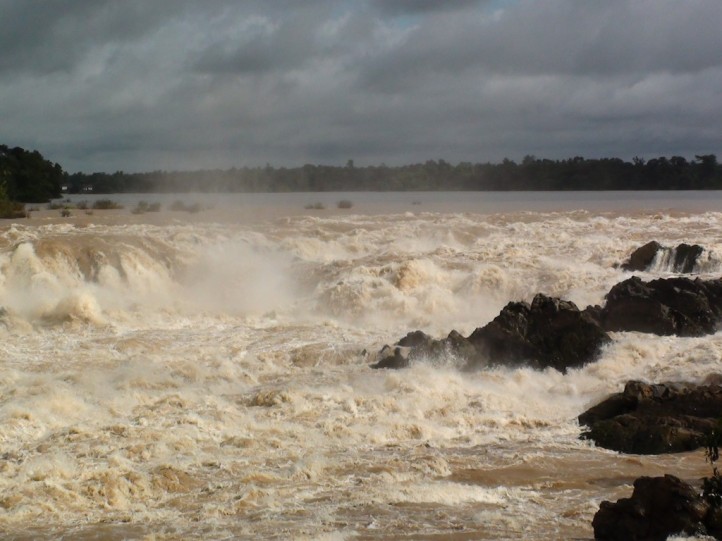
Khone Phapeng falls in southern Laos; photo by Tom Fawthrop

Khone Phapeng falls in southern Laos; photo by Tom Fawthrop

Fishers and farmers have for some time tried to block a proposed dam on the Mekong River in southern Lao People’s Democratic Republic (Lao PDR). Most recently, they made their views known at a public consultation on the Don Sahong dam. In all likelihood, however, they will lose and the dam will be built. Great Gamble on the Mekong, a new documentary from filmmaker and journalist Tom Fawthrop, insightfully details the probable dire consequences of this dam, and the failure this represents for a once-promising extra-legal cooperative structure, the Mekong River Commission.

The Mekong runs from the Himalayas in Tibet through China, Burma, Thailand, Lao PDR, Cambodia, and Vietnam—the latter five forming the Lower Mekong Basin (LMB)—where it empties into the South China Sea. According to Fawthrop, it provides protein and food security for 65 million people in the form of fish for food and trade, and water and nutrients for home gardens and commercial farms. At the same time, the Mekong has long represented a potential source of renewable energy. China has already built six dams on the Upper Mekong, and plans to build at least 14 more.

Dams have been discussed and rejected on the Lower Mekong mainstream since the 1950s, though they have gone up on its tributaries in that time.  In 1995 Thailand, Lao PDR, Cambodia and Vietnam signed the Mekong Agreement and formed the Mekong River Commission (MRC). The goal of the MRC is to facilitate cooperation in managing the resources of the Lower Mekong, but it has no final decision-making power.

The proposed Don Sahong dam at the center of this film would sit squarely across the main channel that migratory fish use to bypass the massive Khone Falls near the Lao border with Cambodia. It would be the second dam begun on the mainstream of the Lower Mekong—construction began on Xayaburi, another controversial dam, in 2012—with as many as 10 more to follow.


Cost-Benefit Analysis

The Lao government and the Finnish company Poyry it hired to oversee construction of Xayaburi claim that dam will provide clean energy to three million people in Thailand and one million in Lao PDR. The MRC claims dams on the Lower Mekong mainstream have the potential to reduce the severity of floods and droughts, and thatbuilding all 12 would generate $15 billion in economic activity, create 400,000 jobs, and reduce greenhouse gas emmissions by 50 Mtons CO2/yr by 2030. A study commissioned by the MRC, and completed by the International Centre for Environmental Management (ICEM) in 2010, concluded that the 12 dams could meet 8 percent of the region’s energy needs by 2025.

The ICEM study is clear however that benefits will not be disbursed equally: “Mainstream hydropower generation projects would contribute to a growing inequality in the LMB countries. Benefits of hydropower would accrue to electricity consumers using national grids, developers, financiers and host governments, whereas most costs would be borne by poor and vulnerable riparian communities and some economic sectors…In the short to medium term poverty would be made worse….”  Lao PDR does plan to use the revenues from selling the energy produced by its dams for rural roads, health care, and education, though during the “concession period” (estimated by ICEM at 25 years) after dam completion, the bulk of revenues would go to the dams’ financiers and developers.

According to the academics and nonprofit workers that Fawthrop interviews in Great Gamble on the Mekong, the exact impacts of the dams are impossible to predict, but they will likely be severe. “The Don Sahong dam will only push Cambodia and Vietnam closer to a food crisis,” says Chhith Sam Ath, an employee of the World Wildlife Fund in Cambodia. In addition to flooding gardens along the river, and diminishing the fish stock, they predict that the entrapment of nutrients by the dams will hurt rice production in Vietnam, leading to higher global food prices.

The 2010 ICEM study concluded that building the 11 mainstream dams on the Lower Mekong would reduced “capture” (non-farmed) fisheries by 16 percent. Combined with the built and proposed dams on the Upper Mekong, and on tributaries in the Lower Mekong Basin, this number rises to 26-42 percent. New aquaculture associated with dams would only replace at most 10 percent of this loss. Lao PDR and its developers claim they can mitigate the losses of fish–Poyry claims fish gates will allow 80 percent of migratory fish to pass up and down streams, while MegaFirst, the Malaysian company planning to dam Hou Sahong, claims making adjacent channels wider and deeper will provide fish with a detour route.

Yet the fish gates Poyry plans to use have never been tested on the varieties of fish found in the Mekong, and fish passes need to be designed to take into account individual species’ behavior and sensitivity to factors such as oxygen and nutrient levels. AsPoyry’s senior project manager conceded, “whether the fish get across [the dam], you’ll only see when it is built.” Faulting Lao PDR for not testing the fish gates in the Mekong before building a dam, when you need a dam to test the gates seems unfair. But they could test the technology on a smaller, less impactful dam on a tributary.


The Political Process

In the face of this uncertainty, the ICEM report recommended putting off any mainstream dam construction until 2020, using the intervening years to more fully study the impacts of the dams on the Upper Mekong and on the tributaries of the Lower Mekong. In a five-year strategic plan issued in March 2011, the MRC Council also recommended more study, as well as a thorough Procedure of Notification, Prior Consultation and Agreement (PNPCA), the internal procedure of the MRC for member countries to consider and offer feedback on the proposals of other countries. Yet eight months later, Poyry announced that Lao PDR had met its obligations under the 1995 agreement and could proceed with construction of Xayaburi. A year after that, in November 2012, Poyry received an eight-year contract to supervise Xayaburi’’s construction and engineering, and construction began. Poyry claimed at the time that it had updated designs to take into account the concerns of downstream nations. Yet in January 2013, Cambodia and Vietnam vigorously protested that their concerns had not been addressed, and demanded a halt to construction. They were unsuccessful.

A similar drama unfolded around the Don Sahong Dam. Last September, Lao PDR announced the start of the Don Sahong Dam, this time avoiding the PNPCA by claiming the project was not on the mainstream. After diplomatic outrage, the Lao government consented to a PNCPA, which began last July and is only required to run six months. Despite opposition from the governments and civil society in Vietnam and Cambodia, the Lao government has signaled its intention to proceed with the dam.

These dams are the first major test of the MRC’s ability to handle conflict among its members. The MRC tasks members with “aiming at arriving at agreement” on projects that significantly impact water quality or flow but has no voting mechanism or penalties for not reaching agreement. The CEO of the MRC Secretariat, Hans Guttman, states in Great Gamble that if the parties don’t arrive at an agreement, the country proposing such a project can still go ahead with it.


Resistance

Citizens of Cambodia, Thailand, and Vietnam have lobbied their respective governments to halt the dam. Hundreds of NGOs, both local and international (including World Wildlife Fund and International Rivers) have been trying to mobilize the opposition. Thai villagers filed a lawsuit against EGAT, the National Energy Policy Council, and three other government agencies in 2012, challenging the power-purchasing agreement they entered into with the Lao PDR government for electricity from Xayaburi. In June 2014, the Thai Supreme Administrative Court agreed to hear the case.

The international response, outside of the press, has been muted. MRC’s international donors issued a joint statement in January 2013 urging further study before beginning dam construction, but have said little else. The UN and heads of state have been notably silent.

Fawthrop’s film does not address how concerned Westerners can respond. The answer certainly feels fraught, given Laos’ historical experience of French colonialism and U.S.military aggression, including the unexploded ordinance that still affects the country. Then there’s the region’s very real need for clean energy as well as the standard argument about the hypocrisy of industrialized nations telling any country to sacrifice growth for environmental protection.

This is the progressive’s dilemma when it comes to foreign policy. Certainly any intervention should come in the form of carrots and not sticks: money and/or technology to develop less destructive sources of renewable energy; promotion of tourism to the region; UNESCO World Heritage Site recognition for Kohne falls, and so on, conditioned on implementing the ICEM report’s recommendations.What Great Gamble on the Mekong makes clear, and what studies of other massive dam projects have proved is that this is a humanitarian issue, and that the poorest will likely suffer the most.

Great Gamble on the Mekong has some distracting elements. The claim that the Thai banks funding Xayaburi are “getting nervous” as a result of letters sent to them by anti-dam activists seems like wishful thinking. For the sake of their own credibility, the filmmakers shouldn’t have included a cartoon set to Pink Panther music. Finally, the filmmakers should have addressed how some species got to be endangered before any dams were built. For example a WWF report says that overfishing was partly responsible for the decline of the great catfish. These critiques aside, this is an important and stirring film.

Nathaniel Eisen is a freelance author interested in the intersections of trade, human rights, security policy, and the environment. Information about the documentary Great Gamble on the Mekong can be found at www.tomfawthropmedia.com. Copies of the DVD can be ordered from eurekacuba@gmail.com.  This post was first published on the Foreign Policy in Focus blog on 12/26/2014.  It is reposted here with the permission of the author.

Leave a Comment

Filed under China, Current Events, Energy, Environment and sustainability, Foreign policy, GMS, Mekong River, Reviews, SLIDER, water

Myanmar fighting escalates, tens of thousands flee into China

mynamar fighting

As fighting in Myanmar grew more intense near the Sino-Burmese border during Spring Festival, media reports became increasingly confused and alarming. Clashes between rebels and government forces in Shan State reportedly claimed the combined lives of more than 100 combatants on both sides. The ramp-up in hostilities has also forced tens of thousands of Burmese civilians to flee their rural villages for refuge in China.

Fighting that first broke out on February 9, and included air and artillery strikes by the Burmese army in Kokang, have led to protracted bouts of guerrilla warfare. Estimates place the number of dead in the violence between 70 and 130, and media reports are unclear how many of these are soldiers or civilians.

However, a spokesman for the Myanmar Defense Ministry, Lieutenant General Mya Htun Oo, wasquoted in the Hindustan Times as saying “the conflict had killed 61 military and police officers and around 72 insurgents”. Red Cross officials have also said humanitarian workers in the region have been attacked twice in the past week. The Burmese military has declared three months of martial law in Kokang, although how well such a policy can be enforced remains unclear.

Skirmishes have been most intense near the Burmese town of Laukkai, or Laogai. The village, now described as a “ghost town”, is located on the Salween River — known in Chinese as theNujiang. The refugees sought shelter in Yunnan’s Lincang Prefecture and were first thought to number a few thousand. However, Red Cross workers in Myanmar now claim at least 30,000 people have made the crossing, raising fears both inside and outside China of a looming humanitarian crisis.

The embattled Kokang region is a semi-autonomous part of northeastern Myanmar. Although the national government in Naypyidaw asserts titular control of the area, 90 percent of the local population claim Chinese descent and identify ethnically as Han Chinese. The rebel army now fighting Burmese troops is called the Myanmar National Democratic Alliance Army (MNDAA) and is headed by former members of the country’s defunct Communist Party.

No official reason has been given for the escalation in violence in Kokang, although it seems likely connected to December ambushes by guerrillas that killed at least seven Burmese soldiers and injured 20 others. As the conflict continues, both sides have presented their own narratives. Burmese military spokesmen have gone so far as to accuse the rebels of employing Chinese mercenaries in an attempt at complete self rule — a charge the guerrillas and Beijing have vociferously denied.

Also at stake for both the Kokang and Burmese authorities are lucrative, if unofficial, trade routes in the area. China’s border with Myanmar is extremely porous, and around Kokang is notorious for booming illicit trafficking of illegally logged timber, rare animals, jade and narcotics.

This article by  was first posted on the GoKunming on 

Leave a Comment

Filed under ASEAN, China, Cold War, Current Events, ethnic policy, Foreign policy, Myanmar/Burma, Regional Relations, SLIDER, Yunnan Province

China & Europe: Reconnecting Across a New Silk Road

chen 1

Since 2013, economic and trade relations between China and Europe have grown significantly. In this article, the authors look beyond conventional economic indicators, like trade, and political issues, like human rights, instead focusing on transport infrastructure, real estate and tourism to show that a new page is unfolding in the history of China-Europe relations.

China and Europe have been closely linked since the Opium Wars, but the relative economic positions and power have reversed. Nothing illustrates this more symbolically than a stroll along the Bund in Shanghai: the low rise and old European-style buildings on the West side of the Huangpu River are dwarfed and eclipsed by the sparkling skyscrapers in Pudong on the east bank. The built environment of Shanghai, with its historic European-style buildings and modern China-built skyscrapers, is a physical manifestation of the reconfigured dynamic between China and Europe.

Since 2013, China’s connections with Europe have expanded since developing its official policy of building a westward economic corridor — a new Silk Road — along its ancient route. Most recently, in December 2014, China agreed with Hungary, Serbia, and Macedonia to build a rail link between Budapest and Belgrade, which will be financed by Chinese companies and completed by 2017. This rail line will then be connected to the Macedonian capital of Skopje and the Greek port city of Piraeus where COSCO, the Chinese shipping giant, operates two piers for container units. While the linked land-sea project will strengthen cross-border transport between Central and Southeastern Europe by reducing train travel times between Budapest and Belgrade from eight to three hours, it really is designed to enlarge and accelerate the movement of goods between China and Europe.

Having grown fivefold since 2003, trade between China and Europe reached $559 billion in 2013, solidifying the EU as China’s largest trading partner for the past 10 years. While the EU has invested more in China than the latter’s direct investment in the former, a US consulting company expects the EU to attract $250-500 billion more Chinese direct investment by 2020.1 A scenario likely to occur in the next few years is that China will invest more in Europe, instead of vice versa. This will be another telling sign that fortune and power are shifting in China’s favour.

These developments are not isolated and random. They represent a new structure of interactions between the older European economies and a rising Chinese power. We can understand this structure well by examining its conventional macroeconomic dimensions of bilateral trade and investment. In this essay, however, we make better sense of the new China-Europe relationship through a set of less used lenses: transport infrastructure, real estate, and tourism. They offer new insights into areas where China exerts a large and heavy footprint in Europe, via official channels and from the ground up.


Transport Infrastructure and Connectivity

In thinking about China and Europe today, transport infrastructure does not usually come to mind due to the long distance between them and Europe’s own well connected transport networks. Having built the world’s longest highway, railway, and more bridges and buildings than any other country over the past two decades, China has been constructing an extensive transport and municipal infrastructure within its Asian neighbours and far-flung African cities.2 More recently, China has also turned to Europe in strengthening their long-distance transport connections, aiming to improve the overland movement of traded goods. Less expected is China’s new foray into the domestic infrastructure sector of a few European countries. Both moves make infrastructure a major avenue for China to forge direct physical connections to Europe.

The most important connection thus far is the Trans-Eurasia railroad from the city of Chongqing in southwestern China to Duisburg, Germany. Launched into operation in 2011 by a joint venture with Germany, China, Kazakhstan, and Russia, the 11,179-kilometre rail line snakes through six countries including Belarus and Poland (see Figure 1). China is the largest beneficiary of this freight-focused rail network, having already shipped $2.5 billion worth of goods on this route to Europe since 2011. As labour and land costs in coastal cities like Shanghai and Shenzhen have gone up, the Chinese government has been pushing and inducing foreign investors and domestic producers to move inland through its “Go West” policy. Interior megacities like Chongqing and Chengdu have been booming as major destinations for large new manufacturing projects. Having set up what would be Asia’s largest laptop factory in Chongqing, US computer giant Hewlett Packard has already shipped more than four million notebook computers to Europe by the Chongqing-Duisburg rail since 2011.

chen 2 chian-map


As manufacturing becomes more concentrated in Chongqing and Chengdu, it will reap more savings from reduced transport costs. About 60% of the material inputs for laptops and 30% of the finished laptops depend on rail transport. Bringing them in and out by sea is very expensive and time-consuming. It requires a long train ride to Shanghai or Hong Kong from where container units are shipped to Europe. In the other direction, growing demands in interior China for European foods and cars can also benefit from a greater use of the Chongqing-Duisburg rail connection. It typically takes 2-3 months for a customer in Chengdu to receive the delivery of a European car by sea as it has to come through the port city of Tianjin. This wait can be reduced to 25 days if the car is transported by train from Europe to Chengdu.3

While this overland rail route can yield major economic benefits for China and Europe, its greater potential won’t be realised without policies for overcoming existing barriers. The Chinese government has recently approved the status of an international land port for Chengdu and Chongqing. This allows the direct and full import of European meats and cars to fill the train cars going back to China that would otherwise only be partially filled after carrying full loads of exported electronic products to the European markets. A fully loaded train has recently brought car parts from Germany to a Ford plant in Chongqing using the Trans-Eurasia railroad.

Another obstacle is that Chinese and European railways use different gauges than Russia and its former satellite states. So far the Chongqing to Duisburg route has met this standardisation challenge by transferring to cars with new gauges at relevant border crossings to meet varied national track requirements. It will need to adapt to other differences in technologies, signalling systems, and gauges that add costs to coordination across several countries.4 However, the existing and potential benefits for China and the other countries along this rail route will motivate them to co-operate in overcoming the remaining hurdles. So far it is China that has been moving at full speed. It has already sent a total of 239 (100 during the first seven months of 2014) trains carrying container units to Europe, including a train from the city of Zhengzhou in the central province of Henan bound for Hamburg.5

As China’s rail transport connections to Europe multiply, China has also launched an infrastructure build-up within Europe with an initial focus on the geographically closer and economically weaker Central and Eastern Europe. In December 2014, China and Serbia inaugurated the first ever bridge in Europe across the Danube River financed and built by China. Named after Mihajlo Pupin, a renowned Serbian scientist, the 1,500-metre bridge connects the southern industrial district of Zemun with the northern residential area of Borca in Belgrade, cutting the travel time across the Danube from more than one hour to just 10 minutes. China has also landed the contracts for the Stanari Thermal Power Plant in Bosnia (up to $1.7 billion) and the Bar-Boljare motorway in Montenegro with a link to Serbia ($984 million).6 Infrastructure projects of this scale have been very rare in these countries for more than 20 years, given the bad economic conditions in Croatia, Serbia, and Bosnia-Herzegovina, with nearly 1.5 million unemployed, due to the post-Yugoslavian political instability, ethnic conflicts, and natural disasters like flooding. China’s major efforts to finance and upgrade the outdated transport and municipal infrastructure in these countries opens up a new era of China’s local presence and influence in Europe.


Going After European Property

As China is making inroads into Europe’s infrastructure sector, the real estate sector cannot be far behind as an investment target. Southern European countries like Italy and Portugal, which have been adversely affected by the financial crisis, are seen as especially good opportunities for Chinese investors, as the property prices there are lower than in other European countries, like the United Kingdom and France, that have managed to weather the crisis better. Homes in southern Europe are also attractive compared with those of China as 300,000 euros buys a 200 square metre villa facing the sea. That amount only buys an apartment of 68 square metres in central Shanghai7 where property prices have been artificially inflated due to years of speculative supply and persistently strong demand.

Besides their low property prices, countries such as Cyprus, Portugal, and Greece are offering resident permits to property buyers who are not already residents of the European Union. This appeals to Chinese investors who have the capital to buy the properties but not the residency or citizenship benefits to use them within Europe. In exchange for a minimum amount of investment in property in a European country (amounts vary depending on the country, but the starting price is generally upwards of 250,000 euros), the investor may be granted a visa that allows him or her to live and travel within the Schengen Area, which consists of 26 European countries. A recent trend among Chinese investors is to buy a property in Southern Europe and then secure permanent residency there once their visas have been approved. A reporter from Bloomberg observed that “most (Chinese investors) are getting homes for personal use or to send their children to schools there.”8 By July 2014, Chinese citizens had received 282 of the 1,880 “golden visas” or permanent residencies granted by the Spanish government to those who bought local property.9 Since October 2013, the Portuguese immigration office has approved 1,681 property purchase applications, 1,429 of them from China, about 85% of the total.10

Besides property value and permanent residency, the measure of the Chinese yuan (RMB) against the euro is another important consideration, and one that has contributed to the rise of Chinese investment in European property. The euro depreciated approximately 17% against the yuan from 2010 to July 2014. Chinese investors bought 3.05 billion euros’ worth of European property in 2013, an increase from the 978 million euros spent in 2012. The Financial Times found that Chinese direct investment in Europe tripled in just two years (2010-2012), from 9 billion euros to 27 billion euros.11


chen 3 comp-pic-copy

The large volume of this investment in European property reflects a major shift in China’s overall outbound investment, from securing natural resources in developing countries to acquiring brands, technology, and other assets in developed countries. A major Chinese real estate developer has recently committed $1.6 billion to convert the derelict Royal Albert Dock in London into a global trading hub. Intended to attract Chinese companies as tenants, this project is planned for 4.5 million square feet of office space to be developed in phases through 2020. London’s Mayor Boris Johnson has strongly endorsed this project for its prospect of generating about $10 billion for the national and local economies. He has lauded the project’s potential ability to turn what was once one of “the throbbing arteries of UK trade and commerce” into “a world-class international business district.”12

In June 2014, Wang Jianlin, one of China’s largest real estate investors and richest men, bought the 25-story Edificio España in Madrid, a landmark Franco-era building that was also Spain’s tallest, for 265 million euros or $340 million. Sitting empty since the Spanish real estate market’s collapse in 2008, the building will be renovated to include luxury apartments and a hotel as part of a larger-scale neighbourhood regeneration.13

The scope of Chinese investment in European property represents a powerful combination of China’s surplus corporate and private capital that can affect the urban landscape in European cities. Its long-term impact, however, will depend on the pace and volume of its outflow from China, and its geographical concentration and spread within Europe.


Big-Spending Chinese Tourists

As a relatively small but growing number of wealthy Chinese investors put their money into European real estate, a much larger number of middle and upper middle class tourists from China are coming to Europe to buy a lot of luxury goods. China’s rapid economic growth has created a huge number of middle and upper middle class consumers with insatiable desire and startling purchasing power. In 2013, Chinese citizens made approximately 100 million overseas trips and spent over $100 billion on their trips, mostly on luxury goods, overtaking the United States and Germany as the world’s number one tourist spending nation. Today nearly one-third of the world’s personal luxury goods are bought by Chinese consumers.

In 2014, Europe accounted for 3.5% of overseas travel destinations for Chinese citizens; this was the second most popular regional destination after Asia, which accounted for 70.4% of overseas tourism. Visa applications to enter the Schengen Area from China accounted for approximately 1.5 million of the total applications in 2013, ranking China third overall, behind Russia and Ukraine.14 In its 2014 report, hotels.com observed that “European destinations are the most popular amongst Chinese travellers in terms of places they wish to visit in the next 12 months.” By surveying the number of rooms and the length of stay in hotels booked through its website, hotels.com placed France, the United Kingdom, and Italy in the top ten destinations for Chinese travellers in 2013 as all three countries experienced growth in the amount of tourism from China.15The German National Tourist Board recently showed Germany, France, Italy, and Switzerland as the top four European destinations for Chinese tourists.

While many Chinese tourists in Europe are interested in seeing sites of historical interest and established landmarks like the Eiffel Tower and Venice’s Grand Canal, they are there for a much more passionate interest: shopping, especially for brand-name and luxury goods. Paris is the most popular destination for this shopping spree. It is where Chinese tourists head to the Louis Vuitton shops in much larger numbers than to the Louvre. As early as 2009, Chinese tourists overtook Russians as the highest spending visitors to France. Wealthy Chinese tourists also head south to the wine country of Bordeaux where they snap up expensive wine, paying as much as $800 for a bottle.16 They bring the wine back to China where it can be displayed and then drunk as a prized possession; red wine has become increasingly popular at dinner parties, replacing beer and traditional Chinese liquor.

McKinsey’s survey of Chinese luxury consumers in 2012 found that “Europe is growing in appeal among Chinese luxury consumers, with about one-fifth of them reporting this year that their most recent overseas purchases occurred in a European city. That is more than double the European share two years ago.”17 A study by the European Travel Commission estimated that Chinese tourists reserve more than a third of their trip budgets for shopping. To be able to do so, they compromise on eating and sleeping. A survey in 2006 found that Chinese travellers in Europe had eaten “European food” only once, and 10% not at all. Many in tour groups arranged by Chinese travel agencies would stay in cheaper hotels and eat instant noodles, even though they could afford luxurious hotels and lavish meals.18 The average Chinese tourist spends around $5,000 during a European trip, more than any other country. This is not surprising when one often sees groups of Chinese tourists getting dropped off at expensive stores and coming out with their suitcases full of brand name clothes, handbags, and cosmetics.

There are several reasons for Chinese tourists to buy luxury goods heavily in Europe. Besides the obvious factor of their rising affluence, Chinese tourists pay less for luxury consumption in Europe than in China. Taxes on certain items and tariffs on imported goods increase the price of luxury goods produced elsewhere and sold in China. According to The Economist, taxes and tariffs can increase prices in China to 50% more than a shopper would pay elsewhere. For example, a Louis Vuitton handbag costs 30% more in Beijing than in Paris.19 The purchase of luxury goods while travelling in Europe connotes the high income and status of the consumer. A study published by the University of Pennsylvania’s Wharton Business School found that “travelling has become part of the luxury lifestyle in China and is considered a status symbol: there is greater cachet in being able to say you purchased your bag at the place of origin in Paris rather than a branch in Tianjin.”20 Chinese consumers also perceive a higher quality and a greater variety of luxury goods if bought in the places of origin. In addition, while the appreciation of the Chinese yuan against the euro has helped, Chinese tourists have benefited from a greater ease in getting European visas.

European countries have made getting visas easier for Chinese tourists. Recent initiatives include changes in the visa process for tourists wishing to visit the Schengen area. Visa applications can be submitted up to six months in advance instead of three, allowing people to plan their trips earlier, and travel medical insurance is no longer required. The time it takes to process applications from China has been reduced. When Chinese Premier Li Keqiang visited Germany in October 2014, the two sides agreed to reduce the visa application process from between three and five working days to 48 hours for Chinese tourists. The French embassy in China also shortened its visa processing time for Chinese visitors to 48 hours and simplified the application documents. Italy has already cut its visa approval for Chinese tourists to 36 hours. The United Kingdom has recently introduced the 24-hour Super Priority Visa service in Beijing, Shanghai, and Guangzhou. With 12 visa application centres across China now, the United Kingdom issued more than 320,000 visas to Chinese tourists during January-August 2014, the highest number ever.21 This competitive rush of European countries to simplify and speed up visa applications for high spending Chinese tourists will help boost their sluggish economies.


Money and More

The sum of Chinese investment and spending in Europe’s infrastructure, real estate, and tourism sectors amounts to a huge influx of money that reflects the changed economic positions of China and Europe and their long-distance connections. Many may see this as the relative decline of Europe and the continuing rise of China that implies a reversal of power and fortune. But there is both change and continuity to the new China-Europe relationship that makes it more complex than a one-way flow of surplus Chinese money. In 2013, the EU invested $6.5 billion in China, up 21.9% from 2012, which doubled China’s $3.6 billion in the other direction, an increase of only 6.2%. While this sustains the earlier pattern of bilateral investment, individual European countries have taken more differentiated economic approaches in dealing with China. Through the agreement between the Bank of England and the People’s Bank of China to clear and settle Chinese currency in London, the British government has gone ahead of most other European countries in making London the leading hub for trade with China. By the end of 2013, China’s cumulative investment in the United Kingdom reached $32 billion, far exceeding the $18 billion the other way around.22 Not to be left behind, Switzerland’s central bank joined its Chinese counterpart in January 2015, making Zurich Europe’s newest hub for trading the Chinese currency (RMB). As the China-Europe economic relationship becomes stronger, it has become more varied and specific to individual countries.

chen 4
The uneven penetration of China’s economic influence has begun to generate a sort of cultural backlash, which is illustrated by a recent cartoon that made the cover of Fluide Glacial, a French monthly comic book (see Figure 2). Despite an underlying negative headline of “Yellow Peril: What if it is too late?” the restaurant window shows a harmless sign: “Chinese spoken here.” But the joke is a man bearing the words “I am hungry” sitting at the door of a restaurant that advertises steamed Chinese dumplings with a French twist: the addition of béarnaise sauce. Adding to the insult is a Frenchman pulling a rickshaw that carries a Chinese man in traditional high-class clothing with a blonde European woman. The humour aside, this cartoon reveals an unfavourable view of China, or at least its economic wealth in Paris and in Europe. It immediately drew a harsh response from The Global Times, a Chinese daily with close links to the government, saying that the French magazine possibly attempted to gain attention by following Charlie Hebdo whose Paris offices were savagely attacked by Islamist gunmen on January 7, 2015.

This media episode matters little to the massive scope of China-Europe interactions. When we look beyond conventional economic indicators like trade and political issues like human rights as in this article, we see a new page unfolding in the history of China-Europe relations. While it features continued bilateral official policies that have led to new infrastructure deals, bottom-up activities in real estate investment and tourism have become more prominent. With the Trans-Eurasia railroad already in operation and millions of Chinese tourists moving around Europe, China’s ancient dream of connecting to Europe via Central Asia along the old Silk Road has come true. Yet the new Silk Road envisioned by China for the 21st century is just beginning to take shape. Its full opportunities for both China and Europe are yet to come.

This article was written by Xiangming Chen and Julia Mardeusz and originally published here in the European Financial Review on February 10, 2015.

About the Authors


Xiangming Chen
is the Dean and Director of the Center for Urban and Global Studies and Paul E. Raether Distinguished Professor of Global Urban Studies and Sociology at Trinity College, Connecticut, and a distinguished guest professor at Fudan University, Shanghai. He has published extensively on urbanisation and globalisation with a focus on China and Asia. His many books include Shanghai Rising: State Power and Local Transformations in a Global Megacity (University of Minnesota Press, 2009; Chinese Edition, 2009).

Julia Mardeusz is currently a junior at Trinity College, Connecticut, majoring in Public Policy and Law. Her interests include American public policy and European politics and policy. She has been a student researcher at the Center for Urban and Global Studies at Trinity College since 2013 and studied in Paris during fall 2014.


References

1. Reported by The People’s Daily, June 23, 2014, p. 4.

2. See Xiangming Chen and Curtis Stone, “China and Southeast Asia: Unbalanced Development in the Greater Mekong Subregion”, The European Financial Review (August 2013). pp. 7-11; Xiangming Chen and Garth Myers, “China and Africa: The Crucial Urban Connection”, The European Financial Review (December 2013). pp. 89-93.

3. “European meats are transported directly to Chengdu”, The People’s Daily, April 26, 2014, p. 6.

4. “’Silk Road’ railways link Europe and Asia”, The Gateway, CNN News, June 27, 2013; accessed from http://edition.cnn.com/2013/06/27/business/silk-railroad-trading-network/.

5. “The 100th China-Europe train this year has departed”, The People’s Daily, August 2, 2014, p. 1.

6. “Li forges new link in Serbian relations”, The China Daily, December 19, 2014, p. 1.

7. Henrique Almeida, “Needy EU nations woo Chinese home buyers to ease slump,” Bloomberg News; accessed from http://www.bloomberg.com/news/2013-08-21/needy-eu-nations-woo-chinese-home-buyers-to-ease-slump.html.

8. See note 7.

9. “Sale of a landmark skyscraper puts Spain on the map of Chinese investors”, The New York Times, September 23, 2014, p. B3.

10. Fu Yao, “A place in the sun”, NewsChina, February 2015, pp. 34-37.

11. Jamil Anderlini, “Chinese investors surged into the EU at height of debt crisis,” The Financial Times, October 6, 2014; access from http://www.ft.com/intl/cms/s/2/53b7a268-44a6-11e4-ab0c-00144feabdc0.html#axzz3NduHcZzt.

12. “Chinese developer envisions a future for abandoned London docks,” The New York Times, Business Section, February 19, 2014, pp. B1, B6.

13. See note 9.

14. National Tourism Administration of the People’s Republic of China, “European Countries Fight for Chinese Tourists”, accessed from http://en.cnta.gov.cn/html/2014-7/2014-7-3-9-57-70413.html.

15. Hotels.com, “Chinese international travel monitor 2014”, p. 21; accessed from http://press.hotels.com/content/themes/CITM/assets/pdf/CITM_UK_PDF_2014.pdf.

16. “A new grant tour”, The Economist, December 10, 2010, p. 114.

17. Atsmon, Yuval, Diane Ducarme, Max Magni, and Cathy Wu, Luxury Without Borders: China’s vNew Class of Shoppers Take on the World. The McKinsey Chinese Luxury Consumer Survey, McKinsey Insight China, December 2012; accessed from https://solutions.mckinsey.com/insightschina/.

18. See note 14.

19. “China’s addiction to luxury goods”, The Economist, April 29, 2014; accessed from http://www.economist.com/blogs/economist-explains/2014/04/economist-explains-17.

20. Knowledge@Wharton Blog, “Louis Vuitton and the traveling Chinese consumer”, Knowledge@Wharton, January 3, 2012; accessed from http://knowledge.wharton.upenn.edu/article/louis-vuitton-and-the-traveling-chinese-consumer/.

21. “European countries compete for Chinese tourists”, The China Daily, Travel Section, December 20-21, 2014, p. 19.22. Reported in The People’s Daily, June 20, 2014, p. 4.

2 Comments

Filed under China, Current Events, Economic development, Foreign policy, SLIDER

Laos Vegas: Rolling the dice on rural development

OLYMPUS DIGITAL CAMERA

In Lao PDR, there are three large casinos presently in operation: the Savan Vegas Hotel and Casino, the Kings Roman Casino and the Dansavanh Nam Ngum Resort. They are facing controversies over forced evictions, dispossession of farmlands belonging to the local rural communities, and are ridden with mafia-style armed fights among rival casino and investor factions. In January 2005, China’s anti-gambling campaign forced many casinos and small gambling houses to move to countries on China’s southwestern border including Myanmar, Laos, and Vietnam. Meanwhile, Lao officials and others, including middlemen and land developers, are reaping the cash benefits from this so-called rural development.

“The damned Chinese are taking over Laos,” the words spat out of a farmer whose nickname is Khoua living in the northern province of Luang Nam Tha. He was mouthing what most Lao people believe. Rural people dispossessed of land, urban dwellers witnessing the slow demise of their once elegant cities, all blame the mainland Chinese. Their presence is increasingly obvious, whether it be in the high speed motorcades blasting though Luang Prabang or in the proliferation of Chinese enterprises and their gargantuan construction projects, many of which lie echoingly empty and idle after completion. The influx of Chinese workers is affecting the local people’s chances of employment or skills training. But in the midst of frustration about the Chinese presence, what often goes unremarked or largely forgotten is that the Chinese are there as a direct result of the investment policies of the Government of Lao PDR, with many benefits from power to wealth being reaped by a long line of Lao officialdom.

When the author visited the area in November 2012, there were massive boards advertising the latest megaproject. Some provinces like Oudomxai north of the capital are more Chinese than Lao. That being said migrations and state borders have shape-shifted over the centuries blurring ethnicities and cultural loyalties. But what is obvious is the anger and resentment aimed at China while at the same time failing to recognise the agency and responsibility of the Lao government in ceding land and concessionary deals in return for investment and bribes.

This development complexity is best exemplified in the huge (and often bizarrely designed) casinos and gambling establishments that are expanding under the same perseverating rhetoric of development and poverty alleviation by which large dams and roads are being built. While these casinos have been written about in the mainstream media, very little analysis has been done about what they mean for rural people and their livelihoods.

Ferries bringing patrons across from Thailand and China for gambling (Photo by Melinda Boh.)

Ferries bringing patrons across from Thailand and China for gambling (Photo by Melinda Boh.)

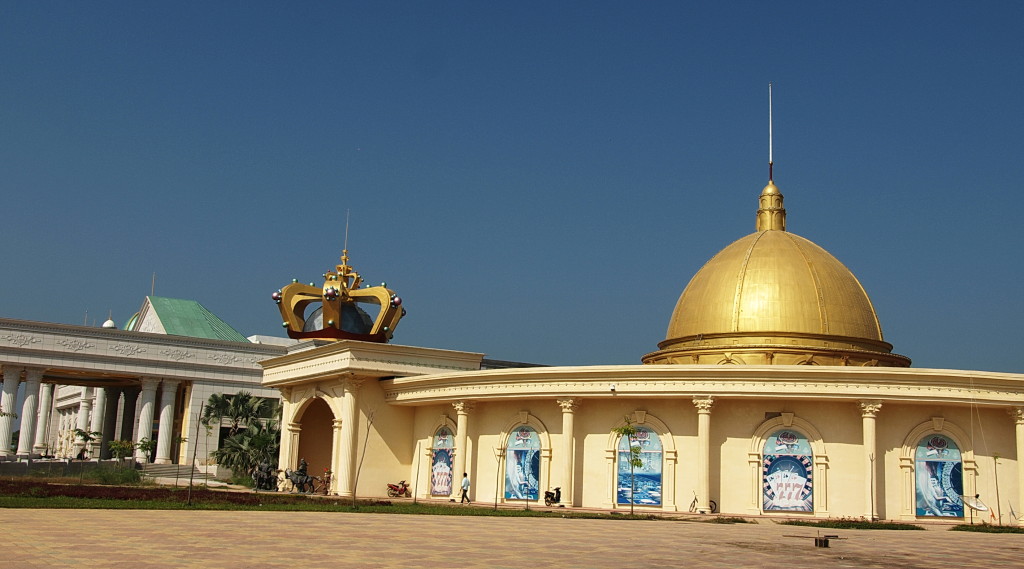
From Chiang Saen in Thailand’s north, the white colonnaded building across the river, topped with a huge gilt crown is a bizarre sight. From Huay Xai in Laos, a potholed road through farmlands leads to the casino complex. The car suddenly jolt-lands on to thick cement, marking the casino’s boundary in Dork Ngoui Kham. Half an hour later we spot the golden cupola, its clock set on Beijing time, marking Bokeo Province’s Special Economic Zone (SEZ) office.

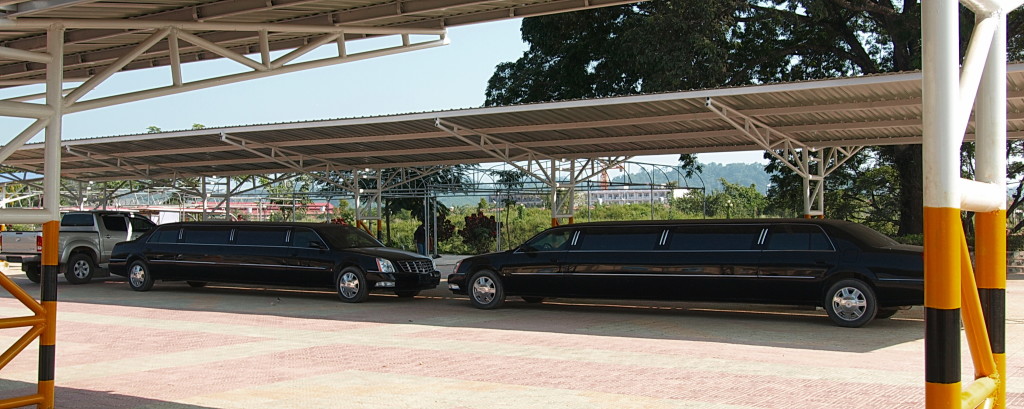
The nearby King Roman casino reveals plaster toga-clad statues alongside Chinese patriarchs and the symbols of the newest local religion: gambling. Parked nearby were two stretch limousines. Inside the building, men in suits gambled at the tables. “Kunming officials doing a site inspection,” was the official story from an attendant.

The only Lao person we saw was a farmer on a dust-covered motorbike with his equally dust-covered wife, narrowly avoiding being pushed into the Mekong River by the boat passengers.

The concession area includes archaeological treasures, importantly the ruins of a 16th century city reputedly built by King Setthatirat. Other remnants, possibly from the Mon empires of the first millennium CE, are considered to be of World Heritage value. Instead they may end up under the runway of an international airport planned to bring patrons in, but fiercely resisted by the local farmers. History will be replaced by what appears to be a gambling based narco-empire, where anything goes. For Laos, it means that some of the most fertile arable land and considerable archaeological treasures would soon be buried under asphalt to feed the gambling industry.

Stretch limousines pick up selected high rollers from the airport (Photo by Melinda Boh.)

Stretch limousines pick up selected high rollers from the airport (Photo by Melinda Boh.)

Civilising

Defending the casino and entertainment complex, a senior Chinese manager told researcher Pal Nyriri: “Before it was opium and drug businesses. There were no roads, no electricity … Laos is developing and it [the casino] is good for them.”

Zhang Wei, the casino’s principal developer, told Thai sociologist Pinkaew Laungaramsri of Chiang Mai University: “The biggest obstacle is that villagers … do not understand us. We have rented all the land and forest … but they … cut … or burn them. We can’t go around, arresting or beat up (sic) and fine the villagers who burn our gardens … it will cause ethnic issues.”

A local NGO worker, requesting anonymity, recalled taking a Chinese delegation to the site in 2009. “The three Government officials, a journalist, an environmentalist and a few academics were shocked at what they saw. ‘This gives China a bad image,’ they said. When we stopped; a crowd of up to 70 to 100 village people assembled shouting that they would not give up their land. The area is one of the most fertile and productive in Laos.”

They pointed to a white Humvee. “That’s the local official. Zhang gave him and the (Lao) police the same cars.”

China may see itself as a civilising influence, drawing on its long and remarkable history, using its wealth and dynamism to bring rapid economic growth. But with its entrepreneurs building casinos like those at the Lao border, China risks reinforcing its growing reputation for exploiting its neighbours.

Because although it’s the Lao government’s party apparatchiks and provincial officials whose signatures and rubber stamps bless these casino developments, it’s China that gets the bad press, a point clearly understood by the visiting Chinese delegation. The development of ‘legal/ illegal’ states through the formation of SEZ’s has enabled the Lao government to consolidate power, and amass wealth, patronage and control, while portraying itself as a helpless lackey of China.

Laos is fast gaining a reputation as a lawless state. It has shown unwillingness to arrestwildlife trafficker Vixay Keosavang while it faces continuing criticism for its intransigence in not being serious about investigating the high-profile disappearance of Magsaysay award winner Sombath Somphone. Moreover, Laos continues to face allegations of human rights violations, money laundering and profligate illegal logging that are causing both international concern to its many foreign donors and local frustration.

The so called “red carpet”, the road being paved pink for the patrons (Photo by Melinda Boh.)

The so called “red carpet”, the road being paved pink for the patrons (Photo by Melinda Boh.)

SEZs and other confusions

The casinos in the SEZ epitomise the complexity of the modernist zeal with which the Government of Lao and China pursue investment. Observers like Danielle Tan have noted the SEZs bring a post-socialist neo-liberal model to the Lao-China border zones. For nations that expound socialism and wisdom of central control, this is a strange choice. Neo-liberalism increases state income through taxes, exploits labour and expropriates land from traditional owners and farmers. The renowned sociologist Pierre Bourdieu considers neoliberalism “a program for destroying collective structures”, and even nations themselves.

With their confused legal frameworks and ambiguous status, SEZs invites all sorts of temptations. The implicit freedom tempts the seamier side of legitimate trade and investment particularly in the fabled Golden Triangle. Added to this mix, the Chinese fascination with gambling and luck makes Bokeo’s proximity all too tempting.

Along with disappointed losers, Tan found evidence of drug sales and money laundering, while Li Quan a London based tiger conservationist, told the Global Times that Lao casinos were trading posts for endangered species. Others are worried about child trafficking, rape and tax farming 1.

Tan alleges that the former military junta and drug lord Lin Mingxian is a major investor in the King Roman Casino, a charge denied by Zhang Wei. Ying and Zhang, of China’s Institute of Contemporary International Relations (CIR) and part of the 2009 delegation, agreed, writing, “While the nominal boss of the Casino in Bokeo is a Fujian native with a Hong Kong passport, it is … likely… the real investor is a drug cartel from Myanmar.”

The other side of China’s double jeopardy is legitimacy. The Bokeo casino is a photocopy of those in Mong La (Myanmar) and Boten (Laos) both managed by Zhang Wei, and both closed by China after evidence of mafia-style gunfights and crimes. However the King Roman is within Lao sovereign territory, while the others were on international no man’s land.

The Vice Prime Minister of the Government of Lao PDR, Somsavat Lengsavad, reacted to China’s concern about ongoing casino development with assurances that no further concessions would be granted as “casinos were a bad model for Laos.” But barely six months later in March 2014, the Vientiane Times announced plans for another casino in the South.

In total forty-nine SEZs are planned. How many will have casinos is anyone’s guess, and pose a serious concern to China.

OLYMPUS DIGITAL CAMERA

Size matters

The CIR’s critical appraisal of Laos’ transparency backs Nyiri’s research revealing that the Government of Lao granted the Hong Kong registered King Roman group a concession for the Bokeo land in 2007, after a down payment of US$850,000.

Lao government media KPL reported 827 hectares were ceded for 40 years; the maximum allowed under Lao law, but at variance to the company’s own estimation of 10,300 hectares for 99 years. In 2010, Zhao reported the new casinos would be bigger in scale than those in Boten, bragging that US$500 million would be spent developing the site, more than ten times the Laos national health budget.

A resident of Huay Xai who declined to be identified, admitted the casino is run down: “The paint’s peeling and shops boarded up. Less people visit now. One rich guy hired some [Lao] cops to protect him, but they shot him and took his money. Despite joint patrols, we still have shootings, as the Chinese mafia are using the place as a staging post. Gamblers are afraid. As for the organic farms and markets they promised, well who would buy the stuff? The farmers who lost their land are now broke and they used to produce what the casino promised but never delivered.”

“The casino’s still trying for the airport, but there is well-organised resistance. The locals called in Thai TV. The Lao police arrested two cameramen and held them for two weeks. The Thai government responded by closing the border until they were released. Now it’s a stand-off. The PR risk is too high.”

China has its own problems with crime. What it does to curb the influence of its neighbour will be interesting to see.

Post script: In late 2013, the Lao media announced that the farmers had been given their promised settlement. The casino had agreed to pay a compensation amount that was found satisfactory to the government. Many on the Lao agribusiness list-serv cheered.

Following up on this story, I was told by the above long term resident of the area (new laws in Laos restricting critical media make me reluctant to name anyone for fear of recrimination) that the company had in fact offered compensation way over the odds as the farmers had been both successful in gaining publicity and in holding out, fearing the same poverty that had mired their neighbours.

But the informant said the Lao government refused to give their imprimateur to the negotiated rate fearing that the amount offered would set an unhealthy precedent for other areas of Laos, so the farmers were given a significantly reduced amount. Hence the term “found satisfactory to the government” does not mean what one might have assumed.

This article was written by Melinda Boh for the Mekong Commons website and published here on 1/31/15.  It is reposted in its entirety with permission from Mekong Commons and the author.  ExSE is excited to begin a new cooperative partnership with the Mekong Commons team in sharing analysis and reporting.

Leave a Comment

Filed under China, Economic development, Governance, Laos, Mekong River, SLIDER