Category Archives: China

All aboard: Kunming-Vientiane Railway inches forward

china train head

Although a bit trite with repetition, no saying better encapsulates the major obstacle facing Laos than “geography is destiny”. The only landlocked country in Southeast Asia, Laos is wedged between the vast rivers and expansive mountain ranges that demarcate its natural borders with China, Vietnam, Cambodia, Myanmar and Thailand. Because of its lack of access to maritime trade routes, the small country has historically relied heavily on domestic subsistence agriculture with little opportunity for much international commerce.

The legacy of its geography in combination with the destruction wrought by the United States during the Vietnam War has today resulted in a nation with some of the world’s highest poverty and unemployment rates. With the help of the Chinese and Thai governments, Laos hopes to change this narrative of international isolation in the years to come.

Since 2010, plans have been under consideration to construct a high-speed railway between Kunming and Vientiane, Laos’ capital. However, political and financial setbacks have pushed the starting date of the project back by five years. This year, the three governments all sound confident that construction of the seven billion dollar project will begin.

Many analysts now view the construction of the Kunming-Vientiane railway within the context of China’s larger ambitions to revamp trade routes throughout Southeast Asia. China’s president Xi Jinping has openly stated his eagerness to establish silk road-esque connections with China’s neighbors, placing Kunming at the epicenter of overland transactions. The country has already invested 40 billion dollars to facilitate railway links, which it hopes will eventually drive new economic plans throughout South Asia.

Already, long-term proposals have been hashed out to eventually link Kunming with Singapore. The first phase in the series of projects is currently under construction, with China building a 737-kilometer connection between the Thai city of Nong Khai — just across the Mekong River from Vientiane — and Map Ta Phut — one of the largest deep water ports in Thailand.

The planned Kunming-Vientiane rail then, would add on to existing railroad infrastructure, facilitating a larger Kunming-Bangkok route by — according to recent estimates — no later than 2020. A link to Malaysia would from there be relatively simple. If all goes as projected, passengers may, within the next decade, be able to hop onto a high speed rail from Kunming all the way to Singapore.

Past financial qualms that have plagued the realization of the Vientiane-Kunming proposal continue to worry politicians in both China and Laos. Although a fairly small investment for China, the seven billion dollar price tag corresponds to over 60 percent of Laos’ US$11.24 billion gross domestic product, making it a hefty and risky endeavor. Currently, the two countries have agreed on a 40-60 split of the initial financing, with Laos contributing US$840 million and China US$1.26 billion. The remaining five billion will later be chipped in by Chinese venture capital firms, who would then hold substantial stakes in the railway once it is up and running.

Although worries over the pragmatic utilization of the railway have previously stymied Laos’ cooperation with Chinese entrepreneurs, increasingly Lao politicians believe the connection to Yunnan’s capital is paramount for their country’s economic growth. In an interview with Japanese magazine Nikkei, Laos’ deputy prime minister, Somsavat Lengsavad, explained that Laos, being a landlocked country, can only rely on roads, so the transport cost is very high. “In our policy of turning Laos from a landlocked to a land-linked country, we believe the railroad will help us reach our objective. [The railway] will boost the Lao economy because many investors are now looking for a production base here. They say that if the country had a railway, it would help them reduce their transportation costs. So it would make us more attractive to investors.”

Recently, the country has proven itself one in an appealing group of potential manufacturing centers in Southeast Asia as overseas companies flee China. Over the past few years, Laos has ridden a growing wave of economic growth, with annual GDP often topping eight percent. Such financial development has been attributed primarily to the construction of massive 1,000-megawatt hydroelectric dam complexes, growing highway infrastructure and multibillion-dollar investors betting on long term prosperity in the region.

Politicians, including Lengsavad, remain sanguine that the fiscal expansion will only be further boosted by a direct link to Yunnan. Already, companies including Samsung and Yahoo have left China to venture into smaller, burgeoning financial systems. Laos hopes the Vientiane-Kunming connection will enable it to hop onto the train of foreign investment out of China.

Skeptics, including Lao politicians, point out that the real construction cost of the Kunming-Vientiane route may soon render the project another white-elephant. Without a doubt, both financially and topographically, much stands in the way of the railway’s establishment. An astounding 154 bridges, 76 tunnels and 31 train stations will be necessary for the Lao leg of the track. The monumental proposals stands in stark contrast to Laos’ nearly complete lack of experience with railway construction. The land-locked country currently boasts only of a 3,5-kilometer train link, spanning the Thai-Lao Friendship Bridge.

To make matters more complicated, the Annamite mountain range, which the railway will eventually need to cross, is infamous as a minefield littered with unexploded American ordnance dropped during the Vietnam War. These factors combined are likely to result in a final cost for the track much greater than the projected seven billion dollar price tag. Laos thus finds itself stuck between a rock and a hard place — on one hand it desperately needs infrastructure for greater commerce, while on the other, current proposals may leave the country in an even more precarious financial situation than it currently faces.

This article was written by Richard Diehl Martinez and first posted here on GoKunming.

Leave a Comment

Filed under ASEAN, China, Current Events, Foreign policy, GMS, Laos, Mekong River, Regional Relations, SLIDER, Thailand, Trade, Yunnan Province

Kokang conflict reveals ethnic strife unlikely to end after cease fire

Many things in Myanmar are changing – the economy, the government, infrastructure. Others, like violent ethnic conflict, seem destined to stay the same. For the past three months, the government of Myanmar has been fighting the Myanmar National Democratic Alliance Army (MNDAA), an ethnic rebel army based on the country’s border with China. The MNDAA are predominantly made up of ethnic Kokang fighters. The Kokang are ethnically Han Chinese and the live in Kokang region, in Myanmar’s Shan state.

The MNDAA  initiated the conflict by storming Kokang’s largest city, Laukkai, on 9 February 2015. Over the past four months, the government has aimed to reassert control over the region and its agriculture, as well as disarm the MNDAA. The government of Myanmar extended martial law over Kokang region on 15 May 2015.

A rebel soldier of Myanmar National Democratic Alliance Army (MNDAA) places a machine gun bullet belt around the neck of another soldier at a military base in Kokang region, March 10, 2015. Photo courtesy of VOA News.

The violence in Kokang has accompanied ongoing ceasefire talks between the government and 16 other ethnic armies, who agreed on a ceasefire draft on 31 March 2015. Previous agreements fell through because the language of the agreements weakened ethnic groups’ legal protection and the government had refused the other ethnic armies’ demands that the MNDAA be included in ceasefire talks, which began in 2013. Government forces continued operations in Kokang even after the MNDAA declared its own ceasefire on 11 June 2015, and on 24 June 2015 offered to begin discussing peace only if the MNDAA surrendered and gave up their weapons. This attitude suggests the government of Myanmar prioritizes undermining the MNDAA over negotiating peace. Moreover, history shows that a ceasefire or even a surrender may not end the violence.

CURRENT CONFLICT DISPLACES THOUSANDS

The MNDAA — along with two other ethnic armies, the Ta’ang National Liberation Army (TNLA) and the Arakan Army, all of which are based in Shan state — positioned their forces in towns and outposts throughout Kokang months before they finally launched attacks on 9 February. MNDAA forces began their attack by shelling the targeted cities and outposts. The Myanmar Army (also known as the Tatmadaw) responded by moving its forces into the besieged cities, and used artillery and airstrikes to support their advance, outgunning the rebels. Nevertheless, Tatmadaw officials admitted MNDAA troops were better armed and seemed better organized on the battlefield than previous skirmishes.

More than 100,000 Kokang civilians fled to Yunnan province within the first few weeks of fighting. Tens of thousands of refugees settled in refugee camps along or across the border, but in early March, China began to evict refugees from camps near the border, either relocating them to other camps or forcing them to return to Myanmar.

The combat itself has also spilled over the border into Yunnan province. The Tatmadaw used artillery and airstrikes on MNDAA positions in which, Tatmadaw claimed, heavy forestation made acquiring accurate targets difficult. As a result their air force bombed Chinese territory twice. On 8 March, one bomb went off course and exploded in a field in Lincang, Yunnan, destroying property and causing a forest fire, but not directly killing or injuring anyone.

Medics rush the wounded away from a 2014 ambush. Photo by Silver Yang, used courtesy of VOA News.

On 13 March, the Tatmadaw was not so lucky in avoiding collateral damage, bombing a sugarcane farm and killing four and injuring nine Chinese citizens. Beijing swiftly rebuked Myanmar for the deaths of innocent Chinese citizens, and demanded an investigation into the bombing operation. Myanmar apologized for the incident and promised it would never again allow for Chinese nationals to be killed. Beijing agreed to not intervene in Myanmar’s fighting with the MNDAA, but has stepped up its security along the border between Kokang and Yunnan with ground patrols and fighter jet sorties.

Both the MNDAA and the Tatmadaw warn civilians that the opposing side will abuse any civilians they come across, and the accusations are not unfounded. Neither army, however does much to prevent or punish soldiers who harass, rob, shoot, or rape civilians. There is also a long history of the Tatmadaw committing war crimes, and both the Tatmadaw and ethnic armies are accused of using child soldiers. On 17 February the MNDAA ambushed a Tatmadaw convoy of soldiers, Red Cross personnel, and at least two journalists, wounding two. The MNDAA denied the attack, but has continued to target humanitarian aid operations and even fleeing civilians. The attack mirrored an ambush in 10 December 2014 that resulted in seven dead and 20 wounded, for which MNDAA also denied responsibility.

EARLIER CONFLICT SET THE STAGE

The MNDAA launched its attack in 2015 to regain control of the Kokang region, which the Tatmadaw has occupied since a short but politically significant series of battles in 2009. While the most recent skirmish before 2015 was the ambush in 2014, the 2009 offensive lay more of the foundation for this year’s conflict. Tensions that led to the 2009 conflict began when the Myanmar government urged ethnic armies — which it refers to as “ceasefire groups” when negotiating — to assimilate into the Tatmadaw as border patrol divisions. Most ethnic armies vehemently opposed this because it would have completely undermined ethnic groups’ autonomy. Aside from losing political control of its soldiers, the MNDAA also did not want to allow the Myanmar government to expand its ownership of agricultural land in Kokang.

The 2009 conflict began to escalate on 8 August of that year, when Burmese forces raided a factory in Kokang suspected to be a drug lab and surrounded the residence of Peng Jiasheng, the leader of the MNDAA.

Image from a Kokang resident, courtesy of Radio Free Asia.

Thousands of Kokang residents fled the area as soon as MNDAA seized Laukkai, the capital city of the Kokang region, on 20 August. After the MNDAA advised residents to “prepare” as Tatmadaw forces closed in on the city, more refugees followed, to the point of Laukkai being virtually abandoned. The next few days saw an apparent schism within the MNDAA over whether to support the 2008 Myanmar constitution and assimilate into the Tatmadaw. The splinter group allowed Burmese forces to enter Laukkai unopposed, and then assisted them in fighting from then on.

The schism reveals that limited negotiations, as opposed to ending violence in lasting way, are the priority for some rebels. Each conflict is a way to potentially get better treatment or concessions, and this gambit has a long history. Kokang fighters and their fellow Burmese Communist Party (BCP) rebels — who later became part of MNDAA — were among the first to agree to the last major ceasefire between the Myanmar government and many ethnic armies in 1989. The 1989 ceasefire guaranteed ethnic groups could keep their weapons and land, as well as continue their illegal drug, weapons, and human trafficking operations.

Now, the violence has likely destroyed any progress the 1989 ceasefire created. The MNDAA has attempted to participate in the newest ceasefire negotiations by joining two inter-faction organizations, the United Nationalities Federal Council (UNFC) and the Nationwide Ceasefire Coordinating Team (NCCT), but the Myanmar government refuses to allow the MNDAA to sit at the negotiation table.

Even the recent agreements did not address many controversial issues, and was mostly an overture for future meetings. Moreover, a new national constitution drafted in 2008 caused severe discord between Myanmar and most ethnic groups because of the language concerning the degree of autonomy ethnic minorities will be afforded, and it has yet to be officially accepted by the MNDAA and other groups. If the Myanmar government refuses to allow ethnic armies military autonomy and affords them more freedom over land ownership while extending them development aid, there is a chance negotiations can move forward, but if it demands rebel groups accept the 2008 constitution, nothing will change.

BLOOD IS THICKER THAN BORDERS

The Kokang region has a long history of bridging the cultural gap between China and Myanmar. During the fall of Ming Dynasty, Ming loyalists fled to Yunnan and Kokang, which was almost beyond the reach of the ascendant Qing Dynasty during the 1600s. After the Communists took power in 1949, thousands of Kuomintang forces fled to Kokang to regroup and prepare to reclaim China from the Communists, which never happened. Before the current conflict, many Chinese conducted legal business in Kokang.

The fact that the Kokang are ethnic Han Chinese gives the MNDAA more opportunities to curry favor with Chinese nationals living nearby. Some Kokang refugees are even able to live with their Yunnanese relatives. The MNDAA leader, Peng Jiashaneg,  is attempting to rally support from Beijing or at least nationalist Chinese by exploiting Chinese insecurities about Myanmar opening up to the rest of the international community. Peng claimed Myanmar’s violence against the Kokang and other ethnic groups are actions encouraged by the United States.

Peng may be ineffective at changing the course of official Burmese-Chinese relations, but his rhetoric is enough to maintain sympathy from Chinese citizens who voluntarily smuggle in money or supplies, and to attract mercenaries with promises of earning about 30,000 RMB a month, which is roughly five times the income of the average farmer in Yunnan and other nearby provinces. MNDAA denies the use of hiring Chinese nationals as mercenaries, but there is evidence of the practice. Myanmar also accuses the Yunnan government of assisting MNDAA forces with funds and supplies, but Beijing denies providing any official military support to the MNDAA. That doesn’t mean that all officials follow Beijing’s orders. One Chinese official named Huang Xing, former senior strategist for the People’s Liberation Army, faces charges of leaking state secrets and diverting funds to MNDAA in Myanmar since 2009.

A Nanchang A-5C Fantan jet fighter commonly used by the Burmese military. Image used under Wikimedia Commons.

A Nanchang A-5C Fantan jet fighter commonly used by the Burmese military. Image used under Wikimedia Commons.

Despite the outpouring of moral and financial support from individual Chinese citizens, Beijing does not consider the continued fighting to be a strategic benefit to China, nor the plight of the Kokang people to be worth expending resources on. On the contrary, instability in Myanmar presents an economic, and now human, cost to China and complicates Burmese-Chinese relations. Myanmar is meant to be a trade partner and a link between other countries along China’s proposed Silk Roads. Because China prefers to do business with governments, the ethnic groups cannot offer China anything that the Myanmar government isn’t already providing. But as much as China blames the rebels, not the government, for causing the strife, China is getting more frustrated with Myanmar’s apparent inability or unwillingness to end its conflicts and reach harmonious political resolutions.

Both the current conflict and the 2009 conflict took place mere months before general elections. The Myanmar government and the MNDAA both have reasons to fight so soon before the elections. If the Tatmadaw successfully quells the ongoing rebellion, it will reflect positively on the government in its path toward establishing a unified Myanmar that is under the control of one effective military. Thein Sein of the Union Solidarity and Development Party won the 2010 election, which most of the international community considered fraudulent, but the Myanmar government still considers maintaining an image of strength to be a top priority. If the MNDAA at least continues to put up a fight during and after the elections, it will earn more political sway and bargaining power in regards to ensuring that the implementation of ceasefires provide equitable rights to ethnic minorities. It is possible the MNDAA would sue for peace some time around voting day in hopes of getting MNDAA members into government positions and achieving representation for Kokang at the ceasefire negotiations. The MNDAA and most other ethnic armies, including the 16 groups included in the recent ceasefire agreement, all want Myanmar to be a politically unified state but want to exercise autonomy.

KING OF THE HILLS

Beyond political capital and bargaining chips, all factions desire the tangible source of power in Myanmar: land. Control of land and the production of opium, rubber, bananas, and timber is central to the power dynamic between the Myanmar government and ethnic groups. Kokang was declared opium-free after a ban was enacted in 2003, but the region continues to produce large amounts of opium because it is more lucrative and easier to transport than most other crops. Ethnic armies make most of their money from opium and methamphetamine production, prostitution and human trafficking, gun smuggling, illegal logging, gambling, and extorting locals.

Volunteers destroy a poppy field near Loi Chyaram, Myanmar. Photo courtesy of VOA News.

After the Tatmadaw took control of Kokang, many military elites took ownership of vast plots of land and converted most of the fields to mass production of rubber. Myanmar supplies China with rubber, which is in high demand in China, as well as timber, which is in such great demand that an epidemic of illegal logging is spreading throughout Southeast Asian countries. The rubber Myanmar produces is of lower quality and efficiency than other rubber-producing countries, however, because their cultivation practices are less advanced. Moreover, the price of rubber crashed around the world because of the overproduction that followed so many countries prioritizing rubber cultivation

Myanmar’s rubber industry reveals how smoothly the revolving door swings for Tatmadaw officials who become government policy-makers or private land barons. In 2009, upon the Burmese army securing Kokang, the government confiscated many peasants’ land and gave insufficient compensation or none at all. This was a reversal of MNDAA’s gains in the 1989 ceasefire. Land was either given to companies to develop infrastructure or grow rubber, or owned by individual military elites. Myanmar is able to confiscate so much land because most peasants do not have formal titles to their land. The only documentation they might have are land tax receipts; but the slash-and-burn agriculture that most ethnic minority people in the hill regions practice is not considered a legitimate use of land, and so their receipts are not accepted by the Myanmar government when officials move in.

The glut of rubber production doesn’t seem to be dissipating in the near future; therefore, if Myanmar continues to dump a large portion of its money into mass-production of poor quality rubber, the country’s economy will suffer. However, one should not consider the MNDAA to be nobler stewards of the land. They continue to prioritize lucrative yet illegal business, particularly producing and trafficking opium and methamphetamine, which contributes to the region’s drug abuse epidemic and puts farmers at risk of losing everything if Tatmadaw troops come through and destroy or confiscate their illicit agriculture.

PREDICTIONS

It is unlikely that the MNDAA will be able to wrest full control of Kokang away from the Burmese government purely through military force, but it could use political means to secure its autonomy. If the MNDAA continues to fend off Tatmadaw troops until it can win more political sympathy near election time, it stands a chance of cementing its interests in the discourse of Myanmar and the international community. Pressure from China will most likely make Myanmar nervous about further escalating the conflict, although they have been slow to retreat from the border with Yunnan. If another bomb accidentally kills Chinese citizens or if violence reaches refugee camps, China would increase its border security even more and strengthen its rhetoric against Myanmar, but it would not intervene on behalf of MNDAA. Beijing’s cares more for increasing cross-border trade and thus China’s  interest in the conflict is only in its swift resolution . Individual Chinese citizens, especially in Yunnan, will continue to watch the conflict carefully. While Chinese citizens have no input in Beijing’s actions or priorities, Myanmar has an interest in not allowing the refugee crisis to worsen, lest it anger the Yunnanese provincial government and citizenry.

As the elections approach, Suu Kyi’s democratic rhetoric may help apply pressure to the Thein Sein administration to negotiate with rebels. While Suu Kyi herself does not champion all ethnic minority movements in Myanmar — she has been surprisingly tight-lipped about the Rohingya crisis for some time — having anyone challenge the ruling party could give MNDAA a better chance in gaining from the election process.

Any resolution to the conflict will involve the Myanmar government accepting ethnic groups’ demands to revise the 2008 constitution, but negotiations will most likely not affect the economic regime of Myanmar’s periphery. Moreover, the previous several decades have been a roller coaster of conflict and ceasefire in which the Burmese army seizes ethnic minority communities’ land and then returns it after bloody fighting and meager compromises. Such cyclical violence makes every ceasefire less valuable in contributing to substantial social and economic growth. Additionally, it is very unlikely that the MNDAA will accept the government’s offer to surrender as the only way to negotiating peace, as this would gravely reduce people’s ability to resist the Tatmadaw’s bullying in Kokang. The only solution to long-term problems like drug production and illegal logging is to include ethnic minorities in the post-conflict economic development of the country. If the international community wants to participate in Myanmar’s societal recovery, it should demand more equitable agreements between the Myanmar government and ethnic minorities and more humane treatment of civilians, or else the cycle of unequal ceasefires, violence, and land confiscation will continue to disastrous effect.

Leave a Comment

Filed under China, ethnic policy, Myanmar/Burma, Regional Relations, SLIDER

China’s national meat scandal hits Yunnan


This week news broke that dozens, if not hundreds, of police seizures had been carried out across the country in an ever-broadening meat scandal. The crackdown covers at least 14 Chinese provinces including Yunnan, where much of the spoiled food apparently entered the mainland.

Coinciding with reports released across the country, the Yunnan Public Security Bureau announced it had seized 750 tons of rotten or otherwise dangerous pork, chicken, beef and donkey meat in three separate cases. The investigations were originally opened last year but a spate of arrests began on April 13, 2015, and has led to the jailing of 25 people as well as the confiscation of tainted food valued at 80 million yuan (US$13 million).

The national scandal has involved horrific stories of meat frozen for up to forty years. Investigators believe Shenzhen was a major port of entry for three billion yuan (US$482 million) in spoiled goods (requires proxy). However sizable amounts are also thought to have entered China through Vietnamese border crossings in Yunnan and Guangxi. Once in China, meat was often thawed, repackaged, relabeled and then frozen once again before being distributed across the country.

Yunnan police detained suspects in the cities of Songming, Yiliang, Jinghong, Jinning, andChenggong. Some were taken into custody for trafficking, while others arrested for illegally transporting banned substances. Vietnamese companies operating under the Chinese names Tianhe (越南天河公司) and Huafeng (越南华峰公司) have been implicated in smuggling meat across the border, although no legal action against the companies themselves has been made public.

The case in Songming began when 200 middle school students were sent to emergency rooms with food poisoning. A subsequent criminal investigation into the school cafeteria eventually uncovered a cache of rotten meat, some of which tested positive for E coli. All of the students were eventually released from the hospital.

As with most Chinese provinces, Yunnan is no stranger to terrifying headlines concerning tainted or dangerous food. Before ancient meat products came to be a concern, gutter oil — referred to colloquially as digouyou (地沟油) — was a major worry, culminating in the 2013 police seizure of 32,000 tons of ‘store-ready cooking oil’ manufactured largely out of industrial and commercial waste.

The current province-wide investigation into illegal food and drug smuggling is code-named ‘Operation Sharp Sword’ (利剑行动). In addition to uncovering trafficking rings dealing in contaminated meat, detectives are also concerned with finding factories producing fake over-the-counter drugs. To report suspicious behavior, people are encouraged to call the Yunnan Public Security Bureau hotline at 63052548. Operation Sharp Sword will continue until April 2016.

This article, written by Patrick Scally was first published here on GoKunming.com.

Leave a Comment

Filed under China, Food, Governance, SLIDER, Yunnan Province

Kunming’s China-South Asia Expo Balloons to Enormous Proportions

9325

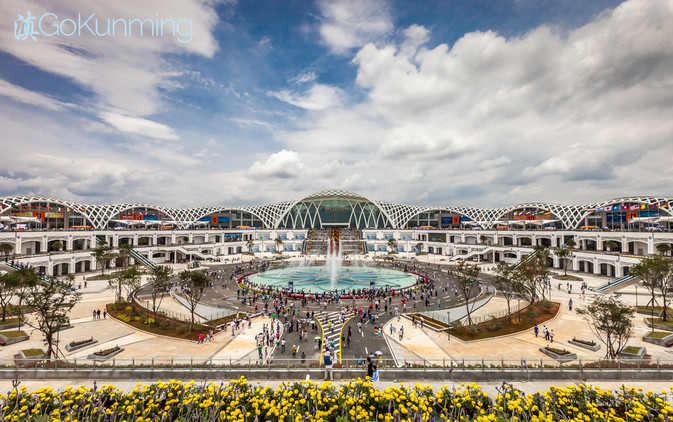
When the Spring City throws a trade and investment party, everyone comes. That is the lesson gleaned following closing ceremonies held yesterday at the twenty-third annual Kunming Import and Export Commodities Fair and third annual China-South Asia Expo. Expected to generate billions in business agreements and attract hundreds of thousands of curious attendees, the twin events did not disappoint.

The expos are held each year with the intention of attracting greater foreign business interest and interaction with Yunnan-based companies. This principal goal is part of a larger strategy to build up the province’s economy while also increasing China’s political and commercial footprint in Southeast Asia and beyond.

In terms of sheer numbers, these goals are being realized. Contracts signed during the course of the fairs totaled 785 billion yuan (US$127 billion) in direct foreign investment — a catchall term including money put toward virtually any business acquisition or other commitment. At last year’s expo opening ceremony, Chinese Vice Premier Wang Yang (汪洋) said he expected the next few years to be “the most active and fruitful period yet” for cooperation between Yunnan, Association of Southeast Asian Nations member-countries and South Asia. He appears to have been correct.

The numbers for direct foreign investment in Yunnan dwarfed those concerned with Chinese ventures in other countries, which reached 155 billion yuan (US$25 billion). In total, 903 overseas firms inked deals to begin or expand existing businesses in the province. The largest of these involved the fields of tourism, energy and infrastructure development, logistics, education, and environmental protection.

9329

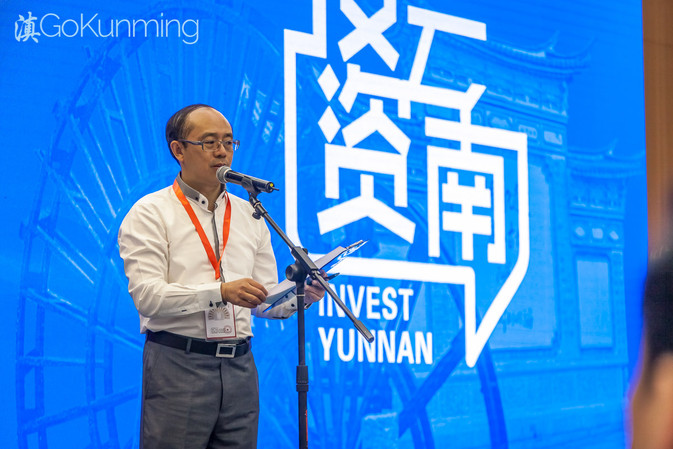
Highlighting Yunnan’s growing importance as a trade and investment hub, 20,000 businesspeople as well as dignitaries from 31 countries attended. Among the most notable were Chinese Vice President Li Yuanchao (李源潮), the president of the Maldives, Laos’ prime minister and high-ranking representatives from Bangladesh, Cambodia, India, Myanmar, Thailand and Vietnam.

India’s Minister of State External Affairs, VK Singh, also attended. He represented the expo’s feature country, a place of honor this year replete with a dedicated “museum” devoted not only to the Subcontinent’s most advanced industries, but also its history and culture. At a separate event held during the expo, Singh officially opened China’s first yoga college at the Yunnan University of Nationalities campus in Chenggong.

9326
Giving India such recognition was no random decision, but instead a calculated diplomatic move aimed at encouraging the world’s second most populous country to embrace China’s Belt and Road Initiative. The brainchild of President Xi Jinping, the proposal looks to propel regional integration between China and the countries of Central and South Asia, India chief among them.

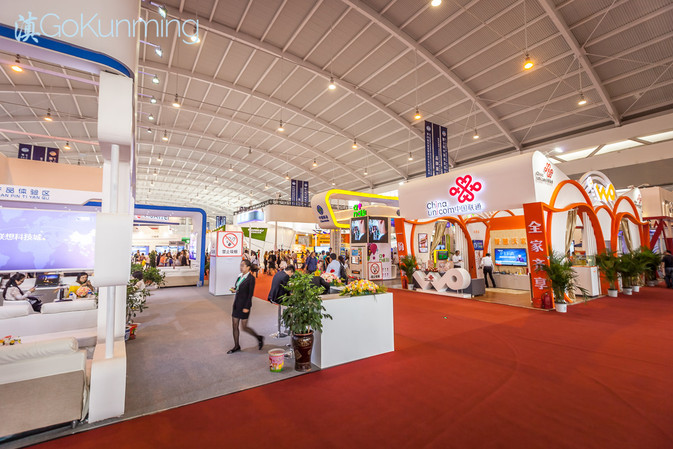
While enormous deals and industry-specific conferences were carried out behind closed doors, the general public tuned out in droves to this year’s expos. In preparation, organizers printed half a million tickets. It did not prove to be enough, as 740,000 attendees passed through the gates at the Kunming Dianchi International Convention and Exhibition Center, shattering last year’s attendance numbers by 500,000.

An exhibitor from Taiwan, surnamed Li, told reporters she had signed deals to sell dried fish to Carrefour, Parkson and Golden Eagle while at the expo. She, like many other exhibitors, ran out of things to sell two days before the expo concluded. “Everyone has been so friendly and warm,” Li said, “I hope to see them all again next year.”

This article, written by Patrick Scally with images by Yereth Jansen, was first posted here on Gokunming.com.

Leave a Comment

Filed under China, Current Events, Economic development, Foreign policy, GMS, SLIDER, Yunnan Province

The US Rebalance in Vietnam & The Philippines

In Southeast Asia, the United States has rebalanced its attention to a vital region while seeking to avoid alarming China. The Obama Administration’s comprehensive efforthas engaged a diverse array of countries, strengthening ties with both unlikely partners and longtime allies. Coupled with a brief study of American interests in the region, an examination of the strategy applied to two countries – Vietnam and the Philippines –reveals little cause for the Chinese concern that America is pursuing a policy of containment.

VIETNAM

In Vietnam, the U.S. has succeeded in creating a partnership with a nation that was a bitter foe just forty years ago. Perceiving China’s recent policies as a disturbing sign of greater assertiveness to come, Vietnam has felt it necessary to hedge against its neighbor by pursuing a closer relationship with the United States.

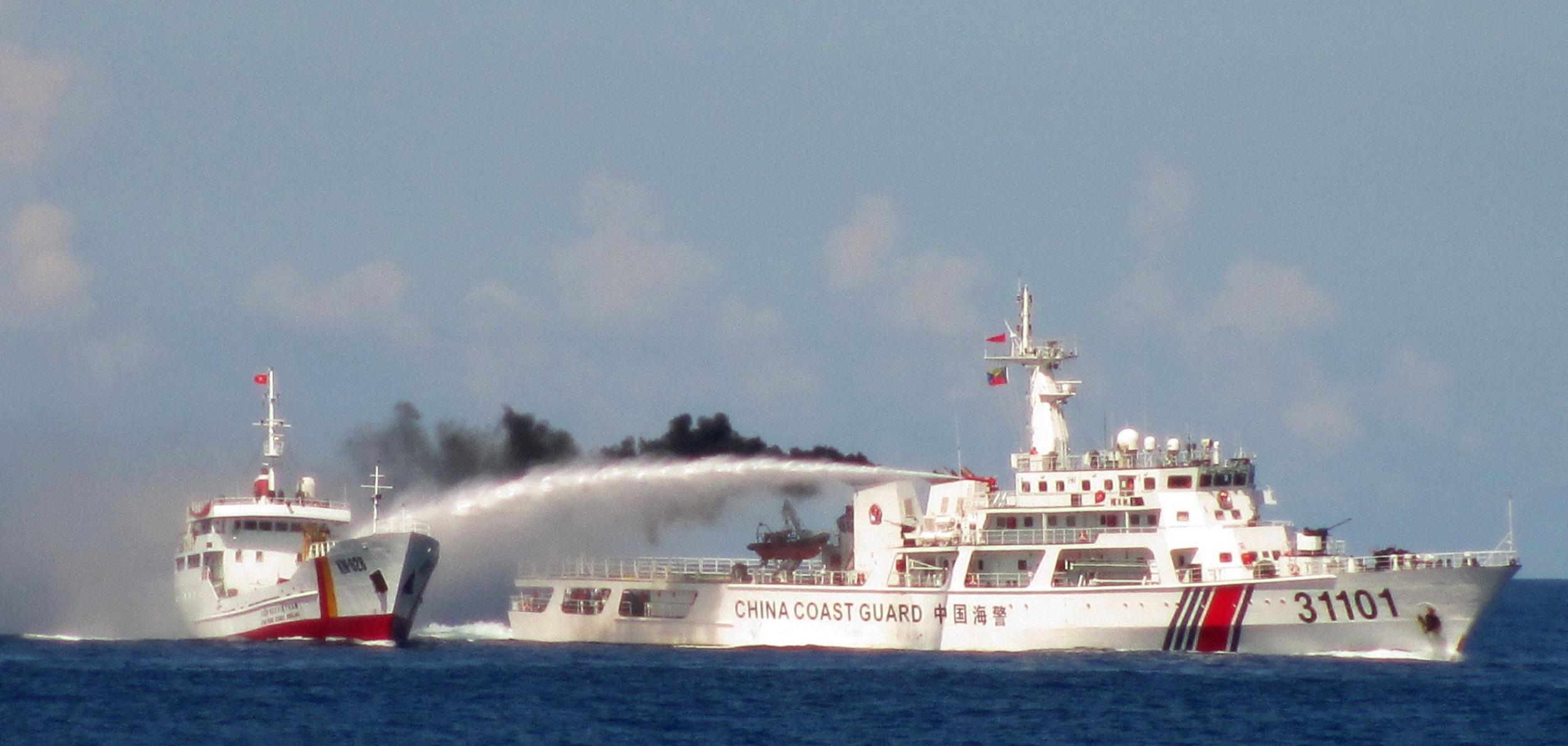
The driving force behind this reconciliation has been China’s provocations in the South China Sea, which have infuriated the Vietnamese government and its people and caused them to view China as a potentially destabilizing force in the region. The May 2014 placement of a Chinese oil rig within Vietnam’s Exclusive Economic Zone (EEZ) marked a highpoint in the tensions, sparking deadly anti-Chinese protests in Vietnam and naval incidents in the area of the drilling.

Vietnamese and Chinese vessels clash near the disputed oil rig. Photo: Getty Images

Vietnamese and Chinese vessels clash near the disputed oil rig. Photo: Getty Images

Chinese diplomacy has not eased Vietnamese concerns. Rhetoric regarding the South China Sea has been inflexible: in 2010, officials labeled the region one of China’s “core interests,” joining only Taiwan and Tibet. At a meeting concerning the South China Sea the same year, in which all disputant states were present, Chinese Foreign Minister Yang Jiechi reportedly stared at Singapore’s Foreign Minister while pointedly stating, “China is a big country and other countries are small countries, and that’s just a fact.” In the eyes of Vietnam and its fellow Southeast Asian States, this threatening tone has confirmed fears inspired by China’s aggressive policy in the region.

While some American observers have gone so far as to call for a full treaty alliance with Hanoi, several barriers will keep a degree of separation the two countries. The first is Vietnam’s policy of the “three nos”: no military alliances, no foreign military bases on Vietnamese territory, and no dependence on any countries for help in combating other countries. The last point is particularly important in the context of Vietnam’s history: when China invaded in 1979, the Soviet Union – having signed a defense treaty with Hanoi just a year before – declined to come to its aid. This history provides Vietnam with a powerful warning against reliance on powerful but distant allies.

Another analogy that suggests restraint is the ongoing conflict in Ukraine. Looking to Moscow once more, Vietnam sees a disturbing example of how a major power will react to its small neighbor aligning with a rival. Of course, the comparison is imperfect, but the degree of similarity between the two cases is striking nonetheless.

The greatest constraint upon Vietnamese diplomacy is its economy’s dependence upon trade with China. China is Vietnam’s largest trade partner, and the source of many of the inputs critical to its burgeoning manufacturing industry. While some worry that tensions could lead to a trade war, economic concerns have thus far won out, and the Vietnamese government has been careful to avoid pushing China too far.

The Rebalance

Even with these constraints, Vietnam has welcomed American efforts to deepen ties on diplomatic, economic, and military fronts. The rebalancing is directed toward all of Asia, but extra attention has been directed toward Vietnam – a prominent victim of China’s actions in the South China Sea, and a country with an especially dynamic and promising economy.

America has promoted Trans-Pacific Partnership (TPP) as the main pillar of its economic rebalancing to Asia. The United States, Vietnam, and 11 other Asian-Pacific nations are currently negotiating the deal,which seeks to reduce both tariff and non-tariff trade barriers while maintaining high standards for intellectual property, the environment, and labor rights. American officials have said they would welcome China, but it is widely acknowledged that the deal’s standards are too stringent for China to adhere to. Vietnam also faces challenges to joining, especially with its reluctance to reform state-owned enterprises and labor rights. Its presence in the negotiations is a testament to the determination of both America and Vietnam to deepen their economic ties.

TPP

Current members negotiating the TPP. Image: The New York Times


Diplomatically, the bulk of American efforts are directed toward the region rather than individual states. With regard to the South China Sea disputes, the United States has recognized that no single Southeast Asian state can hope to receive bilateral negotiations with China on equal footing. As a result, it has worked quietly to promote a closer unification of the Association of Southeast Asian Nations (ASEAN), which wields significant influence but, like all regional organizations, is held back by the disagreements of its member states.

Even with the region-wide focus of diplomacy, however, a rapid exchange of interstate visits has reflected Vietnam’s importance. American congressional delegations and Administration officials have met with the Vietnamese with increasing regularity, and Gen. Martin Dempsey’s 2011 trip marked the first visit by a Chairman of the Joint Chiefs of Staff since 1971.Nguyen Phu Trong, the General Secretary of Vietnam’s Communist Party and the country’s supreme leader, will make his first visit to the United States this June.

America’s military policy constitutes the most visible aspect of its rebalancing strategy, and naturally draws the bulk of Beijing’s complaints. In Vietnam, the U.S. has coupled emphasis on exchanges and cooperation with direct (although minor) military aid. Military-to-military ties have grown greatly in the past decade, particularly with the introduction of an annual Naval Engagement Activity (NEA), which pairs each navy in noncombat exercises. In 2014, the Secretary of the Navy also invited Vietnam to join the biannual, U.S.-led RIMPAC exercises, the largest naval exercise in the world.

While noncombat exercises are a mild form of cooperation, American promises of military aid to Vietnam reflect a much stronger commitment to rebalancing. In December of 2013, Secretary of State John Kerry announced $18 million in aid to Vietnam to “boost maritime security.” A portion of the money was earmarked for the purchase of five unarmed patrol boats for the Vietnamese Coast Guard – a minor increase, but symbolically significant. Additionally, Japan – the linchpin of American security in the Pacific and another country locked in a territorial dispute with China – provided Vietnam with an additional six boats, worth $5 million. And in 2014, the U.S. eased its ban on providing Vietnam with lethal arms, opening the door to a number ofsystems for its coastal defense.

Military Spending Infographic

THE PHILIPPINES

In the Philippines, the U.S. is working to further deepen its relationship with a treaty ally and longtime partner. After a brutal war with the United States that left it an American colony, the Philippines maintained a better relationship with its conqueror than most countries, and upon gaining independence sought American protection throughout the Cold War. While Filipinos resentment of U.S. military bases led to an American exit in the 1990s and a slight chill in relations, the Philippines remains one of America’s closest allies in the region.

Philippine-American Timeline Infographic

As with Vietnam, the Philippines’ desire to draw even closer to America is explained by Chinese tactics in the South China Sea. The Sino-Philippine conflict has actually been significantly more contentious. Because it shares no border with China, is less economically dependent, and has signed a mutual defense treaty with America, the Philippine government has been less constrained by geopolitics than its Vietnamese counterpart. (It should be noted, however, that the U.S. has declined to clarify whether this defense treaty applies to Philippine claims in the South China Sea.)

These circumstances have enabled the Philippine government to apply for international arbitration of its disputes in the South China Sea, a step that Vietnam considered too divisive. China has objected, stating that it will “neither accept nor participate” in the arbitration, and maintained its political stance of indisputable sovereignty throughout the South China Sea. It is highly unlikely that the suit will achieve any result.

In spite of greater economic insularity than Vietnam, the Philippines has still fallen victim to what isperhaps China’s greatest asset: economic coercion. China has employed this strategy often, taking advantage of its large domestic market and the control the state retains over the economy. In June of 2012, it reacted to a confrontation with the Philippine Navy by cutting off Filipino banana imports. Justifying the policy as a health regulation, China succeeded in choking an important industry and driving Manila to adopt a conciliatory tone.

The Rebalance

Economically, the United States and the Philippines are already quite close. America is the Philippines’ second-largest trade partner (after Japan) and its biggest investor. Still, the Obama Administration has worked to further enhance the relationship. While the Philippines does not currently take part in the TPP negotiations, it has expressed interest, and high-level officials from each country have met to discuss what its participation would look like. In 2011, the fiftieth anniversary of the bilateral defense treaty, the two countries signed a five-year Partnership For Growth (PFG) agreement, designating the Philippines as a priority area for American development assistance. That same year, the Millennium Challenge Corporation (a government agency) signed a five-year, $434 million compact to combat poverty and encourage growth in the Philippines.

Trade Growth Infographic

While historical closeness, cultural similarity, and the depth of Philippine-American exchange have already created close ties, American diplomats have sought to further reinforce the relationship. The two countries recently began holding a Bilateral Strategic Dialogue to institutionalize the regular exchange of ideas. And in 2011, Secretary of State Clinton visited the Philippines to release a joint Philippine-American declaration,reaffirming that the alliance had “never been stronger.”

The military aspect of rebalancing has consisted of naval aid, closer cooperation and training, and – most importantly – a strengthened defense treaty. Having always depended on its American counterpart, the Philippine Navy is one of the weakest in the region. Its flagship is a 45-year-old cutter, donated by the U.S. Coast Guard in 2011. The U.S. has offered an additional ship, communications equipment, and training, but recognizes that no amount of aid will enable the Philippines to unilaterally defend against Chinese naval incursions.

The true cornerstone of the military rebalance is a ten-year enhanced defense pact negotiated in 2014. The agreement creates no permanent bases, an option that then-Secretary of Defense Chuck Hagel dismissed as a “return to an outdated Cold War mentality.”Instead, it invites rotational deployments of American ships and advisers, which will significantly escalate military presence in the region. It also opens the door to greater commitments of military aid to the Philippines.

The symbolic value of a return to the Philippines, just over twenty years after public protest forced the closing of American bases at Subic Bay and Clark Air Force Base, is indicative of the region’s tense atmosphere. Some anti-American sentiment remains, stalling the agreement in a legal challenge that is now before the Philippine Supreme Court. Still, Philippine officials are confident that the case will be thrown out when a decision is reached.

Assessing American Intentions Throughout Southeast Asia

In spite of American efforts to paint the rebalance in nonthreatening terms, Beijing has frequently voiced its concern that the strategy aims to encircle and contain China. These complaints have especially been directed at the military components of these partnerships with Vietnam and the Philippines. China – at least publicly – eyes these moves suspiciously, and assumes that realist, hegemonic motives dominate American intentions.

For many reasons, however, this theory does not hold water. Even if China were to be excluded from the equation, a shift in attention to Asia would remain eminently logical. The War on Terror absorbed American resources in the Middle East for a decade after 9/11, but never promised long-term benefits to the national interest. Nor does any other region offer the dynamism and promise of Asia, which officials and scholars predict will be at the center of international affairs for decades to come

While China’s era of incredible growth is finally slowing, the rest of Asia is only beginning to take off. Asia holds more than half of the world’s population and is projected to account for half of its economy by 2050. Southeast Asia in particular holds much of this untapped potential, and four of the ten ASEAN states already rank among the world’s 20 most competitive economies.

With this unparalleled importance in mind, it becomes clear that the rebalance is simply an alignment of American resources and commitments with its interests – and that if anything, criticisms should question if the policy has gone far enough. With a globally integrated economy and worldwide commitments and interests, the United States does not see itself as having the option to neglect such a crucial region.

The rebalancing strategy has also emphasized the importance of improved relations with China. While public statements have often put America and China at odds, particularly over territorial disputes, diplomatic and military coordination have improved considerably. The annual, Strategic and Economic Dialogue receives a great deal of attention, and institutionalizes the frank exchange of positions between the two countries. Communication has been at the heart of American efforts to ease Chinese suspicions. For example, the Administration even privately briefed China on its plans before embarking on President Obama’s 2014 trip to Asia, in which he announced the enhanced defense treaty with the Philippines.

In responding to fears of containment, it is also important to note that a struggling China would be a disaster for America’s economy and interests. As Gen. Martin Dempsey, the Chairman of the Joint Chiefs of Staff put it in 2014,“I worry more about a China that falters economically than I do about them building another aircraft carrier.” The American and Chinese economies are deeply intertwined, and economic turmoil could also provoke political instability in China and East Asia– the last thing the United States would like to see.

Chinese ships expanding land in the South China Sea. Image: Center for Strategic and International Studies

Chinese ships expanding land in the South China Sea. Image: Center for Strategic and International Studies

Beijing may blame America for regional sentiment turning against it, but it would be better served by turning the mirror on itself. China’s policy in the South China Sea has done much more damage to its stature in Southeast Asia than American actions conceivably could. With aggressive expansion, including incursions into both Vietnamese and Philippine Exclusive Economic Zones, China has flouted both regional and international norms and laws. Its inflexible and even threatening rhetoric and diplomacy have only compounded the problem.

Only this behavior can explain why a country like Vietnam has sought greater friendship with the United States, or why ASEAN has pursued greater unity in dealing with other countries. China may well regret its policies in the South China Sea: in pursuit of territorial gains, it has sacrificed regional influence and reputation, thus containing itself.

Leave a Comment

Filed under China, Current Events, Foreign policy, Governance, Philippines, Regional Relations, SLIDER, South China Seas, Trade, Vietnam

Dali Old Town to charge entry fee

Dali Old Town; Image: Yereth Jansen

Dali Old Town; Image: Yereth Jansen

Dali, ancient seat of the Nanzhao Kingdom (南诏) and famed across China for its triumvirate of 1,200 year-old pagodas, will soon have an entry fee for tour groups. Beginning September 1, travel agents booking group trips to the city will be charged a one-time “maintenance fee”.

The 30 yuan per person charge will be added to the price of all group packages that include tours of Dali Old Town (大理古城). In addition to the fee, all companies operating within a 2.5 square kilometer “key protected area” of the old town will be charged a “preservation tax” equal to one percent of each businesses’ gross annual income. The entry surcharge for tour groups does not apply to those traveling independently or to locals living in the old town.

Money raised through the fee will be put towards historical preservation efforts and upgraded safety measures. Over the past four years, the Dali municipal government has reportedly spent 160 million yuan (US$25.8 million) on renovation and upkeep of older traditional buildings. However, more money was deemed necessary and instead of dipping into city coffers, officials decided to pass the cost on to visiting tourists. According to Dali’s Deputy Party Secretary, Yang Junbiao (杨军标):

Relying only on fiscal spending was insufficient as a means to maintaining Old Town. Requesting maintenance fees and asking for support from society at large will help fix the problem of [our] monetary deficiency and widen the availability of maintenance money. This is a useful way to protect and elevate Dali Old Town.

A similar fee was first discussed in 2009 but eventually put on hold until 2014. At the time, tour operators and local merchants strongly opposed establishing a surcharge and were also concerned with perceived transparency and oversight problems concerning how the money would be spent.

It appears some of these fears have now been alleviated, as the local government outlined its planned expenditures. Each year, Yang said in his announcement, two million yuan (US$322,000) will be put toward protecting and renovating historic buildings, with special focus on Bai minority residential structures. Also, a one-time outlay of 30 million yuan (US$4.8 million) has been earmarked for unspecified upgrades to the town’s fire protection infrastructure.

This last concern is being given high priority in old towns around the province following a January 2014 fire that destroyed much of Shangri-la in northwest Yunnan. The blaze raged for 14 hours and razed hundreds of traditional homes and businesses, highlighting the need for more serious fire precautions in similar historic towns composed almost entirely of interconnected wooden buildings.

This article was originally posted here on GoKunming by Patrick Scally.

Leave a Comment

Filed under China, Yunnan Province

Bright City Lights: Urban Trends and Futures in Southeast Asia

Traffic congestion in Bangkok

Traffic congestion in Bangkok

This year, Jakarta earned the unsavory title of “World’s Worst Gridlock.” The city of 23 million is now reputed for having to most congested streets in the world. Another Indonesian city, Surabaya, took the number four spot. If you continue down the rankings to number eight, you will find yet another Southeast Asian metropolis – Bangkok.

The tendency for gridlock in these cities is more than a daily inconvenience for residents. These levels of traffic congestion are indicators of a trend in the wider Southeast Asian region. In this part of the world, urban populations are growing faster than municipal and national governments can handle.  When managed sustainably, cities can be a valuable vehicle for economic development and socio-demographic transition. For example, cities can facilitate productive trans-border connections and slow birthrates, which enables more women to enter the workforce. Nevertheless, urbanization is a double-edged sword.

Rapid, unplanned growth results in unsustainable development that threatens social, economic, and environmental stability.  In a landmark report that analyzes 10 years of urbanization data from East Asia, the World Bank suggests that urbanization in East and Southeast Asia will have “long-lasting effects on the region’s social, economic, and environmental future.” Understanding the growth trends in Southeast Asia will boost the region’s ability to avoid the pitfalls associated with the rapid type of urbanization that has been observed over the past decade.  In other words, the region needs to pay attention to these changes if they don’t want to spend the rest of their down time stuck in traffic.

Dominant Urbanization Trends

Between 1990 and 2010, Southeast Asia increased its urban population by at least 12%, per United Nations estimates. The fact that Asian cities are growing is not a fresh realization, but few observers of these phenomena have questioned how these cities are growing, instead of just how big.

Screen Shot 2015-04-10 at 5.50.38 PM

For example, in the past 10 years, East Asia has experienced more urban growth in small- and mid-sized cities than in major metropolitan areas. This has several more nuanced implications for the region. Successful development in smaller metropolitan areas could relieve much of the pressure put on high-population areas. For example, a Thai development strategy used tax breaks to encourage people to take up residence in the regions outside of Bangkok . Unfortunately, the government failed to provide infrastructure and facilities to support business development in outlying regions. Bangkok remained the prime area for investment, and the program floundered.

Megacities like Bangkok often gain international reputations that afford them opportunities to advertise for foreign direct investment.Small and mid-sized cities, on the other hand, have to fight for attention and funding from national governments and lack the resources necessary to advertise to a wider range of investors. Take the case of Ho Chi Minh City and Da Nang, two metro areas in Vietnam. Ho Chi Minh City is the country’s largest city and Da Nang was only about an eighth of HCMC’s size in 2011. However, the rate of urban population change in Da Nang was 4.5% as of 2010 and HCMC was 3.9%. While this may appear to be a narrow margin between two cities, imagine the national impact when every mid-sized city in a country grows at this rate. The need for infrastructure would surely outpace the investment available to these smaller metropolitan areas.

laos.vte

In addition to major growth in small- and mid-sized cities, the fastest growth of urban population was experienced in East Asia’s low- and middle-income countries, namely Laos, Cambodia, and Vietnam. Japan, South Korea, and even Thailand place far behind these countries in their rates of urban land and urban population increase.

Screen Shot 2015-04-10 at 7.20.26 PM

The less developed countries in the region face administrative and financial challenges on a national level, which creates an environment where a single city in the country, often times the capital city, experiences the majority of the urbanization. The massive, resource-hogging cities that result are known as “primate cities” in the vernacular of urban studies scholars. Concentrating an entire country’s political, cultural, and economic capital in one area creates national vulnerability if there is a crisis in that single city.

Urban primacy is especially detrimental for a country when there is massive migration to the core and a development lag in the country’s periphery. This phenomenon plays out the same way in developing countries across the globe: Rural poor migrate to urban areas in search of better economic opportunities, but financially and administratively inept governments cannot provide migrants with adequate resources for finding jobs and homes. Densely populated and amenity-poor settlements result as migrants join the informal economy of the city.

Bangkok, Yangon, Phnom Penh, Vientiane, Jakarta, Manila, and Kuala Lumpur have all reached primacy within their respective countries. As previously mentioned, Bangkok is one city that has acknowledged its primate city status and attempted to reduce its dominance of Thailand’s geography. Countries such as Cambodia and Myanmar will also need to take steps to ensure that Phnom Penh and Yangon do not morph into unsustainable networks of unplanned settlements. The challenge lies in the fact that countries like Cambodia and Myanmar lack the administrative and financial capacity to shift rural to urban migration trends. However, it is promising that smaller cities in the region are doing most of the growth, even if they have a long way to go before they can compete with these metro areas.

Screen Shot 2015-04-10 at 5.24.48 PM

Finally, Southeast Asia’s urban populations are growing faster than the region’s urban land. At present, the main reason for dense urban growth in the region can be attributed to the lack infrastructure available on the periphery – a far cry from the smart growth policies that many cities implement to promote compact growth. Even so, high-density urban growth is associated with many positive outcomes when it is effectively provided for. Namely, high-density development tends to have fewer negative environmental consequences than urban sprawl. Kuala Lumpur is actually an exception to this trend in Southeast Asia, and has been criticized for failing to compact its urban growth. A heavy reliance on automobiles has been detrimental to the city, but other emerging urban areas in the region have the chance to get ahead of the car craze and promote smart growth that emphasizes efficient land use and practical transportation.

By and large, dense urban growth still has a number of caveats. As mentioned, the reason density in the region is high is due to a lack of amenities outside of core cities. If population growth outpaces the ability of the core to provide services, the quality of life in many cities will quickly degrade. Overcrowding is also a serious challenge that many cities in the developing world are faced with, and Southeast Asia is no exception. Comprehensive urban planning will be necessary to prevent overcrowding from becoming another major trend in the region.

Urban Planning and Governance: Missing Links

When you combine all of the formulas for urban growth in Southeast Asia, the results are two-sided: There is potential for inclusive, sustainable urban areas, but there is also a chance for the region to mushroom into a clutter of poorly planned development. When planning is neglected, poverty, environmental degradation, and land use conflicts ensure. For Southeast Asian cities to avoid falling victim to, say, the level of air quality degradation that many Chinese cities now face, spatial planning and good governance are crucial.

A 2009 assessment of urban governance prepared for UN Habitat is grim: the report asserts that the capacity of both local and national governments in the region is fragmented and weak, with a serious lack of simple management skills and adequate budgeting for necessary infrastructure. “Good” urban governance requires transparency, political will, and funding, but many Southeast Asian governments underperform in all three categories. There is always a propensity for countries to urbanize, regardless of political stability. With that being said, Southeast Asia’s urbanization trends alone illustrate that not all growth is good growth. A solid political environment at least ensures that there is a structure for discussing urban needs when they arise, although definitive actions need to be taken if there is going to be any change.

Administrative fragmentation is another burgeoning obstacle for Southeast Asian boomtowns. This term refers to the spillover of growth from one municipality into neighboring jurisdictions. One example is Manila’s urban area, which spans 85 municipalities and seven provinces. The World Bank predicts that many of the growing small- and medium-sized cities will soon experience this type of administrative challenge, if they are not experiencing it already.  Different jurisdictions often struggle to coordinate plans for infrastructure development and management, leaving many areas underserved.

The ecosystems impact of such trans-boundary urban areas is also notable because rivers, lakes, and forests require cooperative management.  Overcoming administrative fragmentation appears daunting in a region where political stability is scarce, but regional planning associations have proved to be an effective way to manage fragmented urban areas. The Metro Manila Development Authority (MMDA) is one such organization tasked with monitoring urban development, but it struggles with a low budget and limited regulatory power. Even so, the future of many urban agglomerations in the region would look brighter if such organizations were widely utilized. Urban management organizations have the ability to pull multiple institutional actors together when questions arise about different stakeholders’ opinions.

 Screen Shot 2015-04-10 at 7.26.18 PM

Urban Futures

Southeast Asia’s urban population has not yet reached 50% of total population, an indicator that more urban growth is still to come. The future of the region’s urban areas will in part be dictated by the trends that have been observed in the past decade, but also by events that remain to be seen. Climate change is one of the foremost worries in the region, but political stability and economic productivity will also play roles in the ability of the region’s cities to develop sustainably. Metropolitan areas in the region need to get ahead of urban growth and expansion in order to take some of the uncertainty out of the future.

Climatology experts maintain that no part of the world will remain unaffected by climate change, but Southeast Asia is actually a particularly high-risk area. A number of Southeast Asia’s urban centers falter in climate change scenarios that involve sea level rise, drought, saltwater intrusion, and severe weather events, and famine. As metropolitan areas in the region continue to develop, resilience is a topic that needs to be kept in mind. Cities like Bangkok and Ho Chi Minh need to have planes in place for flooding and typhoon events. Manila needs to ask itself how to feed a metropolitan area of 16 million if crop productivity plummets due to droughts or heat waves.

Besides the need for climate change adaptation measures, Southeast Asia also represents a large market for mitigation efforts. By reducing dependency on cars and carbon-based energy sources, the region can bypass being a part of the carbon problem. China and the West used coal to fuel their urban expansion, but Southeast Asia has the opportunity to exclude GHG heavy industries and develop using environmentally sound technologies. As new attempts at international climate treaties are rolled out, it will be interesting to see where many Southeast Asian nations fall on the spectrum of mitigation requirements.

Historically, developing countries have been held to lower emission reduction standards than countries in the developed world, but countries like Malaysia and Thailand have potentially reached a threshold where they will be counted among the world’s more developed countries, and thus required to reduced their emissions further. In any case, climate mitigation is good for Southeast Asia if it means that the impacts of climate change on the region will be softer than current predictions.

Political stability is also a recurring obstacle for a number of Southeast Asian countries. Years of stability and growth have been punctuated by sudden regime changes that have reduced the level of confidence both Southeast Asian nationals and outsiders have in the region’s governance. Urban planning is an intensely political process, so the status of a country’s national government directly effects urban development. If establishing effective national governments proves to be too much of a challenge for parts of the region, how can we expect urban management to get the attention that it requires?  Metropolitan development authorities and NGOs could potentially help cities weather the storm if political institutions fail, but finding consistent, effective governance is critical for the future of Southeast Asia’s cities.

Future economic development in Southeast Asia will also continue to shape urban areas in the region. Low-cost manufacturing has played a significant role in growing many of the region’s largest cities, but that may change as smaller urban areas take up lower-technology manufacturing as well. Some suggest that economic outcomes are better in regions where the largest cities take on service industries and high-tech manufacturing and the smaller cities concentrate low-tech industries. However, this is impossible if the infrastructure needs of smaller cities remain unmet. Investment in Southeast Asia’s small- and mid- sized cities is an important step that the region can take to move towards greater economic output.

Urbanization in Southeast Asia has reached a clear bottom line: In order to reap the benefits of healthy, innovative urban areas, the region needs to raise its expectations for planning and governance. If current regional urbanization trends continue to play out, there is potential for Southeast Asia to be the home of several highly productive urban areas. Investing in small and mid-sized cities will create robust national economies and capitalizing on dense growth will keep the environmental impact of cities to a minimum. However, if planning and coordination are left on the wayside, the region will be set on a course for vulnerability to any sort of crisis that should arise.

Leave a Comment

Filed under ASEAN, Cambodia, China, Current Events, Economic development, Environment and sustainability, Governance, Indonesia, Laos, Malaysia, Myanmar/Burma, Philippines, Sustainability and Resource Management, Thailand, Vietnam

In China’s hinterlands, a new life for Myanmar’s Rohingya

President of Myanmar Thein Sein. Photo: Wikemedia Commons

President of Myanmar Thein Sein. Photo: Wikemedia Commons

On February 12, 2015 Myanmar President Thein Sein, prompted by protests led by Buddhist monks in Yangon, reversed a decision made ten days earlier to give voting rights to the country’s Rohingya population. The reversal, while surprising to some, was only the latest in a series of events to befall the Muslim minority who call western Myanmar’s Rakhine state home.

The Rohingya of Myanmar (also known as Burma) have lost more than voting rights in the past. Regarded as one of the world’s most oppressed peoples, the Rohingya are a distinct ethnic group that speak a dialect of Bengali and are thought to be descended from Arab and Persian traders.

Persecuted at Home

Under the military junta that ruled Myanmar for most of the latter half of the 20th century and the current, nominally civilian government, Myanmar’s Rohingya have suffered chronic poverty, food insecurity, harassment and forced labor, among other human rights abuses. Following Burma’s 1982 Citizenship Law, hundreds of thousands of Rohingya were denied citizenship and are still referred to as ‘aliens’ and ‘foreigners’ by government officials. They are neither allowed to travel outside their hometown nor marry without official approval.

Poor relations between the Muslim Rohingya and their neighbors have only made things worse. Tensions between Rakhine state’s Muslim population and the majority Rakhine ethnicity, who are Buddhist, boiled over in 2012, leading to anti-Muslim riots that spread throughout the country. In Rakhine state alone, over 200 people were killed and whole villages were burned to the ground. Conditions have not improved for Myanmar’s Rohingya population since then. The current boat crisis of thousands of Bengali and Rohingya refugees stranded off the coasts of Thailand, Malaysia and Indonesia is a consequence of awful conditions at home.

The Rohingya, however are certainly not the only group struggling in Myanmar. Despite what appears to be a nascent democracy, a civil war between the government and an array of armed ethnic groups along the country’s periphery has flickered continuously since the 1950s. The reasons for the conflicts are many, though issues of ethnic autonomy and control of precious resources like jade and timber loom large.

The conflict’s latest iteration began in February 2015 and is still ongoing. A flare up of tensions between the Myanmar Army and Myanmar National Democratic Alliance Army (MNDAA) in Kokang, Shan State, has killed hundreds and forced tens of thousands of civilians to flee across the border into China.

Many Rohingya have also left Burma in the past decades. Tens of thousands of them reside in ill-equipped refugee camps on the Myanmar-Bangladesh border, though others have escaped to new lives abroad. Their final destinations vary, but the majority resides in Saudi Arabia, Malaysia, Thailand and Pakistan. Of these Rohingya living overseas, who may number over one million, most work low-wage jobs in the construction and service industries. There are some, however, that have chosen a different path in a land closer to home.

Abdullah's storefront in Jinghong

Abdullah’s storefront in Jinghong

Eight hundred kilometers east of Rakhine state in Jinghong, China, Abedullah owns a small jewelry shop. It’s three o’clock in the afternoon he hasn’t sold a thing.

Abedullah, like almost one million of his compatriots in Rakhine state, is a Rohingya, but he has not lived there in thirteen years. Instead, he’s settled in Jinghong, the capital of Yunnan Province’s Xishuangbanna Dai Autonomous Prefecture, along with almost 600 other Rohingya. All of them sell jade.

According to Abedullah, who only agreed to give his first name, Rohingya merchants first came to Jinghong almost forty years ago. Following the end of the bloody Bangladesh Independence War in 1973, hundreds of thousands of refugees fled into neighboring Burma. Marginalized by the Burmese and eventually disavowed by the Bangladeshi government, tens of thousands of Rohingya fled overseas. A handful made it to southwest China’s Yunnan province.

Stories of Jinghong’s first Rohingya are hard to find and by all accounts, the number of émigrés remained small until the 1990s. It was then that the Chinese economy began to truly open up to the international market. As trade increased and more Chinese became wealthy, the country’s jewelry consumption level grew as well, skyrocketing over 4000% in a decade.

While all gemstones have grown in popularity in recent decades, none hold the place in Chinese culture that jade does. Regarded as a stone of mystical qualities since antiquity, jade is the king of gemstones in China and it is in Myanmar that the world’s highest quality jade is found.

As a result, jade shops are ubiquitous in dozens of towns along the China-Myanmar border. Jinghong is one of the largest. Straddling the Mekong River, this once sleepy town has grown into a city of six hundred-thousand and now hosts millions of tourists each year. Many of these tourists come looking to buy Burmese jade. As travelers have flocked to Jinghong in greater numbers in recent years, Rohingya merchants with connections to the Burmese jade trade have followed to keep up with demand.

A New Life

One of the recent arrivals is Xiao Fei, a 21 year-old who prefers his new Chinese nickname to his given name. Xiao Fei, like many other Rohingya in Jinghong, came at the behest of his family; his grandfather first arrived in the city almost thirty years ago. After saving enough money for a passport, Xiao Fei was able to leave his home in Yangon and help his grandfather set up the family’s second shop.

Xiao Fei had to save up for his passport because getting such a document is often impossible for many Rohingya in Myanmar. Since they are officially considered to be foreigners by the Burmese government, Rohingya can only obtain passports after paying expensive bribes to the right people. That is why, as Xiao Fei explains, “Only rich Rohingya can make it to China.”

Once in Jinghong, new arrivals find an environment altogether strange and inviting. The forest of newly-built apartment complexes and hotels certainly dwarfs anything found in Rakhine state, however the hundreds of established Rohingya businessmen form a tight community that provides everything from religious services to a lunchtime delivery service of halal Burmese cuisine.

It is the mosque that is the heart of the community, says Waynai, a trader living in Jinghong for six years. The Jinghong Mosque, located not far from the banks of the Mekong was first established decades ago by the city’s existing community of Hui, a distinct ethnic group of more than ten million people that practice Islam and speak Mandarin Chinese.

When the Rohingya began to move to Jinghong in greater numbers in the late 1990s, they became a part of the congregation, eventually joined by a small population of Uighurs from China’s northwest. Together, these three groups of Muslims manage the congregation. Despite disparate geographic and cultural backgrounds, the mosque is thriving with a healthy number of members, daily prayers held in Arabic and discussion groups where participants speak in Standard Mandarin.

The Jinghong Mosque

The Jinghong Mosque

However both Waynai and Abedullah agree more with the mosque’s Uighur members on theological questions. When asked whether or not he had any non-Rohingya friends from the congregation, Abedullah answers, “Yes, but not the Hui. They’re fake … they don’t have Allah in their hearts.” Instead, it is the Uighur community that he feels closer too. “[The Rohingya] are similar to the Uighurs because neither of us are free … we both have to struggle to survive.”

This struggle is why Ba Hlaing, a 31 year-old jade dealer, came to Jinghong eight years ago. At the time, his family lived comfortably in a suburb of Yangon but as he came of age, conditions for young Rohingya grew more difficult. “I would’ve liked to stay with my family, but there wasn’t anything to do, no money to make.”

“It’s because of [the government] that we’re so backwards now,” he says in a whirlwind of English, Mandarin and Jinghong dialect, slapping the table after each word.

Just then a Han Chinese couple enters Ba Hlaing’s shop. He greets them using his best Mandarin, standing, “Welcome to Ba Hlaing’s Jewelry! We have the finest jade from Myanmar! Would you like to look at a bracelet?”

After five minutes of browsing, the wife still has not decided on a piece and the husband, fidgeting, suggests heading back to their hotel. The couple leaves and Ba Hlaing sits down to light a cigarette. “That’s how it goes,” he sighs. Just like Abedullah, business is slow for Ba Hlaing, even during tourism’s high season.

Ba Hlaing believes the drop in jade sales is a consequence of Chinese President Xi Jinping’s much-publicized crackdown on corruption. Once-popular ostentatious displays of wealth, like jade pieces worth tens of thousands of dollars are now frowned upon and officials that might frequent jade shops like Ba Hlaing’s are staying away.

Burmese jadeite

Burmese jadeite. Photo: Wikimedia Commons

The jade, however, keeps flowing from Myanmar. Most of it is mined in a strip of remote jungle in Kachin State, in the country’s northeast.  Conditions in Myanmar’s jade mines are notoriously dangerous and the towns that spring up around them are known as much for their drugs and guns as they are for their jade. However bad mining conditions are though, the money can be worth it for those who can make it. Official figures from Myanmar’s government put jade exports at $1.4 billion between 2011 and 2014. Analysts from Harvard University’s Ash Center disagree, estimating jade sales – both official and off the books – at $8 billion for 2011 alone.

Once the raw jade has been extracted, it is sent to processing centers. The majority are located within Myanmar, in urban centers like Mandalay and Yangon, where the jade is polished and crafted into a final product. The next step is to get it into China, where the market is.

Most traders interviewed for this article admitted that the majority of the jade they sold was actually smuggled into Yunnan. A few well-placed bribes on both sides of the border can get shipments of jade, transported in trucks, into China reliably. Once the jade is in Yunnan, it usually makes its way to Ruili, a major border crossing between China and Myanmar.

According to Ba Hlaing, many Rohingya traders in Jinghong have a contact in Ruili, usually family, that buys the jade. Others, however, are directly connected to processing centers, most often in Yangon. For more valuable pieces, with sale prices upwards of $50,000, many traders will use air transport to ensure their safe arrival. While import taxes must be paid in these cases, the extra cost is often worth the peace of mind.

 A Tough Decision

Peace of mind, however, is getting harder to come by. With a slowdown in business and mounting issues back in Myanmar, many members of Jinghong’s Rohingya community are facing a tough decision whether or not to return home.

Ba Hlaing, for one, is planning on going back to Myanmar. Sales have decreased for the past two years and he fears that a protracted crackdown on corruption in China will keep jade sales low and prevent his shop in Jinghong from making a profit.

Despite the dire situation for the Rohingya in Myanmar, Ba Hlaing is choosing to remain positive. “I think things will get better for us,” he says guardedly. “We have [this year’s parliamentary] election and the world paying attention to us so democracy is a good thing.”

Abedullah, on the other hand, does not share Ba Hlaing’s optimism. He does not want to return to Myanmar and sees little hope for democracy delivering the Rohingya from oppression.

“Things are a mess in Myanmar right now, everything is a mess,” he says. “The economy is bad and the government and [the armed ethnic groups] are still fighting.”

When asked his thoughts on the country’s armed conflicts, Abedullah pauses before exhaling heavily. “You know, we want to go to war too. At least [the armed ethnic groups] have guns. We don’t have anything,” he laments. “The government even took the knives from our houses … But then they still call us terrorists.”

Leave a Comment

Filed under China, ethnic policy, Myanmar/Burma, SLIDER, Trade, Yunnan Province

Yunnan’s governor looks to smooth relations with Myanmar

IMG_20130721_102713

One of the top government officials in Yunnan is spending time this week in Naypyidaw, capital of neighboring Myanmar. Provincial governor Chen Hao (陈豪) began a three-day diplomatic trip May 6 by meeting with Burmese president Thein Sein to discuss a litany concerns on both sides, as well as ways to promote the increase of legitimate bilateral trade.

At the center of the talks is stability along Myanmar’s 2,000-kilometer shared border with Yunnan. The most high-profile concern is a three-month war raging between the Burmese military and ethnically Chinese Kokang guerrillas in Myanmar’s Shan State. What started as an internal Burmese issue in February quickly changed into a cross-border crisis when tens of thousands of refugees sought safety in Lincang Prefecture in Yunnan.

Already angered by the humanitarian situation, Beijing was positively incensed when Burmese warplanes bombed rural Yunnan villages not once but twice. Although the initial bombing caused only minor property damage, the latter claimed the lives of four Chinese farmers, leading Beijing to angrily summon the Burmese ambassador to China for a tongue lashing.

Chen’s trip is no doubt a delicate attempt to repair strained relations between Myanmar and China. Civil war, refugees and errant explosives are enough to make any relationship tenuous, but Chinese leadership is also concerned with the huge shipments of heroin, opium and methamphetamines that routinely leak across the porous Yunnan border.

And the concerns are not one-sided. Thein Sein’s government charges that illegal trade out of his country — especially in jade, gold, endangered species and old-growth timber — is promoted and financed by unscrupulous Chinese businessmen operating illegally in Myanmar. However, the touchiest issue may be that of human trafficking in women.

Already this year, Chinese authorities have made several notable stings, arresting dozens of people involved in buying, transporting and selling Burmese women to perspective Chinese husbands. The largest of these occurred in March, when police made 35 arrests and repatriated 177 women and girls to Myanmar after raiding a Yunnan company advertising “Myanmar women [who] cost you only 20,000 yuan”.

Chen has only officially been in power since January, and his province’s western border snakes along endless mountain ranges, beside lush river valleys and through dense jungle that are nearly impossible to properly patrol. The one possible bright spot, and something he will undoubtedly bring up repeatedly during his Naypyidaw visit, is bilateral trade and the third annual China-South Asia Expo opening June 12 in Kunming. But what can be accomplished regarding the lawless and sometimes dangerous border between Myanmar and Yunnan remains a giant question mark.

This article was written by Patrick Scally and originally published on GoKunming. It is reprinted here, in its entirety, with permission from the author.

Leave a Comment

Filed under China, Human trafficking, Myanmar/Burma, Regional Relations, SLIDER

Who’s afraid of China’s One Belt One Road Initiative?

A month ago China unveiled an action plan for China’s controversial One Belt, One Road initiative. The action plan introduces a series infrastructure development projects and trade related agreements along three Silk Roads emanating from China and reaching as far as Europe, Africa, and South America. It undoubtedly will be the subject of scrutiny as analysts and pundits on both sides of the Pacific chime in to make hasty comparisons to China’s 14th century maritime expansion and the more recent U.S. led Marshall Plan.  Some may even go as far to equate the One Belt, One Road to Japan’s pernicious WWII era East Asia Co-Prosperity Sphere – this analogy, to the Chinese, is ultimately insulting.

Scrutiny and false comparisons aside, China and the world will be made economically better off by a successful implementation of the One Road, One Belt initiative.  China estimates the total benefit stream for investors and firms that participate in the initiative to reach an astronomical USD 21 trillion. Moreover, the prospects of such benefits are particularly timely at a time when global aggregate demand is on a downslide.   During a series of fall 2013 visits to Asian neighbors, China’s president Xi Jinping first announced the One Road, One Belt proposal as an umbrella concept describing three economic belts extending westward from China toward Europe and Africa.  The three economic belts roughly follow historical trade routes linking China with the West and are known as the New Silk Road, South Silk Road, and the 21st Century Maritime Silk Road (See map).

One Belt One Road

According to the Chinese Foreign Ministry, the initiative seeks to strengthen economic collaboration, improve road connectivity, promote trade and investment, promote currency conversion, and bolster people-to-people exchanges.  The timing of the initiative is critical.  China’s current development trajectory requires an infusion of economic growth emanating from its under-developed interior using an outward focused plan to export its finished products abroad while importing much needed raw materials and foodstuffs from the rest of the world.

The catchword among the planners of the Belt and Road system is youwai zhinei (由外至内) or ‘to bring the outside in.’ This concept reveals the actual logic of the plan as an outward looking plan that fills domestic economic needs first. Xi Jinping is betting his political future, and by extension, the continued legitimacy of the Chinese Communist Party, on this plan to solve China’s economic woes and deliver successful reforms.  Thus, criticism should not pontificate on how the initiative is China’s grand strategy for global domination, but rather focus on assessing the efficiency of the various related project and prognosticating whether Xi can drive the initiative’s benefits home in time to stave off an economic slowdown.

To address current criticism, pundits are quick to draw historical comparisons to when Ming dynasty Admiral Zheng He, a court eunuch whose naval fleets, sailed as far as the east African coastline collecting tribute and expanding China’s sphere of influence.  To be sure, Zheng He’s ships were equipped with soldiers and were not simply diplomatic missions.  However, historian Jeremiah Jenne Executive Director of The Hutong in Beijing says, “Zheng was not trying to conquer or colonize in the name of the Ming Court. China gets into a lot of trouble in contemporary diplomacy because there seem to be elements in the foreign policy and military establishments and a whole swath of the general population who have trouble separating tributary arrangements from actual control and sovereignty.”

Jenne’s comments are generally made in reference to China’s historical claims to most of the South China Sea, many of which are based on Zheng He’s naval explorations.  However, on equal measure, Western detractors of the One Belt One Road plans should also not claim Zheng He as a world conqueror or challenger to the status quo.

Some analysts suggest the cheap financing and aid packages attached to the One Belt One Road plan are part of a political strategy for China to placate its neighbors over territorial disagreements with trade incentives and cash.  China indeed ill-advisedly attempted this strategy in the mid 1990s with its economic cooperation strategies vis-à-vis mainland Southeast Asia, but its track record with this strategy, particularly with Vietnam and Indonesia is spotty and has not produced desired results.

Yun Sun, resident fellow and Chinese foreign policy expert at the Stimson Center in Washington D.C. does not quite agree with the view that One Belt, One Road is motivated primarily by strategic and political calculations. She says, “The plan is primarily an economic campaign designed to serve China’s economic restructuring and export needs. It will benefit the region, as well as China.”  She admits the initiative will inevitably have a political impact and Beijing conceivably sees the political benefit as a part of the package.

“Using the counter-factual approach,” continues Sun, “China would still pursue One Belt, One Road without South China Sea disputes, so we can’t really say that the South China Seas or mending ties due to disputes there is the cause of China’s One Belt One Road.”

The post-WII Marshall plan which successfully lifted both the US and Europe out of its post-WWII economic woes and acted as the keystone to US led global restructuring models such as the Bretton Woods system indeed serves as a useful comparison to the One Belt, One Road initiative.   While we should be mindful that there is no guarantee the plan will deliver the local and global economic benefits that China hopes for, we should be more mindful that unlike the Marshall Plan, China has no economic restructuring model to offer the rest of the world, its stock of soft power is not necessarily improving, and this plan, still in its proposal stage, will be no easy sell.

To provide a comparison, China’s scorecard in regard to economic belt and road development in mainland Southeast Asia is murky and has contributed much to its current reputation rising regional power with unclear intentions.  Vietnam has stringently followed China’s export-led growth model and as a result is currently heading toward dire and inexorable economic straits unless it considers other alternatives.  Even in poor countries like Laos, where mid-to-high-value Chinese exports are not preferred to Thai or even Vietnamese products, scant evidence exists to demonstrate the “Made in China” image is improving.

The record of Chinese firms abroad in regard to environmental protection and labor practices is abysmal in countries like Laos, Myanmar, and Cambodia with no evidenced improvement in corporate social responsibility practices. Tied to this, Xi Jinping’s anti-corruption crackdown will reveal deep corruption and graft in many of China’s overseas infrastructure development projects.  Moreover, Xi Jinping is pledging to break-up the monopolies of many of China’s powerful state firms – construction and energy firms are already in his sights – thus, it is unclear who will build the One Belt, One Road projects.

To reiterate, these are the issues that deserve scrutiny and attention rather than the high-level rhetoric of China’s grand strategy.

Liu Jinxin, regional logistics expert and chief architect of the Bangladesh-China-India-Myanmar Corridor (a westward stretching leg of the South Silk Road – see map), says that the greatest challenge facing the One Belt, One Road strategy is in China’s public relations strategy.  “Too many out there misunderstand China’s intentions, and factions, particularly within democratic countries, will misinterpret the benefit flows that this plan will deliver.”  Liu also cites the need for harmonizing legal structures between cooperative partners in sectors related to trade, commerce, and logistics.  “China will learn the most from this process, specifically through interaction with countries in Europe where the rule of law is strong.  However, since China’s legal system is not based on rule of law, it will be difficult for China to emerge as a conversation leader on this initiative.  In many ways China’s role is passive.”

Thailand’s refusal to pass a regional cross-border transportation agreement sponsored by the Asian Development Bank (which China and other mainland Southeast Asian states have ratified) is reflective of Liu’s commentary.  The ratification of this agreement would require the break-up of many entrenched factions within Thailand’s customs and inspection agencies as well as the military – a move these powerful groups are unwilling to budge on despite Thailand’s overall enthusiasm for economic cooperation with China.

When applying a critical eye to the One Belt, One Road initiative, its best to begin with a consideration toward the feasibility of such a project and looking at China’s real capabilities. Many worthwhile questions arise amidst such an inquiry, and certainly no one should take for granted that China can pull such an endeavor.  The functionality of the initiative is to push China successfully through its next wave of economic reforms promising further stability to East Asia and delivering a substantial contribution to global economic growth.

2 Comments

Filed under China, Current Events, Economic development, Foreign policy, GMS, Governance, Regional Relations, SLIDER