Category Archives: China

Anning refinery fined for violation of national environmental laws

refinery

The Chinese Ministry of Environmental Protection issued a modest fine over the weekend to anAnning oil refinery. While the “administrative penalty” did not specifically mention pollution, the facility in question has been the source of public concern and controversy since construction began in 2013.

Yunnan Petrochemical Company, a subsidiary of China National Petroleum Corporation, was fined 200,000 yuan (US$31,000) for violating articles 19 and 24 of the national Environmental Protection Act. Specific details were not disclosed beyond mention of “significant changes and unauthorized construction” without the company filing required environmental impact assessment (EIA) documents.

However, the two statutes Yunnan Petrochemical Company was found to be in violation of are both concerned with the construction of factories or processing installations deemed potentially harmful to the environment. Article 19 is specifically concerned with the “utilization of natural resources”, and reads, in part:

The development and utilization of natural resources is bound to affect and damage the environment, [including] resources such as water, land, forests, grasslands, oceans, minerals…All types of exploitation of natural resources must comply with the relevant laws and regulations and fulfill ecological environmental impact assessment procedures according to law…and key construction projects, must comply with soil and water conservation programs should [or] otherwise will not be allowed to start construction.

In addition to the fine, the Anning refinery was ordered to shut down construction on the parts of the factory not in compliance with EIA requirements. Those sections will be allowed to reopen only after the proper documents have been submitted and approved by the Ministry of Environmental Protection.

The refinery, which processes “ten million tons” of petroleum each year, has been a source of community concern since construction began outside of Anning in 2013. Local residents feared the plant would produce the chemical paraxylene — an important ingredient in the manufacturing of plastic bottles and polyester clothing. If inhaled or absorbed through the skin, the gas causes varying degrees of damage to abdominal organs and the central nervous system.

Concerns over the potential danger the facility could pose to public health went viral on microblogging services, and led to large street protests in Kunming. The city’s mayor eventually addressed demonstrators, promising to look into the matter. However, no substantial news of a final decision was made public, and the refinery operated without further media comment until Saturday.

This article written by Patrick Scally was first published here on the GoKunming website on September 1, 2015.  Eastbysoutheast.com reported extensively on the the PX protest issue in Kunming in 2013.

Leave a Comment

Filed under China, Current Events, Energy, Governance, SLIDER, Yunnan Province

No Recourse: Upper Mekong Dam Spells End for Tibetan Village

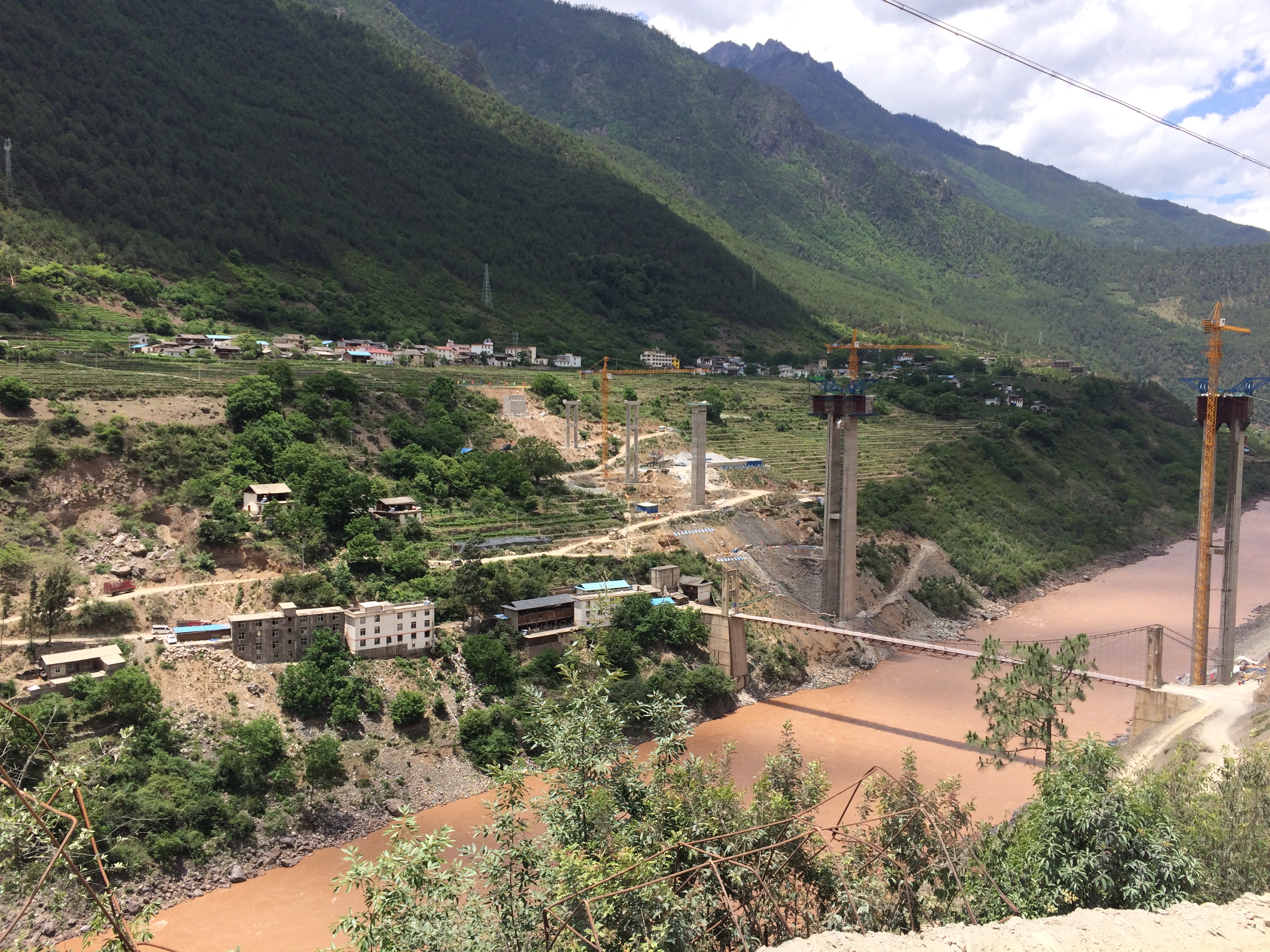
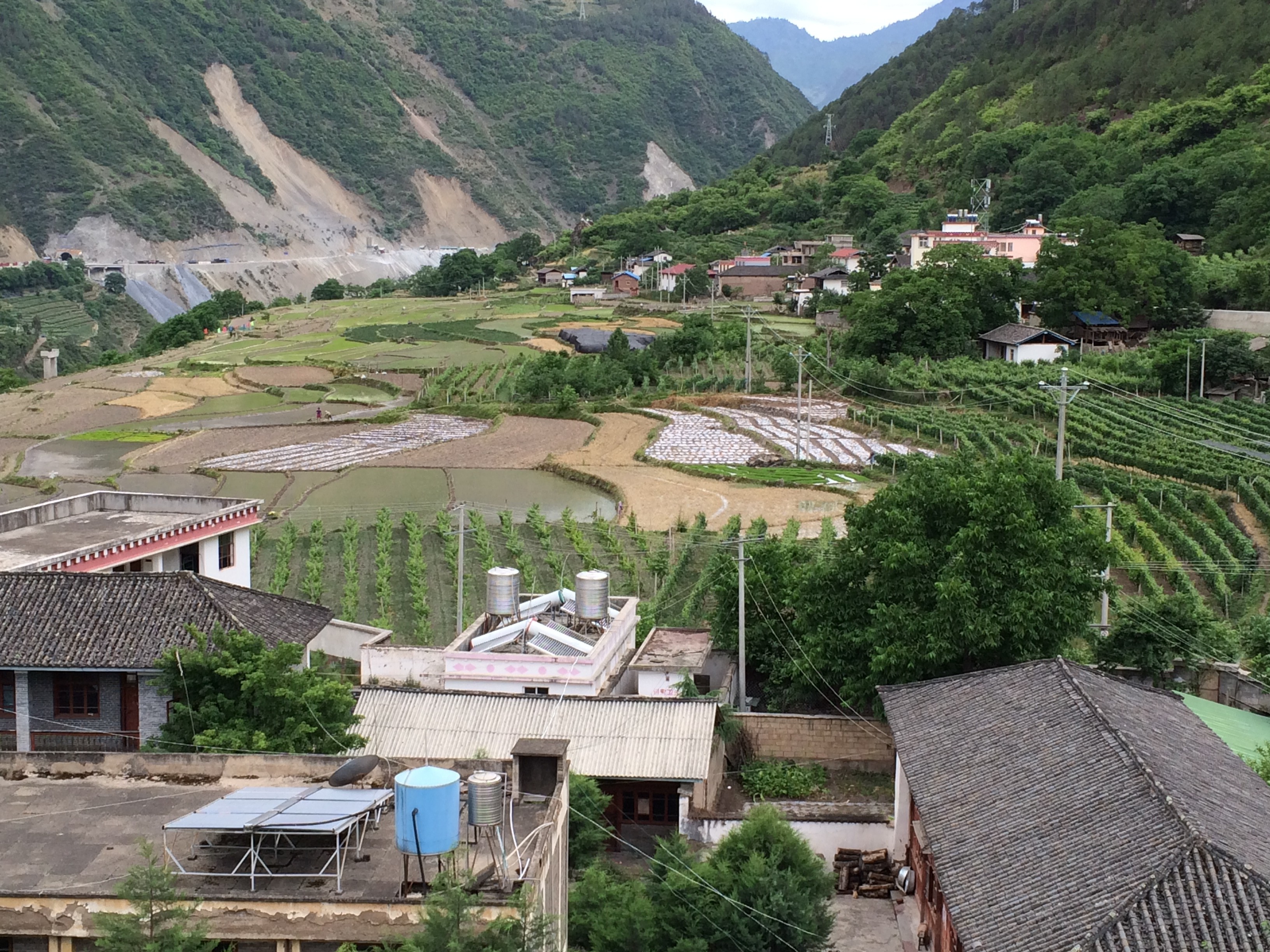
Cizhong village in the background along the west bank of the Upper Mekong in Yunnan.

Cizhong village in the background along the west bank of the Upper Mekong in Yunnan.

Cizhong, a remote Tibetan village in China’s Yunnan province, has no recourse against the onslaught of impacts from the construction of the Wunonglong dam on the Upper Mekong River.

This year has seen no pause in activity from civil society organizations and community level stakeholders in the Lower Mekong targeting criticism at the Xayaburi and Don Sahong dams in Laos, both high-profile projects on the main stem of the Mekong River. Moreover, evidence shows how efforts of these groups are actually delaying the construction of these projects and raising the costs associated with their completion. Dual influences of economic uncertainty in China and Southeast Asia and the unavoidable effects of climate change in addition to grassroots efforts are challenging the popular notion of a “domino effect” of inevitable hydropower development on the Mekong.

Yet while the domino effect on the Lower Mekong may be under question, it has prevailed in China’s stretch of the Mekong , silencing activism and subjecting affected communities and local ecologies to the vagaries of unchecked development. The 990MW Wunonglong dam, scheduled for completion in 2019, and the impacts of its reservoir on thousands of households serves as a case in point.

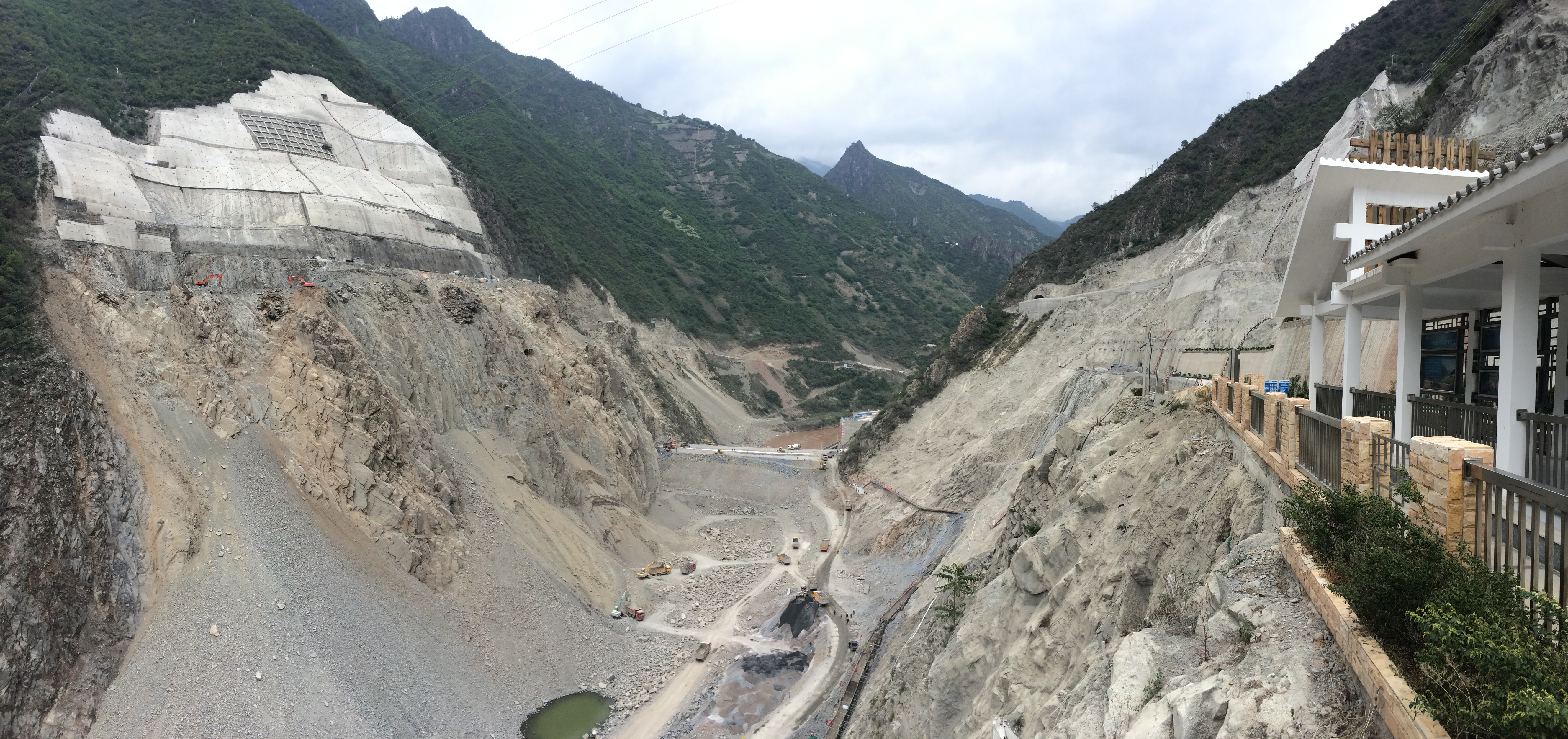
Construction began at the Wunonglong dam site in 2010.

Construction began at the Wunonglong dam site in 2010.

I first heard of the impacts of the Wunonglong dam on the day I walked into Cizhong, a village 40km upstream of the construction site. Cizhong sits on a small plateau 100 meters above the Mekong at the southern end of Deqin county in one of the most remote areas of Yunnan province. I crossed into Cizhong on a bridge that will be inundated by the dam’s reservoir in a few years.  Looming fifty meters above, a half constructed bridge built by the dam developer Huaneng Hydrolancang will upon completion bisect a patch of carefully maintained rice paddies located between the river and the village.

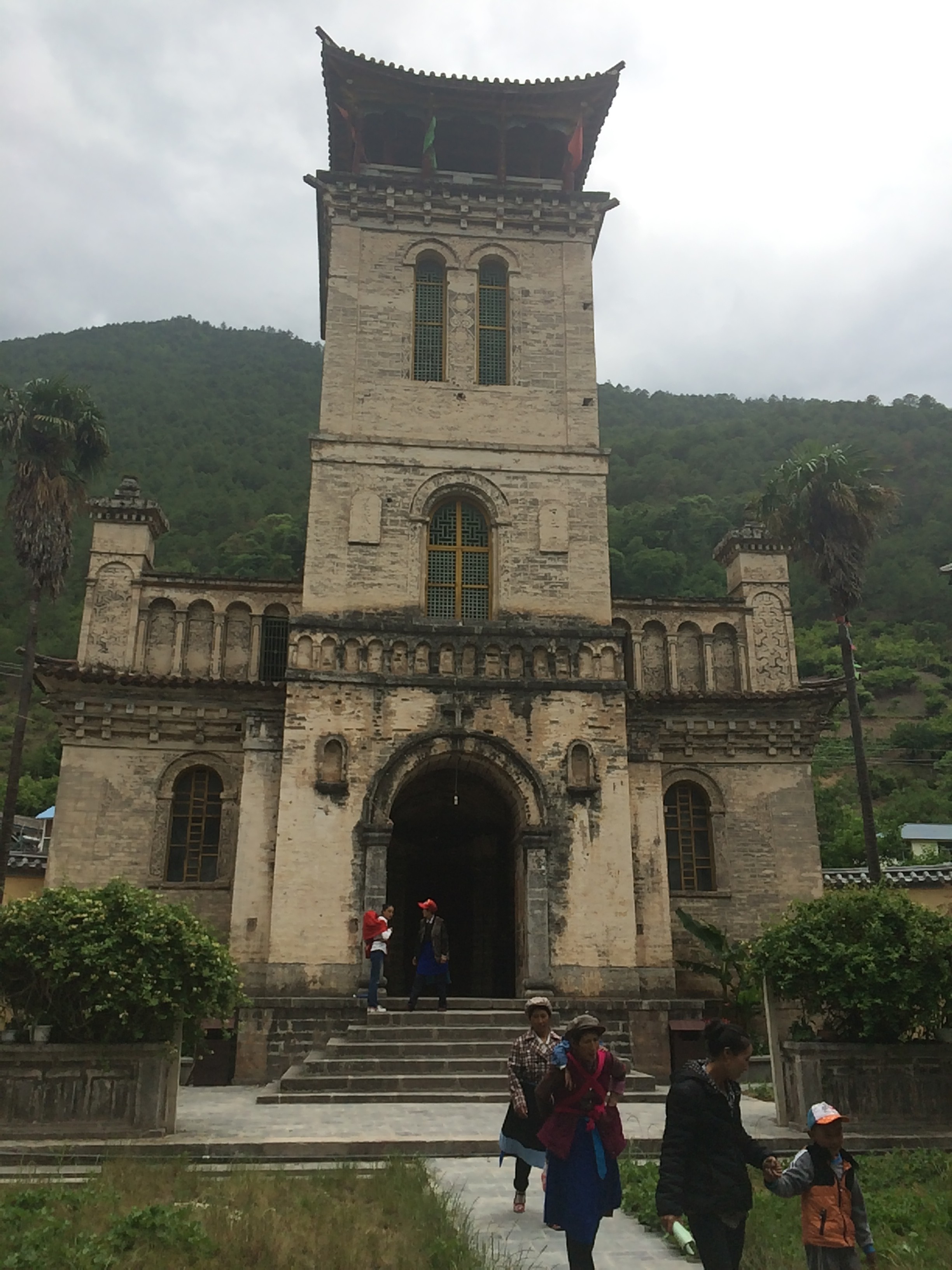
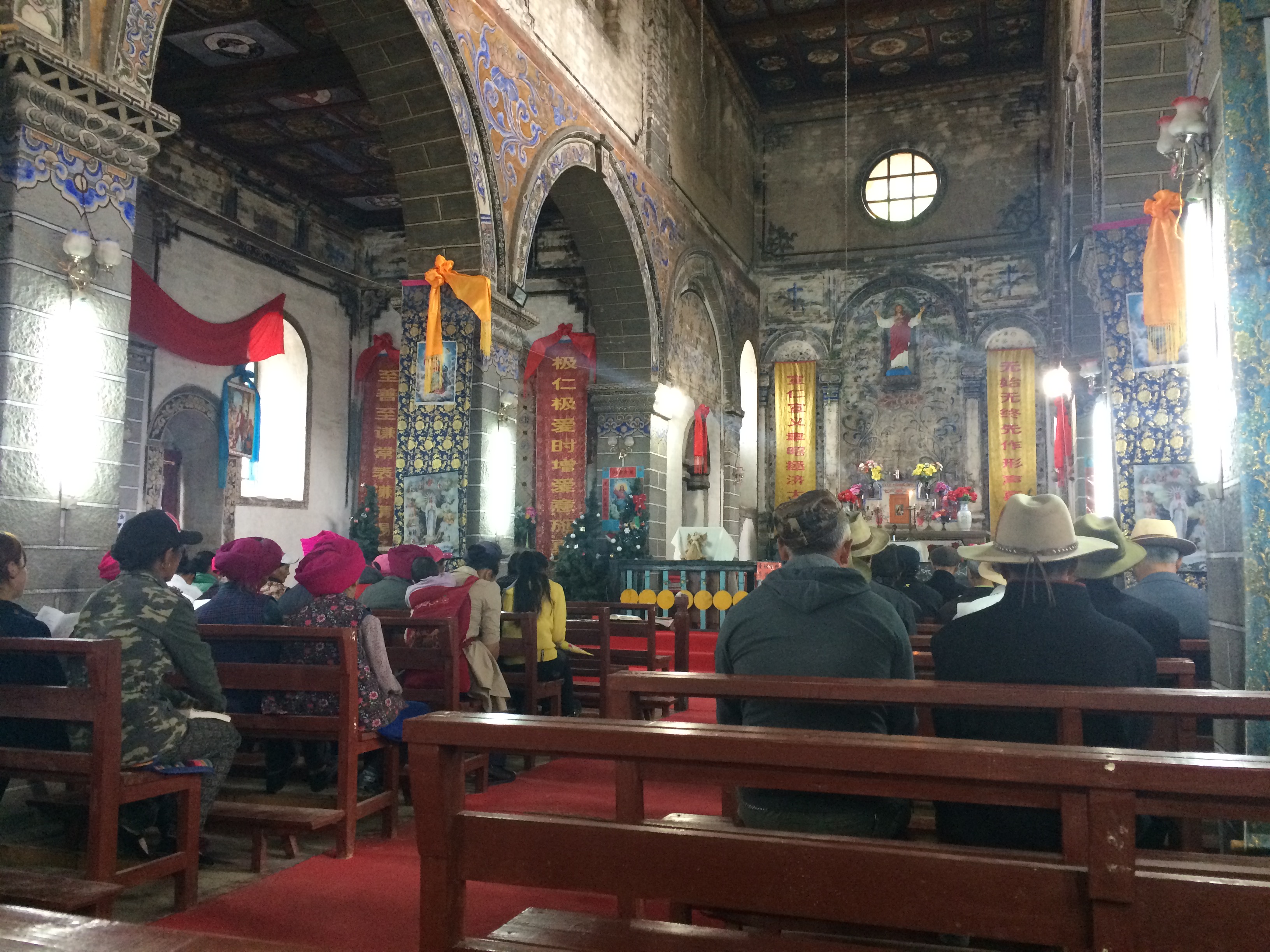
Cizhong is majority Tibetan, and for years both Chinese and foreign tourists have flocked to the village for two reasons.  First, eighty percent of the village’s 115 households are members of the local Catholic church established in the late 19th century by French missionaries. Several times a week, villagers file into the stone Cizhong cathedral, a nationally protected structure, to take part in mass led by Li Fei, a priest from Inner Mongolia.  The prayers sung in unison before mass are to the tune of commonly known Tibetan Buddhist chants.  European tourists typically line the back pews to catch a glimpse of this uncommon marriage of cultures.

Cizhong’s Catholic Church, a nationally protected structure built in the early 20th century.

Cizhong’s Catholic Church, a nationally protected structure built in the early 20th century.

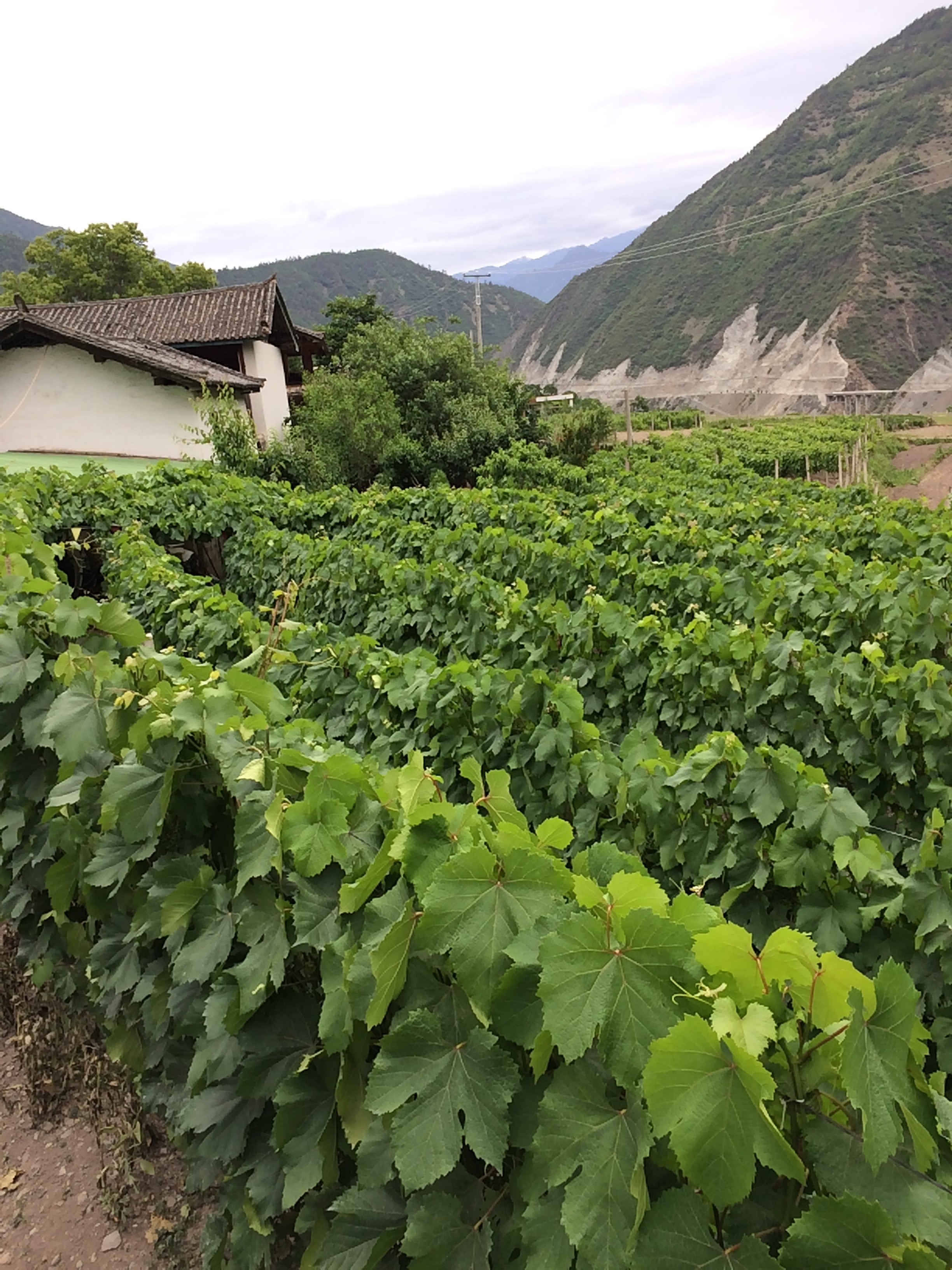
Second, Cizhong is home to a growing cottage wine industry, also introduced by the French missionaries prior to the establishment of the People’s Republic of China in 1949.  The wine boom started in the late 1990s with the resurrection of a Rose Honey grape variety found growing on the cathedral grounds and no longer cultivated in France.  About ten years ago, the local Deqin county government introduced agricultural assistance programs that brought in other kinds of grape varieties as well as technical aid to supply a larger wine making industry in the Shangri-la region.  Currently, most villagers sell their grapes to middlemen each harvest, but some choose to make their own wine to retail at Cizhong’s local wineries and guesthouses.

New neighbors

However, the things that make Cizhong special may not be around for long. The Wunonglong dam threatens not just Cizhong’s local economy that has delivered modest levels of prosperity to the village over the past thirty years, but also the religious harmony between local Tibetan Catholics and Buddhists.

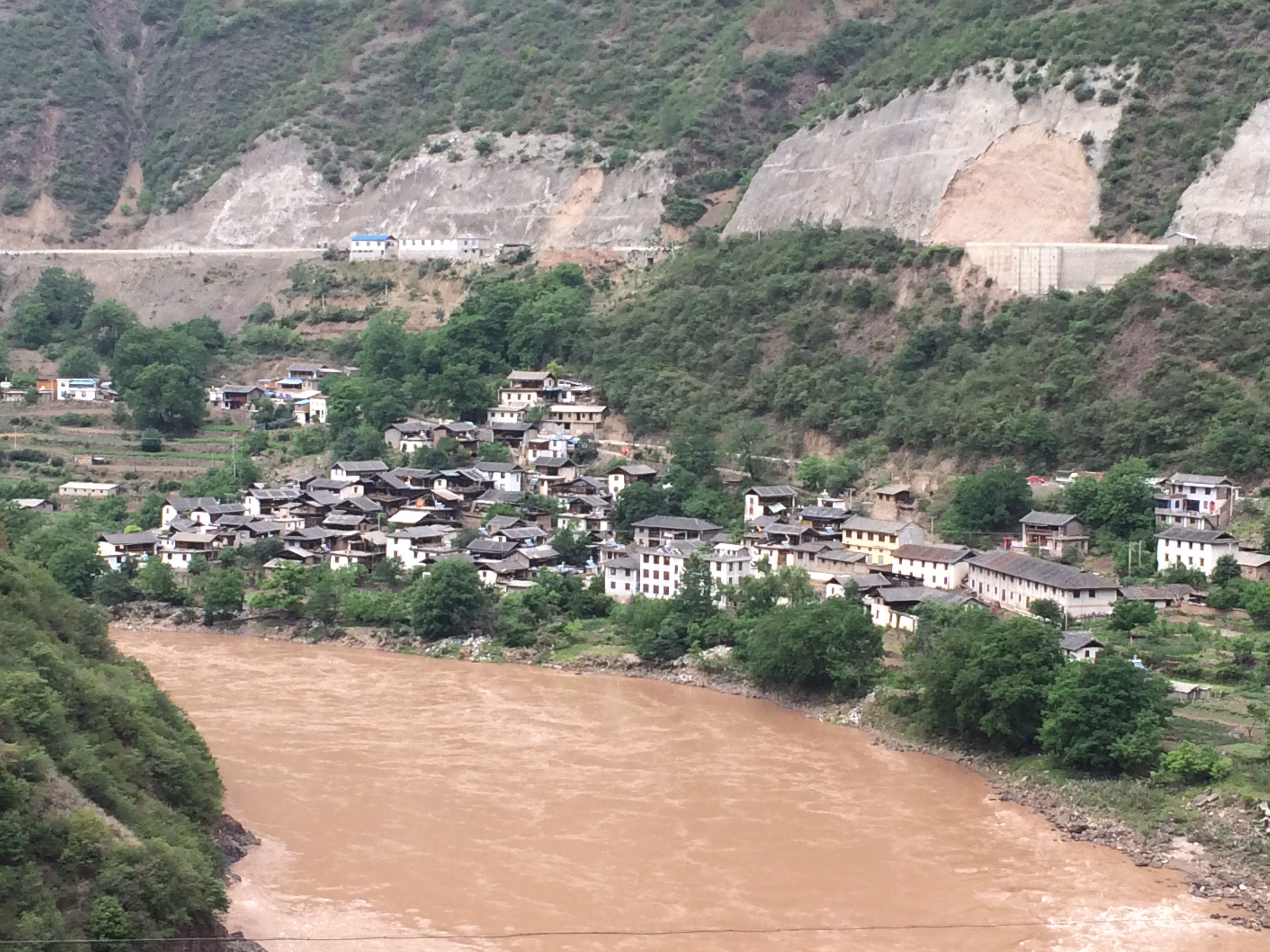
In two years Yanmen, an upstream community with more than two hundred households, will be entirely relocated to Cizhong.  Yanmen sits low along the banks of the Mekong and will be completely flooded by Wunonglong’s reservoir and the only place to transplant Yanmen’s residents is on top of Cizhong’s rice paddies.  Upon hearing the news of Yanmen’s takeover of their rice paddies, Cizhong’s villagers reacted emotionally as the paddies create a critical community space for social interaction. “The village elders cried when they heard the rice paddies would be destroyed.  The paddies were carved with their bare hands in the 1960’s and now the government wants to take them away?” says a local villager. Another villager claimed one rice harvest can feed the village for two years. Without a rice crop, villagers will have to generate income to overcome a critical food security issue.

Part of Yanmen village located below the inundation zone of Wunonglong's reservoir.

Part of Yanmen village located below the inundation zone of Wunonglong’s reservoir.

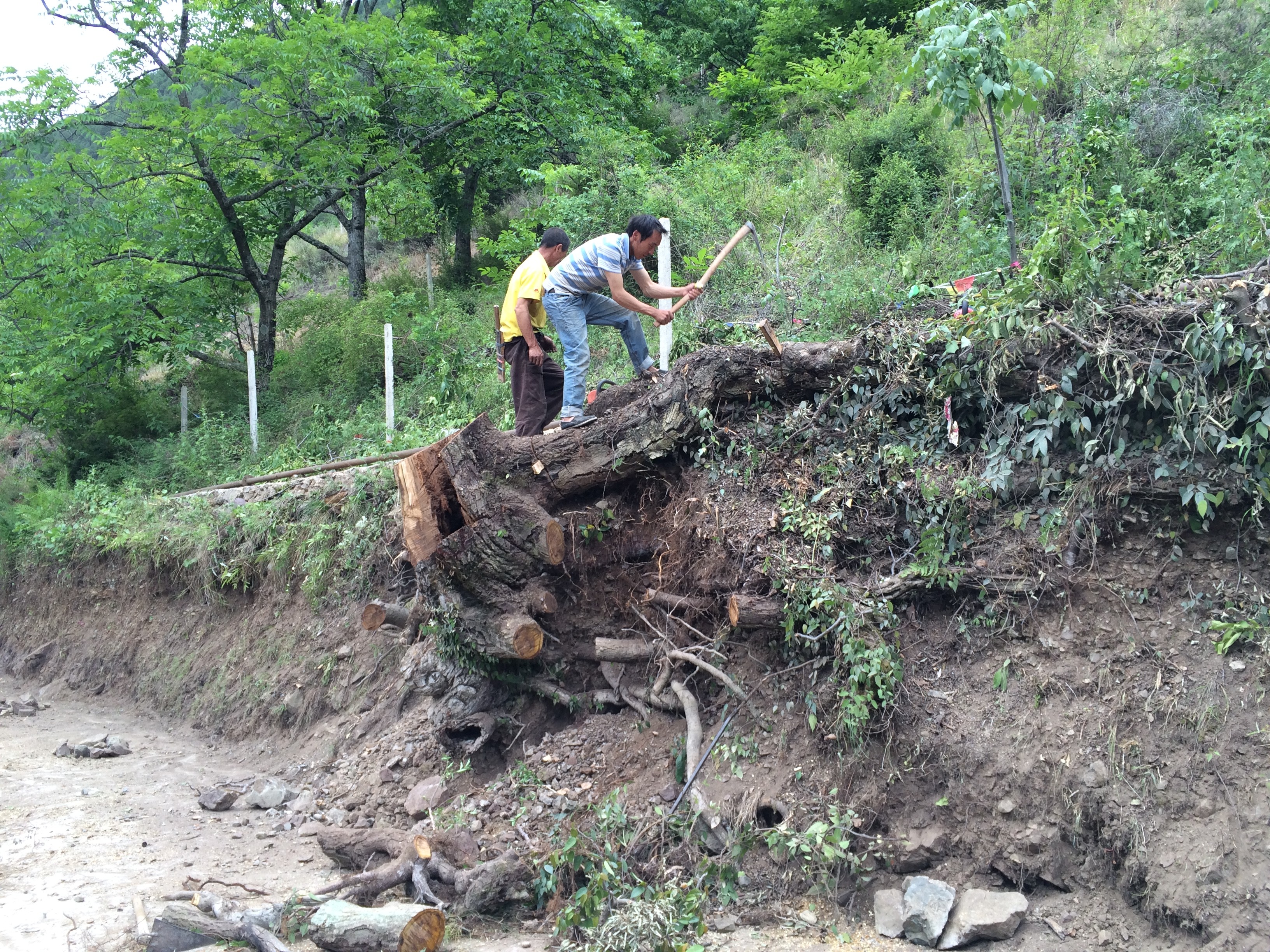
The day I walked through Cizhong was the last day for the giant walnut trees that lined Cizhong’s only road. To widen the road making way for Yanmen’s relocation, the remains of the trees, which each can produce up to 10000 RMB (1500 USD) of walnuts per year for sale at local markets, were stacked into wrecked piles of limbs and logs. Villagers received 300-10000 RMB in compensation per tree, at most enough to cover one year’s harvest.

The wine industry, as well as walnuts, has suffered as a result of the relocation. “They cut down an entire row of my grapes,” says a villager who also lost walnut trees to the road’s expansion.  “We were only compensated 40 RMB for a healthy vine and 30 RMB for saplings.  One vine produces 40 RMB of grapes per year, and I have no new land to plant on.  They took 100 of my vines.”

Road widening brings down scores of Cizhong’s walnut trees.

Road widening brings down scores of Cizhong’s walnut trees.

No equity, nowhere to turn

Land compensation is an issue of major contention in Cizhong.  More than half of Cizhong’s agriculturally productive land is being claimed for redistribution to the incoming residents of Yanmen and originally villagers were offered 30,000 RMB per mu of land (1 acre equals 6 mu) lost to Yanmen’s relocation.  Currently the local government is offering 100,000 RMB per mu, but Cizhong’s villagers continue to hold out.

“The villagers who moved to the city long ago and no longer live here agreed to 100,000 RMB per mu.  It’s easy for them because they have other jobs and other income, but to us, the taking of our land is taking away our only source of income,” says a villager surnamed Wang. Some villagers will lose all of their productive land. Stall tactics make sense since the local government will take 30% of the compensation and only dole out the agreed upon compensation in monthly installments over 15 years.  At the current offer, with only 3000 RMB per mu in compensation per month, even the most business savvy individuals will not be able to survive.  “We will wait,” says Wang with unsteady confidence.

Yanmen’s residents will rebuild on Cizhong’s carefully cultivated rice paddies

Yanmen’s residents will rebuild on Cizhong’s carefully cultivated rice paddies

I inquired about legal recourse.  “The local mayor only listens to money.  He’s not on our side,” continues Wang.  “I tried to file a petition in Deqin, the county seat, but the official there said the only way he’d review our petition was if the entire village showed up. That’s impossible. We don’t know who to turn to.”

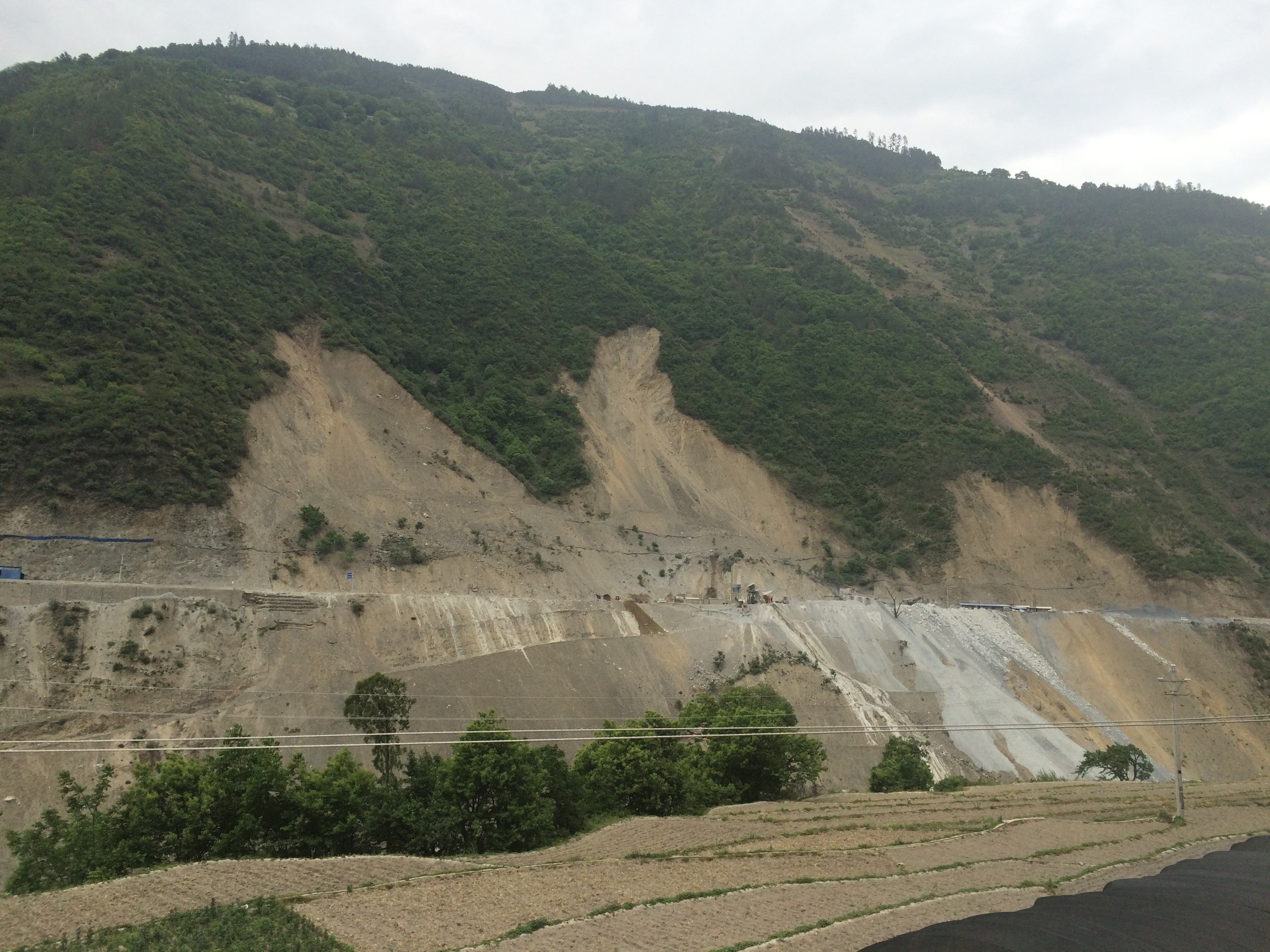
Two hundred meters from the village on the opposite bank of the Mekong, new road construction and a tunneling project carries on day and night. Like the old bridge, the current road to Cizhong will be flooded by the dam’s reservoir. Noise from stone crushing machinery and cement processers pervades the valley.  Last year a landslide created by the road project forced the river to change course and washed away three mu of Wang’s riverside agricultural land. To date he has received no compensation.  Wang claims landslides opposite the village have resulted in the deaths of more than fifty construction workers. He points to cracks in the plaster walls of his traditional home built of wood and earth.  “My house shakes all day long from the construction.”

Highway construction opposite Cizhong has led to landslides and more than 50 deaths.

Highway construction opposite Cizhong has led to landslides and more than 50 deaths.

“Ten years ago we had everything we needed and now life is only getting worse,” continues Wang. Electricity generated by the Wunonglong dam will not be distributed to Cizhong.  In a prelude to Cizhong’s current worries, a small-scale hydropower project adjacent to the village was constructed a few years ago. It sends no power to the village, and to make matters worse, the small scale project cut off access to a local stream and to pasture lands beyond it.  “We let our cows out to pasture in the hills but they came back with bloodied legs because they couldn’t cross the land affected by the small hydropower project. Now there’s nowhere for our cows to graze.” When the small scale project was commissioned, developers promised locals 500 units of free electricity – those promises were never fulfilled.  Not a single Cizhong villager was employed in the construction of the small scale power station, and the price of electricity has been on a steady rise in the village.

Squeezed by national development needs

When Chinese dam developers conduct feasibility studies and first meet with locals affected by projects, they fervently sing praises of hydropower, boasting of how the dam will deliver local communities out of poverty and provide new income sources.  Reality tells a different story as infrastructure development projects in southwest China nearly always fail to provide net benefits to those who live closest to them.  In the case of China’s hydropower development on the Mekong, most power is sent to cities on or near China’s eastern coast. And as China doubles down on its commitments to reducing carbon output, the investment in hydropower projects, particularly in the under-developed southwest is amplified.

In Cizhong as in many other parts of upland southwest China, the Chinese government’s “core interests” of energy dependence and carbon reduction combine forces to turn land held by indigenous ethnic peoples  into a marketable commodity. Individual livelihoods, the social cohesion provided by generational practices and reliance on the land, and local traditions are consistently marginalized.

A few years ago at a village meeting, a former Cizhong mayor berated the villagers shouting “This land, this water, these mountains, they are not yours!  Stop acting like these are yours!  This is the state’s land, and these are the state’s resources.”

From a legal perspective, the Chinese state owns the land and everything above and below it, but villagers who are responsible for the productive economic activities that happen on that land are legally guaranteed compensation at fair market value for land grabbed by developers or involved in relocation efforts. Yet on China’s periphery, even the commoditization process fails. The marginalized nature of Cizhong and distance from the state’s judicial apparatus prevents fair compensation. Further, the law lacks consideration for values attached to various ways upland ethnic peoples use the land.

The Chinese state apparatus sees compensation to and relocation of rural peoples affected by development through standards applied to lowland agriculture, where patches of land are treated as commodities producing an accountable thus taxable yield on an annual basis. In upland China as in parts of Southeast Asia, land use patterns are less standardized and less predictable. Villagers there use mountain slopes as common pasture land for grazing animals, the forests as areas for collecting consumable and marketable products such as the matsutake mushroom and caterpillar fungus, or as in Cizhong’s case, walnuts produced by trees lining its roads and fields. The value of community-building functions created by these shared land use practices often is greater than the cumulative economic value derived from the land.

Sunday mass in Cizhong's Catholic church.

Sunday mass in Cizhong’s Catholic church.

“We are worried about village harmony,” Wang continues, discussing how the daily routines of Cizhong’s Catholics are still deeply entwined with Tibetan Buddhist culture.  “It’s common to see Buddhist monks present to give blessings at Catholic weddings and Christmas and Easter. We’ve achieved this harmony through decades of exchange with our Buddhist neighbors.”  However, all of Yanmen’s residents are believers in Tibetan Buddhism and unfamiliar with Catholic culture. Wang is worried that despite common ethnic heritage, the influx of Buddhists will upset community harmony and social interaction.  He labels Yanmen’s residents as overly superstitious and tells stories of how they are caught up in a spiteful sectoral feud between a local protector deity and the Dalai Lama that divides families in this part of the Tibetan world.

As if matters could not get any worse, when Yanmen village moves in, Cizhong will lose its name. Yanmen is one rung higher in China’s administrative ranking of localities, providing further risk to the interdependent cottage tourism and wine industries that have bet their futures on Cizhong’s name and unique history. The name change coupled with the inundation of Tibetan Buddhist villagers from Yanmen will dilute the uniqueness of Cizhong’s past and have a particular impact on Cizhong’s tourism industry.  With less land available for agricultural production per household, villager’s annual grape yields will decrease having an impact on income.  Villagers might choose to switch to higher value crops, but options for diversification are few in the canyonlands of the Upper Mekong. Alternatively villagers will be pressured to intensify the use of fertilizers to increase grape yields, pushing limits on sustainability and subjecting the local ecology to the effects of dangerous chemicals.

Spring grapes in Cizhong

Spring grapes in Cizhong

With no avenue for legal recourse and no one coming to aid the villagers, Cizhong’s days are numbered. The demoralizing effects of the Wunonglong dam are obvious and with nowhere to turn to for assistance or relief, Cizhong’s villagers can only passively wait to absorb the next shockwave. Censorship and the tightening of restrictions on NGOs under Xi Jinping’s government discourages civil society groups from intervening in cases like Cizhong’s making this unfortunate village just one of many caught up in the inevitable leviathan of energy infrastructure development in southwest China.

3 Comments

Filed under Agriculture, China, Current Events, Energy, Food, SLIDER, Sustainability and Resource Management

Yunnan’s Dulong minority isolated no more

9512

Recently, the Ethnic Dulong Survey Team conducted a week of anthropological observation and interview research based around the remote village of Dizhengdang (迪政当村). Under the leadership of Professor Gao Zhiying (高志英), an expert on ethnic Dulong culture and society, the 21 team members spent three days heading from Kunming to one of Yunnan’s most remote river valleys.

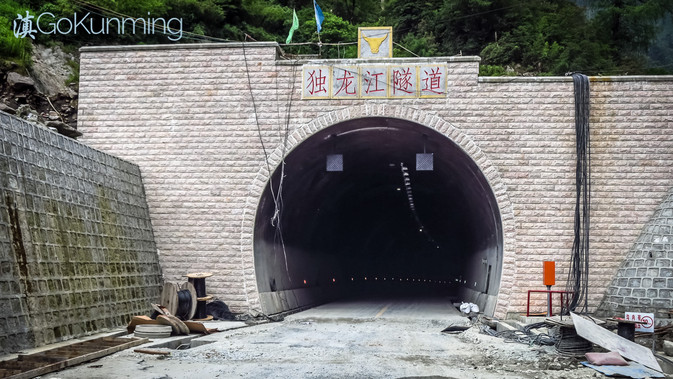
The survey team from Yunnan University found state-funded housing and road projects are transforming the culture of the Dulong people (独龙族), who have for centuries inhabited theDulong River area largely undisturbed. Now, with the opening of a tunnel and road in 2014, their traditional way of life has been changed and sometimes disrupted by a permanent link to the outside world.

9517

A bit of background

The town of Kongdang (孔当) sits on a plot of flat land by the Dulong River, and is also a stop on the Dulong River Road, which begins in Gongshan (贡山县). Dizhengdang is 42 kilometers further north of Kongdang and currently inhabited by 592 villagers comprising 158 households.

The narrow Dulong river valley is formed by an upstream tributary of the Irrawaddy River, which runs primarily through Yunnan before reaching Myanmar. Its course cuts across the Gaoligong Mountain Nature Reserve. Seventy percent of the entire Dulong population — roughly 4,000 people — call this area home. A long history of isolation and poverty has for decades made the Dulong targets of socio-economic aid and government-funded ‘reforms’.

9513

The first of these began in 1964, with the establishment of the 65-kilometer People and Horse Track (人马驿道). This footpath was built largely by the People’s Liberation Army and opened a new avenue for the supply of everyday goods to inhabitants of the Dulong valley. The seven-day hike to Gongshan was cut to four, making the transport of commodities in both directions less cumbersome. A state-operated mule caravan later shuttled vital supplies such as grain and clothing back and forth over the mountains as well, ending the need for military parachute drops of supplies that preceded the path. In 1999, a 96-kilometer road from Gongshan to the Dulong River saw its first traffic, officially ‘opening up the last minority area in China‘.

Fifteen years later, a seven-kilometer tunnel opened along the Dulong River Road, reducing travel times further and making villages once unreachable during the winter months accessible year-round. Other branch roads are planned or under construction to even more distant hamlets. These include Dibuli (迪布里), Nandai (南代), and Xiongdang (雄当) near the Tibetan border — which are still only accessible by dirt paths, tiny suspension bridges and Yunnan’squickly disappearing ziplines.

9516

Anthropological observations

Traditionally, the Dulong practiced subsistence slash-and-burn agriculture while cultivating corn, millet, buckwheat, taro and several varieties of beans. However, the Chinese government has, since 2003, subsidized many villages with cash and handouts of rice in efforts to conserve forested hillsides. This has had multiple and often contradictory consequences. In addition to hunting and fishing, the joint cultivation of traditional agriculture is a core element of Dulong culture, relating not just to native ecological knowledge, but also to religion and social organization.

Thus, the implementation of grain and cash handouts has increased the Dulong people’s dependency on state subsidies, decreased overall agro-biodiversity, and threatened to make endemic bio-cultural knowledge a thing of the past. The extra time saved from less farm work also leaves room for some villagers to seek out timber and herbs in the mountains, which, while increasing incomes, also results in unintended natural resource depletion and a new form of deforestation.

9510

Between 2010 and 2014, the provincial government invested a further 1.3 billion yuan (US$203 million) in “improved housing, infrastructure, social development and environmental protection”. This included the building of several modern housing clusters not necessarily located near where their proposed inhabitants traditionally call home.

For example, the research team from Yunnan University observed in Dizhengdang that each household has its own house built by the state. However, the choice of the new village site only took into consideration road accessibility. The new compounds are convenient for villagers living nearby but for those living scattered in the mountains beyond road networks, a move to a new home without arable lands is problematic.

9511

Among the 40 households in the northernmost hamlets of Xianghong and Nandai, not one them have moved to the new compounds in Xiongdang and Dizhengdang. When asked why they had not taken advantage of government housing, many replied “We don’t have farmland nearby the new villages, and the elderly also prefer to stay in the places where they grew up”. All villagers interviewed expressed satisfaction and gratitude for government subsidy policies, but considering the high cost of daily supplies transported to this remote valley, most Dulong people still have to work very hard in the fields to lead modest lives.

Another major factor soon to affect Dulong culture is the expected inundation of tourists hungry for the opportunity to see an ethnicity most famous for tattooing the faces of its women. While this practice is no longer common, many of the older female residents do still bear the marks of this tradition.

During the researchers’ one-week canvas of the area, the fledgling tourist industry was apparent, with visitors from Kunming and Shenzhen being the most prevalent. Due to the policies listed above — as well as the opening of a permanent road — the Dulong people are undergoing radical changes to their society and culture. How they adjust to the rapid encroachment of the outside world remains an open question.

9515

This article written by Sun Fei was first published on 8/25 here on the GoKunming website. 

Leave a Comment

Filed under Agriculture, China, Culture, Current Events, Economic development, ethnic policy, SLIDER, Yunnan Province

Alpaca for sale in Kunming: Financial stunt or subtle protest?

9455

Nanping Square is a bustling retail area in the heart of Kunming known for its upscale shopping, luxury entertainment and, as of recently, an alpaca. On the afternoon of July 28, a man surnamed Fang paraded his woolly pet — a small relative of the llama — around the busy commercial plaza. The bewildered animal wore a sign hung around its neck stating “Lost a fortune in the stock market, mythical creature for sale”.

Large crowds gathered around the man, who declared he was selling his beloved companion for 100,000 yuan in response to losing his shirt during the stock market’s recent fluctuations. Fang explained he originally bought the alpaca two years ago and imported it from New Zealand — an endeavor costing him the same amount he now hopes to recoup from selling the animal. He admitted his situation was regrettable, saying because he “raised the alpaca from infancy, we now regard him as part of the family.”

Seeing the prized pet go will not be easy, Fang admitted, but after receiving his daughter’s first college tuition bill, he believes he has no other choice. The hapless investor told bystanders he had already mortgaged his house and car, but it was not enough. The alpaca, he explained, is his last major asset. Although a cherished family-member, Fang confessed that the 56 yuan needed daily to properly feed the growing animal has also left an increasingly large hole in his wallet.

Despite the hefty selling price, the hopeful Fang argued that alpacas make for loyal and well-behaved pets. Because of its docile nature, Fang’s alpaca was the center of attention for both curious children and their confused parents. One excited onlooker told reporters “My kids have always wanted an alpaca. If it’s the right price, we may even take it home tonight.” However, after consulting with Fang, he sadly confessed that “the asking price is a bit too high for just a pet.” Later in the afternoon, police politely escorted Fang and his companion out of the square. No buyer was found.

Fang first moved to Kunming ten years ago from Shaanxi province. After amassing a small fortune that included investments in stocks, Fang experienced firsthand the brunt of this summer’s economic upheavals. In Yunnan, this has included the suspension of trading on the world’s largest rare metal brokerage, the Kunming Fanya Non-ferrous Metal Exchange. Investors, unable to sell futures options worth billions, threatened legal action and protested in the street.

Many Chinese netizens also see Fang’s recent alpaca stunt as a similar, if more subtle, form of protest. His use of the term ‘mythical creature’ is thought by many to be an allusion to a list of imaginary beasts posted six years ago in an online Chinese encyclopedia. The list included the now-infamous ‘grass mud horse’ (草泥马), an invented term for alpaca which, when pronounced with different tones, is a caustic epithet involving mothers, and has since become a way to express frustration with censorship.

While Fang’s intentions to raise capital by selling his beloved alpaca may be genuine, the manner in which he has done it, for many observers, represents a form of protest against recent government interventions in the economy, albeit subtly and in a quintessentially Chinese manner.

9456

 This article written by Richard Diehl Martinez was originally posted here on the Gokunming.com website.

Leave a Comment

Filed under China, Current Events, SLIDER, Yunnan Province

Shangri-la Highland, China’s newest micro-brewery

On June 20, 2015, a new face entered, or rather re-entered, the growing craft beer scene in Yunnan. The Shangri-la Highland Craft Brewery, founded and chaired by Songtsen Gyalzur (known as Sonny), officially opened for business. Though hailing from similarly mountainous Switzerland, Sonny, a Tibetan, has deep roots in Shangri-la, from where his parents emigrated.

The impetus for Shangri-la Beer began in 2009, when he first traveled to his family’s homeland in Yunnan and visited an orphanage run by his mother. Coming from a real estate background back in Switzerland, Sonny opened a restaurant to give back to the local community. As part of his mission, he worked to employ and train former orphanage residents. With business booming, customers soon began asking him if any beers were made locally in Shangri-la. That is when Sony decided to open a brewery that would use local ingredients.

After some research, Sonny learned that most Chinese beers, such as Dali Beer, are made using larger quantities of rice. Collaborating with a Swiss brew master, he instead developed beers using highland barley grown on farms near the city. They then opened and developed a small brewery, which sold four bottled beers — mostly in small quantities — to local restaurants in the old town.

These beers, which are now produced at a larger facility, include Tibetan Lager, Tibetan Pale Ale, Black Yak — similar to a porter with some hints of coffee — and Supernova, which is a strong flavorful ale with hints of licorice. The beers were, and still are, all brewed using a combination of naked highland barley and imported Belgian malts. Seasonal microbrews are also planned for the future.

Following the initial success of Sonny’s small and unofficial brewery, the local government approached him, suggesting he open a much larger, officially licensed operation with their support. Officials believed this would be a good way to help local farmers sell their barley. Construction on the new brewery facility began in March 2014, with its official opening ceremony taking place in June.

It was, for Shangri-la, quite a spectacular event, attended by notable dignitaries, both local and foreign. Large scale festivities were held, including traditional Tibetan dances. There was, of course, free beer for all. Sonny also introduced the crowd to the brewery itself and explained his philosophy of brewing good beer – at one point comparing a good beer to a beautiful Tibetan woman. The opening itself was paired with two other notable events in Shangri-la over the weekend, the annual horse racing festival, and the celebration of Shangri-la’s establishment as an official city.

To capitalize on the two-day event, Sonny and his company also worked to formally establish a sister-city relationship with the skiing town of Arosa back in Switzerland. As such, the opening celebration for the new brewery included speeches of recognition from both the Swiss ambassador to China and the mayor of Shangri-la. City and federal governments on both sides were very supportive of the Swiss-Sino relationship, and used the brewery as a vehicle to support it. Fortunately, and following much effort, bureaucrats in Beijing also came through to encourage the idea.

Sonny’s Tibetan beers are unique, a fact his brew master attributes to the alpine water used in the beer-making process. For Shangri-la Beer, brewing is not just so much about the hops which have become so popular in American microbrews. Sonny explains that, unlike hops-based beer, his are more focused on malts — for both flavor and for the utilization and development of local Tibetan yeasts and highland barley. The beer also has no additives or stabilizers, as part of an all-organic mission statement.

During our interview, Sonny explained that he feels the beer is truly Tibetan. It is made by native people with local raw materials, resulting in brews typifying the social custom of drinking barley chhaang — a strong Tibetan alcoholic drink often made from barley.

With its new brewery and bottling factory, Shangri-la Beer has moved beyond the scale of a microbrewery, but Sonny maintains the company is committed to maintaining a quality and unique product. He explains that to make a micro-style beer that can be legally bottled is very difficult due to the required production size. Obtaining an official health and bottling license from Beijing took a huge amount of effort. The minimum production capacity required for such a license is 18,000 bottles per hour. Yet even at this quantity, Shangri-la Beer remains something of a mystery to the wider world. In the very near future, however, Sonny’s brew will arrive in Kunming.

This post originally appeared on GoKunming, and appears here with full permission from the author.

Leave a Comment

Filed under China, Culture, Current Events, SLIDER, Yunnan Province

Trial of Chinese loggers in Myanmar raises questions about bilateral relations

burmese logging

Chinese demand for prized woods like teak has led to an illegal logging epidemic in eastern Myanmar.

In Myanmar, the trial of over 150 Chinese workers has sparked yet another diplomatic row and has raised questions about the stability of the Sino-Burmese relationship.

Last week Wednesday, a local court in Myanmar sentenced 153 Chinese nationals to life in prison for illegal logging. In addition, another two Chinese minors were sentenced to 10 years imprisonment for the same offense.

The sentences were handed down in the Myitkyina district court, in northern Myanmar’s Kachin state. The 155 Chinese nationals, most from neighboring Yunnan province, were apprehended in January of this year by members of the Myanmar army, along with a number of Burmese citizens. At the time of arrest, the loggers were found with 436 logging trucks, along with drugs and around 12000 Chinese Yuan (around 2000 USD) in currency, according to a report from Phoenix News.

“We tried to make the sentences as fair as possible, but we had to consider the environmental point of view,” district deputy magistrate Myint Swe told Radio Free Asia’s Myanmar Service.

“If you look at the number of vehicles, and machinery and the equipment [they were arrested with], you can imagine the amount of environmental damage they’ve done.”

The criminals were convicted  under a 1963 law carrying a sentence of 10 years to life imprisonment for abusing or stealing public property. However,  life sentences are commonly only served for 20 years under Myanmar’s legal system, according to the Associated Press.

Searching for an explanation

The trial marks a new low in Sino-Burmese relations. Since the suspension of the Chinese-funded Myitsone hydropower project in 2011, the two neighbors’ relations have steadily deteriorated. The relationship was further strained in March when fighting between the Myanmar Army and the Myanmar National Democratic Alliance Army (MNDAA), a rebel group based in Myanmar’s Kokang Special Region, spilled over the border and killed five Chinese civilians.

The life sentences in this case could simply be the result of a local magistrate’s decision, however the recent downturn in bilateral relations has led some to wonder if there are ulterior motives behind the verdicts given to the loggers. One explanation is that the sentencing was given in response to Beijing hosting  Nobel Peace Prize laureate Daw Aung San Suu Kyi in June. Despite the Burmese opposition leader speaking Chinese President Xi Jinping during a meeting of political parties (Daw Suu heads the National League for Democracy and Xi is the Chinese Communist Party leader), the significance of the visit was not lost on Naypidaw and the government might have taken offense at Beijing’s meeting with the opposition leader. However, Aung San Suu Kyi has met with world leaders before, including US President Barack Obama and Indian PM Nahendra Modi, and neither visit provoked such a controversial response from Naypidaw. It is unlikely that Daw Suu’s meeting with Xi is an exception.

Another possible explanation for the harsh sentences is that the Myanmar government wants some sort of insurance against aggressive actions from their neighbor. If the current trend in Sino-Burmese relations is to continue, Myanmar may be looking for some sort of bargaining chip in any future interactions with China. One can imagine that a further escalation of the ethnic conflict along the China-Myanmar border prompts the Chinese to send its military into Myanmar. The Burmese could use the release of the Chinese loggers as an incentive for Beijing to withdraw its troops. While Sino-Burmese relations have indeed reached a nadir in 2015, the Burmese would have to have an extremely cynical view of the relationship to make so shrewd a move.

A third view of the trial invokes a discussion of the so-called “Dream of the Golden Land,” one of the popular frameworks of the nation of Myanmar. Like China’s national humiliation discourse or US President Ronald Reagan’s “shining city upon a hill,” the “Dream of the Golden Land” is the Burmese nation’s story about itself, according to Yale University’s Josh Gordon. In the narrative, Myanmar is a land endowed with abundant natural resources, highly desired by foreigners. One has only to look at the colonial period for evidence of this. It is then the duty of the majority ethnic Bamar to protect their “Golden Land” from these covetous outsiders and since independence from the British in 1948 this has been done by expelling Chinese and Indian immigrants from the country in the 1960’s, remaining non-aligned through the Cold War and fighting off a host of ethnic insurgencies for almost six decades. The military junta’s attacks against Daw Suu as a tool of the West, the violent campaign against Rohingya Muslims and the results of this trial could also be interpreted using this narrative. In this view, by sentencing 153 Chinese loggers to life in prison, Myanmar has once again protected itself from the thieving hands of outsiders and is making an example of the offenders to avoid similar incidents in the future.

There are also sovereignty issues at stake in the trial. Kachin state has long been contested by ethnic armed groups, namely the Kachin Independence Army (KIA). The KIA has been known to issue permits for resource extraction projects, including logging, in the areas it controls, despite the Myanmar government’s protests. This appears to be the case here.

According to a report from Phoenix News, the workers in question were found with logging permits issued by the KIA. Moreover, the Chinese workers arrested in this case claimed they were unaware that they were breaking the law and believed that their permits were valid.

As parts of Kachin and Shan states have switched hands between rebel groups and central government control over the past decades, Chinese and Thai businessmen have taken advantage by signing shady  logging and mining contracts with insurgent armies and local Myanmar army commanders. In this case, it appears that Myanmar’s long-running civil war may have moved from the battlefield to the court room. By prosecuting Chinese workers for logging with illegal permits issued by the KIA, the Myanmar government is sending a signal that it, not the KIA is the final authority on who gets to extract resources in the country. It is a significant move, especially considering the ongoing ceasefire negotiations between Naypidaw and a number of ethnic armed groups.

“Highly concerned with the verdict”

News of the verdicts last Wednesday provoked protests from China’s Ministry of Foreign Affairs. Chinese Foreign Ministry spokesperson Lu Kang said that Beijing is “highly concerned” with the sentences and urged the Burmese to consider Chinese concerns and “properly” handle the case, according to a report from the state-run Xinhua News Agency.

On Thursday, Xinhua published a commentary on the matter, condemning the sentences and calling for the loggers to be treated in a “reasonable and sensible way.” The piece noted that China “respects laws and customs of other countries,” but also called the mass sentencing “abnormal,” questioning the impartiality of the verdict.

While the Chinese government has been vocal in its displeasure with the sentencing, it has not yet gone to extraordinary lengths to secure the release of its citizens. Following the announcement of the verdict, some analysts wondered whether Beijing would involve itself in the legal process, a move which could challenge China’s existing foreign policy principles. Since its founding, non-interference in other countries’ domestic affairs has been a pillar of the PRC’s foreign policy. Intervening  strongly on the Chinese loggers’ behalf could trigger an evolution in China’s non-interference and would mark an important transition in the country’s foreign policy.

Until now, however, it appears that China will not take such extreme measures to see its citizens freed. Officials from China’s Foreign Ministry were in attendance for the reading of the verdict on Wednesday but there was no evidence of any further involvement.

According to a lawyer familiar with the case, the loggers can file an appeal with the Kachin state judiciary and then to the Supreme Court in Myanmar’s capital, Naypidaw.

3 Comments

Filed under China, Foreign policy, Myanmar/Burma, Regional Relations, SLIDER

World’s largest solar maker invests in Yunnan

solar

Solar power is shining a renewed spotlight on Yunnan. Last week, Trina Solar announced an agreement with Yunnan Electric Power Design Institute to supply solar cells capable of producing 51 megawatts of electricity. These panels will be the first installment of a larger plan to populate some tea-growing areas in Xishuangbanna with photovoltaic generators.

The proposed solar farm will eventually reach a capacity of 100 megawatts (MW), enough to power roughly 36,000 homes annually. Despite its tremendous size, all of the electricity has been reserved exclusively for large tea plantations within the prefecture. The power will be utilized to run well-water pumps and irrigation systems already in place within the farms.

The Yunnan Electric Power Design Institute (YEPDI), according to an industry press release, will supply “engineering, procurement and construction services for the project”. Representatives from both companies expressed hope the collaboration will revolutionize renewable energy projects in the region. Chang Jichun, deputy manger of YEDPI, congratulated Trina Solar as “an industry leader with a vision to build a greener world…[building] a pioneer project in China to put solar power to work on the tea plantations.” As a result of the endeavor, Chang continued, Yunnan’s “tea plantations can be more efficient with increas[ed] self-reliance and less pollution.”

In the first stage of the multi-pronged project, Trina Solar will deliver approximately 43,000 TSM-255 modules and 154,000 TSM-260 versions. Extremely durable and designed to withstand exposure to pesticides and herbicides, the glass panels represent only half of the solar farm’s eventual size. With each panel measuring one meter by 1.65 meters, the 190,000 panels eventually covering the farm will take up an area of 660,000 square meters.

Put in perspective, that corresponds to 120 American football fields worth of solar modules placed side-by-side — a sea of glittering black. Each TSM-260 panel comes with a 25-year performance guarantee. Tea farmers in the area are thus assured a long-term source of renewable electricity, with each panel replaceable and upgradeable. Already underway, shipments and installation are expected to be completed by the third quarter of 2015.

Trina Solar has proved itself the most lucrative and successful businesses of its kind, often promising shareholders five percent returns on investment. Founded in 1997, Trina Solar today operates mostly in Africa, China and North America and explosive demand for solar energy has allowed the company to grow exponentially since its founding. Last year, the company sold solar panels able to generate 3.66 gigawatts of electricity. With such success, Trina Solar may well push further into the Yunnan market as the BBC reports Beijing has pledged to introduce programs to significantly expand the nation’s solar and wind power industries.

Yunnan province is already home to some of the largest photovoltaic power stations in Asia. Just 70 kilometers southeast of Kunming on the outskirts of the Stone Forest, a 166 MW solar farmis expected to complete construction this year. Once fully underway, the project will generate 188 million kilowatts of energy per hour, eliminating 175,000 tons of carbon dioxide emissions each year. The 9.1 billion yuan (US$1.45billion) project is just one of many reasons Kunming carries the unofficial title of China’s ‘Solar City‘.

Outside of Yunnan, massive endeavors throughout China are underway to reinforce the importance of wind and solar energy while tackling the country’s crippling pollution issues. Although often overlooked, China already leads the world in terms of renewable electricity production, currently spending more than US$80 billion annually on enhancing its green energy sector — funding which has facilitated a 100-fold increase in the country’s use of solar cells since 2005.

This article written by Richard Diehl Martinez, was originally published here on the Gokunming.com website.

Leave a Comment

Filed under China, Current Events, Economic development, Energy, Environment and sustainability, Sustainability and Resource Management, Yunnan Province

Daniel Russel: Remarks at the 5th Annual South China Sea Conference

russel
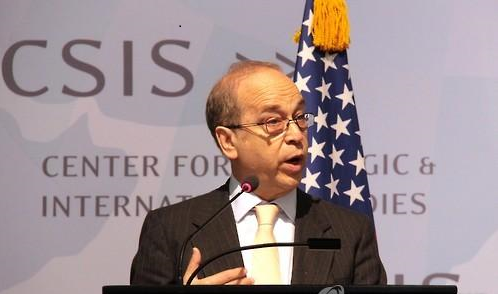
On July 21, 2015 at the 5th Annual South China Sea Conference at the Center for Strategic and International Studies (CSIS), Daniel R. Russel, Assistant Secretary, Bureau of East Asian and Pacific Affairs for the US State Department delivered a keynote speech clearly outlining the US position on China’s recent land reclamation action in the South China Sea and its implications for US-China relations.  Given the timeliness and relevance of this speech, we’ve posted it in its entirety below.  
Good afternoon. Thank you, Murray, for the kind introduction. It’s always a pleasure to be back at CSIS.

Let me start by laying out the essential context.

The United States has always had interests in Asia. These interests have only grown stronger as our economies have become more interconnected, and as our people have grown closer through travel and the Internet.

For the last seven decades, we’ve worked with allies and partners in the region to build shared prosperity and shared security. In the last six-and-a-half years, in particular, we’ve invested in building cooperative relations with every country in the region. This is the rebalance.

There are many types of investment the world, and Asia, needs in order to grow—investment in people, first and foremost; investment in business; in physical infrastructure, and just as important; investment in “cooperative capital” – the international law and order infrastructure that facilitates the interactions between countries, that advances regional economic integration, and helps states peacefully manage and settle disputes.

The U.S. makes balanced investments in all of these areas.

The last one, the international rules-based system, has been the ‘essential but underappreciated underpinning’ of global growth over the last 70 years. That’s especially true in Asia, where many countries have grown – and continue to grow – their economies through international trade, especially trade with the U.S.

Asia’s nations have achieved so much in recent decades—reducing poverty, raising living standards, and creating opportunities for their people. They’ve done it through hard work, cooperation with each other, partnership with the U.S., and by jointly developing and operating within a rules-based system.

And we are helping them to do even more:

We’re taking broad-based, sustainable economic growth to a new level with the Trans-Pacific Partnership.

The TPP embraces a future that reaches beyond trade and investment to include high standards for environmental protection, for labor rights.

TPP’s provisions will support a thriving, growing, entrepreneurial middle class that is able to connect with the world and do business through a free, open Internet.

We’re taking the security architecture that underpins this brighter future to a new level by investing in regional institutions like the East Asia Summit and the Association of Southeast Asian Nations (ASEAN), in addition to our longstanding work with global ones like the U.N.

These institutions uphold norms and tackle tough challenges; they can help bring parties together to hash out disagreements, or when bilateral diplomacy doesn’t succeed, help to have those disputes resolved peacefully in a fair, impartial manner.

Standing behind and supporting these institutions is our system of alliances and partnerships.

This network has helped keep the peace in the region since World War II. And through a series of important agreements with key security partners over the last few years, we’ve refreshed them so they’ll last for decades to come.

We’re taking environmental protection to a new level, through our work on ocean preservation, on combatting climate change and its effects, and through programs like the Lower Mekong Initiative that help make economic growth environmentally sustainable.

As we pursue this broad, forward-looking vision for the region, we’ve worked constructively with China—a lot.

We’ve built greater understanding through President Obama’s 20 some-odd meetings with the Chinese President or Premier; and through the Strategic and Economic Dialogue and an alphabet soup of other consultations.

We’ve put a floor under the relationship so it can withstand tensions or even a crisis.

And in the last couple years, all of this work has paid off—we’ve made measurable progress in a range of cooperative efforts: in low-carbon policies; countering piracy at sea; in stemming the Ebola crisis; supporting a better future for Afghanistan; and much more.

But unfortunately, the situation in the South China Sea does not fit this cooperative pattern.

Now, the U.S. is not a claimant. As I’ve said here at CSIS, these maritime and territorial disputes are not intrinsically a US-China issue. The issue is between China and its neighbors and – ultimately – it’s an issue of what kind of power China will become. But for a variety of reasons, the competing claims and problematic behavior in the South China Sea have emerged as a serious area of friction in the U.S.-China relationship.

Let’s take a step back and recall, as I’m sure you discussed this morning, that there is a history of competing assertions of sovereignty and jurisdiction in the South China Sea, and even violent conflicts in 1974 and 1988.

There are no angels here. The occupation of land features in this contested space over the years looked a lot like “squatters’ rights.” But that is something that in 2002 the claimants agreed to stop doing.

In that year, all the claimants (and the ASEAN states) signed a Declaration of Conduct. In it, and on other occasions, they have committed “to exercise self-restraint in the conduct of activities that would complicate or escalate disputes and affect peace and stability including, among others, refraining from … inhabiting the presently uninhabited… features and to handle their differences in a constructive manner”.

In the Declaration of Conduct, they also committed to negotiate a Code of Conduct that would lay out and lock in responsible behavior. But in the ensuing 13 years, work on the Code has stalled, and the Declaration has not been sufficient to prevent confrontations or to help claimants resolve these disputes peacefully.

Recently, the level of concern in the region has escalated as the scale and speed of China’s reclamation work has become public. The Chairman’s statement at the ASEAN leaders’ summit in April was unusually blunt, speaking of “serious concerns” about “land reclamation being undertaken in the South China Sea, which has eroded trust and confidence and may undermine peace, security and stability….”

While China’s statement on June 16 that it would stop reclamation work “soon” was presumably intended to reassure, its effect was in fact alarming since the statement went on to warn that China would construct military facilities on these reclaimed outposts.

So we are pushing the parties to revive the spirit of cooperation embodied in the 2002 Declaration of Conduct.

We see a broad consensus within ASEAN on a path forward to reduce tensions and promote peaceful handling of these disputes. And we support ASEAN’s efforts to expeditiously conclude an effective, rigorous Code of Conduct that builds on the Declaration by translating its cooperative spirit into specific “do’s and don’ts.”

But to make this happen, the parties need to create room for diplomacy.

In the famous words of Rich Armitage’s Dictum Number 1, “when you find yourself in a hole – stop digging.” That is the advice we are giving to all the claimants: lower the temperature and create breathing room by: stopping land reclamation on South China Sea features; stopping construction of new facilities; and stopping militarization of existing facilities.

These are steps the parties could commit to immediately; steps that would cost them nothing; steps that would significantly reduce risks; steps that would open the door to eventual resolution of the disputes.

Secretary Kerry has made this point to Chinese leaders and to the other claimants, and will be meeting with his counterparts early next month in Malaysia at the ASEAN Regional Forum, or ARF, to push for progress on this important priority.

Now, steps to exercise restraint through a moratorium and a Code of Conduct will create diplomatic space and help keep the peace, but they won’t address the question of maritime boundaries or sovereignty over land features.

So what’s the way forward?

When it comes to competing claims, two of the main peaceful paths available to claimants are negotiations and arbitration.

Countries across the region in fact have resolved maritime and territorial disputes peacefully and cooperatively, whether through direct negotiations or through third-party dispute settlement mechanisms.

Just a few examples: Indonesia and the Philippines recently agreed on their maritime boundary;

Malaysia and Singapore used international court and tribunal proceedings to resolve disputes concerning the Singapore Strait; and the International Tribunal for the Law of the Sea delimited the maritime boundary between Bangladesh and Burma.

A common thread runs through the maritime boundary disputes that have been resolved peacefully: the parties asserted maritime claims based on land features, and were prepared to resolve those disputes in accordance with international law.

This is why we’ve consistently called on all claimants to clarify the scope of their claims in the South China Sea, in accordance with international law as reflected in the 1982 Law of the Sea Convention. Doing so would narrow the differences and offer the basis for negotiations and cooperative solutions.

Regrettably, I don’t know anyone in the region who believes that a negotiated settlement between China and other claimants is attainable in the current atmosphere.

And the multiple competing claims in some parts of the South China Sea make negotiations that much more difficult.

And then there is the absolutist political position taken by some claimants who insist that their own claims are “indisputable” and represent territory – however distant from their shores – that was “entrusted to them by ancestors” and who vow never to relinquish “one inch.”

What about arbitration? As this audience knows, there currently is an arbitration case pending under the Law of the Sea Convention between the Philippines and China.

At the heart of the case is the question of the so-called “Nine Dash Line” and whether that has a legal basis under the international law of the sea. It also asks what maritime entitlements, if any, are generated by features that China occupies? In other words, regardless of whose jurisdiction it may fall under, would Mischief Reef, for example, be entitled to a 12 nautical mile territorial sea? A 200nm exclusive economic zone? A continental shelf?

Now, it’s important to note that the Tribunal is not being asked – and is not authorized to rule – on the question of sovereignty over disputed land features. Everyone recognizes that the sovereignty issue is beyond the Tribunal’s jurisdiction. Claimants would need to agree to bring that sort of sovereignty dispute before a court or tribunal, typically the ICJ.

But under the Law of the Sea Convention, the Tribunal is authorized to first determine whether it has jurisdiction under the Convention over any of the Philippines’ claims in the case and, if it does, whether the Philippines’ arguments have merit.

The United States, of course, is not a party to this arbitration and does not take a position on the merits of the case. But when they became parties to the Convention, both the Philippines and China agreed to its compulsory dispute settlement regime.

Under this regime, the decision of the arbitral tribunal is legally binding on the parties to the dispute. It’s a treaty. In keeping with the rule of law, both the Philippines and China are obligated to abide by whatever decision may be rendered in the case, whether they like it or not.

Now China has argued that the tribunal lacks jurisdiction, and the tribunal has specifically considered this issue in recent hearings in The Hague, looking very carefully at a position paper published by China. But if the Tribunal concludes that it in fact has jurisdiction in this case, it will proceed to the merits, including potentially the question of the legality of China’s “Nine-Dash Line.”

Should it then rule that the “Nine-Dash Line” is not consistent with the Law of the Sea Convention, and particularly if the Tribunal ruled that the features cited in the case do not generate EEZ or continental shelf entitlements, the scope of the overlapping maritime claims – and hopefully the points of friction – would be significantly reduced.

But it’s also important to recognize that even in this outcome, important sovereignty and boundary issues would remain unresolved.

This is as good a time as any to acknowledge (as China has often pointed out) that the United States has not acceded to the Law of the Sea Convention, although accession has been supported by every Republican and Democratic administration since the Convention was signed and sent to the Senate in 1994. It is supported by the U.S. military, by industry, environmental groups, and other stakeholders.

For the United States to secure the benefits of accession, the Senate has to provide its advice and consent, as I hope it ultimately will.

But even as we encourage the parties to work for long term solutions, we are obligated to protect U.S. interests. Let me take a moment to examine what some of those interests are:

  • Protecting unimpeded freedom of navigation and overflight and other lawful uses of the sea by all, not just the U.S. Navy;
  • Honoring our alliance and security commitments, and retaining the full confidence of our partners and the region in the United States;
  • Aiding the development of effective regional institutions, including a unified ASEAN;
  • Promoting responsible marine environmental practices;
  • Fostering China’s peaceful rise in a manner that promotes economic growth and regional stability, including through consistency with international law and standards.
  • And more generally, an international order based on compliance with international law and the peaceful of disputes without the threat or use of force.

As a practical matter, in addition to our support for principles such as the rule of law, we are taking steps to help all countries in the region cooperate on maritime issues. For example, we’re investing in the maritime domain awareness capabilities of coastal states in the region.

This allows countries to protect safety at sea and respond to threats such as piracy, marine pollution and illegal trafficking. Maritime awareness also advances transparency, in line with our call to all claimants to be more open and transparent about their capabilities, actions, and intentions at sea.

The U.S. military’s freedom of navigation operations are another element of a global policy to promote compliance with the international law of the sea.

Our goal is to ensure that not only can the U.S. Navy or Air Force exercise their navigational rights and freedoms, but ships and planes from even the smallest countries are also able to enjoy those rights without risk. The principles underlying unimpeded lawful commerce apply to vessels from countries around the globe.

And under international law, all countries—not just the United States—enjoy the rights, freedoms, and lawful uses of the sea that our diplomacy and the U.S. military’s freedom of navigation operations help protect.

For us, it’s not about the rocks and shoals in the South China Sea or the resources in and under it, it’s about rules and it’s about the kind of neighborhood we all want to live in. So we will continue to defend the rules, and encourage others to do so as well. We will also encourage all countries to apply principles of good neighborliness to avoid dangerous confrontations.

Let me close by mentioning that we have a host of cooperative initiatives we’re working on for the upcoming ASEAN Regional Forum meeting, the Asia-Pacific Economic Cooperation forum, and the East Asia Summit—all of which will advance much more quickly and effectively when tensions in the South China Sea are lower.

President Obama and Secretary Kerry have shown that they are not afraid to tackle the biggest challenges facing US foreign policy and the world. And we’re energized, here in the fourth quarter of this administration to do much more in partnership with our Allies, with ASEAN and with China.

For us, for the region, and for China – finding a peaceful, lawful and responsible way forward on the South China Sea is a prerequisite to achieving our longer term goals.

Thank you.

1 Comment

Filed under ASEAN, China, Current Events, Philippines, Regional Relations, SLIDER, South China Seas, Vietnam, water

Kunming to invest in public electric car fleet

9412

The Kunming municipal government is moving toward the acquisition of all-electric cars that will be made publicly available by year’s end. Once delivered, the vehicles would become the centerpiece of a public transportation initiative designed to reduce general traffic congestion and cut down on overall tailpipe emissions in the Spring City.

Kunming deputy mayor Wang Chunyan (王春燕) traveled to Hangzhou on a fact-finding mission concerned with the scheme earlier this week. While there, he met with government counterparts and automotive industry leaders to discuss the city’s electric car-sharing fleet — a first in China when inaugurated in 2013.

Hangzhou officials have been lauded for the implementation of a public car rental system that relies on automation and cars using no gasoline. Wang wants Kunming to emulate this system. Following a meeting with Hangzhou deputy mayor Zhang Zheng (张耕), Wang told reporters he expects the Spring City to make an initial purchase of 2,000 electric cars by December 2015.

At its inception, Hangzhou’s ‘micro-transport’ (微公交) system made available two thousand electric cars built by Zhejiang-based Kandi Technologies, a subsidiary of manufacturer Geely. People who need to rent a car for a few hours or days can present their national identification cards and driver’s licenses, along with valid credit cards, at rental centers resembling outsized vending machines. Once registered, customers choose between two- or four-seat cars, both with top speeds of 80 kilometers per hour and a single charge range of roughly 90 kilometers.

Two years on, the Hangzhou fleet has quadrupled in size to 9,850 vehicles. They rent for between 20 and 25 yuan per hour, a fee that includes insurance. Long-term leases are also available — 9,000 yuan for year-long use of a two-passenger car and 14,400 yuan for a four-passenger version. The cars can be re-powered, or have their batteries replaced, at any rental facility or at an expanding network of quick-charge locations.

Deputy mayor Wang said Kunming would adopt the Hangzhou project and adapt it for implementation in the city. Kandi cars will be utilized, but a pricing scheme has yet to be announced. Kunming urban planners want to alleviate at least some of the traffic jams that stifle commuters on a daily basis. Wang’s proposal also targets the related problem of perpetual parking shortages — which once caused some garage spaces to fetch yearly prices of 180,000 yuan (US$29,000).

Kunming’s frenzy of car buying perhaps reached its zenith in 2010, when 1,000 new cars were being registered in the city each day. Costly infrastructure projects aimed at easing traffic congestion have been largely hit-or-miss. This newest solution of publicly sharing e-vehicles has become quite popular in China’s largest metropolises, as Beijing, Shanghai, Shenzhen, Chengdu and now Kunming have all followed Hangzhou’s lead.

This article written by Patrick Scally was originally published here on the GoKunming.com site on July 16, 2015.

Leave a Comment

Filed under China, Current Events, SLIDER, Sustainability and Resource Management, Yunnan Province

Thailand deports Uyghur refugees to China, despite protests

Refugees on the way to a Thai detention center, March 18, 2014. Image used courtesy of VOA News.

Refugees being transported to a Thai detention center, March 18, 2014. Image used courtesy of VOA News.

After more than a year of waiting, almost 300 ethnic Uyghurs are leaving Thailand. On July 1, a group of 173 Uyghur refugees, mostly women and children, left Thailand for Turkey. A week later, another 109 Uyghurs were deported back to their home country of China. The decision on the fate of these refugees, who have remained in Thai custody since their arrests in March 2014, has sparked criticism from human rights groups and protests from the Turkish public.

These 282 Uyghurs are part of a group of almost 300 people taken into custody by Thai authorities in March 2014. Many were found in a human trafficking camp in Songkhla province. Since then, they have waited in detention centers in Songkhla, Trat and Rayong while an intense diplomatic battle over their fates raged between the governments of China, Turkey and Thailand.

The Uyghurs are a Turkic-speaking, predominantly Muslim people from Xinjiang Uyghur Autonomous Region in China’s northwest. In the last decade, they have left China in increasingly larger numbers, escaping religious persecution and political and economic repression.

On July 1, Seyit Tumturk, vice president of the Munich-based World Uyghur Congress (WUC), confirmed through Radio Free Asia‘s Uyghur language service that the first group of 173 Uyghurs were able to “enter into Turkey safely” after arriving in Istanbul.

“They are mostly women and kids—around 120 kids and about 50 women. Hopefully, the men [still in detention] will be granted this kind of chance in the near future.”

Initial reports of bloodshed

The Uyghur men, however were not given such a chance. On July 8, 109 refugees were forcibly deported to China from Thailand. The group was made up of mostly men, however some women and children were also repatriated.

The World Uyghur Congress first reported that 25 men had been shot dead after resisting their deportation in Bangkok. Thai authorities, however, denied the story.

Thai government deputy spokesman Weerachon Sukhontapatipak told Radio Free Asia in an interview that “there was no such thing as claimed by WUC.” Another, anonymous source in the Thai government confirmed Weerachon’s statement, saying, “It is not true. There was no killing as claimed by the WUC.” He added that video evidence confirming the refugees’ safety could be provided.

In the initial report published on their website, the WUC reported that a first plane of mostly women and children departed without incident. “The second plane, however, was intended to transport around 65 men, but authorities faced some resistance from the men in doing so.”

In the process of subduing the resisters, 25 men were shot and killed, the WUC originally reported. Hours after its publication, however, the paragraph concerning the killings was removed from the report.

Protests and condemnation

The move by Thailand to repatriate the refugees drew intense criticism from Uyghur organizations and human rights groups. The office of the U.N. High Commissioner for Refugees said it was “shocked” by Thailand’s decision and considered the deportation “a flagrant violation of international law.”

Prime Minister Prayuth Chan-ocha, head of Thailand’s military government, seemed unconcerned with issues of international law, claiming that the matter did not concern Thailand.

“I’m asking if we don’t do it this way, then how would we do it?” he said. “Or do you want us to keep them for ages until they have children for three generations?”

Rights groups worry that the deported Uyghurs will face harsh penalties once on Chinese soil. Uyghurs that have been repatriated from Southeast Asian countries in the past have received long jail sentences and even capital punishment for illegally leaving China.

In Beijing, Hua Chunying, spokeswoman for the Ministry of Foreign Affairs confirmed that the Chinese government would pursue legal action against the repatriated Uyghurs.

“China’s relevant departments will bring those who are suspected of committing serious crimes to justice according to law,” she told reporters. “As for those who are not suspected of committing crimes or who commit lesser offences, we will find proper ways to deal with them.”

The episode has also led to protests in Turkey, where many see Uyghurs as their Turkic-speaking “cousins”. On Thursday, both the Thai consulate in Istanbul and the Thai embassy in Ankara were attacked during pro-Uyghur demonstrations. Police in Ankara used tear gas there to disperse protesters.

Earlier in the week, the Chinese consulate was attacked along with  Chinese restaurants in Istanbul. Protesters were angry after reports emerged that local governments in Xinjiang region were prohibiting Uyghur schoolchildren and civil servants from fasting for Ramadan. Similar Ramadan crackdowns have been reported annually for over a decade In response to the protests, the Chinese government issued a travel warning to Turkey for Chinese tourists on  July 8.

A split decision

Despite closer ties between Turkey and China in recent years, the issues surrounding the treatment of Uyghurs in Xinjiang and Turkey’s acceptance of Uyghur refugees have prevented the Sino-Turkish relations from moving forward. This week’s protests certainly marks a low point in the relationship and it will be interesting to see how things develop after this latest deportation episode. It is unlikely that China’s crackdowns nor Turkey’s acceptance of Uyghurs will end anytime soon.

Despite Thai Prime Minister Prayuth’s claims that Thailand was simply a third party actor, its role in the refugees’ deportation to Turkey and repatriation to China was key. How it navigated this tricky diplomatic issue says much about Thailand’s relations with China. Ties between the Southeast Asian state and China have improved in recent years and increased Chinese investment in Thailand’s infrastructure will only make the two countries closer. Therefore, it was never in doubt that Thailand would acquiesce to the PRC’s request to have the Uyghur migrants returned.

However, Thailand, with a proud history of resisting foreign pressures, still wishes to remain independent in the face of a rising China. Its decision to send 173 women and children, likely low-priority targets for China’s internal security forces, to Turkey instead of China is significant. It could be interpreted as a symbol that while China’s clout in the region is growing, it is not yet large enough to wholly influence diplomatic decisions.  Future cases of deportation involving Uyghurs in Southeast Asia will act as a barometer of China’s influence on the foreign affairs ministries in Bangkok, Kuala Lumpur and other regional capitals. This episode may have reached its conclusion, but it is unlikely to be the last as long as Uyghurs continue to look for a better life outside China’s borders.

5 Comments

Filed under China, ethnic policy, Human trafficking, Regional Relations, SLIDER, Thailand