Category Archives: Yunnan Province

In China’s hinterlands, a new life for Myanmar’s Rohingya

President of Myanmar Thein Sein. Photo: Wikemedia Commons

President of Myanmar Thein Sein. Photo: Wikemedia Commons

On February 12, 2015 Myanmar President Thein Sein, prompted by protests led by Buddhist monks in Yangon, reversed a decision made ten days earlier to give voting rights to the country’s Rohingya population. The reversal, while surprising to some, was only the latest in a series of events to befall the Muslim minority who call western Myanmar’s Rakhine state home.

The Rohingya of Myanmar (also known as Burma) have lost more than voting rights in the past. Regarded as one of the world’s most oppressed peoples, the Rohingya are a distinct ethnic group that speak a dialect of Bengali and are thought to be descended from Arab and Persian traders.

Persecuted at Home

Under the military junta that ruled Myanmar for most of the latter half of the 20th century and the current, nominally civilian government, Myanmar’s Rohingya have suffered chronic poverty, food insecurity, harassment and forced labor, among other human rights abuses. Following Burma’s 1982 Citizenship Law, hundreds of thousands of Rohingya were denied citizenship and are still referred to as ‘aliens’ and ‘foreigners’ by government officials. They are neither allowed to travel outside their hometown nor marry without official approval.

Poor relations between the Muslim Rohingya and their neighbors have only made things worse. Tensions between Rakhine state’s Muslim population and the majority Rakhine ethnicity, who are Buddhist, boiled over in 2012, leading to anti-Muslim riots that spread throughout the country. In Rakhine state alone, over 200 people were killed and whole villages were burned to the ground. Conditions have not improved for Myanmar’s Rohingya population since then. The current boat crisis of thousands of Bengali and Rohingya refugees stranded off the coasts of Thailand, Malaysia and Indonesia is a consequence of awful conditions at home.

The Rohingya, however are certainly not the only group struggling in Myanmar. Despite what appears to be a nascent democracy, a civil war between the government and an array of armed ethnic groups along the country’s periphery has flickered continuously since the 1950s. The reasons for the conflicts are many, though issues of ethnic autonomy and control of precious resources like jade and timber loom large.

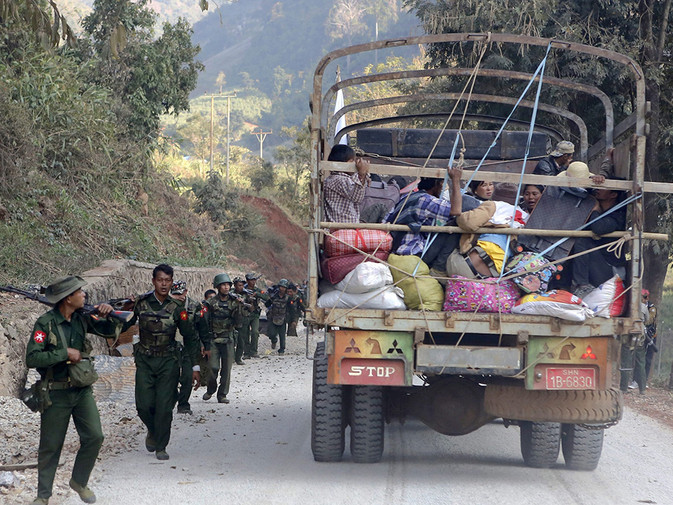
The conflict’s latest iteration began in February 2015 and is still ongoing. A flare up of tensions between the Myanmar Army and Myanmar National Democratic Alliance Army (MNDAA) in Kokang, Shan State, has killed hundreds and forced tens of thousands of civilians to flee across the border into China.

Many Rohingya have also left Burma in the past decades. Tens of thousands of them reside in ill-equipped refugee camps on the Myanmar-Bangladesh border, though others have escaped to new lives abroad. Their final destinations vary, but the majority resides in Saudi Arabia, Malaysia, Thailand and Pakistan. Of these Rohingya living overseas, who may number over one million, most work low-wage jobs in the construction and service industries. There are some, however, that have chosen a different path in a land closer to home.

Abdullah's storefront in Jinghong

Abdullah’s storefront in Jinghong

Eight hundred kilometers east of Rakhine state in Jinghong, China, Abedullah owns a small jewelry shop. It’s three o’clock in the afternoon he hasn’t sold a thing.

Abedullah, like almost one million of his compatriots in Rakhine state, is a Rohingya, but he has not lived there in thirteen years. Instead, he’s settled in Jinghong, the capital of Yunnan Province’s Xishuangbanna Dai Autonomous Prefecture, along with almost 600 other Rohingya. All of them sell jade.

According to Abedullah, who only agreed to give his first name, Rohingya merchants first came to Jinghong almost forty years ago. Following the end of the bloody Bangladesh Independence War in 1973, hundreds of thousands of refugees fled into neighboring Burma. Marginalized by the Burmese and eventually disavowed by the Bangladeshi government, tens of thousands of Rohingya fled overseas. A handful made it to southwest China’s Yunnan province.

Stories of Jinghong’s first Rohingya are hard to find and by all accounts, the number of émigrés remained small until the 1990s. It was then that the Chinese economy began to truly open up to the international market. As trade increased and more Chinese became wealthy, the country’s jewelry consumption level grew as well, skyrocketing over 4000% in a decade.

While all gemstones have grown in popularity in recent decades, none hold the place in Chinese culture that jade does. Regarded as a stone of mystical qualities since antiquity, jade is the king of gemstones in China and it is in Myanmar that the world’s highest quality jade is found.

As a result, jade shops are ubiquitous in dozens of towns along the China-Myanmar border. Jinghong is one of the largest. Straddling the Mekong River, this once sleepy town has grown into a city of six hundred-thousand and now hosts millions of tourists each year. Many of these tourists come looking to buy Burmese jade. As travelers have flocked to Jinghong in greater numbers in recent years, Rohingya merchants with connections to the Burmese jade trade have followed to keep up with demand.

A New Life

One of the recent arrivals is Xiao Fei, a 21 year-old who prefers his new Chinese nickname to his given name. Xiao Fei, like many other Rohingya in Jinghong, came at the behest of his family; his grandfather first arrived in the city almost thirty years ago. After saving enough money for a passport, Xiao Fei was able to leave his home in Yangon and help his grandfather set up the family’s second shop.

Xiao Fei had to save up for his passport because getting such a document is often impossible for many Rohingya in Myanmar. Since they are officially considered to be foreigners by the Burmese government, Rohingya can only obtain passports after paying expensive bribes to the right people. That is why, as Xiao Fei explains, “Only rich Rohingya can make it to China.”

Once in Jinghong, new arrivals find an environment altogether strange and inviting. The forest of newly-built apartment complexes and hotels certainly dwarfs anything found in Rakhine state, however the hundreds of established Rohingya businessmen form a tight community that provides everything from religious services to a lunchtime delivery service of halal Burmese cuisine.

It is the mosque that is the heart of the community, says Waynai, a trader living in Jinghong for six years. The Jinghong Mosque, located not far from the banks of the Mekong was first established decades ago by the city’s existing community of Hui, a distinct ethnic group of more than ten million people that practice Islam and speak Mandarin Chinese.

When the Rohingya began to move to Jinghong in greater numbers in the late 1990s, they became a part of the congregation, eventually joined by a small population of Uighurs from China’s northwest. Together, these three groups of Muslims manage the congregation. Despite disparate geographic and cultural backgrounds, the mosque is thriving with a healthy number of members, daily prayers held in Arabic and discussion groups where participants speak in Standard Mandarin.

The Jinghong Mosque

The Jinghong Mosque

However both Waynai and Abedullah agree more with the mosque’s Uighur members on theological questions. When asked whether or not he had any non-Rohingya friends from the congregation, Abedullah answers, “Yes, but not the Hui. They’re fake … they don’t have Allah in their hearts.” Instead, it is the Uighur community that he feels closer too. “[The Rohingya] are similar to the Uighurs because neither of us are free … we both have to struggle to survive.”

This struggle is why Ba Hlaing, a 31 year-old jade dealer, came to Jinghong eight years ago. At the time, his family lived comfortably in a suburb of Yangon but as he came of age, conditions for young Rohingya grew more difficult. “I would’ve liked to stay with my family, but there wasn’t anything to do, no money to make.”

“It’s because of [the government] that we’re so backwards now,” he says in a whirlwind of English, Mandarin and Jinghong dialect, slapping the table after each word.

Just then a Han Chinese couple enters Ba Hlaing’s shop. He greets them using his best Mandarin, standing, “Welcome to Ba Hlaing’s Jewelry! We have the finest jade from Myanmar! Would you like to look at a bracelet?”

After five minutes of browsing, the wife still has not decided on a piece and the husband, fidgeting, suggests heading back to their hotel. The couple leaves and Ba Hlaing sits down to light a cigarette. “That’s how it goes,” he sighs. Just like Abedullah, business is slow for Ba Hlaing, even during tourism’s high season.

Ba Hlaing believes the drop in jade sales is a consequence of Chinese President Xi Jinping’s much-publicized crackdown on corruption. Once-popular ostentatious displays of wealth, like jade pieces worth tens of thousands of dollars are now frowned upon and officials that might frequent jade shops like Ba Hlaing’s are staying away.

Burmese jadeite

Burmese jadeite. Photo: Wikimedia Commons

The jade, however, keeps flowing from Myanmar. Most of it is mined in a strip of remote jungle in Kachin State, in the country’s northeast.  Conditions in Myanmar’s jade mines are notoriously dangerous and the towns that spring up around them are known as much for their drugs and guns as they are for their jade. However bad mining conditions are though, the money can be worth it for those who can make it. Official figures from Myanmar’s government put jade exports at $1.4 billion between 2011 and 2014. Analysts from Harvard University’s Ash Center disagree, estimating jade sales – both official and off the books – at $8 billion for 2011 alone.

Once the raw jade has been extracted, it is sent to processing centers. The majority are located within Myanmar, in urban centers like Mandalay and Yangon, where the jade is polished and crafted into a final product. The next step is to get it into China, where the market is.

Most traders interviewed for this article admitted that the majority of the jade they sold was actually smuggled into Yunnan. A few well-placed bribes on both sides of the border can get shipments of jade, transported in trucks, into China reliably. Once the jade is in Yunnan, it usually makes its way to Ruili, a major border crossing between China and Myanmar.

According to Ba Hlaing, many Rohingya traders in Jinghong have a contact in Ruili, usually family, that buys the jade. Others, however, are directly connected to processing centers, most often in Yangon. For more valuable pieces, with sale prices upwards of $50,000, many traders will use air transport to ensure their safe arrival. While import taxes must be paid in these cases, the extra cost is often worth the peace of mind.

 A Tough Decision

Peace of mind, however, is getting harder to come by. With a slowdown in business and mounting issues back in Myanmar, many members of Jinghong’s Rohingya community are facing a tough decision whether or not to return home.

Ba Hlaing, for one, is planning on going back to Myanmar. Sales have decreased for the past two years and he fears that a protracted crackdown on corruption in China will keep jade sales low and prevent his shop in Jinghong from making a profit.

Despite the dire situation for the Rohingya in Myanmar, Ba Hlaing is choosing to remain positive. “I think things will get better for us,” he says guardedly. “We have [this year’s parliamentary] election and the world paying attention to us so democracy is a good thing.”

Abedullah, on the other hand, does not share Ba Hlaing’s optimism. He does not want to return to Myanmar and sees little hope for democracy delivering the Rohingya from oppression.

“Things are a mess in Myanmar right now, everything is a mess,” he says. “The economy is bad and the government and [the armed ethnic groups] are still fighting.”

When asked his thoughts on the country’s armed conflicts, Abedullah pauses before exhaling heavily. “You know, we want to go to war too. At least [the armed ethnic groups] have guns. We don’t have anything,” he laments. “The government even took the knives from our houses … But then they still call us terrorists.”

Leave a Comment

Filed under China, ethnic policy, Myanmar/Burma, SLIDER, Trade, Yunnan Province

Kunming party chief falls to corruption probe; held post for less than 8 months

ST_20150414_GAOJINSONG_1232589e

Former Kunming party secretary, Gao Jinsong


It’s official: there is no government posting more inauspicious than that of Kunming Communist Party Secretary.

On April 10, the Yunnan discipline inspection commission announced that current Kunming party chief Gao Jinsong (高劲松) is being investigated for “serious violations of party discipline and law,” official jargon for corruption. He had served as the Yunnan provincial capital’s party chief for less than eight months.

Gao, 51, is the third consecutive Kunming party chief to have fallen victim to President Xi Jinping’s anti-corruption campaign. His predecessor, Zhang Tianxin (张田欣) was forced to step down in July 2014 and Qiu He (仇和), who held the post from 2011-2014 was investigated just last month.

Before assuming his post in Kunming, Gao Jinsong was the Communist Party secretary of Yunnan’s Qujing prefecture from 2012 to 2014. Along with Kunming party secretary, Gao was also party secretary of the city’s garrison command. He was not, however a member of Yunnan’s standing committee, the top level of party leadership in the province.

According to a report by Caixin, Gao’s investigation is linked to the case against Bai Enpei (白恩培). The former Yunnan provincial party secretary, Bai was investigated for corruption and in August 2014. Gao reportedly gave Bai Enpei millions of yuan in bribes. “Bai and his wife confessed … regarding the bribes they took, which implicated many officials currently in office,” Caixin cited an anonymous Yunnan official as saying.

Gao’s investigation marks a new direction for the current anti-corruption drive. When Gao was announced as the replacement for the disgraced Zhang Tianxin in August 2014, many locals thought him to be a safe choice. It was assumed that the central government had properly vetted him and that his term as party secretary would last longer than eight months. It’s obvious now that something went wrong.

It is certainly possible that Gao’s investigation is directly related to the Bai Enpei case. However, the investigations and court proceedings in official corruption cases are done behind closed doors, the details of which are only released through state-run media.

Indeed, it would make sense that Gao Jinsong had corrupt dealings with Bai Enpei. Bai, who was the provincial secretary from 2001 to 2011, was a kingmaker of Yunnan’s party leadership and Gao’s political rise coincided with Bai’s tenure.

Regardless of the exact details of Gao’s case, what is becoming clearer with each disgraced official is that the central government is displeased with Yunnan. It is a troubling new face of the province’s relationship with Beijing.

In the early 2000’s provincial leaders took pride in their appointment to serve as China’s chief representatives for carrying out the country’s economic policies and cooperation initiatives with neighboring Southeast Asia.  Now the Yunnan provincial leadership’s role is tarnished and uncertain.

In an action plan for China’s One Belt, One Road Initiative revealed last month at the Bo’ao Forum, Yunnan province was not listed as a key province despite its geographic significance in the current and future development of the South Silk Road.  Furthermore, the future of Luosiwan International Trade City, which acts as a logistics hub for all Chinese goods travelling overland into Southeast Asia, is surrounded by uncertainty after its owner, Liu Weigao, was arrested for corruption earlier this year.

In the past thirteen months, the entire Communist Party leadership of Yunnan has fallen one by one to charges of corruption. That the man chosen to replace one of these fallen leaders has now been investigated himself for graft only reinforces the notion that something is wrong in Yunnan’s politics. Is it that the profits from province’s tin and copper mines are too tempting for these top officials? Is it their connections to the disgraced security czar Zhou Yongkang and his Sichuan-based clique? Or is it something else?

Whatever the reason, Yunnan’s relationship with the center is clearly troubled with no solution in sight. Those next in line for the province’s party leadership will be desperate to find one; their role in China’s development in Southeast Asia depends on it.

2 Comments

Filed under China, Governance, SLIDER, Yunnan Province

Three executed for Kunming railway station attack

courthouse

Three men from Xinjiang, all of them convicted of helping to carry out the brutal 2014 Kunming train station attack, were put to death earlier this week. A brief notice posted on a micro-blog managed by the Kunming Intermediate People’s Court announced the executions on Tuesday

Iskandar Ehet, Hasayn Muhammad and Turgun Tohtunyaz were convicted of premeditated murder and leading a terrorist group in September 2014. Their guilty verdicts and sentences were recently upheld by China’s highest judiciary, the Supreme People’s Court, clearing the way for the executions.

The three men did not physically participate in the shocking March 1, 2014 attack in Yunnan’s provincial capital. Instead, according to the now-accepted narrative, they were apprehended for illegally trying to cross the border out of China two days before the train station rampage. In a statement made shortly after the attack, then Yunnan Party Secretary, Qin Guangrong,characterized the captured men as Muslim terrorists, adding one had confessed to his crimes and admitted the group wanted “to join jihad”.

Parts of this narrative directly contradict previous press accounts claiming the suspects were captured following a 36-hour manhunt in Kunming undertaken by authorities after the train station bloodshed. It remains unclear when or where the men were actually caught, as no details of their arrests have ever been made public.

Alternately dubbed the ‘3.01 Event’ and ‘China’s 9/11’, the March 2014 attack left 31 people dead and 141 injured. Four of the assailants were shot and killed at the scene — in some accounts by a single police sniper in under 15 seconds. The lone female attacker, Patigul Tohti, was apprehended alive at the train station and later sentenced to life in prison at the same trial where Ehet, Muhammad and Tohtunyaz were condemned to die.

Making an already painful and opaque situation even more confusing, investigators who claimed the case was closed in mid-2014, announced last month that four new suspects had been arrested in Indonesia. Another five people thought to have helped orchestrate the Kunming plot reportedly escaped a police dragnet by Indonesian police.

Uncertainty of details aside, this week’s handling of the executions was far more subdued than the last time Kunming authorities dealt with a high-profile death sentence. The simple announcement was made on a micro-blogging service and did not mention the means of death or where the executions were carried out.

In stark contrast, Kunming judicial officials made waves both inside and outside China in 2013 for their handling of the execution of Burmese drug kingpin and convicted murderer Naw Kham. Authorities televised his final hours, producing an ill-conceived reality television show — complete with running commentary — that aired nationally. It ran for nearly two hours, ending with a live interview with Naw seconds before he was taken away and killed.

Leave a Comment

Filed under Kunming Train Station Attack, SLIDER, Yunnan Province

Liu Weigao: The Developer Behind Qiu He’s Curtain

Capture1

Jiangsu businessman Liu Weigao at a meeting of the National People’s Congress in Beijing.


The following translation is a detailed exposé of Liu Weigao, the Suqian businessman whose exploits brought down Qiu He, the Vice-Party Secretary of Yunnan  Province.  The smartly crafted article written by Southern Weekend reporter Liu Jun was published on March 19 on the Phoenix News site.  The author is careful not to directly connect Qiu He to Liu Weigao, but the implications are extremely salient.  Moreover, the report links both Qiu and Liu to the deaths of two villagers.  After Qiu was placed under investigation on March 15, word passed quickly around Kunming that villagers died in the demolition of a village overseen by Qiu’s team.  A keen reader will note the usage of citations from the Kunming Daily that ridiculously support the work of the Kunming leadership demonstrating government control of the local media.

In Suqian, Liu Weigao went by the nickname “Half the City.” Others,  in private quarters, called him the “Godfather of Urban Construction.”

Li Xiong, a villager from Hongren village who protested his village’s demolition was severely beaten by three unidentified assailants one night while returning home.  At the local village department overseeing the demolition of Hongren village, an itemized account log reads: November 2010, hire people to take care of Li Xiong, spent 30000 RMB.  These notes were handwritten.  A line on May 16, 2010 shows “Purchased two wooden coffins, 1200 RMB.”

On March 17, 2015, Zhonghao (中豪) Commercial Group’s official Weixin account posted a notice saying its board chairman Liu Weigao (刘卫高) resigned from his position. Ever since the March 15 announcement of Vice-Provincial Party Secretary Qiu He’s (仇和)arrest, the media has been paying high attention to the name Liu Weigao.

Many signs of Liu’s demise appeared before the March 15 announcement.  Liu Weigao was a Jiangsu provincial representative to the National People’s Congress, but he was absent from this year’s recently concluded meetings in Beijing.  Many sources told to Southern Weekend reporter Xiu Lu that long before this year’s Spring Festival, Liu had already been taken away for official investigation.  Meanwhile in Suqian (宿迁), Jiangsu, many had noted that most of Liu’s real estate and investment projects had already come to a standstill.

Thirty years ago Liu Weigao got his start in Yiwu, Zhejiang.  He then slowly made the transition from northern Jiangsu to southwestern Kunming.  He started with a small company with registered capital of 5mn RMB (800,000 USD) which he then transformed into an empire of ten major firms valued at over 1bn RMB (150mn USD).  This empire went by the name of Zhonghao, and now Zhonghao will forever be associated with the name of a fallen official.


Designs for the X square kilometer New Luosiwan International Trade City

Designs for the 8 square kilometer New Luosiwan International Trade City

A Key Project

Among Zhonghao’s empire, the Zhonghao Luosiwan International Trade City (中豪螺蛳湾国际商贸城) is Liu Weigao’s magnum opus.  Luosiwan International trade city is a golden line of connected buildings stretching for hundreds of meters and is located 15 kilometers from downtown Kunming.  The locals prefer to call it Luosiwan (螺蛳湾).

New Luosiwan’s first and second phase buildings are five meters high with banners sporting the lofty slogans “Go Out into the World” and “Face the Future” hanging on its outer walls. Its entryways are cluttered by delivery companies and cargo trucks continuously drive in and out. Alongside of the complex are countless banks and hotels showing that “Asia’s top comprehensive commercial firm” (the slogan printed on Zhonghao’s stationery) was not built on the waves of a false reputation.

But this is only a small part of Luosiwan’s territory.  According to Liu Weigao’s plans, Luosiwan’s final size reached 12000 mu or more than 8 square kilometers.  It’s important to note that Kunming city’s area is only 98 square kilometers with Luosiwan accounting for 8% of that space

luosiwan

New Luosiwan’s main entrance


Five years ago, Luosiwan’s site was a barren farmer’s field located on the eastern banks of Dianchi, in Kunming’s outer reaches.  Now with more than 5.8bn RMB (935mn USD) invested around Luosiwan, it’s more like a new city in the midst of development.  Some praise Liu Weigao’s capabilities, but others look at him with disdain suggesting that without the government’s support behind him, he wouldn’t have such capabilities.

In 2008, Zhonghao entered Kunming amidst the frenzy of a major building phase where the new Kunming Party Secretary Qiu He called for the demolition and rebuilding of 300 urban villages.

In February 2008, a group of twenty-five businessmen from Yiwu, Zhejiang arrived in Kunming to survey commercial opportunities. This group was led by Liu Weigao.  In May of the same year the group decided to begin to replicate the Suqian model of economic development, and set Kunming in its sites as its priority testing ground.  Ground was broken on September 2008, and in April of the following year the roof was finished on the 1.2mn square meter marketplace which opened for business the following November.

“Within one year, an investment miracle happened in Kunming. Kunming’s investment efficiency is very high.” This is how Zhonghao’s board chairman, Liu Weigao appraised Kunming’s investment atmosphere at the May 9, 2009 annual meeting of Zhejiang investors.

This type of speed was not made possible without the “kind efforts” and support of the Kunming government.  According to a report in the Kunming Daily, to promote the development of Luosiwan International Investment City, the Kunming municipal government set up a leading small group to hold regular meetings to follow up on the progress of related projects and to assist with problem solving when the project came across difficulties and challenges.

A farmer tends his fields near the New Luosiwan site.

A farmer tends his fields near the New Luosiwan site.

For the three years after 2008, Zhonghao “attacked the city and seized territories” repeatedly grabbing extremely cheap land with extremely low effort. Public reports show on September 23, 2008, the Kunming municipal land bureau auctioned off seven parcels of state land totaling 877 mu (58 hectares) at a value of 780mn RMB (125mn USD).  Within five minutes the only bidder at the auction, incidentally from Zhonghao, purchased the land.  The construction of New Luosiwan’s first phase was secured.

A portion of this was farmland belonging to Hongren village.  Li Zhaorong, a villager from Hongren, recalled in a Southern Weekend report that at that time the government told villagers the use of the sold land was for public purposes.  The government did not mention the construction of Luosiwan.  At that time the standard for land compensation was 160,000 RMB  (25,800 USD) per mu, but in the end villagers in Hongren only received 60000 RMB per mu (9677 USD).

Zhu Xiaoyang, a professor from Peking University’s sociology department, conducted long term research on Hongren village and was a witness and participant in the resistance movement inside of Hongren.  She claims that at the time villager were compensated, surrounding land was valued at least 1.5mn RMB (241,000 USD) per mu.

When New Luosiwan opened for business, the old Luosiwan market in downtown Kunming announced its closing.  There was only one reason for closing –for the betterment of the New Luosiwan.  The official explanation was to “comprehensively direct vendors in their transition to the new Luosiwan.”  According to a Kunming Daily report, the Kunming Municipal government put on a special closing event for the Old Luosiwan market on November 17, 2009 two weeks before its official closing date.  At the event, the government head of Xishan district (where the old market was located) proclaimed the completion of the New Luosiwan Market.  He urged the vendors still operating at the old market to positively support and follow the directives of the Kunming municipal party and government organs.  He displayed confidence in the future of New Luosiwan.

But this only one side of reality, as many vendors resisted the forced relocation.  Yet their efforts had little effect.

Former Yunnan CCPCC Vice-chairman Yang Weijun remembers receiving the vendors’ petitions.  From the perspective of an old Kunminger, the demolition of the old Luosiwan market entirely was a mistake of the sitting municipal leadership.  “The old Luosiwan market had more than twenty years of history and received more than 200,000 customers per day.  It was the largest distribution center for everyday commodities in all of Yunnan and perhaps all of Southwest China.  How can you just shut a place down with business as good as that?  And then move 15 kilometers out into the suburbs?” he told Southern Weekend reporters.

The Hand Behind the Curtain

No outside protests were going to stop Liu Weigao’s New Luosiwan project. In fact, the deeper his steps, the larger the project grew.  In March 2010, a land sale’s sole bidder, again representing Zhonghao, grabbed four parcels of land for 1.07bn at 1.8mn RMB per mu (290,000 USD per mu) to be used in the Luosiwan’s second phase.  One year later at another land auction, the only bidder, also from Zhonghao, bought up twenty-seven parcels of land totaling for 6.4bn at 3.5mn RMB per mu (564,000 USD per mu). That auction lasted less than three minutes.

A Southern Weekend report revealed during the construction of New Luosiwan’s 2nd and 3rd phase, not all of the land was used to build the commercial space. A portion of the land was used to build private real estate.  For example, in the 3rd phase among the twenty-seven parcels of land purchased, only eight were used for commercial purposes.  Eleven were used for residential space.  Taking commercial land and illicitly converting it for residential purposes has been an unspoken rule of the real estate industry for years.  Zhonghao is known to exploit this rule to the extreme.

On Luosiwan’s grounds, Southern Weekend’s reporters observed that Zhonghao’s real estate projects occupy the periphery, and possibly in aggregate outsize Luosiwan’s commercial space.  In February, 2010 Liu Weigao established the Zhongwang(中望) real estate company with a registered capital of 250mn RMB (40mn USD) with Zhonghao as the majority shareholder.  Zhongwang’s first project was the 1500 mu (100 hectare) Zhongwang City (中望城) – across the street from New Lousiwan.

Zhongwang City’s first phase construction was unsurprisingly smooth. In August of 2014, Zhongwang purchased the largest parcel of land for sale that year at 1.79bn RMB (288mn USD).  The land is located in Yiliu subdistrict’s Wula village in Guandu District and was comprised of nine parcels of land totaling 569.47mu (38 hectares).  Because of this purchase Zhongwang was named Yunnan’s land king.  The auction was the same as previous years – only one bidder from Zhongwang was present.

Luosiwan 2007

Google satellite image of future New Luosiwan site, 2007. Tami, Wula, and Hongren villages occupy the periphery.

Luosiwan 2015

Google satellite image of New Luosiwan site, 2015. Only Hongren village remains near the upper left corner.


The land grabbed by Zhonghao has been done so entirely in the name of demolishing Kunming’s urban villages (城中村). A Kunming Daily report said it is out of step for a major commercial port of China to be surrounded by urban villages.  “This is an effective project for integrating the rural and urban areas and to improve residential environment and transportation.  It has great significance for improving the image of the city.”

But surveys conducted by Southern Weekend discovered that Tami village, Wula village, and Hongren village, all affected by the New Luosiwan project were in fact not zoned as “urban villages.”  They were only torn down after the Yiliu sub-district applied to the Guandu district government for demolition.

An internal document from Guandu District reads that on November 3, 2009 the Guandu office responsible for speeding up urban village demolition approved the request of Ailiu sub-district and agreed to proceed with the destruction of the three villages.

The Guandu district government has always been responsible for taking the lead on demolition related to the New Luosiwan project.  Zhonghao, from beginning to end, has never been at the front of the action.  Li Zhaorong says he’s never seen Zhonghao talk directly to the Guandu government, but in actuality Zhonghao has always been behind the curtain providing support.

According to many documents acquired by Southern Weekend, Zhonghao’s people have participated in the entirety of the planning related to demolition in Guandu district.  The minutes of meetings regarding demolition related to the New Luosiwan project show that Chen Hongbing, Wang Zaizhang, Xu Dingsheng, Chen Qianfei (陈红兵、王存章、徐定生、陈钱飞)were in attendance.  All four are upper management at Zhonghao.

In another internal document procured by Southern Weekend, eleven Zhonghao employees were listed on the roster of Hongren Village’s demolition team.  They were sent from Zhonghao’s finance, cartography, and office departments.

The demolition progress hit a snag when it reached Hongren village.  Among 1300 families that lived there, only sixty agreed to move.  Hongren village had just been built according to regulations related to the construction of China’s new socialist countryside program.  Those living there had only recently moved in, yet now their homes faced immediate demolition.  The villagers were not interested in an extra cent of compensation to coax them to pick up and move again.

The demolition of Hongren village was to be carried out by its own government office. On May 20, 2010 at 9:00am, forceful demolition of Hongren village was begun. Headed by the demolition team from Hongren village government – more than 500 chengguan, guards, and policemen were on hand.  Zhonghao had five employees on site to oversee maintenance and provide material support.  Amidst the chaos, one villager was blinded.  Li Zhaorong was one of the “Five heroes who resisted demolition” (抗拆五君子). He recalled to Southern Weekend reporters that one of the other “heroes” Li Xiong was beaten by three unidentified persons in the middle of the night.  Three others were sent to the local jail and not released until the next morning.

Southern Weekend also procured handwritten documentation from the Yiliu sub-district demolition command center, “November 2010, hired people to take care of Li Xiong’s, spent 30000 RMB.  On May 16 2010 a line showed “Purchased two wooden coffins, 1200 RMB.”

Not only did Zhonghao grab the homes of villagers. It also swallowed land previously purchased by other real estate developers.  Sources close to the situation have told Southern Weekend that it was industry owners and government officials who blew the whistle on Liu Weigao.

The Liberator’s Realm of Fortune

Many people are clear that the completion of New Luosiwan was a replication of Liu Weigao’s investment experience in Suqian, Suzhou. Looking back at Liu Weigao’s journey, Yiwu was where he got his start, but Suqian was his realm of fortune.

Media reports suggest that Liu Weigao is from Suqian’s Shuyang county, but there is no certainty to this information. Southern Weekend can report that Liu Weigao was born in Qingyanliu village in Zhejiang’s Yiwu City. Interestingly Qingyanliu Village is famously known as the “Number one village for online vendors” (网店第一村).

With only a high school education, Liu Weigao got his start selling socks.  After a ten year struggle, his Zhejiang Suli company registered in 2003 with an initial startup capital of 160mn RMB (25.8mn USD).  In that year, Zhejiang province stopped the approval of new industrial land and Liu’s sock industry faced the risk of losing his supply of capital.  This shock forced Liu Weigao to Suqian and ultimately is responsible for his rise.

This time was also a positive period for Suqian’s fortunes.  In 1996, Suqian was the poorest of Jiangsu’s thirteen cities.  That year Suqian’s leadership began to attract investment by promoting the city for economic development to outside investors.

Liu Weigao traveled from Yiwu to Suqian to conduct investment surveys two days after receiving an invitation from Suqian officials.  He decided to invest in the city’s economic development zone and expand his sock industry.  Three years after settling in Suqian, he began to search for other investment opportunities.

At that time Suqian was home to an old wholesale market established in 1997 with an area of 130,000 square meters.  Its market base was weak, product selection narrow, and was lacking in both customers and vendors.  Although the Suqian government provided numerous policies to promote commercial activity, in 2005, the market’s commercial sales were less than 500mn RMB (80mn USD).

Then Liu Weigao proposed to build a new market on the site of the old one, but this plan would restrict the scale of the market’s potential.  Later, the city government sold him a parcel of land in which Liu Weigao invested 2.6bn RMB (420mn USD) to build a brand new, bigger market.  This market was a direct copy of Yiwu’s successful small commodities market.  Liu Weigao was eager for the world to know of his new project.

Ground was broken on August 1, 2005 on the Suqian-Yiwu International Trade City (宿迁-义乌国际商贸城)more familiarly known as the Suqian Small Commodities City (宿迁小商品城).  Liu Weigao’s efforts were promoted with high praise from the Suqian government.  In June of that year, the Suqian Party headquarters held a meeting to promote the construction of Liu’s market.  The saying at the time was “Building a big market and opening big development will expand accumulation” and “Work hard to create a large market, strengthen the attraction of Suqian’s markets.”

In 2006 Suqian celebrated its tenth anniversary as a municipality.  Liu Weigao’s market was complete with a physical area of 1.46mn square meters.  In August 2006, China’s most popular television show “One Song”(同一首歌) came to Suqian.  At the Suqian taping Liu Weigao spent an estimated 8mn RMB (1.3mn USD), and because of this he shot to stardom gaining the reputation of the wealthiest businessman in Suqian.

From 2002 onward “Attracting financing and investment” was the top priority for economic development according to Suqian municipal government.  The taping of “One Song” was a perfect way to hit the government’s objectives.  After airing on China Central Television, Suqian’s image received a major boost.

One month after the taping, Liu Weigao was honored as a “Top Minister for City Construction” (建市十大功臣) at the municipality’s year-end meeting.

Liu Half-the-City

After “One Song” Liu Weigao’s reputation climbed to its zenith.  In January of 2007 Liu Weigao was elected head of the Suqian Chamber of Commerce in a landslide victory. He represented Suqian at the annual Jiangsu provincial meeting of top commercial investors.  There he proclaimed “When I chose to invest in Suqian, I fell in love with its openness and tolerance.”

Moreover, the license plate number, N00000, on his ostentatious Rolls Royce suggested that he did not simply enjoy a typical relationship with the local government.  He was the talk of the town.

From here, Liu Weigao’s investment in Suqian expanded.  He began to expand his scope of real estate investments and won contracts to build many government and public buildings.  He easily bought up parcels of land in Suqian’s most valuable downtown areas, particularly those close to Xihu Road (西湖路).  Here he built the giant Zhonghao International Market (中豪国际广场) and Zhonghao International Mall (中豪国际星城) and afterwards began construction on Phoenix City(凤凰美地), a giant real estate project, in addition to other projects.

After he invested in Kunming, Liu Weigao returned once again in 2010 to invest in Suqian.  This time his proposed project was even bigger: the 11 square kilometer Canal Cultural City – a mixed commercial residential site with a large exhibition center and more than twenty tourist sites.  It was known as China’s largest Grand Canal themed project.

On November 29, 2010, Suqian government leaders proclaimed “After construction the Canal Cultural City will be Suqian’s international calling card.”

In Suqian, Liu Weigao went by the nickname “Liu Half the City” (刘半城).  Others in private quarters called him the “Godfather of Urban Construction”(城建教父 ).

According to the report of an anonymous high-level Suqian official, Liu Weigao’s motivations for returning to Kunming were unclear, but one can assume his endeavors in Kunming had reached high levels of success.  Otherwise he would not have been able to make such an enormous investment in the Canal Cultural City.

When the Tree Falls, the Monkeys scatter

In August 2014, Zhonghao’s annual commercial income reached 35bn RMB (5.6bn  USD) ranking it as the top private firm in Yunnan province.  Zhonghao was also in preparation to list its holdings on the Hong Kong stock market.  But last October Kunming Municipal Land and Resources Bureau (国土局) issued a list of twenty-five firms which owed money on land deals.  One of those firms was Zhonghao.  It is critical to note that prior to this announcement, Kunming’s top leadership had been reshuffled in Xi Jinping’s anti-corruption drive.

Zhonghao was not prepared for days like this.  Vendors at New Luosiwan still held Liu Weigao with much contempt as a rude and arbitrary businessman.  One vendor recalled to a Southern Weekend reporter that originally vendors were required to pay five year’s rent up front, but now were required to put up six year’s rent.  Some vendors in the New Luosiwan’s first phase zone engaged in physical altercations with Zhonghao’s management because Zhonghao forced them to move to the recently opened third phase zone to improve the atmosphere.  They refused, saying, “With business this good, on what basis are they forcing us to move?”

Opposite from his Kunming experience, back in Suqian, Liu Weigao continued to rein in honors and political resources.  In 2013 he was selected as a Jiangsu Province representative to the Chinese National People Congress.  Liu was one of only six representatives from Suqian.

On October 1, 2013 Liu Weigao’s theme park, Canal Paradise (克拉嗨谷), opened on the grounds of the Grand Canal Cultural City.  With a total size of 450,000 square meters, it is known as northern Jiangsu’s largest theme park.  After an initial positive reception, the interest in the park has gradually lessened.  Tickets cost 150 RMB per person and many in Suqian remark that the park is too expensive.

Canal Park

Google satellite image of a portion of the Canal Cultural Park. Liu Weigao’s Canal theme park is center bottom with the Tianxi real estate developments bordering above.


In addition, most of the commercial space for rent at the park’s entrance is empty.  Those who do conduct business there are barely getting by.  A manager of a local restaurant told Southern Weekend reporters that rent for a 100 square meter space is 30000 RMB (4830 USD) per year.  But she has less than three or four customers per day with some days attracting no business at all.  A nearby shop posted a “for rent” sign on its doors only after doing two months of business.  To date, no one has responded to the offer.

Across from the Grand Canal Park, sits the Grand Canal Tianxi(天玺) real estate project.  Construction stopped here earlier this year.  Barren and grey, the half-finished buildings show off huge advertisements “Grand Canal City gives you a piece of blue sky and green pastures”  In addition another advertisement sports a promise unlikely to be kept, “Buy in the spring, and move in this fall.”

Only ten or so guards watch the empty construction site.  The doors and walls of the site are pasted with banners saying “Because of Grand Canal City’s major violations, the construction on this project terminated on February 1, 2015.”

Kunming’s New Luosiwan Market is equally quiet.  The deeper you walk into it, the more you discover it’s a ghost town.  Inside New Luosiwan’s second phase building, Southern Weekend reporters discovered that most of the stalls above the third floor are empty.  One of the stall owners said he’s losing money daily, not even making enough to pay rent.  The finished sections of phase three are even more barren.  Surrounding phase three are real estate projects as big as several football pitches.  Some have finished work while some are still under construction.  Very few people are moving in.

At the end of 2014, word on the Suqian’s streets was that Liu Weigao’s capital flow was on the rocks. A source close to the situation told Southern Weekend reporters that banks were tightening their debt structures and forced Liu Weigao to pay back a portion of his own debt.  They had no further loans to issue him as well.  Another source close to Liu Weigao told Southern Weekend reporters that at this time Liu Weigao’s capital was drying up.  Liu realized at meetings in both Kunming and Suqian that he was being treated differently and was caught weeping several times.

A reliable source also told Southern Weekend reporters that early in January 2015, Liu Weigao had been taken away for investigation by Zhejiang’s Commission on Discipline and Inspection.  At that time, Suqian municipal government began to find other firms to finish a portion of the construction projects previously started by Liu Weigao.

Another source told Southern Weekend reporters that in the last two years Liu Weigao’s capital flow began to dry up as Kunming’s pace of development slowed. Many of Liu Weigao’s cooperative partners defaulted on their debt payments.

In Zhonghao’s Suqian headquarters, an employee told a Southern Weekend reporter that Liu Weigao’s troubles will not affect the business of the company.  Everything is normal here at the company.  He said, “This company doesn’t solely belong to Liu Weigao, rather it belongs to its board. And there are many board members.”

3 Comments

Filed under Current Events, Economic development, Governance, Yunnan Province

Infrastructure money continues to pour into Kunming

Planning Map of Kunming Subway System Image: Kunming Rail Transit Group

Planning Map of Kunming Subway System Image: Kunming Rail Transit Group

The seemingly unlimited supply of development money made available to Spring City urban planners shows no signs of letting up. A new report released by the municipal governmentreveals 340 billion yuan (US$54.3 billion) has been allocated to “accelerate” construction, especially on the city’s metro, railway and highway systems, over the next five years.

Referred to as the “Comprehensive Transportation Campaign” (CTC), program costs include having at least six fully functioning metro lines by the year 2020, up from the current number of two-and-a-half. When finished, the above- and below-ground sections of the Kunming Metro will cover 206 kilometers. Three additional lines are also under consideration, but will not be finished by 2020.

It is not only the metro that will receive huge amounts of funding. So too will railway ventures designed to make Yunnan more connected not only to the rest of China, but also to its Southeast Asian neighbors. Among the 12 railroads receiving CTC money is a line that will one day connect Lhasa to Shangri-la and then Kunming, a bullet train to Shanghai and other railways linking up with Chongqing, and cities in Guizhou, Myanmar and Vietnam.

In addition to the expenditures for the metro system and vast railway upgrades, the Comprehensive Transportation Campaign will add more than 20 newly built or drastically expanded traffic expressways radiating outwards from the Spring City. The network of roads is planned to connect all of the “economically important cities of central Yunnan” and in some cases drastically reduce driving times.

One other key initiative involves logistics and Dianchi Lake. To facilitate all of the planned trade coming into and leaving Kunming once the aforementioned projects are completed, an enormous “integrated transport hub” is under consideration for Chenggong. If approved — and it appears the money has already been set aside — a 458 million yuan (US$73 million) shipping and receiving facility would be built on the shores of the lake, complete with a wharf.

The CTC’s 340 billion yuan price tag should provide a significant economic jolt to a city already in the throes of a long-lasting and frenetic building boom. In 2014, the entire province saw 70 billion yuan earmarked for infrastructure work — a number almost matched by annual CTC outlays for the Spring City alone. It appears provincial leaders, and those in Beijing, are still quite serious in their intentions to transform Kunming into a hub connecting greater China with Southeast Asia and beyond.

Editors note: This article was originally published on GoKunming and written by Patrick Scally. It is republished here, in its entirety, with permission from the author.

Leave a Comment

Filed under Governance, SLIDER, Technology, Yunnan Province

Qiu He, top Yunnan official, ousted for corrupt land deals

Qiu He

Qiu He, Former Vice Party Secretary of Yunnan Province Photo: GoKunming

The Ides of March did not bode well for Yunnan province’s most controversial official.  Qiu He, Yunnan’s Vice Party Secretary  is being investigated for alleged corruption by the government’s corruption watchdog agency for “serious violations of discipline and law”, a common euphemism for graft.

State media reported the opening of the Central Commission for Discipline Inspection (CCDI) investigation into Qiu on Sunday March, 15.

Qiu He was in Beijing at the time of the announcement, attending the yearly National People’s Congress there, along with the rest of the Party leadership from Yunnan.

He is the latest in a number of top Yunnan officials to have been nabbed for corruption in the past year. Following the investigation of former vice governor of the province, Shen Peiping, in March 2014, former Kunming Party Secretary Zhang Tianxin and former Yunnan Party Secretary Bai Enpei were all taken down for graft.

Before taking up the position of deputy Party secretary of Yunnan in 2011, Qiu He was the Party secretary of the provincial capital, Kunming, starting in late 2007.

A controversial city-builder 

Originally from Jiangsu province, Qiu was known as an anti-graft crusader and free market reformer. He began his meteoric rise in politics as the Party secretary of northern Jiangsu’s Suqian city, where he privatized local hospitals and schools and reformed the city’s infrastructure.

In Kunming, Qiu began his tenure by organizing a taskforce to ensure city officials arrived to work on time and limited their lunch breaks to thirty minutes.  Within a week of taking office in 2007 he instituted a policy linking local political futures of local officials to waste water pollution into the feeder rivers of Kunming’s Lake Dianchi, one of China’s most polluted bodies of water.   His passionate speeches on Yunnan’s development often highlighted the need to turn Yunnan from a backwater frontier province into a fast-developing regional hub.

He was the catalyst for a swath of controversial infrastructure projects in Kunming, including a new international airport finished in 2012 and an expansive subway system, still under construction and over budget.  The fog-stricken location of Kunming’s Changshui international airport, 40km outside of the city is a common source of frustration for Kunming’s citizens.  During the winter months, the airport will often close unexpectedly, stranding thousands of passengers and costing airlines millions.

Among Kunmingers, Qiu He is also known for demolishing a majority of Kunming’s 300-plus “urban villages” – poorly-constructed, low-income neighborhoods that dotted the city’s modern landscape. Many of these villages were replaced by housing developments built by businessmen from Jiangsu, Qiu He’s home province.  While Qiu He’s economic polices are often attributed to the skyrocketing rates of growth in Yunnan province (average 12% over last 5 years), now that China’s real estate market is cooling off, the Spring City’s blue skies are marred by dense and unsightly high-rise housing projects, many of which have completely stopped construction.  During Qiu He’s tenure, this pattern of unfettered real estate development was also copied in scenic and popular tourist regions such as Dali and Xishuangbanna, greatly decreasing their natural and cultural values.

 Attracting outside investment proves fatal 

While rumor and speculation are bound to follow the announcement of Qiu’s takedown, many cite deals made with his Jiangsu and Zhejiang business connections as reason for the investigation.

The New Luosiwan International Trade Center, with an area of more than 3 million square meters, is one of the world’s largest warehouse distribution centers and the final stop before Chinese-made goods are shipped onto destinations in Southeast Asia. It was built with an investment of more than 3 billion renminbi ($500 million) from Liu Weigao, a Jiangsu businessman most famous for establishing Yiwu’s China Commodity City, the world’s largest small commodities market, in Zhejiang province. Qiu He knows Liu, a National People’s Congress representative to Jiangsu’s Suqian city, from his time as Party secretary there. Once in Kunming, Qiu He recruited Liu to invest in New Luosiwan as part of his economic development policy. When the CCDI announced an investigation into Liu Weigao in February 2015, speculation circulated that Qiu He’s downfall was imminent.

According to one source at a local bank who wished to remain anonymous, Qiu’s demise was a popular topic of discussion at the office. Liu Weigao had millions in savings seized after he was investigated in February, along with a number of business loans associated with New Luosiwan that have yet to be paid back. The source and the source’s colleagues knew of Qiu He’s connection to Liu Weigao and openly speculated prior to Sunday whether Qiu would be investigated himself.

In fact, Qiu was scheduled to visit the bank’s local offices in downtown Kunming this week for an investigation of the bank’s performance. The source and colleagues spent the weekend at the office preparing for the Vice Party Secretary’s visit. However, the work appears to be all for naught, after Qiu did not come back from Beijing Sunday.

An even bigger target

Despite his controversial track record in Yunnan, Qiu He was known as an official who cared more about his promising political path rather than benefiting financially from his position. Qiu was an extremely cautious politician who is known only to have met with supplicants during office hours, and not in decadent KTV parlors or in exclusive social clubs.

Whereas 2014 saw a raft of top Yunnanese officials taken down for their connections to the disgraced Zhou Yongkang, Qiu He’s investigation appears unrelated. Instead it may mark a shift in focus from the Sichuan-based clique that formed under Zhou to an even bigger target.

Qiu He is associated with a political faction related to Li Yuanchao, current vice president of China. Li, the former Jiangsu Party Secretary from 2003 to 2007, is a major power broker in the province and likely oversaw Qiu He’s rise. Behind Li Yuanchao however, stands former President Jiang Zemin, who oversaw the country’s development in the 1990s. Jiang’s clique includes officials from Shanghai, Zhejiang and Jiangsu.

Qiu He could be the first top official from the Jiang clique to be taken down during Xi Jinping’s current anti-corruption campaign. Further fueling speculation of a crackdown on the Jiang clique, the Governor and Provincial Party Secretary of Jiangsu province were nowhere to be found at this year’s recently concluded “two sessions” (lianghui). Some analysts see current President Xi Jinping’s crackdown on corruption as serving the dual purpose of restoring the public’s confidence in the Party and eliminating Xi’s political rivals.

Many Kunmingers welcomed news of the downfall of former top Yunnanese officials Bai Enpai, Shen Peiping, and Zhang Tianxin with support and expressed satisfaction; however reactions to Qiu He’s ousting are mixed, particularly among investment groups from outside of Yunnan.  A source close to the situation remarked that many of Kunming’s Jiangsu businessmen left the city after hearing about Qiu’s investigation. His friends with connections to Qiu, many of whom are responsible for large chunks of Yunnan’s commerce, have all cancelled their cell phone subscriptions and are currently unreachable.  Their fears, understandably justified, lie in speculation that once Xi’s political rivals are eliminated, those businessmen connected to them will soon come under the gun.

3 Comments

Filed under China, Current Events, Economic development, Governance, SLIDER, Yunnan Province

China summons Burmese ambassador after bomb kills four in Yunnan

China has summoned Myanmar’s Ambassador to China following a Burmese air raid that led to the deaths of four Chinese citizens.

The Burmese military is currently engaged in an armed conflict with the Myanmar National Democratic Alliance Army (MNDAA), centered on the Kokang region. Kokang lies on the border of Burma’s Shan State and China’s Yunnan Province.

According to a report from state-run Xinhua News Agency, four villagers from Yunnan’s Gengma County were killed Friday afternoon while working in their sugarcane fields. Nine others were injured.

A Nanchang A-5C Fantan jet fighter commonly used by the Burmese military.

A Nanchang A-5C Fantan jet fighter commonly used by the Burmese military.

China’s Vice Minister of Foreign Affairs Liu Zhenmin expressed strict condemnation of the incident in a statement. Late Friday night, Liu urged Burmese Ambassador to China Thit Linn Ohn to fully investigate the incident and report the investigation’s outcomes to Beijing.

In addition, the Vice Minister asked for severe punishment for those involved and for the Burmese to take steps to ensure security in its border regions.

The incident on Friday was the second of its kind in just a week. On March 8, an errant shell fired from Burmese territory landed on a house in Gengma County. No one was injured.

While the Chinese press has pointed its finger squarely at the Myanmar Air Force, the question of blame is not so clear cut on the Burmese side.

An official with the office of the Myanmar president claimed that Burmese forces had informed the Chinese side of their air operations, which were carried out “strictly adhering to the information we told them”.

“The targets of all our aerial attacks were inside our territory,” the official, Zaw Htay, told Reuters in an interview.

“It’s possible that those fighting with us purposely created these attacks with the intent of causing misunderstanding between China and us … We plan to explain it to Chinese diplomats after summoning them.”

The 2015 Kokang Conflict began last month when MNDAA forces launched an offensive against the Burmese military. They attacked in an effort to retake territory lost in 2009 during a similar conflict with government forces. Like the 2009 conflict, this latest flare up has caused tens of thousands of refugees to flee across the border into Yunnan.

Before hostilities broke out in 2009, Kokang, a region largely populated by ethnic Han Chinese, had enjoyed a twenty year ceasefire.

MYANMAR-POLITICS-MINORITIES-UNREST

MNDAA soldiers in Kokang region. AFP image, February 13, 2015

Myanmar has repeatedly accused the Chinese government of  aiding the MNDAA with troops and materiel. Beijing has categorically denied such claims.

The MNDAA was formed in 1989 after the breakup of the Communist Party of Burma, an armed group which Beijing supported for decades.

This latest iteration of the Kokang conflict has done much to strain relations between China and Myanmar.  Despite historically close ties between the two governments, Naypidaw’s efforts to defeat simmering rebellions in its border regions have had consequences for bilateral ties. The 2009 Kokang conflict and the refugee crisis it created drew condemnation from China’s Ministry of Foreign Affairs. Additionally, Burmese shells landed in Chinese territory during 2012 and 2013 as a result of Myanmar’s ongoing conflict with the Kachin Indepence Army.

Long Myanmar’s only ally in the region, China has had to compete with other countries for Myanmar’s favor following its implementation of reforms starting in 2011. However, whereas many have claimed Myanmar was distancing itself from China, the opposite may be true following this latest iteration of the Kokang conflict.

Additionally, these threats to China’s border security could test its commitment to non-interference, a key part of its foreign policy. Will another incident provoke China to deploy troops to the region? Will China seek to mediate a ceasefire agreement in Kokang? Does this all mark a significant turn in Sino-Burmese relations? China’s response in the coming days and weeks will help to answer these questions and more.

Update 7:07pm, March 14: According to new reports from China Central Television, China Eastern Airlines has decided to cancel six flights to three cities in Myanmar: Yangon, Mandalay and the capital, Naypidaw. In addition , it is now reported that China has deployed fighter jets to the border region opposite Kokang.

1 Comment

Filed under China, Current Events, Foreign policy, Myanmar/Burma, Regional Relations, SLIDER, Yunnan Province

Myanmar accidentally bombs China, worsening tense relations

A Nanchang A-5C Fantan jet fighter commonly used by the Burmese military.

Fighting between ethnically Chinese Kokang rebels and the Burmese military spilled over the border into Yunnan on March 8. China Central Television reports a plane from Myanmar’s air force mistakenly dropped bombs on a Chinese village in Gengma County (耿马县), near the prefectural capital of Lincang.

The house of a civilian surnamed Luo was destroyed by one of the bombs, but no casualties or injuries were sustained. Hong Lei, spokesman for the Chinese Foreign Ministry, confirmed the accident during a March 10 press conference, saying, “The Chinese side has expressed grave concerns to the Myanmar side, asking them to get to the bottom of this incident as soon as possible and take effective measures to ensure that such [an] incident will never happen again.”

Indeed, a similar mishap happened two years ago, when three errant mortars fired by Burmese troops exploded in a different Yunnanese village. On that occasion, Burmese troops were fighting against the Kachin Independence Army, which is in Myanmar’s Kachin State.

On Sunday, the Burmese military’s intended target was Kokang guerrillas fighting for the Myanmar National Democratic Alliance Army (MNDAA). A slow-burning civil war between the Kokang and Myanmar’s government has been ongoing for decades, and although a ceasefire was agreed to in 1989, hostilities resumed again in 2009.

The most recent flare-up in violence began last year when rebels ambushed and killed seven Burmese soldiers at an outpost along the Chinese border. The conflict has escalated further over the past month, causing at least 10,000 Burmese civilians to flee across the border into Yunnan to escape ongoing airstrikes.

The refugee situation, combined with the accidental bombardment of Chinese territory, has strained already difficult Sino-Burmese relations. Spokesman Hong voiced concern at his press conference, saying:

Conflicts in the Kokang region in northern Myanmar have been raging on for more than a month, disturbing the stability and normal order of China-Myanmar border areas. China once again urges relevant parties to exercise restraint, calm things down on the ground at an early date, and restore peace and stability in northern Myanmar.

Despite Mr Hong’s rather moderate tone, an accident such as this could seriously challenge China’s stance of non-interference — a cornerstone of Beijing’s foreign policy strategy. As journalists writing in The Diplomat recently pointed out, “It may be China’s state policy not to get involved, but that doesn’t mean individual actors from China are following suit”.

Making things more confused, China has been accused by members of the Burmese military of supplying Kokang rebels with weapons and other supplies. The allegations, which were categorically rejected by Beijing, are based in part on historical assumptions. In the past, before the 1989 ceasefire was signed, Chinese officials openly supported the pro-communist MNDAA, who are ethnically Han Chinese and speak Mandarin.

In addition to the official denials emanating from China’s capital, Kokang rebels have also disavowed receiving any military support. Nonetheless, Chinese authorities recently launched an investigation into the actions of Huang Xing, a former senior strategist from the People’s Liberation Army. He stands accused of corruption and leaking state secrets to Burmese rebels as long ago as 2009.

This article was written by Chiara Ferraris and originally published on GoKunming. It is reprinted here, with permission, in its entirety. 

1 Comment

Filed under China, Current Events, Myanmar/Burma, SLIDER, Yunnan Province

Myanmar fighting escalates, tens of thousands flee into China

mynamar fighting

As fighting in Myanmar grew more intense near the Sino-Burmese border during Spring Festival, media reports became increasingly confused and alarming. Clashes between rebels and government forces in Shan State reportedly claimed the combined lives of more than 100 combatants on both sides. The ramp-up in hostilities has also forced tens of thousands of Burmese civilians to flee their rural villages for refuge in China.

Fighting that first broke out on February 9, and included air and artillery strikes by the Burmese army in Kokang, have led to protracted bouts of guerrilla warfare. Estimates place the number of dead in the violence between 70 and 130, and media reports are unclear how many of these are soldiers or civilians.

However, a spokesman for the Myanmar Defense Ministry, Lieutenant General Mya Htun Oo, wasquoted in the Hindustan Times as saying “the conflict had killed 61 military and police officers and around 72 insurgents”. Red Cross officials have also said humanitarian workers in the region have been attacked twice in the past week. The Burmese military has declared three months of martial law in Kokang, although how well such a policy can be enforced remains unclear.

Skirmishes have been most intense near the Burmese town of Laukkai, or Laogai. The village, now described as a “ghost town”, is located on the Salween River — known in Chinese as theNujiang. The refugees sought shelter in Yunnan’s Lincang Prefecture and were first thought to number a few thousand. However, Red Cross workers in Myanmar now claim at least 30,000 people have made the crossing, raising fears both inside and outside China of a looming humanitarian crisis.

The embattled Kokang region is a semi-autonomous part of northeastern Myanmar. Although the national government in Naypyidaw asserts titular control of the area, 90 percent of the local population claim Chinese descent and identify ethnically as Han Chinese. The rebel army now fighting Burmese troops is called the Myanmar National Democratic Alliance Army (MNDAA) and is headed by former members of the country’s defunct Communist Party.

No official reason has been given for the escalation in violence in Kokang, although it seems likely connected to December ambushes by guerrillas that killed at least seven Burmese soldiers and injured 20 others. As the conflict continues, both sides have presented their own narratives. Burmese military spokesmen have gone so far as to accuse the rebels of employing Chinese mercenaries in an attempt at complete self rule — a charge the guerrillas and Beijing have vociferously denied.

Also at stake for both the Kokang and Burmese authorities are lucrative, if unofficial, trade routes in the area. China’s border with Myanmar is extremely porous, and around Kokang is notorious for booming illicit trafficking of illegally logged timber, rare animals, jade and narcotics.

This article by  was first posted on the GoKunming on 

Leave a Comment

Filed under ASEAN, China, Cold War, Current Events, ethnic policy, Foreign policy, Myanmar/Burma, Regional Relations, SLIDER, Yunnan Province

Report: Thousands of Burmese refugees fleeing into China

Renewed fighting between the Burmese military and a guerrilla army in Myanmar’s northeastern Shan State erupted once again this week. The violence has caused civilian refugees — by some estimates more than 10,000 people — to flee across the border into rural areas in China’s Yunnan province.

Hostilities broke out on Monday in Kokang, a self-administered zone with a population estimated at 150,000. An article posted on Burmese news website The Irrawaddy reports fighting was most intense near the town of Laukkai, located on the Salween River — known in Chinese as theNujiang. Refugees were headed to the opposite side of the river to the village Nansan (南傘) in Lincang Prefecture.

The location of Myanmar’s Kokang region shown in green. Shan State in Yellow (Wikipedia)

The Burmese military attacked areas held by the Myanmar National Democratic Alliance Army (MNDAA), the armed wing of the Kokang ethnic group — 90 percent of whom are of Han Chinese ancestry. Bombing has been concentrated nearby Laukkai using Russian-made jet fighters and helicopters during the day and artillery during the night, according to MNDAA general secretary Htun Myat Lin.

He also claimed the number of refugees fleeing into China was approaching 10,000 as of Tuesday, most of them Burmese villagers, with a small minority made up of Chinese merchants. Chinese media have so far not estimated the number of displaced but Foreign Ministry spokesman Hua Chunying was quoted by CCTV as saying:

China is concerned about the Myanmar situation. During the past two days, some Myanmar border residents, because of safety considerations, have entered China. They have been looked after. China will continue to pay close attention to how the situation develops, and maintain the peace and stability of the China-Myanmar border. We also believe that the Myanmar side should also work hard for this.

State-backed Burmese news outlets have yet to release reports regarding casualties from the fighting. No official reason has been given for the escalation in violence, although it seems likely the actions by the Burmese military are connected to December ambushes by Kokang guerrillas that killed at least seven soldiers and injured 20 others.

The current situation along the border closely mirrors a monthlong period in 2009 when an estimated 30,000 Burmese civilians from Kokang crossed into Yunnan in the wake of fighting. China dealt quietly with those displaced by fighting six years ago, instituting a near media blackout of its humanitarian actions.

This article was written by Patrick Scally and originally published on GoKunming on February 12, 2015 .

Leave a Comment

Filed under China, Current Events, Myanmar/Burma, Regional Relations, SLIDER, Yunnan Province