Category Archives: Uncategorized

Regional Roundup for the Week of 3.29.14

Links this week include updates on the search for Malaysia Airlines 370, ramped-up concerns on pollution in China, and continued political unrest in Bangkok in anticipation of a renewed rallies and protests this weekend.

Prime Minister Najib Razak of Malaysia made a statement on Monday announcing that according to satellite data from British company Inmarsat, Malaysia Airlines 370 crashed into the South Indian Ocean with no possibility of survival. Search teams from six countries have continued to look for fragments of debris and definitive answers to where the crash occurred but inclement weather has complicated exploration of already slim leads. With the search still continuing, media coverage has shifted to increasing analysis of how Malaysia’s government has handled the disaster and seemingly mismanaged cooperation with China and the United States.

Reports also emerged of the detention in Thailand of 189 refugees presumed to be ethnic Uighurs fleeing from China, which follows a March 14 raid on another camp that netted 220 refugees also assumed to be from China.

ExSE FOCUS

Search for Lost Jet Is Complicated by Geopolitics and Rivalries | NYT — While the United States, China and others have collaborated in the search for the Malaysian plane, each in its own way has been hesitant to reveal the extent of its surveillance abilities.

MH370: 122 objects spotted in Indian Ocean are ‘most credible lead yet’ | Guardian — Satellite imagery showing more than 122 possible objects floating in a patch of the southern Indian Ocean offers the most credible lead yet in the hunt for the missing Malaysian airliner, the country’s transport minister has said.

Jet Fell Into Ocean With All Lost, Premier Says | NYT — Based on analysis of satellite data, Prime Minister Najib Razak of Malaysia said there was no longer any doubt that the plane flew south into remote waters and could not have landed safely.

Thais Detain More Migrants Believed to Be Ethnic Uighurs | NYT — The move brings to 409 the number of people stopped by Thailand this month who are believed to be ethnic Uighurs fleeing China.

A Small Step Forward for ASEAN LGBT Rights | Diplomat — LGBT activists face a tough battle winning acceptance in Southeast Asia, but there are some modest signs of change.

Climate Change Darkens Life in China | ChinaFile — Asia faces a worsening water crisis, according to a leaked report from the Intergovernmental Panel on Climate Change (IPCC).

Government looking to step up supervision of Erhai | GoKunming — Yunnan’s top legislative body is considering the overhaul of long-standing laws governing development of one the province’s premier tourist destinations. Yunnan Standing Committee members are currently holding deliberations on a bill that could expand provincial-level oversight of how Erhai Lake (洱海) and its surrounding watershed are managed.

Kyaukphyu Plan ‘Lacks Purpose’ If China Pipeline Problems Persist | Irrawaddy — Problems afflicting the oil and gas pipelines built by China through Burma could jeopardize the development of a special economic zone (SEZ) around Kyaukphyu on the Arakan State coast, an economist said. Energy industry reports say the natural gas pipeline stretching from Kyaukphyu to China’s Yunnan Province is operating at less than 20 percent of its capacity, five months after it was declared operational by China National Petroleum Corporation (CNPC).

CHINA

Most Chinese Cities Fail Minimum Air Quality Standards, Study Says | NYT — Only three of 74 cities monitored managed to meet standards set by the government, with most of the polluted cities in northern China.

On Visit to China, Michelle Obama Eases In Some Political Messages | NYT — What seemed to start as a spring break holiday for the first lady has turned out to be far more substantive than what the cheerful advocate of fitness and healthful eating often displays at home.

Editor Leaves Bloomberg, Citing China Coverage | NYT — Ben Richardson, an editor for Bloomberg News in China, is critical of the way the news agency handled an investigative article that explored the financial ties of the families of top Chinese leaders.

Fissures in China’s Ethnic Policy | NYT — A spying incident at the United Nations by a representative of a group tied to the Communist Party’s United Front Work Department has cast a spotlight on a turf war over ethnic policy, scholars said.

The Politics of China’s Urbanization | Diplomat — Large-scale urbanization is an economic necessity for China, but a political risk for the Chinese Communist Party.

China’s Shadow Banking Malaise | NYT — A severe slowdown in China’s economy would have a modest ripple effect, particularly on global commodity prices, but would not provoke a global crisis, two economists write.

Tracking China’s Hot Money Flows Through Commodities | Diplomat — The issue of misinvoicing of exports and imports can be tracked for commodities.

Wealthy Chinese Snatch Up US Investor Visas | Diplomat — Chinese investors have established a virtual monopoly on a U.S. visa program that offers green cards in exchange for investment.

Expressing the Chinese Dream | Diplomat — Imagery and ideograms in the “Chinese Dream” campaign posters send a message to an increasingly pluralized society.

Tigers slaughtered in show of social stature for Guangdong businessmen | Guardian — More than 10 tigers have been killed as “visual feasts” in China to entertain officials and rich business people, state media reported.

China Reports Gains in Fighting Tuberculosis | NYT — Evidence that a relatively low-tech strategy for combating the disease can work well, if it is rigorously applied.

Closed Doors and Quiet Times in China’s Sin City | NYT — At the Dongguan Exhibition International Hotel, a karaoke club and a sauna are closed until further notice, markers of a crackdown on vice across the city known as China’s sex capital.

REGION

China’s Criticism Over Handling of Missing Flight Stirs Malaysian Backlash | NYT — Many on social media in Malaysia have denounced China this week, noting that Malaysians as well as Chinese died on Malaysia Airlines Flight 370.

Search for Missing Jet Is Moved Nearly 700 Miles, Based on Radar Analysis | NYT — The revision of the search area, based on further analysis by an international team working with Malaysian officials, means that Australia is redirecting the search far from the floating objects seen in the previous search area.

New Satellite Images Said to Be ‘Credible Lead’ in Malaysia Jet Hunt | NYT — Malaysia’s defense minister said satellite images taken Sunday showed 122 objects floating southwest of Australia.

Is a Philippine-Vietnam Alliance in the Making? | Diplomat — Trends indicate that cooperation between the Philippines and Vietnam is expanding, but is an alliance on the horizon?

CAMBODIA

After the storm | SEA Globe — Cambodia’s health system struggles to cope with a high incidence of mental disorders – a festering legacy of the Khmer Rouge regime.

Hidden habitat | SEA Globe — We’re in the depths of the Prek Toal Bird Sanctuary, a watery 213-square-kilometre refuge to more than 200 bird and reptile species, and one of Cambodia’s best-preserved tracts of wilderness. The sanctuary sits at the northwestern edge of the Tonle Sap lake […] which yields more than half of all the fish caught in Cambodia, is Southeast Asia’s largest and a Unesco Biosphere Reserve.

INDONESIA

Indonesia Candidate Tied to Human Rights Abuses Stirs Unease | NYT — Prabowo Subianto, an ex-special forces commander accused of torture and abductions, has announced his candidacy for president, putting the Obama administration in a difficult position.

LAOS

Laos, south-east Asia’s new emerging economy | Guardian — Laos has long been seen as a poor, landlocked, sparsely populated country. But it is at last emerging from its isolation. Once a part of French Indochina, ranking as the poor relation among its neighbours, it is now shaping up as a new contender in south-east Asia, with growth slated to exceed 8% this year, the highest in the region.

Sex Trafficking Victims Go Unnoticed in Laos | Diplomat — There is little assistance available to the many victims of sex trafficking in Laos.

MALAYSIA

Obama’s Upcoming Trip to Malaysia: Going to Be Prickly and Tough | Diplomat — The recent reality in Malaysia is at odds with the White House narrative.

Can Malaysia Restore Its Public Image? | CFRThe Malaysian government probably has done more over the past week to undermine the international image of Malaysia than anyone else in the country’s nearly sixty years as an independent nation. Asia Unbound —

MYANMAR/BURMA

Shine’s Off the Apple as Burma Govt Marks Three Years | Irrawaddy — President Thein Sein’s speech to Parliament this week, marking the third anniversary of his government, received a lukewarm reception among the Burmese public, adding to indications that doubts are growing over the direction and substance of the country’s reform process.

Burma Awards Offshore Oil and Gas Deals to Foreign Firms | Irrawaddy — Burma’s Ministry of Energy on Wednesday announced that it has awarded international firms, mostly from Western nations, 20 areas in its waters to explore for oil and gas.

PHILIPPINES

World Briefing: The Philippines: Peace Accord Is Signed | NYT — The Philippine government signed a peace accord with the country’s largest Muslim rebel group, the Moro Islamic Liberation Front, on Thursday, the culmination of years of negotiations.

SINGAPORE

Singapore Criminalizes Cyber Bullying and Stalking | Diplomat — Concerns have been raised over how the law will be interpreted for journalists and those critical of the government.

THAILAND

Grenade Attack on Thai Anti-Graft Office Ahead of PM Hearing | Irrawaddy — Grenades were thrown at the offices of Thailand’s anti-corruption agency, which has summoned the prime minister to answer charges of dereliction of duty next week, as protesters trying to oust her prepared for a big weekend rally. Nobody was injured in the overnight attack, the second on the agency’s offices this week, police said on Friday.

Redshirts in Isan, north-east Thailand, keep faith with benefactor Thaksin | Guardian — Rural minority support the return of the exiled former prime minister, who improved their standard of living.

Thai villagers pan for gold  in pictures | Guardian — Villagers from Wang Nuea in northern Thailand look for gold in the river every year during the dry season. They can make about $15 a day, though two years ago they reached $200 in a single day when the river level dropped more than usual.

VIETNAM

Vietnamese guards brave attack to reverse destruction of the forest | Guardian — Vietnam’s remote forests have finally come to the attention of ecologists, but efforts to protect wildlife and people risk being stymied by the habits and hardship of poachers and loggers.

Leave a Comment

Filed under NEWS DIGEST, Uncategorized

Regional Roundup for the Week of 3.23.14

“The search continued this week for Malaysia Airlines flight 370, with minimal leads and conflicting reports increasing frustration among relatives of the missing passengers. The current search has shifted to focus on a swath of the southern Indian Ocean where Australian and Chinese searchers spotted debris, however inclement weather prevented confirmation that they were the remains of MU370. Malaysia’s handling of the incident has sparked strong criticism for a lack of transparency to both the public and to countries partnering in the search for the missing plane.

Details also emerged this week of extensive NSA hacking into Huawei servers in order to gain access to both computer and telephone networks, escalating tensions over cyber espionage between the United States and China. Michelle Obama is visiting China for a weeklong visit that is expected to focus on education and away from political topics, while President Obama is scheduled to meet with Xi Jinping at the Hague to discuss Russia and Ukraine.

Thailand’s Constitutional Court voided the results of February elections because of incomplete polling but did not indicate when another election might be held, raising the possibility of fresh protests in Bangkok that had waned since the election.

ExSE  FOCUS

Retracing a Lost Flight: A Routine Flight, Till Both Routine and Flight Vanish | NYT — As the search stretches on, authorities look back at the data for clues of the plane’s whereabouts.

MH370: Chinese satellite spots potential debris | Guardian — A Chinese satellite has made a fresh sighting of potential debris from the missing Malaysian Airlines flight MH370 floating in the southern Indian Ocean, with ships being sent urgently to investigate.

Plane Debris Would Be Modest Clue Two Weeks After a Crash, Experts Say | NYT — If searchers spotted floating debris from the missing Malaysia Airlines jet in the ocean, it would be more dispersed and farther from the wreckage sunk beneath the waves, experts said.

Flight MH370 Shows Limits of ASEAN’s Maritime Cooperation | Diplomat — The limits of regional Search and Rescue cooperation were evident following the disappearance of MH370.

Thai Court Voids Election, Adding to Turmoil | NYT — The Constitutional Court said the election was invalid because voting was not held across the country on the same day, as required by the Thai Constitution.

Politics Won’t Be on First Lady’s China Itinerary, Aides Say| NYT — The White House is billing Michelle Obama’s visit as a cultural exchange, but political overtones will be almost impossible to avoid.

N.S.A. Breached Chinese Servers Seen as Security Threat | NYT — As the United States made a public case about the dangers of buying from Huawei, the Chinese telecommunications giant, classified documents show that the National Security Agency was creating its own back doors — directly into Huawei’s networks.

Surging ASEAN Trade Prompts Banking Realignment | Diplomat — Major banks are realigning their businesses in Southeast Asia, where a winding back of cross-border tariffs and regulations has led to sharp rise in regional trade ahead of the launch of the ASEAN Economic Community (AEC).

Turkestan Islamic Party Expresses Support for Kunming Attack | Diplomat — In an online video, TIP’s leader praised the deadly attack in Kunming and promised further violence.

Suspected Uyghurs Rescued in Thai Raid of Human Trafficking Camp | Diplomat — 200 refugees rumored to be Chinese Uyghurs were rescued from a human trafficking camp in Thailand last week.

Uyghurs Test ASEAN’s Refugee Credentials | Diplomat — Despite facing religious and ethnic discrimination in China, Uyghur refugees are often sent back.

Thousands to March for Termination of Burma’s Myitsone Dam | Irrawaddy — Thousands of protesters are expected to join a march from Rangoon to the site of the proposed Myitsone dam in Kachin State, calling for the Burma government to permanently cancel the project.

CHINA

Developer’s Collapse Adds to China Concerns | NYT — Weak housing prices for February contribute to signs that a slowdown in China’s property sector could represent a systemic risk to the economy.

The World Needs China’s Leadership | Diplomat — A more stable and prosperous world necessitates a China that’s more active and assertive in global affairs.

China Releases Plan to Incorporate Farmers Into Cities | NYT — An ambitious government blueprint is the country’s first attempt to broadly coordinate the introduction of hundreds of millions of rural residents into cities.

Tiger, Tiger, Burning Bright | SEA Globe — The greatest unsolved mystery in China right now is not the disappearance of Malaysian airliner MH370 but the fate of Zhou Yongkang, the feared former head of China’s security apparatus. From 2007 to 2012 a member of China’s top political body, the Politburo Standing Committee, Zhou is now reportedly under investigation for corruption, casting suspicion on hundreds, if not thousands, of his of his allies, subordinates, and relatives.

China’s Central Bank Allows Its Currency More Volatility | NYT — The bank doubled the amount by which the renminbi would be permitted to rise or fall each day, making it more responsive to market forces.

Xi Jinping and Social Media: Harnessing the People’s Voice | Diplomat — China’s president uses social media to attract public support, while cracking down on social media users.

Obama will meet Xi Jinping of China in attempt to isolate Russia over Ukraine | Guardian — White House extends president’s overseas schedule as adviser Rice says ‘US is leading … in supporting government of Ukraine’

Baucus in Beijing: New Ambassador, Same Priorities | Diplomat — Max Baucus is the latest in a string of trade-oriented U.S. Ambassadors to China.

Is China Underfunding its ‘War on Pollution’? | SEA Globe — China’s environmental spending showed a year-on-year drop of almost ten percent in 2013, according to the budget report delivered at China’s annual parliamentary gathering.

REGION

As Malaysia Goes Its Own Way Over Missing Jet, China Finds Limits to Power | NYT — Within China, relatives and friends of the passengers press for answers, but the government finds itself helpless as Malaysia takes the lead in the investigation.

Nations Start to Collaborate in the Search | NYT — The expansion of the multinational operation off the western coast of Australia illustrates how the hunt for the Malaysia Airlines plane has helped dampen regional tensions.

Ripple effect | SEA Globe — The tightening of the US Federal Reserve’s monetary policy will confront Asean member states with tougher financing conditions and lower capital inflows, putting growth prospects at risk.

Could Flight 370 Damage China-Malaysia Relations? | Diplomat — Frustrations in China towards Malaysia’s handling of the search and rescue mission could spill over to affect ties.

China’s Newest Maritime Dispute | Diplomat — China’s hardly in need of more territorial disputes with neighbors. Yet, it has started a new one with Indonesia.

What Flight MH370 Tells Us About the US in Asia | Diplomat — In the wake of a terrible tragedy, the U.S. is proving why it is indispensable to the Asia-Pacific region.

Malaysian Firms Eye Construction Prospects in Burma | Irrawaddy — With its companies doing over US$1.6 billion worth of business in Burma, Malaysia was ranked as the seventh-biggest source of foreign investment into the country by the end of January 2014.

CAMBODIA

Top 10 books about Cambodia | Guardian — From a portrait of Pol Pot to a collection of ancient oral tales, here are 10 titles essential to understanding the Asian nation.

Pushing the boundaries | SEA Globe — Thy Sovantha was born in 1995, the year after Cambodia’s opposition leader Sam Rainsy left his post as finance minister to start his own political party. Almost two decades later, Sovantha, whose personal Facebook page has more than 215,000 followers and counting, is an entirely new political entity: a young woman with huge support in a country where politics is the realm of old men.

INDONESIA

Indonesia’s forest fires feed ‘brown cloud’ of pollution choking Asia’s cities | Guardian — An acrid blanket of haze is hanging over the cities of south-east Asia, where 700,000 people a year die prematurely from the effects of air pollution. Industry and climate change are being blamed, but governments are slow to act.

Indonesia: A Legal Plot to Thwart Corruption Fight | Diplomat — Legislators try to hobble the country’s popular anti-corruption body.

Battle for lashes | SEA Globe — The price of Western beauty may be too high for the 100,000 workers who toil in central Java’s lucrative false-eyelash industry.

MALAYSIA

George Town Memo: Malaysia’s Deep Political Rifts Exposed Amid Mystery of Missing Flight | NYT — Malaysia’s opposition leaders have strongly criticized the government for focusing public attention on Flight 370’s pilot, an opposition supporter.

The Lede: Malaysian Opposition Leader Calls Speculation About Pilot of Missing Jet ‘Absurd’ | NYT — Malaysia’s opposition leader, Anwar Ibrahim, dismissed speculation that the pilot of the missing Malaysia Airlines jet, a supporter of his movement for democratic change, might have hijacked the plane for political reasons, in an interview with Britain’s Channel 4 News on Friday.

Pilots’ Possible Role in Flight 370 Vanishing ‘Unthinkable’ to Friends | NYT — The two men at the controls of Flight 370 led ordinary lives that revolved around family and flying, those who knew them said.

MYANMAR/BURMA

Burma’s homosexuality law ‘undermining HIV and Aids fight’ | Guardian — A law criminalising “unnatural” sex is reinforcing the stigma that leaves gay men in Burma hidden, silenced and shamed, hindering efforts to contain HIV/Aids, claim experts and activists.

Myanmar: The Worsening Plight of the Rohingya | Diplomat — It has been a tragic start to the year for Myanmar’s persecuted Muslim minority.

Myanmar Fighting a Losing Battle Against Opium Addiction | Diplomat — Myanmar, formerly the world’s largest opium producer, is experiencing a resurgence in poppy cultivation as the government seeks truces with rebel groups. In opium-growing areas, such as the village of Nampakta, officials estimate that half of the population is addicted.

Burma’s Marine Eden Braces for Tourism | Irrawaddy — The Mergui archipelago has been called the “Lost World,” but outsiders have found it—first fishermen, poachers and loggers, and now developers and high-end tourists. The people losing this world are the Moken, who have lived off the land and the sea for centuries.

PHILIPPINES

Communist Party Chief Held in Philippines | NYT — Philippine security forces arrested the chairman of the underground Communist Party of the Philippines and his wife on Saturday, the military said, dealing the biggest blow in years to the decades-old rebel group.

Eyewitness: Luzon Island, Philippines | Guardian — Photographs from the Guardian Eyewitness series

SINGAPORE

Seeing red | SEA Globe — Eager collectors and rabid critics ate up Art Stage Singapore 2014, bolstering the city-state’s presence on the global art radar.

THAILAND

Thailand to stage fresh elections after court rules February poll invalid | Guardian — Thailand’s constitutional court has ruled that a general election held in February was invalid, setting the stage for a new vote and further deepening the country’s political crisis.

Thailand needs friends to help it through its crisis | Jonathan Prentice | Guardian — Thailand faces truly existential challenges. It is riven by social, economic, ideological and regional divisions. Resignation seems to give way only to heightened extremism; vituperative intolerance has damaged any prospect of talks. Outside powers should not misinterpret a lull in the streets as progress. Without a concerted attempt to alter course, Thailand remains at risk of tipping into violent confrontation.

JOBS
Position: Assistant Director-Center for the Pacific Rim
University of San Francisco
Reporting directly to the Executive Director, the Assistant Director provides key operational and administrative support for the Executive Director and the Center. The successful applicant will be responsible for and work closely with the Executive Director in the areas of grant writing and administration, communications and marketing, and event management and public programs, and will be the first point of contact for communications and visitors to the Center related to public programs, visiting scholars, fellowship programs and conferences/events.
Minimum Qualifications: Bachelors Degree in field relevant to Asia Pacific Studies; Masters Degree desirable  At least four years of experience working in higher education, with preference for areas related to international programs or student services.
To be considered for this position please visit our web site and apply on line at the following link:http://apptrkr.com/449204


Leave a Comment

Filed under Current Events, NEWS DIGEST, SLIDER, Uncategorized

Regional Roundup for the week of 3.16.14

The big topic this week was the mysterious disappearance of Malaysian Airlines flight MH370 en route from Kuala Lumpur to Beijing on Saturday. What initially appeared to be simply a tragic accident has shifted to an investigation into a  much more complicated incident after it emerged that crucial communication devices on the plane appeared to be intentionally disabled, and that the plane may have flown for hours after its last contact. Search efforts are still underway 10 days after the plane disappeared, involving nearly twelve countries in the Southeast Asian region and extending well into the southern Indian Ocean.

Malaysian authorities have faced intense criticism over their perceived lack of transparency regarding the investigation and for conflicting statements about the plane’s disappearance. One of the strongest critics has been China, with Chinese citizens comprising two-thirds of the passengers and frustration mounting amongst their families waiting for news.

ExSE FOCUS

Flight MH370: Malaysia asks for help as search for missing plane continues | Guardian — Malaysian officials have requested official assistance from more than a dozen countries in south-east and south Asia in a desperate bid to find missing Malaysian Airlines flight MH370, after new satellite data indicated the aircraft flew on for hours after it last made contact with civilian radar.

Series of Errors by Malaysia Mounts, Complicating the Task of Finding Flight 370 | NYT — A week after the plane disappeared, the trail is even colder as the search now sprawls from the snowy peaks of the Himalayas to the empty expanses of the southern Indian Ocean.

If MH370 crashed in southern Indian Ocean it wouldn’t be seen or heard | Guardian — The empty expanse of water is one of the most remote places in the world and also one of the deepest, posing potentially enormous challenges for the international search effort focusing on the area, one of several possible crash sites.

Malaysian Prime Minister’s Statement on Flight 370 Investigation | NYT — The text of Prime Minister Najib Razak’s statement Saturday.

Amid Search for Plane, Malaysian Leaders Face Rare Scrutiny | NYT — Worldwide bafflement at the disappearance of an airplane has challenged Malaysia’s paternalistic political culture and exposed its elite to withering judgments.

Lincang Journal: Communism Is the Goal at a Commune, but Chinese Officials Are Not Impressed | NYT — A utopian farming commune in Yunnan Province probably would have pleased Chairman Mao, but the Communist Party has never had much tolerance for independent groups, and the community faces a campaign of intimidation.

220 Are Detained in Raid on a Thai Jungle Camp | NYT — Those arrested are thought to be Uighurs, a Turkic people from western China who have suffered repression from the ethnic Han who rule China.

A Marketplace Dispute in Central China Turns Deadly | NYT — News reports said a dispute between two food vendors in Changsha escalated, leaving five people stabbed to death and one man shot and killed by the police. /Reports popped up in western media outlets late Friday morning as well as two small articles on the Xinhua homepage which were quickly scrubbed by early afternoon./

China’s Sudden WeChat Crackdown | Diplomat — A sudden censorship crackdown on popular social media app WeChat has Chinese netizens in a bind.

For Myanmar Muslim Minority, No Escape From Brutality | NYT — Rohingya Muslims, denied citizenship in Myanmar, pass through Thailand on their way to relative safety in Malaysia or, if they cannot afford to pay unscrupulous brokers, languish there.

CHINA

News Analysis: China Torn Between Policies and Partnership | NYT — China is struggling to find a neutral diplomatic position over Russia’s intervention in Ukraine.

China’s Hard Line: ‘No Room for Compromise’ | NYT — Wang Yi took a strong stand Saturday on China’s territorial disputes, saying it will “never accept unreasonable demands from smaller countries.”

Its Growth Targets Elusive, China Focuses on Jobs and Quality of Life | NYT — As China’s leader emphasized quality of economic growth over a set target, the government reported poor performance in areas like industrial output during January and February.

China’s Central Bank Allows Its Currency More Volatility | NYT — The bank doubled the amount by which the renminbi would be permitted to rise or fall each day, making it more responsive to market forces.

China Details Plans to Liberalize Interest Rates and Encourage Private Banks | NYT — Analysts welcomed the announcements, which signaled progress in a far-ranging plan of overhauls designed to modernize the country’s financial system.

China Puts a Stop to Plans for Virtual Credit Cards | NYT — China’s central bank said it wanted to assess the risks that customers could face using the untested services from the online giants Alibaba and Tencent.

For Foreign Journalists in Beijing, It’s All About Asking the Right Question | NYT — A news conference with the Chinese prime minister and foreign journalists each year is broadcast worldwide, but is actually staged, with the complicity of many of the largest news organizations in Western journalism.

Why Do Men Dominate Chinese Politics? Because They’re ‘Just Too Superb’ | NYT — The National People’s Congress has slightly more women than in previous sessions, but women still remain a rarity at the top levels of Chinese politics. This gender gap might be due to a “quality” issue, some female delegates said.

The United States of China | NYT — Federalism’s biggest benefit for China is its promise to address the concerns of restive minority regions.

N.B.A. Looks to Asia for Next Growth Spurt | NYT — With China as the big revenue prize, the National Basketball Association is steadily stoking interest and wooing fans across the region.

REGION

U.S. Takes Back Seat in Malaysian Jet Inquiry | NYT — Some of the world’s foremost experts on crash investigations are in Kuala Lumpur, but technically only to assist the Malaysian government, and they are saying nothing.

The X Factors: How Third Parties Destabilize US-China Relations | Diplomat — Third party actors such as the Philippines, Japan, and North Korea have the biggest potential to upset US-China ties.

Second Thomas Shoal Tensions Intensify | Diplomat — The Philippines, China, and the U.S. are upping a war of words over Beijing’s blocking of Filipino civilian vessels.

Asia-Pacific countries failing to stop forest loss, UN warns | Guardian — Region losing 2m hectares of forest and grasslands every year, with area the size of India and Burma together requiring restoration.

Can India Catch Up With China in Myanmar? | Diplomat — China has a powerful economic presence, but India has some historical and institutional strengths.

Australian journalist faces jail after refugee report angers Thai navy | Guardian — Alan Morison and Thai colleague Chutima Sidasathian face defamation charges for reporting alleged abuse and human trafficking.

CAMBODIA

In Cambodia, Voicing the Struggle | NYT — Mam Sonando, described by his supporters as Cambodia’s only truly independent radio broadcaster, says he is fighting to “protect people who have been victimized.”

INDONESIA

Governor of Jakarta Receives His Party’s Nod for President | NYT — The move by the party of Joko Widodo, who has become a political phenomenon, ended speculation over whether the party chairwoman would stand in his way.

LAOS

Vanished: Laotian development worker still missing after more than a year | Guardian — Family and colleagues believe Sombath Somphone was forcibly detained, joining ranks of others taken in ‘forced disappearance’.

Wife remembers Sombath Somphone, 15 months after he was seized in Laos – video | Guardian — Singaporean national and Unicef representative Shui Meng Ng speaks to Amnesty International about her husband Sombath Somphone, who was forcibly disappeared in Laos.

MALAYSIA

Malaysia Officials Open Criminal Inquiry Into Missing Jet | NYT — Prime Minister Najib Razak said in a news conference that data indicated that someone took action to change the course of the plane, which traveled for seven hours after it lost contact with ground control.

Radar Suggests Jet Shifted Path More Than Once | NYT — A military radar track appeared to show that Malaysia Airlines Flight 370 climbed to 45,000 feet after disappearing from civilian radar and altered its course as if still under a pilot’s command.

Jet Hunt Shifts as Findings Hint at Longer Flight | NYT — Experts were poring over military radar data that seemed to indicate that the missing Malaysian flight had turned west and stayed aloft long after its last contact with ground controllers.

Frustration Over Malaysian Flight Turns to Anger | NYT — Insults and water bottles were thrown at Malaysia Airlines staff members in Beijing over the lack of information about what has happened to Flight MH370.

False Leads Set Back Search for Malaysian Jet | NYT — Authorities widen the search area after suspected debris and an oil slick turn out to be unconnected to a Malaysia Airlines flight that vanished Saturday night.

MYANMAR/BURMA

Ban on Doctors’ Group Imperils Muslim Minority in Myanmar | NYT — The government halted the work of Doctors Without Borders after some officials accused it of favoring the Muslim Rohingya over Buddhists.

International Education: Education Programs Try to Close Gaps in Myanmar | NYT — International programs are helping to tackle Myanmar’s shortfall in higher education and vocational training after decades of military rule.

UK urged to increase aid to Burma in bid to press home democratic gains | Guardian — As Burma sheds its pariah status after decades of military dictatorship, the international development committee (IDC) urged the Department for International Development (DfID) to step up its involvement in a country that, once among the richest in south-east Asia, is now among the poorest.

PHILIPPINES

US-Philippines Reach Deal on US Military Access | Diplomat — Manila will welcome the U.S. military back to the country after ejecting it in 1992.

THAILAND

How Thailand’s trade in fake passports fuels crime gangs around the world | Guardian — Have you ever lost your passport on holiday? The illegal trade in forged and doctored travel documents props up criminal activity all around the world: from human trafficking to terrorism

Italian’s passport used to board flight MH370 was stolen in Phuket | Guardian — The Italian national who was believed to be on flight MH370 has told Thai police that his passport went missing last year from a motorbike rental shop on the tourist island of Phuket, where hundreds of passports are thought to be lost or stolen every year in a black-market racket.

Court Deals Blow to Thai Government by Halting $62 Billion Rail Project | NYT — A transportation plan that is a centerpiece policy of the ruling government is called unconstitutional after a challenge by the opposition party.

VIETNAM

Oil slicks spotted in search for missing Malaysia Airlines plane | Guardian — Vietnam air force spots oil slicks off coast after Malaysian Airlines flight MH370 disappears with 239 people on board during flight from Kuala Lumpur to Beijing.

The battle of Dien Bien Phu, 1954 – a picture from the past| Guardian — The ferocious 55-day siege of the last French stronghold in northern Indochina began on 13 March 1954. Vietnamese photographers restaged these scenes shortly after the real fighting occurred, with French casualties still lying on the battlefield.

Leave a Comment

Filed under Current Events, NEWS DIGEST, SLIDER, Uncategorized

‘Uighur’ Refugees Arrested in Thailand, Malaysia: Part of a Larger Trend?

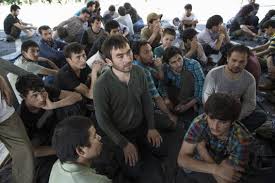
Detained Uighurs in Thailand. Photo: Reuters

Detained Uighurs in Thailand. Photo: Reuters

Last week, East by Southeast, in a piece hypothesizing the motives of the Kunming train station attackers, made the connection between Uighur asylum seekers, Yunnan and Southeast Asia. In the analysis, ExSE posited that Thailand was a likely destination for Uighur refugees as they made their way from Xinjiang, through Yunnan and into Myanmar or Laos. This past week, two separate incidents in near the border of Thailand and Malaysia occurred that appear to confirm this hypothesis.

News was released on Thursday that Thai authorities had rescued 200 people from a human smuggling camp in the south of Thailand. During a raid on Wednesday, police discovered 200 people imprisoned in a camp suspected to be used for human trafficking.

The group, which includes 78 men, 60 women and 82 children, at first claimed to be Turkish, despite having no documents to confirm that. However, they have now been identified as ethnic Uighurs from China by a US-based organization.

With their identities confirmed, Thailand has faced calls to not to deport the refugees, with the US State Department also weighing in.

“We are concerned about Uighurs generally (and) welcome reports that these Uighurs were rescued,” State Department spokeswoman Marie Harf told reporters Friday. “We’re encouraging Thailand to make sure their humanitarian needs are met.”

US-based Human Rights watch also urged the Thai government not to deport the refugees. “Thai authorities should realize that Uighurs forced back to China disappear into a black hole,” Brad Adams, the organization’s Asia director said in a statement.  “They need to allow all members of this group access to a fair process to determine their claims based on their merits, not on Beijing’s demands.”

Refugees on the way to a Thai detention center

Refugees on the way to a Thai detention center

Despite these calls, dozens of the refugees were sentenced for illegal entry by a Thai court on Saturday, with each person assessed a fine of 4,000 baht ($124). For now, the men will be taken to an immigration detention center and the women and children will be taken to a shelter, according to Police Major General Thatchai Pitaneelaboot.

In a possibly related story, 62 people were arrested just across the border in Malaysia last week. Like the group caught in Thailand, the Malaysian also claimed to be Turkish refugees. The group of alleged Turks were found near the border fence during routine patrols early Thursday morning Deputy Superintendent Sivam of Malaysia’s General Operations Force said in a statement.

Despite their claims of Turkish nationality, those arrested were not carrying valid travel documents or identification papers and historically, there has been a small, if nonexistent presence of illegal Turkish immigrants in the region. In light of this and the arrests in Thailand, some in the media believe that the alleged Turks might in fact be Uighurs from China. If so, this would mark the largest number found in Southeast Asia to date.

If both groups arrested are indeed Uighur refugees, their escape to Southeast Asia wouldn’t be without precedent. Since Cambodia deported 20 Uighurs back to China in 2009, there have been a string of similar deportations in the region. In 2010, Lao PDR deported a group of seven Uighur refugees back to their native Xinjiang in northwest China and in 2011 and 2012, Malaysia deported separate groups of refugees to China. Each deportation case has been heavily criticized by rights groups like Amnesty International and Human Rights Watch. Human rights groups fear that once repatriated, Uighurs face a grim future of long prison sentences and possible torture. Refugees deported back to China from places like Pakistan and Cambodia have all faced life prison terms upon their return.

The threat of prison is likely a reason why those arrested in Thailand and Malaysia have claimed to be Turks when discovered. Instead of admitting to Chinese nationality and facing the possibility of deportation back to China and likely prison time, the refugees opted for claiming another nationality. Seeing that the Uighur population is nearly all Muslim and speaks a Turkic language, claiming Turkish citizenship was a natural choice.

However, as is the case with both groups of refugees, these people’s true identities have yet to be discovered. If they aren’t Turks, are they really Uighurs? If they are Uighurs, how did they get to the Thai-Malaysian border and why did they come this far? Was Malaysia, a Muslim-majority country with labor shortages, the final destination? If both groups are indeed Uighur, this would mark a new level of southward migration for Uighur refugees. Might this also tie them to Kunming train station attackers, as East by Southeast hypothesized? For now, these are only questions, but ExSE will be searching for answers.


1 Comment

Filed under China, Current Events, ethnic policy, Kunming Train Station Attack, Malaysia, Regional Relations, SLIDER, Thailand, Uncategorized

Regional Round Up for 3.7.2014

By far one of the biggest stories this week was the deadly knife attack that occurred the night of Saturday, March 1st at the Kunming train station. Starting with reports on Weixin and other social media sites Saturday evening, the violence has been covered extensively in both Western and Chinese media. Because of the significance of this event, East by Southeast has prepared a news digest focusing solely on the attack in addition to our regular regional round-up. The additional coverage can be found via this link.

All of us at East by Southeast express our sincere condolences to the families and friends of those directly impacted by the train station attack, as well as appreciation for the support we’ve received in the past week.

ExSE FOCUS

Blowing Away the Smog in Beijing, Politically Speaking | NYT — The annual sessions of the National People’s Congress and the Chinese People’s Political Consultative Conference are underway in Beijing, and both groups are regarded by many Chinese as not truly representative of the people.

Beijing Goes Quiet on Rise of Local Security Budgets | NYT — Saying the data “is still being collected,” the Chinese Finance Ministry has declined to release figures on local security spending, a major component of a domestic security apparatus that has grown bigger than the military.

Trafficking of Burma’s Rohingya Muslims shifts to Malaysia | Guardian — Human traffickers are holding hundreds of Rohingya Muslims captive in houses in northern Malaysia, beating them, depriving them of food, and demanding a ransom from their families, according to detailed accounts by the victims.

Burma allows Médecins Sans Frontières to resume work but not in Rakhine | Guardian — Médecins Sans Frontières has been allowed to resume work in parts of Burma, but not in the strife-torn state of Rakhine, the medical aid group says.

Asian Development Bank failing in mission to protect poor and vulnerable | Guardian — According to a 180-page report released late February on a project to repair Cambodia’s rail system, ADB is not, however, adhering to its own polices and procedure in these areas. The bank’s internal watchdog, the Compliance Review Panel (CRP), said management needed to undergo a “mind-shift” in the way it deals with vulnerable populations.

CHINA

Opening day | Economist — China has opened the annual full session of its parliament, the National People’s Congress, in Beijing. If the past is any guide, the proceedings will be tightly controlled and will not feature any dramatic legislative votes during the ten-day session.

Red Lights Dim in China’s Sin City | NYT — China is in the throes of the harshest anti-vice campaign in years, and the crackdown is taking a toll on the economy of Dongguan, a southern city of more than eight million people.

China Declares ‘War Against Pollution’ | NYT — Facing growing dissatisfaction from citizens about high pollution in China, the premier, Li Keqiang, declared in his work report Wednesday that the government he leads would “declare war” on pollution.

Chinese Workers at IBM Factory on Strike Amid Company Sale | NYT — More than 1,000 workers from a Shenzhen site being sold to Lenovo took to the streets in the latest sign of growing labor activism in China

China Announces 12.2% Increase in Military Budget | NYT — China announced that it was increasing its military budget for 2014 to almost $132 billion. The expansion is being closely watched by other nations in the region and by the United States.

Home Prices in China May Hurt Families | NYT — Chinese households have an overwhelming share of their assets in their homes, and any slump in prices could lead to widespread anger, findings say.

Kashgar Journal: China Remodels an Ancient Silk Road City, and an Ethnic Rift Widens | NYT — China has razed thousands of traditional homes as it modernizes Kashgar, and the results underscore the divide between the government and the Muslim ethnic minority, the Uighurs.

China Prioritizes Ukraine’s ‘Ethnic Groups’ Over Its ‘Territorial Integrity’ | Diplomat — China has stopped voicing support for Ukraine’s territorial integrity, which could set a dangerous precedent.

Putin to Visit China In ‘Near Future’ | Diplomat — President Xi told Putin he is looking forward to his visit during a phone call discussing Ukraine.

Op-Docs: ‘Chinese, on the Inside’ | NYT — Catie and Kimberly were adopted from China by a couple from Maine, who attempt to pass on a culture they’ve never known firsthand. /With the departure of Ambassador Gary Locke and one commentator’s snide remark calling him a “banana”, this short documentary

The Gary Locke Effect: Does Race Matter for a US Ambassador? | Diplomat — Gary Locke, the first Chinese-American ambassador to Beijing, faced taunts and barbs because of his race.

REGION

Emerging, but No Longer a Mother Lode of Profits | NYT — Multinational corporations that crowed for years about their presence in booming emerging markets are now blaming turmoil in those regions for dents in their bottom lines.

Thai seafood industry censured over Burmese migrant’s trafficking ordeal  | Guardian — Thailand is the third-largest exporter of seafood in the world, sending nearly a billion euros (£8.2m) of fish to Europe and more than $1.5bn to the US each year. However, allegations of slavery and forced labour have dogged the sector in recent years.

China to Foreign Fishing Boats: ‘Get Out’ of South China Sea | Diplomat — Hainan’s Party Chief confirms that authorities are confronting foreign fishing vessels in the South China Sea.

Sri Lanka’s Growing Links with China | Diplomat — Trade, investment and a strategic Indian Ocean location bring the two countries closer together.

Take it to the bank | SEA Globe — Banking in Southeast Asia is a bipolar industry that reaches all manner of extremes – nearly 100% of Singaporeans over the age of 15 have a bank account, whereas less than 5% of Cambodians in the same age bracket do. Naturally, this has a lot to do with people’s incomes.

CAMBODIA

Cambodia: Challenges of Democratic Consolidation | Diplomat — Cambodia needs to press ahead with reforms to consolidate its young democracy.

Back to back, they face each other | SEA Globe — Both sides of Cambodia’s political divide need to address the concerns of voters and replace rhetoric with action

INDONESIA

‘Act of Killing’ Film Fails to Stir Indonesia | NYT — The film recounts in graphic detail the killings of an estimated 500,000 or more Indonesians during state-sponsored purges of suspected Communists and their sympathizers in 1965 and 1966.

Surabaya Journal: Pointing Fingers Over Heavy Death Toll at an Indonesian Zoo | NYT — The municipal zoo in Surabaya, Indonesia’s second-largest city, where more than 100 animals have died since last summer, has drawn calls for its closing.

LAOS

Mekong mission: Impossible | SEA Globe — After last year’s fatal Lao Airlines crash, a hastily assembled local dive team was scrambled. Their story is a remarkable feat of human endurance and teamwork

MALAYSIA

Malaysia’s Anwar Convicted of Sodomy, Political Future in Doubt | Irrawaddy — A Malaysian court convicted opposition leader Anwar Ibrahim of sodomy and sentenced him to five years in prison on Friday, shattering his plan to take control of the country’s richest state and stoking political tension in the Southeast Asian nation following a divisive national election last year.

MYANMAR/BURMA

Rise in Bigotry Fuels Massacre Inside Myanmar | NYT — Violence against the Rohingya minority has presented a test for Myanmar’s leaders, who have done little to rein in the ethnic killings even as they pursue broad political and economic reforms.

Burmese villagers exiled from ancestral home as fate of dam remains unclear | Guardian — The Myitsone dam project lies unfinished in Kachin state, northern Burma, caught in a tug of war between the Burmese government and a powerful Chinese corporation. 12,000 Kachin villagers remain in exile as a political and military drama plays out over the fate of the dam.

Preserving Indian Heritage in Myanmar | Diplomat — Yangon was once a center for India’s independence struggle. Can the heritage be preserved?

PHILIPPINES

Filipino families destitute after typhoon Haiyan find shelter in jail | Guardian — When the typhoon came, it made short work of the prison. It ripped the roof off and dismantled some of the cells. You might have expected the prisoners to have made off into the night. But while several did take advantage of their newfound freedom, they did so only to find their destitute families and bring them back to the unusual refuge of the half-intact prison building.

Fashion designers in Philippines support communities with sustainable textiles | Guardian — While a new wave of Philippine designers use indigenous materials and social enterprise to support communities, textile innovation could also address consequences of Typhoon Haiyan

SINGAPORE

Singapore tops world’s most expensive cities list for 2014 | Guardian — Singapore kicks Tokyo from most expensive city in the world to sixth – and there are lots of other surprises

The state of the city | SEA Globe — Many of Singapore’s poorest citizens must suffer in silence due to the absence of an official poverty line and meagre government support

Sex and the Lion City | SEA Globe –Singapore, where prostitution is legal but paying for sex with a girl aged under 18 is against the law, has a thriving vice industry – despite its manicured image. According to the US’s Trafficking in Persons Report 2013, the island is a destination for women and girls coerced into the sex trade from countries including China, the Philippines, Indonesia and Vietnam.

THAILAND

Thailand’s protests: Dismantling the barricades | Economist — AT LAST it looks as though the street protests designed to oust Thailand’s prime minister, Yingluck Shinawatra, are running out of steam. After more than four months of relentless sit-ins and government shutdowns, the leader of the insurrection, Suthep Thaugsuban, has dismantled most of his various protest sites around the capital, retreating to a single encampment in central Bangkok.

Shutting down the shutdown | Economist — Fifty-three days after anti-government protesters vowed to “shut down” the world’s most-visited city in a bid to “restart” Thailand, they have been forced to quit their programme. Or perhaps rather to “minimise” its window: from the city streets to a public park in Bangkok.

VIETNAM

Vietnamese blogger jailed for two years for ‘abusing democratic freedoms’ | Guardian — A Vietnamese blogger, Truong Duy Nhat, has been sentenced to two years in prison on a charge of “abusing democratic freedoms to infringe on the interests of the state and on the legitimate rights and interests or organisations and citizens.”

Point of no return | SEA Globe — Young Vietnamese are flocking abroad to study, often leaving their homeland for good. With their acquired skills and knowledge the economy could reach new heights

Leave a Comment

Filed under NEWS DIGEST, SLIDER, Uncategorized

Roundup of 3.01 Train Station Attack News Coverage

In addition to our usual news digest, this week ExSE has compiled a list of articles covering the 3/1 terrorist attack at the Kunming train station. The links are ordered chronologically by publication date, and include both Western media sources and English-language Chinese state media links.

March 9

The Kunming Train Station Attack: A Hypothesis | East by Southeast — In answering the question “Why was Kunming chosen as the site of last Saturday’s attack?” consider the following […] – See more at: http://www.eastbysoutheast.com/kunming-train-station-attack-hypothesis/#comments

March 8

Xinjiang Party Secretary Talks Terrorism After Kunming Attack |Diplomat — On Thursday, Xinjiang’s Party Secretary Zhang Chunxian led the Xinjiang delegation’s meeting at the National People’s Congress in Beijing. In the wake of the deadly March 1 attack in Kunming, Zhang faced a barrage of questions about the rise of terrorism within China and the government’s response.

The two-faced stance of US on terrorists | China Daily — Many Chinese are indignant at the slow and reluctant response from the United States in condemning last Saturday’s terrorist attack at the railway station in Kunming in southwest China’s Yunnan province. The US’ reluctance to condemn the terrorists is obvious since neither President Barack Obama nor Secretary of State John Kerry has spoken out and deplored the attack.

A week later, prayers, paper cranes, heightened security in Kunming | China Daily — According to Zhang Guibai, a member of the armed police in Yunnan, about 6,600 officers have been working on the investigation of the case and maintaining social stability. Police are deployed in and around public places, including parks, schools and train stations. Armed police units also have been strengthened near Yunnan’s borders with neighboring countries.

UN human rights body calls for “thorough investigation” over terrorist attack in China | Global Times — The Office of the United Nations High Commissioner for Human Rights (OHCHR) called on Friday for “thorough investigation” over the appalling terrorist attack in Kunming, southwest China, which claimed at least 29 lives and left over a hundred others wounded.

March 7

Chinese Governor Signals Crackdown on Separatists | NYT — The remarks by the governor of Xinjiang signaled that the Communist Party would tighten security throughout the region in reaction to a knife attack that killed 29 civilians.

Chinese police arrest 45 for ‘spreading rumours’ online after knife attack | Guardian — Chinese police have arrested 45 people for “spreading rumours” online in the wake of Saturday’s horrific knife attack at a Chinese train station.

China warns influential commentators to stick to party line on Kunming attack | Daily Telegraph — Chinese police have named and threatened some of the country’s most influential journalists and commentators for questioning the party line on a terror attack in Kunming.

Terror attack: Dark day | Economist — A brutal knife attack shocks China and raises questions about its policy towards ethnic minorities

Terrorist Attacks ‘part of trend’ | Global Times — About 90 percent of violent terrorists use means such as VPNs (Virtual Private Networks) to circumvent the Great Firewall and the increasing amount of terrorist attacks is part of the international trend, the top leader of the Xinjiang Uyghur Autonomous Region said on Thursday.

March 6

China imposes censorship on reporting of knife attack | Guardian — After the knife attack on Chinese people in Kunming last Saturday, in which 29 people were hacked to death, the state council information office issued the following directive: “Media that report on the knife attack incident that occurred March 1 at the Kunming railway station must strictly adhere to Xinhua News Agency wire copy or information provided by local authorities.”

Implications of the Kunming Terrorist Attack | Diplomat — The Diplomat speaks with Dr. Sean Roberts about the implications of the Kunming knife attack.

Details slowly emerge in Kunming knifing investigation | GoKunming — As people across China attempt to come to terms with the deadly knife attack on civilians at Kunming’s train station, details of the tragedy are beginning to come to light. Although no clear motive has been announced, high-ranking officials have given statements detailing some actions of the group responsible for the assault. More importantly, many of those injured at the station are reported to be convalescing in local hospitals.

Don’t label terrorism as ‘ethnic’: adviser | China Daily — Cases like the deadly attack in Kunming should be handled in a way that avoids linking a terrorist assault with an “ethnic issue”. Zhu Weiqun, head of the committee on ethnic and religious affairs under China’s top political advisory body, made the remark on Wednesday in an interview with China Daily.

March 5

Chinese Officials Seek to Shift Attention From Rampage | NYT — Days after knife-wielding assailants killed 29 people and injured 143 at the train station in Kunming, Chinese authorities appeared eager to change the subject.

Attack prompts strengthened anti-terrorism legislation | China Daily — Legislators and political advisors have proposed improving legislation to counter terrorism following the deadly terrorist attack that killed 29 civilians and injured 143 others.

Opposing Narratives in Piecing Together Kunming Attackers’ Motives | NYT — Were the assailants who slashed to death 29 people and wounded 143 others at a train station in southwestern China last Saturday aspiring jihadists or would-be refugees seeking to flee the country?

China knife massacre culprits wanted to wage jihad abroad, official says | Guardian — The group behind Saturday’s gruesome knife attack at a Chinese train station turned to violence after failing to leave the country “to participate in jihad”, a senior Communist party official was quoted as saying on Wednesday.

Kunming: A New Phase of Terrorism in China | Diplomat — The deadly weekend attack, which killed 29 civilians, could mark a new era for security in China.

Kunming knife gang ‘tried to leave China’ before attack | Daily Telegraph — Attackers who launched a brutal mass knifing at a Chinese train station acted in desperation after a failed attempt to leave the country and become jihadists overseas, a Chinese official was Wednesday quoted as saying.

Officer tells of fight with terrorists | China Daily –Kunming SWAT team officer Zhang Jun (not his real name) went on his first real crisis response mission on Saturday at Kunming Railway Station and came face to face with a gang of knife-wielding terrorists slashing and stabbing people at random. He was the only member of the four-man team armed with an automatic rifle.

Uygur community tries to regain trust after incident | China Daily — Three days after a deadly terrorist attack by eight people from the Xinjiang Uygur autonomous region, the biggest Uygur community in Kunming, Yunnan province, is trying to recover from the shock. In Dashuying, which has the biggest community of Uygurs in Kunming, people from different ethnic groups are trying to build trust.

Journalists see bias in Western coverage | China Daily — On Monday, the All-China Journalists Association condemned major Western media outlets, including CNN and AP, for “turning a blind eye” to the terrorist attack at a Kunming railway station, where 29 people were killed and 143 injured.

Xi calls for strong ethnic unity to guide nation after rampage | China Daily — Qin Guangrong, Party secretary of Yunnan province and a deputy to the National People’s Congress, said on Tuesday that police tracked the three suspects who fled Kunming to the Honghe Hani and Yi autonomous prefecture in southern Yunnan and arrested them in Shadian, a largely Muslim township in the prefecture, 40 hours after the attack. Qin was the first Yunnan deputy to the NPC to make an official statement on the massacre.

March 4

Report: suspects apprehended in Kunming mass stabbing case | GoKunming — Chinese state-run media is reporting all suspects believed to have taken part in a brutal attack on civilians at the Kunming railway station have been arrested or killed. Initial reports put the number of perpetrators at ten or more, but that number has been scaled back to eight.

Kunming terrorist attack suspects captured | Xinhua — Chinese police said Monday three suspects involved in the terrorist attack in the southwestern city of Kunming had been captured. The Ministry of Public Security said in a statement that the terrorist gang led by Abdurehim Kurban was responsible for the attack.

After Prodding, U.S. State Department Labels Kunming Attack ‘Terrorism’ | NYT — Questioned by reporters, a State Department spokeswoman, Jen Psaki, called the deadly attack in Kunming a terrorist attack, after the Chinese state news media accused overseas news agencies of failing to do so.

Train Station Rampage Further Strains Ethnic Relations in China | NYT — Relations have never been easy between the Han majority and Uighurs, but after an attack on Saturday, many Chinese are saying the mood is worsening.

Kunming massacre: Has the global jihad reached China? | Daily Telegraph — No terrorist group has claimed responsibility for last Saturday’s attack. But some fear it may be the start of a new cycle of violence as China becomes a target for radicals trained or influenced by Al Qaeda and the Taliban. The state media called the attack “China’s 9-11”: the moment when Islamic terrorists began to target Chinese civilians.

Is the Kunming Knife Attack China’s 9-11? | The Diplomat — The deadly attack in Kunming may forever change the way China thinks about and deals with terrorism.

Terror in Kunming | The Economist — Chinese police announced the capture on Monday of three suspected participants in a gruesome attack by a knife-wielding gang that killed 29 people in the main train station of Kunming, a major city in China’s south-west.

Security tightened at railway stations, airports in major cities | China Daily — Police in Kunming, Beijing, Shanghai, Guangzhou and other provincial capitals, including Xi’an, Shaanxi province, and Changsha, Hunan province, have stepped up police forces at transport hubs and public areas such as shopping malls and schools, authorities said.

Western Media Coverage of Kunming’s Terror Attack Shows Sheer Mendacity and Heartlessness | People’s Daily Online — While China grieved and expressed its outrage following the savage stabbing of innocent civilians by Xinjiang separatists at the crowded railway station in southwest China’s Kunming Saturday night, some Western media organizations, including CNN, Associated Press, the New York Times, and the Washington Post, were already presenting their audiences and their readership with a distorted view of events.

US: Train depot attack ‘terrorism’ | China Daily — On Monday, State Department spokeswoman Jen Psaki said the US acknowledged that China has characterized the incident as a terrorist act.

Impact of terror attack on Yunnan tourism limited | China Daily — The terrorist attack in southwest China’s Kunming on Saturday has had and will have a limited impact on tourism in Yunnan province, the provincial tourism authority said on Tuesday.

Media innuendos unjustified | China Daily — Most media organizations worldwide covered the incident in a professional manner in line with the principle of humanity, however, a handful of Western news organizations have rubbed salt into the wounds, says a Xinhua commentary.

Kunming Train Station Attacks: The Media’s Response | East by Southeast — More than a day has passed since Kunmingers and the rest of the world awoke to news of Saturday night’s terrorist attack at the Kunming Railway Station. In that time, local residents, concerned citizens, the media and the world at large have begun the process of digesting what happened and what it all means.

Kaiser Kuo: On Radicalization and Chinese Policy | via East by Southeast –While I’ve noted elsewhere how it bothers me profoundly that many Anglophone commentators offer a merely perfunctory nod to the monstrousness of the knife attacks that claimed 29 innocent lives and sent 160 or more people to the hospital with stab and slash wounds before moving on to the “real” issue of Chinese repression of Uyghur rights, I do believe the desire on the part of some people to use the Kunming massacre to talk about underlying issues is well-intentioned and appropriate.

March 3

Video Said to Be of Kunming Attack Aftermath Appears Online | NYT — Video has emerged on a Chinese video-sharing service that apparently shows scenes from the knife attack in the Kunming train station on Saturday that left at least 29 people dead.

U.N. Security Council Condemns ‘Terrorist Attack’ in Kunming | NYT — As the United Nations Security Council condemned the attack in China’s Kunming train station that left at least 29 dead, the authorities moved to delete social media posts that called on leaders to allow open discussion of the situation in Xinjiang, where tensions are running high.

China Train Station Attackers May Have Acted ‘in Desperation’ | Radio Free Asia — A group of knife-wielding attackers who went on a weekend slashing spree at a train station in China’s southern Yunnan province may have been disgruntled ethnic minority Uyghur asylum seekers who felt “trapped” between violence in their Xinjiang homeland and the inability to flee across the border into Laos, sources say.

Report People From Xinjiang, Police Say After Deadly Attack | NYT — A police station in the southern region of Guangxi has called on citizens to report any people from Xinjiang in their midst, after attackers believed to be from the far western region killed at least 29 people on Saturday.

Kunming in the aftermath of the train station attack | GoKunming — n the wake of the attack on the Kunming Train Station, in which official sources say at least 29 people lost their lives and 143 were injured, I went to sniff around the city for stories and reactions. People are stoic, supportive of their fellow citizens and have seemed to steer clear of any racial or religious violence.

Kunming restores order after deadly terror attack | China Daily — At the train station where the attacked happened, train arrivals resumed on Sunday after three trains with 3,000 passengers were affected on Saturday night, said station officials. Meanwhile, 60,000 passengers are expected to leave the station on Sunday, higher than the 59,000 on Saturday.

China Focus: Legislators, advisors urge US to abandon terrorism double standard | People’s Daily Online — China’s legislators and political advisors have urged Washington to condemn Saturday’s deadly attack in southwest China as terrorist activity after the U.S. downplayed its severity. “The U.S. definition of terrorist activities hinges on its own political interests,” Yin Zhuo, director of the Expert Consultation Committee of the People’s Liberation Army (PLA) Navy, told Xinhua on Monday.

Uygur general: PLA backs Xinjiang’s counter-terrorism efforts | People’s Daily Online — The counter-terrorism efforts in northwest China’s Xinjiang Uygur Autonomous Region have the strong backing from the People’s Liberation Army (PLA), said a senior military commander here Monday. “Counter-terrorism arrangements are in place to prevent serious incidents in Xinjiang,” said Saimati Muhammat, major general and deputy commander of the Xinjiang Military Area Command, in an interview with Xinhua.

March 2

China Blames Xinjiang Separatists for Stabbing Rampage at Train Station | NYT — Although no group has claimed responsibility for the attack, officials on Sunday described the killings as an act of terrorism planned and perpetrated by separatists from Xinjiang, where members of the Uighur minority are increasingly at odds with the government.

Attackers With Knives Kill 29 at Chinese Rail Station | NYT — A group of assailants, dressed in black and wielding knives, stormed into a train station in Kunming in southwestern China, slashing employees and commuters.

Horrific Knife Attack in China Leaves 33 Dead | Diplomat — Authorities vow justice as a group of men it says are Xinjiang separatists attack a crowd in Kunming.

Attack leaves dozens dead at Kunming Train Station | GoKunming — A coordinated assault by at least ten people at the Kunming Train Station has left more than 20 people dead and more than 100 injured. Police reportedly killed four of the attackers and arrested another, while five others remain at large.

Foreigners cautious in Kunming | China Daily — Kunming has for many years been a favored destination for foreign travelers, and it has a bubbling expat community. Foreigners in Kunming were shocked by the attack, especially those who witnessed it.

Migrants use hookahs to fight terrorists | China Daily — At around 9:30pm, Wang Dezhu, a migrant worker from Baoshan city in Yunnan, and some companions were preparing to take the train to Hebei province when the terrorists attacked. He said the migrant workers wielded bamboo hookahs – long, bamboo water pipes used in rural areas – as a weapon to protect themselves.

Social media users condemn attacks, pray for the dead | China Daily — On Sina Weibo, netizens are spreading the word of stopping the circulation of bloody photos on the Internet.

At least 29 dead, 130 injured in Kunming violence | China Daily — Twenty-nine civilians were confirmed dead and more than 130 others injured Saturday in a railway station attack in Southwest Chinese city of Kunming, authorities said. Police have shot dead at least four attackers whose identities are yet to be confirmed and are hunting for the rest. It was an organized, premeditated violent terrorist attack, according to the authorities.

Deadly Kunming Knife Attack Leaves 33 Dead, 130+ Wounded | East by Southeast — The Spring City’s reputation was irrevocably changed on the evening of Saturday March 1 as a group of five to ten knife-wielding attackers entered the Kunming Railway Station and engaged in a stabbing rampage that killed 28 passengers and wounded more than 100. The Chinese government is labeling the assailants as a Uyghur separatist terrorist group although very little is known of the actual identities of the assailants and their motives.

March 1

Police confirm injuries in Kunming railway station | China Daily — A group of unidentified armed men on Saturday stormed into a railway station in Kunming, capital of Southwest China’s Yunnan province, causing injuries, said the city police. Casualties have been under investigation, according to the police.

China’s ‘Blurred Lines’ on Security Threats | Diplomat — Under Xi Jinping, the Chinese Communist Party is purposely conflating external and domestic security threats. /This was published the day of the attack at the train station, apparently before news had emerged, however it’s unfortunate timing by The Diplomat./


Leave a Comment

Filed under Kunming Train Station Attack, NEWS DIGEST, SLIDER, Uncategorized

Kunming in the aftermath of the train station attack

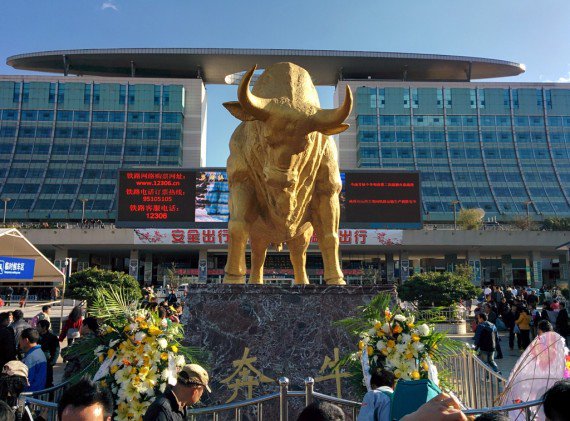
Memorials in front of the Kunming Train Station

Memorials in front of the Kunming Train Station

In the aftermath of the attack on the Kunming train station, in which official sources say at least 29 people lost their lives and 143 were injured, I went to sniff around the city for stories and reactions. People were stoic, supportive of their fellow citizens and seem to steer clear of any racial violence.

In general, the city felt ridiculously normal for the day after the attack . The people manning the gate at my compound greeted me as cheerily as I scooted down the hill and the only armed police I saw were hanging around a major interchange. Most people ambled lazily around Green Lake park, gazing at the flocks of sea gulls on their way back to Siberia as if nothing had happened. Not a SWAT team to be seen, even though this would be a potential spot for carnage. Kunming’s 1st People’s Hospital also had only a few law enforcers stationed outside, a shrill contrast to the mob of police inside that was trying to keep nosy journalists at bay.

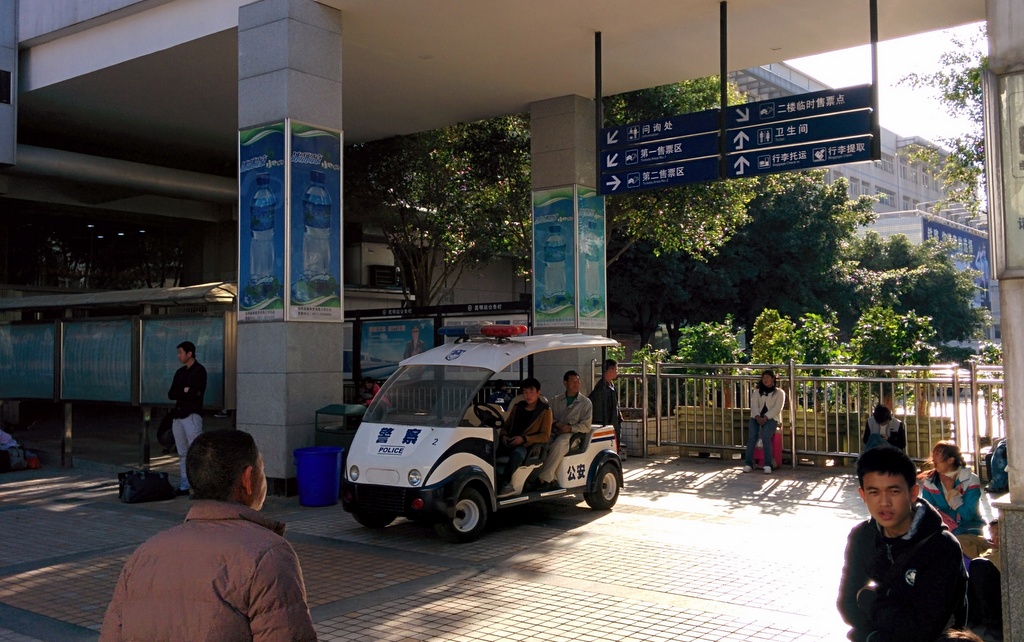
Unmanned police vehicle manned by local kids — right in front of the train station ticket office

Unmanned police vehicle manned by local kids — right in front of the train station ticket office

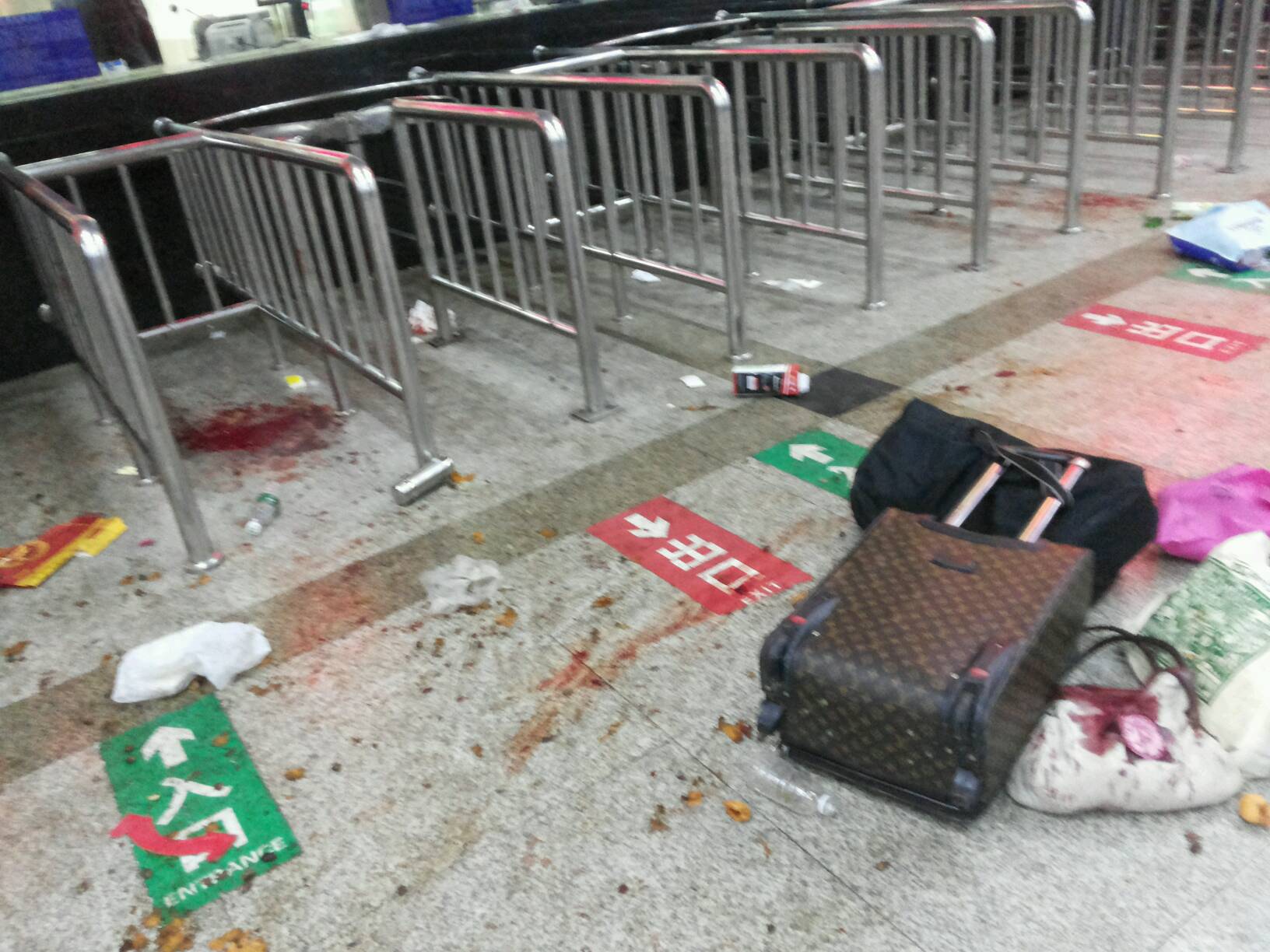
Even the train station felt relatively normal. On the left side of the square, a large part was sectioned off with police line and a dozen or so armed SWAT policemen were swarming around. In the middle of the square, under the large gilded bull, people were taking pictures of flowery memorials, one of which had already fallen down and torn. The ticket hall, the goriest place from Saturday’s attack, had been properly cleaned and was again filled to the brim with people queuing to buy tickets.

A young man cheekily ran behind me to measure himself against my height, so I used that as a pretext to ask him some questions. Whether he was afraid? “If I were afraid I wouldn’t be here”. Any other questions resulted in him uneasily shooting his eyes around so I left it at that.

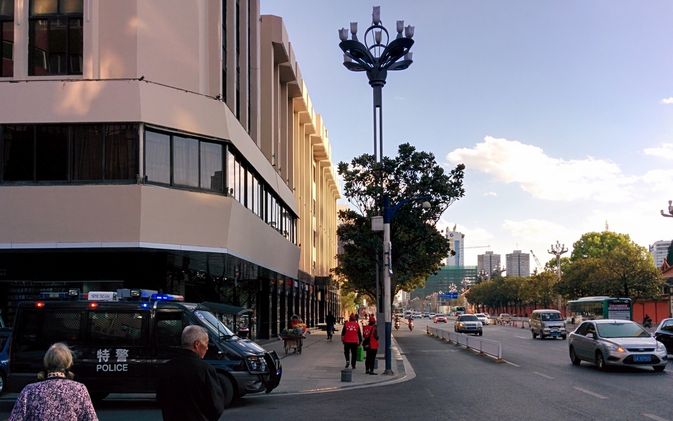
A SWAT vehicle on Beijing Lu

A SWAT vehicle on Beijing Lu

The cigarette lady was more helpful. She had already closed the shop and gone home for the night when the killings happened, but she was dead afraid to come to work on Sunday. She had wanted to stay home, but her boss and the need for a salary made her show up. She added that the extra security made her feel safer, though. A Bai minority woman in traditional dress was waiting for her daughter to pick her up. When I asked her if she was worried about coming here, given yesterday’s events, she replied: “which events?” Apparently the news had not reached rural Dali.

I also visit one of the mobile blood donation centers that the government had set up at twelve different locations all over the city. They must have rushed them in, as the containers still sported a sign for a previous blood-donating event at New Year’s day and make no mention of the stabbings the day before. That didn’t seem to stop people from flocking to the cabin. I am told that at least 150 people had already donated blood at this point and another 60 people were waiting to give.

Mobile blood donation center – caption reads: "Kunming blood donation center wishes Spring City residents a happy new year"

Mobile blood donation center – caption reads: “Kunming blood donation center wishes Spring City residents a happy new year”

I met Miss Wu (25) and her two friends at the mobile blood bank. She herself is not able to donate, but her two male companions are. While the two men were inside, I struck up a conversation. ”We’re here to help our fellow citizens after yesterday’s massacre,” she beams. Solidarity and stoicism obviously go hand in hand in Yunnan. “I don’t think this will affect how I see Muslims,” she explains, “and I don’t think it will the view of most other Chinese, either. The attackers were a violent group who had nothing to do with other Muslims. There have even been a lot of Muslims coming in to donate blood. Wherever you have people, you have bad ones.”

A Chinese journalist asked me my opinion and added that he had not been able to interview any Uighur people. “Perhaps they’re afraid for retaliation [from Han majority people], but they really needn’t be, there doesn’t seem to be a strong anti-Muslim sentiment among the people.”

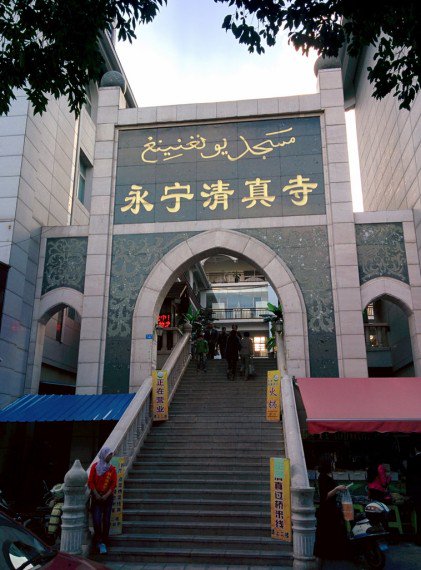
Business as usual at a Kunming mosque

Business as usual at a Kunming mosque

At the nearby mosque at Jinbi square, too, everything seemed to be business as usual. No signs of Islamophobic rioting, just people cooking all kinds of Halal cuisine for visitors. I talked to Ma Jun, a Hui (ethnic Han Muslim) woman from Inner Mongolia. While roasting some Erkuai pancakes, a local Yunnan delicacy, she told me she had seen some Uighur people coming in today for food and prayer, like on any other day. She made a plea for stronger feeling of unity among the Chinese people and says all will always be welcome under the roof of the mosque.

Questions remain, though, which no one currently has an answer to. One such question is: why Kunming? Of all places of importance to the government, was Kunming just the one with the weakest security? Were the attackers simply locals? Were they after tourists or after a particular train (the train to Shanghai was about to leave)? Kunming has almost no history of violence in the contemporary era, with the only notable event being the bombing of a bus in 2008. Then, too, Uighurs were initially blamed until it was later revealed that the lone bomber belonged to theHui minority.

Editor’s noteThis article was written by Kunming transplant Sander Van de Moortel and originally published on his blog A World of Nonging, on March 2.

1 Comment

Filed under China, Current Events, Kunming Train Station Attack, SLIDER, Uncategorized, Yunnan Province

Kaiser Kuo: On Radicalization and Chinese Policy

I get that some people trying to make sense of the attacks in Kunming want to take the opportunity to discuss how Chinese policy contributed to radicalization. And while I’ve noted elsewhere how it bothers me profoundly that many Anglophone commentators offer a merely perfunctory nod to the monstrousness of the knife attacks that claimed 29 innocent lives and sent 160 or more people to the hospital with stab and slash wounds before moving on to the “real” issue of Chinese repression of Uyghur rights, I do believe the desire on the part of some people to use the Kunming massacre to talk about underlying issues is well-intentioned and appropriate.

What troubles me, though, is that too often in that ensuing discussion, this attack as well as all the recent attacks—whether or not they cross our (still somewhat blurred) definitional line into terror—are seen simply as responses to Chinese repression. Is there repression and bad policy? Yes, absolutely. Has it contributed to radicalization? Sure.

But is it the only factor that has contributed to radicalization?

Of course not. The weird part is that while it should be stunningly obvious that the whole context, the whole relationship between Islam and the secular, industrialized world, the whole discourse on the way Islamic peoples are situated in the modern world—all this has dramatically changed, but this barely enters conversation. There are myriad alternative responses, loci of identity, causes, leaders, and movements on offer now that just weren’t there pre-September 11. The Internet barely existed in the oasis cities of the Tarim before 2001.

But people are for the most part writing and talking about the situation as though it’s happening in complete isolation, as though the rise of radical Islam in the rest of the world since the 1980s doesn’t figure in. It somehow doesn’t merit a paragraph or two alongside the context paragraphs that most of the Anglophone outlets see fit to include about repressive policies in restive Xinjiang. People can’t see beyond the simple narrative of Chinese repression.

Any serious effort to look at what’s happened and where things might go from here has to look at Chinese policy, and I’m sure that there’s plenty of blame to be laid there. But it should also factor in—and this is a far from comprehensive list—the rise of Wahhabism and other fundamentalist sects much further to the west; the Mujahedin in the aftermath of the Soviet withdrawal; Bin Laden and AQ; their bloody work; the whole idiotic enterprise of the GWoT; networks like the Islamic Movement of Uzbekistan; the Afghan training camps (where let’s not forget there were many Uyghurs); the wars in Afghanistan and Iraq; and the Arab Spring in more recent years. It has to look critically at the WUC and the pared-down, simplistic narrative it’s managed to sell, and on and on.

It’s depressing that instead people are quibbling over how well organized ETIM is, with some even denying that any organizations like it exist at all. Or they quibble over whether scare-quotes should be used with the word terrorism. (Yes, I’ve been quibbling over that, but I think it’s important: Like many people, I find that the word’s been badly abused, mostly at the hands of the Bush 43 Administration, and is deeply problematic, but dropping our use of it now, or deploying it only with the scare-quotes, is too loaded a statement and sends very wrong messages).

But to my main point: Yes, let’s talk about the underlying problems. But let’s not for a second believe that if only the Chinese would be nicer all the nasty, violent radicalism would just disappear.

This post was originally published on Kaiser Kuo’s Facebook page on 3/3/14. It received so much attention that we reached out to Kaiser for a repost on ExSE.  This is posted with the permission of the author. Comments and discussion welcome.  

7 Comments

Filed under Current Events, ethnic policy, Governance, Kunming Train Station Attack, Regional Relations, SLIDER, Uncategorized

Deadly Kunming Knife Attack Leaves 33 Dead, 130+ Wounded

luggage

Kunming is a city known for its sleepy nature and a perfect climate that promotes a casual urban way of life.  In many ways it offers an alternative to the busy competitive nature of China’s first and second tier cities.  As the capital of Yunnan province, the city also prides itself as a peaceful melting pot of ethnic unity in one of the most ethnically diverse areas of the world.

The Spring City’s reputation was irrevocably changed on the evening of Saturday March 1 as a group of five to ten knife-wielding attackers entered the Kunming Railway Station and engaged in a stabbing rampage that killed 28 passengers and wounded more than 100. The Chinese government is labeling the assailants as a Uyghur separatist terrorist group although very little is known of the actual identities of the assailants and their motives.

This horrifying incident is the bloodiest in recent memory to occur outside of Xinjiang, a territory that has seen an increase in restive ethnic activity over the past five years. The domestic Chinese media and international media are providing plenty of coverage of the incident, but many questions remain unanswered and facts surrounding the incident are sketchy at best.

Most importantly, who are the assailants?  Why was Kunming and its train station chosen as a site for the attack? And how could security at the train station be so lax to permit this unprecedented violence?

Official reports confirmed late Saturday evening that security forces killed four of five assailants and apprehended a fifth female attacker.  In the firefight one or more of Kunming’s SWAT force was injured with undisclosed levels of injuries.  Phoenix TV reported three of the assailants fled northward on Beijing Road (Kunming’s central north to south thoroughfare) out of the train station and continued to stab innocent bystanders until they met a police blockade several hundred meters from the station. Two were shot on sight and one apprehended, allegedly a woman five months pregnant.  Photos show the assailants were wearing the same black head to toe uniforms and were said to have their heads covered. Early Sunday morning March 2, photographs of a short sleeve black t-shirt with a crescent moon and Arabic script began to circulate Chinese social media channels; the t-shirt was the alleged uniform of the attackers – however, photos of the apprehended and assailants killed on site suggest they were wearing long sleeve shirts.

photo

On Sunday morning March 2, the official Chinese media labeled the incident as a terrorist attack laying the blame on Uyghur separatists groups.  At the point of this publication no names, photos, or information on the assailants have been released to the public. Identifying the assailants as Uyghur did confirm the initial messages that hit popular Chinese social media channels around 10pm on Saturday evening.  Concerned Chinese citizens are calling for the release of information on the assailants by the public security forces, but due process in China does not require the release of such information.  It is possible that we will never know the true identity and motivations of the attackers.

At noon on March 2, a list of 11 Uyghur men with names and headshots began to circulate Chinese social media sites.  The men are labeled as suspects fleeing the scene of the crime and no information has been released about their specific connection to the incident.  Were these men identified by close circuit cameras in the train station? Were their names divulged by the apprehended fifth attacker? Were they simply men who failed to show up to work on Sunday and reported by their Han Chinese employers as missing or by local observers as suspicious figures? Again Chinese criminal and legal processes help to shed little light on the identity of these men who apparently are still at large.

Kunmingers are in a state of fear and disbelief as news of the incident unfolds. Of the few people interviewed by ExSE most state that it is important to stay indoors since suspects were still on the run. The municipal public security bureau has asked all housing complexes, public venues, and university campuses to increase security surveillance methods. Property management companies of housing complexes are encouraging residents to blanket report sightings of any Uyghurs to local police stations.

Photos from the Kunming No. 1 Hospital located in the center of the city show the wounded recovering in gurneys, occupying hallways in the already crowded and resource strapped facility. A Sina Weibo user reported in an unverified report that a migrant family cannot afford the 50000 RMB required for treatment of their critically injured child.

Chinese train stations are often crowded and packed with passengers into the late evening as passengers board overnight trains to destinations throughout the country. Kunming’s station last night was no exception. The mix of people in the train station was likely comprised of various walks of life from migrant workers, to middle-class tourists, to foreign backpackers heading to the popular tourism destinations of Lijiang and Dali as well as points north in inland China.  One photo showed a bag of golf clubs against a wall towering above a pool of blood.  Gruesome photos of the scene also show luggage left strewn throughout the scene of the violence, a rampage that occurred in many of the stations waiting halls in addition to the main ticketing room.

Anyone who travels on China’s rails and bus system knows the security at train and bus stations is extremely lax. Poorly trained guards – really hired help in shabby blue uniforms – man posts at metal detectors and luggage scanners placed in station entryways more for show than to serve a security purpose. At peak times train and bus stations are much more crowded than airports in China and metal detectors are constantly sounding as passengers walk through without any recourse or further pat downs. With the exception of Xinjiang and Tibet were security has been increasingly tightened over the past five years, the quality of procedures to safeguard the security of public places wanes as one gets farther  away from Beijing.

This lax security culture is likely to, and hopefully will change as a result of the incident in which locals are dubbing as Kunming’s 9/11. China’s President Xi Jinping dispatched top domestic security official Meng Jianzhu to Kunming to oversee the investigation that comes days before the opening of critical government meetings in Beijing. This incident will surely cast a cloud over the meetings which are a critical platform for Xi to further deepen his reform policies for China – or the incident will force the agenda to be more focused on security concerns, an already expressed concern for the new leadership. Meng Jianzhu said in a public statement today, “This gang of terrorists were cruel without any humanity. They completely abandoned their conscience. We must strike hard against them according to the law.”

Perhaps the known factor of a lax security environment and a municipal government famous for slow responses and public relations nightmares made Kunming an easy target for the assailants – if they were as the official Chinese media claims from western Xinjiang. We are all still grappling to understand why Kunming was chosen as a target for an attack of such scale. The last time an incident of this nature – although admittedly we are still trying to figure out the exact nature of the incident – happened was a series of two bombings in 2008 when a local man, a former convict disgruntled and unable to find a place and job in China’s competitive society bombed a bus killing two and then unintentionally killed himself in a second bombing inside the popular Salvador’s Café in the city’s university district.  The two incidents were spread out over a five month period. Prior to the bomber’s death in the second December 2008 bombing, authorities blamed the first bombings on Uyghur separatists until they could forensically link the two incidents. The bomber was Hui Muslim but not Uyghur and religion ties or ethnic suppression were not revealed as motivations for the incident.

Today on the streets of Kunming, many were reluctant to discuss the incident.  Known acquaintances opened conversations with “the thing on TV” or “what was in the news,” a reaction that displays the shock and disbelief that this could happen in their city or a willingness to distance themselves from the incident in self-protective behavior. A local fruit vendor was angry beyond words and could only mutter, to my disbelief, that all Uyghurs should be corralled and shot. Another local suggested that as a foreigner I should pack my bags and go back to the West where “you don’t have to worry about terrorism.”  Similar responses and sentiments pervade the Chinese population

As the city begins to piece itself back together with the start of the work week tomorrow, ExSE will continue its discussion of this horrible incident, continuing to comment on official media response, the discussion of Uyghur separatism and its link to the incident. In addition to the broader topics above which the mainstream media has already defined as its main narrative surrounding the incident, ExSE, a Kunming based website is interested in exploring issues on the ground here in the city as they unfold and from a long term, more connected perspective.

With so little information released on the true identities of the assailants as well as the identity of those slain in the attack, how does an urban society process and respond to such a violent incident? We are also curious and concerned to the way an urban society heals from the shock and grief that now holds sway over Kunming and to what effect security will be raised in the city in both the short and long term. Importantly how will the ethnically diverse but general peaceful and non-restive ethnic groups of Yunnan respond to an attack labeled with ethnic motivations by an outside separatist group?  And will angry Chinese nationals seek retaliation against Uyghurs and Muslims in all patterns of ethnic and nationalist tension that are becoming more and more predictable in China?

Please feel free to leave comments to this post or if you have contributions, contact us at eastbystheastmail@gmail.com.

2 Comments

Filed under China, Current Events, Kunming Train Station Attack, SLIDER, Uncategorized, Yunnan Province

Attack at Kunming train station leaves 27 dead and more than 100 injured

Late Saturday evening March 1, unknown attackers used knives to randomly kill passengers waiting at the Kunming train station. Xinhua News has reported 27 killed with 109 injured. A local hospital has seen more than 170 patients apparently injured in the incident.

The assailants are of unknown origin and motivation although Chinese social media sites are flying with rumors of ethnic affiliation. The state media has officially called this incident a terrorist attack.

While details are extremely sketchy photos from the incident are circulating as the story hits the international media. To keep up with the story as it breaks follow this live blog.

20140302-024335.jpg

Leave a Comment

Filed under China, Current Events, Kunming Train Station Attack, SLIDER, Uncategorized