Category Archives: Regional Relations

Myanmar-China Natural Gas Pipeline Complete, But Complications Remain

Last Monday, Chinese press outlets announced the long-awaited opening of the Myanmar-China Natural Gas Pipeline. The project, which has been in construction for almost four years, is part of a larger plan to import both natural gas and oil from the Bay of Bengal, through Myanmar and into China. The twin natural gas and oil pipelines are a project of great national importance as it is expected that the output from these pipelines will ease China’s growing energy needs. It is little wonder then that the opening of the natural gas pipeline was met with such fanfare.

On the day of its opening, July 29, the announcement was the top story on China Central Television’s evening news and stories ran in national and local newspapers celebrating the pipeline’s completion. The opening ceremony itself was supposedly an affair of great jubilation as well. Xinhua News reported, “”When torches flamed in the sky of Namkham Measuring Station of the Myanmar-China Gas Pipeline, a storm of applause and cheers broke out…”

Celebratory voices were not the only ones to be heard in the days surrounding the pipeline’s completion. This editorial in the English version of the People’s Daily argued that “Irresponsible remarks on the Myanmar-China oil and gas Pipeline should stop as the scientifically feasible project has benefited multiple parties.” According to the editorial, Western criticism of the pipeline stems from a “shady mentality”. These critics are “unwilling to see an intimate relationship between Myanmar and China” and are uncomfortable with the thought of China being energy secure. Continue reading →
Leave a Comment

Filed under China, Current Events, Energy, Health, Myanmar/Burma, Regional Relations

Is there state complicity in the attacks on Myanmar Muslims communities?

The government of Myanmar’s President Thein Sein, so active in its efforts to assure Western audiences that the new Myanmar will never return to the dark days of the previous ruling military junta, has so far failed to display any commitment to ending the brutal spiral of attacks on Muslim communities, carried out in town after town by suspiciously well-organized Buddhist gangs.

Thein Sein’s periodic appeals for ”an end to communal violence” are less than convincing given the absence of any government measures or plan to stem the flood anti-Muslim propaganda being freely disseminated under the noses of the authorities.

Leaflets and magazines denigrating Muslims are being churned out every day across the country.

The monk Wirathu has spread a perniciously xenophobic version of Theravada Buddhism through inflammatory sermons directed against a Muslim minority that comprises only 5% of the population in this predominantly Buddhist nation of 60 million

Extremist Buddhist monks led by the publicity hungry U Wirathu, are preaching a brand of pure Buddhist nation-state and hatred of Islam, that cause consternation and disgust  among the true devotees of peace non-violence and the path of the Lord Buddha.
Muslim shops and homes in Lashio in Shan state were the most recent victims of a Buddhist motorbike gang in June. Shan researcher Sai Latt commented  “the government and the police are not doing anything at all to clamp down on extremist hate propaganda against Muslims.” Continue reading →

2 Comments

Filed under Current Events, Economic development, Foreign policy, Governance, Myanmar/Burma, Regional Relations

The Code of Conduct for the South China Sea: A Waiting Game

On June 30, 2013, following the China-ASEAN Foreign Ministers’ Meeting held in Bandar Seri Begawan, capital of Brunei, China released a joint-statement with ASEAN in a post-meeting press conference, indicating that they have agreed to hold “official consultations” on a proposed Code of Conduct (CoC) to govern South China Sea “naval actions”. All parties agreed to move forward with consultations in upcoming meetings to be held in China during September later this year.

Misleadingly or mistakenly billed as a significant paradigm shift by many English language news outlets, this development should not have come as a surprise to anyone. As early as November 2012, China already issued a joint statement with ASEAN at the 15th ASEAN-China Summit in Phnom Penh, Cambodia, marking the 10th anniversary of the Declaration on the Conduct of Parties in the South China Sea (DOC) and agreeing to “keep momentum of dialogue” in moving towards a formal Code of Conduct (COC).  China also reiterated this commitment in April this year, following the 19th China-ASEAN Senior Officials’ Consultation.

For the casual observer, keeping track of the ins-and-outs of numerous ASEAN-China agreements and cryptic diplomatic sparring over South China Sea (SCS) disputes can be daunting. News reporting differs greatly depending on its country of origin and the same story can be told in a hundred different ways leaving entirely different impressions of what happened. The following is a breakdown of the important historical, political, and legal considerations necessary to understand what the Code of Conduct for the SCS is, why it is important, and how it may eventually come about. Continue reading →

2 Comments

Filed under ASEAN, Brunei, Cambodia, China, Current Events, Energy, Foreign policy, Indonesia, Laos, Malaysia, Myanmar/Burma, Philippines, Regional Relations, Singapore, Thailand, Vietnam, water

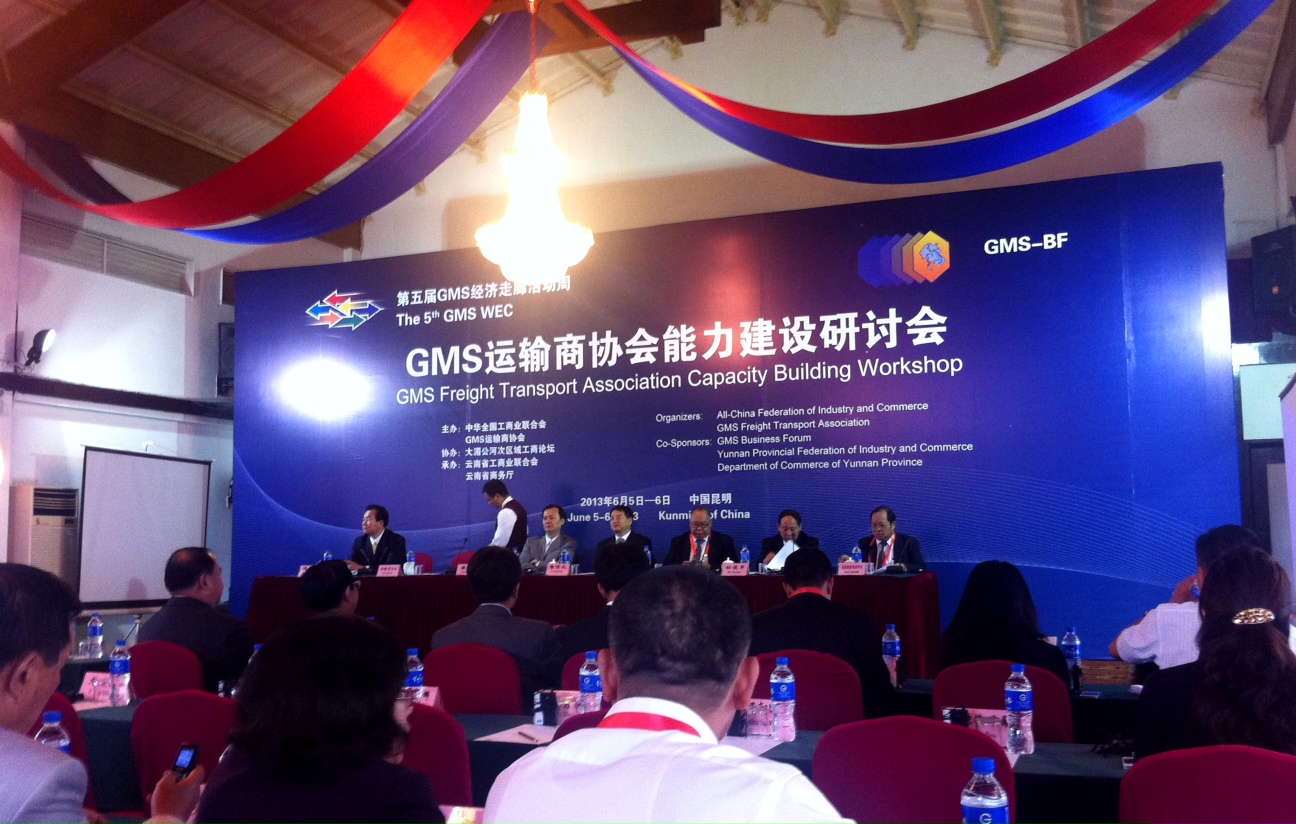
Remarks: Strengthening Cooperation & Promoting Cross-border Transport Logistics

GMS workshop

NOTE: The following is the English language transcription of a speech by Yang Shiji, Vice Director of the Yunnan Provincial Government’s Research Office, presented on June 5, 2013 at a workshop on GMS (Greater Mekong Subregion) Freight Transport Association Capacity Building.  The first part contains an interesting portrayal of connectivity potentials and a brief history of transportation linkages between China and Southeast Asia.  The reader should keep in mind that the area in discussion contains some of the most difficult terrain in the world, but the speaker’s main concerns are inter-government cooperation and the harmonization of customs and trade procedures throughout the region.   The final portion of the speech provides a framework to improve connectivity and upgrade logistical services within the region. 

For reference, a map of the Greater Mekong Subregion is linked here. 

“Strengthening Cooperation and Promoting Cross-border Transport Logistics in the Greater Mekong Subregion”

Cross-border logistics is an emerging industry combining several composite services such as transport, warehousing, and information.  Connecting production with consumption and linking countries to the outside world, the industry is composed of tangible and intangible factors and covers the entire process from product manufacturing to commodity flow.  Therefore, giving full play to the function and role of transport and upgrading the efficiency of cross-border logistic transport will have significant impact on all aspects of the economic and social lives of the countries in the GMS.  With the maturation of China’s market economy, a professional and efficient logistic system has been an indispensible factor for upgrading the quality of its economic functions, the income of its enterprises, and an accelerator for its entire national economy.

Located at the junction of China and Southeast Asia, the South Asian Subcontinent, Yunnan borders with Laos, Vietnam, and Myanmar, and shares with them a 4060 km national boundary line, about one-fifth of China’s total land border.  It has 25 frontier counties, 23 national entry ports, and over 100 trading channels for border residents.  To its east Yunnan is linked to the Zhujiang River delta and the Yangtze River delta economic circles, and to its south it has direct access from three routes, east, central, and west, to Hanoi, Bangkok, Singapore, and Rangoon via the Kunming-Bangkok highway and the Pan-Asia Railway, currently under construction.  It is the gateway to the vast western hinterland of China to its north.  To its west, it has access to the Indian Ocean via Myanmar.  In a word, the province enjoys the locational advantage in “connecting with two oceans, the Pacific Ocean and Indian Ocean, and linking with three major markets in East Asia, Southeast Asia, and South Asia.” Continue reading →

Leave a Comment

Filed under China, DOCUMENTS, Economic development, GMS, Laos, Mekong River, Myanmar/Burma, Regional Relations, Technology, Thailand, Vietnam

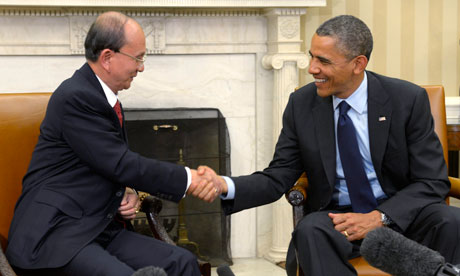
Mr. Thein Sein Goes to Washington… Mr. Abe Goes to Naypidaw

This past week saw big foreign policy news from Myanmar (Burma). Just days after meeting with US President Obama in Washington, Burmese President Thein Sein returned to Naypidaw to meet with Japanese Prime Minister Shinzo Abe. Both visits saw improvements in Burma’s respective relations with the two countries, but which of the two relationships remain closer? From whom did Burma gain the most, and vice versa? The clear answer is Japan.

President Thein Sein visited Washington at the beginning of last week, becoming the first Burmese leader to visit the US since Ne Win in 1966. The visit was a largely symbolic one, lacking many of the tangible economic benefits that are usually associated with these sort of state visits. Aside from agreements to strengthen bilateral trade relations with two US agencies, most of Myanmar’s benefits can be found in the language of US officials. Before the President arrived, US Press Secretary Jay Carney referred to the country as Myanmar, not Burma. Myanmar is the name used by the military junta since 1989, while Burma is an appellation preferred by opponents of the regime. President Obama also referred to the country as ‘Myanmar’ and while it does not mark an official policy change, it does reflect a change in attitude.

During his meeting with President Thein Sein, Obama raised the perennial issue of human rights, but at the same time expressed strong support for the leader. Also of note, US Senator Mitch McConnell, a long-time champion of sanctions against Myanmar, said he was no longer in support of continued sanctions against the country, paving the way for smoother relations in the future. The Burmese president’s visit to the US came without multi-million dollar contracts and major US investment in the country will have to wait, but Thein Sein’s visit did represent a further thawing of the relationship, and offers hope for the future.

Continue reading →

2 Comments

Filed under China, Current Events, Economic development, Foreign policy, Myanmar/Burma, Regional Relations

A Primer to the Philippines’ South China Sea Arbitration Challenge to China

Earlier in January this year, the Philippines submitted a unilateral challenge to China on certain key aspects of their ongoing dispute in South China Sea (SCS) maritime delimitations under the United Nations Convention on the Law of the Seas (UNCLOS). This challenge will take the form of an arbitration case before the International Tribunal on the Law of the Seas (ITLOS). To the uninitiated, this move is intriguing but unclear as to its real-world implications for international maritime law or the future of SCS geopolitics. The following primer attempts to translate the dense jargon of maritime law, distill the meanings behind subtle diplomatic language of Claimant States, and untangle the intricate web of geopolitical maneuvering to provide a clearer, layman picture of this case and its implications for the SCS disputes.

Why the arbitration case?

The ongoing dispute between the Philippines and China has been simmering for many years. Ever since a joint exploration agreement (along with Vietnam) to conduct seismic review of potential hydrocarbons in the SCS region collapsed in 2007, the tone and intensity of SCS disputes have escalated.  The situation came to a head when in early 2012, Chinese Coast Guard ships came into confrontation with a Philippine naval ship over harassment of fishermen in Scarborough Shoal, a formation in the Spratlys (南沙in Chinese). The Scarborough Shoal standoff did not end well for the Philippines as China has now established an ongoing blockade of the shoal. (More discussion of this standoff and its implications to follow in a later article) In response, the Philippines moved for ASEAN to issue a unified statement to China censoring it for its actions in the South China Sea. However, other ASEAN members proved reluctant to do so for many reasons. (More discussion of this will come in a later article) Suffice it to say, by Fall 2012, the Philippines began actively exploring other options to pursue its dispute with China.

What is happening?

To the layman observer of SCS disputes, the Philippines’ move to challenge China by arbitration may have been surprising. After all, it’s generally understood that China studiedly avoids multilateral engagement on SCS disputes and/or 3rd party mediation, insisting that the SCS disputes are a regional issue that should be addressed on a bilateral basis. Questions regarding this case include:

  • Can the Philippines unilaterally bring China to arbitration? And if so, does China have to engage?
  • Regardless of China’s engagement, does the ITLOS have jurisdiction to rule on the challenges?
  • What are the points the Philippines is challenging?
  • Even if ITLOS has jurisdiction to rule on certain aspects of challenges put forth, what are the actual implications for SCS disputes?

Continue reading →

2 Comments

Filed under ASEAN, China, Energy, Foreign policy, Philippines, Regional Relations, Uncategorized, water

Myitsone: A road block for Sino-Burmese relations?

A year and half ago this past March, one of the more the surprising events in recent Sino-Burmese relations took place. With a short letter delivered to the Burmese legislature, President Thein Sein suspended the Myitsone Dam until 2015, the end of his term. The dam, a $3.6 billion project that would sit at the confluence of the Irrawaddy’s two main tributaries, was the centerpiece of a series of seven dams on the upper reaches of the river. The project was the result of a joint venture between the Burmese government and China Power Investment (CPI) beginning in 2006 and appeared to be of great importance to both sides. However, a nationwide protest campaign against the construction of the dam supported by Aung San Suu Kyi ultimately won out.

Continue reading →

1 Comment

Filed under China, Current Events, Energy, Foreign policy, Myanmar/Burma, Regional Relations, Uncategorized, water