Category Archives: Regional Relations

Unexpected Waters: How Sudden Water Changes in the Mekong Affect Local Thai Livelihoods


The riverbank vegetable plot in Boong Kla sub-district, Boong Kla, Bueng Kan was completely inundated.  Ms. Jarin Kamghong had to replant the plot after flooding in December 2013.  Photo: March 8, Montree Chantawong

The riverbank vegetable plot in Boong Kla sub-district, Boong Kla, Bueng Kan was completely inundated. Ms. Jarin Kamghong had to replant the plot after flooding in December 2013. Photo: March 8, Montree Chantawong

On an early morning last December, Manee* (name changed to protect privacy), a woman of 73, woke to prepare offerings to the monks in Ban Viang Kook of Nongkhai Province in Thailand. A papaya in one hand, she steadied the knife in the other to make somtum – northeastern Thailand’s famed salad dish. Apart from unripened papaya, the other crucial ingredient is tomato. Manee walked to her backyard on the banks of the Mekong River to pick some. That’s when she realized that her riverbank crops had flooded overnight, as she lifted her sarong up above her knees to avoid the water. Continue reading →

2 Comments

Filed under China, Economic development, Energy, Environment and sustainability, Food, GMS, Governance, Regional Relations, SLIDER, Thailand

Terrorists or Refugees?: Case of ‘Uighur’ Migrants Unsolved in Thailand

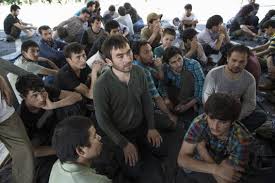
Detained Uighurs in Thailand. Photo: Reuters

Detained Uighurs in Thailand. Photo: Reuters

In the past two weeks, close to 300 suspected Uighur migrants were discovered in the jungles of southern Thailand. Since their discovery and apprehension by Thai authorities, accusations of terrorism and rebuttals to these claims have flown.

Quoting an unnamed source attached with Thai police, the Bangkok Post published an article claiming that the migrants were indeed Uighurs. They intended to use Thailand as a transit point to go to Turkey, where they would be trained in terror tactics that could be used in their native China and elsewhere.

Recently, two groups of migrants have been found in the south of Thailand. The first, discovered March 12 at a rubber plantation near Songkhla, was a group of 219 people, containing dozens of women and children. Another group of 77 were arrested near a school in Sadao district on the 20th of March.

The same source alleged that the migrants were identified as Chinese Uighurs and not Turks, as they have claimed, by bus tickets and items that had Chinese writing on them. “Immigration police are not stupid,” the police source added.

Turkey has sent diplomats to southern Thailand to verify the migrants’ claims of Turkish nationality. The migrants were able to speak with diplomats when interviewed, however when met by an interpreter from the Thai Immigration Bureau they could not communicate well. “The interpreter believed they could not speak Turkish,” the source said.

A named source, Thai Immigration Bureau chief Lt. General Panu Kerdlarppol, refused to give any specific details regarding the migrants’ nationality or ethnicity. However, historically and geographically, it would make more sense that they were Uighur. Thai authorities have been aware of a Uighur migrant presence in the country since last year.

In December 2013, 112 refugees were arrested in the country’s south and are now being held at a detention center. Thirty of the migrants have so far been positively identified as Uighurs. Following the arrests, Lt. General Panu met with Chinese authorities in Kunming about the issue.

There are some, however, that dispute claims of the migrants’ nefarious motives. Speaking through the Phuket Wan Tourism News, the New York-based Human Rights Watch dismissed the accusations.

‘The groups in question are composed of significant numbers of small children, and more than a few pregnant women,” Phil Robertson, Deputy Director, Asia Division, Human Rights Watch, said today, ”so one wonders how unnamed police sources have suddenly somehow jumped to a conclusion that these people are ‘terrorists.”

Mr. Robertson links these claims of terrorism to Thailand’s treatment of asylum seekers in the past. Starting in 2009, hundreds of Muslim Rohingya refugees from Myanmar began regularly washing ashore on Thailand’s western coast. These refugees, fleeing ethnic violence in their home, were also labelled as terrorists. Oftentimes, they were pushed back out to sea by units of the Thai navy.

”It seems pretty clear that Thai officials have some ulterior motives in trying to tar this entire group with the ‘terrorist’ label,” Mr Robertson said.

He believes the end game is to deport the migrants to China, ”I suspect that such ‘terrorist’ accusations are a prelude to some Thai government officials trying to force these groups back to China in what would be a clear violation of international law,” Mr Robertson surmised.

Migrants claiming Turkish nationality were also arrested in Malaysia this month, though no further word on their situation has been released.


1 Comment

Filed under China, Current Events, ethnic policy, Kunming Train Station Attack, Regional Relations, SLIDER, Thailand

‘Uighur’ Refugees Arrested in Thailand, Malaysia: Part of a Larger Trend?

Detained Uighurs in Thailand. Photo: Reuters

Detained Uighurs in Thailand. Photo: Reuters

Last week, East by Southeast, in a piece hypothesizing the motives of the Kunming train station attackers, made the connection between Uighur asylum seekers, Yunnan and Southeast Asia. In the analysis, ExSE posited that Thailand was a likely destination for Uighur refugees as they made their way from Xinjiang, through Yunnan and into Myanmar or Laos. This past week, two separate incidents in near the border of Thailand and Malaysia occurred that appear to confirm this hypothesis.

News was released on Thursday that Thai authorities had rescued 200 people from a human smuggling camp in the south of Thailand. During a raid on Wednesday, police discovered 200 people imprisoned in a camp suspected to be used for human trafficking.

The group, which includes 78 men, 60 women and 82 children, at first claimed to be Turkish, despite having no documents to confirm that. However, they have now been identified as ethnic Uighurs from China by a US-based organization.

With their identities confirmed, Thailand has faced calls to not to deport the refugees, with the US State Department also weighing in.

“We are concerned about Uighurs generally (and) welcome reports that these Uighurs were rescued,” State Department spokeswoman Marie Harf told reporters Friday. “We’re encouraging Thailand to make sure their humanitarian needs are met.”

US-based Human Rights watch also urged the Thai government not to deport the refugees. “Thai authorities should realize that Uighurs forced back to China disappear into a black hole,” Brad Adams, the organization’s Asia director said in a statement.  “They need to allow all members of this group access to a fair process to determine their claims based on their merits, not on Beijing’s demands.”

Refugees on the way to a Thai detention center

Refugees on the way to a Thai detention center

Despite these calls, dozens of the refugees were sentenced for illegal entry by a Thai court on Saturday, with each person assessed a fine of 4,000 baht ($124). For now, the men will be taken to an immigration detention center and the women and children will be taken to a shelter, according to Police Major General Thatchai Pitaneelaboot.

In a possibly related story, 62 people were arrested just across the border in Malaysia last week. Like the group caught in Thailand, the Malaysian also claimed to be Turkish refugees. The group of alleged Turks were found near the border fence during routine patrols early Thursday morning Deputy Superintendent Sivam of Malaysia’s General Operations Force said in a statement.

Despite their claims of Turkish nationality, those arrested were not carrying valid travel documents or identification papers and historically, there has been a small, if nonexistent presence of illegal Turkish immigrants in the region. In light of this and the arrests in Thailand, some in the media believe that the alleged Turks might in fact be Uighurs from China. If so, this would mark the largest number found in Southeast Asia to date.

If both groups arrested are indeed Uighur refugees, their escape to Southeast Asia wouldn’t be without precedent. Since Cambodia deported 20 Uighurs back to China in 2009, there have been a string of similar deportations in the region. In 2010, Lao PDR deported a group of seven Uighur refugees back to their native Xinjiang in northwest China and in 2011 and 2012, Malaysia deported separate groups of refugees to China. Each deportation case has been heavily criticized by rights groups like Amnesty International and Human Rights Watch. Human rights groups fear that once repatriated, Uighurs face a grim future of long prison sentences and possible torture. Refugees deported back to China from places like Pakistan and Cambodia have all faced life prison terms upon their return.

The threat of prison is likely a reason why those arrested in Thailand and Malaysia have claimed to be Turks when discovered. Instead of admitting to Chinese nationality and facing the possibility of deportation back to China and likely prison time, the refugees opted for claiming another nationality. Seeing that the Uighur population is nearly all Muslim and speaks a Turkic language, claiming Turkish citizenship was a natural choice.

However, as is the case with both groups of refugees, these people’s true identities have yet to be discovered. If they aren’t Turks, are they really Uighurs? If they are Uighurs, how did they get to the Thai-Malaysian border and why did they come this far? Was Malaysia, a Muslim-majority country with labor shortages, the final destination? If both groups are indeed Uighur, this would mark a new level of southward migration for Uighur refugees. Might this also tie them to Kunming train station attackers, as East by Southeast hypothesized? For now, these are only questions, but ExSE will be searching for answers.


1 Comment

Filed under China, Current Events, ethnic policy, Kunming Train Station Attack, Malaysia, Regional Relations, SLIDER, Thailand, Uncategorized

Kaiser Kuo: On Radicalization and Chinese Policy

I get that some people trying to make sense of the attacks in Kunming want to take the opportunity to discuss how Chinese policy contributed to radicalization. And while I’ve noted elsewhere how it bothers me profoundly that many Anglophone commentators offer a merely perfunctory nod to the monstrousness of the knife attacks that claimed 29 innocent lives and sent 160 or more people to the hospital with stab and slash wounds before moving on to the “real” issue of Chinese repression of Uyghur rights, I do believe the desire on the part of some people to use the Kunming massacre to talk about underlying issues is well-intentioned and appropriate.

What troubles me, though, is that too often in that ensuing discussion, this attack as well as all the recent attacks—whether or not they cross our (still somewhat blurred) definitional line into terror—are seen simply as responses to Chinese repression. Is there repression and bad policy? Yes, absolutely. Has it contributed to radicalization? Sure.

But is it the only factor that has contributed to radicalization?

Of course not. The weird part is that while it should be stunningly obvious that the whole context, the whole relationship between Islam and the secular, industrialized world, the whole discourse on the way Islamic peoples are situated in the modern world—all this has dramatically changed, but this barely enters conversation. There are myriad alternative responses, loci of identity, causes, leaders, and movements on offer now that just weren’t there pre-September 11. The Internet barely existed in the oasis cities of the Tarim before 2001.

But people are for the most part writing and talking about the situation as though it’s happening in complete isolation, as though the rise of radical Islam in the rest of the world since the 1980s doesn’t figure in. It somehow doesn’t merit a paragraph or two alongside the context paragraphs that most of the Anglophone outlets see fit to include about repressive policies in restive Xinjiang. People can’t see beyond the simple narrative of Chinese repression.

Any serious effort to look at what’s happened and where things might go from here has to look at Chinese policy, and I’m sure that there’s plenty of blame to be laid there. But it should also factor in—and this is a far from comprehensive list—the rise of Wahhabism and other fundamentalist sects much further to the west; the Mujahedin in the aftermath of the Soviet withdrawal; Bin Laden and AQ; their bloody work; the whole idiotic enterprise of the GWoT; networks like the Islamic Movement of Uzbekistan; the Afghan training camps (where let’s not forget there were many Uyghurs); the wars in Afghanistan and Iraq; and the Arab Spring in more recent years. It has to look critically at the WUC and the pared-down, simplistic narrative it’s managed to sell, and on and on.

It’s depressing that instead people are quibbling over how well organized ETIM is, with some even denying that any organizations like it exist at all. Or they quibble over whether scare-quotes should be used with the word terrorism. (Yes, I’ve been quibbling over that, but I think it’s important: Like many people, I find that the word’s been badly abused, mostly at the hands of the Bush 43 Administration, and is deeply problematic, but dropping our use of it now, or deploying it only with the scare-quotes, is too loaded a statement and sends very wrong messages).

But to my main point: Yes, let’s talk about the underlying problems. But let’s not for a second believe that if only the Chinese would be nicer all the nasty, violent radicalism would just disappear.

This post was originally published on Kaiser Kuo’s Facebook page on 3/3/14. It received so much attention that we reached out to Kaiser for a repost on ExSE.  This is posted with the permission of the author. Comments and discussion welcome.  

7 Comments

Filed under Current Events, ethnic policy, Governance, Kunming Train Station Attack, Regional Relations, SLIDER, Uncategorized

China’s Humanitarian Policy in the Philippines: Politics Over People?

Image courtesy Bruce Reyes-Chow

Image courtesy Bruce Reyes-Chow

China has been no stranger to territorial conflict throughout its long and complex history, having met plenty of resistance while spreading its dynamic culture near and far. Today is no different, as intense disputes over tiny island chains in the South and East China Seas have left China in a state of particularly poor relations with some of its most important neighbors. These disputes, of course, do not bode well for maintaining reasonable terms over some of the region’s most important geopolitical issues. However, what has become equally as apparent—and potentially more important—is the way these conflicts are currently affecting the way China conducts humanitarian policies in the region. As China continues to rise toward the top of global power and influence, many assert that with it comes a rising role of global responsibility. What we have found thus far is that China does not appear interested in taking up that challenge.

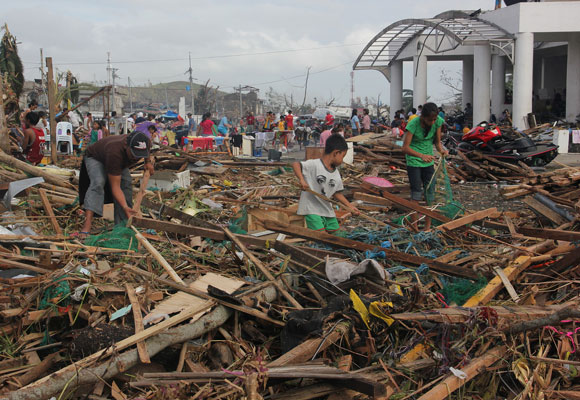
After Typhoon Haiyan—an exceptionally powerful storm—roared through Southeast Asia in early November and devastated parts of the Philippines, leaving the country’s death toll at over 6,000, China surprised the global community by offering a meager $100,000 in humanitarian aid. This, compared to the tens of millions of dollars in aid offered by many of the world’s most powerful countries, was perceived as particularly frugal and, to some, downright disrespectful. Understandably, China received quite a bit of backlash for its decision and soon thereafter increased its contribution to $1.6 million and committed state medical resources to the areas of the Philippines most affected by the disaster. However, China’s initial contribution seemed to clearly define its true opinion on the issue.

Despite China’s late arrival to the hard-hit Philippines, its aid and assistance was, of course, still received warmly and excitedly by the victims. When a natural disaster afflicts a nation, political relations no longer seem to matter to many. Filipino residents greatly embraced China’s support. Gina Tubigon expressed her appreciation after China’s arrival ensured the survival of her sister-in-law, Elesea. A 75-year-old suffering from a chronic respiratory ailment that worsened in the wake of the typhoon, Elesea may not have lived through the storm’s aftermath had it not been for the assistance of the Chinese medical team. Relieved about her sister-in-law’s stabilized condition, Gina expressed her appreciation, noting, “I know the relationship between the Philippines and China is not good, but we’re very thankful for the help.” This purely honest and non-politically calculated sentiment sums up the importance of cooperative relations between the two nations. It also suggests the possibility that a lack of increased aid and assistance from the Chinese government may have caused Gina to lose her sister-in-law.

 Relations between the two countries have been tumultuous for some time. As China continues its unprecedented rise, with an increasingly strong military accompanying extraordinary economic development, its Southeast Asian neighbors have become more and more anxious about territorial integrity. As China’s claims to the region become more extensive, the Philippines has been bolstering its defense and maritime law enforcement—with the help of US support—and has sought endorsements from ASEAN during the process. The Philippines, just like many of its regional neighbors, has endorsed the US’s recent pivot to Asia, as a mechanism to balance against Beijing’s increased maritime objectives.

These exhaustive disputes have occurred between the two countries for decades, but have become further amplified in recent years, as China’s claim to maritime territory off the coast of the Philippines—the 200 nautical mile radius that makes up its Exclusive Economic Zone (EEZ)—has continued to expand. This includes a tiny rock called the Scarborough Shoal, which is no bigger that the size of a relatively small raft, yet vital to the two countries, as it holds important designation for charting territorial boundaries. The dispute between the two countries serves as a microcosm for a more general trend of tension and insecurity that has existed between China and its neighbors further south.

Though these tensions have persisted for many years, amplified to greater extents during certain periods more so than others, they have ceased to have a highly significant or long-term impact on trade relations in the region. Yet, China’s frugal initial response to Haiyan relief reflected a new realm of implications—that these strained relations are having a negative impact on how China is handling its humanitarian policy in the region. As the countries of East Asia continue developing economically, their regional interdependence grows in import. They must be prepared to support one another in combatting natural international crises that extend beyond politics, such as typhoons of the magnitude of Haiyan, especially when these crises have potential for mutually severe impact on multiple countries in the region.

China’s interest in extended control and influence over the region of the South China Sea—and East China Sea as well—has caused many to ponder whether Beijing also plans to embrace a wider role of responsibility regarding international crises. By offering such a small amount of financial aid during the immediate aftermath of this horrific storm, Beijing has implied that—at least for the time being—national interests remain the focal point of its current objectives, clearly trumping the need to be an international leader.

Of course, China’s stance toward the Haiyan relief effort is certainly not simple—with a range of complex considerations likely at play throughout the decision-making process. One fundamental question posed in response to China’s position is whether China is currently choosing not to emphasize the importance of more intimate relations with its neighbors—and the international community more generally—in order to instead commit more focus inward. As the Chinese government creates very carefully calculated strategies regarding domestic economic growth and infrastructural development, large numbers of financial resources and assets are presently committed to various projects throughout the country.

Indeed, China’s current national economic milieu is one of many different parts. These parts include initiatives such as western economic expansion, raising the standard of living for larger populations, developing the nation’s energy sector in a push for cleaner sources of fuel to drive the country’s future development, further establishing modern industries throughout different parts of the country (i.e. financial, technological, and creative/cultural sectors)—and many others. In addition, unprecedented economic progress has also instigated a range of complex social strains, some of which have never before been seen. Actively seeking to deal with these increasingly pronounced issues, such as frustration with appallingly high levels of pollution, larger interest in individual freedoms and self-expression among Chinese citizens, and rapidly evolving national identity—to list only a few—the Chinese government is carefully undertaking its national strategy.

As China consciously addresses these economic and social factors, simultaneous emphasis on non-political/economic international issues may not be on the immediate agenda. National leadership may currently ascertain that, still in an infant state of modern global importance and influence, this complex and highly dynamic country is not in a position to fully involve itself financially and logistically in these types of crises. However, regardless of China’s strategy with respect to regional and international stability—which at this point can only be speculated—what is clear is that China’s highly active position in geopolitical affairs has caused its western counterparts to expect a greater level of support from the rising giant towards these types of crises. Most important will be how China responds to this increased level of pressure and expected responsibility from its global economic partners as similar issues come about into the future.

Nevertheless, in the case of Haiyan, this is only but one event in the midst of a lengthy modern history of strained relations between these two countries that has fluctuated in degree over the years. Therefore, only time will tell if China’s increasingly powerful international role will cause the economic powerhouse to engage the international community differently into the future. In the meantime, the aid and assistance that China did eventually provide to the Haiyan relief effort was effective and surely prevented many from severe illness or death. The victims of the storm as well as those on the medical relief team were not considering regional political tensions as lives were saved. This kind of understanding and expectation will hopefully be at the core of decision-making between China and its Southeast Asian neighbors into the future, as a rapidly changing world seeks to prioritize people over politics.


Leave a Comment

Filed under China, Current Events, Foreign policy, Philippines, Regional Relations, SLIDER, South China Seas

The Kunming-Bangkok Highway’s Final Link Opens over the Mekong

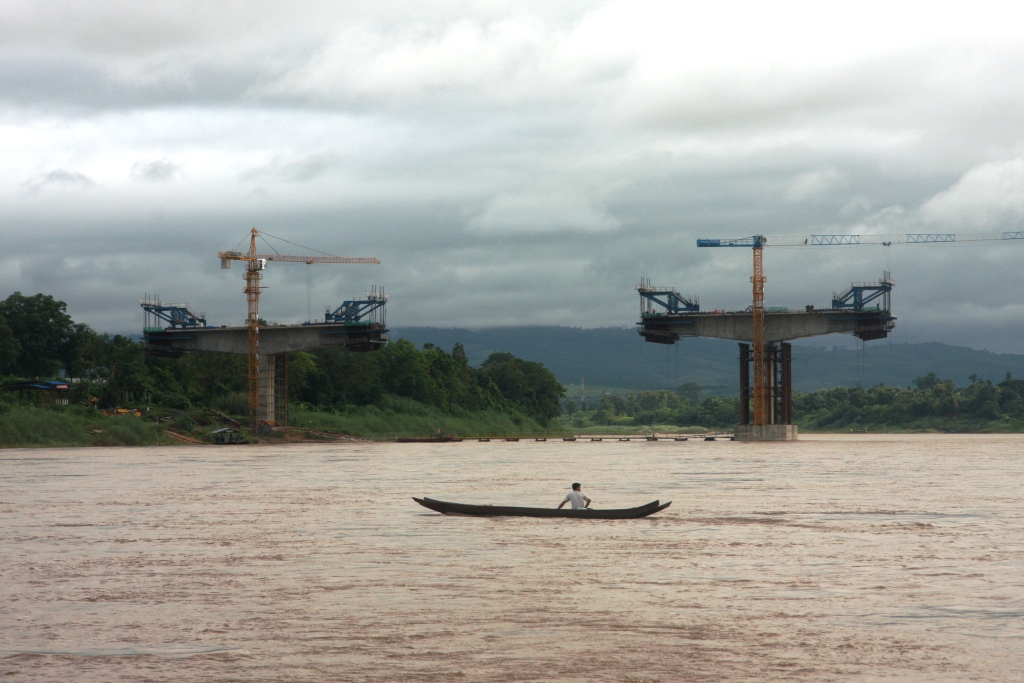
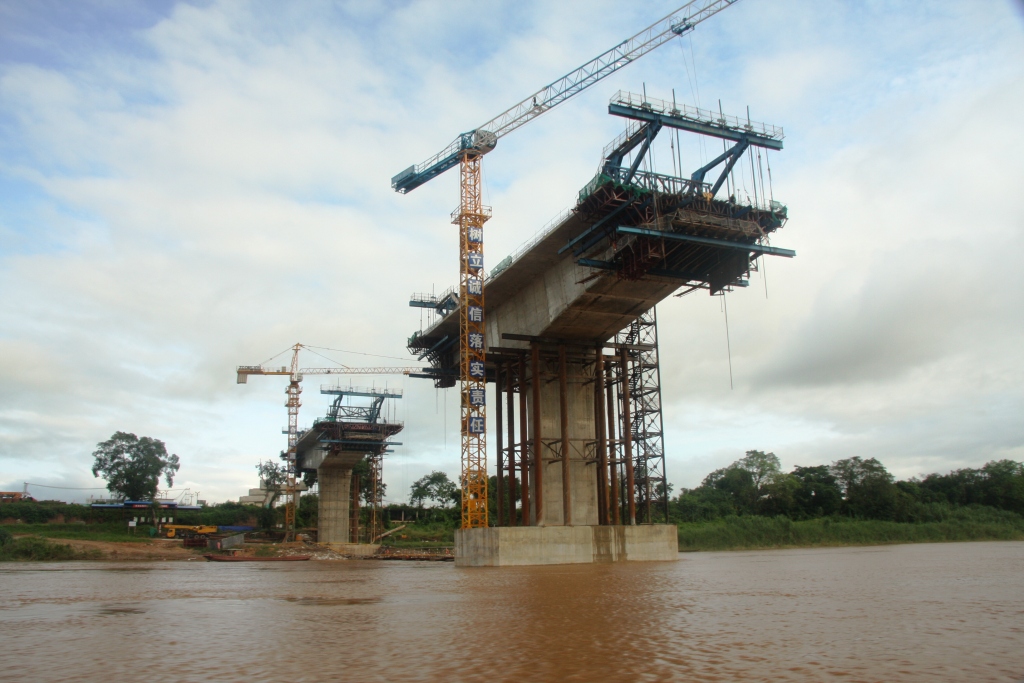
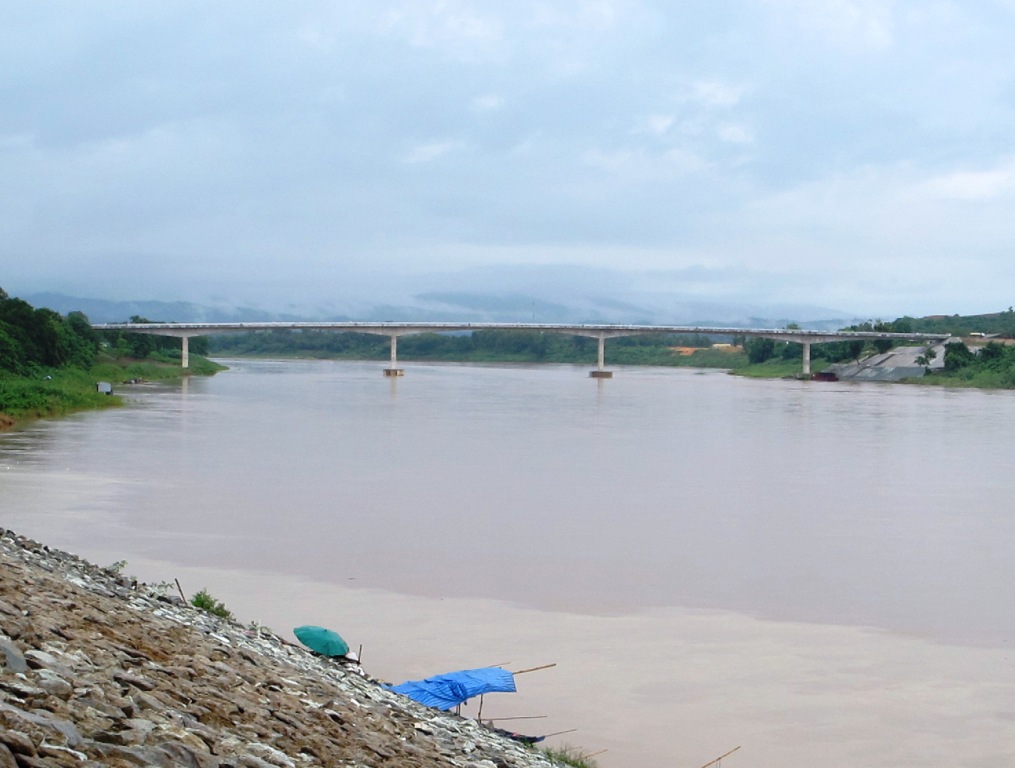
The Fourth Thai-Lao Friendship bridge which connects Thailand’s Chiang Rai province to Lao PDR’s Bokeo province officially opened for business yesterday.  Although the bridge, which stretches 400 meters across the Mekong river, and surrounding customs and inspection infrastructure have been completed for a few months, the two countries set the auspicious date of December 11, 2013 or 11/12/13 as written in the international form for the bridge’s opening ceremony conducted by Thailand’s highly respected Princess Sirindhorn.


A local fisherman navigates the Mekong downstream of the new bridge (July 2012)

A local fisherman navigates the Mekong downstream of the new bridge (July 2012)

The prime benefactor from the bridge’s opening is not Thailand or Laos, but rather China as the bridge serves as the final link in the Kunming-Bangkok highway, a 1900km series of connected highways that will facilitate significant increases in container shipping trade between China and Thailand.  Six years ago overland transport between Kunming and Bangkok for container shipping was virtually impossible due to the poor quality of roads.  In China’s southwestern Yunnan province, a drive from Kunming to Jinghong, the Dai cultural capital of Sipsongpanna (Xishuangbanna) prefecture took up to 24 hours and another six hours to the Lao PDR border at Boten.   China completed its portion of the highway to in late 2007.

The Lao PDR segment of the highway connects Boten to the 4th Friendship bridge in Huayxai and cuts through 180km of the most remote parts of Laos.  In the summer rainy season of 2004 I hitched a ride on a pickup truck to travel the 180km segment which then was a single lane mud track.  We completed the tiresome 10 hour drive only after averting a serious accident and certain death when the truck spun out of control nearly pitched over a 400 meter cliffside.    China, Thailand, and the Asian Development Bank invested equal thirds in the Laos portion of the highway which opened in 2010 and dropped transportation time to three hours.

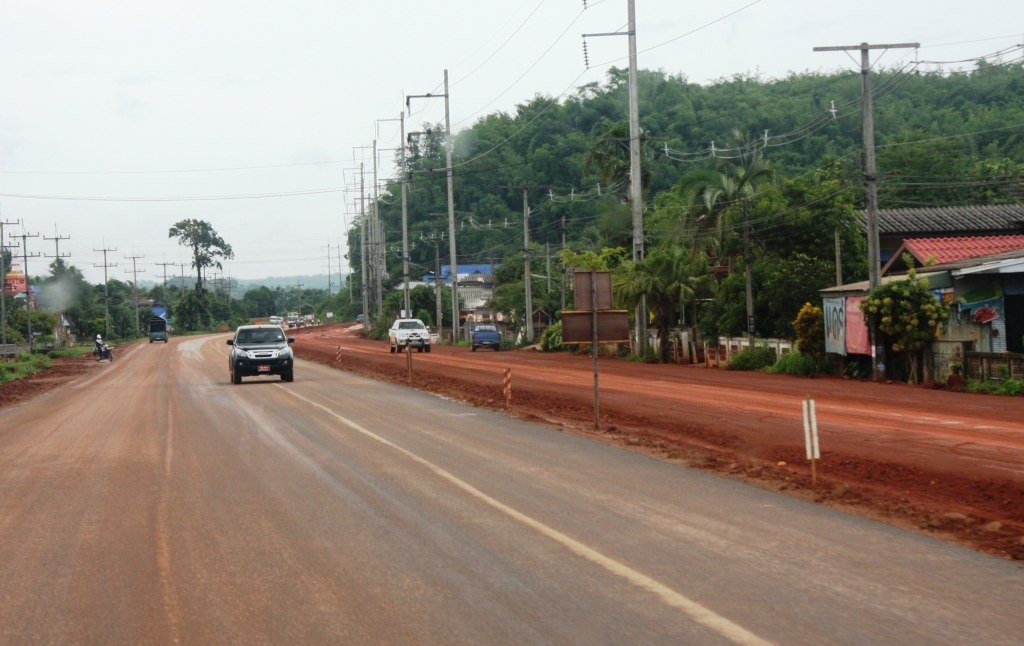
By design, the highway system links the friendship bridge to Bangkok, but despite being the strongest economy on mainland Southeast Asia, Thailand’s highway system lags behind in quality compared to China and the stretch running through northern Laos.  Improvements to Thailand’s R3 highway system which will link Chiang Rai province to all points in Thailand is ongoing but far from complete.  Thailand has promised to upgrade its national transportation and highway infrastructure but political roadblocks, corruption, and a perceived lack of momentum for regional integration at many levels of Thai government and society has discouraged those plans from synching up with China’s outwardly stretching infrastructure linkages.   When the Thai roads are finished, a container truck will be able to travel from Kunming to Bangkok in less than 18 hours.

Road widening construction on Thailand's R3 in Chiang Rai province

Road widening construction on Thailand’s R3 in Chiang Rai province

The 14 hour drive from Kunming to the friendship bridge feels like a leapfrog journey from bridge to tunnel and tunnel to bridge as the road makes its 1800 meter descent.  These two roads cut through some of the most difficult terrain on the planet and link the Chinese state to the Thai state while passing through the most ethnically diverse region in Asia.

The roads not only to build regional commercial connections between China, Thailand, and Laos through the increases of trade and investment but they also assist in expanding each of these state’s interests and systems into the once impenetrable regions of upland southeast Asia by introducing national education systems, agricultural techniques that promote mono-cropping over traditional subsistence farming, and creating avenues for ethnic and rural peoples to leave their homes and link up to national labor markets.   The opening of the bridge will increase trade in the region and will intensify and quicken the pace of social change in upland Southeast Asia and reshuffle the cultural milieu of peoples who have sought refuge from the expansionary Chinese and Thai states for centuries.

Under construction, July 2012

Under construction, July 2012

Bridge completion, December 2013

Bridge completion, December 2013

The bridge’s construction has also caused an influx of Chinese investment in Chiang Rai province mostly in real estate development, speculation on future industrial estates for manufacturing of intra-industry goods passing between China and Thailand, and the buying up of agricultural lands.  While this investment is encouraged and welcomed at the national level and by the Chiang Rai Chamber of Commerce, locals are wary of the fast and growing levels of investment in the Golden Triangle Area by Chinese firms and often cite a “Chinese invasion.”  The mayor of Pak Ying Tai village, a small fishing community of 100 households located less than one kilometer south of the bridge has lamented to me on several occasions about China’s footprint in Chiang Rai as he observes year on year decreases in freshwater fish catches and sends more and more of his villagers looking for work in urban areas.

A local farmer from Pak Ying Tai village discusses his worries about community impacts of economic development

A local farmer from Pak Ying Tai village discusses his worries about community impacts of economic development

In many ways the bridge and its construction serve to represent the challenges of regional cooperation between China, Thailand, and the rest of mainland Southeast Asia.  From its conception in the late 1990s to its completion yesterday, the bridge has gone through stalled and failed rounds of negotiation and has not lacked controversy.  Groundbreaking for the 1 billion Thai baht project which is equally invested by China, Laos, and Thailand did not occur until 2010 despite a scheduled start for as early as 2006. In May 2011 Thailand pulled its portion of the construction team in order to settle a land dispute with the local Thai government accusing Chinese commercial interests of illegally purchasing land on the Thai side of the bridge.

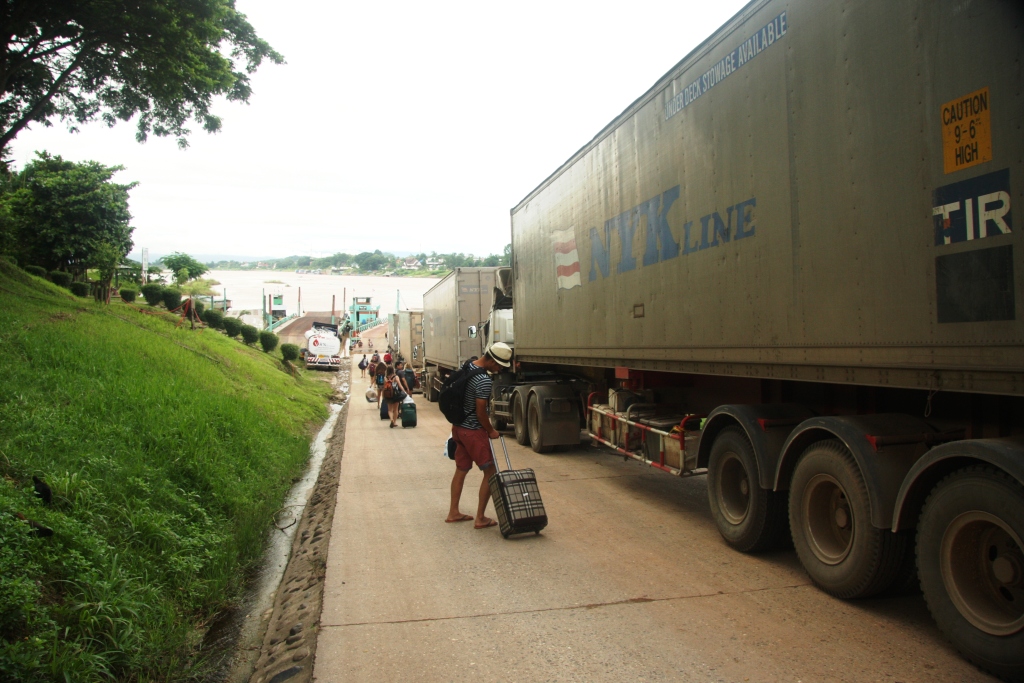
Container trucks will no longer have to wait in line for the Mekong ferry at Huayxai in Laos.

Container trucks will no longer have to wait in line for the Mekong ferry at Huayxai in Laos.

Another obstacle to regional cooperation demonstrated by the bridge is the ease of passage through customs and inspection for both container trucks and individual travelers or tourists to the region.  Chinese trucks are not permitted to drive in Thailand, nor are Thai trucks allowed to travel through China; thus the speed of transport is slowed by the need to repackage goods at one of the border crossing points. Despite efforts of the ADB in to facilitate a shared cross border trade and transport protocol to streamline logistical flows at regional border checks in China and mainland Southeast Asia, states have been slow to adopt the measures in order to protect national markets and logistics industries.  New customs and inspections facilities at the bridge are fitted to increase the speed of transport and ease of people movement and will serve as a testing ground for these promised increases in logistical efficiencies.

Looking forward to the first six months after the bridge’s opening, the verdict will be clear on whether the bridge will serve as a strategic choke point, a gateway for win-win trade and economic development between two regional powers , or a conduit that will further challenge the structure of rural livelihoods in upland Southeast Asia.

Looking upstream at the completed bridge from Pak Ying Tai village.

Looking upstream at the completed bridge from Pak Ying Tai village.

Leave a Comment

Filed under China, Current Events, Economic development, GMS, Mekong River, Regional Relations, SLIDER, Thailand, Uncategorized, Yunnan Province

Gary Locke, US Ambassador to China visits Kunming one day after announcing resignation

photo 1

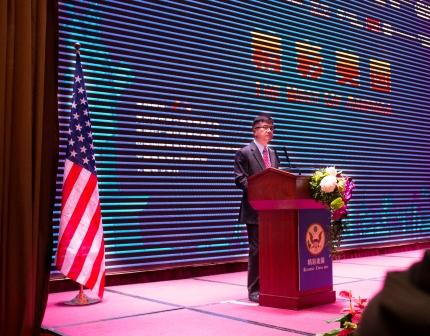
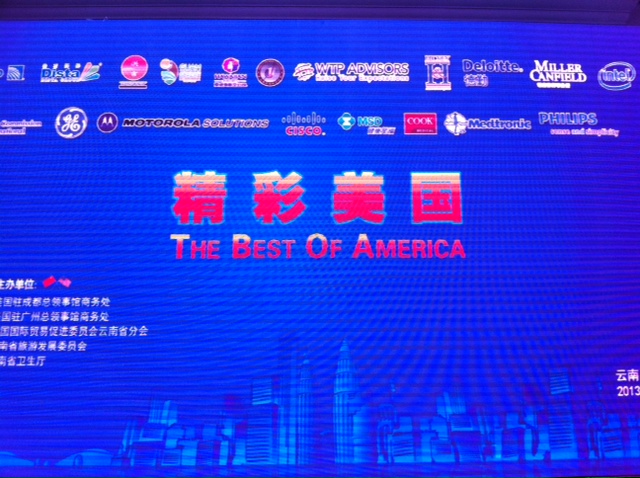
US Ambassador to China Gary Locke paid his third visit to Yunnan province on Thursday, November 21, one day after the announcement of his unexpected resignation.  His visit was part of an investment promotion roadshow entitled “The Best of America” traveling around China’s southwestern provinces and organized by the US consulates in Chengdu and Guangzhou.  The event was hosted by provincial vice-governor Gao Feng and attended by Yunnanese business interests and officials from the provincial international trade promotion department, tourism department and public health departments.   Core economic strengths of the US were represented by CEOs and officers of Deliotte, GE, Motorola, CISCO systems, Intel, and Miller Canfield Law firm in addition to other firms.  United Airlines was also in attendance and eager to promote its new direct flight from Chengdu-San Francisco opening early 2014.

Opening remarks were given by both Ambassador Locke and Vice Governor Gao. Both speeches highlighted the United States’ and Yunnan’s shared history of cooperation through the Flying Tigers, as well as the need for present day economic cooperation. In his remarks, Ambassador Locke boasted of the increase of China-to-US FDI under his tenure. In the past 21 months, investments from China totaled USD 18 billion, more than the past 10 years combined, an accomplishment Locke can only take partial credit for, as larger macroeconomic trends in the US and China were also important factors. Locke was also able to highlight the increase of Chinese students in the US in recent years. According to the ambassador, the number of Chinese students in the US reached 280,000 in 2012. In addition, Ambassador Locke was also able to point to decrease in wait time for US visas and a new, expanded visa office at the Chengdu consulate as notable achievements under his tenure.  Aside from pushing investment in America, Locke also promoted core American values like legal transparency, free trade and intellectual property rights, issues that have been divisive for the two countries in past years.

Photo courtesy of Allie Horick

Photo courtesy of Allie Horick

Speaking directly after Ambassador Locke, Yunnan’s Vice Governor Gao Feng also promoted bilateral trade and cooperation. In his remarks, Vice Governor Gao emphasized Yunnan’s role as China’s gateway to South Asia and Southeast Asia and its fast pace of the its economic growth. Gao pointed to the recent China-South Asia Expo as a marker of Yunnan’s rise in national and regional importance. The US delegation noted that Locke’s visit to Yunnan went very smoothly and all requests for visits to companies and government ministries were granted, including a visit to Yunnan University, where the Ambassador met with students and professors. This is in contrast to the difficulty encountered when US delegations request access in other provinces and autonomous regions in southwest China, particularly Tibet.

The roadshow was planned with the specific purpose of promoting Chinese FDI to the US, the export of medical technology to Yunnan’s developing healthcare sector, and tourism to the US.  After the Green Lake Hotel event, the delegation met mostly with potential investors from the agriculture and mining sectors reflective of these two sectors as two core pillars of Yunnan’s economy – tourism.  Locke also encouraged US investment in Yunnan tourism management systems – something sorely needed in Yunnan, and China at large, as localities struggle to protect cultural capital bases and natural endowments from the damaging onslaught of mass Chinese tourism.

photo 2

The inability of Yunnan’s medical infrastructure to keep up with the demand for medical services was apparent when the delegation was shown MRI scanner purchased from the US that had been use for 10 years at the Kunming Number One Hospital.  The machine was being used 70-80 times per day non-stop for seven days per week.  Cumulative cost of parts and supplies maintenance, all imported from the US, had greatly exceeded the original cost of the machine.

Lastly, Chinese tourism to the US was high on the list of promotion for the delegation.  In 2012, tourism to the US was the US’s top service sector export with Chinese tourists leading the way in number of tourists visiting the US in a by country breakdown.  In international trade accounting, foreign tourist visits are counted as an export due to the positive accumulation of foreign income.

Locke’s visit is recognition of the fruits of the China’s Western development program – namely economic progress to the degree that US investors are now drawn to the fast growth rates coming out of China’s southwestern provinces.  And as a result of that economic progress, Yunnanese investors have reached levels of wealth garnering capabilities to invest in the US, half a globe away.  His visit is also reinforcement of Yunnan’s strategic location as a gateway for regional investment to Southeast Asia and South Asia – a key point mentioned by both the US delegation and the provincial hosts.

Later in the day, Locke’s diplomatic rock star status was confirmed by an exuberant crowd of students at Yunnan University proud of their shared heritage with the US ambassador.  Locke returned that exuberance with hugs.   With Locke stepping down it may be a while until another US ambassador to China receives the kind of welcome received in Thursday in Yunnan.

Consensus among some of the ExSE members is that Locke may be stepping down in preparation for a high appointment related to the 2016 presidential election.  He is an extremely successful career politician with experience managing Americans’ most important bilateral relationship, domestic economic and international trade relations as US Commerce Secretary, and a successful run as governor of Washington State.  This portfolio positions Locke as a strong candidate for VP or Secretary of State under a future Democratic presidency.  Gary Locke will step down as US Ambassador to China early 2014 after taking up the post in August, 2011.


Leave a Comment

Filed under China, Current Events, Economic development, Regional Relations, SLIDER, Uncategorized, USA, Yunnan Province

China’s Bridgehead Strategy and Yunnan Province

Editor’s note: Liu Jinxin wrote this essay to debunk the myth that China’s bridgehead strategy is militaristic or expansionary in nature.  As a chief architect of this strategy, he seeks to demonstrate that developing Yunnan province into a bridgehead will increase international trade flows and deliver long-term regional security.  This translated essay currently guides top-level foreign policy makers in China in implementing economic strategies along its borders with Southeast Asia.  


Yunnan province's border crossing with Vietnam at Hekou/Lao Cai

Yunnan province’s border crossing with Vietnam at Hekou/Lao Cai

The definition of a bridgehead?

According to the Modern Chinese Dictionary, a bridgehead (桥头堡) is a military term that refers to a strategic chokepoint on the field of battle and particularly refers to a fortified structure that defends and controls a bridge or ferry crossing. In economic terms, bridgehead refers to a strategic forward position on a political or economic front line. The term bridgehead appeared for the first time in an official national level Chinese policy document called “Eastern Bridgeheads” in July 1994 which confirmed the Shandong cities of Rizhao and Lianyugang as the bridgehead terminus of the Eurasian landbridge.

In the economic research of landbridges, a bridgehead is a key concept that acts as a port and facilitates the ease of transportation. Bridgeheads are also international centers of shipping, finance, and information which together form an integrated international center of trade. From a logistical and supply chain system perspective, a bridgehead serves basic support to the Eurasian landmass. It is a city or a region that sits on a strategic position on the logistical and supply chain and serves the specific purpose of controlling the flow of resources along international trade routes. The basic characteristics of a bridgehead are its powers to control, develop, and influence.

The power to control

The power to control suggests capabilities levels of secure logistical flows. This can be understood in narrow and broad senses. From a narrow sense, secure logistical flows are conditional to the degree of market openness.  The survival and development of logistical flows must not be threatened by the power of a government to regulate or control it. From a broad sense, a state’s security and international security are guaranteed by engaging in logistical activities. The capability of a state’s secure logistic flows is determined by its capacity to control strategic resources, logistics routes, linkages, and its industrial supply chain.

Linking with the similar strategic logistic routes, resources, and supply chain structures of neighboring states, a concerted logistics system can deliver harmony and mutual trust as well as a collective security that realizes long term stability. Fostering mutual trust, mutual benefit, and equality work together to form a new worldview for security and protects the security of individual states as well as respects the security concerns of other states.  Mutual trust also promotes collective security.


The power to develop 

Developmental power is preconditioned by the construction of logistic routes, linkages and supply chain structures, the developmental needs of economic corridors, and mutual benefit and cooperation. This power can help states share development trajectories, share prosperity and harmonious development, and eliminate security threats at their root. States should place the promotion of shared development as the method for solving global development imbalances and fostering sustainable development. To revolutionize international financial systems, oppose trade protectionism, and promote regional economic cooperation, developing countries should establish development modes that foster interdependence, deliver effective beneficial outcomes, and seek to erase poverty. Developing countries should expand trade with each other, open markets to each other, and increase the level of south-south cooperation.


The power to influence

Influential capabilities rely on a state’s degree of openness and tolerance, strengthening of the construction of a national culture, making positive contributions in international cooperation, solidification of geo-cultural space, promotion of geo-cultural integration, ability to cooperate harmoniously, and mutual progress with its neighbors. States should respect the rights of other states to determining their own development paths by admitting differences in cultural traditions, social systems, and value systems. States should actively promote and provide guarantees to human rights, and increase dialogue to eliminate misunderstandings. States should initiate a spirit of openness and tolerance, make use of the development modes of other states in a comparative and competitive fashion, and seek collective development despite differences.


The functionality of China’s bridgeheads

The central government has required Xinjiang Uyghur Autonomous Zone, Yunnan province, and other frontier provinces and zones to open the construction bridgeheads along national borders to implement a stable and prosperous frontier region. To deliver prosperity, the bridgeheads should:

1) Be a foundation of protecting border security and stability

2) Take measures under the conditions of high technology to serve as a front line in partial wars and non-traditional security issues

3) Support efforts to rapidly develop ethnic and national zones through new economic modeling

4) Expand the promotion of international/regional cooperation with neighboring states and extend degrees of openness by forging ahead as zones of experimentation.

5) Serve as a transit and storage point for national energy resources.

From a spatial perspective, Xinjiang acts as a bridge between the East and the West; it is the new Eurasian landbridge’s thoroughfare, and as a “west gate,” it serves the opening of China’s northwest region to Central Asia and Europe.

Yunnan opens China to the Southwest connecting two oceans, the Pacific and the Indian as well as East Asia, Southeast Asia, and South Asia. It is the linkage point between China’s southwest, the Southeast Asian peninsula, and the South Asian Subcontinent, and is the starting point of the Yangtze River Delta economic zone as well as the Pearl River Delta economic zone. Yunnan acts as the core belt of the China-South Asia Economic Circle and the China-Southeast Asia economic circle. It is the main connective channel between China and the Indian Ocean and is China’s core zone in the Greater Mekong Subregion. More importantly the province serves as a key trade passageway for goods and services passing from China to South Asia and the Southeast Asian peninsula.

gms_map_large

Core Values

China’s bridgeheads are a result of major changes in geo-strategic international structure. The concept is part of China’s key diplomatic principles which pledge to be a good neighbor, a prosperous neighbor, and a secure neighbor. It is also reflective of China’s active pursuit of being a responsible world power. The core values of the bridgehead strategy are:

1) To foster an infrastructure development strategy that expands participation in the world market and establishes interdependence, while constructing mutually beneficial win-win relations with its neighbors

2) To highly prioritize unity among ethnic peoples and social stability by promoting cultural diversity and shared developmental progress

3) To respect  public opinion and the will of peoples in neighboring countries, and respect their value systems by promoting cooperation and exchange between peoples and democratic equality

4) To acknowledge the guidance of international voices and place equal importance on China’s international image and economic benefit

5) To safeguard the benefit of overseas Chinese and Chinese businessmen abroad

6) To value strategic resources, strategic routes, the shared security of strategic industrial supply line

7) To promote the construction of low carbon footprint urban areas and the use of clean energy by promoting an economic society that delivers harmonious, stable, and secure sustainable development

8) To promote the construction of a harmonious new world order and the active promotion of new kinds of partnerships with neighboring countries

9) To resolutely protect free and fair global trade and investment climates, and maintain the free flow of products, investment and services

10) In the long term, to promote sustainable growth, coordinated concerns, advocate tolerance to total adjustment, and promote balanced growth

Global economic balances can only be reached through sharing benefits and needs between developing and developed states.


Yunnan province as China’s southwest bridgehead

The southwest bridgehead is the front line of China’s interaction with the Indian Ocean, and its purpose is to construct a series of overland pathways given China’s southwest connects to South Asia and Southeast Asia trade routes. The bridgehead’s purpose is also to construct a base facing South Asia and Southeast Asia that supports export processing and the facilitation of international and domestic production, and the Kunming international land port economic zone.

Establishing Kunming as an inland economic zone will strengthen logistical flows coming from South Asia and Southeast Asia, create a tourism base for national culture, a commerce base, export processing base, and modern agriculture base as well as an information platform. This platform will come together through the increased progress of the yearly Kunming trade fair, China-South Asia fair, and the creation of different cooperation forums. The central objective is to turn Yunnan province into China’s platform for communicating with Southeast Asia and South Asia. Through creating this window, Yunnan can facilitate the building of trust between China and South Asia and Southeast Asia, and demonstrate the fruits of reform as well as Chinese culture by promoting mutual understanding and friendship. Yunnan can become a demonstration zone for how China can open to its neighbors.

The influence of a bridgehead extends outwards and is continuously stretching its limits. In China this includes two major regions.


A bridgehead to Southeast Asia

Southeast Asia includes the 10 ASEAN states of Malaysia, Philippines, Singapore, Thailand, Indonesia, Brunei, Vietnam, Lao PDR, Cambodia, and Myanmar and the non-ASEAN state of East Timor. In total this region covers 4.5 million square kilometers, supports a population of 580 million, has a combined GDP of $1.9 trillion USD and a total trade of approximately 2 trillion USD. The creation of the ASEAN-China Free Trade Zone in 2010 created a free trade area of 13 million square kilometers and a combined population of 1.9 billion. It is the largest populated free trade zone in the world and the largest free trade zone among developing countries.

China and ASEAN states are linked by mountains and rivers and share advantages by having varied distribution of resources, differences in specialization of industrial processes, complementary strengths, and an enormous potential for cooperation. As trade between China and ASEAN states increases at a rapid rate so are rates of investment. China is ASEAN’s 4th largest trading partner and ASEAN is China’s 5th largest trading partner. ASEAN has been established as a priority zone for attracting Chinese FDI and is one of the outward investment zones for Chinese industries. ASEAN is also a major market for Chinese labor, and China is winning an increasing amount of engineering contracts in ASEAN.

To date China and ASEAN trade relations have already entered a “Golden Era” and as China and ASEAN open their markets to each other, the ASEAN-China Free Trade Zone will enter a substantive phase. These contributions will bring robust commercial opportunities as the Southeast Asian peninsula is a major global agricultural production area and a critical zone of emerging industries.


A bridgehead to South Asia

The South Asian subcontinent (by way of the BCIM economic zone which includes Bangladesh, China, India, and Myanmar) is the geo-strategic fulcrum between the Indian Ocean and the Arabian Sea. At the same time, it is zone of choice for the secure channeling of China’s energy resources. The South Asian Subcontinent is also known as the Indian Subcontinent and is comprised of the Indian peninsula, the Indus river plateau, and the downstream plains of the Ganges and Brahmaputra rivers covering an area of 4.3 million square kilometers. It supports a population of 1.2 billion on 10% of the Asian continent. Its northern reaches are formed by the Himalayan and Karakoram mountain ranges and its southern limits are the Arabian Sea and the Bay of Bengal. Its western borders are limited by the Iranian plateau, and its eastern frontiers are the mountainous eastern regions of India, Bangladesh, and Myanmar.

The severity of South Asia’s natural landscape has prevented integration and the historically its cultures have been relatively closed-off to each other. This has produced divergent sentiments of independence in the region. The South Asian subcontinent includes India, Pakistan, Bangladesh, Nepal, Bhutan and does not include Sri Lanka or the Maldives. Its major rivers are the Indus, Ganges, and the Brahmaputra. Major agricultural products are wheat, rice, cotton, hemp, cane sugar and tea. Resource endowments include coal, mica, zinc, and gold.

An international pathway can be built from Yunnan through Myanmar to give China direct access to the Indian Ocean and its benefits will promote good neighborliness and the strengthening of border areas. Frontiers serve the specific functions of national defense and economic and cultural exchange. Sharing borders with Myanmar, Lao PDR, and Vietnam, Yunnan province serves as the connective link between China, South Asia, and Southeast Asia. It offers an alternate route to the passage of goods through the Straits of Malacca and is the fastest land route for goods to travel from China to South Asia, the Indian Ocean, Europe, and Africa.

Due to its advantageous geographical position, the province can facilitate huge market potential with partners in South Asia, Southeast Asia, and the Middle East. Lastly, because of its history of friendly exchange with its neighbors, Yunnan province serves as the ideal representative for diplomatic connections.

The construction of international pathways will do much to improve the state of transportation and shipping and can only expand and deepen the political, economic, and cultural cooperation between China and Southeast Asian states. Building these pathways and supporting the bridgehead strategy will develop regional economic cooperation between China, Southeast Asian, and South Asian states, strengthen the relationship of good neighborliness, and bring stability and peace to China’s border areas.

4 Comments

Filed under ASEAN, China, DOCUMENTS, Economic development, GMS, Laos, Mekong River, Myanmar/Burma, Regional Relations, SLIDER, Thailand, Vietnam

Missed Opportunity? Barack Obama Cancels Southeast Asia Trip

obama

Earlier this week US President Barack Obama cancelled his historic visits to Malaysia and the Philippines but made good on his promise to attend regional leadership meetings in the coming days where key trade agreements and hard power deals are likely be negotiated and fortified.  However, domestic pressures over the budget crisis and government shutdown in Washington have caused the President to scrap his trip entirely.

Will Obama’s absence be a game-changer for regional relations and the US’s strategic pivot to the Asia Pacific?  Will Tea Party-infused political brinkmanship in the US offer Chinese president Xi Jinping, also attending the summits, a golden opportunity to expand China’s regional footprint?

Obama’s strategic “pivot” and return to the Asia Pacific, by and large, has utilized Southeast Asian states as a springboard in developing a program of political and economic laurels that open up Southeast Asian markets for foreign direct investment and international trade.  From a 1,000 foot view, the US pivot looks similar to China’s foreign policy to Southeast Asia, thus the US’s program both complements and competes with China’s regional rise.  It is important to remember that due to its proximity to Southeast Asia and its fast-tracked economic expansion, China’s investment and trade volumes with Southeast Asia will always exceed that of the United States.  However another hard reality is that US power in Southeast Asia, both soft and hard, will always eclipse that of China’s.  It will take major restructuring in the US (for the worse) and in China (for the better) to reverse this relationship.  Despite the best efforts of the Tea Party in the US and potentially of an equally challenging New Left movement down the road, the status quo in terms of the channels that express US military, economic, and cultural power in Southeast Asia are unlikely to weaken.  For China, we are uncertain of Xi Jinping’s economic reform platform likely to unfold at year’s end, but we can be assured that his platform will focus on strengthening China’s domestic economy first, with foreign policy and other considerations taking a backseat.

In terms of soft power choices between China and the US, the consistent preference of Southeast Asians is to side with the US or at the very least, against China.  Wealthy Southeast Asians, like the Chinese, send their children to top US universities for robust skilling; Southeast Asians, like Americans, go to China to learn Mandarin. Middle income consumers in Thailand, Vietnam, and Malaysia refuse to purchase Chinese made smart phones (and their apps and operating  systems), those who have the means to purchase cars in Laos choose Japanese Toyotas or refurbished Korean used cars, and with the Chinese mainland’s crowding out of the Hong Kong and Taiwan entertainment industries, no one in Southeast Asia listens to new music or watches new films coming out of China. Continue reading →

1 Comment

Filed under ASEAN, Current Events, Foreign policy, Regional Relations, SLIDER, USA

China & Southeast Asia: Unbalanced Development in the Greater Mekong Subregion

By Xiangming Chen and Curtis Stone

Integrating with Southeast Asia is a key component of China’s multi-pronged regionalisation around its borders as its global rise continues. Below, Xiangming Chen and Curtis Stone consider the ambition of China’s ‘Go Southwest’ strategy to extend its economic interests and influence into Southeast Asia, and explore how China’s regional assertion reinforces the larger trend of new spatial configurations in light of increasing globalisation. The authors show how simultaneous globalisation and regionalisation unleashes a dual process of de-bordering and re-bordering where the traditional barrier role of borders is yielding more to that of bridges, as small, marginal, and remote border cities and towns become larger centers of trade and tourism. This article examines China’s effort to engage Southeast Asia and many of China’s footprints within and beyond the cities of the Greater Mekong Subregion (GMS). Inter-country and intra-regional trade provides the starting point for examining the extent of economic integration in the GMS, and also its unbalanced development.

Going Southwest

In a coffee shop in central Vientiane on a hot summer day in 2012, two young Chinese businessmen from northwestern China, sipping ice-cold Latte, talked about the prospect of a new venture to explore copper in the mountains of northern Laos: ‘If we make $100 and they [Laotians] get $5, they should be happy’. On the outskirts of Yunnan’s capital city of Kunming, China’s fourth largest airport behind Beijing, Shanghai, and Guangzhou (also the world’s fifth largest airport in occupied area), Changshui International Airport, which is expected to have flown 38 million passengers by 2020 and 65 million by 2040, was opened with much fanfare in June 2012. While seemingly disparate, this pair of anecdotes reveals the ambition of China’s ‘Go Southwest’ strategy to extend its economic interests and influence into Southeast Asia.

Integrating with Southeast Asia is a key component of China’s multi-pronged regionalisation around its borders as its global rise continues. China’s regional assertion reinforces a larger trend of new spatial configuration as an inherent part of increasing globalisation driven by China. This simultaneous globalisation and regionalisation unleashes a dual process of de-bordering and re-bordering where the traditional barrier role of borders is yielding more to that of bridges (Chen). As a result, once small, marginal, and remote border cities and towns have become larger and lively centers of trade, tourism, and other flows. China’s effort to engage Southeast Asia leaves many striking footprints within and beyond the cities of the Asian Development Bank (ADB) facilitated Greater Mekong Subregion (GMS), which was launched in 1992 and consists of China’s Yunnan Province (with the later addition of Guangxi Zhuang Auto-nomous Region), Cambodia, Laos, Myanmar, Thailand, and Vietnam.

Trade with the GMS Countries

Inter-country and intra-regional trade provides the starting point for examining the extent of economic integration in the GMS as well as its unbalanced development. China’s trade with each of the GMS countries has grown since 1990, most rapidly since 2000 (see Figure 1). Given the size of their economies, Thailand, followed by Vietnam, led the smaller GMS countries in trade with China. However, the total volume of China-Myanmar trade rose by $5.9 billion from 2001 to 2011, while China-Laos trade increased by $1.2 billion (Figure 1). Much of China’s growing trade with Myanmar and Laos occurred through cooperation across international boundaries. The role of Yunnan and its capital city of Kunming in China-GMS trade cannot be understated. Yunnan’s GDP skyrocketed from $33 billion in 2000 to $160 billion in 2012, and the province aims to double that to $320 billion by 2017 through even stronger cross-border economic and trade ties. Kunming acts as the origin and core of economic activities that reach into the bordering countries of Laos, Myanmar, Vietnam, and beyond.

Table

Continue reading →

1 Comment

Filed under ASEAN, Cambodia, China, Current Events, Economic development, Energy, Foreign policy, GMS, Governance, Mekong River, Myanmar/Burma, Regional Relations, Thailand, Uncategorized, Vietnam, water