Category Archives: Myanmar/Burma

Meet the Salween

salween

I heard the name “Salween” before. I didn’t know exactly where it is. I knew it was somewhere close.

Somehow its name portrays a feeling of fearless turbulence. Perhaps, it’s the sound of “S” and the rhyme between “ween” and a Thai word “wian” from the word “wonwian” meaning lingering and wandering which makes me think of the word “namwon” meaning whirlpool.

There is a legend about the two great sister rivers of Southeast Asia: the Salween and the Mekong.

And this is how the story goes:

One day, the two rivers decided to go to sea. They agreed to travel through the mountains together and stopped whenever they wanted to. The Mekong slowly spanned its waterline through the landscape while the Salween hurried its way to claim the frontline.

After rushing ahead, the Salween decided to stop for a quick nap to wait for the Mekong. Days passed and the Mekong was still absent. The Salween thought the Mekong took a chance when it was sleeping to get ahead—to be the first to see the ocean. Angry and feeling betrayed, the Salween rushed through the channels and aimed to destroy any rock that stood in its way. Its wild speed was felt by those living nearby. The Mekong, on the other end, finally arrived at where the Salween was napping. Not seeing its younger sibling did not push it to move any faster. The Mekong continued to crawl and collect waters along the way; it even went off-route to carry fish and water into Tonle Sap before it finally reached the sea.

It is said that many communities believe in this story, though I have only heard it from two people. The anecdote may vary. Though it does resemble the turtle and the hare tale, but stories and legends are much better tools to narrate and describe the difference between the two.

Perhaps, it is the Salween’s anger that makes it the last free flowing river in China and Southeast Asia until 2015.

The Salween is originated from the marshland in the Himalayan Plateau—the same glacial area where the Mekong and the Brahmaputra start their mightiness. It travels over 2,200 kilometres through southwest China, Thailand, and Myanmar. Most of the areas it nourishes are occupied by ethnic indigenous communities. In Yunnan alone, the Nu River  (as the Chinese called the upper Salween) feeds at least 22 ethnic groups. The same reality applies to downstream communities at the border between Thailand and Myanmar and major ethnic states in Myanmar (where Burmese names it “Thanlwin”). I remember someone told me that the Salween’s turbulence is reflected by perpetual ethnic tension in the most recent open country of ASEAN.

The plan to dam the free flowing Salween is not new. 13 cascade dams for the Nu River were proposed in 2003 as part of China’s 10th Five Year Plan. Chinese environmentalists immediately called the government to halt the project. Their voices were listened, but the hiatus is now over and the proposed 13 hydropower projects are back on the table.

Thailand’s eyes on damming Myanmar’s Thanlwin/Salween is also not new. Nearly ten years ago, Thai environmentalists became aware of 7,110 MW Ta Sang Hydropower Project, a Thai national dam at the cost of Burmese environment. The news of Ta Sang Dam has been silent but a recent loosely done EIA report and signed MOA for the 1,360 MW Hat Gyi Dam prove that the intention isn’t going away.

7 is the number of proposed dams on the Thanlwin/Salween. Over 20,700 MW will be generated to Thailand and China. The newly built transmission lines that would come with the new dams would gracefully pass over the electricity and wealth to Myanmar’s neighboring countries. Its people would have to look up to the electricity they are not entitled to use while watching their houses and livelihoods inundated by the reservoir.

But the real battle has only started. In June, 2014 Myanmar government switched on the green light for Chinese Hanergy Holding Group Company to tackle its hydropower project in Shan State. Kunlong Dam will stand tall to hold back the Salween while producing 1,400 MW of electricity to be sent back to China.

Large-scale hydropower projects—along with many other environmentally and socially detrimental projects—never prove beneficial to local communities. “The few should sacrifice for the many” is the excuse project proponents always use to dignify their grand prize. However, in this case, “the few” we’re talking here isn’t small in number but their political voice and power to decide how and who would control the river they rely on.

“We call the Thanlwin, ‘the River of Peace’” said Ko Ye, an activist from Dawei who has been fighting against Thailand-proposed mega development project in his hometown. “Because if this river is dammed or falls under one group’s control, the ethnic war in Myanmar will never stop.

2 Comments

Filed under China, Current Events, Economic development, Energy, Environment and sustainability, ethnic policy, Mekong River, Myanmar/Burma, SLIDER, Sustainability and Resource Management, Thailand, water, Yunnan Province

The Illicit Drug Industry & Counter-Narcotics in Southeast Asia

drug picture 1

Drug enforcement officials in Burma. Image: The Irrawaddy

On 5 October 2011, when Thai river police investigated reported gunshots on the middle reaches of the Mekong River, they discovered two cargo vessels and their 12 Chinese crew members, all of whom had been executed and their bodies dumped in the river. The ships were determined to have been hijacked to transport illicit cargo, and they contained over 920,000 amphetamine tablets, locally referred to as yaba, which were subsequently confiscated by Thai authorities.

Over the past 70 years stories like this have become commonplace in the notorious Golden Triangle, a delta area at the confluence of the Mekong and Ruak Rivers that takes up approximately 150,000 square kilometers of land in the tri-state Thai, Lao and Burmese (Myanmar) border region. Drug production and trafficking has brought this locality to international infamy, and it remains the world’s second largest cultivator of opium poppy, second only to Afghanistan. Faced with rising heroin and amphetamine-type stimulant (ATS) addiction levels, drug-related violence, and an expanding HIV epidemic, Southeast Asian governments have recently begun to intensify their efforts to combat this endemic problem. Using bilateral agreements and the frameworks of the Association of South-East Asian Nations (ASEAN), the Greater Mekong Subregion (GMS), and the Asian Regional Forum (ARF), actions by these governments have met varying levels of success.


Colonial Roots of the Southeast Asian Drug Trade

Opium poppy is native to the lush and remote Yunnan and Sichuan Provinces of China’s southwest. For hundreds of years small-scale cultivation by hill tribes in the region met the modest needs of Chinese opium-smokers, but in the early 19th century a powerful competitor arrived in Southeast Asia: the British Empire and its waves of merchants and imperialists, all trying to find new markets for seemingly unlimited supplies of India-grown opium. At the humiliating conclusion of the 1842 Opium War the British forced the Chinese emperor to accept opium imports, thereby unleashing one of the most devastating drug epidemics in history: a mere thirty years later, British opium imports were supplying an estimated 15 million Chinese opium addicts.

Social upheaval in China during the 19th and 20th century caused massive emigration of Chinese refugees to all parts of the world, and where they went, their opium habits followed. The large Chinese immigrant populations in Thailand, Burma, and Vietnam provided lucrative opportunities for the opium industry, and despite the protests of indigenous rulers, one by one state-mandated opium franchises were forced into being by British and French imperialists. It was also in this time that fleeing Chinese merchants and hill tribe people arrived in the Golden Triangle area and introduced poppy cultivation to the local populations.

In British Burma, the imperialist government lacked the ability to administer the western Shan States and so instead provided them with autonomy in exchange for loyalty. This autonomy provided a foundation for a thriving opium economy and a fiercely independent political consciousness, both of which would have strong legacies long after the British withdrawal. In French Indochina, the government-run Opium Monopoly worked industriously to incorporate Laotian poppy-growing hill tribes, and helped to sponsor the Yunnan-Tonkin railway, which provided a valuable link to the well-established opium cultivators of southwest China.


Colonial Events Timeline

In the years following World War II, almost all of the world’s major opium producers, the largest being Turkey, Iran, and India, brought an end to their legal opium exports to Southeast Asia, which created an enormous vacuum in the opium industry. Newly Communist China, independent Burma, and restored French Indochina all cracked down on local production, further choking supply. Eradication of the drug industry was not achieved however, primarily thanks to the actions of Chinese Nationalist Kuomintang (KMT) remnants in northern Burma, the corrupt Thai National Police Force, and the French and American covert intelligence agencies.

About 1,500 battered KMT troops entered Burma in 1949, fleeing the advance of the People’s Liberation Army into Yunnan Province. This weak force was nearly crushed by the Burmese army, but in 1950 they began receiving airdrops of weapons from the CIA, which was frantic to arm groups on the southern borders of the People’s Republic of China in case Mao Zedong had expansionist ambitions. Reinforced by additional troops flown in from Taiwan, the empowered KMT army executed several failed invasions to retake Yunnan, but afterward decided to remain in northern Burma and hold the line against the Communist threat. This well-armed army proceeded to force the local tribes-people into opium cultivation, and with the help of the corrupt Thai police force, created one of the most robust drug production and trafficking systems in history.

Opium produced in northern and eastern Burma was transported across the Thai border and down to Bangkok, where it was exported out of the rest of Southeast Asia. In 1961, provoked by aggressive expansionism on the part of the KMT, the Burmese Army and the PLA jointly ousted the Nationalists from Burma and forced them into Thailand and Laos, where their communities remain today. Although the KMT forces no longer directly controlled the opium cultivation, the system was in place and ethnic Chinese, then later various Burmese insurgent traffickers, maintained the lucrative trafficking network into Thailand.


Drug enforcement officials in Burma. Image: Business Week

Drug enforcement officials in Burma. Image: Business Week

In French Indochina, the under-financed French intelligence community covertly took over management of the formally illegal opium trade in order to continue their efforts in suppressing Ho Chi Minh’s Viet Minh. The Laotian opium industry that they nourished would later find its greatest successes during the American GI heroin epidemic of the Second Indochina Conflict, and following that, in its international spread into the continental US and Europe.

Currently, the vast majority of Southeast Asian illicit narcotics are produced in the semi-autonomous, rebel-administered eastern states of Burma, while smaller amounts also come from the remote areas of western Laos and northern Thailand. It is trafficked in two main routes: the southern route goes through Thailand to Bangkok for distribution, and the northern route enters China’s Yunnan Province, headed for Kunming and then all of East Asia. Recently, Golden Triangle supply has been unable to keep up with skyrocketing Asian demand for heroin and ATS, and approximately one third of East and Southeast Asia’s narcotics now originate in Afghanistan.

map

Source: UNODC Southeast Asia Opium Survey 2013: Lao PDR, Myanmar


Temporarily successful eradication programs and sustained crackdowns brought Southeast Asian drug production to a historical low in 2006, but since then there has been a consistent increase in cultivation, production, trafficking, and consumption, with levels returning to those of the 1970s and 1980s. This steady expansion of the drug trade is occurring despite a 2005 self-imposed opium cultivating ban in the territories of the United Wa State Army (UWSA) in Burma, a rebel group that previously accounted for the lion’s share of Burma’s opium production. This worrying trend has many consequences for Southeast Asian society.


Threats Posed by the Illicit Drug Industry

The streaming supply of narcotics from the Golden Triangle into China and Thailand has negative impacts on myriad areas of Southeast Asian life. Mass drug addiction and drug trafficking causes the breakup of families and increases in crime rates, spreads diseases like HIV, burdens the economy through lost productivity, imposes financial costs on the state, spreads law enforcement thin, overwhelms justice systems, encourages corruption, and funds violent groups. As production continues to increase, these problems are becoming more pronounced and demand strong preventative action.

The United Nations Office on Drugs and Crime estimates that an average of 13% of injected-drug users are HIV positive, and more than half have hepatitis C. Coupled with China’s annually growing number of registered opioid users (official figures reported 1.3 million users in 2012, with actual rates likely almost double that), this situation makes the threat of a massive HIV epidemic in the world’s largest country ever more likely. Recent trends in China suggest that methamphetamine use is slowly overtaking heroin use as China’s most problematic drug, and just in China 228 meth labs were dismantled in 2012. Widespread amphetamine use continues to be a regional dilemma, as more than 8,980,000 people in East and Southeast Asian used ATS tablets in 2013. The Greater Mekong Subregion has the highest rate of crystal meth use in the world, and this drug use is exacting large tolls on society, as addiction-fueled crime expands and as families and communities spend time and resources helping addicts.

Number of Heroin Users 2010

Source: UNODC Transnational Organized Crime in East Asia and the Pacific: a Threat Assessment, April 2013

The criminals and insurgents that operate the drug trade are making enormous windfalls from their work: the value of all consumed East and Southeast Asian heroin was estimated at $16.3 billion USD in 2011, with methamphetamine and amphetamine consumption valued at an additional $15 billion USD. The traffickers and their associates encompass a wide variety of individuals: ethnic Chinese syndicates, Nigerian and Iranian criminal groups, high-ranking Southeast Asian officials and military personnel, and Burmese insurgent and paramilitary forces. Although on average 50,000 people are arrested each year for trafficking illicit narcotics in Southeast Asia, the high profits of the drug trade continue to lure thousands more into the business. In the case of Burmese fighters, drug earnings are usually spent on weapons, helping to intensify violence in those areas.

drug market value

Source: UNODC Transnational Organized Crime in East Asia and the Pacific: a Threat Assessment, April 2013

Some of the drug trade’s worst victims are the poverty-stricken opium cultivators in the Golden Triangle. Lacking other economic opportunities and desperate for income, many rural farmers are forced into dealings with violent traffickers and become trapped in a cycle of drug cultivation, slowly becoming more and more dependent on poppy income. They are prevented from growing crops that can benefit society, and oftentimes their communities are hit hard by addiction. Unfortunately, these rural villagers only make up a small portion of the people whose lives are destroyed by the drug trade.


International Cooperation and Efforts to Eliminate the Drug Industry

The governments of Southeast Asia have been working to combat the narcotics trade ever since their post-colonial independence, but unfortunately the vast majority of these efforts have been restricted to unilateral measures. Law enforcement is usually by definition national in character, but the drug trade is a transnational and regional problem, and increased cooperation on the part of Southeast Asian governments is critical for its sustainable reduction.

Thanks in large part to the prodding of the US government, which had recently declared its own War on Drugs, the 1976 ASEAN Bali Summit saw the adoption of the “ASEAN Declaration of Principles to Combat the Abuses of Narcotics Drugs.” Although mainly filled with rhetoric and containing few concrete measures, this declaration showed consensus among the ASEAN governments and kicked off the modern wave of counter-narcotics policies in Southeast Asia.

Thailand can be considered one of the more successful cases of sustainable reduction in illicit cultivation. Starting in 1984, the Thai government embarked on a 30-year intensive program of crop replacement, which has resulted in bringing opium cultivation in northern Thailand to negligible levels.

In contrast, the efforts of Burma’s Central Committee for Drug Abuse Control have been snared in the frequently contradicting objectives of the government’s anti-insurgent policy. Despite the ambitious 1999 declaration by the ruling regime to eliminate all illicit drug production by 2014, the Burmese government often turns a blind eye towards the narcotics industry in its efforts to co-opt various rebel groups. In the 1980s and 1990s the weak central government began signing ceasefire agreements with the numerous insurgent armies that control the Burmese borderlands, and many of those autonomy-granting agreements contained clauses permitting (and even encouraging) drug cultivation and production by the groups in exchange for their loyalty to the regime. Subsequently, drug enforcement policy became a tool of the state, and it was used both as a carrot and a stick to bring insurgent groups into the legal fold. When a United States grand jury indicted several leaders of the United Wa State Army, which had signed a ceasefire agreement and was the largest Burmese opium producer in the early 2000s, the government refused to arrest them or crack down on their illegal businesses. This lack of enforcement can be seen as a way of repayment for loyalty, and is in direct contrast to the government’s actions towards the Myanmar National Democratic Alliance Army (MNDAA). The MNDAA, another major opium producer, had refused to make peace with the government, and when the government attacked them in 2009, drug enforcement was the justification given. These two examples show how the central regime manipulates drug policy to its advantage in its state-building efforts, and explains the lack of sustained progress in eliminating the narcotics industry.


ASEAN response timeline            In addition to the unilateral efforts of individual states, regional organizations and agreements have been crucial to the evolution of drug enforcement in the Golden Triangle. In the late 1990s, ASEAN began examining anti-narcotics and other issues such as human trafficking and smuggling in the context of transnational crime, and started putting greater emphasis on regional cooperation. The expansion of ASEAN in 1997 to include the Lao People’s Democratic Republic and the Union of Myanmar allowed the other ASEAN governments to exert more diplomatic pressure on the newcomers to clean up their drug exporting regions, demonstrated in the ASEAN Declaration on Transnational Crime. Although the declaration contained no binding measures, it set up several communication and monitoring bodies, including the ASEAN Ministerial Meeting on Transnational Crime (AMMTC), the ASEAN Chiefs of National Police (ASEANAPOL) and the ASEAN Senior Officials on Drug Matters (ASOD). These bodies mainly monitor the progress of the 2000 Bangkok Political Declaration in Pursuit of a Drug-Free ASEAN 2015, but they also work to encourage development of bilateral extradition treaties, international criminal justice institutions, and cooperative border control, legal assistance, and data sharing.


The Future: Regional Integration and the Effectiveness of Anti-Narcotics Policy

2015 is marked to be the year in which the ASEAN Economic Community is brought into being, and many hope that it will bring with it great advances in regional trade, infrastructure, and cooperation. Already projects such as the North-South Economic Corridor, running from Kunming to Bangkok, and the building of ports and bridges along the Mekong River are generating enormous economic benefits. However, advances in regional integration also provide opportunities for those who would exploit them for illegal purposes. The increasing ease of transporting illicit narcotics and the improving communication technologies of criminal groups present a strong challenge to the national law enforcement agencies of ASEAN countries. Equally innovative and efficient use of new capabilities and technologies, as well as increased intelligence sharing and coordination must be implemented for Southeast Asian governments to effectively meet these new threats.

In November 2011, just a month after the “Mekong Massacre,” China, Laos, Burma, and Thailand agreed to cooperate on river patrols and law enforcement along the Mekong River. Their Joint Statement detailed numerous confidence building measures between the various national police forces, but mainly focused on the responsibility of each individual nation to properly patrol its own sovereign waters. This aspect reveals the major weakness of all ASEAN counter-narcotics efforts to date: ASEAN nations are caught in a paradoxical situation where despite the damaging effects of the drug industry and transnational crime on national sovereignty, the only way to effectively counter those threats is by each nation giving up some measure of their treasured sovereignty. Sovereignty and non-intervention are the two defining pillars of the “ASEAN Way,” and yet those two concepts desperately need to be reevaluated if transnational crime is to be confronted.

Confidence building measures and increased regional communication is a critical first step, but in order to make real progress in fighting the rising threat of transnational crime ASEAN nations need to accept the reduction of their sovereignty. A hopeful example is provided by the official conclusion of the Mekong Massacre: Naw Kham, the Burmese drug lord who supposedly masterminded the murders, was captured by Burmese counter-narcotics forces and extradited to China, where he and three of his subordinates were tried and executed in March 2013. Extradition treaties like these form the basis of effective cooperation, and similarly collaborative measures must be actively pursued by ASEAN governments if they are to successfully tackle the deeply-entrenched and continually evolving menace of the drug industry in Southeast Asia.

1 Comment

Filed under China, Cold War, Current Events, Economic development, ethnic policy, GMS, Governance, Laos, Mekong River, Myanmar/Burma, Regional Relations, SLIDER, Thailand, USA, Vietnam, Yunnan Province

China and South Asia: Contention and Cooperation Between Giant Neighbors

Are China and India allies or enemies in the South Asian economy? Well, it seems they are both; working together in healthy and profitable partnerships while maintaining armies in the contested China-India borders. This article explains the paradoxical nature of the China-India relationship and its impact and implications for the smaller countries in South Asia and neighboring Southeast Asia.

The rise of China and India over the last two or three decades continues to make global news headlines. Competition between these two global powers in economic, political and diplomatic domains has garnered scholarly and media attention. Yet we know much less about China’s growing ties and contention with India that are also spreading across the South Asia subcontinent and beyond. As China-India trade has grown, India in 2006 opened the historical trade route, Nathula Pass, which had remained closed for almost 50 years as a result of a border war with China in 1962. Today in the presence of several persistently disputed border zones in South Asia (see Map 1), China is beginning to build dams on the rivers in the Tibetan Plateau, including the upper Brahmaputra (yarlung tsangpo or Yarlung River), which could impact populations living downstream in India and Bangladesh (see Map 1). China has taken over the construction of Gwadar Port in the Pakistani province of Baluchistan, on the Arabian Sea. China has also begun building the Gwadar road corridor all the way north to Xinjiang. Continue reading

Leave a Comment

Filed under China, Economic development, Energy, Foreign policy, GMS, Mekong River, Myanmar/Burma, Regional Relations, SLIDER, Uncategorized, Yunnan Province

Burmese Hardwoods Logged to the Brink of Extinction

burmese logging

While swaths of virgin rainforests have been cleared to feed China’s growing appetite for luxury wood, there are some regions, like Myanmar’s remote northern forests, that have remained heretofore intact. This is about to change, predicts a new study, as loggers advance on the “final frontier” for tropical hardwoods in Southeast Asia.

A report from the Environmental Investigation Agency (EIA), published July 4, warns that soaring demand in China for valuable, endangered rosewood trees — known in Chinese as hongmu (红木) — is “completely unsustainable”. Based on current trends, the two most coveted rosewood species in Myanmar — Dalbergia oliveri/bariensis and Pterocarpus macrocarpus — could be “logged to commercial extinction in as little as three years”.

Recent demand for hongmu timber has spiked due to its use in high-value reproduction Qing and Ming Dynasty furniture. In 2013, China imported 237,000 cubic meters of rosewood logs from Myanmar at a value of two billion yuan (US$324 million), tripling the intake from the previous year. “Virtually overnight,” reports the EIA, “Myanmar has become the biggest log supplier to China worldwide.”

Seventy-eight percent of China’s hongmu imports come through Yunnan, although Myanmar has banned land-border exports of raw timber. Illegal logging, however, reportedly accounts for nearly three-fourths of the country’s wood exports. Financial rewards for smuggling the timber dwarf traditional incomes, and one trip, carrying up to 15 tons of timber, can reportedly earn a truck driver as much as nine million Burmese kyat (US$300,000).

hongmu-made tea table can fetch 30,000 yuan (US$5,000) in China, where rumors of stricter import bans have led to sizable price spikes. In Kunming, where four-fifths of hongmu timber arrives from Myanmar, prices for the raw wood have risen 90 percent since this time last year. Interpreting Myanmar’s export ban as an economic move, commercial website Huaxia explained:

There is an important reason why Myanmar restricts the export of raw hongmu — they are asking foreign companies to invest in Myanmar, build wood-processing factories in the country, and export finished goods, thus adding value to their timber industry.

The EIA report urges the Convention on International Trade in Endangered Species (CITES) to assist Myanmar in protecting its remaining hongmu forests. An international treaty tasked with protecting more than 35,000 plants and animals, CITES enjoys some legitimacy with the Chinese government. To save the hongmu from imminent depletion, the EIA advises CITES to take action, and upgrade the species’ status to reflect that they “may become threatened with extinction unless trade is regulated”.

This article by Cissy Yu, was first published here on the GoKunming website  on 7/9/2014.

Leave a Comment

Filed under China, Environment and sustainability, Myanmar/Burma, Regional Relations, SLIDER, Sustainability and Resource Management, Yunnan Province

Trafficking of Women on the Burma-China Border & International Responsibility

Camp for internally displaced persons at Mai Ja Yang, Kachin State on the the Chinese border.

Camp for internally displaced persons at Mai Ja Yang, Kachin State on the the Chinese border.

In recent weeks, warfare in Burma’s Kachin State has increased and is now making its way closer to the Burma-China border. While the international community has paid little attention to the Kachin conflict over the past few years, understanding its complexity is now more important than ever. Failing to do so could have dire implications on the lives of Kachin women, and on diplomatic relations in the region.

Kachin State is an ethnic area in northern Burma that has long suffered from conflict with the central Burmese government. In 2011, a seventeen-year cease-fire was broken, resulting in the onset of active warfare. In spite of ongoing attempts at peace negotiations, the Burmese government has been committing atrocities– including rape, arbitrary arrest and torture– against civilians. The region has been documented to be an active conflict zone resulting in one of the worst humanitarian crises in the world. According to reports issued by the Kachin Independence Organization (KIO)—the political arm of the Kachin people– over 100,000 internally displaced persons (IDPs) have fled to border areas of Burma and China to escape the fighting, and these communities suffer from a lack of basic necessities and little to no foreign aid. Additionally, as the Kachin Women’s Association of Thailand has documented, the trafficking of women into China’s neighboring Yunnan province as forced brides has become a growing problem.

Recently, I traveled to Mai Ja Yang, the second largest city in KIO-controlled territory to interview women and men living amid the conflict about the issue of trafficking. I conducted interviews with over 25 trafficking survivors, female soldiers, women’s organizations, lawmakers, cultural leaders, IDP relief workers and administrators from the KIO. I was hosted by the Kachin Women’s Association of Thailand, an organization actively working on the issue.

A child in the Mai Ja Yang camp.

A child in the Mai Ja Yang camp.

My research revealed that gender discrimination, demand from China for brides due to the one-child policy and crippling conditions on the ground due to the military conflict within Kachin State contribute to the problem of trafficking. As former “forced brides” and others reported, the escalation of the military conflict has resulted in a sharp increase in irregular migration. Simultaneously, trafficking has become less of a priority for the KIO government, whose attention is focused on war strategy and the political process, rather than the empowerment of Kachin women.

Now, the Burma army is stepping up its attacks in a move that could increase women’s vulnerability to trafficking. As a recent article in the Irrawaddy Magazine revealed, last week the army launched an attack on a KIO military outpost near Mai Ja Yang, which shares its eastern border with China’s Yunnan province. Mai Ja Yang is home to a growing number of IDPs—men, women and children who have had to flee their homes after their villages were raided. Now, not only are these people’s homes destroyed, but their temporary camps are in danger, as well.

With fighting approaching the border areas, women living in the camps could become even more vulnerable. These women face insecurity in the form of food shortage, lack of infrastructure and basic sanitation. They also face circumstances of gender-based violence and rape. Additionally, lack of a means of income generation influences women to migrate to China to find work—a situation that leaves them vulnerable to labor exploitation and trafficking.

But the international community has been slow to respond to the conflict. As a recent Stimson Report revealed, the precarious nature of the US- China relationship has given American leaders pause in “interfering” in such a sensitive geo-political arena. Additionally, aid workers report having had difficulty accessing the IDP camps due to the ongoing warfare in surrounding areas.

Despite these cautions, it is in the interest of the Chinese, Burmese and Kachin governments to quell an increase in trafficking. Doing so would not only improve the lives of thousands of women, but it could prove beneficial for each country’s relationship with the United States. This is because the US State Department has made trafficking a primary agenda in its international policy. In fact, the State Department’s Trafficking In Persons (TIP) Report ranks every country in the world according to how well they comply with the US mandate against human trafficking. As a result, in recent years trafficking has become a number one priority on the US government’s agenda.

The policies associated with the US government’s anti-trafficking mandate are n0t always beneficial for the women they’re intended to help. As I discuss here, the US State Department sometimes gets it wrong, and trafficking continues to escalate. In the case of Burma and China, however, the US’s mandate could actually serve a useful—even diplomatic– function. Due to the transnational nature of human trafficking, cooperation between governments in the region is essential for the development and implementation of a robust anti-trafficking policy. Collaboration between the Chinese government and KIO, for example, is needed to resolve trafficking cases and bolster prevention efforts on both sides of the border. As wary as the US government is of getting involved in these relationships, the trafficking issue could potentially be an inroad yielding productive results.

Thus far, however, the only people seriously trying to combat trafficking along the Burma-China border are a handful of brave and talented activists on the ground. Mai Ja Yang is home to a number of women’s organizations dedicated to increasing the political and civil rights of women in Kachin society. These women work at great personal risk, while the Third Brigade of the KIA works to maintain their security.

But these organizations can only accomplish so much without international support. Instead of turning a blind eye to the conflict, Western governments should help them develop a robust anti-trafficking policy for Kachin State. Additionally, the US government should put pressure on the Burmese and Chinese governments to de-escalate the conflict in KIO-controlled areas. Failing to do so could not only exacerbate the precarious nature of diplomatic ties in the region, but it could lead to an increase in victims of human trafficking– the very people the US government says it is trying to help.

1 Comment

Filed under China, Current Events, ethnic policy, Myanmar/Burma, Regional Relations, SLIDER, Uncategorized, USA, Yunnan Province

New Addition: Country Profiles on East by Southeast

ExSE is excited to announce the addition of a new section to our website!  Country profiles are now available for Cambodia, Laos, Myanmar/Burma, Thailand, and Vietnam.  These profiles introduce the historical, political, and economic milieu of countries in Southeast Asia and provide you with up to date analysis of current events and developing trends in the region.  You will find links to economic and environmental data as well as a discussion of each country’s regional connections (including the China connection!) in a greater context.

These country profiles are authored by undergraduate students enrolled in the Regional Development in China and Southeast Asia program at the IES Kunming center.  Each semester new students will have the opportunity to update, edit, or add to the existing reports so be sure to check for updates frequently.

Country reports can also be accessed via the site’s top menu bar under Profiles.

If you have suggestions, contributions, or photos to provide for the country reports, please feel free to contact us at eastbysoutheastmail@gmail.com.

Leave a Comment

Filed under ASEAN, Cambodia, China, Current Events, Laos, Myanmar/Burma, SLIDER, Thailand, Uncategorized, Vietnam

The Unlikely Story of Pastor Yang Congguang

Pastor Yang Congguang and his wife

Pastor Yang Congguang and his wife

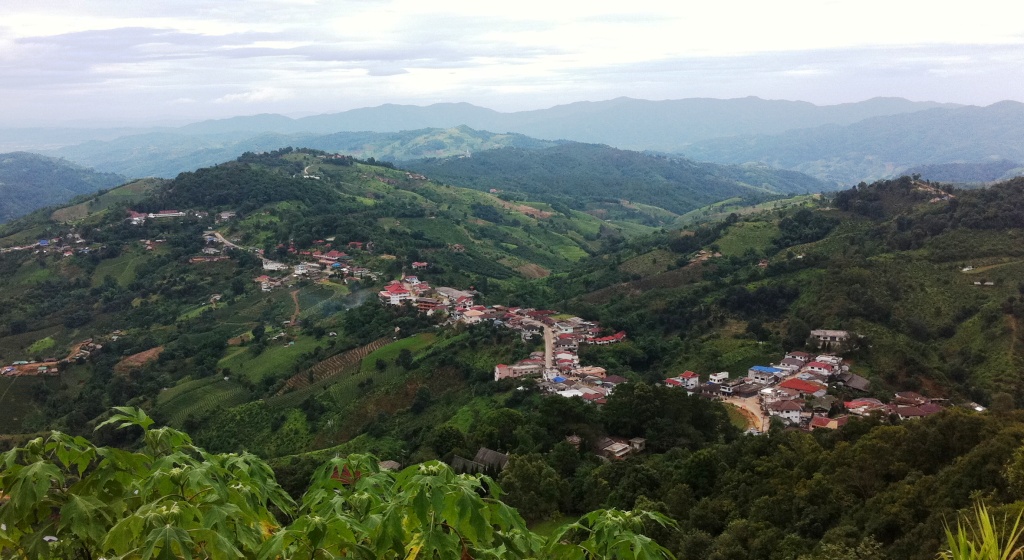
It’s lunchtime in Mae Salong, a small village perched on the spine of mountains that trail south from China’s Yunnan province to divide Thailand and Myanmar. The restaurant sign is in Thai, but the menu is written in traditional Chinese, offering peanut-flecked pad-thai noodles and steamed chicken jiaozi dumplings finished with tea grown in the surrounding hills.

Throughout the meal, English, Thai, Mandarin, and a local Akha dialect mingle along with the food, a cultural confluence that reflects the town’s unique history. Officially now called Santakhiri by the Thai government, Mae Salong is perhaps best known for its role as a heroin trading outpost and as a base for remnants of Chinese Kuomintang forces who refused to surrender to the Communists. Even today, the village has a distinctly Chinese flavor, where a dialect similar to Yunnan’s is spoken at stores, restaurants serve Yunnan-style food, and Mandarin language instruction is an option for public education.

The village of Mae Salong

The village of Mae Salong

The local economy now relies on tea production and cultural tourism surrounding the local Akha highland hill tribes rather than heroin, however the Kuomintang heritage of many villagers remains an enduring legacy. Pastor Yang Congguang of the local Baptist Church is one such resident of Mae Salong.

Pastor Yang was born in 1956 in Luxi County in Yunnan Province, during what he calls “an era of war” that followed him around through childhood and much of his adult life. By the time he was two years old, Yang had already been registered by the government to join the army upon adulthood, along with his two older sisters. Yang’s parents decided to flee to Burma, hoping to escape increasingly dismal prospects in China.

Yang’s father, a farm veterinarian, went first in 1957 to a village in Kokang in northern Burma settled by other ethnic Chinese. The head of the village there owned some 3000 horses, and his father’s skills were highly sought after. However, the Chinese population of the village were not the majority Han ethnic group like Yang’s family, but the Lisu people, one of the many ethnic groups of upland Southeast Asia.

Yang’s father found the Lisu not at all as he had imagined “backwards” minority people to be. He was impressed how many of the Lisu, especially the Christian population, did not smoke, drink or gamble, and furthermore were educated enough to read. Yang’s father told the chief that he wanted to bring his family to the safety of Kokang, and that if the villagers prayed for the family’s safe passage, they would all convert to Christianity.

Yang supervising construction of his new church.

Yang supervising construction of his new church.

By this time it was 1958, and leaving China had become increasingly difficult and dangerous. Yang’s extended family, numbering sixteen people in total, required three trips and traveling only at night through the forests. During the final trip, it rained hard all night just before they were to cross the border and the group lost the right path. When the sun came up, his father realized they were very close to the only road across the border, manned by a PLA checkpoint. Despite the danger of trying to cross during the day, Yang’s father decided to take the risk. At the border, chance had it that checkpoint patrol house was empty, although the stationed soldiers had built a small fire. Yang’s uncle stopped briefly to warm his hands, telling the group to go on ahead. Today, Yang estimates that his family must have had only a few minutes’ window of time to sneak across the border.  His uncle did not rejoin the group and was never seen nor heard from again.

Once in Burma, the Yang family reached Kokang safely and converted to Christianity as promised. The Kokang authorities did not permit education in Chinese, so Yang learned through studying the Bible. In Kokang the family had a few years of peace, until 1966 when the Burmese Communist party swept into the northern border region, beginning a period of civil unrest as well as tumult in Yang’s life. The family moved further south, to an area in Burma populated by the Shan (Dai) ethnic minority, where they stayed for three years until once again the Burmese communists arrived. The Yang family to Lashio in the eastern Shan state, and then again even further south to an area with very few ethnic Chinese.

Yang’s adolescence occupies a murky place both in memory and time, a period of transience and uncertainty that also coincided with the rise of the heroin trade in Southeast Asia. Former Kuomintang soldiers clashed with Burmese communists, with unrest and violence spilling across the borders of Thailand, Burma, and Yunnan. During these years, Mae Salong sprung up as both a drug trading outpost and a refuge for Kuomintang soldiers recruited by the Thai government to counter Communist threats.

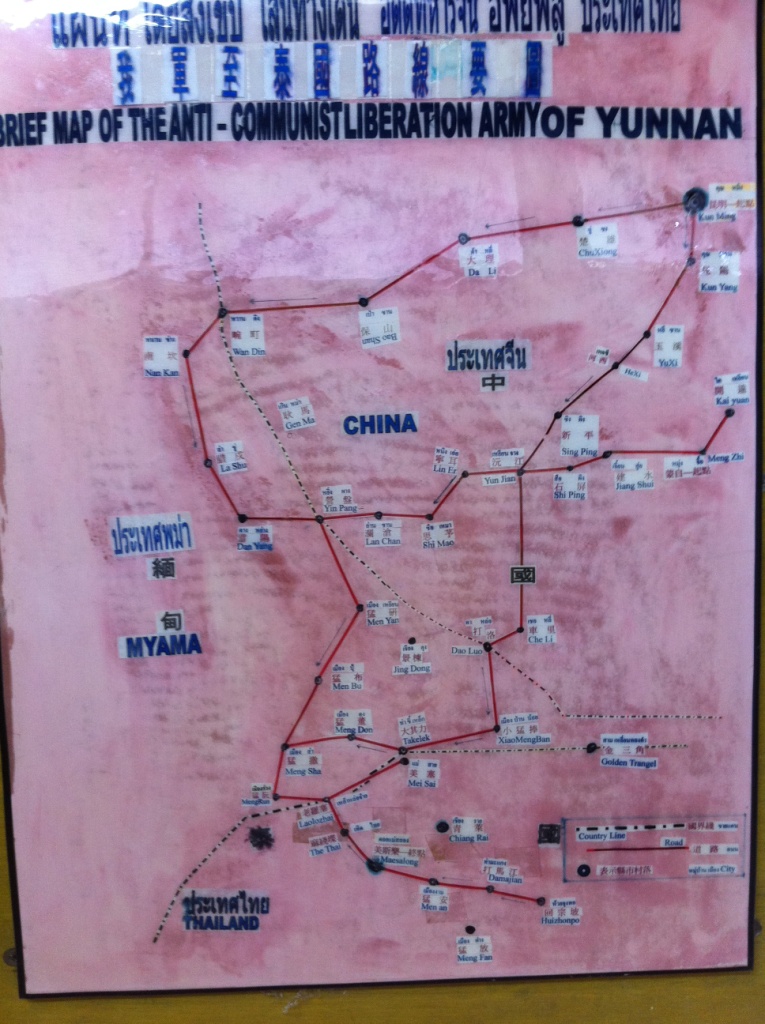
A homegrown depiction of the KMT's path of flight from China to Mae Salong

A homegrown depiction of the KMT’s path of flight from China to Mae Salong

“It was like trying to escape from a jaguar only to run into a tiger,” says Yang. “My parents didn’t want me or my siblings to grow up to be soldiers, so every time the armies came we left. But everywhere we went, they kept coming.” In 1973 he reluctantly joined the Kuomintang for a little over a year and fought against the Burmese. During this time, his faith kept pushing him to seek a different path. “I kept thinking some verses were especially speaking to me – that I should rather be a guard outside the house of God than live in the opulent tent of an evil person. The army for me meant living in an evil person’s tent,” he remembers on his decision to desert.

Yang escaped across the Salween river to Thailand at great personal cost. His commander came to his family’s house, and threatened Yang’s father to make him return. Yang’s father refused, and was taken away by the army along with nearly everything from their house, which was then burned. Yang’s brother escaped to the forests, but Yang found out later that the army shot his father by the side of the road.

For six years Yang drifted, stateless and without identity like many Yunnanese refugees in Thailand, feeling both immense guilt at the death of his father and a responsibility to lift his family back on their feet. He worked odd jobs to try and make money, “but life had no color, and I thought God had perhaps forgotten me.” But in 1981 he received an opportunity to enroll in Bible college in Bangkok, and a new beginning. His first job afterward was working at a church in Mae Salong, the village known for its KMT heritage.

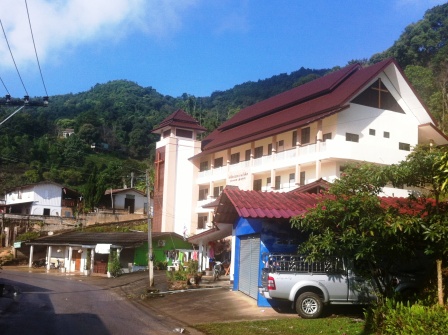
Today Yang is the pastor at the Mae Salong Baptist Church and with a wide smile proudly shows off a gleaming new building opened just this past year.  Over the past three decades, Pastor Yang has developed his own parish into a congregation made up of two hundred families who travel over the hills and footpaths to his church for worship, schooling, and community programming.  In the early 1990s, Pastor Yang and his wife built a single room church with the little donations they could gather from local villagers and began offering free Chinese language education to Yunnanese, Akha, and Lisu families who could not afford tuition at the state sponsored school.


Mae Salong's new Baptist Church

Mae Salong’s new Baptist Church

The newly built church has eight large classrooms for free Chinese language and free primary education classes taught by a cohort of regional volunteer teachers from Thailand, Singapore, Malaysia, and mainland China. Many of the students are Akha, as most of the Chinese residents of Mae Salong can now afford to attend school further down the mountain, reflecting a growing assimilation with Thai culture as more and more move away from the village to bigger cities. Yet Yang remains confident that his church and school can serve as a bridge between the past and present, as well as provide opportunities to educate the Akha residents of Mae Salong. Yang says the students are not required to be Christians to attend the school.  The Baptist Church also has a healthy relationship with the small Yunnanese Muslim population of Mae Salong, sharing access to public water resources and cooperating to bring a new pipe to the village. Yang is content, and although his life is modest he finds fulfillment serving his community.

Pastor Yang and Mae Salong may share a history that began in an era of war, but more importantly they both have a future supporting a community where multiple cultures can mix, and peacefully coexist.  “Life is good,” he smiles while looking over the town, across the green ridges of tea terraces and mist-covered mountains towards the border of Myanmar some fifteen kilometers away.

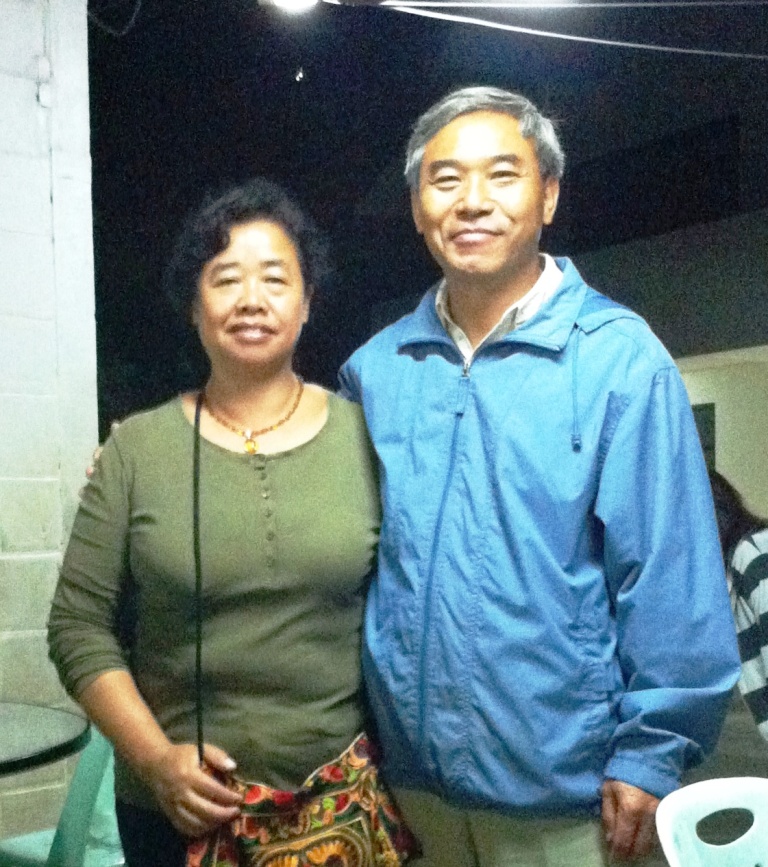
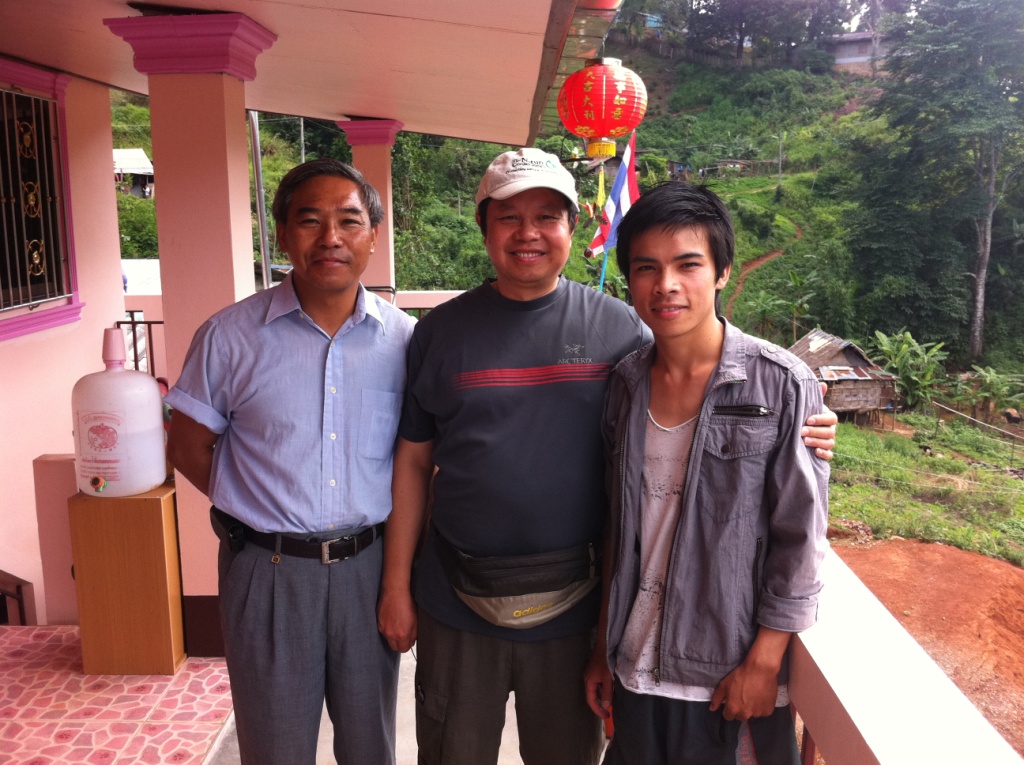
(from left) Pastor Yang with ExSE contributor Zhou Dequn and Ashi, the first of his family to attend college after matriculating through Yang's school

(from left) Pastor Yang with ExSE contributor Zhou Dequn and Ashi, the first of his family to attend college after matriculating through Yang’s school

Leave a Comment

Filed under China, Culture, Myanmar/Burma, SLIDER, Thailand, Uncategorized, Yunnan Province

China’s Bridgehead Strategy and Yunnan Province

Editor’s note: Liu Jinxin wrote this essay to debunk the myth that China’s bridgehead strategy is militaristic or expansionary in nature.  As a chief architect of this strategy, he seeks to demonstrate that developing Yunnan province into a bridgehead will increase international trade flows and deliver long-term regional security.  This translated essay currently guides top-level foreign policy makers in China in implementing economic strategies along its borders with Southeast Asia.  


Yunnan province's border crossing with Vietnam at Hekou/Lao Cai

Yunnan province’s border crossing with Vietnam at Hekou/Lao Cai

The definition of a bridgehead?

According to the Modern Chinese Dictionary, a bridgehead (桥头堡) is a military term that refers to a strategic chokepoint on the field of battle and particularly refers to a fortified structure that defends and controls a bridge or ferry crossing. In economic terms, bridgehead refers to a strategic forward position on a political or economic front line. The term bridgehead appeared for the first time in an official national level Chinese policy document called “Eastern Bridgeheads” in July 1994 which confirmed the Shandong cities of Rizhao and Lianyugang as the bridgehead terminus of the Eurasian landbridge.

In the economic research of landbridges, a bridgehead is a key concept that acts as a port and facilitates the ease of transportation. Bridgeheads are also international centers of shipping, finance, and information which together form an integrated international center of trade. From a logistical and supply chain system perspective, a bridgehead serves basic support to the Eurasian landmass. It is a city or a region that sits on a strategic position on the logistical and supply chain and serves the specific purpose of controlling the flow of resources along international trade routes. The basic characteristics of a bridgehead are its powers to control, develop, and influence.

The power to control

The power to control suggests capabilities levels of secure logistical flows. This can be understood in narrow and broad senses. From a narrow sense, secure logistical flows are conditional to the degree of market openness.  The survival and development of logistical flows must not be threatened by the power of a government to regulate or control it. From a broad sense, a state’s security and international security are guaranteed by engaging in logistical activities. The capability of a state’s secure logistic flows is determined by its capacity to control strategic resources, logistics routes, linkages, and its industrial supply chain.

Linking with the similar strategic logistic routes, resources, and supply chain structures of neighboring states, a concerted logistics system can deliver harmony and mutual trust as well as a collective security that realizes long term stability. Fostering mutual trust, mutual benefit, and equality work together to form a new worldview for security and protects the security of individual states as well as respects the security concerns of other states.  Mutual trust also promotes collective security.


The power to develop 

Developmental power is preconditioned by the construction of logistic routes, linkages and supply chain structures, the developmental needs of economic corridors, and mutual benefit and cooperation. This power can help states share development trajectories, share prosperity and harmonious development, and eliminate security threats at their root. States should place the promotion of shared development as the method for solving global development imbalances and fostering sustainable development. To revolutionize international financial systems, oppose trade protectionism, and promote regional economic cooperation, developing countries should establish development modes that foster interdependence, deliver effective beneficial outcomes, and seek to erase poverty. Developing countries should expand trade with each other, open markets to each other, and increase the level of south-south cooperation.


The power to influence

Influential capabilities rely on a state’s degree of openness and tolerance, strengthening of the construction of a national culture, making positive contributions in international cooperation, solidification of geo-cultural space, promotion of geo-cultural integration, ability to cooperate harmoniously, and mutual progress with its neighbors. States should respect the rights of other states to determining their own development paths by admitting differences in cultural traditions, social systems, and value systems. States should actively promote and provide guarantees to human rights, and increase dialogue to eliminate misunderstandings. States should initiate a spirit of openness and tolerance, make use of the development modes of other states in a comparative and competitive fashion, and seek collective development despite differences.


The functionality of China’s bridgeheads

The central government has required Xinjiang Uyghur Autonomous Zone, Yunnan province, and other frontier provinces and zones to open the construction bridgeheads along national borders to implement a stable and prosperous frontier region. To deliver prosperity, the bridgeheads should:

1) Be a foundation of protecting border security and stability

2) Take measures under the conditions of high technology to serve as a front line in partial wars and non-traditional security issues

3) Support efforts to rapidly develop ethnic and national zones through new economic modeling

4) Expand the promotion of international/regional cooperation with neighboring states and extend degrees of openness by forging ahead as zones of experimentation.

5) Serve as a transit and storage point for national energy resources.

From a spatial perspective, Xinjiang acts as a bridge between the East and the West; it is the new Eurasian landbridge’s thoroughfare, and as a “west gate,” it serves the opening of China’s northwest region to Central Asia and Europe.

Yunnan opens China to the Southwest connecting two oceans, the Pacific and the Indian as well as East Asia, Southeast Asia, and South Asia. It is the linkage point between China’s southwest, the Southeast Asian peninsula, and the South Asian Subcontinent, and is the starting point of the Yangtze River Delta economic zone as well as the Pearl River Delta economic zone. Yunnan acts as the core belt of the China-South Asia Economic Circle and the China-Southeast Asia economic circle. It is the main connective channel between China and the Indian Ocean and is China’s core zone in the Greater Mekong Subregion. More importantly the province serves as a key trade passageway for goods and services passing from China to South Asia and the Southeast Asian peninsula.

gms_map_large

Core Values

China’s bridgeheads are a result of major changes in geo-strategic international structure. The concept is part of China’s key diplomatic principles which pledge to be a good neighbor, a prosperous neighbor, and a secure neighbor. It is also reflective of China’s active pursuit of being a responsible world power. The core values of the bridgehead strategy are:

1) To foster an infrastructure development strategy that expands participation in the world market and establishes interdependence, while constructing mutually beneficial win-win relations with its neighbors

2) To highly prioritize unity among ethnic peoples and social stability by promoting cultural diversity and shared developmental progress

3) To respect  public opinion and the will of peoples in neighboring countries, and respect their value systems by promoting cooperation and exchange between peoples and democratic equality

4) To acknowledge the guidance of international voices and place equal importance on China’s international image and economic benefit

5) To safeguard the benefit of overseas Chinese and Chinese businessmen abroad

6) To value strategic resources, strategic routes, the shared security of strategic industrial supply line

7) To promote the construction of low carbon footprint urban areas and the use of clean energy by promoting an economic society that delivers harmonious, stable, and secure sustainable development

8) To promote the construction of a harmonious new world order and the active promotion of new kinds of partnerships with neighboring countries

9) To resolutely protect free and fair global trade and investment climates, and maintain the free flow of products, investment and services

10) In the long term, to promote sustainable growth, coordinated concerns, advocate tolerance to total adjustment, and promote balanced growth

Global economic balances can only be reached through sharing benefits and needs between developing and developed states.


Yunnan province as China’s southwest bridgehead

The southwest bridgehead is the front line of China’s interaction with the Indian Ocean, and its purpose is to construct a series of overland pathways given China’s southwest connects to South Asia and Southeast Asia trade routes. The bridgehead’s purpose is also to construct a base facing South Asia and Southeast Asia that supports export processing and the facilitation of international and domestic production, and the Kunming international land port economic zone.

Establishing Kunming as an inland economic zone will strengthen logistical flows coming from South Asia and Southeast Asia, create a tourism base for national culture, a commerce base, export processing base, and modern agriculture base as well as an information platform. This platform will come together through the increased progress of the yearly Kunming trade fair, China-South Asia fair, and the creation of different cooperation forums. The central objective is to turn Yunnan province into China’s platform for communicating with Southeast Asia and South Asia. Through creating this window, Yunnan can facilitate the building of trust between China and South Asia and Southeast Asia, and demonstrate the fruits of reform as well as Chinese culture by promoting mutual understanding and friendship. Yunnan can become a demonstration zone for how China can open to its neighbors.

The influence of a bridgehead extends outwards and is continuously stretching its limits. In China this includes two major regions.


A bridgehead to Southeast Asia

Southeast Asia includes the 10 ASEAN states of Malaysia, Philippines, Singapore, Thailand, Indonesia, Brunei, Vietnam, Lao PDR, Cambodia, and Myanmar and the non-ASEAN state of East Timor. In total this region covers 4.5 million square kilometers, supports a population of 580 million, has a combined GDP of $1.9 trillion USD and a total trade of approximately 2 trillion USD. The creation of the ASEAN-China Free Trade Zone in 2010 created a free trade area of 13 million square kilometers and a combined population of 1.9 billion. It is the largest populated free trade zone in the world and the largest free trade zone among developing countries.

China and ASEAN states are linked by mountains and rivers and share advantages by having varied distribution of resources, differences in specialization of industrial processes, complementary strengths, and an enormous potential for cooperation. As trade between China and ASEAN states increases at a rapid rate so are rates of investment. China is ASEAN’s 4th largest trading partner and ASEAN is China’s 5th largest trading partner. ASEAN has been established as a priority zone for attracting Chinese FDI and is one of the outward investment zones for Chinese industries. ASEAN is also a major market for Chinese labor, and China is winning an increasing amount of engineering contracts in ASEAN.

To date China and ASEAN trade relations have already entered a “Golden Era” and as China and ASEAN open their markets to each other, the ASEAN-China Free Trade Zone will enter a substantive phase. These contributions will bring robust commercial opportunities as the Southeast Asian peninsula is a major global agricultural production area and a critical zone of emerging industries.


A bridgehead to South Asia

The South Asian subcontinent (by way of the BCIM economic zone which includes Bangladesh, China, India, and Myanmar) is the geo-strategic fulcrum between the Indian Ocean and the Arabian Sea. At the same time, it is zone of choice for the secure channeling of China’s energy resources. The South Asian Subcontinent is also known as the Indian Subcontinent and is comprised of the Indian peninsula, the Indus river plateau, and the downstream plains of the Ganges and Brahmaputra rivers covering an area of 4.3 million square kilometers. It supports a population of 1.2 billion on 10% of the Asian continent. Its northern reaches are formed by the Himalayan and Karakoram mountain ranges and its southern limits are the Arabian Sea and the Bay of Bengal. Its western borders are limited by the Iranian plateau, and its eastern frontiers are the mountainous eastern regions of India, Bangladesh, and Myanmar.

The severity of South Asia’s natural landscape has prevented integration and the historically its cultures have been relatively closed-off to each other. This has produced divergent sentiments of independence in the region. The South Asian subcontinent includes India, Pakistan, Bangladesh, Nepal, Bhutan and does not include Sri Lanka or the Maldives. Its major rivers are the Indus, Ganges, and the Brahmaputra. Major agricultural products are wheat, rice, cotton, hemp, cane sugar and tea. Resource endowments include coal, mica, zinc, and gold.

An international pathway can be built from Yunnan through Myanmar to give China direct access to the Indian Ocean and its benefits will promote good neighborliness and the strengthening of border areas. Frontiers serve the specific functions of national defense and economic and cultural exchange. Sharing borders with Myanmar, Lao PDR, and Vietnam, Yunnan province serves as the connective link between China, South Asia, and Southeast Asia. It offers an alternate route to the passage of goods through the Straits of Malacca and is the fastest land route for goods to travel from China to South Asia, the Indian Ocean, Europe, and Africa.

Due to its advantageous geographical position, the province can facilitate huge market potential with partners in South Asia, Southeast Asia, and the Middle East. Lastly, because of its history of friendly exchange with its neighbors, Yunnan province serves as the ideal representative for diplomatic connections.

The construction of international pathways will do much to improve the state of transportation and shipping and can only expand and deepen the political, economic, and cultural cooperation between China and Southeast Asian states. Building these pathways and supporting the bridgehead strategy will develop regional economic cooperation between China, Southeast Asian, and South Asian states, strengthen the relationship of good neighborliness, and bring stability and peace to China’s border areas.

4 Comments

Filed under ASEAN, China, DOCUMENTS, Economic development, GMS, Laos, Mekong River, Myanmar/Burma, Regional Relations, SLIDER, Thailand, Vietnam

The Godfather of the Golden Triangle: Lo Hsing Han, Obituary

Most crime bosses and drug barons never reach old age, unless they end up behind bars serving a life sentence. More often than not they are eliminated in a hail of bullets fired by either a police sharp-shooters or from a rival gang.

But  Lo Hsing Han ,the former ‘King of the Golden Triangle’ heroin trade  who survived several decades of opium wars in the Shan state and became one of the world’s ‘Most Wanted Men’, amazingly defied the odds to become an octogenarian. He died in Yangon on July 6th 2013 aged 80.

Nor did this legendary drug-trafficker die in lonely obscurity shunned by society. His lavish funeral was a VIP affair attended by former generals, two cabinet ministers, and hundreds of well-wishers from Burmese high society.

They paid tribute to his rare metamorphosis from a notorious drug-kingpin to a respected business tycoon, the founder of the Asia World Group that has become a dominating pillar of the Myanmar economy. He is also credited with being the key player in establishing the nation’s economic dependence on narco-profits in the 1990s.

Lo was born around 1935 into a poor ethnic Chinese family in the Kokang district of the Shan state northern Myanmar.

His career in the opium trade began in the 1960s not as an outlaw, but as the leader of a Yangon–sanctioned militia, the KKY, under the auspices of General Ne Win’s dictatorship.

The militias were supposed to fight Shan rebel armies and the Burmese communist guerrillas but expended most of their energy on taxing and protecting mule convoys carrying huge sacks of opium. Thanks to a complex chess-board of   nationalist rebels, opium warlords, the Burmese army and communist guerrillas backed by China, anarchy reigned supreme in the Shan state.

After the 1967 Opium War, Lo Hsing Han emerged as the big winner and consolidated much of the opium trade under his command, still enjoying the blessings of the Ne Win regime.

But the regime came to realise that their home guard KKY militias were a failure and started to disband them in 1973, prompting Lo to abruptly change sides and team up with his former enemies the SSA rebels –the Shan State Army.

During the next 20 years the Lo Hsing Han real–life story was packed with more intrigues, changing allegiances and betrayals, than a John Le Carre novel.

British film-maker Adrian Cowell filmed his classic ‘Opium Warlords’ (‘screened on ITV in 1974), after spending more than nine months trapped in the Shan jungles. It featured for the first time an interview with Lo, the legendary warlord.

Lo, the drug trafficker warlord, unexpectedly offered a diplomatic deal to end the narcotics trade in Burma, by offering to sell the whole opium harvest to the US government in exchange for a mere $12 million. It was taken seriously in Washington by a US congressional committee.

DEA agents based in Thailand arranged for Thai Police to pick him up inside Burma with a message that high-ranking US officials had agreed to talks in Chiangmai.  However after the Thai helicopter collected him from inside Burma, he was stunned to be immediately arrested upon arrival in Thailand July 1973.

US law enforcement plans were confounded by the sudden deportation of the prize catch to Yangon. Some Thai officials clearly wanted to stop Lo Hsing Han from talking. Many high-ranking Thai police and military officials were on Lo’s extensive payroll, which helped to grease the smooth transportation of narcotics delivery by road from the Shan state to Thai ports, without being intercepted by police checkpoints.

The Ne Win regime promptly indicted him for treason and he was sentenced to death. In another twist to the saga, the verdict was soon set aside in favour of an 8 years jail term, much of it served comfortably under house arrest. Then in 1980 amnesty was granted and he returned to Lashio in Shan state.

The military junta’s intelligence chief General Khin Nyunt had spotted an opportunity to recycle the resourceful man from Kokang, who had contacts with everybody in the ethnic mosaic of the Shan state, to work for the regime in a new capacity.

A 1989 mutiny inside the communist BCP proved to be a major game-changer, which allowed Lo Hsing Han to play his newly assigned role as a broker of ceasefires.

His contacts with all the Shan, Kokang and Wa rebel armies helped General Khin Nyunt to conclude a series of ceasefire agreements, and in return the military junta happily re-licensed Lo to resume the opium and heroin trade in opposition to rival drug warlord Khun Sa, who was still fighting the government under the banner of Shan nationalism.

In 1992 Asia World Corporation was set up in Yangon as a family partnership between Lo Hsing Han the chairman and his son US- educated Steven Law, the managing director.

The company’s portfolio included: import-export business, bus transport, property development and Rangoon’s port development.

But it was Singapore ‘s decision to get into bed with the Lo family’s Asia world conglomerate with a stake in two new luxury hotel through the government’s investment arm GIS, that garnered most international attention.

According to research based on all the available date of Myanmar’s trade investment and revenue in the fiscal year 1995-6, no less than US$600 million income in the state treasury could not be accounted for.

This conspicuous gap in Myanmar’s bookkeeping at a time when their official economy was on the rocks, points to only one plausible explanation–a generous infusion of narco-dollars from the Golden Triangle coming from Lo. One of the country’s most successful entrepreneurs had come to the rescue of a faltering economy in dire straits.

The grand wedding of  Steven Law to Singaporean business partner Cecilia Ng in 1996  clearly helped to cement the growing ties between the military junta, Asia World, and Singapore investors..

The Lo family’s guest of honour was Hotels and Tourism Minister Lieut. General Kyaw Ba, accompanied by four more cabinet ministers, and two planeloads of wedding guests from Singapore. The special charter flights not only carried the bride’s relatives, but also investors from representing one of Asia’s most important financial hubs.

US officials claimed that half of Singapore’s investments in Myanmar have been tied to Lo’s family.

It was far more than a grand wedding bash. It symbolised Lo Hsing Han’s metamorphosis from a drug baron to a corporate respectability, and his acceptance by investors from a key member of the Asean business community.

Asia World established three subsidiaries in Singapore jointly run by Steven Law and his wife Cecilia Ng (Ng Sor Hong) she allegedly also runs an underground banking system facilitating money-laundering and safe tax havens for narco-dollars.

Although Singapore is proud of its mandatory death penalty for small-time narcotics couriers and heroin addicts, both father and son travelled freely in and out of the island city state.

Steven Law and his father had become VIPs in Burma, and welcome business partners in Singapore, but they were forbidden to enter the United States since 1996 on “suspicion of involvement in narcotics trafficking.”

Under new US sanctions imposed in 2008 Asia World and six of its subsidiaries were blacklisted and similar sanctions were applied by the UK.

But these sanctions have done little to hinder Asia World‘s dynamic expansion. The company built on the illicit black economy has thrived,  and currently  partners major companies from mainland China in several mega-projects including an oil and gas pipeline, a deep sea port at Kyaukpyu, and the controversial Myitsone dam project.

Another irony is that Lo was closely connected to Taiwan’s military intelligence for 30 years, and deployed his Shan and Kokang soldiers to fight against Beijing-backed Burmese communist party.

Asia World has its financial foundations built on the law of the Burmese jungle and the 3 Gs :Guns, Gold and Goons. But  Lo’ s legacy will casts a long shadow over the aspirations of many groups to move the economy out of the hands of the cronies, and towards a respect for environment, human rights and the development of a democracy.

This account of the Life and Times of Lo Hsin Han provided the basis for the obituary published in The Economist in July, 2013.

2 Comments

Filed under China, Cold War, Mekong River, Myanmar/Burma, Singapore, SLIDER

China Sea Territory Disputes (source: Money Morning, NPR, google news)

0912ChinaSeaTerritory2

Leave a Comment

Filed under Brunei, China, Foreign policy, Malaysia, Myanmar/Burma, Philippines, USA, Vietnam, VISUALS, water