Category Archives: Mekong River

Carrots, Sticks & the TIP Report: Understanding the US Government’s Anti-Trafficking Efforts in Southeast Asia

Last week the US State Department issued its annual Trafficking In Persons (TIP) Report, which ranks every country in the world according to their adherence to the US government’s anti-trafficking mandate. For the first time, Thailand was designated “Tier 3,” the lowest “rung” on the TIP Report’s ladder.

The report, which is published by the Office to Monitor and Combat Trafficking, describes “Tier 1” countries as those demonstrating sufficient anti-trafficking efforts; “Tier 2” as those that have begun to demonstrate such efforts but still have improvements to make; and “Tier 3” as countries demonstrating little to no effort to combat trafficking. Countries that receive the Tier 3 ranking are subject to sanctions by the US government. Continue reading

Leave a Comment

Filed under Cambodia, China, Current Events, ethnic policy, Foreign policy, GMS, Governance, Health, Malaysia, Mekong River, Philippines, Regional Relations, Singapore, Uncategorized, water, Yunnan Province

Laos extradites drug suspects to Yunnan

Editors note: This article was originally written by Cissy Yu and published on Go Kunming. It is reprinted on Exse in its entirety. 

Yunnan has long been the country’s main entry point for illegal drugs. Despite increased interdiction efforts, international law enforcement cooperation and recent large-scale busts, it appears the province’s ‘Drug War‘ is becoming more costly and having only a small effect on the overall flow of narcotics across the border.

Last week, Lao police transferred five suspected members of a drug ring to Kunming in a display of cooperation between the two countries. Authorities originally detained the suspects in a joint police raid conducted on March 19, 2013, when a naval patrol seized more than 500 million yuan (US$82.3 million) worth of methamphetamines on the Mekong River.

China has been conducting patrols such as this with the help of Thailand, Laos and Myanmar since the “Mekong River Massacre” of October 2011. The attack, which killed 13 Chinese sailors, spurred Beijing to begin interdiction patrols along the river. Institution of the policy, although sanctioned by neighboring Southeast Asian countries, was the first time in three decades that Chinese forces have operated outside the nation’s borders without a United Nations mandate.

Although the drug lord responsible for the killings, Naw Kham, was sentenced and publicly executed in Kunming last year, illegal drug trafficking continues to run rampant in the border regions between Yunnan, Laos, Myanmar and Thailand. Known as the Golden Triangle, the area supplies an estimated 60 to 70 percent of all drugs consumed in China. A United Nations surveyconducted last year reported that opium cultivation in the Triangle rose by 22 percent in 2013, largely driven by mounting demand from the mainland.

Yunnan’s 4,060-kilometer border with Golden Triangle nations presents a grim challenge for anti-drug personnel. According to Yunnan Net, 70 percent of methamphetamines confiscated in China last year were seized in Yunnan. Currently, there are 1.7 million registered drug addicts in the province, although the government acknowledges the actual numbers are much higher.

While heroin remains the most commonly smuggled drug on the border, methamphetamines — also known as ‘ice’ — are a fast-growing second. In Ruili, a border town infamous in the past for its heroin trade, methamphetamines now dominate the market. One dose of the crystals — known as bingdu (冰毒) in Chinese — reportedly costs as little as five yuan.

Yunnan’s narcotics officials, meanwhile, claim they have redoubled efforts to combat the drug trade. Provincial courts sentenced more than 5,020 suspects for drug crimes in 2013. Yet some officials have complained that the record numbers on trial have led to more lenient judgments. “A suspect who would get the death penalty elsewhere [in China] only gets several years of jail in Yunnan,” said a National People’s Congress deputy. “The judicial system should be punishing these people with an iron hand.”

Image: China Radio International

Leave a Comment

Filed under China, GMS, Health, Laos, Mekong River, Regional Relations, SLIDER, Yunnan Province

Monsters in the Mekong

Construction of the Xayaburi Dam in Laos

Construction of the Xayaburi Dam in Laos

It will be a giant, stretching across the mighty Mekong River. Standing 32.6 metres tall and 820m wide, the $3.8 billion Xayaburi dam in Laos could supply electricity to more than three quarters of a million homes in Thailand. And when it’s completed in 2019, it will be the most controversial power project in the region.

Since the plan was released in 2010 to construct the hydroelectric plant, geologists and environmentalists have voiced concerns about safety and the effects the mega-dam will have on neighbours Cambodia, Vietnam and Thailand. They have highlighted the risks of seismic activity in the area and the threat to the fishing industry on the 3,100-mile long (4,900 kilometres) Mekong River, which flows from the Tibetan steppes into southern China on its way to Myanmar, Laos, Thailand, Cambodia and Vietnam. Continue reading

1 Comment

Filed under China, Current Events, Laos, Mekong River, Regional Relations, SLIDER, Thailand, water

Recommendations Regarding Hydropower Development and the Rights of China’s Ethnic Peoples

Most of China’s water resources are found in China’s western regions with 70% coming from China’s southwest.  Since the beginning of this century, the core of China’s hydropower development focused on middle and upstream portions of rivers in southwest China. This region also serves as the central native land of many of China’s ethnic minorities.  In early 2013, China’s State Council issued a plan for resource development in its 12th five year plan with details to design and begin construction on more than 60 major hydropower projects between 2011 and 2015.  China is entering into an explosive period of rapid and unprecedented development of its hydropower industry.

For the next twenty years more than 8 million ethnic minorities will be affected by the development and planning of dams.  With the expressed state agenda of establishing a sustainable hydropower industry, achieving social stability in ethnic minorities areas, and realizing the “Chinese dream” for all of China’s citizens, how will the Central government guide law and policy to provide rational standardization, coordination, and management to the interests of the state, industry, and of ethnic minority groups?

According to the principles of “Encouraging the Benefits of Ethnic Autonomous Areas” set forth by the Chinese Constitution, the Law of Ethnic Autonomous Zones advanced a new regulation in 2005 to “encourage the production and livelihood of local ethnic minorities.”  This broad-based regulation passed as part of one of three items in the addendum to the State Council’s PRC Legislation on the Autonomy of Ethnic Regions. Yet to date, there is no specific clarification to the rights of local ethnic minorities or details concerning the autonomy of ethnic areas within the language of the basic law.  The administrative regulations of the State Council list only one related clause: The regulation of peaceful migration should respect the production methods, the lifestyle, and customs of ethnic minorities.

A new policy promulgated in 2012 by the National Development and Reform Commission (NDRC) requiring state sponsored development projects to first oversee the migration of peoples before beginning construction has no mention of protecting the rights of local ethnic minorities. Laws and regulations related to the issue of ethnic minority protection do indeed exist, but because there is no guarantee on the methods of protecting procedural justice or monitoring processes, these laws and regulation cannot reach efficient levels of execution.  Not long ago, the publications of the Third Plenary Session of the 18th Party Congress emphasized the Chinese Communist Party’s views of ethnic policy, guaranteeing the legal benefits of ethnic minorities and bolstering and developing the equal unity and mutual harmonious relations of socialist peoples.

In past years, researchers carrying out investigative field study on the beneficial effects of hydropower development toward the ethnic peoples of the Jinsha River, Lancang (Mekong) River, Nu (Salween) River, Yalong River, Min River, and the Dadu River discovered that the everyday livelihoods and production methods of ethnic peoples living along these rivers are immensely affected by the development of hydropower projects.  In the early development and planning stages, hydropower projects are requested to maintain a holding status before beginning construction.  For many unknown reasons this holding status could continue for many years.  The clearing of roads with dynamite creates air and noise pollution and along with the risks of falling rocks and landslides, greatly affects the safety of people and livestock and the volume of agricultural harvests.  Dam construction and rising waters force people to move.  This uprooting destroys longstanding social networks, privately held assets and shared natural resources such as traditional collecting, fishing, and grazing methods that rely on forests, pasture lands and wetlands.  What is lost is not justly compensated for.

The rights of ethnic groups to be informed, to participate, to express views, and to monitor procedures are not respected or guaranteed with the development of hydropower projects and in many ways these rights are illegally violated.  The relevant institutions of local governments cannot realistically carry out existing laws and regulations, and hydropower firms ignore the law failing to take social responsibility for the protection of vulnerable groups.  Large scale hydropower firms – particularly central level hydropower firms – exact great profits from local areas but remit taxes to the major cities in which they are registered.  The benefits received by localities are greatly out of proportion with the costs borne.


In consideration to the issues raised above and to the demands of the 18th Party Congress, the suggestions below should be considered. Generally, the Central government should re-examine existing hydropower projects and immediately clarify and formulate policy that guarantees the benefits of ethnic peoples in China’s western regions affected the by hydropower development.

1.       Clarify policy and approaches suitable for Western ethnic regions

In western ethnic regions, the Central government should incorporate a guarantee of the basic rights of ethnic peoples as an indicator of sustainable development. The Central government should coordinate development of hydropower projects in ethnic areas giving basic consideration to resource safety, economic development, guarantees of the rights of ethnic peoples, and ecological protection. The activities surrounding hydropower development should respect and guaranteed the basic rights of ethnic people including political, economic, and cultural rights. In accordance to law, ethnic peoples should not be discriminated against and should equally participate in and enjoy the benefits of resulting from economic development in their localities.  They also have the rights to maintain their value systems, religious observance, and unique ways of living.  Moreover they have rights to protect the natural resources such as the land, rivers, forests, and pastureland on which they have existed for many years.

Moreover, the Central government should amend the legal and policy framework on the Law of Ethnic Autonomous Zones within the Chinese Constitution to protect the basic rights of citizens and ethnic peoples.  While strengthening relevant polices, the Central government should expedite policy on formulating specific guarantees of the protection of peoples affected by hydropower development and ensure the implementation and execution of these policies.

2.       Guarantee procedural justice in the processes of hydropower development

In the development of hydropower projects, firms and local governments should respect and protect the rights of ethnic groups and individuals to be informed, participate, make decisions, and monitor procedures. Hydropower firms should establish corporate social responsibility systems that pay particular attention to respecting and protecting the rights of ethnic peoples while operating.  Firms should incorporate this kind of responsibility into their specific duties and make public record of their CSR work on a regular basis.  Firms should also take initiative in accepting monitoring presences of multiple levels of society.

The Central government should establish systems for assessing the impact on the rights of ethnic peoples.  Results of the impact assessment should serve as key findings for the approval of hydropower projects.

The Central government should monitor the entire process of relocation of people related to hydropower development and provide support and effective relief to ethnic peoples whose rights are violated.  The government should establish and open various channels of complaints mechanisms, provide various forms of legal assistance, and eliminate obstacles that prevent ethnic groups and their members in accessing these systemic mechanisms to realize their rights and receive relief.


3.       Guarantee mutual benefit for ethnic people and hydropower development

In ethnic areas, large-scale hydropower firms and central level hydropower firms, by principle, should register for license in the locale in which they operate and pay taxes to that locale.  An alternative could be for the hydropower firm and the autonomous local government should come to agreement on an appropriate distribution of taxes to the locale under the supervision of relevant managing government organizations,

Hydropower firms and local governments should make best efforts to reduce the relocation of people due to hydropower construction and resolutely block forced migration.  Hydropower firms and local governments should make best efforts to reduce the negative impacts of hydropower development on ethnic people’s environment, economy, society, culture, and spirit.  Hydropower firms and local governments should provide fair and appropriate compensation to ethnic groups and individuals for the material, physical, and spiritual damage and impacts caused by activities related to hydropower development.

Hydropower firms and local governments should appropriately provide accordant compensation for negative social, economic, and cultural impacts of past hydropower projects on the basis of social impact assessment and an impact assessment on ethnic people’s rights. Hydropower firms should provide monies for the protection of resources and development funds in affected communities. Firms should provide compensation to and protect the resources and development of intangible assets, communally shared natural resources, and collective impacts that are difficult to compensate at the individual level.

Local governments should adopt measures to protect the cultural heritage of ethnic peoples, to aid ethnic peoples in the passing down and development of their own history, culture, language, traditions, and customs and guarantee the protection of their own cultural heritage and historical traditions.

4.       Fully utilize the function of social organizations

In the realm of social administration, the diversification of social administration is a common and successful experience of developed countries.  It is also a mainstream trend of modern social administration.  Popularized global “New Administration” philosophies purport:

“Governments are not the only pillar of public rights. rather citizens, individuals, and non-government organizations can become pillars of public management.  Under a set of shared goals non-government organizations can participate in public policy making processes and provide public services.  The responsibilities of public affairs administration and the advocacy for the satisfaction of social and economic needs can be collectively shared through the cooperation between social groups and government.”

With the reforms of China’s government institutions and new rounds of innovation in public administration, the function of social organizations in public administration and social life becomes more apparent on a daily basis.  The government should make full use of social organizations in regard to the protection of ethnic peoples and western hydropower development.  The Central government should encourage relevant social organizations to participate in the activities of local hydropower development, participate in the ecological impact assessment, social impact assessment, and social monitoring of hydropower development.  Finally the Central government should utilize the contracting of services to support positive contributions and innovative practices that social organizations can make toward the social administration of ethnic areas.

This is the final part of a 5 part series on hydropower and the rights of ethnic minorities living in the upper Yangtze River valley.  Link here to part 1.  

1 Comment

Filed under China, Economic development, Energy, Environment and sustainability, ethnic policy, GMS, Governance, Hydropower & Ethnic Resettlement in China's Yalong River Valley, Mekong River, SLIDER, Sustainability and Resource Management, water

A Casino at the Khone Falls in Laos?

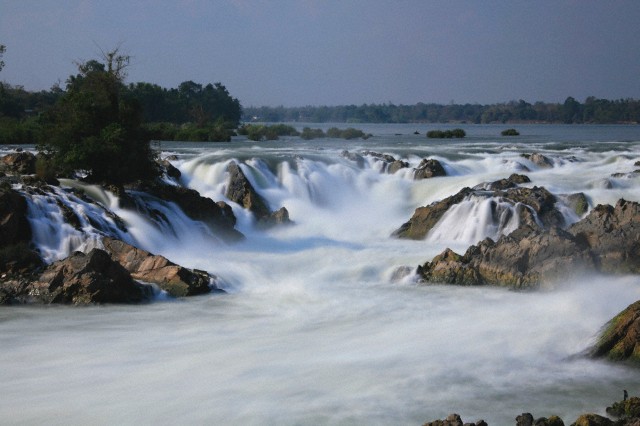
Khone Falls in Siphandone, Laos.  Image: Corbis

Khone Falls in Siphandone, Laos. Image: Corbis

At the end of March 2014 the Lao PDR government will consider a proposal to build a special economic zone slated for tourism development and other unspecified commercial uses in Siphandone, one of the world’s most pristine and biodiverse areas.  The SEZ will showcase a casino located less than one kilometer from the famed Khone Falls, the largest in Southeast Asia.

“The Siphandone area is set to become a more sought after tourism destination with many more activities to experience,” remarked Buasone Vongsongkhone, Deputy Governor of Laos’ southern Champassak province on Monday, March 17 after a meeting to discuss the proposal.

Vongsongkhone said the plans for the SEZ will include a casino and other facilities in keeping up with developing tourism trends in the Siphandone and Khone Falls area while protecting the environment.

“At the meeting we discussed how to regulate the casino to ensure the zone has proper security.”

What Vongsongkhone did not discuss was the impact of the new SEZ on the relatively untouched ecosystem of the Siphandone area.  Siphandone, translated as “four thousand islands” is where the Mekong River fans out into a waterfall and islet ridden expanse more than 15 kilometers wide.  The sparsely populated area has been described as an environmental oasis and is home to numerous native fish and bird species.  The Khone falls area is the perhaps the last habitat where endangered freshwater Irrawaddy dolphin can be found in the wild.

Satellite image of Siphandone.  Khone falls is the on left side of the image.  Google Earth

Satellite image of Siphandone. Khone falls is the on left side of the image. Google Earth

Laos’ growing reputation of holding some of our world’s last untouched natural areas and idyllic vacation spots has brought increases in international tourists to Siphandone area.  With the increase in tourism, the need for regulation and protection is obvious, but is marking a zone for economic development first and environmental protection second a sustainable approach or is it just another way for local Lao officials and outside investors to gain quick wealth through the exploitation of Laos’ abundance of resources?

Last week in an article in the Vientiane Times, the official English language outlet for Laos’ state controlled media reported “the government attaches great importance to developing SEZs to boost the country’s growth, which is crucial to lifting people out of poverty and enabling Laos to graduate from the list of least developed countries by 2020.”

Mock-up of the That Luang Marsh SEZ in Vientiane.

Mock-up of the That Luang Marsh SEZ in Vientiane.

The track record for SEZs in Laos, often dominated by Chinese and Vietnamese investment, is sketchy at best.  In Vientiane, construction of the That Luang Marsh SEZ (yet to begin commercial activities) has negatively impacted the local urban environment.  The natural wetland filters and holds the capital city’s waste water acting as a terminus of the city’s century-old waste canal system; many of these canals are now blocked by construction.  Much of the That Luang wetland areas has been filled in and long-time residents have noticed an average rise in temperatures as water is removed from the ecosystem. 

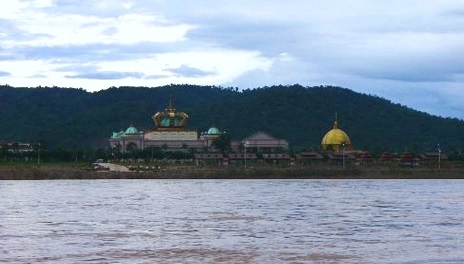
In Laos’ northern Bokeo province, the Golden Triangle SEZ dominated by the Chinese owned King Roman Casino complex has a seedy reputation as a conduit for money laundering from China and zone of human trafficking. The SEZ has scarred the scenic views of the Golden Triangle area, also known for its tourism, with open quarry mining and industrial development.

King Roman Casino along the Mekong in Bokeo Province, Laos

King Roman Casino along the Mekong in Bokeo Province, Laos

To make matters worse, the Siphandone area is slated for the construction of the 260 megawatt Don Sahong dam located  on the only of Siphandone’s Mekong channels that allows for the passage of hundreds of species of migratory fish.  In September 2013, the Lao PDR government notified the Mekong River Commission that the Don Sahong dam project would begin construction in 2014 despite years of protest and opposition by local and international environmental NGOs.

Eco-tourism opportunities such as river cruises, dolphin sighting tours, village homestays, and fishing demonstrations have brought sustainable sources of income to local communities in the Siphandone area for years.  Investors interested in building large resorts and casino complexes will likely be majority Chinese and Vietnamese taking more than they provide while leaving a stained and irreversible mark on one of the Earth’s most scenic spots.

3 Comments

Filed under China, Economic development, Energy, Environment and sustainability, GMS, Laos, Mekong River, SLIDER, Sustainability and Resource Management, water

Energy and Environmentalism on the Mekong: Time to Reach Across the Aisle

In recent years, two powerful narratives have emerged from mainland Southeast Asia. Generally speaking, discussions of the region focus around one of two topics: economic development and environmental degradation. For example, by typing “Mekong” into Google News the first page of results will show articles like this and this. As one can imagine, these two views of Southeast Asia are often in opposition and proponents of each rarely see eye to eye, sometimes going so far as to ignore the other side altogether. Recently, the battleground of these two narratives has been the construction sites of hydroelectric dams (both real and planned) that dot the Mekong River. Proponents of economic development see these dams as a necessary component to continued economic growth in the region. On the other hand, environmentalists point to the unknown ecological costs of the Mekong dams and argue that there are hidden costs to supposedly cheap hydropower. What is lost in the increasingly polarized game of right and wrong is a larger, more nuanced picture of the region and its needs. Some say that the Mekong needs dams while others argue that the region needs better protection measures for its natural resources. But what Southeast Asia really needs is for development fans and environmentalists to stop ignoring each other, and to restart the dialogue. Continue reading

1 Comment

Filed under Economic development, Energy, Environment and sustainability, GMS, Mekong River, SLIDER, Sustainability and Resource Management, Uncategorized, water

The Kunming-Bangkok Highway’s Final Link Opens over the Mekong

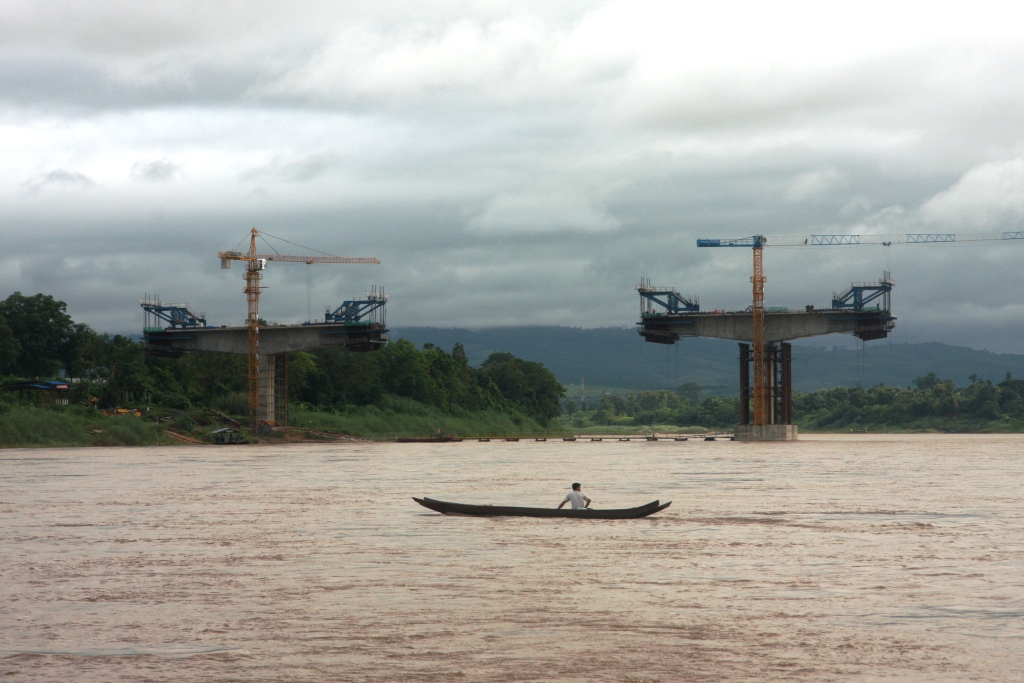
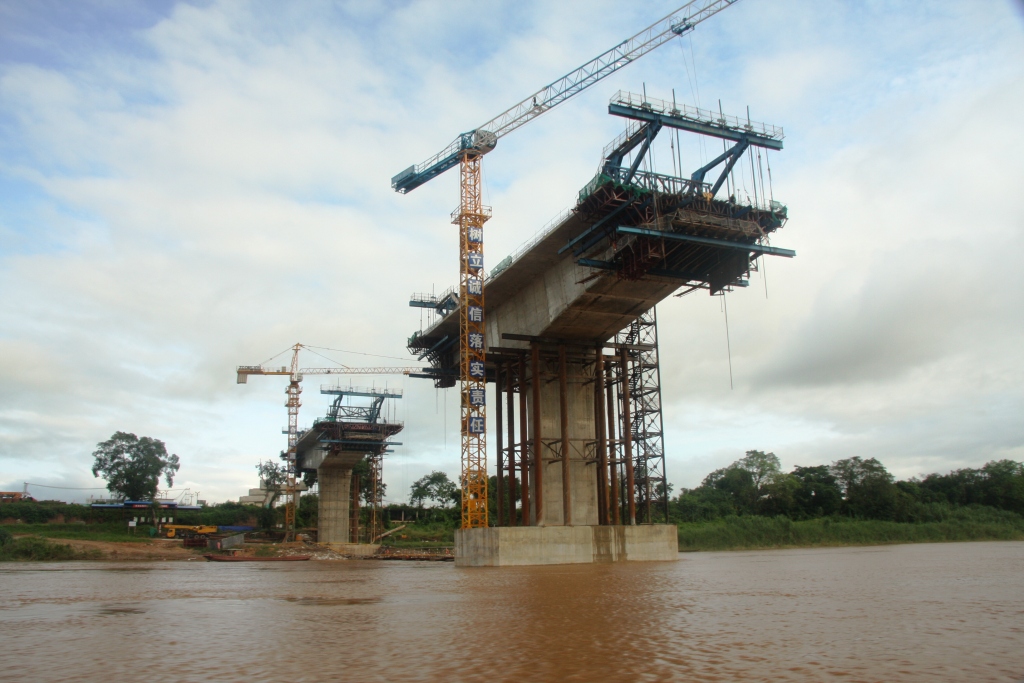
The Fourth Thai-Lao Friendship bridge which connects Thailand’s Chiang Rai province to Lao PDR’s Bokeo province officially opened for business yesterday.  Although the bridge, which stretches 400 meters across the Mekong river, and surrounding customs and inspection infrastructure have been completed for a few months, the two countries set the auspicious date of December 11, 2013 or 11/12/13 as written in the international form for the bridge’s opening ceremony conducted by Thailand’s highly respected Princess Sirindhorn.


A local fisherman navigates the Mekong downstream of the new bridge (July 2012)

A local fisherman navigates the Mekong downstream of the new bridge (July 2012)

The prime benefactor from the bridge’s opening is not Thailand or Laos, but rather China as the bridge serves as the final link in the Kunming-Bangkok highway, a 1900km series of connected highways that will facilitate significant increases in container shipping trade between China and Thailand.  Six years ago overland transport between Kunming and Bangkok for container shipping was virtually impossible due to the poor quality of roads.  In China’s southwestern Yunnan province, a drive from Kunming to Jinghong, the Dai cultural capital of Sipsongpanna (Xishuangbanna) prefecture took up to 24 hours and another six hours to the Lao PDR border at Boten.   China completed its portion of the highway to in late 2007.

The Lao PDR segment of the highway connects Boten to the 4th Friendship bridge in Huayxai and cuts through 180km of the most remote parts of Laos.  In the summer rainy season of 2004 I hitched a ride on a pickup truck to travel the 180km segment which then was a single lane mud track.  We completed the tiresome 10 hour drive only after averting a serious accident and certain death when the truck spun out of control nearly pitched over a 400 meter cliffside.    China, Thailand, and the Asian Development Bank invested equal thirds in the Laos portion of the highway which opened in 2010 and dropped transportation time to three hours.

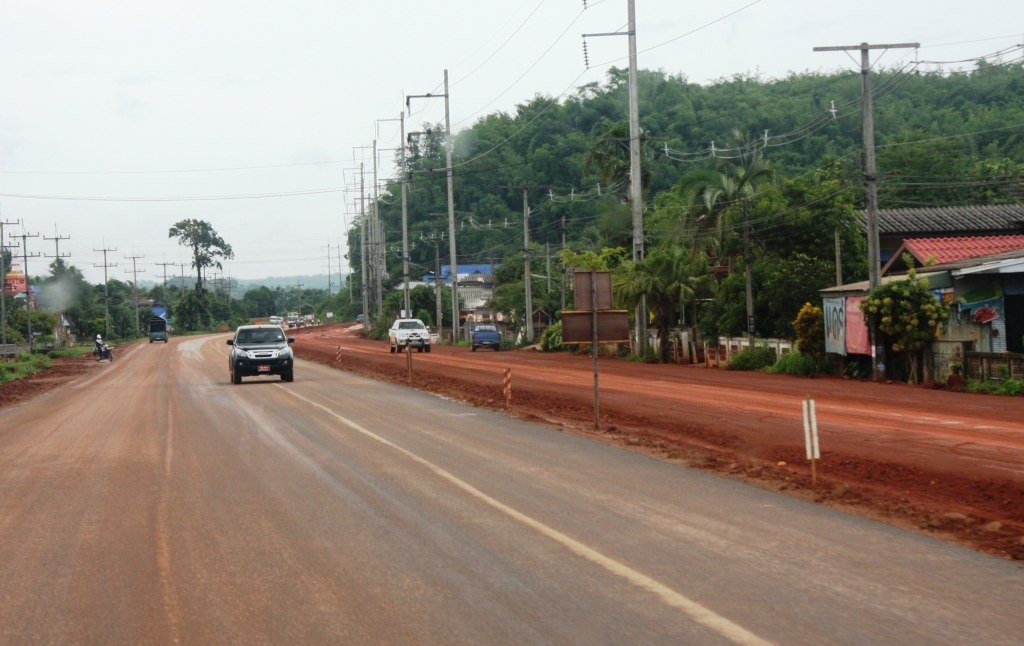
By design, the highway system links the friendship bridge to Bangkok, but despite being the strongest economy on mainland Southeast Asia, Thailand’s highway system lags behind in quality compared to China and the stretch running through northern Laos.  Improvements to Thailand’s R3 highway system which will link Chiang Rai province to all points in Thailand is ongoing but far from complete.  Thailand has promised to upgrade its national transportation and highway infrastructure but political roadblocks, corruption, and a perceived lack of momentum for regional integration at many levels of Thai government and society has discouraged those plans from synching up with China’s outwardly stretching infrastructure linkages.   When the Thai roads are finished, a container truck will be able to travel from Kunming to Bangkok in less than 18 hours.

Road widening construction on Thailand's R3 in Chiang Rai province

Road widening construction on Thailand’s R3 in Chiang Rai province

The 14 hour drive from Kunming to the friendship bridge feels like a leapfrog journey from bridge to tunnel and tunnel to bridge as the road makes its 1800 meter descent.  These two roads cut through some of the most difficult terrain on the planet and link the Chinese state to the Thai state while passing through the most ethnically diverse region in Asia.

The roads not only to build regional commercial connections between China, Thailand, and Laos through the increases of trade and investment but they also assist in expanding each of these state’s interests and systems into the once impenetrable regions of upland southeast Asia by introducing national education systems, agricultural techniques that promote mono-cropping over traditional subsistence farming, and creating avenues for ethnic and rural peoples to leave their homes and link up to national labor markets.   The opening of the bridge will increase trade in the region and will intensify and quicken the pace of social change in upland Southeast Asia and reshuffle the cultural milieu of peoples who have sought refuge from the expansionary Chinese and Thai states for centuries.

Under construction, July 2012

Under construction, July 2012

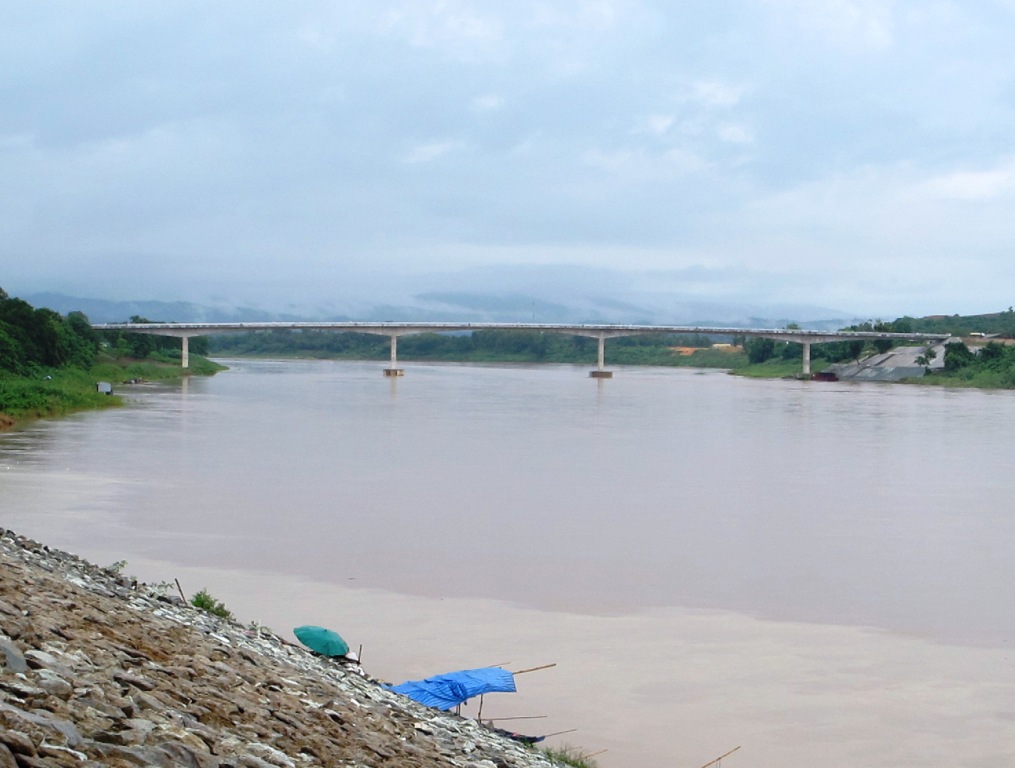
Bridge completion, December 2013

Bridge completion, December 2013

The bridge’s construction has also caused an influx of Chinese investment in Chiang Rai province mostly in real estate development, speculation on future industrial estates for manufacturing of intra-industry goods passing between China and Thailand, and the buying up of agricultural lands.  While this investment is encouraged and welcomed at the national level and by the Chiang Rai Chamber of Commerce, locals are wary of the fast and growing levels of investment in the Golden Triangle Area by Chinese firms and often cite a “Chinese invasion.”  The mayor of Pak Ying Tai village, a small fishing community of 100 households located less than one kilometer south of the bridge has lamented to me on several occasions about China’s footprint in Chiang Rai as he observes year on year decreases in freshwater fish catches and sends more and more of his villagers looking for work in urban areas.

A local farmer from Pak Ying Tai village discusses his worries about community impacts of economic development

A local farmer from Pak Ying Tai village discusses his worries about community impacts of economic development

In many ways the bridge and its construction serve to represent the challenges of regional cooperation between China, Thailand, and the rest of mainland Southeast Asia.  From its conception in the late 1990s to its completion yesterday, the bridge has gone through stalled and failed rounds of negotiation and has not lacked controversy.  Groundbreaking for the 1 billion Thai baht project which is equally invested by China, Laos, and Thailand did not occur until 2010 despite a scheduled start for as early as 2006. In May 2011 Thailand pulled its portion of the construction team in order to settle a land dispute with the local Thai government accusing Chinese commercial interests of illegally purchasing land on the Thai side of the bridge.

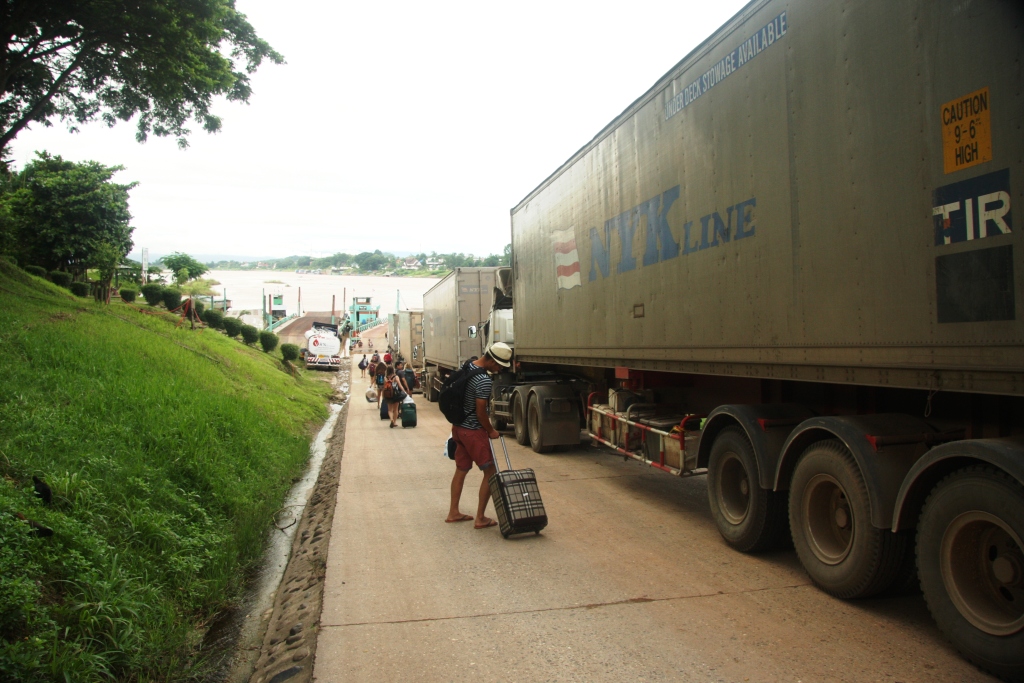
Container trucks will no longer have to wait in line for the Mekong ferry at Huayxai in Laos.

Container trucks will no longer have to wait in line for the Mekong ferry at Huayxai in Laos.

Another obstacle to regional cooperation demonstrated by the bridge is the ease of passage through customs and inspection for both container trucks and individual travelers or tourists to the region.  Chinese trucks are not permitted to drive in Thailand, nor are Thai trucks allowed to travel through China; thus the speed of transport is slowed by the need to repackage goods at one of the border crossing points. Despite efforts of the ADB in to facilitate a shared cross border trade and transport protocol to streamline logistical flows at regional border checks in China and mainland Southeast Asia, states have been slow to adopt the measures in order to protect national markets and logistics industries.  New customs and inspections facilities at the bridge are fitted to increase the speed of transport and ease of people movement and will serve as a testing ground for these promised increases in logistical efficiencies.

Looking forward to the first six months after the bridge’s opening, the verdict will be clear on whether the bridge will serve as a strategic choke point, a gateway for win-win trade and economic development between two regional powers , or a conduit that will further challenge the structure of rural livelihoods in upland Southeast Asia.

Looking upstream at the completed bridge from Pak Ying Tai village.

Looking upstream at the completed bridge from Pak Ying Tai village.

Leave a Comment

Filed under China, Current Events, Economic development, GMS, Mekong River, Regional Relations, SLIDER, Thailand, Uncategorized, Yunnan Province

China’s Bridgehead Strategy and Yunnan Province

Editor’s note: Liu Jinxin wrote this essay to debunk the myth that China’s bridgehead strategy is militaristic or expansionary in nature.  As a chief architect of this strategy, he seeks to demonstrate that developing Yunnan province into a bridgehead will increase international trade flows and deliver long-term regional security.  This translated essay currently guides top-level foreign policy makers in China in implementing economic strategies along its borders with Southeast Asia.  


Yunnan province's border crossing with Vietnam at Hekou/Lao Cai

Yunnan province’s border crossing with Vietnam at Hekou/Lao Cai

The definition of a bridgehead?

According to the Modern Chinese Dictionary, a bridgehead (桥头堡) is a military term that refers to a strategic chokepoint on the field of battle and particularly refers to a fortified structure that defends and controls a bridge or ferry crossing. In economic terms, bridgehead refers to a strategic forward position on a political or economic front line. The term bridgehead appeared for the first time in an official national level Chinese policy document called “Eastern Bridgeheads” in July 1994 which confirmed the Shandong cities of Rizhao and Lianyugang as the bridgehead terminus of the Eurasian landbridge.

In the economic research of landbridges, a bridgehead is a key concept that acts as a port and facilitates the ease of transportation. Bridgeheads are also international centers of shipping, finance, and information which together form an integrated international center of trade. From a logistical and supply chain system perspective, a bridgehead serves basic support to the Eurasian landmass. It is a city or a region that sits on a strategic position on the logistical and supply chain and serves the specific purpose of controlling the flow of resources along international trade routes. The basic characteristics of a bridgehead are its powers to control, develop, and influence.

The power to control

The power to control suggests capabilities levels of secure logistical flows. This can be understood in narrow and broad senses. From a narrow sense, secure logistical flows are conditional to the degree of market openness.  The survival and development of logistical flows must not be threatened by the power of a government to regulate or control it. From a broad sense, a state’s security and international security are guaranteed by engaging in logistical activities. The capability of a state’s secure logistic flows is determined by its capacity to control strategic resources, logistics routes, linkages, and its industrial supply chain.

Linking with the similar strategic logistic routes, resources, and supply chain structures of neighboring states, a concerted logistics system can deliver harmony and mutual trust as well as a collective security that realizes long term stability. Fostering mutual trust, mutual benefit, and equality work together to form a new worldview for security and protects the security of individual states as well as respects the security concerns of other states.  Mutual trust also promotes collective security.


The power to develop 

Developmental power is preconditioned by the construction of logistic routes, linkages and supply chain structures, the developmental needs of economic corridors, and mutual benefit and cooperation. This power can help states share development trajectories, share prosperity and harmonious development, and eliminate security threats at their root. States should place the promotion of shared development as the method for solving global development imbalances and fostering sustainable development. To revolutionize international financial systems, oppose trade protectionism, and promote regional economic cooperation, developing countries should establish development modes that foster interdependence, deliver effective beneficial outcomes, and seek to erase poverty. Developing countries should expand trade with each other, open markets to each other, and increase the level of south-south cooperation.


The power to influence

Influential capabilities rely on a state’s degree of openness and tolerance, strengthening of the construction of a national culture, making positive contributions in international cooperation, solidification of geo-cultural space, promotion of geo-cultural integration, ability to cooperate harmoniously, and mutual progress with its neighbors. States should respect the rights of other states to determining their own development paths by admitting differences in cultural traditions, social systems, and value systems. States should actively promote and provide guarantees to human rights, and increase dialogue to eliminate misunderstandings. States should initiate a spirit of openness and tolerance, make use of the development modes of other states in a comparative and competitive fashion, and seek collective development despite differences.


The functionality of China’s bridgeheads

The central government has required Xinjiang Uyghur Autonomous Zone, Yunnan province, and other frontier provinces and zones to open the construction bridgeheads along national borders to implement a stable and prosperous frontier region. To deliver prosperity, the bridgeheads should:

1) Be a foundation of protecting border security and stability

2) Take measures under the conditions of high technology to serve as a front line in partial wars and non-traditional security issues

3) Support efforts to rapidly develop ethnic and national zones through new economic modeling

4) Expand the promotion of international/regional cooperation with neighboring states and extend degrees of openness by forging ahead as zones of experimentation.

5) Serve as a transit and storage point for national energy resources.

From a spatial perspective, Xinjiang acts as a bridge between the East and the West; it is the new Eurasian landbridge’s thoroughfare, and as a “west gate,” it serves the opening of China’s northwest region to Central Asia and Europe.

Yunnan opens China to the Southwest connecting two oceans, the Pacific and the Indian as well as East Asia, Southeast Asia, and South Asia. It is the linkage point between China’s southwest, the Southeast Asian peninsula, and the South Asian Subcontinent, and is the starting point of the Yangtze River Delta economic zone as well as the Pearl River Delta economic zone. Yunnan acts as the core belt of the China-South Asia Economic Circle and the China-Southeast Asia economic circle. It is the main connective channel between China and the Indian Ocean and is China’s core zone in the Greater Mekong Subregion. More importantly the province serves as a key trade passageway for goods and services passing from China to South Asia and the Southeast Asian peninsula.

gms_map_large

Core Values

China’s bridgeheads are a result of major changes in geo-strategic international structure. The concept is part of China’s key diplomatic principles which pledge to be a good neighbor, a prosperous neighbor, and a secure neighbor. It is also reflective of China’s active pursuit of being a responsible world power. The core values of the bridgehead strategy are:

1) To foster an infrastructure development strategy that expands participation in the world market and establishes interdependence, while constructing mutually beneficial win-win relations with its neighbors

2) To highly prioritize unity among ethnic peoples and social stability by promoting cultural diversity and shared developmental progress

3) To respect  public opinion and the will of peoples in neighboring countries, and respect their value systems by promoting cooperation and exchange between peoples and democratic equality

4) To acknowledge the guidance of international voices and place equal importance on China’s international image and economic benefit

5) To safeguard the benefit of overseas Chinese and Chinese businessmen abroad

6) To value strategic resources, strategic routes, the shared security of strategic industrial supply line

7) To promote the construction of low carbon footprint urban areas and the use of clean energy by promoting an economic society that delivers harmonious, stable, and secure sustainable development

8) To promote the construction of a harmonious new world order and the active promotion of new kinds of partnerships with neighboring countries

9) To resolutely protect free and fair global trade and investment climates, and maintain the free flow of products, investment and services

10) In the long term, to promote sustainable growth, coordinated concerns, advocate tolerance to total adjustment, and promote balanced growth

Global economic balances can only be reached through sharing benefits and needs between developing and developed states.


Yunnan province as China’s southwest bridgehead

The southwest bridgehead is the front line of China’s interaction with the Indian Ocean, and its purpose is to construct a series of overland pathways given China’s southwest connects to South Asia and Southeast Asia trade routes. The bridgehead’s purpose is also to construct a base facing South Asia and Southeast Asia that supports export processing and the facilitation of international and domestic production, and the Kunming international land port economic zone.

Establishing Kunming as an inland economic zone will strengthen logistical flows coming from South Asia and Southeast Asia, create a tourism base for national culture, a commerce base, export processing base, and modern agriculture base as well as an information platform. This platform will come together through the increased progress of the yearly Kunming trade fair, China-South Asia fair, and the creation of different cooperation forums. The central objective is to turn Yunnan province into China’s platform for communicating with Southeast Asia and South Asia. Through creating this window, Yunnan can facilitate the building of trust between China and South Asia and Southeast Asia, and demonstrate the fruits of reform as well as Chinese culture by promoting mutual understanding and friendship. Yunnan can become a demonstration zone for how China can open to its neighbors.

The influence of a bridgehead extends outwards and is continuously stretching its limits. In China this includes two major regions.


A bridgehead to Southeast Asia

Southeast Asia includes the 10 ASEAN states of Malaysia, Philippines, Singapore, Thailand, Indonesia, Brunei, Vietnam, Lao PDR, Cambodia, and Myanmar and the non-ASEAN state of East Timor. In total this region covers 4.5 million square kilometers, supports a population of 580 million, has a combined GDP of $1.9 trillion USD and a total trade of approximately 2 trillion USD. The creation of the ASEAN-China Free Trade Zone in 2010 created a free trade area of 13 million square kilometers and a combined population of 1.9 billion. It is the largest populated free trade zone in the world and the largest free trade zone among developing countries.

China and ASEAN states are linked by mountains and rivers and share advantages by having varied distribution of resources, differences in specialization of industrial processes, complementary strengths, and an enormous potential for cooperation. As trade between China and ASEAN states increases at a rapid rate so are rates of investment. China is ASEAN’s 4th largest trading partner and ASEAN is China’s 5th largest trading partner. ASEAN has been established as a priority zone for attracting Chinese FDI and is one of the outward investment zones for Chinese industries. ASEAN is also a major market for Chinese labor, and China is winning an increasing amount of engineering contracts in ASEAN.

To date China and ASEAN trade relations have already entered a “Golden Era” and as China and ASEAN open their markets to each other, the ASEAN-China Free Trade Zone will enter a substantive phase. These contributions will bring robust commercial opportunities as the Southeast Asian peninsula is a major global agricultural production area and a critical zone of emerging industries.


A bridgehead to South Asia

The South Asian subcontinent (by way of the BCIM economic zone which includes Bangladesh, China, India, and Myanmar) is the geo-strategic fulcrum between the Indian Ocean and the Arabian Sea. At the same time, it is zone of choice for the secure channeling of China’s energy resources. The South Asian Subcontinent is also known as the Indian Subcontinent and is comprised of the Indian peninsula, the Indus river plateau, and the downstream plains of the Ganges and Brahmaputra rivers covering an area of 4.3 million square kilometers. It supports a population of 1.2 billion on 10% of the Asian continent. Its northern reaches are formed by the Himalayan and Karakoram mountain ranges and its southern limits are the Arabian Sea and the Bay of Bengal. Its western borders are limited by the Iranian plateau, and its eastern frontiers are the mountainous eastern regions of India, Bangladesh, and Myanmar.

The severity of South Asia’s natural landscape has prevented integration and the historically its cultures have been relatively closed-off to each other. This has produced divergent sentiments of independence in the region. The South Asian subcontinent includes India, Pakistan, Bangladesh, Nepal, Bhutan and does not include Sri Lanka or the Maldives. Its major rivers are the Indus, Ganges, and the Brahmaputra. Major agricultural products are wheat, rice, cotton, hemp, cane sugar and tea. Resource endowments include coal, mica, zinc, and gold.

An international pathway can be built from Yunnan through Myanmar to give China direct access to the Indian Ocean and its benefits will promote good neighborliness and the strengthening of border areas. Frontiers serve the specific functions of national defense and economic and cultural exchange. Sharing borders with Myanmar, Lao PDR, and Vietnam, Yunnan province serves as the connective link between China, South Asia, and Southeast Asia. It offers an alternate route to the passage of goods through the Straits of Malacca and is the fastest land route for goods to travel from China to South Asia, the Indian Ocean, Europe, and Africa.

Due to its advantageous geographical position, the province can facilitate huge market potential with partners in South Asia, Southeast Asia, and the Middle East. Lastly, because of its history of friendly exchange with its neighbors, Yunnan province serves as the ideal representative for diplomatic connections.

The construction of international pathways will do much to improve the state of transportation and shipping and can only expand and deepen the political, economic, and cultural cooperation between China and Southeast Asian states. Building these pathways and supporting the bridgehead strategy will develop regional economic cooperation between China, Southeast Asian, and South Asian states, strengthen the relationship of good neighborliness, and bring stability and peace to China’s border areas.

4 Comments

Filed under ASEAN, China, DOCUMENTS, Economic development, GMS, Laos, Mekong River, Myanmar/Burma, Regional Relations, SLIDER, Thailand, Vietnam

The Godfather of the Golden Triangle: Lo Hsing Han, Obituary

Most crime bosses and drug barons never reach old age, unless they end up behind bars serving a life sentence. More often than not they are eliminated in a hail of bullets fired by either a police sharp-shooters or from a rival gang.

But  Lo Hsing Han ,the former ‘King of the Golden Triangle’ heroin trade  who survived several decades of opium wars in the Shan state and became one of the world’s ‘Most Wanted Men’, amazingly defied the odds to become an octogenarian. He died in Yangon on July 6th 2013 aged 80.

Nor did this legendary drug-trafficker die in lonely obscurity shunned by society. His lavish funeral was a VIP affair attended by former generals, two cabinet ministers, and hundreds of well-wishers from Burmese high society.

They paid tribute to his rare metamorphosis from a notorious drug-kingpin to a respected business tycoon, the founder of the Asia World Group that has become a dominating pillar of the Myanmar economy. He is also credited with being the key player in establishing the nation’s economic dependence on narco-profits in the 1990s.

Lo was born around 1935 into a poor ethnic Chinese family in the Kokang district of the Shan state northern Myanmar.

His career in the opium trade began in the 1960s not as an outlaw, but as the leader of a Yangon–sanctioned militia, the KKY, under the auspices of General Ne Win’s dictatorship.

The militias were supposed to fight Shan rebel armies and the Burmese communist guerrillas but expended most of their energy on taxing and protecting mule convoys carrying huge sacks of opium. Thanks to a complex chess-board of   nationalist rebels, opium warlords, the Burmese army and communist guerrillas backed by China, anarchy reigned supreme in the Shan state.

After the 1967 Opium War, Lo Hsing Han emerged as the big winner and consolidated much of the opium trade under his command, still enjoying the blessings of the Ne Win regime.

But the regime came to realise that their home guard KKY militias were a failure and started to disband them in 1973, prompting Lo to abruptly change sides and team up with his former enemies the SSA rebels –the Shan State Army.

During the next 20 years the Lo Hsing Han real–life story was packed with more intrigues, changing allegiances and betrayals, than a John Le Carre novel.

British film-maker Adrian Cowell filmed his classic ‘Opium Warlords’ (‘screened on ITV in 1974), after spending more than nine months trapped in the Shan jungles. It featured for the first time an interview with Lo, the legendary warlord.

Lo, the drug trafficker warlord, unexpectedly offered a diplomatic deal to end the narcotics trade in Burma, by offering to sell the whole opium harvest to the US government in exchange for a mere $12 million. It was taken seriously in Washington by a US congressional committee.

DEA agents based in Thailand arranged for Thai Police to pick him up inside Burma with a message that high-ranking US officials had agreed to talks in Chiangmai.  However after the Thai helicopter collected him from inside Burma, he was stunned to be immediately arrested upon arrival in Thailand July 1973.

US law enforcement plans were confounded by the sudden deportation of the prize catch to Yangon. Some Thai officials clearly wanted to stop Lo Hsing Han from talking. Many high-ranking Thai police and military officials were on Lo’s extensive payroll, which helped to grease the smooth transportation of narcotics delivery by road from the Shan state to Thai ports, without being intercepted by police checkpoints.

The Ne Win regime promptly indicted him for treason and he was sentenced to death. In another twist to the saga, the verdict was soon set aside in favour of an 8 years jail term, much of it served comfortably under house arrest. Then in 1980 amnesty was granted and he returned to Lashio in Shan state.

The military junta’s intelligence chief General Khin Nyunt had spotted an opportunity to recycle the resourceful man from Kokang, who had contacts with everybody in the ethnic mosaic of the Shan state, to work for the regime in a new capacity.

A 1989 mutiny inside the communist BCP proved to be a major game-changer, which allowed Lo Hsing Han to play his newly assigned role as a broker of ceasefires.

His contacts with all the Shan, Kokang and Wa rebel armies helped General Khin Nyunt to conclude a series of ceasefire agreements, and in return the military junta happily re-licensed Lo to resume the opium and heroin trade in opposition to rival drug warlord Khun Sa, who was still fighting the government under the banner of Shan nationalism.

In 1992 Asia World Corporation was set up in Yangon as a family partnership between Lo Hsing Han the chairman and his son US- educated Steven Law, the managing director.

The company’s portfolio included: import-export business, bus transport, property development and Rangoon’s port development.

But it was Singapore ‘s decision to get into bed with the Lo family’s Asia world conglomerate with a stake in two new luxury hotel through the government’s investment arm GIS, that garnered most international attention.

According to research based on all the available date of Myanmar’s trade investment and revenue in the fiscal year 1995-6, no less than US$600 million income in the state treasury could not be accounted for.

This conspicuous gap in Myanmar’s bookkeeping at a time when their official economy was on the rocks, points to only one plausible explanation–a generous infusion of narco-dollars from the Golden Triangle coming from Lo. One of the country’s most successful entrepreneurs had come to the rescue of a faltering economy in dire straits.

The grand wedding of  Steven Law to Singaporean business partner Cecilia Ng in 1996  clearly helped to cement the growing ties between the military junta, Asia World, and Singapore investors..

The Lo family’s guest of honour was Hotels and Tourism Minister Lieut. General Kyaw Ba, accompanied by four more cabinet ministers, and two planeloads of wedding guests from Singapore. The special charter flights not only carried the bride’s relatives, but also investors from representing one of Asia’s most important financial hubs.

US officials claimed that half of Singapore’s investments in Myanmar have been tied to Lo’s family.

It was far more than a grand wedding bash. It symbolised Lo Hsing Han’s metamorphosis from a drug baron to a corporate respectability, and his acceptance by investors from a key member of the Asean business community.

Asia World established three subsidiaries in Singapore jointly run by Steven Law and his wife Cecilia Ng (Ng Sor Hong) she allegedly also runs an underground banking system facilitating money-laundering and safe tax havens for narco-dollars.

Although Singapore is proud of its mandatory death penalty for small-time narcotics couriers and heroin addicts, both father and son travelled freely in and out of the island city state.

Steven Law and his father had become VIPs in Burma, and welcome business partners in Singapore, but they were forbidden to enter the United States since 1996 on “suspicion of involvement in narcotics trafficking.”

Under new US sanctions imposed in 2008 Asia World and six of its subsidiaries were blacklisted and similar sanctions were applied by the UK.

But these sanctions have done little to hinder Asia World‘s dynamic expansion. The company built on the illicit black economy has thrived,  and currently  partners major companies from mainland China in several mega-projects including an oil and gas pipeline, a deep sea port at Kyaukpyu, and the controversial Myitsone dam project.

Another irony is that Lo was closely connected to Taiwan’s military intelligence for 30 years, and deployed his Shan and Kokang soldiers to fight against Beijing-backed Burmese communist party.

Asia World has its financial foundations built on the law of the Burmese jungle and the 3 Gs :Guns, Gold and Goons. But  Lo’ s legacy will casts a long shadow over the aspirations of many groups to move the economy out of the hands of the cronies, and towards a respect for environment, human rights and the development of a democracy.

This account of the Life and Times of Lo Hsin Han provided the basis for the obituary published in The Economist in July, 2013.

2 Comments

Filed under China, Cold War, Mekong River, Myanmar/Burma, Singapore, SLIDER

Tibetan Wine Boom Threatens Food Security

The growing Tibetan wine industry raises concerns about local food supplies and pesticide use.

Many familiar with China and Tibet, may have heard about China’s “Shangri-La,” a region in the northwest of China’s Yunnan Province bordering Tibet and Sichuan that was officially renamed in 2001 after the location of a mystical Himalayan paradise in James Hilton’s 1933 novel, Lost Horizon.  The goal of this naming campaign was to heavily promote and extend tourism throughout the region, a strategy that has proved highly effective for the local government with the number of both Chinese and foreign visitors continuing to grow annually and with the increasing expansion of a tourism industry catering to the desires of travelers wanting to experience both Tibetan culture and local natural wonders.


Grapes on vine in a village near the Yunnan Tibet border

Grapes on vine in a village near the Yunnan Tibet border

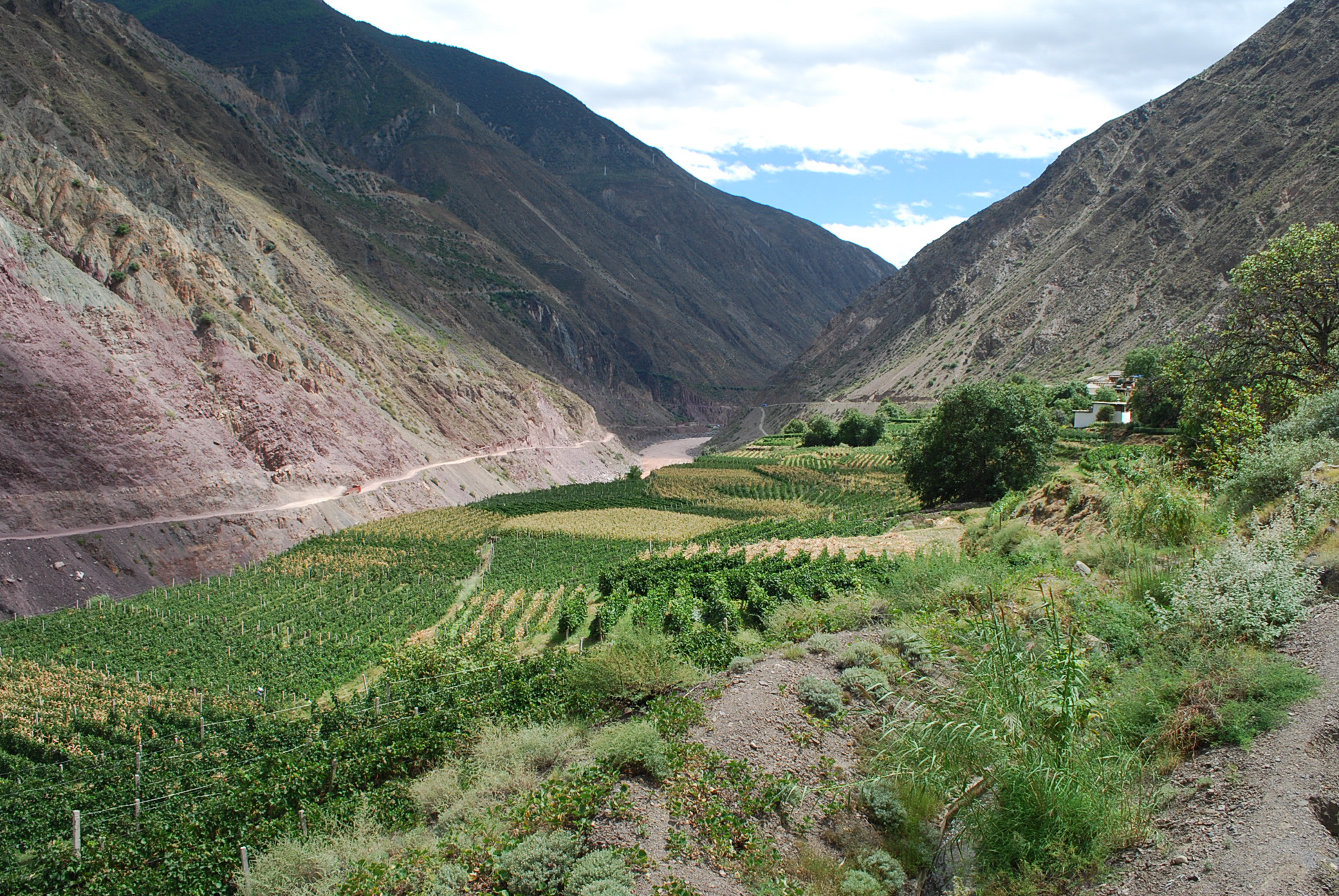
Over the last decade, a significant corporate and agricultural development project in the region has involved the growth of a Tibetan wine industry among rural villages on the upper Lancang (Mekong) and Jinsha (Yangtze) rivers.  About nine years ago, the provincial government approached villagers across the region’s warm and dry rivers valleys and encouraged them to begin growing grapes to annually sell to the newly established Shangri-La Red Wine Company, a new corporation with close government ties that markets its wine as being distinctly Tibetan and coming from “Shangri-La.”  As part of this program, villagers were given grape seedlings and concrete trellises to support their new vineyards.  Slowly, more and more villages have caught on to this practice and pattern of agriculture to the point that in several areas, fields have been transformed into monocrops, though this is not the case is all locations.  Indeed in some of the region’s villages, a diversity of crops including wheat, barley, buckwheat, corn, and in the southernmost areas rice, are all grown.


The government introduced Cabernet Sauvignon vineyards to the  village along the Upper Lancang in Yunnan close to Tibet.

The government introduced Cabernet Sauvignon vineyards to the
village along the Upper Lancang in Yunnan close to Tibet.

Though I had been traveling and studying in this region for seven years and had indeed witnessed grape growing, it was not until 2011 when I arrived to conduct research on the potential impacts of hydropower resettlement in the region for my master’s degree that I began to realize what a large undertaking has occurred with grape agriculture and the major impacts that this has had on local livelihoods.  Discovering these issues, I began to explore them more deeply, writing a chapter in my MA thesis focused on the topic (which is soon to be published as an academic article), and now looking at this grape agriculture, its history, and the changes associated with it in great depth for my doctoral research.


Original Rose Honey vines in the church yard at Cizhong in the  south of Yunnan’s Tibetan region

Original Rose Honey vines in the church yard at Cizhong in the
south of Yunnan’s Tibetan region

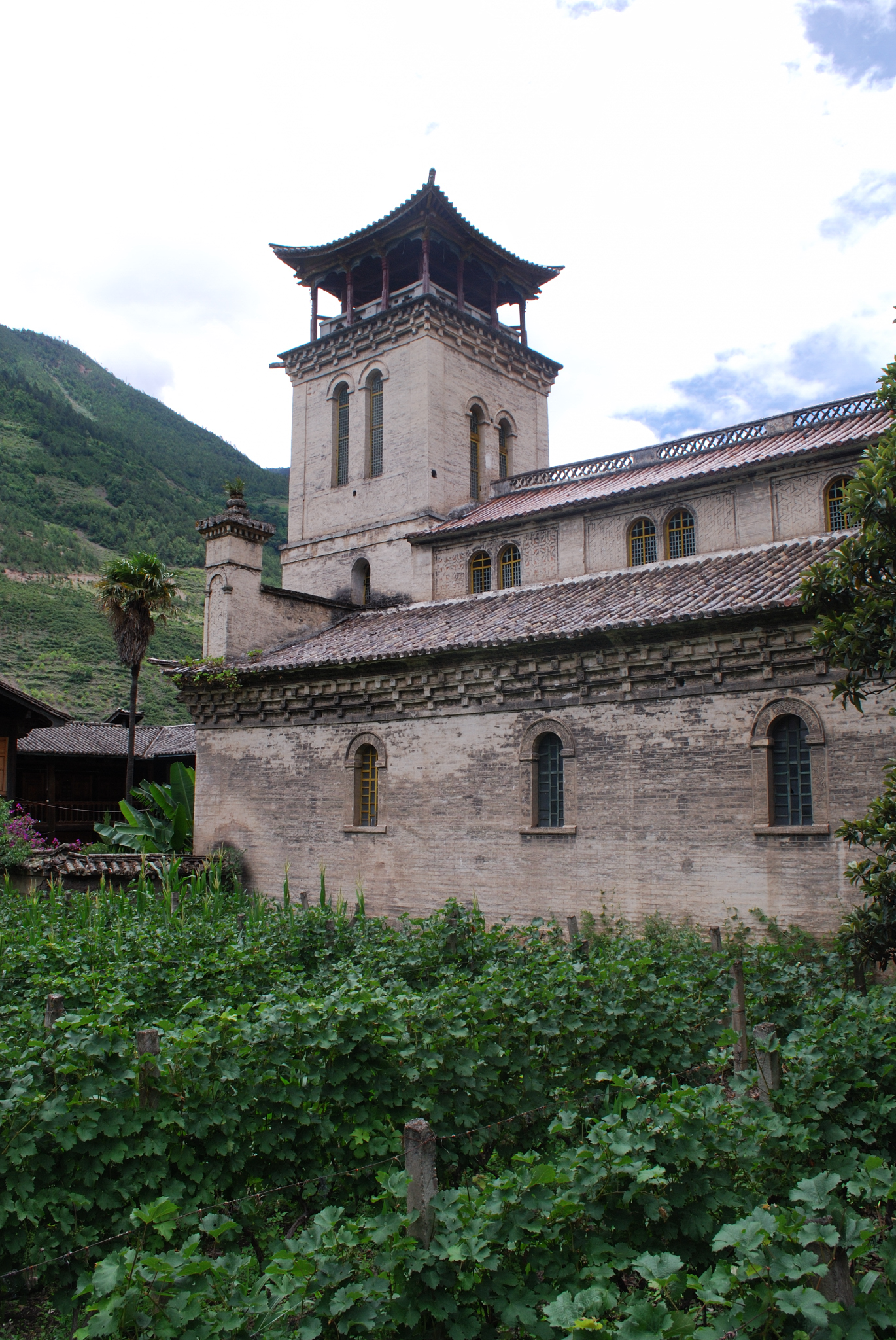
Despite their recent expansion across the region, grapes and wine actually have a long and interesting history in the region in isolated areas.  In the late 1800’s, French Catholic missionaries established a strong presence in the region, primarily in the neighboring Nu (Salween) river valley but with a few successful churches and Tibetan converts in the Lancang as well.  While establishing their churches, the French also began to plant grapes and to produce wine, a practice which is still carried on to this day by villagers in Yunnan’s southern most Tibetan villages in Cizhong.  Unique to Cizhong on the upper Lancang is also a variety of grapes known as Rose Honey, a strain that was thought to have been completely wiped out by a blight in France but was found preserved within the church walls at Cizhong.


Township government Cabernet vineyards planted outside of Cizhong’ s church

Township government Cabernet vineyards planted outside of Cizhong’
s church

Based on my own interviews and ethnographic work in the region, the Rose Honey grapes are in fact only grown by a limited number of villagers and today are primarily unique to Cizhong alone.  When the prefectural government and Shangri-La Red Wine Company introduced and encouraged grape growing throughout the region approximately eight years ago, they provided a new variety of Cabernet Sauvignon grapes, which is the only variety that this company will purchase.  Therefore the majority of the communities in the region grow and sell these grapes, though in some cases around Cizhong they also produce some wine to sell to tourists themselves, though this is not the case everywhere, especially in the most upstream areas closest to Tibet where some villages have no knowledge of wine making.  Unlike the Rose Honey grapes, the Cabernet variety also requires significant chemical inputs by way of fertilizers and pesticides.


From a sustainability standpoint, this increasing reliance on chemicals is one of two major areas of concern and interest – the second is food security.  Villagers themselves are not unaware that they are becoming increasingly reliant on chemicals and that this may be causing problems either.  In one village where I work, only two years ago it was a very common practice among households to intercrop vegetables for personal consumption among grape vines.  However starting this year I both noticed that the practice has decreased and was informed that this was due to villagers own worries about eating foods exposed to too many chemicals and possibly now toxic soils.  Similarly, one of my informants in Cizhong prides himself on two features of his grapes: they are completely organic, and he only grows the Rose Honey variety he obtained from the church yards.  This man has pointed out that most people in Cizhong use many chemicals because the Cabernet grapes introduced by the government won’t grow without them, while the Rose Honey grapes can be grown without any inputs.  Using these characteristics he markets the wine he makes as being both organic and of the historically significant Rose Honey variety, and has managed to develop a very good income for himself by selling wine to local government officials for banquets and to a restaurant in the famous tourism city of Lijiang to the south.


Cizhong villager tending his organic Rose Honey vines.  He makes and sells wine  himself rather than selling grapes to a company.

Cizhong villager tending his organic Rose Honey vines. He makes and sells wine
himself rather than selling grapes to a company.

Food security and changes in traditional cropping patterns and ways of life are also a major issue created by grape growing.  In the downstream regions around Cizhong, the majority of villagers still grow large amounts of grain including rice (the northernmost rice in the Mekong and the only rice grown by Tibetans), wheat, barley, corn, and buckwheat to fulfill their own subsistence and livestock needs.  This is not the case upstream however where villagers now grow little to no grain in exchange for grapes as a monocrop; by doing so they then rely on the profits from grape sales to purchase grain for subsistence and also fertilizers and pesticides.  This has brought about two issues.  The first is major changes in diet, as people who traditionally subsisted on wheat and barley are now purchasing rice and in a sense becoming “Hanified” by their diets as they move away from eating traditional Tibetan foods.  Second, there is now a great reliance on the government and the Shangri-La Red Wine Company to purchase grapes, which are the number one income source and thus hugely important in securing funds to purchase adequate amounts of food to eat.  However from year to year, selling grapes is a major issue of concern, particularly being able to sell them at the ideal time when they are first ready to be harvested because if one waits too long they begin to rot on the vines and lose weight which is how they are measured for sales.


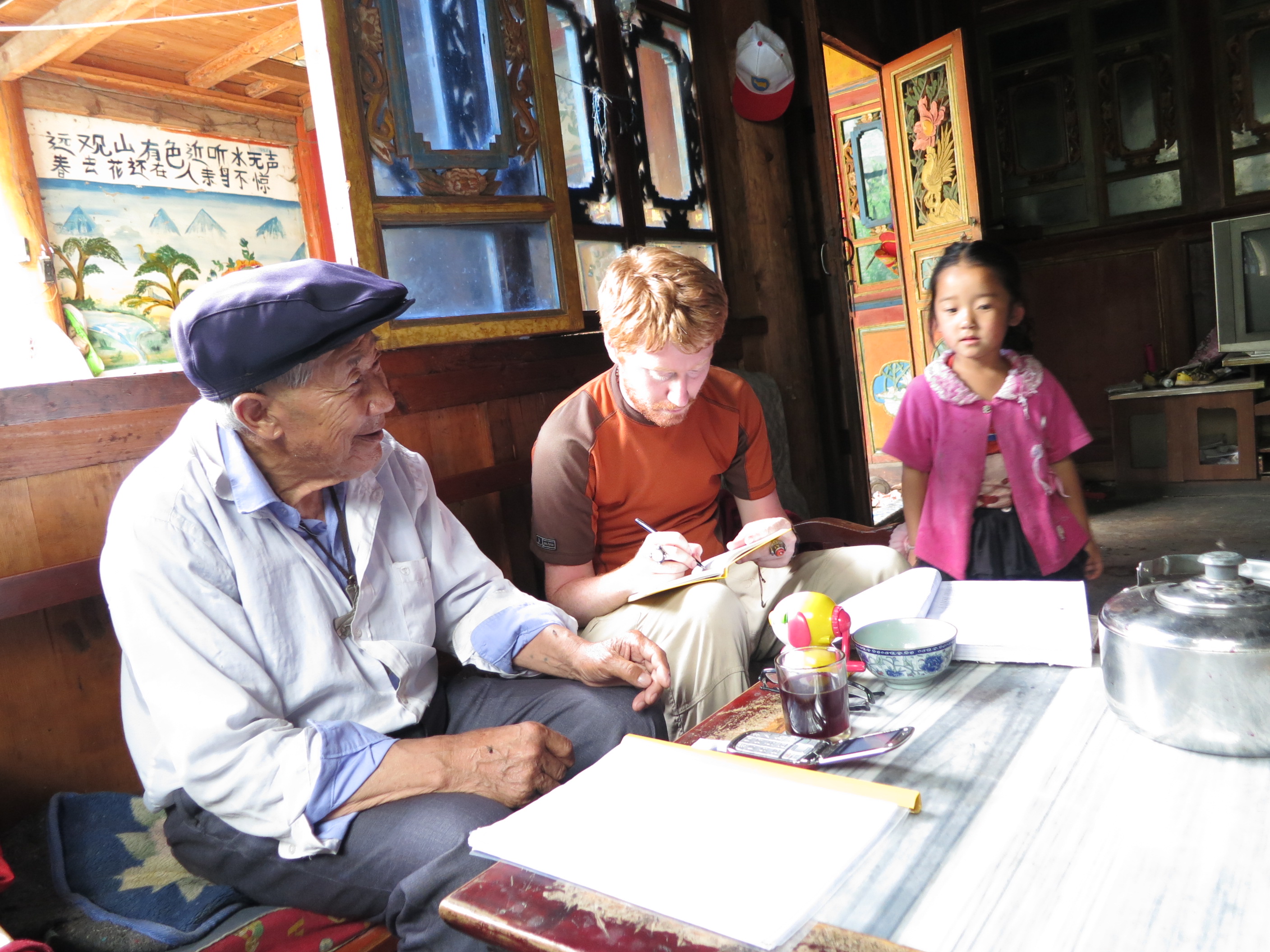
Interview with an 85 year old Cizhong villager who learned to make wine from French Catholics in the 1930s (photo by Sun Fei).

Interview with an 85 year old Cizhong villager who learned to make wine from French Catholics in the 1930s (photo by Sun Fei).

Since the harvest season of 2011 when I first began studying these issues, the company purchases have consistently arrived late every year, which has created serious worries among villagers about their ability to sell the crop.  Despite government assurances that the company is guaranteed to arrive by a certain date each year, this has not appeared to actually be the case, and securing maximum prices and value from grapes from year to year is a constant struggle for villagers as well as the new reliance on outside food purchase which are well captured in the following quotes from interviews:


“Before we planted grapes we didn’t have to buy corn and pesticides, but now we do.  However our income is still better growing grapes. If you plant grapes your income will increase, but you also have to spend more money to buy food.”


More or less, villages fully recognize the vulnerabilities involved in switching their cropping to grapes, but have still chosen to do and have invested much time and energy in doing so because of the high monetary returns that they provide.

An abbreviated version was posted here earlier this week on thethirdpole.net


Leave a Comment

Filed under China, Food, Mekong River, SLIDER, Uncategorized, Yunnan Province