Category Archives: Mekong River

Book: The Mekong – Turbulent Past, Uncertain Future

The Mekong: Turbulent Past, Uncertain Future

Milton Osborne (Grove Press, 2000)


The Mekong, Turbulent Past, Uncertain Future, by Milton Osborne is a critical introduction to the history, geography, and a slate of current issues facing the Mekong River basin.  Despite being written in 1999, the book is a must read for those looking for a primer to the myriad issues challenging the region.  Those more familiar with the Mekong region will find interest in the anecdotal observations of locations like Luang Prabang and Phnom Penh by locals and outsiders through the centuries as well as the personal perspectives of the Milton Osborne himself, a seminal authority on the Mekong and Southeast Asia.  PLUS, any book that begins with a description of drinking Beer Lao along the Mekong must be a good one.

Weaving the 2000 year history of a river and those living in its watershed into a 300 page narrative is no small task.  As a basic approach, Osborne selects contemporary themes prevalent to the region such as violent exploitation by outside groups, biodiversity losses, the protection of local and indigenous cultures, and the establishment of independent state and regionalism.  He then searches for the roots of these themes in both the historical record and contemporary experience.  The composite product is a rich chronology that begins with the rise and fall of classic empires like Angkor Wat, transitions to the exploits of the European Colonials up the river as they search for a river road to China, and finally pits emerging Mekong states in a battle with a contemporary rising China over the Mekong’s abundant endowment of resources.  The book by no means is a local history, but rather one of an outsider looking in, a familiar and recurrent theme utilized by Osborne to connect with his English speaking audience.

Part I of the book begins with the 13th century reflections of Chou Ta-kuan who made the only written documentation of the great Khmer kingdom at Angkor.  Chou’s observations, calling the Khmer “a coarse people, ugly and deeply sunburnt,” reveal prejudices of the hegemonic Chinese empire toward lesser and classic rice cultivating states to the south.  This reminds the reader at once of similar prejudices European colonials held toward Asians as well as the prevalent chauvinism that modern day Chinese often show toward their southern neighbors.  Osborne’s description of the Khmer empire highlights the critical linkage of the seasonal ebb and flow of the Mekong watershed’s Tonle Sap lake to sustaining the life of a historically unprecedented empire.  He accurately portrays that this natural phenomena of yearly flooding along the Mekong and its tributaries serves as lifeline to the abundance of fish species that nearly 60 million people rely on for sustenance in contemporary times.

The book excels as a historical narrative as Osborne introduces the steady stream of European influence over the region starting with exploits of the Portuguese and Spanish in the 16th century and then, across a few of the books chapters, giving a detailed account of a 19th century failed French exploratory mission to find a way to navigate the river from its delta at the sea to upstream into China.  At the time of the book’s writing in 1999, Chinese engineers were blasting rapids in the upper reaches of the Mekong near the Golden Triangle to open trade river trade between China and Thailand, so the river exploration theme may have seemed more relevant then than now.  Yet even today local communities struggle to cope with the costs of foreign investment and imposed development practices.  The story of the not-so-successful Lagree-Garnier mission of the late 1850s reveals hubris of the French who discovered, at great cost of human life, that the river could not be used as a trade route to China.  Yet their meticulously recorded 15-month expedition produced the region’s first accurate topographic map, and picturesque illustrations by the expeditions’ engraver, Louis DelaPorte detail the dynamic cornucopia of human culture that was found then (and still exists) along the course of the Mekong.

In Part II, Osborne tells of the political and social upheaval of the Mekong region of the 20th century through his own experiences and those of his friends and colleagues, some of whom met a violent end in the decades of Cold War conflicts that plagued Vietnam, Cambodia, and Laos.  Arriving in Phnom Penh in 1959 on assignment by the Australian government, Osborn tells how he once (like many Southeast Asian leaders today) was excited about the prospects of the US’s plans to dam the Mekong.   Through first-hand, detailed accounts he portrays how the Vietnam War and the Cambodian conflict put an end to American sponsored hydropower cascades on the river.  This portion of the book also introduces readers not so familiar with the Vietnam War, the Killing Fields of the Khmer Rouge in Cambodia, and the US’s Secret War with Laos to key events, political leaders, and suggests literature for further reading.

The irony of Part III, an exposition on future concerns toward the Mekong, is although it was written 14 years ago, so little has changed of the rhetoric and concern towards the future of the Mekong.  Much of this portion is spent discussing the details and impacts of China’s dams on the Mekong on downstream fisheries and communities – a theme that still pervades the current literature on Mekong issues.  This suggests little progress has been made on issues that were not only apparent in the mid-1990s, but in retrospect, apparent in the 1950s when the US planned to dam the Mekong.  Osborne discusses the lack of political gravitas displayed by the Mekong River Commission, the coordinating body responsible for the river’s maintenance and development made up of the four lower basin member states of Thailand, Laos, Cambodia, and Vietnam.   He introduces salinization of the Mekong Delta and the potential costs that will be burdened by local communities through increases of regional transportation infrastructure such as highways and bridges built across the Mekong for the purpose of trade facilitation.  Most Mekong scholars would agree that the circumstances surrounding these key contemporary issues have only worsened since the time of the book’s writing.

The Mekong: Turbulent Past, Troubled Future is a must read and good starting point for all students of the Mekong and its narrative is as significant now as it was in 2000 at the time of its publishing.  More importantly, the book leads the reader to more exhaustive texts like the Cambridge History of Southeast Asia and sets the reader to explore a widening pathway of issues developing in the Mekong basin.  The book also serves as an excellent travel companion for those backpacking through the region.  Travelers will be surprised to see how much the urban spaces, like Phnom Penh, Jinghong, and Dali described in the book by its various characters throughout the centers have changed and enticed by how much cultural cores, like sleepy Luang Prabang, have not.

1 Comment

Filed under Current Events, Economic development, Environment and sustainability, GMS, Mekong River, Reviews

The 3rd Annual ICIRD Conference, Part II

Previously, I introduced ICIRD 2013, a Bangkok-based conference exploring issues of development, greater economic integration, and the idea of the regional commons. This blog post will delve more deeply into the background of the commons, an alternative way of organizing public goods that circumvents the hungry advance of neoliberal globalization. 

By way of illustrating, one of the most pressing current issues surrounds the Mekong River, the classic example of a regional – and transboundary – commons in Southeast Asia. Crossing six countries, laden with social and historical significance, and layered with overlapping claims and uses, millions depend on its shared resources, while growing hydropower development threatens large-scale devastation and destruction of riparian ecosystems. But forms of the commons can range in scale from municipal parks and shared community fishing sites along river banks, to oceans and digital commons on the far end.

The Commons as Social and Historical

Certainly in the context of greater regional integration augured by the ASEAN Economic Community (AEC), the concept of the commons becomes an increasingly important, if imperiled, way of organizing assets and resources within communities. Introducing the Focus on the Global South Round Table I, Shalmali Guttal offered the following definition of the commons: it is a collection of assets that are actively managed for the good of the collective and should be accessible by everyone. They include not only natural and physical resources, but social, cultural, political (e.g., concepts like justice) and intellectual wealth as well.

But that’s not all that the concept offers: there can be no commons without a certain type of social relations based on sharing. It’s important to remember that the commons are entwined within the history of Southeast Asia, just as its growing commodification is embedded within the larger context of globalization. As Dr. Victor Savage (National University of Singapore) mentioned in an earlier panel, historically the Southeast Asian region has lacked traditional notions of private land ownership. Here, instead, usufruct rights guaranteed the rights of access for communities, and the commons functioned as safety net and social insurance.

But over time, as  Dr. Walden Bello (Member of the Philippines’ House of Representatives) reviewed, the transition to capitalism became inextricable from the plunder of non-Western societies, in a process that continues even now. He argued, for example, that the ADB and World Bank are central in enforcing ideologies of private property and codes to delegitimize communal traditions.

The tension between these divergent worldviews, one based upon the primacy of private property and the other upon the social relations upholding the commons, is ultimately not about choosing between a given set of choices, but rather about entire ideological frameworks brought together in one current, historically-informed confrontation.

Resistance and Alternatives

Pervasive throughout the ICIRD panels was the idea that everywhere the commons are being threatened by a neoliberal logic that seeks its enclosure and commercialization. The growing commodification of nature makes itself readily felt in the rise of issues like land grabbing, water privatization, and rampant hydropower development in the region, all of which were repeatedly raised in the course of the conference.

Neoliberalism, in Dr. Bello’s account, lost much of its legitimacy, due in part to the role of research organizations and scholars who documented its high human costs, as well as the internal crises of neoliberalism, erupting spectacularly in the Asian financial crisis of 1997 and the global crisis in 2008. He argues that while neoliberalism has been largely discredited, the lack of alternative paradigms means that it remains a source of default strategies for technocrats.

It may be partially true that business as usual continues for lack of other competing visions. But power also incentivizes its own perpetuation. And raising alternative possibilities is one way to counter the naturalization and legitimacy of dominant neoliberal globalization as it is taking place.

In seeking alternative forms of state-community relationships, it makes sense to step back from the lens of the nation-state. Yong Ming Li’s presentation (subtitled “Seeing like a chao baan/neak tonle,” in reference to James C. Scott’s seminal tome) offers one such narrative. By shifting down to the scale of the local, social-natural relations take on a new centrality that includes “a multiplicity of grounded perspectives and practices from the chao baan (villagers) of Chiang Khong, Thailand and the neak tonle (villagers living on the Tonle Sap lake)” (from ICIRD paper abstract). These social-natural relationships defy conceptualization based solely on market relations with nature.

The role of the research and academic communities seems clear – to keep giving voice to critical analyses of the changes taking place in the region and what’s at stake. To illustrate, the “Encouraging Green Growth in Thailand” forum was based on the appealing premise that “green economies will lead to higher resource efficiency, and investments in green innovation will benefit green pioneers with new markets, higher productivity, and human capital development” (from panel summary). Yet the forum ended in a robust debate about whether green growth (with its undeniable focus on growth) represents merely another reconfiguration of capitalism being pushed towards a new frontier.

Ultimately, as former Philippines Senator Dr. Orlando S. Mercado (who holds the distinction of being the first permanent representative of the country to ASEAN) told me after the Focus panel:

“We have to struggle to have our voices heard. But we should not only just be making our voices heard. We have to be able to move within the system to affect changes by taking advantage of various crises that erupt. To me, as a scholar interested in disaster mis-management, I feel that the cause of protecting the commons is served very well by making sure that each crisis, each disaster, each calamity, is taken advantage of to show that there must be people championing the cause of those who are adversely affected by its lack of management and the privatization that is ongoing as a consequence of economic development – all on the altar of creating a community that is ‘prosperous’.”

2 Comments

Filed under ASEAN, China, Current Events, Economic development, Environment and sustainability, Governance, Mekong River, Reviews, SLIDER, Thailand, water

The 3rd Annual ICIRD Conference, Part I

With the ASEAN Economic Community set to launch in 2015, it’s not surprising to see a heightened level of uncertainty, concern, and even apprehension about what this enhanced sphere of regional integration will mean for Southeast Asian nations.

Holding this backdrop firmly in mind, the 3rd Annual International Conference on International Relations and Development (ICIRD) recently commenced at Chulalongkorn University in Bangkok, on August 22-23, 2013. This year’s timely theme, “Beyond Borders: Building a Regional Commons in SE Asia,” showcased established voices, civil society organizations, and a new generation of scholars rising to the challenges of this historical moment. Over forty panels traversed diverse but interrelated topics from environmental justice and human rights, to sustainable economic growth.

While few would deny the problems of development in Asia as they have manifested so far (e.g., environmental degradation, growing income disparity, and resettlement), finding a consensus on a way forward proves much more difficult. As Dr. Siriporn Wajjwalku (Assoc. Prof., Thammasat University) noted with some urgency in the opening remarks, “2015 for us in the region is approaching… It’s extremely important for us to think about the commons and go beyond the borders that we are facing now.”

Dialogue and discussion are a good place to start. Thus Dr. Carl Middleton (Lect., Chulalongkorn University), a member of the ICIRD Executive Committee that organized the event, proclaimed the conference “a success in that there was plenty of sharing of knowledge, experience and ideas amongst the participants, and a wide range of examples of the commons and how they support peoples well-being and create public space were discussed.” Continue reading

1 Comment

Filed under ASEAN, China, Current Events, Economic development, Environment and sustainability, Governance, Mekong River, Thailand, water

China & Southeast Asia: Unbalanced Development in the Greater Mekong Subregion

By Xiangming Chen and Curtis Stone

Integrating with Southeast Asia is a key component of China’s multi-pronged regionalisation around its borders as its global rise continues. Below, Xiangming Chen and Curtis Stone consider the ambition of China’s ‘Go Southwest’ strategy to extend its economic interests and influence into Southeast Asia, and explore how China’s regional assertion reinforces the larger trend of new spatial configurations in light of increasing globalisation. The authors show how simultaneous globalisation and regionalisation unleashes a dual process of de-bordering and re-bordering where the traditional barrier role of borders is yielding more to that of bridges, as small, marginal, and remote border cities and towns become larger centers of trade and tourism. This article examines China’s effort to engage Southeast Asia and many of China’s footprints within and beyond the cities of the Greater Mekong Subregion (GMS). Inter-country and intra-regional trade provides the starting point for examining the extent of economic integration in the GMS, and also its unbalanced development.

Going Southwest

In a coffee shop in central Vientiane on a hot summer day in 2012, two young Chinese businessmen from northwestern China, sipping ice-cold Latte, talked about the prospect of a new venture to explore copper in the mountains of northern Laos: ‘If we make $100 and they [Laotians] get $5, they should be happy’. On the outskirts of Yunnan’s capital city of Kunming, China’s fourth largest airport behind Beijing, Shanghai, and Guangzhou (also the world’s fifth largest airport in occupied area), Changshui International Airport, which is expected to have flown 38 million passengers by 2020 and 65 million by 2040, was opened with much fanfare in June 2012. While seemingly disparate, this pair of anecdotes reveals the ambition of China’s ‘Go Southwest’ strategy to extend its economic interests and influence into Southeast Asia.

Integrating with Southeast Asia is a key component of China’s multi-pronged regionalisation around its borders as its global rise continues. China’s regional assertion reinforces a larger trend of new spatial configuration as an inherent part of increasing globalisation driven by China. This simultaneous globalisation and regionalisation unleashes a dual process of de-bordering and re-bordering where the traditional barrier role of borders is yielding more to that of bridges (Chen). As a result, once small, marginal, and remote border cities and towns have become larger and lively centers of trade, tourism, and other flows. China’s effort to engage Southeast Asia leaves many striking footprints within and beyond the cities of the Asian Development Bank (ADB) facilitated Greater Mekong Subregion (GMS), which was launched in 1992 and consists of China’s Yunnan Province (with the later addition of Guangxi Zhuang Auto-nomous Region), Cambodia, Laos, Myanmar, Thailand, and Vietnam.

Trade with the GMS Countries

Inter-country and intra-regional trade provides the starting point for examining the extent of economic integration in the GMS as well as its unbalanced development. China’s trade with each of the GMS countries has grown since 1990, most rapidly since 2000 (see Figure 1). Given the size of their economies, Thailand, followed by Vietnam, led the smaller GMS countries in trade with China. However, the total volume of China-Myanmar trade rose by $5.9 billion from 2001 to 2011, while China-Laos trade increased by $1.2 billion (Figure 1). Much of China’s growing trade with Myanmar and Laos occurred through cooperation across international boundaries. The role of Yunnan and its capital city of Kunming in China-GMS trade cannot be understated. Yunnan’s GDP skyrocketed from $33 billion in 2000 to $160 billion in 2012, and the province aims to double that to $320 billion by 2017 through even stronger cross-border economic and trade ties. Kunming acts as the origin and core of economic activities that reach into the bordering countries of Laos, Myanmar, Vietnam, and beyond.

Table

Continue reading

1 Comment

Filed under ASEAN, Cambodia, China, Current Events, Economic development, Energy, Foreign policy, GMS, Governance, Mekong River, Myanmar/Burma, Regional Relations, Thailand, Uncategorized, Vietnam, water

Mekong study tour update: 7.19.2013

Other than top-notch commentary on China and SE Asia, ExSE isn’t known for too much and it’s quite clear now that keeping promises isn’t a strongpoint of ours. If you were expecting regular updates on our excursion to Thailand and Laos, we deeply apologize for not delivering. However, if there’s any worthy excuse, it’s that Brian, Dequn, Tai and I have been too busy learning. The following is simply a recap of what’s been going on so far; the true implications of the things that we’ve learned are too much for me to explore in any one post.

Our first two days were spent rather relaxingly, and thankfully far away from a 3G or broadband connection, taking a cruise down the Chao Praya River with Traidhos Three Generations Barges. On the cruise, we learned the river’s watershed, conservation efforts on the river and its significance to Thailand. It was a wonderful introduction to the country through its principal waterway.

The next morning, we met with Pete Cutter at the World Wide Fund for Nature Greater Mekong Office in Bangkok. The WWF Bangkok Office is involved in some very important efforts to preserve more than a half-dozen endangered species in the region and coordinates often with other NGO’s and governments in the GMS.

Our two days in Chiang Mai, where I’m writing from now, have been our most fruitful. Thanks to our friend and ExSE team member Tom Fawrthrop, we were able to meet with many of the top journalists, NGO heads and scholars in northern Thailand. On the 16th we had a lunch talk with Tom himself and learned a ton on the region in general, and specifically the dangers of the 1250MW Xayabouri Dam in the Lao Mekong and the movement to resist its completion. We then two lectures by Professor Narut and Professor Panuwat from the Chiang Mai University Political Science Department on Thailand’s economic role in the GMS and democracy in Thailand, respectively. Afterwards, we met with the Forest Restoration Research Unit at Doi Suthep National Park and learned about their groundbreaking research on tropical forest care. Continue reading

Leave a Comment

Filed under ASEAN, Culture, Economic development, Energy, GMS, Governance, Laos, Mekong River, Myanmar/Burma, Thailand, water

China needs to change its energy strategy in the Mekong region

This op-ed was first published at ChinaDialogue and thethirdpole.net on 7/16.

 Mekong bridge

At the end of this year cars and container trucks loaded with goods from China and Thailand will finally be able to drive across a multi-lane bridge spanning the Mekong River (known as the Lancang in China). The bridge will connect Chiang Rai province in Thailand to Bokeo province in Laos, effectively linking China’s highways stretching south from Beijing and Shanghai to those coming north from Singapore, Kuala Lumpur and Bangkok.

Funded by equal investment from the Chinese and Thai government, the completion of the bridge, which took ten years of planning and two years to build, is not without controversy. For many years Thailand held back investment due to an uneven distribution of benefits between China, Laos and Thailand. Also on the Thai side, the NGO Rak Chiang Khong claim the bridge negatively impacts the local Golden Triangle economy and will ruin Mekong fisheries.

The Golden Triangle Bridge serves to highlight the challenges facing China, as the country’s new leadership attempts to balance its slowing and volatile economy and deliver domestic stability by maintaining peaceful economic relations with its neighbours.

China’s regional strategy

“In 2012 China’s growth in trade and outward investment with the five other Mekong countries of Myanmar, Laos, Thailand, Cambodia, and Vietnam surpassed its trade and investment growth in ASEANcountries,” said Xu Ningning, chairman of the Greater Mekong Subregion (GMS) Business Council. “Greater growth rates will continue with increases in regional cooperation and win-win investment opportunities.”

For the past three years China’s GMS provinces of Yunnan and Guangxi have posted growth rates of 12-15%, the highest of China’s localities, and arguably China’s economic rise has also helped deliver high growth rates among Mekong countries.

The end of the Cold War in the 1990s created a favourable environment for China to develop its economic cooperation strategies toward the Mekong region. The blurring and opening of once inviolable borders encouraged traders on both sides of the China-Southeast Asia frontier to appeal to local and national governments for better conditions for trade and migration. The Chinese government responded with twenty years of state-led trade liberalisation and investment policies to promote regional cooperation in state and private sectors.

China’s economic cooperation strategies towards its four Mekong neighbours has dovetailed nicely into a strategy that fits China’s current development needs. Liu Jinxin, a policy analyst and logistics expert says, “Unlike the US which leads the world in finance and IT, both high-value service-oriented industries, China is the world’s factory, producing goods to drive the growth of its growing middle class and serving export markets around the world. To survive, the Chinese ‘factory’ needs inputs like energy and raw materials.” Continue reading

1 Comment

Filed under ASEAN, China, Current Events, Economic development, Energy, Environment and sustainability, Food, Foreign policy, GMS, Governance, Laos, Mekong River, Myanmar/Burma, Sustainability and Resource Management, Thailand, Vietnam, water

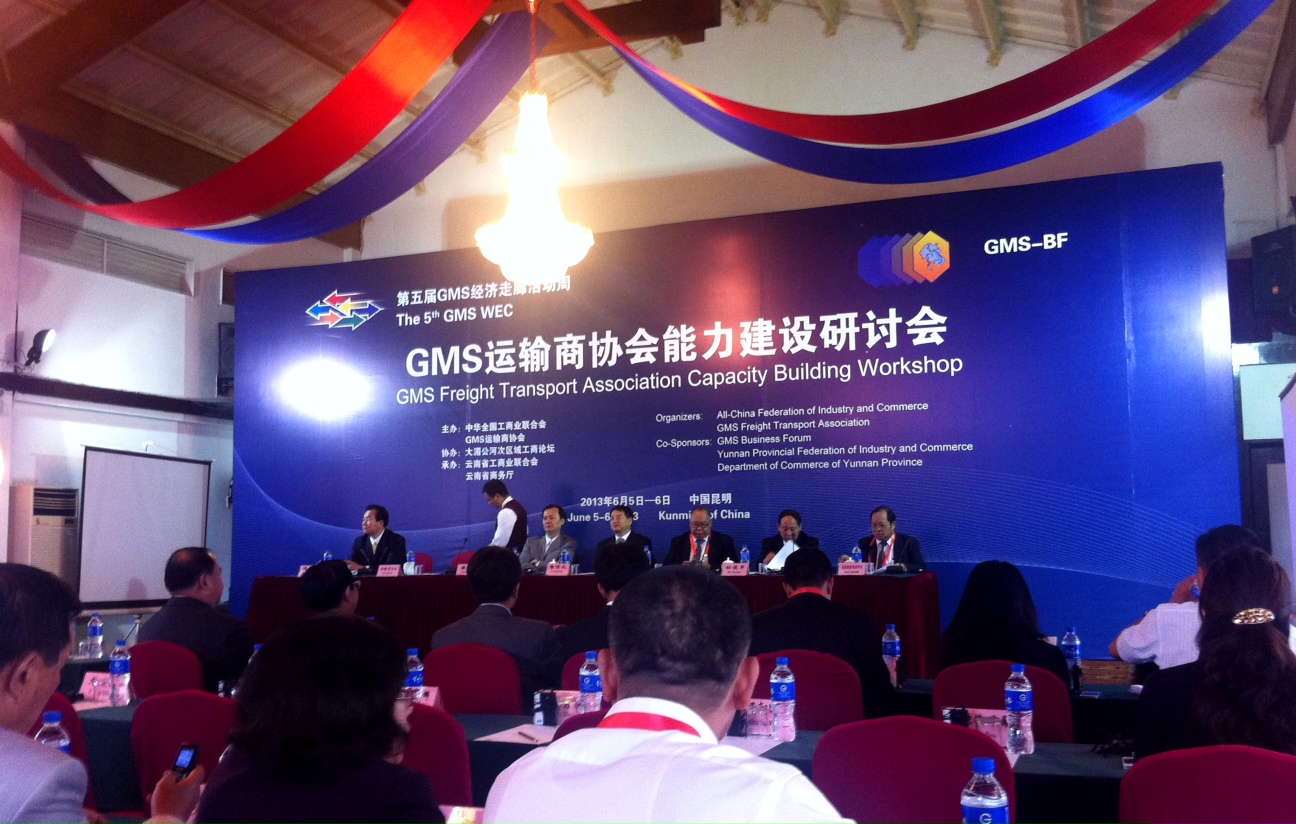
Remarks: Strengthening Cooperation & Promoting Cross-border Transport Logistics

GMS workshop

NOTE: The following is the English language transcription of a speech by Yang Shiji, Vice Director of the Yunnan Provincial Government’s Research Office, presented on June 5, 2013 at a workshop on GMS (Greater Mekong Subregion) Freight Transport Association Capacity Building.  The first part contains an interesting portrayal of connectivity potentials and a brief history of transportation linkages between China and Southeast Asia.  The reader should keep in mind that the area in discussion contains some of the most difficult terrain in the world, but the speaker’s main concerns are inter-government cooperation and the harmonization of customs and trade procedures throughout the region.   The final portion of the speech provides a framework to improve connectivity and upgrade logistical services within the region. 

For reference, a map of the Greater Mekong Subregion is linked here

“Strengthening Cooperation and Promoting Cross-border Transport Logistics in the Greater Mekong Subregion”

Cross-border logistics is an emerging industry combining several composite services such as transport, warehousing, and information.  Connecting production with consumption and linking countries to the outside world, the industry is composed of tangible and intangible factors and covers the entire process from product manufacturing to commodity flow.  Therefore, giving full play to the function and role of transport and upgrading the efficiency of cross-border logistic transport will have significant impact on all aspects of the economic and social lives of the countries in the GMS.  With the maturation of China’s market economy, a professional and efficient logistic system has been an indispensible factor for upgrading the quality of its economic functions, the income of its enterprises, and an accelerator for its entire national economy.

Located at the junction of China and Southeast Asia, the South Asian Subcontinent, Yunnan borders with Laos, Vietnam, and Myanmar, and shares with them a 4060 km national boundary line, about one-fifth of China’s total land border.  It has 25 frontier counties, 23 national entry ports, and over 100 trading channels for border residents.  To its east Yunnan is linked to the Zhujiang River delta and the Yangtze River delta economic circles, and to its south it has direct access from three routes, east, central, and west, to Hanoi, Bangkok, Singapore, and Rangoon via the Kunming-Bangkok highway and the Pan-Asia Railway, currently under construction.  It is the gateway to the vast western hinterland of China to its north.  To its west, it has access to the Indian Ocean via Myanmar.  In a word, the province enjoys the locational advantage in “connecting with two oceans, the Pacific Ocean and Indian Ocean, and linking with three major markets in East Asia, Southeast Asia, and South Asia.” Continue reading

Leave a Comment

Filed under China, DOCUMENTS, Economic development, GMS, Laos, Mekong River, Myanmar/Burma, Regional Relations, Technology, Thailand, Vietnam

Where have all the fish gone? Killing the Mekong dam by dam

The Mekong, a river of wildly majestic fast-flowing currents flowing through six countries, has long enchanted explorers with its rich biodiversity second only to the Amazon.

It is home to the Giant Catfish, and at least 877 fish species sustaining food security for around 65 million people which make the Mekong the world’s most important centre of freshwater fisheries.

“For the people born on the Mekong, the river is like their blood—the principle of life,” says Dorn Bouttasing, a Lao environmental researcher.

Surely it is unthinkable that man would want to endanger or destroy the basis of such extraordinary natural wealth? Such invaluable natural resources, their infinite value defies any attempt to measure with a crude price tag.

My documentary Where Have All the Fish Gone? (Eureka Films) looks at the four Chinese hydropower dams that have been already built on the Lancang (The Chinese name for the upper Mekong), but its main focus is on the Lower Mekong basin shared by Laos, Myanmar, Thailand, Cambodia and Vietnam.

Continue reading

Leave a Comment

Filed under Cambodia, China, Current Events, Economic development, Energy, Environment and sustainability, Food, Foreign policy, GMS, Governance, Laos, Mekong River, Sustainability and Resource Management, Thailand, Vietnam, water

Regional Roundup for Week of 4.18.2013

Just the news this week. Continue reading

Leave a Comment

Filed under ASEAN, China, Cold War, Current Events, Economic development, Energy, Environment and sustainability, Foreign policy, Governance, Health, Laos, Mekong River, Myanmar/Burma, NEWS DIGEST, Thailand, Vietnam, water