Category Archives: Kunming Train Station Attack

On Xinjiang’s Freedom Struggle and Oppression

Uyghur woman facing a police cordon during protests in Xinjiang in 2009. Photo: REUTERS

Uyghur woman facing a police cordon during protests in Xinjiang in 2009. Photo: REUTERS

I never intended to write a background article on the Xinjiang situation, simply because I feel I’m not nearly an expert on the field. But inevitably, when you’re researching a subject and trying to form an idea, article after article pops up, and important people all over the world voice opinion after opinion. And that’s how it’s suddenly noon and you’re still sitting in your underwear on the couch with your head stuck deep into the internet.

Even though I have become a lot wiser about the Xinjiang issue, I am not in a place to make socio-political analysis. However, this terror attack, this fight for freedom, and this cultural and economic oppression are not confined to Kunming, Xinjiang or China. They are not isolated events. And neither are reactions from the opposite side, which slowly but surely tighten the noose of public opinion around the neck of a culture, a religion and a people until it has been stripped of its humanity and hunting season is declared open to shoot down – verbally or literally – anyone connected with it. It’s easy to draw a few parallels to the intolerant climate in Europe in the 1930′s and the world doesn’t need another such occurrence. With this opinion piece I want to contribute, however little, to halt this mass demonisation.

People have been rightfully pointing out that many western media used quotes (such as CNN, now removed) around terrorism, as if terrorism is some sort of privilege of the West to suffer. Of course, the definition of terrorism is problematic, even the UN hasn’t properly outlined it yet. I would define terrorism as an act of violence with a political motive which, rather than targeting the political bodies it is in conflict with, targets a group of unrelated people in the hope that their fear will cause them to put political pressure on the targeted government. By this definition, the Kunming knife incident is very likely to be a terror attack (very likely, because the attack hasn’t been claimed by anyone, and because the authorities have not made the perpetrators’ identities public yet).

The Washington Post has published an article in which it looks for motives and where it blames Chinese oppression. As terrorism and freedom struggles are a global issue, this comes across as hypocritical. The author probably doesn’t mean it as such, but if you read between the lines, he’s saying that while terrorism in the West is to blame on freedom-hating thugs, terrorism in China is the result of government oppression. In my opinion, naturally only the latter is true and the West ought to learn a lesson from this. It should also apply its China logic to how it judges insurgent groups, and not only in the Muslim world.

That brings me to the next issue: can it simply be blamed on government oppression?

There has been a lot of outrage about the statement of Dilxat Rexit, the head of the World Uyghur Congresswhich strives for Uyghur self-determination. In an e-mailed statement to the New York Times, he said: ”We oppose any form of violence, and we also urge the Chinese government to ease systematic repression. If this incident was really the work of Uyghurs, then I can only say that it may be an extreme act by people who feel they cannot take it anymore.” Some (e.g. Kaiser Kuo on his Facebook page) argue this is basically a defence of the barbaric acts of last Saturday.

Yet what do you expect the head of the World Uyghur Congress to say? He’s the head of an organisation that promotes the cultural and political freedom of Uyghur people all around the world. Do you expect him not to give his take on the motives? And do you not think that he will find those motives rooted in the cultural and violent oppression by the Han in Xinjiang? Do you expect him to merely condemn the attacks without following up with a ‘but’ clause? Of course not, that’s why he’s the leader of the WUC. What he is saying is: “I could see that coming.”

I am for once agreeing with Mao Zedong, in that there is no hatred without a reason. I strongly recommend taking ten minutes to read Chinachange.org’s translation of an opinion piece written by Wang Lixiong (王力雄), Beijing-based political dissident and writer of “My West China, Your East Turkestan” (我的西域,你的东土). In it, the author argues that the problem is political at its core and therefore cannot be solved with economic solutions such as Beijing’s knee-jerk response of ‘developing’ China’s far west.

Mr. Wang writes that Uyghur people in Xinjiang are at a disadvantage on many levels. They often do not speak Mandarin well enough, have their own cultural and religious values and are therefore completely left out of the political process. At the same time, the government is siphoning away Xinjiang’s riches to the east. Social and economic segregation results in Uyghurs only getting the crumbles of a cake that the Han (who are now more or less equal in numbers in Xinjiang) have divided among themselves. The perpetual circle of violence and repression will lead to the ultimate exclusion of Uyghurs from society and, ultimately, to ‘Palestinisation‘ (a word the writer uses to mean the full mobilisation of a people against another). These pariahs will turn to their neighbours Afghanistan or Pakistan for their religious identity. This includes the risk that Uyghur people, who normally adhere a milder strain of Sunni Islam, will be converted to fundamentalists. The comparison to another Palestine or even Chechnya is indeed not far off.

It is easy for us to say something along the lines of “the Muslims are at it again.” It’s an old mantra repeated by ever more people all over the world. Yet I doubt that it’s right to blame religion. In fact, I’d even make the case that Islam doesn’t even play a real role in the knife attacks. It just happens to be the religious background of a people that want their land back, or at least want to be treated as equals in what once was their land. Possibly only the modus operandi changes: the IRA or the ETA would have planted a bomb.

Therefore, blaming religion is wrong and dangerous, because it would condemn a group far larger than the one engaging in violent activity. At the same time, it cannot be denied that the rise of radical Islam all over the globe is playing and will be playing an ever more important role in the lives of Xinjiang Uyghurs.

In light of the radicalisation of the entire Muslim world, if you don’t come to the conclusion that outsiders have created an environment in which they feel oppressed and which therefore allows terrorism to flourish, then your conclusion can only be that there is no chance of ever abating their extremism. Then you must conclude that Muslims are an evil group that needs to be eradicated or at least fought until they give up. I think history has taught us that that is not the way the cookie crumbles.

Editor’s Note: Sander originally published this post on his blog www.worldofnonging.com on 3/4/14.
1 Comment

Filed under China, Current Events, Kunming Train Station Attack, SLIDER

Kunming in the aftermath of the train station attack

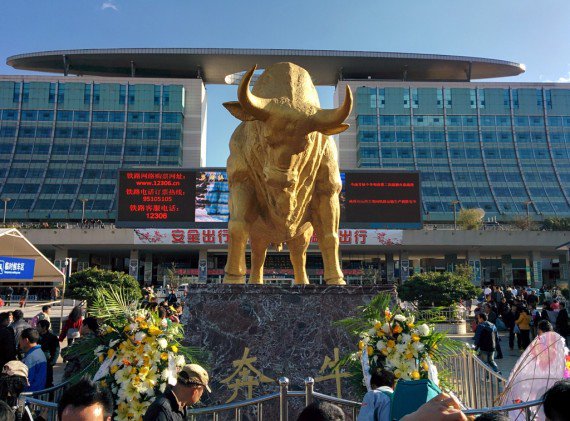
Memorials in front of the Kunming Train Station

Memorials in front of the Kunming Train Station

In the aftermath of the attack on the Kunming train station, in which official sources say at least 29 people lost their lives and 143 were injured, I went to sniff around the city for stories and reactions. People were stoic, supportive of their fellow citizens and seem to steer clear of any racial violence.

In general, the city felt ridiculously normal for the day after the attack . The people manning the gate at my compound greeted me as cheerily as I scooted down the hill and the only armed police I saw were hanging around a major interchange. Most people ambled lazily around Green Lake park, gazing at the flocks of sea gulls on their way back to Siberia as if nothing had happened. Not a SWAT team to be seen, even though this would be a potential spot for carnage. Kunming’s 1st People’s Hospital also had only a few law enforcers stationed outside, a shrill contrast to the mob of police inside that was trying to keep nosy journalists at bay.

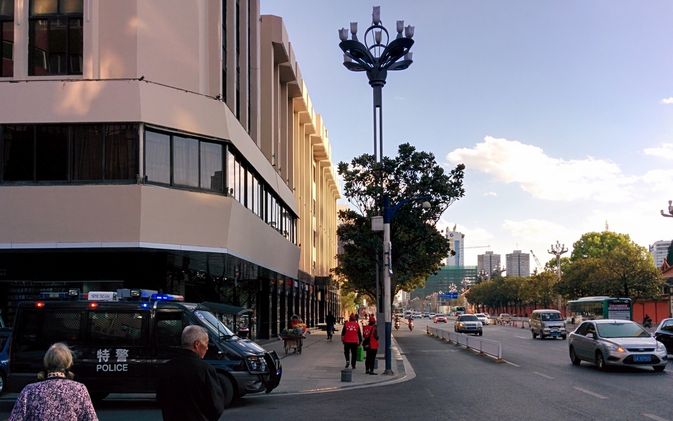
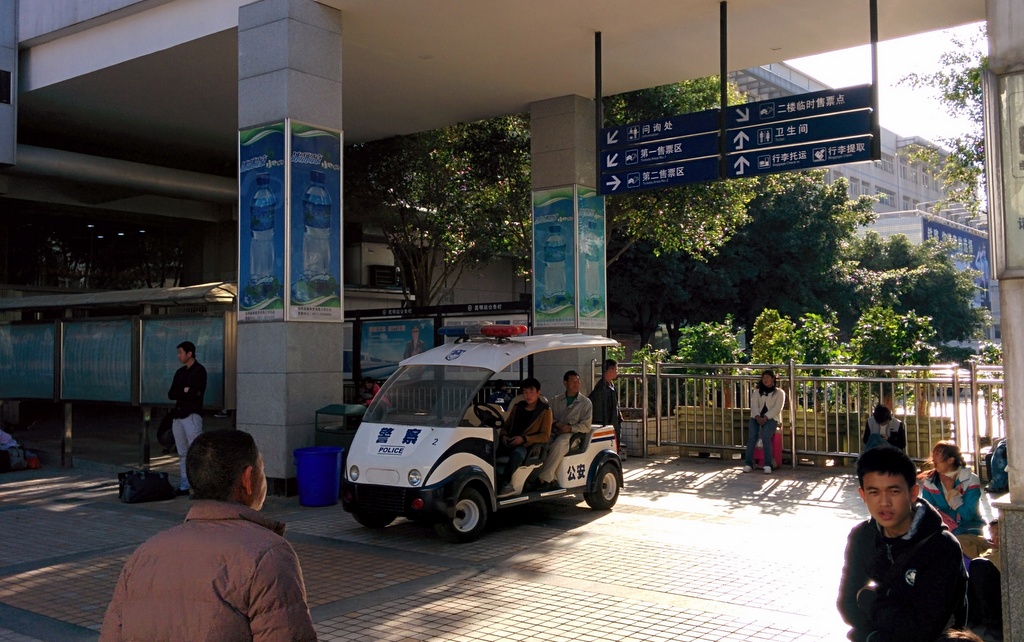
Unmanned police vehicle manned by local kids — right in front of the train station ticket office

Unmanned police vehicle manned by local kids — right in front of the train station ticket office

Even the train station felt relatively normal. On the left side of the square, a large part was sectioned off with police line and a dozen or so armed SWAT policemen were swarming around. In the middle of the square, under the large gilded bull, people were taking pictures of flowery memorials, one of which had already fallen down and torn. The ticket hall, the goriest place from Saturday’s attack, had been properly cleaned and was again filled to the brim with people queuing to buy tickets.

A young man cheekily ran behind me to measure himself against my height, so I used that as a pretext to ask him some questions. Whether he was afraid? “If I were afraid I wouldn’t be here”. Any other questions resulted in him uneasily shooting his eyes around so I left it at that.

A SWAT vehicle on Beijing Lu

A SWAT vehicle on Beijing Lu

The cigarette lady was more helpful. She had already closed the shop and gone home for the night when the killings happened, but she was dead afraid to come to work on Sunday. She had wanted to stay home, but her boss and the need for a salary made her show up. She added that the extra security made her feel safer, though. A Bai minority woman in traditional dress was waiting for her daughter to pick her up. When I asked her if she was worried about coming here, given yesterday’s events, she replied: “which events?” Apparently the news had not reached rural Dali.

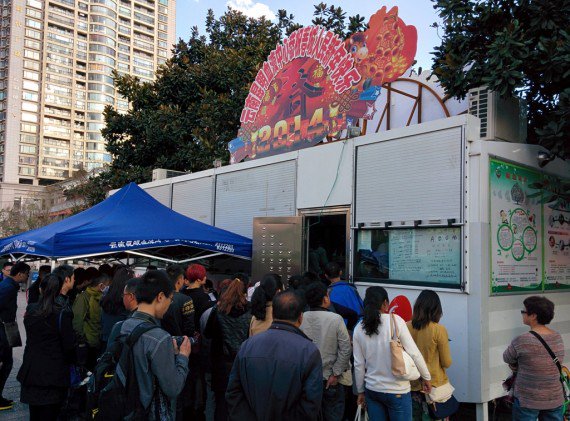
I also visit one of the mobile blood donation centers that the government had set up at twelve different locations all over the city. They must have rushed them in, as the containers still sported a sign for a previous blood-donating event at New Year’s day and make no mention of the stabbings the day before. That didn’t seem to stop people from flocking to the cabin. I am told that at least 150 people had already donated blood at this point and another 60 people were waiting to give.

Mobile blood donation center – caption reads: "Kunming blood donation center wishes Spring City residents a happy new year"

Mobile blood donation center – caption reads: “Kunming blood donation center wishes Spring City residents a happy new year”

I met Miss Wu (25) and her two friends at the mobile blood bank. She herself is not able to donate, but her two male companions are. While the two men were inside, I struck up a conversation. ”We’re here to help our fellow citizens after yesterday’s massacre,” she beams. Solidarity and stoicism obviously go hand in hand in Yunnan. “I don’t think this will affect how I see Muslims,” she explains, “and I don’t think it will the view of most other Chinese, either. The attackers were a violent group who had nothing to do with other Muslims. There have even been a lot of Muslims coming in to donate blood. Wherever you have people, you have bad ones.”

A Chinese journalist asked me my opinion and added that he had not been able to interview any Uighur people. “Perhaps they’re afraid for retaliation [from Han majority people], but they really needn’t be, there doesn’t seem to be a strong anti-Muslim sentiment among the people.”

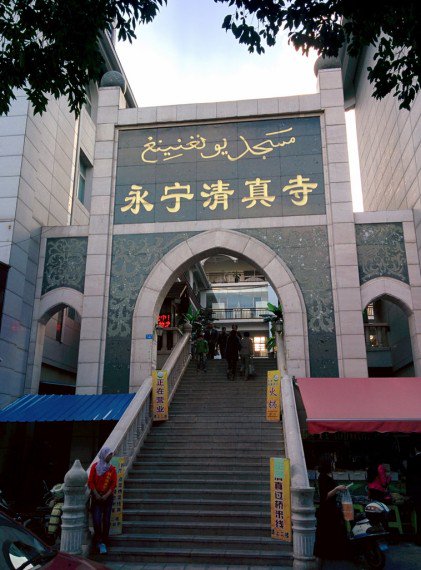
Business as usual at a Kunming mosque

Business as usual at a Kunming mosque

At the nearby mosque at Jinbi square, too, everything seemed to be business as usual. No signs of Islamophobic rioting, just people cooking all kinds of Halal cuisine for visitors. I talked to Ma Jun, a Hui (ethnic Han Muslim) woman from Inner Mongolia. While roasting some Erkuai pancakes, a local Yunnan delicacy, she told me she had seen some Uighur people coming in today for food and prayer, like on any other day. She made a plea for stronger feeling of unity among the Chinese people and says all will always be welcome under the roof of the mosque.

Questions remain, though, which no one currently has an answer to. One such question is: why Kunming? Of all places of importance to the government, was Kunming just the one with the weakest security? Were the attackers simply locals? Were they after tourists or after a particular train (the train to Shanghai was about to leave)? Kunming has almost no history of violence in the contemporary era, with the only notable event being the bombing of a bus in 2008. Then, too, Uighurs were initially blamed until it was later revealed that the lone bomber belonged to theHui minority.

Editor’s noteThis article was written by Kunming transplant Sander Van de Moortel and originally published on his blog A World of Nonging, on March 2.

1 Comment

Filed under China, Current Events, Kunming Train Station Attack, SLIDER, Uncategorized, Yunnan Province

Kaiser Kuo: On Radicalization and Chinese Policy

I get that some people trying to make sense of the attacks in Kunming want to take the opportunity to discuss how Chinese policy contributed to radicalization. And while I’ve noted elsewhere how it bothers me profoundly that many Anglophone commentators offer a merely perfunctory nod to the monstrousness of the knife attacks that claimed 29 innocent lives and sent 160 or more people to the hospital with stab and slash wounds before moving on to the “real” issue of Chinese repression of Uyghur rights, I do believe the desire on the part of some people to use the Kunming massacre to talk about underlying issues is well-intentioned and appropriate.

What troubles me, though, is that too often in that ensuing discussion, this attack as well as all the recent attacks—whether or not they cross our (still somewhat blurred) definitional line into terror—are seen simply as responses to Chinese repression. Is there repression and bad policy? Yes, absolutely. Has it contributed to radicalization? Sure.

But is it the only factor that has contributed to radicalization?

Of course not. The weird part is that while it should be stunningly obvious that the whole context, the whole relationship between Islam and the secular, industrialized world, the whole discourse on the way Islamic peoples are situated in the modern world—all this has dramatically changed, but this barely enters conversation. There are myriad alternative responses, loci of identity, causes, leaders, and movements on offer now that just weren’t there pre-September 11. The Internet barely existed in the oasis cities of the Tarim before 2001.

But people are for the most part writing and talking about the situation as though it’s happening in complete isolation, as though the rise of radical Islam in the rest of the world since the 1980s doesn’t figure in. It somehow doesn’t merit a paragraph or two alongside the context paragraphs that most of the Anglophone outlets see fit to include about repressive policies in restive Xinjiang. People can’t see beyond the simple narrative of Chinese repression.

Any serious effort to look at what’s happened and where things might go from here has to look at Chinese policy, and I’m sure that there’s plenty of blame to be laid there. But it should also factor in—and this is a far from comprehensive list—the rise of Wahhabism and other fundamentalist sects much further to the west; the Mujahedin in the aftermath of the Soviet withdrawal; Bin Laden and AQ; their bloody work; the whole idiotic enterprise of the GWoT; networks like the Islamic Movement of Uzbekistan; the Afghan training camps (where let’s not forget there were many Uyghurs); the wars in Afghanistan and Iraq; and the Arab Spring in more recent years. It has to look critically at the WUC and the pared-down, simplistic narrative it’s managed to sell, and on and on.

It’s depressing that instead people are quibbling over how well organized ETIM is, with some even denying that any organizations like it exist at all. Or they quibble over whether scare-quotes should be used with the word terrorism. (Yes, I’ve been quibbling over that, but I think it’s important: Like many people, I find that the word’s been badly abused, mostly at the hands of the Bush 43 Administration, and is deeply problematic, but dropping our use of it now, or deploying it only with the scare-quotes, is too loaded a statement and sends very wrong messages).

But to my main point: Yes, let’s talk about the underlying problems. But let’s not for a second believe that if only the Chinese would be nicer all the nasty, violent radicalism would just disappear.

This post was originally published on Kaiser Kuo’s Facebook page on 3/3/14. It received so much attention that we reached out to Kaiser for a repost on ExSE.  This is posted with the permission of the author. Comments and discussion welcome.  

7 Comments

Filed under Current Events, ethnic policy, Governance, Kunming Train Station Attack, Regional Relations, SLIDER, Uncategorized

Kunming Train Station Attacks: The Media’s Response


luggage

It’s Monday night, local time, and more than a day has passed since Kunmingers and the rest of the world awoke to news of Saturday night’s terrorist attack at the Kunming Railway Station. In that time, local residents, concerned citizens, the media and the world at large have begun the process of digesting what happened and what it all means. In this short time, reports have gone from panicked messages on mobile chat apps to full articles in the international press and an ongoing discussion on Twitter and Weibo. A few narratives have emerged, each with their distinct angle on the attack and some focused solely on the reaction to them.

Many of the first stories that were published were strict accounts what happened, such as this report from the BBC. The BBC story is representative in describing only the scene at the train station and eyewitness accounts of the attack. Similar stories were found on the websites of most news outlets.

The Chinese press, like the international press, only reported accounts of the scene at first, but stressed the official response, with most articles carrying quotes from President Xi Jinping and Premier Li Keqiang. Today, much of the coverage focused around security measures,  the efforts of medical teams in Kunming, and Chinese citizens’ response to the attacks.

Another narrative in the Chinese press was one of anger towards the foreign media for their treatment of the incident. One hotly discussed essay was this one from Xinhua News. Both the US Embassy and CNN drew Xinhua’s ire for downplaying the importance of the attacks. CNN put quotation marks around the word ‘terrorists’ in its first article on the incident while the US Embassy’s official statement failed to identify the attackers as terrorist. Xinhua was not the only one angry with the US Embassy, with thousands of Chinese criticizing the US online as well. In addition, this graphic from the People’s Daily online edition made for an intense discussion on both Twitter and Weibo.

A third strain of coverage of the incident centered around the bigger picture for China’s minority populations going forward. This article from Reuters looks at the possibility for increased tension between Uighurs and the majority Han population. A 2013 ChinaFile article by James Palmer, republished yesterday by Foreign Policy, was another article looking at ethnic tensions in Xinjiang that made the rounds on Twitter over the past 36 hours. The discussion around both articles has focused on whether or not the Kunming attacks are a harbinger for a new wave of crackdowns in Xinjiang and it’s a conversation that is sure to develop over the next days and weeks.

One line of discourse that has been missing from coverage is that of local Kunmingers. As often happens with events like these, the details and reactions of those most affected are discarded for larger implications and trends. Whether it be another short-lived skirmish over media bias towards China or the continuation of a long discussion on ethnic tensions in China, what locals think might be lost in the shuffle. Some interesting storylines that should be followed are: how Kunming as a city heals from the attacks; the language locals use to talk about the attack and what we can learn from that; how Kunming’s Uighur and Hui Muslim populations have been affected by the attacks; and how these attacks fit in the larger picture of ethnic relations in Yunnan. These are all critical questions and East by Southeast will do its best to find answers to them in the coming days. At the same time, we encourage our readers to reach out and tell us how they have been affected by the attacks what they see as important in the aftermath of such an event.

1 Comment

Filed under China, Current Events, Kunming Train Station Attack, SLIDER

Deadly Kunming Knife Attack Leaves 33 Dead, 130+ Wounded

luggage

Kunming is a city known for its sleepy nature and a perfect climate that promotes a casual urban way of life.  In many ways it offers an alternative to the busy competitive nature of China’s first and second tier cities.  As the capital of Yunnan province, the city also prides itself as a peaceful melting pot of ethnic unity in one of the most ethnically diverse areas of the world.

The Spring City’s reputation was irrevocably changed on the evening of Saturday March 1 as a group of five to ten knife-wielding attackers entered the Kunming Railway Station and engaged in a stabbing rampage that killed 28 passengers and wounded more than 100. The Chinese government is labeling the assailants as a Uyghur separatist terrorist group although very little is known of the actual identities of the assailants and their motives.

This horrifying incident is the bloodiest in recent memory to occur outside of Xinjiang, a territory that has seen an increase in restive ethnic activity over the past five years. The domestic Chinese media and international media are providing plenty of coverage of the incident, but many questions remain unanswered and facts surrounding the incident are sketchy at best.

Most importantly, who are the assailants?  Why was Kunming and its train station chosen as a site for the attack? And how could security at the train station be so lax to permit this unprecedented violence?

Official reports confirmed late Saturday evening that security forces killed four of five assailants and apprehended a fifth female attacker.  In the firefight one or more of Kunming’s SWAT force was injured with undisclosed levels of injuries.  Phoenix TV reported three of the assailants fled northward on Beijing Road (Kunming’s central north to south thoroughfare) out of the train station and continued to stab innocent bystanders until they met a police blockade several hundred meters from the station. Two were shot on sight and one apprehended, allegedly a woman five months pregnant.  Photos show the assailants were wearing the same black head to toe uniforms and were said to have their heads covered. Early Sunday morning March 2, photographs of a short sleeve black t-shirt with a crescent moon and Arabic script began to circulate Chinese social media channels; the t-shirt was the alleged uniform of the attackers – however, photos of the apprehended and assailants killed on site suggest they were wearing long sleeve shirts.

photo

On Sunday morning March 2, the official Chinese media labeled the incident as a terrorist attack laying the blame on Uyghur separatists groups.  At the point of this publication no names, photos, or information on the assailants have been released to the public. Identifying the assailants as Uyghur did confirm the initial messages that hit popular Chinese social media channels around 10pm on Saturday evening.  Concerned Chinese citizens are calling for the release of information on the assailants by the public security forces, but due process in China does not require the release of such information.  It is possible that we will never know the true identity and motivations of the attackers.

At noon on March 2, a list of 11 Uyghur men with names and headshots began to circulate Chinese social media sites.  The men are labeled as suspects fleeing the scene of the crime and no information has been released about their specific connection to the incident.  Were these men identified by close circuit cameras in the train station? Were their names divulged by the apprehended fifth attacker? Were they simply men who failed to show up to work on Sunday and reported by their Han Chinese employers as missing or by local observers as suspicious figures? Again Chinese criminal and legal processes help to shed little light on the identity of these men who apparently are still at large.

Kunmingers are in a state of fear and disbelief as news of the incident unfolds. Of the few people interviewed by ExSE most state that it is important to stay indoors since suspects were still on the run. The municipal public security bureau has asked all housing complexes, public venues, and university campuses to increase security surveillance methods. Property management companies of housing complexes are encouraging residents to blanket report sightings of any Uyghurs to local police stations.

Photos from the Kunming No. 1 Hospital located in the center of the city show the wounded recovering in gurneys, occupying hallways in the already crowded and resource strapped facility. A Sina Weibo user reported in an unverified report that a migrant family cannot afford the 50000 RMB required for treatment of their critically injured child.

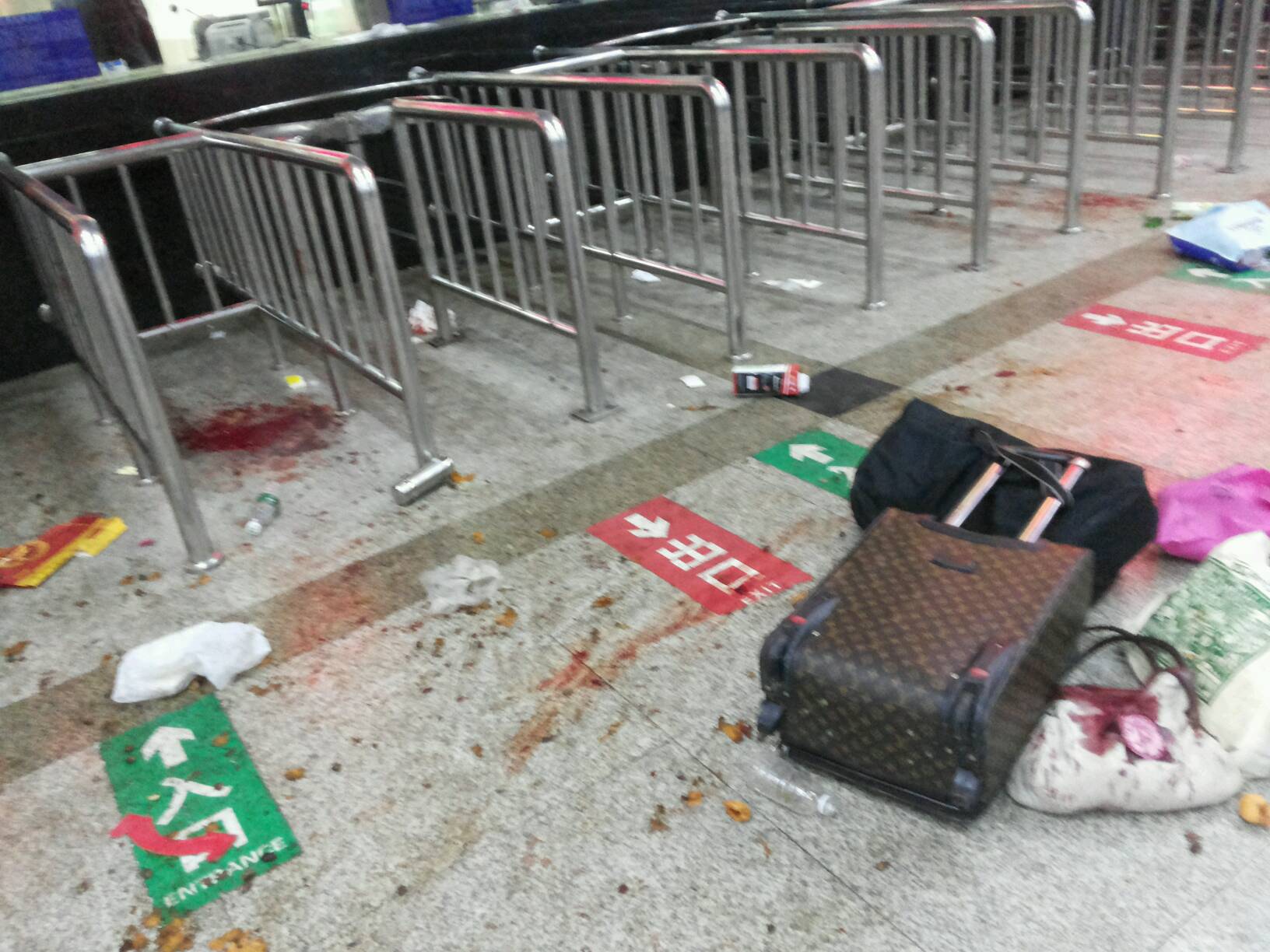
Chinese train stations are often crowded and packed with passengers into the late evening as passengers board overnight trains to destinations throughout the country. Kunming’s station last night was no exception. The mix of people in the train station was likely comprised of various walks of life from migrant workers, to middle-class tourists, to foreign backpackers heading to the popular tourism destinations of Lijiang and Dali as well as points north in inland China.  One photo showed a bag of golf clubs against a wall towering above a pool of blood.  Gruesome photos of the scene also show luggage left strewn throughout the scene of the violence, a rampage that occurred in many of the stations waiting halls in addition to the main ticketing room.

Anyone who travels on China’s rails and bus system knows the security at train and bus stations is extremely lax. Poorly trained guards – really hired help in shabby blue uniforms – man posts at metal detectors and luggage scanners placed in station entryways more for show than to serve a security purpose. At peak times train and bus stations are much more crowded than airports in China and metal detectors are constantly sounding as passengers walk through without any recourse or further pat downs. With the exception of Xinjiang and Tibet were security has been increasingly tightened over the past five years, the quality of procedures to safeguard the security of public places wanes as one gets farther  away from Beijing.

This lax security culture is likely to, and hopefully will change as a result of the incident in which locals are dubbing as Kunming’s 9/11. China’s President Xi Jinping dispatched top domestic security official Meng Jianzhu to Kunming to oversee the investigation that comes days before the opening of critical government meetings in Beijing. This incident will surely cast a cloud over the meetings which are a critical platform for Xi to further deepen his reform policies for China – or the incident will force the agenda to be more focused on security concerns, an already expressed concern for the new leadership. Meng Jianzhu said in a public statement today, “This gang of terrorists were cruel without any humanity. They completely abandoned their conscience. We must strike hard against them according to the law.”

Perhaps the known factor of a lax security environment and a municipal government famous for slow responses and public relations nightmares made Kunming an easy target for the assailants – if they were as the official Chinese media claims from western Xinjiang. We are all still grappling to understand why Kunming was chosen as a target for an attack of such scale. The last time an incident of this nature – although admittedly we are still trying to figure out the exact nature of the incident – happened was a series of two bombings in 2008 when a local man, a former convict disgruntled and unable to find a place and job in China’s competitive society bombed a bus killing two and then unintentionally killed himself in a second bombing inside the popular Salvador’s Café in the city’s university district.  The two incidents were spread out over a five month period. Prior to the bomber’s death in the second December 2008 bombing, authorities blamed the first bombings on Uyghur separatists until they could forensically link the two incidents. The bomber was Hui Muslim but not Uyghur and religion ties or ethnic suppression were not revealed as motivations for the incident.

Today on the streets of Kunming, many were reluctant to discuss the incident.  Known acquaintances opened conversations with “the thing on TV” or “what was in the news,” a reaction that displays the shock and disbelief that this could happen in their city or a willingness to distance themselves from the incident in self-protective behavior. A local fruit vendor was angry beyond words and could only mutter, to my disbelief, that all Uyghurs should be corralled and shot. Another local suggested that as a foreigner I should pack my bags and go back to the West where “you don’t have to worry about terrorism.”  Similar responses and sentiments pervade the Chinese population

As the city begins to piece itself back together with the start of the work week tomorrow, ExSE will continue its discussion of this horrible incident, continuing to comment on official media response, the discussion of Uyghur separatism and its link to the incident. In addition to the broader topics above which the mainstream media has already defined as its main narrative surrounding the incident, ExSE, a Kunming based website is interested in exploring issues on the ground here in the city as they unfold and from a long term, more connected perspective.

With so little information released on the true identities of the assailants as well as the identity of those slain in the attack, how does an urban society process and respond to such a violent incident? We are also curious and concerned to the way an urban society heals from the shock and grief that now holds sway over Kunming and to what effect security will be raised in the city in both the short and long term. Importantly how will the ethnically diverse but general peaceful and non-restive ethnic groups of Yunnan respond to an attack labeled with ethnic motivations by an outside separatist group?  And will angry Chinese nationals seek retaliation against Uyghurs and Muslims in all patterns of ethnic and nationalist tension that are becoming more and more predictable in China?

Please feel free to leave comments to this post or if you have contributions, contact us at eastbystheastmail@gmail.com.

2 Comments

Filed under China, Current Events, Kunming Train Station Attack, SLIDER, Uncategorized, Yunnan Province

Attack at Kunming train station leaves 27 dead and more than 100 injured

Late Saturday evening March 1, unknown attackers used knives to randomly kill passengers waiting at the Kunming train station. Xinhua News has reported 27 killed with 109 injured. A local hospital has seen more than 170 patients apparently injured in the incident.

The assailants are of unknown origin and motivation although Chinese social media sites are flying with rumors of ethnic affiliation. The state media has officially called this incident a terrorist attack.

While details are extremely sketchy photos from the incident are circulating as the story hits the international media. To keep up with the story as it breaks follow this live blog.

20140302-024335.jpg

Leave a Comment

Filed under China, Current Events, Kunming Train Station Attack, SLIDER, Uncategorized