The Yalong river is one of the largest tributaries of China’s Yangtze river watershed. Originating in Qinghai province, the 1368 kilometer long river system creates some of the deepest gorges in the world falling 3180 meters in elevation before flowing into the Yangtze at Panzhihua in southern Sichuan province. According to the 2013 Twelfth Five Year Plan for resources management issued by the Chinese National Energy Administration, 21 dams will be built on the mainstream of the Yalong River and two of the dams will be the highest in the world. The Plan also includes the completion of several hydropower projects which have been on hold since 2005 due to concerns about the fragility of the local ecosystem and culture. Continue reading
Category Archives: ethnic policy
Hydropower and ethnic resettlement in the Yalong River valley
Filed under China, Current Events, Economic development, Energy, Environment and sustainability, ethnic policy, Governance, Health, Hydropower & Ethnic Resettlement in China's Yalong River Valley, SLIDER, water
Tagged as Chengdu Rivers Association, China dams, China hydropower, forced relocation, Green Watershed, Gubai, Miao resettlement, Muli, Sichuan province, Yalong River, Yi resettlement, Yu Xiaogang, Zomia
The Economics of the Kunming Massacre
In the wake of the Kunming massacre, the mood in Beijing is more choleric than somber. President Xi Jinping immediately announced a nationwide crackdown on terrorism and military troops were rapidly posted at train and bus stations throughout the country. Armored vehicles now patrol Kunming, Xinjiang natives have been told to register themselves at local police stations in Qinghai province and in Guangxi province authorities have asked citizens to report if they see anyone from Xinjiang — anyone at all.
President Xi also issued a gag order on local reporting, with coverage in Kunming Daily and Yunnan Daily provided by Xinhua reporters in Beijing. Meanwhile China Daily featured a front page photograph of President Xi shaking hands with an ethnic Uighur member of the PCC (China’s Senate). But strengthening national unity goes beyond public cries for concord and front page handshakes. It also involves eliminating the perceived cause of the conflict, and the national narrative is that this cause has more to do with nomadism or Islamist ideology than the fact that employment opportunities for Uighur people, even in their homeland province, are dismally inadequate. In 2009 Ilham Tohti, economics professor at Beijing’s Central Nationalities University and an ethnic Uighur, spoke with Radio Free Asia and suggested jobs might be the key to settling unrest.
But rather than address economic pressures, the government continues to focus on Islam as the catalyst. In 2013 police in Xinjiang began harassing women in head scarves and men with beards. Radio Free Asia reported how one man, with no prior record of violence, stabbed a police officer when he was forced to shave. Ehmetjan Niyaz, an intelligence agent with the local security bureau, commented that they had been advised to investigate men with beards. In Xinjiang, that essentially means all Uighur men.
In other words, the more Beijing singles out Muslims as a means of burking separatism, the more separatist Xinjiang Muslims become. Gardner Bovingdon, Professor of Central Eurasian Studies at Indiana University and author of The Uyghurs: Strangers in Their Own Land, writes “the closure of mosques, supervision and dismissal of clerics, and the prevention of religious practice by the young — has made Islam in Xinjiang more rather than less political”.
Another government strategy has been to manipulate the demographics of the region. Of the 60% of Xinjiang’s population that is not Uighur, Kazakhs constitute 7% with Hui being another 4.5%. The remaining dozen or so minority groups collectively make up 8.5% while the final 40% is entirely ethnic Han. According to Dr Stanley Toops of Miami University, from 1953 to 1964 the presence of ethnic Han rose from 7% to 33%. Since the 1970s, this number has remained stable at around 40%, making it one of the fastest demographic shifts in Chinese history.
In 2007 Gaël Raballand and Agnès Andrésy published an article entitled “Why Should Trade between Central Asia and China Continue to Expand?” In it, the authors describe how the Xinjiang Construction and Production Corps, also known as the bingtuan, was created in 1954 to encourage the movement of Han Chinese into the region by creating infrastructure there. In addition to creating an ethnic Han workforce to outnumber local Uighurs, the bingtuan also helps ensure locals remain calm with a security force of more than 120,000 heavily-armed troops. As The Economist points out, propaganda is par for the course:
“A museum in Shihezi, a city in northern Xinjiang controlled by the corps, displays a photograph of members of the bingtuan militia armed with rifles, crouching behind a wall during a 1990 uprising by Uighurs near the city of Kashgar. The militia, says the caption, played an important role in crushing the unrest. Amnesty International, a human-rights group, says 50 Uighurs were killed in the incident, including some who were shot while running away.”
Morris Rossabi, who teaches History at Columbia University, points to the Tang Dynasty as the origin of the bingtuan. Famously cosmopolitan, the Tang Dynasty celebrated the Turkic culture of present-day Xinjiang, staffing its frontier armies with Turkic soldiers and even allowing some, like the great Ashina Se’er, to rise to the rank of Tang general. This helped frontier lands become self-reliant and even afforded some measure of political autonomy. The bingtuan follows this tradition by providing Xinjiang the means for economic self-reliance, yet deviates sharply by staffing its workforce with ethnic Han rather than local Uighurs.
With Xinjiang currently contributing roughly 4% of the nation’s GDP (primarily through oil reserves) as well as Beijing’s Western Development policy, which hopes to see China’s western provinces contribute greatly to the nation’s economy, Uighurs will remain a minority in Xinjiang for the foreseeable future. Dr Ilham Tohti has stated he is not opposed to state-orchestrated migration policies, but that these policies need to be carefully reviewed, pointing that if there are enough jobs to warrant the migration of millions of ethnic Han into the region, then why aren’t there enough jobs for the people already living there?
In 2006 Dr Tohti launched a website promoting understanding between ethnic Han and Uighurs, but in 2009 it was shut down and Dr Tohti was arrested. He was released shortly before President Obama’s visit to Beijing but in January 2014 the BBC reported he had again disappeared, that his family had no knowledge of his whereabouts and that the government was charging him with separatism — a crime punishable by death.
For now, events like the Kunming massacre serve to further Beijing’s program of economic development in Xinjiang by providing carte blanche to those who view ethnic identity as a major roadblock to China’s economic future and by giving Xinjiang politicians an easy scapegoat when they fail to provide economic paths of opportunity.
‘Uighur’ Refugees Arrested in Thailand, Malaysia: Part of a Larger Trend?
Last week, East by Southeast, in a piece hypothesizing the motives of the Kunming train station attackers, made the connection between Uighur asylum seekers, Yunnan and Southeast Asia. In the analysis, ExSE posited that Thailand was a likely destination for Uighur refugees as they made their way from Xinjiang, through Yunnan and into Myanmar or Laos. This past week, two separate incidents in near the border of Thailand and Malaysia occurred that appear to confirm this hypothesis.
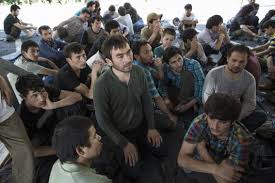
News was released on Thursday that Thai authorities had rescued 200 people from a human smuggling camp in the south of Thailand. During a raid on Wednesday, police discovered 200 people imprisoned in a camp suspected to be used for human trafficking.
The group, which includes 78 men, 60 women and 82 children, at first claimed to be Turkish, despite having no documents to confirm that. However, they have now been identified as ethnic Uighurs from China by a US-based organization.
With their identities confirmed, Thailand has faced calls to not to deport the refugees, with the US State Department also weighing in.
“We are concerned about Uighurs generally (and) welcome reports that these Uighurs were rescued,” State Department spokeswoman Marie Harf told reporters Friday. “We’re encouraging Thailand to make sure their humanitarian needs are met.”
US-based Human Rights watch also urged the Thai government not to deport the refugees. “Thai authorities should realize that Uighurs forced back to China disappear into a black hole,” Brad Adams, the organization’s Asia director said in a statement. “They need to allow all members of this group access to a fair process to determine their claims based on their merits, not on Beijing’s demands.”
Despite these calls, dozens of the refugees were sentenced for illegal entry by a Thai court on Saturday, with each person assessed a fine of 4,000 baht ($124). For now, the men will be taken to an immigration detention center and the women and children will be taken to a shelter, according to Police Major General Thatchai Pitaneelaboot.
In a possibly related story, 62 people were arrested just across the border in Malaysia last week. Like the group caught in Thailand, the Malaysian also claimed to be Turkish refugees. The group of alleged Turks were found near the border fence during routine patrols early Thursday morning Deputy Superintendent Sivam of Malaysia’s General Operations Force said in a statement.
Despite their claims of Turkish nationality, those arrested were not carrying valid travel documents or identification papers and historically, there has been a small, if nonexistent presence of illegal Turkish immigrants in the region. In light of this and the arrests in Thailand, some in the media believe that the alleged Turks might in fact be Uighurs from China. If so, this would mark the largest number found in Southeast Asia to date.
If both groups arrested are indeed Uighur refugees, their escape to Southeast Asia wouldn’t be without precedent. Since Cambodia deported 20 Uighurs back to China in 2009, there have been a string of similar deportations in the region. In 2010, Lao PDR deported a group of seven Uighur refugees back to their native Xinjiang in northwest China and in 2011 and 2012, Malaysia deported separate groups of refugees to China. Each deportation case has been heavily criticized by rights groups like Amnesty International and Human Rights Watch. Human rights groups fear that once repatriated, Uighurs face a grim future of long prison sentences and possible torture. Refugees deported back to China from places like Pakistan and Cambodia have all faced life prison terms upon their return.
The threat of prison is likely a reason why those arrested in Thailand and Malaysia have claimed to be Turks when discovered. Instead of admitting to Chinese nationality and facing the possibility of deportation back to China and likely prison time, the refugees opted for claiming another nationality. Seeing that the Uighur population is nearly all Muslim and speaks a Turkic language, claiming Turkish citizenship was a natural choice.
However, as is the case with both groups of refugees, these people’s true identities have yet to be discovered. If they aren’t Turks, are they really Uighurs? If they are Uighurs, how did they get to the Thai-Malaysian border and why did they come this far? Was Malaysia, a Muslim-majority country with labor shortages, the final destination? If both groups are indeed Uighur, this would mark a new level of southward migration for Uighur refugees. Might this also tie them to Kunming train station attackers, as East by Southeast hypothesized? For now, these are only questions, but ExSE will be searching for answers.
Filed under China, Current Events, ethnic policy, Kunming Train Station Attack, Malaysia, Regional Relations, SLIDER, Thailand, Uncategorized
Tagged as Deportation, Hat Yai, human trafficking, illegal migrant, refugees, Uighur
Kaiser Kuo: On Radicalization and Chinese Policy
I get that some people trying to make sense of the attacks in Kunming want to take the opportunity to discuss how Chinese policy contributed to radicalization. And while I’ve noted elsewhere how it bothers me profoundly that many Anglophone commentators offer a merely perfunctory nod to the monstrousness of the knife attacks that claimed 29 innocent lives and sent 160 or more people to the hospital with stab and slash wounds before moving on to the “real” issue of Chinese repression of Uyghur rights, I do believe the desire on the part of some people to use the Kunming massacre to talk about underlying issues is well-intentioned and appropriate.
What troubles me, though, is that too often in that ensuing discussion, this attack as well as all the recent attacks—whether or not they cross our (still somewhat blurred) definitional line into terror—are seen simply as responses to Chinese repression. Is there repression and bad policy? Yes, absolutely. Has it contributed to radicalization? Sure.
But is it the only factor that has contributed to radicalization?
Of course not. The weird part is that while it should be stunningly obvious that the whole context, the whole relationship between Islam and the secular, industrialized world, the whole discourse on the way Islamic peoples are situated in the modern world—all this has dramatically changed, but this barely enters conversation. There are myriad alternative responses, loci of identity, causes, leaders, and movements on offer now that just weren’t there pre-September 11. The Internet barely existed in the oasis cities of the Tarim before 2001.
But people are for the most part writing and talking about the situation as though it’s happening in complete isolation, as though the rise of radical Islam in the rest of the world since the 1980s doesn’t figure in. It somehow doesn’t merit a paragraph or two alongside the context paragraphs that most of the Anglophone outlets see fit to include about repressive policies in restive Xinjiang. People can’t see beyond the simple narrative of Chinese repression.
Any serious effort to look at what’s happened and where things might go from here has to look at Chinese policy, and I’m sure that there’s plenty of blame to be laid there. But it should also factor in—and this is a far from comprehensive list—the rise of Wahhabism and other fundamentalist sects much further to the west; the Mujahedin in the aftermath of the Soviet withdrawal; Bin Laden and AQ; their bloody work; the whole idiotic enterprise of the GWoT; networks like the Islamic Movement of Uzbekistan; the Afghan training camps (where let’s not forget there were many Uyghurs); the wars in Afghanistan and Iraq; and the Arab Spring in more recent years. It has to look critically at the WUC and the pared-down, simplistic narrative it’s managed to sell, and on and on.
It’s depressing that instead people are quibbling over how well organized ETIM is, with some even denying that any organizations like it exist at all. Or they quibble over whether scare-quotes should be used with the word terrorism. (Yes, I’ve been quibbling over that, but I think it’s important: Like many people, I find that the word’s been badly abused, mostly at the hands of the Bush 43 Administration, and is deeply problematic, but dropping our use of it now, or deploying it only with the scare-quotes, is too loaded a statement and sends very wrong messages).
But to my main point: Yes, let’s talk about the underlying problems. But let’s not for a second believe that if only the Chinese would be nicer all the nasty, violent radicalism would just disappear.
This post was originally published on Kaiser Kuo’s Facebook page on 3/3/14. It received so much attention that we reached out to Kaiser for a repost on ExSE. This is posted with the permission of the author. Comments and discussion welcome.