Category Archives: ethnic policy

The Illicit Drug Industry & Counter-Narcotics in Southeast Asia

drug picture 1

Drug enforcement officials in Burma. Image: The Irrawaddy

On 5 October 2011, when Thai river police investigated reported gunshots on the middle reaches of the Mekong River, they discovered two cargo vessels and their 12 Chinese crew members, all of whom had been executed and their bodies dumped in the river. The ships were determined to have been hijacked to transport illicit cargo, and they contained over 920,000 amphetamine tablets, locally referred to as yaba, which were subsequently confiscated by Thai authorities.

Over the past 70 years stories like this have become commonplace in the notorious Golden Triangle, a delta area at the confluence of the Mekong and Ruak Rivers that takes up approximately 150,000 square kilometers of land in the tri-state Thai, Lao and Burmese (Myanmar) border region. Drug production and trafficking has brought this locality to international infamy, and it remains the world’s second largest cultivator of opium poppy, second only to Afghanistan. Faced with rising heroin and amphetamine-type stimulant (ATS) addiction levels, drug-related violence, and an expanding HIV epidemic, Southeast Asian governments have recently begun to intensify their efforts to combat this endemic problem. Using bilateral agreements and the frameworks of the Association of South-East Asian Nations (ASEAN), the Greater Mekong Subregion (GMS), and the Asian Regional Forum (ARF), actions by these governments have met varying levels of success.


Colonial Roots of the Southeast Asian Drug Trade

Opium poppy is native to the lush and remote Yunnan and Sichuan Provinces of China’s southwest. For hundreds of years small-scale cultivation by hill tribes in the region met the modest needs of Chinese opium-smokers, but in the early 19th century a powerful competitor arrived in Southeast Asia: the British Empire and its waves of merchants and imperialists, all trying to find new markets for seemingly unlimited supplies of India-grown opium. At the humiliating conclusion of the 1842 Opium War the British forced the Chinese emperor to accept opium imports, thereby unleashing one of the most devastating drug epidemics in history: a mere thirty years later, British opium imports were supplying an estimated 15 million Chinese opium addicts.

Social upheaval in China during the 19th and 20th century caused massive emigration of Chinese refugees to all parts of the world, and where they went, their opium habits followed. The large Chinese immigrant populations in Thailand, Burma, and Vietnam provided lucrative opportunities for the opium industry, and despite the protests of indigenous rulers, one by one state-mandated opium franchises were forced into being by British and French imperialists. It was also in this time that fleeing Chinese merchants and hill tribe people arrived in the Golden Triangle area and introduced poppy cultivation to the local populations.

In British Burma, the imperialist government lacked the ability to administer the western Shan States and so instead provided them with autonomy in exchange for loyalty. This autonomy provided a foundation for a thriving opium economy and a fiercely independent political consciousness, both of which would have strong legacies long after the British withdrawal. In French Indochina, the government-run Opium Monopoly worked industriously to incorporate Laotian poppy-growing hill tribes, and helped to sponsor the Yunnan-Tonkin railway, which provided a valuable link to the well-established opium cultivators of southwest China.


Colonial Events Timeline

In the years following World War II, almost all of the world’s major opium producers, the largest being Turkey, Iran, and India, brought an end to their legal opium exports to Southeast Asia, which created an enormous vacuum in the opium industry. Newly Communist China, independent Burma, and restored French Indochina all cracked down on local production, further choking supply. Eradication of the drug industry was not achieved however, primarily thanks to the actions of Chinese Nationalist Kuomintang (KMT) remnants in northern Burma, the corrupt Thai National Police Force, and the French and American covert intelligence agencies.

About 1,500 battered KMT troops entered Burma in 1949, fleeing the advance of the People’s Liberation Army into Yunnan Province. This weak force was nearly crushed by the Burmese army, but in 1950 they began receiving airdrops of weapons from the CIA, which was frantic to arm groups on the southern borders of the People’s Republic of China in case Mao Zedong had expansionist ambitions. Reinforced by additional troops flown in from Taiwan, the empowered KMT army executed several failed invasions to retake Yunnan, but afterward decided to remain in northern Burma and hold the line against the Communist threat. This well-armed army proceeded to force the local tribes-people into opium cultivation, and with the help of the corrupt Thai police force, created one of the most robust drug production and trafficking systems in history.

Opium produced in northern and eastern Burma was transported across the Thai border and down to Bangkok, where it was exported out of the rest of Southeast Asia. In 1961, provoked by aggressive expansionism on the part of the KMT, the Burmese Army and the PLA jointly ousted the Nationalists from Burma and forced them into Thailand and Laos, where their communities remain today. Although the KMT forces no longer directly controlled the opium cultivation, the system was in place and ethnic Chinese, then later various Burmese insurgent traffickers, maintained the lucrative trafficking network into Thailand.


Drug enforcement officials in Burma. Image: Business Week

Drug enforcement officials in Burma. Image: Business Week

In French Indochina, the under-financed French intelligence community covertly took over management of the formally illegal opium trade in order to continue their efforts in suppressing Ho Chi Minh’s Viet Minh. The Laotian opium industry that they nourished would later find its greatest successes during the American GI heroin epidemic of the Second Indochina Conflict, and following that, in its international spread into the continental US and Europe.

Currently, the vast majority of Southeast Asian illicit narcotics are produced in the semi-autonomous, rebel-administered eastern states of Burma, while smaller amounts also come from the remote areas of western Laos and northern Thailand. It is trafficked in two main routes: the southern route goes through Thailand to Bangkok for distribution, and the northern route enters China’s Yunnan Province, headed for Kunming and then all of East Asia. Recently, Golden Triangle supply has been unable to keep up with skyrocketing Asian demand for heroin and ATS, and approximately one third of East and Southeast Asia’s narcotics now originate in Afghanistan.

map

Source: UNODC Southeast Asia Opium Survey 2013: Lao PDR, Myanmar


Temporarily successful eradication programs and sustained crackdowns brought Southeast Asian drug production to a historical low in 2006, but since then there has been a consistent increase in cultivation, production, trafficking, and consumption, with levels returning to those of the 1970s and 1980s. This steady expansion of the drug trade is occurring despite a 2005 self-imposed opium cultivating ban in the territories of the United Wa State Army (UWSA) in Burma, a rebel group that previously accounted for the lion’s share of Burma’s opium production. This worrying trend has many consequences for Southeast Asian society.


Threats Posed by the Illicit Drug Industry

The streaming supply of narcotics from the Golden Triangle into China and Thailand has negative impacts on myriad areas of Southeast Asian life. Mass drug addiction and drug trafficking causes the breakup of families and increases in crime rates, spreads diseases like HIV, burdens the economy through lost productivity, imposes financial costs on the state, spreads law enforcement thin, overwhelms justice systems, encourages corruption, and funds violent groups. As production continues to increase, these problems are becoming more pronounced and demand strong preventative action.

The United Nations Office on Drugs and Crime estimates that an average of 13% of injected-drug users are HIV positive, and more than half have hepatitis C. Coupled with China’s annually growing number of registered opioid users (official figures reported 1.3 million users in 2012, with actual rates likely almost double that), this situation makes the threat of a massive HIV epidemic in the world’s largest country ever more likely. Recent trends in China suggest that methamphetamine use is slowly overtaking heroin use as China’s most problematic drug, and just in China 228 meth labs were dismantled in 2012. Widespread amphetamine use continues to be a regional dilemma, as more than 8,980,000 people in East and Southeast Asian used ATS tablets in 2013. The Greater Mekong Subregion has the highest rate of crystal meth use in the world, and this drug use is exacting large tolls on society, as addiction-fueled crime expands and as families and communities spend time and resources helping addicts.

Number of Heroin Users 2010

Source: UNODC Transnational Organized Crime in East Asia and the Pacific: a Threat Assessment, April 2013

The criminals and insurgents that operate the drug trade are making enormous windfalls from their work: the value of all consumed East and Southeast Asian heroin was estimated at $16.3 billion USD in 2011, with methamphetamine and amphetamine consumption valued at an additional $15 billion USD. The traffickers and their associates encompass a wide variety of individuals: ethnic Chinese syndicates, Nigerian and Iranian criminal groups, high-ranking Southeast Asian officials and military personnel, and Burmese insurgent and paramilitary forces. Although on average 50,000 people are arrested each year for trafficking illicit narcotics in Southeast Asia, the high profits of the drug trade continue to lure thousands more into the business. In the case of Burmese fighters, drug earnings are usually spent on weapons, helping to intensify violence in those areas.

drug market value

Source: UNODC Transnational Organized Crime in East Asia and the Pacific: a Threat Assessment, April 2013

Some of the drug trade’s worst victims are the poverty-stricken opium cultivators in the Golden Triangle. Lacking other economic opportunities and desperate for income, many rural farmers are forced into dealings with violent traffickers and become trapped in a cycle of drug cultivation, slowly becoming more and more dependent on poppy income. They are prevented from growing crops that can benefit society, and oftentimes their communities are hit hard by addiction. Unfortunately, these rural villagers only make up a small portion of the people whose lives are destroyed by the drug trade.


International Cooperation and Efforts to Eliminate the Drug Industry

The governments of Southeast Asia have been working to combat the narcotics trade ever since their post-colonial independence, but unfortunately the vast majority of these efforts have been restricted to unilateral measures. Law enforcement is usually by definition national in character, but the drug trade is a transnational and regional problem, and increased cooperation on the part of Southeast Asian governments is critical for its sustainable reduction.

Thanks in large part to the prodding of the US government, which had recently declared its own War on Drugs, the 1976 ASEAN Bali Summit saw the adoption of the “ASEAN Declaration of Principles to Combat the Abuses of Narcotics Drugs.” Although mainly filled with rhetoric and containing few concrete measures, this declaration showed consensus among the ASEAN governments and kicked off the modern wave of counter-narcotics policies in Southeast Asia.

Thailand can be considered one of the more successful cases of sustainable reduction in illicit cultivation. Starting in 1984, the Thai government embarked on a 30-year intensive program of crop replacement, which has resulted in bringing opium cultivation in northern Thailand to negligible levels.

In contrast, the efforts of Burma’s Central Committee for Drug Abuse Control have been snared in the frequently contradicting objectives of the government’s anti-insurgent policy. Despite the ambitious 1999 declaration by the ruling regime to eliminate all illicit drug production by 2014, the Burmese government often turns a blind eye towards the narcotics industry in its efforts to co-opt various rebel groups. In the 1980s and 1990s the weak central government began signing ceasefire agreements with the numerous insurgent armies that control the Burmese borderlands, and many of those autonomy-granting agreements contained clauses permitting (and even encouraging) drug cultivation and production by the groups in exchange for their loyalty to the regime. Subsequently, drug enforcement policy became a tool of the state, and it was used both as a carrot and a stick to bring insurgent groups into the legal fold. When a United States grand jury indicted several leaders of the United Wa State Army, which had signed a ceasefire agreement and was the largest Burmese opium producer in the early 2000s, the government refused to arrest them or crack down on their illegal businesses. This lack of enforcement can be seen as a way of repayment for loyalty, and is in direct contrast to the government’s actions towards the Myanmar National Democratic Alliance Army (MNDAA). The MNDAA, another major opium producer, had refused to make peace with the government, and when the government attacked them in 2009, drug enforcement was the justification given. These two examples show how the central regime manipulates drug policy to its advantage in its state-building efforts, and explains the lack of sustained progress in eliminating the narcotics industry.


ASEAN response timeline            In addition to the unilateral efforts of individual states, regional organizations and agreements have been crucial to the evolution of drug enforcement in the Golden Triangle. In the late 1990s, ASEAN began examining anti-narcotics and other issues such as human trafficking and smuggling in the context of transnational crime, and started putting greater emphasis on regional cooperation. The expansion of ASEAN in 1997 to include the Lao People’s Democratic Republic and the Union of Myanmar allowed the other ASEAN governments to exert more diplomatic pressure on the newcomers to clean up their drug exporting regions, demonstrated in the ASEAN Declaration on Transnational Crime. Although the declaration contained no binding measures, it set up several communication and monitoring bodies, including the ASEAN Ministerial Meeting on Transnational Crime (AMMTC), the ASEAN Chiefs of National Police (ASEANAPOL) and the ASEAN Senior Officials on Drug Matters (ASOD). These bodies mainly monitor the progress of the 2000 Bangkok Political Declaration in Pursuit of a Drug-Free ASEAN 2015, but they also work to encourage development of bilateral extradition treaties, international criminal justice institutions, and cooperative border control, legal assistance, and data sharing.


The Future: Regional Integration and the Effectiveness of Anti-Narcotics Policy

2015 is marked to be the year in which the ASEAN Economic Community is brought into being, and many hope that it will bring with it great advances in regional trade, infrastructure, and cooperation. Already projects such as the North-South Economic Corridor, running from Kunming to Bangkok, and the building of ports and bridges along the Mekong River are generating enormous economic benefits. However, advances in regional integration also provide opportunities for those who would exploit them for illegal purposes. The increasing ease of transporting illicit narcotics and the improving communication technologies of criminal groups present a strong challenge to the national law enforcement agencies of ASEAN countries. Equally innovative and efficient use of new capabilities and technologies, as well as increased intelligence sharing and coordination must be implemented for Southeast Asian governments to effectively meet these new threats.

In November 2011, just a month after the “Mekong Massacre,” China, Laos, Burma, and Thailand agreed to cooperate on river patrols and law enforcement along the Mekong River. Their Joint Statement detailed numerous confidence building measures between the various national police forces, but mainly focused on the responsibility of each individual nation to properly patrol its own sovereign waters. This aspect reveals the major weakness of all ASEAN counter-narcotics efforts to date: ASEAN nations are caught in a paradoxical situation where despite the damaging effects of the drug industry and transnational crime on national sovereignty, the only way to effectively counter those threats is by each nation giving up some measure of their treasured sovereignty. Sovereignty and non-intervention are the two defining pillars of the “ASEAN Way,” and yet those two concepts desperately need to be reevaluated if transnational crime is to be confronted.

Confidence building measures and increased regional communication is a critical first step, but in order to make real progress in fighting the rising threat of transnational crime ASEAN nations need to accept the reduction of their sovereignty. A hopeful example is provided by the official conclusion of the Mekong Massacre: Naw Kham, the Burmese drug lord who supposedly masterminded the murders, was captured by Burmese counter-narcotics forces and extradited to China, where he and three of his subordinates were tried and executed in March 2013. Extradition treaties like these form the basis of effective cooperation, and similarly collaborative measures must be actively pursued by ASEAN governments if they are to successfully tackle the deeply-entrenched and continually evolving menace of the drug industry in Southeast Asia.

1 Comment

Filed under China, Cold War, Current Events, Economic development, ethnic policy, GMS, Governance, Laos, Mekong River, Myanmar/Burma, Regional Relations, SLIDER, Thailand, USA, Vietnam, Yunnan Province

Three sentenced to death for Kunming Train Station attack

The Intermediate Court of Kunming has found four defendants guilty of carrying out a deadly knife attack that claimed the lives of 31 civilians and injured 141 in March of this year. Three of the defendants, all men, received the death penalty, while the lone female suspect was sentenced to life in prison.

The one-day trail, held on September 12, lasted only a few hours. Video shows the three men, Iskandar Ehet, Turgun Tohtunyaz and Hasayn Muhammad seated in court with shaved heads, wearing matching blue prison uniforms. They were all found guilty of “premeditated murder and leading and organizing a terrorist group”. The fourth defendant, Patigul Tohti, will spend the rest of her life behind bars after being found guilty of “intentional homicide and joining a terrorist group”.

None of the men on trial participated directly in the train station attack, according to a BBCreport. Instead, they coordinated the assault from afar — making plans beforehand and then directing five of their associates. Court documents made public following the trial say the three men were all captured by police two days before the attacks occurred.

This narrative directly contradicts previous official accounts claiming the suspects were apprehended March 4 following a 36-hour manhunt in Kunming and beyond. It remains unclear when or where the men were actually captured, as no details of their arrests have ever been made public. Conversely, the story surrounding female assailant Tohti has remained consistent since March.

She was arrested following a bloody rampage wherein she and four others indiscriminately stabbed dozens of people who were queueing to buy tickets at the Kunming Train Station. Tohti was eventually subdued by police and arrested, while her four co-conspirators were all reportedly shot dead in a span of 15 seconds by a SWAT team sniper.

The trial in Kunming was uncharacteristically open to the public, and 300 people, including victims and their families, attended the proceedings. Security at the courthouse was increased noticeably, with armed guards posted both inside and outside the courtroom.

China has significantly ramped up law enforcement and ‘anti-terror’ efforts following the bloodshed in Kunming. In many cities around the country, police officers are now permitted to carry sidearms for the first time in decades. Trials involving suspected militants have also increased, and hundreds of people have been jailed for terrorism-related crimes by Xinjiang police as violence escalated over the summer.

This article was written by Patrick Scally and originally published on GoKunming

Leave a Comment

Filed under China, ethnic policy, Kunming Train Station Attack, SLIDER, Yunnan Province

Kunming railway station attackers charged in mass stabbings

Image: CCTV

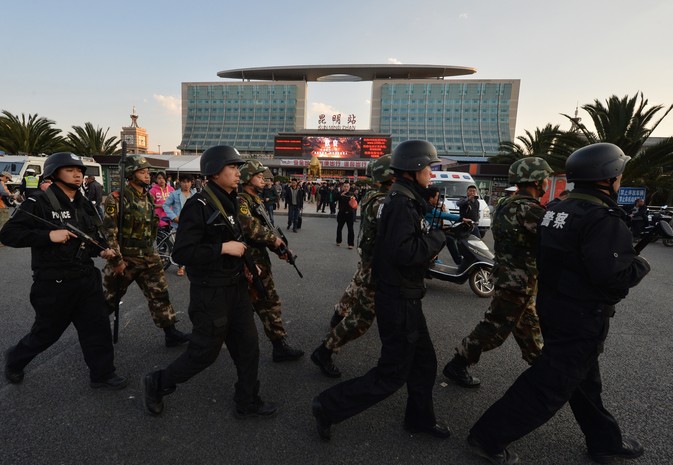
A SWAT team patrols the Kunming train station. Image: CCTV

In March of this year, a group of men and women armed with knives descended on the crowded Kunming Railway Station. Their ensuing rampage left 29 civilians dead and 143 injured in what is one of the most violent coordinated attacks to occur in China in recent memory. Four people accused of perpetrating the violence have been formally charged and will soon stand trial, Xinhuais reporting.

Official accounts of the attack state that six men and two women participated in the train station assault. Of those, four were shot and killed at the scene by police. One woman was subdued and arrested at the station, while three other suspects remained at large for 36 hours before being captured. No details of the manhunt or exactly how, where and when the fugitives were caught have ever been made public.

The four defendants stand accused of multiple crimes and will presumably face the death penalty if convicted. They have each been charged by the Kunming People’s Procuratorate, the city’s highest court, with participating in a terrorist organization, carrying out violent terrorist activities and premeditated homicide. No date has been publicly announced for a trial.

The outcome of the case is likely a foregone conclusion. Defendants tried by the government, especially in high-profile proceedings such as this, are generally found guilty following extremely short, closed-door judicial proceedings. A short, terse statement by prosecutors trying the four defendants appears to confirm this. It read, “The facts are clear and the evidence is ample. The four [suspects] should be investigated for criminal responsibility according to law and then prosecuted according to law.”

The defendants are all ethnic Uighurs from China’s Xinjiang Autonomous Region and prosecutors maintain the March 1 attack was religiously and politically motivated. In a statement made shortly after the suspects were apprehended, Yunnan Party Secretary, Qin Guangrong,characterized the captured men and woman as Muslim terrorists, adding one had confessed to the crime and admitted the group wanted “to join jihad”.

China has significantly ramped up law enforcement and ‘anti-terror’ efforts following the bloodshed in Kunming. In many cities around the country, police officers are now permitted to carry sidearms for the first time in decades. Trials involving suspected militants have also increased, and 113 people were recently jailed for terrorism-related crimes by Xinjiang courts.

Click here to link to this article written by Patrick Scally, first published on July, 1 on the GoKunming website.

Leave a Comment

Filed under China, Current Events, ethnic policy, Governance, Kunming Train Station Attack, SLIDER, Yunnan Province

Carrots, Sticks & the TIP Report: Understanding the US Government’s Anti-Trafficking Efforts in Southeast Asia

Last week the US State Department issued its annual Trafficking In Persons (TIP) Report, which ranks every country in the world according to their adherence to the US government’s anti-trafficking mandate. For the first time, Thailand was designated “Tier 3,” the lowest “rung” on the TIP Report’s ladder.

The report, which is published by the Office to Monitor and Combat Trafficking, describes “Tier 1” countries as those demonstrating sufficient anti-trafficking efforts; “Tier 2” as those that have begun to demonstrate such efforts but still have improvements to make; and “Tier 3” as countries demonstrating little to no effort to combat trafficking. Countries that receive the Tier 3 ranking are subject to sanctions by the US government. Continue reading

Leave a Comment

Filed under Cambodia, China, Current Events, ethnic policy, Foreign policy, GMS, Governance, Health, Malaysia, Mekong River, Philippines, Regional Relations, Singapore, Uncategorized, water, Yunnan Province

Trafficking of Women on the Burma-China Border & International Responsibility

Camp for internally displaced persons at Mai Ja Yang, Kachin State on the the Chinese border.

Camp for internally displaced persons at Mai Ja Yang, Kachin State on the the Chinese border.

In recent weeks, warfare in Burma’s Kachin State has increased and is now making its way closer to the Burma-China border. While the international community has paid little attention to the Kachin conflict over the past few years, understanding its complexity is now more important than ever. Failing to do so could have dire implications on the lives of Kachin women, and on diplomatic relations in the region.

Kachin State is an ethnic area in northern Burma that has long suffered from conflict with the central Burmese government. In 2011, a seventeen-year cease-fire was broken, resulting in the onset of active warfare. In spite of ongoing attempts at peace negotiations, the Burmese government has been committing atrocities– including rape, arbitrary arrest and torture– against civilians. The region has been documented to be an active conflict zone resulting in one of the worst humanitarian crises in the world. According to reports issued by the Kachin Independence Organization (KIO)—the political arm of the Kachin people– over 100,000 internally displaced persons (IDPs) have fled to border areas of Burma and China to escape the fighting, and these communities suffer from a lack of basic necessities and little to no foreign aid. Additionally, as the Kachin Women’s Association of Thailand has documented, the trafficking of women into China’s neighboring Yunnan province as forced brides has become a growing problem.

Recently, I traveled to Mai Ja Yang, the second largest city in KIO-controlled territory to interview women and men living amid the conflict about the issue of trafficking. I conducted interviews with over 25 trafficking survivors, female soldiers, women’s organizations, lawmakers, cultural leaders, IDP relief workers and administrators from the KIO. I was hosted by the Kachin Women’s Association of Thailand, an organization actively working on the issue.

A child in the Mai Ja Yang camp.

A child in the Mai Ja Yang camp.

My research revealed that gender discrimination, demand from China for brides due to the one-child policy and crippling conditions on the ground due to the military conflict within Kachin State contribute to the problem of trafficking. As former “forced brides” and others reported, the escalation of the military conflict has resulted in a sharp increase in irregular migration. Simultaneously, trafficking has become less of a priority for the KIO government, whose attention is focused on war strategy and the political process, rather than the empowerment of Kachin women.

Now, the Burma army is stepping up its attacks in a move that could increase women’s vulnerability to trafficking. As a recent article in the Irrawaddy Magazine revealed, last week the army launched an attack on a KIO military outpost near Mai Ja Yang, which shares its eastern border with China’s Yunnan province. Mai Ja Yang is home to a growing number of IDPs—men, women and children who have had to flee their homes after their villages were raided. Now, not only are these people’s homes destroyed, but their temporary camps are in danger, as well.

With fighting approaching the border areas, women living in the camps could become even more vulnerable. These women face insecurity in the form of food shortage, lack of infrastructure and basic sanitation. They also face circumstances of gender-based violence and rape. Additionally, lack of a means of income generation influences women to migrate to China to find work—a situation that leaves them vulnerable to labor exploitation and trafficking.

But the international community has been slow to respond to the conflict. As a recent Stimson Report revealed, the precarious nature of the US- China relationship has given American leaders pause in “interfering” in such a sensitive geo-political arena. Additionally, aid workers report having had difficulty accessing the IDP camps due to the ongoing warfare in surrounding areas.

Despite these cautions, it is in the interest of the Chinese, Burmese and Kachin governments to quell an increase in trafficking. Doing so would not only improve the lives of thousands of women, but it could prove beneficial for each country’s relationship with the United States. This is because the US State Department has made trafficking a primary agenda in its international policy. In fact, the State Department’s Trafficking In Persons (TIP) Report ranks every country in the world according to how well they comply with the US mandate against human trafficking. As a result, in recent years trafficking has become a number one priority on the US government’s agenda.

The policies associated with the US government’s anti-trafficking mandate are n0t always beneficial for the women they’re intended to help. As I discuss here, the US State Department sometimes gets it wrong, and trafficking continues to escalate. In the case of Burma and China, however, the US’s mandate could actually serve a useful—even diplomatic– function. Due to the transnational nature of human trafficking, cooperation between governments in the region is essential for the development and implementation of a robust anti-trafficking policy. Collaboration between the Chinese government and KIO, for example, is needed to resolve trafficking cases and bolster prevention efforts on both sides of the border. As wary as the US government is of getting involved in these relationships, the trafficking issue could potentially be an inroad yielding productive results.

Thus far, however, the only people seriously trying to combat trafficking along the Burma-China border are a handful of brave and talented activists on the ground. Mai Ja Yang is home to a number of women’s organizations dedicated to increasing the political and civil rights of women in Kachin society. These women work at great personal risk, while the Third Brigade of the KIA works to maintain their security.

But these organizations can only accomplish so much without international support. Instead of turning a blind eye to the conflict, Western governments should help them develop a robust anti-trafficking policy for Kachin State. Additionally, the US government should put pressure on the Burmese and Chinese governments to de-escalate the conflict in KIO-controlled areas. Failing to do so could not only exacerbate the precarious nature of diplomatic ties in the region, but it could lead to an increase in victims of human trafficking– the very people the US government says it is trying to help.

1 Comment

Filed under China, Current Events, ethnic policy, Myanmar/Burma, Regional Relations, SLIDER, Uncategorized, USA, Yunnan Province

Recommendations Regarding Hydropower Development and the Rights of China’s Ethnic Peoples

Most of China’s water resources are found in China’s western regions with 70% coming from China’s southwest.  Since the beginning of this century, the core of China’s hydropower development focused on middle and upstream portions of rivers in southwest China. This region also serves as the central native land of many of China’s ethnic minorities.  In early 2013, China’s State Council issued a plan for resource development in its 12th five year plan with details to design and begin construction on more than 60 major hydropower projects between 2011 and 2015.  China is entering into an explosive period of rapid and unprecedented development of its hydropower industry.

For the next twenty years more than 8 million ethnic minorities will be affected by the development and planning of dams.  With the expressed state agenda of establishing a sustainable hydropower industry, achieving social stability in ethnic minorities areas, and realizing the “Chinese dream” for all of China’s citizens, how will the Central government guide law and policy to provide rational standardization, coordination, and management to the interests of the state, industry, and of ethnic minority groups?

According to the principles of “Encouraging the Benefits of Ethnic Autonomous Areas” set forth by the Chinese Constitution, the Law of Ethnic Autonomous Zones advanced a new regulation in 2005 to “encourage the production and livelihood of local ethnic minorities.”  This broad-based regulation passed as part of one of three items in the addendum to the State Council’s PRC Legislation on the Autonomy of Ethnic Regions. Yet to date, there is no specific clarification to the rights of local ethnic minorities or details concerning the autonomy of ethnic areas within the language of the basic law.  The administrative regulations of the State Council list only one related clause: The regulation of peaceful migration should respect the production methods, the lifestyle, and customs of ethnic minorities.

A new policy promulgated in 2012 by the National Development and Reform Commission (NDRC) requiring state sponsored development projects to first oversee the migration of peoples before beginning construction has no mention of protecting the rights of local ethnic minorities. Laws and regulations related to the issue of ethnic minority protection do indeed exist, but because there is no guarantee on the methods of protecting procedural justice or monitoring processes, these laws and regulation cannot reach efficient levels of execution.  Not long ago, the publications of the Third Plenary Session of the 18th Party Congress emphasized the Chinese Communist Party’s views of ethnic policy, guaranteeing the legal benefits of ethnic minorities and bolstering and developing the equal unity and mutual harmonious relations of socialist peoples.

In past years, researchers carrying out investigative field study on the beneficial effects of hydropower development toward the ethnic peoples of the Jinsha River, Lancang (Mekong) River, Nu (Salween) River, Yalong River, Min River, and the Dadu River discovered that the everyday livelihoods and production methods of ethnic peoples living along these rivers are immensely affected by the development of hydropower projects.  In the early development and planning stages, hydropower projects are requested to maintain a holding status before beginning construction.  For many unknown reasons this holding status could continue for many years.  The clearing of roads with dynamite creates air and noise pollution and along with the risks of falling rocks and landslides, greatly affects the safety of people and livestock and the volume of agricultural harvests.  Dam construction and rising waters force people to move.  This uprooting destroys longstanding social networks, privately held assets and shared natural resources such as traditional collecting, fishing, and grazing methods that rely on forests, pasture lands and wetlands.  What is lost is not justly compensated for.

The rights of ethnic groups to be informed, to participate, to express views, and to monitor procedures are not respected or guaranteed with the development of hydropower projects and in many ways these rights are illegally violated.  The relevant institutions of local governments cannot realistically carry out existing laws and regulations, and hydropower firms ignore the law failing to take social responsibility for the protection of vulnerable groups.  Large scale hydropower firms – particularly central level hydropower firms – exact great profits from local areas but remit taxes to the major cities in which they are registered.  The benefits received by localities are greatly out of proportion with the costs borne.


In consideration to the issues raised above and to the demands of the 18th Party Congress, the suggestions below should be considered. Generally, the Central government should re-examine existing hydropower projects and immediately clarify and formulate policy that guarantees the benefits of ethnic peoples in China’s western regions affected the by hydropower development.

1.       Clarify policy and approaches suitable for Western ethnic regions

In western ethnic regions, the Central government should incorporate a guarantee of the basic rights of ethnic peoples as an indicator of sustainable development. The Central government should coordinate development of hydropower projects in ethnic areas giving basic consideration to resource safety, economic development, guarantees of the rights of ethnic peoples, and ecological protection. The activities surrounding hydropower development should respect and guaranteed the basic rights of ethnic people including political, economic, and cultural rights. In accordance to law, ethnic peoples should not be discriminated against and should equally participate in and enjoy the benefits of resulting from economic development in their localities.  They also have the rights to maintain their value systems, religious observance, and unique ways of living.  Moreover they have rights to protect the natural resources such as the land, rivers, forests, and pastureland on which they have existed for many years.

Moreover, the Central government should amend the legal and policy framework on the Law of Ethnic Autonomous Zones within the Chinese Constitution to protect the basic rights of citizens and ethnic peoples.  While strengthening relevant polices, the Central government should expedite policy on formulating specific guarantees of the protection of peoples affected by hydropower development and ensure the implementation and execution of these policies.

2.       Guarantee procedural justice in the processes of hydropower development

In the development of hydropower projects, firms and local governments should respect and protect the rights of ethnic groups and individuals to be informed, participate, make decisions, and monitor procedures. Hydropower firms should establish corporate social responsibility systems that pay particular attention to respecting and protecting the rights of ethnic peoples while operating.  Firms should incorporate this kind of responsibility into their specific duties and make public record of their CSR work on a regular basis.  Firms should also take initiative in accepting monitoring presences of multiple levels of society.

The Central government should establish systems for assessing the impact on the rights of ethnic peoples.  Results of the impact assessment should serve as key findings for the approval of hydropower projects.

The Central government should monitor the entire process of relocation of people related to hydropower development and provide support and effective relief to ethnic peoples whose rights are violated.  The government should establish and open various channels of complaints mechanisms, provide various forms of legal assistance, and eliminate obstacles that prevent ethnic groups and their members in accessing these systemic mechanisms to realize their rights and receive relief.


3.       Guarantee mutual benefit for ethnic people and hydropower development

In ethnic areas, large-scale hydropower firms and central level hydropower firms, by principle, should register for license in the locale in which they operate and pay taxes to that locale.  An alternative could be for the hydropower firm and the autonomous local government should come to agreement on an appropriate distribution of taxes to the locale under the supervision of relevant managing government organizations,

Hydropower firms and local governments should make best efforts to reduce the relocation of people due to hydropower construction and resolutely block forced migration.  Hydropower firms and local governments should make best efforts to reduce the negative impacts of hydropower development on ethnic people’s environment, economy, society, culture, and spirit.  Hydropower firms and local governments should provide fair and appropriate compensation to ethnic groups and individuals for the material, physical, and spiritual damage and impacts caused by activities related to hydropower development.

Hydropower firms and local governments should appropriately provide accordant compensation for negative social, economic, and cultural impacts of past hydropower projects on the basis of social impact assessment and an impact assessment on ethnic people’s rights. Hydropower firms should provide monies for the protection of resources and development funds in affected communities. Firms should provide compensation to and protect the resources and development of intangible assets, communally shared natural resources, and collective impacts that are difficult to compensate at the individual level.

Local governments should adopt measures to protect the cultural heritage of ethnic peoples, to aid ethnic peoples in the passing down and development of their own history, culture, language, traditions, and customs and guarantee the protection of their own cultural heritage and historical traditions.

4.       Fully utilize the function of social organizations

In the realm of social administration, the diversification of social administration is a common and successful experience of developed countries.  It is also a mainstream trend of modern social administration.  Popularized global “New Administration” philosophies purport:

“Governments are not the only pillar of public rights. rather citizens, individuals, and non-government organizations can become pillars of public management.  Under a set of shared goals non-government organizations can participate in public policy making processes and provide public services.  The responsibilities of public affairs administration and the advocacy for the satisfaction of social and economic needs can be collectively shared through the cooperation between social groups and government.”

With the reforms of China’s government institutions and new rounds of innovation in public administration, the function of social organizations in public administration and social life becomes more apparent on a daily basis.  The government should make full use of social organizations in regard to the protection of ethnic peoples and western hydropower development.  The Central government should encourage relevant social organizations to participate in the activities of local hydropower development, participate in the ecological impact assessment, social impact assessment, and social monitoring of hydropower development.  Finally the Central government should utilize the contracting of services to support positive contributions and innovative practices that social organizations can make toward the social administration of ethnic areas.

This is the final part of a 5 part series on hydropower and the rights of ethnic minorities living in the upper Yangtze River valley.  Link here to part 1.  

1 Comment

Filed under China, Economic development, Energy, Environment and sustainability, ethnic policy, GMS, Governance, Hydropower & Ethnic Resettlement in China's Yalong River Valley, Mekong River, SLIDER, Sustainability and Resource Management, water

The weak vs. the strong: Ethnic villagers, the government, and hydropower firms

As China increases its hydropower development plans into the 21st century, an estimated 8 million ethnic people in southwest China, many of them Tibetan, Miao, and Yi will be forced to leave their remote mountain homes. My previous posts this week focused on unjust and inappropriate compensation ethnic villagers in the Yalong River valley have received during the relocation process.  During this process, local government and hydropower development firms give very little consideration to the rights of ethnic villagers.  They also give very little consideration to  existing laws protecting these marginalized people.

In the valley between the Kala and Yangfanggou dam sites, two large billboards sport eye-catching slogans.  One says, “Maximize people’s benefits within the limits of law and policy” and the other “Crack down swiftly with the heavy hand of the law against illegal acts disturbing public affairs.”

牌 打击阻工扰工

To address the second billboard, in the eyes of the law there are two kinds of illegal acts.  One kind is simply a violation of the law.  The other constitutes a crime punishable by swift and heavy measures.  Legal expert Zhou Yong of Norway University, Oslo questions the legal grounds for the Public Security Bureau to erect this billboard.  Specifically, which law is the billboard referring to?  And to what extent do swift and heavy measures apply? He continues his critique of the local public security bureau’s abuse of the law by adding that the final judicial organ deciding cases are courts, not the public security bureau.

Citizens have the right to act and react to changes going on around them especially in ethnic areas where China’s Law of Ethnic Autonomous Areas applies.  Citizens should be aware of their rights and enjoy their rights. The role of NGOs should be to ensure that people can be protected by certain laws and regulations in ethnic areas.  In addition, basic rights of personal safety and right of property should be guaranteed.

Yang Lin, an expert in social impact assessment adds that the billboards are very thought provoking.  Reading them together seems to suggest that the government will provide you with what you need, so there’s nothing to worry about.  But on the flipside, the sign indicates that if the government does not give you what it has promised, you shouldn’t ask for it again.  This kind of ex-post behavior by relocated villagers is illegal and will be punished.

Article 27 of the UN Declaration on the Rights of Indigenous People declares:

States shall establish and implement, in conjunction with indigenous peoples concerned, a fair, independent, impartial, open and transparent process, giving due recognition to indigenous peoples’ laws, traditions, customs and land tenure systems, to recognize and adjudicate the rights of indigenous peoples pertaining to their lands, territories and resources,  including those which were traditionally owned or otherwise occupied or used. Indigenous peoples shall have the right to participate in this process.

Today China is the building more hydropower projects than any other country in the world.  In the new energy development plan, over 60 major hydropower dams and several hundred small and medium sized ones will be built along the Jinsha River (Yangtze), Lancang River (Mekong), Nu River (Salween), Yalong River, Min River Brahmaputra river, and the main stem of The number of ethnic minority people resettled will soon reach eight million. This will be the largest-scale involuntary resettlement in China’s history.

A promotional film for the Ertan dam says that all Chinese people will benefit from hydropower and that China will reach through to new heights from which all mankind will benefit.

A local villager from Danbo disagrees.

“We had to go away for seven days to attend the review and assessment process.  Each family had to send a representative.  We are uneducated and had no idea who might be in charge of the assessment.  All we got were review forms.”  During our meeting she produced a thin stack of official looking forms.  “My husband became mentally ill because of this.  He is still taking medicine to control the illness.”

As a country, China has a plan for the development of the national economy and will try its best to realize the goal of energy security and sustainable resource development.  But hydropower development firms only seek to maximize profits.  The country has power, and the firms have money.  When power and money come together they will inevitably put a third party at disadvantage.

When “weak” individuals face a “strong” government and hydropower firm, the interests and needs of these individuals usually cannot be protected or heard. The Chinese government should fulfill its obligations by exercising its administrative powers within the framework of law. It should solve this issue according to the current laws, regulations, and the international conventions that China has approved.  For example the UN Human Rights Convention requires that China follow related international law and assume international obligations. When solving conflicts between three parties, the most important thing is to make sure that concerns of the people can be heard. Throughout this process, people should be able to make use of various channels and platforms to raise their concerns.

Yu Xiaogang surveys a group of relocated villagers in the Yalong River Valley

Yu Xiaogang surveys a group of relocated villagers in the Yalong River Valley

During our surveying, countless villagers vented their frustration to my research team. “We can’t sleep at night.  We can’t concentrate on our work during the day, and why is that? Back then, though we were poor, we had enough food and warm clothes.  If we move to a new place, we will lose these.”

Another shared, “We can’t afford to leave, but we can’t afford to stay.  We are sorry to cause such troubles for the Party, but this is a really big problem.”

“They used dynamite this time.  The gods of the mountains and the Buddhist spirits all left.  Some people will die now.  Some will fall ill.  Some will go crazy.”

This is the 2nd in a five part series on ethnic resettlement and the impacts of hydropower development by Yu Xiaogang.  Link here to part 5 and here to link back to part 1.


Leave a Comment

Filed under China, Current Events, Economic development, Energy, Environment and sustainability, ethnic policy, Governance, Hydropower & Ethnic Resettlement in China's Yalong River Valley, SLIDER, water

Ethnic Resettlement: Resistance & Villagers’ Rights:

The pain of resettlement

The pain of resettlement

For years in China’s southwest, water engineering and hydropower firms companies have been fanatical about building more dams.  Plans of demolition and removal of villages and structures obstructing dam design are always being put in place before plans for resettlement and compensation are appropriately thought out. Ordinary people can only wait in passive anxiety for the uncertainties related to resettlement and their future to be resolved. They are destined to make sacrifices for so-called development.

“Back there are our mountains, our meadows, our fields, and our villages,” says a villager in Shangpu village downstream of the Kala hydropower plant on the Yalong River as she points to her former home up the valley. “The fog is because of the pollution, it’s heartbreaking to see this place become polluted,” The dam’s designer wanted to use the flat land of the village as a location for a construction camp.  Eighty people were relocated to an alluvial terrace two kilometers away.

“The local government told us to do whatever the Ertan company people say,” adds the villager.

Most villagers saw little sense in moving since their village, a place they lived in for generations would not be displaced by the rising reservoir created by the dam. Many resisted.

“The elder in my family, my father, held my hand on his deathbed, holding on to his last breath. I told him ‘we will not leave here, don’t you worry, just go without regret.’ Hearing these words, he let go and passed away. I said these words myself. Only these words could comfort him,” says a Shangpu villager who has refused to move to the resettlement.   In all, eighty families signed a pact with their fingerprints to resist relocation and are still resisting to this day.

“My father said the water we drink comes from the Himalayas.  Drink the water and our children will be blessed.” The villagers are connected to their land in ways that urban city dwellers and lowland farmers fail to comprehend.  “Our ancestors left this place for us, and we have lived here for generations. The mountains and water are all wonderful. The trees, every family has walnut trees and apple trees. We don’t have to go out to work for money. The families that live here are already living a good life, that’s why no one wants to leave.”

When my research team conducted a focus group discussion with the Shangpu villagers, the trauma associated with relocation was palpable.  A group of village women sobbed openly and angrily.

Shangpu villagers weeping uncontrollably at the thought of relocation

Shangpu villagers weeping uncontrollably at the thought of relocation

A local villager added through her tears, “The Immigration Office said that we have to move no matter what, but we can’t afford to move. We are just poor farmers, we have a hard life. We can’t afford to move.  Nothing will change no matter how hard they cry.  Nothing will change if the policy has already been made. When the people of Immigration Office came here, our people asked them to please let us stay here, please think of something to help us. Many old people started to cry and got ill.”

Yang Lin, an expert in social impact assessment admits exploiting 3000 megawatts while only having to resettle a small group of people is a good bargain on paper.  But there is no reason for resettlement not to be done properly.  China does not lack the resources to justly compensate these villagers.  When securing the benefits for hydropower and construction firms, the government spares no effort.  So why can’t villagers receive the similar treatment?

The government’s official response is to prioritize the successful construction of major development projects to ensure development targets are met.  Yet the reality is proper resettlement of displaced peoples will not impede construction.  Many social and economic problems, many of them unnecessary, arise when the government seeks to solely protect the profits of the developers.  In the end, the Chinese people have to pay for the government to solve these problems and conflicts that are neglected in the early phases of construction and planning.

In 2007 China became a signatory to the UN Declaration on the Rights of Indigenous Peoples which  says:

States shall consult and cooperate in good faith with the indigenous peoples concerned through their own representative institutions in order to obtain their free and informed consent prior to the approval of any project affecting their lands or territories and other resources, particularly in connection with the development, utilization or exploitation of mineral, water or other resources. (Article 32)

Villagers’ rights to consent, participate, and be informed in the resettlement process or the project design process is always neglected.  A case in point is Danbo Village, the first village to be resettled as a result of the Yanfanggou dam. The villagers have lived in anxiety of resettlement for years.  They had no prior notification of the dam project, and one day surveyors hired by the hydropower firm showed up unannounced to measure and assess the “value” of the village.

In a focus group discussion, a villager recalled the process.  “No one has explained resettlement to us. Our people are very confused. See, like that,” as he pointed to unidentifiable chalk scribblings on his home.  “They taped measured here, and there, and drew some lines and left. We had no idea what happened.”

None of the villagers was satisfied with the result.  Many remember the surveyors measuring very little during their time and noted that much property was left out of the assessment.  Another villager added, “They came here but did not take the measuring seriously. They only measured for a little while and concluded ‘That will do.’ They didn’t measure as they promised, at all! I have worked my land day after day, all by myself, until my hair turned white, but did they measure the land? The trees, I planted them one by one and the rice fields. Did they count them? No.”

Danbo villagers will be resettled to Muli in Xianyuan township where purchasing a house costs five to six hundred thousand yuan (USD $80,000 to $95,000), in addition relocated villagers must purchase land to cultivate at the cost of RMB 110,000 with a potential yield of RMB 200,000 per year.  “All they offer us for compensation is two to three hundred thousand yuan in total! We can’t start a new life with that little bit of money.  What we need is fairness, equity, and justice.”

The Danbo villagers recall another time a group of government officials and hydropower firm representatives came to the village.  Again arriving unannounced, this time at eight or nine o’clock at night, the group held a two hour meeting where they lectured to the villagers.  There were forty or fifty of them and the director general gave the first speech followed by the deputy general and further on down the line.  The officials held documents in their hand and read directly from them speaking only in official language and speaking only in Mandarin.

Most villagers had no clue as to what the officials were reading.  After two hours, the meeting concluded and the officials went for dinner.  Some stayed behind and measured the land and the houses the following day.   “They were all over the mountain, like ants.  In our language when we say they are like ants, it means the kind of insect that crowds together when it finds a bug,” concluded one villager.

When discussing resettlement with the group anxiety and tension levels immediately intensified.  Many noted that they cannot focus on their work with the uncertain outcomes associated with resettlement and compensation occupying their minds.  Part of my team’s approach to social impact assessment is to conduct a legal briefing with the village group.  A colleague Zhou Yong, Professor of Law at Norway University, Oslo informed the group of one of their most important legal rights: a citizen’s right to know. All Chinese citizens enjoy this right, just as citizens likewise have the right to request information.

The villagers have the right to know the time frame for the dam’s construction.  It is unjust to create an environment where villagers are waiting in limbo for resettlement.  Sometimes projects are postponed for five to ten years while the affected people live in anxiety.

 Social impact expert Yang Lin advocates that in order to guarantee the right to know, the first thing to do is to inform the citizens before the launch of a project. Local governments or hydropower firms cannot only tell them to accept it after the plan has been made. This will give them the time to think about the projects, to raise suggestions and objections. Second, people should know about the overall plan, including the standard of the compensation and the overall plan for resettlement. Third, in ethnic minority areas, simply making an announcement or issuing a notice does not amount to the “guarantee the right of informed consent.” The related department should offer a detailed explanation to the people, answer their questions, and let them truly understand the related information.

Citizens should have the chance to participate in the whole process, from planning to the completion of the whole project. A system needs to be established to make sure people’s voices can be heard. A processing and a feedback system to guarantee citizens’ opinions will be taken into consideration and influence the making of the final decision. Without these systems, participation is just a meaningless and mere formality.

What happens to villagers who refuse to resettle?   A Danbo villager recounted her experience:

“I told them that we could not afford to move. They said moving or not was my own business, but they had to measure the house anyway. Then I told them to stop measuring the house, and some of them replied that if I didn’t allow them to measure this time, next time people from a higher level would be sent and force would be used. Most of us were frightened by the threat.”

This is the 3rd in a five part series on ethnic resettlement and the impacts of hydropower development by Yu Xiaogang. Link here to part 4 and here to link back to part 1.


1 Comment

Filed under China, Economic development, Energy, Environment and sustainability, ethnic policy, Governance, Hydropower & Ethnic Resettlement in China's Yalong River Valley, SLIDER, water

Terrorists or Refugees?: Case of ‘Uighur’ Migrants Unsolved in Thailand

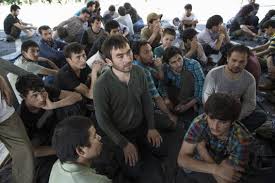
Detained Uighurs in Thailand. Photo: Reuters

Detained Uighurs in Thailand. Photo: Reuters

In the past two weeks, close to 300 suspected Uighur migrants were discovered in the jungles of southern Thailand. Since their discovery and apprehension by Thai authorities, accusations of terrorism and rebuttals to these claims have flown.

Quoting an unnamed source attached with Thai police, the Bangkok Post published an article claiming that the migrants were indeed Uighurs. They intended to use Thailand as a transit point to go to Turkey, where they would be trained in terror tactics that could be used in their native China and elsewhere.

Recently, two groups of migrants have been found in the south of Thailand. The first, discovered March 12 at a rubber plantation near Songkhla, was a group of 219 people, containing dozens of women and children. Another group of 77 were arrested near a school in Sadao district on the 20th of March.

The same source alleged that the migrants were identified as Chinese Uighurs and not Turks, as they have claimed, by bus tickets and items that had Chinese writing on them. “Immigration police are not stupid,” the police source added.

Turkey has sent diplomats to southern Thailand to verify the migrants’ claims of Turkish nationality. The migrants were able to speak with diplomats when interviewed, however when met by an interpreter from the Thai Immigration Bureau they could not communicate well. “The interpreter believed they could not speak Turkish,” the source said.

A named source, Thai Immigration Bureau chief Lt. General Panu Kerdlarppol, refused to give any specific details regarding the migrants’ nationality or ethnicity. However, historically and geographically, it would make more sense that they were Uighur. Thai authorities have been aware of a Uighur migrant presence in the country since last year.

In December 2013, 112 refugees were arrested in the country’s south and are now being held at a detention center. Thirty of the migrants have so far been positively identified as Uighurs. Following the arrests, Lt. General Panu met with Chinese authorities in Kunming about the issue.

There are some, however, that dispute claims of the migrants’ nefarious motives. Speaking through the Phuket Wan Tourism News, the New York-based Human Rights Watch dismissed the accusations.

‘The groups in question are composed of significant numbers of small children, and more than a few pregnant women,” Phil Robertson, Deputy Director, Asia Division, Human Rights Watch, said today, ”so one wonders how unnamed police sources have suddenly somehow jumped to a conclusion that these people are ‘terrorists.”

Mr. Robertson links these claims of terrorism to Thailand’s treatment of asylum seekers in the past. Starting in 2009, hundreds of Muslim Rohingya refugees from Myanmar began regularly washing ashore on Thailand’s western coast. These refugees, fleeing ethnic violence in their home, were also labelled as terrorists. Oftentimes, they were pushed back out to sea by units of the Thai navy.

”It seems pretty clear that Thai officials have some ulterior motives in trying to tar this entire group with the ‘terrorist’ label,” Mr Robertson said.

He believes the end game is to deport the migrants to China, ”I suspect that such ‘terrorist’ accusations are a prelude to some Thai government officials trying to force these groups back to China in what would be a clear violation of international law,” Mr Robertson surmised.

Migrants claiming Turkish nationality were also arrested in Malaysia this month, though no further word on their situation has been released.


1 Comment

Filed under China, Current Events, ethnic policy, Kunming Train Station Attack, Regional Relations, SLIDER, Thailand

Misunderstanding land use, traditional values, & resettlement compensation

Yu Xiaogang meeting with villagers scheduled for resettlement in Muli

Yu Xiaogang meeting with villagers scheduled for resettlement in Muli

Due to the onslaught of hydropower construction in the upper reaches of the Yangtze River watershed, tens of thousands of ethnic Yi and Miao peoples have relocated from mountainside villages deep in the Yalong River valley into lowland resettlements in China’s Sichuan province.    A shared result of all peoples forced to leave their homes due to China’s development plans is a substandard compensation package due to the failure of local governments and hydropower firms to properly assess the impact of relocation on the villagers. In the case of ethnic peoples relocated from the Yalong River valley, the distribution of land parcels for agricultural purposes to individual households in resettlements falls short of matching the land use patterns enjoyed by villagers in their remote mountain homes. A villager in the Gubai resettlement commented that in the mountains he “used to fish at night and could usually get five, six, seven, to eight pounds of fish.  If we were lucky we might even get ten pounds.  We would boil them – it was such a good time.”

The Yi mountain village of Muli had groves of walnut trees each two to three hundred years old.  Villagers could earn extra income of more than 1000 RMB per year from each tree.  In the Gubai resettlement few opportunities like this exist.  Each household is only given two mu of irrigable land and less than one mu of paddy field for rice cultivation. Ma Erzi, Director of the Liang Shan Yi Minority Culture Research Institute identifies four functional areas of land use in Yi mountain villages each abundant with food resources and used throughout the year in the Yalong river valley.  He comments that traditional Yi people from Liang Shan autonomous prefecture lived by traditional farming methods and taking animals to pasture.  With their houses at the center, they divided land into pasture land 禾普, farming land 么普, forests for collecting timber and food like fruits and mushrooms 斯普, and water areas for fishing and fetching drinking water 日普. These areas formed a special distribution pattern each linked to the other, none of them dispensable.

Local governments may compensate resettled villagers for houses and land, but the water areas, forests, and pastures cannot be compensated.  These missing links will provide a major challenge for resettlement. There are two common misconceptions about resettlement. First the Chinese government believes that as long as compensation standards are followed, resettled villagers will be compensated appropriately and once compensated there is no need for follow-up.  In actuality resettled peoples think their losses are far from covered.  The products and services provided by mountains and forests where they could dig wild herbs and mushrooms, their religious facilities, the loss of community – all of these losses should be compensated for.  Second, the government economic compensation will solve all problems, but in actuality what people need is to be taught a new way to make a living and to build a new social network.  Only in this way can the resettled truly build a new life. The Yalong River valley is an ancient corridor for the movement and settlement of Tibetans, Yi, Pumi, and Miao (Hmong) peoples who have all lived to the south of Hengduan mountains for generations.  Will the demand for hydropower development cause us to turn a blind eye to the historical and cultural value of this corridor?  When resettlement separates the people from hundreds if not thousands of years of traditions, how will it harm the people who have lived there for generations?

Conducting a social impact assessment a resettlement

Conducting a social impact assessment a resettlement

To illustrate the loss of culture and the lack of recognition of the cultural values of indigenous peoples by local governments and hydropower developers, we should examine the near desecration of Yi family graves in the Liang Shan autonomous prefecture.  Over the last decade, the development of dams on the Yalong, Dadu, and Jinsha Rivers has sent countless criss-crosses of electricity lines through the blue skies of Liang Shan.  In 2009, a series of the electricity towers was scheduled for construction on a mountain specified for placing the Ji, Mu, Wu, and Qi family graves – the core ancestral clan of the Liang Shan Yi people. “To build an electric tower on our mountain is like hammering a nail into someone’s head – it will hurt for sure!” recalls Feng Gebo, a local leader and representative of the Ji-Mu-Wu-Qi clans.  “That tower is hammered into the head of our mountain, it gives us a feeling that we can never develop again because we are being stepped on.” Feng took my research team to a hole five to six meters deep, dug initially to support an electricity tower. “We filled this hole in on our own after the ground breaking ceremony for the tower network.  (The hydropower firm) didn’t do anything.”

The Ji-Mu-Wu-Qi ancestral tombs date back to 1556 and play a key role in maintaining and preserving Yi identity and historical understanding.  Feng pleaded to the local government to move the towers to an adjacent ridge without tombs. But his original pleas fell on deaf ears as local officials failed to understand his request or cited state development as a priority over local needs.  “They believe it’s for the construction of the state and the stated outcome of this hydropower project is to help us overcome poverty and achieve prosperity.  But we know what’s good for us, and we believe the best thing to do is to let this place stay just the way it was.” Feng acknowledged during his initial pleas to the local government he discovered that officials held different views.  He discovered some officials understood the importance of protecting the social customs, religions, and cultures of minority peoples. “At that time, I managed to arrange more than 100 people to help me, to make sure construction would not start until I finished the negotiations.”  He was only asking for the two towers to be built 200 meters away so his ancestors could rest in peace.  To keep vigil over their movement, farmers would spend nights at the construction site warming themselves by a fire in the subzero autumn temperatures to prevent construction from starting up.

This lasted until February 2010 when the local party secretary ended negotiations with Feng and asked him to send the farmers home due to exposure the extreme temperatures.   “The secretary promised me the construction would not start without the permission of the farmers.  In the end, the provincial design institute redesigned the towers and removed them.” Prior to the establishment of the PRC in 1949, ethnic groups in the mountainous regions of southwest China defended their culture, lands, and traditions with arms and kept the expanding Chinese state at arms’ length.  Feng noted, “At that time if you built something like that on top of a mountain, you would be in real trouble and make enemies for sure.” The Yi people have a saying often asserted in a quarrel or argument, “Are you an Apukeh or not?”  An Apukeh refers both to the ancestral tomb and the essence of an honorable person.  “You can mess with anything you like, but you simply cannot mess with an Apukeh – it’s a matter of life.  As a part of the next generation if you cannot protect the ancestral tomb, then you can’t protect anything.  You don’t call yourself a man or even a person.  That’s how important the Apukeh is – more important than our lives.” In September 2010, Feng Gebo’s efforts and the collective efforts of Yi people in the Ji-Mu-Wu-Qi clan successfully saved their ancestral tombs.  But how many other ancestral mountains will be flooded due to rising reservoirs behind dams or destroyed by the construction of electricity towers or roads that support the hydropower projects?

This is the 2nd in a five part series on ethnic resettlement and the impacts of hydropower development by Yu Xiaogang.  Link here to part 3 and here to link back to part 1.


2 Comments

Filed under China, Culture, Economic development, Energy, Environment and sustainability, ethnic policy, Hydropower & Ethnic Resettlement in China's Yalong River Valley, SLIDER, water