Category Archives: Current Events

Regional Roundup for Week of 11.9.2014

EXSE FOCUS 

US-China Relations: Attitude and Attitudes The Diplomat Obama’s second trip to China is a good opportunity to set a new course in bilateral relations.

 Defining a ‘New Type of Major Power Relations’ The Diplomat Heading into the APEC Summit, the U.S. and China may need to narrow their interpretation of the concept.

 Obama, Asia, and Democracy Asia Unbound It’s nice, in a way, to see issues one has worked on appear in major, globally important publications. This past week, just before President Obama’s trip to Asia, the Banyan column inThe Economist, a column that focuses on Asia, detailed the Obama administration’s general disinterest in issues related to democracy and human rights in Asia.

 To China, Shift in Obama’s Political Fortunes Eclipses U.S. Economic Gains NYT When President Obama visits China on Monday, authorities there are likely to dwell more on his electoral reversals than on the robust American economy, analysts say.

 The U.S. and China’s Competing FTA’s During APEC The Diplomat The U.S. is uninterested in ceding power in a more comprehensive regional trade agreement.// Interesting to look at the TPP from a strategic perspective. Many potential Asian members (Vietnam, Malaysia, Taiwan, Japan) have territorial disputes with China, conspicuously absent in the negotiations. Meanwhile, the US is the TPP cheerleader this side of the Pacific. 

 Beijing attempts to cut air pollution for APEC summit Guardian Factories, schools, offices and building sites to be closed and cars part-banned as city hosts world leaders including Obama and Putin. To Beijing’s 21 million residents, the city’s air pollution is a health hazard. To the city’s leaders, it’s an embarrassment. So as the Asia-Pacific Economic Cooperation summit (Apec) begins this week in the city, authorities have been scrambling to keep the air clean, temporarily restricting the operation of cars, factories, construction sites and even crematoriums. 

So Long Deployment, Hello Employment: Redefining the Rebalance to Asia The Diplomat John Kerry’s definition of the U.S. rebalance to Asia is far different from Hillary Clinton’s original description.

 The New Silk Road: China’s Marshall Plan? The Diplomat China’s plan for massive investments along the New Silk Road and Maritime Silk Road is a bid for diplomatic clout.//China’s int’l economic development plan is certainly attractive, and not just for countries like Nepal or the Maldives. Indonesia just joined the Asian Infrastructure Investment Bank this week, much to the US’s chagrin.


REGIONAL RELATIONS

Authorities break up China-Vietnam telecom scam GoKunming During a time of tense and increasingly complicated political relations, China and its southern neighbor Vietnam are still finding ways to cooperate, at least in the realm of law enforcement. Police from both countries announced Tuesday they have jointly broken up a cross-border telecommunications swindle that bilked its unwitting victims out of at least two million yuan.

The Tyranny of SE Asia’s Establishment The Diplomat The “old middle class” in Southeast Asia is turning against democracy in a bid to protect its interests.

China’s Uighur Unrest Is Opportunity for Afghans NYT With new aid and investments, Beijing seems to be coming to grips with Afghanistan’s role in its national security.

China and Japan, in Sign of a Thaw, Agree to Disagree on a Disputed Island Group NYT The countries’ leaders gave the first public declaration they are trying to roll back a long standoff that has inflamed nationalist sentiments and damaged economic ties.

Chinese President’s Delegation Tied to Illegal Ivory Purchases During Africa Visit NYT At a time when China says it is trying to root out corruption, a report accuses President Xi Jinping’s delegation of colluding with corrupt Tanzanian officials to smuggle ivory.// You won’t find this coming from Xinhua. Awful if true. Local friends often talk about how Xi’s clique is just as corrupt as the rest – this is a pretty shocking example.

Mexico revokes multibillion-dollar rail contract with China Reuters Mexico has sought closer ties with China but the revocation of the project is an embarrassment ahead of a state visit next week. Mexico has revoked a contract for a multibillion-dollar, high-speed passenger rail link from a Chinese-led consortium after its uncontested bid sparked complaints, souring a state visit to China next week by President Enrique Peña Nieto.


SUSTAINABILITY & RESOURCE MANAGEMENT

China’s EIA Industry Rife with Fraud ChinaFile A farce played out at an environmental impact assessment (EIA) firm in the southern city of Shenzhen when inspectors called round in early October, this year. //The Sino-Burmese pipeline’s EIA is a complete sham in addition to the refineries and side projects that come with it.

Counting the Varied Costs of China’s Dependence on Coal NYT A report by the Natural Resources Defense Council and Chinese partners puts a monetary price on the problems created by the energy source, like air pollution.

China and Russia Said to Block Creation of Antarctic Marine Reserves NYT International talks in Australia on establishing two marine reserve areas, each larger than Texas, in the waters around Antarctica ended in failure on Friday.

China-based companies turn blind eye to water risks third pole Big companies are more aware of water risk but are still not doing enough about it, and companies in China are falling behind. Companies based in China lag behind global counterparts in terms of addressing water risks, according to CDP’s annual water survey based on data supplied by big companies worldwide.

Snails devour paddy fields in Irrawaddy delta DVB A plague of imported snails has destroyed more than 1,000 acres of rice fields in Irrawaddy Division’s Dedaye Township, farmers told DVB this week.

Japan-China relations strained over illegal coral poaching Guardian Tokyo presses Beijing to act on poaching near Ogasawara islands, warning that Chinese boats will not be allowed to shelter there from coming typhoon


CHINA

Investment flows: Going out Economist A big reason for its fast economic growth is that China has been a magnet for the world’s investment capital. Over the past two decades, China attracted more foreign direct investment (FDI) than any country save America. So the recent prediction made by the Centre for China and Globalisation, a Beijing think-tank, that this year China’s outbound investments would exceed its inbound ones, is noteworthy.

China’s Questionable Economic Power Project Syndicate The World Bank recently announced that China’s economy will surpass that of the US this year, measured according to purchasing power parity. But this is far from a holistic depiction of China’s global economic standing. //It’s much better to be a healthy economy than a large one, though ‘healthy’ isn’t an adjective that could be used to describe either country right now.

In Beijing, Clearer Views Hide Real Life NYT Determined to show a cleaner version of Beijing, the Chinese authorities have ordered dozens of temporary changes that are upending daily life.

Britain soft on China over Hong Kong crisis, says Chris Patten Reuters Territorys last British governor says Beijing is being allowed to spit in the face of handover pact because of trade fears. Britain is not putting enough pressure on China to stick to its side of an agreement on the transfer of Hong Kongs sovereignty because it is worried about damaging trade links, the former Hong Kong governor Chris Patten has said.


NEWS FROM SOUTHEAST ASIA

 Festival ends on a high note Phnom Penh Post Third day of races wrapped up the formal part of Cambodia’s Water Festival yesterday – and a number of high-ranking officials were left enjoying the spoils of success after vessels they sponsored were winners.

 On the River, CPP Bosses Become Racing Rivals Cambodia Daily The captain blew his whistle, startling his oarsmen out of their resting places, and ordered them to gather under a ragged tarpaulin strung between three trees in the mud. Here they would discuss Water Festival racing tactics for Srey Mao Kraing Yov, the boat named and sponsored by Prime Minister Hun Sen.

Cambodian-American Wins US State House Seat Phnom Penh A former refugee whose family fled the Khmer Rouge regime became the first Cambodian-American legislator in the U.S. after being elected as a state representative in Massachusetts Tuesday.

 Thailand: Man Gets Over 2 Years on Charge of Defaming King AP A Thai court sentenced Akkaradet Eiamsuwan, 24, to two and a half years in prison on Tuesday for posting a message on Facebook that the court said insulted King Bhumibol Adulyadej.

Suu Kyi calls for critical eye on reforms DVB Burma’s opposition leader Aung San Suu Kyi said on Wednesday that the country’s reform process has stalled.

Myanmar Policy’s Message to Muslims: Get Out NYT A government plan to resettle Muslim minorities who cannot meet strict standards for naturalized citizenship has spurred a major exodus, rights groups say.

Myanmar Not Yet Attracting U.S. Companies Asia Unbound As President Barack Obama arrives in Myanmar next week for the East Asia Summit, he will find less optimism not only about the political situation but also about Myanmar’s economic future. As I noted last week, when Obama first visited Myanmar in 2012, it was at the height of the country’s political reform process. Since then, the process of political reform has deteriorated, so much so that President Thein Sein last week held a kind of emergency summit with top civilian and military leaders, including Aung San Suu Kyi. //Promised political and economic forms are all fine, but if you’re persecuting a minority to no end, still fighting a civil war and your country lacks basic rule of law, businesses might be hesitant to invest.

Burma’s state security forces profit from trafficking Rohingya Muslims Guardian Authorities are earning $7,000 per boatload in exchange for passage out to sea. Burmas state security forces are profiting directly from the trafficking of stateless Rohingya Muslims, earning up to $7,000 per boatload in exchange for passage to sea, a human rights group has found.

Laos’ Internet Law Undermines Free Speech Diplomat It appears the law gives the government broad scope to treat legitimate criticism as criminal.

On permanent parole Economist A FOUR-YEAR battle ended yesterday, when Singapore’s highest court upheld the constitutionality of Section 377(a) of the country’s penal code, which renders any man convicted of committing “or abet[ting] the commission of…any act of gross indecency” with another man liable to two years in prison. Tan Eng Hong first challenged the law in September 2010, after he was charged under 377(a) for having oral sex with another man in a public-toilet stall.


YUNNAN

Child trafficking ring uncovered in Yunnan GoKunming Over the weekend, authorities working in Yunnan took dozens of people suspected of being involved in a large-scale child trafficking ring into custody. While conducting raids, police also rescued 11 youngsters presumed by officers to be on their way to China’s east coast, where they would be sold to new families.


Leave a Comment

Filed under Current Events, NEWS DIGEST

A Different Global Power: Understanding China’s Rise in the Developing World

China-s-meat-majors-focus-on-convenience-as-incomes-rise_strict_xxl

By Xiangming Chen and Ivan Su

China is now the largest trading nation in the world with strong ties to Africa, Latin and America and the Middle East. This once impoverished and isolated nation has lifted several hundred millions of its own people out of poverty and is now reshaping the developing world. This article looks at China’s involvement in four developing regions to assess China’s influence as a rising global power.

The China where the first author grew up through college in the early 1980s was the largest and one of the poorest developing countries. The China where the second author left to attend high school in the United States was about to pass Japan to become the world’s second largest economy, in 2010. Over the past three decades, China has lifted over 500 million of its people out of poverty. Globally, China has just surpassed the United States to become the largest trading nation in the world and is expected to soon overtake the latter as the world’s largest economy (in terms of purchasing power parity or PPP). More importantly regarding the focus of this essay, China is now the largest trader and investor in Africa, with its footprints spreading and seeping into all corners of the developing world.

How did the once impoverished and isolated “Third World” country become a powerful force in shaping a new developing world in the 21st century? What are the positive vs. negative consequences of China’s inroads into developing countries by exporting its urbanism to Africa, for example? These questions highlight China’s global impact that matters a great deal to the everyday life of millions of poor people in developing countries. In this essay, following China’s global footprints in four developing regions, we offer a broad comparison of both the different and consistent economic impacts of China within and across these regions.1 Figure 1 shows China’s investment in energy and infrastructure in the four regions, while Figure 2 breaks China’s investment into four specific sectors of one major country in each of the four regions. Guided by these comparative data and focusing on four developing regions, we present a broad picture of China’s widespread but mixed role in developing countries, thus offering a preliminary assessment of whether China’s influence as a rising global power may differ from the traditional or established Western powers in how they approach the developing world.


China in Asia: Exerting Neighboring Influences

Back in the last decades of the 20th century, the drivers and role models for development in Asia and beyond were the “Four Tigers”: Hong Kong, Singapore, South Korea, and Taiwan. The onset of the 21st century began to position China toward the epicentre of the Asian economy, with its influence spreading across the continent through more trade, outward investment, and other outgoing initiatives such as cross-border infrastructure development.

In Southeast Asia, China has been trying to integrate with the Greater Mekong Subregion (GMS), which consists of China’s Yunnan Province, Guangxi Autonomous Region, Cambodia, Laos, Myanmar, Thailand and Vietnam. “China’s trade with each of the GMS countries has grown since 1990, most rapidly since 2000.”2 In addition to increasing trade, China exerts strong influence on the GMS through various development projects. In Myanmar, China has reached a $20 billion agreement to construct an 800-kilometre rail link between Myanmar’s Chinese border and its western coast.3 In addition to investing in infrastructure, China is also helping its neighbors to generate energy. Since 2005, China has invested over $87 billion in the energy sector across Asia, and about one quarter of these investments went to Malaysia. In 2010, an $11 billion energy deal signed between China’s State Grid Corporation and Malaysia Development Company included four hydroelectric mega-dams that are capable of generating up to 28,000 megawatts of power, an aluminum-smelting plant, exploitation of coal mines containing 1.5 billion metric tons of coal, and a 40 billion-cubic-feet natural gas development project. “With Malaysia reeling from an exodus of capital over the past two years, the projects have strong support at the state and federal levels. Officials hope the plan will attract foreign investment to the region.”4

China’s investment in Asia is not limited to Southeast Asia, as countries in South and Central Asia have also been affected by China’s direct investment. In 2013, China established a strong foothold in South Asia when it took over the upgrading and operation of Pakistan’s Gwadar Port from Singapore. The Gwadar project serves China’s “Go West” policy while allowing Pakistan to “look east.” China is building a road from Gwadar all the way north to Kashgar, the westernmost large city in Xinjiang. At the same time, Pakistan and China have also planned to connect the port via the Indus Highway, which will provide China with a land-based supply of oil from Central Asia. Given Gwadar’s geographical location, Gwadar cuts China’s distance from the Persian Gulf, from which China gets 60% of its oil, by thousands of kilometres.5

Compared to the other energy projects sponsored by China, the Central Asian vector of China’s energy policy has become more important due to the region’s abundance of oil and natural gas. While China sees Kazakhstan’s energy supply a key to its “Go West” program, Kazakhstan has used Sino-Kazakh cooperation to balance against Russia’s influence in its energy sector. China is also constructing a 1,800-kilometre natural gas pipeline from one of the world’s largest natural gas exporter, Turkmenistan, which benefits from doubling its energy supply to China and circumventing its biggest competitor – Russia. Beijing wins by securing new gas supplies and thus enlarging its already hefty investment in energy projects in Asia (see Figure 1).


infograph-1


China in Africa: Reaching Maximum Impact

Through increasing trade and investment, China’s growing presence has reshaped the landscape in Africa. While negligible two decades ago, China-Africa trade reached $200 billion in 2013, which makes China Africa’s largest trading partner today. With only limited investment in Africa before the 2000s, China’s cumulative investment in Africa exceeded $150 billion by the beginning of 2014. Of these investments, close to $100 billion has gone into energy and infrastructure projects.6

China’s unprecedented economic growth requires an increasing amount of oil to sustain it. In 2012, close to one-third of China’s total oil imports came from Africa, and China is looking to expand its energy presence in Africa. Nigeria has received the most Chinese direct investment over the past decade. While many Western energy firms are reluctant, China reached a $10 billion hydrocarbon deal with Nigeria at the beginning of 2014 (see Photo 1). In addition to exploiting crude oil and natural gas, China has been involved in constructing an additional refinery in Baro, Nigeria.7 Although critics have attributed China’s heavy footprint in Africa’s energy sector to its energy and resource demand back home, evidence suggests otherwise. China Africa Sunlight Energy Ltd. recently invested $2.1 billion in developing a 2,100-megawatt plant to help ease electricity shortages in Zimbabwe, which is only capable of generating 1,320 megawatts against a demand of 2,200 megawatts of electricity. “China Africa Sunlight Energy is looking at the possibility of pumping gas to the port city of Beira in neighbouring Mozambique, using an idle pipeline that the National Oil Co. of Zimbabwe once used to bring fuel into the country.”8 This power plant is expected to produce 300 megawatts by mid-2015, and the number is looking to double by the end of the year. While much of the media attention has focused on China’s investment in Africa’s energy sector, China is reshaping Africa’s landscape through large-scale infrastructure development.

photo1

Photo 1: Drilling Oil in Nigeria

Since 2005, China has invested more in Africa’s infrastructure than in any other part of the developing world. More than $44 billion has been spent to build roads, airports, and housing that are essential to the continent’s economic development. In Angola, China is helping the country’s reconstruction effort after the devastating civil war. One of China’s major investments in Angola is the rebuilding of the Benguela Railway, “an 840-mile transcontinental railway that links the Atlantic port of Lobito in Angola with rail networks in the Democratic Republic of Congo and Zambia. The project is expected to cost $300 million, and it will provide a much-needed cheap outlet for Congolese and Zambia copper, tin and coltan.”9 In Nigeria, China is helping to build Africa’s largest free trade zone in its commercial capital, Lagos. “A total of 16,500 hectares of land bordered by the Atlantic Ocean and the Lagos and Lekki lagoons has been earmarked for the whole free zone, which will include a deep-water sea port and a new international airport in close proximity.”10 The Lekki Free Trade Zone is aiming to cut down the country’s reliance on imports, and it will cost $5 billion to complete the first phrase of the project, which will cover 3,000 hectares of land. The construction will also include roads, power plants, and water plants. This evidence reinforces China’s substantial investment in building Africa’s infrastructure relative to the energy sector in comparison with the other developing regions (see Figure 2)


infograph-2_1

However, concerns arise on whether Africa is too dependent on China as results of “high commodity prices and investment inflows.”11 With China-Africa trade looking to hit $280 billion by 2015, some worry that African economies depend too much on China. Some urge African countries to diversify their economies and decrease their dependence on China. There are also calls for China to focus more on human rights and community engagement. As such a dominant investor in some African countries including those with an authoritarian government like Zimbabwe, China struggles to balance between the return on its huge investment, helping local development and living up to international norms of engagement.


China in Latin America: Extending the Reach

Ever since the 1960s, China has been providing limited development assistance to a small number of Latin American countries such as Chile. Fast-forward to the 21st century, China has considerably expanded its economic ties with Latin America through greater trade and more diverse investment.

“Trade between China and Latin American countries has grown exponentially over the past decade. Although Sino-Latin American trade continues to remain a relatively small share of their respective global trade, growth has exceeded many expectations. From 2000 to 2009, annual trade between China and Latin American countries grew more than 1,200%, from $10 billion to $130 billion, according to the United Nations statistics.”12 In 2012, Latin America accounted for 13% of China’s total outbound investment – about $11.4 billion, a significant increase from the $120 million of 2004.

Like in Asia and Africa, China has favored the energy sector in Latin America (see Figure 1), targeting Venezuela for its oil and Brazil for its hydropower. Of China’s $100 billion investment in Latin America since 2005, more than half has been energy and infrastructure related. In 2010, China’s State Grid announced a $1 billion buyout of seven Brazilian power transmission companies. Two years later, in 2012, China’s State Grid was chosen by the Brazilian government to build a $440 million power-transmission project. And at the end of 2013, China’s State Grid led a group to win the rights building a $21 billion hydropower plant in Brazil. Set to become the world’s third-largest hydropower plant and take around 46 months to complete, it will also create a 2,092 km hydropower transmission line and two energy converter stations that will be able to take energy from the State of Pará, along the Xingu River in the Amazon Basin, to Brazil’s Southeast region, with a planned capacity of 11,233 megawatts. Brazil’s economic acceleration in the past decade led to a surge in the country’s energy demand. Given Brazil’s geographical endowment, as much as 80% of its total energy comes from hydropower generation.13 With power generation operating close to the limit, Brazil is urgently constructing more power plants using the Amazon’s abundant hydro resources and transmitting it to its Southeast region, especially Rio de Janeiro where much more energy is needed in light of the upcoming World Cup and Summer Olympics in 2016. To do so, Brazil has turned to China for its expertise and experience in building long-distance power transmission towers or the so-called electricity pylons (see Photo 2).


Photo 2: High on an Electricity Pylon in Eastern China  Source: China Daily/Reuters

Photo 2: High on an Electricity Pylon in Eastern China Source: China Daily/Reuters

Besides its growing economic presence in Latin America, China has made some cultural inroads as well. Since 2012, China has opened 32 new Confucius Institutes all over Latin America, a Chinese foreign ministry deputy announced. Hotels in the region have begun to prepare for the increasing number of Chinese tourists by making the menus available in Mandarin.14 This confirms the larger trend of more Chinese tourists going to developing countries beyond Asia and advanced economies in North America and Western Europe, making China the world’s number one tourist-sending nation in 2013 with approximately 100 million overseas trips.


China in the Middle East: Reviving the Silk Road

Tracing what China is doing in the conventionally defined developing world has taken us to Asia, Africa and Latin America. Yet given China’s huge demand for external energy, we are not surprised at all to see China’s growing presence in the Middle East, whose energy sector ranks second behind Asia in absorbing Chinese investment (see Figure 1).

Despite China’s massive efforts to secure energy from Asia and Africa, as well as from Venezuela in Latin America, its dependency on Middle Eastern oil has risen over time. The Middle East is currently the largest exporter of crude oil to China. The share of oil imported by China from the Middle East was 48% in 1990, 49% in 2005, and 51% in 2011. It is expected that China’s crude oil imports from the Middle East will reach 70% by 2020 and continue to grow until 2035, according to the International Energy Agency. Saudi Arabia is China’s largest energy supplier with about one million barrels per day, accounting for 20% of China’s crude oil imports. Iran, another big oil supplier, contributes about 10% to China’s overall oil imports as well (see Figure 2). China has maintained a friendly relationship with both Saudi Arabia and Iran. A number of top Chinese leaders including Hu Jintao and the current president Xi Jinping have visited Saudi Arabia. And China has been dragging its feet on the UN sanctions against Iran.15 These diplomatic postures toward the Middle East conform to China’s pragmatic economic policies and interests in other energy- and commodity-rich regions such as Africa and Latin America.

But China’s interest in the Middle East does not stop with oil. “As with other regions, China has rapidly expanded its economic ties with the Middle East through trade. From 2005 to 2009, China’s total trade volume with the Middle East rose 87%, to $100 billion and reached approximately $222 billion in 2012, according to China’s official statistics. This surge pushed China to surpass the United States as the top destination for the Middle East’s exports in 2010. China’s exports to the Middle East are primarily low-cost household goods that benefit the average Middle East consumer. An example is growing numbers of Egyptians being able to afford inexpensive Chinese cars. Also, residents in the Gaza Strip suffering from the Israeli blockade depend on cheap Chinese goods in their daily lives.”16

As many African countries have done, some Middle Eastern governments have brought Chinese contractors in to work on major infrastructure projects. Egypt has also partnered with China to develop its Suez special economic zone, a development strategy that China had used itself and promoted in Africa and the least developed parts of Southeast Asia like Laos. While China has diversified its investment in the Middle East, it is much more concentrated in the energy sector than in infrastructure (Figure 1). This further establishes China’s significant dependency on the Middle East for energy resources, namely oil. However, once we factor in the non-oil related Chinese economic activities, China’s footprint in the Middle East becomes somewhat similar to the large scope of China’s economic influence in the other three developing regions, especially in several major countries where China has moved beyond energy into infrastructure and commodities (see Figures 1 and 2). In this sense, the Middle East still marks the old destination for China’s new effort to revive the ancient Silk Road through Central Asia.


China’s Ambitious and Uncertain Role

Judging by a sampling of evidence across the four developing regions, we characterize China’s role as very ambitious and yet uncertain. The ambitious aspect is increasingly fueled by China’s abundant surplus capital in both private and public hands that may have a stronger effect on the urban landscape and transport infrastructure of developing countries than on its quest for the latter’s energy and commodities.

On the bank of the Mekong River in Cambodia’s capital city Phnom Penh, the $700 million Diamond Island Riviera, a joint venture mixed-used development project involving a Chinese company, includes three 33-story condominium towers, a shopping mall, a hospital, an international school and two pedestrian shopping streets with signs in Mandarin. Before its scheduled completion in 2017, Chinese buyers, especially Shanghainese, are already buying the condos in cash as investment properties.17

It is again in Africa where the transport infrastructure is the poorest in the developing world that China is scaling up its investment most aggressively. On his recent four-country tour of Africa, Chinese Premier Li Keqiang committed to set aside $2 billion for an African Development Fund and promised his support for a high-speed rail network connecting African capitals. As a start, China Railway Construction Corporation made a $13.1 billion deal to build an 860-mile high-speed railway in Nigeria that would employ more than 4,000 workers during construction, and 5,000 more afterward.18 Claiming no-strings-attached, China’s ambitious effort can deviate from the precedent of Western colonial powers who had built highly limited transport infrastructure for shipping out their craved commodities from Africa. Yes it is uncertain that the Chinese will succeed where the earlier powers largely failed.

As further evidence on its ambition to build the developing world’s urban and transport infrastructure, China is funding and building Nicaragua’s lifelong dream in having its own canal since the 19th century, when it rivaled Panama for control of the waterway. In August 2013, President Daniel Ortega announced that a $40 billion contract had been signed with a Hong Kong-based Chinese company that would design a route and start construction in December 2014 and manage the canal for 50 years. Estimated to cost as much as $60 billion, an infrastructure project of this massive scale is very uncertain in terms of returning investment to China. Yet China might not be looking for a quick return on investment, but to control a trade route independent from U.S.-managed Panama.19

The uncertain aspect of China’s strong role has also run into trouble in the Middle East. Despite China’s political advantage in taking a somewhat neutral position regarding Iran under West-imposed sanctions in order to continue buying its oil, Iran’s Ministry of Oil has recently removed China from the project to develop the South Azadegan oilfield because of long delays. This puts China’s non-political or no-strings-attached approach to dealing with developing countries, especially those with an authoritarian domestic system and a precarious international status, to test or at risk.

While ambitious and already far-reaching and powerful, China’s role in reshaping the developing world will only grow and remain uncertain over time. It highlights the ongoing debate about whether China merely exploits commodity and energy resources in developing countries as the old West or truly promotes national and local development through its overseas infrastructure construction and other positive means as a new global power. This debate will not be settled for a long time as we continue to scrutinize China’s powerful role in shaping the developing world during the 21st century.


About the Authors

Xiangming Chen is the founding Dean and Director of the Center for Urban and Global Studies and Paul E. Raether Distinguished Professor of Global Urban Studies and Sociology at Trinity College, Connecticut, and a distinguished guest professor at Fudan University, Shanghai. He has published extensively on urbanization and globalization with a focus on China and Asia. His several books include Shanghai Rising: State Power and Local Transformations in a Global Megacity (University of Minnesota Press, 2009; Chinese Edition, 2009).

Ivan Su is currently a third-year student at Trinity College, Connecticut, majoring in Public Policy and Law and Urban Studies. His interests are situated at the intersection of city planning, city economic development, and legal studies. He speaks fluent Mandarin and Cantonese, and  carried out a field research project in the southern Chinese city of Guangzhou in summer 2014. He has been a student researcher at the Center for Urban and Global Studies at Trinity College since 2012.

References

  1. For this culminating article, we have drawn heavily from the series of articles on China and the developing world that has appeared in this magazine since the February 2013 issue. See Kayla Chen and Xiangming Chen, “China and Latin America: Connected and Competing”,The European Financial Review(February 2013): 56-58; Fakhmiddin Fazilov and Xiangming Chen, “China and Central Asia: A Significant New Energy Nexus”, The European Financial Review (April 2013): 38-43; Xiangming Chen and Curtis Stone, “China and Southeast Asia: Unbalanced Development in the Greater Mekong Subregion”, The European Financial Review (August 2013): 7-11; Xiangming Chen and Garth Myers, “China and Africa: The Crucial Urban Connection”, The European Financial Review(December 2013): 89-93; Abbᾱs Varij Kᾱzemi and Xiangming Chen, “China and the Middle East: More Than Oil”, The European Financial Review(February 2014): 40-44; and Xiangming Chen, Pallavi Banerjee, Gaurav Toor, and Ned Downie, “China and South Asia: Contention and Cooperation Between Giant Neighbours”, The European Financial Review(April 2014): 10-16.
  2. Xiangming Chen and Curtis Stone, ‘China and Southeast Asia: Unbalanced Development in the Greater Mekong Subregion’,The European Financial Review(August 2013): 7-11.
  3. Ibid.
  4. ‘Malaysia and China agree to $11 billion deal to build mines, dams in Borneo’; accessed from http://news.mongabay.com/2010/0112-sarawak.html.
  5. Xiangming Chen, Pallavi Banerjee, Gaurav Toor and Ned Downie, ‘China and South Asia: Contention and Cooperation Between Giant Neighbours’,The European Financial Review(April 2014): 10-16.
  6. Xiangming Chen and Garth Myers, ‘China and Africa: The Crucial Urban Connection’,The European Financial Review(December 2013): 89-93.
  7. John C.K. Daly, ‘China’s bold $10 Billion investment in Nigerian hydrocarbons’; accessed from http://thediplomat.com/2014/01/chinas-bold-10-billion-investment-in-nigerian-hydrocarbons.
  8. Godfrey Marawanyika, ‘China Africa Sunlight to invest $2.1 Billion in Zimbabwe Power’; accessed from http://www.bloomberg.com/news/2013-09-03/china-africa-sunlight-to-invest-2-1-billion-in-zimbabwe-power.html.
  9. Michail Vafeiadis, ‘China buying out Africa: Top five destinations of Chinese money’; accessed from http://www.csmonitor.com/World/2012/0301/China-buying-out-Africa-Top-5-destinations-of-Chinese-money.
  10. ‘Nigeria embarks on vast free trade zone with China’; accessed from http://www.reuters.com/article/2010/09/01/nigeria-china-idUSLDE67U24K20100901.
  11. Accessed from http://www.ibtimes.com/imf-worries-chinese-slowdown-could-damage-sub-saharan-economies-1576706?ft=3aj78&utm_content=xiangming.chen@trincoll.edu&utm_medium=Apr_27_2014_0401_194973&utm_source=TailoredMail&utm_term=China+Economic+Slowdown+Impacts+Reach+To+Africa&utm_campaign=Apr_27_2014_0401.
  12. Kayla Chen and Xiangming Chen, ‘China and Latin America: Connected and Competing’,The European Financial Review(February 2013): 56-58.
  13. Ze Jin, ‘China’s 21 billion investment in Brazil’s hydropower’; accessed from http://wallstreetcn.com/node/75689.
  14. ‘China’s influence in Latin America is increasing’; accessed from http://www.dw.de/chinas-influence-in-latin-america-is-increasing/a-17156409.
  15. Ibid.
  16. Ibid.
  17. Chris Horton, ‘Giant development in Cambodia hinges on Chinese buyers’,The New York Times,May 6, 2014; accessed from http://www.nytimes.com/2014/05/07/realestate/commercial/giant-development-in-cambodia-hinges-on-chinese-buyers.html?_r=1.
  18. Kathleen Caulderwood, ‘Chinese Premier Li Keqiang vows to help build a railway through Africa ‘with no strings attached’,International Business Times,May 6, 2014; accessed from http://www.ibtimes.com/chinese-premier-li-keqiang-vows-help-build-railway-through-africa-no-strings-attached-al+African+Railway+No+Longer+A+Pipe+Dream&utm_campaign=May_09_2014_0700.
  19. Patricia Rey Mallén, ‘Is the partnership between China and Latin America paying off’?International Business Times, May 8, 2014; accessed from http://www.ibtimes.com/partnership-between-china-latin-america-paying-off?


Leave a Comment

Filed under ASEAN, China, Current Events, Economic development, Energy, Foreign policy, GMS, Governance, SLIDER, USA, Yunnan Province

In Anti-Corruption Campaign, Top Yunnan Officials Pay Steep Price for Graft, Political Relationships

During dynastic times, Yunnan was known as a place where disgraced mandarins were sent to live out their days and where the local officials maintained a large degree of independence from the capital. As the saying goes, “the heavens are high and the emperor is far away.” However, as new highways and railroads have linked Yunnan to the rest of China over the past century, Beijing is not as distant as it used to be, and the days of the province’s freewheeling officials seem to be at an end. If that were ever in doubt, a recent string of high profile corruption cases have confirmed Beijing’s grip on its representatives in the land south of the clouds.

President Xi Jinping

Since President Xi Jinping took office more than a year ago, the Communist Party of China (CPC) has undertaken the herculean task of ridding itself of graft, collusion and anything that would diminish the public’s already low level of trust in its leaders. By going after both high-ranking party leaders and petty bureaucrats, or ‘swatting flies and hunting tigers’ (拍苍蝇,打老虎) in the modern parlance, the current anti-corruption drive has yielded impressive results.

To date, over 50 high level party members have been arrested, 182000 government officials punished, and as of July 2014, 6,000 officials have been placed under investigation this year. Among the ‘tigers’ caught in the campaign are former mayor of Chongqing, Bo Xilai, former Minster of Railways, Liu Zhijun, former vice-chairman of the Central Military Commission Xu Caihou and former Minister of Public Security, Zhou Yongkang, also a member of the Politburo Standing Committee under Hu Jintao.

Thousands of officials from every region have been swept up in the campaign and Yunnan Province has indeed seen its fair share, with hundreds of local public servants investigated since the 18th Party Congress almost two years ago. However, in recent months, a number of high profile officials in the province have found themselves in the cross hairs of the Central Commission for Discipline Inspection.

Shen Peiping

Shen Peiping, former vice-governor of Yunnan Province

The first major official to fall was Shen Peiping, former vice-governor of Yunnan Province. Shen, a native of Baoshan, Yunnan, worked in various government posts before becoming Mayor of Pu’er City in 2007. Dubbed ‘Mayor of Tea’, Shen gained fame in promoting the local Pu’er tea to the rest of China and the world, leading to quick economic development of the region. However, Shen was also known locally for his heavy-handed tactics in dealing with petitioners and shady relationships with local businessmen.
After spending a little over a year as the vice-governor, Shen was officially investigated in March of this year and in August, he was charged with using his post for personal benefit, accepting large bribes and committing adultery. Traditionally, intra-Party disciplinary investigations almost always lead to a court case, where the conviction rate is above 99%. Therefore, few expect Shen to recover from these accusations.

It was not long after Shen Peiping’s investigation began that Kong Chuizhu, a personal friend, began his demise, albeit under much more scandalous circumstances. The provincial vice-governor from 2003 to 2013, Kong was known to share mistresses with Shen Peiping and the two would often frequent high-end brothels together. For Kong, the consequences were grave.

Kong Chuizhu

Kong Chuizhu, former vice-governor of Yunnan Province

Following the announcement that Shen was being investigated in early March, Kong, in Beijing attending meetings at the time, attempted suicide in his hotel room. The attempt, however, was unsuccessful and Kong was admitted into a Beijing hospital for recovery. Following medical tests, he was found to be HIV positive. The central government immediately opened an investigation on Kong and ordered him back to Yunnan to lay low while undergoing treatment. Two months later, he unsuccessfully attempted suicide for a second time and was admitted into the Provincial Armed Police Hospital. Finally, Kong jumped to his death from his hospital window on July 12.

Days after Kong Chuizhu’s death, the Central Commission for Discipline Inspection announced it was investigating Zhang Tianxin, former Party Secretary of Kunming. Zhang’s Party membership and posts were immediately revoked as a result of the investigation.
Zhang, the CPC Party Chief of Yunnan’s Wenshan Prefecture from 1999 to 2006, was apparently involved in corrupt practices in the prefecture’s mining industry. In addition, it is significant to note that Zhang was taken down just two weeks after an exposé aired on CCTV revealing plans for a number of illegal housing developments on the shores of the famously polluted Lake Dianchi, plans that Zhang reportedly approved.

That Zhang Tianxin was investigated is not surprising to many Yunnanese.  According to one local government employee who wished to remain anonymous, “Everyone knew Zhang Tianxin and (former Yunnan Provincial Party Secretary) Bai Enpei were corrupt. Once (the Central Commission for Discipline Inspection) started looking at Yunnan, they were done.”

Zhang Tianxin, former Party Secretary of Kunming

Indeed, Bai Enpei did not have much time left. On August 29, it was reported that an investigation was being opened on him and that he was suspected of “serious discipline and law violations,” Party jargon for ‘corruption’.

Bai, Provincial Party Secretary from 2001 to 2011, oversaw a period of rapid growth for the province. He was a vocal supporter of hydropower development and campaigned intensely in favor of damming western Yunnan’s Nu River, also known as the Salween. Following 10 years as the CPC’s top man in Yunnan, Bai assumed the post of deputy secretary for the Environmental Protection and Resources Conservation Committee.

His tenure there, however, was cut short. According to a report from YiCai, the former vice-secretary for the People’s Political Consultative Conference of Yunnan, Yang Weijun submitted to Beijing an official complaint regarding Bai’s corruption in mid-August in which he detailed Bai Enpei’s extensive dealings in selling off mining contracts in the province.

In the most grievous case, Bai sold sixty percent ownership of China’s largest zinc and tin mine for a mere one billion yuan, despite the mine having an estimated value of fifty billion yuan. The shares were sold to a relative of Liu Han, a Sichuanese mining tycoon and close friend of Zhou Yongkang. Mr. Liu was sentenced to death earlier this year for murder, among other charges.

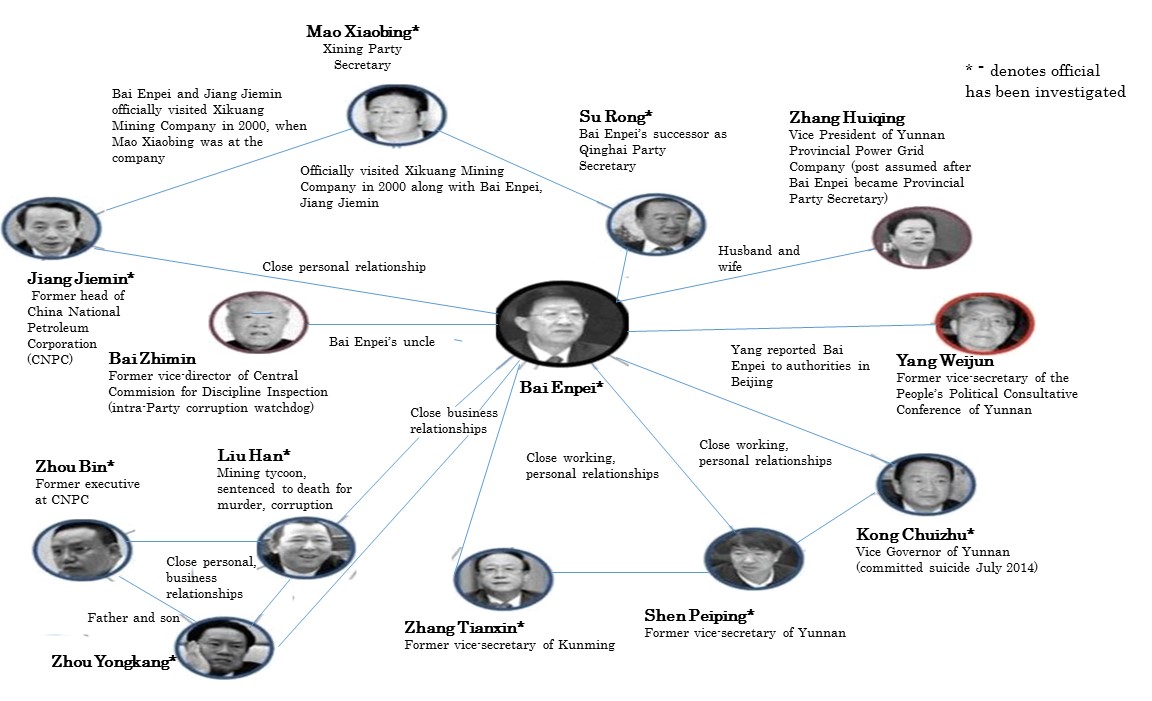
A map of Bai Enpei's relationships with other corrupt officials. An asterisk next to the name indicates that official has been investigated. (Infographic originally produced by Sohu.com August 2014)

A map of Bai Enpei’s relationships with other corrupt officials. Click to enlarge. (Infographic originally produced by Sohu.com August 2014)

As the above infographic shows, Bai Enpei was at the center of corruption among Yunnan’s political elite and closely tied with Zhou Yongkang and Liu Han. What’s more, when Bai was the party secretary of Qinghai from 1997 to 2001, he had dealings with Jiang Jiemin, a former executive of the notoriously corrupt Sinopec who is currently under investigation for embezzlement of state funds. Many of Bai’s former colleagues from his days in Qinghai have also met the same fate as him and currently face investigation by the Central Commission for Discipline Inspection.

Bai Enpei, former Party Secretary of Yunnan Province

Bai Enpei, former Party Secretary of Yunnan Province

The dominoes did not stop falling with Bai Enpei, however. In mid-October 2014, state media announced that Yunnan Party Secretary Qin Guangrong had been relieved of his duties and would be replaced by sitting governor, Li Jiheng. Qin will now assume the post of vice-secretary of the State Organs Work Committee. However, local Kunmingers interviewed see the job transfer as more of a demotion with possible serious consequences. “(Qin’s) new position is meaningless, he has no power there. The central government just put him there until he’s formally charged… and that should be coming soon,” Yang Mouren, a local teacher, claimed. He may be right. While Qin was well-liked by many locals, he had close ties to a number of disgraced officials and it is probable that like his colleagues, Qin also had his hands in corrupt resource deals. However, unless he is formally investigated, details regarding any corruption Qin took part in will not be publicly released.

Qin Guangrong (R) with his replacement as Yunnan Party Secretary, Li Jiheng (L)

Qin Guangrong (R) with his replacement as Yunnan Party Secretary, Li Jiheng (L)

With so many high officials, and hundreds of local bureaucrats, investigated, it’s clear that the central government has its sights on Yunnan’s corrupt officialdom. But, with countless other corrupt officials scattered across China, many locals are asking ‘Why Yunnan?’ The reasons are twofold.

The first has to do with Yunnan’s natural resources. Of the two provinces that have so far been cleaned out by Beijing, Yunnan and Shanxi, one important commonality is their abundance of resources. With such wealth in natural resources come opportunities for massive corruption. In the case of Shanxi, its army of ostentatiously wealthy coal bosses were known nationwide, as were their close relationships with their political patrons. At the same time, Yunnan’s reserves of aluminum, lead, zinc and tin are the largest in China and it’s clear from the cases of Bai Enpei and Zhang Tianxin that provincial power brokers were heavily involved in the illegal distribution of these resources.

Also significant is the fact that all of the high officials mentioned in this article have ties to the disgraced Zhou Yongkang and his mining tycoon friend, Liu Han. With his power base in Sichuan, Zhou’s influence on officials in neighboring provinces, including Yunnan, was deep. Shen Peiping, Bai Enpei and Qin Guangrong especially were known to belong to the same political clique that formed under Zhou Yongkang. Shen and Qin were heavily rumored to engage in business with Zhou’s family members worth tens of millions of renminbi, while Bai Enpei sold off control of a western Yunnan mine to Liu Han’s family at a cut rate. In addition, Bai and Qin were Zhou Yongkang’s unofficial hosts when he visited the province in 2007, and Bai accompanied the Politburo Standing Committee member on his 2011 trip to Laos, all implying very close relations. For their part, Kong Chuizhu and Zhang Tianxin were intimately connected to Bai Enpei and as his power grew in the province, so did theirs. As is often the case within Chinese bureaucracy, underlings rise and fall with their leaders. Bai Enpei, and those who came up with him, were intimately connected to Zhou Yongkang; they are now paying the price for their political associations.

Former Minister of Public Security, Zhou Yongkang

Former Minister of Public Security, Zhou Yongkang

Xi Jinping’s anti-corruption drive has rocked the national bureaucracy, clearing out the upper echelon of Yunnan politicians in the process. It isn’t just top officials that have felt the squeeze however; there have been noticeable effects for local bureaucrats as well. According to one university administrator who wished to remain anonymous, his college’s office environment has changed in the past year. As he explained, “Before, you just had to show up, sit in your office, drink tea and chat with the other teachers from time to time. Now, a lot of people are very nervous at the school because we’re known to be pretty corrupt.” However, the corruption crackdown has led to some unexpected opportunities. “I actually have more freedom with my job now. Because all of the higher officials are so worried about their own jobs, I can consult for other companies on the side, and they’re too busy to notice. Plus, I wasn’t too corrupt to begin with so I’m not worried.”

The changes may not be over yet, however. When asked about corruption in Yunnan, locals still doubt the effect of the current campaign. “In Yunnan, nine out of ten officials are corrupt,’’ Mr. Yang, the school teacher, claims “and it’s the same everywhere else in the country. The story isn’t over yet.”

4 Comments

Filed under China, Current Events, Governance, SLIDER, Yunnan Province

Official: Yunnan will have two bullet trains by 2016

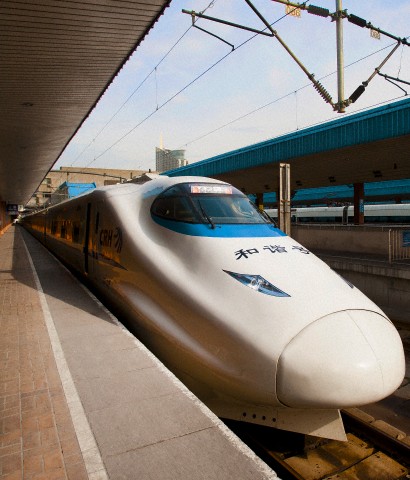
Engine of a Chinese high speed train parked at a railway station platform, Shanghai, China.  Image: Corbis

Engine of a Chinese high speed train parked at a railway station platform, Shanghai, China. Image: Corbis

Announcing specific completion timetables for infrastructure endeavors is a dicey business in China. If a project suffers setbacks and deadlines pass without completion, officials can lose their jobs. This reality makes it maddeningly difficult to guess with any accuracy when work on a given venture might actually conclude.

Such is the case with high-speed railways in Yunnan. Initial forecasts first made public six years ago anticipated at least two separate inter-city bullet train lines would be running in the province by 2015. That goal is apparently no longer feasible, but the head of the Kunming Railway Bureau (KRB) appears confident work will be completed less than two years from now.

Zhang Caichun (张才春), KRB party secretary, publicly declared both the Shanghai-Kunming (沪昆高铁) and Yunnan-Guangxi (云桂高铁) lines would be operational by the end of 2016. He made the comments October 30 while taking calls for the Mayor’s Hotline — a phone service established to make government officials more available to the public.

The Shanghai-Kunming High-Speed Railway will connect the now under-construction railway station in Chenggong to China’s most populous municipality. The dual track, passenger-only railway, will cover 2,066 kilometers and pass through the major cities of Hangzhou, Nanchang, Changsha and Guiyang. A full journey is projected to take eight to ten hours at cruising speeds of between 200 and 300 kilometers per hour.

Zhang’s comments confirmed reports regarding the Shanghai-Kunming line from last year. However, up until Thursday, no concrete schedule for the 754-kilometer Yunnan-Guangxi line had been announced. According to Zhang, that line — connecting Kunming to Nanning, and eventually Guangzhou — will be finished two years from now, at the same time as the Shanghai project. The Kunming terminus will be the existing Kunming Train Station, another detail left up in the air until Zhang began taking phone calls.

During his time speaking with the public, the railway chief also revealed details of what passengers can expect when boarding bullet trains in Yunnan. Some staff, according to Zhang, will be decked out in minority dress common to the areas through which the trains travel and dining cars will feature minority cuisine. On a more practical level, trains will all be equipped with wi-fi capability.

This article was originally posted on the GoKunming website by in News and published

1 Comment

Filed under China, Current Events, Economic development, SLIDER, Yunnan Province

8 Killed, 18 injured in Yunnan construction fracas

Police respond to the incident in Jinning County

According to local government sources, eight people were killed after a fight broke out between construction workers and villagers in Jinning County, located 60 km south of the provincial capital Kunming.

The county government reported the incident on its Sina Weibo account on October 15, a day after the fight occurred. According to sources, the incident happened at a construction site for the Jincheng Transasia Industrial Logistics Center in Fuyou Village. The fight broke out after a dispute over farm land used for the logistics center. Police reported that of the eight people killed, two were villagers and six were construction workers.

However, local villagers interviewed by Caixin said that the so-called construction workers were actually an unknown group of people. They reportedly attacked the villagers using knives and tear gas. The alleged attackders were clad in black and some carried shields that bore what looked to be police symbols. According to unconfirmed reports online, four of the unknown attackers were burned to death by the farmers. Police were called, but arrived after the fighting had stopped.

Disputes over land requisition are a common theme in rural China and Southeast Asia, as industry expands outside previous city borders and into traditional farm land. In China, most of the thousands of protests and riots that happen annually are linked with disputes over land requisition. Oftentimes, compensation given to rural villagers is also an issue, as has been documented by ExSE in its series on hydropower development on the Yalong River.

Leave a Comment

Filed under China, Current Events, Governance, SLIDER, Yunnan Province

Jinggu Earthquake – 1 dead, 324 injured in Yunnan; are hydropower dams in danger?

Earthquake damage in Jinggu County, Yunnan

A major earthquake has struck China’s Yunnan province for the second time in just over two months. Last night at 9:49pm (Beijing time), a 6.0-magnitude quake occurred in Jinggu County, Pu’er Prefecture. According to Xinhua News Agency, the current death toll stands at 1, with a further 324 people injured.

The epicenter of the quake was 22 km west-southwest from Weiyuan Township and it struck at a focal depth of 10.9 km beneath the surface. Luckily, the earthquake occurred in a sparsely populated area of the province, and there have a relatively few casualties as a result. However, according to local authorities, a total of 92,700 people were affected by the quake, with 56, 880 of them being relocated. Within hours of the earthquake,  thousands of search and rescue personnel had been transported to the county and were undertaking operations.

Aftershocks were felt in the area for hours after the initial quake, and the largest registered at 4.2 on the Richter scale. Tremors were also felt throughout the province, with friends of East by Southeast feeling the earthquake in Kunming, almost 400 km away from the epicenter.

Closer to the center of the earthquake are a number of major hydropower dams. According to ExSE’s research, a total of 10 hydropower stations are in a 200 km radius of Weiyuan Township, some of them high-wall dams with installed capacities of over 1000 MW. The closest is the 1,350 MW Dachaoshan Dam (大朝山大坝), located just 60 km from the earthquake’s epicenter and . Yayangshan Dam (崖羊山大坝), the first in a 1,300 MW, seven-dam cascade on Yunnan’s Black River (墨江) is 85 km away and  The third closest, the Nuozhadu Dam (糯扎渡大坝), is located 118 km from the earthquake’s epicenter.

Southwest China is a seismic hotbed where earthquakes are quite common and in the past 6 years alone, there have been a number of major earthquakes in the region. The Wenchuan Earthquake (2008) killed more than 70,00 people while more recently, earthquakes in Ya’an, Sichuan (2013) and Ludian, Yunnan (August 2014), killed 220 people and 617 people, respectively. At the same time, Southwest China’s mountainous geography and wealth of major rivers makes it ideal for hydropower development.

In the past 30 years, hundreds of dams have been built in the region, however their placement in a such a seismically active area is problematic. First, there is evidence to suggest that major hydropower dams can be a factor in seismic activity. In the aftermath of the 2008 Wechuan Earthquake, a number of scientists found that the placement of a dam and its large reservoir over an active fault line could have caused the quake. Secondly, dams and reservoirs can sustain major damage in the event of a large earthquake in its vicinity. Following the 8.0-magnitude  Wenchuan Earthquake, the Chinese Ministry of Water Resources found that 2,380 dams were damaged.

Yesterday’s quake was of a smaller magnitude than the Wenchuan Earthquake so the potential for damage is smaller and at the time of publication, there have not been any reports of any of the 10 dams in Jinggu County’s vicinity sustaining damage. However, ExSE will continue to cover the aftermath of the Jinggu Earthquake and the recovery and rescue efforts undertaken.

Leave a Comment

Filed under China, Current Events, SLIDER, Yunnan Province

The Red Line, Bottom Line, and Direction of State-Owned Enterprise Reform (translation)

China's president Xi Jinping discussing State-sector reform in December 2013.

China’s president Xi Jinping discussing State-sector reform in December 2013.

Translators note: This essay was first published in Qiushi’s online journal Red Flag in early June and then recirculated on various CCP and government websites/publications including the official CCP News website, SASAC website, and most recently SinoPec’s  official site.  Its analysis provides key insight into the both the nature of China’s coming state-owned enterprise reforms and challenges to launching reforms.  

The author, Zhu Jidong, first outlines that the reforms will not be a massive sell-off or a granting of private and foreign firms access to state assets as many pundits have suggested, but rather a reform that re-introduces corporatization and mixed-ownership structures to China’s state-owned firms.  The essay continues with a discussion of the connection between the importance of state-owned industries and the survival of the Chinese state and Communist Party.  It touches on the dangers and risks of reform going off in a wrong and misguided direction and hints that power currently is unevenly distributed in the state-owned sector and that managers of state-owned industries could continue to use their power to make arbitrary decisions, engage in corrupt practices, and take advantage of reform.  The author calls on the Party and governments from the central to local level to promote the supervisory powers of various societal sectors to ensure the coming reform process is fair and transparent.  He encourages Party commissions and local governments to set up hotlines using various forms of social media for observers and whistle-blowers within the state-sector to utilize in reporting malfeasance and corrupt practices that occur during the coming round of state-owned enterprise reform.

 The timing of this essay’s release is critical as state-owned enterprise reform should be a key issue discussed at the coming 4th Plenary Session of the 18th Party Congress this fall. To date this is the essay’s only known English language translation.


 The Red Line, Bottom Line, and Direction of State-Owned Enterprise Reform

Deepening state-owned enterprise reform is a major undertaking and is a major issue gaining attention and controversy around the future fate of the party and the state.  During the “two sessions” of 2014, General Secretary Xi Jinping stressed that state-owned enterprises cannot be undercut but rather must strengthen.  State-owned enterprises must absorb the experience and lessons of past reforms and state assets cannot turn into an opportunity for speculative profiteers amidst the wave of reform.  The underlying spirit of this essay is to further advance the definition of state-owned enterprise reform’s red line, identify the bottom line, and clarify its direction.

Drawing the red line: Speculative profiteering opportunities cannot be made in the name of State-owned enterprise reform

“Decision of the Central Committee of the Communist Party of China on Some Major Issues Concerning Comprehensively Deepening the Reform,“ the document produced during the CCP’s Third Plenary Session of the 18th Party Congress clearly states for the positive development of a mixed ownership economy.  There are those who advocate the position that the development of mixed ownership economies will serve as a big push to advance privatization, to permit more private and foreign enterprises to control the shares of state-owned enterprises while at the same time allowing state-owned enterprises to retreat away from competitive sectors.  This has created a certain mindset of confusion throughout society.  Looking back at more than 30 years of Reform and Opening, the loss of state assets during the process of state-owned enterprise reform has been a controversial topic which triggered many problems.

Some people say that the purpose of reform is to sell state-owned enterprises, as if success is only delivered through wholesale sell-offs and the price of the efforts of privatization is the laying off of large quantities of employees. A sentiment exists that not only can state employees not share fruits of this kind of reform, but they also serve as the sacrifices of reform; further the state must shoulder the welfare burden of this heavy issue.  Correspondingly a minority state-owned enterprise upper management who once carried the torch of reform have become billionaires.  Now there are even those who advocate “To mix is to sell, if you don’t sell you can’t mix.” If the name of reform is to forcibly make state-owned enterprises sell off rights and assets to private and foreign enterprises, then state-owned enterprises are not strengthened, rather they are weakened..

Developing a mixed ownership economy calls for open and transparent principles. Some people stress that the process of developing mixed ownership is to allow private enterprises to participate in the affairs of state-owned enterprises.  But if upper management of some state-owned enterprises take up this slogan and combine it with the efforts of private managers, then the possibility of “state assets becoming opportunities for private exploitation in the wave of reform” will arise. The crux of reform is openness and transparency and it is a reform to be carried out under the supervision of the masses.

The basic policy of developing a mixed ownership economy is already clear and its essence, as well as its success and failure, is in the details of regulation.  It is imperative for the transfer of state ownership and assets to be an open and transparent process.  Financial assets should be made known to exchange markets.  Transfers should be public knowledge.  State-owned enterprises should engage in open, fair, and just exchange.  The state should establish an institution with the sole purpose of managing, supervising, and quickly establishing a platform for the transfer of state ownership and assets and mandate all state-owned enterprises regardless of reputation to openly, fairly, and justly execute the transfer of state assets.  The private transfer or third party management of the transfer of state assets is impermissible. At the same time, this platform must be built to be as transparent as a glass window in order to put a stop to end all under the table dealings.

In order to develop mixed ownership economies it is necessary to guard against foreign capital controlling the pulse of the Chinese economy.  In accounting for the livelihood of the Chinese people, China’s state-owned industries not are not only the key sector for economic stabilization and boosting the economy, but these firms also bear the load of fending off the control of International monopolistic capital controlled by multinational corporations.  They take on the heavy task of protecting the security of the national economy, and because of this, frequently are a target in the eyes of Western countries and multinational corporations.  If foreign capital and foreign firms are to enter the reform of the state sector, we must first consider the question of the security of the economy and the security of the entire country.  Otherwise after foreign capital and foreign firms enter this sector, it is possible they will spy on the state sector’s confidential policies and strategic decisions.  One can easily imagine that this will influence the security of China’s economy.

A 2006 report issued by the State Council’s Development Research Center expressed that among industries already open to foreign capital investment, each of the top five firms in those industries were nearly completely under the control of foreign capital.  Particularly among twenty-eight major industries, foreign capital exploits the controlling rights to multiple forms of assets of twenty-one industries.  It can be said that foreign capital controls these twenty-one industries.  Today this data should be even more shocking.  Because of this, we must guard against foreign capital from taking advantage of mixed ownership economies to control the lifeline of the Chinese economy and threaten China’s economic stability.   We must take strict precautions against foreign capital from seizing the opportunities of national defense, railways, energy resources, telecommunication, public industries, and those that are associated with national security and major industries associated with the economic pulse of the state and people.

The development of mixed economies needs to allow for the participation and supervision by the masses.  We must appeal for the positive activation of the masses to supervise the whole process of the development of mixed ownership economies and absolutely cannot allow for the invaders to embezzle from and take advantage of state industries.  The party committees and governments at the central and local levels have all installed hotlines, mailboxes, and websites and are positively ready to receive reports on neglect, malfeasance, and corrupt activities associated with state enterprise reform. We will positively investigate and make public the clues reported by the masses pertaining to the loss of state assets.  Toward the actions and behavior of those who embezzle state assets, we will investigate resolutely and severely punish. Through dissecting case studies involving the loss of state assets, we will establish and strengthen the institutions to protect state assets and the benefits of workers during the process of state sector reform.

In the development of mixed ownership economies, we must prevent the torchbearers of this reform from carving up state assets for their own purpose.  The selling of shares to managerial levels and to employees is a topic that will attract much attention during this round of state-owned enterprise reform.  Some locals are already implementing models for share distribution, so this direction has already been established. State assets are legal assets owned by the people of the socialist state of China, and the spirit of state assets cannot be violated. No one has the right to turn these assets into the private assets regardless if they are at the managerial level or a common employee.  Importantly the leaders and employees of state-owned enterprises cannot grant distribution of shares to themselves or transfer all of the people’s assets into private assets.  To permit or even encourage employees and managerial levels to hold shares or to institute models for the holding of shares is a means to permit these people to buy enterprise shares using their own money –  not to carve up state assets for their own usage.

Identifying the bottom line: State enterprise not only cannot weaken, but it must strengthen

In the Communist Manifesto, Marx and Engels pointed out that: “The question of ownership is the fundamental issue of the movement.” The common means of production is the economic base of the socialist system and state-owned enterprises are the principal part and pillar of the common means of production.  The Constitution of the People’s Republic of China clearly stipulates common ownership economy is the guiding power of the economy of the Chinese people and the state.  The state must guarantee the strengthening and development of the state economy.  The development of a strong state economy is assured by the state economy’s controlling the economic lifeline of the people and the state.  In order to express the superior characteristics of the socialist system as well as provide national defense and social cohesion, it is critically important to strengthen the power of China’s economy.

Through controlling the economic lifeline of the people and the state, the state-owned economy can keep the entire national economy running and serve as the engine of development.  The state-owned economy is the effective means for macro-economic adjustment, adjusting market inefficiencies and for realizing the prerequisite conditions of national strategic planning.  Because of this CCP General Party Secretary Xi Jinping has emphasized, “State owned enterprises not only must not weaken, but they must strengthen.” Regardless of the manner of reform, we cannot go beneath this bottom line, otherwise we will end up on the wrong road.
Even after if the many years of privatization and liberalization in Europe, the state owned economies of many countries in many still occupy dominant positions in key sectors and state-owned enterprise investment takes up approximately 20% of total national investment.  For example, state-owned enterprise investment is more than 27% in France.  Moreover the French national government owns more than fifty-one enterprises and employs 838,000 people.  The income of these enterprises contributes approximately 15% of France’s GDP ranking sixth in Europe.  Norway’s government owns forty-six firms which employ 230,000 and contribute about 9.4% of national employment, levels these firms’ incomes comprised nearly 70% of Norway’s 2008 GDP, an increase of 10% from 2004.  Although post-Soviet economies went through a spurt of privatization, by and large, the state-owned sector of many powerful former Soviet states is extremely large.  Russia’s state-owned fixed assets account for 40% of total state assets and state-owned enterprises control nearly 50% of the economy, and state-owned enterprises account for 31% of total employment.  Moreover, the state owned economy comprises more than 70% in Belarus.  Perhaps this is the reason why Russia and Belarus have the confidence to not fear the West and even dare to stand up to Western hegemony.

A few foreign friends have also provided advice for the reform of China’s state-owned economy. On February 15, 2012, German Prime Minister Schmidt reminded China in an interview that the question of ownership reform is one of hundreds of trillions of RMB. Currently most state enterprises are monopolistic and relate to state security.  These firms should develop in the interest of long-term stability and are not for the purpose of profit-seeking as top priority.  The profits of state-owned enterprises are the profits of the people; if these state-owned enterprises privatize, they will not necessarily become more competitive, and they will not necessarily provide more benefit.  Schmidt used the railway system as a case in point: some of China’s western railways are seriously bearing too much weight and collecting too little in fees.  If the railway firms privatize, these railways might halt transportation or raise their price.  This will bring major (negative) impacts to the development of the country’s interior.  If foreign friends can clearly see the danger, should their words fall on deaf ears?

China’s 2012 GDP was 51.9322 trillion RMB and per capita income 38,354 RMB.   This is already higher than 6000 USD.  This makes China the world’s second largest economy.  Moreover the rapid development of China’s state-owned economy was the major guarantor of China’s reaching the rank of the world’s second largest economy.  It is also the major motivational fountainhead of China’s economic development.  The CCP’s “Decision of the Central Committee of the Communist Party of China on Some Major Issues Concerning Comprehensively Deepening the Reform” calls for the transitioning of a portion of state-owned capital to enrich social welfare funds, improve the budgetary system of state capital operations, improve the rate of contribution of state-owned enterprises to public finance.  The decision sets the goal of 30% contribution to public finance by 2020 in order to guarantee welfare benefits for the people.  Further, this reveals how state capital relates to all people, and it is only through the strengthening of enterprise that the broad masses can enjoy the benefits of state capital.

Let me ask, can the state enrich social welfare funding through foreign capital and private capital?  Can foreign capital and private capital act without conditions, not seek return on investment, invest in the infrastructure of impoverished areas or fend off earthquake, floods, and other natural disasters? The answer is obviously no.  Because of this, if China is to strengthen and is to allow the people to better enjoy the fruits of reform and development, it must demonstrate the guiding function of the state-owned economy, continuously increase the state economy’s vitality, controlling capabilities, and influence, and make this bottom line clear to the world.

Many people think of the selling off of state production rights and assets when they hear of mixed ownership economies and envision the single possibility of private enterprises and foreign enterprises entering into state-owned enterprises.  Actually the development of mixed ownership in no way should be or is a one-way concept.  Moreover, the development of mixed ownership is two-directional and even multi-directional.  Private and foreign enterprises can enter the state owned sector by purchasing production rights and assets, and state-owned enterprises can also purchase the production rights and assets of private and foreign enterprises and even control the shares of some private and foreign enterprises.  This is the true meaning of mixed ownership economy.

If the development of a mixed ownership economy means only the selling-off of state production rights and assets then the obvious result is the weakening of state-owned enterprises and not their strengthening. Because of this we certainly need to clarify that the development of a mixed ownership economy is not for the purpose of weakening state-owned enterprises and surely is not to privatize.  We need to promote dual directional and multi-directional mixed ownership structures of state-owned enterprises, private enterprise, and foreign enterprise and not simply sell off the production rights and assets of state-owned enterprises to private and foreign enterprises.

Setting the Course: Continuously strengthen the vitality, controlling abilities, and influence of the state economy

In order to promote national modernization, guarantee power the mutual benefit of the people, the continuous development and strengthening of state-owned enterprises is the major force that supports the rise of the Chinese economy. It is also the guarantor of the endurance, strength, and perfection of the party leadership.  “To continuously strengthen the vitality, controlling abilities, and influence of state-owned economy” is the direction set forward for reform in the state sector by the CCP’s 18th Party Congress.

State-owned enterprises should take steps of self-improvement and like a phoenix rising from the ashes take on social responsibilities, establish a proper image, and increase the degree of promoting the processes of reform.  This requires us take a serious look at  the existing challenges to the current development of state-owned enterprises and persevere to strengthen and perfect the party leadership and realistically strengthen the positive characteristics which promote the working class as masters of society.  We should take action in accepting the supervision of multiple levels of society, severely punish graft and corruption, and in the deepening of state-owned enterprise reform promote the continuous improvement of modern enterprise system.

At the high strategic level we must prioritize and continuously strengthen the vitality, controlling abilities, and influence of state-owned industries. As the corporatization of state owned industries attracts strategic investors and key groups, state owned property rights are diversified, and the vitality, controlling abilities, and influence of the state economy continuously strengthens.  But at the same time we can see that the existing problems within state-owned industries are many.  The salary differences in some state-owned enterprises are comparatively large even to the point of great disparity. Disparities exist in the execution of corporate social responsibility programs within some state owned enterprises.  The management method of some state-owned enterprises is careless and accidents have occurred, some state-owned enterprises’ modern enterprise systems are just for show or have large degrees of patrimony.  Some leaders of state-owned enterprises make arbitrary decisions, their lives are extravagant and degenerate, they practice nepotism, and even will sell off state interests for their own personal benefit.

These issues not only influence the initiative of employees, but also damage the vitality, controlling capabilities, and influence of the state-owned economy.  The report of the 18th Party Congress calls to stimulate new energies in various market sectors and calls for all state-owned enterprises to adopt a specific and realistic focus. Thus the increase, stimulation, and demonstration of these new energies is a major challenge that all state-owned enterprises and their leaders must face directly, and this challenge must be highly respected at the strategic levels.  The issue of how to continuously reform and increase the state-owned economy’s vitality, controlling capabilities, and influence is for the relevant departments, work units, and experts located within the Central level’s  Leading Groups on Comprehensive Deepening of Reform to deepen research and determine the right path, polices, and regulations.

We must clearly see that from the distribution of industries, to date 90% of state-owned enterprise are outside the realm of competitiveness.  A slogan such as “Allow state-owned enterprises to leave the realm of competitiveness” is a covert argument of those who support privatization, and the basic motive of those who support privatization of state enterprises is to destroy our party’s economic base.  We must prioritize at a high degree how to scientifically develop a mixed ownership system while preventing new losses of state assets and guard against people from taking advantage of state assets in a new round of privatization.  To develop mixed ownership economies, we should select a portion of firms within a portion of industries as demonstration sites and expand the scale of development after summarizing experience and learning.  We must act accordingly to the path, policies, and regulations set by the central government in order to orderly develop mixed economies and prevent a mad rush.

We must persevere to strengthen and perfect the party leadership of state-owned enterprise reform.  General Party Secretary Xi Jinping has stressed many times “China is a major power, and we absolutely cannot allow any subversive errors.” What are subversive errors?  It is those errors of directionality which depart from the fundamental characteristics of socialism. And it is on this point that the 3rd Plenary of the 18th Party Congress stresses that comprehensive deepening of reform must strengthen and perfect party leadership.  Serving as the resolute leadership core of China’s socialist cause, the CCP naturally also forms the leadership core of China’s economic construction and serves as the leadership core of state-owned enterprise reform.

During the coming reform of the state-owned sector, we must demonstrate the offensive and defensive functions of party organs and the vanguard and model nature of party members.  Further we must dare to shoulder responsibility and resolutely confront all erroneous words and deeds.  It is only through perseverance in strengthening and perfecting the party leadership that the existing degeneration, extravagant waste, and nepotism within state-owned enterprises can be solved. We must unite and lead the masses the struggle against the activities of those who would embezzle state assets in order to maintain the right direction of state-owned enterprise reform. The nature of mixed ownership economies is decided by who controls shares. This is the central issue. The Central government should not give up shareholding rights in the name of state-owned enterprise reform.  Moreover, the Central government cannot change the characteristics of strategic enterprises.  This is what is meant by persevering to strengthen and perfect the party leadership as a strong base and powerful safeguard.

We must strengthen the master status of the working class.  Strengthening the master status of the working class is to continuously strengthen the vitality, controlling abilities, and influence of the state-owned economy’s solid base.  The working class is China’s leading class.  It is the representative of China’s advanced production force and production relationship.  It is our party’s most solid and most reliable class base and the comprehensive construct of a moderately prosperous society.  Lastly, the working class is the main force of upholding and developing socialism with Chinese characteristics.  To uphold and develop socialism with Chinese characteristics, we must rely on the working class with our whole hearts and whole minds and strengthen the master status of the working class to realize the full function of the working class as a main force.

In recent years the issue of corruption has arisen within state-owned enterprises and within some industries to the point of extreme severity. A contributing factor to this corruption is that the master status of the working class is wrongly viewed.  Some leaders and cadres within state-owned enterprises do not take supervision by the working class and the interest of workers to heart, and for their own personal benefit, these leaders will sacrifice the interests of workers and the state.  Relevant documents have expressed that the gap between actual average salaries of leaders of centrally owned enterprises to their employees is exponentially widening.  This has raised questions and criticisms in some enterprises.  When developing the mixed-ownership structure, state-owned enterprises should consider the raising of employee’s salaries.  Actually many centrally owned enterprises achieved rapid improvement and synergy in increasing industrial efficiency and employee’s salaries when shifting to mixed ownership.

Chen Jieyuan, Party Secretary and Board Chairman of the Shanghai Port Group LLC said, “In recent years, The Shanghai Port Group, through has experience the sweet taste of mixed ownership.  From 2006 when we fully listed on the market, our net assets have doubled, profits have basically doubled, and employees’ incomes have doubled.  These three “doubles” mark the direction in which state-owned enterprise reform should persevere especially in the process of developing mixed ownership, priority should be placed on promoting the distribution of shares to employees, establish a modern enterprise system, and fully raise income of employees.

The data shows that in 2010 the average income of an employee in a state-owned enterprise was 38359 RMB, 5% higher than the national average.  The average income of an employee in a private enterprise was 20759 RMB, 43% lower than the national average.  It is obvious which kind of enterprise serves as a better model for increasing the incomes of workers.  Because of this, the only way to strengthen the master status of the working class is to continuously increase the income levels of employees in the private sector, not the other way around.  Relevant organs at the central level should come up with a proposal for the distribution of shares to employees based on rigorous surveying and research and make this a major breakthrough point for feasibly strengthening the master status of the working class.

We must require state-owned enterprises to accept supervision from many levels of society.  This is the major guarantor for the continuous strengthening of the vitality, controlling ability, and influence of state-owned enterprises. We must open various channels of supervision, promote and accept the supervision of the masses, and accept and participate in supervision of the process of mixed ownership reform.  We must also draw from the concepts and management experience of private enterprises and foreign enterprises. Party committees at the central and local levels and governments should set up whistle-blower hotlines, mailboxes, and websites and accept reporting from all levels of society on malfeasance, dereliction of duty, and corruption during the process of state-enterprise reform. Concerning state-owned enterprise reform these committees should take advice and suggestions from various societal levels, and make use of the body of people’s wisdom and power to make good on state-enterprise reform.

Especially with the rapid development of the internet, online news, Weibo, Wechat, forums, blogs, podcasts, these broadcast formats provide the best arena and platform for the people to supervise government and fight corruption in an ever-strengthening manner.  Relevant organs should organically integrate educational experiences from the mass party line and pure and clean frameworks into the reform of state-owned enterprises.  These organs should positively involve the participation of the masses, make progress in using the internet, and widen and open to the masses channels for reporting corrupt practices.  Anti-corruption departments must especially focus on clues related to the loss of state assets which are revealed through reporting from the internet, and encourage and direct the masses to report on the egregious ways and issues of corruption through legal methods.  Those who would attempt to transfer state assets into personal exploits should be called out and swatted like mice crossing the street. This is the way to uphold the core status of common ownership.

About the author:  Zhu Jidong is a researcher at the Qinghua University Research Center for College Moral Education.  Holds a post-doctorate in Marxism Theory, is Head of China Academy of Science World Socialism Research Center and General Secretary of National Cultural-Security and Ideology Research Center.

Leave a Comment

Filed under China, Current Events, Economic development, Energy, Governance, SLIDER

China forbids some rice imports from Vietnam

Roger Hamilton via The Baltimore Sun

Roger Hamilton via The Baltimore Sun

Beijing has banned what trade authorities are calling “unofficial rice imports” from neighboring Vietnam. The move, ostensibly announced as closing a previously existing tax loophole, appears to be specifically targeted at Hanoi and does not affect other Southeast Asian countries sharing a border with China.

The prohibition specifically addresses the overland, cross-border traffic of rice into Guangxi Zhuang Autonomous Region and Yunnan province, both of which share lengthy southern borders with Vietnam. These shipments are often brokered and carried out by individual Chinese brokers who often skirt paying national import levies, according to Vietnamese press reports.

By centralizing bulk purchases of rice, Beijing could stand to generate substantial tax revenues.Two million tons of Vietnamese rice worth an estimated US$800 million were expected to imported through unofficial channels this year before the proscription went into affect. This number represents more than 30 percent of Vietnam’s total worldwide rice exports from 2013.

Although billed as a tax collecting endeavor, the Chinese ban has obvious political undertones. Once-strong ties between the two countries have been markedly strained since the deployment of a Chinese oil platform in international waters sparked deadly anti-China riots in Vietnam this summer. Although the oil rig has since been removed, relations have not thawed and the rice import ban may be a way for Beijing to subtly punish Hanoi.

China, which has announced it is attempting to expand its rice import portfolio, announced on Tuesday an agreement to buy 100,000 metric tons of rice from Cambodia. The contract, which went into affect immediately, states the rice must be purchased over the next year. A Cambodian businessman involved in the deal, surnamed Van, told the Phnom Penh Post that Vietnam’s loss was Cambodia’s gain:

The South China Sea dispute lately may have also played [an indirect] part in China wanting to diversify its rice import base as imports from Vietnam hit a substantial figure. China [received] over 66 percent of its total rice imports from Vietnam in 2013, while only one percent came from Cambodia.

For its part, Vietnam appears nonplussed by the import ban. Sales of rice to other countries such as Indonesia, Malaysia and the Philippines are expected to rise and make up for any money lost because of the new Chinese law. The situation, in some people’s eyes, might actually benefit the county’s agricultural market. According to Huynh The Nang, general director Vietnamese company Vinafood 2, “The demand from countries other than China for Vietnam’s rice is very high now, while the domestic supply is declining.”

This article written was by Patrick Scally and first published 8/13 here on the GoKunming website.

Leave a Comment

Filed under Agriculture, China, Current Events, Economic development, Regional Relations, SLIDER, Vietnam

Understanding China’s housing reforms

hukou


Xinhua News Agency reported in late July on the government’s planned hukou reforms, which will begin by facilitating the urban settlement of roughly 100 million people who do not hold urban IDs and which will ultimately lead to the elimination of discrete registration systems for urban and rural residents.

The hukou (huji or ‘household register’) system is about 4000 years old. Early in its inception it became an instrument for tax collection and by the 7th century BCE administrators in present-day Shandong were levying different regions according to different standards. The present system serves to maintain census data and severely limit migration into urban areas, making it analogous to the North Korean hoju or former Soviet propiska systems and earning it criticism as China’s apartheid by BBC News, The Independent and South Africa’s The Star.

Citizens currently registered in rural areas must follow a tortuous bureaucratic path in order to qualify for non-agricultural work and unless they successfully do, they will not receive the same educational or medical benefits as their city-dwelling compatriots. Government officials have defended the system by citing the need for stability but some, like Tim Luard of BBC News (here), have suggested the restriction of urbanization preserves a rural population in order to furnish state enterprises with low-wage workers.

Jasper Becker, former Beijing bureau chief of Hong Kong’s South China Morning Post, has written an engrossing account of the Great Chinese Famine entitled Hungry Ghosts: Mao’s Secret Famine in which he describes how local administrators, eager to impress, oversold the output of their districts. Corresponding taxes claimed the bulk of food production in many rural communes and, as a result, holding a rural hukou became a death sentence for millions even while urban residents dined well.

But officials remain wary of reforms that may trigger massive nationwide urbanization, leading to spikes in urban crime and stressing the limits of municipal resources and social services. So while the government works to improve the system, it does so with deliberate speed. Rural residents were given the right to work in urban centers years ago by purchasing temporary urban visas and Beijing has now announced plans to allow the movement of 100 million workers, roughly half the total number of illegal residents.

Major cities like Shanghai will retain tighter controls whereas urban districts with less than three million people will become easier for rural resident to move into, thus encouraging growth in mid-sized cities while protecting larger ones from overpopulation. The government’s stated long-term hope is the standardization of the nation’s system by 2020, allowing rural and urban residents to enjoy the same benefits and opportunities.

Leave a Comment

Filed under China, Current Events, Economic development, Governance, SLIDER, Yunnan Province

The Coming Downturn of China-Vietnam Trade Relations

IMG_1040small

I recently had a conversation with a high ranking officer in Vietnam’s Ministry of Industry and Trade whose work responsibilities include promoting and facilitating border trade and investment between Vietnam and China.  We have been meeting for years and despite past flareups in the South China Seas and the occasional anti-China rally in Hanoi, he has always expressed optimism toward the future of the China-Vietnam relationship. He has believed that cooler heads will always prevail at the upper levels of government and that the increasing flows in border trade and investment overland between China and Vietnam do much to alleviate the tensions brewing on the seas.  But in my recent meeting, the officer expressed a 180 degree interpretation of the future of trade relations between China and Vietnam.  He fears that as a result of China’s aggressive movements in the South China Sea, the two countries will soon adopt isolationist and protective trade policies toward each other, and the goodwill provided by decades of border trade and shared investment projects will soon become undone. Continue reading →

2 Comments

Filed under China, Current Events, Economic development, Energy, Regional Relations, SLIDER, South China Seas, USA, Vietnam