Category Archives: Current Events

China’s Upscaling of Potato Production Sprouts Controversy


Farmers in China's Gansu province show off increases in potato yields

Farmers in China’s Gansu province show off increases in potato yields

The Chinese Ministry of Agriculture started the year with an awkwardly named but nevertheless resonating event: at the “Potato Staple-ization Strategy Research Symposium” Vice-minister of Agriculture Yu Xinrong proclaimed that potatoess shall become China’s fourth staple food.  That netizens tweeted more than half a million responses on Sina Weibo about this denotes more than sheer curiosity. While many of the conversations focused on a perceived Chinese consumers’ tardiness in getting on the Columbian Exchange bandwagon, the announcement could have an impact throughout the country and affect the ethnic minority regions and the Southwest in particular.

Historically speaking, potatoes, an American contribution to the world’s food basket, quickly became a mainstay on the tables through most of the Old World, despite initial trepidation among the Europeans.  Research suggests they might have contributed extra nutrition and thus the population boom that brought about the Industrial Revolution. The Irish Famine ensued, and the rest of history is laced with potato jokes.

Spud Stigma

In China, however, spuds have largely remained within the category of dishes (菜) rather than the staple source of carbohydrates and thus energy of the meal (主食). Unlike the other new comer, corn, which has successfully shed its foreign flair, the name Western taro (洋芋) has stuck with taters and is further strengthened by deep-fried potatoes served up by fast food industry that positions it as a Westernized modern food choice. The association of potatoes with foreignness has also been brought to the New World by immigrants, and in a subaltern twist the term potato queen is used to describe Asian gay men that prefer non-Asian partners.

Besides foreigners, the other factor that gives spuds a bad name is poverty. An unnamed researcher has been widely cited saying that potatoes are the staple food for 75% of China’s officially poor counties, where potatoes are consumed “instead of cereals” up to half of the year. What’s more– a lot of that poverty is concentrated in ethnic minority areas: the backward denizens of supposedly sad places like Yunnan, Guizhou, and Gansu rely on spuds to scrape out a living.

The reverse side of the perceived unfortunate overlap between ethnicity, poverty, and potatoes is something that a southern Yunnanese acquaintance imparted over lunch the other day: spuds are grown for oneself. Adapted for a wide variety of ecological conditions and productive even in poor soils and under other unfavorable circumstances, potatoes provide easy and reliable sustenance. More importantly, in the words of anthropologist James Scott, potatoes can be “appropriation-free”: bulky, low in commercial value, and harvested intermittently, potatoes like other tubers are a good way of keeping the tax-collectors and their ilk at bay. It is no coincidence that potatoes are so prevalent in refuge zones as different as Guyuan in southern Ningxia and the balmy mountain slopes of Yunnan and Guangxi.

Cumbersome taters

While direct requisition of crops is not much of a concern for farmers today, especially since the abolishing of farming taxes in 2006, potatoes are nevertheless strongly affected by farming policies and national food security strategies. For justifiable historic reasons the Chinese government, which is linked to some of history’s worst natural and man-made famines and related unrest, at all levels is extremely concerned with ensuring availability of food. With national grain self-sufficiency as the core principle, the central government has consistently demanded and incentivized production of staple crops through a mix of administrative mandate to grow certain crops, direct subsidies to house-holders and larger producers, and intervention pricing. While intervention purchases and stockpiling has been extended to the somewhat-ridiculed strategic swine reserve, it still mostly focuses on grains and shuns spuds because of the difficulty of appropriation.

Unlike bacon, you can’t just put some taters on ice for a few years, or depending on the situation either cellar the spuds for a good while or alternatively sell at a commodities exchange in Chicago if the price is right. Potatoes don’t keep well and the bulk makes them a lousy commodity for shipping. Despite globally being the fourth most significant staple (hence the frequent misstatement in the press that somehow the UN has declared potatoes as one of the global four staples), the governmental preference for a government-focused national-level food security rather than rural household level food-sufficiency has led to spuds falling behind in output growth. However, food security (what the Chinese government calls 粮食安全, not to be confused with food safety – 食品安全) is primarily concerned with the provision of food at the national level through market mechanisms rather than household self-provision. In other words, there is no tater scarcity at the household level, where those who choose to grow them can have their fill, but that does not result in peaceful minds behind the planners’ desks.

It is not to say that potatoes are some sort of primeval anarchist food taking on the capitalist-with-Chinese-peculiarities hegemony. For one, local governments have been as quick as ever to get their paws in the potato pot and are pushing potatoes as one of the options for farming development. According to the National Statistics Bureau, between 2006 and 2012, total potato output increased by about 40%. That’s a solid increase of over more than 5% a year, albeit rather low when compared with the expansion of many other indicators over the same time period. According to the UN Food and Agriculture Organization, China is the world’s largest producer of potatoes. Mind you, the FAO estimate for 2006 exceeds the Chinese central government’s estimates 5-fold, so go figure on who’s right.

It would also be a mistake to say that there is much pride in the importance in the potato in the regions where potatoes are important to the diet. During a recent month-long research stay with various rural households in Ningxia, I heard several apologies for offering too many potatoes and not enough rice to the guest. My insistence that, having grown up on a Latvian potato farm, I gladly take spuds over rice any time was accepted with a polite smile and puzzlement over the impossibility of such a statement. The shame of living off potatoes even by those who grow them is an obvious obstacle in increasing the demand for fresh potatoes and possibly even derived dry goods.

Technical solutions

The drive to (let’s borrow a word from the Ministry of Foreign Affairs’ repertoire) hype spuds encounters the simplest of economic realities: if there was demand for potatoes the farmers would meet it despite regulations slanted against it. After all, regulations have not stopped urbanization and the emergence of a secondary market for theoretically untradeable farmland. And if indeed the potatoes were so good for you as some have suggested, the market would have overcome the consumer acceptance obstacles described earlier and we would be eating spuds left and right.

The Ministry of Agriculture’s decision to “staple-fy” spuds should be interpreted as increased pressure to expand potato production – the stated goal is to almost double the current reported plantations of 80 million mu to 150 million mu. That’s increase of almost half a million hectares. New investment in growing technologies and varieties will be made available, which has predictably caused knee-jerk concerns about potential weakly regulated experiments with genetic modification. It also means a push towards more industrially processed and thus durable potato products, particularly using potato starch that, unsurprisingly, transforms the crop into long shelf-life products favored by retail supply chain managers and government food provision planners alike. To celebrate the new national potato staple-ization strategy, Shanxi potato entrepreneur Feng Xiaoyan, who goes by @sisterpotato on Sina Weibo, has launched a product line of potato mooncakes.

And while you praise the crackdown on superfluous gifts and thus a reduced (albeit not eliminated) chance of getting your next year’s Mid-Autumn bonus in the form of candied fork floss covered potato starch mooncakes, the good folks in China’s agricultural research and development industry are getting ready to partake in the expected windfall in research funding and new experiments. Local government officials and their cousins who own the farming companies are looking forward to filling their coffers with infrastructure programs and potential subsidies.

A curious and unfortunate potential side-effect of expanded cultivation is the replacement of existing technologies and varieties with improved yields with the accompanying other side of the coin– disappearance of existing livelihoods and genetic as well as cultural diversity. While the farmers of hilly dry parts of Yunnan will not be marching down the streets of Kunming against Monsanto (in fact, poor Monsanto is unlikely to be able to stick its finger in this pie), the fact remains that intensifying farming can leave the growers and the rest of us with fewer resources for when the bad times of crop failure, pests, or climate change hit.

Interestingly, this year’s Central Government Document Number 1, the annual proclamation of rural and development priorities, did not address potatoes and did not call for any expansion of the staple policies to include new crops. The State Council might not be as excited about spuds as Ministry of Agriculture is. Just like many issues, this one will be decided in the well-ventilated halls of newly built governmental districts with limited direct public input. Regardless though of whether one roots for the spud or takes a more tater-phobic stance, the potato staple-ization controversy has stirred minds and brought to dinner table conversation some of the fundamental issues at play in Chinese agriculture, particularly in the economically marginal regions.

1 Comment

Filed under Agriculture, China, Current Events, Economic development, Food, SLIDER, Sustainability and Resource Management, Yunnan Province

Oil pipeline connects Kunming to Andaman Sea

pipline map

Map of Sino-Burmese oil and natural gas pipeline. (Image via Stratfor)


A 771-kilometer long oil pipeline linking refineries in Kunming to oil fields off the western coast of Myanmar began shipments over the weekend. Built over six years, at a cost of 9.37 billion yuan (US$1.5 billion), the project was marred by controversy in China and, at times, violence and threatened cancellation in Myanmar.

An opening ceremony held in the Burmese city of Yangon on January 29 marked activation of the above-ground crude pipeline. It travels from the Andaman port of Kyaukpyu, through the Chinese border town of Ruili and on to Anning just west of Kunming. The inauguration was attended by Liao Yongyuan, general manager of China National Petroleum Company (CNPC), and U Nyan Tun, vice president of Myanmar, according to a report by website The Nation.

The pipeline is jointly owned by Myanmar Oil and Gas Enterprise and CNPC, with the latter controlling a majority stake of 50.9 percent after having financed most of the construction process. When operating at full capacity, the pipeline is designed to transport 22 million tons of crude oil into China each year, a total nearly double that reported when work on the energy conduit first broke ground in 2009.

Named after seabed fossil fuel deposits off the Myanmar coast, the Shwe pipeline runs parallel with a similar natural gas conduit that went online in 2013. First proposed in 2004, the twin pipelines were conceived in China as a way to bypass oceangoing tanker shipments of crude oil and natural gas from not only Myanmar, but also the Middle East and Africa.

Now that both pipelines are open for business, Southwest China will receive fossil fuels from countries to its west much more directly. Sea-bound shipments not only take significantly longer than those through the pipeline, but must also pass through the nominally United States-controlled Strait of Malacca — one of the busiest ocean shipping lanes in the world.

As with many Sino-Burmese infrastructure projects, the twin Shwe pipelines were not guaranteed to ever be finished. Construction was nearly halted in 2012 when Burmese parliamentarians threatened to mothball the project over environmental concerns, reported labor strife and claims of forced village relocations. On the Chinese side, well-publicized Kunming rallies against a refinery-related petrochemical factory also brought the future of the pipeline into question, at least momentarily.

This article was written by  and originally published in GoKunming.

Leave a Comment

Filed under China, Current Events, Energy, Myanmar/Burma, SLIDER, Yunnan Province

A Tibetan Christmas in Yunnan

Brendan 1

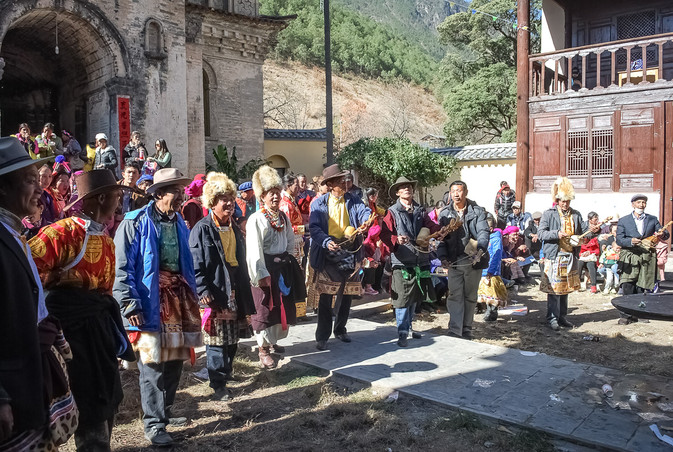
Nestled on the banks of the Upper Mekong River — or Lancang (澜沧江) as it is known in China — are several Tibetan villages of mixed religion where Buddhist and Catholic families live together and often join in each other’s festivals. While engaged in research on the history and budding economy of winemaking in this region, I was able to take part in the annual Christmas mass and festival in the village of Cizhong (茨中). Here, celebrations are a two-day event and the largest festival of the year for the area.

First, a very short primer on the history of Catholicism in Yunnan’s northwest, and how the religious observance of Christmas became a major festival for local Tibetans: Yunnan’s official renaming of the nearby Zhongdian region as Shangri-La — based on James Hilton’s classic 1930’s novel Lost Horizon — actually gains a small bit of credence as the real location of Hilton’s story thanks to Cizhong and its nearby villages. In the book, the fictional Shangri-la is a mixed monastic community where Tibetan Buddhists, Chinese, and western Catholics all live peacefully in together. This is largely true in Cizhong today, though Catholicism historically faced a somewhat violent reception from some in the region, while other peopele openly welcomed it. French Catholic missionaries first arrived in northwest Yunnan in the nineteenth century, and viewed their work as a gateway to expanding their teachings across greater Tibet.Brendan 2

Never being able to reach very far into this isolated and at times violent country — often due to resistance from local Buddhist lamas — the French would eventually manage to set up a community of churches and convert many Tibetan communities in northwest Yunnan along both the upper reaches of the Lancang and Nujiang rivers. They were never quite able to penetrate much farther into Tibet. Even in these areas, religious crusaders at times faced violent repression from local religions leaders and in many cases even death.

Yet the French persisted in their missions, and were later joined in the early to mid-twentieth century by request by a group of Swiss from the Great Saint Bernard Hospice high up in the Alps. These priests had already become quite famous for providing mountain rescues and services to Catholic pilgrims crossing the Alps en route to Rome. Their expertise in mountain travel and high-altitude living were crucial in helping to continue and eventually take over the work first begun by the French in Yunnan.

Today in Cizhong, where the original cathedral built by the French in 1905 still stands, about 80 percent of villagers still actively practice Catholicism. They are led by a Han Chinese priest from Inner Mongolia who arrived in 2008, sent by the Catholic Association of China. Prior to this time, the village had no priest, and so no formal masses were held after 1952 when the remaining French and Swiss Christians were expelled. Villagers nonetheless maintained their religion and began to openly pray together in the 1980s after Deng Xiaoping lifted bans on organized religion put in place during the Mao era.

Brendan 3

2014 Christmas observance

Christmas today in Cizhong is a major event, and the non-religious portions of the festival are in fact celebrated by both Catholics and Buddhists alike. Major preparations and community events for the festival began on the morning of Christmas Eve, when many villagers gathered together at the church to clean the building and decorate it for the festival. Lunch was made for those working through the afternoon, and then everyone returned home before dusk.

The decorations set up in the church were predominantly what one might equate with a Western Christmas celebration: Statues of Mary and Joseph in shrines on each side of the altar were surrounded by strings of lights, and a similar statue of Christ was placed high up on the wall behind the altar for all to see. Several plastic Christmas trees which grace the inside of the church year round were also cleaned and redecorated with Christmas lights.

Brendan 4

A very elaborate nativity scene was set up to one side of the altar, decorated with pine boughs, with lights on its roof. In addition to the boughs, the areas in the front of the church are also decorated with branches from a local broadleaf evergreen tree with red berries from the genus Photinia. Local elders say they have called this plant shengdan shu — or ‘Christmas Tree’ — since the time of the French and Swiss fathers.
Brendan 5

Around 7pm, villagers slowly began to arrive and file into the church for the evening mass, which began this year around 8:30. It should be noted that Christmas seems to have become quite a publicized event in Cizhong, perhaps due to the attention it receives in tourism materials. The mass not only included Cizhong villagers but many foreign — particularly French — and Chinese tourists, photographers, and other academics including myself. Christmas Eve mass continued for just under two hours, after which everyone returned home until the next morning. Both Christmas masses, and particularly the morning mass, were much more extravagant than a typical Sunday service. Large numbers of villagers showed up from all over, dressed in their full traditional Tibetan regalia. This drew even more tourists.

The Christmas morning mass — which actually didn’t begin until almost noon despite villagers arriving around 9am — also included a full processional composed of the priest and his assistants walking into the church in their robes, with candles, a cross, and incense censer. None of this is normally used for weekly services.The language of the mass in Cizhong is peculiar.  Many familar Catholic songs sung by villagers are sung in Tibetan using the translations originally created by the French and Swiss. Conversely, the mass and bible readings themselves are conducted by the priest in Mandarin Chinese, so the service is quite syncretic and eclectic being Chinese with Tibetan chanting.

Later an engaged couple walked down the aisle to receive a special Christmas blessing from the father. They were followed by a procession of children in traditional Tibetan clothing and Santa hats, followed by traditionally dressed women bearing gifts for Christ. The priest and his village assistants accepted the gifts and then placed them in front of the nativity scene that had been set up below and to the side of the altar.

brendan 9

The Afterparty

Following the Christmas morning mass, everyone — villagers, tourists, and anyone else in attendance — gathered in the courtyard in front of the church and began the afternoon festivities of drinking and performing traditional Tibetan dances and sings. During this portion of the day, Buddhist locals also arrived to join in the festivities.

To begin, everyone first simply found a spot in the courtyard to enjoy the sun, the company of others and cake donated by all the village families. It was served followed by a choice of barley liquor — known as qingkejiu — mixed with meat, or a locally made rice wine called mijiu mixed with egg.

Brendan 7

After a short time, traditional circle dancing began, accompanied by singing and several men playing traditional string instruments called piwang. The singing is always done as a back-and-forth exchange, with men and women each singing separately while dancing on opposite sides of the circle which rotates around as more people join.

While the merriment ensued, a lunch of several Chinese-style dishes was served in a small museum room next to the church. Here, several tables were set up and groups of locals and visitors rotated through to sit down and be served. After they finished, the tables were cleared and a new group welcomed in to eat.

Dancing continued, and by this time many of the villagers had joined in. The men particularly all seemed to be sporting a bottle or can of beer. By around 5pm things began to wind down with most people returned home, while the tourists and other visitors headed back to their guesthouses. And with that, my Tibetan Catholic Christmas on the Upper Mekong came to an end.
Brendan 8

Leave a Comment

Filed under China, Culture, Current Events, ethnic policy, SLIDER, Yunnan Province

Meet the Salween

salween

I heard the name “Salween” before. I didn’t know exactly where it is. I knew it was somewhere close.

Somehow its name portrays a feeling of fearless turbulence. Perhaps, it’s the sound of “S” and the rhyme between “ween” and a Thai word “wian” from the word “wonwian” meaning lingering and wandering which makes me think of the word “namwon” meaning whirlpool.

There is a legend about the two great sister rivers of Southeast Asia: the Salween and the Mekong.

And this is how the story goes:

One day, the two rivers decided to go to sea. They agreed to travel through the mountains together and stopped whenever they wanted to. The Mekong slowly spanned its waterline through the landscape while the Salween hurried its way to claim the frontline.

After rushing ahead, the Salween decided to stop for a quick nap to wait for the Mekong. Days passed and the Mekong was still absent. The Salween thought the Mekong took a chance when it was sleeping to get ahead—to be the first to see the ocean. Angry and feeling betrayed, the Salween rushed through the channels and aimed to destroy any rock that stood in its way. Its wild speed was felt by those living nearby. The Mekong, on the other end, finally arrived at where the Salween was napping. Not seeing its younger sibling did not push it to move any faster. The Mekong continued to crawl and collect waters along the way; it even went off-route to carry fish and water into Tonle Sap before it finally reached the sea.

It is said that many communities believe in this story, though I have only heard it from two people. The anecdote may vary. Though it does resemble the turtle and the hare tale, but stories and legends are much better tools to narrate and describe the difference between the two.

Perhaps, it is the Salween’s anger that makes it the last free flowing river in China and Southeast Asia until 2015.

The Salween is originated from the marshland in the Himalayan Plateau—the same glacial area where the Mekong and the Brahmaputra start their mightiness. It travels over 2,200 kilometres through southwest China, Thailand, and Myanmar. Most of the areas it nourishes are occupied by ethnic indigenous communities. In Yunnan alone, the Nu River  (as the Chinese called the upper Salween) feeds at least 22 ethnic groups. The same reality applies to downstream communities at the border between Thailand and Myanmar and major ethnic states in Myanmar (where Burmese names it “Thanlwin”). I remember someone told me that the Salween’s turbulence is reflected by perpetual ethnic tension in the most recent open country of ASEAN.

The plan to dam the free flowing Salween is not new. 13 cascade dams for the Nu River were proposed in 2003 as part of China’s 10th Five Year Plan. Chinese environmentalists immediately called the government to halt the project. Their voices were listened, but the hiatus is now over and the proposed 13 hydropower projects are back on the table.

Thailand’s eyes on damming Myanmar’s Thanlwin/Salween is also not new. Nearly ten years ago, Thai environmentalists became aware of 7,110 MW Ta Sang Hydropower Project, a Thai national dam at the cost of Burmese environment. The news of Ta Sang Dam has been silent but a recent loosely done EIA report and signed MOA for the 1,360 MW Hat Gyi Dam prove that the intention isn’t going away.

7 is the number of proposed dams on the Thanlwin/Salween. Over 20,700 MW will be generated to Thailand and China. The newly built transmission lines that would come with the new dams would gracefully pass over the electricity and wealth to Myanmar’s neighboring countries. Its people would have to look up to the electricity they are not entitled to use while watching their houses and livelihoods inundated by the reservoir.

But the real battle has only started. In June, 2014 Myanmar government switched on the green light for Chinese Hanergy Holding Group Company to tackle its hydropower project in Shan State. Kunlong Dam will stand tall to hold back the Salween while producing 1,400 MW of electricity to be sent back to China.

Large-scale hydropower projects—along with many other environmentally and socially detrimental projects—never prove beneficial to local communities. “The few should sacrifice for the many” is the excuse project proponents always use to dignify their grand prize. However, in this case, “the few” we’re talking here isn’t small in number but their political voice and power to decide how and who would control the river they rely on.

“We call the Thanlwin, ‘the River of Peace’” said Ko Ye, an activist from Dawei who has been fighting against Thailand-proposed mega development project in his hometown. “Because if this river is dammed or falls under one group’s control, the ethnic war in Myanmar will never stop.

2 Comments

Filed under China, Current Events, Economic development, Energy, Environment and sustainability, ethnic policy, Mekong River, Myanmar/Burma, SLIDER, Sustainability and Resource Management, Thailand, water, Yunnan Province

Kunming airport site of winter weather chaos

File photo of de-icing at the Kunming airport.

File photo of de-icing at the Kunming airport.

Winter weather bedeviled China’s fourth largest airport last weekend. As with similar situations from the past few years, thousands of travelers experienced delays, flight cancellations and a general lack of up-to-date information regarding flight status in Kunming. Aboard one airplane, anger and frustration boiled over to the point that passengers attempted to open emergency doors while their aircraft was moving.

China Eastern Airlines flight MU2036 was originally scheduled to depart Kunming Changshui International Airport January 9 for Beijing at 8:45pm. However, due to a combination of cold, fog and snow, the flight was delayed five hours and did not begin boarding until 1:45am.

While passengers stowed their baggage and took their seats, several people noticed a distraught elderly woman complaining of discomfort. Further delayed as the aircraft wings were de-iced, passengers began to complain on the woman’s behalf to flight attendants, some demanding to speak with the captain.

At this point, the story becomes a bit confused. The captain apparently addressed the cabin via intercom. What he said is a point of contention, with at least one passenger taking to social media to accuse the captain of going on a profanity-laced tirade so virulent multiple travelers felt compelled to call the police. A spokesperson for China Eastern Airlines has denied the use of any untoward language.

Once the plane began to taxi onto the runway, at least two unidentified passengers — still worried by the condition of the elderly woman and further angered by the pilot’s tirade — tried to open three of the plane’s emergency exit doors. The aircraft returned to the terminal, where 25 people were taken into custody by airport police.

Two people were eventually arrested, a tour guide from Beijing and a woman surnamed Zhao. Both were charged with “inciting [a] crowd and disturbing public order” and will spend 15 days in a Kunming jail.

Changshui Airport authorities delayed 83 flights on Friday — some for nearly 12 hours — and canceled another 23. Those cancellations and continued cold, foggy weather in turn led to more delays on Saturday and Sunday. Other than the drama on flight MU2036, no near riot situations arose as they did in 2013.

This post written by Patrick Scally was originally posted on the GoKunming website on 1/12/15.

Leave a Comment

Filed under China, Current Events, SLIDER, Yunnan Province

Letter to the Mekong River Commission on the Don Sahong Dam

The following is a letter written by Mekong river expert and conservationist Alan Potkin submitted today to the Mekong River Commission’s online stakeholder consultation concerning the Don Sahong dam.  The construction of the Don Sahong dam on the Mekong’s Hou Sahong channel in Siphandon, Laos is a project sparking extreme controversy in the Mekong region.  Despite Vietnam’s and Cambodia’s condemnation of the dam along with a massively successful petition campaign gaining more than 250,000 signatures and increasing local and international coverage of the controversial project, construction for the dam is likely to begin by the end of the year.

Indeed “now is the time to separate fact from fiction”…

Notwithstanding his Googleable scientific publications being exclusively in quantitative algology, rather than in any aspect of ichthyology (not  least fish taxonomy, physiology, and reproductive or migratory behaviors), I had consistently argued that we should accept that Dr Peter Hawkins, Don Sahong’s Environmental Manager, was speaking and acting in good faith until proven otherwise…

Until this latest announcement by him that the altered dry season hydrology above and below Siphandone, following the new release regime
from the Lançang Jiang cascade of hydropower dams in Yunnan PRC, will now make it “easier for fish to migrate” through alternate channels other than Hou Sahong during the dry season.

Well, maybe yes and maybe no.

According to years of fieldwork conducted there by Dr Tyson Roberts and Profs. Ian Baird and Water Rainboth, amongst others,
no less than 150 species of fish transit through, or are resident, in Siphandone. Other than their basic taxonomy, almost nothing is known in
sufficient empirical detail about any ofthem to understand exactly what ecological and behavioral cues initiate bi-directional migration and successful reproduction: Water temperature? Current velocity and/or stream stage? Phases of the moon? Subtle chemical alterations? Angle of the sun in the sky/polarization of insolation?

How much change in elevation per unit of lineal distance could be encompassed within a particular species’ genetically-determined
metabolic parameters and swimming musculature to still be a manageable pathway?

All essentially unknown!

The planet’s best understood migratory fishes are the salmonidae of the northern hemisphere, which in any given inland waterway probably never exceed four or five different species having themselves much in common. Yet even now ichthyologists are far from certain over exactly how salmonids are capable of navigating to, and infallibly identifying, precisely that reach of river/tributary wherein they were originally spawned, perhaps even a decade earlier, with most of those intervening years as adults spent offshore in the oceans.

And if any or all of that that were known in exact and correct detail about one or two or three of the most economically and nutritionally
important Mekong species, there would yet be another 140 species, at least, which might be responding to completely different sets of stimulae and environmental cues.

I would be delighted to have these assertions proven false by aquatic ecologists holding credible expertise far greater than my own.

Once again, I would note that available to whomever might successfully navigate far upstream into several of our interactive eBooks, notably
“Mekong-Orwell” —mostly about the Pak Mun debate Xayaboury and Don Sahong— there are linked online videos showing the
rather underdeveloped state-of-the-art of “fish friendly” turbines, and showing the general impassibility of even a 70cm artificial obstruction erected across the migratory pathways of one of the most robust and powerful N. American fish species, but one which lacks any evolutionary history of jumping.

Thanks as always, for all due consideration.

Access the interactive media links below to learn more about Alan Potkin’s work on Mekong issues.
http://www.sethathirath.com/mekong_actual_outcomes1.final_cfp.pdf
http://www.sethathirath.com/nam_phit/digital_mekong_planning.pdf
http://www.sethathirath.com/mekong_orwell_eBook/pak_mun_homepages.pdf
http://www.sethathirath.com/mekong_fish_atlas_4.1/welcome.pdf
http://sethathirath.com/EFDNW_UNESCO_1.4.1/nongchanh%20interactive/EFDNW_poster/nongchanh_poster_homepage.pdf
http://vimeo.com/86935784

Leave a Comment

Filed under Cambodia, Current Events, Laos, Malaysia, Mekong River, SLIDER, Sustainability and Resource Management, Vietnam, water

Regional Roundup: Week of 12.28.2014

In what is normally a festive time of year, this last week has been one of shock, grief and solemn remembrance for many in Southeast Asia. On December 26th, countries around the region marked the ten year anniversary of the devastating 2004 Indian Ocean Tsunami with memorials, prayers and promises of renewed efforts to strengthen disaster infrastructure.

 Now, however, the region’s focus is on AirAsia flight QZ8501, which has been missing since yesterday morning. The flight, which was flying from Surabaya, Indonesia to Singapore, lost contact not long after taking off and after 30+ hours of search efforts, the worst is now feared. According to the head of Indonesia’s search and rescue agency, QZ5801 is now likely “on the ocean floor.” There were 162 people on the flight, with 155 Indonesian citizens. Despite rumors of wreckage found, there has been no news of any successful recovery efforts as of publishing time. The thoughts and prayers of all of us at ExSE are with the passengers’ loved ones in the wake of this tragedy.

ExSE FOCUS

Indonesia says missing AirAsia plane could be at ‘bottom of sea’ – Reuters A missing AirAsia jet carrying 162 people could be at the bottom of the sea after it was presumed to have crashed off the Indonesian coast, an official said on Monday, as countries around Asia sent ships and planes to help in the search effort.

Related: AirAsia Plane Missing After Takeoff From Indonesia – NPR

Related: Search resumes for missing AirAsia flight – USA Today

Related: Tony Fernandes, the millionaire entrepreneur behind AirAsia – The Guardian

 Asia remembers devastating 2004 tsunami with tears and prayers – Reuters Memorials were held in the worst-affected countries – India, Thailand, Sri Lanka and Indonesia – where monks, imams and priests held ceremonies to honor those who perished. Hundreds gathered in Indonesia’s Aceh province, many bursting into tears as poems and songs were heard and a montage was screened showing the devastation from a disaster that killed 126,741 people in Aceh alone.

Laos to Break Ground on Don Sahong Dam in Early 2015 – RFA Formal construction on the much-criticized Don Sahong Dam in Laos will begin early next year, according to a Lao energy official, despite a host of concerns raised during an open consultation period with stakeholders. The controversial dam is being built by Malaysia’s Mega First Corporation Berhad (Mega First) on Southeast Asia’s key artery the Mekong River, just two kilometers (1.2 miles) north of Cambodia.

The project has sparked widespread concern among neighboring countries and environmentalists who say that it will block migratory fish routes, negatively affecting nutrition and livelihoods across regional boundaries.

Daovieng Phonekeo, deputy director general of the Lao Department of Electricity, told RFA’s Lao Service that full-scale construction of the 260-megawatt dam would begin shortly after the end of a six-month consultation process which began in July. “On Jan. 21, the consultation process will be completed, and after that we will begin construction during this dry season [which runs from January to May], because during the rainy season we can’t carry out the work,” he said. Opposition to dam still intense from Vietnam, Cambodia, int’l community. Highly-touted MRC consultation process doesn’t amount to much. Not really a consultation on whether to build the dam, more like a discussion on the effects. ExSE’s Brian and Will will be in the Siphandone area in the next few weeks. Look for reports in the new year.

 Related: Downstream Communities File Groundbreaking Complaint Over Don Sahong Dam – International Rivers

Related:  Vietnamese committee opposes Laos’ new dam – Thanh Nien News

Related: Don Sahong dam in Laos: Energy at what cost? – Mekong Commons

Rescuers struggle to reach flood victims in Malaysia as anger mounts – Thanh Nien News Rescue teams struggled Saturday to reach inundated areas of northeast Malaysia as victims accused the government of being slow to provide assistance after the country’s worst flooding in decades. Hopefully flooding will end soon, recovery efforts can get underway.2014 not a good year for Malaysia, here’s to hoping for a better 2015.

Related: Malaysia and Thailand flood crisis – Thanh Nien News

Gmail blocked in China – Reuters Google Inc’s Gmail was blocked in China after months of disruptions to the world’s biggest email service, with an anti-censorship advocate suggesting the Great Firewall was to blame. Large numbers of Gmail web addresses were cut off in China on Friday, said GreatFire.org, a China-based freedom of speech advocacy group. Users said the service was still down on Monday. Rumors on Twitter that you can’t even send emails to Gmail accounts or company accounts that are hosted by Gmail from within China. If true, Chinese government is cutting off a major route to the outside world. What about Chinese companies communicating with foreign firms that have Gmail-hosted accounts? What about children of elite applying to Western universities with Gmail-hosted emails? Might be a good time to buy stock in Astrill, other VPN companies. 

REGIONAL RELATIONS

Woman Killed While Protesting Chinese Copper Mine in Myanmar – NYT Villagers said the 56-year-old was shot by security forces as the police and Chinese employees of the mine erected a fence after land had been seized to expand the project. An unfortunate death and probably not the last. Protests will continue if local communities aren’t included in decisions on large projects like the Latpadaung Mine.

Related: The Latpadaung Mine Story – DVB

Cambodia, Vietnam Vow to Boost Bilateral Ties –The Diplomat Vietnamese president’s state visit sees neighbors advance comprehensive cooperation

Malaysia’s Janakuasa, Vietnam reach deal on 1,200 MW power plant – Thanh Nien News Vietnam has reached a preliminary agreement with Malaysian company Teknik Janakuasa on a build-operate-transfer contract for a 1,200-megawatt coal-fired power plant, the country’s first such facility to use imported coal, Vietnam’s industry and trade ministry said. Despite all the talk of hydropower among SE Asia watchers, coal still rules the market and makes up more than half of the region’s energy profile.

SUSTAINABILITY & RESOURCE MANAGEMENT

U.N. Disaster Chief Warns of More Natural Catastrophes to Come – NYT Margareta Wahlstrom, the top United Nations official on disasters, said the frequency of global hurricanes, flooding and other natural events would continue to rise. On the anniversary of the 2004 tsunami, Thailand and Malaysia are struggling with the worst flooding in 60 years. Many parts of SE Asia aren’t prepared for natural disasters and will suffer the consequences as climate change effects worsen.

2015 Set to Be a Tough Year for Commodities – The Diplomat The region’s miners have had a year to forget. Will 2015 be any better? Much of the region’s economic growth based on resource extraction. Falling commodities prices aren’t a welcome sign in places like Laos, Malaysia, Indonesia.

Water From China’s South-North Transfer Project Flows to Beijing – NYT Within days, Beijing’s faucets are expected to begin spewing water that has traveled hundreds of miles to the capital from Hubei Province via one of the world’s most ambitious, and controversial, engineering projects.

Financing Climate Safety – Project Syndicate When the global financial system works properly, savings are channeled into investments that raise living standards; when it malfunctions, savings finance real-estate bubbles and environmentally harmful projects, including those that worsen climate change. Next year will be a turning point in the effort to create a better system.

What happened to The Third Pole’s environment in 2014? – The Third Pole The series of natural disasters that battered the Himalayan region and South Asia during 2014 threw in stark relief the region’s vulnerability to climate change as well as poor planning and development policies.

Police Chief, RCAF Official Arrested for Logging – The Cambodia Daily A commune police chief and a Royal Cambodian Armed Forces border police commander were arrested in Ratanakkiri province on Friday for involvement in “forestry crime,” according to officials, who would not go into detail about what crime the pair had committed.

CHINA

The Elusive Chinese Dream – NYT The Communist Party should be more confident than ever. So why is it so anxious?

 China to send 700 combat troops to South Sudan – The Guardian Deployment marks shift in Africa policy and will be first Chinese infantry battalion to take part in a UN peacekeeping mission. China is to send 700 combat troops to South Sudan in what analysts describe as a significant shift from its stated policy of non-interference in African conflicts. The first Chinese infantry battalion to take part in a UN peacekeeping mission will be equipped with drones, armoured carriers, antitank missiles, mortars and other weapons, “completely for self-defence purpose”, state media reported.

China Urges Companies to ‘Go Global’ – The Diplomat Increasing China’s outbound investment is part of Beijing’s long-term economic and political strategy.

Chinese Hit Back Against a Foreign Intrusion: Christmas – NYT As some Chinese enjoy the trappings of Western-style Christmas, and retailers enjoy some of their highest sales in late December, others are calling for bans on any celebrations. Friends in the US – Has Fox News been reporting on this? Would make a great addition to the annual ‘War on Christmas’ story.

China’s Growth Secret – Project Syndicate Many people are profoundly pessimistic about the Chinese economy’s growth prospects, owing to the emergence of massive debt, overcapacity, and excessive investment. But China’s flexible approach to institutional reform has imbued its economy with the capacity to overcome such challenges.

SOUTHEAST ASIA

Koh Tao murder trial rescheduled – The Nation Court sets hearing dates from July; Myanmar embassy arranges bail guarantee money for the two suspects who allegedly murdered two British tourists earlier this year.

Landmark City Elections Underway in Rangoon – The Irrawaddy Rangoon residents went to the polls on Saturday to elect a portion of their municipal government for the first time in more than 60 years, though initial reports indicated the landmark vote was under attended by an ill-informed electorate. 

Suu Kyi Says Wants West to Spur Reform not Reimpose Sanctions – The Irrawaddy Burma’s opposition leader Aung San Suu Kyi on Friday called on the West to encourage her country’s government to enter meaningful reform talks but told it not to reintroduce punitive sanctions even though democratic reforms were foundering.

Vietnam economic growth quickens on exports, beating target – Thanh Nien News Vietnam’s economic growth accelerated in the fourth quarter as banks increased lending and rising foreign investment boosted exports.

Prem thanks Prayut for staging coup – The Nation Privy Council President Gen Prem Tinsulanonda Monday expressed appreciation to Prime Minister Prayut Chan-o-cha and other military leaders, noting that they had done “a great thing” for the country on May 22. This is just Prem patting himself on the back, seeing as the Privy Council was a major driver of the coup in the first place. The military, Privy Council and His Majesty are what many Thais call ‘conservative forces’ and they’re thick as thieves.

Leave a Comment

Filed under Current Events, NEWS DIGEST, SLIDER

Regional Roundup: Week of 12.21.2014

The analysis is beginning to roll out from the Mekong River Commission’s Regional Consultation on the Don Sahong Dam in Laos – see below.  International Rivers, vehemently opposed to any damming on the Mekong released a series of op-eds on their blog this week – worth reading.  At the 5th GMS Summit this weekend, Chinese Santa delivered 3bn in development goodies to its Mekong neighbors to the south – at the same time its chief hydropower developer is considering to take over construction of the Don Sahong dam project.  Let’s watch carefully how this money is spent.  Would be interesting to look at the ROR on China’s overseas and cross border investment.  Much more including predictions for 2015….


ExSE FOCUS

 Parties polarized after consultations on Laos Don Sahong Dam – VOA Robert Mather, South East Asia head for the International Union for the Conservation of Nature (IUCN), said there are serious questions about whether this evaluation process is worthwhile.”Three main issues – the timing of the process, the lack of clarity about really the limits of what the process is actually about and the lack of any real trans-boundary EIA (Environmental Impact Assessment) discussions around, then I really don’t think you can expect the process to really yield anything meaningful,” said Maher.

Unquiet grows the Don – The Economist THE Mekong river, sustaining around 60m people, mostly rural and poor, is the world’s largest and most productive inland fishery. It is hardly surprising, then, that NGOs and downstream governments are fretting about the impact of yet another planned upstream dam. On December 11th the Mekong River Commission (MRC)—an intergovernmental body of the four riverside, or riparian, states (Cambodia, Laos, Thailand and Vietnam) along the lower Mekong—held a public consultation over Laos’s plan to dam the river two kilometres north of its border with Cambodia.

Along with Vietnam, Laos’s other downstream neighbour, Cambodia is unhappy with the Don Sahong dam project. Environmental NGOs, such as the WWF and International Rivers (IR), worry about the damage it could cause to communities and fisheries—particularly the Mekong giant catfish and the rare Irrawaddy dolphin. So Nam, who heads the MRC’s fisheries programme, said that there was still too little data on how the Don Sahong would affect Mekong fisheries. He also said that the engineers’ proposals to mitigate damage—diverting water away from the channel across which the Don Sahong will be built, and making two other channels wider and deeper—would fail to attract migrating fish.

The Vietnamese delegation to the MRC insists it will take five to ten years of study to know how the dam will affect fish migrating through the region. Other concerns raised include the Don Sahong’s blockage of sediment, used as fertiliser by downstream farming communities, and its effects on Si Phan Don, the tranquil archipelago in which it will be built. A lack of transboundary studies has impelled several regional NGOs to call for Laos to cancel the project.//great analysis from an old friend of the blog.  Correction: Laos currently has 23 dams on the Mekong tributary system and zero operating on the main stem.  The Xayaburi dam is about 30% complete but has not fully blocked the flow of the river..yet.

 Laos Dam Risks Damaging Mekong River, Igniting Tensions With Vietnam – The Diplomat Consultations on Don Sahong dam fail to bridge gap between Laos and neighboring states

 Opening Speech by CEO of MRC Secretariat – Regional public consultation on Don Sahong Hydropower Project – ADB

Fish migration, potential environmental impacts and transboundary effects took centre stage at MRC’s regional public consultation on Don Sahong hydropower project – ADB About 100 members of various stakeholder groups from the Lower Mekong Basin gathered in Pakse, Lao PDR for the Mekong River Commission’s (MRC) regional public consultation

 Is the Mekong at a Tipping Point? – International Rivers For thousands of years the mighty Mekong River Basin has served as a life-sustaining force, supporting the livelihoods and food security of more than 40 million people in the region. The river’s rich mosaic of ecosystems supports the world’s largest inland fisheries and exceptional riverine biodiversity that is only surpassed by the Amazon River. The Mekong provides ecosystem services on a scale so vast that it’s often called the mother of all rivers.

Dams and the Politicization of Science International Rivers For almost two years, the sensational water conflict brewing in Southeast Asia was a hot topic, drawing the attention of global leaders and major newspapers. Laos was planning to build the enormous Xayaburi Dam across the Mekong River, angering downstream countries that depend on the river for food security. Prominent global politicians, including Hillary Clinton, urged Laos to act in an environmentally responsible manner. Regional leaders, especially from Vietnam and Cambodia, called for a delay in the project. I was working for International Rivers at the time, and we were constantly responding to requests from journalists who wanted to gauge how far the conflict would go.

Is the world’s biggest dam builder willing to change? International Rivers Dam-builder Sinohydro has an opportunity to prove that it values its reputation and its role as an ambassador of the Chinese state more than the short-term profits of a destructive contract, says International Rivers policy director Peter Bosshard. Since the turn of the century, Sinohydro has become the world’s dominant dam builder. The company is engaged in an ongoing dialogue with International Rivers, and prepared a strong environmental policy framework in 2011. Yet Sinohydro now considers building of the Don Sahong Dam, which would threaten a vital fish migration path on the Mekong, and other highly destructive dam projects.

 China offers $3bn in aid and loans to neighbours Reuters China has offered more than $3 billion in loans and aid to neighbours Cambodia, Vietnam, Myanmar, Thailand and Laos to improve infrastructure and production, and to fight poverty, state media reported on Saturday.

China plans to lead by example at GMS summit WantChinaTimes China will continue to play a leading role in pursuing inclusive and sustainable development of the Greater Mekong Subregion.

 China Is Handing Out Money To Its Neighbors – Business Insider

Spotlight: GMS eyes better connectivity, China’s bigger role Xinhua–

 Mekong countries plan $30bn links –Bangkok Post

Thailand – China sign two MOUs ahead of 5th GMS Summit Thailand National News Bureau.

China, Thailand boost ties with deals for rail and rice – Reuters

 Other countries welcome to invest in three other rail routes: Prajin – The Nation Japan, South Korea and European countries still have an opportunity to invest in Thailand’s railway systems – despite the pending 867-kilometre double-track project being allocated to China, Transport Minister Prajin Juntong said yesterday.

 ADB President Calls on Greater Mekong Subregion to Build on Achievements ADB  The President of the Asian Development Bank (ADB), Takehiko Nakao, completed a two-day visit to Bangkok today, where he participated in the 5th Leaders’ Summit of the Greater Mekong Subregion (GMS) and met top officials of the host country to discuss ADB’s deepening partnership with Thailand.

 New Year’s Predictions for Southeast Asia – CFR Asia Unbound It’s that time of year again. Since I will be away between Christmas and the end of the year, this is the week for boldly making predictions about 2015 in Southeast Asia. At the end of 2015, just like this year, we can look back and see how many of my fearless predictions were right, and how many missed the mark.


REGIONAL RELATIONS

China’s Charm Offensive: A Temporary, Tactical Change The Diplomat China is playing nice for now, but there are cracks in its friendly smile.//Xi has done much to improve China’s soft power image in the last 12 months. He’d get receive even more global laurels if he showed up in a Santa suit for the Christmas day press conference in Beijing.

Can China’s Gwadar Port Dream Survive Local Ire? The Diplomat China wants the Gwadar port, but impoverished locals have no interest in foreign meddling.//next project, public opinion polls at all of China’s new trading/naval ports around the world. 

Thailand-Burma in border trade talks BANGKOK POST Thailand and Burma plan to have a joint trade committee meeting next month in an attempt to boost two-way trade and investment. The move is part of the countries’ strategy to drive overall border trade volume to reach 1.5 trillion baht (US$4.5 billion) next year. The first meeting will be chaired by Thai Commerce Minister Chatchai Sarikulya and his Burmese counterpart.

Burma Last in Asean to Join Regional Infrastructure Fund  The Irrawaddy  Burma has become a full member of the Asean Infrastructure Fund, the last country of the regional grouping to gain shareholder status, the fund announced on Thursday. “It [Burma] will be able to access funding from AIF for infrastructure projects, that will be how Myanmar benefits,” said Jin W. Cyhn, the principal economist of the Southeast Asia department of the Asian Development Bank (ADB), which administers the fund.//Then again Burma was last to join every ASEAN institution. Perhaps the better headline is “Burma finally joins…”

Maritime Southeast Asia: A Game of Go? The Diplomat How much does the ancient game of Go, or weiqi, reveal about Chinese military strategy?

Q and A.: Bill Hayton on Growing Rivalries in the South China Sea NYT The BBC journalist’s latest work, “The South China Sea: The Struggle for Power in Asia,” addresses the history, politics and energy resources of the sea that has become central to China’s foreign policy.

Navy to sink two more illegal fishing boats – Jakarta Post Despite complaints from neighboring countries, Indonesia is set to continue sinking foreign ships caught fishing illegally in its territorial waters. The Indonesian Navy was scheduled to sink two more ships on Sunday at Laha, Teluk Ambon, Maluku, Navy spokesman Commodore Manahan Simorangkir said.

 Indonesia: Playing With Fire in the South China Sea – The Diplomat Indonesia’s new president could jeopardize bilateral relations and ASEAN unity with his maritime “shock therapy.”

 ASEAN Should Confront Laos On Rights Abuses: NGOs – The Diplomat Call issued on anniversary of disappearance of Lao civil society leader Sombath Somphone. //The whole world should confront Laos on this atrocity. Google the writings of Sombath Somphone to see how generous, creative, and inspiring he is. 

Crimson tide Southeast Asia Globe After being destroyed by the 2004 tsunami, Banda Aceh’s Lampulo fish market was rebuilt and remains a hotbed of shark fin trading. Local fishermen trawl the seas, hauling in hundreds of thousands of the creatures each year to meet the demand for shark fin soup that flows out of China and Vietnam.

 Multi-country tourist visas stalled over security worries – The Nation The idea of tourists getting one visa for six destinations in the Mekong region is tough to achieve because nations are concerned about security, Tourism and Sports Minister Kobkarn Wattanavrangkul said yesterday.//This is a reflection of general anxiety regarding the AEC 2015.  Thailand has yet to sign the Cross Border Trade Agreement which will increase flows of regional goods – reasons same, Thailand is concerned about security.

Will we see an ASEAN Economic Community by 2015? ADB Launched as a political bloc and security pact in the aftermath of the Viet Nam War, the Association of Southeast Asian Nations (ASEAN) has evolved to embrace an ambitious economic agenda. Its latest project is to establish the ASEAN Economic Community by 31 December 2015. But is this likely?

Suu Kyi still negotiating China visit DVB Burmese opposition leader Aung San Suu Kyi is still discussing an itinerary for her planned visit to China this month. Suu Kyi’s spokesperson Phyo Zayar Thaw, himself an MP for the National League for Democracy (NLD), said: “Arrangements are still being discussed with Chinese officials. She won’t be leaving anytime soon.”

 Burmese soldiers reportedly killed near Chinese border – GoKunming  Seven soldiers were killed in an ambush near the Myanmar-China frontier last week, according to Burmese state media reports. The target of the attack was an army outpost inKunlong, a small town in the north of Shan State, located only 30 kilometers away from the border with Yunnan’s western Lincang Prefecture.

 US Congress in the Driver’s Seat on US–Burma Military Cooperation – Irrawaddy  Burma When it comes to foreign policy, among the most powerful words in any Congressman’s vocabulary are “none of the funds appropriated by this Act…” Congress used them, or a variation thereof, twice this week (Dec. 8-13) in connection with Burma policy.

Unlocking ASEAN’s Potential – Project Syndicate For decades, the Association of Southeast Asian Nations has been asking whether ten countries with different cultures, political systems, and levels of economic development can act in concert to expand their collective potential. Judging by their leaders’ ambitious vision for cooperation, the answer may be yes.

Thailand Turns to China – The Diplomat With a post-coup cooling of relations with the West, Bangkok is looking to its largest trading partner.//China also turns to Thailand with the prospects of big changes in the year to come.  China always saw Thai democracy as a big obstacle to bilateral relations. 


SUSTAINABILITY & RESOURCE MANAGEMENT

Asia’s fragile caves face growing development risks The Guardian The limestone caves of Southeast Asia and southwest China are home to scores of plants and animals, many of them rare. But a rise in tourism, mining, and other human activities is placing these biodiverse environments at risk, reports Environment360

Hainan gibbon ‘clinging on’ with 25 left in China The Guardian Scientists say a disease outbreak or typhoon could push world’s rarest ape species towards extinction. Scientists are racing to save a critically endangered ape species that lives only in the rainforests of southern China’s Hainan island. With 25 known individuals remaining, a disease outbreak or a strong typhoon could “massively impact” the species’s chances of survival, the scientists say.

Hu tieu, a Vietnamese dish spiced with prosperity and climate change – The Guardian The rice noodle soup, a specialty of the Mekong Delta, tells the tale of the changing economy and environment in the region. Is Vietnam becoming a victim of our appetites? On a visit last month to the town of My Tho, the capital of the Tien Giang province in Vietnam’s Mekong Delta, I found a riverside restaurant that served the local specialty, a dish called hu tieu. It’s a delicious soup, dense with stretchy rice noodles and topped with succulent locally farmed shrimp.//The quickest way to understand climate change goes through the stomach. 

China’s farmers face major challenges adapting to climate change – ChinaDialogue China’s mainly small-scale agricultural sector, where the average farm is less than a hectare, needs significant investment and capacity building to adapt to climate change. In an interview with chinadialogue, Xu Yinlong, who is a member of the Scientific Steering Committee leading UNEP’s ‘Programme of Research on Climate Change Vulnerability, Impacts and Adaptation‘, explains the government’s strategy.

Using local knowledge to recover fisheries in the Mekong Delta, Vietnam – Mekong Commons  Vam Nao village is located on the riverbank of Vam Nao River in the Mekong River Delta, Vietnam. The river plays a very important role in local community life, both for fisheries and agriculture. In the Mekong Delta, the Mekong River branches in to nine major rivers, and the Vam Nao River balances the water flows between two of these, namely the Tien River and the Hau River.

Greed and Resistance in Sarawak’s Rainforest – International Rivers Will dams flood out Sarawak’s indigenous cultures? Sarawak, the Malaysian province on the island of Borneo, has long been one of the six world regions with the highest biodiversity. An average hectare of Sarawak rainforest contains more tree species than all of Europe. The local Penan communities have names for more than 1300 of the plants they live with. The forest is also home to orang utans and tree leopards, hundreds of bird species, and frogs that can glide up to 20 meters through the air.

 Laos foots the bill for power-hungry Bangkok – Mekong Commons Seven months ago, in May, Bangkok’s latest shopping mall, Central Embassy, celebrated its opening with aplomb, attracting several thousand Bangkok celebrities to this glitzy affair. The 144 000 square-meter luxurious and futuristic-looking mall was described by Travel & Leisure magazine as a ‘monster of a shopping complex’. During the same month, theWorldwide Wildlife Fund warned that the construction of the Don Sahang dam in southern Laos would endanger the survival of freshwater Irrawaddy dolphins, and called for a suspension of the project.

The Oil Price Opportunity – Project Syndicate Though lower oil prices may boost overall global growth, with the oil-importing advanced economies gaining the most, the impact on efforts to combat climate change could be devastating. But this decline in oil prices could also provide a rare political opportunity to introduce an explicit carbon price.

 Why Are Commodity Prices Falling? – Project Syndicate Most dollar commodity prices have fallen since the first half of the year. Though a host of sector-specific factors are at work, the fact that the downswing is so broad – as is often the case with large price movements – suggests that macroeconomic factors are at work.


CHINA

Story Map: What is the impact of China’s mega water diversion scheme? – Third Pole China’s South-North Water Transfer Project – the world’s largest engineering project –  will eventually pump 45 billion cubic metres of water each year from the Yangtze to the Yellow River to feed the cities and coal fields of northern and western China, which are running out of water. The amount of water diverted every year will be equivalent to a second Yellow River.//great work from Beth Walker

Housing: Why grumble? The Economist JUST how bad is China’s housing bubble? One important measure—the most important for those trying to get a foot on the property ladder—is affordability. Many believe that Chinese housing prices have soared well beyond the reach of ordinary people. There is some truth to that. But a closer look at the data reveals a more complex picture. The Economist Intelligence Unit, our sister company, created a city-level index to track the relation between housing prices and incomes across China. Two points stand out.

China’s Housing Resists Efforts to Spur Market – NYT Property developers in China are struggling to unload unsold units as potential buyers try to decide if prices will continue to fall.

Tourists Behaving Badly: China’s Image Problem – The Diplomat There is a disconnect between China’s growing national power and the international image of the Chinese people.//I’m writing this on an AirAsia flight from Kunming to Bangkok – so far so good.  Even though Chinese tourists’ action often should stand alone along with the actions of businessmen and govt officials behaving badly we have to admit there’s a growing disconnect between how the West looks out for China and the international capabilities of China’s growing power. 


SOUTHEAST ASIA

 Cambodia investigates suspected mass HIV infection Agence France-Presse Unlicensed doctor suspected of spreading virus through contaminated needles, leaving 106 people thought to be infected. Cambodia’s prime minister, Hun Sen, has ordered an inquiry into an apparent mass HIV infection believed to have been spread by contaminated needles, as the number of suspected cases passed 100.

Thai murders: Foreign Office blocking fair trial for Burmese migrants – lawyers The Guardian Lawyers representing men accused of murdering two British tourists in Koh Tao say information about case is being withheld. Lawyers representing Burmese migrant workers accused of killing two young British tourists in Thailand have accused the Foreign Office of being complicit in ensuring the men will not receive a fair trial after officials in London refused to share any information about the prosecution case.//Coup plus murdered tourists do not bode well for tourism to Thailand which accounts for a significant portion of GDP

Thai NGOs Call for Improved Social Benefits for Migrant Workers – Irrawaddy  Burmese migrants and NGOs supporting migrants in Thailand have called on the Thai government to reform its social security system so that legally registered Burmese, Laotian and Cambodia workers in the country can gain long-term benefits from the system. Brahm Press, the director of the MAP Foundation for the Health and Knowledge of Ethnic Labor, said the group, along with half a dozen other community-based organizations, had sent an open letter to the Thai Ministry of Interior’s office at Chiang Mai City Hall and to the Thailand’s Legal Reform Committee.

The Harsh Life of Thailand’s Migrant Workers – The Diplomat Two recent cases underscore just how difficult life is for migrant workers in Thailand.

Thailand’s Twelve Turbulent Months – The Diplomat Democracy in Thailand took about 12 steps backwards in 2014.//this fall at the annual Thai Studies Conference at UWisconsin, Thongchai Winichakul proclaimed the military coup set Thailand back 2-3 generations.

Samsung could double-down on Vietnam by 2017 – Thanh Nien News Samsung has offered to raise its investment in Vietnam to US$20 billion in 2017 if their existing business here goes smoothly, according to a new government report.//Interesting that Samsung’s largest cell phone factory is in Hanoi rather than the more productive HCMC – because lower wages or need to keep close to the state?

Faced with Russian tourist drop, Vietnam resort towns cut prices – Thanh Nien News Hotels, resorts and travel agencies in Binh Thuan Province, famous for its Mui Ne beach, have agreed to cut prices to fight a dramatic decline in Russian tourists’ bookings due to the ruble’s fall.//Tourism is likely down from Hainan all the way to Phuket this holiday season.

Vietnam’s rising debt a serious concern, economists warn – Thanh Nien News After Vietnam’s public debt hit US$70 billion in late 2013, economists began to express concerns about the country’s financial future.

Power-Grid Study to Tackle Supply Problems Cambodia Daily U.S. conglomerate General Electric on Thursday inked a $1 million deal with Cambodia’s state-owned Electricite du Cambodge (EdC) to conduct a six-month study to identify weaknesses in Cambodia’s electrical grid with the aim of enhancing the reliability of the power supply.//cost of electricity in Cambodia is among the most expensive in the world – a new grid is necessary.  Investors line up.

ADB, Cambodia Sign Loans to Boost Water Supply, Tourism and Financial Sectors ADB  Cambodia’s Minister of Economy and Finance H.E. Aun Pornmoniroth and ADB today signed loan agreements totaling $67 million for three support operations to improve water supply, tourism and financial sectors.

China to Build New National Police Headquarters – Cambodia Daily The Interior Ministry on Wednesday confirmed that China will construct a new head office for the National Police in Phnom Penh at no cost in order to accommodate the expanding duties of Cambodia’s domestic security operations.// yet another eyesore to mar the skyline of Phnom Penh.

Leave a Comment

Filed under Current Events, NEWS DIGEST, SLIDER

Mass Disappearance of Vietnamese Brides in China’s North

Cover shot of a 2010 Southern Weekly magazine featuring the trend of Chinese men are marrying Vietnamese brides

Cover shot of a 2010 Southern Weekly magazine with a feature on how Chinese men are marrying Vietnamese brides

Police are investigating how a hundred people came to be missing last month in Handan County, Hebei.  The disappeared aren’t protesters or dissidents, they aren’t journalists, they aren’t teachers; they haven’t been victim to a mud slide, a coal mine collapse or a flood.  They are a hundred young Vietnamese women, brokered into marriage to Chinese men across the border mere months ago, and now gone.

Public, verifiable facts on the case are scarce; even on the barest nature of the crime.  Are the disappeared women victims or co-conspirators with their traffickers?  Did they move on willingly, clandestinely, or were they forcibly kidnapped?  How could a hundred people remove themselves from their new husbands without a trace left behind?

One local official says it looks like the men were scammed by a marriage broker who had lived in the county for twenty years before disappearing with the women.

Wu Meiyu was herself a Vietnamese bride, moving to the county and raising a family there with her new Chinese husband.  Wu is alleged to have travelled widely this year in search of lonely male bachelors to sell Vietnamese brides to.  She successfully administrated one hundred illegal marriages to these men, importing each bride individually through associates in Vietnam for a hefty fee.

On the evening of November 20 all one hundred of these women disappeared en masse.  They apparently told their husbands they were attending a dinner party, but none returned at evening’s end.  Except, possibly,for one.

It has been reported that one of the brides returned to her hometown and filed a police report.  The report claimed that upon arriving for a dinner party she was told by an unspecified person that a new husband was going to be found for her.  At some point she fell unconscious and after awakening managed to make her way back to her adopted village.

This incredibly vague, frustrating anecdote raises more questions than it answers, but if true, appears to imply that the women have been trafficked against their will.  On the other hand, this is the only piece of evidence pointing to the forced nature of the disappearance, and if untrue the likelihood of the women being scammers themselves increases.

Whether these women are victims or co-conspirators, the scale of the movement of people involved highlights the robust, entrenched criminal networks involved in human trafficking in the region – and the suffering trafficking incurs for all involved.

Human trafficking in China is a huge, murky issue.  Although absolutely illegal in PRC law, it occurs constantly; domestically – with victims being abducted and transported thousands of kilometers across the huge country, to unfamiliar surrounds – and internationally, with thousands of people being smuggled in from neighboring countries such as Vietnam, Myanmar, Laos and nations further afield.  In some parts of China openly marrying brokered, foreign brides has become local tradition.

Chinese police forces are enacting a notional attempt to stem the tide of trafficking crime, with most attention being paid to child trafficking, sexual slavery and prostitution.  However, given China’s skewed sex ratio and its growing demand for trafficked children and wives (the Chinese Academy of Social Sciences estimates there could be up to 24 million more men than women of marriageable age in China by 2020) it remains to be seen if police can make any real inroads into the problem.

This particular police investigation into the hundred missing women is worth tracking for its unusual scale.  Every day young vulnerable Vietnamese women are abducted from their homes by friends, family and strangers and sold into China.  These damaged women rarely manage to return and are mostly voiceless if they do.

Local and regional policing efforts need to work effectively to achieve a solid outcome in this potentially high-profile case so that more attention can be drawn to the crimes of slavery and human trafficking in Asia.Source countries must also do their bit, but as a significant destination country China has a huge responsibility –and debt – to the many victims who wake up there daily in the dark: far from home, scared and stripped of their rights.

Leave a Comment

Filed under China, Current Events, Human trafficking, Regional Relations, SLIDER, Vietnam

South Thailand’s Muslim Insurgency is not Global Jihad

solider guarding Muslims

A Thai soldier guards a group of Muslims during prayer. Photo courtesy of The Nation.

Introduction

In the early morning of January 4, 2004, a group of armed men raided an army depot at the Rajanakarin Camp in the southern Thai province of Narathiwat. They walked away with hundreds of military-grade weapons, and left four Thai soldiers dead in their wake. Around the same time, arsonists set alight 20 provincial schools and two unmanned police posts. A series of similar incidents followed in neighboring Yala and Pattani provinces, prompting then-Prime Minister Thaksin Shinawatra to declare martial law in volatile areas within Pattani, Yala, and Narathiwat—on top of his already high-handed brutality in the region.

Further angered and suppressed, belligerents in this area escalated violence to new intensities. At the core of this conflict is a separatist movement active among the Thai Malay Muslim community since the 1960s. While the term “Malay” refers only to an Austronesian ethnic group, ethnic Malay identity cannot be divorced from Malay traditions, Malay language, or adherence to Islam. This has pitted Malay identity in direct competition with the Thai identity cultivated under King Bhumibol Adulyadej. This conflict of identity and consequent alienation from the Thai community has prompted violence to erupt in Thailand’s majority Muslim southern provinces of Pattani, Yala, and Narathiwat, collectively referred to as Patani.

Since a renewed surge of violence in 2004, the South Thailand Insurgency, as it is know, has incurred over 6,000 fatalities and over 11,000 injuries and has significantly impeded development in the region. The Thai state, meanwhile, refuses to acknowledge the ethno-national and ethno-political grievances at the heart of the conflict, hindering an effective solution to the violence and prompting international organizations—including the Malaysian government and the United Nations Development Programme—to become increasingly involved in the problem-solving effort. Effective dialogue between belligerents and the Thai state is the only way to resolve the South Thailand Insurgency, but this will remain out of the realm of possibilities if Thailand continues to deny the identity issues fueling this conflict.

Patani map

Map of Patani region. Source: http://books.sipri.org/files/PP/SIPRIPP20.pdf

Patani Region

Patani is a historical region located on the northern part of the Malay peninsula. In the modern day, this region is transnational: Patani includes the southern Thai provinces of Pattani, Yala, Narathiwat, and parts of Songkhla, as well as the Malaysian state of Kelantan.

Patani was an independent Muslim city-state until the sixteenth century when it became a vassal state of Siam, and came under increasingly direct Siamese rule during the Sukhothai and Ayuthaya periods. Following resistance and a series of rebellions in response to this shift, Patani fractured into seven separate regions. These seven regions existed until the Bangkok Treaty of 1909, in which the British (who at that time controlled Malaysia and were creeping northwards) acknowledged Thailand’s sovereignty over the seven regions of Patani. In return, Thailand relinquished the southern territory of Kelantan to British control. By 1933, Thailand had consolidated the seven Patani regions and renamed them Pattani, Yala, and Narathiwat. Today, the Patani region is home to roughly 1.8 million Thai citizens, 80 percent of whom are Muslim. The remaining 20 percent are almost all Thai or Sino-Thai Buddhists.


Rise of “Nation, Religion, King”

In the post-colonial, increasingly globalized world, the Thai monarchy saw the need to reinvent itself for the modern era. In the process of reinventing the monarchy, King Bhumibol Adulyadej’s relationship with the monastic community of ordained Buddhist monks—the sangha—became intertwined with the prosperity of the nation. Thus, the role of the sangha was given a national component, and became integral to a healthy state of internal affairs. In later years, King Bhumibol was emboldened to transform the sangha. Guiding Bhumibol in this process was Vajiravudh (Rama VI)’s three pillars of nation, religion, and king. These pillars linked King Bhumibol inextricably to the nation through religion, and served to strengthen the king’s intertwinement with the sangha. In practice, the pillars meant that Buddhism was to facilitate the deification of King Bhumibol. Accordingly, a variety of rituals and holy days were presided over by the king, and royally endorsed public works projects were under taken in the countryside. Rural temples, controlled by the sangha and hence the king, became a link between the village and the national consciousness, thus providing the Thai people with a common experience with king, and laying the framework for a common Thai identity.


“Thainess” vs. “Otherness”

A standardized practice of Theravada Buddhism, in other words, has historically been employed as the ideological underpinning for the civilization and unification of all Thais. It was not just the practice of Buddhism that was standardized, but also the ethnic composition of its adherents. Promotion of the Thai language, too, was used to standardize Buddhist practices. This standardization provided a specific group of people within Thailand’s borders with a collective goal and a common sense of duty towards the advancement of the nation. The goal was to “make them realize [that they belong to] the same nation, religion and king, pledging loyalty to the king and the nation as their refuge and worship Buddhism.” A Thai identity based in these precepts resulted. This is known as “Thainess.”

It is the standardization of the sangha that has facilitated the construction of otherness. Confronted with globalization and modernity, Western notions of nationhood and rigid borders began to change the Thai attitude on who is entitled to benefit from the state. In order to determine this, an identity binary developed: “Thainess” arose situated opposite to “otherness.” Thainess is defined by a collective duty to Vajiravudh’s three pillars as previously discussed, and holds little in common with Western notions of individualized national identity. This group alone is allowed to benefit from the Thai state.

“Otherness,” by contrast, encompasses everything Thainess is not. Because the three pillars define the Thai conception of nationhood, any deviation from these three pillars disqualifies an individual or group from integrating to and benefiting from Thai society. The South Thailand Insurgency is one particularly aggressive response to this identity binary. In southern Thailand, Malay Muslims cannot integrate because they do not practice Buddhism; those who do not practice Buddhism are not viewed as Thai. Simply put, to be a part of Thailand is to be quintessentially Buddhist. Standardization has changed meaning of religion from one of personal choice to that of identity signifier.

A Thai soldier guards a Buddhist monk as he collects alms. Photo courtesy of USA Today.

A Thai soldier guards a Buddhist monk as he collects alms. Photo courtesy of USA Today.

The effects of otherness extend beyond the inability to integrate into Thai society: otherness is often viewed as a threat to national stability. King Bhumibol has cultivated a sense of fear and animosity towards those who do not identify with the three pillars, and has convinced each individual Thai that his or her fate is tied up with the state, and that the state’s fate is tied to the monarchy. If the monarchy falls, Thai prosperity will falter. This common understanding has provided the monarchy with masses directly aligned with its ideology, thus protecting the monarchy from threats of otherness. The South Thailand Insurgency attests to the lengths to which many Thais are willing to go to protect their monarchy—the foundation of their identity—and to prevent the fracture of the state. This conflict is also a testament to the difficulty of building a national identity in Thailand—the process is hindered by porous borders, multiple ethnic minorities and religions, and a complicated citizenship process. This means that language spoken, religion practices, and ethnicity do not line up as the Thai state insists they do.


Conflict Overview

Many consider the current violence in the “Deep South” to be a renewed version of the older liberation struggle of the 1960s and 1970s, which itself was a reaction to Thai state control. Lack of state legitimacy due to rigid ethnic identifiers then as well as now is at the core of the conflict. King Bhumibol’s continued standardization policies and centralization of the Thai state have alienated those who do not subscribe to the “nation, religion, king” trifecta, resulting in a “legitimacy deficit” of the Thai government in minority regions. In Patani, Bhumibol’s policies have transformed Patani’s political and Islamic educational and legal structures into a “quintessentially Thai” system. Because Malay Muslims in this region cannot identify themselves within this structure, grievances and resistance movements have materialized to address the government’s failure to provide Malay Muslims with a niche in Thai society.

Grievances are brought to the attention of the Thai state by a number of Patani liberation movements, with most fighting carried out by small groups of fighters consisting of young men aged 17 to 25. Violence occurs in open areas during the day, and takes the form of drive-by shootings or bombings, and sometimes larger, organized attacks. This has meant that most casualties are civilians. The most active groups are the BRN-C (BarisanRevolusiNasional-Koordinasi), its alleged armed wing the RKK (Runda Kumpulan Kecil), the GMIP (Gerakan Mujahidin Islam Patani), the BBMP (BarisanBersatu Mujahidin Patani), and the PULO (Patani United Liberation Organization). As opposed to the conflict of the ‘60s and ‘70s in which insurgent groups were sharply divided, today’s insurgent groups share a common Islamist agenda, ideology, and goals. Above all, the liberations movements demand the creation of a Malay Muslim state separate from the rest of Thailand. This united front has made the modern iteration of the conflict more difficult to fracture and quell than the last.

 Destruction in Patani. Photo courtesy of The Christian Science Monitor

Destruction in Patani. Photo courtesy of The Christian Science Monitor

Following the 2004 raid on the Rajanakarin Camp depot, violence in the three southernmost provinces of Pattani, Yala, and Narathiwat has increased dramatically. The 2004 Krue Se and TakBai incidents have become synonymous with the recent resurgence in violence, and have fueled grievances among liberation groups in recent years. Then-Prime Minister Thaksin Shinawatra’s unapologetic response to the incidents served to heighten violence towards Thai forces on the part of the liberation groups. Since then, violence has escalated steadily. Because the conflict is ongoing, it is difficult to accurately assess the number of injured and killed. In a July 2014 report, Deep South Watch released the most up-to-date information on number of killed and injured by religious affiliation. Some sources speculate that death tolls have climbed to 8,000 or more.


Insurgency, Not Global Jihad

This conflict cannot simply be described as Buddhism versus Islam, religion versus religion. At this core of this conflict is an issue of identity that happens to have a religious component. The main reason the South Thailand Insurgency cannot be considered part of the global jihad is because the conflict is more strongly contextualized as one of Thai vs. other. And while the conflict undeniably has a religious component, that religious component is only one piece of a larger identity issue. To date, there has been no evidence of external involvement in the bombings and killings in the Patani region. The South Thailand Insurgency is ethno-political and ethno-national at heart, and centers on a local historical claim to the Patani territory. As Islam garners more and more negative press around the world, we must be careful to assume that all conflicts that involve Islam are fundamentally jihadist in nature.

Fatalities and Injuries 2004-2014

Source: http://www.deepsouthwatch.org/node/5904


Human Development Indicators

Poor development is both a cause and effect of the South Thailand Insurgency. Development in the area has been particularly hindered since heightened violence emerged in 2004. A comparison of the United Nations Development Programme’s Human Development Indicators (UNDP HDI) from the years 2003, 2007, 2009, and 2014 reveals that the three southernmost provinces of Pattani, Yala, and Narathiwat have consistently failed to match the national development average. HDI ratings experienced a marked decreased following the violence of 2004. Education, income, family and community life, and participation in political and community activities are areas of particular concern.

HDI Yala

Source: http://www.deepsouthwatch.org/node/5904

HDI Pattani

Source: http://www.deepsouthwatch.org/node/5904

HDI Narathiwat

Source: http://www.deepsouthwatch.org/node/5904

It has been suggested that poor development is heightening regional grievances and exacerbating the conflict; development is then further hindered, fueling further dissent. But while development averages in Pattani, Yala, and Narathiwat remain below the national average, UNDP HDI data reveals improving development indicators in 2014. This could be due to the increased involvement of international organizations in the region, discussed in the section below.


Solutions

A number of solutions have been implemented to facilitate resolution to the South Thailand Insurgency. Thailand, however, has taken a back-seat role in the problem-solving effort. The two most comprehensive peace processes, the Southern Thailand Empowerment and Participation (STEP) Project and the Ramadan Peace Initiative, were organized by the United Nations Development Programme and the Malaysian government, respectively. The STEP Project, implemented in March 2010, seeks to address grassroots development issues in Patani as a way to increase interaction with the local government and pave the way for national-level advocacy. STEP has progressed to its second and final phase, and is slated to be completed by December 2017. The Ramadan Peace Initiative, meanwhile, provided a neutral forum for talks between Thailand’s National Security Council (NSC) and the BRN-C. The talks were held in Kuala Lumpur, Malaysia, and ended in the signing of the General Consensus on Peace Dialogue Process on February 28, 2013. The two parties met again in March, April, and May 2013, vowing to keep the dialogue channels open and actively work towards peace in the region. But since Thailand’s coup in May 2014, the domestic political situation has not been conducive to furthering the peace process.

Violent Attacks in Patani Jan13-April14

On November 3, 2014, Thailand’s military government vowed again to end the violence in the three southernmost provinces, this time within one year. Questions have arisen around the feasibility of this plan considering the lack of confidence in Thailand’s new government, and the fact that peace talks started during the Ramadan Peace Initiative have stalled. And despite the violence plaguing the region and the reorganization of government, Narathiwat is still slated to be become a Special Economic Zone in 2016. The Thai government’s hope is that by developing the economy, security issues will be resolved and the violence will be quelled as the economy grows. But because this solution still does not address the fundamental issue of the conflict—identity—it holds a high potential for failure.

According to International Crisis Group, “a highly centralized administrative structure, the persistence of rigid conceptions of national identity and an old-fashioned bureaucratic outlook” inhibit resolution to the South Thailand Insurgency. Furthermore, according to the International Crisis Group these influence analyses of the problem as well as policy formation and implementation, thus making it difficult for Thai leaders to acknowledge the political dimension of the conflict. To do so would call into question state legitimacy based on the three pillars or nation, religion, and king. These misguided priorities have seriously inhibited the peace process in southern Thailand. Government spending in the region reveals that the focus remains on counterinsurgency and military capabilities rather than community and infrastructure development: as the violence escalates, so does counterinsurgency spending. Since 2005, counterinsurgency spending in the Patani region alone has fluctuated between 9.9 and 17.5 percent of total military spending. Some reports indicate that average per-capita military spending in Patani is around twice as much as average per-capita military spending nationwide.


Source:  http://www.deepsouthwatch.org/node/5904

Source: http://www.deepsouthwatch.org/node/5904

Looking to the Future

The nature of the solutions proposed by the Thai state suggests that Prime Minister Prayut Chan-o-cha and his government (as well as prime ministers who came before him, and particularly Thaksin Shinawatra) refuse to acknowledge the ethno-political and ethno-national components to South Thailand Insurgency. In other words, there are no signs that Thailand is adjusting its adherence to the mantra “nation, religion, king” in order to accommodate minority groups. Some speculate that if the Thai government did adjust its definition of Thai identity or even allowed Patani to secede, other suppressed groups—both domestic and regional—would follow with their own liberation movements. This is unlikely for a number of reasons. First, the trifecta championed by the Thai state provides a direct contrast to minority identity that does not exist in other countries. Other minorities (like Myanmar’s Rohingya Muslim minority group) may find it difficult to similarly contextualize their conflict as one of “state identity” vs. “other” because this rigid framework does not exist. Secondly, Malay Muslims constitute the second largest minority in Thailand (the first being ethnic Chinese) and are concentrated in a region on Thailand’s fringes. This has allowed the Malay Muslim community to over time create a united front against the Thai state. Other minorities in Thailand lack the same ability to unite due to their smaller and geographically fractured populations.

Although the South Thailand Insurgency is unlikely to threaten the existence of the Thai state, the conflict presents a severe humanitarian and national security issue and therefore deserves to be dealt with promptly and effectively. Dialogue is the most effective problem-solving tool in this situation, but there are few indications that the new Thai government is willing to cooperate in this way. In mid-November, 2014 a program to arm villagers against insurgents went into effect in southern Thailand, highlighting once again the government’s focus on weapon-based counterinsurgency. Thai authorities distributed approximately 2,700 military grade weapons—reportedly HK-33 assault rifles—to civilians in Pattani, Yala, and Narathiwat. Scholars as well as sources on the ground with knowledge of local opinion believe that the plan is bound to backfire and increase violence in the region, not quell it. This kind of “problem solving” must end. The Thai government instead must demonstrate flexibility and inclusion by supporting Muslim representatives in government and easing its assimilationist policies in the south. Only when a political space for discussion and the airing of grievances is created and maintained can the violence plaguing the Patani region end.


Further reading: 

Abuza, Zachary. “A Breakdown of Southern Thailand’s Insurgent Groups.” The Jamestown Foundation. 8 Sept. 2006. Web.

Advancing Human Development Through the ASEAN Community: Thailand Human Development Report 2014. Bangkok: United Nations Development Programme, 2014.

Bean, James. “Thailand’s Little-Known Peace Process.” The Diplomat. 31 July 2013

BTI 2014 – Thailand Country Report. BTI. Bertelsmann Stiftung, 2014.

Boontanondha, Thep. King Vajiravudh and the Making of his Military Image. 2013. Web

 Decludt, Florian. “The Cause of Unrest in Thailand: ThaksinShinawatra.” International Affairs Review. The Elliot School of International Affairs at George Washington University, 20 Jan. 2014. Web 

Handley, Paul M. The King Never Smiles: A Biography of Thailand’s BhumibolAdulyadej. New Haven: Yale UP, 2006. Print.

 How Can the Peace Process Be Taken Forward?Deep South Watch. 28 Feb. 2014.

 Human Security, Today and Tomorrow: Thailand Human Development Report 2009. Bangkok: United Nations Development Programme, 2010.

Jerryson, Michael K. Buddhist Fury: Religion and Violence in Southern Thailand. Oxford: Oxford UP, 2011.

 Jitpiromsri, Srisompob. An Inconvenient Truth about the Deep South Violent Conflict: A Decade of Chaotic, Constrained Realities and Uncertain Resolution. Deep South Watch. 2 July 2014.

Jitpiromsri, Srisompob, and PanyasakSobhonvasu. “Unpacking Thailand’s southern conflict: The poverty of structural explanations.” Critical Asian Studies 38.1 (2006): 95-117.

Karaman, Bahar. “Thailand promises peace ‘within a year’ in Muslim south.” Thailand Business News. 4 Nov. 2014.

Lefevre, Amy Sawitta. “Thailand promises peace ‘within a year’ in insurgency-hit south.” Reuters. 3 Nov. 2014. Web

National Security Council of Malaysia. “General Consensus on Peace Dialogue Process.” Agreement between Lt Gen ParadornPattanatabut and Ustaz Hassan Taib. 28 Feb. 2013.

“Massacre of Thai Muslims remembered.”Al-Jazeera. 25 Oct. 2012.

Mateus, Sofia Diogo. “More guns to increase ‘tit-for-tat violence’ in southern Thailand.” DW. Deutsche Welle, 11 May 2014.

McCargo, Duncan. Situation Report: Thailand. Tony Blair Faith Foundation.Tony Blair Faith Foundation, n.d. Web.

Melvin, Neil J. Conflict in Southern Thailand: Islamism, Violence and the State in the Patani Insurgency. Stockholm: Stockholm .

“Rohingya: Stateless and Unwanted.” Al-Jazeera. 2014..

Shadbolt, Peter. “Explainer: Thailand’s deadly southern insurgency.” CNN. 19 Feb. 2013.

Southern Thailand Empowerment and Participation (STEP) Project: 2010-2012. 2010.

“Southern Thailand Empowerment and Participation (STEP) Project.” United Nations Development Programme. Web.

“Thailand begins peace talks with southern rebel group.” BBC. 28 March 2013.

Thailand Human Development Report 2007. Bangkok: United Nations Development Programme, 2007.

Thailand Human Development Report 2003. Bangkok: United Nations Development Programme, 2003.

“Thailand Islamic Insurgency.” Global Security. 22 June 2014.

“Thailand/Malay Muslims (1948-present).” University of Central Arkansas.

Thailand: The Evolving Conflict in the South. International Crisis Group. International Crisis Group, 11 Dec. 2012.

“Thailand military seizes power in coup.” BBC. 22 May 2014.

“Thai mosque killings criticised.” BBC. 28 July 2004.

United States Bureau of Intelligence and Research. International Boundary Study. Rept. no. 7 1965. The Florida State University. Web.


Leave a Comment

Filed under Current Events, ethnic policy, Regional Relations, SLIDER, Thailand