Category Archives: Current Events

Regional round-up for week of 7.12.15

Giant steps for the future of US-Vietnam relations this week, as Vietnam’s Communist Party General Secretary Nguyen Phu Trong paid a historic visit to Washington and discussed Agent Orange cleanup, the TPP, and military relations with President Obama.  It was the first time that a standing party General Secretary visited the US – Ho Chi Minh lived in the US before he became founder of Vietnam’s Communist Party.  The Chinese stock market roller coaster threatened to unravel much of the goodwill promised in Xi Jinping’s Silk Road infrastructure development projects and the AIIB – let’s keep our eye on this.  Finally Thai usurper PM Prayuth continued to prove his reputation as Southeast Asia’s biggest asshole by separating more than 50 Uighur families for life – he sent 170 women and children refugees to Turkey while dispatching their husbands back to China for likely life imprisonment.  These stories and more below.

EXSE FOCUS

After Week of Turmoil, Chinese Stocks Post Further Gains – NYTimes A week of volatility in China’s stock markets ended on a better note than many investors expected, as government policies to prop up shares seemed to have muted some of the panic among sellers. China’s Shanghai composite index jumped 4.5 percent Friday, after a similar rise on Thursday. Responding to the restored confidence and a new proposal from the Greek government for a bailout plan, regional markets followed suit. The Hang Seng in Hong Kong rose over 2.1 percent.//Recovery in China’s stock market is critical for Xi Jinping’s political aspirations both domestically and abroad.  A major crash could bankrupt his policy reform plans and reduce much capital earmarked for infrastructure projects in Southeast Asia.  This week the Indonesian media ran a headline of China poses a bigger threat to Indonesia than Greece with logic in the aforementioned vein, but the headline could read the same in each of Southeast Asia’s countries.

Related: The Problem With China’s Efforts to Prop Up Its Stock Market

Ignoring Protests, Thailand Deports About 100 Uighurs Back to China – NYTimes Thailand has sent about 100 ethnic Uighurs back to China, the country they fled, a Thai government spokesman said on Thursday. Thailand acted despite international warnings that the Uighurs could face harsh treatment in China and pleas that they be allowed to resettle elsewhere. // Point for China in Thai relations, adds to Thai gov announcement of Chinese sub deal a few weeks ago. 

ExSE analysis by Will Feinberg here.

Southeast Asia Drought Forces Farmers to Leave Fields Unplanted – Radio Free Asia A severe lack of rain and higher-than-normal temperatures in parts of Vietnam, Laos and Cambodia have caused some farmers to leave their fields and rice paddies unplanted, sources inside the developing Southeast Asian countries said.//Finally the rains came this week.  Overnight the Mekong rose by one meter in Vientiane – droughts and sudden rises in river levels disables the opportunity for flood retreat agriculture, a long relied on form of planting in Southeast Asia.  

Malaysian prime minister faces corruption allegations – CFR Asia Unbound Prime Minister Najib Razak is facing calls to resign after a Wall Street Journal report traced nearly $700 million of deposits into his personal bank account from the 1Malaysia Development Bhd. (1MDB), the country’s strategic development fund. Investigators have frozen bank accounts associated with the case and have raided the offices of 1MDB, while both 1MDB and Najib have denied wrongdoing. The fund, which is owned by Malaysia’s Finance Ministry, has financed itself by issuing more than $11 billion in debt. Though the fractured political opposition poses little threat to the prime minister,criticism from within his own governing party, and from political heavyweight and former Prime Minister Mahathir Mohamad, could threaten Najib’s continued leadership.

Related: self-explanatory.  

Sesan families report illness – Phnom Penh Post Villagers living downstream from the controversial Lower Sesan II hydropower project have claimed that they contracted unusual skin ailments causing large black spots on their bodies after the firm building the dam drained industrial waste into a river they use for bathing. Locals in Plok village, only a few kilometres downstream from the $800-million project in Stung Treng province’s Sesan district, have said they saw workers at the dam site using explosives near the river bank and piping industrial waste into the water earlier this year.//The costs of hydropower projects in Southeast Asia continue to rise along with unforeseen risks.

All aboard: Kunming-Vientiane Railway inches forward – East by Southeast Although a bit trite with repetition, no saying better encapsulates the major obstacle facing Laos than “geography is destiny”. The only landlocked country in Southeast Asia, Laos is wedged between the vast rivers and expansive mountain ranges that demarcate its natural borders with China, Vietnam, Cambodia, Myanmar and Thailand. Because of its lack of access to maritime trade routes, the small country has historically relied heavily on domestic subsistence agriculture with little opportunity for much international commerce. // Kunming – Singapore (really South Malaysia) rail would be HUGE win for China, and Laos must be a part of that. Beijing’s progress on this will reflect robustness of government and economy.

Myanmar: General Election Is Scheduled for Nov. 8 – AP via NYTimes The military, which had ruled the country since 1964, scheduled the last general election in 2010 under rules widely seen as rigging the outcome. // These elections will be test of Burma’s commitment to democracy reforms. Suu Kyi’s absence will hurt but not crush NLD’s chances, watch to see which candidate they field.

President Obama, Vietnam Party chief talk deepening of partnership at White House — Tuoi Tre News U.S. President Barrack Obama and Vietnam’s Party leader Nguyen Phu Trong have agreed to the principle of resolving disputes in the East Sea via peaceful means based on international law. The agreement was reached during a meeting held at the White House in Washington, D.C., on July 7 (local time) between the U.S. president and his guest, who is the General Secretary of the Communist Party of Vietnam. // VN wants to be new US darling, almost all citizens want to be in TPP (June Pew poll). Not just hedge against China, VN wants development it can’t get from China.

              Related: Vietnam Party Chief’s Historic Visit to Washington: Establishing Strategic Trust   

Thailand’s electricity utility may be complicit in human rights violations in Myanmar’s Salween dams – Mekong Commons The building of the 241 meter high Mong Ton (also known as Tasang dam) is well underway in the Upper Salween River in the southern Shan state of Myanmar. The largest dam planned on the Upper Salween River, the US$10 billion Mong Ton dam’s reservoir  will flood at least 640 square km stretching across two-thirds of Shan State. It will produce 7,000 MW of power, 90% of which will be exported to Thailand and China. the reservoir. // 🙁


REGIONAL RELATIONS

UN tribunal to begin South China Sea deliberation – BBC A United Nations tribunal is to begin deliberations on whether it can hear a legal challenge over territorial claims in the South China Sea. In 2013, the Philippines asked the Permanent Court of Arbitration to declare invalid most of China’s maritime claims in the disputed area. China claims almost the whole of the South China Sea angering several Asian neighbors. It says the tribunal does not have the jurisdiction to hear the challenge. If the tribunal decides it can rule on the case, the legal hearings will get under way.  // The likely mixed ruling (expected in August or September) will be an ultimate Phils win, but probably won’t stop China from doing anything as the court has no jurisdiction.

              Related: China on talks with PH: No need to drop case

              Related: 3 out of 5 Filipinos have ‘little trust’ in China – SWS poll

A Tipping Point in the US-China-Vietnam Triangle – The Diplomat The significance of Trong’s visit lies more in what it means than in what it says. For the United States, it means that the strategic gains from a close and strong relationship with Vietnam have outweighed the strategic costs of provoking China and the political costs of befriending a communist regime. For Vietnam, the trip will boost the communist regime’s legitimacy, but at the same time, the friendship with America will have political and strategic ramifications. It will affect the balance of power among the country’s elites in favor of the reformers at the expense of the conservatives, and it will irritate China. Trong’s trip means that the reformers are on the rise and the conservatives in decline. It also means that Hanoi has reached the limits of its engagement with Beijing and is now trying to reach out to Washington to broaden its options.

Cambodia’s Strategic China Alignment – The Diplomat Cambodia’s provisional alignment with China will depend on the foreign policy behaviors of Thailand and Vietnam toward Cambodia, ASEAN’s relevance in meeting the security need of its members, its capability to withstand perceived threats from neighboring countries, and the availability of sufficient support from the international community to ensure the small kingdom’s survival, sovereignty, and pursuit of prosperity. // Cambodia gets infrastructure development, an army training school, and support for neglecting human rights from China. In return China got support in the SCS during Cambodia’s 2012 ASEAN chair. 


SUSTAINABILITY AND RESOURCE MANAGEMENT

New dams could drown hopes of returning home for refugees – Bangkok Post In mid-June, the Thai military government and its Myanmar counterpart signed a memorandum of understanding on energy, with an eye to expanding Thailand’s import of electricity from Myanmar, by up to 10,000 megawatts. The initial agreement also promotes overseas investment by Thai state-owned and public companies in numerous coal and hydropower projects in Myanmar, including the Hat Gyu, Ywathit, and Mong Ton dams on the Salween River. Significantly, these projects are all situated in ethnic states, namely the Shan, Kayah, Karen, and the Tanessserim divisions, which make up some of the country’s most vulnerable areas and populations.

Italian-Thai set to sign 50-year Dawei contract – Bangkok Post Italian-Thai Development Plc (ITD) through its subsidiary Dawei Development Co (DDC) will sign a contract with the Myanmar government by July 24 to develop and run the Dawei economic development zone for at least 50 years.

As Blockade Against Sarawak Dam Continues, OECD Complaint Results in Unprecedented Agreement – International Rivers The blockade to stop the Baram Hydroelectric Dam in Sarawak, Malaysia from being built is now entering into its 21st month, standing as a testament to the strength, determination and hope of thousands of women and men, prepared to go up against all odds. Up to 20,000 indigenous people, known collectively as the Orang Ulu, or upriver people, would be displaced if the proposed 1,200 megawatt (MW) dam moves ahead. Much of the land to be inundated is considered the customary territory of the Orang Ulu. The blockade effort began in October 2013 and consists of two separate sites set up at road access points in the area of the proposed dam.


CHINA

Chinese Authorities Detain and Denounce Rights Lawyers – NYTimes At least five lawyers from a firm that specialized in rights cases have been detained and accused of running a criminal syndicate to smear the Communist Party and “create social turmoil” through their litigation, state-run media said on Saturday.

Mass Evacuation in China as Typhoon Chan-Hom Hits Coast – NYTimes A typhoon swept along the coast of eastern China on Saturday, whipping up high waves, intense winds, and rain that forced the crowded commercial region to suspend flights and evacuate hundreds of thousands of residents.

The Big Story Behind China’s New Military Strategy – The Diplomat As China reemerges as one of the globe’s leading powers, just what type of actor it will be on the world stage has become a subject of intense debate among China watchers and the broader public. With tensions rising to what one eminent China scholar has called a “tipping point” in U.S.-China relations, the Chinese government released its first-ever white paper on military strategy just before the fourteenth annual Shangri-La Dialogue was held in Singapore this past weekend. Since 2012, Beijing has indeed become more assertive in proximate waters, and the paper underscores determination to strengthen Chinese “strategic management of the sea.”


SOUTHEAST ASIA

Outcry as Malaysia’s human trafficking record brings praise from US — Reuters Country could now sign up to Trans-Pacific Partnership trade deal, but advocates say Malaysia continues to face human trafficking issues. The United States is upgrading Malaysia from the lowest tier on its list of worst human trafficking centres, US sources said on Wednesday, a move that could smooth the way for an ambitious US-led free-trade deal with the south-east Asian nation and 11 other countries. The upgrade to so-called “tier two watch list” status removes a potential barrier to President Barack Obama’s signature global trade deal. // U.S. reps have said they’ll introduce bills to stop this if it isn’t changed. How will Obama get around it for TPP?

Seven dead and dozens injured in attacks in Thailand’s south – Agence France-Presse More than 6,300 people have been killed in the conflict pitting troops and police against rebels seeking greater autonomy for three Muslim-majority provinces. Three people were killed and a dozen injured in four separate bomb blasts in Thailand’s war-torn deep south, police said on Saturday, while another four died from shooting and arson attacks. More than 6,300 people have been killed in near-daily conflict pitting troops and police against rebels seeking greater autonomy for the three Muslim-majority provinces bordering Malaysia since 2004.

Vietnam After 2016: Who Will Lead? – The Diplomat Every five years, the Vietnamese Communist Party holds its National Congress. Among other important policy issues, the party congress chooses the central leadership teams, to govern both the party and the country. If the 11th party congress (2011) is any guide, the new Central Committee, which will be elected by all delegates at the coming 12th party congress (to be held in 2016), will select a new general secretary (Tổng Bí Thư), a new Politburo (Bộ Chính Trị), a new Secretariat (Ban Bí Thư), and a new Central Commission of Inspection (Uỷ Ban Kiểm Tra Trung Ương).

Why people don’t buy insurance in Asia – ADB Blog Insurance is often viewed as a product of the sophisticated, capitalistic system of the West, and those who are outside this cultural group are less likely to value insurance protection. Asians, who rely on informal insurance such as a family network, are thus typically less focused on buying insurance

Kokang conflict reveals ethnic strife unlikely to end after cease fire – East by Southeast Many things in Myanmar are changing – the economy, the government, infrastructure. Others, like violent ethnic conflict, seem destined to stay the same. For the past three months, the government of Myanmar has been fighting the Myanmar National Democratic Alliance Army (MNDAA), an ethnic rebel army based on the country’s border with China. The MNDAA are predominantly made up of ethnic Kokang fighters. The Kokang are ethnically Han Chinese and the live in Kokang region, in Myanmar’s Shan state.


YUNNAN

New Research: Rubber Expansion Threatens Biodiversity and Livelihoods – East by Southeast  Xishuangbanna prefecture in China’s Yunnan province has seen an explosion of rubber cultivation in the past 15 years. Increasing amounts of environmentally valuable and protected land are being cleared for rubber plantations that are economically unsustainable, new research suggests. More widespread monitoring is vital to design policy that protects livelihoods and environments. The research was recently published in Global Environmental Change and constitutes a joint effort by scientists at the World Agroforestry Centre (ICRAF) East and Central Asia office, the Chinese Academy of Sciences, the Royal Botanic Garden Edinburgh, the University of Singapore and the East-West Center.

This week’s news digest was compiled by John Jeunemann with analysis by John Jeunemann and Brian Eyler.  

Leave a Comment

Filed under Current Events, NEWS DIGEST, SLIDER

All aboard: Kunming-Vientiane Railway inches forward

china train head

Although a bit trite with repetition, no saying better encapsulates the major obstacle facing Laos than “geography is destiny”. The only landlocked country in Southeast Asia, Laos is wedged between the vast rivers and expansive mountain ranges that demarcate its natural borders with China, Vietnam, Cambodia, Myanmar and Thailand. Because of its lack of access to maritime trade routes, the small country has historically relied heavily on domestic subsistence agriculture with little opportunity for much international commerce.

The legacy of its geography in combination with the destruction wrought by the United States during the Vietnam War has today resulted in a nation with some of the world’s highest poverty and unemployment rates. With the help of the Chinese and Thai governments, Laos hopes to change this narrative of international isolation in the years to come.

Since 2010, plans have been under consideration to construct a high-speed railway between Kunming and Vientiane, Laos’ capital. However, political and financial setbacks have pushed the starting date of the project back by five years. This year, the three governments all sound confident that construction of the seven billion dollar project will begin.

Many analysts now view the construction of the Kunming-Vientiane railway within the context of China’s larger ambitions to revamp trade routes throughout Southeast Asia. China’s president Xi Jinping has openly stated his eagerness to establish silk road-esque connections with China’s neighbors, placing Kunming at the epicenter of overland transactions. The country has already invested 40 billion dollars to facilitate railway links, which it hopes will eventually drive new economic plans throughout South Asia.

Already, long-term proposals have been hashed out to eventually link Kunming with Singapore. The first phase in the series of projects is currently under construction, with China building a 737-kilometer connection between the Thai city of Nong Khai — just across the Mekong River from Vientiane — and Map Ta Phut — one of the largest deep water ports in Thailand.

The planned Kunming-Vientiane rail then, would add on to existing railroad infrastructure, facilitating a larger Kunming-Bangkok route by — according to recent estimates — no later than 2020. A link to Malaysia would from there be relatively simple. If all goes as projected, passengers may, within the next decade, be able to hop onto a high speed rail from Kunming all the way to Singapore.

Past financial qualms that have plagued the realization of the Vientiane-Kunming proposal continue to worry politicians in both China and Laos. Although a fairly small investment for China, the seven billion dollar price tag corresponds to over 60 percent of Laos’ US$11.24 billion gross domestic product, making it a hefty and risky endeavor. Currently, the two countries have agreed on a 40-60 split of the initial financing, with Laos contributing US$840 million and China US$1.26 billion. The remaining five billion will later be chipped in by Chinese venture capital firms, who would then hold substantial stakes in the railway once it is up and running.

Although worries over the pragmatic utilization of the railway have previously stymied Laos’ cooperation with Chinese entrepreneurs, increasingly Lao politicians believe the connection to Yunnan’s capital is paramount for their country’s economic growth. In an interview with Japanese magazine Nikkei, Laos’ deputy prime minister, Somsavat Lengsavad, explained that Laos, being a landlocked country, can only rely on roads, so the transport cost is very high. “In our policy of turning Laos from a landlocked to a land-linked country, we believe the railroad will help us reach our objective. [The railway] will boost the Lao economy because many investors are now looking for a production base here. They say that if the country had a railway, it would help them reduce their transportation costs. So it would make us more attractive to investors.”

Recently, the country has proven itself one in an appealing group of potential manufacturing centers in Southeast Asia as overseas companies flee China. Over the past few years, Laos has ridden a growing wave of economic growth, with annual GDP often topping eight percent. Such financial development has been attributed primarily to the construction of massive 1,000-megawatt hydroelectric dam complexes, growing highway infrastructure and multibillion-dollar investors betting on long term prosperity in the region.

Politicians, including Lengsavad, remain sanguine that the fiscal expansion will only be further boosted by a direct link to Yunnan. Already, companies including Samsung and Yahoo have left China to venture into smaller, burgeoning financial systems. Laos hopes the Vientiane-Kunming connection will enable it to hop onto the train of foreign investment out of China.

Skeptics, including Lao politicians, point out that the real construction cost of the Kunming-Vientiane route may soon render the project another white-elephant. Without a doubt, both financially and topographically, much stands in the way of the railway’s establishment. An astounding 154 bridges, 76 tunnels and 31 train stations will be necessary for the Lao leg of the track. The monumental proposals stands in stark contrast to Laos’ nearly complete lack of experience with railway construction. The land-locked country currently boasts only of a 3,5-kilometer train link, spanning the Thai-Lao Friendship Bridge.

To make matters more complicated, the Annamite mountain range, which the railway will eventually need to cross, is infamous as a minefield littered with unexploded American ordnance dropped during the Vietnam War. These factors combined are likely to result in a final cost for the track much greater than the projected seven billion dollar price tag. Laos thus finds itself stuck between a rock and a hard place — on one hand it desperately needs infrastructure for greater commerce, while on the other, current proposals may leave the country in an even more precarious financial situation than it currently faces.

This article was written by Richard Diehl Martinez and first posted here on GoKunming.

Leave a Comment

Filed under ASEAN, China, Current Events, Foreign policy, GMS, Laos, Mekong River, Regional Relations, SLIDER, Thailand, Trade, Yunnan Province

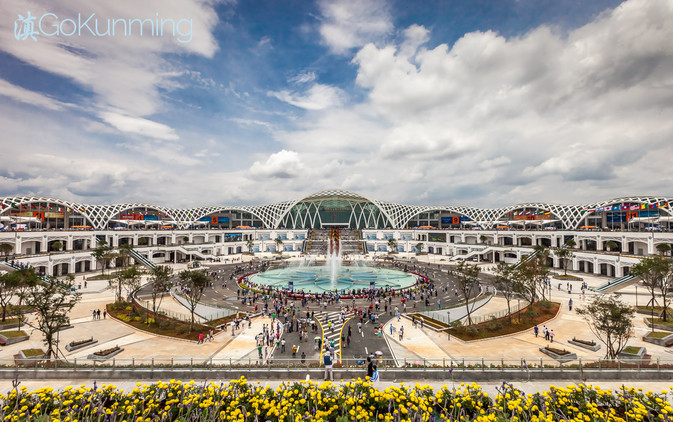
Kunming’s China-South Asia Expo Balloons to Enormous Proportions

9325

When the Spring City throws a trade and investment party, everyone comes. That is the lesson gleaned following closing ceremonies held yesterday at the twenty-third annual Kunming Import and Export Commodities Fair and third annual China-South Asia Expo. Expected to generate billions in business agreements and attract hundreds of thousands of curious attendees, the twin events did not disappoint.

The expos are held each year with the intention of attracting greater foreign business interest and interaction with Yunnan-based companies. This principal goal is part of a larger strategy to build up the province’s economy while also increasing China’s political and commercial footprint in Southeast Asia and beyond.

In terms of sheer numbers, these goals are being realized. Contracts signed during the course of the fairs totaled 785 billion yuan (US$127 billion) in direct foreign investment — a catchall term including money put toward virtually any business acquisition or other commitment. At last year’s expo opening ceremony, Chinese Vice Premier Wang Yang (汪洋) said he expected the next few years to be “the most active and fruitful period yet” for cooperation between Yunnan, Association of Southeast Asian Nations member-countries and South Asia. He appears to have been correct.

The numbers for direct foreign investment in Yunnan dwarfed those concerned with Chinese ventures in other countries, which reached 155 billion yuan (US$25 billion). In total, 903 overseas firms inked deals to begin or expand existing businesses in the province. The largest of these involved the fields of tourism, energy and infrastructure development, logistics, education, and environmental protection.

9329

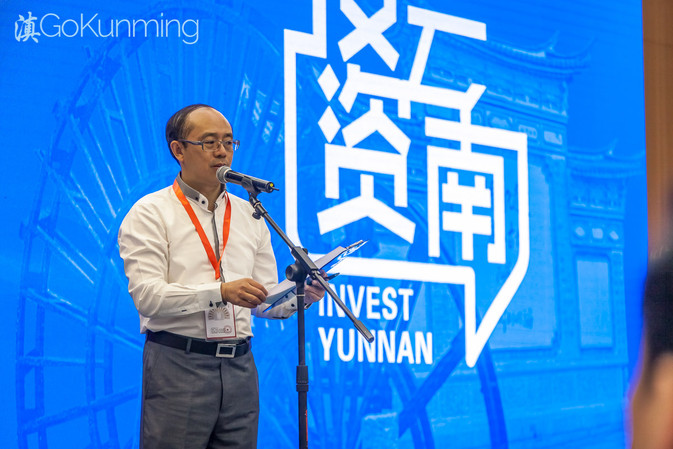
Highlighting Yunnan’s growing importance as a trade and investment hub, 20,000 businesspeople as well as dignitaries from 31 countries attended. Among the most notable were Chinese Vice President Li Yuanchao (李源潮), the president of the Maldives, Laos’ prime minister and high-ranking representatives from Bangladesh, Cambodia, India, Myanmar, Thailand and Vietnam.

India’s Minister of State External Affairs, VK Singh, also attended. He represented the expo’s feature country, a place of honor this year replete with a dedicated “museum” devoted not only to the Subcontinent’s most advanced industries, but also its history and culture. At a separate event held during the expo, Singh officially opened China’s first yoga college at the Yunnan University of Nationalities campus in Chenggong.

9326
Giving India such recognition was no random decision, but instead a calculated diplomatic move aimed at encouraging the world’s second most populous country to embrace China’s Belt and Road Initiative. The brainchild of President Xi Jinping, the proposal looks to propel regional integration between China and the countries of Central and South Asia, India chief among them.

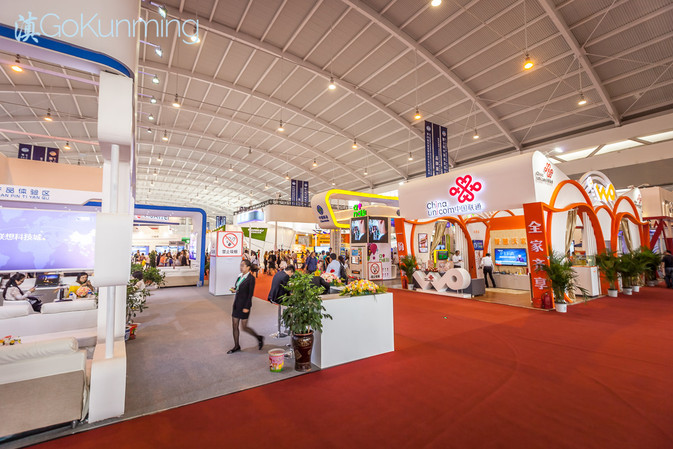
While enormous deals and industry-specific conferences were carried out behind closed doors, the general public tuned out in droves to this year’s expos. In preparation, organizers printed half a million tickets. It did not prove to be enough, as 740,000 attendees passed through the gates at the Kunming Dianchi International Convention and Exhibition Center, shattering last year’s attendance numbers by 500,000.

An exhibitor from Taiwan, surnamed Li, told reporters she had signed deals to sell dried fish to Carrefour, Parkson and Golden Eagle while at the expo. She, like many other exhibitors, ran out of things to sell two days before the expo concluded. “Everyone has been so friendly and warm,” Li said, “I hope to see them all again next year.”

This article, written by Patrick Scally with images by Yereth Jansen, was first posted here on Gokunming.com.

Leave a Comment

Filed under China, Current Events, Economic development, Foreign policy, GMS, SLIDER, Yunnan Province

The US Rebalance in Vietnam & The Philippines

In Southeast Asia, the United States has rebalanced its attention to a vital region while seeking to avoid alarming China. The Obama Administration’s comprehensive efforthas engaged a diverse array of countries, strengthening ties with both unlikely partners and longtime allies. Coupled with a brief study of American interests in the region, an examination of the strategy applied to two countries – Vietnam and the Philippines –reveals little cause for the Chinese concern that America is pursuing a policy of containment.

VIETNAM

In Vietnam, the U.S. has succeeded in creating a partnership with a nation that was a bitter foe just forty years ago. Perceiving China’s recent policies as a disturbing sign of greater assertiveness to come, Vietnam has felt it necessary to hedge against its neighbor by pursuing a closer relationship with the United States.

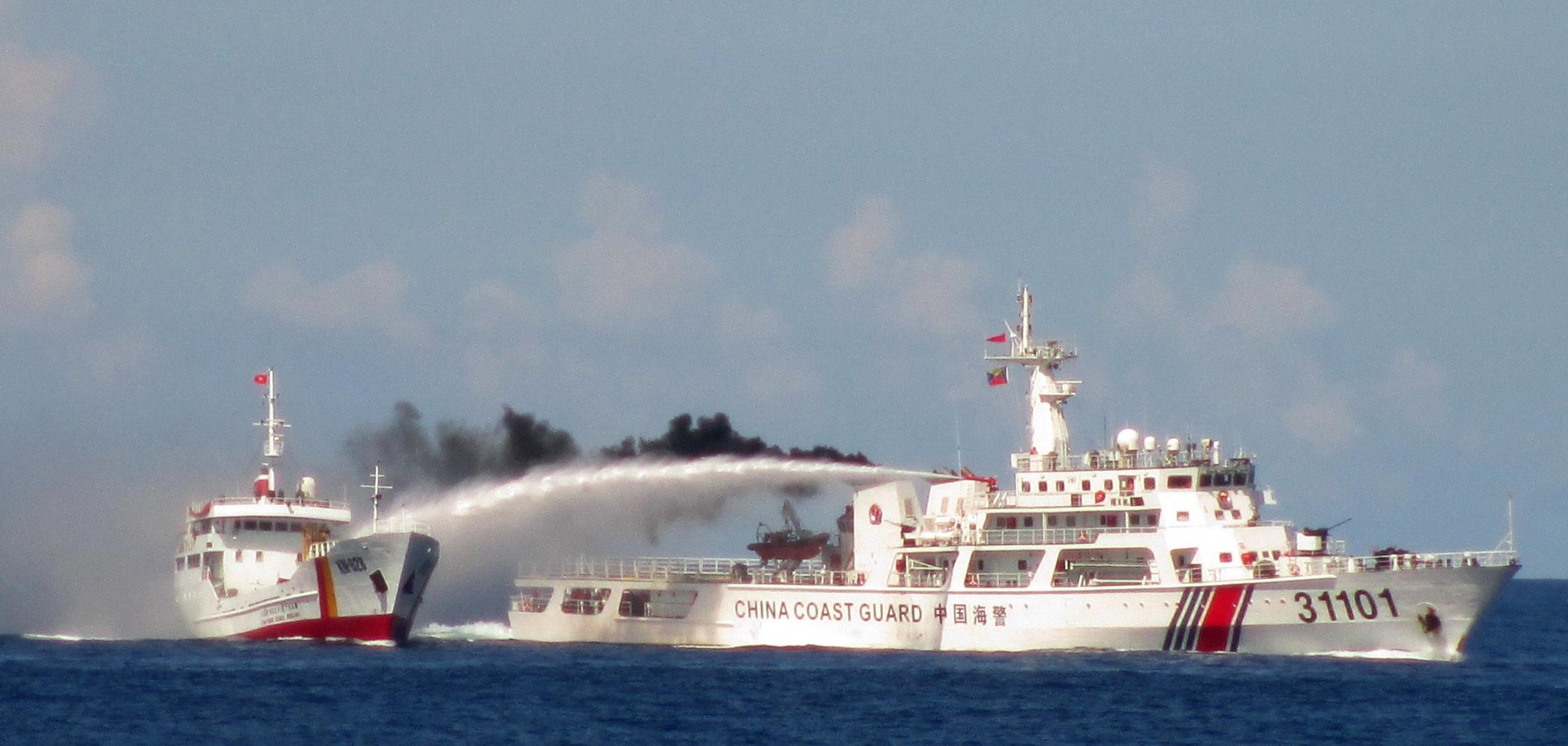
The driving force behind this reconciliation has been China’s provocations in the South China Sea, which have infuriated the Vietnamese government and its people and caused them to view China as a potentially destabilizing force in the region. The May 2014 placement of a Chinese oil rig within Vietnam’s Exclusive Economic Zone (EEZ) marked a highpoint in the tensions, sparking deadly anti-Chinese protests in Vietnam and naval incidents in the area of the drilling.

Vietnamese and Chinese vessels clash near the disputed oil rig. Photo: Getty Images

Vietnamese and Chinese vessels clash near the disputed oil rig. Photo: Getty Images

Chinese diplomacy has not eased Vietnamese concerns. Rhetoric regarding the South China Sea has been inflexible: in 2010, officials labeled the region one of China’s “core interests,” joining only Taiwan and Tibet. At a meeting concerning the South China Sea the same year, in which all disputant states were present, Chinese Foreign Minister Yang Jiechi reportedly stared at Singapore’s Foreign Minister while pointedly stating, “China is a big country and other countries are small countries, and that’s just a fact.” In the eyes of Vietnam and its fellow Southeast Asian States, this threatening tone has confirmed fears inspired by China’s aggressive policy in the region.

While some American observers have gone so far as to call for a full treaty alliance with Hanoi, several barriers will keep a degree of separation the two countries. The first is Vietnam’s policy of the “three nos”: no military alliances, no foreign military bases on Vietnamese territory, and no dependence on any countries for help in combating other countries. The last point is particularly important in the context of Vietnam’s history: when China invaded in 1979, the Soviet Union – having signed a defense treaty with Hanoi just a year before – declined to come to its aid. This history provides Vietnam with a powerful warning against reliance on powerful but distant allies.

Another analogy that suggests restraint is the ongoing conflict in Ukraine. Looking to Moscow once more, Vietnam sees a disturbing example of how a major power will react to its small neighbor aligning with a rival. Of course, the comparison is imperfect, but the degree of similarity between the two cases is striking nonetheless.

The greatest constraint upon Vietnamese diplomacy is its economy’s dependence upon trade with China. China is Vietnam’s largest trade partner, and the source of many of the inputs critical to its burgeoning manufacturing industry. While some worry that tensions could lead to a trade war, economic concerns have thus far won out, and the Vietnamese government has been careful to avoid pushing China too far.

The Rebalance

Even with these constraints, Vietnam has welcomed American efforts to deepen ties on diplomatic, economic, and military fronts. The rebalancing is directed toward all of Asia, but extra attention has been directed toward Vietnam – a prominent victim of China’s actions in the South China Sea, and a country with an especially dynamic and promising economy.

America has promoted Trans-Pacific Partnership (TPP) as the main pillar of its economic rebalancing to Asia. The United States, Vietnam, and 11 other Asian-Pacific nations are currently negotiating the deal,which seeks to reduce both tariff and non-tariff trade barriers while maintaining high standards for intellectual property, the environment, and labor rights. American officials have said they would welcome China, but it is widely acknowledged that the deal’s standards are too stringent for China to adhere to. Vietnam also faces challenges to joining, especially with its reluctance to reform state-owned enterprises and labor rights. Its presence in the negotiations is a testament to the determination of both America and Vietnam to deepen their economic ties.

TPP

Current members negotiating the TPP. Image: The New York Times


Diplomatically, the bulk of American efforts are directed toward the region rather than individual states. With regard to the South China Sea disputes, the United States has recognized that no single Southeast Asian state can hope to receive bilateral negotiations with China on equal footing. As a result, it has worked quietly to promote a closer unification of the Association of Southeast Asian Nations (ASEAN), which wields significant influence but, like all regional organizations, is held back by the disagreements of its member states.

Even with the region-wide focus of diplomacy, however, a rapid exchange of interstate visits has reflected Vietnam’s importance. American congressional delegations and Administration officials have met with the Vietnamese with increasing regularity, and Gen. Martin Dempsey’s 2011 trip marked the first visit by a Chairman of the Joint Chiefs of Staff since 1971.Nguyen Phu Trong, the General Secretary of Vietnam’s Communist Party and the country’s supreme leader, will make his first visit to the United States this June.

America’s military policy constitutes the most visible aspect of its rebalancing strategy, and naturally draws the bulk of Beijing’s complaints. In Vietnam, the U.S. has coupled emphasis on exchanges and cooperation with direct (although minor) military aid. Military-to-military ties have grown greatly in the past decade, particularly with the introduction of an annual Naval Engagement Activity (NEA), which pairs each navy in noncombat exercises. In 2014, the Secretary of the Navy also invited Vietnam to join the biannual, U.S.-led RIMPAC exercises, the largest naval exercise in the world.

While noncombat exercises are a mild form of cooperation, American promises of military aid to Vietnam reflect a much stronger commitment to rebalancing. In December of 2013, Secretary of State John Kerry announced $18 million in aid to Vietnam to “boost maritime security.” A portion of the money was earmarked for the purchase of five unarmed patrol boats for the Vietnamese Coast Guard – a minor increase, but symbolically significant. Additionally, Japan – the linchpin of American security in the Pacific and another country locked in a territorial dispute with China – provided Vietnam with an additional six boats, worth $5 million. And in 2014, the U.S. eased its ban on providing Vietnam with lethal arms, opening the door to a number ofsystems for its coastal defense.

Military Spending Infographic

THE PHILIPPINES

In the Philippines, the U.S. is working to further deepen its relationship with a treaty ally and longtime partner. After a brutal war with the United States that left it an American colony, the Philippines maintained a better relationship with its conqueror than most countries, and upon gaining independence sought American protection throughout the Cold War. While Filipinos resentment of U.S. military bases led to an American exit in the 1990s and a slight chill in relations, the Philippines remains one of America’s closest allies in the region.

Philippine-American Timeline Infographic

As with Vietnam, the Philippines’ desire to draw even closer to America is explained by Chinese tactics in the South China Sea. The Sino-Philippine conflict has actually been significantly more contentious. Because it shares no border with China, is less economically dependent, and has signed a mutual defense treaty with America, the Philippine government has been less constrained by geopolitics than its Vietnamese counterpart. (It should be noted, however, that the U.S. has declined to clarify whether this defense treaty applies to Philippine claims in the South China Sea.)

These circumstances have enabled the Philippine government to apply for international arbitration of its disputes in the South China Sea, a step that Vietnam considered too divisive. China has objected, stating that it will “neither accept nor participate” in the arbitration, and maintained its political stance of indisputable sovereignty throughout the South China Sea. It is highly unlikely that the suit will achieve any result.

In spite of greater economic insularity than Vietnam, the Philippines has still fallen victim to what isperhaps China’s greatest asset: economic coercion. China has employed this strategy often, taking advantage of its large domestic market and the control the state retains over the economy. In June of 2012, it reacted to a confrontation with the Philippine Navy by cutting off Filipino banana imports. Justifying the policy as a health regulation, China succeeded in choking an important industry and driving Manila to adopt a conciliatory tone.

The Rebalance

Economically, the United States and the Philippines are already quite close. America is the Philippines’ second-largest trade partner (after Japan) and its biggest investor. Still, the Obama Administration has worked to further enhance the relationship. While the Philippines does not currently take part in the TPP negotiations, it has expressed interest, and high-level officials from each country have met to discuss what its participation would look like. In 2011, the fiftieth anniversary of the bilateral defense treaty, the two countries signed a five-year Partnership For Growth (PFG) agreement, designating the Philippines as a priority area for American development assistance. That same year, the Millennium Challenge Corporation (a government agency) signed a five-year, $434 million compact to combat poverty and encourage growth in the Philippines.

Trade Growth Infographic

While historical closeness, cultural similarity, and the depth of Philippine-American exchange have already created close ties, American diplomats have sought to further reinforce the relationship. The two countries recently began holding a Bilateral Strategic Dialogue to institutionalize the regular exchange of ideas. And in 2011, Secretary of State Clinton visited the Philippines to release a joint Philippine-American declaration,reaffirming that the alliance had “never been stronger.”

The military aspect of rebalancing has consisted of naval aid, closer cooperation and training, and – most importantly – a strengthened defense treaty. Having always depended on its American counterpart, the Philippine Navy is one of the weakest in the region. Its flagship is a 45-year-old cutter, donated by the U.S. Coast Guard in 2011. The U.S. has offered an additional ship, communications equipment, and training, but recognizes that no amount of aid will enable the Philippines to unilaterally defend against Chinese naval incursions.

The true cornerstone of the military rebalance is a ten-year enhanced defense pact negotiated in 2014. The agreement creates no permanent bases, an option that then-Secretary of Defense Chuck Hagel dismissed as a “return to an outdated Cold War mentality.”Instead, it invites rotational deployments of American ships and advisers, which will significantly escalate military presence in the region. It also opens the door to greater commitments of military aid to the Philippines.

The symbolic value of a return to the Philippines, just over twenty years after public protest forced the closing of American bases at Subic Bay and Clark Air Force Base, is indicative of the region’s tense atmosphere. Some anti-American sentiment remains, stalling the agreement in a legal challenge that is now before the Philippine Supreme Court. Still, Philippine officials are confident that the case will be thrown out when a decision is reached.

Assessing American Intentions Throughout Southeast Asia

In spite of American efforts to paint the rebalance in nonthreatening terms, Beijing has frequently voiced its concern that the strategy aims to encircle and contain China. These complaints have especially been directed at the military components of these partnerships with Vietnam and the Philippines. China – at least publicly – eyes these moves suspiciously, and assumes that realist, hegemonic motives dominate American intentions.

For many reasons, however, this theory does not hold water. Even if China were to be excluded from the equation, a shift in attention to Asia would remain eminently logical. The War on Terror absorbed American resources in the Middle East for a decade after 9/11, but never promised long-term benefits to the national interest. Nor does any other region offer the dynamism and promise of Asia, which officials and scholars predict will be at the center of international affairs for decades to come

While China’s era of incredible growth is finally slowing, the rest of Asia is only beginning to take off. Asia holds more than half of the world’s population and is projected to account for half of its economy by 2050. Southeast Asia in particular holds much of this untapped potential, and four of the ten ASEAN states already rank among the world’s 20 most competitive economies.

With this unparalleled importance in mind, it becomes clear that the rebalance is simply an alignment of American resources and commitments with its interests – and that if anything, criticisms should question if the policy has gone far enough. With a globally integrated economy and worldwide commitments and interests, the United States does not see itself as having the option to neglect such a crucial region.

The rebalancing strategy has also emphasized the importance of improved relations with China. While public statements have often put America and China at odds, particularly over territorial disputes, diplomatic and military coordination have improved considerably. The annual, Strategic and Economic Dialogue receives a great deal of attention, and institutionalizes the frank exchange of positions between the two countries. Communication has been at the heart of American efforts to ease Chinese suspicions. For example, the Administration even privately briefed China on its plans before embarking on President Obama’s 2014 trip to Asia, in which he announced the enhanced defense treaty with the Philippines.

In responding to fears of containment, it is also important to note that a struggling China would be a disaster for America’s economy and interests. As Gen. Martin Dempsey, the Chairman of the Joint Chiefs of Staff put it in 2014,“I worry more about a China that falters economically than I do about them building another aircraft carrier.” The American and Chinese economies are deeply intertwined, and economic turmoil could also provoke political instability in China and East Asia– the last thing the United States would like to see.

Chinese ships expanding land in the South China Sea. Image: Center for Strategic and International Studies

Chinese ships expanding land in the South China Sea. Image: Center for Strategic and International Studies

Beijing may blame America for regional sentiment turning against it, but it would be better served by turning the mirror on itself. China’s policy in the South China Sea has done much more damage to its stature in Southeast Asia than American actions conceivably could. With aggressive expansion, including incursions into both Vietnamese and Philippine Exclusive Economic Zones, China has flouted both regional and international norms and laws. Its inflexible and even threatening rhetoric and diplomacy have only compounded the problem.

Only this behavior can explain why a country like Vietnam has sought greater friendship with the United States, or why ASEAN has pursued greater unity in dealing with other countries. China may well regret its policies in the South China Sea: in pursuit of territorial gains, it has sacrificed regional influence and reputation, thus containing itself.

Leave a Comment

Filed under China, Current Events, Foreign policy, Governance, Philippines, Regional Relations, SLIDER, South China Seas, Trade, Vietnam

Bright City Lights: Urban Trends and Futures in Southeast Asia

Traffic congestion in Bangkok

Traffic congestion in Bangkok

This year, Jakarta earned the unsavory title of “World’s Worst Gridlock.” The city of 23 million is now reputed for having to most congested streets in the world. Another Indonesian city, Surabaya, took the number four spot. If you continue down the rankings to number eight, you will find yet another Southeast Asian metropolis – Bangkok.

The tendency for gridlock in these cities is more than a daily inconvenience for residents. These levels of traffic congestion are indicators of a trend in the wider Southeast Asian region. In this part of the world, urban populations are growing faster than municipal and national governments can handle.  When managed sustainably, cities can be a valuable vehicle for economic development and socio-demographic transition. For example, cities can facilitate productive trans-border connections and slow birthrates, which enables more women to enter the workforce. Nevertheless, urbanization is a double-edged sword.

Rapid, unplanned growth results in unsustainable development that threatens social, economic, and environmental stability.  In a landmark report that analyzes 10 years of urbanization data from East Asia, the World Bank suggests that urbanization in East and Southeast Asia will have “long-lasting effects on the region’s social, economic, and environmental future.” Understanding the growth trends in Southeast Asia will boost the region’s ability to avoid the pitfalls associated with the rapid type of urbanization that has been observed over the past decade.  In other words, the region needs to pay attention to these changes if they don’t want to spend the rest of their down time stuck in traffic.

Dominant Urbanization Trends

Between 1990 and 2010, Southeast Asia increased its urban population by at least 12%, per United Nations estimates. The fact that Asian cities are growing is not a fresh realization, but few observers of these phenomena have questioned how these cities are growing, instead of just how big.

Screen Shot 2015-04-10 at 5.50.38 PM

For example, in the past 10 years, East Asia has experienced more urban growth in small- and mid-sized cities than in major metropolitan areas. This has several more nuanced implications for the region. Successful development in smaller metropolitan areas could relieve much of the pressure put on high-population areas. For example, a Thai development strategy used tax breaks to encourage people to take up residence in the regions outside of Bangkok . Unfortunately, the government failed to provide infrastructure and facilities to support business development in outlying regions. Bangkok remained the prime area for investment, and the program floundered.

Megacities like Bangkok often gain international reputations that afford them opportunities to advertise for foreign direct investment.Small and mid-sized cities, on the other hand, have to fight for attention and funding from national governments and lack the resources necessary to advertise to a wider range of investors. Take the case of Ho Chi Minh City and Da Nang, two metro areas in Vietnam. Ho Chi Minh City is the country’s largest city and Da Nang was only about an eighth of HCMC’s size in 2011. However, the rate of urban population change in Da Nang was 4.5% as of 2010 and HCMC was 3.9%. While this may appear to be a narrow margin between two cities, imagine the national impact when every mid-sized city in a country grows at this rate. The need for infrastructure would surely outpace the investment available to these smaller metropolitan areas.

laos.vte

In addition to major growth in small- and mid-sized cities, the fastest growth of urban population was experienced in East Asia’s low- and middle-income countries, namely Laos, Cambodia, and Vietnam. Japan, South Korea, and even Thailand place far behind these countries in their rates of urban land and urban population increase.

Screen Shot 2015-04-10 at 7.20.26 PM

The less developed countries in the region face administrative and financial challenges on a national level, which creates an environment where a single city in the country, often times the capital city, experiences the majority of the urbanization. The massive, resource-hogging cities that result are known as “primate cities” in the vernacular of urban studies scholars. Concentrating an entire country’s political, cultural, and economic capital in one area creates national vulnerability if there is a crisis in that single city.

Urban primacy is especially detrimental for a country when there is massive migration to the core and a development lag in the country’s periphery. This phenomenon plays out the same way in developing countries across the globe: Rural poor migrate to urban areas in search of better economic opportunities, but financially and administratively inept governments cannot provide migrants with adequate resources for finding jobs and homes. Densely populated and amenity-poor settlements result as migrants join the informal economy of the city.

Bangkok, Yangon, Phnom Penh, Vientiane, Jakarta, Manila, and Kuala Lumpur have all reached primacy within their respective countries. As previously mentioned, Bangkok is one city that has acknowledged its primate city status and attempted to reduce its dominance of Thailand’s geography. Countries such as Cambodia and Myanmar will also need to take steps to ensure that Phnom Penh and Yangon do not morph into unsustainable networks of unplanned settlements. The challenge lies in the fact that countries like Cambodia and Myanmar lack the administrative and financial capacity to shift rural to urban migration trends. However, it is promising that smaller cities in the region are doing most of the growth, even if they have a long way to go before they can compete with these metro areas.

Screen Shot 2015-04-10 at 5.24.48 PM

Finally, Southeast Asia’s urban populations are growing faster than the region’s urban land. At present, the main reason for dense urban growth in the region can be attributed to the lack infrastructure available on the periphery – a far cry from the smart growth policies that many cities implement to promote compact growth. Even so, high-density urban growth is associated with many positive outcomes when it is effectively provided for. Namely, high-density development tends to have fewer negative environmental consequences than urban sprawl. Kuala Lumpur is actually an exception to this trend in Southeast Asia, and has been criticized for failing to compact its urban growth. A heavy reliance on automobiles has been detrimental to the city, but other emerging urban areas in the region have the chance to get ahead of the car craze and promote smart growth that emphasizes efficient land use and practical transportation.

By and large, dense urban growth still has a number of caveats. As mentioned, the reason density in the region is high is due to a lack of amenities outside of core cities. If population growth outpaces the ability of the core to provide services, the quality of life in many cities will quickly degrade. Overcrowding is also a serious challenge that many cities in the developing world are faced with, and Southeast Asia is no exception. Comprehensive urban planning will be necessary to prevent overcrowding from becoming another major trend in the region.

Urban Planning and Governance: Missing Links

When you combine all of the formulas for urban growth in Southeast Asia, the results are two-sided: There is potential for inclusive, sustainable urban areas, but there is also a chance for the region to mushroom into a clutter of poorly planned development. When planning is neglected, poverty, environmental degradation, and land use conflicts ensure. For Southeast Asian cities to avoid falling victim to, say, the level of air quality degradation that many Chinese cities now face, spatial planning and good governance are crucial.

A 2009 assessment of urban governance prepared for UN Habitat is grim: the report asserts that the capacity of both local and national governments in the region is fragmented and weak, with a serious lack of simple management skills and adequate budgeting for necessary infrastructure. “Good” urban governance requires transparency, political will, and funding, but many Southeast Asian governments underperform in all three categories. There is always a propensity for countries to urbanize, regardless of political stability. With that being said, Southeast Asia’s urbanization trends alone illustrate that not all growth is good growth. A solid political environment at least ensures that there is a structure for discussing urban needs when they arise, although definitive actions need to be taken if there is going to be any change.

Administrative fragmentation is another burgeoning obstacle for Southeast Asian boomtowns. This term refers to the spillover of growth from one municipality into neighboring jurisdictions. One example is Manila’s urban area, which spans 85 municipalities and seven provinces. The World Bank predicts that many of the growing small- and medium-sized cities will soon experience this type of administrative challenge, if they are not experiencing it already.  Different jurisdictions often struggle to coordinate plans for infrastructure development and management, leaving many areas underserved.

The ecosystems impact of such trans-boundary urban areas is also notable because rivers, lakes, and forests require cooperative management.  Overcoming administrative fragmentation appears daunting in a region where political stability is scarce, but regional planning associations have proved to be an effective way to manage fragmented urban areas. The Metro Manila Development Authority (MMDA) is one such organization tasked with monitoring urban development, but it struggles with a low budget and limited regulatory power. Even so, the future of many urban agglomerations in the region would look brighter if such organizations were widely utilized. Urban management organizations have the ability to pull multiple institutional actors together when questions arise about different stakeholders’ opinions.

 Screen Shot 2015-04-10 at 7.26.18 PM

Urban Futures

Southeast Asia’s urban population has not yet reached 50% of total population, an indicator that more urban growth is still to come. The future of the region’s urban areas will in part be dictated by the trends that have been observed in the past decade, but also by events that remain to be seen. Climate change is one of the foremost worries in the region, but political stability and economic productivity will also play roles in the ability of the region’s cities to develop sustainably. Metropolitan areas in the region need to get ahead of urban growth and expansion in order to take some of the uncertainty out of the future.

Climatology experts maintain that no part of the world will remain unaffected by climate change, but Southeast Asia is actually a particularly high-risk area. A number of Southeast Asia’s urban centers falter in climate change scenarios that involve sea level rise, drought, saltwater intrusion, and severe weather events, and famine. As metropolitan areas in the region continue to develop, resilience is a topic that needs to be kept in mind. Cities like Bangkok and Ho Chi Minh need to have planes in place for flooding and typhoon events. Manila needs to ask itself how to feed a metropolitan area of 16 million if crop productivity plummets due to droughts or heat waves.

Besides the need for climate change adaptation measures, Southeast Asia also represents a large market for mitigation efforts. By reducing dependency on cars and carbon-based energy sources, the region can bypass being a part of the carbon problem. China and the West used coal to fuel their urban expansion, but Southeast Asia has the opportunity to exclude GHG heavy industries and develop using environmentally sound technologies. As new attempts at international climate treaties are rolled out, it will be interesting to see where many Southeast Asian nations fall on the spectrum of mitigation requirements.

Historically, developing countries have been held to lower emission reduction standards than countries in the developed world, but countries like Malaysia and Thailand have potentially reached a threshold where they will be counted among the world’s more developed countries, and thus required to reduced their emissions further. In any case, climate mitigation is good for Southeast Asia if it means that the impacts of climate change on the region will be softer than current predictions.

Political stability is also a recurring obstacle for a number of Southeast Asian countries. Years of stability and growth have been punctuated by sudden regime changes that have reduced the level of confidence both Southeast Asian nationals and outsiders have in the region’s governance. Urban planning is an intensely political process, so the status of a country’s national government directly effects urban development. If establishing effective national governments proves to be too much of a challenge for parts of the region, how can we expect urban management to get the attention that it requires?  Metropolitan development authorities and NGOs could potentially help cities weather the storm if political institutions fail, but finding consistent, effective governance is critical for the future of Southeast Asia’s cities.

Future economic development in Southeast Asia will also continue to shape urban areas in the region. Low-cost manufacturing has played a significant role in growing many of the region’s largest cities, but that may change as smaller urban areas take up lower-technology manufacturing as well. Some suggest that economic outcomes are better in regions where the largest cities take on service industries and high-tech manufacturing and the smaller cities concentrate low-tech industries. However, this is impossible if the infrastructure needs of smaller cities remain unmet. Investment in Southeast Asia’s small- and mid- sized cities is an important step that the region can take to move towards greater economic output.

Urbanization in Southeast Asia has reached a clear bottom line: In order to reap the benefits of healthy, innovative urban areas, the region needs to raise its expectations for planning and governance. If current regional urbanization trends continue to play out, there is potential for Southeast Asia to be the home of several highly productive urban areas. Investing in small and mid-sized cities will create robust national economies and capitalizing on dense growth will keep the environmental impact of cities to a minimum. However, if planning and coordination are left on the wayside, the region will be set on a course for vulnerability to any sort of crisis that should arise.

Leave a Comment

Filed under ASEAN, Cambodia, China, Current Events, Economic development, Environment and sustainability, Governance, Indonesia, Laos, Malaysia, Myanmar/Burma, Philippines, Sustainability and Resource Management, Thailand, Vietnam

Southeast Asia’s Illicit Wildlife Trade: International Cooperation Necessary to Find Solution

On Wednesday March 25, immigration authorities confiscated 492 black spotted terrapin pond tortoises at the Tiruchirappalli International Airport in India. Identified as merely carriers, the five passengers with tortoise-laden luggage seemed unaware of their baggage contents and were merely promised 10,000 Rupees each for transportation, a sum of about $800 USD. Bound for Bangkok, this shipment of tortoises represents the largest attempted volume of wildlife trafficking at the Trichy Airport and highlights the trans-boundary nature of the illegal wildlife trade in Southeast Asia.

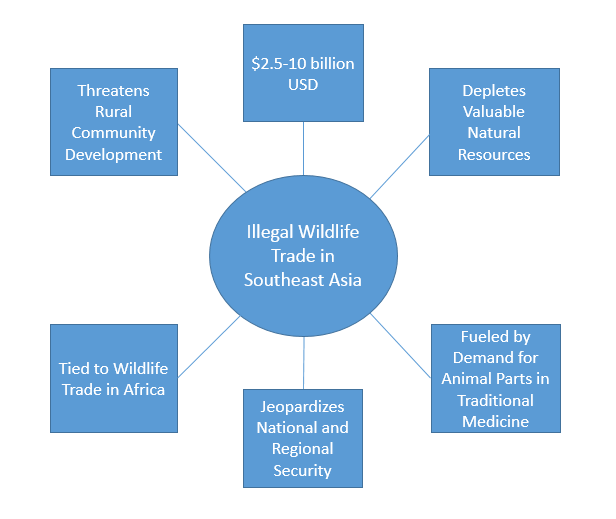
Preceded only by the arms and drug trade, illegal wildlife trafficking represents the third- largest illicit trade in the world. As a region, Southeast Asia remains among the most critical in terms of severity and volume of wildlife trafficking. According to the United Nations Office on Drugs and Crime 2013 Threat Assessment, China represents the leading consumer country in the East Asia and Pacific region, with consumption levels in South Korea and Japan on the rise. Driven by high demand in East Asia for animal products in the form of food, traditional medicine, and decoration, the illegal wildlife trade in Southeast Asia is responsible for approximately 25% of the global industry, according to estimates made in 2005. Facilitated by expanding transportation infrastructure in Southeast Asia and the region’s porous international borders, the trans-boundary wildlife trade presents numerous governance challenges to the region’s developing nations. Not only does the illegal wildlife trade threaten Southeast Asia’s ecosystem biodiversity, but the industry also impedes economic growth and regional security because of its ties to drug trafficking and terrorism. While the role of each country within Southeast Asia is different regarding the illicit trade of live animals and their parts, the countries of the region must work together in order to develop viable governance solutions for the issue.

Facing the challenges presented by the illicit wildlife trade in Southeast Asia requires international cooperation, within the East Asia and Pacific region as well as globally. Ratified in 1975, the Convention on International Trade in Endangered Species of Wild Fauna and Flora (CITES) was among the first international efforts to mitigate the illegal wildlife trade. CITES establishes lists of species, the trade of which is illegal without proper documentation, and requires that its member parties regulate the trade of these species through national legislation.  Currently, CITES has 180 member parties, including all of the countries in Southeast Asia, China, and the United States. However, CITES merely provides a framework for enforcement and requires country cooperation to effectively reduce illegal wildlife trafficking.  Although putting an end to the illegal wildlife trade in Southeast Asia remains an ambitious task, the efforts of CITES and ASEAN Wildlife Enforcement Network (WEN) have generated legislative headway in the region. Recent collaboration between China, the United States, and the member states of ASEAN suggests that wildlife trafficking is a dilemma that, just as the trade itself, transcends national boundaries.

Overview of the Illegal Wildlife Trade in Southeast Asia

Before introducing the various cooperation efforts in Southeast Asia aimed at combatting the illegal wildlife trade, we must first have an understanding of the unique set of ecological, economic, and security challenges that the industry presents to the region. Globally, Southeast Asia represents a hotspot for the illegal wildlife trade. Figure 1 presents data collected via a real-time, online surveillance system designed to track reports of illegal wildlife trade worldwide. Although these data do not reflect every instance of illegal wildlife trafficking, they provide a good base for comparing the trade between different regions.

According to the numbers I collected from the system on April 7, 2015, reports of illegal wildlife trade in Southeast Asia vastly outnumber every other region in the world. Because the region also contains numerous biodiversity hotspots, the illegal wildlife trade in Southeast Asia threatens some of the most ecologically productive ecosystems on earth. Inextricably tied to economic development, sustainable agriculture practices, and natural resource bases, maintaining ecosystem services remains of utmost importance to developing nations. The United Nations Environmental Crisis Assessment agrees, stating, “Healthy ecosystems provide the platform upon which future food production and economies are ultimately based.” As the single largest threat to vertebrate species extinction in Southeast Asia, the illegal wildlife trade undoubtedly threatens ecosystem health as well as economic development within the region.

animalcommodity

Black market value of commonly-traded wildlife products in Asia-Pacific region. Measured in USD. Figure 1: Information gathered on April 7, 2015 from http://www.healthmap.org/wildlifetrade


The Southeast Asian illegal wildlife trade represents a lucrative business. Figure 2 shows maximum market value data for various commonly traded illegal animal parts, information collected by the U.S. Congressional Research Service in 2008. Currently, a kilogram of rhino horn is approximately worth as much as a kilogram of gold in Vietnam. In terms of the monetary value of the wildlife trade worldwide and regionally in Southeast Asia, the illicit nature of the industry prevents researchers from making completely accurate estimations. However, the UNODC suggests that the illegal wildlife trade in in the East Asia and Pacific region is, conservatively, worth around 2.5 billion USD annually, while a Brookings Institute report suggests that the value for Southeast Asia alone is closer to 8-10 billion USD.

The magnitude of and range between these values demonstrates that the illegal wildlife trade in Southeast Asia represents a substantial economic problem, the scale of which is largely uncertain, due to a lack of regulation and research. The economic threats posed by the illegal wildlife trade range from a potential decrease in eco-tourism due to species loss to large-scale development impediment as the trade perpetuates a cycle of poverty within Southeast Asia’s rural regions. For example, the vast majority of those who illegally harvest wildlife in the East Asia and Pacific region happen to be rural individuals seeking to boost their low income levels. Therefore, as an enterprise born out of desperation and the lack of financial resources, the illegal wildlife trade, particularly the specialized traders at the top of the industry, benefits immensely from keeping rural individuals poor. Thus, the continuation of the illegal wildlife trade in Southeast Asia does not bode well for the region’s economic future.

RealTime_Data

Figure 2: Information from U.S. Congressional Research Service on maximum market prices for commonly-traded animal products worldwide


Illegal wildlife trafficking also carries significant national security implications. In Africa, for example, ties between poaching and terrorist groups have proved particularly alarming. Although less is known regarding the connection between wildlife trafficking and other criminal organizations in Southeast Asia, the region’s illegal wildlife industry maintains strong ties with poaching throughout Africa. While this tie does not necessarily suggest that wildlife trafficking in Southeast Asia is directly connected to African terrorists groups, the connection can generate security threats in the form of government corruption.

Vietnamese demand for rhino horn for use in traditional medicine spurred a sharp increase in rhino poaching in South Africa during 2013. The World Wildlife Fund recognizes government-level corruption as a contributing factor to the trade of rhino horn in the country, as officials allow free passage to select individuals transporting rhino horn. Not only does corruption in the illegal wildlife trafficking industry hinder enforcement efforts, but it also leads to political instability, as the national government loses the respect of its citizens as well as other nations.

Web_Chart

On a similar note, Vietnam’s ties with rhino poaching in South Africa demonstrate that Southeast Asia plays a diverse set of roles in the global wildlife trade. Because the countries of Southeast Asia simultaneously serve as source, transit, and demand points for live wildlife and animal parts, tracking the origin of species traded in the region proves incredibly difficult. Similarly, the trade itself encompasses a complex set of actors. As a relatively low-risk, incredibly lucrative crime, wildlife trafficking presents an appealing option for impoverished individuals at the poaching and transportation levels as well as for experienced criminals at the highest level of the trade, hoping to supplement other illicit industries. Those responsible for the transactions are rarely caught and the transporters generally take the blame, as in the black spotted tortoise case at the Trichy Airport earlier this year. The inability to identify ringleaders within the industry perpetuates the illegal trade, as the individuals caught in the process (poor transporters and poachers) are easily replaceable. Fundamentally, the illegal wildlife trade exploits low levels of law enforcement prevalent in Southeast Asia’s developing countries, and thus undermines existing legal efforts aimed at reducing the trade.

CITES and Southeast Asia

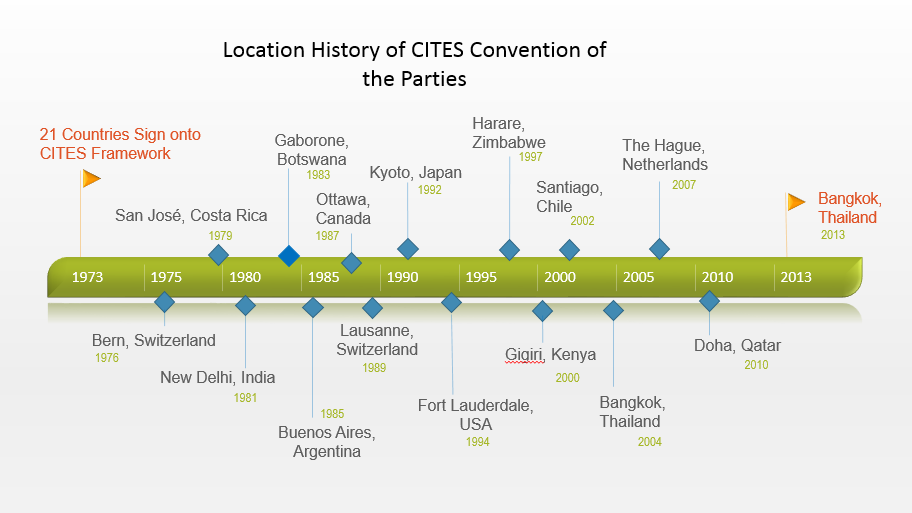
The illegal wildlife trafficking situation in Southeast Asia is dire and benefits no one but those at the top of the trade. Nevertheless, international attention to Southeast Asia’s illegal wildlife trade has undoubtedly increased since CITES was first established. The timeline below shows the location history of the CITES Convention of the Parties (CoP). Occurring every two to three years, these conventions essentially assess the progress of member countries in terms of illegal wildlife trafficking enforcement. Held in Bangkok, the 2004 convention was the first CoP held in Southeast Asia.

In 2013, Bangkok again served as the convention host, becoming the only city to host two CITES CoP’s. CITES’s focus on Bangkok reflects international recognition that the illegal wildlife trade in Southeast Asia, specifically Thailand, is in desperate need of regulatory help. Last year, CITES issued a warning to Thailand, asserting that if the national government continued to let its ivory market go unregulated by March 2015, it would face wildlife trade sanctions. As of 2013, Thai laws permitted the trade of domesticated elephant ivory; however, due to a lack of market regulation, poached African elephant ivory could easily make its way into the market. There has been no word thus far as to whether Thailand met CITES demands by the March deadline.

Timeline

CITES is undoubtedly a useful international organization that provides information and baseline regulatory practices to its member countries; however, CITES framework must be implemented in national legislation and then carried out at major transportation centers in order to be effective. Refocusing on the recent wildlife trafficking case at the Trichy Airport, the black spotted tortoise (Geoclemys hamiltonii) falls under Appendix 1 of CITES, a list reserved for species threatened with extinction. While this listing did not deter those attempting to transport the tortoises to Bangkok, it did allow officials to halt this potential transaction and suggests that CITES protocol is being implemented, to some degree. Furthermore, a look at the CITES website news and highlights shows that ASEAN and China are making regulatory progress in the eyes of the international community regarding the illegal wildlife trade. For example, on March 11, “CITES commends leading Chinese courier companies’ zero tolerance towards illegal wildlife trade” was followed by an April 2 report titled “ASEAN member States discuss enhancing regional cooperation to combat poaching and illegal trade in wildlife.”

These positive reports regarding the illegal wildlife trade in the East Asia and Pacific region reflect CITES attention to and support of the region’s efforts. And CITES praise of China and ASEAN is not unwarranted. A group of courier companies thought to make up approximately 95% of China’s market agreed to a “Zero Tolerance” pledge with regard to the illegal wildlife trade at a World Wildlife Day symposium. The CITES website recognizes this action as a huge step because “courier service is being used as by far the most important means of transport…in the illegal trade chain.” On the ASEAN side of the equation, member states met from March 30 to April 1 of this year for a Regional Forum on Combatting Wildlife Trafficking. Held in Malaysia, the forum emphasized the importance of collaboration and cooperation in controlling the illegal wildlife crime that continues to plague the region. However, CITES openly recognizes that more work must be done on the part of national governments, listing China, Malaysia, the Philippines, Thailand, and Vietnam among eight countries of “primary concern.”

ASEAN-WEN’s Role in Halting Illegal Wildlife Trade

Although the process of ASEAN incorporation into CITES was gradual, all ASEAN countries were member parties by 2004. As CITES’ report suggests, recent cooperative strategies have been adopted to staunch the illegal flow of live animals and their parts throughout Southeast Asia, through the lens of ASEAN. Among these strategies include the formation of the ASEAN-WEN at the 2004 CITES CoP in Bangkok.

ASEAN_Integration

Number of ASEAN countries that were also member parties to CITES over the past four decades


Self-defined as “a regional intergovernmental law-enforcement network designed to combat the illegal wildlife trade,” ASEAN-WEN maintains connections with CITES, U.S. Fish and Wildlife Service, and U.S. Department of Justice. The inclusion of two U.S. federal entities signifies a strong link between the efforts of ASEAN-WEN and the United States. Member states of ASEAN, despite the organization’s strong tendencies towards non-interference, seem to welcome U.S. input with regard to the region’s fight to stop the illegal wildlife trade.

Earlier this year, the Obama administration designed a plan to track and target wildlife traffickers worldwide using American intelligence agencies. President Obama has recognized that the ivory and rhino horn markets in Asia have grown tremendously and the problem represents an “international crisis.” During the aforementioned Regional Forum on Combatting Wildlife Trafficking, the United States served as the symposium’s co-host. While the relationship between the U.S. and ASEAN-WEN is an important factor in slowing the trade, China’s role as the region’s largest consumer of illegal wildlife products makes its inclusion in cooperative enforcement efforts vital.

China-U.S. Cooperation: The Future of Tackling the Illegal Wildlife Trade in Southeast Asia

ASEAN will not be able to combat the region’s illegal wildlife trade alone. With the majority of demand for wildlife and animal products coming from outside of the region, Southeast Asia’s wildlife trafficking problem fully includes China and thus requires Chinese cooperation in enforcement efforts. Joining CITES in 1981 shortly after its opening and reform, China’s cooperation in regulating the illegal wildlife trade is essential to reducing wildlife extraction in Southeast Asia as well as Africa. The International Fund for Animal Welfare praised China in 2014 for destroying six tons of ivory in an effort to discourage the trade and promoting several campaigns to dissuade Chinese citizens from buying items made with animal parts. The campaign photograph below utilizes a play on Chinese characters to grab the attention of Chinese consumers and decrease the demand for animal parts in luxury items.

IFAW_Campaign

Image Source: International Fund of Animal Welfare http://www.ifaw.org/united-states/news/new-year-china-comes-new-campaign


While little cooperative action has taken place thus far, the illegal wildlife trade represents an issue in Southeast Asia through which the U.S. and China can effectively cooperate. Often viewed as competitors in the region, U.S.-China collaboration on the issue of the illegal wildlife trade could slow the flow as well as provide a common goal towards which the U.S. and China could work. Though somewhat vague in its direction, the 2013 U.S.-China Strategic and Economic Dialogue generated conversation surrounding China-U.S. cooperation in combating the illegal wildlife trade worldwide. Both countries recognize that a thriving illicit wildlife trade bolsters organized crime and, therefore, severely threatens national security as well as legal economic enterprises. Jointly tackling the illegal wildlife trade could strengthen positive ties between the U.S. and China, particularly with regard to Southeast Asia.

Reducing Southeast Asia’s illegal wildlife trade not only enhances the region’s ecosystems, economic development, and regional security, but also unites national governments in the name of a common cause. Already the region has seen some progress: Vietnamese demand for rhino horn dropped by over 33% during 2014 after a series of public information campaigns disproving the effectiveness of its medicinal uses. Not only do these information campaigns seem to have been effective, but they also shows that the Vietnamese government responded to internal and external concerns regarding the country’s negative role in the global wildlife trafficking industry.

As other Southeast Asian countries as well as China continue in their efforts to regulate the wildlife trade within their own markets, international cooperation is vital in significantly reducing the trade and targeting the individuals responsible. With a large portion of illegal animal products coming into the region from Africa and then crossing multiple borders once arriving in the East Asia and Pacific region, controlling transit points in the region and developing effective law enforcement practices is key. Because animal products harvested and traded within Southeast Asia often end up China and the United States, the governments of the United States and China also have a responsibility to reduce demand and can work collaboratively to stop the supply.

The success of CITES strongly suggests that international cooperation and strict national enforcement are the keys to reducing the illegal wildlife trade. Yet, as demonstrated by the trade’s continued prevalence throughout the world, particularly in Southeast Asia, more work must be done. Cracking down on the illicit wildlife trade in Southeast Asia represents a significant cooperation opportunity for the U.S. and China, and taking this opportunity could bring positive results to relations between the two nations while also effectively reducing the illegal wildlife trade in Southeast Asia.

Leave a Comment

Filed under ASEAN, Current Events, Economic development, Governance, Regional Relations, SLIDER

Who’s afraid of China’s One Belt One Road Initiative?

A month ago China unveiled an action plan for China’s controversial One Belt, One Road initiative. The action plan introduces a series infrastructure development projects and trade related agreements along three Silk Roads emanating from China and reaching as far as Europe, Africa, and South America. It undoubtedly will be the subject of scrutiny as analysts and pundits on both sides of the Pacific chime in to make hasty comparisons to China’s 14th century maritime expansion and the more recent U.S. led Marshall Plan.  Some may even go as far to equate the One Belt, One Road to Japan’s pernicious WWII era East Asia Co-Prosperity Sphere – this analogy, to the Chinese, is ultimately insulting.

Scrutiny and false comparisons aside, China and the world will be made economically better off by a successful implementation of the One Road, One Belt initiative.  China estimates the total benefit stream for investors and firms that participate in the initiative to reach an astronomical USD 21 trillion. Moreover, the prospects of such benefits are particularly timely at a time when global aggregate demand is on a downslide.   During a series of fall 2013 visits to Asian neighbors, China’s president Xi Jinping first announced the One Road, One Belt proposal as an umbrella concept describing three economic belts extending westward from China toward Europe and Africa.  The three economic belts roughly follow historical trade routes linking China with the West and are known as the New Silk Road, South Silk Road, and the 21st Century Maritime Silk Road (See map).

One Belt One Road

According to the Chinese Foreign Ministry, the initiative seeks to strengthen economic collaboration, improve road connectivity, promote trade and investment, promote currency conversion, and bolster people-to-people exchanges.  The timing of the initiative is critical.  China’s current development trajectory requires an infusion of economic growth emanating from its under-developed interior using an outward focused plan to export its finished products abroad while importing much needed raw materials and foodstuffs from the rest of the world.

The catchword among the planners of the Belt and Road system is youwai zhinei (由外至内) or ‘to bring the outside in.’ This concept reveals the actual logic of the plan as an outward looking plan that fills domestic economic needs first. Xi Jinping is betting his political future, and by extension, the continued legitimacy of the Chinese Communist Party, on this plan to solve China’s economic woes and deliver successful reforms.  Thus, criticism should not pontificate on how the initiative is China’s grand strategy for global domination, but rather focus on assessing the efficiency of the various related project and prognosticating whether Xi can drive the initiative’s benefits home in time to stave off an economic slowdown.

To address current criticism, pundits are quick to draw historical comparisons to when Ming dynasty Admiral Zheng He, a court eunuch whose naval fleets, sailed as far as the east African coastline collecting tribute and expanding China’s sphere of influence.  To be sure, Zheng He’s ships were equipped with soldiers and were not simply diplomatic missions.  However, historian Jeremiah Jenne Executive Director of The Hutong in Beijing says, “Zheng was not trying to conquer or colonize in the name of the Ming Court. China gets into a lot of trouble in contemporary diplomacy because there seem to be elements in the foreign policy and military establishments and a whole swath of the general population who have trouble separating tributary arrangements from actual control and sovereignty.”

Jenne’s comments are generally made in reference to China’s historical claims to most of the South China Sea, many of which are based on Zheng He’s naval explorations.  However, on equal measure, Western detractors of the One Belt One Road plans should also not claim Zheng He as a world conqueror or challenger to the status quo.

Some analysts suggest the cheap financing and aid packages attached to the One Belt One Road plan are part of a political strategy for China to placate its neighbors over territorial disagreements with trade incentives and cash.  China indeed ill-advisedly attempted this strategy in the mid 1990s with its economic cooperation strategies vis-à-vis mainland Southeast Asia, but its track record with this strategy, particularly with Vietnam and Indonesia is spotty and has not produced desired results.

Yun Sun, resident fellow and Chinese foreign policy expert at the Stimson Center in Washington D.C. does not quite agree with the view that One Belt, One Road is motivated primarily by strategic and political calculations. She says, “The plan is primarily an economic campaign designed to serve China’s economic restructuring and export needs. It will benefit the region, as well as China.”  She admits the initiative will inevitably have a political impact and Beijing conceivably sees the political benefit as a part of the package.

“Using the counter-factual approach,” continues Sun, “China would still pursue One Belt, One Road without South China Sea disputes, so we can’t really say that the South China Seas or mending ties due to disputes there is the cause of China’s One Belt One Road.”

The post-WII Marshall plan which successfully lifted both the US and Europe out of its post-WWII economic woes and acted as the keystone to US led global restructuring models such as the Bretton Woods system indeed serves as a useful comparison to the One Belt, One Road initiative.   While we should be mindful that there is no guarantee the plan will deliver the local and global economic benefits that China hopes for, we should be more mindful that unlike the Marshall Plan, China has no economic restructuring model to offer the rest of the world, its stock of soft power is not necessarily improving, and this plan, still in its proposal stage, will be no easy sell.

To provide a comparison, China’s scorecard in regard to economic belt and road development in mainland Southeast Asia is murky and has contributed much to its current reputation rising regional power with unclear intentions.  Vietnam has stringently followed China’s export-led growth model and as a result is currently heading toward dire and inexorable economic straits unless it considers other alternatives.  Even in poor countries like Laos, where mid-to-high-value Chinese exports are not preferred to Thai or even Vietnamese products, scant evidence exists to demonstrate the “Made in China” image is improving.

The record of Chinese firms abroad in regard to environmental protection and labor practices is abysmal in countries like Laos, Myanmar, and Cambodia with no evidenced improvement in corporate social responsibility practices. Tied to this, Xi Jinping’s anti-corruption crackdown will reveal deep corruption and graft in many of China’s overseas infrastructure development projects.  Moreover, Xi Jinping is pledging to break-up the monopolies of many of China’s powerful state firms – construction and energy firms are already in his sights – thus, it is unclear who will build the One Belt, One Road projects.

To reiterate, these are the issues that deserve scrutiny and attention rather than the high-level rhetoric of China’s grand strategy.

Liu Jinxin, regional logistics expert and chief architect of the Bangladesh-China-India-Myanmar Corridor (a westward stretching leg of the South Silk Road – see map), says that the greatest challenge facing the One Belt, One Road strategy is in China’s public relations strategy.  “Too many out there misunderstand China’s intentions, and factions, particularly within democratic countries, will misinterpret the benefit flows that this plan will deliver.”  Liu also cites the need for harmonizing legal structures between cooperative partners in sectors related to trade, commerce, and logistics.  “China will learn the most from this process, specifically through interaction with countries in Europe where the rule of law is strong.  However, since China’s legal system is not based on rule of law, it will be difficult for China to emerge as a conversation leader on this initiative.  In many ways China’s role is passive.”

Thailand’s refusal to pass a regional cross-border transportation agreement sponsored by the Asian Development Bank (which China and other mainland Southeast Asian states have ratified) is reflective of Liu’s commentary.  The ratification of this agreement would require the break-up of many entrenched factions within Thailand’s customs and inspection agencies as well as the military – a move these powerful groups are unwilling to budge on despite Thailand’s overall enthusiasm for economic cooperation with China.

When applying a critical eye to the One Belt, One Road initiative, its best to begin with a consideration toward the feasibility of such a project and looking at China’s real capabilities. Many worthwhile questions arise amidst such an inquiry, and certainly no one should take for granted that China can pull such an endeavor.  The functionality of the initiative is to push China successfully through its next wave of economic reforms promising further stability to East Asia and delivering a substantial contribution to global economic growth.

2 Comments

Filed under China, Current Events, Economic development, Foreign policy, GMS, Governance, Regional Relations, SLIDER

The best of Thailand’s PM Prayuth Chan-Ocha, a true April Fool

Gen. Prayuth: Taking aim at the haters

Gen. Prayuth: Taking aim at the haters

Yesterday, Thai government officials announced that starting next month, officials other than Thailand’s Prime Minister, General Prayuth Chan-Ocha, would be giving weekly press conferences to make sure the media “accurately” covers the government’s actions.

Gen. Prayuth commented: “We want to explain to media, and we want to create understanding between the state and the media to avoid any mistakes.” The mistakes and verbal gaffes indeed have been many and if the military junta wasn’t so repressive, he actually might be a funny PM. In honor of April Fool’s Day (we didn’t want to scare anyone with fake news of PLA jets bombing Naypidaw or something of that sort), we’re giving you a list of ExSE’s favorite quotes from a true April Fool, Gen. Prayuth. Without further ado…

Letting you know that he’s hip with the youth and a proponent of culture, Gen. Prayuth even has ideas on how to improve Thai soap operas:

“I have ordered that scripts be written, including plays on reconciliation, on tourism and on Thai culture,” Prayuth told reporters. “They are writing plots at the moment and if they can’t finish it I will write it myself,” he said of a team of government-appointed writers.

“Thai PM bemoans divisive soap operas, offers to write better ones“, Reuters, September 26, 2014

To make sure Thailand remains the ‘Land of a Million Smiles’, the junta has cracked down on political dissent and discussion. In giving his reasoning for the crackdown, Gen. Prayuth quipped:

“Please understand that I don’t come from an election. I’m well aware of that. So please put on hold all political criticism and forums on politics,” said the prime minister, who came to administrative power through a military coup on May 22.

“‘Unelected’ Prayut warns against political forums“, Bangkok Post, September 19, 2014

After two British tourists were murdered, Gen. Prayuth wanted to make sure that the Thai authorities were taking the case seriously, or at least make it look like they did. But you can guess what happened…

“There are always problems with tourist safety. They think our country is beautiful and is safe so they can do whatever they want, they can wear bikinis and walk everywhere,” Prime Minister Prayuth Chan-ocha, who is also the army chief, told government officials. But “can they be safe in bikinis… unless they are not beautiful?” he said, addressing the issue of tourist safety in a speech broadcast live on television.

“Thai PM questions if ‘tourists in bikinis’ safe after murders“, AFP, September 17, 2014

In one of his most notorious statements, Gen. Prayuth admits that there may be more than one of him:

“He was referring to the media’s suggestions for him to try to improve his personality. “I would like to thank [the media] for warning and suggestions. I won’t change my personality because I am a person with multiple personalities,” Prayut said.

“Prayut admits he has ‘multiple personalities’“, The Nation, November 3, 2014

Last but not least, it looks like the good ole General has some thoughts about truth and journalism. When asked by reporters what the government would do with journalists who didn’t support the official line, Prayuth, without smiling, replied:

“We’ll probably just execute them

We’ll probably kill journalists who don’t report the truth, says Thai leader, Reuters, March 25, 2015

Leave a Comment

Filed under Current Events, SLIDER, Thailand

Liu Weigao: The Developer Behind Qiu He’s Curtain

Capture1

Jiangsu businessman Liu Weigao at a meeting of the National People’s Congress in Beijing.


The following translation is a detailed exposé of Liu Weigao, the Suqian businessman whose exploits brought down Qiu He, the Vice-Party Secretary of Yunnan  Province.  The smartly crafted article written by Southern Weekend reporter Liu Jun was published on March 19 on the Phoenix News site.  The author is careful not to directly connect Qiu He to Liu Weigao, but the implications are extremely salient.  Moreover, the report links both Qiu and Liu to the deaths of two villagers.  After Qiu was placed under investigation on March 15, word passed quickly around Kunming that villagers died in the demolition of a village overseen by Qiu’s team.  A keen reader will note the usage of citations from the Kunming Daily that ridiculously support the work of the Kunming leadership demonstrating government control of the local media.

In Suqian, Liu Weigao went by the nickname “Half the City.” Others,  in private quarters, called him the “Godfather of Urban Construction.”

Li Xiong, a villager from Hongren village who protested his village’s demolition was severely beaten by three unidentified assailants one night while returning home.  At the local village department overseeing the demolition of Hongren village, an itemized account log reads: November 2010, hire people to take care of Li Xiong, spent 30000 RMB.  These notes were handwritten.  A line on May 16, 2010 shows “Purchased two wooden coffins, 1200 RMB.”

On March 17, 2015, Zhonghao (中豪) Commercial Group’s official Weixin account posted a notice saying its board chairman Liu Weigao (刘卫高) resigned from his position. Ever since the March 15 announcement of Vice-Provincial Party Secretary Qiu He’s (仇和)arrest, the media has been paying high attention to the name Liu Weigao.

Many signs of Liu’s demise appeared before the March 15 announcement.  Liu Weigao was a Jiangsu provincial representative to the National People’s Congress, but he was absent from this year’s recently concluded meetings in Beijing.  Many sources told to Southern Weekend reporter Xiu Lu that long before this year’s Spring Festival, Liu had already been taken away for official investigation.  Meanwhile in Suqian (宿迁), Jiangsu, many had noted that most of Liu’s real estate and investment projects had already come to a standstill.

Thirty years ago Liu Weigao got his start in Yiwu, Zhejiang.  He then slowly made the transition from northern Jiangsu to southwestern Kunming.  He started with a small company with registered capital of 5mn RMB (800,000 USD) which he then transformed into an empire of ten major firms valued at over 1bn RMB (150mn USD).  This empire went by the name of Zhonghao, and now Zhonghao will forever be associated with the name of a fallen official.


Designs for the X square kilometer New Luosiwan International Trade City

Designs for the 8 square kilometer New Luosiwan International Trade City

A Key Project

Among Zhonghao’s empire, the Zhonghao Luosiwan International Trade City (中豪螺蛳湾国际商贸城) is Liu Weigao’s magnum opus.  Luosiwan International trade city is a golden line of connected buildings stretching for hundreds of meters and is located 15 kilometers from downtown Kunming.  The locals prefer to call it Luosiwan (螺蛳湾).

New Luosiwan’s first and second phase buildings are five meters high with banners sporting the lofty slogans “Go Out into the World” and “Face the Future” hanging on its outer walls. Its entryways are cluttered by delivery companies and cargo trucks continuously drive in and out. Alongside of the complex are countless banks and hotels showing that “Asia’s top comprehensive commercial firm” (the slogan printed on Zhonghao’s stationery) was not built on the waves of a false reputation.

But this is only a small part of Luosiwan’s territory.  According to Liu Weigao’s plans, Luosiwan’s final size reached 12000 mu or more than 8 square kilometers.  It’s important to note that Kunming city’s area is only 98 square kilometers with Luosiwan accounting for 8% of that space

luosiwan

New Luosiwan’s main entrance


Five years ago, Luosiwan’s site was a barren farmer’s field located on the eastern banks of Dianchi, in Kunming’s outer reaches.  Now with more than 5.8bn RMB (935mn USD) invested around Luosiwan, it’s more like a new city in the midst of development.  Some praise Liu Weigao’s capabilities, but others look at him with disdain suggesting that without the government’s support behind him, he wouldn’t have such capabilities.

In 2008, Zhonghao entered Kunming amidst the frenzy of a major building phase where the new Kunming Party Secretary Qiu He called for the demolition and rebuilding of 300 urban villages.

In February 2008, a group of twenty-five businessmen from Yiwu, Zhejiang arrived in Kunming to survey commercial opportunities. This group was led by Liu Weigao.  In May of the same year the group decided to begin to replicate the Suqian model of economic development, and set Kunming in its sites as its priority testing ground.  Ground was broken on September 2008, and in April of the following year the roof was finished on the 1.2mn square meter marketplace which opened for business the following November.

“Within one year, an investment miracle happened in Kunming. Kunming’s investment efficiency is very high.” This is how Zhonghao’s board chairman, Liu Weigao appraised Kunming’s investment atmosphere at the May 9, 2009 annual meeting of Zhejiang investors.

This type of speed was not made possible without the “kind efforts” and support of the Kunming government.  According to a report in the Kunming Daily, to promote the development of Luosiwan International Investment City, the Kunming municipal government set up a leading small group to hold regular meetings to follow up on the progress of related projects and to assist with problem solving when the project came across difficulties and challenges.

A farmer tends his fields near the New Luosiwan site.

A farmer tends his fields near the New Luosiwan site.

For the three years after 2008, Zhonghao “attacked the city and seized territories” repeatedly grabbing extremely cheap land with extremely low effort. Public reports show on September 23, 2008, the Kunming municipal land bureau auctioned off seven parcels of state land totaling 877 mu (58 hectares) at a value of 780mn RMB (125mn USD).  Within five minutes the only bidder at the auction, incidentally from Zhonghao, purchased the land.  The construction of New Luosiwan’s first phase was secured.

A portion of this was farmland belonging to Hongren village.  Li Zhaorong, a villager from Hongren, recalled in a Southern Weekend report that at that time the government told villagers the use of the sold land was for public purposes.  The government did not mention the construction of Luosiwan.  At that time the standard for land compensation was 160,000 RMB  (25,800 USD) per mu, but in the end villagers in Hongren only received 60000 RMB per mu (9677 USD).

Zhu Xiaoyang, a professor from Peking University’s sociology department, conducted long term research on Hongren village and was a witness and participant in the resistance movement inside of Hongren.  She claims that at the time villager were compensated, surrounding land was valued at least 1.5mn RMB (241,000 USD) per mu.

When New Luosiwan opened for business, the old Luosiwan market in downtown Kunming announced its closing.  There was only one reason for closing –for the betterment of the New Luosiwan.  The official explanation was to “comprehensively direct vendors in their transition to the new Luosiwan.”  According to a Kunming Daily report, the Kunming Municipal government put on a special closing event for the Old Luosiwan market on November 17, 2009 two weeks before its official closing date.  At the event, the government head of Xishan district (where the old market was located) proclaimed the completion of the New Luosiwan Market.  He urged the vendors still operating at the old market to positively support and follow the directives of the Kunming municipal party and government organs.  He displayed confidence in the future of New Luosiwan.

But this only one side of reality, as many vendors resisted the forced relocation.  Yet their efforts had little effect.

Former Yunnan CCPCC Vice-chairman Yang Weijun remembers receiving the vendors’ petitions.  From the perspective of an old Kunminger, the demolition of the old Luosiwan market entirely was a mistake of the sitting municipal leadership.  “The old Luosiwan market had more than twenty years of history and received more than 200,000 customers per day.  It was the largest distribution center for everyday commodities in all of Yunnan and perhaps all of Southwest China.  How can you just shut a place down with business as good as that?  And then move 15 kilometers out into the suburbs?” he told Southern Weekend reporters.

The Hand Behind the Curtain

No outside protests were going to stop Liu Weigao’s New Luosiwan project. In fact, the deeper his steps, the larger the project grew.  In March 2010, a land sale’s sole bidder, again representing Zhonghao, grabbed four parcels of land for 1.07bn at 1.8mn RMB per mu (290,000 USD per mu) to be used in the Luosiwan’s second phase.  One year later at another land auction, the only bidder, also from Zhonghao, bought up twenty-seven parcels of land totaling for 6.4bn at 3.5mn RMB per mu (564,000 USD per mu). That auction lasted less than three minutes.

A Southern Weekend report revealed during the construction of New Luosiwan’s 2nd and 3rd phase, not all of the land was used to build the commercial space. A portion of the land was used to build private real estate.  For example, in the 3rd phase among the twenty-seven parcels of land purchased, only eight were used for commercial purposes.  Eleven were used for residential space.  Taking commercial land and illicitly converting it for residential purposes has been an unspoken rule of the real estate industry for years.  Zhonghao is known to exploit this rule to the extreme.

On Luosiwan’s grounds, Southern Weekend’s reporters observed that Zhonghao’s real estate projects occupy the periphery, and possibly in aggregate outsize Luosiwan’s commercial space.  In February, 2010 Liu Weigao established the Zhongwang(中望) real estate company with a registered capital of 250mn RMB (40mn USD) with Zhonghao as the majority shareholder.  Zhongwang’s first project was the 1500 mu (100 hectare) Zhongwang City (中望城) – across the street from New Lousiwan.

Zhongwang City’s first phase construction was unsurprisingly smooth. In August of 2014, Zhongwang purchased the largest parcel of land for sale that year at 1.79bn RMB (288mn USD).  The land is located in Yiliu subdistrict’s Wula village in Guandu District and was comprised of nine parcels of land totaling 569.47mu (38 hectares).  Because of this purchase Zhongwang was named Yunnan’s land king.  The auction was the same as previous years – only one bidder from Zhongwang was present.

Luosiwan 2007

Google satellite image of future New Luosiwan site, 2007. Tami, Wula, and Hongren villages occupy the periphery.

Luosiwan 2015

Google satellite image of New Luosiwan site, 2015. Only Hongren village remains near the upper left corner.


The land grabbed by Zhonghao has been done so entirely in the name of demolishing Kunming’s urban villages (城中村). A Kunming Daily report said it is out of step for a major commercial port of China to be surrounded by urban villages.  “This is an effective project for integrating the rural and urban areas and to improve residential environment and transportation.  It has great significance for improving the image of the city.”

But surveys conducted by Southern Weekend discovered that Tami village, Wula village, and Hongren village, all affected by the New Luosiwan project were in fact not zoned as “urban villages.”  They were only torn down after the Yiliu sub-district applied to the Guandu district government for demolition.

An internal document from Guandu District reads that on November 3, 2009 the Guandu office responsible for speeding up urban village demolition approved the request of Ailiu sub-district and agreed to proceed with the destruction of the three villages.

The Guandu district government has always been responsible for taking the lead on demolition related to the New Luosiwan project.  Zhonghao, from beginning to end, has never been at the front of the action.  Li Zhaorong says he’s never seen Zhonghao talk directly to the Guandu government, but in actuality Zhonghao has always been behind the curtain providing support.

According to many documents acquired by Southern Weekend, Zhonghao’s people have participated in the entirety of the planning related to demolition in Guandu district.  The minutes of meetings regarding demolition related to the New Luosiwan project show that Chen Hongbing, Wang Zaizhang, Xu Dingsheng, Chen Qianfei (陈红兵、王存章、徐定生、陈钱飞)were in attendance.  All four are upper management at Zhonghao.

In another internal document procured by Southern Weekend, eleven Zhonghao employees were listed on the roster of Hongren Village’s demolition team.  They were sent from Zhonghao’s finance, cartography, and office departments.

The demolition progress hit a snag when it reached Hongren village.  Among 1300 families that lived there, only sixty agreed to move.  Hongren village had just been built according to regulations related to the construction of China’s new socialist countryside program.  Those living there had only recently moved in, yet now their homes faced immediate demolition.  The villagers were not interested in an extra cent of compensation to coax them to pick up and move again.

The demolition of Hongren village was to be carried out by its own government office. On May 20, 2010 at 9:00am, forceful demolition of Hongren village was begun. Headed by the demolition team from Hongren village government – more than 500 chengguan, guards, and policemen were on hand.  Zhonghao had five employees on site to oversee maintenance and provide material support.  Amidst the chaos, one villager was blinded.  Li Zhaorong was one of the “Five heroes who resisted demolition” (抗拆五君子). He recalled to Southern Weekend reporters that one of the other “heroes” Li Xiong was beaten by three unidentified persons in the middle of the night.  Three others were sent to the local jail and not released until the next morning.

Southern Weekend also procured handwritten documentation from the Yiliu sub-district demolition command center, “November 2010, hired people to take care of Li Xiong’s, spent 30000 RMB.  On May 16 2010 a line showed “Purchased two wooden coffins, 1200 RMB.”

Not only did Zhonghao grab the homes of villagers. It also swallowed land previously purchased by other real estate developers.  Sources close to the situation have told Southern Weekend that it was industry owners and government officials who blew the whistle on Liu Weigao.

The Liberator’s Realm of Fortune

Many people are clear that the completion of New Luosiwan was a replication of Liu Weigao’s investment experience in Suqian, Suzhou. Looking back at Liu Weigao’s journey, Yiwu was where he got his start, but Suqian was his realm of fortune.

Media reports suggest that Liu Weigao is from Suqian’s Shuyang county, but there is no certainty to this information. Southern Weekend can report that Liu Weigao was born in Qingyanliu village in Zhejiang’s Yiwu City. Interestingly Qingyanliu Village is famously known as the “Number one village for online vendors” (网店第一村).

With only a high school education, Liu Weigao got his start selling socks.  After a ten year struggle, his Zhejiang Suli company registered in 2003 with an initial startup capital of 160mn RMB (25.8mn USD).  In that year, Zhejiang province stopped the approval of new industrial land and Liu’s sock industry faced the risk of losing his supply of capital.  This shock forced Liu Weigao to Suqian and ultimately is responsible for his rise.

This time was also a positive period for Suqian’s fortunes.  In 1996, Suqian was the poorest of Jiangsu’s thirteen cities.  That year Suqian’s leadership began to attract investment by promoting the city for economic development to outside investors.

Liu Weigao traveled from Yiwu to Suqian to conduct investment surveys two days after receiving an invitation from Suqian officials.  He decided to invest in the city’s economic development zone and expand his sock industry.  Three years after settling in Suqian, he began to search for other investment opportunities.

At that time Suqian was home to an old wholesale market established in 1997 with an area of 130,000 square meters.  Its market base was weak, product selection narrow, and was lacking in both customers and vendors.  Although the Suqian government provided numerous policies to promote commercial activity, in 2005, the market’s commercial sales were less than 500mn RMB (80mn USD).

Then Liu Weigao proposed to build a new market on the site of the old one, but this plan would restrict the scale of the market’s potential.  Later, the city government sold him a parcel of land in which Liu Weigao invested 2.6bn RMB (420mn USD) to build a brand new, bigger market.  This market was a direct copy of Yiwu’s successful small commodities market.  Liu Weigao was eager for the world to know of his new project.

Ground was broken on August 1, 2005 on the Suqian-Yiwu International Trade City (宿迁-义乌国际商贸城)more familiarly known as the Suqian Small Commodities City (宿迁小商品城).  Liu Weigao’s efforts were promoted with high praise from the Suqian government.  In June of that year, the Suqian Party headquarters held a meeting to promote the construction of Liu’s market.  The saying at the time was “Building a big market and opening big development will expand accumulation” and “Work hard to create a large market, strengthen the attraction of Suqian’s markets.”

In 2006 Suqian celebrated its tenth anniversary as a municipality.  Liu Weigao’s market was complete with a physical area of 1.46mn square meters.  In August 2006, China’s most popular television show “One Song”(同一首歌) came to Suqian.  At the Suqian taping Liu Weigao spent an estimated 8mn RMB (1.3mn USD), and because of this he shot to stardom gaining the reputation of the wealthiest businessman in Suqian.

From 2002 onward “Attracting financing and investment” was the top priority for economic development according to Suqian municipal government.  The taping of “One Song” was a perfect way to hit the government’s objectives.  After airing on China Central Television, Suqian’s image received a major boost.

One month after the taping, Liu Weigao was honored as a “Top Minister for City Construction” (建市十大功臣) at the municipality’s year-end meeting.

Liu Half-the-City

After “One Song” Liu Weigao’s reputation climbed to its zenith.  In January of 2007 Liu Weigao was elected head of the Suqian Chamber of Commerce in a landslide victory. He represented Suqian at the annual Jiangsu provincial meeting of top commercial investors.  There he proclaimed “When I chose to invest in Suqian, I fell in love with its openness and tolerance.”

Moreover, the license plate number, N00000, on his ostentatious Rolls Royce suggested that he did not simply enjoy a typical relationship with the local government.  He was the talk of the town.

From here, Liu Weigao’s investment in Suqian expanded.  He began to expand his scope of real estate investments and won contracts to build many government and public buildings.  He easily bought up parcels of land in Suqian’s most valuable downtown areas, particularly those close to Xihu Road (西湖路).  Here he built the giant Zhonghao International Market (中豪国际广场) and Zhonghao International Mall (中豪国际星城) and afterwards began construction on Phoenix City(凤凰美地), a giant real estate project, in addition to other projects.

After he invested in Kunming, Liu Weigao returned once again in 2010 to invest in Suqian.  This time his proposed project was even bigger: the 11 square kilometer Canal Cultural City – a mixed commercial residential site with a large exhibition center and more than twenty tourist sites.  It was known as China’s largest Grand Canal themed project.

On November 29, 2010, Suqian government leaders proclaimed “After construction the Canal Cultural City will be Suqian’s international calling card.”

In Suqian, Liu Weigao went by the nickname “Liu Half the City” (刘半城).  Others in private quarters called him the “Godfather of Urban Construction”(城建教父 ).

According to the report of an anonymous high-level Suqian official, Liu Weigao’s motivations for returning to Kunming were unclear, but one can assume his endeavors in Kunming had reached high levels of success.  Otherwise he would not have been able to make such an enormous investment in the Canal Cultural City.

When the Tree Falls, the Monkeys scatter

In August 2014, Zhonghao’s annual commercial income reached 35bn RMB (5.6bn  USD) ranking it as the top private firm in Yunnan province.  Zhonghao was also in preparation to list its holdings on the Hong Kong stock market.  But last October Kunming Municipal Land and Resources Bureau (国土局) issued a list of twenty-five firms which owed money on land deals.  One of those firms was Zhonghao.  It is critical to note that prior to this announcement, Kunming’s top leadership had been reshuffled in Xi Jinping’s anti-corruption drive.

Zhonghao was not prepared for days like this.  Vendors at New Luosiwan still held Liu Weigao with much contempt as a rude and arbitrary businessman.  One vendor recalled to a Southern Weekend reporter that originally vendors were required to pay five year’s rent up front, but now were required to put up six year’s rent.  Some vendors in the New Luosiwan’s first phase zone engaged in physical altercations with Zhonghao’s management because Zhonghao forced them to move to the recently opened third phase zone to improve the atmosphere.  They refused, saying, “With business this good, on what basis are they forcing us to move?”

Opposite from his Kunming experience, back in Suqian, Liu Weigao continued to rein in honors and political resources.  In 2013 he was selected as a Jiangsu Province representative to the Chinese National People Congress.  Liu was one of only six representatives from Suqian.

On October 1, 2013 Liu Weigao’s theme park, Canal Paradise (克拉嗨谷), opened on the grounds of the Grand Canal Cultural City.  With a total size of 450,000 square meters, it is known as northern Jiangsu’s largest theme park.  After an initial positive reception, the interest in the park has gradually lessened.  Tickets cost 150 RMB per person and many in Suqian remark that the park is too expensive.

Canal Park

Google satellite image of a portion of the Canal Cultural Park. Liu Weigao’s Canal theme park is center bottom with the Tianxi real estate developments bordering above.


In addition, most of the commercial space for rent at the park’s entrance is empty.  Those who do conduct business there are barely getting by.  A manager of a local restaurant told Southern Weekend reporters that rent for a 100 square meter space is 30000 RMB (4830 USD) per year.  But she has less than three or four customers per day with some days attracting no business at all.  A nearby shop posted a “for rent” sign on its doors only after doing two months of business.  To date, no one has responded to the offer.

Across from the Grand Canal Park, sits the Grand Canal Tianxi(天玺) real estate project.  Construction stopped here earlier this year.  Barren and grey, the half-finished buildings show off huge advertisements “Grand Canal City gives you a piece of blue sky and green pastures”  In addition another advertisement sports a promise unlikely to be kept, “Buy in the spring, and move in this fall.”

Only ten or so guards watch the empty construction site.  The doors and walls of the site are pasted with banners saying “Because of Grand Canal City’s major violations, the construction on this project terminated on February 1, 2015.”

Kunming’s New Luosiwan Market is equally quiet.  The deeper you walk into it, the more you discover it’s a ghost town.  Inside New Luosiwan’s second phase building, Southern Weekend reporters discovered that most of the stalls above the third floor are empty.  One of the stall owners said he’s losing money daily, not even making enough to pay rent.  The finished sections of phase three are even more barren.  Surrounding phase three are real estate projects as big as several football pitches.  Some have finished work while some are still under construction.  Very few people are moving in.

At the end of 2014, word on the Suqian’s streets was that Liu Weigao’s capital flow was on the rocks. A source close to the situation told Southern Weekend reporters that banks were tightening their debt structures and forced Liu Weigao to pay back a portion of his own debt.  They had no further loans to issue him as well.  Another source close to Liu Weigao told Southern Weekend reporters that at this time Liu Weigao’s capital was drying up.  Liu realized at meetings in both Kunming and Suqian that he was being treated differently and was caught weeping several times.

A reliable source also told Southern Weekend reporters that early in January 2015, Liu Weigao had been taken away for investigation by Zhejiang’s Commission on Discipline and Inspection.  At that time, Suqian municipal government began to find other firms to finish a portion of the construction projects previously started by Liu Weigao.

Another source told Southern Weekend reporters that in the last two years Liu Weigao’s capital flow began to dry up as Kunming’s pace of development slowed. Many of Liu Weigao’s cooperative partners defaulted on their debt payments.

In Zhonghao’s Suqian headquarters, an employee told a Southern Weekend reporter that Liu Weigao’s troubles will not affect the business of the company.  Everything is normal here at the company.  He said, “This company doesn’t solely belong to Liu Weigao, rather it belongs to its board. And there are many board members.”

3 Comments

Filed under Current Events, Economic development, Governance, Yunnan Province

Regional Roundup for Week of 3.22.15

Thanks for your support!  ExSE posted its 200th post earlier this week with analysis of the downfall of Qiu He, Yunnan’s Provincial Vice Party Secretary.  More coming this week on Qiu He’s background and demise into this week.  As we prepare for our 2nd anniversary, we look forward to providing you with more timely analysis on issues rising in the region.  Of course we always welcome contributions from new writers – feel free to get in touch at eastbysoutheastmail@gmail.com

EXSE FOCUS

Hostility From U.S. as China Lures Allies to New Bank – NYT The willingness of Britain to join the China bank over American objections was an especially clear sign of China’s sophisticated strategy for winning friends, and Washington’s failure to respond effectively.//Can the White House produce a press release stating its logic for not joining the AIIB?

Related: 3 European Powers Say They Will Join China-Led Bank –NYT

Related: Australia on brink of joining China’s Asian Infrastructure Investment Bank – The Guardian

Related: The AIIB Debacle: What Washington Should Do Now – CFR

High-end Laos resort serves up illegal wildlife for Chinese tourists  – The Guardian Shocking undercover investigation finds restaurants offering live bear cubs ‘to eat on request’ washed down with tiger bone wine in the ‘lawless playground’ of Laos’ Golden Triangle Special Economic Zone //We’ve posted on the lawlessness of the Kings Roman Casino and GTSEZ before – news on this place only get worse and worse.  Let’s be clear here, this is a 100% Chinese owned project in northern Laos.


REGIONAL RELATIONS

ASEAN Patrols in the South China Sea? – The Diplomat A US official suggests ASEAN states undertake joint patrols in the South China Sea.

Myanmar’s Fight With Rebels Creates Refugees and Ill Will With China – NYT The Myanmar Army has been fighting rebels of the Kokang, a Chinese ethnic group that has lived in the mountains of northern Myanmar for more than 400 years.

Related: China’s Flashpoint on the Land: Southwest Yunnan – The Diplomat

DVB Debate: ‘How troubled is Burma’s relationship with China?’ – DVB

Air Force Back in Kokang Action Amid Chinese Ire Over Border Bombing – The Irrawaddy

China Needs Great Power Diplomacy in Asia – The Diplomat To promote its Silk Road strategy, China needs to proactively engage other Asian powers.

Related: From ‘Made in China’ to ‘Made in Africa’? – The Diplomat

 Malaysia as ASEAN Chair: What Are The Challenges? – The Diplomat Malaysia must confront several challenges to successfully lead ASEAN in 2015.

Human Trafficking Thrives Where Rule of Law Ends – The Diplomat Solving Asia’s enormous human trafficking problem will require trained law enforcement and non-corrupt judicial systems.

Michelle Obama Going to Asia to Push Education – NYT The first lady will leave Wednesday for a five-day trip to Japan and Cambodia to promote Let Girls Learn, an effort to expand access to education for millions of girls in developing countries.


SUSTAINABILITY AND RESOURCE MANAGEMENT

 China’s ‘Silent Spring’ Moment? – NYT As “Under the Dome” went viral, a stunned leadership stumbled over how to react.

Military scrambles to put out fires as burn-offs are banned – The Nation MORE than 16,000 people in Lampang have undergone treatment for respiratory issues since the smog began affecting the upper North in February, the province’s deputy governor said yesterday.

Big fish to fry: Endangered Mekong giant barb ends up in Saigon restaurant – Cambodia Daily The rare fish has been transported all the way from Cambodia

Outlook for Solar Gets a Bit Brighter – NYT Solar has seen a dramatic fall in costs, on the order of more than 60 percent over the last five years.

World Coal Investments Increasingly Risky, Especially China’s – China File The investment case for coal-fired power is looking increasingly unconvincing, but more plants will need to be cancelled if the world is to avoid runaway climate change, a report published on Monday said.

Jade Sales Dwindle Amid Conflict and Chinese Anti-Graft Campaign – The Irrawaddy Jade sales at the country’s biggest gems market in Mandalay have slowed to a near-halt in recent months, industry experts said, likely linked to both Chinese anti-corruption campaigns and stalled production in conflict-affected parts of northern Burma.


CHINA

Chinese, Japanese and South Korean Ministers to Resume Three-Way Talks – NYT Recognizing the urgent need to stop the country’s nuclear weapons program, South Korea, Japan and China issued a joint statement in which they said they would continue to try to reopen talks aimed at ending North Korea’s nuclear weapons…

Hackers Attack GreatFire.org, a Workaround for Websites Censored in China – NYT Unidentified hackers have attacked GreatFire.org, a website that provides access to news websites blocked by China.

A bad day for women – The Economist A GROUP of women’s-rights activists had planned to mark International Women’s Day on March 8th by handing out leaflets and stickers in several Chinese cities to draw attention to the prevalence of sexual harassment on public transport. But the authorities decided to observe the day in a different way—by detaining at least ten of the women. Five remain in custody, charged with the crime of “picking quarrels and causing trouble”, a frequently used catch-all for locking up dissidents. Fellow feminists fear this heralds greater government opposition to their campaigning.

Cameroon Highlights Pros and Cons of Chinese Infrastructure Development – China File When finished, the new deep-sea port in the southern Cameroonian city of Kribi will likely become a major gateway for all of Central Africa. This will be Cameroon’s only deep-sea port that can accommodate the larger inter-continental trading ships. This might explain why officials have placed such a huge financial bet on the project.

 China’s Trial-and-Error Economy – Project Syndicate The key to understanding China’s development path is to grasp the process of trial and error that has long guided policymaking. In such a context of experimentation, mistakes are to be expected; what matters is how the country’s leaders respond to them

China Unveils Plan to Bolster Its National Soccer Team – NYT The men’s national team has never lived up to the expectation of Chinese fans. Now the government is pushing for changes that it hopes will bring better results

Chinese army denounces ‘pathetic and shameful’ Xu Caihou after cancer death – The Guardian Ex-general was facing trial in high-profile corruption case, with Communist party showing no disappointment that cancer killed him first

Q and A.: David Shambaugh on the Risks to Chinese Communist Rule – NYT The highly influential American scholar of Chinese politics argues that his recent essay about the ‘‘endgame’’ of the Communist Party envisions a protracted period of decline.


SOUTHEAST ASIA

Bangkok’s Big Brother is watching you – The Guardian General Prayuth Chan-ocha is determined to make Thailand a happy place. He’s doing this by throttling civil liberties. Abigail Haworth charts the surreal rise of his despotic regime.

Thai former PM Yingluck Shinawatra to face trial over rice scheme – The Guardian Thailand’s first female prime minister must attend a hearing in May at Bangkok’s Supreme Court over a subsidy scheme that cost the country billions of dollars

Laos Tries But Fails to Make ASEAN NGOs Ignore Plight of Missing Activist – VOA Lao activists are crying foul at a stealthy, failed attempt by their government to delete the disappearance of the country’s most prominent civil society leader from the list of regional human rights issues to be discussed on the sidelines of the Association of  Southeast Asian Nations (ASEAN) summit in Malaysia next month.

Michelle Obama, Tell the President to Forgive Cambodia’s Debt Cambodia Daily The White House says the U.S. is committed to being more involved in the Asia-Pacific region. This week, Michelle Obama will make a historic solo visit to Cambodia—the first sitting U.S. first lady to visit the country.

National Assembly Passes Election Laws Cambodia Daily The National Assembly on Thursday unanimously approved the country’s two new election laws, paving the way for the new bipartisan National Election Committee to be established.

Prime Minister Warns of Legal Action Against Kem Sokha Cambodia Daily On the 45th anniversary of Lon Nol’s U.S.-backed 1970 ouster of Prince Norodom Sihanouk, Prime Minister Hun Sen on Wednesday publicly accused the opposition CNRP of working to illicitly overthrow his CPP government.

Growing Political Crisis in Malaysia? – The Diplomat The government may have thought that jailing Anwar would bring stability. If so, it was mistaken.

Vietnam capital suspends scores of officials after tree felling causes uproar – Thanh Nien The exact number of the suspended officials and the punishment they are facing have remained sketchy

Burma’s bizarre capital: a super-sized slice of post-apocalypse suburbia – The Guardian The purpose-built city of Naypyidaw – unveiled a decade ago this year – boasts 20-lane highways, golf courses, fast Wi-Fi and reliable electricity. The only thing it doesn’t seem to have is people, report Matt Kennard and Claire Provost

One nation, world’s apart – SEA Globe Indonesia’s 17,500 islands are home to one of the most diverse populations on earth. Is shifting power from Jakarta to other urban centres the best way to unite the archipelago?

5,000 White Card holders stripped of NLD membership – DVB Five thousand non-citizen White Card holders have been forced to renounce their membership of the National League for Democracy (NLD). A new law means that holders of White Cards, which afford holders legal status in the form of temporary residency and voting rights, are no longer permitted join political parties. The Union Election Commission (UEC) recently threatened parties with severe penalties, including dissolution, if non-citizens were not expelled.

APEC 2015: Tapping into the potential of high-value services – ADB Analysts have long argued that the services will help take Asian emerging economies further up the value chain in global markets, but first we need an altogether different lens to look at the sector.

Victims of the raid – The Economist On January 25th 392 SAF troops assembled at Mamasapano, a town in the Muslim-majority province of Mindanao, in the southern Philippines, to capture Marwan and two other men, Usman and Baco, who are suspected of involvement in various bombings and kidnappings. What was supposed to be a simple snatch and grab turned into a disaster: after a daylong firefight, 44 SAF troops were dead, along with 18 MILF fighters, at least five civilians and an unknown number of BIFF rebels.

Burma jails New Zealand bar manager over ‘insulting’ Buddha images – The Guardian Phil Blackwood and two Burmese colleagues get two-and-a-half year sentences over use of psychedelic image of Buddha wearing headphones to promote bar

Burma’s Military to Maintain Political Role, President Says – The Irrawaddy  Burma’s military will maintain its role in politics in order to support a transition to democracy but will eventually submit to civilian rule, President Thein Sein said in an interview broadcast on Friday.

Rangoon Peace Talks End on ‘Positive’ Note – The Irrawaddy On the tail end of four days of peace talks between the Burmese government and ethnic armed groups, stakeholders on both sides of the table came out with a positive outlook.

Gears of war – SEA Globe Southeast Asia is experiencing a boom in the arms trade, but does that mean advances for defence contractors?


YUNNAN

Yunnan mulls “total ban” on tobacco product advertising – GoKunming Late in 2014, Beijing made international headlines when it enacted sweeping reforms regarding smoking and the advertising of cigarettes. The statutes are planned to go into effect in June 2015 and will be the most stringent anti-tobacco laws in the country. It now appears Yunnan province — the heart of Chinese tobacco country — may soon follow suit.


Leave a Comment

Filed under Current Events, NEWS DIGEST, SLIDER