Category Archives: China

The Illicit Drug Industry & Counter-Narcotics in Southeast Asia

drug picture 1

Drug enforcement officials in Burma. Image: The Irrawaddy

On 5 October 2011, when Thai river police investigated reported gunshots on the middle reaches of the Mekong River, they discovered two cargo vessels and their 12 Chinese crew members, all of whom had been executed and their bodies dumped in the river. The ships were determined to have been hijacked to transport illicit cargo, and they contained over 920,000 amphetamine tablets, locally referred to as yaba, which were subsequently confiscated by Thai authorities.

Over the past 70 years stories like this have become commonplace in the notorious Golden Triangle, a delta area at the confluence of the Mekong and Ruak Rivers that takes up approximately 150,000 square kilometers of land in the tri-state Thai, Lao and Burmese (Myanmar) border region. Drug production and trafficking has brought this locality to international infamy, and it remains the world’s second largest cultivator of opium poppy, second only to Afghanistan. Faced with rising heroin and amphetamine-type stimulant (ATS) addiction levels, drug-related violence, and an expanding HIV epidemic, Southeast Asian governments have recently begun to intensify their efforts to combat this endemic problem. Using bilateral agreements and the frameworks of the Association of South-East Asian Nations (ASEAN), the Greater Mekong Subregion (GMS), and the Asian Regional Forum (ARF), actions by these governments have met varying levels of success.


Colonial Roots of the Southeast Asian Drug Trade

Opium poppy is native to the lush and remote Yunnan and Sichuan Provinces of China’s southwest. For hundreds of years small-scale cultivation by hill tribes in the region met the modest needs of Chinese opium-smokers, but in the early 19th century a powerful competitor arrived in Southeast Asia: the British Empire and its waves of merchants and imperialists, all trying to find new markets for seemingly unlimited supplies of India-grown opium. At the humiliating conclusion of the 1842 Opium War the British forced the Chinese emperor to accept opium imports, thereby unleashing one of the most devastating drug epidemics in history: a mere thirty years later, British opium imports were supplying an estimated 15 million Chinese opium addicts.

Social upheaval in China during the 19th and 20th century caused massive emigration of Chinese refugees to all parts of the world, and where they went, their opium habits followed. The large Chinese immigrant populations in Thailand, Burma, and Vietnam provided lucrative opportunities for the opium industry, and despite the protests of indigenous rulers, one by one state-mandated opium franchises were forced into being by British and French imperialists. It was also in this time that fleeing Chinese merchants and hill tribe people arrived in the Golden Triangle area and introduced poppy cultivation to the local populations.

In British Burma, the imperialist government lacked the ability to administer the western Shan States and so instead provided them with autonomy in exchange for loyalty. This autonomy provided a foundation for a thriving opium economy and a fiercely independent political consciousness, both of which would have strong legacies long after the British withdrawal. In French Indochina, the government-run Opium Monopoly worked industriously to incorporate Laotian poppy-growing hill tribes, and helped to sponsor the Yunnan-Tonkin railway, which provided a valuable link to the well-established opium cultivators of southwest China.


Colonial Events Timeline

In the years following World War II, almost all of the world’s major opium producers, the largest being Turkey, Iran, and India, brought an end to their legal opium exports to Southeast Asia, which created an enormous vacuum in the opium industry. Newly Communist China, independent Burma, and restored French Indochina all cracked down on local production, further choking supply. Eradication of the drug industry was not achieved however, primarily thanks to the actions of Chinese Nationalist Kuomintang (KMT) remnants in northern Burma, the corrupt Thai National Police Force, and the French and American covert intelligence agencies.

About 1,500 battered KMT troops entered Burma in 1949, fleeing the advance of the People’s Liberation Army into Yunnan Province. This weak force was nearly crushed by the Burmese army, but in 1950 they began receiving airdrops of weapons from the CIA, which was frantic to arm groups on the southern borders of the People’s Republic of China in case Mao Zedong had expansionist ambitions. Reinforced by additional troops flown in from Taiwan, the empowered KMT army executed several failed invasions to retake Yunnan, but afterward decided to remain in northern Burma and hold the line against the Communist threat. This well-armed army proceeded to force the local tribes-people into opium cultivation, and with the help of the corrupt Thai police force, created one of the most robust drug production and trafficking systems in history.

Opium produced in northern and eastern Burma was transported across the Thai border and down to Bangkok, where it was exported out of the rest of Southeast Asia. In 1961, provoked by aggressive expansionism on the part of the KMT, the Burmese Army and the PLA jointly ousted the Nationalists from Burma and forced them into Thailand and Laos, where their communities remain today. Although the KMT forces no longer directly controlled the opium cultivation, the system was in place and ethnic Chinese, then later various Burmese insurgent traffickers, maintained the lucrative trafficking network into Thailand.


Drug enforcement officials in Burma. Image: Business Week

Drug enforcement officials in Burma. Image: Business Week

In French Indochina, the under-financed French intelligence community covertly took over management of the formally illegal opium trade in order to continue their efforts in suppressing Ho Chi Minh’s Viet Minh. The Laotian opium industry that they nourished would later find its greatest successes during the American GI heroin epidemic of the Second Indochina Conflict, and following that, in its international spread into the continental US and Europe.

Currently, the vast majority of Southeast Asian illicit narcotics are produced in the semi-autonomous, rebel-administered eastern states of Burma, while smaller amounts also come from the remote areas of western Laos and northern Thailand. It is trafficked in two main routes: the southern route goes through Thailand to Bangkok for distribution, and the northern route enters China’s Yunnan Province, headed for Kunming and then all of East Asia. Recently, Golden Triangle supply has been unable to keep up with skyrocketing Asian demand for heroin and ATS, and approximately one third of East and Southeast Asia’s narcotics now originate in Afghanistan.

map

Source: UNODC Southeast Asia Opium Survey 2013: Lao PDR, Myanmar


Temporarily successful eradication programs and sustained crackdowns brought Southeast Asian drug production to a historical low in 2006, but since then there has been a consistent increase in cultivation, production, trafficking, and consumption, with levels returning to those of the 1970s and 1980s. This steady expansion of the drug trade is occurring despite a 2005 self-imposed opium cultivating ban in the territories of the United Wa State Army (UWSA) in Burma, a rebel group that previously accounted for the lion’s share of Burma’s opium production. This worrying trend has many consequences for Southeast Asian society.


Threats Posed by the Illicit Drug Industry

The streaming supply of narcotics from the Golden Triangle into China and Thailand has negative impacts on myriad areas of Southeast Asian life. Mass drug addiction and drug trafficking causes the breakup of families and increases in crime rates, spreads diseases like HIV, burdens the economy through lost productivity, imposes financial costs on the state, spreads law enforcement thin, overwhelms justice systems, encourages corruption, and funds violent groups. As production continues to increase, these problems are becoming more pronounced and demand strong preventative action.

The United Nations Office on Drugs and Crime estimates that an average of 13% of injected-drug users are HIV positive, and more than half have hepatitis C. Coupled with China’s annually growing number of registered opioid users (official figures reported 1.3 million users in 2012, with actual rates likely almost double that), this situation makes the threat of a massive HIV epidemic in the world’s largest country ever more likely. Recent trends in China suggest that methamphetamine use is slowly overtaking heroin use as China’s most problematic drug, and just in China 228 meth labs were dismantled in 2012. Widespread amphetamine use continues to be a regional dilemma, as more than 8,980,000 people in East and Southeast Asian used ATS tablets in 2013. The Greater Mekong Subregion has the highest rate of crystal meth use in the world, and this drug use is exacting large tolls on society, as addiction-fueled crime expands and as families and communities spend time and resources helping addicts.

Number of Heroin Users 2010

Source: UNODC Transnational Organized Crime in East Asia and the Pacific: a Threat Assessment, April 2013

The criminals and insurgents that operate the drug trade are making enormous windfalls from their work: the value of all consumed East and Southeast Asian heroin was estimated at $16.3 billion USD in 2011, with methamphetamine and amphetamine consumption valued at an additional $15 billion USD. The traffickers and their associates encompass a wide variety of individuals: ethnic Chinese syndicates, Nigerian and Iranian criminal groups, high-ranking Southeast Asian officials and military personnel, and Burmese insurgent and paramilitary forces. Although on average 50,000 people are arrested each year for trafficking illicit narcotics in Southeast Asia, the high profits of the drug trade continue to lure thousands more into the business. In the case of Burmese fighters, drug earnings are usually spent on weapons, helping to intensify violence in those areas.

drug market value

Source: UNODC Transnational Organized Crime in East Asia and the Pacific: a Threat Assessment, April 2013

Some of the drug trade’s worst victims are the poverty-stricken opium cultivators in the Golden Triangle. Lacking other economic opportunities and desperate for income, many rural farmers are forced into dealings with violent traffickers and become trapped in a cycle of drug cultivation, slowly becoming more and more dependent on poppy income. They are prevented from growing crops that can benefit society, and oftentimes their communities are hit hard by addiction. Unfortunately, these rural villagers only make up a small portion of the people whose lives are destroyed by the drug trade.


International Cooperation and Efforts to Eliminate the Drug Industry

The governments of Southeast Asia have been working to combat the narcotics trade ever since their post-colonial independence, but unfortunately the vast majority of these efforts have been restricted to unilateral measures. Law enforcement is usually by definition national in character, but the drug trade is a transnational and regional problem, and increased cooperation on the part of Southeast Asian governments is critical for its sustainable reduction.

Thanks in large part to the prodding of the US government, which had recently declared its own War on Drugs, the 1976 ASEAN Bali Summit saw the adoption of the “ASEAN Declaration of Principles to Combat the Abuses of Narcotics Drugs.” Although mainly filled with rhetoric and containing few concrete measures, this declaration showed consensus among the ASEAN governments and kicked off the modern wave of counter-narcotics policies in Southeast Asia.

Thailand can be considered one of the more successful cases of sustainable reduction in illicit cultivation. Starting in 1984, the Thai government embarked on a 30-year intensive program of crop replacement, which has resulted in bringing opium cultivation in northern Thailand to negligible levels.

In contrast, the efforts of Burma’s Central Committee for Drug Abuse Control have been snared in the frequently contradicting objectives of the government’s anti-insurgent policy. Despite the ambitious 1999 declaration by the ruling regime to eliminate all illicit drug production by 2014, the Burmese government often turns a blind eye towards the narcotics industry in its efforts to co-opt various rebel groups. In the 1980s and 1990s the weak central government began signing ceasefire agreements with the numerous insurgent armies that control the Burmese borderlands, and many of those autonomy-granting agreements contained clauses permitting (and even encouraging) drug cultivation and production by the groups in exchange for their loyalty to the regime. Subsequently, drug enforcement policy became a tool of the state, and it was used both as a carrot and a stick to bring insurgent groups into the legal fold. When a United States grand jury indicted several leaders of the United Wa State Army, which had signed a ceasefire agreement and was the largest Burmese opium producer in the early 2000s, the government refused to arrest them or crack down on their illegal businesses. This lack of enforcement can be seen as a way of repayment for loyalty, and is in direct contrast to the government’s actions towards the Myanmar National Democratic Alliance Army (MNDAA). The MNDAA, another major opium producer, had refused to make peace with the government, and when the government attacked them in 2009, drug enforcement was the justification given. These two examples show how the central regime manipulates drug policy to its advantage in its state-building efforts, and explains the lack of sustained progress in eliminating the narcotics industry.


ASEAN response timeline            In addition to the unilateral efforts of individual states, regional organizations and agreements have been crucial to the evolution of drug enforcement in the Golden Triangle. In the late 1990s, ASEAN began examining anti-narcotics and other issues such as human trafficking and smuggling in the context of transnational crime, and started putting greater emphasis on regional cooperation. The expansion of ASEAN in 1997 to include the Lao People’s Democratic Republic and the Union of Myanmar allowed the other ASEAN governments to exert more diplomatic pressure on the newcomers to clean up their drug exporting regions, demonstrated in the ASEAN Declaration on Transnational Crime. Although the declaration contained no binding measures, it set up several communication and monitoring bodies, including the ASEAN Ministerial Meeting on Transnational Crime (AMMTC), the ASEAN Chiefs of National Police (ASEANAPOL) and the ASEAN Senior Officials on Drug Matters (ASOD). These bodies mainly monitor the progress of the 2000 Bangkok Political Declaration in Pursuit of a Drug-Free ASEAN 2015, but they also work to encourage development of bilateral extradition treaties, international criminal justice institutions, and cooperative border control, legal assistance, and data sharing.


The Future: Regional Integration and the Effectiveness of Anti-Narcotics Policy

2015 is marked to be the year in which the ASEAN Economic Community is brought into being, and many hope that it will bring with it great advances in regional trade, infrastructure, and cooperation. Already projects such as the North-South Economic Corridor, running from Kunming to Bangkok, and the building of ports and bridges along the Mekong River are generating enormous economic benefits. However, advances in regional integration also provide opportunities for those who would exploit them for illegal purposes. The increasing ease of transporting illicit narcotics and the improving communication technologies of criminal groups present a strong challenge to the national law enforcement agencies of ASEAN countries. Equally innovative and efficient use of new capabilities and technologies, as well as increased intelligence sharing and coordination must be implemented for Southeast Asian governments to effectively meet these new threats.

In November 2011, just a month after the “Mekong Massacre,” China, Laos, Burma, and Thailand agreed to cooperate on river patrols and law enforcement along the Mekong River. Their Joint Statement detailed numerous confidence building measures between the various national police forces, but mainly focused on the responsibility of each individual nation to properly patrol its own sovereign waters. This aspect reveals the major weakness of all ASEAN counter-narcotics efforts to date: ASEAN nations are caught in a paradoxical situation where despite the damaging effects of the drug industry and transnational crime on national sovereignty, the only way to effectively counter those threats is by each nation giving up some measure of their treasured sovereignty. Sovereignty and non-intervention are the two defining pillars of the “ASEAN Way,” and yet those two concepts desperately need to be reevaluated if transnational crime is to be confronted.

Confidence building measures and increased regional communication is a critical first step, but in order to make real progress in fighting the rising threat of transnational crime ASEAN nations need to accept the reduction of their sovereignty. A hopeful example is provided by the official conclusion of the Mekong Massacre: Naw Kham, the Burmese drug lord who supposedly masterminded the murders, was captured by Burmese counter-narcotics forces and extradited to China, where he and three of his subordinates were tried and executed in March 2013. Extradition treaties like these form the basis of effective cooperation, and similarly collaborative measures must be actively pursued by ASEAN governments if they are to successfully tackle the deeply-entrenched and continually evolving menace of the drug industry in Southeast Asia.

1 Comment

Filed under China, Cold War, Current Events, Economic development, ethnic policy, GMS, Governance, Laos, Mekong River, Myanmar/Burma, Regional Relations, SLIDER, Thailand, USA, Vietnam, Yunnan Province

China’s Maritime Silk Road is all about Africa

Thailandriceexport-1

Rice bound for Africa is loaded onto a cargo ship in Bangkok, Thailand

A recently signed agreement between China and Thailand sheds light on the dynamics of the Maritime Silk Road.

Amid all the fanfare and media buzz about China’s re-envisioning of its two Silk Road projects, the New Silk Road and the Maritime Silk Road, admittedly little is known about the details, the mechanics, and the functions of the new routes.  For example, this interactive graphic published by Xinhua suggests the Maritime Silk Road’s prime focus is to facilitate trade between Asia and Europe when in actuality the focus of the Maritime Silk Road is to support and facilitate booming trade growth between Asia and Africa.  To put this into perspective, from 2011 to 2013, trade between China and the EU showed no increase, keeping steady at around USD 530bn.  This was outpaced by trade growth between China and Africa which expanded at an average of 10% per year over the same period of time and is projected to increase 15-20% per year over the next five years.  In 2013 total trade between China and Africa reached USD 210bn – five years ago China’s total trade with Africa was less than half of what it is now. Continue reading

2 Comments

Filed under ASEAN, China, Current Events, Foreign policy, GMS, Regional Relations, SLIDER, Thailand, Trade, Yunnan Province

A Different Global Power: Understanding China’s Rise in the Developing World

China-s-meat-majors-focus-on-convenience-as-incomes-rise_strict_xxl

By Xiangming Chen and Ivan Su

China is now the largest trading nation in the world with strong ties to Africa, Latin and America and the Middle East. This once impoverished and isolated nation has lifted several hundred millions of its own people out of poverty and is now reshaping the developing world. This article looks at China’s involvement in four developing regions to assess China’s influence as a rising global power.

The China where the first author grew up through college in the early 1980s was the largest and one of the poorest developing countries. The China where the second author left to attend high school in the United States was about to pass Japan to become the world’s second largest economy, in 2010. Over the past three decades, China has lifted over 500 million of its people out of poverty. Globally, China has just surpassed the United States to become the largest trading nation in the world and is expected to soon overtake the latter as the world’s largest economy (in terms of purchasing power parity or PPP). More importantly regarding the focus of this essay, China is now the largest trader and investor in Africa, with its footprints spreading and seeping into all corners of the developing world.

How did the once impoverished and isolated “Third World” country become a powerful force in shaping a new developing world in the 21st century? What are the positive vs. negative consequences of China’s inroads into developing countries by exporting its urbanism to Africa, for example? These questions highlight China’s global impact that matters a great deal to the everyday life of millions of poor people in developing countries. In this essay, following China’s global footprints in four developing regions, we offer a broad comparison of both the different and consistent economic impacts of China within and across these regions.1 Figure 1 shows China’s investment in energy and infrastructure in the four regions, while Figure 2 breaks China’s investment into four specific sectors of one major country in each of the four regions. Guided by these comparative data and focusing on four developing regions, we present a broad picture of China’s widespread but mixed role in developing countries, thus offering a preliminary assessment of whether China’s influence as a rising global power may differ from the traditional or established Western powers in how they approach the developing world.


China in Asia: Exerting Neighboring Influences

Back in the last decades of the 20th century, the drivers and role models for development in Asia and beyond were the “Four Tigers”: Hong Kong, Singapore, South Korea, and Taiwan. The onset of the 21st century began to position China toward the epicentre of the Asian economy, with its influence spreading across the continent through more trade, outward investment, and other outgoing initiatives such as cross-border infrastructure development.

In Southeast Asia, China has been trying to integrate with the Greater Mekong Subregion (GMS), which consists of China’s Yunnan Province, Guangxi Autonomous Region, Cambodia, Laos, Myanmar, Thailand and Vietnam. “China’s trade with each of the GMS countries has grown since 1990, most rapidly since 2000.”2 In addition to increasing trade, China exerts strong influence on the GMS through various development projects. In Myanmar, China has reached a $20 billion agreement to construct an 800-kilometre rail link between Myanmar’s Chinese border and its western coast.3 In addition to investing in infrastructure, China is also helping its neighbors to generate energy. Since 2005, China has invested over $87 billion in the energy sector across Asia, and about one quarter of these investments went to Malaysia. In 2010, an $11 billion energy deal signed between China’s State Grid Corporation and Malaysia Development Company included four hydroelectric mega-dams that are capable of generating up to 28,000 megawatts of power, an aluminum-smelting plant, exploitation of coal mines containing 1.5 billion metric tons of coal, and a 40 billion-cubic-feet natural gas development project. “With Malaysia reeling from an exodus of capital over the past two years, the projects have strong support at the state and federal levels. Officials hope the plan will attract foreign investment to the region.”4

China’s investment in Asia is not limited to Southeast Asia, as countries in South and Central Asia have also been affected by China’s direct investment. In 2013, China established a strong foothold in South Asia when it took over the upgrading and operation of Pakistan’s Gwadar Port from Singapore. The Gwadar project serves China’s “Go West” policy while allowing Pakistan to “look east.” China is building a road from Gwadar all the way north to Kashgar, the westernmost large city in Xinjiang. At the same time, Pakistan and China have also planned to connect the port via the Indus Highway, which will provide China with a land-based supply of oil from Central Asia. Given Gwadar’s geographical location, Gwadar cuts China’s distance from the Persian Gulf, from which China gets 60% of its oil, by thousands of kilometres.5

Compared to the other energy projects sponsored by China, the Central Asian vector of China’s energy policy has become more important due to the region’s abundance of oil and natural gas. While China sees Kazakhstan’s energy supply a key to its “Go West” program, Kazakhstan has used Sino-Kazakh cooperation to balance against Russia’s influence in its energy sector. China is also constructing a 1,800-kilometre natural gas pipeline from one of the world’s largest natural gas exporter, Turkmenistan, which benefits from doubling its energy supply to China and circumventing its biggest competitor – Russia. Beijing wins by securing new gas supplies and thus enlarging its already hefty investment in energy projects in Asia (see Figure 1).


infograph-1


China in Africa: Reaching Maximum Impact

Through increasing trade and investment, China’s growing presence has reshaped the landscape in Africa. While negligible two decades ago, China-Africa trade reached $200 billion in 2013, which makes China Africa’s largest trading partner today. With only limited investment in Africa before the 2000s, China’s cumulative investment in Africa exceeded $150 billion by the beginning of 2014. Of these investments, close to $100 billion has gone into energy and infrastructure projects.6

China’s unprecedented economic growth requires an increasing amount of oil to sustain it. In 2012, close to one-third of China’s total oil imports came from Africa, and China is looking to expand its energy presence in Africa. Nigeria has received the most Chinese direct investment over the past decade. While many Western energy firms are reluctant, China reached a $10 billion hydrocarbon deal with Nigeria at the beginning of 2014 (see Photo 1). In addition to exploiting crude oil and natural gas, China has been involved in constructing an additional refinery in Baro, Nigeria.7 Although critics have attributed China’s heavy footprint in Africa’s energy sector to its energy and resource demand back home, evidence suggests otherwise. China Africa Sunlight Energy Ltd. recently invested $2.1 billion in developing a 2,100-megawatt plant to help ease electricity shortages in Zimbabwe, which is only capable of generating 1,320 megawatts against a demand of 2,200 megawatts of electricity. “China Africa Sunlight Energy is looking at the possibility of pumping gas to the port city of Beira in neighbouring Mozambique, using an idle pipeline that the National Oil Co. of Zimbabwe once used to bring fuel into the country.”8 This power plant is expected to produce 300 megawatts by mid-2015, and the number is looking to double by the end of the year. While much of the media attention has focused on China’s investment in Africa’s energy sector, China is reshaping Africa’s landscape through large-scale infrastructure development.

photo1

Photo 1: Drilling Oil in Nigeria

Since 2005, China has invested more in Africa’s infrastructure than in any other part of the developing world. More than $44 billion has been spent to build roads, airports, and housing that are essential to the continent’s economic development. In Angola, China is helping the country’s reconstruction effort after the devastating civil war. One of China’s major investments in Angola is the rebuilding of the Benguela Railway, “an 840-mile transcontinental railway that links the Atlantic port of Lobito in Angola with rail networks in the Democratic Republic of Congo and Zambia. The project is expected to cost $300 million, and it will provide a much-needed cheap outlet for Congolese and Zambia copper, tin and coltan.”9 In Nigeria, China is helping to build Africa’s largest free trade zone in its commercial capital, Lagos. “A total of 16,500 hectares of land bordered by the Atlantic Ocean and the Lagos and Lekki lagoons has been earmarked for the whole free zone, which will include a deep-water sea port and a new international airport in close proximity.”10 The Lekki Free Trade Zone is aiming to cut down the country’s reliance on imports, and it will cost $5 billion to complete the first phrase of the project, which will cover 3,000 hectares of land. The construction will also include roads, power plants, and water plants. This evidence reinforces China’s substantial investment in building Africa’s infrastructure relative to the energy sector in comparison with the other developing regions (see Figure 2)


infograph-2_1

However, concerns arise on whether Africa is too dependent on China as results of “high commodity prices and investment inflows.”11 With China-Africa trade looking to hit $280 billion by 2015, some worry that African economies depend too much on China. Some urge African countries to diversify their economies and decrease their dependence on China. There are also calls for China to focus more on human rights and community engagement. As such a dominant investor in some African countries including those with an authoritarian government like Zimbabwe, China struggles to balance between the return on its huge investment, helping local development and living up to international norms of engagement.


China in Latin America: Extending the Reach

Ever since the 1960s, China has been providing limited development assistance to a small number of Latin American countries such as Chile. Fast-forward to the 21st century, China has considerably expanded its economic ties with Latin America through greater trade and more diverse investment.

“Trade between China and Latin American countries has grown exponentially over the past decade. Although Sino-Latin American trade continues to remain a relatively small share of their respective global trade, growth has exceeded many expectations. From 2000 to 2009, annual trade between China and Latin American countries grew more than 1,200%, from $10 billion to $130 billion, according to the United Nations statistics.”12 In 2012, Latin America accounted for 13% of China’s total outbound investment – about $11.4 billion, a significant increase from the $120 million of 2004.

Like in Asia and Africa, China has favored the energy sector in Latin America (see Figure 1), targeting Venezuela for its oil and Brazil for its hydropower. Of China’s $100 billion investment in Latin America since 2005, more than half has been energy and infrastructure related. In 2010, China’s State Grid announced a $1 billion buyout of seven Brazilian power transmission companies. Two years later, in 2012, China’s State Grid was chosen by the Brazilian government to build a $440 million power-transmission project. And at the end of 2013, China’s State Grid led a group to win the rights building a $21 billion hydropower plant in Brazil. Set to become the world’s third-largest hydropower plant and take around 46 months to complete, it will also create a 2,092 km hydropower transmission line and two energy converter stations that will be able to take energy from the State of Pará, along the Xingu River in the Amazon Basin, to Brazil’s Southeast region, with a planned capacity of 11,233 megawatts. Brazil’s economic acceleration in the past decade led to a surge in the country’s energy demand. Given Brazil’s geographical endowment, as much as 80% of its total energy comes from hydropower generation.13 With power generation operating close to the limit, Brazil is urgently constructing more power plants using the Amazon’s abundant hydro resources and transmitting it to its Southeast region, especially Rio de Janeiro where much more energy is needed in light of the upcoming World Cup and Summer Olympics in 2016. To do so, Brazil has turned to China for its expertise and experience in building long-distance power transmission towers or the so-called electricity pylons (see Photo 2).


Photo 2: High on an Electricity Pylon in Eastern China  Source: China Daily/Reuters

Photo 2: High on an Electricity Pylon in Eastern China Source: China Daily/Reuters

Besides its growing economic presence in Latin America, China has made some cultural inroads as well. Since 2012, China has opened 32 new Confucius Institutes all over Latin America, a Chinese foreign ministry deputy announced. Hotels in the region have begun to prepare for the increasing number of Chinese tourists by making the menus available in Mandarin.14 This confirms the larger trend of more Chinese tourists going to developing countries beyond Asia and advanced economies in North America and Western Europe, making China the world’s number one tourist-sending nation in 2013 with approximately 100 million overseas trips.


China in the Middle East: Reviving the Silk Road

Tracing what China is doing in the conventionally defined developing world has taken us to Asia, Africa and Latin America. Yet given China’s huge demand for external energy, we are not surprised at all to see China’s growing presence in the Middle East, whose energy sector ranks second behind Asia in absorbing Chinese investment (see Figure 1).

Despite China’s massive efforts to secure energy from Asia and Africa, as well as from Venezuela in Latin America, its dependency on Middle Eastern oil has risen over time. The Middle East is currently the largest exporter of crude oil to China. The share of oil imported by China from the Middle East was 48% in 1990, 49% in 2005, and 51% in 2011. It is expected that China’s crude oil imports from the Middle East will reach 70% by 2020 and continue to grow until 2035, according to the International Energy Agency. Saudi Arabia is China’s largest energy supplier with about one million barrels per day, accounting for 20% of China’s crude oil imports. Iran, another big oil supplier, contributes about 10% to China’s overall oil imports as well (see Figure 2). China has maintained a friendly relationship with both Saudi Arabia and Iran. A number of top Chinese leaders including Hu Jintao and the current president Xi Jinping have visited Saudi Arabia. And China has been dragging its feet on the UN sanctions against Iran.15 These diplomatic postures toward the Middle East conform to China’s pragmatic economic policies and interests in other energy- and commodity-rich regions such as Africa and Latin America.

But China’s interest in the Middle East does not stop with oil. “As with other regions, China has rapidly expanded its economic ties with the Middle East through trade. From 2005 to 2009, China’s total trade volume with the Middle East rose 87%, to $100 billion and reached approximately $222 billion in 2012, according to China’s official statistics. This surge pushed China to surpass the United States as the top destination for the Middle East’s exports in 2010. China’s exports to the Middle East are primarily low-cost household goods that benefit the average Middle East consumer. An example is growing numbers of Egyptians being able to afford inexpensive Chinese cars. Also, residents in the Gaza Strip suffering from the Israeli blockade depend on cheap Chinese goods in their daily lives.”16

As many African countries have done, some Middle Eastern governments have brought Chinese contractors in to work on major infrastructure projects. Egypt has also partnered with China to develop its Suez special economic zone, a development strategy that China had used itself and promoted in Africa and the least developed parts of Southeast Asia like Laos. While China has diversified its investment in the Middle East, it is much more concentrated in the energy sector than in infrastructure (Figure 1). This further establishes China’s significant dependency on the Middle East for energy resources, namely oil. However, once we factor in the non-oil related Chinese economic activities, China’s footprint in the Middle East becomes somewhat similar to the large scope of China’s economic influence in the other three developing regions, especially in several major countries where China has moved beyond energy into infrastructure and commodities (see Figures 1 and 2). In this sense, the Middle East still marks the old destination for China’s new effort to revive the ancient Silk Road through Central Asia.


China’s Ambitious and Uncertain Role

Judging by a sampling of evidence across the four developing regions, we characterize China’s role as very ambitious and yet uncertain. The ambitious aspect is increasingly fueled by China’s abundant surplus capital in both private and public hands that may have a stronger effect on the urban landscape and transport infrastructure of developing countries than on its quest for the latter’s energy and commodities.

On the bank of the Mekong River in Cambodia’s capital city Phnom Penh, the $700 million Diamond Island Riviera, a joint venture mixed-used development project involving a Chinese company, includes three 33-story condominium towers, a shopping mall, a hospital, an international school and two pedestrian shopping streets with signs in Mandarin. Before its scheduled completion in 2017, Chinese buyers, especially Shanghainese, are already buying the condos in cash as investment properties.17

It is again in Africa where the transport infrastructure is the poorest in the developing world that China is scaling up its investment most aggressively. On his recent four-country tour of Africa, Chinese Premier Li Keqiang committed to set aside $2 billion for an African Development Fund and promised his support for a high-speed rail network connecting African capitals. As a start, China Railway Construction Corporation made a $13.1 billion deal to build an 860-mile high-speed railway in Nigeria that would employ more than 4,000 workers during construction, and 5,000 more afterward.18 Claiming no-strings-attached, China’s ambitious effort can deviate from the precedent of Western colonial powers who had built highly limited transport infrastructure for shipping out their craved commodities from Africa. Yes it is uncertain that the Chinese will succeed where the earlier powers largely failed.

As further evidence on its ambition to build the developing world’s urban and transport infrastructure, China is funding and building Nicaragua’s lifelong dream in having its own canal since the 19th century, when it rivaled Panama for control of the waterway. In August 2013, President Daniel Ortega announced that a $40 billion contract had been signed with a Hong Kong-based Chinese company that would design a route and start construction in December 2014 and manage the canal for 50 years. Estimated to cost as much as $60 billion, an infrastructure project of this massive scale is very uncertain in terms of returning investment to China. Yet China might not be looking for a quick return on investment, but to control a trade route independent from U.S.-managed Panama.19

The uncertain aspect of China’s strong role has also run into trouble in the Middle East. Despite China’s political advantage in taking a somewhat neutral position regarding Iran under West-imposed sanctions in order to continue buying its oil, Iran’s Ministry of Oil has recently removed China from the project to develop the South Azadegan oilfield because of long delays. This puts China’s non-political or no-strings-attached approach to dealing with developing countries, especially those with an authoritarian domestic system and a precarious international status, to test or at risk.

While ambitious and already far-reaching and powerful, China’s role in reshaping the developing world will only grow and remain uncertain over time. It highlights the ongoing debate about whether China merely exploits commodity and energy resources in developing countries as the old West or truly promotes national and local development through its overseas infrastructure construction and other positive means as a new global power. This debate will not be settled for a long time as we continue to scrutinize China’s powerful role in shaping the developing world during the 21st century.


About the Authors

Xiangming Chen is the founding Dean and Director of the Center for Urban and Global Studies and Paul E. Raether Distinguished Professor of Global Urban Studies and Sociology at Trinity College, Connecticut, and a distinguished guest professor at Fudan University, Shanghai. He has published extensively on urbanization and globalization with a focus on China and Asia. His several books include Shanghai Rising: State Power and Local Transformations in a Global Megacity (University of Minnesota Press, 2009; Chinese Edition, 2009).

Ivan Su is currently a third-year student at Trinity College, Connecticut, majoring in Public Policy and Law and Urban Studies. His interests are situated at the intersection of city planning, city economic development, and legal studies. He speaks fluent Mandarin and Cantonese, and  carried out a field research project in the southern Chinese city of Guangzhou in summer 2014. He has been a student researcher at the Center for Urban and Global Studies at Trinity College since 2012.

References

  1. For this culminating article, we have drawn heavily from the series of articles on China and the developing world that has appeared in this magazine since the February 2013 issue. See Kayla Chen and Xiangming Chen, “China and Latin America: Connected and Competing”,The European Financial Review(February 2013): 56-58; Fakhmiddin Fazilov and Xiangming Chen, “China and Central Asia: A Significant New Energy Nexus”, The European Financial Review (April 2013): 38-43; Xiangming Chen and Curtis Stone, “China and Southeast Asia: Unbalanced Development in the Greater Mekong Subregion”, The European Financial Review (August 2013): 7-11; Xiangming Chen and Garth Myers, “China and Africa: The Crucial Urban Connection”, The European Financial Review(December 2013): 89-93; Abbᾱs Varij Kᾱzemi and Xiangming Chen, “China and the Middle East: More Than Oil”, The European Financial Review(February 2014): 40-44; and Xiangming Chen, Pallavi Banerjee, Gaurav Toor, and Ned Downie, “China and South Asia: Contention and Cooperation Between Giant Neighbours”, The European Financial Review(April 2014): 10-16.
  2. Xiangming Chen and Curtis Stone, ‘China and Southeast Asia: Unbalanced Development in the Greater Mekong Subregion’,The European Financial Review(August 2013): 7-11.
  3. Ibid.
  4. ‘Malaysia and China agree to $11 billion deal to build mines, dams in Borneo’; accessed from http://news.mongabay.com/2010/0112-sarawak.html.
  5. Xiangming Chen, Pallavi Banerjee, Gaurav Toor and Ned Downie, ‘China and South Asia: Contention and Cooperation Between Giant Neighbours’,The European Financial Review(April 2014): 10-16.
  6. Xiangming Chen and Garth Myers, ‘China and Africa: The Crucial Urban Connection’,The European Financial Review(December 2013): 89-93.
  7. John C.K. Daly, ‘China’s bold $10 Billion investment in Nigerian hydrocarbons’; accessed from http://thediplomat.com/2014/01/chinas-bold-10-billion-investment-in-nigerian-hydrocarbons.
  8. Godfrey Marawanyika, ‘China Africa Sunlight to invest $2.1 Billion in Zimbabwe Power’; accessed from http://www.bloomberg.com/news/2013-09-03/china-africa-sunlight-to-invest-2-1-billion-in-zimbabwe-power.html.
  9. Michail Vafeiadis, ‘China buying out Africa: Top five destinations of Chinese money’; accessed from http://www.csmonitor.com/World/2012/0301/China-buying-out-Africa-Top-5-destinations-of-Chinese-money.
  10. ‘Nigeria embarks on vast free trade zone with China’; accessed from http://www.reuters.com/article/2010/09/01/nigeria-china-idUSLDE67U24K20100901.
  11. Accessed from http://www.ibtimes.com/imf-worries-chinese-slowdown-could-damage-sub-saharan-economies-1576706?ft=3aj78&utm_content=xiangming.chen@trincoll.edu&utm_medium=Apr_27_2014_0401_194973&utm_source=TailoredMail&utm_term=China+Economic+Slowdown+Impacts+Reach+To+Africa&utm_campaign=Apr_27_2014_0401.
  12. Kayla Chen and Xiangming Chen, ‘China and Latin America: Connected and Competing’,The European Financial Review(February 2013): 56-58.
  13. Ze Jin, ‘China’s 21 billion investment in Brazil’s hydropower’; accessed from http://wallstreetcn.com/node/75689.
  14. ‘China’s influence in Latin America is increasing’; accessed from http://www.dw.de/chinas-influence-in-latin-america-is-increasing/a-17156409.
  15. Ibid.
  16. Ibid.
  17. Chris Horton, ‘Giant development in Cambodia hinges on Chinese buyers’,The New York Times,May 6, 2014; accessed from http://www.nytimes.com/2014/05/07/realestate/commercial/giant-development-in-cambodia-hinges-on-chinese-buyers.html?_r=1.
  18. Kathleen Caulderwood, ‘Chinese Premier Li Keqiang vows to help build a railway through Africa ‘with no strings attached’,International Business Times,May 6, 2014; accessed from http://www.ibtimes.com/chinese-premier-li-keqiang-vows-help-build-railway-through-africa-no-strings-attached-al+African+Railway+No+Longer+A+Pipe+Dream&utm_campaign=May_09_2014_0700.
  19. Patricia Rey Mallén, ‘Is the partnership between China and Latin America paying off’?International Business Times, May 8, 2014; accessed from http://www.ibtimes.com/partnership-between-china-latin-america-paying-off?


Leave a Comment

Filed under ASEAN, China, Current Events, Economic development, Energy, Foreign policy, GMS, Governance, SLIDER, USA, Yunnan Province

In Anti-Corruption Campaign, Top Yunnan Officials Pay Steep Price for Graft, Political Relationships

During dynastic times, Yunnan was known as a place where disgraced mandarins were sent to live out their days and where the local officials maintained a large degree of independence from the capital. As the saying goes, “the heavens are high and the emperor is far away.” However, as new highways and railroads have linked Yunnan to the rest of China over the past century, Beijing is not as distant as it used to be, and the days of the province’s freewheeling officials seem to be at an end. If that were ever in doubt, a recent string of high profile corruption cases have confirmed Beijing’s grip on its representatives in the land south of the clouds.

President Xi Jinping

Since President Xi Jinping took office more than a year ago, the Communist Party of China (CPC) has undertaken the herculean task of ridding itself of graft, collusion and anything that would diminish the public’s already low level of trust in its leaders. By going after both high-ranking party leaders and petty bureaucrats, or ‘swatting flies and hunting tigers’ (拍苍蝇,打老虎) in the modern parlance, the current anti-corruption drive has yielded impressive results.

To date, over 50 high level party members have been arrested, 182000 government officials punished, and as of July 2014, 6,000 officials have been placed under investigation this year. Among the ‘tigers’ caught in the campaign are former mayor of Chongqing, Bo Xilai, former Minster of Railways, Liu Zhijun, former vice-chairman of the Central Military Commission Xu Caihou and former Minister of Public Security, Zhou Yongkang, also a member of the Politburo Standing Committee under Hu Jintao.

Thousands of officials from every region have been swept up in the campaign and Yunnan Province has indeed seen its fair share, with hundreds of local public servants investigated since the 18th Party Congress almost two years ago. However, in recent months, a number of high profile officials in the province have found themselves in the cross hairs of the Central Commission for Discipline Inspection.

Shen Peiping

Shen Peiping, former vice-governor of Yunnan Province

The first major official to fall was Shen Peiping, former vice-governor of Yunnan Province. Shen, a native of Baoshan, Yunnan, worked in various government posts before becoming Mayor of Pu’er City in 2007. Dubbed ‘Mayor of Tea’, Shen gained fame in promoting the local Pu’er tea to the rest of China and the world, leading to quick economic development of the region. However, Shen was also known locally for his heavy-handed tactics in dealing with petitioners and shady relationships with local businessmen.
After spending a little over a year as the vice-governor, Shen was officially investigated in March of this year and in August, he was charged with using his post for personal benefit, accepting large bribes and committing adultery. Traditionally, intra-Party disciplinary investigations almost always lead to a court case, where the conviction rate is above 99%. Therefore, few expect Shen to recover from these accusations.

It was not long after Shen Peiping’s investigation began that Kong Chuizhu, a personal friend, began his demise, albeit under much more scandalous circumstances. The provincial vice-governor from 2003 to 2013, Kong was known to share mistresses with Shen Peiping and the two would often frequent high-end brothels together. For Kong, the consequences were grave.

Kong Chuizhu

Kong Chuizhu, former vice-governor of Yunnan Province

Following the announcement that Shen was being investigated in early March, Kong, in Beijing attending meetings at the time, attempted suicide in his hotel room. The attempt, however, was unsuccessful and Kong was admitted into a Beijing hospital for recovery. Following medical tests, he was found to be HIV positive. The central government immediately opened an investigation on Kong and ordered him back to Yunnan to lay low while undergoing treatment. Two months later, he unsuccessfully attempted suicide for a second time and was admitted into the Provincial Armed Police Hospital. Finally, Kong jumped to his death from his hospital window on July 12.

Days after Kong Chuizhu’s death, the Central Commission for Discipline Inspection announced it was investigating Zhang Tianxin, former Party Secretary of Kunming. Zhang’s Party membership and posts were immediately revoked as a result of the investigation.
Zhang, the CPC Party Chief of Yunnan’s Wenshan Prefecture from 1999 to 2006, was apparently involved in corrupt practices in the prefecture’s mining industry. In addition, it is significant to note that Zhang was taken down just two weeks after an exposé aired on CCTV revealing plans for a number of illegal housing developments on the shores of the famously polluted Lake Dianchi, plans that Zhang reportedly approved.

That Zhang Tianxin was investigated is not surprising to many Yunnanese.  According to one local government employee who wished to remain anonymous, “Everyone knew Zhang Tianxin and (former Yunnan Provincial Party Secretary) Bai Enpei were corrupt. Once (the Central Commission for Discipline Inspection) started looking at Yunnan, they were done.”

Zhang Tianxin, former Party Secretary of Kunming

Indeed, Bai Enpei did not have much time left. On August 29, it was reported that an investigation was being opened on him and that he was suspected of “serious discipline and law violations,” Party jargon for ‘corruption’.

Bai, Provincial Party Secretary from 2001 to 2011, oversaw a period of rapid growth for the province. He was a vocal supporter of hydropower development and campaigned intensely in favor of damming western Yunnan’s Nu River, also known as the Salween. Following 10 years as the CPC’s top man in Yunnan, Bai assumed the post of deputy secretary for the Environmental Protection and Resources Conservation Committee.

His tenure there, however, was cut short. According to a report from YiCai, the former vice-secretary for the People’s Political Consultative Conference of Yunnan, Yang Weijun submitted to Beijing an official complaint regarding Bai’s corruption in mid-August in which he detailed Bai Enpei’s extensive dealings in selling off mining contracts in the province.

In the most grievous case, Bai sold sixty percent ownership of China’s largest zinc and tin mine for a mere one billion yuan, despite the mine having an estimated value of fifty billion yuan. The shares were sold to a relative of Liu Han, a Sichuanese mining tycoon and close friend of Zhou Yongkang. Mr. Liu was sentenced to death earlier this year for murder, among other charges.

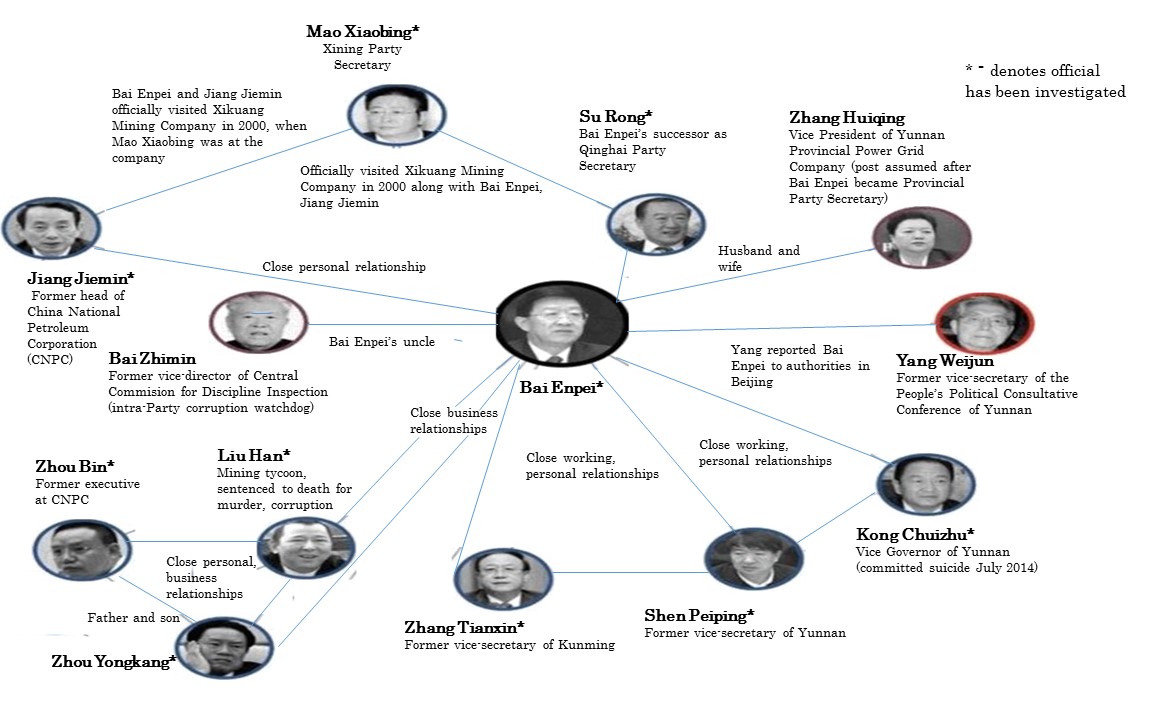
A map of Bai Enpei's relationships with other corrupt officials. An asterisk next to the name indicates that official has been investigated. (Infographic originally produced by Sohu.com August 2014)

A map of Bai Enpei’s relationships with other corrupt officials. Click to enlarge. (Infographic originally produced by Sohu.com August 2014)

As the above infographic shows, Bai Enpei was at the center of corruption among Yunnan’s political elite and closely tied with Zhou Yongkang and Liu Han. What’s more, when Bai was the party secretary of Qinghai from 1997 to 2001, he had dealings with Jiang Jiemin, a former executive of the notoriously corrupt Sinopec who is currently under investigation for embezzlement of state funds. Many of Bai’s former colleagues from his days in Qinghai have also met the same fate as him and currently face investigation by the Central Commission for Discipline Inspection.

Bai Enpei, former Party Secretary of Yunnan Province

Bai Enpei, former Party Secretary of Yunnan Province

The dominoes did not stop falling with Bai Enpei, however. In mid-October 2014, state media announced that Yunnan Party Secretary Qin Guangrong had been relieved of his duties and would be replaced by sitting governor, Li Jiheng. Qin will now assume the post of vice-secretary of the State Organs Work Committee. However, local Kunmingers interviewed see the job transfer as more of a demotion with possible serious consequences. “(Qin’s) new position is meaningless, he has no power there. The central government just put him there until he’s formally charged… and that should be coming soon,” Yang Mouren, a local teacher, claimed. He may be right. While Qin was well-liked by many locals, he had close ties to a number of disgraced officials and it is probable that like his colleagues, Qin also had his hands in corrupt resource deals. However, unless he is formally investigated, details regarding any corruption Qin took part in will not be publicly released.

Qin Guangrong (R) with his replacement as Yunnan Party Secretary, Li Jiheng (L)

Qin Guangrong (R) with his replacement as Yunnan Party Secretary, Li Jiheng (L)

With so many high officials, and hundreds of local bureaucrats, investigated, it’s clear that the central government has its sights on Yunnan’s corrupt officialdom. But, with countless other corrupt officials scattered across China, many locals are asking ‘Why Yunnan?’ The reasons are twofold.

The first has to do with Yunnan’s natural resources. Of the two provinces that have so far been cleaned out by Beijing, Yunnan and Shanxi, one important commonality is their abundance of resources. With such wealth in natural resources come opportunities for massive corruption. In the case of Shanxi, its army of ostentatiously wealthy coal bosses were known nationwide, as were their close relationships with their political patrons. At the same time, Yunnan’s reserves of aluminum, lead, zinc and tin are the largest in China and it’s clear from the cases of Bai Enpei and Zhang Tianxin that provincial power brokers were heavily involved in the illegal distribution of these resources.

Also significant is the fact that all of the high officials mentioned in this article have ties to the disgraced Zhou Yongkang and his mining tycoon friend, Liu Han. With his power base in Sichuan, Zhou’s influence on officials in neighboring provinces, including Yunnan, was deep. Shen Peiping, Bai Enpei and Qin Guangrong especially were known to belong to the same political clique that formed under Zhou Yongkang. Shen and Qin were heavily rumored to engage in business with Zhou’s family members worth tens of millions of renminbi, while Bai Enpei sold off control of a western Yunnan mine to Liu Han’s family at a cut rate. In addition, Bai and Qin were Zhou Yongkang’s unofficial hosts when he visited the province in 2007, and Bai accompanied the Politburo Standing Committee member on his 2011 trip to Laos, all implying very close relations. For their part, Kong Chuizhu and Zhang Tianxin were intimately connected to Bai Enpei and as his power grew in the province, so did theirs. As is often the case within Chinese bureaucracy, underlings rise and fall with their leaders. Bai Enpei, and those who came up with him, were intimately connected to Zhou Yongkang; they are now paying the price for their political associations.

Former Minister of Public Security, Zhou Yongkang

Former Minister of Public Security, Zhou Yongkang

Xi Jinping’s anti-corruption drive has rocked the national bureaucracy, clearing out the upper echelon of Yunnan politicians in the process. It isn’t just top officials that have felt the squeeze however; there have been noticeable effects for local bureaucrats as well. According to one university administrator who wished to remain anonymous, his college’s office environment has changed in the past year. As he explained, “Before, you just had to show up, sit in your office, drink tea and chat with the other teachers from time to time. Now, a lot of people are very nervous at the school because we’re known to be pretty corrupt.” However, the corruption crackdown has led to some unexpected opportunities. “I actually have more freedom with my job now. Because all of the higher officials are so worried about their own jobs, I can consult for other companies on the side, and they’re too busy to notice. Plus, I wasn’t too corrupt to begin with so I’m not worried.”

The changes may not be over yet, however. When asked about corruption in Yunnan, locals still doubt the effect of the current campaign. “In Yunnan, nine out of ten officials are corrupt,’’ Mr. Yang, the school teacher, claims “and it’s the same everywhere else in the country. The story isn’t over yet.”

4 Comments

Filed under China, Current Events, Governance, SLIDER, Yunnan Province

Official: Yunnan will have two bullet trains by 2016

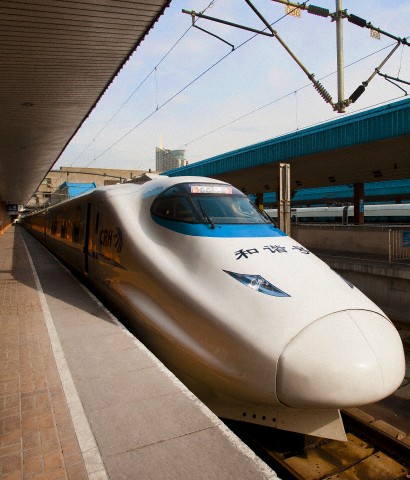
Engine of a Chinese high speed train parked at a railway station platform, Shanghai, China.  Image: Corbis

Engine of a Chinese high speed train parked at a railway station platform, Shanghai, China. Image: Corbis

Announcing specific completion timetables for infrastructure endeavors is a dicey business in China. If a project suffers setbacks and deadlines pass without completion, officials can lose their jobs. This reality makes it maddeningly difficult to guess with any accuracy when work on a given venture might actually conclude.

Such is the case with high-speed railways in Yunnan. Initial forecasts first made public six years ago anticipated at least two separate inter-city bullet train lines would be running in the province by 2015. That goal is apparently no longer feasible, but the head of the Kunming Railway Bureau (KRB) appears confident work will be completed less than two years from now.

Zhang Caichun (张才春), KRB party secretary, publicly declared both the Shanghai-Kunming (沪昆高铁) and Yunnan-Guangxi (云桂高铁) lines would be operational by the end of 2016. He made the comments October 30 while taking calls for the Mayor’s Hotline — a phone service established to make government officials more available to the public.

The Shanghai-Kunming High-Speed Railway will connect the now under-construction railway station in Chenggong to China’s most populous municipality. The dual track, passenger-only railway, will cover 2,066 kilometers and pass through the major cities of Hangzhou, Nanchang, Changsha and Guiyang. A full journey is projected to take eight to ten hours at cruising speeds of between 200 and 300 kilometers per hour.

Zhang’s comments confirmed reports regarding the Shanghai-Kunming line from last year. However, up until Thursday, no concrete schedule for the 754-kilometer Yunnan-Guangxi line had been announced. According to Zhang, that line — connecting Kunming to Nanning, and eventually Guangzhou — will be finished two years from now, at the same time as the Shanghai project. The Kunming terminus will be the existing Kunming Train Station, another detail left up in the air until Zhang began taking phone calls.

During his time speaking with the public, the railway chief also revealed details of what passengers can expect when boarding bullet trains in Yunnan. Some staff, according to Zhang, will be decked out in minority dress common to the areas through which the trains travel and dining cars will feature minority cuisine. On a more practical level, trains will all be equipped with wi-fi capability.

This article was originally posted on the GoKunming website by in News and published

1 Comment

Filed under China, Current Events, Economic development, SLIDER, Yunnan Province

8 Killed, 18 injured in Yunnan construction fracas

Police respond to the incident in Jinning County

According to local government sources, eight people were killed after a fight broke out between construction workers and villagers in Jinning County, located 60 km south of the provincial capital Kunming.

The county government reported the incident on its Sina Weibo account on October 15, a day after the fight occurred. According to sources, the incident happened at a construction site for the Jincheng Transasia Industrial Logistics Center in Fuyou Village. The fight broke out after a dispute over farm land used for the logistics center. Police reported that of the eight people killed, two were villagers and six were construction workers.

However, local villagers interviewed by Caixin said that the so-called construction workers were actually an unknown group of people. They reportedly attacked the villagers using knives and tear gas. The alleged attackders were clad in black and some carried shields that bore what looked to be police symbols. According to unconfirmed reports online, four of the unknown attackers were burned to death by the farmers. Police were called, but arrived after the fighting had stopped.

Disputes over land requisition are a common theme in rural China and Southeast Asia, as industry expands outside previous city borders and into traditional farm land. In China, most of the thousands of protests and riots that happen annually are linked with disputes over land requisition. Oftentimes, compensation given to rural villagers is also an issue, as has been documented by ExSE in its series on hydropower development on the Yalong River.

Leave a Comment

Filed under China, Current Events, Governance, SLIDER, Yunnan Province

Yunnan government weathers unexpected power shake-up

Li Jiheng (left) has taken over for Qin Guangrong (right) as Yunnan Provincial Party Secretary

The government of Yunnan completed a reshuffle of its top members a bit more than two and half years ago amid some confusion. At the time, Kunming’s golden boy partysecretary, Qiu He (仇和), received what appeared to many to be an improbable demotion. It’s déjà vu all over again as the Communist Party’s top man in the province has been relieved of his office without an accompanying explanation.

During a high-level meeting of provincial party cadres held October 14 in Kunming, it was made public that Qin Guangrong (秦光荣), party secretary of Yunnan, would be replaced by sitting governor Li Jiheng (李纪恒). Generally, such power handovers are quickly followed by news of a departing bureaucrat’s next job posting. In Qin’s case, no such announcement has been forthcoming.

The news seems all the more odd because until very recently, Qin was tabbed by many to be in line for a promotion to Beijing. The South China Morning Post is reporting that before Tuesday’s meeting, “speculation was rife […] that he could become deputy head of the party’s Working Committee of Organs Directly Under the State Council.”

Qin’s departure was conducted without any apparent rancor and the outgoing party boss gave a lengthy speech in which he said he was thankful for his 16 years of public service in Yunnan. He first arrived in the province in 1999 after a governmental stint in Hunan. Qin was then named governor in 2007 and provincial party head six years later.

The newly anointed Li also addressed the meeting and thanked his predecessor for what he deemed Qin’s “practical” approach and “heartfelt and sincere” service. Li also took the time to welcome his heir-apparent and relative newcomer, Chen Hao (陈豪). Chen had previously been deputy-head and party secretary of the All-China Federation of Trade Unions (中华全国总工会), the largest organization of its kind in the country.

Qin’s time in office will most likely be remembered for environmental issues. During the entirety of his time as provincial party head, Yunnan suffered from a recurring and often crippling drought. Qin was a vocal proponent of rerouting water from the Jinsha River (金沙江) towards Kunming in the dual hope of alleviating city water shortages and flushing away the algae blooms that have become a permanent feature of Dianchi Lake.

The secretary also had a hand in aggressively implementing Beijing’s Bridgehead Strategy — a multifaceted program aimed at strengthening the province’s economy through international business and trade. However, when all is said and done, history may judge Qin guilty by association with several governmental colleagues — including his predecessor — who have recently been embroiled in corruption scandals.

This article was written by Patrick Scally and originally published in GoKunming on October 15, 2014.

1 Comment

Filed under China, Governance, SLIDER, Yunnan Province

Jinggu Earthquake – 1 dead, 324 injured in Yunnan; are hydropower dams in danger?

Earthquake damage in Jinggu County, Yunnan

A major earthquake has struck China’s Yunnan province for the second time in just over two months. Last night at 9:49pm (Beijing time), a 6.0-magnitude quake occurred in Jinggu County, Pu’er Prefecture. According to Xinhua News Agency, the current death toll stands at 1, with a further 324 people injured.

The epicenter of the quake was 22 km west-southwest from Weiyuan Township and it struck at a focal depth of 10.9 km beneath the surface. Luckily, the earthquake occurred in a sparsely populated area of the province, and there have a relatively few casualties as a result. However, according to local authorities, a total of 92,700 people were affected by the quake, with 56, 880 of them being relocated. Within hours of the earthquake,  thousands of search and rescue personnel had been transported to the county and were undertaking operations.

Aftershocks were felt in the area for hours after the initial quake, and the largest registered at 4.2 on the Richter scale. Tremors were also felt throughout the province, with friends of East by Southeast feeling the earthquake in Kunming, almost 400 km away from the epicenter.

Closer to the center of the earthquake are a number of major hydropower dams. According to ExSE’s research, a total of 10 hydropower stations are in a 200 km radius of Weiyuan Township, some of them high-wall dams with installed capacities of over 1000 MW. The closest is the 1,350 MW Dachaoshan Dam (大朝山大坝), located just 60 km from the earthquake’s epicenter and . Yayangshan Dam (崖羊山大坝), the first in a 1,300 MW, seven-dam cascade on Yunnan’s Black River (墨江) is 85 km away and  The third closest, the Nuozhadu Dam (糯扎渡大坝), is located 118 km from the earthquake’s epicenter.

Southwest China is a seismic hotbed where earthquakes are quite common and in the past 6 years alone, there have been a number of major earthquakes in the region. The Wenchuan Earthquake (2008) killed more than 70,00 people while more recently, earthquakes in Ya’an, Sichuan (2013) and Ludian, Yunnan (August 2014), killed 220 people and 617 people, respectively. At the same time, Southwest China’s mountainous geography and wealth of major rivers makes it ideal for hydropower development.

In the past 30 years, hundreds of dams have been built in the region, however their placement in a such a seismically active area is problematic. First, there is evidence to suggest that major hydropower dams can be a factor in seismic activity. In the aftermath of the 2008 Wechuan Earthquake, a number of scientists found that the placement of a dam and its large reservoir over an active fault line could have caused the quake. Secondly, dams and reservoirs can sustain major damage in the event of a large earthquake in its vicinity. Following the 8.0-magnitude  Wenchuan Earthquake, the Chinese Ministry of Water Resources found that 2,380 dams were damaged.

Yesterday’s quake was of a smaller magnitude than the Wenchuan Earthquake so the potential for damage is smaller and at the time of publication, there have not been any reports of any of the 10 dams in Jinggu County’s vicinity sustaining damage. However, ExSE will continue to cover the aftermath of the Jinggu Earthquake and the recovery and rescue efforts undertaken.

Leave a Comment

Filed under China, Current Events, SLIDER, Yunnan Province

Rosh Hashana in Kunming

During my first year of college, I was asked to draw and divide a pie chart into five sections. From there, I was to label each section with an adjective or characteristic that I felt strongly defined me (and with which I voluntarily identified).

Immediately, I filled in four sections: Jewish, Asian American (born in China), adoptee, and traveler. Then I paused, contemplating what the last slice of my identity pie would be. Finally, I settled on cultural bridge builder.

I chose this last identifier for multiple reasons. First, it is everything I aspire to be. I aim to work in a field where I can help diverse communities connect. Second, all the activities and clubs I belonged to in high school and in which I participate at Davidson College revolve around initiatives for diversity, inclusiveness, and religious dialogue. Finally, in my view, my four other identifiers mark me as an individual who has been socialized and challenged to show the world that unique or unconventional backgrounds can lead to new perspectives.

I am not just an “other” in society that belongs nowhere. I refuse to accept such a label passively, yet it is a label so many try to pin on me when they do not understand my background. My Jewish and Asian American identities are not mutually exclusive. Rather, my understanding and connection to each group enriches my outlook on the world.

This semester, I challenged myself to study abroad in Kunming, China. Yunnan Province is known for its ethnic diversity. China has worked to incorporate these diverse minority groups into greater Chinese society, but there are still stark disparities. If anyone were to understand my struggles with fitting into Chinese society, would it not be these people?

Though Chinese by birth, I have identified myself as Jewish first for as long as I can remember. Judaism is the culture in which I was raised. Most of my role models, including close family friends and relatives, are Jewish. I never had Chinese American or Asian role models who taught me how to navigate society, deal with prejudice and discrimination, and assert myself as an Asian American woman. Rather, I consider myself a cultural and religious Jew because of the community of which I am a part and the relationships I’ve fostered since childhood. I practice certain holidays and ceremonies but also closely identify with the historic struggles of the Jewish people.

Yet the average person meets me and first identifies me as Asian, often distinguishing me as Chinese right away. He or she never assumes I am Jewish. This is a consequence of the way our society views identity—one’s race or ethnicity is defined by the viewer without ever conversing with the individual in question. Ethnicity and race become primary markers in categorizing people and subsequently applying stereotypes to that individual.

I had hoped that coming to China would help enhance my lifelong journey to define myself within a greater, international society. When I was eight years old, I remember a Hebrew school classmate asking me if it was even legal to be both Asian and Jewish. Though I’ve grown to understand that he meant no harm, these comments were painful and I reflect on them often, especially when I feel vulnerable or insecure about my identity in the context of a new place.

I have been fortunate to have spent the past three summers in Southeast Asia, engaged in both voluntary and paid experiences. As a result, I am fairly confident in my place there. To Southeast Asians I have met, I am American by culture and Asian by heritage and birth. They are curious yet respectful; no one in Southeast Asia has ever challenged my self identity or tried to suggest that how I view myself is incorrect.

I’ve had many long discussions with locals in Burma, Thailand, Laos, and Cambodia about adoption—a foreign concept to many—and Abrahamic religions. I take pride in teaching these people about my identity and culture while learning about theirs. It is truly an educational dialogue. But in no way do I, or my views, represent an entire population.

In China, on the other hand, I feel out of my element completely. I have felt more insecure here in the past six weeks than I have in any other country I have ever visited. Being surrounded by native, authentic Chinese has made me struggle internally about my place in this society. While my face to them is authentically Chinese, the way in which my parents raised me is not. Since I do not consider my biological parents my family, my family is not Chinese. Yet explaining this is complex and often causes more pain than just nodding along with Chinese who inquire about my heritage and assume I am mixed race or just the child of Chinese immigrants.

Sure, on the outside I am Chinese. But, often, my clothes mark me as a Westerner. My lack of language and cultural skills also betray my physical characteristics and mark me as alien. When I explain that I was adopted, I get a multitude of reactions. Some turn to my Caucasian friends (who have better Mandarin skills than mine) and question, ”Really?” Others look at me like I am a spectacle but nod and resume the conversation. Others still just grunt and end the discussion.

Transnational, transracial adoption and the one child policy can be touchy subjects in China. Sometimes I feel that people resent the opportunities my family has given me outside of China. Many Chinese students my age aspire to learn English and subsequently work abroad, and see my situation as ideal. I believe others fear me and are worried about resentments I may hold against China. A few cannot hold a straight face when talking to me: they cannot believe that I am not Chinese. To them, I am simply one of them with a funny accent. It isn’t possible, in their minds, that I reject my Chinese facet of identity. Herein lies the gap in my and their understanding.

In other parts of the world when I struggle with identity, I resort to the local Jewish community for support and a sense of extended family and belonging. While fitting into Judaism has also been a lifelong challenge, my adoptive family raised me in that culture and I understand those nuances more than Chinese cultural traditions. My grandfather in particular took great pride in belonging to a temple and volunteering through that network, and I hope to carry on his legacy. He and the rest of my family never made me doubt being Jewish. I find more commonalities with Jews around the world than with the pan-Asian American community.

Coming to China, I hoped to find at least a small Jewish community. Usually Jewish communities become more outwardly present during the High Holy Days of Rosh Hashanah and Yom Kippur. I sought assistance from my program directors and RA, hoping they could steer me in the direction of a service or gathering for Rosh Hashanah. One told me of services on Rosh Hashanah that were open to Jews all over Kunming. Many, she said, belonged to the Israeli or American ex-pat communities.

Excited, I set out on the morning of the New Year. When the cab driver didn’t know the address I showed him, I walked. I was proud that I navigated the city by myself. Despite being anxious about meeting a new group of people (I am extremely shy around strangers, especially when there is a potential language barrier), I hoped that this service would lead to the opening of a new community and relationships. Obviously I wouldn’t be engaged in the same way as in New York where I grew up, or North Carolina where I go to school, or Europe where I’ve visited various synagogues. But a new service would be part of the adventure. Going beyond my comfort zone would not kill me.

To my surprise, the address was a Chinese language school in which ex-pats in Kunming came to study Mandarin intensively. Furthermore, none of the staff knew of the Rosh Hashanah programming. Hmmm. I looked at the company’s logo: it had two Stars of David. Why? One staff member explained that Chinese people like to do business with Jews and see many similarities between the groups. I chuckled, recalling New York Times articles that discussed Chinese peoples’ fascination with Jews.

I was about to leave, admitting defeat in my quest for a service, when another woman from the language school asked me to wait. Apparently, there was a man praying upstairs and I could speak to him when he finished. Hope inside me sparked anew. I’d come all this way—why not try talking with him? I returned to my seat.

An hour later, he emerged from upstairs and I introduced myself. He did the same. He had come from Singapore and had converted to Orthodox Judaism. He prided himself on being a practicing Jew and spoke of his leadership roles in Kunming. He said the Rabbi sometimes asked him to organize gatherings or lead prayers. This all sounded along the lines of what I wanted.

Then the man asked me about my affiliation to Judaism. This is never an easy question for me to answer. Not because I am uncomfortable, but the intricacies of my background sometimes lose people. I told him that I was born in Yangzhou and adopted at five months of age. I explained that my parents subsequently had a mikvah (conversion ceremony) for me. I said that I was a Reform Jew, and told him that while it is unique to the United States, our customs follow cultural and religious Judaism.

He then asked me how I was raised. I replied that I had a bat mitzvah, had attended religious school, and was even the president of Hillel (the Jewish student organization) at Davidson College. He frowned, and I felt myself recoiling. Why were we still talking about my background? Why was he not nodding or even smiling?

Then came the question: did I have proof of my conversion? Had I stood before rabbis and sworn my allegiance to Judaism? Sure, this man was strictly Orthodox, but did he not realize that there are different types of Judaism and that I was no less Jewish than he? While he did not distinguish between religious and cultural Judaism, I got the distinct impression that he was trying to prove he was more Jewish and more devoted.

Again and again, he told me I could not truly be Jewish because my birth mother was not. He said I would have to stand in front of Rabbis before I could be a real Jew. Wasn’t this hypocritical? Didn’t he understand that an infant who was immersed in a mikvah and experienced the ritual cleansing it provides was as Jewish as someone born to a Jewish woman? His conversion, as an adult, required study and supervision. Mine did not.

As I kept trying to explain my background and why I was Jewish, I felt tears pricking at the back of my eyes. Rosh Hashanah is supposed to be about a sweet new year and the idea of a Jewish community or family. From my past experience, Orthodox Jews have always wanted to draw me into their stricter traditions and show me the way. Why was he excluding me?

Judaism had been the backbone of my upbringing and identity. Being told, bluntly, that I was not Jewish hurt me deeply. I was once again being excluded from a community. This time, though, it was a community in which I usually sought comfort after being detached from my Asian identity. If I am shut out of both my Asian and Jewish communities, to whom could I turn?

As a member of the Better Together interfaith movement, I had to remind myself that not everyone sees difference within and between religions as an asset. I call myself a cultural bridge builder, but not everyone supports my efforts. Some prefer to remain on islands, disconnected from those around them.

Living in China this semester has been difficult thus far. I look like an insider and feel like an outsider. I’ve been told again and again that I have an advantage because I look like the majority here, but if I don’t feel like the majority on the inside, does the color of my skin or my complexion matter? I know in a few years, I’ll value these experiences as important learning experiences. But now, the pain overrides the growth that I know will come from this.

2 Comments

Filed under China, Culture, SLIDER, Yunnan Province

Water release at Yunnan dam sparks SE Asian alarm

Manwan Dam, Yunnan

A huge hydroelectric facility in southern Yunnan is causing tension between China and several of its downstream Southeast Asian neighbors. The Jinghong dam (景洪大坝), which stretches across the Mekong River, is currently discharging water in an effort to lower reservoir levels, raising the specter of flash flooding further south along the riverway.

On September 1, the Chinese government informed flood control authorities in Cambodia, Laos and Thailand that the dam would begin to release large amounts of excess water. The facility partially opened its floodgates September 5, releasing 535 cubic meters of water per second. Such activity is expected to continue through the end of the month.

Although this amount of water has yet to cause flooding in Laos or Thailand, both countries have issued public warnings as a precaution. Officials in both countries fear any further increase in outflow from the dam — which has the capacity to release up to 9,000 cubic meters of water per second — could have disastrous consequences. An unnamed official in Laos told website RFA river levels in the city of Houayxay — 200 kilometers south of the Jinghong dam — had risen noticeably but had so far not approached flood levels.

Thailand, which makes up more than 800 kilometers of the country’s northern border, is currently in the grips of its annual flood season. At least 28 provinces in the country’s north are already experiencing widespread inundations. Because of this, Thai flood control authorities are particularly wary of any increased flow along the river. Channel News Asia is reporting “the situation at the Chao Phraya dam, the main water gateway between the mountainous north and the central plains [of Thailand], are at a critical level”.

Further downstream in Cambodia and Vietnam, officials appear less concerned. No flood warnings related to the Jinghong dam water release have yet been issued in either country. However, a spokesman for Cambodian water conservancy group 3S Rivers Protection Network told reporters, “We know when an upstream dam opening its gates to release reservoir water combines with the heavy rains of wet season, it’s a high threat.”

The 1,750-megawatt hydropower plant, located roughly five kilometers north of the city ofJinghong, first went into operation 2008 following more than five years of construction. Power generated at the facility is used in Yunnan but is also often sent to energy-hungry Guangzhou or exported to Thailand.

Exemplified by the current situation in Jinghong, cross-border management of the Mekong — called the Lancang River (澜沧江) while flowing through China — is often a contentious issue. Mekong countries have, in the past, expressed frustration over how the river is handled inside China. Such concerns largely revolve around the wellbeing of the 48 million people who rely directly on the waterway for their food and livelihoods in Southeast Asia.

This article was written by Patrick Scally and originally posted on GoKunming.

Leave a Comment

Filed under ASEAN, China, Energy, Mekong River, Regional Relations, SLIDER, water, Yunnan Province