

Category Archives: Vietnam
China Sea Territory Disputes (source: Money Morning, NPR, google news)
Filed under Brunei, China, Foreign policy, Malaysia, Myanmar/Burma, Philippines, USA, Vietnam, VISUALS, water
China & Southeast Asia: Unbalanced Development in the Greater Mekong Subregion
By Xiangming Chen and Curtis Stone
Integrating with Southeast Asia is a key component of China’s multi-pronged regionalisation around its borders as its global rise continues. Below, Xiangming Chen and Curtis Stone consider the ambition of China’s ‘Go Southwest’ strategy to extend its economic interests and influence into Southeast Asia, and explore how China’s regional assertion reinforces the larger trend of new spatial configurations in light of increasing globalisation. The authors show how simultaneous globalisation and regionalisation unleashes a dual process of de-bordering and re-bordering where the traditional barrier role of borders is yielding more to that of bridges, as small, marginal, and remote border cities and towns become larger centers of trade and tourism. This article examines China’s effort to engage Southeast Asia and many of China’s footprints within and beyond the cities of the Greater Mekong Subregion (GMS). Inter-country and intra-regional trade provides the starting point for examining the extent of economic integration in the GMS, and also its unbalanced development.
Going Southwest
In a coffee shop in central Vientiane on a hot summer day in 2012, two young Chinese businessmen from northwestern China, sipping ice-cold Latte, talked about the prospect of a new venture to explore copper in the mountains of northern Laos: ‘If we make $100 and they [Laotians] get $5, they should be happy’. On the outskirts of Yunnan’s capital city of Kunming, China’s fourth largest airport behind Beijing, Shanghai, and Guangzhou (also the world’s fifth largest airport in occupied area), Changshui International Airport, which is expected to have flown 38 million passengers by 2020 and 65 million by 2040, was opened with much fanfare in June 2012. While seemingly disparate, this pair of anecdotes reveals the ambition of China’s ‘Go Southwest’ strategy to extend its economic interests and influence into Southeast Asia.
Integrating with Southeast Asia is a key component of China’s multi-pronged regionalisation around its borders as its global rise continues. China’s regional assertion reinforces a larger trend of new spatial configuration as an inherent part of increasing globalisation driven by China. This simultaneous globalisation and regionalisation unleashes a dual process of de-bordering and re-bordering where the traditional barrier role of borders is yielding more to that of bridges (Chen). As a result, once small, marginal, and remote border cities and towns have become larger and lively centers of trade, tourism, and other flows. China’s effort to engage Southeast Asia leaves many striking footprints within and beyond the cities of the Asian Development Bank (ADB) facilitated Greater Mekong Subregion (GMS), which was launched in 1992 and consists of China’s Yunnan Province (with the later addition of Guangxi Zhuang Auto-nomous Region), Cambodia, Laos, Myanmar, Thailand, and Vietnam.
Trade with the GMS Countries
Inter-country and intra-regional trade provides the starting point for examining the extent of economic integration in the GMS as well as its unbalanced development. China’s trade with each of the GMS countries has grown since 1990, most rapidly since 2000 (see Figure 1). Given the size of their economies, Thailand, followed by Vietnam, led the smaller GMS countries in trade with China. However, the total volume of China-Myanmar trade rose by $5.9 billion from 2001 to 2011, while China-Laos trade increased by $1.2 billion (Figure 1). Much of China’s growing trade with Myanmar and Laos occurred through cooperation across international boundaries. The role of Yunnan and its capital city of Kunming in China-GMS trade cannot be understated. Yunnan’s GDP skyrocketed from $33 billion in 2000 to $160 billion in 2012, and the province aims to double that to $320 billion by 2017 through even stronger cross-border economic and trade ties. Kunming acts as the origin and core of economic activities that reach into the bordering countries of Laos, Myanmar, Vietnam, and beyond.

China needs to change its energy strategy in the Mekong region
This op-ed was first published at ChinaDialogue and thethirdpole.net on 7/16.

At the end of this year cars and container trucks loaded with goods from China and Thailand will finally be able to drive across a multi-lane bridge spanning the Mekong River (known as the Lancang in China). The bridge will connect Chiang Rai province in Thailand to Bokeo province in Laos, effectively linking China’s highways stretching south from Beijing and Shanghai to those coming north from Singapore, Kuala Lumpur and Bangkok.
Funded by equal investment from the Chinese and Thai government, the completion of the bridge, which took ten years of planning and two years to build, is not without controversy. For many years Thailand held back investment due to an uneven distribution of benefits between China, Laos and Thailand. Also on the Thai side, the NGO Rak Chiang Khong claim the bridge negatively impacts the local Golden Triangle economy and will ruin Mekong fisheries.
The Golden Triangle Bridge serves to highlight the challenges facing China, as the country’s new leadership attempts to balance its slowing and volatile economy and deliver domestic stability by maintaining peaceful economic relations with its neighbours.
China’s regional strategy
“In 2012 China’s growth in trade and outward investment with the five other Mekong countries of Myanmar, Laos, Thailand, Cambodia, and Vietnam surpassed its trade and investment growth in ASEANcountries,” said Xu Ningning, chairman of the Greater Mekong Subregion (GMS) Business Council. “Greater growth rates will continue with increases in regional cooperation and win-win investment opportunities.”
For the past three years China’s GMS provinces of Yunnan and Guangxi have posted growth rates of 12-15%, the highest of China’s localities, and arguably China’s economic rise has also helped deliver high growth rates among Mekong countries.
The end of the Cold War in the 1990s created a favourable environment for China to develop its economic cooperation strategies toward the Mekong region. The blurring and opening of once inviolable borders encouraged traders on both sides of the China-Southeast Asia frontier to appeal to local and national governments for better conditions for trade and migration. The Chinese government responded with twenty years of state-led trade liberalisation and investment policies to promote regional cooperation in state and private sectors.
China’s economic cooperation strategies towards its four Mekong neighbours has dovetailed nicely into a strategy that fits China’s current development needs. Liu Jinxin, a policy analyst and logistics expert says, “Unlike the US which leads the world in finance and IT, both high-value service-oriented industries, China is the world’s factory, producing goods to drive the growth of its growing middle class and serving export markets around the world. To survive, the Chinese ‘factory’ needs inputs like energy and raw materials.” Continue reading
The Code of Conduct for the South China Sea: A Waiting Game
On June 30, 2013, following the China-ASEAN Foreign Ministers’ Meeting held in Bandar Seri Begawan, capital of Brunei, China released a joint-statement with ASEAN in a post-meeting press conference, indicating that they have agreed to hold “official consultations” on a proposed Code of Conduct (CoC) to govern South China Sea “naval actions”. All parties agreed to move forward with consultations in upcoming meetings to be held in China during September later this year.
Misleadingly or mistakenly billed as a significant paradigm shift by many English language news outlets, this development should not have come as a surprise to anyone. As early as November 2012, China already issued a joint statement with ASEAN at the 15th ASEAN-China Summit in Phnom Penh, Cambodia, marking the 10th anniversary of the Declaration on the Conduct of Parties in the South China Sea (DOC) and agreeing to “keep momentum of dialogue” in moving towards a formal Code of Conduct (COC). China also reiterated this commitment in April this year, following the 19th China-ASEAN Senior Officials’ Consultation.
For the casual observer, keeping track of the ins-and-outs of numerous ASEAN-China agreements and cryptic diplomatic sparring over South China Sea (SCS) disputes can be daunting. News reporting differs greatly depending on its country of origin and the same story can be told in a hundred different ways leaving entirely different impressions of what happened. The following is a breakdown of the important historical, political, and legal considerations necessary to understand what the Code of Conduct for the SCS is, why it is important, and how it may eventually come about. Continue reading
Filed under ASEAN, Brunei, Cambodia, China, Current Events, Energy, Foreign policy, Indonesia, Laos, Malaysia, Myanmar/Burma, Philippines, Regional Relations, Singapore, Thailand, Vietnam, water
Remarks: Strengthening Cooperation & Promoting Cross-border Transport Logistics
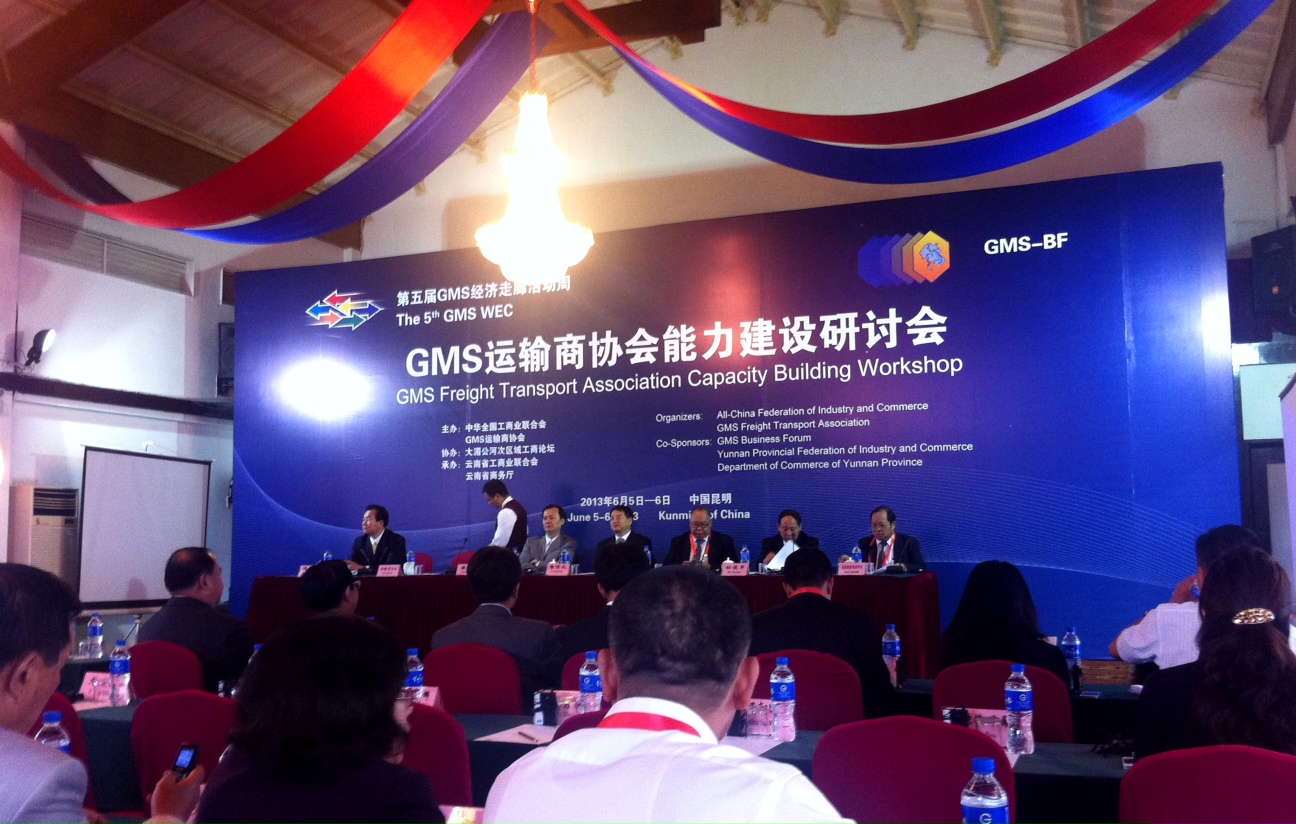
NOTE: The following is the English language transcription of a speech by Yang Shiji, Vice Director of the Yunnan Provincial Government’s Research Office, presented on June 5, 2013 at a workshop on GMS (Greater Mekong Subregion) Freight Transport Association Capacity Building. The first part contains an interesting portrayal of connectivity potentials and a brief history of transportation linkages between China and Southeast Asia. The reader should keep in mind that the area in discussion contains some of the most difficult terrain in the world, but the speaker’s main concerns are inter-government cooperation and the harmonization of customs and trade procedures throughout the region. The final portion of the speech provides a framework to improve connectivity and upgrade logistical services within the region.
For reference, a map of the Greater Mekong Subregion is linked here.
“Strengthening Cooperation and Promoting Cross-border Transport Logistics in the Greater Mekong Subregion”
Cross-border logistics is an emerging industry combining several composite services such as transport, warehousing, and information. Connecting production with consumption and linking countries to the outside world, the industry is composed of tangible and intangible factors and covers the entire process from product manufacturing to commodity flow. Therefore, giving full play to the function and role of transport and upgrading the efficiency of cross-border logistic transport will have significant impact on all aspects of the economic and social lives of the countries in the GMS. With the maturation of China’s market economy, a professional and efficient logistic system has been an indispensible factor for upgrading the quality of its economic functions, the income of its enterprises, and an accelerator for its entire national economy.
Located at the junction of China and Southeast Asia, the South Asian Subcontinent, Yunnan borders with Laos, Vietnam, and Myanmar, and shares with them a 4060 km national boundary line, about one-fifth of China’s total land border. It has 25 frontier counties, 23 national entry ports, and over 100 trading channels for border residents. To its east Yunnan is linked to the Zhujiang River delta and the Yangtze River delta economic circles, and to its south it has direct access from three routes, east, central, and west, to Hanoi, Bangkok, Singapore, and Rangoon via the Kunming-Bangkok highway and the Pan-Asia Railway, currently under construction. It is the gateway to the vast western hinterland of China to its north. To its west, it has access to the Indian Ocean via Myanmar. In a word, the province enjoys the locational advantage in “connecting with two oceans, the Pacific Ocean and Indian Ocean, and linking with three major markets in East Asia, Southeast Asia, and South Asia.” Continue reading
Filed under China, DOCUMENTS, Economic development, GMS, Laos, Mekong River, Myanmar/Burma, Regional Relations, Technology, Thailand, Vietnam
What’s at Stake for the China-South Asia Expo?
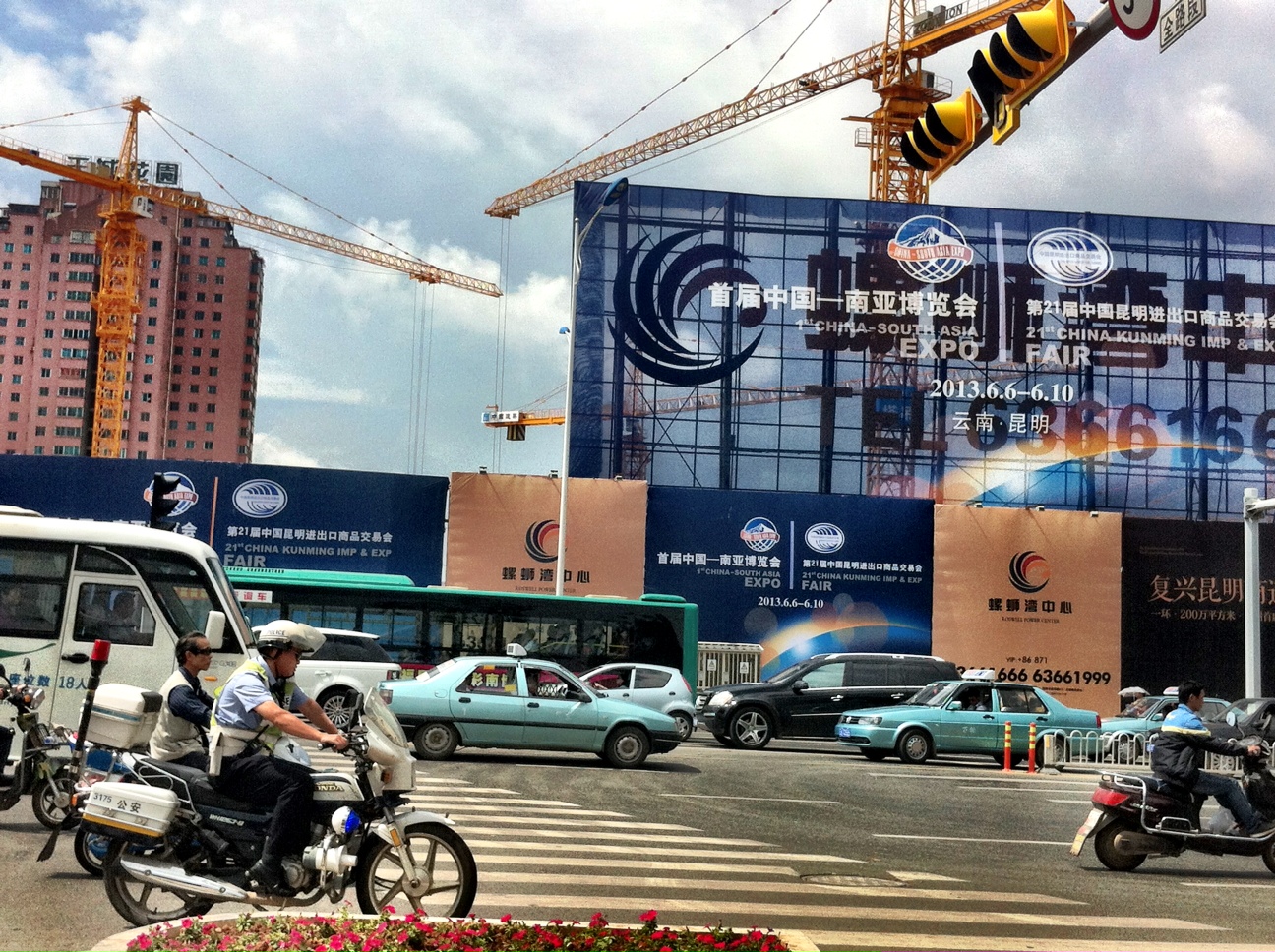
The China-South Asia Expo opened without a hitch yesterday in Kunming despite online calls for a continuation of environmental protests outside of the Expo’s opening ceremony site. It seems protesters decided to stay home due to a combination of sticks and carrots offered by local authorities. On June 3, Kunming’s mayor announced the release of key environmental impact assessment data concerning the construction of a PetroChina oil refinery and PX chemical plant side project scheduled for construction 40 km from the city’s downtown area. Also, the excessive presence of armed and unarmed public security officers lining the city’s streets and manning the Expo site also likely turned protesters away.
What is the rationale behind the excessive security measures? What’s really at stake at the 1st China-South Asia Expo?
The Expo, a combination trade fair and high level forum for investment and trade promotion discussions between China, Southeast Asia, and now South Asia, is part of China’s “Bridgehead Construction” strategy to establish Kunming and Yunnan province as a gateway between China and its neighbors to the south and west. A smoothly running Expo not only will seal multilateral agreements and high-value business deals that will streamline regional trade and investment, but it will also guarantee the continuation of soft-budget infrastructure development projects sponsored by Beijing to Kunming and Yunnan province that are part and parcel of the “Bridgehead” strategy.
Where have all the fish gone? Killing the Mekong dam by dam
The Mekong, a river of wildly majestic fast-flowing currents flowing through six countries, has long enchanted explorers with its rich biodiversity second only to the Amazon.
It is home to the Giant Catfish, and at least 877 fish species sustaining food security for around 65 million people which make the Mekong the world’s most important centre of freshwater fisheries.
“For the people born on the Mekong, the river is like their blood—the principle of life,” says Dorn Bouttasing, a Lao environmental researcher.
Surely it is unthinkable that man would want to endanger or destroy the basis of such extraordinary natural wealth? Such invaluable natural resources, their infinite value defies any attempt to measure with a crude price tag.
My documentary Where Have All the Fish Gone? (Eureka Films) looks at the four Chinese hydropower dams that have been already built on the Lancang (The Chinese name for the upper Mekong), but its main focus is on the Lower Mekong basin shared by Laos, Myanmar, Thailand, Cambodia and Vietnam.
Regional Roundup for Week of 4.18.2013
Just the news this week. Continue reading
The logic of China’s economic strategies in Southeast Asia
In so many ways, China’s strategies for its involvement in Southeast Asia are much more pragmatic, more predictable, and considerably less nefarious than any other rising global power that previous laid sight on region. Moreover, those strategies, born in the 1990s, make even more economic sense now than at the time of their inception due to the current needs of its development trajectory.
Energy consumption and the speed of urbanization in China are rising at ever-increasing rates. To keep pace, the central government must secure energy resources and safe, low-cost agricultural goods. Southeast Asian states, in a complementary fashion, have robust food export markets, as in the case of Thailand or Malaysia, or as in Laos and Myanmar, have abundant endowments of energy resources. Chinese state owned enterprises and private business interests seek to access and integrate into these markets and new infrastructure linkages such as highways and high-speed railways are indicators of deeper market integration abroad. Continue reading


