Category Archives: Thailand

Unexpected Waters: How Sudden Water Changes in the Mekong Affect Local Thai Livelihoods


The riverbank vegetable plot in Boong Kla sub-district, Boong Kla, Bueng Kan was completely inundated.  Ms. Jarin Kamghong had to replant the plot after flooding in December 2013.  Photo: March 8, Montree Chantawong

The riverbank vegetable plot in Boong Kla sub-district, Boong Kla, Bueng Kan was completely inundated. Ms. Jarin Kamghong had to replant the plot after flooding in December 2013. Photo: March 8, Montree Chantawong

On an early morning last December, Manee* (name changed to protect privacy), a woman of 73, woke to prepare offerings to the monks in Ban Viang Kook of Nongkhai Province in Thailand. A papaya in one hand, she steadied the knife in the other to make somtum – northeastern Thailand’s famed salad dish. Apart from unripened papaya, the other crucial ingredient is tomato. Manee walked to her backyard on the banks of the Mekong River to pick some. That’s when she realized that her riverbank crops had flooded overnight, as she lifted her sarong up above her knees to avoid the water. Continue reading

2 Comments

Filed under China, Economic development, Energy, Environment and sustainability, Food, GMS, Governance, Regional Relations, SLIDER, Thailand

Terrorists or Refugees?: Case of ‘Uighur’ Migrants Unsolved in Thailand

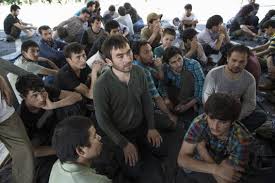
Detained Uighurs in Thailand. Photo: Reuters

Detained Uighurs in Thailand. Photo: Reuters

In the past two weeks, close to 300 suspected Uighur migrants were discovered in the jungles of southern Thailand. Since their discovery and apprehension by Thai authorities, accusations of terrorism and rebuttals to these claims have flown.

Quoting an unnamed source attached with Thai police, the Bangkok Post published an article claiming that the migrants were indeed Uighurs. They intended to use Thailand as a transit point to go to Turkey, where they would be trained in terror tactics that could be used in their native China and elsewhere.

Recently, two groups of migrants have been found in the south of Thailand. The first, discovered March 12 at a rubber plantation near Songkhla, was a group of 219 people, containing dozens of women and children. Another group of 77 were arrested near a school in Sadao district on the 20th of March.

The same source alleged that the migrants were identified as Chinese Uighurs and not Turks, as they have claimed, by bus tickets and items that had Chinese writing on them. “Immigration police are not stupid,” the police source added.

Turkey has sent diplomats to southern Thailand to verify the migrants’ claims of Turkish nationality. The migrants were able to speak with diplomats when interviewed, however when met by an interpreter from the Thai Immigration Bureau they could not communicate well. “The interpreter believed they could not speak Turkish,” the source said.

A named source, Thai Immigration Bureau chief Lt. General Panu Kerdlarppol, refused to give any specific details regarding the migrants’ nationality or ethnicity. However, historically and geographically, it would make more sense that they were Uighur. Thai authorities have been aware of a Uighur migrant presence in the country since last year.

In December 2013, 112 refugees were arrested in the country’s south and are now being held at a detention center. Thirty of the migrants have so far been positively identified as Uighurs. Following the arrests, Lt. General Panu met with Chinese authorities in Kunming about the issue.

There are some, however, that dispute claims of the migrants’ nefarious motives. Speaking through the Phuket Wan Tourism News, the New York-based Human Rights Watch dismissed the accusations.

‘The groups in question are composed of significant numbers of small children, and more than a few pregnant women,” Phil Robertson, Deputy Director, Asia Division, Human Rights Watch, said today, ”so one wonders how unnamed police sources have suddenly somehow jumped to a conclusion that these people are ‘terrorists.”

Mr. Robertson links these claims of terrorism to Thailand’s treatment of asylum seekers in the past. Starting in 2009, hundreds of Muslim Rohingya refugees from Myanmar began regularly washing ashore on Thailand’s western coast. These refugees, fleeing ethnic violence in their home, were also labelled as terrorists. Oftentimes, they were pushed back out to sea by units of the Thai navy.

”It seems pretty clear that Thai officials have some ulterior motives in trying to tar this entire group with the ‘terrorist’ label,” Mr Robertson said.

He believes the end game is to deport the migrants to China, ”I suspect that such ‘terrorist’ accusations are a prelude to some Thai government officials trying to force these groups back to China in what would be a clear violation of international law,” Mr Robertson surmised.

Migrants claiming Turkish nationality were also arrested in Malaysia this month, though no further word on their situation has been released.


1 Comment

Filed under China, Current Events, ethnic policy, Kunming Train Station Attack, Regional Relations, SLIDER, Thailand

‘Uighur’ Refugees Arrested in Thailand, Malaysia: Part of a Larger Trend?

Detained Uighurs in Thailand. Photo: Reuters

Detained Uighurs in Thailand. Photo: Reuters

Last week, East by Southeast, in a piece hypothesizing the motives of the Kunming train station attackers, made the connection between Uighur asylum seekers, Yunnan and Southeast Asia. In the analysis, ExSE posited that Thailand was a likely destination for Uighur refugees as they made their way from Xinjiang, through Yunnan and into Myanmar or Laos. This past week, two separate incidents in near the border of Thailand and Malaysia occurred that appear to confirm this hypothesis.

News was released on Thursday that Thai authorities had rescued 200 people from a human smuggling camp in the south of Thailand. During a raid on Wednesday, police discovered 200 people imprisoned in a camp suspected to be used for human trafficking.

The group, which includes 78 men, 60 women and 82 children, at first claimed to be Turkish, despite having no documents to confirm that. However, they have now been identified as ethnic Uighurs from China by a US-based organization.

With their identities confirmed, Thailand has faced calls to not to deport the refugees, with the US State Department also weighing in.

“We are concerned about Uighurs generally (and) welcome reports that these Uighurs were rescued,” State Department spokeswoman Marie Harf told reporters Friday. “We’re encouraging Thailand to make sure their humanitarian needs are met.”

US-based Human Rights watch also urged the Thai government not to deport the refugees. “Thai authorities should realize that Uighurs forced back to China disappear into a black hole,” Brad Adams, the organization’s Asia director said in a statement.  “They need to allow all members of this group access to a fair process to determine their claims based on their merits, not on Beijing’s demands.”

Refugees on the way to a Thai detention center

Refugees on the way to a Thai detention center

Despite these calls, dozens of the refugees were sentenced for illegal entry by a Thai court on Saturday, with each person assessed a fine of 4,000 baht ($124). For now, the men will be taken to an immigration detention center and the women and children will be taken to a shelter, according to Police Major General Thatchai Pitaneelaboot.

In a possibly related story, 62 people were arrested just across the border in Malaysia last week. Like the group caught in Thailand, the Malaysian also claimed to be Turkish refugees. The group of alleged Turks were found near the border fence during routine patrols early Thursday morning Deputy Superintendent Sivam of Malaysia’s General Operations Force said in a statement.

Despite their claims of Turkish nationality, those arrested were not carrying valid travel documents or identification papers and historically, there has been a small, if nonexistent presence of illegal Turkish immigrants in the region. In light of this and the arrests in Thailand, some in the media believe that the alleged Turks might in fact be Uighurs from China. If so, this would mark the largest number found in Southeast Asia to date.

If both groups arrested are indeed Uighur refugees, their escape to Southeast Asia wouldn’t be without precedent. Since Cambodia deported 20 Uighurs back to China in 2009, there have been a string of similar deportations in the region. In 2010, Lao PDR deported a group of seven Uighur refugees back to their native Xinjiang in northwest China and in 2011 and 2012, Malaysia deported separate groups of refugees to China. Each deportation case has been heavily criticized by rights groups like Amnesty International and Human Rights Watch. Human rights groups fear that once repatriated, Uighurs face a grim future of long prison sentences and possible torture. Refugees deported back to China from places like Pakistan and Cambodia have all faced life prison terms upon their return.

The threat of prison is likely a reason why those arrested in Thailand and Malaysia have claimed to be Turks when discovered. Instead of admitting to Chinese nationality and facing the possibility of deportation back to China and likely prison time, the refugees opted for claiming another nationality. Seeing that the Uighur population is nearly all Muslim and speaks a Turkic language, claiming Turkish citizenship was a natural choice.

However, as is the case with both groups of refugees, these people’s true identities have yet to be discovered. If they aren’t Turks, are they really Uighurs? If they are Uighurs, how did they get to the Thai-Malaysian border and why did they come this far? Was Malaysia, a Muslim-majority country with labor shortages, the final destination? If both groups are indeed Uighur, this would mark a new level of southward migration for Uighur refugees. Might this also tie them to Kunming train station attackers, as East by Southeast hypothesized? For now, these are only questions, but ExSE will be searching for answers.


1 Comment

Filed under China, Current Events, ethnic policy, Kunming Train Station Attack, Malaysia, Regional Relations, SLIDER, Thailand, Uncategorized

New Addition: Country Profiles on East by Southeast

ExSE is excited to announce the addition of a new section to our website!  Country profiles are now available for Cambodia, Laos, Myanmar/Burma, Thailand, and Vietnam.  These profiles introduce the historical, political, and economic milieu of countries in Southeast Asia and provide you with up to date analysis of current events and developing trends in the region.  You will find links to economic and environmental data as well as a discussion of each country’s regional connections (including the China connection!) in a greater context.

These country profiles are authored by undergraduate students enrolled in the Regional Development in China and Southeast Asia program at the IES Kunming center.  Each semester new students will have the opportunity to update, edit, or add to the existing reports so be sure to check for updates frequently.

Country reports can also be accessed via the site’s top menu bar under Profiles.

If you have suggestions, contributions, or photos to provide for the country reports, please feel free to contact us at eastbysoutheastmail@gmail.com.

Leave a Comment

Filed under ASEAN, Cambodia, China, Current Events, Laos, Myanmar/Burma, SLIDER, Thailand, Uncategorized, Vietnam

The Unlikely Story of Pastor Yang Congguang

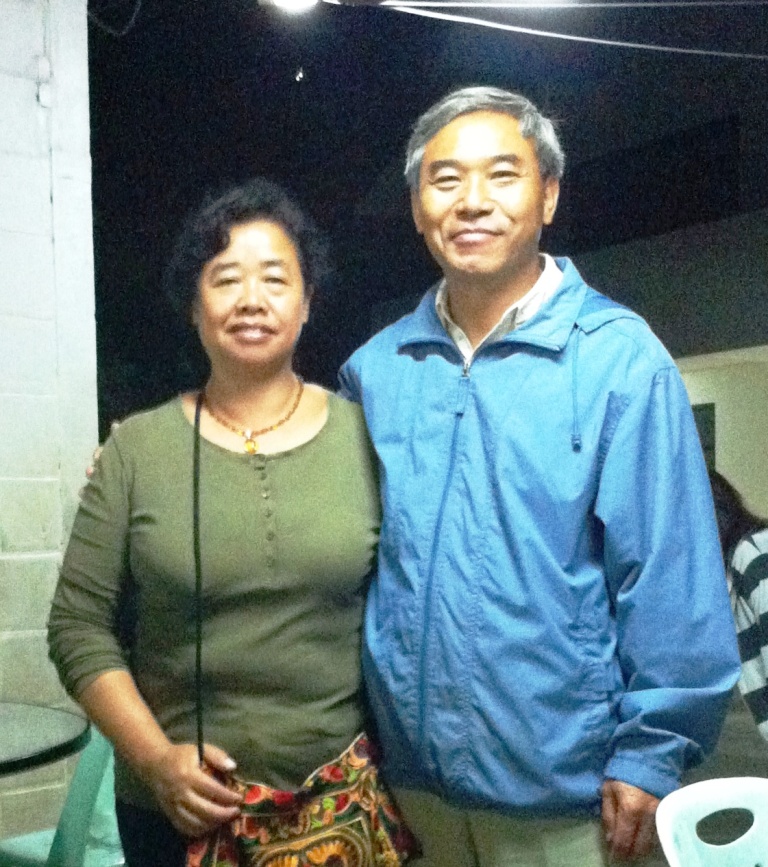
Pastor Yang Congguang and his wife

Pastor Yang Congguang and his wife

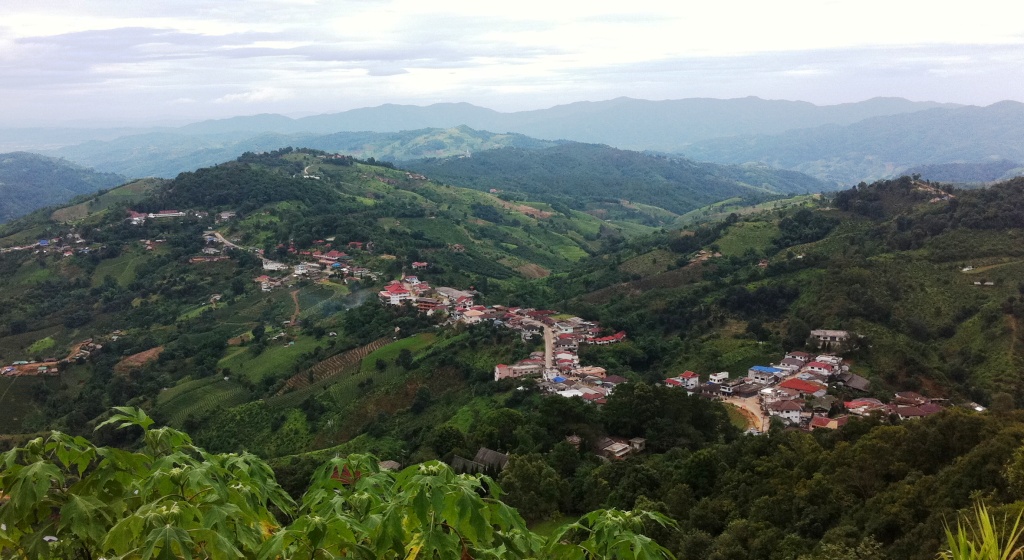
It’s lunchtime in Mae Salong, a small village perched on the spine of mountains that trail south from China’s Yunnan province to divide Thailand and Myanmar. The restaurant sign is in Thai, but the menu is written in traditional Chinese, offering peanut-flecked pad-thai noodles and steamed chicken jiaozi dumplings finished with tea grown in the surrounding hills.

Throughout the meal, English, Thai, Mandarin, and a local Akha dialect mingle along with the food, a cultural confluence that reflects the town’s unique history. Officially now called Santakhiri by the Thai government, Mae Salong is perhaps best known for its role as a heroin trading outpost and as a base for remnants of Chinese Kuomintang forces who refused to surrender to the Communists. Even today, the village has a distinctly Chinese flavor, where a dialect similar to Yunnan’s is spoken at stores, restaurants serve Yunnan-style food, and Mandarin language instruction is an option for public education.

The village of Mae Salong

The village of Mae Salong

The local economy now relies on tea production and cultural tourism surrounding the local Akha highland hill tribes rather than heroin, however the Kuomintang heritage of many villagers remains an enduring legacy. Pastor Yang Congguang of the local Baptist Church is one such resident of Mae Salong.

Pastor Yang was born in 1956 in Luxi County in Yunnan Province, during what he calls “an era of war” that followed him around through childhood and much of his adult life. By the time he was two years old, Yang had already been registered by the government to join the army upon adulthood, along with his two older sisters. Yang’s parents decided to flee to Burma, hoping to escape increasingly dismal prospects in China.

Yang’s father, a farm veterinarian, went first in 1957 to a village in Kokang in northern Burma settled by other ethnic Chinese. The head of the village there owned some 3000 horses, and his father’s skills were highly sought after. However, the Chinese population of the village were not the majority Han ethnic group like Yang’s family, but the Lisu people, one of the many ethnic groups of upland Southeast Asia.

Yang’s father found the Lisu not at all as he had imagined “backwards” minority people to be. He was impressed how many of the Lisu, especially the Christian population, did not smoke, drink or gamble, and furthermore were educated enough to read. Yang’s father told the chief that he wanted to bring his family to the safety of Kokang, and that if the villagers prayed for the family’s safe passage, they would all convert to Christianity.

Yang supervising construction of his new church.

Yang supervising construction of his new church.

By this time it was 1958, and leaving China had become increasingly difficult and dangerous. Yang’s extended family, numbering sixteen people in total, required three trips and traveling only at night through the forests. During the final trip, it rained hard all night just before they were to cross the border and the group lost the right path. When the sun came up, his father realized they were very close to the only road across the border, manned by a PLA checkpoint. Despite the danger of trying to cross during the day, Yang’s father decided to take the risk. At the border, chance had it that checkpoint patrol house was empty, although the stationed soldiers had built a small fire. Yang’s uncle stopped briefly to warm his hands, telling the group to go on ahead. Today, Yang estimates that his family must have had only a few minutes’ window of time to sneak across the border.  His uncle did not rejoin the group and was never seen nor heard from again.

Once in Burma, the Yang family reached Kokang safely and converted to Christianity as promised. The Kokang authorities did not permit education in Chinese, so Yang learned through studying the Bible. In Kokang the family had a few years of peace, until 1966 when the Burmese Communist party swept into the northern border region, beginning a period of civil unrest as well as tumult in Yang’s life. The family moved further south, to an area in Burma populated by the Shan (Dai) ethnic minority, where they stayed for three years until once again the Burmese communists arrived. The Yang family to Lashio in the eastern Shan state, and then again even further south to an area with very few ethnic Chinese.

Yang’s adolescence occupies a murky place both in memory and time, a period of transience and uncertainty that also coincided with the rise of the heroin trade in Southeast Asia. Former Kuomintang soldiers clashed with Burmese communists, with unrest and violence spilling across the borders of Thailand, Burma, and Yunnan. During these years, Mae Salong sprung up as both a drug trading outpost and a refuge for Kuomintang soldiers recruited by the Thai government to counter Communist threats.

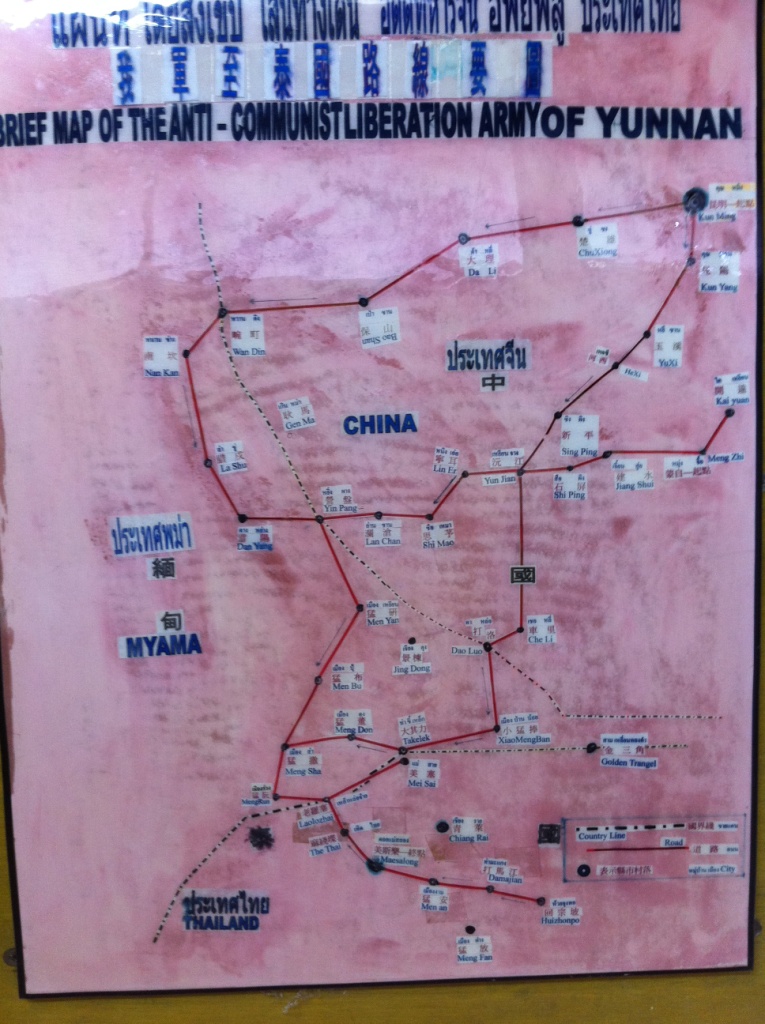
A homegrown depiction of the KMT's path of flight from China to Mae Salong

A homegrown depiction of the KMT’s path of flight from China to Mae Salong

“It was like trying to escape from a jaguar only to run into a tiger,” says Yang. “My parents didn’t want me or my siblings to grow up to be soldiers, so every time the armies came we left. But everywhere we went, they kept coming.” In 1973 he reluctantly joined the Kuomintang for a little over a year and fought against the Burmese. During this time, his faith kept pushing him to seek a different path. “I kept thinking some verses were especially speaking to me – that I should rather be a guard outside the house of God than live in the opulent tent of an evil person. The army for me meant living in an evil person’s tent,” he remembers on his decision to desert.

Yang escaped across the Salween river to Thailand at great personal cost. His commander came to his family’s house, and threatened Yang’s father to make him return. Yang’s father refused, and was taken away by the army along with nearly everything from their house, which was then burned. Yang’s brother escaped to the forests, but Yang found out later that the army shot his father by the side of the road.

For six years Yang drifted, stateless and without identity like many Yunnanese refugees in Thailand, feeling both immense guilt at the death of his father and a responsibility to lift his family back on their feet. He worked odd jobs to try and make money, “but life had no color, and I thought God had perhaps forgotten me.” But in 1981 he received an opportunity to enroll in Bible college in Bangkok, and a new beginning. His first job afterward was working at a church in Mae Salong, the village known for its KMT heritage.

Today Yang is the pastor at the Mae Salong Baptist Church and with a wide smile proudly shows off a gleaming new building opened just this past year.  Over the past three decades, Pastor Yang has developed his own parish into a congregation made up of two hundred families who travel over the hills and footpaths to his church for worship, schooling, and community programming.  In the early 1990s, Pastor Yang and his wife built a single room church with the little donations they could gather from local villagers and began offering free Chinese language education to Yunnanese, Akha, and Lisu families who could not afford tuition at the state sponsored school.


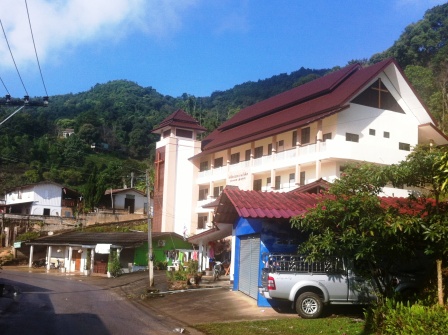
Mae Salong's new Baptist Church

Mae Salong’s new Baptist Church

The newly built church has eight large classrooms for free Chinese language and free primary education classes taught by a cohort of regional volunteer teachers from Thailand, Singapore, Malaysia, and mainland China. Many of the students are Akha, as most of the Chinese residents of Mae Salong can now afford to attend school further down the mountain, reflecting a growing assimilation with Thai culture as more and more move away from the village to bigger cities. Yet Yang remains confident that his church and school can serve as a bridge between the past and present, as well as provide opportunities to educate the Akha residents of Mae Salong. Yang says the students are not required to be Christians to attend the school.  The Baptist Church also has a healthy relationship with the small Yunnanese Muslim population of Mae Salong, sharing access to public water resources and cooperating to bring a new pipe to the village. Yang is content, and although his life is modest he finds fulfillment serving his community.

Pastor Yang and Mae Salong may share a history that began in an era of war, but more importantly they both have a future supporting a community where multiple cultures can mix, and peacefully coexist.  “Life is good,” he smiles while looking over the town, across the green ridges of tea terraces and mist-covered mountains towards the border of Myanmar some fifteen kilometers away.

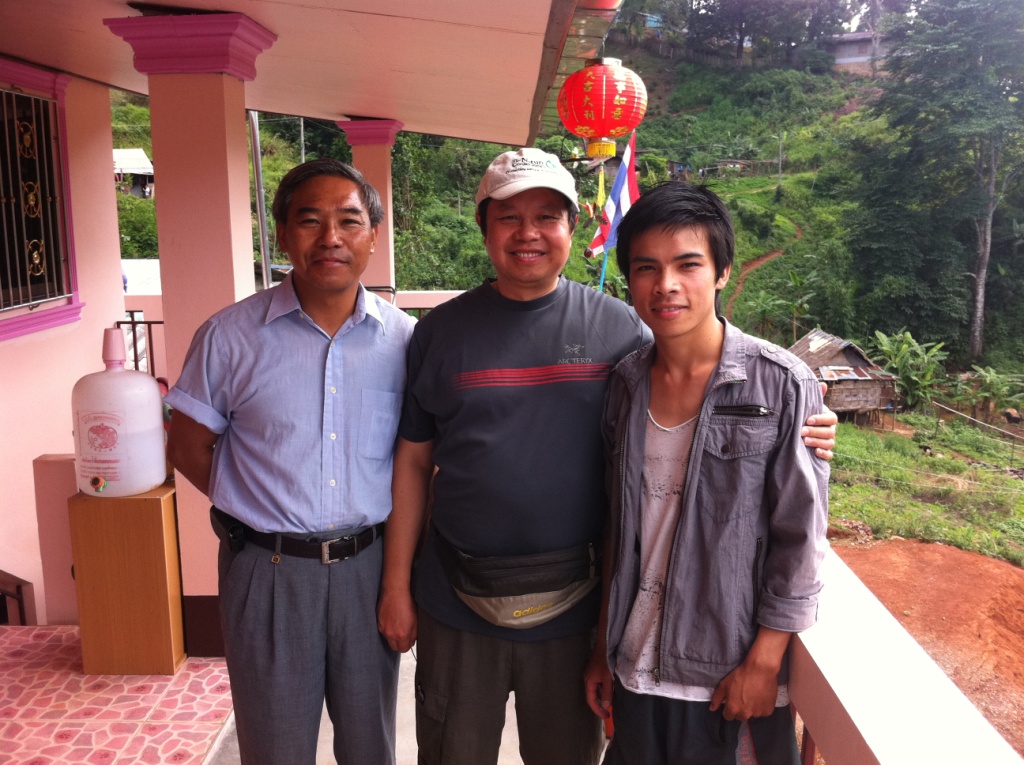
(from left) Pastor Yang with ExSE contributor Zhou Dequn and Ashi, the first of his family to attend college after matriculating through Yang's school

(from left) Pastor Yang with ExSE contributor Zhou Dequn and Ashi, the first of his family to attend college after matriculating through Yang’s school

Leave a Comment

Filed under China, Culture, Myanmar/Burma, SLIDER, Thailand, Uncategorized, Yunnan Province

The Kunming-Bangkok Highway’s Final Link Opens over the Mekong

The Fourth Thai-Lao Friendship bridge which connects Thailand’s Chiang Rai province to Lao PDR’s Bokeo province officially opened for business yesterday.  Although the bridge, which stretches 400 meters across the Mekong river, and surrounding customs and inspection infrastructure have been completed for a few months, the two countries set the auspicious date of December 11, 2013 or 11/12/13 as written in the international form for the bridge’s opening ceremony conducted by Thailand’s highly respected Princess Sirindhorn.


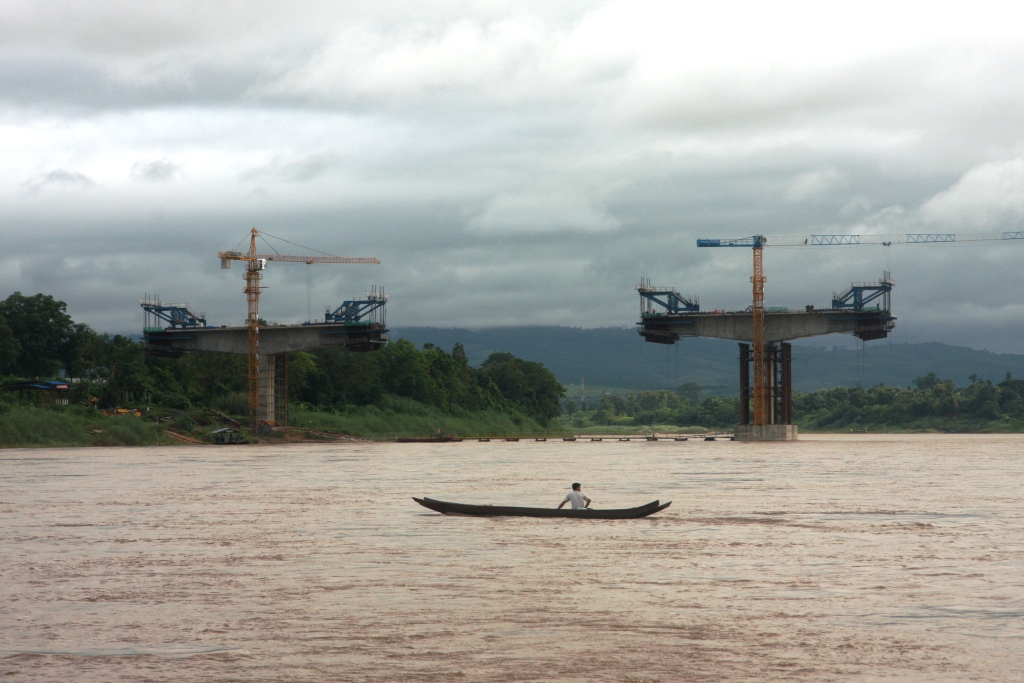
A local fisherman navigates the Mekong downstream of the new bridge (July 2012)

A local fisherman navigates the Mekong downstream of the new bridge (July 2012)

The prime benefactor from the bridge’s opening is not Thailand or Laos, but rather China as the bridge serves as the final link in the Kunming-Bangkok highway, a 1900km series of connected highways that will facilitate significant increases in container shipping trade between China and Thailand.  Six years ago overland transport between Kunming and Bangkok for container shipping was virtually impossible due to the poor quality of roads.  In China’s southwestern Yunnan province, a drive from Kunming to Jinghong, the Dai cultural capital of Sipsongpanna (Xishuangbanna) prefecture took up to 24 hours and another six hours to the Lao PDR border at Boten.   China completed its portion of the highway to in late 2007.

The Lao PDR segment of the highway connects Boten to the 4th Friendship bridge in Huayxai and cuts through 180km of the most remote parts of Laos.  In the summer rainy season of 2004 I hitched a ride on a pickup truck to travel the 180km segment which then was a single lane mud track.  We completed the tiresome 10 hour drive only after averting a serious accident and certain death when the truck spun out of control nearly pitched over a 400 meter cliffside.    China, Thailand, and the Asian Development Bank invested equal thirds in the Laos portion of the highway which opened in 2010 and dropped transportation time to three hours.

By design, the highway system links the friendship bridge to Bangkok, but despite being the strongest economy on mainland Southeast Asia, Thailand’s highway system lags behind in quality compared to China and the stretch running through northern Laos.  Improvements to Thailand’s R3 highway system which will link Chiang Rai province to all points in Thailand is ongoing but far from complete.  Thailand has promised to upgrade its national transportation and highway infrastructure but political roadblocks, corruption, and a perceived lack of momentum for regional integration at many levels of Thai government and society has discouraged those plans from synching up with China’s outwardly stretching infrastructure linkages.   When the Thai roads are finished, a container truck will be able to travel from Kunming to Bangkok in less than 18 hours.

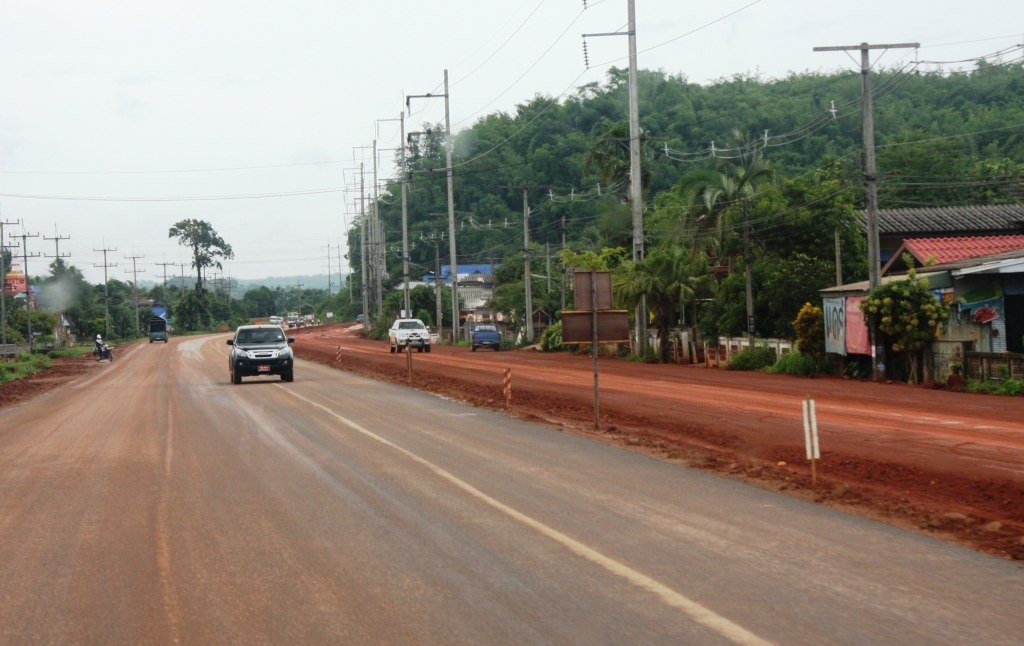
Road widening construction on Thailand's R3 in Chiang Rai province

Road widening construction on Thailand’s R3 in Chiang Rai province

The 14 hour drive from Kunming to the friendship bridge feels like a leapfrog journey from bridge to tunnel and tunnel to bridge as the road makes its 1800 meter descent.  These two roads cut through some of the most difficult terrain on the planet and link the Chinese state to the Thai state while passing through the most ethnically diverse region in Asia.

The roads not only to build regional commercial connections between China, Thailand, and Laos through the increases of trade and investment but they also assist in expanding each of these state’s interests and systems into the once impenetrable regions of upland southeast Asia by introducing national education systems, agricultural techniques that promote mono-cropping over traditional subsistence farming, and creating avenues for ethnic and rural peoples to leave their homes and link up to national labor markets.   The opening of the bridge will increase trade in the region and will intensify and quicken the pace of social change in upland Southeast Asia and reshuffle the cultural milieu of peoples who have sought refuge from the expansionary Chinese and Thai states for centuries.

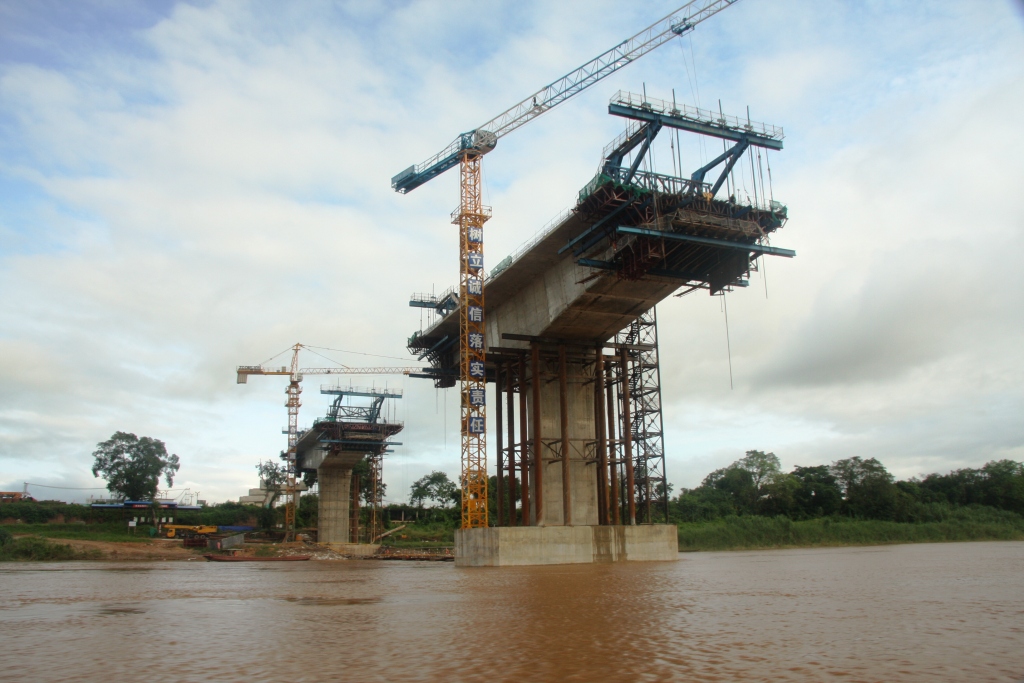
Under construction, July 2012

Under construction, July 2012

Bridge completion, December 2013

Bridge completion, December 2013

The bridge’s construction has also caused an influx of Chinese investment in Chiang Rai province mostly in real estate development, speculation on future industrial estates for manufacturing of intra-industry goods passing between China and Thailand, and the buying up of agricultural lands.  While this investment is encouraged and welcomed at the national level and by the Chiang Rai Chamber of Commerce, locals are wary of the fast and growing levels of investment in the Golden Triangle Area by Chinese firms and often cite a “Chinese invasion.”  The mayor of Pak Ying Tai village, a small fishing community of 100 households located less than one kilometer south of the bridge has lamented to me on several occasions about China’s footprint in Chiang Rai as he observes year on year decreases in freshwater fish catches and sends more and more of his villagers looking for work in urban areas.

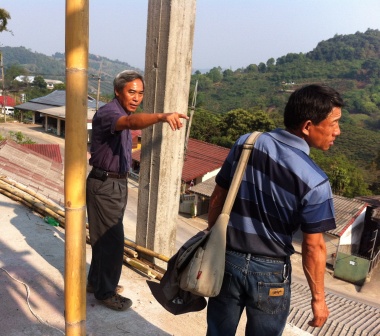
A local farmer from Pak Ying Tai village discusses his worries about community impacts of economic development

A local farmer from Pak Ying Tai village discusses his worries about community impacts of economic development

In many ways the bridge and its construction serve to represent the challenges of regional cooperation between China, Thailand, and the rest of mainland Southeast Asia.  From its conception in the late 1990s to its completion yesterday, the bridge has gone through stalled and failed rounds of negotiation and has not lacked controversy.  Groundbreaking for the 1 billion Thai baht project which is equally invested by China, Laos, and Thailand did not occur until 2010 despite a scheduled start for as early as 2006. In May 2011 Thailand pulled its portion of the construction team in order to settle a land dispute with the local Thai government accusing Chinese commercial interests of illegally purchasing land on the Thai side of the bridge.

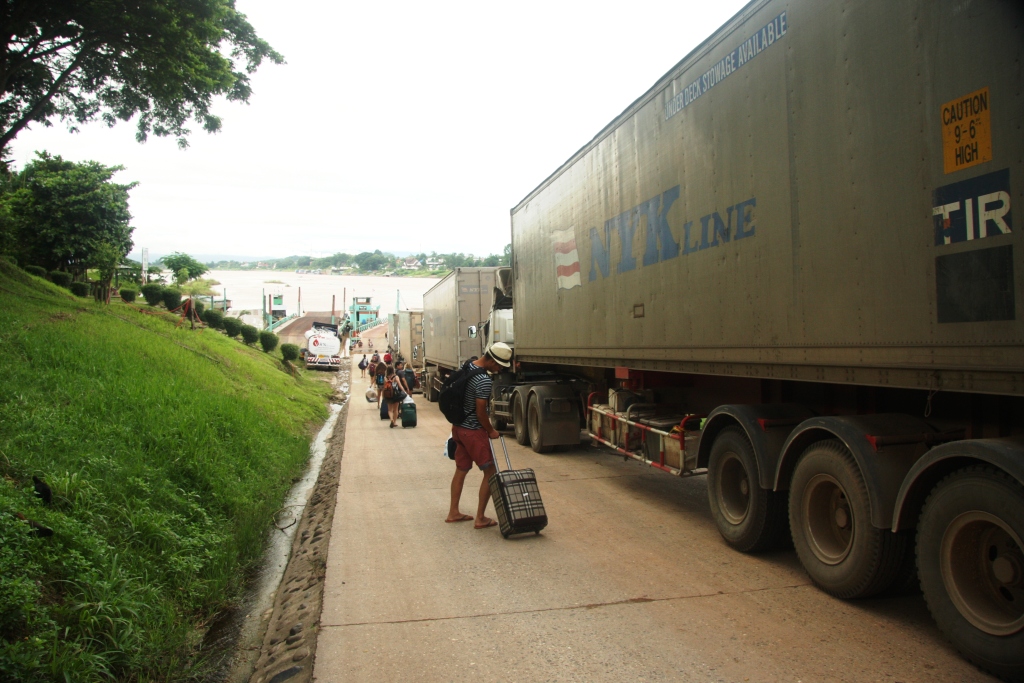
Container trucks will no longer have to wait in line for the Mekong ferry at Huayxai in Laos.

Container trucks will no longer have to wait in line for the Mekong ferry at Huayxai in Laos.

Another obstacle to regional cooperation demonstrated by the bridge is the ease of passage through customs and inspection for both container trucks and individual travelers or tourists to the region.  Chinese trucks are not permitted to drive in Thailand, nor are Thai trucks allowed to travel through China; thus the speed of transport is slowed by the need to repackage goods at one of the border crossing points. Despite efforts of the ADB in to facilitate a shared cross border trade and transport protocol to streamline logistical flows at regional border checks in China and mainland Southeast Asia, states have been slow to adopt the measures in order to protect national markets and logistics industries.  New customs and inspections facilities at the bridge are fitted to increase the speed of transport and ease of people movement and will serve as a testing ground for these promised increases in logistical efficiencies.

Looking forward to the first six months after the bridge’s opening, the verdict will be clear on whether the bridge will serve as a strategic choke point, a gateway for win-win trade and economic development between two regional powers , or a conduit that will further challenge the structure of rural livelihoods in upland Southeast Asia.

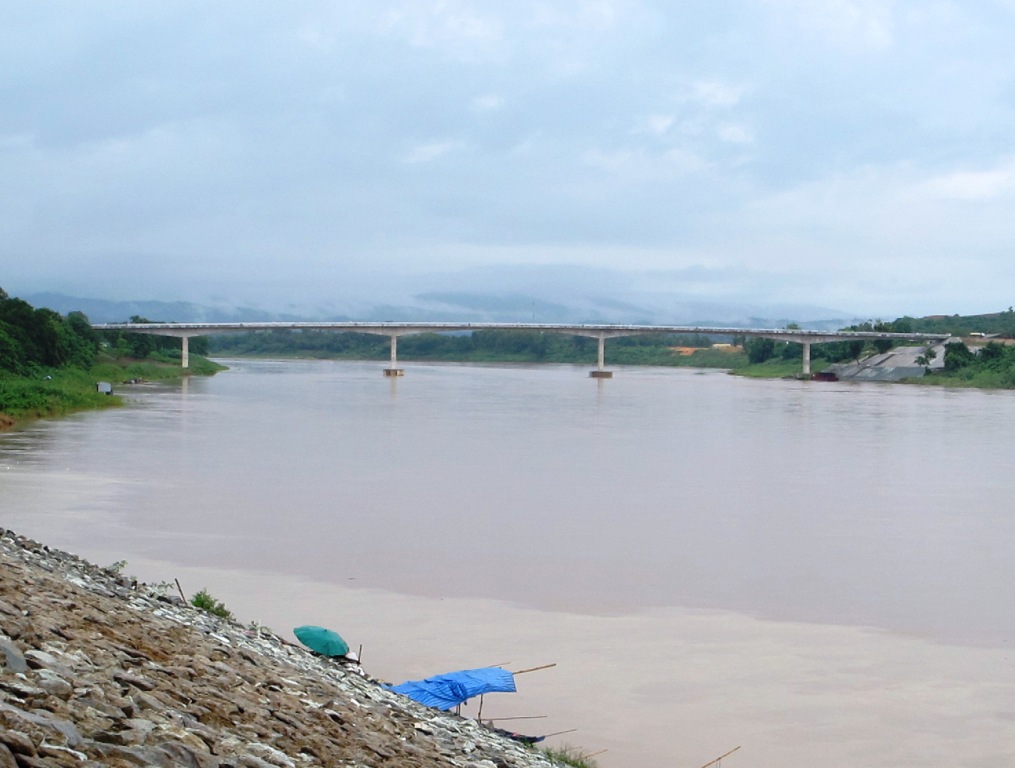
Looking upstream at the completed bridge from Pak Ying Tai village.

Looking upstream at the completed bridge from Pak Ying Tai village.

Leave a Comment

Filed under China, Current Events, Economic development, GMS, Mekong River, Regional Relations, SLIDER, Thailand, Uncategorized, Yunnan Province

Space and Spectacle in the Bangkok Protests

Part of the spectacle at Democracy Monument.


Bangkok has been rocked with the largest political demonstrations since 2010, with protests escalating into isolated pockets of violence.

Yesterday’s D-Day is part of the “final battle” by the anti-government protesters, with morning marches from all major rally sites converging at Government House. Prime Minister Yingluck announced that she would dissolve the lower house of Parliament, as a reported 100,000-150,000 protesters flooded the streets of Bangkok and members of the Democrat party resigned.

Clashes on so-called V-Day last Sunday left a reported five people dead and 64 injured in the confrontation between anti-government and pro-government protesters, including one who died when a bus was attacked.

Over the last two weeks, anti-government protesters occupied key ministries, government complexes and police headquarters.

The police attempted to alleviate tensions after the worst of the clashes, as they opened up barricades to major government offices – even offering roses to protesters in a symbolic gesture just days after taunting protesters and firing tear gas at crowds.

These protests showcase the complicated intersection of history, social changes, and legitimacy in current Thai politics.

And the very spaces of the rallies themselves become entry points into these deep, complex waters. What do the protests and occupied sites in the city reveal about the myriad of claims and competing political aims among the factions? What can the symbols and aesthetics of this protest tell us about what is happening and why? Continue reading

Leave a Comment

Filed under Culture, Current Events, Governance, SLIDER, Thailand

Fire, Spirits and Ritual Self-Injury in Phuket: The Vegetarian Festival

Photograph by Amy Devlin (2013).

Fireworks explode in a loud cascade in the middle of the street, but no one flinches. I watch as a young barefooted man passes me – a pair of guns are impaled in his face, the barrels poking into the open flesh of his cheeks and out of his open mouth. He’s dressed in a black costume embroidered with Chinese symbols.

He is a mah song, a spirit medium, and he’s not the only one. Throngs of men and women are parading down the street, with metal skewers, needles, and even weapons inserted into their cheeks, arms, torsos and elsewhere on their bodies. They are in trances – their heads are twitching rhythmically, eyes rolled back, and their hands are clenched. Groups of devotees reverently carry statues of the gods. As far as the eye can see, everyone is clad in white. Continue reading

Leave a Comment

Filed under China, Culture, Current Events, Reviews, SLIDER, Thailand

China’s Bridgehead Strategy and Yunnan Province

Editor’s note: Liu Jinxin wrote this essay to debunk the myth that China’s bridgehead strategy is militaristic or expansionary in nature.  As a chief architect of this strategy, he seeks to demonstrate that developing Yunnan province into a bridgehead will increase international trade flows and deliver long-term regional security.  This translated essay currently guides top-level foreign policy makers in China in implementing economic strategies along its borders with Southeast Asia.  


Yunnan province's border crossing with Vietnam at Hekou/Lao Cai

Yunnan province’s border crossing with Vietnam at Hekou/Lao Cai

The definition of a bridgehead?

According to the Modern Chinese Dictionary, a bridgehead (桥头堡) is a military term that refers to a strategic chokepoint on the field of battle and particularly refers to a fortified structure that defends and controls a bridge or ferry crossing. In economic terms, bridgehead refers to a strategic forward position on a political or economic front line. The term bridgehead appeared for the first time in an official national level Chinese policy document called “Eastern Bridgeheads” in July 1994 which confirmed the Shandong cities of Rizhao and Lianyugang as the bridgehead terminus of the Eurasian landbridge.

In the economic research of landbridges, a bridgehead is a key concept that acts as a port and facilitates the ease of transportation. Bridgeheads are also international centers of shipping, finance, and information which together form an integrated international center of trade. From a logistical and supply chain system perspective, a bridgehead serves basic support to the Eurasian landmass. It is a city or a region that sits on a strategic position on the logistical and supply chain and serves the specific purpose of controlling the flow of resources along international trade routes. The basic characteristics of a bridgehead are its powers to control, develop, and influence.

The power to control

The power to control suggests capabilities levels of secure logistical flows. This can be understood in narrow and broad senses. From a narrow sense, secure logistical flows are conditional to the degree of market openness.  The survival and development of logistical flows must not be threatened by the power of a government to regulate or control it. From a broad sense, a state’s security and international security are guaranteed by engaging in logistical activities. The capability of a state’s secure logistic flows is determined by its capacity to control strategic resources, logistics routes, linkages, and its industrial supply chain.

Linking with the similar strategic logistic routes, resources, and supply chain structures of neighboring states, a concerted logistics system can deliver harmony and mutual trust as well as a collective security that realizes long term stability. Fostering mutual trust, mutual benefit, and equality work together to form a new worldview for security and protects the security of individual states as well as respects the security concerns of other states.  Mutual trust also promotes collective security.


The power to develop 

Developmental power is preconditioned by the construction of logistic routes, linkages and supply chain structures, the developmental needs of economic corridors, and mutual benefit and cooperation. This power can help states share development trajectories, share prosperity and harmonious development, and eliminate security threats at their root. States should place the promotion of shared development as the method for solving global development imbalances and fostering sustainable development. To revolutionize international financial systems, oppose trade protectionism, and promote regional economic cooperation, developing countries should establish development modes that foster interdependence, deliver effective beneficial outcomes, and seek to erase poverty. Developing countries should expand trade with each other, open markets to each other, and increase the level of south-south cooperation.


The power to influence

Influential capabilities rely on a state’s degree of openness and tolerance, strengthening of the construction of a national culture, making positive contributions in international cooperation, solidification of geo-cultural space, promotion of geo-cultural integration, ability to cooperate harmoniously, and mutual progress with its neighbors. States should respect the rights of other states to determining their own development paths by admitting differences in cultural traditions, social systems, and value systems. States should actively promote and provide guarantees to human rights, and increase dialogue to eliminate misunderstandings. States should initiate a spirit of openness and tolerance, make use of the development modes of other states in a comparative and competitive fashion, and seek collective development despite differences.


The functionality of China’s bridgeheads

The central government has required Xinjiang Uyghur Autonomous Zone, Yunnan province, and other frontier provinces and zones to open the construction bridgeheads along national borders to implement a stable and prosperous frontier region. To deliver prosperity, the bridgeheads should:

1) Be a foundation of protecting border security and stability

2) Take measures under the conditions of high technology to serve as a front line in partial wars and non-traditional security issues

3) Support efforts to rapidly develop ethnic and national zones through new economic modeling

4) Expand the promotion of international/regional cooperation with neighboring states and extend degrees of openness by forging ahead as zones of experimentation.

5) Serve as a transit and storage point for national energy resources.

From a spatial perspective, Xinjiang acts as a bridge between the East and the West; it is the new Eurasian landbridge’s thoroughfare, and as a “west gate,” it serves the opening of China’s northwest region to Central Asia and Europe.

Yunnan opens China to the Southwest connecting two oceans, the Pacific and the Indian as well as East Asia, Southeast Asia, and South Asia. It is the linkage point between China’s southwest, the Southeast Asian peninsula, and the South Asian Subcontinent, and is the starting point of the Yangtze River Delta economic zone as well as the Pearl River Delta economic zone. Yunnan acts as the core belt of the China-South Asia Economic Circle and the China-Southeast Asia economic circle. It is the main connective channel between China and the Indian Ocean and is China’s core zone in the Greater Mekong Subregion. More importantly the province serves as a key trade passageway for goods and services passing from China to South Asia and the Southeast Asian peninsula.

gms_map_large

Core Values

China’s bridgeheads are a result of major changes in geo-strategic international structure. The concept is part of China’s key diplomatic principles which pledge to be a good neighbor, a prosperous neighbor, and a secure neighbor. It is also reflective of China’s active pursuit of being a responsible world power. The core values of the bridgehead strategy are:

1) To foster an infrastructure development strategy that expands participation in the world market and establishes interdependence, while constructing mutually beneficial win-win relations with its neighbors

2) To highly prioritize unity among ethnic peoples and social stability by promoting cultural diversity and shared developmental progress

3) To respect  public opinion and the will of peoples in neighboring countries, and respect their value systems by promoting cooperation and exchange between peoples and democratic equality

4) To acknowledge the guidance of international voices and place equal importance on China’s international image and economic benefit

5) To safeguard the benefit of overseas Chinese and Chinese businessmen abroad

6) To value strategic resources, strategic routes, the shared security of strategic industrial supply line

7) To promote the construction of low carbon footprint urban areas and the use of clean energy by promoting an economic society that delivers harmonious, stable, and secure sustainable development

8) To promote the construction of a harmonious new world order and the active promotion of new kinds of partnerships with neighboring countries

9) To resolutely protect free and fair global trade and investment climates, and maintain the free flow of products, investment and services

10) In the long term, to promote sustainable growth, coordinated concerns, advocate tolerance to total adjustment, and promote balanced growth

Global economic balances can only be reached through sharing benefits and needs between developing and developed states.


Yunnan province as China’s southwest bridgehead

The southwest bridgehead is the front line of China’s interaction with the Indian Ocean, and its purpose is to construct a series of overland pathways given China’s southwest connects to South Asia and Southeast Asia trade routes. The bridgehead’s purpose is also to construct a base facing South Asia and Southeast Asia that supports export processing and the facilitation of international and domestic production, and the Kunming international land port economic zone.

Establishing Kunming as an inland economic zone will strengthen logistical flows coming from South Asia and Southeast Asia, create a tourism base for national culture, a commerce base, export processing base, and modern agriculture base as well as an information platform. This platform will come together through the increased progress of the yearly Kunming trade fair, China-South Asia fair, and the creation of different cooperation forums. The central objective is to turn Yunnan province into China’s platform for communicating with Southeast Asia and South Asia. Through creating this window, Yunnan can facilitate the building of trust between China and South Asia and Southeast Asia, and demonstrate the fruits of reform as well as Chinese culture by promoting mutual understanding and friendship. Yunnan can become a demonstration zone for how China can open to its neighbors.

The influence of a bridgehead extends outwards and is continuously stretching its limits. In China this includes two major regions.


A bridgehead to Southeast Asia

Southeast Asia includes the 10 ASEAN states of Malaysia, Philippines, Singapore, Thailand, Indonesia, Brunei, Vietnam, Lao PDR, Cambodia, and Myanmar and the non-ASEAN state of East Timor. In total this region covers 4.5 million square kilometers, supports a population of 580 million, has a combined GDP of $1.9 trillion USD and a total trade of approximately 2 trillion USD. The creation of the ASEAN-China Free Trade Zone in 2010 created a free trade area of 13 million square kilometers and a combined population of 1.9 billion. It is the largest populated free trade zone in the world and the largest free trade zone among developing countries.

China and ASEAN states are linked by mountains and rivers and share advantages by having varied distribution of resources, differences in specialization of industrial processes, complementary strengths, and an enormous potential for cooperation. As trade between China and ASEAN states increases at a rapid rate so are rates of investment. China is ASEAN’s 4th largest trading partner and ASEAN is China’s 5th largest trading partner. ASEAN has been established as a priority zone for attracting Chinese FDI and is one of the outward investment zones for Chinese industries. ASEAN is also a major market for Chinese labor, and China is winning an increasing amount of engineering contracts in ASEAN.

To date China and ASEAN trade relations have already entered a “Golden Era” and as China and ASEAN open their markets to each other, the ASEAN-China Free Trade Zone will enter a substantive phase. These contributions will bring robust commercial opportunities as the Southeast Asian peninsula is a major global agricultural production area and a critical zone of emerging industries.


A bridgehead to South Asia

The South Asian subcontinent (by way of the BCIM economic zone which includes Bangladesh, China, India, and Myanmar) is the geo-strategic fulcrum between the Indian Ocean and the Arabian Sea. At the same time, it is zone of choice for the secure channeling of China’s energy resources. The South Asian Subcontinent is also known as the Indian Subcontinent and is comprised of the Indian peninsula, the Indus river plateau, and the downstream plains of the Ganges and Brahmaputra rivers covering an area of 4.3 million square kilometers. It supports a population of 1.2 billion on 10% of the Asian continent. Its northern reaches are formed by the Himalayan and Karakoram mountain ranges and its southern limits are the Arabian Sea and the Bay of Bengal. Its western borders are limited by the Iranian plateau, and its eastern frontiers are the mountainous eastern regions of India, Bangladesh, and Myanmar.

The severity of South Asia’s natural landscape has prevented integration and the historically its cultures have been relatively closed-off to each other. This has produced divergent sentiments of independence in the region. The South Asian subcontinent includes India, Pakistan, Bangladesh, Nepal, Bhutan and does not include Sri Lanka or the Maldives. Its major rivers are the Indus, Ganges, and the Brahmaputra. Major agricultural products are wheat, rice, cotton, hemp, cane sugar and tea. Resource endowments include coal, mica, zinc, and gold.

An international pathway can be built from Yunnan through Myanmar to give China direct access to the Indian Ocean and its benefits will promote good neighborliness and the strengthening of border areas. Frontiers serve the specific functions of national defense and economic and cultural exchange. Sharing borders with Myanmar, Lao PDR, and Vietnam, Yunnan province serves as the connective link between China, South Asia, and Southeast Asia. It offers an alternate route to the passage of goods through the Straits of Malacca and is the fastest land route for goods to travel from China to South Asia, the Indian Ocean, Europe, and Africa.

Due to its advantageous geographical position, the province can facilitate huge market potential with partners in South Asia, Southeast Asia, and the Middle East. Lastly, because of its history of friendly exchange with its neighbors, Yunnan province serves as the ideal representative for diplomatic connections.

The construction of international pathways will do much to improve the state of transportation and shipping and can only expand and deepen the political, economic, and cultural cooperation between China and Southeast Asian states. Building these pathways and supporting the bridgehead strategy will develop regional economic cooperation between China, Southeast Asian, and South Asian states, strengthen the relationship of good neighborliness, and bring stability and peace to China’s border areas.

4 Comments

Filed under ASEAN, China, DOCUMENTS, Economic development, GMS, Laos, Mekong River, Myanmar/Burma, Regional Relations, SLIDER, Thailand, Vietnam

The 3rd Annual ICIRD Conference, Part II

Previously, I introduced ICIRD 2013, a Bangkok-based conference exploring issues of development, greater economic integration, and the idea of the regional commons. This blog post will delve more deeply into the background of the commons, an alternative way of organizing public goods that circumvents the hungry advance of neoliberal globalization. 

By way of illustrating, one of the most pressing current issues surrounds the Mekong River, the classic example of a regional – and transboundary – commons in Southeast Asia. Crossing six countries, laden with social and historical significance, and layered with overlapping claims and uses, millions depend on its shared resources, while growing hydropower development threatens large-scale devastation and destruction of riparian ecosystems. But forms of the commons can range in scale from municipal parks and shared community fishing sites along river banks, to oceans and digital commons on the far end.

The Commons as Social and Historical

Certainly in the context of greater regional integration augured by the ASEAN Economic Community (AEC), the concept of the commons becomes an increasingly important, if imperiled, way of organizing assets and resources within communities. Introducing the Focus on the Global South Round Table I, Shalmali Guttal offered the following definition of the commons: it is a collection of assets that are actively managed for the good of the collective and should be accessible by everyone. They include not only natural and physical resources, but social, cultural, political (e.g., concepts like justice) and intellectual wealth as well.

But that’s not all that the concept offers: there can be no commons without a certain type of social relations based on sharing. It’s important to remember that the commons are entwined within the history of Southeast Asia, just as its growing commodification is embedded within the larger context of globalization. As Dr. Victor Savage (National University of Singapore) mentioned in an earlier panel, historically the Southeast Asian region has lacked traditional notions of private land ownership. Here, instead, usufruct rights guaranteed the rights of access for communities, and the commons functioned as safety net and social insurance.

But over time, as  Dr. Walden Bello (Member of the Philippines’ House of Representatives) reviewed, the transition to capitalism became inextricable from the plunder of non-Western societies, in a process that continues even now. He argued, for example, that the ADB and World Bank are central in enforcing ideologies of private property and codes to delegitimize communal traditions.

The tension between these divergent worldviews, one based upon the primacy of private property and the other upon the social relations upholding the commons, is ultimately not about choosing between a given set of choices, but rather about entire ideological frameworks brought together in one current, historically-informed confrontation.

Resistance and Alternatives

Pervasive throughout the ICIRD panels was the idea that everywhere the commons are being threatened by a neoliberal logic that seeks its enclosure and commercialization. The growing commodification of nature makes itself readily felt in the rise of issues like land grabbing, water privatization, and rampant hydropower development in the region, all of which were repeatedly raised in the course of the conference.

Neoliberalism, in Dr. Bello’s account, lost much of its legitimacy, due in part to the role of research organizations and scholars who documented its high human costs, as well as the internal crises of neoliberalism, erupting spectacularly in the Asian financial crisis of 1997 and the global crisis in 2008. He argues that while neoliberalism has been largely discredited, the lack of alternative paradigms means that it remains a source of default strategies for technocrats.

It may be partially true that business as usual continues for lack of other competing visions. But power also incentivizes its own perpetuation. And raising alternative possibilities is one way to counter the naturalization and legitimacy of dominant neoliberal globalization as it is taking place.

In seeking alternative forms of state-community relationships, it makes sense to step back from the lens of the nation-state. Yong Ming Li’s presentation (subtitled “Seeing like a chao baan/neak tonle,” in reference to James C. Scott’s seminal tome) offers one such narrative. By shifting down to the scale of the local, social-natural relations take on a new centrality that includes “a multiplicity of grounded perspectives and practices from the chao baan (villagers) of Chiang Khong, Thailand and the neak tonle (villagers living on the Tonle Sap lake)” (from ICIRD paper abstract). These social-natural relationships defy conceptualization based solely on market relations with nature.

The role of the research and academic communities seems clear – to keep giving voice to critical analyses of the changes taking place in the region and what’s at stake. To illustrate, the “Encouraging Green Growth in Thailand” forum was based on the appealing premise that “green economies will lead to higher resource efficiency, and investments in green innovation will benefit green pioneers with new markets, higher productivity, and human capital development” (from panel summary). Yet the forum ended in a robust debate about whether green growth (with its undeniable focus on growth) represents merely another reconfiguration of capitalism being pushed towards a new frontier.

Ultimately, as former Philippines Senator Dr. Orlando S. Mercado (who holds the distinction of being the first permanent representative of the country to ASEAN) told me after the Focus panel:

“We have to struggle to have our voices heard. But we should not only just be making our voices heard. We have to be able to move within the system to affect changes by taking advantage of various crises that erupt. To me, as a scholar interested in disaster mis-management, I feel that the cause of protecting the commons is served very well by making sure that each crisis, each disaster, each calamity, is taken advantage of to show that there must be people championing the cause of those who are adversely affected by its lack of management and the privatization that is ongoing as a consequence of economic development – all on the altar of creating a community that is ‘prosperous’.”

2 Comments

Filed under ASEAN, China, Current Events, Economic development, Environment and sustainability, Governance, Mekong River, Reviews, SLIDER, Thailand, water