Category Archives: Sustainability and Resource Management

Burmese Hardwoods Logged to the Brink of Extinction

burmese logging

While swaths of virgin rainforests have been cleared to feed China’s growing appetite for luxury wood, there are some regions, like Myanmar’s remote northern forests, that have remained heretofore intact. This is about to change, predicts a new study, as loggers advance on the “final frontier” for tropical hardwoods in Southeast Asia.

A report from the Environmental Investigation Agency (EIA), published July 4, warns that soaring demand in China for valuable, endangered rosewood trees — known in Chinese as hongmu (红木) — is “completely unsustainable”. Based on current trends, the two most coveted rosewood species in Myanmar — Dalbergia oliveri/bariensis and Pterocarpus macrocarpus — could be “logged to commercial extinction in as little as three years”.

Recent demand for hongmu timber has spiked due to its use in high-value reproduction Qing and Ming Dynasty furniture. In 2013, China imported 237,000 cubic meters of rosewood logs from Myanmar at a value of two billion yuan (US$324 million), tripling the intake from the previous year. “Virtually overnight,” reports the EIA, “Myanmar has become the biggest log supplier to China worldwide.”

Seventy-eight percent of China’s hongmu imports come through Yunnan, although Myanmar has banned land-border exports of raw timber. Illegal logging, however, reportedly accounts for nearly three-fourths of the country’s wood exports. Financial rewards for smuggling the timber dwarf traditional incomes, and one trip, carrying up to 15 tons of timber, can reportedly earn a truck driver as much as nine million Burmese kyat (US$300,000).

hongmu-made tea table can fetch 30,000 yuan (US$5,000) in China, where rumors of stricter import bans have led to sizable price spikes. In Kunming, where four-fifths of hongmu timber arrives from Myanmar, prices for the raw wood have risen 90 percent since this time last year. Interpreting Myanmar’s export ban as an economic move, commercial website Huaxia explained:

There is an important reason why Myanmar restricts the export of raw hongmu — they are asking foreign companies to invest in Myanmar, build wood-processing factories in the country, and export finished goods, thus adding value to their timber industry.

The EIA report urges the Convention on International Trade in Endangered Species (CITES) to assist Myanmar in protecting its remaining hongmu forests. An international treaty tasked with protecting more than 35,000 plants and animals, CITES enjoys some legitimacy with the Chinese government. To save the hongmu from imminent depletion, the EIA advises CITES to take action, and upgrade the species’ status to reflect that they “may become threatened with extinction unless trade is regulated”.

This article by Cissy Yu, was first published here on the GoKunming website  on 7/9/2014.

Leave a Comment

Filed under China, Environment and sustainability, Myanmar/Burma, Regional Relations, SLIDER, Sustainability and Resource Management, Yunnan Province

A Flood of Challenges: Climate Change and the Mekong Delta

As loyal readers of ExSE have probably noticed by now, this site, at its core, is dedicated to Mekong River and the people who are connected to it. Thus it seems odd that so little attention has been given to the Mekong Delta on ExSE. As is the case with most international coverage of the Mekong, the upper and lower reaches of the river are largely ignored in favor of stories about hydropower projects and the livelihoods they will affect. However, the challenges that the Mekong Delta (MKD) is currently facing and will face in the future are also serious. These challenges are directly related to global warming and are shared with other deltas, though the unique geography and ecology of the Mekong makes the consequences of climate change here even graver. Continue reading

2 Comments

Filed under Agriculture, Environment and sustainability, Mekong River, SLIDER, Sustainability and Resource Management, Vietnam, water

Recommendations Regarding Hydropower Development and the Rights of China’s Ethnic Peoples

Most of China’s water resources are found in China’s western regions with 70% coming from China’s southwest.  Since the beginning of this century, the core of China’s hydropower development focused on middle and upstream portions of rivers in southwest China. This region also serves as the central native land of many of China’s ethnic minorities.  In early 2013, China’s State Council issued a plan for resource development in its 12th five year plan with details to design and begin construction on more than 60 major hydropower projects between 2011 and 2015.  China is entering into an explosive period of rapid and unprecedented development of its hydropower industry.

For the next twenty years more than 8 million ethnic minorities will be affected by the development and planning of dams.  With the expressed state agenda of establishing a sustainable hydropower industry, achieving social stability in ethnic minorities areas, and realizing the “Chinese dream” for all of China’s citizens, how will the Central government guide law and policy to provide rational standardization, coordination, and management to the interests of the state, industry, and of ethnic minority groups?

According to the principles of “Encouraging the Benefits of Ethnic Autonomous Areas” set forth by the Chinese Constitution, the Law of Ethnic Autonomous Zones advanced a new regulation in 2005 to “encourage the production and livelihood of local ethnic minorities.”  This broad-based regulation passed as part of one of three items in the addendum to the State Council’s PRC Legislation on the Autonomy of Ethnic Regions. Yet to date, there is no specific clarification to the rights of local ethnic minorities or details concerning the autonomy of ethnic areas within the language of the basic law.  The administrative regulations of the State Council list only one related clause: The regulation of peaceful migration should respect the production methods, the lifestyle, and customs of ethnic minorities.

A new policy promulgated in 2012 by the National Development and Reform Commission (NDRC) requiring state sponsored development projects to first oversee the migration of peoples before beginning construction has no mention of protecting the rights of local ethnic minorities. Laws and regulations related to the issue of ethnic minority protection do indeed exist, but because there is no guarantee on the methods of protecting procedural justice or monitoring processes, these laws and regulation cannot reach efficient levels of execution.  Not long ago, the publications of the Third Plenary Session of the 18th Party Congress emphasized the Chinese Communist Party’s views of ethnic policy, guaranteeing the legal benefits of ethnic minorities and bolstering and developing the equal unity and mutual harmonious relations of socialist peoples.

In past years, researchers carrying out investigative field study on the beneficial effects of hydropower development toward the ethnic peoples of the Jinsha River, Lancang (Mekong) River, Nu (Salween) River, Yalong River, Min River, and the Dadu River discovered that the everyday livelihoods and production methods of ethnic peoples living along these rivers are immensely affected by the development of hydropower projects.  In the early development and planning stages, hydropower projects are requested to maintain a holding status before beginning construction.  For many unknown reasons this holding status could continue for many years.  The clearing of roads with dynamite creates air and noise pollution and along with the risks of falling rocks and landslides, greatly affects the safety of people and livestock and the volume of agricultural harvests.  Dam construction and rising waters force people to move.  This uprooting destroys longstanding social networks, privately held assets and shared natural resources such as traditional collecting, fishing, and grazing methods that rely on forests, pasture lands and wetlands.  What is lost is not justly compensated for.

The rights of ethnic groups to be informed, to participate, to express views, and to monitor procedures are not respected or guaranteed with the development of hydropower projects and in many ways these rights are illegally violated.  The relevant institutions of local governments cannot realistically carry out existing laws and regulations, and hydropower firms ignore the law failing to take social responsibility for the protection of vulnerable groups.  Large scale hydropower firms – particularly central level hydropower firms – exact great profits from local areas but remit taxes to the major cities in which they are registered.  The benefits received by localities are greatly out of proportion with the costs borne.


In consideration to the issues raised above and to the demands of the 18th Party Congress, the suggestions below should be considered. Generally, the Central government should re-examine existing hydropower projects and immediately clarify and formulate policy that guarantees the benefits of ethnic peoples in China’s western regions affected the by hydropower development.

1.       Clarify policy and approaches suitable for Western ethnic regions

In western ethnic regions, the Central government should incorporate a guarantee of the basic rights of ethnic peoples as an indicator of sustainable development. The Central government should coordinate development of hydropower projects in ethnic areas giving basic consideration to resource safety, economic development, guarantees of the rights of ethnic peoples, and ecological protection. The activities surrounding hydropower development should respect and guaranteed the basic rights of ethnic people including political, economic, and cultural rights. In accordance to law, ethnic peoples should not be discriminated against and should equally participate in and enjoy the benefits of resulting from economic development in their localities.  They also have the rights to maintain their value systems, religious observance, and unique ways of living.  Moreover they have rights to protect the natural resources such as the land, rivers, forests, and pastureland on which they have existed for many years.

Moreover, the Central government should amend the legal and policy framework on the Law of Ethnic Autonomous Zones within the Chinese Constitution to protect the basic rights of citizens and ethnic peoples.  While strengthening relevant polices, the Central government should expedite policy on formulating specific guarantees of the protection of peoples affected by hydropower development and ensure the implementation and execution of these policies.

2.       Guarantee procedural justice in the processes of hydropower development

In the development of hydropower projects, firms and local governments should respect and protect the rights of ethnic groups and individuals to be informed, participate, make decisions, and monitor procedures. Hydropower firms should establish corporate social responsibility systems that pay particular attention to respecting and protecting the rights of ethnic peoples while operating.  Firms should incorporate this kind of responsibility into their specific duties and make public record of their CSR work on a regular basis.  Firms should also take initiative in accepting monitoring presences of multiple levels of society.

The Central government should establish systems for assessing the impact on the rights of ethnic peoples.  Results of the impact assessment should serve as key findings for the approval of hydropower projects.

The Central government should monitor the entire process of relocation of people related to hydropower development and provide support and effective relief to ethnic peoples whose rights are violated.  The government should establish and open various channels of complaints mechanisms, provide various forms of legal assistance, and eliminate obstacles that prevent ethnic groups and their members in accessing these systemic mechanisms to realize their rights and receive relief.


3.       Guarantee mutual benefit for ethnic people and hydropower development

In ethnic areas, large-scale hydropower firms and central level hydropower firms, by principle, should register for license in the locale in which they operate and pay taxes to that locale.  An alternative could be for the hydropower firm and the autonomous local government should come to agreement on an appropriate distribution of taxes to the locale under the supervision of relevant managing government organizations,

Hydropower firms and local governments should make best efforts to reduce the relocation of people due to hydropower construction and resolutely block forced migration.  Hydropower firms and local governments should make best efforts to reduce the negative impacts of hydropower development on ethnic people’s environment, economy, society, culture, and spirit.  Hydropower firms and local governments should provide fair and appropriate compensation to ethnic groups and individuals for the material, physical, and spiritual damage and impacts caused by activities related to hydropower development.

Hydropower firms and local governments should appropriately provide accordant compensation for negative social, economic, and cultural impacts of past hydropower projects on the basis of social impact assessment and an impact assessment on ethnic people’s rights. Hydropower firms should provide monies for the protection of resources and development funds in affected communities. Firms should provide compensation to and protect the resources and development of intangible assets, communally shared natural resources, and collective impacts that are difficult to compensate at the individual level.

Local governments should adopt measures to protect the cultural heritage of ethnic peoples, to aid ethnic peoples in the passing down and development of their own history, culture, language, traditions, and customs and guarantee the protection of their own cultural heritage and historical traditions.

4.       Fully utilize the function of social organizations

In the realm of social administration, the diversification of social administration is a common and successful experience of developed countries.  It is also a mainstream trend of modern social administration.  Popularized global “New Administration” philosophies purport:

“Governments are not the only pillar of public rights. rather citizens, individuals, and non-government organizations can become pillars of public management.  Under a set of shared goals non-government organizations can participate in public policy making processes and provide public services.  The responsibilities of public affairs administration and the advocacy for the satisfaction of social and economic needs can be collectively shared through the cooperation between social groups and government.”

With the reforms of China’s government institutions and new rounds of innovation in public administration, the function of social organizations in public administration and social life becomes more apparent on a daily basis.  The government should make full use of social organizations in regard to the protection of ethnic peoples and western hydropower development.  The Central government should encourage relevant social organizations to participate in the activities of local hydropower development, participate in the ecological impact assessment, social impact assessment, and social monitoring of hydropower development.  Finally the Central government should utilize the contracting of services to support positive contributions and innovative practices that social organizations can make toward the social administration of ethnic areas.

This is the final part of a 5 part series on hydropower and the rights of ethnic minorities living in the upper Yangtze River valley.  Link here to part 1.  

1 Comment

Filed under China, Economic development, Energy, Environment and sustainability, ethnic policy, GMS, Governance, Hydropower & Ethnic Resettlement in China's Yalong River Valley, Mekong River, SLIDER, Sustainability and Resource Management, water

A Casino at the Khone Falls in Laos?

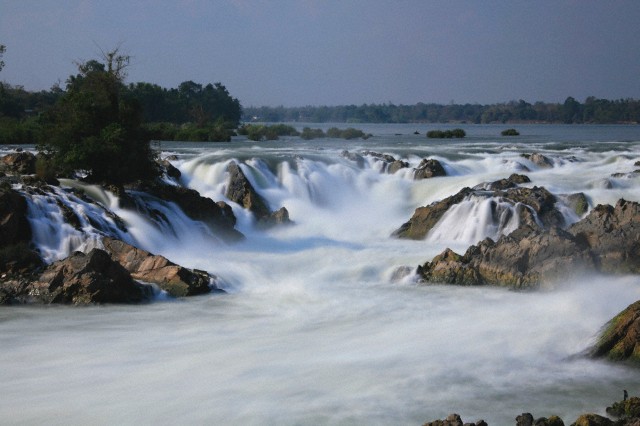
Khone Falls in Siphandone, Laos.  Image: Corbis

Khone Falls in Siphandone, Laos. Image: Corbis

At the end of March 2014 the Lao PDR government will consider a proposal to build a special economic zone slated for tourism development and other unspecified commercial uses in Siphandone, one of the world’s most pristine and biodiverse areas.  The SEZ will showcase a casino located less than one kilometer from the famed Khone Falls, the largest in Southeast Asia.

“The Siphandone area is set to become a more sought after tourism destination with many more activities to experience,” remarked Buasone Vongsongkhone, Deputy Governor of Laos’ southern Champassak province on Monday, March 17 after a meeting to discuss the proposal.

Vongsongkhone said the plans for the SEZ will include a casino and other facilities in keeping up with developing tourism trends in the Siphandone and Khone Falls area while protecting the environment.

“At the meeting we discussed how to regulate the casino to ensure the zone has proper security.”

What Vongsongkhone did not discuss was the impact of the new SEZ on the relatively untouched ecosystem of the Siphandone area.  Siphandone, translated as “four thousand islands” is where the Mekong River fans out into a waterfall and islet ridden expanse more than 15 kilometers wide.  The sparsely populated area has been described as an environmental oasis and is home to numerous native fish and bird species.  The Khone falls area is the perhaps the last habitat where endangered freshwater Irrawaddy dolphin can be found in the wild.

Satellite image of Siphandone.  Khone falls is the on left side of the image.  Google Earth

Satellite image of Siphandone. Khone falls is the on left side of the image. Google Earth

Laos’ growing reputation of holding some of our world’s last untouched natural areas and idyllic vacation spots has brought increases in international tourists to Siphandone area.  With the increase in tourism, the need for regulation and protection is obvious, but is marking a zone for economic development first and environmental protection second a sustainable approach or is it just another way for local Lao officials and outside investors to gain quick wealth through the exploitation of Laos’ abundance of resources?

Last week in an article in the Vientiane Times, the official English language outlet for Laos’ state controlled media reported “the government attaches great importance to developing SEZs to boost the country’s growth, which is crucial to lifting people out of poverty and enabling Laos to graduate from the list of least developed countries by 2020.”

Mock-up of the That Luang Marsh SEZ in Vientiane.

Mock-up of the That Luang Marsh SEZ in Vientiane.

The track record for SEZs in Laos, often dominated by Chinese and Vietnamese investment, is sketchy at best.  In Vientiane, construction of the That Luang Marsh SEZ (yet to begin commercial activities) has negatively impacted the local urban environment.  The natural wetland filters and holds the capital city’s waste water acting as a terminus of the city’s century-old waste canal system; many of these canals are now blocked by construction.  Much of the That Luang wetland areas has been filled in and long-time residents have noticed an average rise in temperatures as water is removed from the ecosystem. 

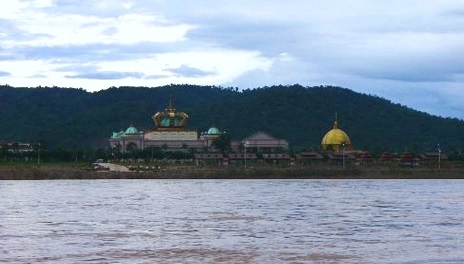
In Laos’ northern Bokeo province, the Golden Triangle SEZ dominated by the Chinese owned King Roman Casino complex has a seedy reputation as a conduit for money laundering from China and zone of human trafficking. The SEZ has scarred the scenic views of the Golden Triangle area, also known for its tourism, with open quarry mining and industrial development.

King Roman Casino along the Mekong in Bokeo Province, Laos

King Roman Casino along the Mekong in Bokeo Province, Laos

To make matters worse, the Siphandone area is slated for the construction of the 260 megawatt Don Sahong dam located  on the only of Siphandone’s Mekong channels that allows for the passage of hundreds of species of migratory fish.  In September 2013, the Lao PDR government notified the Mekong River Commission that the Don Sahong dam project would begin construction in 2014 despite years of protest and opposition by local and international environmental NGOs.

Eco-tourism opportunities such as river cruises, dolphin sighting tours, village homestays, and fishing demonstrations have brought sustainable sources of income to local communities in the Siphandone area for years.  Investors interested in building large resorts and casino complexes will likely be majority Chinese and Vietnamese taking more than they provide while leaving a stained and irreversible mark on one of the Earth’s most scenic spots.

3 Comments

Filed under China, Economic development, Energy, Environment and sustainability, GMS, Laos, Mekong River, SLIDER, Sustainability and Resource Management, water

Energy and Environmentalism on the Mekong: Time to Reach Across the Aisle

In recent years, two powerful narratives have emerged from mainland Southeast Asia. Generally speaking, discussions of the region focus around one of two topics: economic development and environmental degradation. For example, by typing “Mekong” into Google News the first page of results will show articles like this and this. As one can imagine, these two views of Southeast Asia are often in opposition and proponents of each rarely see eye to eye, sometimes going so far as to ignore the other side altogether. Recently, the battleground of these two narratives has been the construction sites of hydroelectric dams (both real and planned) that dot the Mekong River. Proponents of economic development see these dams as a necessary component to continued economic growth in the region. On the other hand, environmentalists point to the unknown ecological costs of the Mekong dams and argue that there are hidden costs to supposedly cheap hydropower. What is lost in the increasingly polarized game of right and wrong is a larger, more nuanced picture of the region and its needs. Some say that the Mekong needs dams while others argue that the region needs better protection measures for its natural resources. But what Southeast Asia really needs is for development fans and environmentalists to stop ignoring each other, and to restart the dialogue. Continue reading

1 Comment

Filed under Economic development, Energy, Environment and sustainability, GMS, Mekong River, SLIDER, Sustainability and Resource Management, Uncategorized, water

Rubber and Sustainability in Southern Yunnan: A Tale of Two Villages

Will Feinberg compares Xishuangbanna’s rubber and sustainabilty in two of southern Yunnan’s ethnic villages. One monocrops while the other hedges.

Driving past new stores and half-built housing developments, you take a right into the forest. Keep going. The farther you drive, the worse the road gets until you burst through another patch of palms trees and cross a stream. Where are you? You’re in Mandian Village, just outside Jinghong, Yunnan and  right in the heart of Chinese rubber country.

Introduced to the area in the 1960s by the central government, rubber is big business in southern Yunnan. Large state plantations have steadily given way to private enterprises and the region has seen a proliferation of rubber planting in the past twenty years. Today in Xishuangbanna Dai Autonomous Region, which Jinghong is the seat of, rubber plantations already make up almost one fifth of all land.

While the environmental costs have been heavy, the rubber explosion has done wonders for Xishuangbanna’s economy. For rubber farmers in Mengla Country, for instance, the average household income is close to $30,000/year, comparable to places like Shanghai or Guangzhou. The economic benefits of rubber harvesting were quite clear to me while traveling through the region late last month. During the trip, I visited two villages that I had been to in 2011. In both cases, rubber has transformed the local economy, however one village was clearly better off than the other. Why?

The first village I visited was the aforementioned Mandian Village. Mandian is largely inhabited by people of the Dai ethnicity, with a 20-family group of Yi people living in an adjacent settlement. Mandian, like many other villages in the area, practices rubber cultivation and relies on rubber as its main source of income. According to villagers there, the Dai started harvesting rubber over a decade ago, while the Yi settlement began their rubber industry only within the last few years. For the village economy as a whole, rubber has had a positive influence. Per capita incomes have risen as well as household consumption and the money from rubber has allowed the town to build a new school.

However, as rubber is Mandian’s only cash crop, the village’s fortunes are now beholden to the world rubber market. Nothing illustrates this better than what happened to the village in 2012. Last year, the bottom fell out on the rubber market and the price of raw rubber dropped by half, going from 30 yuan per pound (1 US dollar is roughly equal to 6 Chinese yuan ) to 15 yuan per pound. Two villagers that I interviewed described the effects. One, a middle-aged Dai woman told of how most of the villagers who harvest rubber had to work overtime to scratch out living and the quality of life dropped for many families. Though because the Dai also plant rice, no one in the village went hungry. A young Yi woman that I spoke to also described how the economic hardships as a result of the rubber crash delayed the building of their house. The Yi, who were recently resettled as a result of the building of the Jinghong Dam, were forced to return to their old fields as a way of producing food during 2012 crash and without these fields, many villagers might have gone hungry. The fall of the rubber price in 2012 was not isolated just to Mandian village. The drop was felt in villages like Mandian all over southern Yunnan and in other rubber producing areas like Malaysia and Brazil. But there was at least one village that was comparatively isolated from the crash’s effects.

Nanpanzhong Village sits on the slope of a ridge just an hour’s drive from the Burmese border. A collection of some 120 families, Nanpanzhong is an Aini village. The Aini are a branch of the Hani/Akha minority, a nomadic, transboundary ethnicity that typically practice subsistence agriculture in the mountains of Southeast Asia. What makes the Aini of Nanpanzhong special, aside from their incredible hospitality, is their economy. Like the Dai and Yi of Mandian, the Aini also harvest rubber, but the role that rubber plays in the village’s economy is quite different. In an interview with the village mayor, I learned that money from rubber harvesting makes up only 30% of the town’s income. Instead, their primary source of income, by a long shot, is pigs. The town raises hundreds of short-eared swine which command quite a high price in China’s metropolises. According to the mayor, his pigs’ pork sells for 130 yuan/pound, many times higher than the price of normal pork. In fact, most of the village’s pork can only be found in places like Beijing, Chongqing and Shanghai; people in Jinghong can’t even afford it.

Pork sales now net the village almost sixty percent of its total income, but Nanpanzhong’s foray into the meat industry is a rather recent affair: villagers only began raising pigs in 2003. Its impact, however, has been astounding. According to the mayor, the average household income was hovering around 500 yuan per year at the turn of the millennium. Thirteen years later, that number as skyrocketed to almost 8,000 yuan and now, the mayor claims, Nanpanzhongcun is the envy of the surrounding valleys.

 When the rubber price plummeted last year, Nanpanzhong was largely unaffected. Of course, the mayor explains, villagers feel the effects when the rubber price fluctuates, but certainly less so than other places. The village is largely self-sustaining for food and the money earned from rubber, livestock and tea (which makes up a tenth of the village’s income) is used for electronics, vehicles and building materials. Both the mayor and villagers that I spoke with were convinced of the Nanpanzhong model’s superiority.

The evidence is hard to disagree with. Not considering the environmental concerns, of which there are many, rubber can be an unsustainable enterprise. Mandian, and hundreds of villages like it, have had a mixed experience with rubber. While it brought the village a new school and the villagers a higher standard of living, Mandian’s reliance on rubber and the fluctuations of the global market brought hardships to the village last year, forcing some villagers to leave in search of food. On the other hand is Nanpanzhong’s model. Rubber, while an important source of income for villagers, is part of a healthy balance. With families growing their own food and relying on two cash crops (rubber and tea) and livestock for their income, the villagers of Nanpanzhong are largely insulated from greater trends in the rubber market. The village’s exact model may not be able to be replicated in every village in Yunnan, but its general ideas can. Pairing rubber with a second cash crop and agricultural self-reliance are concepts that could give protection to villages like Mandian and offer a more economically sustainable path for thousands of people in the region.


Leave a Comment

Filed under Economic development, Food, SLIDER, Sustainability and Resource Management, Yunnan Province

A Restart for the Myitsone Dam?

This September 30 will mark the two years anniversary of the suspension of the Myitsone Dam and once again, there is talk of resuming the project. In 2011, the controversial dam, built by state-owned China Power Investment (CPI) was shelved by Burmese President Thein Sein until 2015.  Since the project’s suspension there have been intermittent reports that construction will begin again, but despite much anticipation on the Chinese side, none of these rumors have led to any action on the project. However, reports in the last month hint at a greater possibility of resuming construction. Does Myitsone really have a future?

This latest round of discussion of Myitsone’s revival started last month with China’s Ambassador to Burma, Yang Houlan. In an interview with the Irrawaddy Magazine, published August 15, Ambassador Yang stated that the Chinese government supported a resumption of construction on the $3.6 billion project. However, while he made clear that the Chinese are for the completion of the dam, the Ambassador added that any action on the project would have to be approved by the Burmese. “China’s view is that we hope we can revive the project,” he said. “But of course, we respect the Myanmar government’s decision and we also respect the people’s views.”  The hydropower project, which is located in northeast Burma’s Kachin State, was suspended in 2011 after intense public disapproval of the project and nationwide protests. It is unknown whether or not further construction on the dam would lead to public outcry like that seen in 2010 and 2011.

Continue reading

Leave a Comment

Filed under China, Myanmar/Burma, SLIDER, Sustainability and Resource Management, water

China needs to change its energy strategy in the Mekong region

This op-ed was first published at ChinaDialogue and thethirdpole.net on 7/16.

 Mekong bridge

At the end of this year cars and container trucks loaded with goods from China and Thailand will finally be able to drive across a multi-lane bridge spanning the Mekong River (known as the Lancang in China). The bridge will connect Chiang Rai province in Thailand to Bokeo province in Laos, effectively linking China’s highways stretching south from Beijing and Shanghai to those coming north from Singapore, Kuala Lumpur and Bangkok.

Funded by equal investment from the Chinese and Thai government, the completion of the bridge, which took ten years of planning and two years to build, is not without controversy. For many years Thailand held back investment due to an uneven distribution of benefits between China, Laos and Thailand. Also on the Thai side, the NGO Rak Chiang Khong claim the bridge negatively impacts the local Golden Triangle economy and will ruin Mekong fisheries.

The Golden Triangle Bridge serves to highlight the challenges facing China, as the country’s new leadership attempts to balance its slowing and volatile economy and deliver domestic stability by maintaining peaceful economic relations with its neighbours.

China’s regional strategy

“In 2012 China’s growth in trade and outward investment with the five other Mekong countries of Myanmar, Laos, Thailand, Cambodia, and Vietnam surpassed its trade and investment growth in ASEANcountries,” said Xu Ningning, chairman of the Greater Mekong Subregion (GMS) Business Council. “Greater growth rates will continue with increases in regional cooperation and win-win investment opportunities.”

For the past three years China’s GMS provinces of Yunnan and Guangxi have posted growth rates of 12-15%, the highest of China’s localities, and arguably China’s economic rise has also helped deliver high growth rates among Mekong countries.

The end of the Cold War in the 1990s created a favourable environment for China to develop its economic cooperation strategies toward the Mekong region. The blurring and opening of once inviolable borders encouraged traders on both sides of the China-Southeast Asia frontier to appeal to local and national governments for better conditions for trade and migration. The Chinese government responded with twenty years of state-led trade liberalisation and investment policies to promote regional cooperation in state and private sectors.

China’s economic cooperation strategies towards its four Mekong neighbours has dovetailed nicely into a strategy that fits China’s current development needs. Liu Jinxin, a policy analyst and logistics expert says, “Unlike the US which leads the world in finance and IT, both high-value service-oriented industries, China is the world’s factory, producing goods to drive the growth of its growing middle class and serving export markets around the world. To survive, the Chinese ‘factory’ needs inputs like energy and raw materials.” Continue reading

1 Comment

Filed under ASEAN, China, Current Events, Economic development, Energy, Environment and sustainability, Food, Foreign policy, GMS, Governance, Laos, Mekong River, Myanmar/Burma, Sustainability and Resource Management, Thailand, Vietnam, water

Burmese Teak: Turning a New Leaf

It’s prized the world over for its durability and beauty and has long been a status symbol; to own something made from teak really means something. But what is teak and why does it matter today?

Teak, or Tectona Grandis, is a large, deciduous, hardwood species found throughout Southeast Asia in environments under 900m in elevation that receive over 500mm of annual rainfall. Teak is known is primarily known for its durability; it is naturally water-resistant and contains resins that repel and termites and slows rot. Because of these qualities, teak wood is valued for its ability to resist the natural elements and is often used in outdoor furniture and yacht and sailboat building.

Teak is native only to India, Indonesia, Lao PDR, Malaysia, Myanmar and Thailand. Of the estimated 29 million hectares of naturally occurring teak forests, almost half are found in Myanmar. It is important to note that only Myanmar does not enforce a logging or export ban on teak, so all legally-harvested natural teak on today’s market is Burmese. The cost of this Burmese teak can be quite high – the market price for some wood can reach than $4,000/m3. This represents the most expensive teak, as natural teak is valued higher than its planted counterpart. There are several reasons for this disparity. First, plantation teak has smaller dimensions than natural teak and rarely reaches the size of a natural tree. Secondly, there is a perception among many buyers that plantation teak is less dense than natural timber and thus is of a lower quality. In addition, natural teak is a rare resource. As mentioned, Myanmar is currently the only country exporting natural teak and its forests are decreasing every year, making prized Burmese wood rarer and more expensive.

teak 1 Continue reading

2 Comments

Filed under China, Economic development, Environment and sustainability, Indonesia, Laos, Malaysia, Myanmar/Burma, Sustainability and Resource Management, Thailand

Why Can’t We Protect China’s Cleanest Freshwater Lake?

4109718

Fuxian Lake, located in Yunnan Province’s Yuxi municipality sixty kilometers southeast of Kunming, sits at the headwaters of the Pearl River, China’s third longest river. It is the largest alpine freshwater lake in China, and its water storage capacity accounts for nearly 10% of all freshwater lakes in China.  Fuxian is twelve times larger than the water volume of its western neighbor, Kunming’s Dianchi Lake. Most importantly, the lake’s water quality is rated at Class I meaning it is directly drinkable.

In order to protect Fuxian Lake’s water quality and local ecosystem, the Yunnan Provincial Government issued a set of “Protection Regulations on Fuxian Lake of Yunnan Province” on September 1, 2007. It declares the entire lake, its watershed, and adjacent lakeside area extending 100m range from the shore are within the first protection zone, a red line under strict protection and monitoring. In accordance with the local regulations, washing clothes and bathing in the lake are strictly prohibited. Even motor-driven boats have been replaced with manpower-driven pedal ones. Furthermore, conditions on the use of cultivated land, shoals and vegetation around the lake are also defined by the regulations.

Also, clearly banned are “the unauthorized expansion or alteration or creation of new buildings or structures; unauthorized pumping of water from the lake or violation of water permit provisions for pumping water; other destructive practices to the ecological system and pollution behavior.”

Since 2005, August 26th of every year has been designated by Yuxi City as the Fuxian Lake Protection Action Day. All of these measures seem to favor the lake’s protection and its aquatic ecosystem. But in practice, is it really true?

A June 7 China Central Television (CCTV) report disclosed the unregulated construction of eleven real estate projects around the lake that threaten to destroy its aquatic ecosystem and degrade its water quality.  The numerous luxury lake-view villas, five stars hotels such as Hilton Hotel, and golf courses were built or under construction within Fuxian Lake protection area. For sales promotion, these ‘Big Mac’ projects were crowned as resorts, sports parks, among other flashy names.

For example, Longhu Lake Park project is located in Mackerel Bay with an area of 147 hm2 size and an investment footprint of USD 730 million. A realtor for the project boasted that its size is as big as one-fifth of Kunming metropolitan area. To my surprise, this project even passed its environmental impact assessment. The EIA report said “impact of the project construction on the environment is slight and controllable. The project meets the regulations and the environmental management standards of construction project of the national construction projects in listed in Yunnan Province’s environmental regulations. The project location is feasible.”

A further embarrassing fact is that some projects broke ground before their EIAs were processed. The Kowloon Bay, Kowloon Sheng Jing Project is located in the upper reaches of lake’s western banks.  In its promotional materials, the developer dared to say “the project site offers the nearest resort-style apartments to Fuxian Lake so far. It is only 50m away from the shoreline.” Most of these European style villas come with a lake view. The project includes luxury hotels, lake view hotel apartments and villas.

In September 2009, Yuxi Municipal Party Committee and Government issued “A Decision for Accelerating Tourism and Cultural Industries Development.” Citing “from 2010 onwards, the municipal government will invest 30 million RMB to promote tourism development…. Each subordinate district and county should set up special budget for tourism development.” The cited purpose of the decision is to “encourage the introduction of high-star hotel projects” and “local governments will be awarded with 10 million RMB for the successful introduction of well-known international brand five-star hotel projects exceeding investment levels 300 million RMB after the project’s completion.”

In this decision, the projects mentioned above were highlighted one by one. The Yuxi municipal government vowed to “create conditions to facilitate the projects’ construction as soon as possible”.

Around Fuxian Lake, many developers promote new commercial buildings and hotels connecting project names to the beauty and quality of the lake. For instance, “Holy Water Lake Phase II” advocated that they built a “wetland park” in Fuxian Lake, exclusively open to the residence owners and the hotel guests.

Locals from surrounding villages told a CCTV reporter that the residential developments were discharging excessive levels of black, smelly sewage directly into the lake! The local villagers angrily said that protecting the Fuxian Lake was merely spoken of on the lips of leaders and the regulations were useless.

The CCTV report further pointed out that although the country already banned golf course construction in national level water resource protection zones, golf courses were being constructed around the lake. It also mentioned that most real estate projects were initiated via oral permission from the local governmental leaders without environmental impact assessment.

Naturally one cannot help asking the following questions regarding the protection of Fuxian Lake:

  • Which is really more powerful and effective, the political agendas of leaders OR the rule of law when a collision between environmental conservation and economic development occurs?
  • Why do we often repeat these inane practices, namely sacrificing environmental quality for economic development? Do these mistakes really pay off?
  • Why do not we try best to maintain our blue skies, clean water and a hygienic environment for ourselves and also for our next generations? Do we fear our next generations will rebuke us if we are too selfish?
  • Is it fair to dirty the environment dirty leave the bill for our next generations?
  • Despite the CCTV report which by the nature of its broadcast, passed muster of national censors and by the eyes of national leaders, why do local environmental protection agencies continue to maintain silence about the Fuxian Lake case?

After the CCTV report, Yuxi government issued a moratorium on the processing of new real estate development projects around Fuxian lake.

1 Comment

Filed under China, Environment and sustainability, Sustainability and Resource Management, water