Category Archives: SLIDER

Attack at Kunming train station leaves 27 dead and more than 100 injured

Late Saturday evening March 1, unknown attackers used knives to randomly kill passengers waiting at the Kunming train station. Xinhua News has reported 27 killed with 109 injured. A local hospital has seen more than 170 patients apparently injured in the incident.

The assailants are of unknown origin and motivation although Chinese social media sites are flying with rumors of ethnic affiliation. The state media has officially called this incident a terrorist attack.

While details are extremely sketchy photos from the incident are circulating as the story hits the international media. To keep up with the story as it breaks follow this live blog.

20140302-024335.jpg

Leave a Comment

Filed under China, Current Events, Kunming Train Station Attack, SLIDER, Uncategorized

Regional Roundup for the Week of 3.1.14

This week’s top news included increased criticism of how China’s government has handled recent severe pollution, heightening concerns that the poor air quality and slow response for a solution will have lasting long-term impact on the economy as well as the environment. There have been reports that more and more elite and educated Chinese are choosing to move away from developed urban coastal cities in favor of less-polluted areas, including Kunming and Dali in Yunnan Province. Aside from the problem of visible air pollution and the dangers of micro particles like PM2.5, a growing concern is water and earth pollution, which may prove even more challenging to reverse. This should be of great concern to officials here in Yunnan Province, home to the Three Parallel Rivers National Park that includes the upper reaches of the Mekong, Yangtze and Salween Rivers.

Political unrest in Thailand continues, with some speculation that the protests are losing steam and even as violence has escalated recently. Protesters agreed to remove blockades from major intersections, a decision that came after a speech by the head of Thailand’s army that distanced himself from the protest movement. However, political deadlock remains weeks after elections and will likely persist into the spring until an agreement is reached between the government and political opposition.

ExSE FOCUS

Party chief: Yunnan ’embracing a new era of environmental protection’ | GoKunming — The most powerful government official in Yunnan, Party Secretary Qin Guangrong (秦 光荣), delivered a speech last week in which he at times bluntly addressed many of the environmental concerns facing the province. Although Qin was, perhaps expectedly, speaking in broad terms, he did mention specific goals and characterized environmental issues as the top priority currently facing the province.

Water Pollution: More Difficult to Fix Than Dirty Air? | ChinaFile — Although China’s air pollution keeps making headlines, its water pollution is just as urgent a problem. One-fifth of the country’s rivers are toxic, while two-fifths are classified as seriously polluted. In 2012, more than half of China’s cities had water that was “poor” or “very poor.” Last week, China’s Ministry of Environmental Protection announced a trillion-yuan (U.S.$320 billion) plan to start dealing with this urgent issue.

Protesters Say They’ll End Blockades in Bangkok | NYT — The leaders of the campaign apologized for blockades of major intersections and promised a new strategy for the protests.

Thailand’s Army Chief Cautions Antigovernment Protesters | NYT — The head of Thailand’s army, after months of neutrality, tells government opponents to “ask yourselves whether this would end peacefully.”

Currency of China Continues to Decline | NYT — The value of China’s currency, the renminbi, continued to slide against the United States dollar on Friday, rattling investors by falling to its lowest level in nearly a year before closing higher

A Border City on the Edge of the Law | NYT — Mong La, Myanmar, draws Chinese over the border to gamble, as well as buy ivory and other animal parts, despite official disapproval of the casinos in China.

Burma tells Medécins Sans Frontières to leave state hit by sectarian violence | Guardian — Médecins Sans Frontières has been ordered by Burma’s government to suspend all operations in a conflict-riddled state because of what officials described as a lack of impartiality in medical treatment.

China Accused of Firing Water Cannons at Filipino Fishermen | NYT — The Philippine military said the Chinese Coast Guard tried to drive away Filipino fishing vessels at the disputed Scarborough Shoal.

Yunnan province increasingly feeding China’s hungry north | GoKunming — Last year, 8.5 million tons of produce grown in Yunnan was shipped to boomtowns in China’s north and east, nearly equaling totals of the previous two years combined. The largest consumers of crops grown south of the clouds, respectively, are Beijing, Tianjin, Xi’an, Xianyang, Hohhot, Yinchuan and Zhengzhou. These cities and six others have established wholesale markets specializing in selling Yunnan produce.

CHINA

China’s President Will Lead a New Effort on Cybersecurity | NYT — President Xi Jinping is presiding over a working group on security, a sign that the Communist Party views the issue as a pressing strategic concern.

In Beijing, Complaints About Smog Grow Louder and Retaliation Grows Swifter  | NYT — Anger is rising over the government’s inability to protect the nation from pollution that has made places like the capital “unsuitable for human habitation,” as a prominent think tank stated this month in a study that was swiftly censored.

Citizen Sues Local Government for Failing to Curb Air Pollution | ChinaFile — Although residents in Northern China are no strangers to dirty air, a man from the smog-enshrouded Hebei province has decided to take the local environmental authority to court for failing to control air pollution.

LinkedIn Goes to China | NYT — The social network for business is creating a Chinese-language site. LinkedIn says it may have to practice self-censorship on its growing publishing platform.

How the Internet and Social Media Are Transforming China | ChinaFile — “The Internet has radically transformed China,” said Emily Parker, author of the book Now I Know Who My Comrades Are: Voices from the Internet Underground, in a public discussion at Asia Society in New York on February 19.

Chinese authorities bust child-trafficking ring – video | Guardian — Chinese police have detained 1,094 people and rescued 382 babies in a crackdown on four online baby trafficking rings, state media reported

Many in China Can Now Have a Second Child, but Say No | NYT — A relaxing of the one-child policy will allow two children in a family when just one parent is an only child, but the cost of child-rearing has given some couples pause.

REGION

Asian Giants Look to the Arctic | Diplomat — After a lengthy courtship, China and India formalized their relationship with the Arctic Council in May 2013 by gaining admission as official observer states. China’s Academic Battle for the South China Sea | Diplomat — Beijing supports increased research on South China Sea issues as part of a soft power push for control.

BRUNEI

Brunei’s Royal Partiers May Have To Curb Their Enthusiasm | Diplomat — The introduction of Sharia Law will put an end to the alcohol-fueled soirees enjoyed by Brunei’s rich.

CAMBODIA

Getting Stares on the Streets of Cambodia: Buses for the Masses | NYT — Phnom Penh is experimenting with a public transportation system, beginning with 10 buses, in a program underwritten by the Japanese government.

Minimum maximum | SEA Globe — Recent violence in Cambodia linked to protests over wage levels underlines the struggle between workers, governments and business owners

Treasured islands | SEA Globe — Beauty and a burly sea captain await passengers sailing Cambodia’s Koh Rong archipelago

INDONESIA

Indonesia’s South China Sea Options | Diplomat — Indonesia has the potential to defend its maritime interests, but for now it will need a partner.

Climate Change Could Lead to the Disappearance of 1,500 Indonesian Islands | Diplomat — Rising seas could swallow as many as 1,500 of Indonesia’s islands by 2050, according to a report from the Maplecroft Climate Change Vulnerability Index. It stated that Jakarta’s Soekarno-Hatta International Airport could be underwater as soon as 2030 if the current rate of global warming persists.

Oscar-Nominated Documentary Scrapes at Raw Wound in Indonesia | Irrawaddy — A chilling documentary about one of the worst massacres since World War Two is up for an Academy Award this weekend. If it does win, don’t expect the Indonesian co-director to go on stage to receive an Oscar: he’s worried for his life.

MALAYSIA

‘Speak Softly and Carry a Big Stick’: What is Malaysia Playing At? | Diplomat — Malaysia and China have had maritime run-ins with mixed results. What is Malaysia’s endgame in the South China Sea?

Malaysian Prime Minister: One in 10 Citizens Pay Their Taxes | Diplomat — Prime Minister Najib Razak announced yesterday that only one out of every 10 Malaysians pay their taxes. Najib, who is also the country’s finance minister, warned that lost tax revenue could force the government to borrow money to pay a steadily increasing number of civil servants.

MYANMAR/BURMA

Myanmar’s Census Controversy | Diplomat — Myanmar is scheduled to hold a census next month but local and international monitoring groups are worried that it could inflame ethnic and religious tensions in the country.

At the mercy of the winds | SEA Globe — Artisans fear their skills won’t survive the onslaught of time and increasing modernity in Myanmar

PHILIPPINES

Gimme shelter | SEA Globe — Plans for a purpose-built hamlet envision opportunity, equality and recognition for the little people of the Philippines

SINGAPORE

Fears over pace of climate change as Singapore, Malaysia battle drought | SCMP — Singapore and Malaysia are grappling with some of the driest weather they have ever seen, forcing Singapore to boost supplies of recycled water while its neighbour rations reserves amid disruptions to farming and fisheries.

Lee Hsien Loong on What Singapore Can—and Can’t—Teach China | ChinaFile — The transformation of Singapore in recent decades can offer valuable lessons to China as it reforms. In an exclusive interview with Caixin in early February, Prime Minister Lee Hsien Loong discussed his expectations for Singapore’s future and challenges confronting the country.

THAILAND

Bangkok Turmoil and Thailand’s Deep South | Diplomat — Prospects for peace in South Thailand recede as Bangkok plunges into political turmoil.

Thailand Headed for a Violent Ending | CFR Asia Unbound — Clashes in Thailand between anti-government protestors and security forces have intensified. This past weekend, unidentified gunmen sprayed bullets at anti-government protestors in eastern Thailand and killed a five-year-old girl, and someone apparently launched two grenade attacks in Bangkok. Since this current round of demonstrations started last November, 21 people have been killed and hundreds injured in Thailand. The country has basically functioned without an effective government now for months, the once-teflon economy is sputtering, and Thais are preparing for the violence to get worse. Crash That Kills Schoolgirls Highlights Thai Road Dangers | NYT — A bus accident that killed 15 people provides a grim corroboration for a study finding that Thailand has the world’s second-highest road fatality rate.

VIETNAM

Project blends Rotterdam knowhow with Ho Chi Minh City street smarts | Guardian — Rotterdam, with long experience in flood management, is advising Ho Chi Minh City on the development and implementation of a climate adaptation plan to help the Vietnamese city avoid disaster as sea levels rise and the frequency and severity of storms increases.

Leave a Comment

Filed under NEWS DIGEST, SLIDER, Uncategorized

New Addition: Country Profiles on East by Southeast

ExSE is excited to announce the addition of a new section to our website!  Country profiles are now available for Cambodia, Laos, Myanmar/Burma, Thailand, and Vietnam.  These profiles introduce the historical, political, and economic milieu of countries in Southeast Asia and provide you with up to date analysis of current events and developing trends in the region.  You will find links to economic and environmental data as well as a discussion of each country’s regional connections (including the China connection!) in a greater context.

These country profiles are authored by undergraduate students enrolled in the Regional Development in China and Southeast Asia program at the IES Kunming center.  Each semester new students will have the opportunity to update, edit, or add to the existing reports so be sure to check for updates frequently.

Country reports can also be accessed via the site’s top menu bar under Profiles.

If you have suggestions, contributions, or photos to provide for the country reports, please feel free to contact us at eastbysoutheastmail@gmail.com.

Leave a Comment

Filed under ASEAN, Cambodia, China, Current Events, Laos, Myanmar/Burma, SLIDER, Thailand, Uncategorized, Vietnam

Regional Roundup for Week of 2.23.2014

Just links this week – and lots of them…

EXSE FOCUS

Gunmen Wound at Least 35 at Rally in Thailand – AP Assailants in a pickup truck attacked the antigovernment rally held by the People’s Democratic Reform Committee in the province of Trat, about 180 miles east of Bangkok.//much more on the unfortunate news coming out of Thailand below

 Behind Pattern of Global Unrest, a Middle Class in Revolt – Asia Unbound For months now, protesters have gathered in the capitals of many developing nations—Turkey, Ukraine, Thailand, Venezuela, Malaysia, and Cambodia, among others—in demonstrations united by some key features. In nearly all of these places, protesters are pushing to oust presidents or prime ministers they claim are venal, authoritarian, and unresponsive to popular opinion. Nearly all of these governments, no matter how corrupt, brutal, and autocratic, actually won elections in relatively free polls. And in nearly all of these countries the vast majority of demonstrators hail from cosmopolitan areas: Kiev, Bangkok, Caracas, Istanbul, and other cities. The streets seem to be filled with very people one might expect to support democracy rather than put more nails in its coffin. // Kurlantzick’s book Democracy in Retreat is a must read.  Thankfully someone is looking through a classist lens at the perils and effects of globalization

 Kerry Implores Indonesia on Climate Change Peril – NYT Secretary of State John Kerry said Indonesia’s failure to act would jeopardize its resources, damage its economy and put much of the capital under water.

Assessing John Kerry’s Visit to Jakarta – Asia Unbound Secretary of State John Kerry’s visit this weekend (U.S. time) to Jakarta was brief, packed into his whirlwind Asia trip. His short stay in Jakarta was understandable—I think Kerry, despite criticism that he has focused too much on the Middle East, has put in enough of the face time in Asia to justify his claim that he has continued the administration’s policy of re-engagement with Southeast Asia. The fact that Kerry chose to give a speech in front of an audience of students at a cultural center highlighted some of the American embassy in Jakarta’s soft power efforts in the archipelago. And I certainly would agree with most of what Kerry said in his speech on climate change and the threat of global warming—that climate change is a near-apocalyptic threat to the world, that the science about global warming is settled, that Indonesia is one of the developing nations most likely to be affected by climate change, that global warming could prove a death blow to many parts of the archipelago.

Chinese Ask Kerry to Help Tear Down a Firewall – NYT Meeting with Secretary of State John Kerry, a group of Chinese bloggers appealed to the United States to take up the cause of Internet freedom.

 McDonald’s Opens in Vietnam, Bringing Big Mac to Fans of Banh Mi – NYT The fast-food giant is opening its first restaurant in the country, which some see as one of Asia’s last consumer markets with significant untapped potential.

After Winding Odyssey, Tibetan Texts Find Home in China – NYT An American scholar’s trove of 12,000 Tibetan-language texts has a new home, a lavishly decorated library on the campus of the Southwest University for Nationalities in Chengdu, China.

 The Red Chains of Bureaucracy That ‘Torment’ Chinese – NYT A politician in the southern city of Guangzhou has listed more than 100 documents the average citizen needs in a lifetime, arguing that China’s bureaucracy is too tortuous. His proposal for streamlining has been met with approval.

Yes, cats and dogs are special – they deserve our protection in China – The Guardian Pets are still being stolen and slaughtered for their meat, but old ideas are changing. There’s no welcome like it when To Zhai and Muppet come hurtling towards me, after I return home to our bear rescue centre in Chengdu, Sichuan province. These incredibly sociable and outgoing dogs have, thankfully, forgotten that they were both once destined for the dinner table in China.

 PLA Officer: China Must Establish South China Sea ADIZ – The Diplomat A Chinese military officer has said that establishing a South China Sea ADIZ is necessary to China’s national interest.

 China Is Not 1914 Germany – The Diplomat Some critical differences render any comparison badly flawed.

 Japan, ASEAN Discuss Defense Exports, Disaster Relief Cooperation – The Diplomat Japanese and ASEAN officials met to discuss potential Japanese defense exports.

Try Procrastination and Prevarication – Banyan NEGOTIATIONS for the Trans-Pacific Partnership (TPP), which enter a crucial phase this weekend with a ministerial meeting in Singapore, seem to take place in two parallel universes. In one, the 12 countries pursuing this ambitious “21st-century” plurilateral free-trade agreement, including America and Japan (but not China) and representing 40% of the world’s GDP and one-third of its trade, came tantalisingly close to meeting their deadline of finalising the deal last year, and are now one last big push—perhaps in the next few days—away from success. In the other, TPP talks are bogged down in intractable disagreements on the most fundamental issues. The notion that it might be signed—let alone implemented—in the near future seems a delusion.

Chinese Netizens (Still) Love ‘House of Cards’ – TLN “Everyone in China who works on this level pays who they need to pay.” Mild spoiler alert: These are the words of the fictitious Xander Feng, an influential Chinese billionaire on the Netflix series “House of Cards,” a show that follows the machinations of U.S. Representative (and later Vice President) Frank Underwood to agglomerate power and crush whoever stands in his way. The phrase is also now viral on the Chinese Internet, which has proven surprisingly hospitable to the show’s second season, which debuted on February 14. Despite having its arguably Sinophobic moments—in addition to Feng-as-villain, the show depicts a Stateside Chinese businessman hiring both male and female sex workers, and a U.S. casino laundering Chinese money to fund a Congressional SuperPAC—the show has Chinese social media users applauding what they believe is a largely accurate depiction of Chinese palace politics

China in ‘House of Cards’ – ChinaFile China figures heavily in the second season of the Netflix series House of Cards, but how accurately does the show portray U.S.-China relations? Steven Jiang, a journalist for CNN in Beijing, binged-watched all thirteen recently-released web-only episodes over the weekend. Donald Clarke, professor of Chinese law at George Washington University, responded to our query saying we’d reached his “inner nerd.” Jiang and Clarke started us off putting the lie to Hollywood’s portrayal of U.S.-China relations, and were followed by Kaiser Kuo, Director of International Communications for Chinese search engine Baidu and co-host of the Sinica Podcast, and by Evan Osnos, staff writer at The New Yorker.

Chinese Censors Have Kept Their Hands Off ‘House of Cards’ – NYT The absence of censorship for the Chinese broadcast of the series is somewhat surprising, and it may indicate a more relaxed approach toward the newer medium of online television show imports.

Chinese thriller wins best film and best actor prizes at Berlin festival – The Guardian Asian films take limelight with best actor and best actress prizes but Richard linklater wins best director for Boyhoo

 Party chief: Yunnan ’embracing a new era of environmental protection’ – GoKunming The most powerful government official in Yunnan, Party Secretary Qin Guangrong (秦光荣), delivered a speech last week in which he at times bluntly addressed many of the environmental concerns facing the province. Although Qin was, perhaps expectedly, speaking in broad terms, he did mention specific goals and characterized environmental issues as the top priority currently facing the province. His opening remarks set the tone for a surprisingly frank monologue.//Believe it when we see it.

 Dawei Awaits Its Destiny – Irawaddy U Aung Myint, a community leader from Mudu village, stands next to a meter-long, gold-colored footprint with 108 Buddhist signs that was carved on a large boulder many centuries ago. “We believe that the Buddha visited here and that this is his left footprint,” he said. The relic, around which a pagoda has been constructed, is part of the heritage of the ethnic Dawei people, who have lived in southern Myanmar’s Tanintharyi Region since the 8th century. The ancient artifact gave the cluster of villages on this remote coastal plain its local name: Nabule. “The Pali word for left foot is Nabule,” U Aung Myint explained.//The Dawei port is a game changer in geo-politics, trade routes and regional relations.  It’s a way for Burma to wean itself further from China and for Thailand to emerge as a stronger regional player.

Overshooting in Emerging Markets – Project Syndicate In the last few years, investors, policymakers, and businesses have been devoting considerable attention to the so-called “middle-income trap.” As a result, emerging markets’ downside risks are increasingly shaping the consensus forecast – a poor basis for investment and policy decisions.


ON THE DALAI LAMA’S VISIT TO THE WHITE HOUSE

What Can the Dalai Lama’s White House Visit Actually Accomplish? – ChinaFile On February 21, the Dalai Lama visited United States President Barack Obama in the White House over the objections of the Chinese government. Beijing labels the exiled spiritual leader a “wolf in sheep’s clothing” who seeks to use violence to free Tibet from Chinese rule. The Dalai Lama, who fled to India after a failed uprising in 1959, disavows the use of violence and says he only wants autonomy for Tibetans. He and Obama previously met in February 2010 and July 2011.

On Lamas in the White House… – The Granite Studio Most Chinese are well aware of the “Western” perspective on Tibet and are understandably prickly about the kinds of epithets used to describe Chinese control over the region. I’m not advocating that we (as in the “West”) need to sugarcoat what is happening in Tibet so that our Chinese friends can feel warm and fuzzy, but the habit of talking AT the Chinese about Tibet is likely no less productive in the long run than the Chinese PR ‘strategy’ outlined in this article.

 China denounces Barack Obama’s meeting with Dalai Lama – The Guardian Beijing says White House meeting is ‘gross interference in Chinese politics’ and will damage China-US relations. Barack Obama met the Dalai Lama at the White House on Friday, despite objections from China, which has warned that the meeting would inflict grave damage on Sino-American relations.

 China denounces Barack Obama’s meeting with Dalai Lama – The Guardian Beijing says White House meeting is ‘gross interference in Chinese politics’ and will damage China-US relations. Barack Obama met the Dalai Lama at the White House on Friday, despite objections from China, which has warned that the meeting would inflict grave damage on Sino-American relations.

Obama Walks Tightrope With Dalai Lama Meeting – The Diplomat Obama did just enough to avoid retaliation by Beijing for his meeting with the Dalai Lama.

China Criticizes Obama Over Visit by Dalai Lama – NYT In contrast to previous meetings, the White House seemed unruffled by the diplomatic repercussions of the meeting with the Tibetan spiritual leader.


CHINA

Beijing Official Detained in Investigation of Former Security Chief – NYT The investigation, centered on the former head of law and order policy, reaches a secretive realm in China’s leadership.

Chinese Officials Widen Campaign Against Vices – NYT The operation appears intended to send a message similar to the so-called anticorruption campaign promoted by President Xi Jinping

Manufacturing Activity Contracts Again in China – REUTERS The slowdown at factories has unsettled markets, although the decline may have reflected in part the annual Lunar New Year holiday.

China Investigating Qualcomm’s Pricing – REUTERS The American chip maker is suspected of overcharging and abusing its market position, the Chinese anti-monopoly regulator said.

Nobel Winner’s Frank Advice to China’s Leadership – NYT To make the transition to a high-income economy, A. Michael Spence calls for bolstering domestic demand and exposing state firms to more market pressure

Taiwan and China Edge Ever Closer – NYT But many Taiwanese prefer the status quo over future unification.

Hunter Gross: What Did China and Taiwan’s Historic Talks Accomplish? Asia Unbound The four-day visit between Zhang Zhijun, director of China’s Taiwan Affairs Office (TAO) and Wang Yu-chi, chairman of Taiwan’s Mainland Affairs Council (MAC), has been described as “historic,” “a turning point in relations,” and “unimaginable.” But the meeting is not unprecedented. In recent years, several encounters between Chinese and Taiwanese representatives have led to this moment. This meeting, however, serves as a symbolic affirmation of the relatively stable status quo that benefits both Beijing and Taipei. To be sure, from a diplomatic standpoint, this is the first official meeting between China and Taiwan since the end of the civil war in 1949. Despite the media hype, however, this is unlikely to bring about any substantial changes in cross-strait relations, and a dramatic change was not necessarily the goal.

China’s Fear Strategy – Project Syndicate Not long ago, China was a soft-power juggernaut, seemingly content to allow its own example of success to speak for itself. Today, China, like many large countries, is allowing its internal political battles to shape how it interacts with others, especially with neighbors whose sensitivities it seems entirely willing to ignore.

China vows to hunt down officials who sheltered Liu Han’s ‘mafia gang’ – The Guardian Authorities to punish Sichuan officials who protected former mining tycoon Liu Han and his gang during ’10-year crime spree.’ Chinese authorities will hunt down the officials who gave protection to a “mafia-style” gang run by a former mining magnate charged with crimes ranging from murder to gun-running.  Liu Han – the former chairman of Hanlong Mining, which attempted to take over Australia’s Sundance Resources Ltd – led his gang on a crime spree for more than a decade in China’s south-western province of Sichuan, state media said.

Chinese government sacks Dongguan police chief over prostitution scandal – The Guardian Yan Xiaokang removed from posts of police chief and vice mayor following televised report into underground sex industry. The Chinese government has sacked the police chief of Dongguan following a report by the main state broadcaster,China Central Television (CCTV), on the underground sex industry there, the Xinhua news agency has reported.

China Will Have to Face a Stronger US-Japan Alliance – The Diplomat Despite its wish for a new type of relationship with the US, China will face a stronger US-Japan alliance in coming years.

China: The Insecure Global Power – The Diplomat Faced with growing expectations, China’s foreign policy is actually becoming more insecure.

Local-government debt: Bridging the fiscal chasm – The Economist CHINA’S provincial administrations are often referred to as “local” governments. But the phrase does not do them justice. The province of Guangdong, for example, boasts more than 105m people and a GDP worth more than $1 trillion. Only 11 countries (including China itself) have a bigger population and only 15 have a larger economy.Equally impressive is the scale of provincial debts. At the end of 2013 China’s national auditor revealed that the liabilities of local governments had grown to 10.9 trillion yuan ($1.8 trillion) by the middle of last year, or 17.9 trillion yuan if various debt guarantees were added.

Academic freedom: Don’t think, just teach – The Economist A MOTTO of Peking University, one of China’s leading academic institutions, is “freedom of thought and an all-embracing attitude”. But in recent months it was not all-embracing enough to allow Xia Yeliang, an outspoken economics professor, to keep his job. Economics was not the subject on which Mr Xia was most forthright. He was a signatory of Charter 08, a petition drawn up in 2008 that called for sweeping political change, and he was known for his liberal political views.

 Pollution Tax Suggested for Wealthy Chinese Fleeing for Greener Pastures – ChinaDialogue Environmental problems have become an important factor causing the rich to leave China—but one academic has now suggested that they should first pay an environmental levy. Chen Guoen, a professor at Wuhan University, said that some Western investment-for-citizenship schemes are tempting China’s rich to emigrate and enjoy cleaner air. According to Chen, China should respond by imposing an environmental restoration levy on those leaving—their accumulation of wealth will have had environmental consequences, and they should not be allowed to take that money and run.

Yunnan province increasingly feeding China’s hungry north – GoKunming China’s ever-growing cities need food, massive amounts of it, and are often unable to grow enough locally. One of many attempts to address this problem was implemented in 2011, when a program designed to send produce grown in the country’s less populated west to teaming cities elsewhere in China was instituted. An article originally published in the Spring City Evening News, and then redistributed nationally by Xinhua, reports the initiative has proved successful enough to warrant further expansion and investment.


REGION

Asylum Fraud in Chinatown: Industry of Lies – NYT More Chinese immigrants seek asylum than any other immigrant group in the country, and most of them apply from New York, where federal officials regard the applicant pool with suspicion.

U.S. Army Seeks Better Ties With China’s Military – NYT As tensions rise between China and other Asian nations, a top U.S. general is working on improving contacts with China’s military.’ v:shapes=”_x0000_i1026″>

 Ecuador pursued China oil deal while pledging to protect Yasuni, papers show – The Guardian Negotiations took place while the country sought funds to forgo oil exploitation in pristine forest under the Yasuni-ITT scheme. The Ecuadorian government was negotiating a secret $1bn deal with a Chinese bank to drill for oil under the Yasuni national park in the Amazon while pursuing a high-profile scheme to keep the oil under the ground in return for international donations, according to a government document seen by the Guardian.

Wealthy Chinese buyers are making Sydney’s housing problem worse – The Guardian Last year median house prices in Sydney rose by 15%, and in some suburbs by up to 27%. Cash pouring in from foreign investors is one of the drivers of this change.

 A U.S.-China Summit Diplomacy Rivalry – The Diplomat With a new summit this year, the U.S. can begin to compete with China for influence in Africa

China Offers To Finance 30 Percent Of Indian Infrastructure Spending Through 2017 – The Diplomat The offer would see $300 billion of Chinese funding flow into India through 2017.

 America and China’s Perception Problems – The Diplomat Around the world China is increasingly seen as the bully while the U.S. seems more and more irresolute.

Closing the Distance: Investing in the Pacific Transport Sector – ADB Island countries in the Pacific need a strong transport sector to support economic growth. ADB’s transport strategy in the region focuses on improving access to markets and social services and building integrated transport systems.

Lee Hsien Loong on What Singapore Can—and Can’t—Teach China – Caixin As one of the Four Asian Tigers, Singapore is known for its strong economy and orderly society. The city-state, with its population of 5.3 million people, is listed by the World Bank as fourth in the world in terms of per capita income. As a regional business hub, it is lauded for its sound business reputation and the transparency of its government. Singapore has also been something of an example for China over the past three decades. A visit by Deng Xiaoping in 1978 provided inspiration for China’s reform and opening up.

Asia’s New Security Trifecta – Project Syndicate Winter is India’s diplomatic high season, with the cool, sunny weather forming an ideal backdrop for pageantry. But this winter has been particularly impressive, with leaders from Japan and South Korea joining Prime Minister Manmohan Singh to advance the cause of security cooperation in Asia.

A Clear Case for Golden Rice – Project Syndicate In some environmental circles, blanket opposition to genetically modified organisms is like taking a loyalty oath – dissidents are regarded as traitors in league with the evil biotech industry. It is time to move beyond such a narrowly ideological stance.

The Davos Apocalypse – Project Syndicate At the World Economic Forum’s annual meeting in Davos last month, leading participants called for a rapid shift to cleaner energy to tackle climate change. There was something unsettling about the global power elite jetting into an exclusive Swiss ski resort and telling the rest of the world to stop using fossil fuels.

India’s disappearing glaciers – The Third Pole The base camp of the Chhota Shigri glacier –  one of the few glaciers monitored regularly in the Indian Himalayas –  stands amidst stones, where once ice flowed 50 metres thick.  The Chhota Shigri glacier is one of three glaciers that has been monitored regularly in the Indian Himalayas over the past decades. (Photo by Ranvir Singh). The Chhota Shigri base camp offers a breath-taking view of the northern ridge of the Pir Panjal range in the Indian Himalayas that reach up to 6,500 metres (21,325 feet). Lateral moraines, the accumulation of boulders and stone deposited by a glacier, form parallel ridges about 50 metres high and 170 metres wide.


CAMBODIA

Cambodians board Phnom Penh’s first public buses in more than a decade – The Guardian Authorities hope road users will swap motorbikes taxis for buses to ease congestion on city’s traffic-clogged roads. Motorcycles, cars, tuk-tuks and the humble rickshaw dominate its traffic-clogged roads, but Phnom Penh has a new weapon in the fight against chronic congestion – its first public buses in more than a decade. Cambodia’s transport system lags behind many of its south-east Asian neighbours, which long ago resorted to public vehicles to ease gridlocked roads in major cities.

Getting Stares on the Streets of Cambodia: Buses for the Masses – NYT Phnom Penh is experimenting with a public transportation system, beginning with 10 buses, in a program underwritten by the Japanese government.’ v:shapes=”_x0000_i1030″>

 Mending hearts – SEA Globe At SL Factory in Phnom Penh, young women sort through piles of blue jeans; their colourful clothes strike a contrast against the steel tables and grey walls. Down a corridor, geysers of steam erupt from massive steel washing machines. Pairs of young men wheel plastic carts of soggy garments, some eventually to be sold in Gap and H&M stores around the world, to the drying room. A man stares into the distance, his mind thick with imagination. Behind him, sheets of scalding water begin to leak from the metal hatch of his washing machine. He jumps and hits a button to release the pressure.


LAOS

Young Laotians Learn Chinese to Improve Job Prospects – NYT Many Chinese schools have sprung up in towns along the Laos-China border, and the schools in Vientiane are gaining popularity.

Tomorrow’s Women Water Leaders in Lao PDR – ADB Scholarships for young women in Lao People’s Democratic Republic are helping today’s students become tomorrow’s water leaders.


MYANMAR/BURMA

Myanmar: Signs of Unrest Raise Alarms – REUTERS

Burmese Refugees in Thailand Are Running out of Options – Irawaddy Win Myint and his two younger sisters fled Burma in June 2011, after months of harassment by plainclothes officers because of a documentary about the Burmese army featuring their exiled younger brother, a former soldier who later spent 15 years in jail for his pro-democracy activism. The officers accused them of distributing the film and warned them they could be jailed. “They told us not to go anywhere overnight. They also followed me to places I gave tuition. They accused our younger brother of trying to break the unity of the armed forces,” said Win Myint, speaking by phone from Umpiem Mai refugee camp in northern Thailand. “We didn’t feel safe,” said Myint, a 63-year-old former teacher and a Muslim.

At the mercy of the winds –  SEA Globe Artisans fear their skills won’t survive the onslaught of time and increasing modernity in Myanmar. Hpan Myay Hman Myay can’t quite remember his age. “More than 60, but not yet 70,” he says, sitting in the shade of a rust-ravaged roof. In the more than 1.5 hectares that surround him, the fruits of his labour for more than 60, but not yet 70 years, are scattered, piled high on the damp soil and half-hidden under leaf litter and sprouting shrubs encroaching on this hidden treasure. It is here, on the outskirts of Myanmar’s largest city, Yangon, that Hpan Myay Hman Myay joined his father in Myanmar’s first hand-blown glass factory.

Poppy replacement in Shan State will take time, money – DVB In eastern Burma, efforts are underway to hamper opium production in Shan State, which, combined with adjacent parts of Laos and Thailand, produces a staggering 18 percent of the world’s opiates. Crop substitution schemes currently being implemented in three townships are unlikely to spread to other areas without a cash injection.

Anti-corruption commission to be formed – DVB President Thein Sein proposed on Thursday that a commission be formed to begin tackling corruption in Burma. In a letter to the Chairman of the Union Parliament, Thein Sein recommended 15 members; five were selected by the president, five by the Pyithu Hluttaw (lower house) and five by the Amyotha Hluttaw (upper house).

Development needed to ensure peace: KPC – DVB Brig-Gen Timothy Laklem of the Karen National Union Peace Council (KPC), an offshoot of the Karen National Union (KNU), has said that peace with Naypyidaw will only be possible once poverty has been reduced in Karen State. “Ethnic leaders are much more likely to sign the [nationwide ceasefire] agreement if there is a guarantee for people’s development,” Timothy Laklem said at a press conference in Rangoon on Thursday.

 Govt urged to settle land grab claims by September – DVB The Burmese Parliament on Thursday called on relevant government bodies to implement settlement claims over land confiscation cases by September at the latest, though the number of cases remains disputed.

From Jade Land to a Wasteland – Irawaddy “They eat up the hills like they’re devouring cakes. Hills three or four hundred feet high are completely flattened, or even turned into holes 300 feet deep. Where there used to be mountains, now there are lakes,” said U Cho, a resident of Hpakant, a town in Kachin State famed for its jade mines. Like many others in the area, U Cho is a jade dealer. But even he struggles to comprehend the scale of the destruction wrought by the jade mines here.

Manufacturing Could Start in Burma’s Thilawa Zone in Mid-2015 – Irawaddy RANGOON — About 40 foreign manufacturers are interested in setting up in the Thilawa economic zone being developed with Japanese help outside Burma’s main city, Rangoon, and commercial operations could start in mid-2015, a Burmese official said. Burma has opened up since a quasi-civilian government took office in 2011 after decades of military dictatorship and foreign firms are looking to benefit from cheap labor and a virgin market in thriving Southeast Asia.


MALAYSIA

Malaysian Restaurants Busted for Putting Endangered Species on the Dinner Menu – The Diplomat Special Valentine’s Day courses offered flying fox, civet and pangolin meat among others.


THAILAND

Court in Thailand Limits Crackdown on Protesters – NYT The Bangkok court barred the authorities from dispersing protesters one day after violent clashes left five people dead.

Economic Growth in Thailand Cools to 0.6% – NYT The unrest that has shaken Thailand since November is taking a potentially lasting toll on the country’s economy, just when regional growth over all is facing headwinds.

Thailand unrest: court prohibits use of force against protesters – The Guardian Two government orders deemed unconstitutional as violent protests continue against PM Yinluck Shinawatra. A Thai court has ordered the government not to use force against anti-government protesters after clashes between riot police and demonstrators left five dead and nearly 70 wounded.

Four killed as Thai police clash with protesters in Bangkok – The Guardian Reports of multiple gunshots from both sides as authorities attempt to clear protest sites around government offices. Four people have been killed and more than 60 injured in Bangkok after a gun battle erupted between police and anti-government protesters who have spent the past month calling for an end to the current regime.

Thailand protesters besiege temporary government HQ – The Guardian Hundreds of protesting rice farmers breach perimeter of military compound used by Yingluck Shinawatra’s mobile government. Thai opposition demonstrators have surrounded government offices – including a compound used as a temporary headquarters by the prime minister, Yingluck Shinawatra – in defiance of authorities who have vowed to reclaim key state buildings.

Protests in Thailand: Stagnant revolution – The Economist AS ARMED police moved in to clear an opposition protest site in central Bangkok on February 18th, it appeared that the gridlock that has paralysed the city for three months might be reaching a dénouement. Four protesters and one policemen were killed and dozens injured in the clashes that followed. But carnage did not lead to catharsis. Just a day later, a civil court ruled that police could not break up any more demonstrations.On the same day the election commission cancelled polls that had been rescheduled for April after a widespread opposition boycott of a general election on February 2nd.

Last gatekeepers – Banyan A HANDWRITTEN piece of paper affixed to one of the entrance gates of Government House reads: “Get out (of) this land”. There, sandbags and a barricade of rubber tyres fortified with razor wire protect the young men who, bucketful by bucketful, are raising a cement wall. They are sealing off the office of the prime minister, Yingluck Shinawatra, so that she cannot return “in this life or the next”. The arrival of food, energy drinks and more cement bags suggests that they are serious. No one will rule Thailand from here, or from anywhere else for that matter, at least for a while.


PHILIPPINES 

The Philippines social workers who are still battling typhoon Yolanda – The Guardian Rory Truell, secretary-general of the International Federation of Social Workers, visits Filipino social workers who put their personal losses aside to support their community. The peoples of the Philippines know about hardship, surviving poverty and resilience. Despite enduring the same terrible conditions as other survivors, the social workers in Tacloban carried on doing their jobs – supporting people in restoring their lives.

15,000 Donated Boats to Replace Those Lost in Philippine Super Typhoon – The Diplomat Also: Husband joins search for missing Japanese diver in Bali, peat fires rage in Malaysia.


VIETNAM

UK warned that aid to Vietnam inadvertently supports death penalty – The Guardian Charities link British funding for UN anti-heroin initiatives with executions for drug-smuggling in the country. The UK’s decision to send millions of pounds in aid to Vietnam has been called into question after the country confirmed that it is to execute 30 heroin smugglers.

Bird feeders – Banyan LAPPY BIRD is a wildly popular game played on smartphones. As well as being compulsively playable, it is also frustratingly difficult: the bird has a habit of dying at the slightest slip of the index finger. To cap it all, this month its Vietnamese creator, Nguyen Ha Dong, suddenly withdrew the game from download sites such as Google Play and Apple’s App Store. Vietnam’s budding tech industry has come a long way in the last decade, but the withdrawal points to how far it still has to go.

Hyper-super hype? – Banyan ON FEBRUARY 8th Vietnam’s first McDonald’s opened with great fanfare in Ho Chi Minh City, the country’s business capital. The event was rich in both saturated fat and historical irony: the outlet, a potent symbol of American capitalism, sits in a city that was, until 1975, a key outpost in America’s struggle against communism. The company’s local franchisee, a Harvard-educated, Vietnamese-American tech tycoon, is the son-in-law of Nguyen Tan Dung, the prime minister, who presides over a nominally communist nation.

Leave a Comment

Filed under Current Events, NEWS DIGEST, SLIDER, Uncategorized

A Quick Glance at Yunnan’s 2013 GDP

Below is the translation of a recent media release on Yunnan’s GDP and breakdown by sector and source.  I’m still tracking down some explanatory data (like why imports decreased by 10%) before I provide analysis and representations, but observe that total debt is greater than 2013 GDP as well as debt/total savings ratio is approximately 77%.  Investment growth was double consumption and real estate investment grew by 40%!   Lastly, there seems to be a mistake with total fixed capital investments listed at nearly 85% of GDP. 

Yunnan Wangxun – January 17, 2014 (author: Lei Suyue): Experts at the Yunnan province Bureau of Statistics report the province’s 2013 GDP totaled 1.17 trillion RMB (193 million USD).  The province’s GDP growth rate ranked third in China at 12.1% and is demonstrating a stable and positive trend. 

The data show the agricultural sector contributing 305bn RMB and growing by 7% on the previous year.  Grain harvests were the highest in five years totaling 18.24mn tons and a YOY growth rate of 4.3% (.749mn tons).  Additionally, special agriculture industries (agro-forestry, livestock, and fisheries) from upland areas (高原特色农业) are contributing strongly to this growth in terms of improvements in quality and quantity.

Industrial output rose to 347Bn RMB and grew by 12.3%.  Light industry contributed 152.8bn RMB and grew by 7.4%.  Growth in heavy industry rose to 194.3bn RMB demonstrating a significant growth rate of 16.3%.  These industries consumed 675.2bn tons of coal (8.1% growth), and the entire province consumed 145.9bn KWH of electricity (10.9%).

Investment in fixed capital assets (not including farm investments) increased by 27.4% reaching a total of 962bn RMB (translators note: this looks too high, could be a typo).  Real estate investment totaled 248.8bn RMB (39.6% growth).  The province added a total of 182mn square meters (27.1% growth) and sales of 33mn square meters (2.2% growth) at a total value of 14.87bn RMB (9.1% growth).

Total government expenditure for 2013 was 278.5bn RMB. Total government revenues for Yunnan province totaled 161bn RMB (20.4% increase).  Tax revenue totaled 121.5bn RMB (increase 14.2%); Non-tax revenue totaled 38.56bn RMB (44.3% increase)

Provincial government expenditures (including locality expenditure) totaled 409.65bn RMB (14.7% increase)with 278.46bn RMB spent on education, social welfare and employment programs, agro-forestry and water resources, transportation shipping, and social housing programs.  This expenditure rose 34.4BN RMB from last year and totals 68% of provincial public expenditure.

Total Consumption reached 403.6bn RMB – a 14% increase over 2012. Urban consumption totaled 324bn RMB growing by 13.8%; rural consumption totaled 79.5bn RMB (growth 14.5%) 7 percentage points higher than urban consumption growth rates.

Yunnan’s international trade (exports + imports) totaled 125bn RMB (25bn USD)

Total trade rose by 22.9% in 2013 – the province’s growth rate is 15.3 points higher than the national trade growth percentage.  Among this exports totaled 15.96bn USD (59.3% growth); Imports totaled 9.87bn USD representing a decrease of 10.2%.

By the end of December, 2013, total savings of provincial financial institutions totaled 2.06 trillion RMB, an increase of 271.84bn RMB (15.2% increase); total debt of Yunnan’s financial institutions is 1.58 trillion RMB an increase of 192bn RMB (14% increase)

GDP breakdown by sector: Primary sector GDP totaled 189.5Bn RMB (6.8% growth), secondary sector GDP totaled 492.8bn RMB (13.3% growth) where industry contributed 376.7bn RMB (12% growth) and construction totaled 116bn RMB (18.4% growth);  Tertiary industry totaled 489.8bn RMB (12.4% growth).

Yunnan has made progress in navigating its development through the pressures of the complex global economic climate through the promotion of a “Stability provides progress, stability provides effectiveness, stability provides expedience” program.  Success in Yunnan has come from promoting stable growth, institutional restructuring, promoting reform.


2 Comments

Filed under China, Current Events, Economic development, SLIDER, Yunnan Province

The Unlikely Story of Pastor Yang Congguang

Pastor Yang Congguang and his wife

Pastor Yang Congguang and his wife

It’s lunchtime in Mae Salong, a small village perched on the spine of mountains that trail south from China’s Yunnan province to divide Thailand and Myanmar. The restaurant sign is in Thai, but the menu is written in traditional Chinese, offering peanut-flecked pad-thai noodles and steamed chicken jiaozi dumplings finished with tea grown in the surrounding hills.

Throughout the meal, English, Thai, Mandarin, and a local Akha dialect mingle along with the food, a cultural confluence that reflects the town’s unique history. Officially now called Santakhiri by the Thai government, Mae Salong is perhaps best known for its role as a heroin trading outpost and as a base for remnants of Chinese Kuomintang forces who refused to surrender to the Communists. Even today, the village has a distinctly Chinese flavor, where a dialect similar to Yunnan’s is spoken at stores, restaurants serve Yunnan-style food, and Mandarin language instruction is an option for public education.

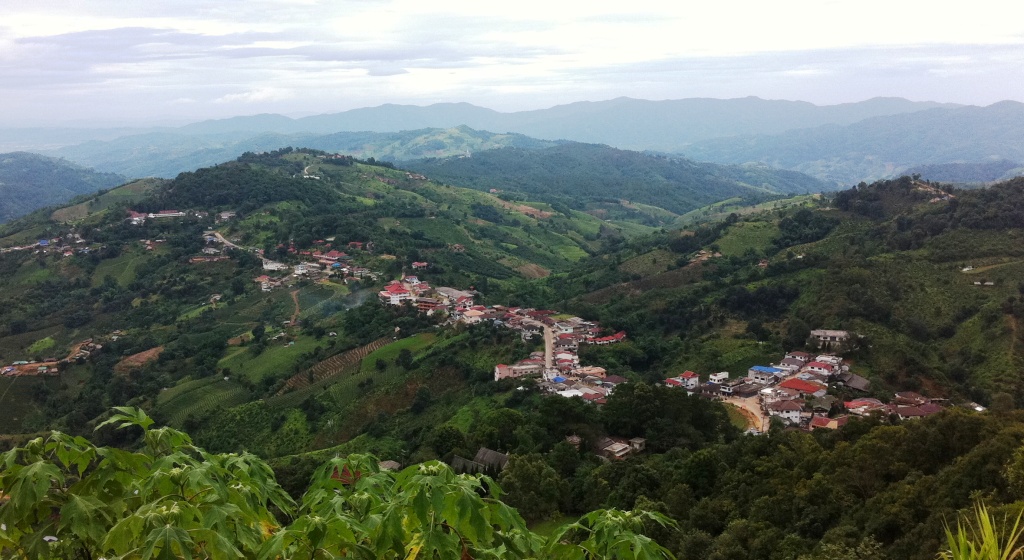
The village of Mae Salong

The village of Mae Salong

The local economy now relies on tea production and cultural tourism surrounding the local Akha highland hill tribes rather than heroin, however the Kuomintang heritage of many villagers remains an enduring legacy. Pastor Yang Congguang of the local Baptist Church is one such resident of Mae Salong.

Pastor Yang was born in 1956 in Luxi County in Yunnan Province, during what he calls “an era of war” that followed him around through childhood and much of his adult life. By the time he was two years old, Yang had already been registered by the government to join the army upon adulthood, along with his two older sisters. Yang’s parents decided to flee to Burma, hoping to escape increasingly dismal prospects in China.

Yang’s father, a farm veterinarian, went first in 1957 to a village in Kokang in northern Burma settled by other ethnic Chinese. The head of the village there owned some 3000 horses, and his father’s skills were highly sought after. However, the Chinese population of the village were not the majority Han ethnic group like Yang’s family, but the Lisu people, one of the many ethnic groups of upland Southeast Asia.

Yang’s father found the Lisu not at all as he had imagined “backwards” minority people to be. He was impressed how many of the Lisu, especially the Christian population, did not smoke, drink or gamble, and furthermore were educated enough to read. Yang’s father told the chief that he wanted to bring his family to the safety of Kokang, and that if the villagers prayed for the family’s safe passage, they would all convert to Christianity.

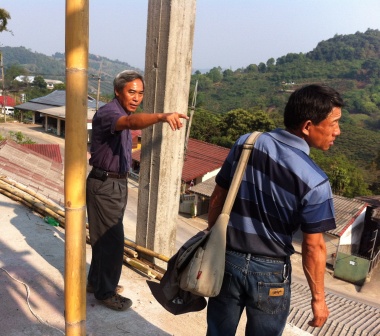
Yang supervising construction of his new church.

Yang supervising construction of his new church.

By this time it was 1958, and leaving China had become increasingly difficult and dangerous. Yang’s extended family, numbering sixteen people in total, required three trips and traveling only at night through the forests. During the final trip, it rained hard all night just before they were to cross the border and the group lost the right path. When the sun came up, his father realized they were very close to the only road across the border, manned by a PLA checkpoint. Despite the danger of trying to cross during the day, Yang’s father decided to take the risk. At the border, chance had it that checkpoint patrol house was empty, although the stationed soldiers had built a small fire. Yang’s uncle stopped briefly to warm his hands, telling the group to go on ahead. Today, Yang estimates that his family must have had only a few minutes’ window of time to sneak across the border.  His uncle did not rejoin the group and was never seen nor heard from again.

Once in Burma, the Yang family reached Kokang safely and converted to Christianity as promised. The Kokang authorities did not permit education in Chinese, so Yang learned through studying the Bible. In Kokang the family had a few years of peace, until 1966 when the Burmese Communist party swept into the northern border region, beginning a period of civil unrest as well as tumult in Yang’s life. The family moved further south, to an area in Burma populated by the Shan (Dai) ethnic minority, where they stayed for three years until once again the Burmese communists arrived. The Yang family to Lashio in the eastern Shan state, and then again even further south to an area with very few ethnic Chinese.

Yang’s adolescence occupies a murky place both in memory and time, a period of transience and uncertainty that also coincided with the rise of the heroin trade in Southeast Asia. Former Kuomintang soldiers clashed with Burmese communists, with unrest and violence spilling across the borders of Thailand, Burma, and Yunnan. During these years, Mae Salong sprung up as both a drug trading outpost and a refuge for Kuomintang soldiers recruited by the Thai government to counter Communist threats.

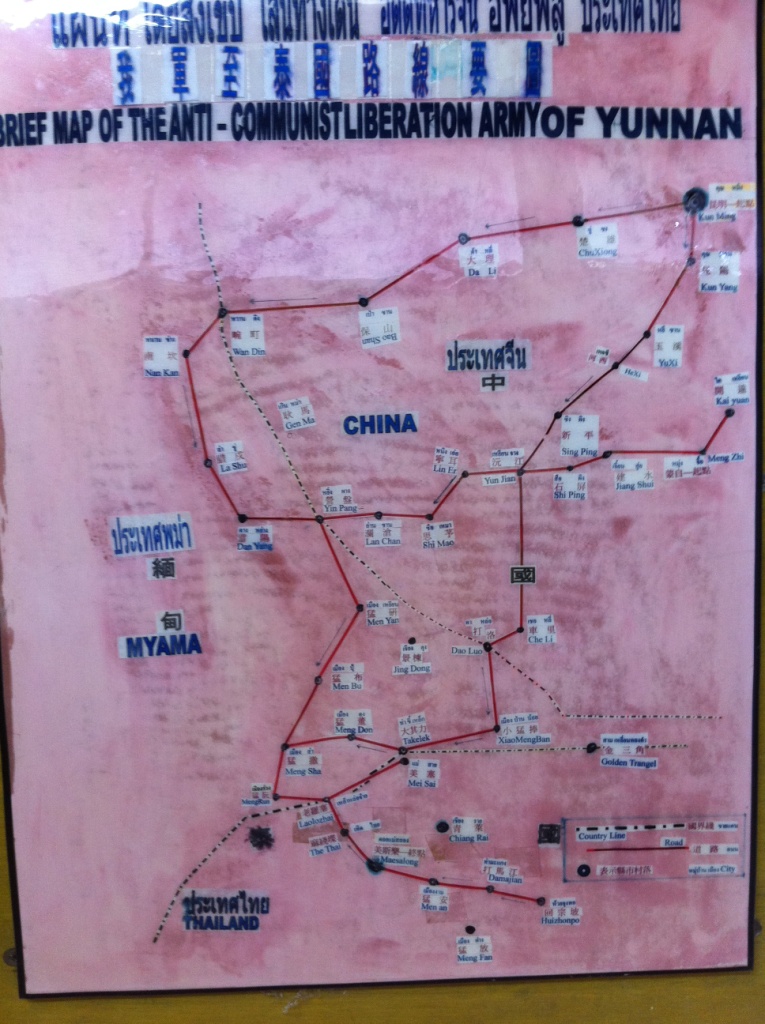
A homegrown depiction of the KMT's path of flight from China to Mae Salong

A homegrown depiction of the KMT’s path of flight from China to Mae Salong

“It was like trying to escape from a jaguar only to run into a tiger,” says Yang. “My parents didn’t want me or my siblings to grow up to be soldiers, so every time the armies came we left. But everywhere we went, they kept coming.” In 1973 he reluctantly joined the Kuomintang for a little over a year and fought against the Burmese. During this time, his faith kept pushing him to seek a different path. “I kept thinking some verses were especially speaking to me – that I should rather be a guard outside the house of God than live in the opulent tent of an evil person. The army for me meant living in an evil person’s tent,” he remembers on his decision to desert.

Yang escaped across the Salween river to Thailand at great personal cost. His commander came to his family’s house, and threatened Yang’s father to make him return. Yang’s father refused, and was taken away by the army along with nearly everything from their house, which was then burned. Yang’s brother escaped to the forests, but Yang found out later that the army shot his father by the side of the road.

For six years Yang drifted, stateless and without identity like many Yunnanese refugees in Thailand, feeling both immense guilt at the death of his father and a responsibility to lift his family back on their feet. He worked odd jobs to try and make money, “but life had no color, and I thought God had perhaps forgotten me.” But in 1981 he received an opportunity to enroll in Bible college in Bangkok, and a new beginning. His first job afterward was working at a church in Mae Salong, the village known for its KMT heritage.

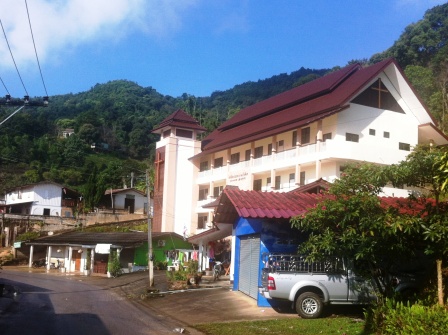
Today Yang is the pastor at the Mae Salong Baptist Church and with a wide smile proudly shows off a gleaming new building opened just this past year.  Over the past three decades, Pastor Yang has developed his own parish into a congregation made up of two hundred families who travel over the hills and footpaths to his church for worship, schooling, and community programming.  In the early 1990s, Pastor Yang and his wife built a single room church with the little donations they could gather from local villagers and began offering free Chinese language education to Yunnanese, Akha, and Lisu families who could not afford tuition at the state sponsored school.


Mae Salong's new Baptist Church

Mae Salong’s new Baptist Church

The newly built church has eight large classrooms for free Chinese language and free primary education classes taught by a cohort of regional volunteer teachers from Thailand, Singapore, Malaysia, and mainland China. Many of the students are Akha, as most of the Chinese residents of Mae Salong can now afford to attend school further down the mountain, reflecting a growing assimilation with Thai culture as more and more move away from the village to bigger cities. Yet Yang remains confident that his church and school can serve as a bridge between the past and present, as well as provide opportunities to educate the Akha residents of Mae Salong. Yang says the students are not required to be Christians to attend the school.  The Baptist Church also has a healthy relationship with the small Yunnanese Muslim population of Mae Salong, sharing access to public water resources and cooperating to bring a new pipe to the village. Yang is content, and although his life is modest he finds fulfillment serving his community.

Pastor Yang and Mae Salong may share a history that began in an era of war, but more importantly they both have a future supporting a community where multiple cultures can mix, and peacefully coexist.  “Life is good,” he smiles while looking over the town, across the green ridges of tea terraces and mist-covered mountains towards the border of Myanmar some fifteen kilometers away.

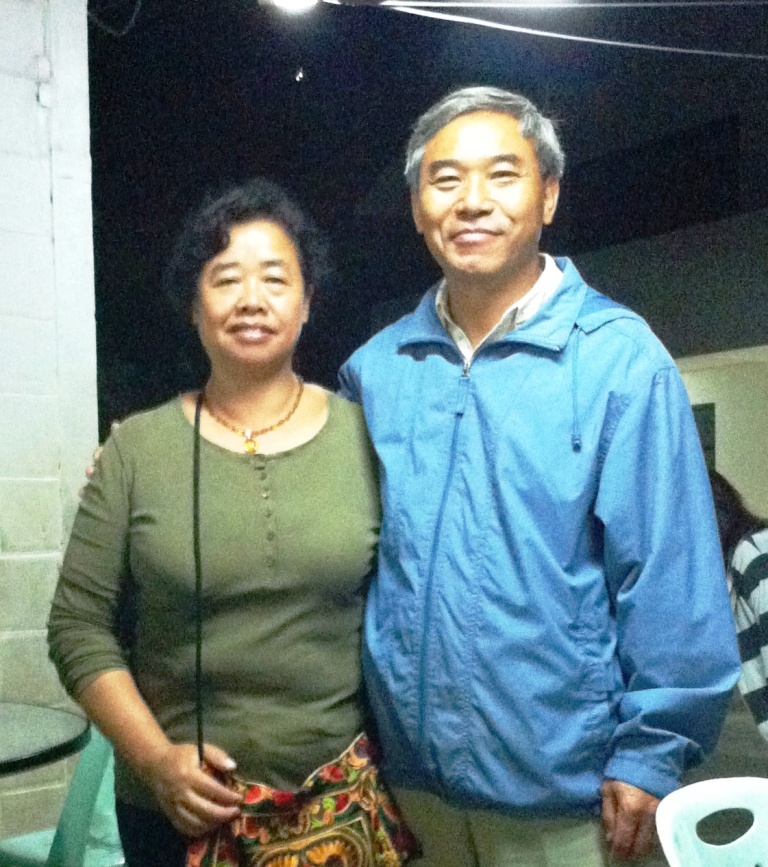
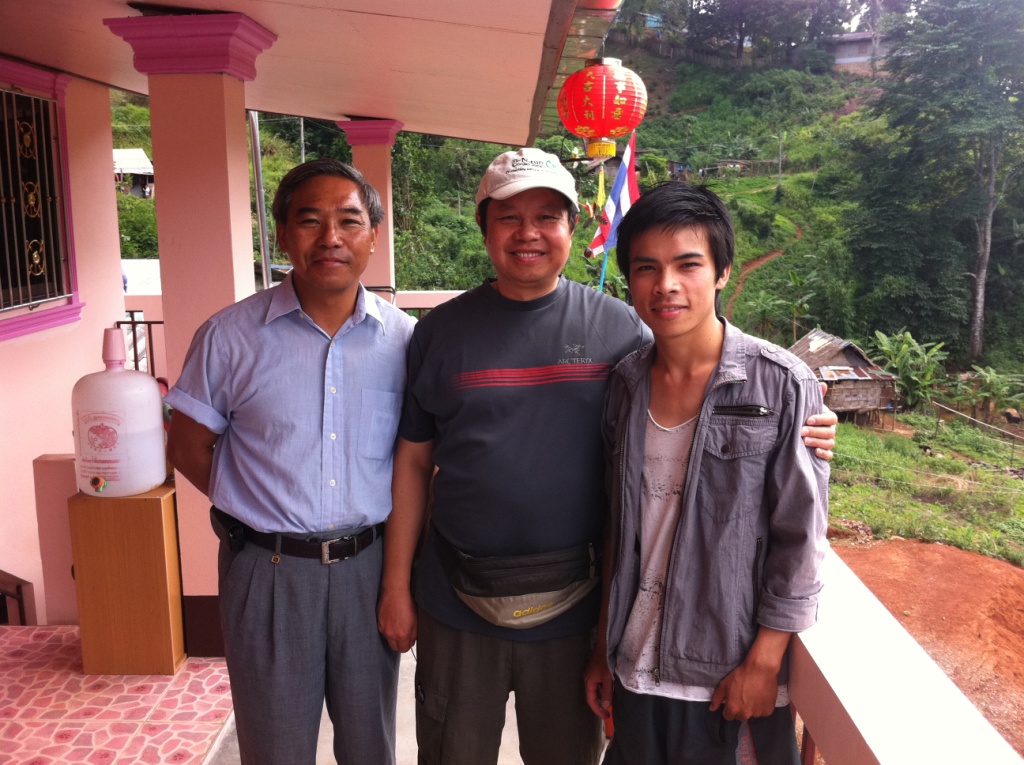
(from left) Pastor Yang with ExSE contributor Zhou Dequn and Ashi, the first of his family to attend college after matriculating through Yang's school

(from left) Pastor Yang with ExSE contributor Zhou Dequn and Ashi, the first of his family to attend college after matriculating through Yang’s school

Leave a Comment

Filed under China, Culture, Myanmar/Burma, SLIDER, Thailand, Uncategorized, Yunnan Province

China’s Humanitarian Policy in the Philippines: Politics Over People?

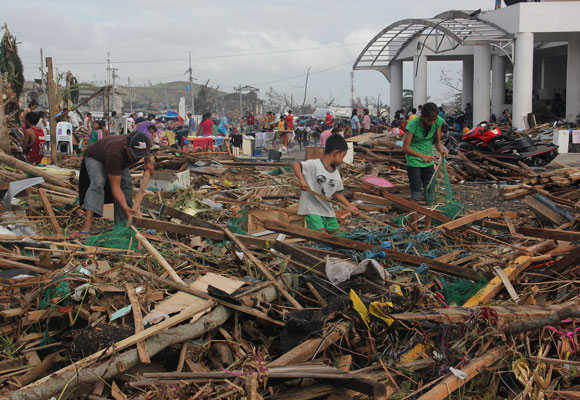
Image courtesy Bruce Reyes-Chow

Image courtesy Bruce Reyes-Chow

China has been no stranger to territorial conflict throughout its long and complex history, having met plenty of resistance while spreading its dynamic culture near and far. Today is no different, as intense disputes over tiny island chains in the South and East China Seas have left China in a state of particularly poor relations with some of its most important neighbors. These disputes, of course, do not bode well for maintaining reasonable terms over some of the region’s most important geopolitical issues. However, what has become equally as apparent—and potentially more important—is the way these conflicts are currently affecting the way China conducts humanitarian policies in the region. As China continues to rise toward the top of global power and influence, many assert that with it comes a rising role of global responsibility. What we have found thus far is that China does not appear interested in taking up that challenge.

After Typhoon Haiyan—an exceptionally powerful storm—roared through Southeast Asia in early November and devastated parts of the Philippines, leaving the country’s death toll at over 6,000, China surprised the global community by offering a meager $100,000 in humanitarian aid. This, compared to the tens of millions of dollars in aid offered by many of the world’s most powerful countries, was perceived as particularly frugal and, to some, downright disrespectful. Understandably, China received quite a bit of backlash for its decision and soon thereafter increased its contribution to $1.6 million and committed state medical resources to the areas of the Philippines most affected by the disaster. However, China’s initial contribution seemed to clearly define its true opinion on the issue.

Despite China’s late arrival to the hard-hit Philippines, its aid and assistance was, of course, still received warmly and excitedly by the victims. When a natural disaster afflicts a nation, political relations no longer seem to matter to many. Filipino residents greatly embraced China’s support. Gina Tubigon expressed her appreciation after China’s arrival ensured the survival of her sister-in-law, Elesea. A 75-year-old suffering from a chronic respiratory ailment that worsened in the wake of the typhoon, Elesea may not have lived through the storm’s aftermath had it not been for the assistance of the Chinese medical team. Relieved about her sister-in-law’s stabilized condition, Gina expressed her appreciation, noting, “I know the relationship between the Philippines and China is not good, but we’re very thankful for the help.” This purely honest and non-politically calculated sentiment sums up the importance of cooperative relations between the two nations. It also suggests the possibility that a lack of increased aid and assistance from the Chinese government may have caused Gina to lose her sister-in-law.

 Relations between the two countries have been tumultuous for some time. As China continues its unprecedented rise, with an increasingly strong military accompanying extraordinary economic development, its Southeast Asian neighbors have become more and more anxious about territorial integrity. As China’s claims to the region become more extensive, the Philippines has been bolstering its defense and maritime law enforcement—with the help of US support—and has sought endorsements from ASEAN during the process. The Philippines, just like many of its regional neighbors, has endorsed the US’s recent pivot to Asia, as a mechanism to balance against Beijing’s increased maritime objectives.

These exhaustive disputes have occurred between the two countries for decades, but have become further amplified in recent years, as China’s claim to maritime territory off the coast of the Philippines—the 200 nautical mile radius that makes up its Exclusive Economic Zone (EEZ)—has continued to expand. This includes a tiny rock called the Scarborough Shoal, which is no bigger that the size of a relatively small raft, yet vital to the two countries, as it holds important designation for charting territorial boundaries. The dispute between the two countries serves as a microcosm for a more general trend of tension and insecurity that has existed between China and its neighbors further south.

Though these tensions have persisted for many years, amplified to greater extents during certain periods more so than others, they have ceased to have a highly significant or long-term impact on trade relations in the region. Yet, China’s frugal initial response to Haiyan relief reflected a new realm of implications—that these strained relations are having a negative impact on how China is handling its humanitarian policy in the region. As the countries of East Asia continue developing economically, their regional interdependence grows in import. They must be prepared to support one another in combatting natural international crises that extend beyond politics, such as typhoons of the magnitude of Haiyan, especially when these crises have potential for mutually severe impact on multiple countries in the region.

China’s interest in extended control and influence over the region of the South China Sea—and East China Sea as well—has caused many to ponder whether Beijing also plans to embrace a wider role of responsibility regarding international crises. By offering such a small amount of financial aid during the immediate aftermath of this horrific storm, Beijing has implied that—at least for the time being—national interests remain the focal point of its current objectives, clearly trumping the need to be an international leader.

Of course, China’s stance toward the Haiyan relief effort is certainly not simple—with a range of complex considerations likely at play throughout the decision-making process. One fundamental question posed in response to China’s position is whether China is currently choosing not to emphasize the importance of more intimate relations with its neighbors—and the international community more generally—in order to instead commit more focus inward. As the Chinese government creates very carefully calculated strategies regarding domestic economic growth and infrastructural development, large numbers of financial resources and assets are presently committed to various projects throughout the country.

Indeed, China’s current national economic milieu is one of many different parts. These parts include initiatives such as western economic expansion, raising the standard of living for larger populations, developing the nation’s energy sector in a push for cleaner sources of fuel to drive the country’s future development, further establishing modern industries throughout different parts of the country (i.e. financial, technological, and creative/cultural sectors)—and many others. In addition, unprecedented economic progress has also instigated a range of complex social strains, some of which have never before been seen. Actively seeking to deal with these increasingly pronounced issues, such as frustration with appallingly high levels of pollution, larger interest in individual freedoms and self-expression among Chinese citizens, and rapidly evolving national identity—to list only a few—the Chinese government is carefully undertaking its national strategy.

As China consciously addresses these economic and social factors, simultaneous emphasis on non-political/economic international issues may not be on the immediate agenda. National leadership may currently ascertain that, still in an infant state of modern global importance and influence, this complex and highly dynamic country is not in a position to fully involve itself financially and logistically in these types of crises. However, regardless of China’s strategy with respect to regional and international stability—which at this point can only be speculated—what is clear is that China’s highly active position in geopolitical affairs has caused its western counterparts to expect a greater level of support from the rising giant towards these types of crises. Most important will be how China responds to this increased level of pressure and expected responsibility from its global economic partners as similar issues come about into the future.

Nevertheless, in the case of Haiyan, this is only but one event in the midst of a lengthy modern history of strained relations between these two countries that has fluctuated in degree over the years. Therefore, only time will tell if China’s increasingly powerful international role will cause the economic powerhouse to engage the international community differently into the future. In the meantime, the aid and assistance that China did eventually provide to the Haiyan relief effort was effective and surely prevented many from severe illness or death. The victims of the storm as well as those on the medical relief team were not considering regional political tensions as lives were saved. This kind of understanding and expectation will hopefully be at the core of decision-making between China and its Southeast Asian neighbors into the future, as a rapidly changing world seeks to prioritize people over politics.


Leave a Comment

Filed under China, Current Events, Foreign policy, Philippines, Regional Relations, SLIDER, South China Seas

Energy and Environmentalism on the Mekong: Time to Reach Across the Aisle

In recent years, two powerful narratives have emerged from mainland Southeast Asia. Generally speaking, discussions of the region focus around one of two topics: economic development and environmental degradation. For example, by typing “Mekong” into Google News the first page of results will show articles like this and this. As one can imagine, these two views of Southeast Asia are often in opposition and proponents of each rarely see eye to eye, sometimes going so far as to ignore the other side altogether. Recently, the battleground of these two narratives has been the construction sites of hydroelectric dams (both real and planned) that dot the Mekong River. Proponents of economic development see these dams as a necessary component to continued economic growth in the region. On the other hand, environmentalists point to the unknown ecological costs of the Mekong dams and argue that there are hidden costs to supposedly cheap hydropower. What is lost in the increasingly polarized game of right and wrong is a larger, more nuanced picture of the region and its needs. Some say that the Mekong needs dams while others argue that the region needs better protection measures for its natural resources. But what Southeast Asia really needs is for development fans and environmentalists to stop ignoring each other, and to restart the dialogue. Continue reading →

1 Comment

Filed under Economic development, Energy, Environment and sustainability, GMS, Mekong River, SLIDER, Sustainability and Resource Management, Uncategorized, water

In Cambodia Racist Rhetoric Brings Death Threats to Human Rights Activist

Opposition protesters from Cambodia's National Rescue Party gather in downtown Phnom Penh, December 2013.  Image: Vicky Han

Opposition protesters from Cambodia’s National Rescue Party gather in downtown Phnom Penh, December 2013. Image: Vicky Han

PHNOM PENH – Cambodia, a nation once traumatised by the ‘Killing Fields’ of the Pol Pot regime in the 1970s, has come a long way since then in rebuilding  the nation from year zero including the holding of elections, and the  creation of a multi-party system.

But the recent flood of hate-mail and death-threats sent to Mr Ou Virak, the president of CCHR (The Cambodian Centre for Human Rights) in the capital Phnom Penh, points to a society still dangerously divided over ethnic and racial issues.

 Attacks on human rights activists in Cambodia and around the world mostly come from the agents and the guardians of the status quo – the police, army, militias, and from private security companies deployed by major corporations seeking to block workers rights. Continue reading →

1 Comment

Filed under Cambodia, Current Events, Foreign policy, GMS, Governance, SLIDER, Vietnam

The Kunming-Bangkok Highway’s Final Link Opens over the Mekong

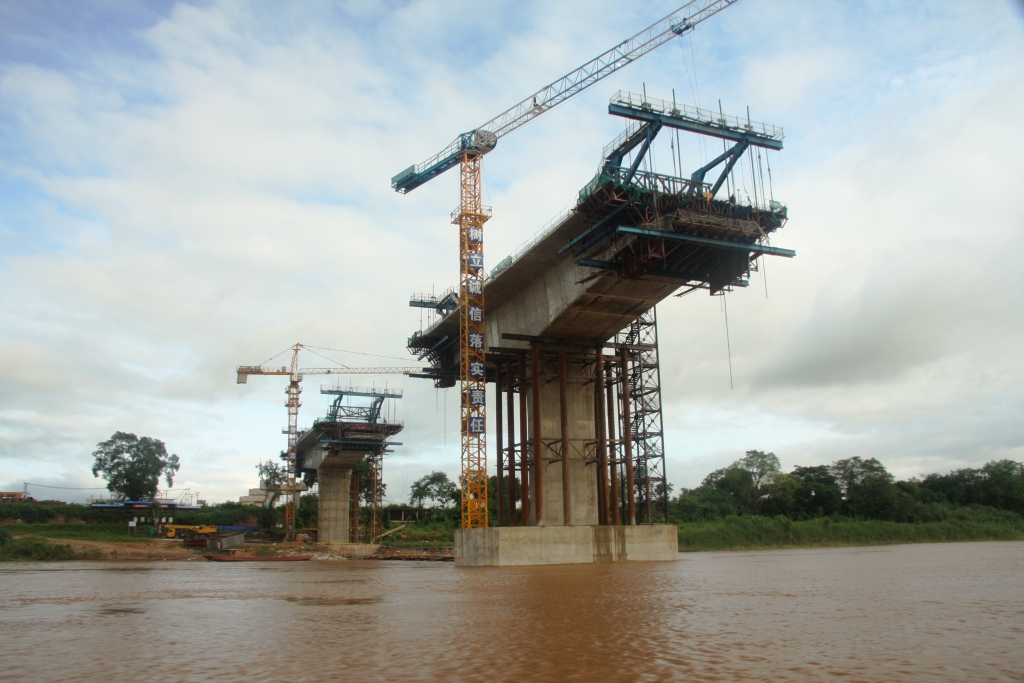
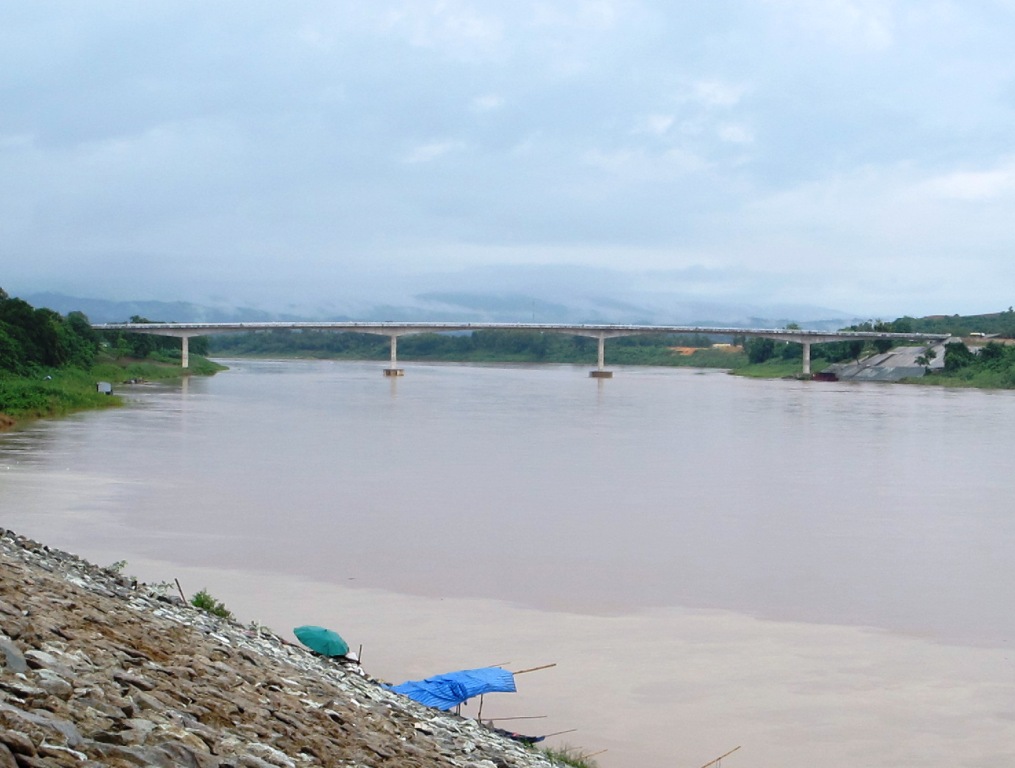
The Fourth Thai-Lao Friendship bridge which connects Thailand’s Chiang Rai province to Lao PDR’s Bokeo province officially opened for business yesterday.  Although the bridge, which stretches 400 meters across the Mekong river, and surrounding customs and inspection infrastructure have been completed for a few months, the two countries set the auspicious date of December 11, 2013 or 11/12/13 as written in the international form for the bridge’s opening ceremony conducted by Thailand’s highly respected Princess Sirindhorn.


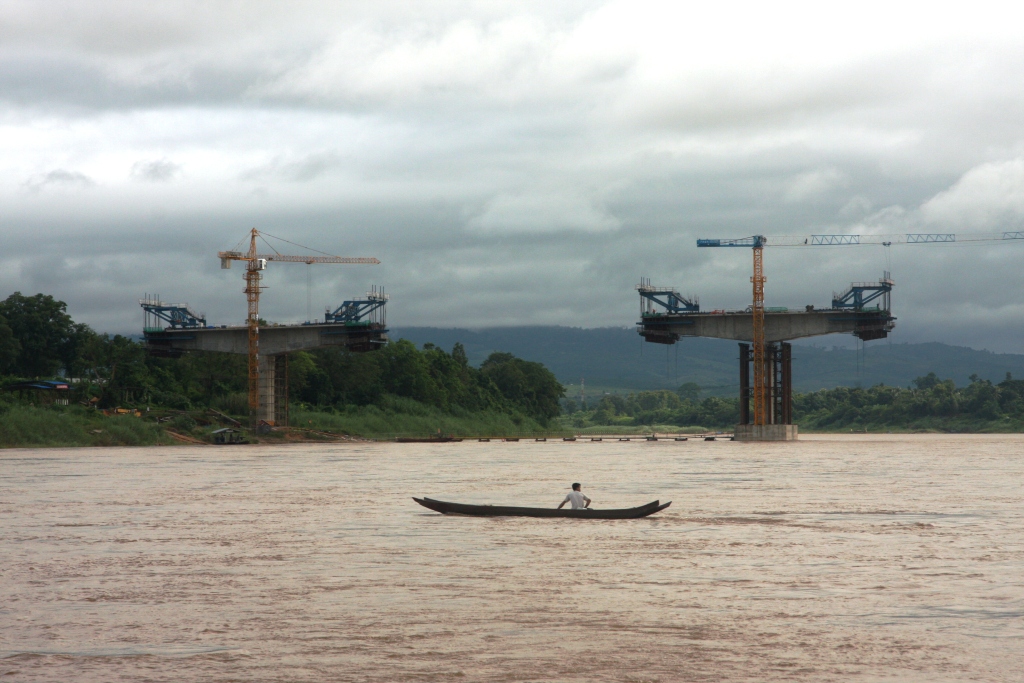
A local fisherman navigates the Mekong downstream of the new bridge (July 2012)

A local fisherman navigates the Mekong downstream of the new bridge (July 2012)

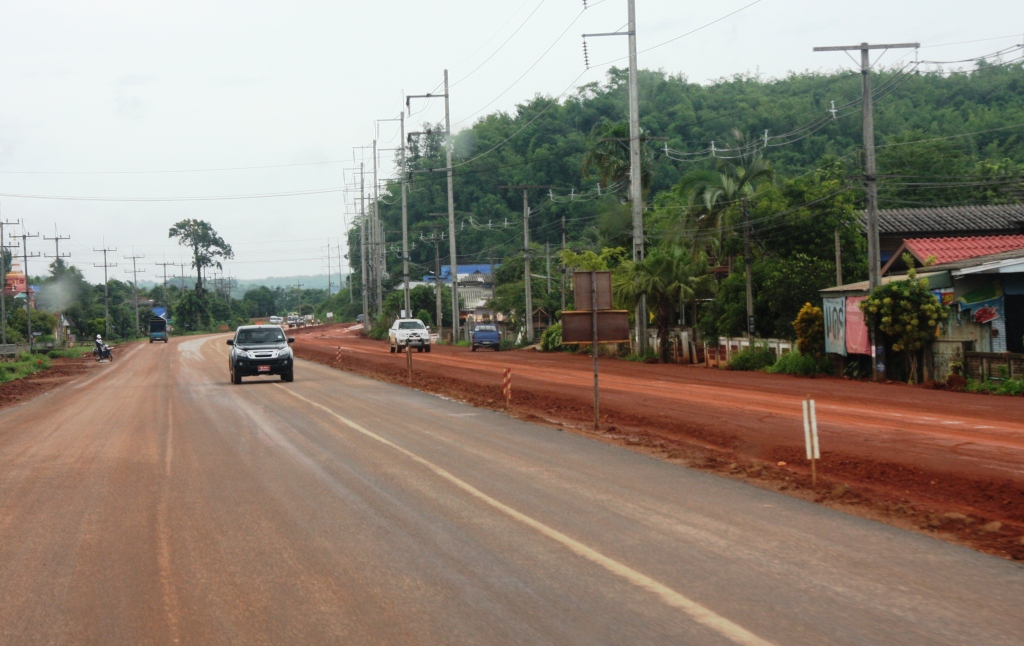
The prime benefactor from the bridge’s opening is not Thailand or Laos, but rather China as the bridge serves as the final link in the Kunming-Bangkok highway, a 1900km series of connected highways that will facilitate significant increases in container shipping trade between China and Thailand.  Six years ago overland transport between Kunming and Bangkok for container shipping was virtually impossible due to the poor quality of roads.  In China’s southwestern Yunnan province, a drive from Kunming to Jinghong, the Dai cultural capital of Sipsongpanna (Xishuangbanna) prefecture took up to 24 hours and another six hours to the Lao PDR border at Boten.   China completed its portion of the highway to in late 2007.

The Lao PDR segment of the highway connects Boten to the 4th Friendship bridge in Huayxai and cuts through 180km of the most remote parts of Laos.  In the summer rainy season of 2004 I hitched a ride on a pickup truck to travel the 180km segment which then was a single lane mud track.  We completed the tiresome 10 hour drive only after averting a serious accident and certain death when the truck spun out of control nearly pitched over a 400 meter cliffside.    China, Thailand, and the Asian Development Bank invested equal thirds in the Laos portion of the highway which opened in 2010 and dropped transportation time to three hours.

By design, the highway system links the friendship bridge to Bangkok, but despite being the strongest economy on mainland Southeast Asia, Thailand’s highway system lags behind in quality compared to China and the stretch running through northern Laos.  Improvements to Thailand’s R3 highway system which will link Chiang Rai province to all points in Thailand is ongoing but far from complete.  Thailand has promised to upgrade its national transportation and highway infrastructure but political roadblocks, corruption, and a perceived lack of momentum for regional integration at many levels of Thai government and society has discouraged those plans from synching up with China’s outwardly stretching infrastructure linkages.   When the Thai roads are finished, a container truck will be able to travel from Kunming to Bangkok in less than 18 hours.

Road widening construction on Thailand's R3 in Chiang Rai province

Road widening construction on Thailand’s R3 in Chiang Rai province

The 14 hour drive from Kunming to the friendship bridge feels like a leapfrog journey from bridge to tunnel and tunnel to bridge as the road makes its 1800 meter descent.  These two roads cut through some of the most difficult terrain on the planet and link the Chinese state to the Thai state while passing through the most ethnically diverse region in Asia.

The roads not only to build regional commercial connections between China, Thailand, and Laos through the increases of trade and investment but they also assist in expanding each of these state’s interests and systems into the once impenetrable regions of upland southeast Asia by introducing national education systems, agricultural techniques that promote mono-cropping over traditional subsistence farming, and creating avenues for ethnic and rural peoples to leave their homes and link up to national labor markets.   The opening of the bridge will increase trade in the region and will intensify and quicken the pace of social change in upland Southeast Asia and reshuffle the cultural milieu of peoples who have sought refuge from the expansionary Chinese and Thai states for centuries.

Under construction, July 2012

Under construction, July 2012

Bridge completion, December 2013

Bridge completion, December 2013

The bridge’s construction has also caused an influx of Chinese investment in Chiang Rai province mostly in real estate development, speculation on future industrial estates for manufacturing of intra-industry goods passing between China and Thailand, and the buying up of agricultural lands.  While this investment is encouraged and welcomed at the national level and by the Chiang Rai Chamber of Commerce, locals are wary of the fast and growing levels of investment in the Golden Triangle Area by Chinese firms and often cite a “Chinese invasion.”  The mayor of Pak Ying Tai village, a small fishing community of 100 households located less than one kilometer south of the bridge has lamented to me on several occasions about China’s footprint in Chiang Rai as he observes year on year decreases in freshwater fish catches and sends more and more of his villagers looking for work in urban areas.

A local farmer from Pak Ying Tai village discusses his worries about community impacts of economic development

A local farmer from Pak Ying Tai village discusses his worries about community impacts of economic development

In many ways the bridge and its construction serve to represent the challenges of regional cooperation between China, Thailand, and the rest of mainland Southeast Asia.  From its conception in the late 1990s to its completion yesterday, the bridge has gone through stalled and failed rounds of negotiation and has not lacked controversy.  Groundbreaking for the 1 billion Thai baht project which is equally invested by China, Laos, and Thailand did not occur until 2010 despite a scheduled start for as early as 2006. In May 2011 Thailand pulled its portion of the construction team in order to settle a land dispute with the local Thai government accusing Chinese commercial interests of illegally purchasing land on the Thai side of the bridge.

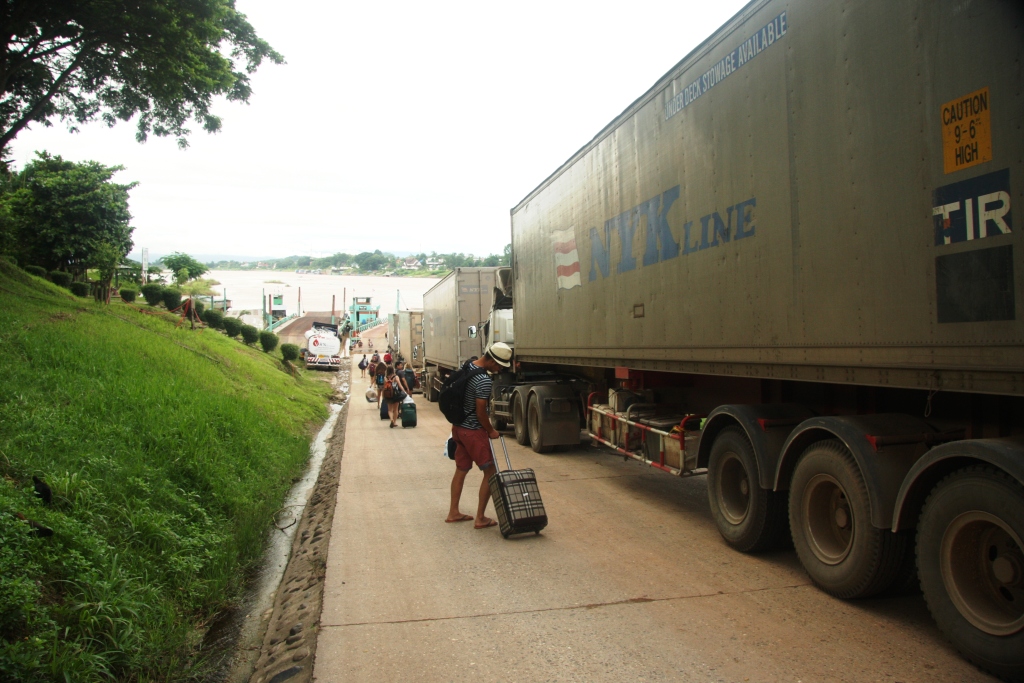
Container trucks will no longer have to wait in line for the Mekong ferry at Huayxai in Laos.

Container trucks will no longer have to wait in line for the Mekong ferry at Huayxai in Laos.

Another obstacle to regional cooperation demonstrated by the bridge is the ease of passage through customs and inspection for both container trucks and individual travelers or tourists to the region.  Chinese trucks are not permitted to drive in Thailand, nor are Thai trucks allowed to travel through China; thus the speed of transport is slowed by the need to repackage goods at one of the border crossing points. Despite efforts of the ADB in to facilitate a shared cross border trade and transport protocol to streamline logistical flows at regional border checks in China and mainland Southeast Asia, states have been slow to adopt the measures in order to protect national markets and logistics industries.  New customs and inspections facilities at the bridge are fitted to increase the speed of transport and ease of people movement and will serve as a testing ground for these promised increases in logistical efficiencies.

Looking forward to the first six months after the bridge’s opening, the verdict will be clear on whether the bridge will serve as a strategic choke point, a gateway for win-win trade and economic development between two regional powers , or a conduit that will further challenge the structure of rural livelihoods in upland Southeast Asia.

Looking upstream at the completed bridge from Pak Ying Tai village.

Looking upstream at the completed bridge from Pak Ying Tai village.

Leave a Comment

Filed under China, Current Events, Economic development, GMS, Mekong River, Regional Relations, SLIDER, Thailand, Uncategorized, Yunnan Province