Category Archives: SLIDER

Review: Hun Sen’s Cambodia

hun-sen-cambodia-review-722x481

It is now 36 years since the end of the Khmer Rouge regime that all but destroyed the Cambodian nation, decimated its most educated people, and reduced the country to year zero.

Amazingly, the young foreign minister who emerged from the debris in 1979 is still in power.

Hun Sen, then a gaunt-looking 27-year-old, was drafted from the obscurity of a Vietnamese camp for Cambodian dissidents and defectors to serve in the newly installed Heng Samrin government. His parents were poor rice farmers. He entered politics without any diplomas or degrees. From the world’s youngest foreign minister in 1979, he currently ranks as the region’s longest-serving prime minister.

Two years after the defeat of the Khmer Rouge regime,world's youngest foreign minister emerges from the genocidal darkness of the oppressive regime. Photo copyright: Tom Fawthrop

Two years after the defeat of the Khmer Rouge regime,world’s youngest foreign minister emerges from the genocidal darkness of the oppressive regime. Photo copyright: Tom Fawthrop


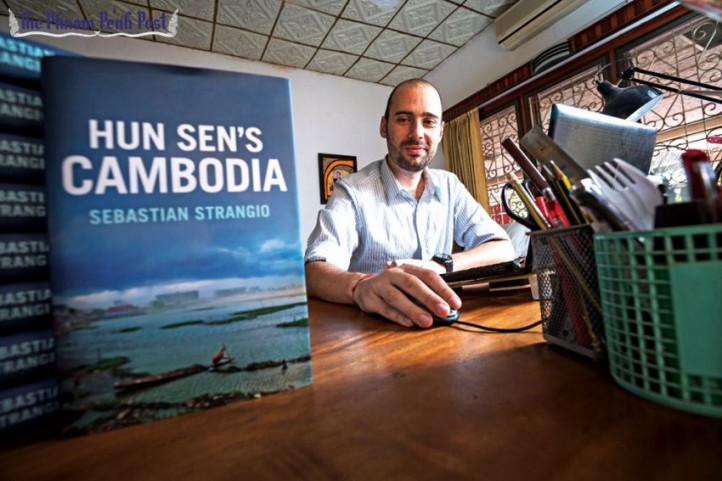
Hun Sen’s Cambodia by Sebastian Strangio, a former journalist with the Phnom Penh Post, helps to fill a number of historical gaps in charting the rise of Hun Sen through the 1980s to the 2013 elections. The young foreign minister was a fast learner. Appointed prime minister in 1985, Hun Sen soon boldly charted an end to the civil war. In 1989 he gave the country a new name — the State of Cambodia — as well as a new flag and constitution, and shrewdly paved the way for an eventual peace settlement in Paris.

Unfortunately, Strangio’s attempt to record recent Cambodian history is marred by an obsessive desire to view every topic through same prism: the legacy of UNTAC — the UN peacekeeping mission (1991-93). Also pervasive is the author’s conviction that in every field Cambodia’s achievements are nothing more than a “mirage.”

A confident Hun Sen already the prime minister ,dares to swim in a Kampot river in spite of Khmer Rouge insurgents still active less than  25km away.

A confident Hun Sen already the prime minister ,dares to swim in a Kampot river in spite of Khmer Rouge insurgents still active less than 25km away. Photo copyright: Tom Fawthrop

Cambodian Reform

Cambodia has clearly made great progress in the last 30 years.

The nation was reborn in the 1980s. Peace returned in 1999. Cambodia long ago lost its regular place on TV news as one of the world’s most dangerous war zones. The magic of the ancient temples of Angkor and the nation’s cultural revival now once again captivate visitors. Both tourism and the garments industry have fueled economic growth.

Moreover, Cambodia is less repressive than many ASEAN governments, including Thailand and its cycle of military coups. Yet, according to Strangio, multiparty elections offer only a “mirage of democracy.”

In Cambodia’s last election, Hun Sen’s ruling party suffered a stunning loss of 22 seats, with the united opposition coming in a strong second with 55 seats in a national parliament of 123 members.

It’s too soon to dub this a “Phnom Penh Spring,” but Cambodia’s political diversity is more than just a mirage, particularly in comparison to the long-serving prime ministerial reigns ofMahathir Mohamad in Malaysia (22 years) and Singapore’s Lee Kuan Yew (31 years). Malaysia and Singapore have never tolerated the strikes, protest rallies, and vociferous opposition that are all welcome features of Cambodian political life.

Cambodia, according to Strangio, was the nation where the UN and Western aid lavished billions of dollars on peacekeeping, implanting liberal democracy and human rights. The author assumes that Cambodia could make a smooth and rapid transition from the genocide and cruel deprivation of the 1980s to a shining beacon of democracy today. Of course that fantasy has not happened. The author concludes that the ruthless intransigence of Hun Sen and his ruling party, abetted by a traditional Cambodian resilience to foreign mentors of all ideologies, thwarted the allegedly benign, well-meaning Western efforts since the end of the Cold War to create a democratic success story.

In so doing, the author fails to detect a “mirage” of a different nature that did not come from any Cambodian failures, but can be squarely laid at the door of Western nations sitting in the UN Security Council.

Flaws of Peacekeeping

The UNTAC peacekeeping operation has been widely hailed as a great success story that ended the Cambodia conflict and ushered in a putative new democracy.

The UN-run election in 1993 did help implant democracy in Cambodia. However, the author glosses over the failure of UN peacekeeping and Western nations to get rid of the Khmer Rouge bases sustained and supported by the Royal Thai Army in blatant violation of the 1991 Paris Peace treaty.

From 1993-1998, the Pol Pot nightmare continued to haunt the fragile new state. The Khmer Rouge still controlled the gem-rich border province of Pailin and Anlong Veng to the north. They still planted landmines and burned down remote villages that defied them.

The war continued because the United States, France, and the UK all gave a much higher priority to preserving their deep military and trading ties with Thailand than putting pressure on this important ally and its military to sever the supply lines to the outlawed Khmer Rouge.

It was an elected Cambodian government led by Hun Sen — and not the UN — that finally eliminated the Khmer Rouge insurgency. On this point the book accepts that many voters in the 2003 election felt relief the war was finally over and rewarded the government with a strong mandate. Having secured the peace where the UN had failed, Hun Sen reached the zenith of his popularity at home.

In 2003, I wrote that if Hun Sen had retired around this time, his achievements and his legacy would have outweighed his dark side. But since peace and stability returned to Cambodia, corruption and looting of natural resources have boomed, with the prime minister’s close associates as the main beneficiaries.

The book rightly points out that 20 years of Western aid has only spawned an aid-addicted dependency. But Hun Sen hardly invented crony capitalism, corrupt patronage, or the skimming off of foreign aid.

The World Bank’s neoliberal development model of sweeping privatization and starving the public sector of any significant aid has also encouraged or tolerated cronyism in the scramble over newly privatized assets and the mass eviction of the urban poor. The opposition has failed to offer a real alternative to Hun Sen’s adoption of the neoliberal model of development designed by the World Bank. Neither side has come up with policies that could narrow the yawning gap between rich and poor.

Hun Sen must take a lot of responsibility for the ugly side of Cambodian development. But the book’s depiction of Western government aid as always benign and benevolent suffers from a lack of critical questioning.

Transitional Justice

Strangio dismisses the landmark trial of a few surviving leaders from the genocidal Khmer Rouge regime — Asia’s first case of international justice — as just another deception.

But the complex UN-backed tribunal brought together local and international lawyers and judges based on a UN partnership with the Cambodian authorities. Many cynics predicted that the trial would never take place. Whatever the shortcomings of this legal process, millions of Cambodians belatedly experienced a very real justice. They finally saw Pol Pot’s chief accomplices held to account, given a fair trial, and convicted of crimes against humanity.

According to UN legal expert Lars Olsen, Cambodian participation in the process exceeded that for all previous international justice courts. In addition to the 500 Cambodians who filled the public gallery day after day, they also participated as victims and litigants known as “civil parties.” Most victims have expressed some satisfaction that the tribunal brought a sense of accountability, closure, and justice.

That Cambodia was brave enough to face its tragic history should alone command international respect. Indonesia is still afraid to document and investigate the skulls in its own cupboard: the massive bloodbath in 1965-66, with an estimated 900,000 dead, and the subsequent atrocities in East Timor.

If the United States and its allies had not helped the Khmer Rouge hang on to Cambodia’s seat in the UN General Assembly and blocked the credentials of the Heng Samrin government, this genocide tribunal could have taken place more than 25 years ago, as Hun Sen proposed in 1986. As it is, the ongoing tribunal is a case of far better late than never.

Why has Hun Sen, a leader from such humble origins, subsequently turned his back on the poor majority of Cambodians and their cry for land and justice? What kind of egomania has driven him to want to remain prime minister until the age of 72?

Strangio should have put these questions to Hun Sen in an interview.

Yet despite five years of commendable research, Strangio’s book doesn’t rely on any interviews with his prime subject. So we never get any of the answers that might have truly illuminated Hun Sen’s character, or any deeper insights in why he has chosen the path of electorally sanctioned authoritarianism and feudal-style patronage — a hallmark of the 1960s under the rule of Prince Norodom Sihanouk.

Tom Fawthrop is a frequent contributor to ExSE.  He directed a Cambodian film Dreams and Nightmares broadcast on UK Channel 4 in 1989 and has interviewed Hun Sen on three occasions. He is also co-author of the book ‘ Getting away with Genocide?”  Pluto Books 2004.

This review was originally posted here on the FPIF website on February 15, 2015 and is reposted with the permission of the author.  

Leave a Comment

Filed under ASEAN, Cambodia, Cold War, Current Events, Economic development, Reviews, SLIDER

China & Europe: Reconnecting Across a New Silk Road

chen 1

Since 2013, economic and trade relations between China and Europe have grown significantly. In this article, the authors look beyond conventional economic indicators, like trade, and political issues, like human rights, instead focusing on transport infrastructure, real estate and tourism to show that a new page is unfolding in the history of China-Europe relations.

China and Europe have been closely linked since the Opium Wars, but the relative economic positions and power have reversed. Nothing illustrates this more symbolically than a stroll along the Bund in Shanghai: the low rise and old European-style buildings on the West side of the Huangpu River are dwarfed and eclipsed by the sparkling skyscrapers in Pudong on the east bank. The built environment of Shanghai, with its historic European-style buildings and modern China-built skyscrapers, is a physical manifestation of the reconfigured dynamic between China and Europe.

Since 2013, China’s connections with Europe have expanded since developing its official policy of building a westward economic corridor — a new Silk Road — along its ancient route. Most recently, in December 2014, China agreed with Hungary, Serbia, and Macedonia to build a rail link between Budapest and Belgrade, which will be financed by Chinese companies and completed by 2017. This rail line will then be connected to the Macedonian capital of Skopje and the Greek port city of Piraeus where COSCO, the Chinese shipping giant, operates two piers for container units. While the linked land-sea project will strengthen cross-border transport between Central and Southeastern Europe by reducing train travel times between Budapest and Belgrade from eight to three hours, it really is designed to enlarge and accelerate the movement of goods between China and Europe.

Having grown fivefold since 2003, trade between China and Europe reached $559 billion in 2013, solidifying the EU as China’s largest trading partner for the past 10 years. While the EU has invested more in China than the latter’s direct investment in the former, a US consulting company expects the EU to attract $250-500 billion more Chinese direct investment by 2020.1 A scenario likely to occur in the next few years is that China will invest more in Europe, instead of vice versa. This will be another telling sign that fortune and power are shifting in China’s favour.

These developments are not isolated and random. They represent a new structure of interactions between the older European economies and a rising Chinese power. We can understand this structure well by examining its conventional macroeconomic dimensions of bilateral trade and investment. In this essay, however, we make better sense of the new China-Europe relationship through a set of less used lenses: transport infrastructure, real estate, and tourism. They offer new insights into areas where China exerts a large and heavy footprint in Europe, via official channels and from the ground up.


Transport Infrastructure and Connectivity

In thinking about China and Europe today, transport infrastructure does not usually come to mind due to the long distance between them and Europe’s own well connected transport networks. Having built the world’s longest highway, railway, and more bridges and buildings than any other country over the past two decades, China has been constructing an extensive transport and municipal infrastructure within its Asian neighbours and far-flung African cities.2 More recently, China has also turned to Europe in strengthening their long-distance transport connections, aiming to improve the overland movement of traded goods. Less expected is China’s new foray into the domestic infrastructure sector of a few European countries. Both moves make infrastructure a major avenue for China to forge direct physical connections to Europe.

The most important connection thus far is the Trans-Eurasia railroad from the city of Chongqing in southwestern China to Duisburg, Germany. Launched into operation in 2011 by a joint venture with Germany, China, Kazakhstan, and Russia, the 11,179-kilometre rail line snakes through six countries including Belarus and Poland (see Figure 1). China is the largest beneficiary of this freight-focused rail network, having already shipped $2.5 billion worth of goods on this route to Europe since 2011. As labour and land costs in coastal cities like Shanghai and Shenzhen have gone up, the Chinese government has been pushing and inducing foreign investors and domestic producers to move inland through its “Go West” policy. Interior megacities like Chongqing and Chengdu have been booming as major destinations for large new manufacturing projects. Having set up what would be Asia’s largest laptop factory in Chongqing, US computer giant Hewlett Packard has already shipped more than four million notebook computers to Europe by the Chongqing-Duisburg rail since 2011.

chen 2 chian-map


As manufacturing becomes more concentrated in Chongqing and Chengdu, it will reap more savings from reduced transport costs. About 60% of the material inputs for laptops and 30% of the finished laptops depend on rail transport. Bringing them in and out by sea is very expensive and time-consuming. It requires a long train ride to Shanghai or Hong Kong from where container units are shipped to Europe. In the other direction, growing demands in interior China for European foods and cars can also benefit from a greater use of the Chongqing-Duisburg rail connection. It typically takes 2-3 months for a customer in Chengdu to receive the delivery of a European car by sea as it has to come through the port city of Tianjin. This wait can be reduced to 25 days if the car is transported by train from Europe to Chengdu.3

While this overland rail route can yield major economic benefits for China and Europe, its greater potential won’t be realised without policies for overcoming existing barriers. The Chinese government has recently approved the status of an international land port for Chengdu and Chongqing. This allows the direct and full import of European meats and cars to fill the train cars going back to China that would otherwise only be partially filled after carrying full loads of exported electronic products to the European markets. A fully loaded train has recently brought car parts from Germany to a Ford plant in Chongqing using the Trans-Eurasia railroad.

Another obstacle is that Chinese and European railways use different gauges than Russia and its former satellite states. So far the Chongqing to Duisburg route has met this standardisation challenge by transferring to cars with new gauges at relevant border crossings to meet varied national track requirements. It will need to adapt to other differences in technologies, signalling systems, and gauges that add costs to coordination across several countries.4 However, the existing and potential benefits for China and the other countries along this rail route will motivate them to co-operate in overcoming the remaining hurdles. So far it is China that has been moving at full speed. It has already sent a total of 239 (100 during the first seven months of 2014) trains carrying container units to Europe, including a train from the city of Zhengzhou in the central province of Henan bound for Hamburg.5

As China’s rail transport connections to Europe multiply, China has also launched an infrastructure build-up within Europe with an initial focus on the geographically closer and economically weaker Central and Eastern Europe. In December 2014, China and Serbia inaugurated the first ever bridge in Europe across the Danube River financed and built by China. Named after Mihajlo Pupin, a renowned Serbian scientist, the 1,500-metre bridge connects the southern industrial district of Zemun with the northern residential area of Borca in Belgrade, cutting the travel time across the Danube from more than one hour to just 10 minutes. China has also landed the contracts for the Stanari Thermal Power Plant in Bosnia (up to $1.7 billion) and the Bar-Boljare motorway in Montenegro with a link to Serbia ($984 million).6 Infrastructure projects of this scale have been very rare in these countries for more than 20 years, given the bad economic conditions in Croatia, Serbia, and Bosnia-Herzegovina, with nearly 1.5 million unemployed, due to the post-Yugoslavian political instability, ethnic conflicts, and natural disasters like flooding. China’s major efforts to finance and upgrade the outdated transport and municipal infrastructure in these countries opens up a new era of China’s local presence and influence in Europe.


Going After European Property

As China is making inroads into Europe’s infrastructure sector, the real estate sector cannot be far behind as an investment target. Southern European countries like Italy and Portugal, which have been adversely affected by the financial crisis, are seen as especially good opportunities for Chinese investors, as the property prices there are lower than in other European countries, like the United Kingdom and France, that have managed to weather the crisis better. Homes in southern Europe are also attractive compared with those of China as 300,000 euros buys a 200 square metre villa facing the sea. That amount only buys an apartment of 68 square metres in central Shanghai7 where property prices have been artificially inflated due to years of speculative supply and persistently strong demand.

Besides their low property prices, countries such as Cyprus, Portugal, and Greece are offering resident permits to property buyers who are not already residents of the European Union. This appeals to Chinese investors who have the capital to buy the properties but not the residency or citizenship benefits to use them within Europe. In exchange for a minimum amount of investment in property in a European country (amounts vary depending on the country, but the starting price is generally upwards of 250,000 euros), the investor may be granted a visa that allows him or her to live and travel within the Schengen Area, which consists of 26 European countries. A recent trend among Chinese investors is to buy a property in Southern Europe and then secure permanent residency there once their visas have been approved. A reporter from Bloomberg observed that “most (Chinese investors) are getting homes for personal use or to send their children to schools there.”8 By July 2014, Chinese citizens had received 282 of the 1,880 “golden visas” or permanent residencies granted by the Spanish government to those who bought local property.9 Since October 2013, the Portuguese immigration office has approved 1,681 property purchase applications, 1,429 of them from China, about 85% of the total.10

Besides property value and permanent residency, the measure of the Chinese yuan (RMB) against the euro is another important consideration, and one that has contributed to the rise of Chinese investment in European property. The euro depreciated approximately 17% against the yuan from 2010 to July 2014. Chinese investors bought 3.05 billion euros’ worth of European property in 2013, an increase from the 978 million euros spent in 2012. The Financial Times found that Chinese direct investment in Europe tripled in just two years (2010-2012), from 9 billion euros to 27 billion euros.11


chen 3 comp-pic-copy

The large volume of this investment in European property reflects a major shift in China’s overall outbound investment, from securing natural resources in developing countries to acquiring brands, technology, and other assets in developed countries. A major Chinese real estate developer has recently committed $1.6 billion to convert the derelict Royal Albert Dock in London into a global trading hub. Intended to attract Chinese companies as tenants, this project is planned for 4.5 million square feet of office space to be developed in phases through 2020. London’s Mayor Boris Johnson has strongly endorsed this project for its prospect of generating about $10 billion for the national and local economies. He has lauded the project’s potential ability to turn what was once one of “the throbbing arteries of UK trade and commerce” into “a world-class international business district.”12

In June 2014, Wang Jianlin, one of China’s largest real estate investors and richest men, bought the 25-story Edificio España in Madrid, a landmark Franco-era building that was also Spain’s tallest, for 265 million euros or $340 million. Sitting empty since the Spanish real estate market’s collapse in 2008, the building will be renovated to include luxury apartments and a hotel as part of a larger-scale neighbourhood regeneration.13

The scope of Chinese investment in European property represents a powerful combination of China’s surplus corporate and private capital that can affect the urban landscape in European cities. Its long-term impact, however, will depend on the pace and volume of its outflow from China, and its geographical concentration and spread within Europe.


Big-Spending Chinese Tourists

As a relatively small but growing number of wealthy Chinese investors put their money into European real estate, a much larger number of middle and upper middle class tourists from China are coming to Europe to buy a lot of luxury goods. China’s rapid economic growth has created a huge number of middle and upper middle class consumers with insatiable desire and startling purchasing power. In 2013, Chinese citizens made approximately 100 million overseas trips and spent over $100 billion on their trips, mostly on luxury goods, overtaking the United States and Germany as the world’s number one tourist spending nation. Today nearly one-third of the world’s personal luxury goods are bought by Chinese consumers.

In 2014, Europe accounted for 3.5% of overseas travel destinations for Chinese citizens; this was the second most popular regional destination after Asia, which accounted for 70.4% of overseas tourism. Visa applications to enter the Schengen Area from China accounted for approximately 1.5 million of the total applications in 2013, ranking China third overall, behind Russia and Ukraine.14 In its 2014 report, hotels.com observed that “European destinations are the most popular amongst Chinese travellers in terms of places they wish to visit in the next 12 months.” By surveying the number of rooms and the length of stay in hotels booked through its website, hotels.com placed France, the United Kingdom, and Italy in the top ten destinations for Chinese travellers in 2013 as all three countries experienced growth in the amount of tourism from China.15The German National Tourist Board recently showed Germany, France, Italy, and Switzerland as the top four European destinations for Chinese tourists.

While many Chinese tourists in Europe are interested in seeing sites of historical interest and established landmarks like the Eiffel Tower and Venice’s Grand Canal, they are there for a much more passionate interest: shopping, especially for brand-name and luxury goods. Paris is the most popular destination for this shopping spree. It is where Chinese tourists head to the Louis Vuitton shops in much larger numbers than to the Louvre. As early as 2009, Chinese tourists overtook Russians as the highest spending visitors to France. Wealthy Chinese tourists also head south to the wine country of Bordeaux where they snap up expensive wine, paying as much as $800 for a bottle.16 They bring the wine back to China where it can be displayed and then drunk as a prized possession; red wine has become increasingly popular at dinner parties, replacing beer and traditional Chinese liquor.

McKinsey’s survey of Chinese luxury consumers in 2012 found that “Europe is growing in appeal among Chinese luxury consumers, with about one-fifth of them reporting this year that their most recent overseas purchases occurred in a European city. That is more than double the European share two years ago.”17 A study by the European Travel Commission estimated that Chinese tourists reserve more than a third of their trip budgets for shopping. To be able to do so, they compromise on eating and sleeping. A survey in 2006 found that Chinese travellers in Europe had eaten “European food” only once, and 10% not at all. Many in tour groups arranged by Chinese travel agencies would stay in cheaper hotels and eat instant noodles, even though they could afford luxurious hotels and lavish meals.18 The average Chinese tourist spends around $5,000 during a European trip, more than any other country. This is not surprising when one often sees groups of Chinese tourists getting dropped off at expensive stores and coming out with their suitcases full of brand name clothes, handbags, and cosmetics.

There are several reasons for Chinese tourists to buy luxury goods heavily in Europe. Besides the obvious factor of their rising affluence, Chinese tourists pay less for luxury consumption in Europe than in China. Taxes on certain items and tariffs on imported goods increase the price of luxury goods produced elsewhere and sold in China. According to The Economist, taxes and tariffs can increase prices in China to 50% more than a shopper would pay elsewhere. For example, a Louis Vuitton handbag costs 30% more in Beijing than in Paris.19 The purchase of luxury goods while travelling in Europe connotes the high income and status of the consumer. A study published by the University of Pennsylvania’s Wharton Business School found that “travelling has become part of the luxury lifestyle in China and is considered a status symbol: there is greater cachet in being able to say you purchased your bag at the place of origin in Paris rather than a branch in Tianjin.”20 Chinese consumers also perceive a higher quality and a greater variety of luxury goods if bought in the places of origin. In addition, while the appreciation of the Chinese yuan against the euro has helped, Chinese tourists have benefited from a greater ease in getting European visas.

European countries have made getting visas easier for Chinese tourists. Recent initiatives include changes in the visa process for tourists wishing to visit the Schengen area. Visa applications can be submitted up to six months in advance instead of three, allowing people to plan their trips earlier, and travel medical insurance is no longer required. The time it takes to process applications from China has been reduced. When Chinese Premier Li Keqiang visited Germany in October 2014, the two sides agreed to reduce the visa application process from between three and five working days to 48 hours for Chinese tourists. The French embassy in China also shortened its visa processing time for Chinese visitors to 48 hours and simplified the application documents. Italy has already cut its visa approval for Chinese tourists to 36 hours. The United Kingdom has recently introduced the 24-hour Super Priority Visa service in Beijing, Shanghai, and Guangzhou. With 12 visa application centres across China now, the United Kingdom issued more than 320,000 visas to Chinese tourists during January-August 2014, the highest number ever.21 This competitive rush of European countries to simplify and speed up visa applications for high spending Chinese tourists will help boost their sluggish economies.


Money and More

The sum of Chinese investment and spending in Europe’s infrastructure, real estate, and tourism sectors amounts to a huge influx of money that reflects the changed economic positions of China and Europe and their long-distance connections. Many may see this as the relative decline of Europe and the continuing rise of China that implies a reversal of power and fortune. But there is both change and continuity to the new China-Europe relationship that makes it more complex than a one-way flow of surplus Chinese money. In 2013, the EU invested $6.5 billion in China, up 21.9% from 2012, which doubled China’s $3.6 billion in the other direction, an increase of only 6.2%. While this sustains the earlier pattern of bilateral investment, individual European countries have taken more differentiated economic approaches in dealing with China. Through the agreement between the Bank of England and the People’s Bank of China to clear and settle Chinese currency in London, the British government has gone ahead of most other European countries in making London the leading hub for trade with China. By the end of 2013, China’s cumulative investment in the United Kingdom reached $32 billion, far exceeding the $18 billion the other way around.22 Not to be left behind, Switzerland’s central bank joined its Chinese counterpart in January 2015, making Zurich Europe’s newest hub for trading the Chinese currency (RMB). As the China-Europe economic relationship becomes stronger, it has become more varied and specific to individual countries.

chen 4
The uneven penetration of China’s economic influence has begun to generate a sort of cultural backlash, which is illustrated by a recent cartoon that made the cover of Fluide Glacial, a French monthly comic book (see Figure 2). Despite an underlying negative headline of “Yellow Peril: What if it is too late?” the restaurant window shows a harmless sign: “Chinese spoken here.” But the joke is a man bearing the words “I am hungry” sitting at the door of a restaurant that advertises steamed Chinese dumplings with a French twist: the addition of béarnaise sauce. Adding to the insult is a Frenchman pulling a rickshaw that carries a Chinese man in traditional high-class clothing with a blonde European woman. The humour aside, this cartoon reveals an unfavourable view of China, or at least its economic wealth in Paris and in Europe. It immediately drew a harsh response from The Global Times, a Chinese daily with close links to the government, saying that the French magazine possibly attempted to gain attention by following Charlie Hebdo whose Paris offices were savagely attacked by Islamist gunmen on January 7, 2015.

This media episode matters little to the massive scope of China-Europe interactions. When we look beyond conventional economic indicators like trade and political issues like human rights as in this article, we see a new page unfolding in the history of China-Europe relations. While it features continued bilateral official policies that have led to new infrastructure deals, bottom-up activities in real estate investment and tourism have become more prominent. With the Trans-Eurasia railroad already in operation and millions of Chinese tourists moving around Europe, China’s ancient dream of connecting to Europe via Central Asia along the old Silk Road has come true. Yet the new Silk Road envisioned by China for the 21st century is just beginning to take shape. Its full opportunities for both China and Europe are yet to come.

This article was written by Xiangming Chen and Julia Mardeusz and originally published here in the European Financial Review on February 10, 2015.

About the Authors


Xiangming Chen
is the Dean and Director of the Center for Urban and Global Studies and Paul E. Raether Distinguished Professor of Global Urban Studies and Sociology at Trinity College, Connecticut, and a distinguished guest professor at Fudan University, Shanghai. He has published extensively on urbanisation and globalisation with a focus on China and Asia. His many books include Shanghai Rising: State Power and Local Transformations in a Global Megacity (University of Minnesota Press, 2009; Chinese Edition, 2009).

Julia Mardeusz is currently a junior at Trinity College, Connecticut, majoring in Public Policy and Law. Her interests include American public policy and European politics and policy. She has been a student researcher at the Center for Urban and Global Studies at Trinity College since 2013 and studied in Paris during fall 2014.


References

1. Reported by The People’s Daily, June 23, 2014, p. 4.

2. See Xiangming Chen and Curtis Stone, “China and Southeast Asia: Unbalanced Development in the Greater Mekong Subregion”, The European Financial Review (August 2013). pp. 7-11; Xiangming Chen and Garth Myers, “China and Africa: The Crucial Urban Connection”, The European Financial Review (December 2013). pp. 89-93.

3. “European meats are transported directly to Chengdu”, The People’s Daily, April 26, 2014, p. 6.

4. “’Silk Road’ railways link Europe and Asia”, The Gateway, CNN News, June 27, 2013; accessed from http://edition.cnn.com/2013/06/27/business/silk-railroad-trading-network/.

5. “The 100th China-Europe train this year has departed”, The People’s Daily, August 2, 2014, p. 1.

6. “Li forges new link in Serbian relations”, The China Daily, December 19, 2014, p. 1.

7. Henrique Almeida, “Needy EU nations woo Chinese home buyers to ease slump,” Bloomberg News; accessed from http://www.bloomberg.com/news/2013-08-21/needy-eu-nations-woo-chinese-home-buyers-to-ease-slump.html.

8. See note 7.

9. “Sale of a landmark skyscraper puts Spain on the map of Chinese investors”, The New York Times, September 23, 2014, p. B3.

10. Fu Yao, “A place in the sun”, NewsChina, February 2015, pp. 34-37.

11. Jamil Anderlini, “Chinese investors surged into the EU at height of debt crisis,” The Financial Times, October 6, 2014; access from http://www.ft.com/intl/cms/s/2/53b7a268-44a6-11e4-ab0c-00144feabdc0.html#axzz3NduHcZzt.

12. “Chinese developer envisions a future for abandoned London docks,” The New York Times, Business Section, February 19, 2014, pp. B1, B6.

13. See note 9.

14. National Tourism Administration of the People’s Republic of China, “European Countries Fight for Chinese Tourists”, accessed from http://en.cnta.gov.cn/html/2014-7/2014-7-3-9-57-70413.html.

15. Hotels.com, “Chinese international travel monitor 2014”, p. 21; accessed from http://press.hotels.com/content/themes/CITM/assets/pdf/CITM_UK_PDF_2014.pdf.

16. “A new grant tour”, The Economist, December 10, 2010, p. 114.

17. Atsmon, Yuval, Diane Ducarme, Max Magni, and Cathy Wu, Luxury Without Borders: China’s vNew Class of Shoppers Take on the World. The McKinsey Chinese Luxury Consumer Survey, McKinsey Insight China, December 2012; accessed from https://solutions.mckinsey.com/insightschina/.

18. See note 14.

19. “China’s addiction to luxury goods”, The Economist, April 29, 2014; accessed from http://www.economist.com/blogs/economist-explains/2014/04/economist-explains-17.

20. Knowledge@Wharton Blog, “Louis Vuitton and the traveling Chinese consumer”, Knowledge@Wharton, January 3, 2012; accessed from http://knowledge.wharton.upenn.edu/article/louis-vuitton-and-the-traveling-chinese-consumer/.

21. “European countries compete for Chinese tourists”, The China Daily, Travel Section, December 20-21, 2014, p. 19.22. Reported in The People’s Daily, June 20, 2014, p. 4.

2 Comments

Filed under China, Current Events, Economic development, Foreign policy, SLIDER

Laos Vegas: Rolling the dice on rural development

OLYMPUS DIGITAL CAMERA

In Lao PDR, there are three large casinos presently in operation: the Savan Vegas Hotel and Casino, the Kings Roman Casino and the Dansavanh Nam Ngum Resort. They are facing controversies over forced evictions, dispossession of farmlands belonging to the local rural communities, and are ridden with mafia-style armed fights among rival casino and investor factions. In January 2005, China’s anti-gambling campaign forced many casinos and small gambling houses to move to countries on China’s southwestern border including Myanmar, Laos, and Vietnam. Meanwhile, Lao officials and others, including middlemen and land developers, are reaping the cash benefits from this so-called rural development.

“The damned Chinese are taking over Laos,” the words spat out of a farmer whose nickname is Khoua living in the northern province of Luang Nam Tha. He was mouthing what most Lao people believe. Rural people dispossessed of land, urban dwellers witnessing the slow demise of their once elegant cities, all blame the mainland Chinese. Their presence is increasingly obvious, whether it be in the high speed motorcades blasting though Luang Prabang or in the proliferation of Chinese enterprises and their gargantuan construction projects, many of which lie echoingly empty and idle after completion. The influx of Chinese workers is affecting the local people’s chances of employment or skills training. But in the midst of frustration about the Chinese presence, what often goes unremarked or largely forgotten is that the Chinese are there as a direct result of the investment policies of the Government of Lao PDR, with many benefits from power to wealth being reaped by a long line of Lao officialdom.

When the author visited the area in November 2012, there were massive boards advertising the latest megaproject. Some provinces like Oudomxai north of the capital are more Chinese than Lao. That being said migrations and state borders have shape-shifted over the centuries blurring ethnicities and cultural loyalties. But what is obvious is the anger and resentment aimed at China while at the same time failing to recognise the agency and responsibility of the Lao government in ceding land and concessionary deals in return for investment and bribes.

This development complexity is best exemplified in the huge (and often bizarrely designed) casinos and gambling establishments that are expanding under the same perseverating rhetoric of development and poverty alleviation by which large dams and roads are being built. While these casinos have been written about in the mainstream media, very little analysis has been done about what they mean for rural people and their livelihoods.

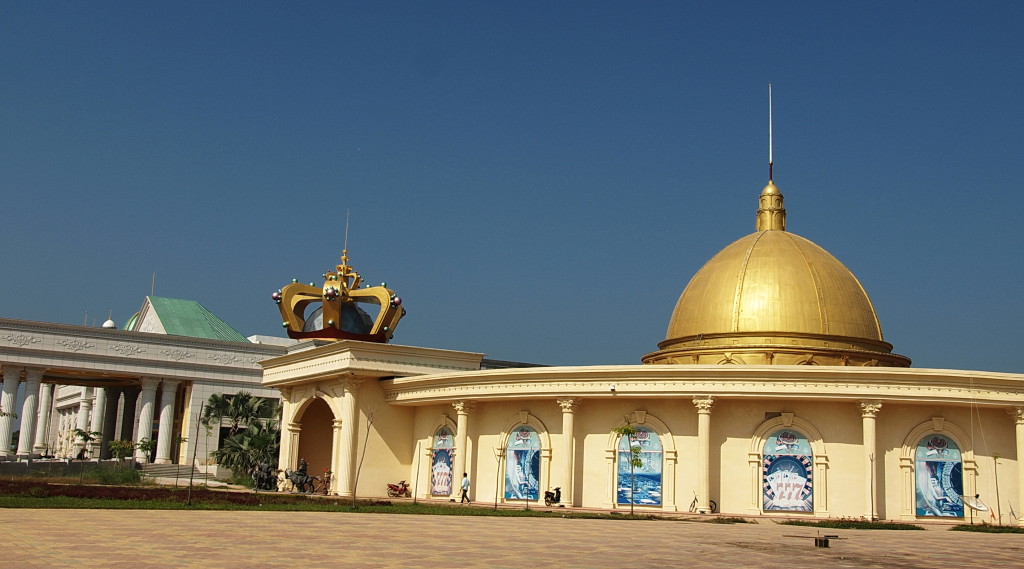
Ferries bringing patrons across from Thailand and China for gambling (Photo by Melinda Boh.)

Ferries bringing patrons across from Thailand and China for gambling (Photo by Melinda Boh.)

From Chiang Saen in Thailand’s north, the white colonnaded building across the river, topped with a huge gilt crown is a bizarre sight. From Huay Xai in Laos, a potholed road through farmlands leads to the casino complex. The car suddenly jolt-lands on to thick cement, marking the casino’s boundary in Dork Ngoui Kham. Half an hour later we spot the golden cupola, its clock set on Beijing time, marking Bokeo Province’s Special Economic Zone (SEZ) office.

The nearby King Roman casino reveals plaster toga-clad statues alongside Chinese patriarchs and the symbols of the newest local religion: gambling. Parked nearby were two stretch limousines. Inside the building, men in suits gambled at the tables. “Kunming officials doing a site inspection,” was the official story from an attendant.

The only Lao person we saw was a farmer on a dust-covered motorbike with his equally dust-covered wife, narrowly avoiding being pushed into the Mekong River by the boat passengers.

The concession area includes archaeological treasures, importantly the ruins of a 16th century city reputedly built by King Setthatirat. Other remnants, possibly from the Mon empires of the first millennium CE, are considered to be of World Heritage value. Instead they may end up under the runway of an international airport planned to bring patrons in, but fiercely resisted by the local farmers. History will be replaced by what appears to be a gambling based narco-empire, where anything goes. For Laos, it means that some of the most fertile arable land and considerable archaeological treasures would soon be buried under asphalt to feed the gambling industry.

Stretch limousines pick up selected high rollers from the airport (Photo by Melinda Boh.)

Stretch limousines pick up selected high rollers from the airport (Photo by Melinda Boh.)

Civilising

Defending the casino and entertainment complex, a senior Chinese manager told researcher Pal Nyriri: “Before it was opium and drug businesses. There were no roads, no electricity … Laos is developing and it [the casino] is good for them.”

Zhang Wei, the casino’s principal developer, told Thai sociologist Pinkaew Laungaramsri of Chiang Mai University: “The biggest obstacle is that villagers … do not understand us. We have rented all the land and forest … but they … cut … or burn them. We can’t go around, arresting or beat up (sic) and fine the villagers who burn our gardens … it will cause ethnic issues.”

A local NGO worker, requesting anonymity, recalled taking a Chinese delegation to the site in 2009. “The three Government officials, a journalist, an environmentalist and a few academics were shocked at what they saw. ‘This gives China a bad image,’ they said. When we stopped; a crowd of up to 70 to 100 village people assembled shouting that they would not give up their land. The area is one of the most fertile and productive in Laos.”

They pointed to a white Humvee. “That’s the local official. Zhang gave him and the (Lao) police the same cars.”

China may see itself as a civilising influence, drawing on its long and remarkable history, using its wealth and dynamism to bring rapid economic growth. But with its entrepreneurs building casinos like those at the Lao border, China risks reinforcing its growing reputation for exploiting its neighbours.

Because although it’s the Lao government’s party apparatchiks and provincial officials whose signatures and rubber stamps bless these casino developments, it’s China that gets the bad press, a point clearly understood by the visiting Chinese delegation. The development of ‘legal/ illegal’ states through the formation of SEZ’s has enabled the Lao government to consolidate power, and amass wealth, patronage and control, while portraying itself as a helpless lackey of China.

Laos is fast gaining a reputation as a lawless state. It has shown unwillingness to arrestwildlife trafficker Vixay Keosavang while it faces continuing criticism for its intransigence in not being serious about investigating the high-profile disappearance of Magsaysay award winner Sombath Somphone. Moreover, Laos continues to face allegations of human rights violations, money laundering and profligate illegal logging that are causing both international concern to its many foreign donors and local frustration.

The so called “red carpet”, the road being paved pink for the patrons (Photo by Melinda Boh.)

The so called “red carpet”, the road being paved pink for the patrons (Photo by Melinda Boh.)

SEZs and other confusions

The casinos in the SEZ epitomise the complexity of the modernist zeal with which the Government of Lao and China pursue investment. Observers like Danielle Tan have noted the SEZs bring a post-socialist neo-liberal model to the Lao-China border zones. For nations that expound socialism and wisdom of central control, this is a strange choice. Neo-liberalism increases state income through taxes, exploits labour and expropriates land from traditional owners and farmers. The renowned sociologist Pierre Bourdieu considers neoliberalism “a program for destroying collective structures”, and even nations themselves.

With their confused legal frameworks and ambiguous status, SEZs invites all sorts of temptations. The implicit freedom tempts the seamier side of legitimate trade and investment particularly in the fabled Golden Triangle. Added to this mix, the Chinese fascination with gambling and luck makes Bokeo’s proximity all too tempting.

Along with disappointed losers, Tan found evidence of drug sales and money laundering, while Li Quan a London based tiger conservationist, told the Global Times that Lao casinos were trading posts for endangered species. Others are worried about child trafficking, rape and tax farming 1.

Tan alleges that the former military junta and drug lord Lin Mingxian is a major investor in the King Roman Casino, a charge denied by Zhang Wei. Ying and Zhang, of China’s Institute of Contemporary International Relations (CIR) and part of the 2009 delegation, agreed, writing, “While the nominal boss of the Casino in Bokeo is a Fujian native with a Hong Kong passport, it is … likely… the real investor is a drug cartel from Myanmar.”

The other side of China’s double jeopardy is legitimacy. The Bokeo casino is a photocopy of those in Mong La (Myanmar) and Boten (Laos) both managed by Zhang Wei, and both closed by China after evidence of mafia-style gunfights and crimes. However the King Roman is within Lao sovereign territory, while the others were on international no man’s land.

The Vice Prime Minister of the Government of Lao PDR, Somsavat Lengsavad, reacted to China’s concern about ongoing casino development with assurances that no further concessions would be granted as “casinos were a bad model for Laos.” But barely six months later in March 2014, the Vientiane Times announced plans for another casino in the South.

In total forty-nine SEZs are planned. How many will have casinos is anyone’s guess, and pose a serious concern to China.

OLYMPUS DIGITAL CAMERA

Size matters

The CIR’s critical appraisal of Laos’ transparency backs Nyiri’s research revealing that the Government of Lao granted the Hong Kong registered King Roman group a concession for the Bokeo land in 2007, after a down payment of US$850,000.

Lao government media KPL reported 827 hectares were ceded for 40 years; the maximum allowed under Lao law, but at variance to the company’s own estimation of 10,300 hectares for 99 years. In 2010, Zhao reported the new casinos would be bigger in scale than those in Boten, bragging that US$500 million would be spent developing the site, more than ten times the Laos national health budget.

A resident of Huay Xai who declined to be identified, admitted the casino is run down: “The paint’s peeling and shops boarded up. Less people visit now. One rich guy hired some [Lao] cops to protect him, but they shot him and took his money. Despite joint patrols, we still have shootings, as the Chinese mafia are using the place as a staging post. Gamblers are afraid. As for the organic farms and markets they promised, well who would buy the stuff? The farmers who lost their land are now broke and they used to produce what the casino promised but never delivered.”

“The casino’s still trying for the airport, but there is well-organised resistance. The locals called in Thai TV. The Lao police arrested two cameramen and held them for two weeks. The Thai government responded by closing the border until they were released. Now it’s a stand-off. The PR risk is too high.”

China has its own problems with crime. What it does to curb the influence of its neighbour will be interesting to see.

Post script: In late 2013, the Lao media announced that the farmers had been given their promised settlement. The casino had agreed to pay a compensation amount that was found satisfactory to the government. Many on the Lao agribusiness list-serv cheered.

Following up on this story, I was told by the above long term resident of the area (new laws in Laos restricting critical media make me reluctant to name anyone for fear of recrimination) that the company had in fact offered compensation way over the odds as the farmers had been both successful in gaining publicity and in holding out, fearing the same poverty that had mired their neighbours.

But the informant said the Lao government refused to give their imprimateur to the negotiated rate fearing that the amount offered would set an unhealthy precedent for other areas of Laos, so the farmers were given a significantly reduced amount. Hence the term “found satisfactory to the government” does not mean what one might have assumed.

This article was written by Melinda Boh for the Mekong Commons website and published here on 1/31/15.  It is reposted in its entirety with permission from Mekong Commons and the author.  ExSE is excited to begin a new cooperative partnership with the Mekong Commons team in sharing analysis and reporting.

Leave a Comment

Filed under China, Economic development, Governance, Laos, Mekong River, SLIDER

Origins: A Study Abroad Homecoming

I did not study abroad to “have the time of my life” or “take it easy for a semester”. Don’t get me wrong—I love adventure. When I fall into a routine for too long, I often crave it. I have spent the past six summers traveling in some of the most remote areas of the world. Last winter, I took a Birthright trip to Israel and embraced my Jewish identity. So traveling to China should not have been a big deal—it should have been just another adventure. Another opportunity to learn about local culture while reflecting on my own privilege. But to me, studying abroad in China for four months was daunting. By returning to my birth country, I was committing myself to the unknown and opening myself up to heartbreak.

I have always been sensitive. Even in safe situations growing up, I often felt vulnerable and insecure. It is a miracle, really, that I have traveled so much, as new situations and environments often give me days-long stomachaches and have me calling home in an emotional upheaval. More surprising still is on every adventure, I opt to travel with all strangers instead of childhood friends, relatives, or classmates from home. But maybe I thrive on that very uneasiness. Maybe my restless side thrives on facing challenges and exploring new places, cultures, and people without a familiar face by my side. Even more accurate, though, is me pushing myself to explore my own identity.

IMG_8378.JPG

Identity is a loaded word. It has a different meaning in various contexts. Identity can encompass perceptions of self as well as others people’s perceptions of you. It can include religion, socioeconomic status, intellectual point of view, political stance. Identity can be defined in the context of one’s community, geographic location, educational institution. And that is just the brink of the layered, multi-dimensional term.

​The eve of October 24, 2014, I boarded a flight from my study abroad program in Kunming to Nanjing, China. It is no metaphor when I say my whole body was shaking in fear, anticipation, excitement, and angst. Truthfully, as I write this three months later, my body is still tense, my fingers trembling. It has taken me months to process, truly, those three days. I think I am still processing my experience—I don’t know if the processing will ever stop. Identity is tricky that way: it always changes. Identity can contradict itself while making all the sense in the world. My identity can restrict me and liberate me.

​That weekend, I returned to my birthplace, Yangzhou. At least we think it is my hometown. When I was three days old, the Yangzhou Social Welfare Institute (both an orphanage and a home for the elderly) states that its workers found me outside the gates. There were no traces of my birth parents. But I am nearly five-foot-nine and my city is known for its tall women. I take pride in that shared trait.

​Returning to Yangzhou was my top priority when I decided to study abroad in China. Initially, the program interested me because of its focus on regional development in Southeast Asia, the place I truly feel at home. Having dabbled in Chinese culture and Mandarin for years, I kept forcing myself to become interested in China. Yet those moments of interest never lasted. I easily could have studied in Thailand, Vietnam, or Cambodia. But that would have been the safe route. Conquering my fear of China and all its unknowns reminded me that I could be strong and face the world bravely. Coming “home” to Yangzhou seemed to be the natural test of my courage.

​This wasn’t my first trip back. In 2005, I returned to China with my family and one other family of three. The girl was my crib mate in 1994 and miraculously, our parents had connected through Families with Children from China, an organization dedicated to giving adoptive families support pre- and post- adoption. It is common for families to bring their adopted children back to their birth countries when they turn 10 years old. We traveled for three weeks, mixing heritage and cultural “homeland” experiences with the more touristy excursions. While in Yangzhou, we visited my orphanage; I met one of my caretakers. Since my parents adopted me at five months old, I have no recollection of China. But I created memories during my first return. I distinctly remember one boy who gripped onto my finger and refused to let go. I recall an infant in a neon-pink fleece crying and throwing her bottle across the nursery. I still feel the pang in my chest as it hit me for the first time: that was once me. I was once in a crib, wanting to be held, nurtured, cherished as someone’s own loved one. During that visit, I presented the orphanage director with a scrapbook of my life in New York. I included a page that said, “I am a Jew, and Proud, Too” as well as photos of my dear grandparents meeting me for the first time at JFK Airport.

​Now, nearly ten years later, I had the opportunity to “come home” to my orphanage again. If you could still call it that. A decade ago, there was a master blueprint for reconstruction. Now, the upgrades have been completed. The new and grand center replaces the old one. Wooden floors and smoothed-cement walls replace the linoleum and dilapidated cinderblock. The former cracked marble sign at the entrance has been replaced with a sleek glass panel. The first floor of the center has been converted to a museum that celebrates successful adoption stories, including a photo of John Huntsman and his family.

Entrance to the Yangzhou Social Welfare Institute

​I did not recognize this place. Maybe that was good, as it meant the needs of the new children were being met. The demographics of children have shifted: it went from, in 1994, being mostly abandoned infant girls to, in 2014, being a majority of mentally and physically disabled boys who span from infancy to middle-school age. I recognize that state-of-the-art physical therapy equipment and play areas are rare in Chinese orphanages. Yangzhou is a welcomed, successful anomaly. But a selfish little part of me wishes there was some memory of the old building, whether it be a metal crib, the dim lighting, or the familiar smell of hot powered milk.

​This new building felt sterile. The lack of crying children or chaos made me feel as if I were in an artificial environment. Most of all, though, I felt that with the tearing down of the old building, I was no longer part of this community. I was once again a perpetual outsider, someone looking into her past without a tangible connection. I was disconnected from one more part of my Chinese heritage. It hurt.

​Of course, this is false. The building I saw ten years ago was a remodeled version of what my parents had witnessed twenty years ago, in 1994, when they adopted me. Everything changes all the time. Nothing slows down just because you want to reminisce.

​But reminisce I did. A public relations worker pulled my file from the archives. Inside the cardboard box, carefully preserved, was my father’s business card, a copy of my Chinese birth certificate, my adoption records, and the scrapbook I had brought nearly ten years ago. Although the construction paper had faded, I was instantly comforted. Here, inside the new, smoothed walls of the orphanage, a part of me remained. I laughed as I saw the “I’m a Jew, and Proud, too” page, especially in the wake of my Rosh Hashanah encounter in Kunming. Being just five days before the two year anniversary of my grandpa’s death and the one year anniversary of my grandma’s, I gulped back the sobs as I flipped through pages of photos of me in their arms.

​It’s unnerving, this concept we call time. It distances us from pain, yet in one moment, one photo can trigger sorrow and joy simultaneously. Seeing those photos of my grandparents sparked emptiness in my heart that I hadn’t felt since their respective funerals. Yet at the same time, I was overcome with relief. Relief that I still remembered their comforting hugs. Reassured that they weren’t slipping from my memories or my grasp. Hopeful that they would be proud of my journey and the person I am becoming.

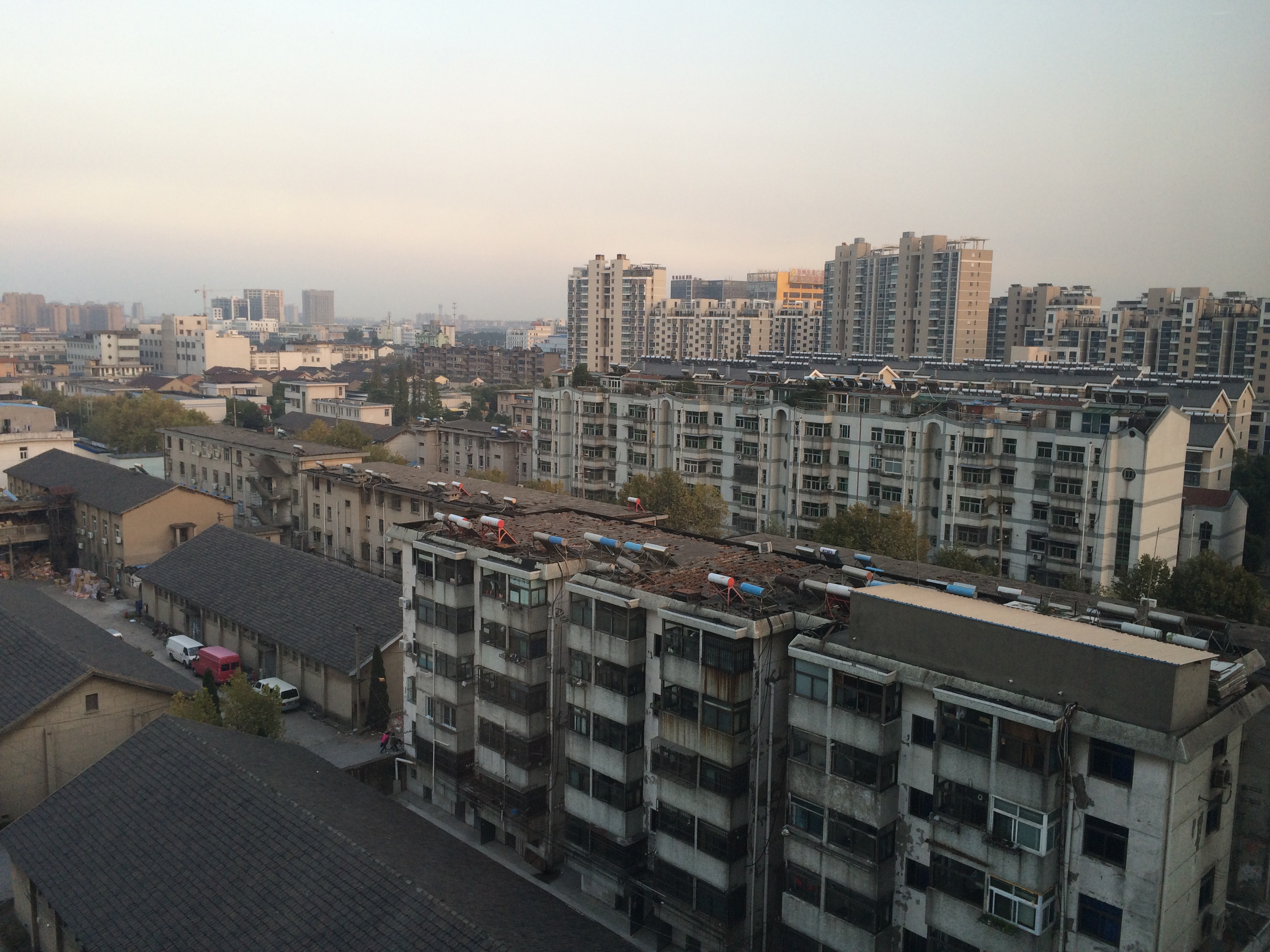
Skyline of Yangzhou, China.

Skyline of Yangzhou, China.

​Even Yangzhou the city was unrecognizable. Ten years ago, roads on the outskirts of the city were unpaved. The canals were beautiful but trash lined some of the older cobblestone streets. Rickshaws were the vehicle of choice. This time, electric motorbikes filled the paved streets. Trash bins and recycling cans sprinkled the sidewalks. There were Western toilets. It was unrecognizable, yet I felt at home. In the market, a woman asked me if I was a Yangzhou girl. Without hesitation, I answered “Yes” and she smiled. For once, I was a local, no questions asked. Unlike Kunming or other parts of China, where my native language does not match my face and my name does not complement my complexion, in Yangzhou, I did not feel like I was letting down others’ expectations of who I should be. Instead, I was candidly, unapologetically me. And no one countered this fact. Even when I fumbled my Mandarin, people smiled patiently. I explained to a shopkeeper that I was a Yangzhou girl but an American, too: I was returning home for a visit. She gave me a “welcome home” hug. I felt no resentment from her, unlike I have from other Chinese who discover I am internationally adopted.

​This is not to say that I fit in perfectly. I was still at the crossroads of my identity. But I felt accepted and I felt an inner calm. I have only felt this calm in Southeast Asia. Even in the United States, the land I call home, I feel out of place. Often, my inner anxiety exacerbates microaggressions, or non-conscious remarks others make about my identity. The expectations of others have become a burden to me. It is my nature to aim to please others; I hate letting people down, even if I have no control over the situation. My time in China has taught me that I have more grit than I give myself credit. It was four months of discomfort, yet I survived. No. I did more than survive; I grew up. I learned about myself. Sure, I learned that I do not want to live in China for the long-term. But I also learned that I am capable of it.

​Returning to China, overall, was not a homecoming for me. If anything, I felt alien. But going to Yangzhou gave me a new sense of what coming home could feel like. Home does not always have to be a place of comfort. It does not have to be familiar. Instead, it can be entering a new place and having a sense of calm wash over you at the same time new questions enter your mind. Coming home can feel like leaving home, and the familiar, simultaneously. I left New York and Southeast Asia, the places I feel safest, and traded them for China, my country of origin. But New York could be my nation of origin, as well. It was where I was given a family, and put down my first real roots. Even Southeast Asia could be my origin: it is the first region where I let go of every insecurity and allowed myself to live freely, unapologetically, and out of my comfort zone.

​My study abroad journey taught me about Southeast Asia, sure. Yes, I learned basic Mandarin. Of course I built up my spicy-food tolerance. But really, study abroad is not about the academics. I learned 5% about the country, but 500% more about myself than when I set off. Cliché as it sounds, the self-discovery process was difficult and rewarding. There is no tangible measure for understanding identity, yet I feel myself observing, questioning, learning, and adapting. My semester in China has taught me to cope with internal struggles and insecurities while exploring who I am—and testing my emotional strength—in a new society. I have lost count of how many times my sense of self has been turned around and twisted. And with every bend, my confidence has faltered. Yet coming to China has made me stronger and more independent. I have new survival tactics. I have learned to channel my vulnerabilities and emotions, turning it into productive and positive energy. I’ve encountered people of all backgrounds who have vastly different agendas and means of getting there. I have furthered my understanding of “informed global citizen” and have pushed myself to become a responsible rising one.

1 Comment

Filed under China, SLIDER

Regional Roundup for Week of 2.15.2015

It’s that time of year again –  you can’t find a train ticket home, your stomach is full of dumplings and your two uncles are fighting again after only three classes of baijiu. At least it’s that time of year for literally billions around the world – it’s Chinese New Year! On the night of the 18th, fireworks will fill the skies over China and many countries throughout Southeast Asia as the Lunar New Year is celebrated. After this last Year of the Horse, it will now be the Year of the Sheep. As it is the holidays, East by Southeast will be taking a break, but we’ll be back with more stories and insightful analysis starting in March. So from everyone at ExSE, we wish you and your families 新年快乐, 万事如意, 羊年大吉 ! Happy New Year!

EXSE FOCUS

Rebels Kill Dozens of Soldiers in Myanmar in Fighting Near Chinese Border – NYT The clashes, a renewal of a longstanding battle for territory in the area, is the latest setback for the government’s national reconciliation efforts.Reports are saying that over 10k refugees are pouring into Yunnan as a result of the fighting, which is less than the 30k refugees that entered China as a result of the 2009 Kokang Incident. So far, the media reaction to the fighting has been tempered. However the Chinese ambassador to Myanmar has had to deny that deny that Chinese troops are participating in military actions across the border. 

Related: Burma: 47 soldiers killed in clashes with insurgents – The Guardian

Related: Tens of thousands flee war, airstrikes in Kokang region – DVB

Dam will not collapse, EIT vows – The Nation Fears mount over Mae Suai Reservoir cracks.

Myanmar, ADB Sign $80 Million Loan Agreement to Improve Connectivity in Ayeyarwaddy Delta – ADB ADB and the Government of Myanmar today signed an $80 million loan agreement to rehabilitate a major road to support economic development in the agriculturally rich but underdeveloped Ayeyarwaddy Delta. This is great news. Deltas are some of the most agriculturally rich areas in the world and a lack of infrastructure connectivity is often a huge roadblock to reaching agricultural potential. 

ADB lends Vietnam $234 mln for policy reform, Hanoi metro – Thanh Nien Vietnam is losing ground in terms of competitiveness, according to the World Economic Forum.

What is ASEAN Community 2015 All About? – The Guardian ASEAN should convey clearly exactly what its community-building this year is all about. As an ADB official once told me, the ASEAN 2015 is more a milestone than a concrete set of regional policies and activities. 

Related: ASEAN Eyes Closer Military Ties in 2015 – The Guardian

Related: Democratic values and human rights in ASEAN – New Mandala

The Geopolitics of the Vietnam War – The Guardian Columnist James Burnham offered strategic insights into the war in Southeast Asia that remain relevant today.

REGIONAL RELATIONS

China Defends Trade Policies After U.S. Files Case at W.T.O. – NYT The country defended its policies and “expressed regret” at the filing of the case challenging Chinese subsidies on exports.

Related: White House to File Case Against China at W.T.O. Over Subsidies for Exports – NYT

 After More Shootings, Government Berates Thailand – The Cambodia Daily Following reports that three Cambodians were shot dead earlier this month by Thai soldiers after illegally crossing the border to find valuable timber, Cambodia’s Foreign Affairs Ministry sent an irate letter to the Thai Em­bassy on Friday.

Vietnamese, Chinese Party chiefs discuss plans to foster bilateral ties – Thanh Nien The countries are celebrating their 65th anniversary of diplomatic ties. Following the last year, Sino-Vietnamese ties will need a little more than ‘fostering’.

Related: Vietnam and Diplomatic Balancing – The Guardian

 Being Chinese in Singapore – NYT How one diaspora is questioning the mainland’s idea of Chineseness.

President Xi Jinping to Visit U.S. in September, Chinese Agency Reports – NYT In addition to visiting the White House, Mr. Xi will go to New York for events marking the 70th anniversary of the United Nations’ founding, the state media report said.

Related: Chinese leader’s US visit is ‘more symbolic than substantive’, say experts – The Guardian

Related: US, China to Discuss Repatriation of Chinese Fugitives – The Irrawaddy

 GIZ helping Asean nations develop a better way to meet its labour demands – The Nation An initiative to improve in-company staff-training standards in Asean that was launched by several countries in the region, including Thailand, with the assistance of the German International Cooperation’s (GIZ) is a step closer to being finalised following a Bangkok workshop.

HIV-Positive Migrants Denied Care at Thai Public Hospitals – The Irrawaddy Hospitals across the country are denying insurance and care to migrant laborers despite an insurance scheme launched over a year ago, officials and rights advocates say.

Lao and Thai Border Officials Team Up Against Trafficking of Young Women – Radio Free Asia Lao immigration officials will work with their Thai counterparts to prevent underage girls from entering Thailand in a bid to prevent them from being lured into the sex industry by human traffickers.

SUSTAINABILITY AND RESOURCE MANAGEMENT

China Unveils Major South China Sea Gas Find – The Guardian Large yields may further fuel resource extraction efforts in contentious waters. The more gas reserves identified, the tighter the race for control of them becomes. 

Related: Can Natural Gas Be a Game-Changer for China? – The Guardian

 Egat ordered to limit Mae Moh impact – The Nation The Supreme Administrative Court yesterday ordered the Mae Moh lignite-fired power plant in Lampang province to minimise its harsh impact on the local environment and residents.

Thailand big contributor to plastic trash on ocean floors – The Nation Thailand is one of the top 10 countries that have been mismanaging their plastic waste, which has resulted in plastic debris sinking to the bottom of the sea along its coastlines, a study published in the Science journal said.

No Need to Sacrifice Asia’s Rivers to Power China’s Development – International Rivers Celebrating China’s commitments to phase out coal without asking how it will meet its targets is a dangerous game. Because while most might assume that China will replace its demand for coal with abundant and affordable renewable energy like solar and wind, the truth is that there’s a new energy – massive hydropower – bringing severe risks of its own. Certainly true that big hydropower brings many risks – but solar and wind might not be the best solutions to for a less coal dependent China. Both depend on weather patterns for their power and storing power for peak seasons is an issue as well. 

Related: Sustainable Hydropower Pitch for Burma Difficult to Swallow – International Rivers

 Ban on fires proposed for North – The Nation The Ministry of Natural Resources and Environment wants to impose a strict ban on fires in nine provinces in the North during a critical 60-day period designated by local administrators, as part of an action plan that requires approval from the Cabinet.

Irrigation chief still wants to build Mae Wong dam – The Nation The Royal Irrigation Department (RID) chief still hopes to build the controversial Mae Wong Dam in Nakhon Sawan province and says the loss of 12,000 rai (4,744 acres) of forestland for the project will be compensated with 30,000 rai of reforested area.

China’s Polluters Hit with Biggest-Ever Fines – ChinaFile Two days before a new environmental law came into effect, six polluting companies in Jiangsu were ordered by the province’s highest court to pay 160 million yuan ($26 million) in restoration costs for illegally dumping almost 25,000 tons of chemical waste into two rivers in 2012.

China’s western water transfer plan affects Tibet, if not Brahmaputra – The Third Pole With the central and eastern route of China’s mega water transfer scheme now complete, attention is turning to the controversial western stretch over the Tibetan plateau

 Northern province sells rescued wildlife to restaurants, angers environmentalists – Thanh Nien 42 pangolins seized from poachers help Bac Ninh Province earn around $11,300.

 CHINA

Why China Is Banning Islamic Veils – ChinaFile This week, regional authorities outlawed Islamic veils from all public spaces in the regional capital of China’s Xinjiang Uighur Autonomous Region (XUAR). The Urumqi ban, which went into effect on Sunday February 1 (coincidentally the third annual (World Hijab Day), empowers Chinese police to punish violators and dole out fines of up to U.S.$800 for those who fail to enforce the prohibition.

Taiwanese Official in Charge of Ties With Mainland China Steps Down – NYT Wang Yu-chi resigned after prosecutors said that his former deputy, whom he had suspected of passing state secrets to China, would not be charged.

Related: Taiwan Charges Dozens of Protesters in Takeover of Government Buildings – NYT

 Politburo, army, casinos: China’s corruption crackdown spreads – The Guardian Xi Jinping’s huge anti-graft campaign has continued with the execution of a mining billionaire. Its effect is now so widespread that some warn daily work is grinding to a halt

Qualcomm given record £631m fine in Chinese anti-monopoly case – The Guardian China has fined the chipmaker Qualcomm 6bn yuan (£631m) in a wave of anti-monopoly penalties that have rattled foreign companies.

Related: China’s Internet Restrictions Are Hampering Business, Foreign Companies Say – NYT

 How China Defines Terrorism – The Diplomat In a new draft law, China has opted for its own definition.

China’s New Environment Minister Has Work Cut Out For Him – ChinaFile The elevation of the president of China’s most prestigious university to the job of government minister was unexpected.

Related: One year on after “war” declared on pollution, Beijing air scarcely improves – The Third Pole

 Good Times Are Over for Local Governments – ChinaFile Two pieces of recent news have piqued the public’s interest. First, local governments reported their latest debt figures to the Ministry of Finance. Second, in an attempt to revive the flagging property market, many local governments are easing requirements for the housing provident fund, which offers mortgages subsidized by the government.

The Plight of China’s Rights Lawyers – ChinaFile As the year came to a close, at least seven prominent Chinese human rights lawyers rang in the New Year from a jail cell. Under President Xi Jinping, 2014 was one of the worst years in recent memory for China’s embattled civil society.

Related: Chinese Lawyers to Chinese Lawmakers: Let Us Defend Our Clients – ChinaFile

 China Seizes Toilet Paper Bearing Image of Hong Kong Leader – The Irrawaddy Authorities in southern China have seized about 8,000 rolls of toilet paper and another 20,000 packages of tissues containing unflattering images of Hong Kong’s pro-Beijing chief executive, according to an official of the small political party that placed the order.

China’s Xiaomi to start small in U.S., with earphones and bands – Thanh Nien Xiaomi, China’s largest smartphone company, will begin selling headphones, smart wristbands and other accessories online in the United States in coming months, taking its first tentative step onto Apple Inc’s home turf without its signature Mi mobile devices.

  SOUTHEAST ASIA

Govt backflips on white-card voting rights – DVB The ID document acknowledges temporary residency and offers voting rights to holders. The President’s Office announced on Thursday that the cards will expire at the end of next month and must be handed over to authorities. Very disappointing. As Myanmar gets closer to the 2015 elections, we see more and more problems related to the country’s minority populations. 

Related: Revoking White Card Holder Voting Rights ‘Counter Reconciliation’: US Official – The Irrawaddy

 Thailand’s Junta Tries to Bury the Opposition in Endless Lawsuits – NYT Hundreds of people have been summoned and forced to sign documents that allow the junta to seize their assets if they become involved with “any political movement.”

Rebels Shun Union Day Pledge ‘Without Concrete Points’: Ethnic Leader – The Irrawaddy The head of an alliance of 16 ethnic armed groups said most of its members had declined to sign a Union Day pledge reaffirming commitments to Burma’s stalled nationwide ceasefire process, as the government-drafted statement failed to address key outstanding issues.

Vietnam to inspect accounts linked to the country in massive HSBC banking scandal – Thanh Nien HSBC Suisse has been accused of abetting tax-dodgers including many criminals across the world.

Related: HSBC scandal: 26 clients linked to Vietnam had accounts in controversial Swiss bank – Thanh Nien

From a Swift Boat to a Sustainable Mekong – US State Dept. Today, the Mekong faces a new and very different danger — one that threatens the livelihoods of tens of millions and symbolizes the risk climate change poses to the entire planet. Unsustainable growth and development along the full reach of the river are endangering its long-term health and the region’s prosperity.

Extraordinary Meeting of the Friends of the Lower Mekong – US State Dept.  On February 2, Counselor Tom Shannon and Senior Advisor to the Secretary Ambassador David Thorne led a U.S. delegation to the Extraordinary Meeting of the Friends of the Lower Mekong in Pakse, Laos. The Friends of the Lower Mekong, a donor coordination group, came together with the countries of the Lower Mekong to discuss the connection between water resources, energy needs and food security.

 ‘Evidence of Illegal Activity’ by Chinese, Canadian Firms at Monywa: Amnesty – The Irrawaddy Amnesty International has called for an investigation into two international firms over their conduct in three adjoining copper mine projects, including the controversial Letpadaung mine, the site of repeated clashes between villagers and police forces in recent months.

Related: Wanbao slams Amnesty report as ‘groundless, sensationalist’ – DVB

 As Technology Entrepreneurs Multiply in Vietnam, So Do Regulations – NYT A growing list of government rules dictates how technology businesses must be run, including what they can do with their content.

Farewell to arms – SEA Globe For more than four decades, sections of the Hmong community have been in conflict with the Lao government, but is the resistance all but over?

 Vietnam’s migrant labourers: Going to debt mountain – The Economist Vietnam’s youthful population of 90m adds up to 1.5m each year to the growing work pool. But economic growth, at 6%, is not fast enough to keep all of them employed.

Villagers ‘seeking justice’ in land dispute – The Nation Local people in Khok Yao and Bor Kaew communities in Chaiyaphum are preparing to petition for help from state authorities again today in the face of growing pressure for them to vacate homes on disputed land in Khon San forest.

Dogs Used to Hunt Down Montagnards – The Cambodia Daily Authorities in Ratanakkiri prov­ince are using dogs in their at­tempts to locate 32 Montagnards hid­­ing in O’Yadaw district forest, an ethnic Jarai villager and a local rights group said Friday.

 YUNNAN

Man dies of bird flu in northwest Yunnan – GoKunming The Yunnan Department of Health on Sunday announced the first instance of fowl-to-human transmission of influenza in China this year. The single case was identified by health workers in a rural area of northwest Yunnan and thought to have occurred because the patient worked with wild birds.

Leave a Comment

Filed under Current Events, NEWS DIGEST, SLIDER

Report: Thousands of Burmese refugees fleeing into China

Renewed fighting between the Burmese military and a guerrilla army in Myanmar’s northeastern Shan State erupted once again this week. The violence has caused civilian refugees — by some estimates more than 10,000 people — to flee across the border into rural areas in China’s Yunnan province.

Hostilities broke out on Monday in Kokang, a self-administered zone with a population estimated at 150,000. An article posted on Burmese news website The Irrawaddy reports fighting was most intense near the town of Laukkai, located on the Salween River — known in Chinese as theNujiang. Refugees were headed to the opposite side of the river to the village Nansan (南傘) in Lincang Prefecture.

The location of Myanmar’s Kokang region shown in green. Shan State in Yellow (Wikipedia)

The Burmese military attacked areas held by the Myanmar National Democratic Alliance Army (MNDAA), the armed wing of the Kokang ethnic group — 90 percent of whom are of Han Chinese ancestry. Bombing has been concentrated nearby Laukkai using Russian-made jet fighters and helicopters during the day and artillery during the night, according to MNDAA general secretary Htun Myat Lin.

He also claimed the number of refugees fleeing into China was approaching 10,000 as of Tuesday, most of them Burmese villagers, with a small minority made up of Chinese merchants. Chinese media have so far not estimated the number of displaced but Foreign Ministry spokesman Hua Chunying was quoted by CCTV as saying:

China is concerned about the Myanmar situation. During the past two days, some Myanmar border residents, because of safety considerations, have entered China. They have been looked after. China will continue to pay close attention to how the situation develops, and maintain the peace and stability of the China-Myanmar border. We also believe that the Myanmar side should also work hard for this.

State-backed Burmese news outlets have yet to release reports regarding casualties from the fighting. No official reason has been given for the escalation in violence, although it seems likely the actions by the Burmese military are connected to December ambushes by Kokang guerrillas that killed at least seven soldiers and injured 20 others.

The current situation along the border closely mirrors a monthlong period in 2009 when an estimated 30,000 Burmese civilians from Kokang crossed into Yunnan in the wake of fighting. China dealt quietly with those displaced by fighting six years ago, instituting a near media blackout of its humanitarian actions.

This article was written by Patrick Scally and originally published on GoKunming on February 12, 2015 .

Leave a Comment

Filed under China, Current Events, Myanmar/Burma, Regional Relations, SLIDER, Yunnan Province

Kunming Train Station Attack Suspects Arrested in Indonesia

Four of the attackers were found guilty following their trial in September 2014.

Four men suspected of planning the 2014 Kunming Train Station attack were arrested this week in Indonesia. According to a report in the Jakarta Post, the Chinese and Indonesian governments agreed to enhance counter-terrorism cooperation in exchange for  information regarding nine Chinese nationals suspected of planning the Kunming terrorist attack. The agreement was signed by the head of the Indonesian  National Counterterrorism Agency (BNPT) Comr. Gen. Saut Usman and China’s Deputy Public Security Minister Meng Hongwei  in Beijing on Tuesday, February 10.

The terror suspects were reportedly arrested on Monday near Poso, Central Sulawesi Province. Speaking after the signing of the cooperation agreement,Saut, director of the BNPT,  said that only four of the nine suspects were arrested. Of the remaining five, three fled into the Sulawesi jungle, while two others escaped to Malaysia. After being picked up by police, the four suspects initially admitted to being Chinese nationals from Xinjiang, however they later changed their story, saying they were from Turkey. China and Indonesia signed an extradition treaty in 2009 so if it is true that suspects are indeed Chinese nationals, it is likely that they will be soon be sent to China to face charges.

In recent years, more and more Uighurs have fled China through Yunnan and into Southeast Asia. In  March 2014, a group of more than 200 Uighur refugees were found in a Thai human trafficking camp near the Malaysian border and earlier that month more than 60 Uighurs were caught escaping into Malaysia. In both cases, those in question claimed Turkish nationality. In previous cases, Uighurs found immigrating illegally into Cambodia and Malaysia were extradited back to China, where they were imprisoned.

In Chinese media, connections between the suspects and the Islamic State in Iraq and the Levant (ISIL) have been made. According to one story on Sina.com, the four suspects were found with Islamic State paraphernalia, leading some to believe that they have a relation to the terrorist organization.  To date, more than three hundred Chinese nationals have joined the Islamic State, and recent reports say that three Chinese fighters were beheaded earlier this month as punishment for defection.

Though the exact story of their arrival in Sulawesi is murky at the moment,  Saut believes they are indeed from China. “They are believed to have fled to Poso by taking the land route through Myanmar, southern Thailand and Malaysia. From Malaysia, they entered Indonesia through Medan with Turkish passports and they posed as asylum seekers when they were in Medan,” he said as quoted by Antara news agency. According to Saut, the terrorism suspects went to Puncak in Bogor, Java to join a group of people from the Middle East who wanted to go to Poso.

Central Sulawesi has long been one of Indonesia’s most unstable regions. Starting in the late nineties, tensions between the province’s Muslim and Christian communities began to boil over before a spate of violence gripped the province. A series of bus attacks in Poso in 2002 and the beheadings of three teenage girls in 2005 brought a certain notoriety to the region  and to this day it’s known as a hotbed for extremist activity in the Indonesian archipelago.

The timing of the arrests and the signing of the counter terrorism cooperation agreement between the two countries is unlikely to be a coincidence. According to information received from the Indonesian Embassy in Beijing, the suspects’ names were on international terrorist watchlists and it is probable that Indonesian authorities picked them up independent of Chinese involvement. Following their arrests, it is likely that the Indonesian government used the news as a bargaining chip  to get the Chinese to sign the bilateral cooperation agreement. The arrests, being related to such a high-profile case, and the cooperation agreement should be seen as victories for Indonesia, whose relationship with China is growing closer, despite persistent maritime issues.

Leave a Comment

Filed under China, Indonesia, Kunming Train Station Attack, SLIDER, Yunnan Province

Regional Roundup for Week of 2.8.2015


EXSE FOCUS

Thai Junta Vows Crackdown Following Bomb Blasts – The Diplomat Security to be tightened amid heightened political tensions. Bomb blasts at the metro outside Siam Paragon mall in central Bangkok. Perpetrators haven’t been caught yet. Is this an anti-junta government attack? Were the attackers related to the insurgency in the southern Thailand? 

  Related: Details from bomb probe secret: city police chief – The Nation

  Related: Hunt on for ‘Dragon’ – The Nation

Upstream dams blamed for shrinking Mekong Delta – Thanh Nien Experts warn that dams in the pipeline could render dramatic losses predicted in the Mekong Delta far worse by the year 2100. Dams are a serious issue for sediment losses in the Delta, but the region also faces a raft of issues associated with climate change in SE Asia, as ExSE detailed last year.

Related: Starving the Mekong: A Report on the Impacts of Cambodia’s Lower Sesan 2 Dam – International Rivers

Laos: Thousands suffering from the deadly aftermath of US bomb campaign – The Guardian Fifty years after US combat troops entered Vietnam, neighbouring Laos is still dealing with unexploded bombs from fierce air attacks

Related: Laos suffers lethal legacy of Vietnam war – The Guardian

        Related: Girl Killed by UXO Explosion in Kompong Speu – Cambodia Daily

Extraordinary Meeting of the Friends of the Lower Mekong – Challenge Program This is the first time the Friends of the Lower Mekong, a donor coordination group, have come together with the countries of the Lower Mekong to discuss the connection between water resources, energy needs, and food security.

Related: Japan, US help to promote development in Mekong River region – Challenge Program


REGIONAL RELATIONS

US-Thailand Relations and Cobra Gold 2015: What’s Really Going On? – The Diplomat Strained ties cloud specifics days before the Asia-Pacific’s largest annual military exercise. The new Thai junta has drawn the ire of the US and the previously rock solid US-Thai relationship has fallen on hard times. What’s more, China seems to be growing closer with Thailand, not only strategically but with trade and infrastructure development. Interesting times in the Land of a Million Smiles.

        Related: Did China Just Boost Military Ties with Thailand? – The Diplomat

Opportunities and fears as Asean prepares for single market – The Guardian While 10-member bloc of south-east Asian nations anticipate investment riches, observers say communities may be sacrificed for big business

A new cold war? – SEA Globe With the United States’ renewed affection for Asia provoking suspicion from China, will Southeast Asian nations become pawns as the two superpowers battle for influence? The Cold War was quite ‘hot’ for most SE Asian nations. That said, any armed conflict in the region is more likely to stem from existing issues between states and not a renewed rivalry between the PRC and the US. 

Narendra Modi Will Visit China in May – The Diplomat The Indian prime minister will visit China for the first time in May.

China’s Central Asian Opportunity – The Diplomat China might be a saving grace for Central Asia’s economies.

Chitralada School, Chinese embassy sign new initiative – The Nation Teachers will be able to go to China for training in language, culture; students will get to train at Chinese establishment in Thailand

Chinese Firm Joins Local Rice Miller to Bolster Industry – The Irrawaddy A Burmese rice milling company and the Chinese firm CAMC Engineering Co. Ltd. have signed a joint venture Memorandum of Understanding to improve the quality and capacity of rice milling operations in Burma, according to Thaung Win, the secretary of the Myanmar Rice Millers Association. This is great news. Myanmar has incredible agricultural capacity – realizing their potential would leave current rice exporting kings like Thailand and Vietnam in the dust.

Thailand Undecided Over Fate Of Cambodian Migrant Workers – Cambodia Daily Thailand has still not decided what will happen to the 738,000 Cambodian migrant workers currently living in the country on temporary work permits when those documents expire at the end of March, an official from the Thai Labor Ministry said Wednesday.

        Related: 40,000 Passports Printed for Workers in Thailand – Cambodia Daily

        Related: Without Citizenship, Vietnamese Remain Adrift – Cambodia Daily

China’s Appetite for Luxury Rosewood Fuels Illegal Timber Trade in Cambodia – Radio Free Asia China’s voracious demand for luxury furniture is driving a multimillion-dollar illegal trade in rosewood in Cambodia, supported by a tycoon who controls an illegal logging network that exports the timber, according to a report by an environmental advocacy group.

Bt20m given to back Myanmar’s anti-drugs efforts – The Nation Thailand’s anti-narcotics agency has given Bt20 million to Myanmar’s counterpart body under a joint agreement to fight rampant drug abuse in both countries.


SUSTAINABILITY AND RESOURCE MANAGEMENT

Hun Sen Defends Proposed Areng Valley Dam – Cambodia Daily In the government’s latest defense of a proposed dam in the heart of the sparsely developed Cardamom Mountains, Prime Minister Hun Sen in a letter downplayed the impact the project would have on the hundreds of ethnic minority families it would displace and touted its likely benefits.

Oil pipeline connects Kunming to Andaman Sea – GoKunming A 771-kilometer long oil pipeline linking refineries in Kunming to oil fields off the western coast of Myanmar began shipments over the weekend. Built over six years, at a cost of 9.37 billion yuan (US$1.5 billion), the project was marred by controversy in China and, at times, violence and threatened cancellation in Myanmar. According to our sources, there isn’t any oil or gas flowing yet. If anything, this latest news concerns a test-run.

Shell Inks Contract to Explore 3 Offshore Oil and Gas Blocks – The Irrawaddy Royal Dutch Shell and its Japanese partner Mitsui Oil Exploration Co., Ltd. (MOECO) signed an exploration and production sharing contract with state-owned firm Myanma Oil and Gas Enterprise (MOGE) in Naypyidaw on Thursday for three offshore deep-water blocks. Recent NY Times editorial lambasting the Chinese for ‘plundering’ Myanmar. Fair, but exploiting Burma for resource extraction isn’t exclusive to the Chinese 

China’s desalination plans will increase carbon emissions and water use – The Third Pole China’s ambitious plans to desalinate water would use huge amounts of energy from coal-intensive power grids, hindering moves to clean up smog-ridden cities and slow growth in carbon emissions.

        Related: China’s desalination plans could thwart “war on pollution” – chinadialogue

Jade Mines Grind to a Halt in Hpakant – The Irrawaddy Jade mining operations in northern Burma’s Kachin State have ground to a halt after more fighting between the military and Kachin Independence Army (KIA) during the week, locals have told The Irrawaddy.

Irrigation officials step in to quell Korat dispute – The Nation Agree to alter water allocation schedule amid fears of drought in many provinces

Rubber Exports Increase, Value Down for 2014 – Cambodia Daily Cambodia’s rubber export volume increased by about 33 percent last year compared to 2013, while the value of rubber decreased by about 9 percent during the same period, according to figures released by the Ministry of Commerce on Thursday.

Related: Cooperative in Trang freezes purchase of rubber sheets – The Nation

Rainforest Alliance report sparks mixed reactions – Jakarta Post The Rainforest Alliance on Thursday announced an independent evaluation of Asia Pulp & Paper (APP)’s Forest Conservation Policy (FCP), marking an immediate end to natural forest clearance by APP’s pulpwood suppliers as well as a range of other measures.

  Related: APP fails to halt forest clearing: WWF – Jakarta Post


CHINA

Pro-Democracy Protesters Back in Hong Kong, No Violence – The Irrawaddy Thousands of pro-democracy protesters returned to the streets of Hong Kong on Sunday in the first large-scale rally since demonstrations rocked the global financial hub late last year.

Barack Obama attacked by Chinese media for ‘chumming with’ Dalai Lama – The Guardian Chinese state media has admonished US president Barack Obama for hosting the Dalai Lama and calling him ‘a good friend’ at a prayer meeting in Washington on Thursday, claiming that receiving the Tibetan spiritual leader “is a political liability which backfires”. India was also miffed at Obama for mentioning religious intolerance issues in India. Along with remarks comparing White supremacists in Jim Crow-era America to ISIS, Barack wasn’t looking to make many friends at the National Prayer Breakfast. That’s okay though – when you’re right, you’re right. 

Related: China Warns Against Obama-Dalai Lama Meeting – The Diplomat

Chinese Agency Softens Criticism of Alibaba on Sales of Fake Goods – NYT Two days after a government regulator harshly criticized the company, the two showed signs of moving quickly to cooperate.

China Proposal on NGOs Raises Transparency Concerns at U.N. – NYT The proposal, which China dropped, sought to withhold the names of countries that raised objections to nongovernmental organizations seeking accreditation at the United Nations.

China Executes Members of Sect for Beating a Woman to Death – NYT Two followers of the Church of Almighty God, a banned religious order, were executed over the deadly attack of a woman who had declined to give them her phone number. China may get criticized for having the highest number of executions per year. Some executions, however, are deserved. 

Argentina’s President Mocks Chinese Accents During Visit to China – NYT During a state visit to China on Wednesday, Cristina Fernández de Kirchner risked offending her hosts by joking about their accents on Twitter. First Maduro comes, then Kirchner. It appears the escape plan for South American leaders under fire is a state visit to China.

Time For Xi to Reform His Reforms – China Unbound As Xi Jinping nears the two-year mark of his tenure as president of China, he might want to take stock of what is working on the political front and what is not. Here are some early wins and losses.

China to Crack Down on Tax Collection From Multinational Companies – NYT The tax agency said it would be looking at how companies moved money and allocated costs among Chinese operations and overseas businesses.

   Related: U.S. Business Group Urges Resistance to Chinese Policy – NYT

Easing of China’s one-child policy has not produced a baby-boom – The Guardian A good number of Chinese families have been less than enthusiastic about the partial relaxation of the policy, choosing to stick with one child, often for practical and economic reasons, but also because decades of government propaganda have convinced them that one child really is best.

Ruling the PLA According to the Law – The Diplomat Chinese authorities are revamping the military legal system to promote the rule of law and weed out corruption.

China’s Changing Labor Conditions – The Diplomat The country’s increasingly skilled labor force will need service sector reforms to accommodate it.


SOUTHEAST ASIA

MPS launch petition to oppose White Card-holder voting rights – DVB Upper house MPs on Friday initiated a petition calling on the Constitutional Tribunal to rule on whether a recent motion to grant voting rights to temporary identification card-holders is in breach of the Constitution.

Related: Week of Protests Planned Against Suffrage for White Card Holders – The Irrawaddy

The little prince – SEA Globe After five decades in and out of Cambodian politics, Prince Norodom Ranariddh has breezily announced yet another return, but many doubt his abilities and motives

Peace Talks to Continue After Union Day, Bypassing Ceasefire Goal – The Irrawaddy The signing of a nationwide ceasefire agreement on Union Day is officially off the agenda, after further talks between the government and ethnic army representatives were postponed to the middle of February.

Thailand’s famous Tiger Temple raided for suspected wildlife trafficking – The Guardian Thai officials have raided a Buddhist temple that is home to more than 100 tigers and are investigating suspected links to wildlife trafficking, authorities said on Thursday.

KMITL ups pressure on SCB to submit all documents in embezzlement case – The Nation Officials at King Mongkut’s Institute of Technology Ladkrabang (KMITL) are now increasing pressure on Siam Commercial Bank (SCB), saying it has so far been uncooperative with the probe into the embezzlement of more than Bt1.58 billion.

Rice Federation Votes, Approves Export Fee – Cambodia Daily The newly formed Cambodia Rice Federation voted Monday to require its members pay an export fee of $0.75 per metric ton of rice in order to raise money for educating farmers and marketing Cambodian rice overseas, according to Sok Puthyvuth, the federation’s president.

Related: Rice Federation May Rely on Banks, Gov’t For Capital – Cambodia Daily

Laos’ Killer Drunk Driving Problem – The Diplomat Cheap alcohol and an absence of breathalyzers are playing havoc on the roads of Laos. It’s not just Laos – drunk driving contributes to a large number of deaths in rural areas all over the region, often for the same reasons listed in this article. 

28 Burmese migrants rescued from suffocating truck – DVB Twenty-eight illegal Burmese migrants were rescued from the back of a poorly ventilated pickup truck in Thailand’s Chumphon province and their two alleged traffickers arrested, police said.

Student protests: Ministry says it will amend Education Law – DVB Burma’s Ministry of Education has publicly announced that it is working on amendments to the National Education Law, which it then intends to present to parliament.

Related: Burma Students Reject Govt Warning to Stop Protests – The Irrawaddy

$360k Drug Bust in Pa-O Territory, Shan State – The Irrawaddy Anti-narcotics police seized a major drug haul in the Pa-O self-administered zone of eastern Burma on Tuesday, the fifth such operation since the start of the year.


YUNNAN

US Ambassador to China visits Yunnan – GoKunming The highest-ranking United States official in China spent time traveling across Yunnan this week. Ambassador Max Baucus‘ trip south of the clouds lasted five days, during which he switched hats between that of well-healed tourist and diplomat. According to friends in the State Department, Ambassadors, Consul Generals and embassy staff all love coming to Yunnan for the good weather, food and fine people.

Floriculture: Let a million flowers bloom – The Economist Yunnan has rapidly emerged as China’s dominant flower-growing region.

    Related: Mekong Delta: Where the color streams begin – Thanh Nien

Lijiang to restrict risqué ads targeting tourists – GoKunming Representatives from across the province recently wrapped up an annual planning session in Kunming. Zhang Zejun, mayor of Lijiang, has made national news for announcing a crackdown on vulgar or otherwise “sexy ads” encouraging people to visit the old towns of Dayan and Shuhe.

Leave a Comment

Filed under NEWS DIGEST, SLIDER

China’s Upscaling of Potato Production Sprouts Controversy


Farmers in China's Gansu province show off increases in potato yields

Farmers in China’s Gansu province show off increases in potato yields

The Chinese Ministry of Agriculture started the year with an awkwardly named but nevertheless resonating event: at the “Potato Staple-ization Strategy Research Symposium” Vice-minister of Agriculture Yu Xinrong proclaimed that potatoess shall become China’s fourth staple food.  That netizens tweeted more than half a million responses on Sina Weibo about this denotes more than sheer curiosity. While many of the conversations focused on a perceived Chinese consumers’ tardiness in getting on the Columbian Exchange bandwagon, the announcement could have an impact throughout the country and affect the ethnic minority regions and the Southwest in particular.

Historically speaking, potatoes, an American contribution to the world’s food basket, quickly became a mainstay on the tables through most of the Old World, despite initial trepidation among the Europeans.  Research suggests they might have contributed extra nutrition and thus the population boom that brought about the Industrial Revolution. The Irish Famine ensued, and the rest of history is laced with potato jokes.

Spud Stigma

In China, however, spuds have largely remained within the category of dishes (菜) rather than the staple source of carbohydrates and thus energy of the meal (主食). Unlike the other new comer, corn, which has successfully shed its foreign flair, the name Western taro (洋芋) has stuck with taters and is further strengthened by deep-fried potatoes served up by fast food industry that positions it as a Westernized modern food choice. The association of potatoes with foreignness has also been brought to the New World by immigrants, and in a subaltern twist the term potato queen is used to describe Asian gay men that prefer non-Asian partners.

Besides foreigners, the other factor that gives spuds a bad name is poverty. An unnamed researcher has been widely cited saying that potatoes are the staple food for 75% of China’s officially poor counties, where potatoes are consumed “instead of cereals” up to half of the year. What’s more– a lot of that poverty is concentrated in ethnic minority areas: the backward denizens of supposedly sad places like Yunnan, Guizhou, and Gansu rely on spuds to scrape out a living.

The reverse side of the perceived unfortunate overlap between ethnicity, poverty, and potatoes is something that a southern Yunnanese acquaintance imparted over lunch the other day: spuds are grown for oneself. Adapted for a wide variety of ecological conditions and productive even in poor soils and under other unfavorable circumstances, potatoes provide easy and reliable sustenance. More importantly, in the words of anthropologist James Scott, potatoes can be “appropriation-free”: bulky, low in commercial value, and harvested intermittently, potatoes like other tubers are a good way of keeping the tax-collectors and their ilk at bay. It is no coincidence that potatoes are so prevalent in refuge zones as different as Guyuan in southern Ningxia and the balmy mountain slopes of Yunnan and Guangxi.

Cumbersome taters

While direct requisition of crops is not much of a concern for farmers today, especially since the abolishing of farming taxes in 2006, potatoes are nevertheless strongly affected by farming policies and national food security strategies. For justifiable historic reasons the Chinese government, which is linked to some of history’s worst natural and man-made famines and related unrest, at all levels is extremely concerned with ensuring availability of food. With national grain self-sufficiency as the core principle, the central government has consistently demanded and incentivized production of staple crops through a mix of administrative mandate to grow certain crops, direct subsidies to house-holders and larger producers, and intervention pricing. While intervention purchases and stockpiling has been extended to the somewhat-ridiculed strategic swine reserve, it still mostly focuses on grains and shuns spuds because of the difficulty of appropriation.

Unlike bacon, you can’t just put some taters on ice for a few years, or depending on the situation either cellar the spuds for a good while or alternatively sell at a commodities exchange in Chicago if the price is right. Potatoes don’t keep well and the bulk makes them a lousy commodity for shipping. Despite globally being the fourth most significant staple (hence the frequent misstatement in the press that somehow the UN has declared potatoes as one of the global four staples), the governmental preference for a government-focused national-level food security rather than rural household level food-sufficiency has led to spuds falling behind in output growth. However, food security (what the Chinese government calls 粮食安全, not to be confused with food safety – 食品安全) is primarily concerned with the provision of food at the national level through market mechanisms rather than household self-provision. In other words, there is no tater scarcity at the household level, where those who choose to grow them can have their fill, but that does not result in peaceful minds behind the planners’ desks.

It is not to say that potatoes are some sort of primeval anarchist food taking on the capitalist-with-Chinese-peculiarities hegemony. For one, local governments have been as quick as ever to get their paws in the potato pot and are pushing potatoes as one of the options for farming development. According to the National Statistics Bureau, between 2006 and 2012, total potato output increased by about 40%. That’s a solid increase of over more than 5% a year, albeit rather low when compared with the expansion of many other indicators over the same time period. According to the UN Food and Agriculture Organization, China is the world’s largest producer of potatoes. Mind you, the FAO estimate for 2006 exceeds the Chinese central government’s estimates 5-fold, so go figure on who’s right.

It would also be a mistake to say that there is much pride in the importance in the potato in the regions where potatoes are important to the diet. During a recent month-long research stay with various rural households in Ningxia, I heard several apologies for offering too many potatoes and not enough rice to the guest. My insistence that, having grown up on a Latvian potato farm, I gladly take spuds over rice any time was accepted with a polite smile and puzzlement over the impossibility of such a statement. The shame of living off potatoes even by those who grow them is an obvious obstacle in increasing the demand for fresh potatoes and possibly even derived dry goods.

Technical solutions

The drive to (let’s borrow a word from the Ministry of Foreign Affairs’ repertoire) hype spuds encounters the simplest of economic realities: if there was demand for potatoes the farmers would meet it despite regulations slanted against it. After all, regulations have not stopped urbanization and the emergence of a secondary market for theoretically untradeable farmland. And if indeed the potatoes were so good for you as some have suggested, the market would have overcome the consumer acceptance obstacles described earlier and we would be eating spuds left and right.

The Ministry of Agriculture’s decision to “staple-fy” spuds should be interpreted as increased pressure to expand potato production – the stated goal is to almost double the current reported plantations of 80 million mu to 150 million mu. That’s increase of almost half a million hectares. New investment in growing technologies and varieties will be made available, which has predictably caused knee-jerk concerns about potential weakly regulated experiments with genetic modification. It also means a push towards more industrially processed and thus durable potato products, particularly using potato starch that, unsurprisingly, transforms the crop into long shelf-life products favored by retail supply chain managers and government food provision planners alike. To celebrate the new national potato staple-ization strategy, Shanxi potato entrepreneur Feng Xiaoyan, who goes by @sisterpotato on Sina Weibo, has launched a product line of potato mooncakes.

And while you praise the crackdown on superfluous gifts and thus a reduced (albeit not eliminated) chance of getting your next year’s Mid-Autumn bonus in the form of candied fork floss covered potato starch mooncakes, the good folks in China’s agricultural research and development industry are getting ready to partake in the expected windfall in research funding and new experiments. Local government officials and their cousins who own the farming companies are looking forward to filling their coffers with infrastructure programs and potential subsidies.

A curious and unfortunate potential side-effect of expanded cultivation is the replacement of existing technologies and varieties with improved yields with the accompanying other side of the coin– disappearance of existing livelihoods and genetic as well as cultural diversity. While the farmers of hilly dry parts of Yunnan will not be marching down the streets of Kunming against Monsanto (in fact, poor Monsanto is unlikely to be able to stick its finger in this pie), the fact remains that intensifying farming can leave the growers and the rest of us with fewer resources for when the bad times of crop failure, pests, or climate change hit.

Interestingly, this year’s Central Government Document Number 1, the annual proclamation of rural and development priorities, did not address potatoes and did not call for any expansion of the staple policies to include new crops. The State Council might not be as excited about spuds as Ministry of Agriculture is. Just like many issues, this one will be decided in the well-ventilated halls of newly built governmental districts with limited direct public input. Regardless though of whether one roots for the spud or takes a more tater-phobic stance, the potato staple-ization controversy has stirred minds and brought to dinner table conversation some of the fundamental issues at play in Chinese agriculture, particularly in the economically marginal regions.

1 Comment

Filed under Agriculture, China, Current Events, Economic development, Food, SLIDER, Sustainability and Resource Management, Yunnan Province

Oil pipeline connects Kunming to Andaman Sea

pipline map

Map of Sino-Burmese oil and natural gas pipeline. (Image via Stratfor)


A 771-kilometer long oil pipeline linking refineries in Kunming to oil fields off the western coast of Myanmar began shipments over the weekend. Built over six years, at a cost of 9.37 billion yuan (US$1.5 billion), the project was marred by controversy in China and, at times, violence and threatened cancellation in Myanmar.

An opening ceremony held in the Burmese city of Yangon on January 29 marked activation of the above-ground crude pipeline. It travels from the Andaman port of Kyaukpyu, through the Chinese border town of Ruili and on to Anning just west of Kunming. The inauguration was attended by Liao Yongyuan, general manager of China National Petroleum Company (CNPC), and U Nyan Tun, vice president of Myanmar, according to a report by website The Nation.

The pipeline is jointly owned by Myanmar Oil and Gas Enterprise and CNPC, with the latter controlling a majority stake of 50.9 percent after having financed most of the construction process. When operating at full capacity, the pipeline is designed to transport 22 million tons of crude oil into China each year, a total nearly double that reported when work on the energy conduit first broke ground in 2009.

Named after seabed fossil fuel deposits off the Myanmar coast, the Shwe pipeline runs parallel with a similar natural gas conduit that went online in 2013. First proposed in 2004, the twin pipelines were conceived in China as a way to bypass oceangoing tanker shipments of crude oil and natural gas from not only Myanmar, but also the Middle East and Africa.

Now that both pipelines are open for business, Southwest China will receive fossil fuels from countries to its west much more directly. Sea-bound shipments not only take significantly longer than those through the pipeline, but must also pass through the nominally United States-controlled Strait of Malacca — one of the busiest ocean shipping lanes in the world.

As with many Sino-Burmese infrastructure projects, the twin Shwe pipelines were not guaranteed to ever be finished. Construction was nearly halted in 2012 when Burmese parliamentarians threatened to mothball the project over environmental concerns, reported labor strife and claims of forced village relocations. On the Chinese side, well-publicized Kunming rallies against a refinery-related petrochemical factory also brought the future of the pipeline into question, at least momentarily.

This article was written by  and originally published in GoKunming.

Leave a Comment

Filed under China, Current Events, Energy, Myanmar/Burma, SLIDER, Yunnan Province