
Happy Lunar New Year from ExSE! There seems a bit of controversy over the naming of this festival once popularly known as Chinese New Year – the issue is that the name’s lack of inclusivity. The US government is now calling it Lunar New Year in its public pronouncements and press releases. Rightfully so, perhaps, given that that holiday is celebrated in Mongolia, Korea,Vietnam, Taiwan, Vietnam, and Singapore and not called Chinese New Year in the home languages of those countries. But in Chinese, it’s also not popularly called Chinese New Year – or at least uses of other forms translated as simply New Year or Spring Festival greatly outweigh the use of Chinese New Year in both the official media and vernacular uses. And as far as I know, even though the holiday falls on the occasion of the new moon marking the beginning of spring, not a single country out there uses the word Lunar New Year in its vernacular labeling of the holiday. Correct me if I’m wrong. It’s all quite confusing. So Happy Spring Festival everyone!
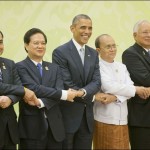
Tomorrow Barack Obama will host leaders of Southeast Asian countries at the first historic US-ASEAN Summit. This is a significant step in the key strategic relationship emerging between the US and ASEAN. And both blocs have China to thank for it. In other words, for the US-ASEAN relationship, China’s regional missteps and economic woes are gifts that keep on giving.
EXSE FOCUS
Obama’s Sunnylands Summit: Does ASEAN Really Matter? – The Diplomat OK, OK, I get the symbolism, but it is a measure of how devalued the language of diplomacy can be that US President Barack Obama would hold an unprecedented summit at Sunnylands in California with ten heads of state whose countries comprise the Association of Southeast Asian Nations (ASEAN) to talk of a “strategic partnership.”
Related: Time for a New US-ASEAN Human Rights Dialogue – The Diplomat
Related: U.S. Drawing Southeast Asia Closer With California Summit – NYT
US President Barack Obama likely to promote virtues of TPP – and independence from China – during summit with Southeast Asian leaders – The South China Morning Post A summit next week between Southeast Asian leaders and President Barack Obama is unlikely to deliver any big economic prizes, but will allow the American side to press the advantages of joining a Pacific trade pact that doesn’t include China. The meetings at Rancho Mirage in California set for Monday and Tuesday will be the first summit of its kind for the 10-member Association of Southeast Asian Nations on US soil. Its special nature is intended to show the Obama administration’s commitment to countering growing Chinese influence in a region that is home to 620 million people and a US$2.6 trillion economy.
The Elephant in the US-ASEAN Room: Democracy – Asia Unbound Next week, at a summit in California, President Obama will meet the ten leaders of countries in the Association of Southeast Asian Nations (ASEAN), the most important regional group in Asia. The event, the first-ever US-ASEAN summit on American soil, is being touted by the White House as a sign of the importance of Southeast Asia. After all, the Obama administration has made relations with Southeast Asia a centerpiece of “the pivot,” or “rebalance to Asia,” a national security strategy that entails shifting American military, economic, and diplomatic resources to the Pacific Rim. There are indeed important reasons for holding the U.S.-ASEAN summit. Tensions are rising between several Southeast Asian nations and China, in part because of Beijing’s increasingly assertive actions in Asian seas.
Related: The Dark Heart of ASEAN – Project Syndicate
Related: Burma’s Outgoing President Cancels Visit to US-ASEAN Summit Next Week – The Irrawaddy
The Future of US Foreign Policy: American Leadership In Asia – The Diplomat The Rebalance authors Mercy Kuo and Angie Tang regularly engage subject-matter experts, policy practitioners and strategic thinkers across the globe for their diverse insights into the U.S. rebalance to Asia. This conversation with Richard Fontaine – President of the Center for a New American Security (CNAS), former Senior Advisor and Senior Fellow at CNAS from 2009-2012, previously foreign policy advisor to Senator John McCain and at the State Department, National Security Council and Senate Foreign Relations Committee, and co-author of An Intensified Approach to Combating Islamic State – is the 31st in “The Rebalance Insight Series.”
Requiem for a river: Can one of the world’s great waterways survive its development? – The Economist GUO, the driver, pulls his car to a merciful halt high above a crevasse: time for a cigarette, and after seven hours of shuddering along narrow, twisting roads, time for his passengers to check that their fillings remain in place. Lighting up, he steps out of the car and dons a cloth cap and jacket: sunny, early-summer days are still brisk 3,500 metres above sea level. Mr Guo is an impish little dumpling of a man, bald, brown-toothed and jolly. He is also an anomaly: a Shanghainese in northern Yunnan who opted to stay with his local bride rather than return to his booming hometown.//ExSE co-founder Brian Eyler gets a mention in this article which draws heavily from his 9/2015 blogpost on Cizhong and the Wunonglong dam. This article also mentions the heavy lifters working effectively on the policy side to promote sustainable solutions to the trouble of hydropower development on the Mekong. Kudos for the Economist for choosing the Mekong as a highlight issue in the run-up to the Sunnylands meeting.
Can China Jump-Start Its Maritime Silk Road in 2016? – The Diplomat According to the director of China’s State Oceanic Administration, China has big plans for the 21st Century Maritime Silk Road (MSR) in 2016. Xinhua cited SOA chief Wang Hong as saying that China will advance the MSR with an action plan this year. Wang also spoke of establishing “a China-ASEAN maritime cooperation center and a platform to boost maritime cooperation in East Asia,” according to Xinhua.
80 Percent of Zero: China’s Phantom South China Sea Claims – The Diplomat Baudelaire said the devil’s best trick was convincing us he did not exist. China’s best trick might be convincing us its claims over the South China Sea do exist. Official rhetoric about its “indisputable sovereignty over the South China Sea islands” certainly sounds like a definitive Chinese position. And, of course, China occupies many islands in the area, its Coast Guard chases off foreign fishing vessels, and massive Chinese land reclamation projects provide new, persistent regional presence. But with the notable exception of the Paracel islands between Hainan Island and Vietnam, China has made no valid legal claim over the South China Sea.
REGIONAL RELATIONS
Decision in Philippines v. China Expected in May 2016 – The Diplomat Plus, updates on U.S.-India patrols, Asian defense spending rises, and more. Weekend security links.
US decides on next ambassador to Burma – DVB The U.S. Senate unanimously confirmed President Barack Obama’s nominee to be ambassador to Burma on Tuesday, after the administration assured lawmakers it would not rush to ease sanctions as the country moves from decades of military rule. The Senate voted 90-0 to confirm career diplomat Scot Marciel to the post in Burma, also known as Myanmar. Currently the principal deputy assistant secretary in the State Department’s Bureau of East Asian and Pacific Affairs, Marciel has also been ambassador to Indonesia and served in Vietnam, the Philippines, Brazil and Turkey.
US urges China-Taiwan talks amid uncertainty after election – The Jakarta Post The Obama administration says it is urging China and Taiwan to maintain dialogue amid concern that the election of an independence-leaning party on the island could heighten tensions in one of Asia’s security hotspots. A House foreign affairs panel on Asia examined the implications for Washington of the January election that throws new uncertainty over the relationship between democratic Taiwan and the communist mainland, which claims the island as its own territory, to be recovered by force if necessary.
US-India Patrols in the South China Sea? Maybe Not Just Yet – The Diplomat Early on Wednesday, Reuters published an interesting exclusive, suggesting that the United States and Indian navies are considering the idea of jointly conducting patrols in the South China Sea. It isn’t explicit if the idea under consideration is a bilateral U.S.-India freedom of navigation patrol, which would require Indian and U.S. vessels to challenge excessive maritime claims, or simply a bilateral passing exercise or other less contentious patrol. Both India and the United States support freedom of navigation, globally and in the South China Sea.
Related: US and India risk angering Beijing as they consider joint naval patrols in the South China Sea – The South China Morning Post
SUSTAINABILITY AND RESOURCE MANAGEMENT
How Mekong women hone science skills – SciDevNet [MANILA] Every two weeks, Somkhith Bouridam of the National University of Laos and her assistant, Palamy Changleuxay, participate in a conference call on a project to help countries across the Lower Mekong region use satellite imagery to cope with climate change and food insecurity. The five-year project called SERVIR-Mekong is being implemented by universities in Cambodia, Laos, Myanmar, Thailand and Vietnam along with the Bangkok-based non-profit Asian Disaster Preparedness Center (ADPC).
What a New Vietnam-Russia Deal Says About the Mekong’s Future – The Diplomat It is potentially an unusual business transaction. While the prospect of a Vietnamese company taking over a Russian group in of itself is unusual, the buyout of a strategic stake in a major fish distributor is also a reflection of changing attitudes to the management of the Mekong River.
Southeast Asia facing severe drought – Southeast Asia Globe With weather experts still assessing whether this year’s El Niño is the most extreme on record, its effects are being felt across the world, not least in Southeast Asia, where prolonged drought conditions are gripping most countries. The current El Niño – a cycle of extreme weather conditions caused by warmer than average sea temperatures in the Pacific – has been of concern to governments and agencies since December 2014 when the current ocean warming began.
China’s Uphill Battle Against the Ivory Trade – The Diplomat On January 13, in his New Year policy address, Hong Kong’s Chief Executive CY Leung announced a plan to ban ivory trade within the region. Zhang Li, secretary general of the China Committee for the Wildlife Conservation Society (WCS), professor at Beijing Normal University and an expert on elephants, hopes that mainland China will keep pace and enact a national ban on ivory trading, as promised by President Xi Jinping on his inaugural visit to the U.S. in September.
Qinghai Lake Activists Confront Chinese, Tibetan Poachers – Radio Free Asia On Feb. 12, a group of activist volunteers were attacked by poachers at a place called Chik Nga Chik after they had gone to check on reports of fishing in the lake, an area resident told RFA’s Tibetan Service on Friday. The poachers, who wore head coverings to conceal their identity, were later identified as Tibetans, RFA’s source said, speaking on condition of anonymity. “It is really sad when some Tibetans try to protect rare fish in the lake, while others try to take those fish,” the source said. Incidents of illegal fishing have increased in recent years around Qinghai Lake, also called Kokonor, with local Tibetans stepping up monitoring activities in response, sources told RFA in earlier reports.
CHINA
Taiwan Blocks Leader of Uyghur Organization From Attending Conference – Radio Free Asia Taiwanese authorities have prevented the executive chairman of an international Uyghur organization from participating in a human rights conference to be held in Taiwan later this month, the World Uyghur Congress (WUC) said Friday. Dolkun Isa, WUC’s executive chairman, will not be able to attend the Asia Pacific Religious Freedom Forum on Feb. 18-21 because of likely pressure from Chinese authorities, the Munich, Germany-based organization of exiled Uyghur groups said in a statement. “It is a true shame that a democratic country such as Taiwan should be so influenced by the will of the Chinese government,” the statement said. “China has consistently maintained that human rights defenders—and those supporting the Uyghur community in particular—should be treated like criminals.”
China Says Its Students, Even Those Abroad, Need More ‘Patriotic Education’ – NYT BEIJING – Chinese students, already immersed in classes and textbooks that promote nationalist loyalty to the Communist Party as a bedrock value, must be made even more patriotic and devoted to the party, even when they are studying in universities abroad, according to a new directive sent to education officials. //China already does this for students at home. Take required Marxist readings at the university level, for example. How probable will it be to successfully enforce this for Chinese students overseas? Furthermore, how will it affect relations with those host countries?
Satellite Images: China Manufactures Land at New Sites in the Paracel Islands – The Diplomat Satellite images show dredging and land filling by China at two new sites in the South China Sea, both in the Amphitrite group of the Paracel Islands, approximately 15 kilometers north-northwest of China’s military base at Woody (Yongxing) Island. Also newly visible is a helicopter base under construction at Duncan Island, another site in the Paracels, suggesting that Beijing may develop a network of bases in the South China Sea to support anti-submarine warfare helicopters, such as its recently deployed ASW Z-18F.
China’s Nuclear Industry Goes Global – The Diplomat A European nuclear plant built and operated by China? Unimaginable, one might say, as China still has to prove to be a reliable partner in operating critical infrastructure, meeting strict safety requirements, and managing the complex technology. Yet, nuclear reactors are about to be built with Chinese participation in the United Kingdom. And that is just the beginning. Chinese power corporations are initiating new projects all over the globe and have the potential to become the next big civil nuclear technology suppliers for several countries (see the map below). As this trend is assuming shape, the next decade will be critical to ensure that Chinese technology is safe and that China adheres to non-proliferation agreements.
Armed Chinese Threaten Lao Banana Workers – Radio Free Asia Armed Chinese guards are forcing Lao workers in the country’s northern Oudomxay province to labor in banana plantations contaminated with dangerous chemicals, local sources tell RFA’s Lao Service. A chief of the Nongbouadeang village in the province’s Houn district told RFA that 50 Lao workers in a Chinese-owned banana plantation in the neighboring village of Nammieng were working under Chinese overseers armed with automatic rifles.
Chinese begin big rush back home on planes, trains and automobiles as new year holiday ends – The South China Morning Post Traffic surged at China’s railway stations, airports and highways on Friday as millions of workers began their journeys back to work after the week-long Lunar New Year holiday. But many were delayed with the arrival of another cold front that brought heavy fog. The China Railway Group said it handled just over 9 million passengers on Friday, 6.9 per cent more than last year as most people travelling home would return to work on Sunday.
SOUTHEAST ASIA
Dateline Irrawaddy: ‘It’s Fair to Say That President U Thein Sein Is Burma’s Reform Icon’ – The Irrawaddy The Irrawaddy speaks with Minister of Information Ye Htut about President Thein Sein’s five-year tenure and the media’s role in the country.
Indonesia to form special TPP team this month – The Jakarta Post The decision whether to join the Trans-Pacific Partnership (TPP) will be arrived at cautiously by first establishing a special committee to review the advantages and disadvantages of joining the US-led trade-pact agreement, an official has said. Office of the Coordinating Economic Minister’s deputy for international economic and financial corporation Rizal Affandi Lukman said the ministry was preparing a decree on the TPP committee. “Hopefully it can be signed soon. Our target is this month,” Rizal told thejakartapost.com in Jakarta on Tuesday. According to Rizal, the team will consist of two layers, namely government officials from relevant ministries, and public figures ranging from experts to chairmen of business associations. They will examine all terms in the trade agreement.
US, Thailand Launch 2016 Cobra Gold Military Exercises Amid Democracy Concerns – The Diplomat On Tuesday, the United States and Thailand kicked off the 2016 iteration of the annual Cobra Gold military exercises – Asia’s largest multinational drill – amid lingering concerns by Washington about its ally’s democratic future. Royal Thai Army Supreme Commander, General Sommai Kaotira, and U.S. Ambassador to Thailand, Glyn Davies, launched the 35th iteration of the annual exercise – which began as a bilateral drill between Washington and Bangkok – at the Royal Thai Navy Command Center in Sattahip district in Chonburi province.
Could improved tax collection strengthen democracy in Cambodia? – Southeast Asia Globe With Cambodia starting to collect more tax, some argue it could increase political accountability in the Kingdom. Cambodia has long been lambasted for not doing enough to collect taxes. In 2006, for example, it collected a little over $600m. In recent years, attempts to levy taxes on ordinary people have been met with protest but the overall amount of tax collected has been rising. The Department of Taxation recently announced that it collected $1.3 billion in 2015, up 21.6% from the previous year. The Department of Customs and Excise – which collects taxes on imports and exports – has yet to release its figures for last year. In 2014, it collected $1.34 billion.
Cambodia’s poverty rate dropping rapidly – Investvine The United Nations hailed Cambodia for its accomplishments in meeting its Millennium Development Goal targets in 2015. In a recent report, the UN calls Cambodia an “early achiever” performing “particularly well” on poverty alleviation. As the Cambodian economy grew on average 7.8 per cent annually from 2004 to 2014, achieving one of the fastest growth rates in the world during this period, some five million people were lifted out of poverty in the period. Cambodia’s poverty rate had been reduced to 14 per cent, down from 53.2 per cent in 2004. At the same time, an increasing number of Cambodians are entering the middle class. In 2016, Cambodia’s economic status will be elevated to the level of a lower-middle income country and the nation will be leaving the league of developing countries. //“Cambodia’s poverty rate had been reduced to 14 per cent, down from 53.2 per cent in 2004.” …based on what established standard for poverty?
The true cost of Laos’ banana plantations – Southeast Asia Globe When Chinese businessmen offered to rent land from impoverished Laotian farmers the deal was too good to turn down. Thousands of hectares of ruined rice paddies and numerous life-threatening illnesses later, the true cost of banana plantations is finally being counted in northern Laos.
This news digest was compiled by Rachel Tritsch with analysis from Rachel Tritsch and Brian Eyler.
 Regional roundup for week of 11.22.15
 Regional Roundup for Week of 12.6.15
 Regional Roundup for Week of 11.16.2014


