Category Archives: Regional Relations

China summons Burmese ambassador after bomb kills four in Yunnan

China has summoned Myanmar’s Ambassador to China following a Burmese air raid that led to the deaths of four Chinese citizens.

The Burmese military is currently engaged in an armed conflict with the Myanmar National Democratic Alliance Army (MNDAA), centered on the Kokang region. Kokang lies on the border of Burma’s Shan State and China’s Yunnan Province.

According to a report from state-run Xinhua News Agency, four villagers from Yunnan’s Gengma County were killed Friday afternoon while working in their sugarcane fields. Nine others were injured.

A Nanchang A-5C Fantan jet fighter commonly used by the Burmese military.

A Nanchang A-5C Fantan jet fighter commonly used by the Burmese military.

China’s Vice Minister of Foreign Affairs Liu Zhenmin expressed strict condemnation of the incident in a statement. Late Friday night, Liu urged Burmese Ambassador to China Thit Linn Ohn to fully investigate the incident and report the investigation’s outcomes to Beijing.

In addition, the Vice Minister asked for severe punishment for those involved and for the Burmese to take steps to ensure security in its border regions.

The incident on Friday was the second of its kind in just a week. On March 8, an errant shell fired from Burmese territory landed on a house in Gengma County. No one was injured.

While the Chinese press has pointed its finger squarely at the Myanmar Air Force, the question of blame is not so clear cut on the Burmese side.

An official with the office of the Myanmar president claimed that Burmese forces had informed the Chinese side of their air operations, which were carried out “strictly adhering to the information we told them”.

“The targets of all our aerial attacks were inside our territory,” the official, Zaw Htay, told Reuters in an interview.

“It’s possible that those fighting with us purposely created these attacks with the intent of causing misunderstanding between China and us … We plan to explain it to Chinese diplomats after summoning them.”

The 2015 Kokang Conflict began last month when MNDAA forces launched an offensive against the Burmese military. They attacked in an effort to retake territory lost in 2009 during a similar conflict with government forces. Like the 2009 conflict, this latest flare up has caused tens of thousands of refugees to flee across the border into Yunnan.

Before hostilities broke out in 2009, Kokang, a region largely populated by ethnic Han Chinese, had enjoyed a twenty year ceasefire.

MYANMAR-POLITICS-MINORITIES-UNREST

MNDAA soldiers in Kokang region. AFP image, February 13, 2015

Myanmar has repeatedly accused the Chinese government of  aiding the MNDAA with troops and materiel. Beijing has categorically denied such claims.

The MNDAA was formed in 1989 after the breakup of the Communist Party of Burma, an armed group which Beijing supported for decades.

This latest iteration of the Kokang conflict has done much to strain relations between China and Myanmar.  Despite historically close ties between the two governments, Naypidaw’s efforts to defeat simmering rebellions in its border regions have had consequences for bilateral ties. The 2009 Kokang conflict and the refugee crisis it created drew condemnation from China’s Ministry of Foreign Affairs. Additionally, Burmese shells landed in Chinese territory during 2012 and 2013 as a result of Myanmar’s ongoing conflict with the Kachin Indepence Army.

Long Myanmar’s only ally in the region, China has had to compete with other countries for Myanmar’s favor following its implementation of reforms starting in 2011. However, whereas many have claimed Myanmar was distancing itself from China, the opposite may be true following this latest iteration of the Kokang conflict.

Additionally, these threats to China’s border security could test its commitment to non-interference, a key part of its foreign policy. Will another incident provoke China to deploy troops to the region? Will China seek to mediate a ceasefire agreement in Kokang? Does this all mark a significant turn in Sino-Burmese relations? China’s response in the coming days and weeks will help to answer these questions and more.

Update 7:07pm, March 14: According to new reports from China Central Television, China Eastern Airlines has decided to cancel six flights to three cities in Myanmar: Yangon, Mandalay and the capital, Naypidaw. In addition , it is now reported that China has deployed fighter jets to the border region opposite Kokang.

1 Comment

Filed under China, Current Events, Foreign policy, Myanmar/Burma, Regional Relations, SLIDER, Yunnan Province

Myanmar fighting escalates, tens of thousands flee into China

mynamar fighting

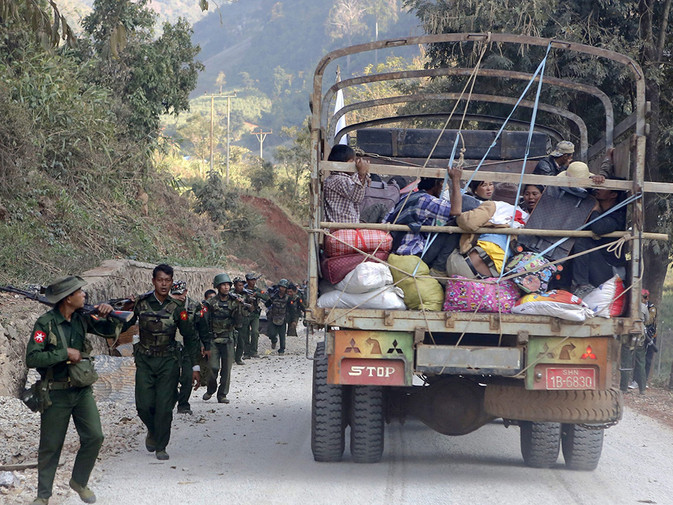
As fighting in Myanmar grew more intense near the Sino-Burmese border during Spring Festival, media reports became increasingly confused and alarming. Clashes between rebels and government forces in Shan State reportedly claimed the combined lives of more than 100 combatants on both sides. The ramp-up in hostilities has also forced tens of thousands of Burmese civilians to flee their rural villages for refuge in China.

Fighting that first broke out on February 9, and included air and artillery strikes by the Burmese army in Kokang, have led to protracted bouts of guerrilla warfare. Estimates place the number of dead in the violence between 70 and 130, and media reports are unclear how many of these are soldiers or civilians.

However, a spokesman for the Myanmar Defense Ministry, Lieutenant General Mya Htun Oo, wasquoted in the Hindustan Times as saying “the conflict had killed 61 military and police officers and around 72 insurgents”. Red Cross officials have also said humanitarian workers in the region have been attacked twice in the past week. The Burmese military has declared three months of martial law in Kokang, although how well such a policy can be enforced remains unclear.

Skirmishes have been most intense near the Burmese town of Laukkai, or Laogai. The village, now described as a “ghost town”, is located on the Salween River — known in Chinese as theNujiang. The refugees sought shelter in Yunnan’s Lincang Prefecture and were first thought to number a few thousand. However, Red Cross workers in Myanmar now claim at least 30,000 people have made the crossing, raising fears both inside and outside China of a looming humanitarian crisis.

The embattled Kokang region is a semi-autonomous part of northeastern Myanmar. Although the national government in Naypyidaw asserts titular control of the area, 90 percent of the local population claim Chinese descent and identify ethnically as Han Chinese. The rebel army now fighting Burmese troops is called the Myanmar National Democratic Alliance Army (MNDAA) and is headed by former members of the country’s defunct Communist Party.

No official reason has been given for the escalation in violence in Kokang, although it seems likely connected to December ambushes by guerrillas that killed at least seven Burmese soldiers and injured 20 others. As the conflict continues, both sides have presented their own narratives. Burmese military spokesmen have gone so far as to accuse the rebels of employing Chinese mercenaries in an attempt at complete self rule — a charge the guerrillas and Beijing have vociferously denied.

Also at stake for both the Kokang and Burmese authorities are lucrative, if unofficial, trade routes in the area. China’s border with Myanmar is extremely porous, and around Kokang is notorious for booming illicit trafficking of illegally logged timber, rare animals, jade and narcotics.

This article by  was first posted on the GoKunming on 

Leave a Comment

Filed under ASEAN, China, Cold War, Current Events, ethnic policy, Foreign policy, Myanmar/Burma, Regional Relations, SLIDER, Yunnan Province

Report: Thousands of Burmese refugees fleeing into China

Renewed fighting between the Burmese military and a guerrilla army in Myanmar’s northeastern Shan State erupted once again this week. The violence has caused civilian refugees — by some estimates more than 10,000 people — to flee across the border into rural areas in China’s Yunnan province.

Hostilities broke out on Monday in Kokang, a self-administered zone with a population estimated at 150,000. An article posted on Burmese news website The Irrawaddy reports fighting was most intense near the town of Laukkai, located on the Salween River — known in Chinese as theNujiang. Refugees were headed to the opposite side of the river to the village Nansan (南傘) in Lincang Prefecture.

The location of Myanmar’s Kokang region shown in green. Shan State in Yellow (Wikipedia)

The Burmese military attacked areas held by the Myanmar National Democratic Alliance Army (MNDAA), the armed wing of the Kokang ethnic group — 90 percent of whom are of Han Chinese ancestry. Bombing has been concentrated nearby Laukkai using Russian-made jet fighters and helicopters during the day and artillery during the night, according to MNDAA general secretary Htun Myat Lin.

He also claimed the number of refugees fleeing into China was approaching 10,000 as of Tuesday, most of them Burmese villagers, with a small minority made up of Chinese merchants. Chinese media have so far not estimated the number of displaced but Foreign Ministry spokesman Hua Chunying was quoted by CCTV as saying:

China is concerned about the Myanmar situation. During the past two days, some Myanmar border residents, because of safety considerations, have entered China. They have been looked after. China will continue to pay close attention to how the situation develops, and maintain the peace and stability of the China-Myanmar border. We also believe that the Myanmar side should also work hard for this.

State-backed Burmese news outlets have yet to release reports regarding casualties from the fighting. No official reason has been given for the escalation in violence, although it seems likely the actions by the Burmese military are connected to December ambushes by Kokang guerrillas that killed at least seven soldiers and injured 20 others.

The current situation along the border closely mirrors a monthlong period in 2009 when an estimated 30,000 Burmese civilians from Kokang crossed into Yunnan in the wake of fighting. China dealt quietly with those displaced by fighting six years ago, instituting a near media blackout of its humanitarian actions.

This article was written by Patrick Scally and originally published on GoKunming on February 12, 2015 .

Leave a Comment

Filed under China, Current Events, Myanmar/Burma, Regional Relations, SLIDER, Yunnan Province

Mass Disappearance of Vietnamese Brides in China’s North

Cover shot of a 2010 Southern Weekly magazine featuring the trend of Chinese men are marrying Vietnamese brides

Cover shot of a 2010 Southern Weekly magazine with a feature on how Chinese men are marrying Vietnamese brides

Police are investigating how a hundred people came to be missing last month in Handan County, Hebei.  The disappeared aren’t protesters or dissidents, they aren’t journalists, they aren’t teachers; they haven’t been victim to a mud slide, a coal mine collapse or a flood.  They are a hundred young Vietnamese women, brokered into marriage to Chinese men across the border mere months ago, and now gone.

Public, verifiable facts on the case are scarce; even on the barest nature of the crime.  Are the disappeared women victims or co-conspirators with their traffickers?  Did they move on willingly, clandestinely, or were they forcibly kidnapped?  How could a hundred people remove themselves from their new husbands without a trace left behind?

One local official says it looks like the men were scammed by a marriage broker who had lived in the county for twenty years before disappearing with the women.

Wu Meiyu was herself a Vietnamese bride, moving to the county and raising a family there with her new Chinese husband.  Wu is alleged to have travelled widely this year in search of lonely male bachelors to sell Vietnamese brides to.  She successfully administrated one hundred illegal marriages to these men, importing each bride individually through associates in Vietnam for a hefty fee.

On the evening of November 20 all one hundred of these women disappeared en masse.  They apparently told their husbands they were attending a dinner party, but none returned at evening’s end.  Except, possibly,for one.

It has been reported that one of the brides returned to her hometown and filed a police report.  The report claimed that upon arriving for a dinner party she was told by an unspecified person that a new husband was going to be found for her.  At some point she fell unconscious and after awakening managed to make her way back to her adopted village.

This incredibly vague, frustrating anecdote raises more questions than it answers, but if true, appears to imply that the women have been trafficked against their will.  On the other hand, this is the only piece of evidence pointing to the forced nature of the disappearance, and if untrue the likelihood of the women being scammers themselves increases.

Whether these women are victims or co-conspirators, the scale of the movement of people involved highlights the robust, entrenched criminal networks involved in human trafficking in the region – and the suffering trafficking incurs for all involved.

Human trafficking in China is a huge, murky issue.  Although absolutely illegal in PRC law, it occurs constantly; domestically – with victims being abducted and transported thousands of kilometers across the huge country, to unfamiliar surrounds – and internationally, with thousands of people being smuggled in from neighboring countries such as Vietnam, Myanmar, Laos and nations further afield.  In some parts of China openly marrying brokered, foreign brides has become local tradition.

Chinese police forces are enacting a notional attempt to stem the tide of trafficking crime, with most attention being paid to child trafficking, sexual slavery and prostitution.  However, given China’s skewed sex ratio and its growing demand for trafficked children and wives (the Chinese Academy of Social Sciences estimates there could be up to 24 million more men than women of marriageable age in China by 2020) it remains to be seen if police can make any real inroads into the problem.

This particular police investigation into the hundred missing women is worth tracking for its unusual scale.  Every day young vulnerable Vietnamese women are abducted from their homes by friends, family and strangers and sold into China.  These damaged women rarely manage to return and are mostly voiceless if they do.

Local and regional policing efforts need to work effectively to achieve a solid outcome in this potentially high-profile case so that more attention can be drawn to the crimes of slavery and human trafficking in Asia.Source countries must also do their bit, but as a significant destination country China has a huge responsibility –and debt – to the many victims who wake up there daily in the dark: far from home, scared and stripped of their rights.

Leave a Comment

Filed under China, Current Events, Human trafficking, Regional Relations, SLIDER, Vietnam

South Thailand’s Muslim Insurgency is not Global Jihad

solider guarding Muslims

A Thai soldier guards a group of Muslims during prayer. Photo courtesy of The Nation.

Introduction

In the early morning of January 4, 2004, a group of armed men raided an army depot at the Rajanakarin Camp in the southern Thai province of Narathiwat. They walked away with hundreds of military-grade weapons, and left four Thai soldiers dead in their wake. Around the same time, arsonists set alight 20 provincial schools and two unmanned police posts. A series of similar incidents followed in neighboring Yala and Pattani provinces, prompting then-Prime Minister Thaksin Shinawatra to declare martial law in volatile areas within Pattani, Yala, and Narathiwat—on top of his already high-handed brutality in the region.

Further angered and suppressed, belligerents in this area escalated violence to new intensities. At the core of this conflict is a separatist movement active among the Thai Malay Muslim community since the 1960s. While the term “Malay” refers only to an Austronesian ethnic group, ethnic Malay identity cannot be divorced from Malay traditions, Malay language, or adherence to Islam. This has pitted Malay identity in direct competition with the Thai identity cultivated under King Bhumibol Adulyadej. This conflict of identity and consequent alienation from the Thai community has prompted violence to erupt in Thailand’s majority Muslim southern provinces of Pattani, Yala, and Narathiwat, collectively referred to as Patani.

Since a renewed surge of violence in 2004, the South Thailand Insurgency, as it is know, has incurred over 6,000 fatalities and over 11,000 injuries and has significantly impeded development in the region. The Thai state, meanwhile, refuses to acknowledge the ethno-national and ethno-political grievances at the heart of the conflict, hindering an effective solution to the violence and prompting international organizations—including the Malaysian government and the United Nations Development Programme—to become increasingly involved in the problem-solving effort. Effective dialogue between belligerents and the Thai state is the only way to resolve the South Thailand Insurgency, but this will remain out of the realm of possibilities if Thailand continues to deny the identity issues fueling this conflict.

Patani map

Map of Patani region. Source: http://books.sipri.org/files/PP/SIPRIPP20.pdf

Patani Region

Patani is a historical region located on the northern part of the Malay peninsula. In the modern day, this region is transnational: Patani includes the southern Thai provinces of Pattani, Yala, Narathiwat, and parts of Songkhla, as well as the Malaysian state of Kelantan.

Patani was an independent Muslim city-state until the sixteenth century when it became a vassal state of Siam, and came under increasingly direct Siamese rule during the Sukhothai and Ayuthaya periods. Following resistance and a series of rebellions in response to this shift, Patani fractured into seven separate regions. These seven regions existed until the Bangkok Treaty of 1909, in which the British (who at that time controlled Malaysia and were creeping northwards) acknowledged Thailand’s sovereignty over the seven regions of Patani. In return, Thailand relinquished the southern territory of Kelantan to British control. By 1933, Thailand had consolidated the seven Patani regions and renamed them Pattani, Yala, and Narathiwat. Today, the Patani region is home to roughly 1.8 million Thai citizens, 80 percent of whom are Muslim. The remaining 20 percent are almost all Thai or Sino-Thai Buddhists.


Rise of “Nation, Religion, King”

In the post-colonial, increasingly globalized world, the Thai monarchy saw the need to reinvent itself for the modern era. In the process of reinventing the monarchy, King Bhumibol Adulyadej’s relationship with the monastic community of ordained Buddhist monks—the sangha—became intertwined with the prosperity of the nation. Thus, the role of the sangha was given a national component, and became integral to a healthy state of internal affairs. In later years, King Bhumibol was emboldened to transform the sangha. Guiding Bhumibol in this process was Vajiravudh (Rama VI)’s three pillars of nation, religion, and king. These pillars linked King Bhumibol inextricably to the nation through religion, and served to strengthen the king’s intertwinement with the sangha. In practice, the pillars meant that Buddhism was to facilitate the deification of King Bhumibol. Accordingly, a variety of rituals and holy days were presided over by the king, and royally endorsed public works projects were under taken in the countryside. Rural temples, controlled by the sangha and hence the king, became a link between the village and the national consciousness, thus providing the Thai people with a common experience with king, and laying the framework for a common Thai identity.


“Thainess” vs. “Otherness”

A standardized practice of Theravada Buddhism, in other words, has historically been employed as the ideological underpinning for the civilization and unification of all Thais. It was not just the practice of Buddhism that was standardized, but also the ethnic composition of its adherents. Promotion of the Thai language, too, was used to standardize Buddhist practices. This standardization provided a specific group of people within Thailand’s borders with a collective goal and a common sense of duty towards the advancement of the nation. The goal was to “make them realize [that they belong to] the same nation, religion and king, pledging loyalty to the king and the nation as their refuge and worship Buddhism.” A Thai identity based in these precepts resulted. This is known as “Thainess.”

It is the standardization of the sangha that has facilitated the construction of otherness. Confronted with globalization and modernity, Western notions of nationhood and rigid borders began to change the Thai attitude on who is entitled to benefit from the state. In order to determine this, an identity binary developed: “Thainess” arose situated opposite to “otherness.” Thainess is defined by a collective duty to Vajiravudh’s three pillars as previously discussed, and holds little in common with Western notions of individualized national identity. This group alone is allowed to benefit from the Thai state.

“Otherness,” by contrast, encompasses everything Thainess is not. Because the three pillars define the Thai conception of nationhood, any deviation from these three pillars disqualifies an individual or group from integrating to and benefiting from Thai society. The South Thailand Insurgency is one particularly aggressive response to this identity binary. In southern Thailand, Malay Muslims cannot integrate because they do not practice Buddhism; those who do not practice Buddhism are not viewed as Thai. Simply put, to be a part of Thailand is to be quintessentially Buddhist. Standardization has changed meaning of religion from one of personal choice to that of identity signifier.

A Thai soldier guards a Buddhist monk as he collects alms. Photo courtesy of USA Today.

A Thai soldier guards a Buddhist monk as he collects alms. Photo courtesy of USA Today.

The effects of otherness extend beyond the inability to integrate into Thai society: otherness is often viewed as a threat to national stability. King Bhumibol has cultivated a sense of fear and animosity towards those who do not identify with the three pillars, and has convinced each individual Thai that his or her fate is tied up with the state, and that the state’s fate is tied to the monarchy. If the monarchy falls, Thai prosperity will falter. This common understanding has provided the monarchy with masses directly aligned with its ideology, thus protecting the monarchy from threats of otherness. The South Thailand Insurgency attests to the lengths to which many Thais are willing to go to protect their monarchy—the foundation of their identity—and to prevent the fracture of the state. This conflict is also a testament to the difficulty of building a national identity in Thailand—the process is hindered by porous borders, multiple ethnic minorities and religions, and a complicated citizenship process. This means that language spoken, religion practices, and ethnicity do not line up as the Thai state insists they do.


Conflict Overview

Many consider the current violence in the “Deep South” to be a renewed version of the older liberation struggle of the 1960s and 1970s, which itself was a reaction to Thai state control. Lack of state legitimacy due to rigid ethnic identifiers then as well as now is at the core of the conflict. King Bhumibol’s continued standardization policies and centralization of the Thai state have alienated those who do not subscribe to the “nation, religion, king” trifecta, resulting in a “legitimacy deficit” of the Thai government in minority regions. In Patani, Bhumibol’s policies have transformed Patani’s political and Islamic educational and legal structures into a “quintessentially Thai” system. Because Malay Muslims in this region cannot identify themselves within this structure, grievances and resistance movements have materialized to address the government’s failure to provide Malay Muslims with a niche in Thai society.

Grievances are brought to the attention of the Thai state by a number of Patani liberation movements, with most fighting carried out by small groups of fighters consisting of young men aged 17 to 25. Violence occurs in open areas during the day, and takes the form of drive-by shootings or bombings, and sometimes larger, organized attacks. This has meant that most casualties are civilians. The most active groups are the BRN-C (BarisanRevolusiNasional-Koordinasi), its alleged armed wing the RKK (Runda Kumpulan Kecil), the GMIP (Gerakan Mujahidin Islam Patani), the BBMP (BarisanBersatu Mujahidin Patani), and the PULO (Patani United Liberation Organization). As opposed to the conflict of the ‘60s and ‘70s in which insurgent groups were sharply divided, today’s insurgent groups share a common Islamist agenda, ideology, and goals. Above all, the liberations movements demand the creation of a Malay Muslim state separate from the rest of Thailand. This united front has made the modern iteration of the conflict more difficult to fracture and quell than the last.

 Destruction in Patani. Photo courtesy of The Christian Science Monitor

Destruction in Patani. Photo courtesy of The Christian Science Monitor

Following the 2004 raid on the Rajanakarin Camp depot, violence in the three southernmost provinces of Pattani, Yala, and Narathiwat has increased dramatically. The 2004 Krue Se and TakBai incidents have become synonymous with the recent resurgence in violence, and have fueled grievances among liberation groups in recent years. Then-Prime Minister Thaksin Shinawatra’s unapologetic response to the incidents served to heighten violence towards Thai forces on the part of the liberation groups. Since then, violence has escalated steadily. Because the conflict is ongoing, it is difficult to accurately assess the number of injured and killed. In a July 2014 report, Deep South Watch released the most up-to-date information on number of killed and injured by religious affiliation. Some sources speculate that death tolls have climbed to 8,000 or more.


Insurgency, Not Global Jihad

This conflict cannot simply be described as Buddhism versus Islam, religion versus religion. At this core of this conflict is an issue of identity that happens to have a religious component. The main reason the South Thailand Insurgency cannot be considered part of the global jihad is because the conflict is more strongly contextualized as one of Thai vs. other. And while the conflict undeniably has a religious component, that religious component is only one piece of a larger identity issue. To date, there has been no evidence of external involvement in the bombings and killings in the Patani region. The South Thailand Insurgency is ethno-political and ethno-national at heart, and centers on a local historical claim to the Patani territory. As Islam garners more and more negative press around the world, we must be careful to assume that all conflicts that involve Islam are fundamentally jihadist in nature.

Fatalities and Injuries 2004-2014

Source: http://www.deepsouthwatch.org/node/5904


Human Development Indicators

Poor development is both a cause and effect of the South Thailand Insurgency. Development in the area has been particularly hindered since heightened violence emerged in 2004. A comparison of the United Nations Development Programme’s Human Development Indicators (UNDP HDI) from the years 2003, 2007, 2009, and 2014 reveals that the three southernmost provinces of Pattani, Yala, and Narathiwat have consistently failed to match the national development average. HDI ratings experienced a marked decreased following the violence of 2004. Education, income, family and community life, and participation in political and community activities are areas of particular concern.

HDI Yala

Source: http://www.deepsouthwatch.org/node/5904

HDI Pattani

Source: http://www.deepsouthwatch.org/node/5904

HDI Narathiwat

Source: http://www.deepsouthwatch.org/node/5904

It has been suggested that poor development is heightening regional grievances and exacerbating the conflict; development is then further hindered, fueling further dissent. But while development averages in Pattani, Yala, and Narathiwat remain below the national average, UNDP HDI data reveals improving development indicators in 2014. This could be due to the increased involvement of international organizations in the region, discussed in the section below.


Solutions

A number of solutions have been implemented to facilitate resolution to the South Thailand Insurgency. Thailand, however, has taken a back-seat role in the problem-solving effort. The two most comprehensive peace processes, the Southern Thailand Empowerment and Participation (STEP) Project and the Ramadan Peace Initiative, were organized by the United Nations Development Programme and the Malaysian government, respectively. The STEP Project, implemented in March 2010, seeks to address grassroots development issues in Patani as a way to increase interaction with the local government and pave the way for national-level advocacy. STEP has progressed to its second and final phase, and is slated to be completed by December 2017. The Ramadan Peace Initiative, meanwhile, provided a neutral forum for talks between Thailand’s National Security Council (NSC) and the BRN-C. The talks were held in Kuala Lumpur, Malaysia, and ended in the signing of the General Consensus on Peace Dialogue Process on February 28, 2013. The two parties met again in March, April, and May 2013, vowing to keep the dialogue channels open and actively work towards peace in the region. But since Thailand’s coup in May 2014, the domestic political situation has not been conducive to furthering the peace process.

Violent Attacks in Patani Jan13-April14

On November 3, 2014, Thailand’s military government vowed again to end the violence in the three southernmost provinces, this time within one year. Questions have arisen around the feasibility of this plan considering the lack of confidence in Thailand’s new government, and the fact that peace talks started during the Ramadan Peace Initiative have stalled. And despite the violence plaguing the region and the reorganization of government, Narathiwat is still slated to be become a Special Economic Zone in 2016. The Thai government’s hope is that by developing the economy, security issues will be resolved and the violence will be quelled as the economy grows. But because this solution still does not address the fundamental issue of the conflict—identity—it holds a high potential for failure.

According to International Crisis Group, “a highly centralized administrative structure, the persistence of rigid conceptions of national identity and an old-fashioned bureaucratic outlook” inhibit resolution to the South Thailand Insurgency. Furthermore, according to the International Crisis Group these influence analyses of the problem as well as policy formation and implementation, thus making it difficult for Thai leaders to acknowledge the political dimension of the conflict. To do so would call into question state legitimacy based on the three pillars or nation, religion, and king. These misguided priorities have seriously inhibited the peace process in southern Thailand. Government spending in the region reveals that the focus remains on counterinsurgency and military capabilities rather than community and infrastructure development: as the violence escalates, so does counterinsurgency spending. Since 2005, counterinsurgency spending in the Patani region alone has fluctuated between 9.9 and 17.5 percent of total military spending. Some reports indicate that average per-capita military spending in Patani is around twice as much as average per-capita military spending nationwide.


Source:  http://www.deepsouthwatch.org/node/5904

Source: http://www.deepsouthwatch.org/node/5904

Looking to the Future

The nature of the solutions proposed by the Thai state suggests that Prime Minister Prayut Chan-o-cha and his government (as well as prime ministers who came before him, and particularly Thaksin Shinawatra) refuse to acknowledge the ethno-political and ethno-national components to South Thailand Insurgency. In other words, there are no signs that Thailand is adjusting its adherence to the mantra “nation, religion, king” in order to accommodate minority groups. Some speculate that if the Thai government did adjust its definition of Thai identity or even allowed Patani to secede, other suppressed groups—both domestic and regional—would follow with their own liberation movements. This is unlikely for a number of reasons. First, the trifecta championed by the Thai state provides a direct contrast to minority identity that does not exist in other countries. Other minorities (like Myanmar’s Rohingya Muslim minority group) may find it difficult to similarly contextualize their conflict as one of “state identity” vs. “other” because this rigid framework does not exist. Secondly, Malay Muslims constitute the second largest minority in Thailand (the first being ethnic Chinese) and are concentrated in a region on Thailand’s fringes. This has allowed the Malay Muslim community to over time create a united front against the Thai state. Other minorities in Thailand lack the same ability to unite due to their smaller and geographically fractured populations.

Although the South Thailand Insurgency is unlikely to threaten the existence of the Thai state, the conflict presents a severe humanitarian and national security issue and therefore deserves to be dealt with promptly and effectively. Dialogue is the most effective problem-solving tool in this situation, but there are few indications that the new Thai government is willing to cooperate in this way. In mid-November, 2014 a program to arm villagers against insurgents went into effect in southern Thailand, highlighting once again the government’s focus on weapon-based counterinsurgency. Thai authorities distributed approximately 2,700 military grade weapons—reportedly HK-33 assault rifles—to civilians in Pattani, Yala, and Narathiwat. Scholars as well as sources on the ground with knowledge of local opinion believe that the plan is bound to backfire and increase violence in the region, not quell it. This kind of “problem solving” must end. The Thai government instead must demonstrate flexibility and inclusion by supporting Muslim representatives in government and easing its assimilationist policies in the south. Only when a political space for discussion and the airing of grievances is created and maintained can the violence plaguing the Patani region end.


Further reading: 

Abuza, Zachary. “A Breakdown of Southern Thailand’s Insurgent Groups.” The Jamestown Foundation. 8 Sept. 2006. Web.

Advancing Human Development Through the ASEAN Community: Thailand Human Development Report 2014. Bangkok: United Nations Development Programme, 2014.

Bean, James. “Thailand’s Little-Known Peace Process.” The Diplomat. 31 July 2013

BTI 2014 – Thailand Country Report. BTI. Bertelsmann Stiftung, 2014.

Boontanondha, Thep. King Vajiravudh and the Making of his Military Image. 2013. Web

 Decludt, Florian. “The Cause of Unrest in Thailand: ThaksinShinawatra.” International Affairs Review. The Elliot School of International Affairs at George Washington University, 20 Jan. 2014. Web 

Handley, Paul M. The King Never Smiles: A Biography of Thailand’s BhumibolAdulyadej. New Haven: Yale UP, 2006. Print.

 How Can the Peace Process Be Taken Forward?Deep South Watch. 28 Feb. 2014.

 Human Security, Today and Tomorrow: Thailand Human Development Report 2009. Bangkok: United Nations Development Programme, 2010.

Jerryson, Michael K. Buddhist Fury: Religion and Violence in Southern Thailand. Oxford: Oxford UP, 2011.

 Jitpiromsri, Srisompob. An Inconvenient Truth about the Deep South Violent Conflict: A Decade of Chaotic, Constrained Realities and Uncertain Resolution. Deep South Watch. 2 July 2014.

Jitpiromsri, Srisompob, and PanyasakSobhonvasu. “Unpacking Thailand’s southern conflict: The poverty of structural explanations.” Critical Asian Studies 38.1 (2006): 95-117.

Karaman, Bahar. “Thailand promises peace ‘within a year’ in Muslim south.” Thailand Business News. 4 Nov. 2014.

Lefevre, Amy Sawitta. “Thailand promises peace ‘within a year’ in insurgency-hit south.” Reuters. 3 Nov. 2014. Web

National Security Council of Malaysia. “General Consensus on Peace Dialogue Process.” Agreement between Lt Gen ParadornPattanatabut and Ustaz Hassan Taib. 28 Feb. 2013.

“Massacre of Thai Muslims remembered.”Al-Jazeera. 25 Oct. 2012.

Mateus, Sofia Diogo. “More guns to increase ‘tit-for-tat violence’ in southern Thailand.” DW. Deutsche Welle, 11 May 2014.

McCargo, Duncan. Situation Report: Thailand. Tony Blair Faith Foundation.Tony Blair Faith Foundation, n.d. Web.

Melvin, Neil J. Conflict in Southern Thailand: Islamism, Violence and the State in the Patani Insurgency. Stockholm: Stockholm .

“Rohingya: Stateless and Unwanted.” Al-Jazeera. 2014..

Shadbolt, Peter. “Explainer: Thailand’s deadly southern insurgency.” CNN. 19 Feb. 2013.

Southern Thailand Empowerment and Participation (STEP) Project: 2010-2012. 2010.

“Southern Thailand Empowerment and Participation (STEP) Project.” United Nations Development Programme. Web.

“Thailand begins peace talks with southern rebel group.” BBC. 28 March 2013.

Thailand Human Development Report 2007. Bangkok: United Nations Development Programme, 2007.

Thailand Human Development Report 2003. Bangkok: United Nations Development Programme, 2003.

“Thailand Islamic Insurgency.” Global Security. 22 June 2014.

“Thailand/Malay Muslims (1948-present).” University of Central Arkansas.

Thailand: The Evolving Conflict in the South. International Crisis Group. International Crisis Group, 11 Dec. 2012.

“Thailand military seizes power in coup.” BBC. 22 May 2014.

“Thai mosque killings criticised.” BBC. 28 July 2004.

United States Bureau of Intelligence and Research. International Boundary Study. Rept. no. 7 1965. The Florida State University. Web.


Leave a Comment

Filed under Current Events, ethnic policy, Regional Relations, SLIDER, Thailand

How’s it Going, Thailand?

In the late afternoon of May 22, 2014–about the time when many people were leaving their offices–many TV screens turned frozen. The tunes behind put many in reminiscence: patriotic songs that once were ubiquitous in Thailand 50 years ago came alive. The screen was dominated by the color of blue with “National Council for Peace and Order” appeared under five logos of the military.

A few hours passed, the screen remained the same but a different song was playing. Every channel was painted with the same six words. Occasionally, for another day or two, a young man in uniform–possibly in his forties–sat behind a table and started to read word by word from the sheet of white A4 paper in front of him. As he read along, the screen scrolled down simultaneously to show what was typed on the letter.

They were orders. More than a dozen orders were issued to Thailand with immediate effect. The head of the military, General Prayuth Chan-Ocha, assumed the head of Thailand’s government. A curfew between 10pm to 5am was set nation-wide. Media was seized and controlled. All to maintain “peace and order.”

The next day, the young man was accompanied by a young woman, each had a few sheets of white paper in front of them. They switched to read over a hundred plus names of high position leaders who were summoned by the new Thai leader. These people were demanded to report within 24 hours.

At this time, no domestic news was reporting what was happening to Thailand. Much of the updates were acquired via social media and foreign news agencies. Videos of uniformed soldiers’ invasion into many media offices were recorded and posted online. People were furious at what was happening. But they were only those who were following the coup’s movement at every step. Others whose main–and possibly the only–channel of news was the television, remained sheltered with messages by the NCPO.

The violence has not broken up yet. Some wanted their voices to be heard so they gathered by Bangkok’s core to claim their stance. Bangkok Arts and Culture Center became the first occupy, followed by the Victory of Monument, and a famous conspicuous shopping street the following days. The “No-Coup” crowd had their signs written and their mouths taped black. A few hours later, the military came to disperse the crowd and instead claimed the territory theirs with their arms. For the next couple days, Bangkok continued to be surprised by more crowds in various spots around the city yelling “No Coup!” Other provinces started to see crowds gathering in the city centers. “No Coup” movement became contagious.

Human rights groups issued their statements condemning the coup and demanding summoned individuals to be released or returned. But their voices never made it to the television. Other Thais–whose source of news wasn’t only the television–reprimanded these protestors as “destroyer of peace.”

The nation is still divided and fragmented.

A week–and months–after the coup’s entrance, every local channel still had NCPO’s logo audaciously pressed at the top right corner. Media was mostly reporting financial news and showing nightly soap operas. Updates on the coup were briefed on May 28, 2014 to foreign media with a strong confirmation that Thailand was too unstable for an election. The last coup last two and a half years before an election of recycled familiar faces.

Hidden in the midst of the coup’s dominating scene over Thailand, rural folks and environmentalists are facing another layer of turmoil overpowering their livelihoods. The new authority is pushing Thailand’s newest Power Development Plan and forest/land kleptocratic programs to the decision-maker’s plate while Nature-dependent communities are squeezed off the cliff. Deals are being made behind closed doors and those who dare to say different risk being detained by the armed force.

“We will keep our promises. Give us some more time. And our beautiful country will return…” This new song, composed by the coup leaders, has become Thailand’s most played song on TVs, radios, public media. Mornings, recess, mid-days, afternoons, late afternoons, nights, midnights, twilights, dusks, dawns.

Six months is how long the coup has taken over. The clock is still ticking.

Thailand no longer has a constitution. If you want to hold an event commenting or expressing your different views on the nation’s policy, either ask for a permission in advance or risk being arrested. Or might as well, just self-censor your existence.

But some university students can no longer remain patient. 5 students, each wearing a black t-shirt with a word on it jumped between a crowd of khaki uniforms and the stage where Prayuth Chan-Ocha was orchestrating about “drought and water management plan for E-san.” Five persons to challenge the military’s order which prohibits an assembly of 4+ persons group. An index, a middle finger, a ring finger to symbolize your support for the “No Coup” wave. A combination of these components will conceal your freedom in the police and the military’s territory.

This is Thailand’s time to test its people. No one knows when fear will stop pressing our faces to the ground. No one knows when curiosity will trigger someone to start questioning reality. Indeed, no one knows if most people will just forget and move on, leaving the minority screaming–in mute.

The author of this essay is a concerned Thai citizen choosing to publish anonymously.  

Leave a Comment

Filed under GMS, Governance, Regional Relations, SLIDER, Thailand, water

The Illicit Drug Industry & Counter-Narcotics in Southeast Asia

drug picture 1

Drug enforcement officials in Burma. Image: The Irrawaddy

On 5 October 2011, when Thai river police investigated reported gunshots on the middle reaches of the Mekong River, they discovered two cargo vessels and their 12 Chinese crew members, all of whom had been executed and their bodies dumped in the river. The ships were determined to have been hijacked to transport illicit cargo, and they contained over 920,000 amphetamine tablets, locally referred to as yaba, which were subsequently confiscated by Thai authorities.

Over the past 70 years stories like this have become commonplace in the notorious Golden Triangle, a delta area at the confluence of the Mekong and Ruak Rivers that takes up approximately 150,000 square kilometers of land in the tri-state Thai, Lao and Burmese (Myanmar) border region. Drug production and trafficking has brought this locality to international infamy, and it remains the world’s second largest cultivator of opium poppy, second only to Afghanistan. Faced with rising heroin and amphetamine-type stimulant (ATS) addiction levels, drug-related violence, and an expanding HIV epidemic, Southeast Asian governments have recently begun to intensify their efforts to combat this endemic problem. Using bilateral agreements and the frameworks of the Association of South-East Asian Nations (ASEAN), the Greater Mekong Subregion (GMS), and the Asian Regional Forum (ARF), actions by these governments have met varying levels of success.


Colonial Roots of the Southeast Asian Drug Trade

Opium poppy is native to the lush and remote Yunnan and Sichuan Provinces of China’s southwest. For hundreds of years small-scale cultivation by hill tribes in the region met the modest needs of Chinese opium-smokers, but in the early 19th century a powerful competitor arrived in Southeast Asia: the British Empire and its waves of merchants and imperialists, all trying to find new markets for seemingly unlimited supplies of India-grown opium. At the humiliating conclusion of the 1842 Opium War the British forced the Chinese emperor to accept opium imports, thereby unleashing one of the most devastating drug epidemics in history: a mere thirty years later, British opium imports were supplying an estimated 15 million Chinese opium addicts.

Social upheaval in China during the 19th and 20th century caused massive emigration of Chinese refugees to all parts of the world, and where they went, their opium habits followed. The large Chinese immigrant populations in Thailand, Burma, and Vietnam provided lucrative opportunities for the opium industry, and despite the protests of indigenous rulers, one by one state-mandated opium franchises were forced into being by British and French imperialists. It was also in this time that fleeing Chinese merchants and hill tribe people arrived in the Golden Triangle area and introduced poppy cultivation to the local populations.

In British Burma, the imperialist government lacked the ability to administer the western Shan States and so instead provided them with autonomy in exchange for loyalty. This autonomy provided a foundation for a thriving opium economy and a fiercely independent political consciousness, both of which would have strong legacies long after the British withdrawal. In French Indochina, the government-run Opium Monopoly worked industriously to incorporate Laotian poppy-growing hill tribes, and helped to sponsor the Yunnan-Tonkin railway, which provided a valuable link to the well-established opium cultivators of southwest China.


Colonial Events Timeline

In the years following World War II, almost all of the world’s major opium producers, the largest being Turkey, Iran, and India, brought an end to their legal opium exports to Southeast Asia, which created an enormous vacuum in the opium industry. Newly Communist China, independent Burma, and restored French Indochina all cracked down on local production, further choking supply. Eradication of the drug industry was not achieved however, primarily thanks to the actions of Chinese Nationalist Kuomintang (KMT) remnants in northern Burma, the corrupt Thai National Police Force, and the French and American covert intelligence agencies.

About 1,500 battered KMT troops entered Burma in 1949, fleeing the advance of the People’s Liberation Army into Yunnan Province. This weak force was nearly crushed by the Burmese army, but in 1950 they began receiving airdrops of weapons from the CIA, which was frantic to arm groups on the southern borders of the People’s Republic of China in case Mao Zedong had expansionist ambitions. Reinforced by additional troops flown in from Taiwan, the empowered KMT army executed several failed invasions to retake Yunnan, but afterward decided to remain in northern Burma and hold the line against the Communist threat. This well-armed army proceeded to force the local tribes-people into opium cultivation, and with the help of the corrupt Thai police force, created one of the most robust drug production and trafficking systems in history.

Opium produced in northern and eastern Burma was transported across the Thai border and down to Bangkok, where it was exported out of the rest of Southeast Asia. In 1961, provoked by aggressive expansionism on the part of the KMT, the Burmese Army and the PLA jointly ousted the Nationalists from Burma and forced them into Thailand and Laos, where their communities remain today. Although the KMT forces no longer directly controlled the opium cultivation, the system was in place and ethnic Chinese, then later various Burmese insurgent traffickers, maintained the lucrative trafficking network into Thailand.


Drug enforcement officials in Burma. Image: Business Week

Drug enforcement officials in Burma. Image: Business Week

In French Indochina, the under-financed French intelligence community covertly took over management of the formally illegal opium trade in order to continue their efforts in suppressing Ho Chi Minh’s Viet Minh. The Laotian opium industry that they nourished would later find its greatest successes during the American GI heroin epidemic of the Second Indochina Conflict, and following that, in its international spread into the continental US and Europe.

Currently, the vast majority of Southeast Asian illicit narcotics are produced in the semi-autonomous, rebel-administered eastern states of Burma, while smaller amounts also come from the remote areas of western Laos and northern Thailand. It is trafficked in two main routes: the southern route goes through Thailand to Bangkok for distribution, and the northern route enters China’s Yunnan Province, headed for Kunming and then all of East Asia. Recently, Golden Triangle supply has been unable to keep up with skyrocketing Asian demand for heroin and ATS, and approximately one third of East and Southeast Asia’s narcotics now originate in Afghanistan.

map

Source: UNODC Southeast Asia Opium Survey 2013: Lao PDR, Myanmar


Temporarily successful eradication programs and sustained crackdowns brought Southeast Asian drug production to a historical low in 2006, but since then there has been a consistent increase in cultivation, production, trafficking, and consumption, with levels returning to those of the 1970s and 1980s. This steady expansion of the drug trade is occurring despite a 2005 self-imposed opium cultivating ban in the territories of the United Wa State Army (UWSA) in Burma, a rebel group that previously accounted for the lion’s share of Burma’s opium production. This worrying trend has many consequences for Southeast Asian society.


Threats Posed by the Illicit Drug Industry

The streaming supply of narcotics from the Golden Triangle into China and Thailand has negative impacts on myriad areas of Southeast Asian life. Mass drug addiction and drug trafficking causes the breakup of families and increases in crime rates, spreads diseases like HIV, burdens the economy through lost productivity, imposes financial costs on the state, spreads law enforcement thin, overwhelms justice systems, encourages corruption, and funds violent groups. As production continues to increase, these problems are becoming more pronounced and demand strong preventative action.

The United Nations Office on Drugs and Crime estimates that an average of 13% of injected-drug users are HIV positive, and more than half have hepatitis C. Coupled with China’s annually growing number of registered opioid users (official figures reported 1.3 million users in 2012, with actual rates likely almost double that), this situation makes the threat of a massive HIV epidemic in the world’s largest country ever more likely. Recent trends in China suggest that methamphetamine use is slowly overtaking heroin use as China’s most problematic drug, and just in China 228 meth labs were dismantled in 2012. Widespread amphetamine use continues to be a regional dilemma, as more than 8,980,000 people in East and Southeast Asian used ATS tablets in 2013. The Greater Mekong Subregion has the highest rate of crystal meth use in the world, and this drug use is exacting large tolls on society, as addiction-fueled crime expands and as families and communities spend time and resources helping addicts.

Number of Heroin Users 2010

Source: UNODC Transnational Organized Crime in East Asia and the Pacific: a Threat Assessment, April 2013

The criminals and insurgents that operate the drug trade are making enormous windfalls from their work: the value of all consumed East and Southeast Asian heroin was estimated at $16.3 billion USD in 2011, with methamphetamine and amphetamine consumption valued at an additional $15 billion USD. The traffickers and their associates encompass a wide variety of individuals: ethnic Chinese syndicates, Nigerian and Iranian criminal groups, high-ranking Southeast Asian officials and military personnel, and Burmese insurgent and paramilitary forces. Although on average 50,000 people are arrested each year for trafficking illicit narcotics in Southeast Asia, the high profits of the drug trade continue to lure thousands more into the business. In the case of Burmese fighters, drug earnings are usually spent on weapons, helping to intensify violence in those areas.

drug market value

Source: UNODC Transnational Organized Crime in East Asia and the Pacific: a Threat Assessment, April 2013

Some of the drug trade’s worst victims are the poverty-stricken opium cultivators in the Golden Triangle. Lacking other economic opportunities and desperate for income, many rural farmers are forced into dealings with violent traffickers and become trapped in a cycle of drug cultivation, slowly becoming more and more dependent on poppy income. They are prevented from growing crops that can benefit society, and oftentimes their communities are hit hard by addiction. Unfortunately, these rural villagers only make up a small portion of the people whose lives are destroyed by the drug trade.


International Cooperation and Efforts to Eliminate the Drug Industry

The governments of Southeast Asia have been working to combat the narcotics trade ever since their post-colonial independence, but unfortunately the vast majority of these efforts have been restricted to unilateral measures. Law enforcement is usually by definition national in character, but the drug trade is a transnational and regional problem, and increased cooperation on the part of Southeast Asian governments is critical for its sustainable reduction.

Thanks in large part to the prodding of the US government, which had recently declared its own War on Drugs, the 1976 ASEAN Bali Summit saw the adoption of the “ASEAN Declaration of Principles to Combat the Abuses of Narcotics Drugs.” Although mainly filled with rhetoric and containing few concrete measures, this declaration showed consensus among the ASEAN governments and kicked off the modern wave of counter-narcotics policies in Southeast Asia.

Thailand can be considered one of the more successful cases of sustainable reduction in illicit cultivation. Starting in 1984, the Thai government embarked on a 30-year intensive program of crop replacement, which has resulted in bringing opium cultivation in northern Thailand to negligible levels.

In contrast, the efforts of Burma’s Central Committee for Drug Abuse Control have been snared in the frequently contradicting objectives of the government’s anti-insurgent policy. Despite the ambitious 1999 declaration by the ruling regime to eliminate all illicit drug production by 2014, the Burmese government often turns a blind eye towards the narcotics industry in its efforts to co-opt various rebel groups. In the 1980s and 1990s the weak central government began signing ceasefire agreements with the numerous insurgent armies that control the Burmese borderlands, and many of those autonomy-granting agreements contained clauses permitting (and even encouraging) drug cultivation and production by the groups in exchange for their loyalty to the regime. Subsequently, drug enforcement policy became a tool of the state, and it was used both as a carrot and a stick to bring insurgent groups into the legal fold. When a United States grand jury indicted several leaders of the United Wa State Army, which had signed a ceasefire agreement and was the largest Burmese opium producer in the early 2000s, the government refused to arrest them or crack down on their illegal businesses. This lack of enforcement can be seen as a way of repayment for loyalty, and is in direct contrast to the government’s actions towards the Myanmar National Democratic Alliance Army (MNDAA). The MNDAA, another major opium producer, had refused to make peace with the government, and when the government attacked them in 2009, drug enforcement was the justification given. These two examples show how the central regime manipulates drug policy to its advantage in its state-building efforts, and explains the lack of sustained progress in eliminating the narcotics industry.


ASEAN response timeline            In addition to the unilateral efforts of individual states, regional organizations and agreements have been crucial to the evolution of drug enforcement in the Golden Triangle. In the late 1990s, ASEAN began examining anti-narcotics and other issues such as human trafficking and smuggling in the context of transnational crime, and started putting greater emphasis on regional cooperation. The expansion of ASEAN in 1997 to include the Lao People’s Democratic Republic and the Union of Myanmar allowed the other ASEAN governments to exert more diplomatic pressure on the newcomers to clean up their drug exporting regions, demonstrated in the ASEAN Declaration on Transnational Crime. Although the declaration contained no binding measures, it set up several communication and monitoring bodies, including the ASEAN Ministerial Meeting on Transnational Crime (AMMTC), the ASEAN Chiefs of National Police (ASEANAPOL) and the ASEAN Senior Officials on Drug Matters (ASOD). These bodies mainly monitor the progress of the 2000 Bangkok Political Declaration in Pursuit of a Drug-Free ASEAN 2015, but they also work to encourage development of bilateral extradition treaties, international criminal justice institutions, and cooperative border control, legal assistance, and data sharing.


The Future: Regional Integration and the Effectiveness of Anti-Narcotics Policy

2015 is marked to be the year in which the ASEAN Economic Community is brought into being, and many hope that it will bring with it great advances in regional trade, infrastructure, and cooperation. Already projects such as the North-South Economic Corridor, running from Kunming to Bangkok, and the building of ports and bridges along the Mekong River are generating enormous economic benefits. However, advances in regional integration also provide opportunities for those who would exploit them for illegal purposes. The increasing ease of transporting illicit narcotics and the improving communication technologies of criminal groups present a strong challenge to the national law enforcement agencies of ASEAN countries. Equally innovative and efficient use of new capabilities and technologies, as well as increased intelligence sharing and coordination must be implemented for Southeast Asian governments to effectively meet these new threats.

In November 2011, just a month after the “Mekong Massacre,” China, Laos, Burma, and Thailand agreed to cooperate on river patrols and law enforcement along the Mekong River. Their Joint Statement detailed numerous confidence building measures between the various national police forces, but mainly focused on the responsibility of each individual nation to properly patrol its own sovereign waters. This aspect reveals the major weakness of all ASEAN counter-narcotics efforts to date: ASEAN nations are caught in a paradoxical situation where despite the damaging effects of the drug industry and transnational crime on national sovereignty, the only way to effectively counter those threats is by each nation giving up some measure of their treasured sovereignty. Sovereignty and non-intervention are the two defining pillars of the “ASEAN Way,” and yet those two concepts desperately need to be reevaluated if transnational crime is to be confronted.

Confidence building measures and increased regional communication is a critical first step, but in order to make real progress in fighting the rising threat of transnational crime ASEAN nations need to accept the reduction of their sovereignty. A hopeful example is provided by the official conclusion of the Mekong Massacre: Naw Kham, the Burmese drug lord who supposedly masterminded the murders, was captured by Burmese counter-narcotics forces and extradited to China, where he and three of his subordinates were tried and executed in March 2013. Extradition treaties like these form the basis of effective cooperation, and similarly collaborative measures must be actively pursued by ASEAN governments if they are to successfully tackle the deeply-entrenched and continually evolving menace of the drug industry in Southeast Asia.

1 Comment

Filed under China, Cold War, Current Events, Economic development, ethnic policy, GMS, Governance, Laos, Mekong River, Myanmar/Burma, Regional Relations, SLIDER, Thailand, USA, Vietnam, Yunnan Province

China’s Maritime Silk Road is all about Africa

Thailandriceexport-1

Rice bound for Africa is loaded onto a cargo ship in Bangkok, Thailand

A recently signed agreement between China and Thailand sheds light on the dynamics of the Maritime Silk Road.

Amid all the fanfare and media buzz about China’s re-envisioning of its two Silk Road projects, the New Silk Road and the Maritime Silk Road, admittedly little is known about the details, the mechanics, and the functions of the new routes.  For example, this interactive graphic published by Xinhua suggests the Maritime Silk Road’s prime focus is to facilitate trade between Asia and Europe when in actuality the focus of the Maritime Silk Road is to support and facilitate booming trade growth between Asia and Africa.  To put this into perspective, from 2011 to 2013, trade between China and the EU showed no increase, keeping steady at around USD 530bn.  This was outpaced by trade growth between China and Africa which expanded at an average of 10% per year over the same period of time and is projected to increase 15-20% per year over the next five years.  In 2013 total trade between China and Africa reached USD 210bn – five years ago China’s total trade with Africa was less than half of what it is now. Continue reading →

2 Comments

Filed under ASEAN, China, Current Events, Foreign policy, GMS, Regional Relations, SLIDER, Thailand, Trade, Yunnan Province

Water release at Yunnan dam sparks SE Asian alarm

Manwan Dam, Yunnan

A huge hydroelectric facility in southern Yunnan is causing tension between China and several of its downstream Southeast Asian neighbors. The Jinghong dam (景洪大坝), which stretches across the Mekong River, is currently discharging water in an effort to lower reservoir levels, raising the specter of flash flooding further south along the riverway.

On September 1, the Chinese government informed flood control authorities in Cambodia, Laos and Thailand that the dam would begin to release large amounts of excess water. The facility partially opened its floodgates September 5, releasing 535 cubic meters of water per second. Such activity is expected to continue through the end of the month.

Although this amount of water has yet to cause flooding in Laos or Thailand, both countries have issued public warnings as a precaution. Officials in both countries fear any further increase in outflow from the dam — which has the capacity to release up to 9,000 cubic meters of water per second — could have disastrous consequences. An unnamed official in Laos told website RFA river levels in the city of Houayxay — 200 kilometers south of the Jinghong dam — had risen noticeably but had so far not approached flood levels.

Thailand, which makes up more than 800 kilometers of the country’s northern border, is currently in the grips of its annual flood season. At least 28 provinces in the country’s north are already experiencing widespread inundations. Because of this, Thai flood control authorities are particularly wary of any increased flow along the river. Channel News Asia is reporting “the situation at the Chao Phraya dam, the main water gateway between the mountainous north and the central plains [of Thailand], are at a critical level”.

Further downstream in Cambodia and Vietnam, officials appear less concerned. No flood warnings related to the Jinghong dam water release have yet been issued in either country. However, a spokesman for Cambodian water conservancy group 3S Rivers Protection Network told reporters, “We know when an upstream dam opening its gates to release reservoir water combines with the heavy rains of wet season, it’s a high threat.”

The 1,750-megawatt hydropower plant, located roughly five kilometers north of the city ofJinghong, first went into operation 2008 following more than five years of construction. Power generated at the facility is used in Yunnan but is also often sent to energy-hungry Guangzhou or exported to Thailand.

Exemplified by the current situation in Jinghong, cross-border management of the Mekong — called the Lancang River (澜沧江) while flowing through China — is often a contentious issue. Mekong countries have, in the past, expressed frustration over how the river is handled inside China. Such concerns largely revolve around the wellbeing of the 48 million people who rely directly on the waterway for their food and livelihoods in Southeast Asia.

This article was written by Patrick Scally and originally posted on GoKunming.

Leave a Comment

Filed under ASEAN, China, Energy, Mekong River, Regional Relations, SLIDER, water, Yunnan Province

China forbids some rice imports from Vietnam

Roger Hamilton via The Baltimore Sun

Roger Hamilton via The Baltimore Sun

Beijing has banned what trade authorities are calling “unofficial rice imports” from neighboring Vietnam. The move, ostensibly announced as closing a previously existing tax loophole, appears to be specifically targeted at Hanoi and does not affect other Southeast Asian countries sharing a border with China.

The prohibition specifically addresses the overland, cross-border traffic of rice into Guangxi Zhuang Autonomous Region and Yunnan province, both of which share lengthy southern borders with Vietnam. These shipments are often brokered and carried out by individual Chinese brokers who often skirt paying national import levies, according to Vietnamese press reports.

By centralizing bulk purchases of rice, Beijing could stand to generate substantial tax revenues.Two million tons of Vietnamese rice worth an estimated US$800 million were expected to imported through unofficial channels this year before the proscription went into affect. This number represents more than 30 percent of Vietnam’s total worldwide rice exports from 2013.

Although billed as a tax collecting endeavor, the Chinese ban has obvious political undertones. Once-strong ties between the two countries have been markedly strained since the deployment of a Chinese oil platform in international waters sparked deadly anti-China riots in Vietnam this summer. Although the oil rig has since been removed, relations have not thawed and the rice import ban may be a way for Beijing to subtly punish Hanoi.

China, which has announced it is attempting to expand its rice import portfolio, announced on Tuesday an agreement to buy 100,000 metric tons of rice from Cambodia. The contract, which went into affect immediately, states the rice must be purchased over the next year. A Cambodian businessman involved in the deal, surnamed Van, told the Phnom Penh Post that Vietnam’s loss was Cambodia’s gain:

The South China Sea dispute lately may have also played [an indirect] part in China wanting to diversify its rice import base as imports from Vietnam hit a substantial figure. China [received] over 66 percent of its total rice imports from Vietnam in 2013, while only one percent came from Cambodia.

For its part, Vietnam appears nonplussed by the import ban. Sales of rice to other countries such as Indonesia, Malaysia and the Philippines are expected to rise and make up for any money lost because of the new Chinese law. The situation, in some people’s eyes, might actually benefit the county’s agricultural market. According to Huynh The Nang, general director Vietnamese company Vinafood 2, “The demand from countries other than China for Vietnam’s rice is very high now, while the domestic supply is declining.”

This article written was by Patrick Scally and first published 8/13 here on the GoKunming website.

Leave a Comment

Filed under Agriculture, China, Current Events, Economic development, Regional Relations, SLIDER, Vietnam