Category Archives: Regional Relations

Thailand deports Uyghur refugees to China, despite protests

Refugees on the way to a Thai detention center, March 18, 2014. Image used courtesy of VOA News.

Refugees being transported to a Thai detention center, March 18, 2014. Image used courtesy of VOA News.

After more than a year of waiting, almost 300 ethnic Uyghurs are leaving Thailand. On July 1, a group of 173 Uyghur refugees, mostly women and children, left Thailand for Turkey. A week later, another 109 Uyghurs were deported back to their home country of China. The decision on the fate of these refugees, who have remained in Thai custody since their arrests in March 2014, has sparked criticism from human rights groups and protests from the Turkish public.

These 282 Uyghurs are part of a group of almost 300 people taken into custody by Thai authorities in March 2014. Many were found in a human trafficking camp in Songkhla province. Since then, they have waited in detention centers in Songkhla, Trat and Rayong while an intense diplomatic battle over their fates raged between the governments of China, Turkey and Thailand.

The Uyghurs are a Turkic-speaking, predominantly Muslim people from Xinjiang Uyghur Autonomous Region in China’s northwest. In the last decade, they have left China in increasingly larger numbers, escaping religious persecution and political and economic repression.

On July 1, Seyit Tumturk, vice president of the Munich-based World Uyghur Congress (WUC), confirmed through Radio Free Asia‘s Uyghur language service that the first group of 173 Uyghurs were able to “enter into Turkey safely” after arriving in Istanbul.

“They are mostly women and kids—around 120 kids and about 50 women. Hopefully, the men [still in detention] will be granted this kind of chance in the near future.”

Initial reports of bloodshed

The Uyghur men, however were not given such a chance. On July 8, 109 refugees were forcibly deported to China from Thailand. The group was made up of mostly men, however some women and children were also repatriated.

The World Uyghur Congress first reported that 25 men had been shot dead after resisting their deportation in Bangkok. Thai authorities, however, denied the story.

Thai government deputy spokesman Weerachon Sukhontapatipak told Radio Free Asia in an interview that “there was no such thing as claimed by WUC.” Another, anonymous source in the Thai government confirmed Weerachon’s statement, saying, “It is not true. There was no killing as claimed by the WUC.” He added that video evidence confirming the refugees’ safety could be provided.

In the initial report published on their website, the WUC reported that a first plane of mostly women and children departed without incident. “The second plane, however, was intended to transport around 65 men, but authorities faced some resistance from the men in doing so.”

In the process of subduing the resisters, 25 men were shot and killed, the WUC originally reported. Hours after its publication, however, the paragraph concerning the killings was removed from the report.

Protests and condemnation

The move by Thailand to repatriate the refugees drew intense criticism from Uyghur organizations and human rights groups. The office of the U.N. High Commissioner for Refugees said it was “shocked” by Thailand’s decision and considered the deportation “a flagrant violation of international law.”

Prime Minister Prayuth Chan-ocha, head of Thailand’s military government, seemed unconcerned with issues of international law, claiming that the matter did not concern Thailand.

“I’m asking if we don’t do it this way, then how would we do it?” he said. “Or do you want us to keep them for ages until they have children for three generations?”

Rights groups worry that the deported Uyghurs will face harsh penalties once on Chinese soil. Uyghurs that have been repatriated from Southeast Asian countries in the past have received long jail sentences and even capital punishment for illegally leaving China.

In Beijing, Hua Chunying, spokeswoman for the Ministry of Foreign Affairs confirmed that the Chinese government would pursue legal action against the repatriated Uyghurs.

“China’s relevant departments will bring those who are suspected of committing serious crimes to justice according to law,” she told reporters. “As for those who are not suspected of committing crimes or who commit lesser offences, we will find proper ways to deal with them.”

The episode has also led to protests in Turkey, where many see Uyghurs as their Turkic-speaking “cousins”. On Thursday, both the Thai consulate in Istanbul and the Thai embassy in Ankara were attacked during pro-Uyghur demonstrations. Police in Ankara used tear gas there to disperse protesters.

Earlier in the week, the Chinese consulate was attacked along with  Chinese restaurants in Istanbul. Protesters were angry after reports emerged that local governments in Xinjiang region were prohibiting Uyghur schoolchildren and civil servants from fasting for Ramadan. Similar Ramadan crackdowns have been reported annually for over a decade In response to the protests, the Chinese government issued a travel warning to Turkey for Chinese tourists on  July 8.

A split decision

Despite closer ties between Turkey and China in recent years, the issues surrounding the treatment of Uyghurs in Xinjiang and Turkey’s acceptance of Uyghur refugees have prevented the Sino-Turkish relations from moving forward. This week’s protests certainly marks a low point in the relationship and it will be interesting to see how things develop after this latest deportation episode. It is unlikely that China’s crackdowns nor Turkey’s acceptance of Uyghurs will end anytime soon.

Despite Thai Prime Minister Prayuth’s claims that Thailand was simply a third party actor, its role in the refugees’ deportation to Turkey and repatriation to China was key. How it navigated this tricky diplomatic issue says much about Thailand’s relations with China. Ties between the Southeast Asian state and China have improved in recent years and increased Chinese investment in Thailand’s infrastructure will only make the two countries closer. Therefore, it was never in doubt that Thailand would acquiesce to the PRC’s request to have the Uyghur migrants returned.

However, Thailand, with a proud history of resisting foreign pressures, still wishes to remain independent in the face of a rising China. Its decision to send 173 women and children, likely low-priority targets for China’s internal security forces, to Turkey instead of China is significant. It could be interpreted as a symbol that while China’s clout in the region is growing, it is not yet large enough to wholly influence diplomatic decisions.  Future cases of deportation involving Uyghurs in Southeast Asia will act as a barometer of China’s influence on the foreign affairs ministries in Bangkok, Kuala Lumpur and other regional capitals. This episode may have reached its conclusion, but it is unlikely to be the last as long as Uyghurs continue to look for a better life outside China’s borders.

5 Comments

Filed under China, ethnic policy, Human trafficking, Regional Relations, SLIDER, Thailand

All aboard: Kunming-Vientiane Railway inches forward

china train head

Although a bit trite with repetition, no saying better encapsulates the major obstacle facing Laos than “geography is destiny”. The only landlocked country in Southeast Asia, Laos is wedged between the vast rivers and expansive mountain ranges that demarcate its natural borders with China, Vietnam, Cambodia, Myanmar and Thailand. Because of its lack of access to maritime trade routes, the small country has historically relied heavily on domestic subsistence agriculture with little opportunity for much international commerce.

The legacy of its geography in combination with the destruction wrought by the United States during the Vietnam War has today resulted in a nation with some of the world’s highest poverty and unemployment rates. With the help of the Chinese and Thai governments, Laos hopes to change this narrative of international isolation in the years to come.

Since 2010, plans have been under consideration to construct a high-speed railway between Kunming and Vientiane, Laos’ capital. However, political and financial setbacks have pushed the starting date of the project back by five years. This year, the three governments all sound confident that construction of the seven billion dollar project will begin.

Many analysts now view the construction of the Kunming-Vientiane railway within the context of China’s larger ambitions to revamp trade routes throughout Southeast Asia. China’s president Xi Jinping has openly stated his eagerness to establish silk road-esque connections with China’s neighbors, placing Kunming at the epicenter of overland transactions. The country has already invested 40 billion dollars to facilitate railway links, which it hopes will eventually drive new economic plans throughout South Asia.

Already, long-term proposals have been hashed out to eventually link Kunming with Singapore. The first phase in the series of projects is currently under construction, with China building a 737-kilometer connection between the Thai city of Nong Khai — just across the Mekong River from Vientiane — and Map Ta Phut — one of the largest deep water ports in Thailand.

The planned Kunming-Vientiane rail then, would add on to existing railroad infrastructure, facilitating a larger Kunming-Bangkok route by — according to recent estimates — no later than 2020. A link to Malaysia would from there be relatively simple. If all goes as projected, passengers may, within the next decade, be able to hop onto a high speed rail from Kunming all the way to Singapore.

Past financial qualms that have plagued the realization of the Vientiane-Kunming proposal continue to worry politicians in both China and Laos. Although a fairly small investment for China, the seven billion dollar price tag corresponds to over 60 percent of Laos’ US$11.24 billion gross domestic product, making it a hefty and risky endeavor. Currently, the two countries have agreed on a 40-60 split of the initial financing, with Laos contributing US$840 million and China US$1.26 billion. The remaining five billion will later be chipped in by Chinese venture capital firms, who would then hold substantial stakes in the railway once it is up and running.

Although worries over the pragmatic utilization of the railway have previously stymied Laos’ cooperation with Chinese entrepreneurs, increasingly Lao politicians believe the connection to Yunnan’s capital is paramount for their country’s economic growth. In an interview with Japanese magazine Nikkei, Laos’ deputy prime minister, Somsavat Lengsavad, explained that Laos, being a landlocked country, can only rely on roads, so the transport cost is very high. “In our policy of turning Laos from a landlocked to a land-linked country, we believe the railroad will help us reach our objective. [The railway] will boost the Lao economy because many investors are now looking for a production base here. They say that if the country had a railway, it would help them reduce their transportation costs. So it would make us more attractive to investors.”

Recently, the country has proven itself one in an appealing group of potential manufacturing centers in Southeast Asia as overseas companies flee China. Over the past few years, Laos has ridden a growing wave of economic growth, with annual GDP often topping eight percent. Such financial development has been attributed primarily to the construction of massive 1,000-megawatt hydroelectric dam complexes, growing highway infrastructure and multibillion-dollar investors betting on long term prosperity in the region.

Politicians, including Lengsavad, remain sanguine that the fiscal expansion will only be further boosted by a direct link to Yunnan. Already, companies including Samsung and Yahoo have left China to venture into smaller, burgeoning financial systems. Laos hopes the Vientiane-Kunming connection will enable it to hop onto the train of foreign investment out of China.

Skeptics, including Lao politicians, point out that the real construction cost of the Kunming-Vientiane route may soon render the project another white-elephant. Without a doubt, both financially and topographically, much stands in the way of the railway’s establishment. An astounding 154 bridges, 76 tunnels and 31 train stations will be necessary for the Lao leg of the track. The monumental proposals stands in stark contrast to Laos’ nearly complete lack of experience with railway construction. The land-locked country currently boasts only of a 3,5-kilometer train link, spanning the Thai-Lao Friendship Bridge.

To make matters more complicated, the Annamite mountain range, which the railway will eventually need to cross, is infamous as a minefield littered with unexploded American ordnance dropped during the Vietnam War. These factors combined are likely to result in a final cost for the track much greater than the projected seven billion dollar price tag. Laos thus finds itself stuck between a rock and a hard place — on one hand it desperately needs infrastructure for greater commerce, while on the other, current proposals may leave the country in an even more precarious financial situation than it currently faces.

This article was written by Richard Diehl Martinez and first posted here on GoKunming.

Leave a Comment

Filed under ASEAN, China, Current Events, Foreign policy, GMS, Laos, Mekong River, Regional Relations, SLIDER, Thailand, Trade, Yunnan Province

Kokang conflict reveals ethnic strife unlikely to end after cease fire

Many things in Myanmar are changing – the economy, the government, infrastructure. Others, like violent ethnic conflict, seem destined to stay the same. For the past three months, the government of Myanmar has been fighting the Myanmar National Democratic Alliance Army (MNDAA), an ethnic rebel army based on the country’s border with China. The MNDAA are predominantly made up of ethnic Kokang fighters. The Kokang are ethnically Han Chinese and the live in Kokang region, in Myanmar’s Shan state.

The MNDAA  initiated the conflict by storming Kokang’s largest city, Laukkai, on 9 February 2015. Over the past four months, the government has aimed to reassert control over the region and its agriculture, as well as disarm the MNDAA. The government of Myanmar extended martial law over Kokang region on 15 May 2015.

A rebel soldier of Myanmar National Democratic Alliance Army (MNDAA) places a machine gun bullet belt around the neck of another soldier at a military base in Kokang region, March 10, 2015. Photo courtesy of VOA News.

The violence in Kokang has accompanied ongoing ceasefire talks between the government and 16 other ethnic armies, who agreed on a ceasefire draft on 31 March 2015. Previous agreements fell through because the language of the agreements weakened ethnic groups’ legal protection and the government had refused the other ethnic armies’ demands that the MNDAA be included in ceasefire talks, which began in 2013. Government forces continued operations in Kokang even after the MNDAA declared its own ceasefire on 11 June 2015, and on 24 June 2015 offered to begin discussing peace only if the MNDAA surrendered and gave up their weapons. This attitude suggests the government of Myanmar prioritizes undermining the MNDAA over negotiating peace. Moreover, history shows that a ceasefire or even a surrender may not end the violence.

CURRENT CONFLICT DISPLACES THOUSANDS

The MNDAA — along with two other ethnic armies, the Ta’ang National Liberation Army (TNLA) and the Arakan Army, all of which are based in Shan state — positioned their forces in towns and outposts throughout Kokang months before they finally launched attacks on 9 February. MNDAA forces began their attack by shelling the targeted cities and outposts. The Myanmar Army (also known as the Tatmadaw) responded by moving its forces into the besieged cities, and used artillery and airstrikes to support their advance, outgunning the rebels. Nevertheless, Tatmadaw officials admitted MNDAA troops were better armed and seemed better organized on the battlefield than previous skirmishes.

More than 100,000 Kokang civilians fled to Yunnan province within the first few weeks of fighting. Tens of thousands of refugees settled in refugee camps along or across the border, but in early March, China began to evict refugees from camps near the border, either relocating them to other camps or forcing them to return to Myanmar.

The combat itself has also spilled over the border into Yunnan province. The Tatmadaw used artillery and airstrikes on MNDAA positions in which, Tatmadaw claimed, heavy forestation made acquiring accurate targets difficult. As a result their air force bombed Chinese territory twice. On 8 March, one bomb went off course and exploded in a field in Lincang, Yunnan, destroying property and causing a forest fire, but not directly killing or injuring anyone.

Medics rush the wounded away from a 2014 ambush. Photo by Silver Yang, used courtesy of VOA News.

On 13 March, the Tatmadaw was not so lucky in avoiding collateral damage, bombing a sugarcane farm and killing four and injuring nine Chinese citizens. Beijing swiftly rebuked Myanmar for the deaths of innocent Chinese citizens, and demanded an investigation into the bombing operation. Myanmar apologized for the incident and promised it would never again allow for Chinese nationals to be killed. Beijing agreed to not intervene in Myanmar’s fighting with the MNDAA, but has stepped up its security along the border between Kokang and Yunnan with ground patrols and fighter jet sorties.

Both the MNDAA and the Tatmadaw warn civilians that the opposing side will abuse any civilians they come across, and the accusations are not unfounded. Neither army, however does much to prevent or punish soldiers who harass, rob, shoot, or rape civilians. There is also a long history of the Tatmadaw committing war crimes, and both the Tatmadaw and ethnic armies are accused of using child soldiers. On 17 February the MNDAA ambushed a Tatmadaw convoy of soldiers, Red Cross personnel, and at least two journalists, wounding two. The MNDAA denied the attack, but has continued to target humanitarian aid operations and even fleeing civilians. The attack mirrored an ambush in 10 December 2014 that resulted in seven dead and 20 wounded, for which MNDAA also denied responsibility.

EARLIER CONFLICT SET THE STAGE

The MNDAA launched its attack in 2015 to regain control of the Kokang region, which the Tatmadaw has occupied since a short but politically significant series of battles in 2009. While the most recent skirmish before 2015 was the ambush in 2014, the 2009 offensive lay more of the foundation for this year’s conflict. Tensions that led to the 2009 conflict began when the Myanmar government urged ethnic armies — which it refers to as “ceasefire groups” when negotiating — to assimilate into the Tatmadaw as border patrol divisions. Most ethnic armies vehemently opposed this because it would have completely undermined ethnic groups’ autonomy. Aside from losing political control of its soldiers, the MNDAA also did not want to allow the Myanmar government to expand its ownership of agricultural land in Kokang.

The 2009 conflict began to escalate on 8 August of that year, when Burmese forces raided a factory in Kokang suspected to be a drug lab and surrounded the residence of Peng Jiasheng, the leader of the MNDAA.

Image from a Kokang resident, courtesy of Radio Free Asia.

Thousands of Kokang residents fled the area as soon as MNDAA seized Laukkai, the capital city of the Kokang region, on 20 August. After the MNDAA advised residents to “prepare” as Tatmadaw forces closed in on the city, more refugees followed, to the point of Laukkai being virtually abandoned. The next few days saw an apparent schism within the MNDAA over whether to support the 2008 Myanmar constitution and assimilate into the Tatmadaw. The splinter group allowed Burmese forces to enter Laukkai unopposed, and then assisted them in fighting from then on.

The schism reveals that limited negotiations, as opposed to ending violence in lasting way, are the priority for some rebels. Each conflict is a way to potentially get better treatment or concessions, and this gambit has a long history. Kokang fighters and their fellow Burmese Communist Party (BCP) rebels — who later became part of MNDAA — were among the first to agree to the last major ceasefire between the Myanmar government and many ethnic armies in 1989. The 1989 ceasefire guaranteed ethnic groups could keep their weapons and land, as well as continue their illegal drug, weapons, and human trafficking operations.

Now, the violence has likely destroyed any progress the 1989 ceasefire created. The MNDAA has attempted to participate in the newest ceasefire negotiations by joining two inter-faction organizations, the United Nationalities Federal Council (UNFC) and the Nationwide Ceasefire Coordinating Team (NCCT), but the Myanmar government refuses to allow the MNDAA to sit at the negotiation table.

Even the recent agreements did not address many controversial issues, and was mostly an overture for future meetings. Moreover, a new national constitution drafted in 2008 caused severe discord between Myanmar and most ethnic groups because of the language concerning the degree of autonomy ethnic minorities will be afforded, and it has yet to be officially accepted by the MNDAA and other groups. If the Myanmar government refuses to allow ethnic armies military autonomy and affords them more freedom over land ownership while extending them development aid, there is a chance negotiations can move forward, but if it demands rebel groups accept the 2008 constitution, nothing will change.

BLOOD IS THICKER THAN BORDERS

The Kokang region has a long history of bridging the cultural gap between China and Myanmar. During the fall of Ming Dynasty, Ming loyalists fled to Yunnan and Kokang, which was almost beyond the reach of the ascendant Qing Dynasty during the 1600s. After the Communists took power in 1949, thousands of Kuomintang forces fled to Kokang to regroup and prepare to reclaim China from the Communists, which never happened. Before the current conflict, many Chinese conducted legal business in Kokang.

The fact that the Kokang are ethnic Han Chinese gives the MNDAA more opportunities to curry favor with Chinese nationals living nearby. Some Kokang refugees are even able to live with their Yunnanese relatives. The MNDAA leader, Peng Jiashaneg,  is attempting to rally support from Beijing or at least nationalist Chinese by exploiting Chinese insecurities about Myanmar opening up to the rest of the international community. Peng claimed Myanmar’s violence against the Kokang and other ethnic groups are actions encouraged by the United States.

Peng may be ineffective at changing the course of official Burmese-Chinese relations, but his rhetoric is enough to maintain sympathy from Chinese citizens who voluntarily smuggle in money or supplies, and to attract mercenaries with promises of earning about 30,000 RMB a month, which is roughly five times the income of the average farmer in Yunnan and other nearby provinces. MNDAA denies the use of hiring Chinese nationals as mercenaries, but there is evidence of the practice. Myanmar also accuses the Yunnan government of assisting MNDAA forces with funds and supplies, but Beijing denies providing any official military support to the MNDAA. That doesn’t mean that all officials follow Beijing’s orders. One Chinese official named Huang Xing, former senior strategist for the People’s Liberation Army, faces charges of leaking state secrets and diverting funds to MNDAA in Myanmar since 2009.

A Nanchang A-5C Fantan jet fighter commonly used by the Burmese military. Image used under Wikimedia Commons.

A Nanchang A-5C Fantan jet fighter commonly used by the Burmese military. Image used under Wikimedia Commons.

Despite the outpouring of moral and financial support from individual Chinese citizens, Beijing does not consider the continued fighting to be a strategic benefit to China, nor the plight of the Kokang people to be worth expending resources on. On the contrary, instability in Myanmar presents an economic, and now human, cost to China and complicates Burmese-Chinese relations. Myanmar is meant to be a trade partner and a link between other countries along China’s proposed Silk Roads. Because China prefers to do business with governments, the ethnic groups cannot offer China anything that the Myanmar government isn’t already providing. But as much as China blames the rebels, not the government, for causing the strife, China is getting more frustrated with Myanmar’s apparent inability or unwillingness to end its conflicts and reach harmonious political resolutions.

Both the current conflict and the 2009 conflict took place mere months before general elections. The Myanmar government and the MNDAA both have reasons to fight so soon before the elections. If the Tatmadaw successfully quells the ongoing rebellion, it will reflect positively on the government in its path toward establishing a unified Myanmar that is under the control of one effective military. Thein Sein of the Union Solidarity and Development Party won the 2010 election, which most of the international community considered fraudulent, but the Myanmar government still considers maintaining an image of strength to be a top priority. If the MNDAA at least continues to put up a fight during and after the elections, it will earn more political sway and bargaining power in regards to ensuring that the implementation of ceasefires provide equitable rights to ethnic minorities. It is possible the MNDAA would sue for peace some time around voting day in hopes of getting MNDAA members into government positions and achieving representation for Kokang at the ceasefire negotiations. The MNDAA and most other ethnic armies, including the 16 groups included in the recent ceasefire agreement, all want Myanmar to be a politically unified state but want to exercise autonomy.

KING OF THE HILLS

Beyond political capital and bargaining chips, all factions desire the tangible source of power in Myanmar: land. Control of land and the production of opium, rubber, bananas, and timber is central to the power dynamic between the Myanmar government and ethnic groups. Kokang was declared opium-free after a ban was enacted in 2003, but the region continues to produce large amounts of opium because it is more lucrative and easier to transport than most other crops. Ethnic armies make most of their money from opium and methamphetamine production, prostitution and human trafficking, gun smuggling, illegal logging, gambling, and extorting locals.

Volunteers destroy a poppy field near Loi Chyaram, Myanmar. Photo courtesy of VOA News.

After the Tatmadaw took control of Kokang, many military elites took ownership of vast plots of land and converted most of the fields to mass production of rubber. Myanmar supplies China with rubber, which is in high demand in China, as well as timber, which is in such great demand that an epidemic of illegal logging is spreading throughout Southeast Asian countries. The rubber Myanmar produces is of lower quality and efficiency than other rubber-producing countries, however, because their cultivation practices are less advanced. Moreover, the price of rubber crashed around the world because of the overproduction that followed so many countries prioritizing rubber cultivation

Myanmar’s rubber industry reveals how smoothly the revolving door swings for Tatmadaw officials who become government policy-makers or private land barons. In 2009, upon the Burmese army securing Kokang, the government confiscated many peasants’ land and gave insufficient compensation or none at all. This was a reversal of MNDAA’s gains in the 1989 ceasefire. Land was either given to companies to develop infrastructure or grow rubber, or owned by individual military elites. Myanmar is able to confiscate so much land because most peasants do not have formal titles to their land. The only documentation they might have are land tax receipts; but the slash-and-burn agriculture that most ethnic minority people in the hill regions practice is not considered a legitimate use of land, and so their receipts are not accepted by the Myanmar government when officials move in.

The glut of rubber production doesn’t seem to be dissipating in the near future; therefore, if Myanmar continues to dump a large portion of its money into mass-production of poor quality rubber, the country’s economy will suffer. However, one should not consider the MNDAA to be nobler stewards of the land. They continue to prioritize lucrative yet illegal business, particularly producing and trafficking opium and methamphetamine, which contributes to the region’s drug abuse epidemic and puts farmers at risk of losing everything if Tatmadaw troops come through and destroy or confiscate their illicit agriculture.

PREDICTIONS

It is unlikely that the MNDAA will be able to wrest full control of Kokang away from the Burmese government purely through military force, but it could use political means to secure its autonomy. If the MNDAA continues to fend off Tatmadaw troops until it can win more political sympathy near election time, it stands a chance of cementing its interests in the discourse of Myanmar and the international community. Pressure from China will most likely make Myanmar nervous about further escalating the conflict, although they have been slow to retreat from the border with Yunnan. If another bomb accidentally kills Chinese citizens or if violence reaches refugee camps, China would increase its border security even more and strengthen its rhetoric against Myanmar, but it would not intervene on behalf of MNDAA. Beijing’s cares more for increasing cross-border trade and thus China’s  interest in the conflict is only in its swift resolution . Individual Chinese citizens, especially in Yunnan, will continue to watch the conflict carefully. While Chinese citizens have no input in Beijing’s actions or priorities, Myanmar has an interest in not allowing the refugee crisis to worsen, lest it anger the Yunnanese provincial government and citizenry.

As the elections approach, Suu Kyi’s democratic rhetoric may help apply pressure to the Thein Sein administration to negotiate with rebels. While Suu Kyi herself does not champion all ethnic minority movements in Myanmar — she has been surprisingly tight-lipped about the Rohingya crisis for some time — having anyone challenge the ruling party could give MNDAA a better chance in gaining from the election process.

Any resolution to the conflict will involve the Myanmar government accepting ethnic groups’ demands to revise the 2008 constitution, but negotiations will most likely not affect the economic regime of Myanmar’s periphery. Moreover, the previous several decades have been a roller coaster of conflict and ceasefire in which the Burmese army seizes ethnic minority communities’ land and then returns it after bloody fighting and meager compromises. Such cyclical violence makes every ceasefire less valuable in contributing to substantial social and economic growth. Additionally, it is very unlikely that the MNDAA will accept the government’s offer to surrender as the only way to negotiating peace, as this would gravely reduce people’s ability to resist the Tatmadaw’s bullying in Kokang. The only solution to long-term problems like drug production and illegal logging is to include ethnic minorities in the post-conflict economic development of the country. If the international community wants to participate in Myanmar’s societal recovery, it should demand more equitable agreements between the Myanmar government and ethnic minorities and more humane treatment of civilians, or else the cycle of unequal ceasefires, violence, and land confiscation will continue to disastrous effect.

Leave a Comment

Filed under China, ethnic policy, Myanmar/Burma, Regional Relations, SLIDER

The “Indo” in Indochina – How much of Southeast Asian culture derives from the subcontinent?

If there is anything certain about place names, it is that they change. Nowhere is this truer than in Southeast Asia. First it was Burma, now it’s Myanmar. No more Malaya, we call it Malaysia now. Siam? Thailand, thank you very much.

Even the name of the region has changed. The massive peninsula jutting southeast from the Himalayas and its associated archipelagos only got the name “Southeast Asia” during the Second World War. For older students of geography, Indochina might be a more familiar term.

Following the war, decolonization fever spread through the tropics and Indochine, the French name for its colonies in what is now Vietnam, Laos and Cambodia, became anathema. Now, referring to the region as “Indochina” might get you some nasty glares at conferences. But despite its colonial connotations, “Indochina” is indeed an accurate term to describe the region.

The local cultures in the region are diverse, distinct and vibrantly unique, but the legacy of the Indian and Chinese traders and soldiers that have criss-crossed the area for millennia is undeniable. In this post specifically, I will focus on the Indian traders who imbued the fore bearers of millions of today’s Southeast Asians with the hallmarks of their cultures: written language, cuisine, dance, architecture, religion. Over the past two millennia, these all have combined to create a complete package of high culture that has seeped into today’s popular culture. What’s more, it is the classical culture of southern India that has been most influential. This winding tale of cultural diffusion takes us back more than seventeen-hundred years to the Pallava dynasty.

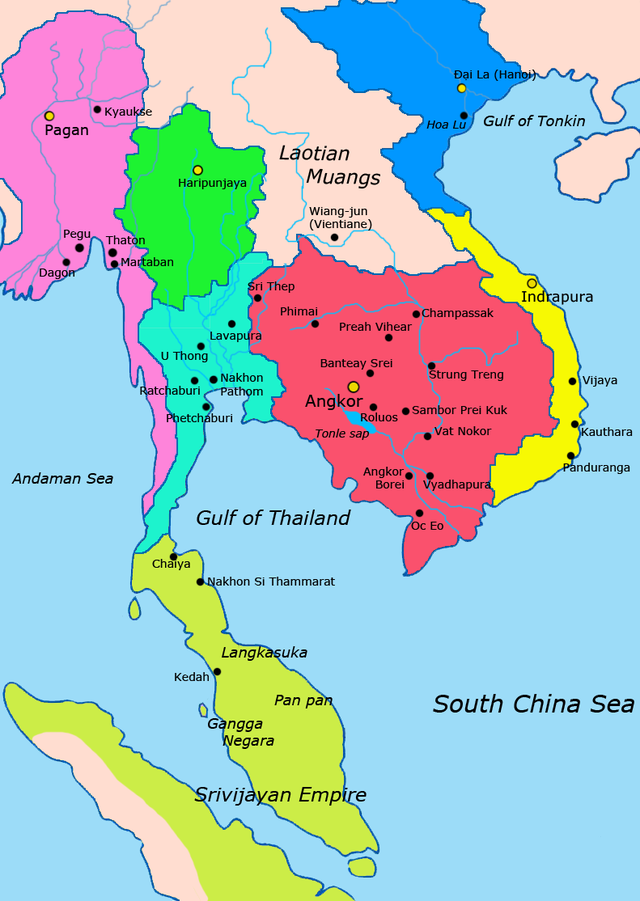
Map of Southeast Asian kingdoms circa 1000 C.E. Champa Kingdom – Yellow, Khmer Empire – Red, Mon Dvaravati Kingdom – Light Blue, Mon Haripunjaya Kingdom – Bright Green, Dai Viet Kingdom – Dark Blue, Pagan Kingdom – Purple

The Pallava

The Pallava was a line of rulers located in southern India from the 3rd to 9th centuries C.E. They originated as pastoralists on the Deccan plateau and by the 4th century established their capital at Kanci (Kanchipuram in today’s Tamil Nadu state) in the subcontinent’s southeast. After taking power, the Pallava adapted to the local Tamil culture. Throughout their dynasty, they were great patrons of music, art and literature and supported Buddhism, Jainism and the Brahmanical faith, building a number of architecturally innovative temples.

Most significantly for Southeast Asia, the Pallava expanded their influence eastward. Using centuries-old trade routes that linked China to Rome via Southeast Asia, India, the Arabian Peninsula and east Africa, Pallava merchants traded extensively with their Southeast Asian counterparts. This trade system only intensified over time. As the Khmer empire expanded in peninsular Southeast Asia and the Srivijaya empire ruled the archipelagos, the Chola kingdom, successors to the Pallava, exerted a growing economic and cultural influence on the region.

While archaeological digs have unearthed Chinese ceramics in modern-day Cambodia and Khmer pottery in Europe, the cultural effects of this ancient trade system are more readily apparent. Indeed many cultural traits that are today shared by different Southeast Asian nations are in fact derived from the Pallava and Chola expansion eastward and the cultural mixing that happened in the following centuries.

Cuisine

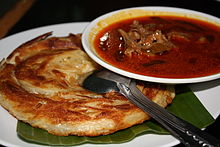
One salient (and delicious) example is cuisine. Curry is a staple in the region – think Thailand’s gang keo warn, Cambodia’s fish amok and Malaysia’s Penang curry. Curry, however, is not endemic to Southeast Asia. The word itself comes from the Tamil kari and its export east is evident not only in the mass consumption of curries but also in the words to describe them. In Indonesian and Malay, curry is also kari and Sumatran cuisine in particular features Indian style curry. In Thai, many curries go by the name gaeng but gaeng gari refers specifically to South Indian style yellow curry while in Cambodia, the kroeung curry makes up the base flavor for a number of commonly consumed dishes. Kroeung -like curry has existed for over a millennium in what is now Cambodia. While ingredients like tumeric and and coconut milk are naturally found there, it was the arrival of Indian traders during and before the Khmer empire that predicated their combination into curry.

Mutton curry and roti from Sumatra.

Language

The Pallava’s greatest influence is arguably their script. The Pallava script, first used in the 6th century, was one of a number of widely-used Brahmic scripts whose descendants are now found throughout the subcontinent. Like curry, the Pallava’s script followed their boats and inspired number of writing systems now used all over Southeast Asia.

There are three older scripts that are direct descendants of Pallava that in turn gave rise to other, later writing systems – Khmer, Mon, and Kawi. A fourth, the script used by the Chams who once ruled much of coastal Vietnam, also descends from Pallava.

The Khmer were the first to adopt the South Indian script. The kings of Angkor also adopted the suffix  –varman (i.e. Suryavarman II, Jayavarman VII), a name that was popular with the Pallava royals and  traced their lineage to a wandering Pallava prince. As their empire expanded to swallow large swaths of peninsular Southeast Asia, their writing system also grew in influence. Today, the modern Khmer script, the Thai script and the Lao script are all prominent derivatives of the writing system used at Angkor.

Pallava script

The Mon people, centered in Lower Burma’s coastal rice-growing heartland, adopted another form of the Pallava script, called Pallava Grantha. Pallava Grantha, also a parent writing system for the modern Indian languages Malayalum and Tamil is characterized by a more rounded look as opposed to the boxier Pallava. Pallava Grantha gave birth to the Mon script in Burma around the 8th century C.E. This writing system in turn inspired the Old Burmese script used at the court of Pagan in Upper Burma and subsequently the modern Burmese script. The Mon script is also the source for the script of the Shan language, the Dai language in China’s Yunnan province and the Lanna script of Northern Thailand.

Unlike the other three, the Kawi writing system was created not in peninsular Southeast Asia, but on the island of Java. It too was derived from the Pallava script and the oldest Kawi texts date to the 8th century. It grew to prominence during the Singhasari Kingdom in the 13th century and was used across the Indonesian archipelago and in what is now the Philippines. Descendants of the Kawi script include Javanese, Balinese, and the Philippine Baybayin script.

Literature

With such a large impact on the region’s writing systems, it is no surprise that the literary traditions of Southeast Asia were also affected by the subcontinent’s culture. The Indian epic Ramayana is the most prominent example. Despite the prevalence of Theravada Buddhism in the region (also an Indian import), local versions of the epic poem, containing many themes and characters from Hindu mythology, can be found almost everywhere.

In Thailand, it appears as the national epic Ramakien, portrayed completely on the walls of the country’s most sacred temple, Wat Phra Keow. The Cambodian version Reamker has been the most famous Khmer story for over a millennium, with bas reliefs depicting scenes from the story on the walls of Angkor Wat. In the former Royal Palace in Luang Prabang, Laos, two lacquered scenes from the epic are displayed prominently on the walls of the king’s reception room.

One of the most unique examples comes from Malaysia, where the story has been adapted over the centuries for the largely Muslim population and substitutes Allah and Adam for the original Hindu deities. There also exist distinct versions of the Ramayana from Myanmar, Java, Bali, and Mindanao, among other places in the region.

The Ramayana’s influence extends past literature and art into dance, as well. In a region whose populace was largely illiterate until the 20th century, local dance theatre has been the most popular non-literary medium for the story. To this day, characters like Rama, Sita, Ravanna and Hanuman the monkey king appear regularly with elaborate costumes in communities all over Southeast Asia.

Rama and Sita, in the Yama Zatdaw, the Burmese retelling of the Ramayana.

Cuisine, written language, literature and dance are only a few examples of areas where India has impacted Southeast Asian cultures. Religion (Hinduism and Buddhism in the classical states and then Islam in the past millennium), the spoken language (many terms relating to politics and religion in the languages of both peninsular and archipelagic Southeast Asia derive from Sanskrit) and architecture (Hindu and Buddhist temples from Myanmar’s Bagan, Cambodia’s Angkor Wat, and Indonesia’s Borobudur all display Indian-influenced architectural styles) were all heavily impacted by the classical Indian cultural expansion.

Moreover, the subcontinent’s influence on Southeast Asia did not end with the classical age. Trade between the two regions grew continuously up through the colonial era. During the 19th century, Britain’s colonization of India, Myanmar and Malaya facilitated not only increased trade, but also increased immigration.  Millions of people from all over the Indian subcontinent moved into these other colonies, bringing a wealth of cultural traditions into the existing mix. In the 1920s and 1930s, Yangon (Rangoon) was the largest immigration port in the world, with most arrivals coming from India. Now, biriyani, dhal and roti flatbread are all as easily found on the streets of Yangon and Kuala Lumpur as they are in Delhi.

Southeast Asia, and the diverse cultures of the hundreds of millions of people that live there, is a true melting pot of cultures. While the states of classical India did imbue the Southeast Asian kingdoms with many of its traditions, they were not the only contributors.

As the name Indochina implies, the Han Chinese state also had an impact on the development of the states to its south, most notably the Dai Viet Empire that rose in the Red River valley. However, Chinese and Indian traditions contributed mostly to the high culture of the Southeast Asian states. Oftentimes, the complex cosmologies and exotic ways of faraway empires had little effect on the peasants that made up the bulk of the populace. Local traditions and folk customs made up the core of mass culture and despite the millennia long process of Indian cultural infusion, they still do.

2 Comments

Filed under history, Regional Relations, SLIDER

Report Card on Education in Southeast Asia


vn primary school

Eager primary school students in Vietnam

As dawn spills on to Ha Thuong, Vietnam, Bui Thi Bich Phuong is preparing for a long day of collecting waste coal from the nearby Mo Me coal mine and catching crabs at the edges of the fields near her house. If she’s lucky, she’ll eek out $4 today. As she’s washing her face, soon to be covered with coal dust, her son Nam is getting ready for his day at school. There, he’ll study a new curriculum of mathematics and literacy in a new classroom, both of which are paid for by the Asian Development Bank, who hopes it’s dawn for education in Southeast Asia, too.

Governments and development agencies, along with the UN, hope for more examples of the younger Phuong in Southeast Asia—bright students preparing for jobs in the service sector—than the older, agrarian Phuong. There are billions of dollars in education aid flowing into the region, most of which comes in the form of ADB loans and implemented by local governments. Is education really critical to development in Southeast Asia? Will the ADB’s programs be successful? There are few resources that answer these questions; this post hopes to provide insight to both, as well as providing case studies in Cambodia and Vietnam.

How important is education for Southeast Asia?

By investing in education, Southeast Asian governments and the ADB hope to approach developmental parity with their successful peers to the northeast. South Korea and Taiwan are the darlings of Asian development as they have made the jump from low-end to high-end manufacturing and are now centers of service and entertainment industries. “Gangnam Style” came from South Korea for a reason: the song parodies the high-end lifestyle in a Seoul district that only exists due to Korea’s rapid development. Taiwan, once a hub of simple computer assembly a-la China, is now a hub of computer design and engineering. Most assembly now takes place around Shanghai.

The transition to high incomes in these countries was not serendipitous; they had laid the framework for development through heavy investment in education at all levels. In 1993 a World Bank report praised these High Performance Asian Economies (HPAEs): “The growth and transformation of systems of education and training … has been dramatic … the HPAEs’ enrollment rates have tended to be higher than predicted for their level of income … By 1987, East Asia’s superior education systems were evident at the secondary level … Primary education is by far the largest single contributor to HPAEs’ predicted growth rates … Physical investment comes second … followed by secondary school enrollment.” Physical investment is a story for another day, right now the focus will be on education: primary and secondary.

public spending on education

So far, the path to development in Southeast Asia seems clear: invest in education while the economy produces low-skill intensive goods so, after a decade or two, the economy can transition to high-quality manufacturing. The graph above shows that the poor Southeast Asian countries spend less than 4% of GDP on education, while Thailand, a more developed country, spends more. Moreover, the poorest countries often neglect to report data to UNESCO. Surely simply spending more money will solve Southeast Asia’s problems?

Not so fast. Due to two different types of competition, these economies might have to transition faster than Taiwan and South Korea did. First, as other developing countries clue in (on their own accord or via a friendly push by the IMF) to the famous/infamous export-based model of development, the rise in international arbitable labor supply will keep wages low, limiting welfare gains like Taiwan and South Korea enjoyed. Second, exploitation of natural resources, plentiful in Southeast Asia, could lead to comparative advantage-killing inflation, further reducing competition. It is important to note that South Korea and Taiwan have few natural resources that would lead to this pesky trend. Therefore, Southeast Asia needs to hit the books sooner rather than later.

Assessment: How is Southeast Asia doing on education?

Not so good. The 1997 economic collapse among ASEAN countries had at least as much to do with lower export levels as it did with currency appreciation. Southeast Asian countries were unable to transition to high-quality exports as other countries (read: China) took the region’s market share in low-quality exports. The region has since recovered, with sustained growth rates in the high single digits. Nevertheless, the region’s better-perming economies, Thailand, Indonesia, and Malaysia, are arguably in the ‘middle-income trap’ of around ten thousand PPP-adjusted dollars per capita, years from becoming rich countries.

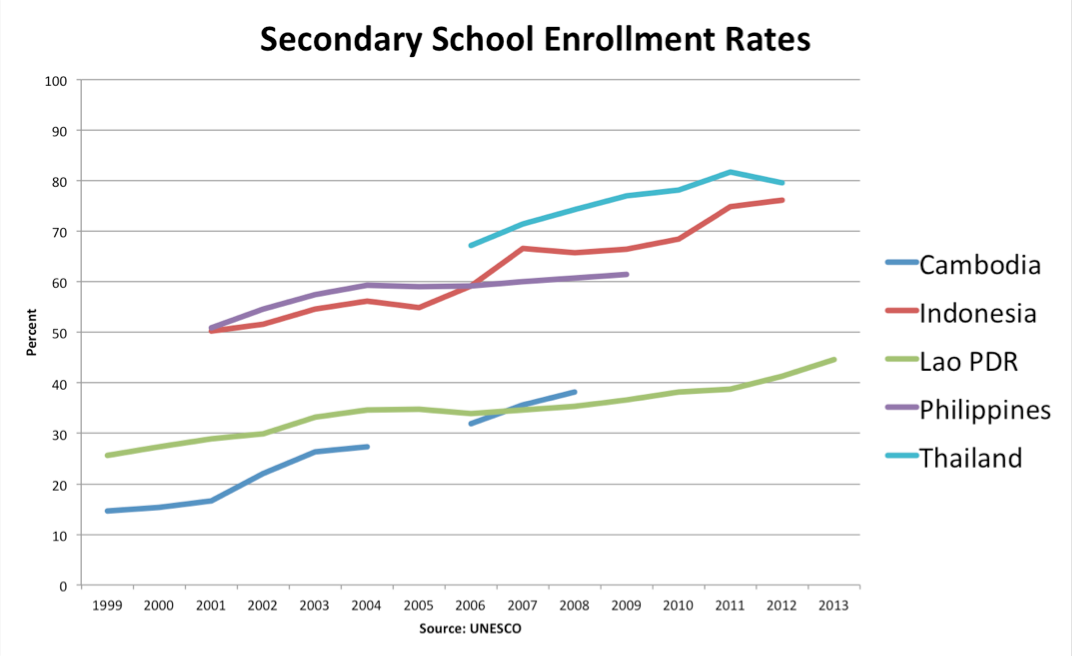
Southeast Asian countries as a whole will have to somehow leverage (read: educate) their substantial populations in order to develop past $10k per capita. There are three areas the region should focus on in order to improve their education prospects:

School Attendance: Somewhat surprisingly, the region, even including laggard countries like Cambodia and Laos, is almost at the worldwide average of 90% primary school attendance. Less surprisingly, survival rates, or the percent of school-aged children who complete primary or secondary school, are lower. In Cambodia, the Philippines, and the Lao PDR, primary school dropout rates are over 25%: poverty calls many students away from school in order to help out at home. In order for countries to improve their skill base, both enrollment and survival must increase.

primary school enrollment

3secondaryenrollment

Inequality: Like their counterparts in developed countries, urban children in developing nations attend school at higher rates than rural children. The gap in countries in Southeast Asia is larger, though, due to severe infrastructure constraints. Since many rural residents cannot afford a bicycle, let alone a car, children are limited to attending schools within a few kilometers of their house. This limits many children to a few years of primary school, which end when the grades offered in the local school do.

Besides economic inequality, Southeast Asian students have to deal with gender bias against both girls and boys. Girls face the more obvious bias: when pressured by resource limitations, many families call girls back from school before boys, who are assumed to be a more worthwhile investment. Many development agencies, especially the ADB, have remedied this problem to the point that in many countries more girls attend school than boys. The school gender ratio should match that of the population. Besides years of schooling, girls are also discriminated against when it comes to types of education, a problem that persists through secondary and vocational education. Responding to cultural stereotypes perpetuated in and out of school, girls self-select into traditionally female professions; employers respond by recruiting females to the same jobs. A comprehensive overhaul of education must include the systematic of gender stereotypes in classroom materials and instructor biases.

Skill Gap: Even students that complete tertiary education in many Southeast Asian countries often lack the skills needed by the companies that may hire these most educated workers. Vietnam’s own Ministry of Education reported that only 30% of college graduates had the skills demanded by the workforce. Other indicators of gaps in the quality of skills are a high education premium or a low unemployment rate, both of which indicate low high-skill labor supply. The latter indicator is produced below; Indonesia and the Philippines (more developed countries) have high unemployment rates, but the least developed countries with the greatest skill gaps have the lowest unemployment rates.

unemployment rates

The Philippines, however, serve as a warning of the effects of a reverse skill gap where high-skill supply is higher than high-skill demand. Until the 1990s, the Philippines had the highest tertiary education enrollment in the region. At the same time, macroeconomic fluctuations that discouraged fixed capital formation resulted in an unfriendly environment for professionals, leading to ‘brain drain’ where highly skilled workers went abroad to find work. As a result, remittances are now 13% of the Philippines GDP, exceeding FDI. The lesson is that graduates have to be able to find work quickly, otherwise educated, unemployed graduates will leave or worse: stay and start a revolution.

How is the ADB addressing education?

As Southeast Asia’s main development agency, the Asian Development Bank is providing the lubrication to meet the UN’s “Education for All” goal. Education is one of the ADB’s eleven focus sectors in development programs; in its Education 2020 report, the bank pledged $1.5 billion in education assistance between 2010 and 2012, 4% of its funds for loans and grants. There are three areas the ADB is focusing on specifically in the region: building new schools; increasing school and teacher quality; and decreasing the skill gap with vocational training.

Education for all


New Schools: A large, but shrinking, number of rural children in Southeast Asia do not have access to even primary education because their families can not get to the schools. Bicycles, motorbikes, and cars cost more than many families can afford, limiting the radius of education to a few kilometers. So, an easy area for the ADB to direct its loans to is building new schools, as the increase in enrollment is immediate and large. This solution, however, does not address the survival rate. Students will stay in school if they perceive education to be meaningful, which is largely dependent on teacher quality. Teachers that inspire students to achieve, and give them the intellectual tools to do so, are more likely to increase the survival rate than teachers who are not. Thus, the ADB must invest in school quantity and quality, though much of the focus is understandably on quantity, the lower-hanging fruit.

Indonesia is a cautionary tale for the ADB in this regard. Lush with oil money following a 1970s oil boom, the country built hundreds of new schools, but faster than teachers could be trained. Education quality subsequently decreased; some scholars say that quality is still decreasing. Consequently, the country lacks the high-quality development that HPAEs won in their own education investment. The difference is that investment in HPAEs was comprehensive, but investment in Indonesia was one-dimensional.

School Quality: Teacher and school quality must come at the same time as new school buildings, as well as permeate existing institutions. Unfortunately, as we will see, ADB reports mention construction of new schools much more often than they mention training new teachers. Education for All efforts have been remarkably successful in increasing the number students that want to attend primary school. Excellent. Now, the ADB and local education ministries must ensure that teachers will inspire students to at least complete primary school. One way to promote high-quality instructions is to vet teachers before they complete teacher training.

The ADB has been more successful in increasing the quality of curricula. The bank’s loans to education ministries usually require that education policy follow a decentralized approach, meaning tailoring curricula to local needs. Southeast Asian countries have the relatively unique characteristic of hosting a plethora of indigenous languages in addition to the official language. Classes taught in the national tongue can alienate ethnic minorities and discourage school completion. Fortunately, the ADB recognizes this problem and supports initiatives for local-language instruction. The bank could go further to ensure that more of classroom content is tailored to local conditions. While it is tempting to imagine every young villager going on to study at the national college and inventing a generator that runs on the sweat of foreign tourists, it is not realistic. Many students will finish primary school and forever remain in their village, so it is important to ensure that they are educated in the latest techniques to maximize their contribution at the local level.

Vocational Training: The ADB has also been successful in promoting vocational training. The skill gap in Southeast Asian countries exists because current curricula do not reflect the demands of employers at all levels. Existing state-provided vocational programs are insufficient because local governments cannot competently handle both vocation policy and program implementation. Further, women are often excluded from these programs, for reasons mentioned above. The ADB recognizes this opportunity for growth and ensures that some of its loans and expertise are directed to creating and reforming vocational programs.

For example, in Lao PDR the bank is implementing a Strengthening Technical Vocation Education and Training (STVET) that seeks to establish vocational programs in the employment-rich carpentry, construction, and maintenance industries. The program specifically includes a Gender Action Plan that requires women fill 20% of the spaces in these nontraditional training programs. The number might seem small, but it is much larger than the current 0-1% women enrollment in these areas. The STVET also has private sector programs in mining that require 40% of the students to be women, and has 50% quotas for programs that do include more traditionally female occupations. Overall, the ADB recognizes the need for vocational training that is accessible to all.

Cambodia at a glance

ADB programs in Cambodia include school construction and vocational programs. Since Cambodia lags the rest of the region in most educational indicators, these basic programs are important to establish a good educational foundation for the nation. For example, there are 48 students per teacher in Cambodia, higher than in 1990. A problem like this requires short-term focus on quantity rather than quality, which the ADB can easily address. In the future, though, the country will need to invest more heavily in teacher training programs in order to improve its educational prospects.

The ADB is laying the foundation for educational success in Cambodia by building new schools and information centers (or as non-development agencies call them, libraries). The $25 million Second Education Sector Development Project provides funds for 215 lower secondary schools, 15 upper secondary schools, and community development projects. The lower secondary schools incentivize children to finish primary school, which the World Bank cites as the most important reason for rapid development in the HPAEs, by providing further educational pathways. Previously, the children who did complete primary school were unable to attend secondary schools because there were too few within walking distance. The new schools will allow students to further explore their educational ambitions, overcoming the previous economic limitations. In addition to schools, the ADB and World Bank are building “public information centers” with books, internet access, and World Bank and ADB research (for aspiring development scholars), in order to allow poor people to access the internet and bright students to study beyond what their perhaps poor quality schools allow. The new infrastructure the ADB is building is admittedly the very first step to a well-educated society, but will solidify the currently unsatisfactory educational base.

Besides educational infrastructure, the ADB is also investing in vocational programs in order to educate people outside the Cambodian schools. A $45 million ADB loan for nonformal skills funded programs that help people like Thav Heat increase their productivity; instead of making one mat a week to sell to tourists, she can make 3-4 in a day. Similarly, Ley Leup, a farmer, learned how to use organic fertilizer to increase yields and decrease environmental damage. His income subsequently increased enough to buy more land, a motorbike, and a bicycle. This program also allows some, like Long Borin, to return home after working as migrant laborers due to higher income opportunities.

Vocational programs like these highlight the importance of education to low-income countries like Cambodia. With just a few weeks of training, these three individuals were able to use existing resources combined with new knowledge to improve their productivity and incomes. Education in general allows countries to become more efficient, using existing human and natural resources to their fullest extent.

Vietnam at a glance

Vietnam is an interesting case study because while the education system is more developed than lowest-income countries like Cambodia, it suffers from low quality and equality. ADB programs are generally focused on increasing marginalized peoples’ access to education while ensuring existing teachers reach the frontier of teaching methods. Vietnam is unique with respect to education in the region because in order for educational reforms to be fully effective, the state must also reform.

In 1996 the Vietnamese government launched a $71.5 million project, of which $50 million came from the ADB, in order to construct new schools and improve ethnic minority enrollment. The program was successful: the 366 new schools in 21 provinces and cities increased enrollment of ethnic minorities by 62% to 924,867 in the 2005/2006 school year. Further, all teachers were introduced to new curricula that included bilingual instruction. In a more recent project, the ADB targeted women and rural populations by constructing boarding schools with 50% female dormitories and ensuring that teachers are 50% women, compared to the national average of 10%. With respect to inequality, the ADB is ensuring that those at the left side of the Lorenz curve get access to not only basic education, but also high-quality basic education.

Higher education will lag, however, if the Vietnamese government does not change its state owned enterprise system. Now, state firms get cheap credit at the expense of the private sector, so state firms can hire the highest-quality labor. Since state firms are often not allowed to produce for the world market, output is constrained by insufficient domestic demand, meaning that the state companies cannot hire as many high-paying jobs as they would if they produced for the world market. As a result, these high-skill, high-paying jobs generate rents (the advantage workers gain from working at a state firm) that can be as high as two years of state sector salary. Meanwhile, the private sector has only low-skill jobs that offer low returns to high education. Further, the state sector jobs that do exist often demand credentials rather than actual skills, a problem so bad that Vietnam’s own Ministry of Education estimates that only 30% of college graduates with credentials actually have the skills they need to perform the jobs they want. This is a problem the ADB cannot address; change must come from within the Vietnamese government if it wants to develop in the long-term.

Concluding Thoughts

Education is important for development in the short term because export-focused industries require basic skills, and in the long term because high-income countries are powered by high-income, high-skill people. Southeast Asian countries for the most part meet world averages for basic educational indicators, but lag in teacher quality and educational equality. ADB programs have been more or less sufficient in meeting demand for schools in under-served regions, and should soon shift to higher quality teaching. Some easy targets are better teacher training and reforming the rote memorization practice so popular in Asian countries. In order to reach and overcome the middle-income trap, Southeast Asia must commit to high quality education in the decades to come.

Leave a Comment

Filed under ASEAN, Education, Governance, Regional Relations, SLIDER

The US Rebalance in Vietnam & The Philippines

In Southeast Asia, the United States has rebalanced its attention to a vital region while seeking to avoid alarming China. The Obama Administration’s comprehensive efforthas engaged a diverse array of countries, strengthening ties with both unlikely partners and longtime allies. Coupled with a brief study of American interests in the region, an examination of the strategy applied to two countries – Vietnam and the Philippines –reveals little cause for the Chinese concern that America is pursuing a policy of containment.

VIETNAM

In Vietnam, the U.S. has succeeded in creating a partnership with a nation that was a bitter foe just forty years ago. Perceiving China’s recent policies as a disturbing sign of greater assertiveness to come, Vietnam has felt it necessary to hedge against its neighbor by pursuing a closer relationship with the United States.

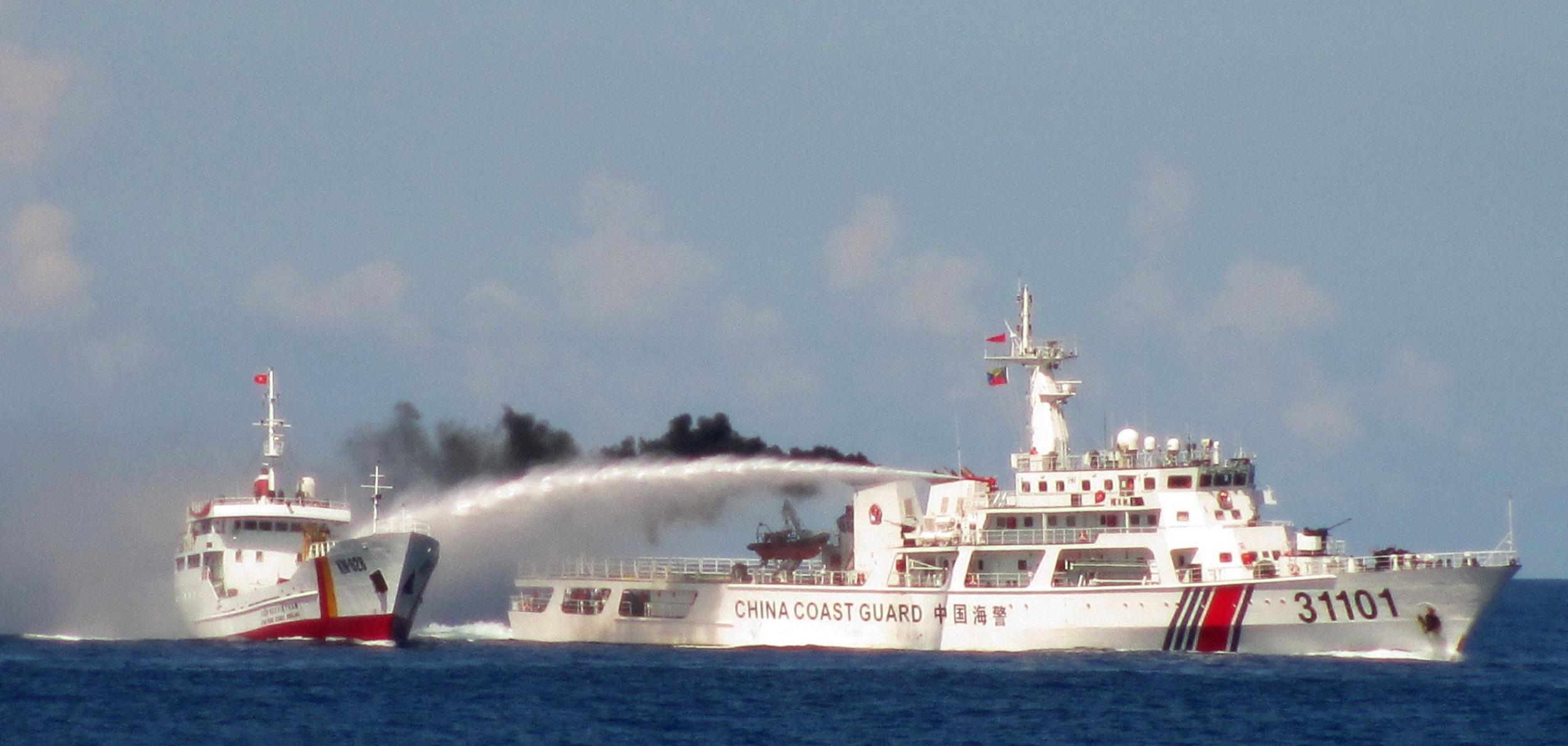
The driving force behind this reconciliation has been China’s provocations in the South China Sea, which have infuriated the Vietnamese government and its people and caused them to view China as a potentially destabilizing force in the region. The May 2014 placement of a Chinese oil rig within Vietnam’s Exclusive Economic Zone (EEZ) marked a highpoint in the tensions, sparking deadly anti-Chinese protests in Vietnam and naval incidents in the area of the drilling.

Vietnamese and Chinese vessels clash near the disputed oil rig. Photo: Getty Images

Vietnamese and Chinese vessels clash near the disputed oil rig. Photo: Getty Images

Chinese diplomacy has not eased Vietnamese concerns. Rhetoric regarding the South China Sea has been inflexible: in 2010, officials labeled the region one of China’s “core interests,” joining only Taiwan and Tibet. At a meeting concerning the South China Sea the same year, in which all disputant states were present, Chinese Foreign Minister Yang Jiechi reportedly stared at Singapore’s Foreign Minister while pointedly stating, “China is a big country and other countries are small countries, and that’s just a fact.” In the eyes of Vietnam and its fellow Southeast Asian States, this threatening tone has confirmed fears inspired by China’s aggressive policy in the region.

While some American observers have gone so far as to call for a full treaty alliance with Hanoi, several barriers will keep a degree of separation the two countries. The first is Vietnam’s policy of the “three nos”: no military alliances, no foreign military bases on Vietnamese territory, and no dependence on any countries for help in combating other countries. The last point is particularly important in the context of Vietnam’s history: when China invaded in 1979, the Soviet Union – having signed a defense treaty with Hanoi just a year before – declined to come to its aid. This history provides Vietnam with a powerful warning against reliance on powerful but distant allies.

Another analogy that suggests restraint is the ongoing conflict in Ukraine. Looking to Moscow once more, Vietnam sees a disturbing example of how a major power will react to its small neighbor aligning with a rival. Of course, the comparison is imperfect, but the degree of similarity between the two cases is striking nonetheless.

The greatest constraint upon Vietnamese diplomacy is its economy’s dependence upon trade with China. China is Vietnam’s largest trade partner, and the source of many of the inputs critical to its burgeoning manufacturing industry. While some worry that tensions could lead to a trade war, economic concerns have thus far won out, and the Vietnamese government has been careful to avoid pushing China too far.

The Rebalance

Even with these constraints, Vietnam has welcomed American efforts to deepen ties on diplomatic, economic, and military fronts. The rebalancing is directed toward all of Asia, but extra attention has been directed toward Vietnam – a prominent victim of China’s actions in the South China Sea, and a country with an especially dynamic and promising economy.

America has promoted Trans-Pacific Partnership (TPP) as the main pillar of its economic rebalancing to Asia. The United States, Vietnam, and 11 other Asian-Pacific nations are currently negotiating the deal,which seeks to reduce both tariff and non-tariff trade barriers while maintaining high standards for intellectual property, the environment, and labor rights. American officials have said they would welcome China, but it is widely acknowledged that the deal’s standards are too stringent for China to adhere to. Vietnam also faces challenges to joining, especially with its reluctance to reform state-owned enterprises and labor rights. Its presence in the negotiations is a testament to the determination of both America and Vietnam to deepen their economic ties.

TPP

Current members negotiating the TPP. Image: The New York Times


Diplomatically, the bulk of American efforts are directed toward the region rather than individual states. With regard to the South China Sea disputes, the United States has recognized that no single Southeast Asian state can hope to receive bilateral negotiations with China on equal footing. As a result, it has worked quietly to promote a closer unification of the Association of Southeast Asian Nations (ASEAN), which wields significant influence but, like all regional organizations, is held back by the disagreements of its member states.

Even with the region-wide focus of diplomacy, however, a rapid exchange of interstate visits has reflected Vietnam’s importance. American congressional delegations and Administration officials have met with the Vietnamese with increasing regularity, and Gen. Martin Dempsey’s 2011 trip marked the first visit by a Chairman of the Joint Chiefs of Staff since 1971.Nguyen Phu Trong, the General Secretary of Vietnam’s Communist Party and the country’s supreme leader, will make his first visit to the United States this June.

America’s military policy constitutes the most visible aspect of its rebalancing strategy, and naturally draws the bulk of Beijing’s complaints. In Vietnam, the U.S. has coupled emphasis on exchanges and cooperation with direct (although minor) military aid. Military-to-military ties have grown greatly in the past decade, particularly with the introduction of an annual Naval Engagement Activity (NEA), which pairs each navy in noncombat exercises. In 2014, the Secretary of the Navy also invited Vietnam to join the biannual, U.S.-led RIMPAC exercises, the largest naval exercise in the world.

While noncombat exercises are a mild form of cooperation, American promises of military aid to Vietnam reflect a much stronger commitment to rebalancing. In December of 2013, Secretary of State John Kerry announced $18 million in aid to Vietnam to “boost maritime security.” A portion of the money was earmarked for the purchase of five unarmed patrol boats for the Vietnamese Coast Guard – a minor increase, but symbolically significant. Additionally, Japan – the linchpin of American security in the Pacific and another country locked in a territorial dispute with China – provided Vietnam with an additional six boats, worth $5 million. And in 2014, the U.S. eased its ban on providing Vietnam with lethal arms, opening the door to a number ofsystems for its coastal defense.

Military Spending Infographic

THE PHILIPPINES

In the Philippines, the U.S. is working to further deepen its relationship with a treaty ally and longtime partner. After a brutal war with the United States that left it an American colony, the Philippines maintained a better relationship with its conqueror than most countries, and upon gaining independence sought American protection throughout the Cold War. While Filipinos resentment of U.S. military bases led to an American exit in the 1990s and a slight chill in relations, the Philippines remains one of America’s closest allies in the region.

Philippine-American Timeline Infographic

As with Vietnam, the Philippines’ desire to draw even closer to America is explained by Chinese tactics in the South China Sea. The Sino-Philippine conflict has actually been significantly more contentious. Because it shares no border with China, is less economically dependent, and has signed a mutual defense treaty with America, the Philippine government has been less constrained by geopolitics than its Vietnamese counterpart. (It should be noted, however, that the U.S. has declined to clarify whether this defense treaty applies to Philippine claims in the South China Sea.)

These circumstances have enabled the Philippine government to apply for international arbitration of its disputes in the South China Sea, a step that Vietnam considered too divisive. China has objected, stating that it will “neither accept nor participate” in the arbitration, and maintained its political stance of indisputable sovereignty throughout the South China Sea. It is highly unlikely that the suit will achieve any result.

In spite of greater economic insularity than Vietnam, the Philippines has still fallen victim to what isperhaps China’s greatest asset: economic coercion. China has employed this strategy often, taking advantage of its large domestic market and the control the state retains over the economy. In June of 2012, it reacted to a confrontation with the Philippine Navy by cutting off Filipino banana imports. Justifying the policy as a health regulation, China succeeded in choking an important industry and driving Manila to adopt a conciliatory tone.

The Rebalance

Economically, the United States and the Philippines are already quite close. America is the Philippines’ second-largest trade partner (after Japan) and its biggest investor. Still, the Obama Administration has worked to further enhance the relationship. While the Philippines does not currently take part in the TPP negotiations, it has expressed interest, and high-level officials from each country have met to discuss what its participation would look like. In 2011, the fiftieth anniversary of the bilateral defense treaty, the two countries signed a five-year Partnership For Growth (PFG) agreement, designating the Philippines as a priority area for American development assistance. That same year, the Millennium Challenge Corporation (a government agency) signed a five-year, $434 million compact to combat poverty and encourage growth in the Philippines.

Trade Growth Infographic

While historical closeness, cultural similarity, and the depth of Philippine-American exchange have already created close ties, American diplomats have sought to further reinforce the relationship. The two countries recently began holding a Bilateral Strategic Dialogue to institutionalize the regular exchange of ideas. And in 2011, Secretary of State Clinton visited the Philippines to release a joint Philippine-American declaration,reaffirming that the alliance had “never been stronger.”

The military aspect of rebalancing has consisted of naval aid, closer cooperation and training, and – most importantly – a strengthened defense treaty. Having always depended on its American counterpart, the Philippine Navy is one of the weakest in the region. Its flagship is a 45-year-old cutter, donated by the U.S. Coast Guard in 2011. The U.S. has offered an additional ship, communications equipment, and training, but recognizes that no amount of aid will enable the Philippines to unilaterally defend against Chinese naval incursions.

The true cornerstone of the military rebalance is a ten-year enhanced defense pact negotiated in 2014. The agreement creates no permanent bases, an option that then-Secretary of Defense Chuck Hagel dismissed as a “return to an outdated Cold War mentality.”Instead, it invites rotational deployments of American ships and advisers, which will significantly escalate military presence in the region. It also opens the door to greater commitments of military aid to the Philippines.

The symbolic value of a return to the Philippines, just over twenty years after public protest forced the closing of American bases at Subic Bay and Clark Air Force Base, is indicative of the region’s tense atmosphere. Some anti-American sentiment remains, stalling the agreement in a legal challenge that is now before the Philippine Supreme Court. Still, Philippine officials are confident that the case will be thrown out when a decision is reached.

Assessing American Intentions Throughout Southeast Asia

In spite of American efforts to paint the rebalance in nonthreatening terms, Beijing has frequently voiced its concern that the strategy aims to encircle and contain China. These complaints have especially been directed at the military components of these partnerships with Vietnam and the Philippines. China – at least publicly – eyes these moves suspiciously, and assumes that realist, hegemonic motives dominate American intentions.

For many reasons, however, this theory does not hold water. Even if China were to be excluded from the equation, a shift in attention to Asia would remain eminently logical. The War on Terror absorbed American resources in the Middle East for a decade after 9/11, but never promised long-term benefits to the national interest. Nor does any other region offer the dynamism and promise of Asia, which officials and scholars predict will be at the center of international affairs for decades to come

While China’s era of incredible growth is finally slowing, the rest of Asia is only beginning to take off. Asia holds more than half of the world’s population and is projected to account for half of its economy by 2050. Southeast Asia in particular holds much of this untapped potential, and four of the ten ASEAN states already rank among the world’s 20 most competitive economies.

With this unparalleled importance in mind, it becomes clear that the rebalance is simply an alignment of American resources and commitments with its interests – and that if anything, criticisms should question if the policy has gone far enough. With a globally integrated economy and worldwide commitments and interests, the United States does not see itself as having the option to neglect such a crucial region.

The rebalancing strategy has also emphasized the importance of improved relations with China. While public statements have often put America and China at odds, particularly over territorial disputes, diplomatic and military coordination have improved considerably. The annual, Strategic and Economic Dialogue receives a great deal of attention, and institutionalizes the frank exchange of positions between the two countries. Communication has been at the heart of American efforts to ease Chinese suspicions. For example, the Administration even privately briefed China on its plans before embarking on President Obama’s 2014 trip to Asia, in which he announced the enhanced defense treaty with the Philippines.

In responding to fears of containment, it is also important to note that a struggling China would be a disaster for America’s economy and interests. As Gen. Martin Dempsey, the Chairman of the Joint Chiefs of Staff put it in 2014,“I worry more about a China that falters economically than I do about them building another aircraft carrier.” The American and Chinese economies are deeply intertwined, and economic turmoil could also provoke political instability in China and East Asia– the last thing the United States would like to see.

Chinese ships expanding land in the South China Sea. Image: Center for Strategic and International Studies

Chinese ships expanding land in the South China Sea. Image: Center for Strategic and International Studies

Beijing may blame America for regional sentiment turning against it, but it would be better served by turning the mirror on itself. China’s policy in the South China Sea has done much more damage to its stature in Southeast Asia than American actions conceivably could. With aggressive expansion, including incursions into both Vietnamese and Philippine Exclusive Economic Zones, China has flouted both regional and international norms and laws. Its inflexible and even threatening rhetoric and diplomacy have only compounded the problem.

Only this behavior can explain why a country like Vietnam has sought greater friendship with the United States, or why ASEAN has pursued greater unity in dealing with other countries. China may well regret its policies in the South China Sea: in pursuit of territorial gains, it has sacrificed regional influence and reputation, thus containing itself.

Leave a Comment

Filed under China, Current Events, Foreign policy, Governance, Philippines, Regional Relations, SLIDER, South China Seas, Trade, Vietnam

Southeast Asia’s Illicit Wildlife Trade: International Cooperation Necessary to Find Solution

On Wednesday March 25, immigration authorities confiscated 492 black spotted terrapin pond tortoises at the Tiruchirappalli International Airport in India. Identified as merely carriers, the five passengers with tortoise-laden luggage seemed unaware of their baggage contents and were merely promised 10,000 Rupees each for transportation, a sum of about $800 USD. Bound for Bangkok, this shipment of tortoises represents the largest attempted volume of wildlife trafficking at the Trichy Airport and highlights the trans-boundary nature of the illegal wildlife trade in Southeast Asia.

Preceded only by the arms and drug trade, illegal wildlife trafficking represents the third- largest illicit trade in the world. As a region, Southeast Asia remains among the most critical in terms of severity and volume of wildlife trafficking. According to the United Nations Office on Drugs and Crime 2013 Threat Assessment, China represents the leading consumer country in the East Asia and Pacific region, with consumption levels in South Korea and Japan on the rise. Driven by high demand in East Asia for animal products in the form of food, traditional medicine, and decoration, the illegal wildlife trade in Southeast Asia is responsible for approximately 25% of the global industry, according to estimates made in 2005. Facilitated by expanding transportation infrastructure in Southeast Asia and the region’s porous international borders, the trans-boundary wildlife trade presents numerous governance challenges to the region’s developing nations. Not only does the illegal wildlife trade threaten Southeast Asia’s ecosystem biodiversity, but the industry also impedes economic growth and regional security because of its ties to drug trafficking and terrorism. While the role of each country within Southeast Asia is different regarding the illicit trade of live animals and their parts, the countries of the region must work together in order to develop viable governance solutions for the issue.

Facing the challenges presented by the illicit wildlife trade in Southeast Asia requires international cooperation, within the East Asia and Pacific region as well as globally. Ratified in 1975, the Convention on International Trade in Endangered Species of Wild Fauna and Flora (CITES) was among the first international efforts to mitigate the illegal wildlife trade. CITES establishes lists of species, the trade of which is illegal without proper documentation, and requires that its member parties regulate the trade of these species through national legislation.  Currently, CITES has 180 member parties, including all of the countries in Southeast Asia, China, and the United States. However, CITES merely provides a framework for enforcement and requires country cooperation to effectively reduce illegal wildlife trafficking.  Although putting an end to the illegal wildlife trade in Southeast Asia remains an ambitious task, the efforts of CITES and ASEAN Wildlife Enforcement Network (WEN) have generated legislative headway in the region. Recent collaboration between China, the United States, and the member states of ASEAN suggests that wildlife trafficking is a dilemma that, just as the trade itself, transcends national boundaries.

Overview of the Illegal Wildlife Trade in Southeast Asia

Before introducing the various cooperation efforts in Southeast Asia aimed at combatting the illegal wildlife trade, we must first have an understanding of the unique set of ecological, economic, and security challenges that the industry presents to the region. Globally, Southeast Asia represents a hotspot for the illegal wildlife trade. Figure 1 presents data collected via a real-time, online surveillance system designed to track reports of illegal wildlife trade worldwide. Although these data do not reflect every instance of illegal wildlife trafficking, they provide a good base for comparing the trade between different regions.

According to the numbers I collected from the system on April 7, 2015, reports of illegal wildlife trade in Southeast Asia vastly outnumber every other region in the world. Because the region also contains numerous biodiversity hotspots, the illegal wildlife trade in Southeast Asia threatens some of the most ecologically productive ecosystems on earth. Inextricably tied to economic development, sustainable agriculture practices, and natural resource bases, maintaining ecosystem services remains of utmost importance to developing nations. The United Nations Environmental Crisis Assessment agrees, stating, “Healthy ecosystems provide the platform upon which future food production and economies are ultimately based.” As the single largest threat to vertebrate species extinction in Southeast Asia, the illegal wildlife trade undoubtedly threatens ecosystem health as well as economic development within the region.

animalcommodity

Black market value of commonly-traded wildlife products in Asia-Pacific region. Measured in USD. Figure 1: Information gathered on April 7, 2015 from http://www.healthmap.org/wildlifetrade


The Southeast Asian illegal wildlife trade represents a lucrative business. Figure 2 shows maximum market value data for various commonly traded illegal animal parts, information collected by the U.S. Congressional Research Service in 2008. Currently, a kilogram of rhino horn is approximately worth as much as a kilogram of gold in Vietnam. In terms of the monetary value of the wildlife trade worldwide and regionally in Southeast Asia, the illicit nature of the industry prevents researchers from making completely accurate estimations. However, the UNODC suggests that the illegal wildlife trade in in the East Asia and Pacific region is, conservatively, worth around 2.5 billion USD annually, while a Brookings Institute report suggests that the value for Southeast Asia alone is closer to 8-10 billion USD.

The magnitude of and range between these values demonstrates that the illegal wildlife trade in Southeast Asia represents a substantial economic problem, the scale of which is largely uncertain, due to a lack of regulation and research. The economic threats posed by the illegal wildlife trade range from a potential decrease in eco-tourism due to species loss to large-scale development impediment as the trade perpetuates a cycle of poverty within Southeast Asia’s rural regions. For example, the vast majority of those who illegally harvest wildlife in the East Asia and Pacific region happen to be rural individuals seeking to boost their low income levels. Therefore, as an enterprise born out of desperation and the lack of financial resources, the illegal wildlife trade, particularly the specialized traders at the top of the industry, benefits immensely from keeping rural individuals poor. Thus, the continuation of the illegal wildlife trade in Southeast Asia does not bode well for the region’s economic future.

RealTime_Data

Figure 2: Information from U.S. Congressional Research Service on maximum market prices for commonly-traded animal products worldwide


Illegal wildlife trafficking also carries significant national security implications. In Africa, for example, ties between poaching and terrorist groups have proved particularly alarming. Although less is known regarding the connection between wildlife trafficking and other criminal organizations in Southeast Asia, the region’s illegal wildlife industry maintains strong ties with poaching throughout Africa. While this tie does not necessarily suggest that wildlife trafficking in Southeast Asia is directly connected to African terrorists groups, the connection can generate security threats in the form of government corruption.

Vietnamese demand for rhino horn for use in traditional medicine spurred a sharp increase in rhino poaching in South Africa during 2013. The World Wildlife Fund recognizes government-level corruption as a contributing factor to the trade of rhino horn in the country, as officials allow free passage to select individuals transporting rhino horn. Not only does corruption in the illegal wildlife trafficking industry hinder enforcement efforts, but it also leads to political instability, as the national government loses the respect of its citizens as well as other nations.

Web_Chart

On a similar note, Vietnam’s ties with rhino poaching in South Africa demonstrate that Southeast Asia plays a diverse set of roles in the global wildlife trade. Because the countries of Southeast Asia simultaneously serve as source, transit, and demand points for live wildlife and animal parts, tracking the origin of species traded in the region proves incredibly difficult. Similarly, the trade itself encompasses a complex set of actors. As a relatively low-risk, incredibly lucrative crime, wildlife trafficking presents an appealing option for impoverished individuals at the poaching and transportation levels as well as for experienced criminals at the highest level of the trade, hoping to supplement other illicit industries. Those responsible for the transactions are rarely caught and the transporters generally take the blame, as in the black spotted tortoise case at the Trichy Airport earlier this year. The inability to identify ringleaders within the industry perpetuates the illegal trade, as the individuals caught in the process (poor transporters and poachers) are easily replaceable. Fundamentally, the illegal wildlife trade exploits low levels of law enforcement prevalent in Southeast Asia’s developing countries, and thus undermines existing legal efforts aimed at reducing the trade.

CITES and Southeast Asia

The illegal wildlife trafficking situation in Southeast Asia is dire and benefits no one but those at the top of the trade. Nevertheless, international attention to Southeast Asia’s illegal wildlife trade has undoubtedly increased since CITES was first established. The timeline below shows the location history of the CITES Convention of the Parties (CoP). Occurring every two to three years, these conventions essentially assess the progress of member countries in terms of illegal wildlife trafficking enforcement. Held in Bangkok, the 2004 convention was the first CoP held in Southeast Asia.

In 2013, Bangkok again served as the convention host, becoming the only city to host two CITES CoP’s. CITES’s focus on Bangkok reflects international recognition that the illegal wildlife trade in Southeast Asia, specifically Thailand, is in desperate need of regulatory help. Last year, CITES issued a warning to Thailand, asserting that if the national government continued to let its ivory market go unregulated by March 2015, it would face wildlife trade sanctions. As of 2013, Thai laws permitted the trade of domesticated elephant ivory; however, due to a lack of market regulation, poached African elephant ivory could easily make its way into the market. There has been no word thus far as to whether Thailand met CITES demands by the March deadline.

Timeline

CITES is undoubtedly a useful international organization that provides information and baseline regulatory practices to its member countries; however, CITES framework must be implemented in national legislation and then carried out at major transportation centers in order to be effective. Refocusing on the recent wildlife trafficking case at the Trichy Airport, the black spotted tortoise (Geoclemys hamiltonii) falls under Appendix 1 of CITES, a list reserved for species threatened with extinction. While this listing did not deter those attempting to transport the tortoises to Bangkok, it did allow officials to halt this potential transaction and suggests that CITES protocol is being implemented, to some degree. Furthermore, a look at the CITES website news and highlights shows that ASEAN and China are making regulatory progress in the eyes of the international community regarding the illegal wildlife trade. For example, on March 11, “CITES commends leading Chinese courier companies’ zero tolerance towards illegal wildlife trade” was followed by an April 2 report titled “ASEAN member States discuss enhancing regional cooperation to combat poaching and illegal trade in wildlife.”

These positive reports regarding the illegal wildlife trade in the East Asia and Pacific region reflect CITES attention to and support of the region’s efforts. And CITES praise of China and ASEAN is not unwarranted. A group of courier companies thought to make up approximately 95% of China’s market agreed to a “Zero Tolerance” pledge with regard to the illegal wildlife trade at a World Wildlife Day symposium. The CITES website recognizes this action as a huge step because “courier service is being used as by far the most important means of transport…in the illegal trade chain.” On the ASEAN side of the equation, member states met from March 30 to April 1 of this year for a Regional Forum on Combatting Wildlife Trafficking. Held in Malaysia, the forum emphasized the importance of collaboration and cooperation in controlling the illegal wildlife crime that continues to plague the region. However, CITES openly recognizes that more work must be done on the part of national governments, listing China, Malaysia, the Philippines, Thailand, and Vietnam among eight countries of “primary concern.”

ASEAN-WEN’s Role in Halting Illegal Wildlife Trade

Although the process of ASEAN incorporation into CITES was gradual, all ASEAN countries were member parties by 2004. As CITES’ report suggests, recent cooperative strategies have been adopted to staunch the illegal flow of live animals and their parts throughout Southeast Asia, through the lens of ASEAN. Among these strategies include the formation of the ASEAN-WEN at the 2004 CITES CoP in Bangkok.

ASEAN_Integration

Number of ASEAN countries that were also member parties to CITES over the past four decades


Self-defined as “a regional intergovernmental law-enforcement network designed to combat the illegal wildlife trade,” ASEAN-WEN maintains connections with CITES, U.S. Fish and Wildlife Service, and U.S. Department of Justice. The inclusion of two U.S. federal entities signifies a strong link between the efforts of ASEAN-WEN and the United States. Member states of ASEAN, despite the organization’s strong tendencies towards non-interference, seem to welcome U.S. input with regard to the region’s fight to stop the illegal wildlife trade.

Earlier this year, the Obama administration designed a plan to track and target wildlife traffickers worldwide using American intelligence agencies. President Obama has recognized that the ivory and rhino horn markets in Asia have grown tremendously and the problem represents an “international crisis.” During the aforementioned Regional Forum on Combatting Wildlife Trafficking, the United States served as the symposium’s co-host. While the relationship between the U.S. and ASEAN-WEN is an important factor in slowing the trade, China’s role as the region’s largest consumer of illegal wildlife products makes its inclusion in cooperative enforcement efforts vital.

China-U.S. Cooperation: The Future of Tackling the Illegal Wildlife Trade in Southeast Asia

ASEAN will not be able to combat the region’s illegal wildlife trade alone. With the majority of demand for wildlife and animal products coming from outside of the region, Southeast Asia’s wildlife trafficking problem fully includes China and thus requires Chinese cooperation in enforcement efforts. Joining CITES in 1981 shortly after its opening and reform, China’s cooperation in regulating the illegal wildlife trade is essential to reducing wildlife extraction in Southeast Asia as well as Africa. The International Fund for Animal Welfare praised China in 2014 for destroying six tons of ivory in an effort to discourage the trade and promoting several campaigns to dissuade Chinese citizens from buying items made with animal parts. The campaign photograph below utilizes a play on Chinese characters to grab the attention of Chinese consumers and decrease the demand for animal parts in luxury items.

IFAW_Campaign

Image Source: International Fund of Animal Welfare http://www.ifaw.org/united-states/news/new-year-china-comes-new-campaign


While little cooperative action has taken place thus far, the illegal wildlife trade represents an issue in Southeast Asia through which the U.S. and China can effectively cooperate. Often viewed as competitors in the region, U.S.-China collaboration on the issue of the illegal wildlife trade could slow the flow as well as provide a common goal towards which the U.S. and China could work. Though somewhat vague in its direction, the 2013 U.S.-China Strategic and Economic Dialogue generated conversation surrounding China-U.S. cooperation in combating the illegal wildlife trade worldwide. Both countries recognize that a thriving illicit wildlife trade bolsters organized crime and, therefore, severely threatens national security as well as legal economic enterprises. Jointly tackling the illegal wildlife trade could strengthen positive ties between the U.S. and China, particularly with regard to Southeast Asia.

Reducing Southeast Asia’s illegal wildlife trade not only enhances the region’s ecosystems, economic development, and regional security, but also unites national governments in the name of a common cause. Already the region has seen some progress: Vietnamese demand for rhino horn dropped by over 33% during 2014 after a series of public information campaigns disproving the effectiveness of its medicinal uses. Not only do these information campaigns seem to have been effective, but they also shows that the Vietnamese government responded to internal and external concerns regarding the country’s negative role in the global wildlife trafficking industry.

As other Southeast Asian countries as well as China continue in their efforts to regulate the wildlife trade within their own markets, international cooperation is vital in significantly reducing the trade and targeting the individuals responsible. With a large portion of illegal animal products coming into the region from Africa and then crossing multiple borders once arriving in the East Asia and Pacific region, controlling transit points in the region and developing effective law enforcement practices is key. Because animal products harvested and traded within Southeast Asia often end up China and the United States, the governments of the United States and China also have a responsibility to reduce demand and can work collaboratively to stop the supply.

The success of CITES strongly suggests that international cooperation and strict national enforcement are the keys to reducing the illegal wildlife trade. Yet, as demonstrated by the trade’s continued prevalence throughout the world, particularly in Southeast Asia, more work must be done. Cracking down on the illicit wildlife trade in Southeast Asia represents a significant cooperation opportunity for the U.S. and China, and taking this opportunity could bring positive results to relations between the two nations while also effectively reducing the illegal wildlife trade in Southeast Asia.

Leave a Comment

Filed under ASEAN, Current Events, Economic development, Governance, Regional Relations, SLIDER

Yunnan’s governor looks to smooth relations with Myanmar

IMG_20130721_102713

One of the top government officials in Yunnan is spending time this week in Naypyidaw, capital of neighboring Myanmar. Provincial governor Chen Hao (陈豪) began a three-day diplomatic trip May 6 by meeting with Burmese president Thein Sein to discuss a litany concerns on both sides, as well as ways to promote the increase of legitimate bilateral trade.

At the center of the talks is stability along Myanmar’s 2,000-kilometer shared border with Yunnan. The most high-profile concern is a three-month war raging between the Burmese military and ethnically Chinese Kokang guerrillas in Myanmar’s Shan State. What started as an internal Burmese issue in February quickly changed into a cross-border crisis when tens of thousands of refugees sought safety in Lincang Prefecture in Yunnan.

Already angered by the humanitarian situation, Beijing was positively incensed when Burmese warplanes bombed rural Yunnan villages not once but twice. Although the initial bombing caused only minor property damage, the latter claimed the lives of four Chinese farmers, leading Beijing to angrily summon the Burmese ambassador to China for a tongue lashing.

Chen’s trip is no doubt a delicate attempt to repair strained relations between Myanmar and China. Civil war, refugees and errant explosives are enough to make any relationship tenuous, but Chinese leadership is also concerned with the huge shipments of heroin, opium and methamphetamines that routinely leak across the porous Yunnan border.

And the concerns are not one-sided. Thein Sein’s government charges that illegal trade out of his country — especially in jade, gold, endangered species and old-growth timber — is promoted and financed by unscrupulous Chinese businessmen operating illegally in Myanmar. However, the touchiest issue may be that of human trafficking in women.

Already this year, Chinese authorities have made several notable stings, arresting dozens of people involved in buying, transporting and selling Burmese women to perspective Chinese husbands. The largest of these occurred in March, when police made 35 arrests and repatriated 177 women and girls to Myanmar after raiding a Yunnan company advertising “Myanmar women [who] cost you only 20,000 yuan”.

Chen has only officially been in power since January, and his province’s western border snakes along endless mountain ranges, beside lush river valleys and through dense jungle that are nearly impossible to properly patrol. The one possible bright spot, and something he will undoubtedly bring up repeatedly during his Naypyidaw visit, is bilateral trade and the third annual China-South Asia Expo opening June 12 in Kunming. But what can be accomplished regarding the lawless and sometimes dangerous border between Myanmar and Yunnan remains a giant question mark.

This article was written by Patrick Scally and originally published on GoKunming. It is reprinted here, in its entirety, with permission from the author.

Leave a Comment

Filed under China, Human trafficking, Myanmar/Burma, Regional Relations, SLIDER

Who’s afraid of China’s One Belt One Road Initiative?

A month ago China unveiled an action plan for China’s controversial One Belt, One Road initiative. The action plan introduces a series infrastructure development projects and trade related agreements along three Silk Roads emanating from China and reaching as far as Europe, Africa, and South America. It undoubtedly will be the subject of scrutiny as analysts and pundits on both sides of the Pacific chime in to make hasty comparisons to China’s 14th century maritime expansion and the more recent U.S. led Marshall Plan.  Some may even go as far to equate the One Belt, One Road to Japan’s pernicious WWII era East Asia Co-Prosperity Sphere – this analogy, to the Chinese, is ultimately insulting.

Scrutiny and false comparisons aside, China and the world will be made economically better off by a successful implementation of the One Road, One Belt initiative.  China estimates the total benefit stream for investors and firms that participate in the initiative to reach an astronomical USD 21 trillion. Moreover, the prospects of such benefits are particularly timely at a time when global aggregate demand is on a downslide.   During a series of fall 2013 visits to Asian neighbors, China’s president Xi Jinping first announced the One Road, One Belt proposal as an umbrella concept describing three economic belts extending westward from China toward Europe and Africa.  The three economic belts roughly follow historical trade routes linking China with the West and are known as the New Silk Road, South Silk Road, and the 21st Century Maritime Silk Road (See map).

One Belt One Road

According to the Chinese Foreign Ministry, the initiative seeks to strengthen economic collaboration, improve road connectivity, promote trade and investment, promote currency conversion, and bolster people-to-people exchanges.  The timing of the initiative is critical.  China’s current development trajectory requires an infusion of economic growth emanating from its under-developed interior using an outward focused plan to export its finished products abroad while importing much needed raw materials and foodstuffs from the rest of the world.

The catchword among the planners of the Belt and Road system is youwai zhinei (由外至内) or ‘to bring the outside in.’ This concept reveals the actual logic of the plan as an outward looking plan that fills domestic economic needs first. Xi Jinping is betting his political future, and by extension, the continued legitimacy of the Chinese Communist Party, on this plan to solve China’s economic woes and deliver successful reforms.  Thus, criticism should not pontificate on how the initiative is China’s grand strategy for global domination, but rather focus on assessing the efficiency of the various related project and prognosticating whether Xi can drive the initiative’s benefits home in time to stave off an economic slowdown.

To address current criticism, pundits are quick to draw historical comparisons to when Ming dynasty Admiral Zheng He, a court eunuch whose naval fleets, sailed as far as the east African coastline collecting tribute and expanding China’s sphere of influence.  To be sure, Zheng He’s ships were equipped with soldiers and were not simply diplomatic missions.  However, historian Jeremiah Jenne Executive Director of The Hutong in Beijing says, “Zheng was not trying to conquer or colonize in the name of the Ming Court. China gets into a lot of trouble in contemporary diplomacy because there seem to be elements in the foreign policy and military establishments and a whole swath of the general population who have trouble separating tributary arrangements from actual control and sovereignty.”

Jenne’s comments are generally made in reference to China’s historical claims to most of the South China Sea, many of which are based on Zheng He’s naval explorations.  However, on equal measure, Western detractors of the One Belt One Road plans should also not claim Zheng He as a world conqueror or challenger to the status quo.

Some analysts suggest the cheap financing and aid packages attached to the One Belt One Road plan are part of a political strategy for China to placate its neighbors over territorial disagreements with trade incentives and cash.  China indeed ill-advisedly attempted this strategy in the mid 1990s with its economic cooperation strategies vis-à-vis mainland Southeast Asia, but its track record with this strategy, particularly with Vietnam and Indonesia is spotty and has not produced desired results.

Yun Sun, resident fellow and Chinese foreign policy expert at the Stimson Center in Washington D.C. does not quite agree with the view that One Belt, One Road is motivated primarily by strategic and political calculations. She says, “The plan is primarily an economic campaign designed to serve China’s economic restructuring and export needs. It will benefit the region, as well as China.”  She admits the initiative will inevitably have a political impact and Beijing conceivably sees the political benefit as a part of the package.

“Using the counter-factual approach,” continues Sun, “China would still pursue One Belt, One Road without South China Sea disputes, so we can’t really say that the South China Seas or mending ties due to disputes there is the cause of China’s One Belt One Road.”

The post-WII Marshall plan which successfully lifted both the US and Europe out of its post-WWII economic woes and acted as the keystone to US led global restructuring models such as the Bretton Woods system indeed serves as a useful comparison to the One Belt, One Road initiative.   While we should be mindful that there is no guarantee the plan will deliver the local and global economic benefits that China hopes for, we should be more mindful that unlike the Marshall Plan, China has no economic restructuring model to offer the rest of the world, its stock of soft power is not necessarily improving, and this plan, still in its proposal stage, will be no easy sell.

To provide a comparison, China’s scorecard in regard to economic belt and road development in mainland Southeast Asia is murky and has contributed much to its current reputation rising regional power with unclear intentions.  Vietnam has stringently followed China’s export-led growth model and as a result is currently heading toward dire and inexorable economic straits unless it considers other alternatives.  Even in poor countries like Laos, where mid-to-high-value Chinese exports are not preferred to Thai or even Vietnamese products, scant evidence exists to demonstrate the “Made in China” image is improving.

The record of Chinese firms abroad in regard to environmental protection and labor practices is abysmal in countries like Laos, Myanmar, and Cambodia with no evidenced improvement in corporate social responsibility practices. Tied to this, Xi Jinping’s anti-corruption crackdown will reveal deep corruption and graft in many of China’s overseas infrastructure development projects.  Moreover, Xi Jinping is pledging to break-up the monopolies of many of China’s powerful state firms – construction and energy firms are already in his sights – thus, it is unclear who will build the One Belt, One Road projects.

To reiterate, these are the issues that deserve scrutiny and attention rather than the high-level rhetoric of China’s grand strategy.

Liu Jinxin, regional logistics expert and chief architect of the Bangladesh-China-India-Myanmar Corridor (a westward stretching leg of the South Silk Road – see map), says that the greatest challenge facing the One Belt, One Road strategy is in China’s public relations strategy.  “Too many out there misunderstand China’s intentions, and factions, particularly within democratic countries, will misinterpret the benefit flows that this plan will deliver.”  Liu also cites the need for harmonizing legal structures between cooperative partners in sectors related to trade, commerce, and logistics.  “China will learn the most from this process, specifically through interaction with countries in Europe where the rule of law is strong.  However, since China’s legal system is not based on rule of law, it will be difficult for China to emerge as a conversation leader on this initiative.  In many ways China’s role is passive.”

Thailand’s refusal to pass a regional cross-border transportation agreement sponsored by the Asian Development Bank (which China and other mainland Southeast Asian states have ratified) is reflective of Liu’s commentary.  The ratification of this agreement would require the break-up of many entrenched factions within Thailand’s customs and inspection agencies as well as the military – a move these powerful groups are unwilling to budge on despite Thailand’s overall enthusiasm for economic cooperation with China.

When applying a critical eye to the One Belt, One Road initiative, its best to begin with a consideration toward the feasibility of such a project and looking at China’s real capabilities. Many worthwhile questions arise amidst such an inquiry, and certainly no one should take for granted that China can pull such an endeavor.  The functionality of the initiative is to push China successfully through its next wave of economic reforms promising further stability to East Asia and delivering a substantial contribution to global economic growth.

2 Comments

Filed under China, Current Events, Economic development, Foreign policy, GMS, Governance, Regional Relations, SLIDER

China’s Maritime Silk Road Gamble

Ever since Xi Jinping announced the creation of a Maritime Silk Road in an October 2013 speech to the Indonesian parliament, China’s vision for “one road” running through Southeast and South Asia has driven a significant portion of Chinese foreign policy in its periphery. This has led to both thecontroversial Asian Infrastructure Investment Bank (AIIB) (announced in the same speech) and complementary investment funds such as the Maritime Silk Road Bank, as well as high-level diplomatic visits by Chinese leaders to countries in the region. In addition, China sees its “Silk Road Economic Belt” among its Central Asian neighbors as indivisible from the “21st Century Maritime Silk Road,” as seen by China’s slogan 一带一路 (“one belt, one road”) and its public diplomacy effort to promote both policies together. All of this indicates that, like many Chinese foreign policy initiatives, the “21st Century Maritime Silk Road” is multi-pronged: it is intended to serve diplomatic, economic, and strategic purposes.

First and foremost, the Maritime Silk Road is designed to pacify neighboring countries threatened by China’s aggressive territorial claims in the South China Sea. Curiously, China has attempted to both aggravate tensions among its Southeast Asian neighbors and soothe them at the same time, contrary to its normal pattern of swinging back and forth between aggressive brinksmanship and diplomatic rapprochement (such as in China’s relationship with Taiwan or its cutting off and then reestablishing of military to military ties with the United States). Despite the idealistic claims of‘peaceful economic development absent political strings’ made by Chinese leaders and state media about the Maritime Silk Road, China has continued unabated to strengthen its unilateral claim to vast maritime territory in the South China Sea, turning reefs and other undersea maritime features into full-fledged islands, complete with airstrips that could be used by the People’s Liberation Army.

Conversely, the Maritime Silk Road is also designed to cement relationships with countries that are tacitly friendly to China such as Malaysia, Cambodia, Sri Lanka, and Pakistan. This will be accomplished primarily through economic incentives like infrastructure development and trade deals. In this sense, the Maritime Silk Road not only stands side by side with the Silk Road Economic Belt, but also as part of a historical continuum that includes China’s past investment in maritime-related infrastructure, which has been referred to by some as a “String of Pearls” policy. If one wants to know what kind of infrastructure projects China will fund in the future, look to what it has done in the past: oil and natural gas links to Myanmar’s port in Sittwe, ports in Sri Lanka such as the Hambantota and Colombo Port City projects, and the Pakistani port in Gwadar. Indeed, China and Malaysia have already announced a joint port project in Malacca. Meanwhile, China, which is already the largest trading partner for most countries in Southeast and South Asia, is also signing new free trade agreements with countries such as Sri Lanka.

Chinese infrastructure investment, intended primarily to strengthen China’s energy security and increase trade between China and its neighbors, will now get a huge boost with the creation of both the AIIB and more specialized investment vehicles such as the Maritime Silk Road Bank and the Silk Road Fund. While the AIIB has had the flashiest rollout with China contributing $50 billion USD to a planned $100 billion USD in capital, the other two funds are no slouches: the Silk Road Fund has plans for $40 billion USD in capital, while the Maritime Silk Road Bank hopes to attract$100 billion RMB in investment.

Finally, unmentioned in authoritative Chinese sources is that the Maritime Silk Road, and especially Chinese infrastructure investment, is implicitly intended to facilitate more frequent People’s Liberation Army Navy (PLAN) deployments in the Indian Ocean and beyond. The PLAN needs reliable logistics chains across Sea Lines of Communication (SLOCs) throughout Southeast and South Asia; ships cannot go far without a reliable supply of fuel, food, and armaments. But for the foreseeable future, China is at a serious disadvantage in this regard: the US Navy and allied navies have such a preponderance of force and ability to project power throughout the region that the PLAN is ill-equipped to compete. Given the PLANs current capabilities, China’s logistics capacity would only be dependable during peacetime; they would not survive in a contested environment, particularly if the US decided to close off key chokepoints like the Malacca and Sunda Straits. Therefore, the first step to strengthen the PLAN’s capabilities is to build reliable logistical infrastructure in key friendly states, such as the aforementioned projects in Malaysia, Sri Lanka, and Pakistan. These logistical links would still be quite vulnerable in a conflict scenario, given the tenuous relationship China would have with even putatively friendly countries if China went to war. Therefore, the primary benefit for the PLAN is to demonstrate presence in peacetime, and to show that it can operate far from its own shores.

The Maritime Silk Road, along with the attendant Silk Road Economic Belt, is truly a multi-headed dragon, so large that it is difficult to disaggregate its many parts. The most difficult challenge for China, however, will not be building infrastructure and signing trade deals—these are no doubt massive undertakings, but they are fundamentally instrumental tasks that will not receive much opposition from countries in the region. The more difficult objective for China is translating investment and trade into building a coalition of states in the region that align their values and foreign policy goals with those of China, and indeed identify with China at the expense of competitors like the US. China will likely find this kind of bandwagoning hard to pull off—when it comes down to it, the Maritime Silk Road may wash away like sand.

Leave a Comment

Filed under China, Economic development, Foreign policy, Regional Relations