Category Archives: Myanmar/Burma

Remarks: Strengthening Cooperation & Promoting Cross-border Transport Logistics

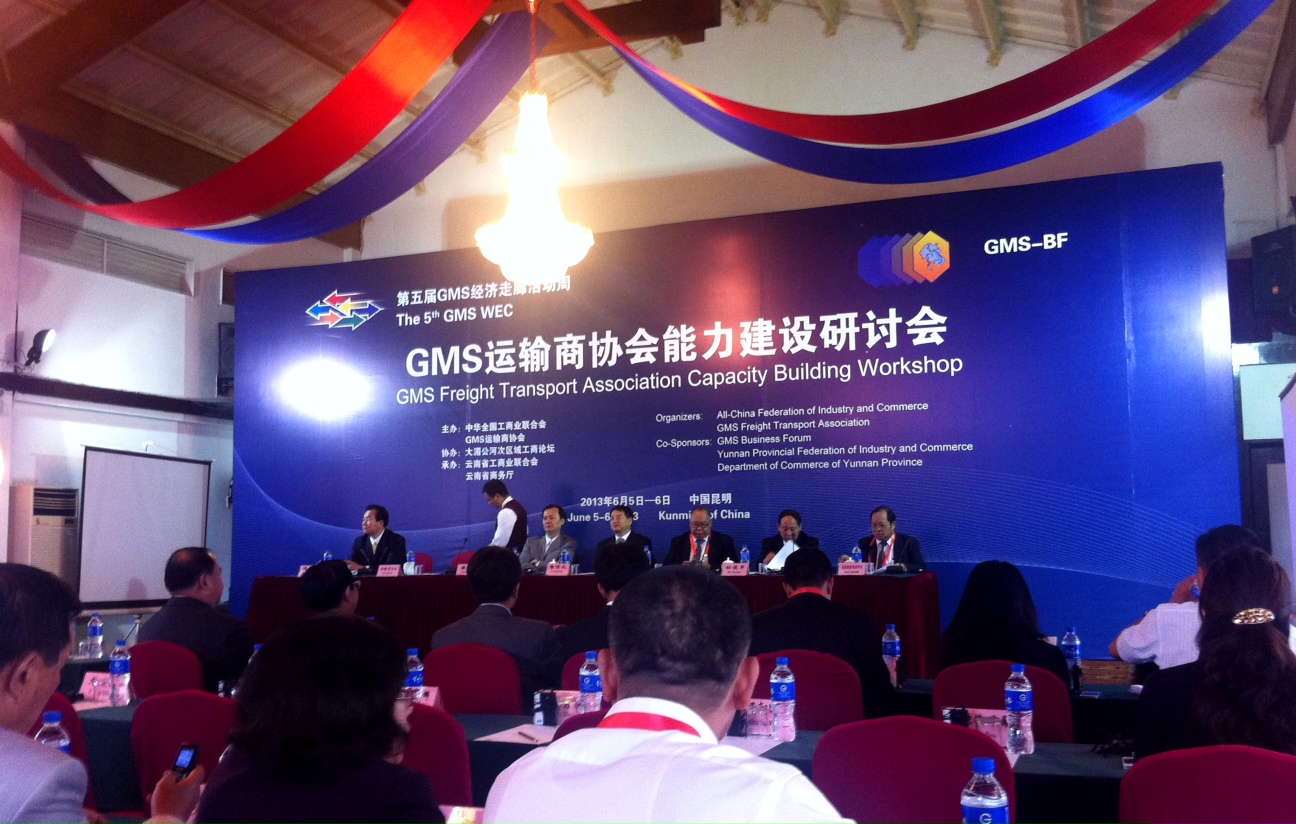
GMS workshop

NOTE: The following is the English language transcription of a speech by Yang Shiji, Vice Director of the Yunnan Provincial Government’s Research Office, presented on June 5, 2013 at a workshop on GMS (Greater Mekong Subregion) Freight Transport Association Capacity Building.  The first part contains an interesting portrayal of connectivity potentials and a brief history of transportation linkages between China and Southeast Asia.  The reader should keep in mind that the area in discussion contains some of the most difficult terrain in the world, but the speaker’s main concerns are inter-government cooperation and the harmonization of customs and trade procedures throughout the region.   The final portion of the speech provides a framework to improve connectivity and upgrade logistical services within the region. 

For reference, a map of the Greater Mekong Subregion is linked here. 

“Strengthening Cooperation and Promoting Cross-border Transport Logistics in the Greater Mekong Subregion”

Cross-border logistics is an emerging industry combining several composite services such as transport, warehousing, and information.  Connecting production with consumption and linking countries to the outside world, the industry is composed of tangible and intangible factors and covers the entire process from product manufacturing to commodity flow.  Therefore, giving full play to the function and role of transport and upgrading the efficiency of cross-border logistic transport will have significant impact on all aspects of the economic and social lives of the countries in the GMS.  With the maturation of China’s market economy, a professional and efficient logistic system has been an indispensible factor for upgrading the quality of its economic functions, the income of its enterprises, and an accelerator for its entire national economy.

Located at the junction of China and Southeast Asia, the South Asian Subcontinent, Yunnan borders with Laos, Vietnam, and Myanmar, and shares with them a 4060 km national boundary line, about one-fifth of China’s total land border.  It has 25 frontier counties, 23 national entry ports, and over 100 trading channels for border residents.  To its east Yunnan is linked to the Zhujiang River delta and the Yangtze River delta economic circles, and to its south it has direct access from three routes, east, central, and west, to Hanoi, Bangkok, Singapore, and Rangoon via the Kunming-Bangkok highway and the Pan-Asia Railway, currently under construction.  It is the gateway to the vast western hinterland of China to its north.  To its west, it has access to the Indian Ocean via Myanmar.  In a word, the province enjoys the locational advantage in “connecting with two oceans, the Pacific Ocean and Indian Ocean, and linking with three major markets in East Asia, Southeast Asia, and South Asia.” Continue reading →
Leave a Comment

Filed under China, DOCUMENTS, Economic development, GMS, Laos, Mekong River, Myanmar/Burma, Regional Relations, Technology, Thailand, Vietnam

What’s at Stake for the China-South Asia Expo?

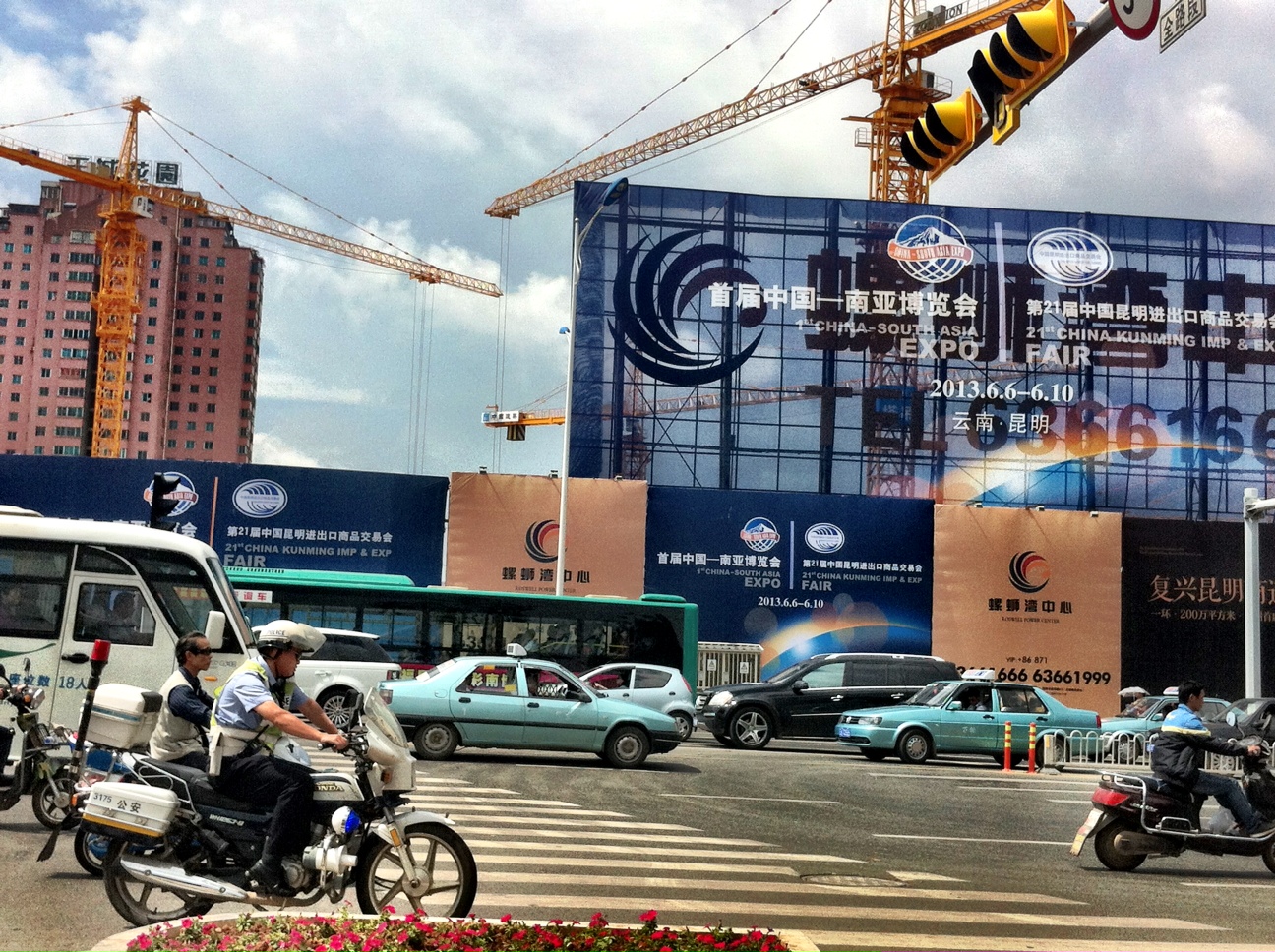
expo

The China-South Asia Expo opened without a hitch yesterday in Kunming despite online calls for a continuation of environmental protests outside of the Expo’s opening ceremony site.  It seems protesters decided to stay home due to a combination of sticks and carrots offered by local authorities.  On June 3, Kunming’s mayor announced the release of key environmental impact assessment data concerning the construction of a PetroChina oil refinery and PX chemical plant side project scheduled for construction 40 km from the city’s downtown area.  Also, the excessive presence of armed and unarmed public security officers lining the city’s streets and manning the Expo site also likely turned protesters away.

What is the rationale behind the excessive security measures?  What’s really at stake at the 1st China-South Asia Expo?

The Expo, a combination trade fair and high level forum for investment and trade promotion discussions between China, Southeast Asia, and now South Asia, is part of China’s “Bridgehead Construction” strategy to establish Kunming and Yunnan province as a gateway between China and its neighbors to the south and west.  A smoothly running Expo not only will seal multilateral agreements and high-value business deals that will streamline regional trade and investment, but it will also guarantee the continuation of soft-budget infrastructure development projects sponsored by Beijing to Kunming and Yunnan province that are part and parcel of the “Bridgehead” strategy.

Continue reading →

3 Comments

Filed under China, Current Events, Economic development, Energy, Environment and sustainability, Foreign policy, GMS, Laos, Myanmar/Burma, Vietnam

Mr. Thein Sein Goes to Washington… Mr. Abe Goes to Naypidaw

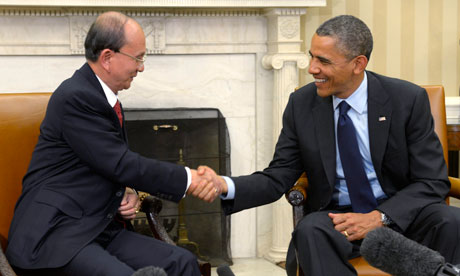
This past week saw big foreign policy news from Myanmar (Burma). Just days after meeting with US President Obama in Washington, Burmese President Thein Sein returned to Naypidaw to meet with Japanese Prime Minister Shinzo Abe. Both visits saw improvements in Burma’s respective relations with the two countries, but which of the two relationships remain closer? From whom did Burma gain the most, and vice versa? The clear answer is Japan.

President Thein Sein visited Washington at the beginning of last week, becoming the first Burmese leader to visit the US since Ne Win in 1966. The visit was a largely symbolic one, lacking many of the tangible economic benefits that are usually associated with these sort of state visits. Aside from agreements to strengthen bilateral trade relations with two US agencies, most of Myanmar’s benefits can be found in the language of US officials. Before the President arrived, US Press Secretary Jay Carney referred to the country as Myanmar, not Burma. Myanmar is the name used by the military junta since 1989, while Burma is an appellation preferred by opponents of the regime. President Obama also referred to the country as ‘Myanmar’ and while it does not mark an official policy change, it does reflect a change in attitude.

During his meeting with President Thein Sein, Obama raised the perennial issue of human rights, but at the same time expressed strong support for the leader. Also of note, US Senator Mitch McConnell, a long-time champion of sanctions against Myanmar, said he was no longer in support of continued sanctions against the country, paving the way for smoother relations in the future. The Burmese president’s visit to the US came without multi-million dollar contracts and major US investment in the country will have to wait, but Thein Sein’s visit did represent a further thawing of the relationship, and offers hope for the future.

Continue reading →

2 Comments

Filed under China, Current Events, Economic development, Foreign policy, Myanmar/Burma, Regional Relations

Law of large numbers: The growing gravity of Kunming’s environmental protests

Kunming’s ongoing protest against the construction of a 10mn ton petroleum refinery 40km from the city center continues to gather attention in China’s domestic media and in the international media.  Yet despite continuous coverage of the protest in China’s Global Times, South China Morning Post, the Telegraph, the Guardian, and most recently the Atlantic (among many other media outlets), questions concerning the gravity of the protests continue to pop up in online chat forums: Does a protest of 1000+ Chinese citizens in a city of 7 million have impact?  Given the numbers, does the average Kunming citizen know about this issue?  Can protests of this scale force changes to policy agendas?

ExSE’s answer to all three of those questions is an unequivocal YES.  Kunming mayor Li Wenrong would have not made an impromptu engagement with protesters last Thursday if he didn’t see the movement as a legitimate challenge to the status quo.  He followed through on his promise to open a Sina Weibo account by noon on 5/18 and since then he’s gathered more than 75000 followers.  Further, an online poll created after the initial 5/4 protest exceeded its limit of 100,000 responses within three days.  The poll asked a simple yes or no question: Should there be a PX plant in Anning? An overwhelming majority of 80% ticked “no.”  It’s no surprise that the poll’s weblink was eradicated last week.  Admittedly, there is no way of knowing whether Li Wenrong’s 75k followers are mostly from Kunming, and online polls are never without bias; but the large numbers undeniably say something and suggest that the 2000+ protesters are representative of a much larger group of concerned citizens. Continue reading →

3 Comments

Filed under China, Current Events, Economic development, Energy, Environment and sustainability, Governance, Myanmar/Burma, Yunnan Province

Unstoppable: Kunming’s environmental protest movement takes a powerful turn


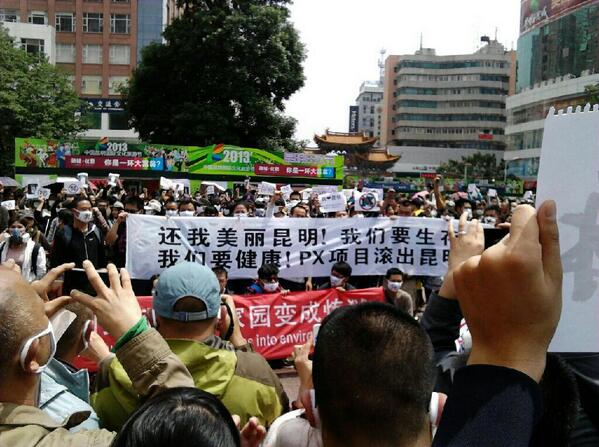
protest view

Kunming’s anti-PX protest movement broke through to new heights on Thursday as more than 2500 protesters took to the city’s downtown streets.  The unexpected success of this impressive NIMBY movement has empowered protesters to shift targets – what began two weeks ago as a movement opposing the construction of a polluting chemical plant attached to a PetroChina oil refinery 40km from the city center has evolved into a full blown protest against the entire 10mn ton oil refinery project.  Throughout the morning the protesters worked a powerful and persistent ground game breaking through rank after rank of public security forces to gain total control of Kunming’s downtown streets by noon.  Protesters marched in peaceful and non-violent demonstration for more than five hours under the intense Kunming sun and prompted an engaging appearance of Kunming mayor Li Wenrong who sympathized with protesters and promised immediate change – another breakthrough victory for this growing social movement. Continue reading →

5 Comments

Filed under China, Current Events, Economic development, Energy, Environment and sustainability, Myanmar/Burma, Uncategorized

Myanmar ethnic reconciliation: Impossible without Chinese cooperation

Just outside of Yangon lies the “National Races Village,” a park laid out as a geographical representation of Myanmar, with real-sized model minority homes dotted around the park next to miniature lakes and mountains. The park feels quite similar to the Chinese Ethnic Culture Park in Beijing; both represent slightly bizarre attempts to paper over inter-ethnic conflict, as if both countries are trying to live out some sort of “big socialist family” of yesteryear.

Unfortunately Myanmar also seems to have copied much of China’s policies towards ethnic minorities. Sixty years ago, China promised its ethnic minorities that if they cooperated with the CCP, they would be granted self-autonomy. Myanmar promised the same thing in the form of the 1947 Panglong Agreement, which called for power sharing between the majority Bamar and ethnic minority groups. Both countries failed to live up to their promises. In China, the CCP has engaged in a campaign to eradicate traditional cultures and languages, and has kept minority areas under tight control by party officials. In Myanmar, Ne Win’s military coup in 1961 gave rise to centralized, authoritarian control, and to ethnic rebel groups who fought the military for decades. Continue reading →

6 Comments

Filed under China, Foreign policy, Governance, Myanmar/Burma

Myitsone: A road block for Sino-Burmese relations?

A year and half ago this past March, one of the more the surprising events in recent Sino-Burmese relations took place. With a short letter delivered to the Burmese legislature, President Thein Sein suspended the Myitsone Dam until 2015, the end of his term. The dam, a $3.6 billion project that would sit at the confluence of the Irrawaddy’s two main tributaries, was the centerpiece of a series of seven dams on the upper reaches of the river. The project was the result of a joint venture between the Burmese government and China Power Investment (CPI) beginning in 2006 and appeared to be of great importance to both sides. However, a nationwide protest campaign against the construction of the dam supported by Aung San Suu Kyi ultimately won out.

Continue reading →

1 Comment

Filed under China, Current Events, Energy, Foreign policy, Myanmar/Burma, Regional Relations, Uncategorized, water

Anatomy of a Protest: Kunming citizens voice concern over chemical plant

Saturday’s peaceful protest in Kunming may be the first of many against a polluting PX chemical plant slated for construction inside Kunming’s city limits. Nearly 2000 people participated in the well organized protest, and the crowd met zero resistance from the 200+ police and public security officers sent to the site to maintain order. For more than three hours, citizens wore “No PX” face masks and paraded around the protest site waving banners and posters sporting slogans like “PX project, get out of Kunming” and “I want green!” Different from other protests I’ve seen in China, the organizers divided the site into teach-in zones where crowds of hundreds could listen to those who had a message to deliver. In the end, no arrests were made and there were zero scuffles between protesters or with the police.

banners

Continue reading →

4 Comments

Filed under China, Current Events, Economic development, Environment and sustainability, Myanmar/Burma

Book: River of Lost Footsteps

River of Lost Footsteps

Thant Myint-U (Farrar, Straus and Giroux)

Since the beginning of political and economic reforms in 2010, Burma has become a regular topic inthe news. Anyone who regular reads publications like the New York Times or the Economist would beable to consider themselves relatively well-informed about the rapidly changing situation in the Golden Land. However, much of the coverage of Burma is often ahistorical, and there is little public discussion about Burma before 2010, let alone before Aung San Suu Kyi. In River of Lost Footsteps, Thant Myint-U provides a detailed history of Burma over the past four centuries, all the while weaving in the story of his own family in Burma.

Indeed, Thant Myint-U is uniquely positioned to write such a history. Born in New York, his grandfather U Thant was the Secretary-General of the UN in the 1960s. Educated at Harvard, the Paul H. Nitze School of Advanced International Studies and Cambridge, the author has lectured extensively on Asian and British imperial history. In the book, his mastery of the subject is quite evident, but also is a certain objectivity. Being Burmese himself and having spent summers there while growing up, he has an obvious intimacy with the country and passion for it but at the same time, he lacks the nationalistic bias that some native Burmese writers might carry. Continue reading →

Leave a Comment

Filed under Cold War, Current Events, Foreign policy, Governance, Myanmar/Burma, Reviews

Regional Roundup for Week of 4.18.2013

Just the news this week. Continue reading →

Leave a Comment

Filed under ASEAN, China, Cold War, Current Events, Economic development, Energy, Environment and sustainability, Foreign policy, Governance, Health, Laos, Mekong River, Myanmar/Burma, NEWS DIGEST, Thailand, Vietnam, water