Category Archives: Foreign policy

Review: Great Gamble on the Mekong documentary

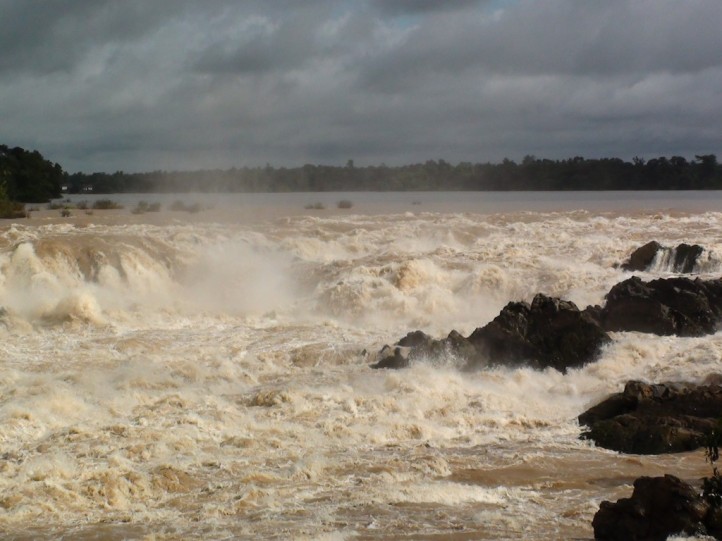
Khone Phapeng falls in southern Laos; photo by Tom Fawthrop

Khone Phapeng falls in southern Laos; photo by Tom Fawthrop

Fishers and farmers have for some time tried to block a proposed dam on the Mekong River in southern Lao People’s Democratic Republic (Lao PDR). Most recently, they made their views known at a public consultation on the Don Sahong dam. In all likelihood, however, they will lose and the dam will be built. Great Gamble on the Mekong, a new documentary from filmmaker and journalist Tom Fawthrop, insightfully details the probable dire consequences of this dam, and the failure this represents for a once-promising extra-legal cooperative structure, the Mekong River Commission.

The Mekong runs from the Himalayas in Tibet through China, Burma, Thailand, Lao PDR, Cambodia, and Vietnam—the latter five forming the Lower Mekong Basin (LMB)—where it empties into the South China Sea. According to Fawthrop, it provides protein and food security for 65 million people in the form of fish for food and trade, and water and nutrients for home gardens and commercial farms. At the same time, the Mekong has long represented a potential source of renewable energy. China has already built six dams on the Upper Mekong, and plans to build at least 14 more.

Dams have been discussed and rejected on the Lower Mekong mainstream since the 1950s, though they have gone up on its tributaries in that time.  In 1995 Thailand, Lao PDR, Cambodia and Vietnam signed the Mekong Agreement and formed the Mekong River Commission (MRC). The goal of the MRC is to facilitate cooperation in managing the resources of the Lower Mekong, but it has no final decision-making power.

The proposed Don Sahong dam at the center of this film would sit squarely across the main channel that migratory fish use to bypass the massive Khone Falls near the Lao border with Cambodia. It would be the second dam begun on the mainstream of the Lower Mekong—construction began on Xayaburi, another controversial dam, in 2012—with as many as 10 more to follow.


Cost-Benefit Analysis

The Lao government and the Finnish company Poyry it hired to oversee construction of Xayaburi claim that dam will provide clean energy to three million people in Thailand and one million in Lao PDR. The MRC claims dams on the Lower Mekong mainstream have the potential to reduce the severity of floods and droughts, and thatbuilding all 12 would generate $15 billion in economic activity, create 400,000 jobs, and reduce greenhouse gas emmissions by 50 Mtons CO2/yr by 2030. A study commissioned by the MRC, and completed by the International Centre for Environmental Management (ICEM) in 2010, concluded that the 12 dams could meet 8 percent of the region’s energy needs by 2025.

The ICEM study is clear however that benefits will not be disbursed equally: “Mainstream hydropower generation projects would contribute to a growing inequality in the LMB countries. Benefits of hydropower would accrue to electricity consumers using national grids, developers, financiers and host governments, whereas most costs would be borne by poor and vulnerable riparian communities and some economic sectors…In the short to medium term poverty would be made worse….”  Lao PDR does plan to use the revenues from selling the energy produced by its dams for rural roads, health care, and education, though during the “concession period” (estimated by ICEM at 25 years) after dam completion, the bulk of revenues would go to the dams’ financiers and developers.

According to the academics and nonprofit workers that Fawthrop interviews in Great Gamble on the Mekong, the exact impacts of the dams are impossible to predict, but they will likely be severe. “The Don Sahong dam will only push Cambodia and Vietnam closer to a food crisis,” says Chhith Sam Ath, an employee of the World Wildlife Fund in Cambodia. In addition to flooding gardens along the river, and diminishing the fish stock, they predict that the entrapment of nutrients by the dams will hurt rice production in Vietnam, leading to higher global food prices.

The 2010 ICEM study concluded that building the 11 mainstream dams on the Lower Mekong would reduced “capture” (non-farmed) fisheries by 16 percent. Combined with the built and proposed dams on the Upper Mekong, and on tributaries in the Lower Mekong Basin, this number rises to 26-42 percent. New aquaculture associated with dams would only replace at most 10 percent of this loss. Lao PDR and its developers claim they can mitigate the losses of fish–Poyry claims fish gates will allow 80 percent of migratory fish to pass up and down streams, while MegaFirst, the Malaysian company planning to dam Hou Sahong, claims making adjacent channels wider and deeper will provide fish with a detour route.

Yet the fish gates Poyry plans to use have never been tested on the varieties of fish found in the Mekong, and fish passes need to be designed to take into account individual species’ behavior and sensitivity to factors such as oxygen and nutrient levels. AsPoyry’s senior project manager conceded, “whether the fish get across [the dam], you’ll only see when it is built.” Faulting Lao PDR for not testing the fish gates in the Mekong before building a dam, when you need a dam to test the gates seems unfair. But they could test the technology on a smaller, less impactful dam on a tributary.


The Political Process

In the face of this uncertainty, the ICEM report recommended putting off any mainstream dam construction until 2020, using the intervening years to more fully study the impacts of the dams on the Upper Mekong and on the tributaries of the Lower Mekong. In a five-year strategic plan issued in March 2011, the MRC Council also recommended more study, as well as a thorough Procedure of Notification, Prior Consultation and Agreement (PNPCA), the internal procedure of the MRC for member countries to consider and offer feedback on the proposals of other countries. Yet eight months later, Poyry announced that Lao PDR had met its obligations under the 1995 agreement and could proceed with construction of Xayaburi. A year after that, in November 2012, Poyry received an eight-year contract to supervise Xayaburi’’s construction and engineering, and construction began. Poyry claimed at the time that it had updated designs to take into account the concerns of downstream nations. Yet in January 2013, Cambodia and Vietnam vigorously protested that their concerns had not been addressed, and demanded a halt to construction. They were unsuccessful.

A similar drama unfolded around the Don Sahong Dam. Last September, Lao PDR announced the start of the Don Sahong Dam, this time avoiding the PNPCA by claiming the project was not on the mainstream. After diplomatic outrage, the Lao government consented to a PNCPA, which began last July and is only required to run six months. Despite opposition from the governments and civil society in Vietnam and Cambodia, the Lao government has signaled its intention to proceed with the dam.

These dams are the first major test of the MRC’s ability to handle conflict among its members. The MRC tasks members with “aiming at arriving at agreement” on projects that significantly impact water quality or flow but has no voting mechanism or penalties for not reaching agreement. The CEO of the MRC Secretariat, Hans Guttman, states in Great Gamble that if the parties don’t arrive at an agreement, the country proposing such a project can still go ahead with it.


Resistance

Citizens of Cambodia, Thailand, and Vietnam have lobbied their respective governments to halt the dam. Hundreds of NGOs, both local and international (including World Wildlife Fund and International Rivers) have been trying to mobilize the opposition. Thai villagers filed a lawsuit against EGAT, the National Energy Policy Council, and three other government agencies in 2012, challenging the power-purchasing agreement they entered into with the Lao PDR government for electricity from Xayaburi. In June 2014, the Thai Supreme Administrative Court agreed to hear the case.

The international response, outside of the press, has been muted. MRC’s international donors issued a joint statement in January 2013 urging further study before beginning dam construction, but have said little else. The UN and heads of state have been notably silent.

Fawthrop’s film does not address how concerned Westerners can respond. The answer certainly feels fraught, given Laos’ historical experience of French colonialism and U.S.military aggression, including the unexploded ordinance that still affects the country. Then there’s the region’s very real need for clean energy as well as the standard argument about the hypocrisy of industrialized nations telling any country to sacrifice growth for environmental protection.

This is the progressive’s dilemma when it comes to foreign policy. Certainly any intervention should come in the form of carrots and not sticks: money and/or technology to develop less destructive sources of renewable energy; promotion of tourism to the region; UNESCO World Heritage Site recognition for Kohne falls, and so on, conditioned on implementing the ICEM report’s recommendations.What Great Gamble on the Mekong makes clear, and what studies of other massive dam projects have proved is that this is a humanitarian issue, and that the poorest will likely suffer the most.

Great Gamble on the Mekong has some distracting elements. The claim that the Thai banks funding Xayaburi are “getting nervous” as a result of letters sent to them by anti-dam activists seems like wishful thinking. For the sake of their own credibility, the filmmakers shouldn’t have included a cartoon set to Pink Panther music. Finally, the filmmakers should have addressed how some species got to be endangered before any dams were built. For example a WWF report says that overfishing was partly responsible for the decline of the great catfish. These critiques aside, this is an important and stirring film.

Nathaniel Eisen is a freelance author interested in the intersections of trade, human rights, security policy, and the environment. Information about the documentary Great Gamble on the Mekong can be found at www.tomfawthropmedia.com. Copies of the DVD can be ordered from eurekacuba@gmail.com.  This post was first published on the Foreign Policy in Focus blog on 12/26/2014.  It is reposted here with the permission of the author.

Leave a Comment

Filed under China, Current Events, Energy, Environment and sustainability, Foreign policy, GMS, Mekong River, Reviews, SLIDER, water

Myanmar fighting escalates, tens of thousands flee into China

mynamar fighting

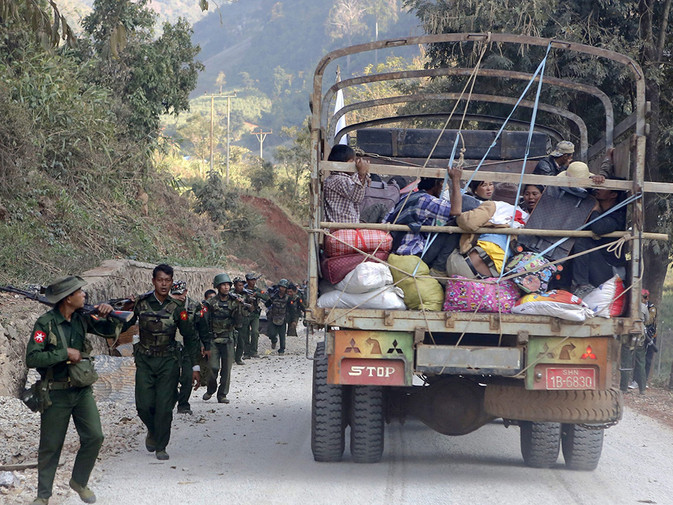
As fighting in Myanmar grew more intense near the Sino-Burmese border during Spring Festival, media reports became increasingly confused and alarming. Clashes between rebels and government forces in Shan State reportedly claimed the combined lives of more than 100 combatants on both sides. The ramp-up in hostilities has also forced tens of thousands of Burmese civilians to flee their rural villages for refuge in China.

Fighting that first broke out on February 9, and included air and artillery strikes by the Burmese army in Kokang, have led to protracted bouts of guerrilla warfare. Estimates place the number of dead in the violence between 70 and 130, and media reports are unclear how many of these are soldiers or civilians.

However, a spokesman for the Myanmar Defense Ministry, Lieutenant General Mya Htun Oo, wasquoted in the Hindustan Times as saying “the conflict had killed 61 military and police officers and around 72 insurgents”. Red Cross officials have also said humanitarian workers in the region have been attacked twice in the past week. The Burmese military has declared three months of martial law in Kokang, although how well such a policy can be enforced remains unclear.

Skirmishes have been most intense near the Burmese town of Laukkai, or Laogai. The village, now described as a “ghost town”, is located on the Salween River — known in Chinese as theNujiang. The refugees sought shelter in Yunnan’s Lincang Prefecture and were first thought to number a few thousand. However, Red Cross workers in Myanmar now claim at least 30,000 people have made the crossing, raising fears both inside and outside China of a looming humanitarian crisis.

The embattled Kokang region is a semi-autonomous part of northeastern Myanmar. Although the national government in Naypyidaw asserts titular control of the area, 90 percent of the local population claim Chinese descent and identify ethnically as Han Chinese. The rebel army now fighting Burmese troops is called the Myanmar National Democratic Alliance Army (MNDAA) and is headed by former members of the country’s defunct Communist Party.

No official reason has been given for the escalation in violence in Kokang, although it seems likely connected to December ambushes by guerrillas that killed at least seven Burmese soldiers and injured 20 others. As the conflict continues, both sides have presented their own narratives. Burmese military spokesmen have gone so far as to accuse the rebels of employing Chinese mercenaries in an attempt at complete self rule — a charge the guerrillas and Beijing have vociferously denied.

Also at stake for both the Kokang and Burmese authorities are lucrative, if unofficial, trade routes in the area. China’s border with Myanmar is extremely porous, and around Kokang is notorious for booming illicit trafficking of illegally logged timber, rare animals, jade and narcotics.

This article by  was first posted on the GoKunming on 

Leave a Comment

Filed under ASEAN, China, Cold War, Current Events, ethnic policy, Foreign policy, Myanmar/Burma, Regional Relations, SLIDER, Yunnan Province

China & Europe: Reconnecting Across a New Silk Road

chen 1

Since 2013, economic and trade relations between China and Europe have grown significantly. In this article, the authors look beyond conventional economic indicators, like trade, and political issues, like human rights, instead focusing on transport infrastructure, real estate and tourism to show that a new page is unfolding in the history of China-Europe relations.

China and Europe have been closely linked since the Opium Wars, but the relative economic positions and power have reversed. Nothing illustrates this more symbolically than a stroll along the Bund in Shanghai: the low rise and old European-style buildings on the West side of the Huangpu River are dwarfed and eclipsed by the sparkling skyscrapers in Pudong on the east bank. The built environment of Shanghai, with its historic European-style buildings and modern China-built skyscrapers, is a physical manifestation of the reconfigured dynamic between China and Europe.

Since 2013, China’s connections with Europe have expanded since developing its official policy of building a westward economic corridor — a new Silk Road — along its ancient route. Most recently, in December 2014, China agreed with Hungary, Serbia, and Macedonia to build a rail link between Budapest and Belgrade, which will be financed by Chinese companies and completed by 2017. This rail line will then be connected to the Macedonian capital of Skopje and the Greek port city of Piraeus where COSCO, the Chinese shipping giant, operates two piers for container units. While the linked land-sea project will strengthen cross-border transport between Central and Southeastern Europe by reducing train travel times between Budapest and Belgrade from eight to three hours, it really is designed to enlarge and accelerate the movement of goods between China and Europe.

Having grown fivefold since 2003, trade between China and Europe reached $559 billion in 2013, solidifying the EU as China’s largest trading partner for the past 10 years. While the EU has invested more in China than the latter’s direct investment in the former, a US consulting company expects the EU to attract $250-500 billion more Chinese direct investment by 2020.1 A scenario likely to occur in the next few years is that China will invest more in Europe, instead of vice versa. This will be another telling sign that fortune and power are shifting in China’s favour.

These developments are not isolated and random. They represent a new structure of interactions between the older European economies and a rising Chinese power. We can understand this structure well by examining its conventional macroeconomic dimensions of bilateral trade and investment. In this essay, however, we make better sense of the new China-Europe relationship through a set of less used lenses: transport infrastructure, real estate, and tourism. They offer new insights into areas where China exerts a large and heavy footprint in Europe, via official channels and from the ground up.


Transport Infrastructure and Connectivity

In thinking about China and Europe today, transport infrastructure does not usually come to mind due to the long distance between them and Europe’s own well connected transport networks. Having built the world’s longest highway, railway, and more bridges and buildings than any other country over the past two decades, China has been constructing an extensive transport and municipal infrastructure within its Asian neighbours and far-flung African cities.2 More recently, China has also turned to Europe in strengthening their long-distance transport connections, aiming to improve the overland movement of traded goods. Less expected is China’s new foray into the domestic infrastructure sector of a few European countries. Both moves make infrastructure a major avenue for China to forge direct physical connections to Europe.

The most important connection thus far is the Trans-Eurasia railroad from the city of Chongqing in southwestern China to Duisburg, Germany. Launched into operation in 2011 by a joint venture with Germany, China, Kazakhstan, and Russia, the 11,179-kilometre rail line snakes through six countries including Belarus and Poland (see Figure 1). China is the largest beneficiary of this freight-focused rail network, having already shipped $2.5 billion worth of goods on this route to Europe since 2011. As labour and land costs in coastal cities like Shanghai and Shenzhen have gone up, the Chinese government has been pushing and inducing foreign investors and domestic producers to move inland through its “Go West” policy. Interior megacities like Chongqing and Chengdu have been booming as major destinations for large new manufacturing projects. Having set up what would be Asia’s largest laptop factory in Chongqing, US computer giant Hewlett Packard has already shipped more than four million notebook computers to Europe by the Chongqing-Duisburg rail since 2011.

chen 2 chian-map


As manufacturing becomes more concentrated in Chongqing and Chengdu, it will reap more savings from reduced transport costs. About 60% of the material inputs for laptops and 30% of the finished laptops depend on rail transport. Bringing them in and out by sea is very expensive and time-consuming. It requires a long train ride to Shanghai or Hong Kong from where container units are shipped to Europe. In the other direction, growing demands in interior China for European foods and cars can also benefit from a greater use of the Chongqing-Duisburg rail connection. It typically takes 2-3 months for a customer in Chengdu to receive the delivery of a European car by sea as it has to come through the port city of Tianjin. This wait can be reduced to 25 days if the car is transported by train from Europe to Chengdu.3

While this overland rail route can yield major economic benefits for China and Europe, its greater potential won’t be realised without policies for overcoming existing barriers. The Chinese government has recently approved the status of an international land port for Chengdu and Chongqing. This allows the direct and full import of European meats and cars to fill the train cars going back to China that would otherwise only be partially filled after carrying full loads of exported electronic products to the European markets. A fully loaded train has recently brought car parts from Germany to a Ford plant in Chongqing using the Trans-Eurasia railroad.

Another obstacle is that Chinese and European railways use different gauges than Russia and its former satellite states. So far the Chongqing to Duisburg route has met this standardisation challenge by transferring to cars with new gauges at relevant border crossings to meet varied national track requirements. It will need to adapt to other differences in technologies, signalling systems, and gauges that add costs to coordination across several countries.4 However, the existing and potential benefits for China and the other countries along this rail route will motivate them to co-operate in overcoming the remaining hurdles. So far it is China that has been moving at full speed. It has already sent a total of 239 (100 during the first seven months of 2014) trains carrying container units to Europe, including a train from the city of Zhengzhou in the central province of Henan bound for Hamburg.5

As China’s rail transport connections to Europe multiply, China has also launched an infrastructure build-up within Europe with an initial focus on the geographically closer and economically weaker Central and Eastern Europe. In December 2014, China and Serbia inaugurated the first ever bridge in Europe across the Danube River financed and built by China. Named after Mihajlo Pupin, a renowned Serbian scientist, the 1,500-metre bridge connects the southern industrial district of Zemun with the northern residential area of Borca in Belgrade, cutting the travel time across the Danube from more than one hour to just 10 minutes. China has also landed the contracts for the Stanari Thermal Power Plant in Bosnia (up to $1.7 billion) and the Bar-Boljare motorway in Montenegro with a link to Serbia ($984 million).6 Infrastructure projects of this scale have been very rare in these countries for more than 20 years, given the bad economic conditions in Croatia, Serbia, and Bosnia-Herzegovina, with nearly 1.5 million unemployed, due to the post-Yugoslavian political instability, ethnic conflicts, and natural disasters like flooding. China’s major efforts to finance and upgrade the outdated transport and municipal infrastructure in these countries opens up a new era of China’s local presence and influence in Europe.


Going After European Property

As China is making inroads into Europe’s infrastructure sector, the real estate sector cannot be far behind as an investment target. Southern European countries like Italy and Portugal, which have been adversely affected by the financial crisis, are seen as especially good opportunities for Chinese investors, as the property prices there are lower than in other European countries, like the United Kingdom and France, that have managed to weather the crisis better. Homes in southern Europe are also attractive compared with those of China as 300,000 euros buys a 200 square metre villa facing the sea. That amount only buys an apartment of 68 square metres in central Shanghai7 where property prices have been artificially inflated due to years of speculative supply and persistently strong demand.

Besides their low property prices, countries such as Cyprus, Portugal, and Greece are offering resident permits to property buyers who are not already residents of the European Union. This appeals to Chinese investors who have the capital to buy the properties but not the residency or citizenship benefits to use them within Europe. In exchange for a minimum amount of investment in property in a European country (amounts vary depending on the country, but the starting price is generally upwards of 250,000 euros), the investor may be granted a visa that allows him or her to live and travel within the Schengen Area, which consists of 26 European countries. A recent trend among Chinese investors is to buy a property in Southern Europe and then secure permanent residency there once their visas have been approved. A reporter from Bloomberg observed that “most (Chinese investors) are getting homes for personal use or to send their children to schools there.”8 By July 2014, Chinese citizens had received 282 of the 1,880 “golden visas” or permanent residencies granted by the Spanish government to those who bought local property.9 Since October 2013, the Portuguese immigration office has approved 1,681 property purchase applications, 1,429 of them from China, about 85% of the total.10

Besides property value and permanent residency, the measure of the Chinese yuan (RMB) against the euro is another important consideration, and one that has contributed to the rise of Chinese investment in European property. The euro depreciated approximately 17% against the yuan from 2010 to July 2014. Chinese investors bought 3.05 billion euros’ worth of European property in 2013, an increase from the 978 million euros spent in 2012. The Financial Times found that Chinese direct investment in Europe tripled in just two years (2010-2012), from 9 billion euros to 27 billion euros.11


chen 3 comp-pic-copy

The large volume of this investment in European property reflects a major shift in China’s overall outbound investment, from securing natural resources in developing countries to acquiring brands, technology, and other assets in developed countries. A major Chinese real estate developer has recently committed $1.6 billion to convert the derelict Royal Albert Dock in London into a global trading hub. Intended to attract Chinese companies as tenants, this project is planned for 4.5 million square feet of office space to be developed in phases through 2020. London’s Mayor Boris Johnson has strongly endorsed this project for its prospect of generating about $10 billion for the national and local economies. He has lauded the project’s potential ability to turn what was once one of “the throbbing arteries of UK trade and commerce” into “a world-class international business district.”12

In June 2014, Wang Jianlin, one of China’s largest real estate investors and richest men, bought the 25-story Edificio España in Madrid, a landmark Franco-era building that was also Spain’s tallest, for 265 million euros or $340 million. Sitting empty since the Spanish real estate market’s collapse in 2008, the building will be renovated to include luxury apartments and a hotel as part of a larger-scale neighbourhood regeneration.13

The scope of Chinese investment in European property represents a powerful combination of China’s surplus corporate and private capital that can affect the urban landscape in European cities. Its long-term impact, however, will depend on the pace and volume of its outflow from China, and its geographical concentration and spread within Europe.


Big-Spending Chinese Tourists

As a relatively small but growing number of wealthy Chinese investors put their money into European real estate, a much larger number of middle and upper middle class tourists from China are coming to Europe to buy a lot of luxury goods. China’s rapid economic growth has created a huge number of middle and upper middle class consumers with insatiable desire and startling purchasing power. In 2013, Chinese citizens made approximately 100 million overseas trips and spent over $100 billion on their trips, mostly on luxury goods, overtaking the United States and Germany as the world’s number one tourist spending nation. Today nearly one-third of the world’s personal luxury goods are bought by Chinese consumers.

In 2014, Europe accounted for 3.5% of overseas travel destinations for Chinese citizens; this was the second most popular regional destination after Asia, which accounted for 70.4% of overseas tourism. Visa applications to enter the Schengen Area from China accounted for approximately 1.5 million of the total applications in 2013, ranking China third overall, behind Russia and Ukraine.14 In its 2014 report, hotels.com observed that “European destinations are the most popular amongst Chinese travellers in terms of places they wish to visit in the next 12 months.” By surveying the number of rooms and the length of stay in hotels booked through its website, hotels.com placed France, the United Kingdom, and Italy in the top ten destinations for Chinese travellers in 2013 as all three countries experienced growth in the amount of tourism from China.15The German National Tourist Board recently showed Germany, France, Italy, and Switzerland as the top four European destinations for Chinese tourists.

While many Chinese tourists in Europe are interested in seeing sites of historical interest and established landmarks like the Eiffel Tower and Venice’s Grand Canal, they are there for a much more passionate interest: shopping, especially for brand-name and luxury goods. Paris is the most popular destination for this shopping spree. It is where Chinese tourists head to the Louis Vuitton shops in much larger numbers than to the Louvre. As early as 2009, Chinese tourists overtook Russians as the highest spending visitors to France. Wealthy Chinese tourists also head south to the wine country of Bordeaux where they snap up expensive wine, paying as much as $800 for a bottle.16 They bring the wine back to China where it can be displayed and then drunk as a prized possession; red wine has become increasingly popular at dinner parties, replacing beer and traditional Chinese liquor.

McKinsey’s survey of Chinese luxury consumers in 2012 found that “Europe is growing in appeal among Chinese luxury consumers, with about one-fifth of them reporting this year that their most recent overseas purchases occurred in a European city. That is more than double the European share two years ago.”17 A study by the European Travel Commission estimated that Chinese tourists reserve more than a third of their trip budgets for shopping. To be able to do so, they compromise on eating and sleeping. A survey in 2006 found that Chinese travellers in Europe had eaten “European food” only once, and 10% not at all. Many in tour groups arranged by Chinese travel agencies would stay in cheaper hotels and eat instant noodles, even though they could afford luxurious hotels and lavish meals.18 The average Chinese tourist spends around $5,000 during a European trip, more than any other country. This is not surprising when one often sees groups of Chinese tourists getting dropped off at expensive stores and coming out with their suitcases full of brand name clothes, handbags, and cosmetics.

There are several reasons for Chinese tourists to buy luxury goods heavily in Europe. Besides the obvious factor of their rising affluence, Chinese tourists pay less for luxury consumption in Europe than in China. Taxes on certain items and tariffs on imported goods increase the price of luxury goods produced elsewhere and sold in China. According to The Economist, taxes and tariffs can increase prices in China to 50% more than a shopper would pay elsewhere. For example, a Louis Vuitton handbag costs 30% more in Beijing than in Paris.19 The purchase of luxury goods while travelling in Europe connotes the high income and status of the consumer. A study published by the University of Pennsylvania’s Wharton Business School found that “travelling has become part of the luxury lifestyle in China and is considered a status symbol: there is greater cachet in being able to say you purchased your bag at the place of origin in Paris rather than a branch in Tianjin.”20 Chinese consumers also perceive a higher quality and a greater variety of luxury goods if bought in the places of origin. In addition, while the appreciation of the Chinese yuan against the euro has helped, Chinese tourists have benefited from a greater ease in getting European visas.

European countries have made getting visas easier for Chinese tourists. Recent initiatives include changes in the visa process for tourists wishing to visit the Schengen area. Visa applications can be submitted up to six months in advance instead of three, allowing people to plan their trips earlier, and travel medical insurance is no longer required. The time it takes to process applications from China has been reduced. When Chinese Premier Li Keqiang visited Germany in October 2014, the two sides agreed to reduce the visa application process from between three and five working days to 48 hours for Chinese tourists. The French embassy in China also shortened its visa processing time for Chinese visitors to 48 hours and simplified the application documents. Italy has already cut its visa approval for Chinese tourists to 36 hours. The United Kingdom has recently introduced the 24-hour Super Priority Visa service in Beijing, Shanghai, and Guangzhou. With 12 visa application centres across China now, the United Kingdom issued more than 320,000 visas to Chinese tourists during January-August 2014, the highest number ever.21 This competitive rush of European countries to simplify and speed up visa applications for high spending Chinese tourists will help boost their sluggish economies.


Money and More

The sum of Chinese investment and spending in Europe’s infrastructure, real estate, and tourism sectors amounts to a huge influx of money that reflects the changed economic positions of China and Europe and their long-distance connections. Many may see this as the relative decline of Europe and the continuing rise of China that implies a reversal of power and fortune. But there is both change and continuity to the new China-Europe relationship that makes it more complex than a one-way flow of surplus Chinese money. In 2013, the EU invested $6.5 billion in China, up 21.9% from 2012, which doubled China’s $3.6 billion in the other direction, an increase of only 6.2%. While this sustains the earlier pattern of bilateral investment, individual European countries have taken more differentiated economic approaches in dealing with China. Through the agreement between the Bank of England and the People’s Bank of China to clear and settle Chinese currency in London, the British government has gone ahead of most other European countries in making London the leading hub for trade with China. By the end of 2013, China’s cumulative investment in the United Kingdom reached $32 billion, far exceeding the $18 billion the other way around.22 Not to be left behind, Switzerland’s central bank joined its Chinese counterpart in January 2015, making Zurich Europe’s newest hub for trading the Chinese currency (RMB). As the China-Europe economic relationship becomes stronger, it has become more varied and specific to individual countries.

chen 4
The uneven penetration of China’s economic influence has begun to generate a sort of cultural backlash, which is illustrated by a recent cartoon that made the cover of Fluide Glacial, a French monthly comic book (see Figure 2). Despite an underlying negative headline of “Yellow Peril: What if it is too late?” the restaurant window shows a harmless sign: “Chinese spoken here.” But the joke is a man bearing the words “I am hungry” sitting at the door of a restaurant that advertises steamed Chinese dumplings with a French twist: the addition of béarnaise sauce. Adding to the insult is a Frenchman pulling a rickshaw that carries a Chinese man in traditional high-class clothing with a blonde European woman. The humour aside, this cartoon reveals an unfavourable view of China, or at least its economic wealth in Paris and in Europe. It immediately drew a harsh response from The Global Times, a Chinese daily with close links to the government, saying that the French magazine possibly attempted to gain attention by following Charlie Hebdo whose Paris offices were savagely attacked by Islamist gunmen on January 7, 2015.

This media episode matters little to the massive scope of China-Europe interactions. When we look beyond conventional economic indicators like trade and political issues like human rights as in this article, we see a new page unfolding in the history of China-Europe relations. While it features continued bilateral official policies that have led to new infrastructure deals, bottom-up activities in real estate investment and tourism have become more prominent. With the Trans-Eurasia railroad already in operation and millions of Chinese tourists moving around Europe, China’s ancient dream of connecting to Europe via Central Asia along the old Silk Road has come true. Yet the new Silk Road envisioned by China for the 21st century is just beginning to take shape. Its full opportunities for both China and Europe are yet to come.

This article was written by Xiangming Chen and Julia Mardeusz and originally published here in the European Financial Review on February 10, 2015.

About the Authors


Xiangming Chen
is the Dean and Director of the Center for Urban and Global Studies and Paul E. Raether Distinguished Professor of Global Urban Studies and Sociology at Trinity College, Connecticut, and a distinguished guest professor at Fudan University, Shanghai. He has published extensively on urbanisation and globalisation with a focus on China and Asia. His many books include Shanghai Rising: State Power and Local Transformations in a Global Megacity (University of Minnesota Press, 2009; Chinese Edition, 2009).

Julia Mardeusz is currently a junior at Trinity College, Connecticut, majoring in Public Policy and Law. Her interests include American public policy and European politics and policy. She has been a student researcher at the Center for Urban and Global Studies at Trinity College since 2013 and studied in Paris during fall 2014.


References

1. Reported by The People’s Daily, June 23, 2014, p. 4.

2. See Xiangming Chen and Curtis Stone, “China and Southeast Asia: Unbalanced Development in the Greater Mekong Subregion”, The European Financial Review (August 2013). pp. 7-11; Xiangming Chen and Garth Myers, “China and Africa: The Crucial Urban Connection”, The European Financial Review (December 2013). pp. 89-93.

3. “European meats are transported directly to Chengdu”, The People’s Daily, April 26, 2014, p. 6.

4. “’Silk Road’ railways link Europe and Asia”, The Gateway, CNN News, June 27, 2013; accessed from http://edition.cnn.com/2013/06/27/business/silk-railroad-trading-network/.

5. “The 100th China-Europe train this year has departed”, The People’s Daily, August 2, 2014, p. 1.

6. “Li forges new link in Serbian relations”, The China Daily, December 19, 2014, p. 1.

7. Henrique Almeida, “Needy EU nations woo Chinese home buyers to ease slump,” Bloomberg News; accessed from http://www.bloomberg.com/news/2013-08-21/needy-eu-nations-woo-chinese-home-buyers-to-ease-slump.html.

8. See note 7.

9. “Sale of a landmark skyscraper puts Spain on the map of Chinese investors”, The New York Times, September 23, 2014, p. B3.

10. Fu Yao, “A place in the sun”, NewsChina, February 2015, pp. 34-37.

11. Jamil Anderlini, “Chinese investors surged into the EU at height of debt crisis,” The Financial Times, October 6, 2014; access from http://www.ft.com/intl/cms/s/2/53b7a268-44a6-11e4-ab0c-00144feabdc0.html#axzz3NduHcZzt.

12. “Chinese developer envisions a future for abandoned London docks,” The New York Times, Business Section, February 19, 2014, pp. B1, B6.

13. See note 9.

14. National Tourism Administration of the People’s Republic of China, “European Countries Fight for Chinese Tourists”, accessed from http://en.cnta.gov.cn/html/2014-7/2014-7-3-9-57-70413.html.

15. Hotels.com, “Chinese international travel monitor 2014”, p. 21; accessed from http://press.hotels.com/content/themes/CITM/assets/pdf/CITM_UK_PDF_2014.pdf.

16. “A new grant tour”, The Economist, December 10, 2010, p. 114.

17. Atsmon, Yuval, Diane Ducarme, Max Magni, and Cathy Wu, Luxury Without Borders: China’s vNew Class of Shoppers Take on the World. The McKinsey Chinese Luxury Consumer Survey, McKinsey Insight China, December 2012; accessed from https://solutions.mckinsey.com/insightschina/.

18. See note 14.

19. “China’s addiction to luxury goods”, The Economist, April 29, 2014; accessed from http://www.economist.com/blogs/economist-explains/2014/04/economist-explains-17.

20. Knowledge@Wharton Blog, “Louis Vuitton and the traveling Chinese consumer”, Knowledge@Wharton, January 3, 2012; accessed from http://knowledge.wharton.upenn.edu/article/louis-vuitton-and-the-traveling-chinese-consumer/.

21. “European countries compete for Chinese tourists”, The China Daily, Travel Section, December 20-21, 2014, p. 19.22. Reported in The People’s Daily, June 20, 2014, p. 4.

2 Comments

Filed under China, Current Events, Economic development, Foreign policy, SLIDER

China’s Maritime Silk Road is all about Africa

Thailandriceexport-1

Rice bound for Africa is loaded onto a cargo ship in Bangkok, Thailand

A recently signed agreement between China and Thailand sheds light on the dynamics of the Maritime Silk Road.

Amid all the fanfare and media buzz about China’s re-envisioning of its two Silk Road projects, the New Silk Road and the Maritime Silk Road, admittedly little is known about the details, the mechanics, and the functions of the new routes.  For example, this interactive graphic published by Xinhua suggests the Maritime Silk Road’s prime focus is to facilitate trade between Asia and Europe when in actuality the focus of the Maritime Silk Road is to support and facilitate booming trade growth between Asia and Africa.  To put this into perspective, from 2011 to 2013, trade between China and the EU showed no increase, keeping steady at around USD 530bn.  This was outpaced by trade growth between China and Africa which expanded at an average of 10% per year over the same period of time and is projected to increase 15-20% per year over the next five years.  In 2013 total trade between China and Africa reached USD 210bn – five years ago China’s total trade with Africa was less than half of what it is now. Continue reading →

2 Comments

Filed under ASEAN, China, Current Events, Foreign policy, GMS, Regional Relations, SLIDER, Thailand, Trade, Yunnan Province

A Different Global Power: Understanding China’s Rise in the Developing World

China-s-meat-majors-focus-on-convenience-as-incomes-rise_strict_xxl

By Xiangming Chen and Ivan Su

China is now the largest trading nation in the world with strong ties to Africa, Latin and America and the Middle East. This once impoverished and isolated nation has lifted several hundred millions of its own people out of poverty and is now reshaping the developing world. This article looks at China’s involvement in four developing regions to assess China’s influence as a rising global power.

The China where the first author grew up through college in the early 1980s was the largest and one of the poorest developing countries. The China where the second author left to attend high school in the United States was about to pass Japan to become the world’s second largest economy, in 2010. Over the past three decades, China has lifted over 500 million of its people out of poverty. Globally, China has just surpassed the United States to become the largest trading nation in the world and is expected to soon overtake the latter as the world’s largest economy (in terms of purchasing power parity or PPP). More importantly regarding the focus of this essay, China is now the largest trader and investor in Africa, with its footprints spreading and seeping into all corners of the developing world.

How did the once impoverished and isolated “Third World” country become a powerful force in shaping a new developing world in the 21st century? What are the positive vs. negative consequences of China’s inroads into developing countries by exporting its urbanism to Africa, for example? These questions highlight China’s global impact that matters a great deal to the everyday life of millions of poor people in developing countries. In this essay, following China’s global footprints in four developing regions, we offer a broad comparison of both the different and consistent economic impacts of China within and across these regions.1 Figure 1 shows China’s investment in energy and infrastructure in the four regions, while Figure 2 breaks China’s investment into four specific sectors of one major country in each of the four regions. Guided by these comparative data and focusing on four developing regions, we present a broad picture of China’s widespread but mixed role in developing countries, thus offering a preliminary assessment of whether China’s influence as a rising global power may differ from the traditional or established Western powers in how they approach the developing world.


China in Asia: Exerting Neighboring Influences

Back in the last decades of the 20th century, the drivers and role models for development in Asia and beyond were the “Four Tigers”: Hong Kong, Singapore, South Korea, and Taiwan. The onset of the 21st century began to position China toward the epicentre of the Asian economy, with its influence spreading across the continent through more trade, outward investment, and other outgoing initiatives such as cross-border infrastructure development.

In Southeast Asia, China has been trying to integrate with the Greater Mekong Subregion (GMS), which consists of China’s Yunnan Province, Guangxi Autonomous Region, Cambodia, Laos, Myanmar, Thailand and Vietnam. “China’s trade with each of the GMS countries has grown since 1990, most rapidly since 2000.”2 In addition to increasing trade, China exerts strong influence on the GMS through various development projects. In Myanmar, China has reached a $20 billion agreement to construct an 800-kilometre rail link between Myanmar’s Chinese border and its western coast.3 In addition to investing in infrastructure, China is also helping its neighbors to generate energy. Since 2005, China has invested over $87 billion in the energy sector across Asia, and about one quarter of these investments went to Malaysia. In 2010, an $11 billion energy deal signed between China’s State Grid Corporation and Malaysia Development Company included four hydroelectric mega-dams that are capable of generating up to 28,000 megawatts of power, an aluminum-smelting plant, exploitation of coal mines containing 1.5 billion metric tons of coal, and a 40 billion-cubic-feet natural gas development project. “With Malaysia reeling from an exodus of capital over the past two years, the projects have strong support at the state and federal levels. Officials hope the plan will attract foreign investment to the region.”4

China’s investment in Asia is not limited to Southeast Asia, as countries in South and Central Asia have also been affected by China’s direct investment. In 2013, China established a strong foothold in South Asia when it took over the upgrading and operation of Pakistan’s Gwadar Port from Singapore. The Gwadar project serves China’s “Go West” policy while allowing Pakistan to “look east.” China is building a road from Gwadar all the way north to Kashgar, the westernmost large city in Xinjiang. At the same time, Pakistan and China have also planned to connect the port via the Indus Highway, which will provide China with a land-based supply of oil from Central Asia. Given Gwadar’s geographical location, Gwadar cuts China’s distance from the Persian Gulf, from which China gets 60% of its oil, by thousands of kilometres.5

Compared to the other energy projects sponsored by China, the Central Asian vector of China’s energy policy has become more important due to the region’s abundance of oil and natural gas. While China sees Kazakhstan’s energy supply a key to its “Go West” program, Kazakhstan has used Sino-Kazakh cooperation to balance against Russia’s influence in its energy sector. China is also constructing a 1,800-kilometre natural gas pipeline from one of the world’s largest natural gas exporter, Turkmenistan, which benefits from doubling its energy supply to China and circumventing its biggest competitor – Russia. Beijing wins by securing new gas supplies and thus enlarging its already hefty investment in energy projects in Asia (see Figure 1).


infograph-1


China in Africa: Reaching Maximum Impact

Through increasing trade and investment, China’s growing presence has reshaped the landscape in Africa. While negligible two decades ago, China-Africa trade reached $200 billion in 2013, which makes China Africa’s largest trading partner today. With only limited investment in Africa before the 2000s, China’s cumulative investment in Africa exceeded $150 billion by the beginning of 2014. Of these investments, close to $100 billion has gone into energy and infrastructure projects.6

China’s unprecedented economic growth requires an increasing amount of oil to sustain it. In 2012, close to one-third of China’s total oil imports came from Africa, and China is looking to expand its energy presence in Africa. Nigeria has received the most Chinese direct investment over the past decade. While many Western energy firms are reluctant, China reached a $10 billion hydrocarbon deal with Nigeria at the beginning of 2014 (see Photo 1). In addition to exploiting crude oil and natural gas, China has been involved in constructing an additional refinery in Baro, Nigeria.7 Although critics have attributed China’s heavy footprint in Africa’s energy sector to its energy and resource demand back home, evidence suggests otherwise. China Africa Sunlight Energy Ltd. recently invested $2.1 billion in developing a 2,100-megawatt plant to help ease electricity shortages in Zimbabwe, which is only capable of generating 1,320 megawatts against a demand of 2,200 megawatts of electricity. “China Africa Sunlight Energy is looking at the possibility of pumping gas to the port city of Beira in neighbouring Mozambique, using an idle pipeline that the National Oil Co. of Zimbabwe once used to bring fuel into the country.”8 This power plant is expected to produce 300 megawatts by mid-2015, and the number is looking to double by the end of the year. While much of the media attention has focused on China’s investment in Africa’s energy sector, China is reshaping Africa’s landscape through large-scale infrastructure development.

photo1

Photo 1: Drilling Oil in Nigeria

Since 2005, China has invested more in Africa’s infrastructure than in any other part of the developing world. More than $44 billion has been spent to build roads, airports, and housing that are essential to the continent’s economic development. In Angola, China is helping the country’s reconstruction effort after the devastating civil war. One of China’s major investments in Angola is the rebuilding of the Benguela Railway, “an 840-mile transcontinental railway that links the Atlantic port of Lobito in Angola with rail networks in the Democratic Republic of Congo and Zambia. The project is expected to cost $300 million, and it will provide a much-needed cheap outlet for Congolese and Zambia copper, tin and coltan.”9 In Nigeria, China is helping to build Africa’s largest free trade zone in its commercial capital, Lagos. “A total of 16,500 hectares of land bordered by the Atlantic Ocean and the Lagos and Lekki lagoons has been earmarked for the whole free zone, which will include a deep-water sea port and a new international airport in close proximity.”10 The Lekki Free Trade Zone is aiming to cut down the country’s reliance on imports, and it will cost $5 billion to complete the first phrase of the project, which will cover 3,000 hectares of land. The construction will also include roads, power plants, and water plants. This evidence reinforces China’s substantial investment in building Africa’s infrastructure relative to the energy sector in comparison with the other developing regions (see Figure 2)


infograph-2_1

However, concerns arise on whether Africa is too dependent on China as results of “high commodity prices and investment inflows.”11 With China-Africa trade looking to hit $280 billion by 2015, some worry that African economies depend too much on China. Some urge African countries to diversify their economies and decrease their dependence on China. There are also calls for China to focus more on human rights and community engagement. As such a dominant investor in some African countries including those with an authoritarian government like Zimbabwe, China struggles to balance between the return on its huge investment, helping local development and living up to international norms of engagement.


China in Latin America: Extending the Reach

Ever since the 1960s, China has been providing limited development assistance to a small number of Latin American countries such as Chile. Fast-forward to the 21st century, China has considerably expanded its economic ties with Latin America through greater trade and more diverse investment.

“Trade between China and Latin American countries has grown exponentially over the past decade. Although Sino-Latin American trade continues to remain a relatively small share of their respective global trade, growth has exceeded many expectations. From 2000 to 2009, annual trade between China and Latin American countries grew more than 1,200%, from $10 billion to $130 billion, according to the United Nations statistics.”12 In 2012, Latin America accounted for 13% of China’s total outbound investment – about $11.4 billion, a significant increase from the $120 million of 2004.

Like in Asia and Africa, China has favored the energy sector in Latin America (see Figure 1), targeting Venezuela for its oil and Brazil for its hydropower. Of China’s $100 billion investment in Latin America since 2005, more than half has been energy and infrastructure related. In 2010, China’s State Grid announced a $1 billion buyout of seven Brazilian power transmission companies. Two years later, in 2012, China’s State Grid was chosen by the Brazilian government to build a $440 million power-transmission project. And at the end of 2013, China’s State Grid led a group to win the rights building a $21 billion hydropower plant in Brazil. Set to become the world’s third-largest hydropower plant and take around 46 months to complete, it will also create a 2,092 km hydropower transmission line and two energy converter stations that will be able to take energy from the State of Pará, along the Xingu River in the Amazon Basin, to Brazil’s Southeast region, with a planned capacity of 11,233 megawatts. Brazil’s economic acceleration in the past decade led to a surge in the country’s energy demand. Given Brazil’s geographical endowment, as much as 80% of its total energy comes from hydropower generation.13 With power generation operating close to the limit, Brazil is urgently constructing more power plants using the Amazon’s abundant hydro resources and transmitting it to its Southeast region, especially Rio de Janeiro where much more energy is needed in light of the upcoming World Cup and Summer Olympics in 2016. To do so, Brazil has turned to China for its expertise and experience in building long-distance power transmission towers or the so-called electricity pylons (see Photo 2).


Photo 2: High on an Electricity Pylon in Eastern China  Source: China Daily/Reuters

Photo 2: High on an Electricity Pylon in Eastern China Source: China Daily/Reuters

Besides its growing economic presence in Latin America, China has made some cultural inroads as well. Since 2012, China has opened 32 new Confucius Institutes all over Latin America, a Chinese foreign ministry deputy announced. Hotels in the region have begun to prepare for the increasing number of Chinese tourists by making the menus available in Mandarin.14 This confirms the larger trend of more Chinese tourists going to developing countries beyond Asia and advanced economies in North America and Western Europe, making China the world’s number one tourist-sending nation in 2013 with approximately 100 million overseas trips.


China in the Middle East: Reviving the Silk Road

Tracing what China is doing in the conventionally defined developing world has taken us to Asia, Africa and Latin America. Yet given China’s huge demand for external energy, we are not surprised at all to see China’s growing presence in the Middle East, whose energy sector ranks second behind Asia in absorbing Chinese investment (see Figure 1).

Despite China’s massive efforts to secure energy from Asia and Africa, as well as from Venezuela in Latin America, its dependency on Middle Eastern oil has risen over time. The Middle East is currently the largest exporter of crude oil to China. The share of oil imported by China from the Middle East was 48% in 1990, 49% in 2005, and 51% in 2011. It is expected that China’s crude oil imports from the Middle East will reach 70% by 2020 and continue to grow until 2035, according to the International Energy Agency. Saudi Arabia is China’s largest energy supplier with about one million barrels per day, accounting for 20% of China’s crude oil imports. Iran, another big oil supplier, contributes about 10% to China’s overall oil imports as well (see Figure 2). China has maintained a friendly relationship with both Saudi Arabia and Iran. A number of top Chinese leaders including Hu Jintao and the current president Xi Jinping have visited Saudi Arabia. And China has been dragging its feet on the UN sanctions against Iran.15 These diplomatic postures toward the Middle East conform to China’s pragmatic economic policies and interests in other energy- and commodity-rich regions such as Africa and Latin America.

But China’s interest in the Middle East does not stop with oil. “As with other regions, China has rapidly expanded its economic ties with the Middle East through trade. From 2005 to 2009, China’s total trade volume with the Middle East rose 87%, to $100 billion and reached approximately $222 billion in 2012, according to China’s official statistics. This surge pushed China to surpass the United States as the top destination for the Middle East’s exports in 2010. China’s exports to the Middle East are primarily low-cost household goods that benefit the average Middle East consumer. An example is growing numbers of Egyptians being able to afford inexpensive Chinese cars. Also, residents in the Gaza Strip suffering from the Israeli blockade depend on cheap Chinese goods in their daily lives.”16

As many African countries have done, some Middle Eastern governments have brought Chinese contractors in to work on major infrastructure projects. Egypt has also partnered with China to develop its Suez special economic zone, a development strategy that China had used itself and promoted in Africa and the least developed parts of Southeast Asia like Laos. While China has diversified its investment in the Middle East, it is much more concentrated in the energy sector than in infrastructure (Figure 1). This further establishes China’s significant dependency on the Middle East for energy resources, namely oil. However, once we factor in the non-oil related Chinese economic activities, China’s footprint in the Middle East becomes somewhat similar to the large scope of China’s economic influence in the other three developing regions, especially in several major countries where China has moved beyond energy into infrastructure and commodities (see Figures 1 and 2). In this sense, the Middle East still marks the old destination for China’s new effort to revive the ancient Silk Road through Central Asia.


China’s Ambitious and Uncertain Role

Judging by a sampling of evidence across the four developing regions, we characterize China’s role as very ambitious and yet uncertain. The ambitious aspect is increasingly fueled by China’s abundant surplus capital in both private and public hands that may have a stronger effect on the urban landscape and transport infrastructure of developing countries than on its quest for the latter’s energy and commodities.

On the bank of the Mekong River in Cambodia’s capital city Phnom Penh, the $700 million Diamond Island Riviera, a joint venture mixed-used development project involving a Chinese company, includes three 33-story condominium towers, a shopping mall, a hospital, an international school and two pedestrian shopping streets with signs in Mandarin. Before its scheduled completion in 2017, Chinese buyers, especially Shanghainese, are already buying the condos in cash as investment properties.17

It is again in Africa where the transport infrastructure is the poorest in the developing world that China is scaling up its investment most aggressively. On his recent four-country tour of Africa, Chinese Premier Li Keqiang committed to set aside $2 billion for an African Development Fund and promised his support for a high-speed rail network connecting African capitals. As a start, China Railway Construction Corporation made a $13.1 billion deal to build an 860-mile high-speed railway in Nigeria that would employ more than 4,000 workers during construction, and 5,000 more afterward.18 Claiming no-strings-attached, China’s ambitious effort can deviate from the precedent of Western colonial powers who had built highly limited transport infrastructure for shipping out their craved commodities from Africa. Yes it is uncertain that the Chinese will succeed where the earlier powers largely failed.

As further evidence on its ambition to build the developing world’s urban and transport infrastructure, China is funding and building Nicaragua’s lifelong dream in having its own canal since the 19th century, when it rivaled Panama for control of the waterway. In August 2013, President Daniel Ortega announced that a $40 billion contract had been signed with a Hong Kong-based Chinese company that would design a route and start construction in December 2014 and manage the canal for 50 years. Estimated to cost as much as $60 billion, an infrastructure project of this massive scale is very uncertain in terms of returning investment to China. Yet China might not be looking for a quick return on investment, but to control a trade route independent from U.S.-managed Panama.19

The uncertain aspect of China’s strong role has also run into trouble in the Middle East. Despite China’s political advantage in taking a somewhat neutral position regarding Iran under West-imposed sanctions in order to continue buying its oil, Iran’s Ministry of Oil has recently removed China from the project to develop the South Azadegan oilfield because of long delays. This puts China’s non-political or no-strings-attached approach to dealing with developing countries, especially those with an authoritarian domestic system and a precarious international status, to test or at risk.

While ambitious and already far-reaching and powerful, China’s role in reshaping the developing world will only grow and remain uncertain over time. It highlights the ongoing debate about whether China merely exploits commodity and energy resources in developing countries as the old West or truly promotes national and local development through its overseas infrastructure construction and other positive means as a new global power. This debate will not be settled for a long time as we continue to scrutinize China’s powerful role in shaping the developing world during the 21st century.


About the Authors

Xiangming Chen is the founding Dean and Director of the Center for Urban and Global Studies and Paul E. Raether Distinguished Professor of Global Urban Studies and Sociology at Trinity College, Connecticut, and a distinguished guest professor at Fudan University, Shanghai. He has published extensively on urbanization and globalization with a focus on China and Asia. His several books include Shanghai Rising: State Power and Local Transformations in a Global Megacity (University of Minnesota Press, 2009; Chinese Edition, 2009).

Ivan Su is currently a third-year student at Trinity College, Connecticut, majoring in Public Policy and Law and Urban Studies. His interests are situated at the intersection of city planning, city economic development, and legal studies. He speaks fluent Mandarin and Cantonese, and  carried out a field research project in the southern Chinese city of Guangzhou in summer 2014. He has been a student researcher at the Center for Urban and Global Studies at Trinity College since 2012.

References

  1. For this culminating article, we have drawn heavily from the series of articles on China and the developing world that has appeared in this magazine since the February 2013 issue. See Kayla Chen and Xiangming Chen, “China and Latin America: Connected and Competing”,The European Financial Review(February 2013): 56-58; Fakhmiddin Fazilov and Xiangming Chen, “China and Central Asia: A Significant New Energy Nexus”, The European Financial Review (April 2013): 38-43; Xiangming Chen and Curtis Stone, “China and Southeast Asia: Unbalanced Development in the Greater Mekong Subregion”, The European Financial Review (August 2013): 7-11; Xiangming Chen and Garth Myers, “China and Africa: The Crucial Urban Connection”, The European Financial Review(December 2013): 89-93; Abbᾱs Varij Kᾱzemi and Xiangming Chen, “China and the Middle East: More Than Oil”, The European Financial Review(February 2014): 40-44; and Xiangming Chen, Pallavi Banerjee, Gaurav Toor, and Ned Downie, “China and South Asia: Contention and Cooperation Between Giant Neighbours”, The European Financial Review(April 2014): 10-16.
  2. Xiangming Chen and Curtis Stone, ‘China and Southeast Asia: Unbalanced Development in the Greater Mekong Subregion’,The European Financial Review(August 2013): 7-11.
  3. Ibid.
  4. ‘Malaysia and China agree to $11 billion deal to build mines, dams in Borneo’; accessed from http://news.mongabay.com/2010/0112-sarawak.html.
  5. Xiangming Chen, Pallavi Banerjee, Gaurav Toor and Ned Downie, ‘China and South Asia: Contention and Cooperation Between Giant Neighbours’,The European Financial Review(April 2014): 10-16.
  6. Xiangming Chen and Garth Myers, ‘China and Africa: The Crucial Urban Connection’,The European Financial Review(December 2013): 89-93.
  7. John C.K. Daly, ‘China’s bold $10 Billion investment in Nigerian hydrocarbons’; accessed from http://thediplomat.com/2014/01/chinas-bold-10-billion-investment-in-nigerian-hydrocarbons.
  8. Godfrey Marawanyika, ‘China Africa Sunlight to invest $2.1 Billion in Zimbabwe Power’; accessed from http://www.bloomberg.com/news/2013-09-03/china-africa-sunlight-to-invest-2-1-billion-in-zimbabwe-power.html.
  9. Michail Vafeiadis, ‘China buying out Africa: Top five destinations of Chinese money’; accessed from http://www.csmonitor.com/World/2012/0301/China-buying-out-Africa-Top-5-destinations-of-Chinese-money.
  10. ‘Nigeria embarks on vast free trade zone with China’; accessed from http://www.reuters.com/article/2010/09/01/nigeria-china-idUSLDE67U24K20100901.
  11. Accessed from http://www.ibtimes.com/imf-worries-chinese-slowdown-could-damage-sub-saharan-economies-1576706?ft=3aj78&utm_content=xiangming.chen@trincoll.edu&utm_medium=Apr_27_2014_0401_194973&utm_source=TailoredMail&utm_term=China+Economic+Slowdown+Impacts+Reach+To+Africa&utm_campaign=Apr_27_2014_0401.
  12. Kayla Chen and Xiangming Chen, ‘China and Latin America: Connected and Competing’,The European Financial Review(February 2013): 56-58.
  13. Ze Jin, ‘China’s 21 billion investment in Brazil’s hydropower’; accessed from http://wallstreetcn.com/node/75689.
  14. ‘China’s influence in Latin America is increasing’; accessed from http://www.dw.de/chinas-influence-in-latin-america-is-increasing/a-17156409.
  15. Ibid.
  16. Ibid.
  17. Chris Horton, ‘Giant development in Cambodia hinges on Chinese buyers’,The New York Times,May 6, 2014; accessed from http://www.nytimes.com/2014/05/07/realestate/commercial/giant-development-in-cambodia-hinges-on-chinese-buyers.html?_r=1.
  18. Kathleen Caulderwood, ‘Chinese Premier Li Keqiang vows to help build a railway through Africa ‘with no strings attached’,International Business Times,May 6, 2014; accessed from http://www.ibtimes.com/chinese-premier-li-keqiang-vows-help-build-railway-through-africa-no-strings-attached-al+African+Railway+No+Longer+A+Pipe+Dream&utm_campaign=May_09_2014_0700.
  19. Patricia Rey Mallén, ‘Is the partnership between China and Latin America paying off’?International Business Times, May 8, 2014; accessed from http://www.ibtimes.com/partnership-between-china-latin-america-paying-off?


Leave a Comment

Filed under ASEAN, China, Current Events, Economic development, Energy, Foreign policy, GMS, Governance, SLIDER, USA, Yunnan Province

China and South Asia: Contention and Cooperation Between Giant Neighbors

Are China and India allies or enemies in the South Asian economy? Well, it seems they are both; working together in healthy and profitable partnerships while maintaining armies in the contested China-India borders. This article explains the paradoxical nature of the China-India relationship and its impact and implications for the smaller countries in South Asia and neighboring Southeast Asia.

The rise of China and India over the last two or three decades continues to make global news headlines. Competition between these two global powers in economic, political and diplomatic domains has garnered scholarly and media attention. Yet we know much less about China’s growing ties and contention with India that are also spreading across the South Asia subcontinent and beyond. As China-India trade has grown, India in 2006 opened the historical trade route, Nathula Pass, which had remained closed for almost 50 years as a result of a border war with China in 1962. Today in the presence of several persistently disputed border zones in South Asia (see Map 1), China is beginning to build dams on the rivers in the Tibetan Plateau, including the upper Brahmaputra (yarlung tsangpo or Yarlung River), which could impact populations living downstream in India and Bangladesh (see Map 1). China has taken over the construction of Gwadar Port in the Pakistani province of Baluchistan, on the Arabian Sea. China has also begun building the Gwadar road corridor all the way north to Xinjiang. Continue reading →

Leave a Comment

Filed under China, Economic development, Energy, Foreign policy, GMS, Mekong River, Myanmar/Burma, Regional Relations, SLIDER, Uncategorized, Yunnan Province

Carrots, Sticks & the TIP Report: Understanding the US Government’s Anti-Trafficking Efforts in Southeast Asia

Last week the US State Department issued its annual Trafficking In Persons (TIP) Report, which ranks every country in the world according to their adherence to the US government’s anti-trafficking mandate. For the first time, Thailand was designated “Tier 3,” the lowest “rung” on the TIP Report’s ladder.

The report, which is published by the Office to Monitor and Combat Trafficking, describes “Tier 1” countries as those demonstrating sufficient anti-trafficking efforts; “Tier 2” as those that have begun to demonstrate such efforts but still have improvements to make; and “Tier 3” as countries demonstrating little to no effort to combat trafficking. Countries that receive the Tier 3 ranking are subject to sanctions by the US government. Continue reading →

Leave a Comment

Filed under Cambodia, China, Current Events, ethnic policy, Foreign policy, GMS, Governance, Health, Malaysia, Mekong River, Philippines, Regional Relations, Singapore, Uncategorized, water, Yunnan Province

The anti-Vietnam protest that didn’t happen

Kunming’s Nanping Jie Square, the site of Sunday’s non-protest.

The ringtone on my wife’s cell phone abruptly called us awake at 8:30am on Saturday. The caller ID displayed the name of one of my closest friends and colleagues in Kunming, yet I wondered why he was calling my wife. “Comrade, good morning,” rang out his thick Sichuanese accent.  This was a standard greeting among my circle of friends, but calling someone comrade in China has long gone out of fashion.

“There’s something I have to tell you.”

So it turns out he spent the previous day at his workplace, a local university, holding meetings with top administration and security brass discussing how to prevent the university’s students from attending a protest scheduled for Sunday, the next day. He told me that a group of Vietnam war veterans from China’s 1979 punitive invasion of Vietnam received approval from the local civil affairs bureau and the local public security bureau to march on the Vietnamese consulate in downtown Kunming.  The scheduled march was in reaction to the growing movement of anti-Chinese protests in Vietnam that left more than 20 Chinese, Taiwanese, and Vietnamese dead in the previous week.

The starting point was the city’s main pedestrian square at Nanping Street; the march would commence at 9am and finish at 2pm at the consulate.  His call was a warning for me to lay low – for all foreigners to lay low – because foreigners, especially Caucasian foreigners could serve as a potential target for angry, nationalistic protesters.  He was also calling to warn me to stay far away from the protest.  He knew I had a penchant for observing and writing about protests in Kunming, and my actions in the past had landed me and subsequently him only by guilt of association in a little trouble with local security officials.

To help place the gravity of the situation squarely on my shoulders, he told me of how he spent the previous evening having meetings with the students under his supervision, pleading them not to attend the protest – even though it was a legal protest – for fear that it may turn violent or take a turn toward other issues that were suppressed and mulling around in the hearts and on the minds of disgruntled people in Kunming.  In fact, his work group in cooperation with a successful commercial real estate form had arranged a 5 kilometer eco-walk scheduled for Sunday morning, but due to the protest he decided to cancel the event.  His university and the firm apparently poured a good deal of money into the event so he was quite put out by the cancellation.  “Right now, we will do what it takes to ensure stability at any cost.” I had heard those words too many times in the last 18 months living in Kunming.

His parting words before hanging up were also ones familiar to me: “Stay at home and have a good time with your wife.”

This season of South China Sea’s flare-ups and shenanigans is heating up once again.  To provide a quick rundown of the last 10 days: China parks it’s billion dollar oil rig 150 miles off the coast of Vietnam near Da Nang; rams a few curious Vietnamese ships, super soaks other onlookers with high pressure water hoses; foreign ministries respond with sabers rattling; protests broil in Vietnam; Chinese, Korean, and Taiwanese factories burn; people die unnecessarily due to this tricky, inane, orderless, yet extremely critical game of cartography, resource grabbing, and interpretation of the current world order.  And to round out the week, the first organized civil response in China comes from….Kunming?

In some ways Kunming makes sense.  The pathway of China’s 1979 spring invasion of Vietnam cut through southeastern Yunnan province into Vietnam’s Lao Cai province.  The three month war was a tough decision for the newly installed Deng Xiaoping.  He sought to punish Vietnam for its humanitarian invasion of Cambodia to take out the Khmer Rouge and install a new caretaker government, in some ways Deng thought this would help make good on his warming commitment to US-China relations.  Many of the troops sent to Vietnam were stationed in Yunnan, Kunming specifically.  Many did not return.  In total approximately 70,000 soldiers and civilians died in the three month conflict.

Both sides claimed pieces of victory.  In the end, China chalked up fewer casualties and proclaimed the incursion’s main purpose was to scare the Vietnamese before retreating.  The Vietnamese army valiantly as always pushed back most of the encroaching forces as the PLA entered the provinces to the north of Hanoi.  The caretaker government in Cambodia was not handed over to the Khmer people 1979.  Officially the caretaker government left in the early 1990s, and some argue that the pro-Vietnamese caretaker government is still in power.  To me a China’s claim to victory holds little water – just like its 9 dash line that lays claim to the near entirety of the South China Sea (which by the way holds a ton of water, fish, and most importantly energy resources.)

But then again there is little about Vietnam’s South China Seas claims that make much sense either.

From my experience interacting with locals, very few Kunmingers, and Chinese people in general, under the age of 50 know the story and context of the 1979 war.   I was not surprised to learn that a group of organized veterans still operated in Kunming given that veteran groups from WWII were still active in Yunnan and much is done in this city to preserve WWII related heritage. But how many were there and how many would show up for the march on Sunday? An organized effort that received government approval and raised the alarms of state related institutions like my friend’s university would likely bring out at least one hundred people. Would they be able to rally more than 1000 Kunmingers under the intense midday sun similar to the anti-PX protests (not government sanctioned) of nearly exactly one year ago?

Would the protesters flip and set cars alight?  Wait, Vietnam doesn’t produce cars.  Would they target people who appeared to be Vietnamese? Wait, I won’t finish that sentence.

On Saturday evening, a crowd of Kunming’s expats gathered for the soft opening of a New York style pizzeria.  The chatter was (sort of) abuzz with talk of the next day’s scheduled march and protest.  Over the previous two days word of the march had spread, for better or worse, among the community via the popular Chinese social media app WeChat, and now the gathering enabled the conversation to go from digital form to the soon-to-be-obsolete vocal communication style characterized by eye contact and hand gestures.

“Did you see how close China’s oil rig is to Vietnam’s shoreline?  It’s totally in Vietnam’s Exclusive Economic Zone.”

“What’s an Exclusive Economic Zone?”

“Yo, this South China Sea shit’s been going on for years.  All these countries play around with each other like they’re still in middle school.”

“That 9 dashed line just showed up in on China’s official maps in 1954.”

“Why Kunming?”

“Maybe the anti-PXers will show up to the protest again and then it could get really ugly.  Wait…maybe the Uighers will plan another attack?  And do you think things will be different now that Kunming’s police forces can carry armed weapons?  What’s happening to our city?  This used to be a really cool place to live!”

“Those Vietnamese love to play games, they learned how from the Soviets.”

“I’m totally going to wear my bright red “Made in Vietnam” shirt with the big yellow star tomorrow.”

“Maybe that’s not the best idea.”

“What’s an Exclusive Economic Zone? And dude, where’s my beer?”


Those who watch the Sino-Vietnamese relationship closely know that the situation is not getting any better despite the rosy accolades of year-on-year bilateral trade increases, strengthened cooperation on the (lately not-so-successful) repatriation of illegal Uighur immigrants from Vietnam back to China, and a new high-speed rail and road network connecting Vietnam to China.  Watching the relationship from Yunnan province only amplifies the growing crevasses.

Looking locally and outside of the South China Sea conflict, foreign direct investment between Yunnan and Vietnam is on the decline and according to the Vietnam Ministry of Industry and Trade office in Kunming, several key Yunnanese invested projects in Vietnam have been put on hold.  Last year Vietnam Airlines suddenly cancelled its daily flight from Kunming to Hanoi.  Two years ago you could readily buy Vietnamese Banh My sandwiches from food carts in downtown Kunming, and now none are to be found.  Enrollments of Vietnamese nationals into Kunming’s university level Chinese language programs are on the decline and are eclipsed by students from Thailand and Laos.  This spring, neighboring Guangxi province closed the border to watermelon imports from Vietnam which gouged prices at home in Vietnam and angered many farmers.

The list goes on, but I must mention that the yearly China-Vietnam Friendship Tennis Tournament which traditionally ushers in Kunming’s Southeast Asia Expo has been suspended for the last two years.  Both sides suspect each other of stacking the line-up with semi-pro players and accuse each other of foul play.

Waking on Sunday morning, the day of the march, I pondered the deterioration of this relationship. It was clear that more were losing than winning, but how many of Kunming’s everyday citizens are directly affected by the recent cooling and would the protesting veterans be able to gather enough onlookers into their fold in order to make an impactful statement?

I also pondered my friend’s advice on whether or not to go observe the march – but only for a few seconds.  With my smart phone charged to the max and ready to live-tweet the march as I had done for the past anti-PX protests in Kunming, I mounted my electric motorbike and made way to the protest zone, picking up a concerned friend along the way.  He promised to help navigate the security arrangements citing experience recently gained on a week-long trip to Pakistan.

I’ve learned in the past 18 months that the signals of a protest in China begin to appear well before arriving on site, and given this sanctioned protest site was staged for the same site as last year’s initial anti-PX protest, I had a well developed strategy to lay low and observe from afar lest I be spotted and photographed by the local security apparatus.  As we approached the downtown pedestrian square at 9:15 just after the march was scheduled to begin, we saw very little increased security presence.  From 100 meters away it was easy to see the center of the pedestrian square was cordoned off by local police forces to create a space the size of two football pitches.  Local police mingled in and out of the zone, and some middle-aged men sat in the shade of some trees on the periphery of the zone.

So far no sign of a protest presented itself.  No banners, no t-shirts, no slogans, no face masks, just a nearly empty square.  In fact, the most conspicuous aspect was the plain clothes policemen scattered around the square.  Always slightly overweight, deep tan, same crew-cut, off-color collared polo, and the signature man bag containing who knows what – the uniform of the Chinese plain clothes policeman is always easy to spot.  I also spotted a fellow blogger sitting in the shade inside the protest zone – his blond locks and European pedigree always stand above the crowd at Kunming’s protests in which he often finds himself smack in the middle of.

There still wasn’t any action, so my friend and I ducked into an adjacent shopping mall and rushed up to the a 2nd floor Starbucks to find a seat on a sofa beside a window overlooking the square.  Needless to say the position of our perch made us feel more like spectators at a sporting event than at China’s first anti-Vietnam protest of the 2014 season.  We were free to comment and tweet at will.  No security forces were going to bother us there.  My VPN was on line and the connection was kicking.

From our bird’s eye viewpoint, we observed a line of ten paddy wagons parked on the southern edge of the square. A small platoon of SWAT police in riot gear made rounds of the square.  Still no protesters.  A WeChat message popped up on my cell phone from the blond blogger sitting inside the zone.  “Situation normal, just loads of police presence, no sign of protesters….Another Kunming couldn’t care less story.”

And that was just it.  Kunming really couldn’t care less.  We estimate that fewer than ten veterans showed up.  Their t-shirts with Chinese flags gave them away.  At about 10:30am, the veterans formed a half-circle in the middle of the square and were escorted around half of the square by uniformed police. Their march lasted less than a minute.  A cameraman from the local television station sitting on a shaded bench missed the procession because his boredom turned to a brief chance to catch a nap.

At 10:45am, the cameraman picked up his bags and went home. Nothing to see here folks.  By 11am the temporary fences were removed, and the pedestrian square exposed to the intensity of the midday sun once again filled with local shoppers making their way through Kunming’s commercial downtown.

I was relieved that nothing happened.  Perhaps word came down from high for the veterans to cool their guns since the Vietnamese government was making good on its commitment to control the anti-Chinese movements and violence within its own borders.  The last thing our little city needs is to have its blue sky reputation tarnished by another incident making the international news and filling the Sinosphere and the South China Seas with flotsam and jetsam.

2 Comments

Filed under China, Current Events, Economic development, Energy, Foreign policy, GMS, Governance, Regional Relations, SLIDER, South China Seas, Uncategorized, Vietnam, water

Anti-Chinese Protests Shake China-Vietnam Relations

China's oil rig, the Haiyang Shiyou 981, sits 120 nautical miles from the Vietnamese coastline.  Photo: Xinhua.

China’s oil rig, the Haiyang Shiyou 981, sits 120 nautical miles from the Vietnamese coastline. Photo: Xinhua.

Following the deployment by China of an oil rig in disputed waters between China and Vietnam, anti-Chinese riots have swept Vietnam, bringing Chinese-Vietnamese relations to their lowest level in recent years.

The demonstrations started shortly after China moved an oil rig, referred to as Haiyang Shiyou 981, within 120 nautical miles off the coast of Vietnam. This position is also 17 nautical miles off of the disputed Paracel Islands.

The Paracel Islands lie at the heart of the controversy over the oil rig. The Paracel Islands are a group of small islands in the middle of the South China Sea with no native population. Both Vietnam and China place historical territorial claims to the islands. Prior to 1974, the islands were controlled by the navies of China and South Vietnam. Following a naval battle in 1974, China took the whole group of islands from South Vietnam.  Following the reunification of Vietnam in 1975, the government of the Socialist Republic of Vietnam renewed its claim to the Parcels, and the dispute has continued ever since.

The dispute over the oil rig and the Paracels also ties into different interpretations by Vietnam and China over the U.N. Convention on the Law of the Sea (UNCLOS), of which both Vietnam and China are signatories. Vietnam claims that the oil rig falls within the 200 nautical-mile exclusive economic zone (EEZ) granted to it by UNCLOS, and thus violates Vietnam’s territorial sovereignty along with UNCLOS. China claims that it falls within its territorial waters that are adjacent to the Paracel Islands it controls.

_74716789_china_vietnam_sprat_464

Regardless of the validity of each of the two country’s legal claims, one thing clear through all of these murky interpretations of international law is that the placement of the oil rig has raised significant anger on the Vietnamese side. Vietnam has declared that it will “apply all necessary and suitable measures to defend its rights and legitimate interests.” At the 24th ASEAN Summit in Burma, Vietnamese Prime Minister Nguyen Tan Dung declared that China’s placement of the rig was “brazen”, “ gravely violates the international law”, and that China’s action was “dangerous”.

In response, the Chinese side has been equally provocative. The state-run newspaper Global Times backed “non-peaceful” measures against Vietnam and the Phillipines, said that Vietnam should get a “lesson it deserves to get”, and declared that “many people believe that a forced war would convince some countries of China’s sincerely peaceful intentions”. Meanwhile, the chief of general staff of the People’s Liberation Army, Fang Fenghui, declared at a press conference that it was actually the Vietnamese who were being provocative, that the Paracels were “”border territory which has passed down from our ancestors into the hands of our generation – we cannot afford to lose an inch”, ending with “We do not make trouble. We do not create trouble. But we are not afraid of trouble.”

The situation around the rig has only gotten worse since it has been deployed, with both sides claiming the other side has rammed its ships and used water cannons, while the Chinese have deployed ships to protect the rig, and have accused the Vietnamese of erecting barricades and fishing nets around the rig in order to impede the rig.

Meanwhile, the situation on the ground on Vietnam has become violent. Anti-Chinese protests have erupted all across Vietnam in response to China’s actions, and the protestors have targeted foreign factories believed to be Chinese, but have also turned out to be Taiwanese, Singaporean, Malaysian or South Korean. More than 400 factories were damaged by the mobs. The casualties resulting from the protests are still unclear with the Chinese Foreign Ministry confirming that two Chinese nationals had been killed, while other sources said that 21 people had been killed. Over 100 are believed injured. China has charted planes and ships in order to evacuate 3000 Chinese nationals in Vietnam.

Photo: Kham/Reuters

Photo: Kham/Reuters

At the time of this writing, it seems that the protests have mostly calmed with over 1400 protestors having been arrested, and Vietnam having deployed massive numbers of security forces throughout the country. However, what’s clear is that the formerly cordial relations between the two states have been seriously damaged, with China’s Foreign Ministry declaring that the violent protests had “undermined the atmosphere and conditions for exchanges and cooperation between China and Vietnam” and that the Chinese side was suspending diplomatic contacts, along with issuing a warning against travel to Vietnam. Meanwhile, the Vietnamese Prime Minister sent out a mass text message warning people not to participate in the protests, but at the same time calling for Vietnamese to “to boost their patriotism to defend the fatherland’s sacred sovereignty with actions in line with the law”. As Vietnam continues to deal with China, the Vietnamese government will likely remember the consequences if it is seen as being soft on China by the Vietnamese populace. And unless China moves the rig, China has likely just given the US further reason to justify its pivot to Asia.

Leave a Comment

Filed under China, Current Events, Economic development, Energy, Foreign policy, GMS, Governance, Regional Relations, SLIDER, South China Seas, Vietnam

China’s Humanitarian Policy in the Philippines: Politics Over People?

Image courtesy Bruce Reyes-Chow

Image courtesy Bruce Reyes-Chow

China has been no stranger to territorial conflict throughout its long and complex history, having met plenty of resistance while spreading its dynamic culture near and far. Today is no different, as intense disputes over tiny island chains in the South and East China Seas have left China in a state of particularly poor relations with some of its most important neighbors. These disputes, of course, do not bode well for maintaining reasonable terms over some of the region’s most important geopolitical issues. However, what has become equally as apparent—and potentially more important—is the way these conflicts are currently affecting the way China conducts humanitarian policies in the region. As China continues to rise toward the top of global power and influence, many assert that with it comes a rising role of global responsibility. What we have found thus far is that China does not appear interested in taking up that challenge.

After Typhoon Haiyan—an exceptionally powerful storm—roared through Southeast Asia in early November and devastated parts of the Philippines, leaving the country’s death toll at over 6,000, China surprised the global community by offering a meager $100,000 in humanitarian aid. This, compared to the tens of millions of dollars in aid offered by many of the world’s most powerful countries, was perceived as particularly frugal and, to some, downright disrespectful. Understandably, China received quite a bit of backlash for its decision and soon thereafter increased its contribution to $1.6 million and committed state medical resources to the areas of the Philippines most affected by the disaster. However, China’s initial contribution seemed to clearly define its true opinion on the issue.

Despite China’s late arrival to the hard-hit Philippines, its aid and assistance was, of course, still received warmly and excitedly by the victims. When a natural disaster afflicts a nation, political relations no longer seem to matter to many. Filipino residents greatly embraced China’s support. Gina Tubigon expressed her appreciation after China’s arrival ensured the survival of her sister-in-law, Elesea. A 75-year-old suffering from a chronic respiratory ailment that worsened in the wake of the typhoon, Elesea may not have lived through the storm’s aftermath had it not been for the assistance of the Chinese medical team. Relieved about her sister-in-law’s stabilized condition, Gina expressed her appreciation, noting, “I know the relationship between the Philippines and China is not good, but we’re very thankful for the help.” This purely honest and non-politically calculated sentiment sums up the importance of cooperative relations between the two nations. It also suggests the possibility that a lack of increased aid and assistance from the Chinese government may have caused Gina to lose her sister-in-law.

 Relations between the two countries have been tumultuous for some time. As China continues its unprecedented rise, with an increasingly strong military accompanying extraordinary economic development, its Southeast Asian neighbors have become more and more anxious about territorial integrity. As China’s claims to the region become more extensive, the Philippines has been bolstering its defense and maritime law enforcement—with the help of US support—and has sought endorsements from ASEAN during the process. The Philippines, just like many of its regional neighbors, has endorsed the US’s recent pivot to Asia, as a mechanism to balance against Beijing’s increased maritime objectives.

These exhaustive disputes have occurred between the two countries for decades, but have become further amplified in recent years, as China’s claim to maritime territory off the coast of the Philippines—the 200 nautical mile radius that makes up its Exclusive Economic Zone (EEZ)—has continued to expand. This includes a tiny rock called the Scarborough Shoal, which is no bigger that the size of a relatively small raft, yet vital to the two countries, as it holds important designation for charting territorial boundaries. The dispute between the two countries serves as a microcosm for a more general trend of tension and insecurity that has existed between China and its neighbors further south.

Though these tensions have persisted for many years, amplified to greater extents during certain periods more so than others, they have ceased to have a highly significant or long-term impact on trade relations in the region. Yet, China’s frugal initial response to Haiyan relief reflected a new realm of implications—that these strained relations are having a negative impact on how China is handling its humanitarian policy in the region. As the countries of East Asia continue developing economically, their regional interdependence grows in import. They must be prepared to support one another in combatting natural international crises that extend beyond politics, such as typhoons of the magnitude of Haiyan, especially when these crises have potential for mutually severe impact on multiple countries in the region.

China’s interest in extended control and influence over the region of the South China Sea—and East China Sea as well—has caused many to ponder whether Beijing also plans to embrace a wider role of responsibility regarding international crises. By offering such a small amount of financial aid during the immediate aftermath of this horrific storm, Beijing has implied that—at least for the time being—national interests remain the focal point of its current objectives, clearly trumping the need to be an international leader.

Of course, China’s stance toward the Haiyan relief effort is certainly not simple—with a range of complex considerations likely at play throughout the decision-making process. One fundamental question posed in response to China’s position is whether China is currently choosing not to emphasize the importance of more intimate relations with its neighbors—and the international community more generally—in order to instead commit more focus inward. As the Chinese government creates very carefully calculated strategies regarding domestic economic growth and infrastructural development, large numbers of financial resources and assets are presently committed to various projects throughout the country.

Indeed, China’s current national economic milieu is one of many different parts. These parts include initiatives such as western economic expansion, raising the standard of living for larger populations, developing the nation’s energy sector in a push for cleaner sources of fuel to drive the country’s future development, further establishing modern industries throughout different parts of the country (i.e. financial, technological, and creative/cultural sectors)—and many others. In addition, unprecedented economic progress has also instigated a range of complex social strains, some of which have never before been seen. Actively seeking to deal with these increasingly pronounced issues, such as frustration with appallingly high levels of pollution, larger interest in individual freedoms and self-expression among Chinese citizens, and rapidly evolving national identity—to list only a few—the Chinese government is carefully undertaking its national strategy.

As China consciously addresses these economic and social factors, simultaneous emphasis on non-political/economic international issues may not be on the immediate agenda. National leadership may currently ascertain that, still in an infant state of modern global importance and influence, this complex and highly dynamic country is not in a position to fully involve itself financially and logistically in these types of crises. However, regardless of China’s strategy with respect to regional and international stability—which at this point can only be speculated—what is clear is that China’s highly active position in geopolitical affairs has caused its western counterparts to expect a greater level of support from the rising giant towards these types of crises. Most important will be how China responds to this increased level of pressure and expected responsibility from its global economic partners as similar issues come about into the future.

Nevertheless, in the case of Haiyan, this is only but one event in the midst of a lengthy modern history of strained relations between these two countries that has fluctuated in degree over the years. Therefore, only time will tell if China’s increasingly powerful international role will cause the economic powerhouse to engage the international community differently into the future. In the meantime, the aid and assistance that China did eventually provide to the Haiyan relief effort was effective and surely prevented many from severe illness or death. The victims of the storm as well as those on the medical relief team were not considering regional political tensions as lives were saved. This kind of understanding and expectation will hopefully be at the core of decision-making between China and its Southeast Asian neighbors into the future, as a rapidly changing world seeks to prioritize people over politics.


Leave a Comment

Filed under China, Current Events, Foreign policy, Philippines, Regional Relations, SLIDER, South China Seas