Category Archives: Economic development

Review: Hun Sen’s Cambodia

hun-sen-cambodia-review-722x481

It is now 36 years since the end of the Khmer Rouge regime that all but destroyed the Cambodian nation, decimated its most educated people, and reduced the country to year zero.

Amazingly, the young foreign minister who emerged from the debris in 1979 is still in power.

Hun Sen, then a gaunt-looking 27-year-old, was drafted from the obscurity of a Vietnamese camp for Cambodian dissidents and defectors to serve in the newly installed Heng Samrin government. His parents were poor rice farmers. He entered politics without any diplomas or degrees. From the world’s youngest foreign minister in 1979, he currently ranks as the region’s longest-serving prime minister.

Two years after the defeat of the Khmer Rouge regime,world's youngest foreign minister emerges from the genocidal darkness of the oppressive regime. Photo copyright: Tom Fawthrop

Two years after the defeat of the Khmer Rouge regime,world’s youngest foreign minister emerges from the genocidal darkness of the oppressive regime. Photo copyright: Tom Fawthrop


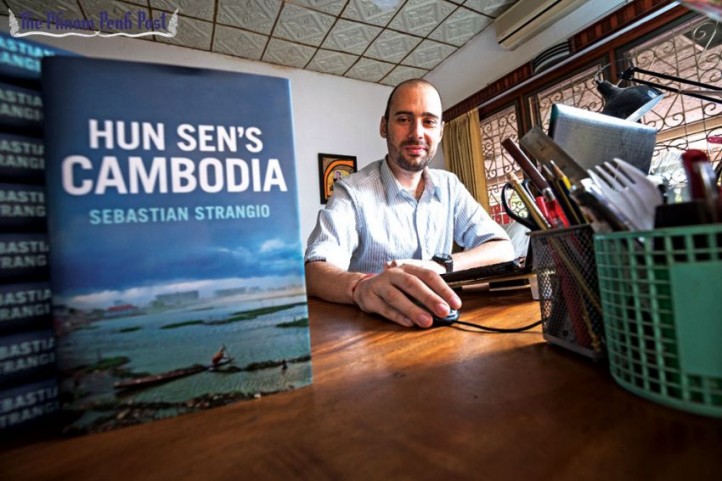
Hun Sen’s Cambodia by Sebastian Strangio, a former journalist with the Phnom Penh Post, helps to fill a number of historical gaps in charting the rise of Hun Sen through the 1980s to the 2013 elections. The young foreign minister was a fast learner. Appointed prime minister in 1985, Hun Sen soon boldly charted an end to the civil war. In 1989 he gave the country a new name — the State of Cambodia — as well as a new flag and constitution, and shrewdly paved the way for an eventual peace settlement in Paris.

Unfortunately, Strangio’s attempt to record recent Cambodian history is marred by an obsessive desire to view every topic through same prism: the legacy of UNTAC — the UN peacekeeping mission (1991-93). Also pervasive is the author’s conviction that in every field Cambodia’s achievements are nothing more than a “mirage.”

A confident Hun Sen already the prime minister ,dares to swim in a Kampot river in spite of Khmer Rouge insurgents still active less than  25km away.

A confident Hun Sen already the prime minister ,dares to swim in a Kampot river in spite of Khmer Rouge insurgents still active less than 25km away. Photo copyright: Tom Fawthrop

Cambodian Reform

Cambodia has clearly made great progress in the last 30 years.

The nation was reborn in the 1980s. Peace returned in 1999. Cambodia long ago lost its regular place on TV news as one of the world’s most dangerous war zones. The magic of the ancient temples of Angkor and the nation’s cultural revival now once again captivate visitors. Both tourism and the garments industry have fueled economic growth.

Moreover, Cambodia is less repressive than many ASEAN governments, including Thailand and its cycle of military coups. Yet, according to Strangio, multiparty elections offer only a “mirage of democracy.”

In Cambodia’s last election, Hun Sen’s ruling party suffered a stunning loss of 22 seats, with the united opposition coming in a strong second with 55 seats in a national parliament of 123 members.

It’s too soon to dub this a “Phnom Penh Spring,” but Cambodia’s political diversity is more than just a mirage, particularly in comparison to the long-serving prime ministerial reigns ofMahathir Mohamad in Malaysia (22 years) and Singapore’s Lee Kuan Yew (31 years). Malaysia and Singapore have never tolerated the strikes, protest rallies, and vociferous opposition that are all welcome features of Cambodian political life.

Cambodia, according to Strangio, was the nation where the UN and Western aid lavished billions of dollars on peacekeeping, implanting liberal democracy and human rights. The author assumes that Cambodia could make a smooth and rapid transition from the genocide and cruel deprivation of the 1980s to a shining beacon of democracy today. Of course that fantasy has not happened. The author concludes that the ruthless intransigence of Hun Sen and his ruling party, abetted by a traditional Cambodian resilience to foreign mentors of all ideologies, thwarted the allegedly benign, well-meaning Western efforts since the end of the Cold War to create a democratic success story.

In so doing, the author fails to detect a “mirage” of a different nature that did not come from any Cambodian failures, but can be squarely laid at the door of Western nations sitting in the UN Security Council.

Flaws of Peacekeeping

The UNTAC peacekeeping operation has been widely hailed as a great success story that ended the Cambodia conflict and ushered in a putative new democracy.

The UN-run election in 1993 did help implant democracy in Cambodia. However, the author glosses over the failure of UN peacekeeping and Western nations to get rid of the Khmer Rouge bases sustained and supported by the Royal Thai Army in blatant violation of the 1991 Paris Peace treaty.

From 1993-1998, the Pol Pot nightmare continued to haunt the fragile new state. The Khmer Rouge still controlled the gem-rich border province of Pailin and Anlong Veng to the north. They still planted landmines and burned down remote villages that defied them.

The war continued because the United States, France, and the UK all gave a much higher priority to preserving their deep military and trading ties with Thailand than putting pressure on this important ally and its military to sever the supply lines to the outlawed Khmer Rouge.

It was an elected Cambodian government led by Hun Sen — and not the UN — that finally eliminated the Khmer Rouge insurgency. On this point the book accepts that many voters in the 2003 election felt relief the war was finally over and rewarded the government with a strong mandate. Having secured the peace where the UN had failed, Hun Sen reached the zenith of his popularity at home.

In 2003, I wrote that if Hun Sen had retired around this time, his achievements and his legacy would have outweighed his dark side. But since peace and stability returned to Cambodia, corruption and looting of natural resources have boomed, with the prime minister’s close associates as the main beneficiaries.

The book rightly points out that 20 years of Western aid has only spawned an aid-addicted dependency. But Hun Sen hardly invented crony capitalism, corrupt patronage, or the skimming off of foreign aid.

The World Bank’s neoliberal development model of sweeping privatization and starving the public sector of any significant aid has also encouraged or tolerated cronyism in the scramble over newly privatized assets and the mass eviction of the urban poor. The opposition has failed to offer a real alternative to Hun Sen’s adoption of the neoliberal model of development designed by the World Bank. Neither side has come up with policies that could narrow the yawning gap between rich and poor.

Hun Sen must take a lot of responsibility for the ugly side of Cambodian development. But the book’s depiction of Western government aid as always benign and benevolent suffers from a lack of critical questioning.

Transitional Justice

Strangio dismisses the landmark trial of a few surviving leaders from the genocidal Khmer Rouge regime — Asia’s first case of international justice — as just another deception.

But the complex UN-backed tribunal brought together local and international lawyers and judges based on a UN partnership with the Cambodian authorities. Many cynics predicted that the trial would never take place. Whatever the shortcomings of this legal process, millions of Cambodians belatedly experienced a very real justice. They finally saw Pol Pot’s chief accomplices held to account, given a fair trial, and convicted of crimes against humanity.

According to UN legal expert Lars Olsen, Cambodian participation in the process exceeded that for all previous international justice courts. In addition to the 500 Cambodians who filled the public gallery day after day, they also participated as victims and litigants known as “civil parties.” Most victims have expressed some satisfaction that the tribunal brought a sense of accountability, closure, and justice.

That Cambodia was brave enough to face its tragic history should alone command international respect. Indonesia is still afraid to document and investigate the skulls in its own cupboard: the massive bloodbath in 1965-66, with an estimated 900,000 dead, and the subsequent atrocities in East Timor.

If the United States and its allies had not helped the Khmer Rouge hang on to Cambodia’s seat in the UN General Assembly and blocked the credentials of the Heng Samrin government, this genocide tribunal could have taken place more than 25 years ago, as Hun Sen proposed in 1986. As it is, the ongoing tribunal is a case of far better late than never.

Why has Hun Sen, a leader from such humble origins, subsequently turned his back on the poor majority of Cambodians and their cry for land and justice? What kind of egomania has driven him to want to remain prime minister until the age of 72?

Strangio should have put these questions to Hun Sen in an interview.

Yet despite five years of commendable research, Strangio’s book doesn’t rely on any interviews with his prime subject. So we never get any of the answers that might have truly illuminated Hun Sen’s character, or any deeper insights in why he has chosen the path of electorally sanctioned authoritarianism and feudal-style patronage — a hallmark of the 1960s under the rule of Prince Norodom Sihanouk.

Tom Fawthrop is a frequent contributor to ExSE.  He directed a Cambodian film Dreams and Nightmares broadcast on UK Channel 4 in 1989 and has interviewed Hun Sen on three occasions. He is also co-author of the book ‘ Getting away with Genocide?”  Pluto Books 2004.

This review was originally posted here on the FPIF website on February 15, 2015 and is reposted with the permission of the author.  

Leave a Comment

Filed under ASEAN, Cambodia, Cold War, Current Events, Economic development, Reviews, SLIDER

China & Europe: Reconnecting Across a New Silk Road

chen 1

Since 2013, economic and trade relations between China and Europe have grown significantly. In this article, the authors look beyond conventional economic indicators, like trade, and political issues, like human rights, instead focusing on transport infrastructure, real estate and tourism to show that a new page is unfolding in the history of China-Europe relations.

China and Europe have been closely linked since the Opium Wars, but the relative economic positions and power have reversed. Nothing illustrates this more symbolically than a stroll along the Bund in Shanghai: the low rise and old European-style buildings on the West side of the Huangpu River are dwarfed and eclipsed by the sparkling skyscrapers in Pudong on the east bank. The built environment of Shanghai, with its historic European-style buildings and modern China-built skyscrapers, is a physical manifestation of the reconfigured dynamic between China and Europe.

Since 2013, China’s connections with Europe have expanded since developing its official policy of building a westward economic corridor — a new Silk Road — along its ancient route. Most recently, in December 2014, China agreed with Hungary, Serbia, and Macedonia to build a rail link between Budapest and Belgrade, which will be financed by Chinese companies and completed by 2017. This rail line will then be connected to the Macedonian capital of Skopje and the Greek port city of Piraeus where COSCO, the Chinese shipping giant, operates two piers for container units. While the linked land-sea project will strengthen cross-border transport between Central and Southeastern Europe by reducing train travel times between Budapest and Belgrade from eight to three hours, it really is designed to enlarge and accelerate the movement of goods between China and Europe.

Having grown fivefold since 2003, trade between China and Europe reached $559 billion in 2013, solidifying the EU as China’s largest trading partner for the past 10 years. While the EU has invested more in China than the latter’s direct investment in the former, a US consulting company expects the EU to attract $250-500 billion more Chinese direct investment by 2020.1 A scenario likely to occur in the next few years is that China will invest more in Europe, instead of vice versa. This will be another telling sign that fortune and power are shifting in China’s favour.

These developments are not isolated and random. They represent a new structure of interactions between the older European economies and a rising Chinese power. We can understand this structure well by examining its conventional macroeconomic dimensions of bilateral trade and investment. In this essay, however, we make better sense of the new China-Europe relationship through a set of less used lenses: transport infrastructure, real estate, and tourism. They offer new insights into areas where China exerts a large and heavy footprint in Europe, via official channels and from the ground up.


Transport Infrastructure and Connectivity

In thinking about China and Europe today, transport infrastructure does not usually come to mind due to the long distance between them and Europe’s own well connected transport networks. Having built the world’s longest highway, railway, and more bridges and buildings than any other country over the past two decades, China has been constructing an extensive transport and municipal infrastructure within its Asian neighbours and far-flung African cities.2 More recently, China has also turned to Europe in strengthening their long-distance transport connections, aiming to improve the overland movement of traded goods. Less expected is China’s new foray into the domestic infrastructure sector of a few European countries. Both moves make infrastructure a major avenue for China to forge direct physical connections to Europe.

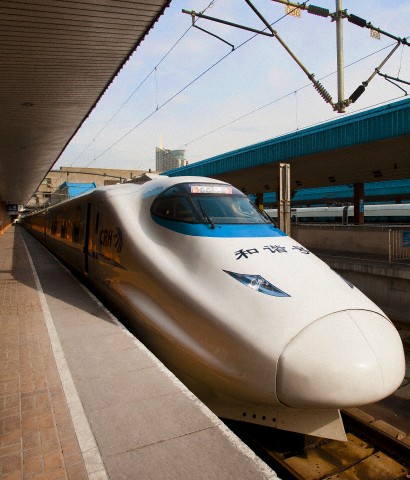
The most important connection thus far is the Trans-Eurasia railroad from the city of Chongqing in southwestern China to Duisburg, Germany. Launched into operation in 2011 by a joint venture with Germany, China, Kazakhstan, and Russia, the 11,179-kilometre rail line snakes through six countries including Belarus and Poland (see Figure 1). China is the largest beneficiary of this freight-focused rail network, having already shipped $2.5 billion worth of goods on this route to Europe since 2011. As labour and land costs in coastal cities like Shanghai and Shenzhen have gone up, the Chinese government has been pushing and inducing foreign investors and domestic producers to move inland through its “Go West” policy. Interior megacities like Chongqing and Chengdu have been booming as major destinations for large new manufacturing projects. Having set up what would be Asia’s largest laptop factory in Chongqing, US computer giant Hewlett Packard has already shipped more than four million notebook computers to Europe by the Chongqing-Duisburg rail since 2011.

chen 2 chian-map


As manufacturing becomes more concentrated in Chongqing and Chengdu, it will reap more savings from reduced transport costs. About 60% of the material inputs for laptops and 30% of the finished laptops depend on rail transport. Bringing them in and out by sea is very expensive and time-consuming. It requires a long train ride to Shanghai or Hong Kong from where container units are shipped to Europe. In the other direction, growing demands in interior China for European foods and cars can also benefit from a greater use of the Chongqing-Duisburg rail connection. It typically takes 2-3 months for a customer in Chengdu to receive the delivery of a European car by sea as it has to come through the port city of Tianjin. This wait can be reduced to 25 days if the car is transported by train from Europe to Chengdu.3

While this overland rail route can yield major economic benefits for China and Europe, its greater potential won’t be realised without policies for overcoming existing barriers. The Chinese government has recently approved the status of an international land port for Chengdu and Chongqing. This allows the direct and full import of European meats and cars to fill the train cars going back to China that would otherwise only be partially filled after carrying full loads of exported electronic products to the European markets. A fully loaded train has recently brought car parts from Germany to a Ford plant in Chongqing using the Trans-Eurasia railroad.

Another obstacle is that Chinese and European railways use different gauges than Russia and its former satellite states. So far the Chongqing to Duisburg route has met this standardisation challenge by transferring to cars with new gauges at relevant border crossings to meet varied national track requirements. It will need to adapt to other differences in technologies, signalling systems, and gauges that add costs to coordination across several countries.4 However, the existing and potential benefits for China and the other countries along this rail route will motivate them to co-operate in overcoming the remaining hurdles. So far it is China that has been moving at full speed. It has already sent a total of 239 (100 during the first seven months of 2014) trains carrying container units to Europe, including a train from the city of Zhengzhou in the central province of Henan bound for Hamburg.5

As China’s rail transport connections to Europe multiply, China has also launched an infrastructure build-up within Europe with an initial focus on the geographically closer and economically weaker Central and Eastern Europe. In December 2014, China and Serbia inaugurated the first ever bridge in Europe across the Danube River financed and built by China. Named after Mihajlo Pupin, a renowned Serbian scientist, the 1,500-metre bridge connects the southern industrial district of Zemun with the northern residential area of Borca in Belgrade, cutting the travel time across the Danube from more than one hour to just 10 minutes. China has also landed the contracts for the Stanari Thermal Power Plant in Bosnia (up to $1.7 billion) and the Bar-Boljare motorway in Montenegro with a link to Serbia ($984 million).6 Infrastructure projects of this scale have been very rare in these countries for more than 20 years, given the bad economic conditions in Croatia, Serbia, and Bosnia-Herzegovina, with nearly 1.5 million unemployed, due to the post-Yugoslavian political instability, ethnic conflicts, and natural disasters like flooding. China’s major efforts to finance and upgrade the outdated transport and municipal infrastructure in these countries opens up a new era of China’s local presence and influence in Europe.


Going After European Property

As China is making inroads into Europe’s infrastructure sector, the real estate sector cannot be far behind as an investment target. Southern European countries like Italy and Portugal, which have been adversely affected by the financial crisis, are seen as especially good opportunities for Chinese investors, as the property prices there are lower than in other European countries, like the United Kingdom and France, that have managed to weather the crisis better. Homes in southern Europe are also attractive compared with those of China as 300,000 euros buys a 200 square metre villa facing the sea. That amount only buys an apartment of 68 square metres in central Shanghai7 where property prices have been artificially inflated due to years of speculative supply and persistently strong demand.

Besides their low property prices, countries such as Cyprus, Portugal, and Greece are offering resident permits to property buyers who are not already residents of the European Union. This appeals to Chinese investors who have the capital to buy the properties but not the residency or citizenship benefits to use them within Europe. In exchange for a minimum amount of investment in property in a European country (amounts vary depending on the country, but the starting price is generally upwards of 250,000 euros), the investor may be granted a visa that allows him or her to live and travel within the Schengen Area, which consists of 26 European countries. A recent trend among Chinese investors is to buy a property in Southern Europe and then secure permanent residency there once their visas have been approved. A reporter from Bloomberg observed that “most (Chinese investors) are getting homes for personal use or to send their children to schools there.”8 By July 2014, Chinese citizens had received 282 of the 1,880 “golden visas” or permanent residencies granted by the Spanish government to those who bought local property.9 Since October 2013, the Portuguese immigration office has approved 1,681 property purchase applications, 1,429 of them from China, about 85% of the total.10

Besides property value and permanent residency, the measure of the Chinese yuan (RMB) against the euro is another important consideration, and one that has contributed to the rise of Chinese investment in European property. The euro depreciated approximately 17% against the yuan from 2010 to July 2014. Chinese investors bought 3.05 billion euros’ worth of European property in 2013, an increase from the 978 million euros spent in 2012. The Financial Times found that Chinese direct investment in Europe tripled in just two years (2010-2012), from 9 billion euros to 27 billion euros.11


chen 3 comp-pic-copy

The large volume of this investment in European property reflects a major shift in China’s overall outbound investment, from securing natural resources in developing countries to acquiring brands, technology, and other assets in developed countries. A major Chinese real estate developer has recently committed $1.6 billion to convert the derelict Royal Albert Dock in London into a global trading hub. Intended to attract Chinese companies as tenants, this project is planned for 4.5 million square feet of office space to be developed in phases through 2020. London’s Mayor Boris Johnson has strongly endorsed this project for its prospect of generating about $10 billion for the national and local economies. He has lauded the project’s potential ability to turn what was once one of “the throbbing arteries of UK trade and commerce” into “a world-class international business district.”12

In June 2014, Wang Jianlin, one of China’s largest real estate investors and richest men, bought the 25-story Edificio España in Madrid, a landmark Franco-era building that was also Spain’s tallest, for 265 million euros or $340 million. Sitting empty since the Spanish real estate market’s collapse in 2008, the building will be renovated to include luxury apartments and a hotel as part of a larger-scale neighbourhood regeneration.13

The scope of Chinese investment in European property represents a powerful combination of China’s surplus corporate and private capital that can affect the urban landscape in European cities. Its long-term impact, however, will depend on the pace and volume of its outflow from China, and its geographical concentration and spread within Europe.


Big-Spending Chinese Tourists

As a relatively small but growing number of wealthy Chinese investors put their money into European real estate, a much larger number of middle and upper middle class tourists from China are coming to Europe to buy a lot of luxury goods. China’s rapid economic growth has created a huge number of middle and upper middle class consumers with insatiable desire and startling purchasing power. In 2013, Chinese citizens made approximately 100 million overseas trips and spent over $100 billion on their trips, mostly on luxury goods, overtaking the United States and Germany as the world’s number one tourist spending nation. Today nearly one-third of the world’s personal luxury goods are bought by Chinese consumers.

In 2014, Europe accounted for 3.5% of overseas travel destinations for Chinese citizens; this was the second most popular regional destination after Asia, which accounted for 70.4% of overseas tourism. Visa applications to enter the Schengen Area from China accounted for approximately 1.5 million of the total applications in 2013, ranking China third overall, behind Russia and Ukraine.14 In its 2014 report, hotels.com observed that “European destinations are the most popular amongst Chinese travellers in terms of places they wish to visit in the next 12 months.” By surveying the number of rooms and the length of stay in hotels booked through its website, hotels.com placed France, the United Kingdom, and Italy in the top ten destinations for Chinese travellers in 2013 as all three countries experienced growth in the amount of tourism from China.15The German National Tourist Board recently showed Germany, France, Italy, and Switzerland as the top four European destinations for Chinese tourists.

While many Chinese tourists in Europe are interested in seeing sites of historical interest and established landmarks like the Eiffel Tower and Venice’s Grand Canal, they are there for a much more passionate interest: shopping, especially for brand-name and luxury goods. Paris is the most popular destination for this shopping spree. It is where Chinese tourists head to the Louis Vuitton shops in much larger numbers than to the Louvre. As early as 2009, Chinese tourists overtook Russians as the highest spending visitors to France. Wealthy Chinese tourists also head south to the wine country of Bordeaux where they snap up expensive wine, paying as much as $800 for a bottle.16 They bring the wine back to China where it can be displayed and then drunk as a prized possession; red wine has become increasingly popular at dinner parties, replacing beer and traditional Chinese liquor.

McKinsey’s survey of Chinese luxury consumers in 2012 found that “Europe is growing in appeal among Chinese luxury consumers, with about one-fifth of them reporting this year that their most recent overseas purchases occurred in a European city. That is more than double the European share two years ago.”17 A study by the European Travel Commission estimated that Chinese tourists reserve more than a third of their trip budgets for shopping. To be able to do so, they compromise on eating and sleeping. A survey in 2006 found that Chinese travellers in Europe had eaten “European food” only once, and 10% not at all. Many in tour groups arranged by Chinese travel agencies would stay in cheaper hotels and eat instant noodles, even though they could afford luxurious hotels and lavish meals.18 The average Chinese tourist spends around $5,000 during a European trip, more than any other country. This is not surprising when one often sees groups of Chinese tourists getting dropped off at expensive stores and coming out with their suitcases full of brand name clothes, handbags, and cosmetics.

There are several reasons for Chinese tourists to buy luxury goods heavily in Europe. Besides the obvious factor of their rising affluence, Chinese tourists pay less for luxury consumption in Europe than in China. Taxes on certain items and tariffs on imported goods increase the price of luxury goods produced elsewhere and sold in China. According to The Economist, taxes and tariffs can increase prices in China to 50% more than a shopper would pay elsewhere. For example, a Louis Vuitton handbag costs 30% more in Beijing than in Paris.19 The purchase of luxury goods while travelling in Europe connotes the high income and status of the consumer. A study published by the University of Pennsylvania’s Wharton Business School found that “travelling has become part of the luxury lifestyle in China and is considered a status symbol: there is greater cachet in being able to say you purchased your bag at the place of origin in Paris rather than a branch in Tianjin.”20 Chinese consumers also perceive a higher quality and a greater variety of luxury goods if bought in the places of origin. In addition, while the appreciation of the Chinese yuan against the euro has helped, Chinese tourists have benefited from a greater ease in getting European visas.

European countries have made getting visas easier for Chinese tourists. Recent initiatives include changes in the visa process for tourists wishing to visit the Schengen area. Visa applications can be submitted up to six months in advance instead of three, allowing people to plan their trips earlier, and travel medical insurance is no longer required. The time it takes to process applications from China has been reduced. When Chinese Premier Li Keqiang visited Germany in October 2014, the two sides agreed to reduce the visa application process from between three and five working days to 48 hours for Chinese tourists. The French embassy in China also shortened its visa processing time for Chinese visitors to 48 hours and simplified the application documents. Italy has already cut its visa approval for Chinese tourists to 36 hours. The United Kingdom has recently introduced the 24-hour Super Priority Visa service in Beijing, Shanghai, and Guangzhou. With 12 visa application centres across China now, the United Kingdom issued more than 320,000 visas to Chinese tourists during January-August 2014, the highest number ever.21 This competitive rush of European countries to simplify and speed up visa applications for high spending Chinese tourists will help boost their sluggish economies.


Money and More

The sum of Chinese investment and spending in Europe’s infrastructure, real estate, and tourism sectors amounts to a huge influx of money that reflects the changed economic positions of China and Europe and their long-distance connections. Many may see this as the relative decline of Europe and the continuing rise of China that implies a reversal of power and fortune. But there is both change and continuity to the new China-Europe relationship that makes it more complex than a one-way flow of surplus Chinese money. In 2013, the EU invested $6.5 billion in China, up 21.9% from 2012, which doubled China’s $3.6 billion in the other direction, an increase of only 6.2%. While this sustains the earlier pattern of bilateral investment, individual European countries have taken more differentiated economic approaches in dealing with China. Through the agreement between the Bank of England and the People’s Bank of China to clear and settle Chinese currency in London, the British government has gone ahead of most other European countries in making London the leading hub for trade with China. By the end of 2013, China’s cumulative investment in the United Kingdom reached $32 billion, far exceeding the $18 billion the other way around.22 Not to be left behind, Switzerland’s central bank joined its Chinese counterpart in January 2015, making Zurich Europe’s newest hub for trading the Chinese currency (RMB). As the China-Europe economic relationship becomes stronger, it has become more varied and specific to individual countries.

chen 4
The uneven penetration of China’s economic influence has begun to generate a sort of cultural backlash, which is illustrated by a recent cartoon that made the cover of Fluide Glacial, a French monthly comic book (see Figure 2). Despite an underlying negative headline of “Yellow Peril: What if it is too late?” the restaurant window shows a harmless sign: “Chinese spoken here.” But the joke is a man bearing the words “I am hungry” sitting at the door of a restaurant that advertises steamed Chinese dumplings with a French twist: the addition of béarnaise sauce. Adding to the insult is a Frenchman pulling a rickshaw that carries a Chinese man in traditional high-class clothing with a blonde European woman. The humour aside, this cartoon reveals an unfavourable view of China, or at least its economic wealth in Paris and in Europe. It immediately drew a harsh response from The Global Times, a Chinese daily with close links to the government, saying that the French magazine possibly attempted to gain attention by following Charlie Hebdo whose Paris offices were savagely attacked by Islamist gunmen on January 7, 2015.

This media episode matters little to the massive scope of China-Europe interactions. When we look beyond conventional economic indicators like trade and political issues like human rights as in this article, we see a new page unfolding in the history of China-Europe relations. While it features continued bilateral official policies that have led to new infrastructure deals, bottom-up activities in real estate investment and tourism have become more prominent. With the Trans-Eurasia railroad already in operation and millions of Chinese tourists moving around Europe, China’s ancient dream of connecting to Europe via Central Asia along the old Silk Road has come true. Yet the new Silk Road envisioned by China for the 21st century is just beginning to take shape. Its full opportunities for both China and Europe are yet to come.

This article was written by Xiangming Chen and Julia Mardeusz and originally published here in the European Financial Review on February 10, 2015.

About the Authors


Xiangming Chen
is the Dean and Director of the Center for Urban and Global Studies and Paul E. Raether Distinguished Professor of Global Urban Studies and Sociology at Trinity College, Connecticut, and a distinguished guest professor at Fudan University, Shanghai. He has published extensively on urbanisation and globalisation with a focus on China and Asia. His many books include Shanghai Rising: State Power and Local Transformations in a Global Megacity (University of Minnesota Press, 2009; Chinese Edition, 2009).

Julia Mardeusz is currently a junior at Trinity College, Connecticut, majoring in Public Policy and Law. Her interests include American public policy and European politics and policy. She has been a student researcher at the Center for Urban and Global Studies at Trinity College since 2013 and studied in Paris during fall 2014.


References

1. Reported by The People’s Daily, June 23, 2014, p. 4.

2. See Xiangming Chen and Curtis Stone, “China and Southeast Asia: Unbalanced Development in the Greater Mekong Subregion”, The European Financial Review (August 2013). pp. 7-11; Xiangming Chen and Garth Myers, “China and Africa: The Crucial Urban Connection”, The European Financial Review (December 2013). pp. 89-93.

3. “European meats are transported directly to Chengdu”, The People’s Daily, April 26, 2014, p. 6.

4. “’Silk Road’ railways link Europe and Asia”, The Gateway, CNN News, June 27, 2013; accessed from http://edition.cnn.com/2013/06/27/business/silk-railroad-trading-network/.

5. “The 100th China-Europe train this year has departed”, The People’s Daily, August 2, 2014, p. 1.

6. “Li forges new link in Serbian relations”, The China Daily, December 19, 2014, p. 1.

7. Henrique Almeida, “Needy EU nations woo Chinese home buyers to ease slump,” Bloomberg News; accessed from http://www.bloomberg.com/news/2013-08-21/needy-eu-nations-woo-chinese-home-buyers-to-ease-slump.html.

8. See note 7.

9. “Sale of a landmark skyscraper puts Spain on the map of Chinese investors”, The New York Times, September 23, 2014, p. B3.

10. Fu Yao, “A place in the sun”, NewsChina, February 2015, pp. 34-37.

11. Jamil Anderlini, “Chinese investors surged into the EU at height of debt crisis,” The Financial Times, October 6, 2014; access from http://www.ft.com/intl/cms/s/2/53b7a268-44a6-11e4-ab0c-00144feabdc0.html#axzz3NduHcZzt.

12. “Chinese developer envisions a future for abandoned London docks,” The New York Times, Business Section, February 19, 2014, pp. B1, B6.

13. See note 9.

14. National Tourism Administration of the People’s Republic of China, “European Countries Fight for Chinese Tourists”, accessed from http://en.cnta.gov.cn/html/2014-7/2014-7-3-9-57-70413.html.

15. Hotels.com, “Chinese international travel monitor 2014”, p. 21; accessed from http://press.hotels.com/content/themes/CITM/assets/pdf/CITM_UK_PDF_2014.pdf.

16. “A new grant tour”, The Economist, December 10, 2010, p. 114.

17. Atsmon, Yuval, Diane Ducarme, Max Magni, and Cathy Wu, Luxury Without Borders: China’s vNew Class of Shoppers Take on the World. The McKinsey Chinese Luxury Consumer Survey, McKinsey Insight China, December 2012; accessed from https://solutions.mckinsey.com/insightschina/.

18. See note 14.

19. “China’s addiction to luxury goods”, The Economist, April 29, 2014; accessed from http://www.economist.com/blogs/economist-explains/2014/04/economist-explains-17.

20. Knowledge@Wharton Blog, “Louis Vuitton and the traveling Chinese consumer”, Knowledge@Wharton, January 3, 2012; accessed from http://knowledge.wharton.upenn.edu/article/louis-vuitton-and-the-traveling-chinese-consumer/.

21. “European countries compete for Chinese tourists”, The China Daily, Travel Section, December 20-21, 2014, p. 19.22. Reported in The People’s Daily, June 20, 2014, p. 4.

2 Comments

Filed under China, Current Events, Economic development, Foreign policy, SLIDER

Laos Vegas: Rolling the dice on rural development

OLYMPUS DIGITAL CAMERA

In Lao PDR, there are three large casinos presently in operation: the Savan Vegas Hotel and Casino, the Kings Roman Casino and the Dansavanh Nam Ngum Resort. They are facing controversies over forced evictions, dispossession of farmlands belonging to the local rural communities, and are ridden with mafia-style armed fights among rival casino and investor factions. In January 2005, China’s anti-gambling campaign forced many casinos and small gambling houses to move to countries on China’s southwestern border including Myanmar, Laos, and Vietnam. Meanwhile, Lao officials and others, including middlemen and land developers, are reaping the cash benefits from this so-called rural development.

“The damned Chinese are taking over Laos,” the words spat out of a farmer whose nickname is Khoua living in the northern province of Luang Nam Tha. He was mouthing what most Lao people believe. Rural people dispossessed of land, urban dwellers witnessing the slow demise of their once elegant cities, all blame the mainland Chinese. Their presence is increasingly obvious, whether it be in the high speed motorcades blasting though Luang Prabang or in the proliferation of Chinese enterprises and their gargantuan construction projects, many of which lie echoingly empty and idle after completion. The influx of Chinese workers is affecting the local people’s chances of employment or skills training. But in the midst of frustration about the Chinese presence, what often goes unremarked or largely forgotten is that the Chinese are there as a direct result of the investment policies of the Government of Lao PDR, with many benefits from power to wealth being reaped by a long line of Lao officialdom.

When the author visited the area in November 2012, there were massive boards advertising the latest megaproject. Some provinces like Oudomxai north of the capital are more Chinese than Lao. That being said migrations and state borders have shape-shifted over the centuries blurring ethnicities and cultural loyalties. But what is obvious is the anger and resentment aimed at China while at the same time failing to recognise the agency and responsibility of the Lao government in ceding land and concessionary deals in return for investment and bribes.

This development complexity is best exemplified in the huge (and often bizarrely designed) casinos and gambling establishments that are expanding under the same perseverating rhetoric of development and poverty alleviation by which large dams and roads are being built. While these casinos have been written about in the mainstream media, very little analysis has been done about what they mean for rural people and their livelihoods.

Ferries bringing patrons across from Thailand and China for gambling (Photo by Melinda Boh.)

Ferries bringing patrons across from Thailand and China for gambling (Photo by Melinda Boh.)

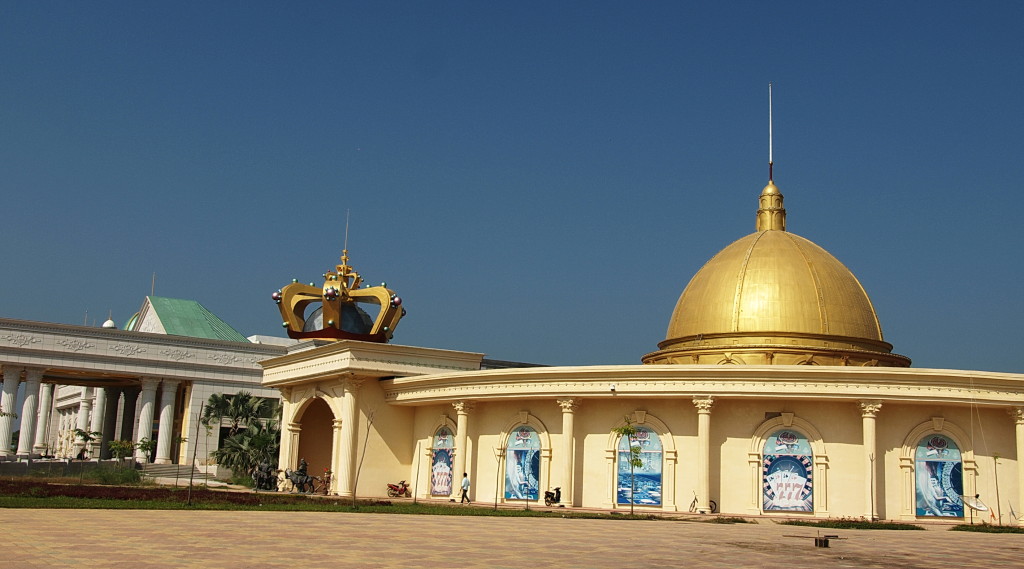
From Chiang Saen in Thailand’s north, the white colonnaded building across the river, topped with a huge gilt crown is a bizarre sight. From Huay Xai in Laos, a potholed road through farmlands leads to the casino complex. The car suddenly jolt-lands on to thick cement, marking the casino’s boundary in Dork Ngoui Kham. Half an hour later we spot the golden cupola, its clock set on Beijing time, marking Bokeo Province’s Special Economic Zone (SEZ) office.

The nearby King Roman casino reveals plaster toga-clad statues alongside Chinese patriarchs and the symbols of the newest local religion: gambling. Parked nearby were two stretch limousines. Inside the building, men in suits gambled at the tables. “Kunming officials doing a site inspection,” was the official story from an attendant.

The only Lao person we saw was a farmer on a dust-covered motorbike with his equally dust-covered wife, narrowly avoiding being pushed into the Mekong River by the boat passengers.

The concession area includes archaeological treasures, importantly the ruins of a 16th century city reputedly built by King Setthatirat. Other remnants, possibly from the Mon empires of the first millennium CE, are considered to be of World Heritage value. Instead they may end up under the runway of an international airport planned to bring patrons in, but fiercely resisted by the local farmers. History will be replaced by what appears to be a gambling based narco-empire, where anything goes. For Laos, it means that some of the most fertile arable land and considerable archaeological treasures would soon be buried under asphalt to feed the gambling industry.

Stretch limousines pick up selected high rollers from the airport (Photo by Melinda Boh.)

Stretch limousines pick up selected high rollers from the airport (Photo by Melinda Boh.)

Civilising

Defending the casino and entertainment complex, a senior Chinese manager told researcher Pal Nyriri: “Before it was opium and drug businesses. There were no roads, no electricity … Laos is developing and it [the casino] is good for them.”

Zhang Wei, the casino’s principal developer, told Thai sociologist Pinkaew Laungaramsri of Chiang Mai University: “The biggest obstacle is that villagers … do not understand us. We have rented all the land and forest … but they … cut … or burn them. We can’t go around, arresting or beat up (sic) and fine the villagers who burn our gardens … it will cause ethnic issues.”

A local NGO worker, requesting anonymity, recalled taking a Chinese delegation to the site in 2009. “The three Government officials, a journalist, an environmentalist and a few academics were shocked at what they saw. ‘This gives China a bad image,’ they said. When we stopped; a crowd of up to 70 to 100 village people assembled shouting that they would not give up their land. The area is one of the most fertile and productive in Laos.”

They pointed to a white Humvee. “That’s the local official. Zhang gave him and the (Lao) police the same cars.”

China may see itself as a civilising influence, drawing on its long and remarkable history, using its wealth and dynamism to bring rapid economic growth. But with its entrepreneurs building casinos like those at the Lao border, China risks reinforcing its growing reputation for exploiting its neighbours.

Because although it’s the Lao government’s party apparatchiks and provincial officials whose signatures and rubber stamps bless these casino developments, it’s China that gets the bad press, a point clearly understood by the visiting Chinese delegation. The development of ‘legal/ illegal’ states through the formation of SEZ’s has enabled the Lao government to consolidate power, and amass wealth, patronage and control, while portraying itself as a helpless lackey of China.

Laos is fast gaining a reputation as a lawless state. It has shown unwillingness to arrestwildlife trafficker Vixay Keosavang while it faces continuing criticism for its intransigence in not being serious about investigating the high-profile disappearance of Magsaysay award winner Sombath Somphone. Moreover, Laos continues to face allegations of human rights violations, money laundering and profligate illegal logging that are causing both international concern to its many foreign donors and local frustration.

The so called “red carpet”, the road being paved pink for the patrons (Photo by Melinda Boh.)

The so called “red carpet”, the road being paved pink for the patrons (Photo by Melinda Boh.)

SEZs and other confusions

The casinos in the SEZ epitomise the complexity of the modernist zeal with which the Government of Lao and China pursue investment. Observers like Danielle Tan have noted the SEZs bring a post-socialist neo-liberal model to the Lao-China border zones. For nations that expound socialism and wisdom of central control, this is a strange choice. Neo-liberalism increases state income through taxes, exploits labour and expropriates land from traditional owners and farmers. The renowned sociologist Pierre Bourdieu considers neoliberalism “a program for destroying collective structures”, and even nations themselves.

With their confused legal frameworks and ambiguous status, SEZs invites all sorts of temptations. The implicit freedom tempts the seamier side of legitimate trade and investment particularly in the fabled Golden Triangle. Added to this mix, the Chinese fascination with gambling and luck makes Bokeo’s proximity all too tempting.

Along with disappointed losers, Tan found evidence of drug sales and money laundering, while Li Quan a London based tiger conservationist, told the Global Times that Lao casinos were trading posts for endangered species. Others are worried about child trafficking, rape and tax farming 1.

Tan alleges that the former military junta and drug lord Lin Mingxian is a major investor in the King Roman Casino, a charge denied by Zhang Wei. Ying and Zhang, of China’s Institute of Contemporary International Relations (CIR) and part of the 2009 delegation, agreed, writing, “While the nominal boss of the Casino in Bokeo is a Fujian native with a Hong Kong passport, it is … likely… the real investor is a drug cartel from Myanmar.”

The other side of China’s double jeopardy is legitimacy. The Bokeo casino is a photocopy of those in Mong La (Myanmar) and Boten (Laos) both managed by Zhang Wei, and both closed by China after evidence of mafia-style gunfights and crimes. However the King Roman is within Lao sovereign territory, while the others were on international no man’s land.

The Vice Prime Minister of the Government of Lao PDR, Somsavat Lengsavad, reacted to China’s concern about ongoing casino development with assurances that no further concessions would be granted as “casinos were a bad model for Laos.” But barely six months later in March 2014, the Vientiane Times announced plans for another casino in the South.

In total forty-nine SEZs are planned. How many will have casinos is anyone’s guess, and pose a serious concern to China.

OLYMPUS DIGITAL CAMERA

Size matters

The CIR’s critical appraisal of Laos’ transparency backs Nyiri’s research revealing that the Government of Lao granted the Hong Kong registered King Roman group a concession for the Bokeo land in 2007, after a down payment of US$850,000.

Lao government media KPL reported 827 hectares were ceded for 40 years; the maximum allowed under Lao law, but at variance to the company’s own estimation of 10,300 hectares for 99 years. In 2010, Zhao reported the new casinos would be bigger in scale than those in Boten, bragging that US$500 million would be spent developing the site, more than ten times the Laos national health budget.

A resident of Huay Xai who declined to be identified, admitted the casino is run down: “The paint’s peeling and shops boarded up. Less people visit now. One rich guy hired some [Lao] cops to protect him, but they shot him and took his money. Despite joint patrols, we still have shootings, as the Chinese mafia are using the place as a staging post. Gamblers are afraid. As for the organic farms and markets they promised, well who would buy the stuff? The farmers who lost their land are now broke and they used to produce what the casino promised but never delivered.”

“The casino’s still trying for the airport, but there is well-organised resistance. The locals called in Thai TV. The Lao police arrested two cameramen and held them for two weeks. The Thai government responded by closing the border until they were released. Now it’s a stand-off. The PR risk is too high.”

China has its own problems with crime. What it does to curb the influence of its neighbour will be interesting to see.

Post script: In late 2013, the Lao media announced that the farmers had been given their promised settlement. The casino had agreed to pay a compensation amount that was found satisfactory to the government. Many on the Lao agribusiness list-serv cheered.

Following up on this story, I was told by the above long term resident of the area (new laws in Laos restricting critical media make me reluctant to name anyone for fear of recrimination) that the company had in fact offered compensation way over the odds as the farmers had been both successful in gaining publicity and in holding out, fearing the same poverty that had mired their neighbours.

But the informant said the Lao government refused to give their imprimateur to the negotiated rate fearing that the amount offered would set an unhealthy precedent for other areas of Laos, so the farmers were given a significantly reduced amount. Hence the term “found satisfactory to the government” does not mean what one might have assumed.

This article was written by Melinda Boh for the Mekong Commons website and published here on 1/31/15.  It is reposted in its entirety with permission from Mekong Commons and the author.  ExSE is excited to begin a new cooperative partnership with the Mekong Commons team in sharing analysis and reporting.

Leave a Comment

Filed under China, Economic development, Governance, Laos, Mekong River, SLIDER

China’s Upscaling of Potato Production Sprouts Controversy


Farmers in China's Gansu province show off increases in potato yields

Farmers in China’s Gansu province show off increases in potato yields

The Chinese Ministry of Agriculture started the year with an awkwardly named but nevertheless resonating event: at the “Potato Staple-ization Strategy Research Symposium” Vice-minister of Agriculture Yu Xinrong proclaimed that potatoess shall become China’s fourth staple food.  That netizens tweeted more than half a million responses on Sina Weibo about this denotes more than sheer curiosity. While many of the conversations focused on a perceived Chinese consumers’ tardiness in getting on the Columbian Exchange bandwagon, the announcement could have an impact throughout the country and affect the ethnic minority regions and the Southwest in particular.

Historically speaking, potatoes, an American contribution to the world’s food basket, quickly became a mainstay on the tables through most of the Old World, despite initial trepidation among the Europeans.  Research suggests they might have contributed extra nutrition and thus the population boom that brought about the Industrial Revolution. The Irish Famine ensued, and the rest of history is laced with potato jokes.

Spud Stigma

In China, however, spuds have largely remained within the category of dishes (菜) rather than the staple source of carbohydrates and thus energy of the meal (主食). Unlike the other new comer, corn, which has successfully shed its foreign flair, the name Western taro (洋芋) has stuck with taters and is further strengthened by deep-fried potatoes served up by fast food industry that positions it as a Westernized modern food choice. The association of potatoes with foreignness has also been brought to the New World by immigrants, and in a subaltern twist the term potato queen is used to describe Asian gay men that prefer non-Asian partners.

Besides foreigners, the other factor that gives spuds a bad name is poverty. An unnamed researcher has been widely cited saying that potatoes are the staple food for 75% of China’s officially poor counties, where potatoes are consumed “instead of cereals” up to half of the year. What’s more– a lot of that poverty is concentrated in ethnic minority areas: the backward denizens of supposedly sad places like Yunnan, Guizhou, and Gansu rely on spuds to scrape out a living.

The reverse side of the perceived unfortunate overlap between ethnicity, poverty, and potatoes is something that a southern Yunnanese acquaintance imparted over lunch the other day: spuds are grown for oneself. Adapted for a wide variety of ecological conditions and productive even in poor soils and under other unfavorable circumstances, potatoes provide easy and reliable sustenance. More importantly, in the words of anthropologist James Scott, potatoes can be “appropriation-free”: bulky, low in commercial value, and harvested intermittently, potatoes like other tubers are a good way of keeping the tax-collectors and their ilk at bay. It is no coincidence that potatoes are so prevalent in refuge zones as different as Guyuan in southern Ningxia and the balmy mountain slopes of Yunnan and Guangxi.

Cumbersome taters

While direct requisition of crops is not much of a concern for farmers today, especially since the abolishing of farming taxes in 2006, potatoes are nevertheless strongly affected by farming policies and national food security strategies. For justifiable historic reasons the Chinese government, which is linked to some of history’s worst natural and man-made famines and related unrest, at all levels is extremely concerned with ensuring availability of food. With national grain self-sufficiency as the core principle, the central government has consistently demanded and incentivized production of staple crops through a mix of administrative mandate to grow certain crops, direct subsidies to house-holders and larger producers, and intervention pricing. While intervention purchases and stockpiling has been extended to the somewhat-ridiculed strategic swine reserve, it still mostly focuses on grains and shuns spuds because of the difficulty of appropriation.

Unlike bacon, you can’t just put some taters on ice for a few years, or depending on the situation either cellar the spuds for a good while or alternatively sell at a commodities exchange in Chicago if the price is right. Potatoes don’t keep well and the bulk makes them a lousy commodity for shipping. Despite globally being the fourth most significant staple (hence the frequent misstatement in the press that somehow the UN has declared potatoes as one of the global four staples), the governmental preference for a government-focused national-level food security rather than rural household level food-sufficiency has led to spuds falling behind in output growth. However, food security (what the Chinese government calls 粮食安全, not to be confused with food safety – 食品安全) is primarily concerned with the provision of food at the national level through market mechanisms rather than household self-provision. In other words, there is no tater scarcity at the household level, where those who choose to grow them can have their fill, but that does not result in peaceful minds behind the planners’ desks.

It is not to say that potatoes are some sort of primeval anarchist food taking on the capitalist-with-Chinese-peculiarities hegemony. For one, local governments have been as quick as ever to get their paws in the potato pot and are pushing potatoes as one of the options for farming development. According to the National Statistics Bureau, between 2006 and 2012, total potato output increased by about 40%. That’s a solid increase of over more than 5% a year, albeit rather low when compared with the expansion of many other indicators over the same time period. According to the UN Food and Agriculture Organization, China is the world’s largest producer of potatoes. Mind you, the FAO estimate for 2006 exceeds the Chinese central government’s estimates 5-fold, so go figure on who’s right.

It would also be a mistake to say that there is much pride in the importance in the potato in the regions where potatoes are important to the diet. During a recent month-long research stay with various rural households in Ningxia, I heard several apologies for offering too many potatoes and not enough rice to the guest. My insistence that, having grown up on a Latvian potato farm, I gladly take spuds over rice any time was accepted with a polite smile and puzzlement over the impossibility of such a statement. The shame of living off potatoes even by those who grow them is an obvious obstacle in increasing the demand for fresh potatoes and possibly even derived dry goods.

Technical solutions

The drive to (let’s borrow a word from the Ministry of Foreign Affairs’ repertoire) hype spuds encounters the simplest of economic realities: if there was demand for potatoes the farmers would meet it despite regulations slanted against it. After all, regulations have not stopped urbanization and the emergence of a secondary market for theoretically untradeable farmland. And if indeed the potatoes were so good for you as some have suggested, the market would have overcome the consumer acceptance obstacles described earlier and we would be eating spuds left and right.

The Ministry of Agriculture’s decision to “staple-fy” spuds should be interpreted as increased pressure to expand potato production – the stated goal is to almost double the current reported plantations of 80 million mu to 150 million mu. That’s increase of almost half a million hectares. New investment in growing technologies and varieties will be made available, which has predictably caused knee-jerk concerns about potential weakly regulated experiments with genetic modification. It also means a push towards more industrially processed and thus durable potato products, particularly using potato starch that, unsurprisingly, transforms the crop into long shelf-life products favored by retail supply chain managers and government food provision planners alike. To celebrate the new national potato staple-ization strategy, Shanxi potato entrepreneur Feng Xiaoyan, who goes by @sisterpotato on Sina Weibo, has launched a product line of potato mooncakes.

And while you praise the crackdown on superfluous gifts and thus a reduced (albeit not eliminated) chance of getting your next year’s Mid-Autumn bonus in the form of candied fork floss covered potato starch mooncakes, the good folks in China’s agricultural research and development industry are getting ready to partake in the expected windfall in research funding and new experiments. Local government officials and their cousins who own the farming companies are looking forward to filling their coffers with infrastructure programs and potential subsidies.

A curious and unfortunate potential side-effect of expanded cultivation is the replacement of existing technologies and varieties with improved yields with the accompanying other side of the coin– disappearance of existing livelihoods and genetic as well as cultural diversity. While the farmers of hilly dry parts of Yunnan will not be marching down the streets of Kunming against Monsanto (in fact, poor Monsanto is unlikely to be able to stick its finger in this pie), the fact remains that intensifying farming can leave the growers and the rest of us with fewer resources for when the bad times of crop failure, pests, or climate change hit.

Interestingly, this year’s Central Government Document Number 1, the annual proclamation of rural and development priorities, did not address potatoes and did not call for any expansion of the staple policies to include new crops. The State Council might not be as excited about spuds as Ministry of Agriculture is. Just like many issues, this one will be decided in the well-ventilated halls of newly built governmental districts with limited direct public input. Regardless though of whether one roots for the spud or takes a more tater-phobic stance, the potato staple-ization controversy has stirred minds and brought to dinner table conversation some of the fundamental issues at play in Chinese agriculture, particularly in the economically marginal regions.

1 Comment

Filed under Agriculture, China, Current Events, Economic development, Food, SLIDER, Sustainability and Resource Management, Yunnan Province

Meet the Salween

salween

I heard the name “Salween” before. I didn’t know exactly where it is. I knew it was somewhere close.

Somehow its name portrays a feeling of fearless turbulence. Perhaps, it’s the sound of “S” and the rhyme between “ween” and a Thai word “wian” from the word “wonwian” meaning lingering and wandering which makes me think of the word “namwon” meaning whirlpool.

There is a legend about the two great sister rivers of Southeast Asia: the Salween and the Mekong.

And this is how the story goes:

One day, the two rivers decided to go to sea. They agreed to travel through the mountains together and stopped whenever they wanted to. The Mekong slowly spanned its waterline through the landscape while the Salween hurried its way to claim the frontline.

After rushing ahead, the Salween decided to stop for a quick nap to wait for the Mekong. Days passed and the Mekong was still absent. The Salween thought the Mekong took a chance when it was sleeping to get ahead—to be the first to see the ocean. Angry and feeling betrayed, the Salween rushed through the channels and aimed to destroy any rock that stood in its way. Its wild speed was felt by those living nearby. The Mekong, on the other end, finally arrived at where the Salween was napping. Not seeing its younger sibling did not push it to move any faster. The Mekong continued to crawl and collect waters along the way; it even went off-route to carry fish and water into Tonle Sap before it finally reached the sea.

It is said that many communities believe in this story, though I have only heard it from two people. The anecdote may vary. Though it does resemble the turtle and the hare tale, but stories and legends are much better tools to narrate and describe the difference between the two.

Perhaps, it is the Salween’s anger that makes it the last free flowing river in China and Southeast Asia until 2015.

The Salween is originated from the marshland in the Himalayan Plateau—the same glacial area where the Mekong and the Brahmaputra start their mightiness. It travels over 2,200 kilometres through southwest China, Thailand, and Myanmar. Most of the areas it nourishes are occupied by ethnic indigenous communities. In Yunnan alone, the Nu River  (as the Chinese called the upper Salween) feeds at least 22 ethnic groups. The same reality applies to downstream communities at the border between Thailand and Myanmar and major ethnic states in Myanmar (where Burmese names it “Thanlwin”). I remember someone told me that the Salween’s turbulence is reflected by perpetual ethnic tension in the most recent open country of ASEAN.

The plan to dam the free flowing Salween is not new. 13 cascade dams for the Nu River were proposed in 2003 as part of China’s 10th Five Year Plan. Chinese environmentalists immediately called the government to halt the project. Their voices were listened, but the hiatus is now over and the proposed 13 hydropower projects are back on the table.

Thailand’s eyes on damming Myanmar’s Thanlwin/Salween is also not new. Nearly ten years ago, Thai environmentalists became aware of 7,110 MW Ta Sang Hydropower Project, a Thai national dam at the cost of Burmese environment. The news of Ta Sang Dam has been silent but a recent loosely done EIA report and signed MOA for the 1,360 MW Hat Gyi Dam prove that the intention isn’t going away.

7 is the number of proposed dams on the Thanlwin/Salween. Over 20,700 MW will be generated to Thailand and China. The newly built transmission lines that would come with the new dams would gracefully pass over the electricity and wealth to Myanmar’s neighboring countries. Its people would have to look up to the electricity they are not entitled to use while watching their houses and livelihoods inundated by the reservoir.

But the real battle has only started. In June, 2014 Myanmar government switched on the green light for Chinese Hanergy Holding Group Company to tackle its hydropower project in Shan State. Kunlong Dam will stand tall to hold back the Salween while producing 1,400 MW of electricity to be sent back to China.

Large-scale hydropower projects—along with many other environmentally and socially detrimental projects—never prove beneficial to local communities. “The few should sacrifice for the many” is the excuse project proponents always use to dignify their grand prize. However, in this case, “the few” we’re talking here isn’t small in number but their political voice and power to decide how and who would control the river they rely on.

“We call the Thanlwin, ‘the River of Peace’” said Ko Ye, an activist from Dawei who has been fighting against Thailand-proposed mega development project in his hometown. “Because if this river is dammed or falls under one group’s control, the ethnic war in Myanmar will never stop.

2 Comments

Filed under China, Current Events, Economic development, Energy, Environment and sustainability, ethnic policy, Mekong River, Myanmar/Burma, SLIDER, Sustainability and Resource Management, Thailand, water, Yunnan Province

The Illicit Drug Industry & Counter-Narcotics in Southeast Asia

drug picture 1

Drug enforcement officials in Burma. Image: The Irrawaddy

On 5 October 2011, when Thai river police investigated reported gunshots on the middle reaches of the Mekong River, they discovered two cargo vessels and their 12 Chinese crew members, all of whom had been executed and their bodies dumped in the river. The ships were determined to have been hijacked to transport illicit cargo, and they contained over 920,000 amphetamine tablets, locally referred to as yaba, which were subsequently confiscated by Thai authorities.

Over the past 70 years stories like this have become commonplace in the notorious Golden Triangle, a delta area at the confluence of the Mekong and Ruak Rivers that takes up approximately 150,000 square kilometers of land in the tri-state Thai, Lao and Burmese (Myanmar) border region. Drug production and trafficking has brought this locality to international infamy, and it remains the world’s second largest cultivator of opium poppy, second only to Afghanistan. Faced with rising heroin and amphetamine-type stimulant (ATS) addiction levels, drug-related violence, and an expanding HIV epidemic, Southeast Asian governments have recently begun to intensify their efforts to combat this endemic problem. Using bilateral agreements and the frameworks of the Association of South-East Asian Nations (ASEAN), the Greater Mekong Subregion (GMS), and the Asian Regional Forum (ARF), actions by these governments have met varying levels of success.


Colonial Roots of the Southeast Asian Drug Trade

Opium poppy is native to the lush and remote Yunnan and Sichuan Provinces of China’s southwest. For hundreds of years small-scale cultivation by hill tribes in the region met the modest needs of Chinese opium-smokers, but in the early 19th century a powerful competitor arrived in Southeast Asia: the British Empire and its waves of merchants and imperialists, all trying to find new markets for seemingly unlimited supplies of India-grown opium. At the humiliating conclusion of the 1842 Opium War the British forced the Chinese emperor to accept opium imports, thereby unleashing one of the most devastating drug epidemics in history: a mere thirty years later, British opium imports were supplying an estimated 15 million Chinese opium addicts.

Social upheaval in China during the 19th and 20th century caused massive emigration of Chinese refugees to all parts of the world, and where they went, their opium habits followed. The large Chinese immigrant populations in Thailand, Burma, and Vietnam provided lucrative opportunities for the opium industry, and despite the protests of indigenous rulers, one by one state-mandated opium franchises were forced into being by British and French imperialists. It was also in this time that fleeing Chinese merchants and hill tribe people arrived in the Golden Triangle area and introduced poppy cultivation to the local populations.

In British Burma, the imperialist government lacked the ability to administer the western Shan States and so instead provided them with autonomy in exchange for loyalty. This autonomy provided a foundation for a thriving opium economy and a fiercely independent political consciousness, both of which would have strong legacies long after the British withdrawal. In French Indochina, the government-run Opium Monopoly worked industriously to incorporate Laotian poppy-growing hill tribes, and helped to sponsor the Yunnan-Tonkin railway, which provided a valuable link to the well-established opium cultivators of southwest China.


Colonial Events Timeline

In the years following World War II, almost all of the world’s major opium producers, the largest being Turkey, Iran, and India, brought an end to their legal opium exports to Southeast Asia, which created an enormous vacuum in the opium industry. Newly Communist China, independent Burma, and restored French Indochina all cracked down on local production, further choking supply. Eradication of the drug industry was not achieved however, primarily thanks to the actions of Chinese Nationalist Kuomintang (KMT) remnants in northern Burma, the corrupt Thai National Police Force, and the French and American covert intelligence agencies.

About 1,500 battered KMT troops entered Burma in 1949, fleeing the advance of the People’s Liberation Army into Yunnan Province. This weak force was nearly crushed by the Burmese army, but in 1950 they began receiving airdrops of weapons from the CIA, which was frantic to arm groups on the southern borders of the People’s Republic of China in case Mao Zedong had expansionist ambitions. Reinforced by additional troops flown in from Taiwan, the empowered KMT army executed several failed invasions to retake Yunnan, but afterward decided to remain in northern Burma and hold the line against the Communist threat. This well-armed army proceeded to force the local tribes-people into opium cultivation, and with the help of the corrupt Thai police force, created one of the most robust drug production and trafficking systems in history.

Opium produced in northern and eastern Burma was transported across the Thai border and down to Bangkok, where it was exported out of the rest of Southeast Asia. In 1961, provoked by aggressive expansionism on the part of the KMT, the Burmese Army and the PLA jointly ousted the Nationalists from Burma and forced them into Thailand and Laos, where their communities remain today. Although the KMT forces no longer directly controlled the opium cultivation, the system was in place and ethnic Chinese, then later various Burmese insurgent traffickers, maintained the lucrative trafficking network into Thailand.


Drug enforcement officials in Burma. Image: Business Week

Drug enforcement officials in Burma. Image: Business Week

In French Indochina, the under-financed French intelligence community covertly took over management of the formally illegal opium trade in order to continue their efforts in suppressing Ho Chi Minh’s Viet Minh. The Laotian opium industry that they nourished would later find its greatest successes during the American GI heroin epidemic of the Second Indochina Conflict, and following that, in its international spread into the continental US and Europe.

Currently, the vast majority of Southeast Asian illicit narcotics are produced in the semi-autonomous, rebel-administered eastern states of Burma, while smaller amounts also come from the remote areas of western Laos and northern Thailand. It is trafficked in two main routes: the southern route goes through Thailand to Bangkok for distribution, and the northern route enters China’s Yunnan Province, headed for Kunming and then all of East Asia. Recently, Golden Triangle supply has been unable to keep up with skyrocketing Asian demand for heroin and ATS, and approximately one third of East and Southeast Asia’s narcotics now originate in Afghanistan.

map

Source: UNODC Southeast Asia Opium Survey 2013: Lao PDR, Myanmar


Temporarily successful eradication programs and sustained crackdowns brought Southeast Asian drug production to a historical low in 2006, but since then there has been a consistent increase in cultivation, production, trafficking, and consumption, with levels returning to those of the 1970s and 1980s. This steady expansion of the drug trade is occurring despite a 2005 self-imposed opium cultivating ban in the territories of the United Wa State Army (UWSA) in Burma, a rebel group that previously accounted for the lion’s share of Burma’s opium production. This worrying trend has many consequences for Southeast Asian society.


Threats Posed by the Illicit Drug Industry

The streaming supply of narcotics from the Golden Triangle into China and Thailand has negative impacts on myriad areas of Southeast Asian life. Mass drug addiction and drug trafficking causes the breakup of families and increases in crime rates, spreads diseases like HIV, burdens the economy through lost productivity, imposes financial costs on the state, spreads law enforcement thin, overwhelms justice systems, encourages corruption, and funds violent groups. As production continues to increase, these problems are becoming more pronounced and demand strong preventative action.

The United Nations Office on Drugs and Crime estimates that an average of 13% of injected-drug users are HIV positive, and more than half have hepatitis C. Coupled with China’s annually growing number of registered opioid users (official figures reported 1.3 million users in 2012, with actual rates likely almost double that), this situation makes the threat of a massive HIV epidemic in the world’s largest country ever more likely. Recent trends in China suggest that methamphetamine use is slowly overtaking heroin use as China’s most problematic drug, and just in China 228 meth labs were dismantled in 2012. Widespread amphetamine use continues to be a regional dilemma, as more than 8,980,000 people in East and Southeast Asian used ATS tablets in 2013. The Greater Mekong Subregion has the highest rate of crystal meth use in the world, and this drug use is exacting large tolls on society, as addiction-fueled crime expands and as families and communities spend time and resources helping addicts.

Number of Heroin Users 2010

Source: UNODC Transnational Organized Crime in East Asia and the Pacific: a Threat Assessment, April 2013

The criminals and insurgents that operate the drug trade are making enormous windfalls from their work: the value of all consumed East and Southeast Asian heroin was estimated at $16.3 billion USD in 2011, with methamphetamine and amphetamine consumption valued at an additional $15 billion USD. The traffickers and their associates encompass a wide variety of individuals: ethnic Chinese syndicates, Nigerian and Iranian criminal groups, high-ranking Southeast Asian officials and military personnel, and Burmese insurgent and paramilitary forces. Although on average 50,000 people are arrested each year for trafficking illicit narcotics in Southeast Asia, the high profits of the drug trade continue to lure thousands more into the business. In the case of Burmese fighters, drug earnings are usually spent on weapons, helping to intensify violence in those areas.

drug market value

Source: UNODC Transnational Organized Crime in East Asia and the Pacific: a Threat Assessment, April 2013

Some of the drug trade’s worst victims are the poverty-stricken opium cultivators in the Golden Triangle. Lacking other economic opportunities and desperate for income, many rural farmers are forced into dealings with violent traffickers and become trapped in a cycle of drug cultivation, slowly becoming more and more dependent on poppy income. They are prevented from growing crops that can benefit society, and oftentimes their communities are hit hard by addiction. Unfortunately, these rural villagers only make up a small portion of the people whose lives are destroyed by the drug trade.


International Cooperation and Efforts to Eliminate the Drug Industry

The governments of Southeast Asia have been working to combat the narcotics trade ever since their post-colonial independence, but unfortunately the vast majority of these efforts have been restricted to unilateral measures. Law enforcement is usually by definition national in character, but the drug trade is a transnational and regional problem, and increased cooperation on the part of Southeast Asian governments is critical for its sustainable reduction.

Thanks in large part to the prodding of the US government, which had recently declared its own War on Drugs, the 1976 ASEAN Bali Summit saw the adoption of the “ASEAN Declaration of Principles to Combat the Abuses of Narcotics Drugs.” Although mainly filled with rhetoric and containing few concrete measures, this declaration showed consensus among the ASEAN governments and kicked off the modern wave of counter-narcotics policies in Southeast Asia.

Thailand can be considered one of the more successful cases of sustainable reduction in illicit cultivation. Starting in 1984, the Thai government embarked on a 30-year intensive program of crop replacement, which has resulted in bringing opium cultivation in northern Thailand to negligible levels.

In contrast, the efforts of Burma’s Central Committee for Drug Abuse Control have been snared in the frequently contradicting objectives of the government’s anti-insurgent policy. Despite the ambitious 1999 declaration by the ruling regime to eliminate all illicit drug production by 2014, the Burmese government often turns a blind eye towards the narcotics industry in its efforts to co-opt various rebel groups. In the 1980s and 1990s the weak central government began signing ceasefire agreements with the numerous insurgent armies that control the Burmese borderlands, and many of those autonomy-granting agreements contained clauses permitting (and even encouraging) drug cultivation and production by the groups in exchange for their loyalty to the regime. Subsequently, drug enforcement policy became a tool of the state, and it was used both as a carrot and a stick to bring insurgent groups into the legal fold. When a United States grand jury indicted several leaders of the United Wa State Army, which had signed a ceasefire agreement and was the largest Burmese opium producer in the early 2000s, the government refused to arrest them or crack down on their illegal businesses. This lack of enforcement can be seen as a way of repayment for loyalty, and is in direct contrast to the government’s actions towards the Myanmar National Democratic Alliance Army (MNDAA). The MNDAA, another major opium producer, had refused to make peace with the government, and when the government attacked them in 2009, drug enforcement was the justification given. These two examples show how the central regime manipulates drug policy to its advantage in its state-building efforts, and explains the lack of sustained progress in eliminating the narcotics industry.


ASEAN response timeline            In addition to the unilateral efforts of individual states, regional organizations and agreements have been crucial to the evolution of drug enforcement in the Golden Triangle. In the late 1990s, ASEAN began examining anti-narcotics and other issues such as human trafficking and smuggling in the context of transnational crime, and started putting greater emphasis on regional cooperation. The expansion of ASEAN in 1997 to include the Lao People’s Democratic Republic and the Union of Myanmar allowed the other ASEAN governments to exert more diplomatic pressure on the newcomers to clean up their drug exporting regions, demonstrated in the ASEAN Declaration on Transnational Crime. Although the declaration contained no binding measures, it set up several communication and monitoring bodies, including the ASEAN Ministerial Meeting on Transnational Crime (AMMTC), the ASEAN Chiefs of National Police (ASEANAPOL) and the ASEAN Senior Officials on Drug Matters (ASOD). These bodies mainly monitor the progress of the 2000 Bangkok Political Declaration in Pursuit of a Drug-Free ASEAN 2015, but they also work to encourage development of bilateral extradition treaties, international criminal justice institutions, and cooperative border control, legal assistance, and data sharing.


The Future: Regional Integration and the Effectiveness of Anti-Narcotics Policy

2015 is marked to be the year in which the ASEAN Economic Community is brought into being, and many hope that it will bring with it great advances in regional trade, infrastructure, and cooperation. Already projects such as the North-South Economic Corridor, running from Kunming to Bangkok, and the building of ports and bridges along the Mekong River are generating enormous economic benefits. However, advances in regional integration also provide opportunities for those who would exploit them for illegal purposes. The increasing ease of transporting illicit narcotics and the improving communication technologies of criminal groups present a strong challenge to the national law enforcement agencies of ASEAN countries. Equally innovative and efficient use of new capabilities and technologies, as well as increased intelligence sharing and coordination must be implemented for Southeast Asian governments to effectively meet these new threats.

In November 2011, just a month after the “Mekong Massacre,” China, Laos, Burma, and Thailand agreed to cooperate on river patrols and law enforcement along the Mekong River. Their Joint Statement detailed numerous confidence building measures between the various national police forces, but mainly focused on the responsibility of each individual nation to properly patrol its own sovereign waters. This aspect reveals the major weakness of all ASEAN counter-narcotics efforts to date: ASEAN nations are caught in a paradoxical situation where despite the damaging effects of the drug industry and transnational crime on national sovereignty, the only way to effectively counter those threats is by each nation giving up some measure of their treasured sovereignty. Sovereignty and non-intervention are the two defining pillars of the “ASEAN Way,” and yet those two concepts desperately need to be reevaluated if transnational crime is to be confronted.

Confidence building measures and increased regional communication is a critical first step, but in order to make real progress in fighting the rising threat of transnational crime ASEAN nations need to accept the reduction of their sovereignty. A hopeful example is provided by the official conclusion of the Mekong Massacre: Naw Kham, the Burmese drug lord who supposedly masterminded the murders, was captured by Burmese counter-narcotics forces and extradited to China, where he and three of his subordinates were tried and executed in March 2013. Extradition treaties like these form the basis of effective cooperation, and similarly collaborative measures must be actively pursued by ASEAN governments if they are to successfully tackle the deeply-entrenched and continually evolving menace of the drug industry in Southeast Asia.

1 Comment

Filed under China, Cold War, Current Events, Economic development, ethnic policy, GMS, Governance, Laos, Mekong River, Myanmar/Burma, Regional Relations, SLIDER, Thailand, USA, Vietnam, Yunnan Province

Growth slowing in Yunnan and Kunming, economy still deemed healthy

Quarterly provincial financial reports used to be cause for celebration across China — a way to tout the wonders of Socialism with Chinese characteristics. The days of double-digit growth have seemingly passed, but much of the country still lays claim to some economic indicators that would make other nations jealous.

Among these places is Yunnan, which this year is on track to post strong, yet simultaneously disappointing, year-on-year (YoY) gross domestic product growth. So far in 2014, the province’s economy is valued at 821 billion yuan, which puts it on track to increase by roughly eight percent over the first three quarters of 2013.

While expansion of this magnitude may sound encouraging, eight percent is a significant drop from the 12.1 percent gain Yunnan enjoyed in 2013. Similar reports have come from all corners of China. “None of the 31 provinces and municipalities are matching growth goals set at the start of the year” by Beijing, according to financial projections made by news outlet Bloomberg.

Such numbers can be a bit esoteric when it comes to how they actually affect the average person. Despite the overall decline in economic performance in Yunnan so far this year, many residents of the province are actually seeing their incomes grow at robust rates.

Through the first three quarters of 2014, the average income of urban residents in the Spring City has grown 9.6 percent YoY. A report released earlier this week by the National Bureau of Statistics (NBS) shows the median yearly income for urban residents of Kunming now stands at 21,754 yuan. Those who live in rural areas under jurisdiction of the Spring City earn significantly less — 7,480 yuan annually — but still saw their incomes grow by 11.2 percent over the same period last year.

At the same time incomes are growing, so too are commodities prices, a combination often signaling a healthy economy. The consumer price index (CPI) — a metric cataloguing price fluctuations in the cost of 84 food-related retail goods kept by KNBS — rose 2.8 percent YoY, led most notably by serious increases in the prices of all types of meat.

Huang Bin (黄斌), lead analyst at NBS, characterized the increase in CPI as steady and moderate when compared to rising incomes, perhaps indicating Kunming’s economy, at least, has yet to succumb to the economic deflation Bloomberg reports is hitting other parts of the country. “From an analysis of the data, the incomes of rural residents grew faster than urban residents [in Kunming]. In terms of promoting the growth of consumption, this is good news.” Huang said.

This article was posted by in on the GoKunming website on 

Leave a Comment

Filed under Economic development, Governance, SLIDER, Trade, Yunnan Province

A Different Global Power: Understanding China’s Rise in the Developing World

China-s-meat-majors-focus-on-convenience-as-incomes-rise_strict_xxl

By Xiangming Chen and Ivan Su

China is now the largest trading nation in the world with strong ties to Africa, Latin and America and the Middle East. This once impoverished and isolated nation has lifted several hundred millions of its own people out of poverty and is now reshaping the developing world. This article looks at China’s involvement in four developing regions to assess China’s influence as a rising global power.

The China where the first author grew up through college in the early 1980s was the largest and one of the poorest developing countries. The China where the second author left to attend high school in the United States was about to pass Japan to become the world’s second largest economy, in 2010. Over the past three decades, China has lifted over 500 million of its people out of poverty. Globally, China has just surpassed the United States to become the largest trading nation in the world and is expected to soon overtake the latter as the world’s largest economy (in terms of purchasing power parity or PPP). More importantly regarding the focus of this essay, China is now the largest trader and investor in Africa, with its footprints spreading and seeping into all corners of the developing world.

How did the once impoverished and isolated “Third World” country become a powerful force in shaping a new developing world in the 21st century? What are the positive vs. negative consequences of China’s inroads into developing countries by exporting its urbanism to Africa, for example? These questions highlight China’s global impact that matters a great deal to the everyday life of millions of poor people in developing countries. In this essay, following China’s global footprints in four developing regions, we offer a broad comparison of both the different and consistent economic impacts of China within and across these regions.1 Figure 1 shows China’s investment in energy and infrastructure in the four regions, while Figure 2 breaks China’s investment into four specific sectors of one major country in each of the four regions. Guided by these comparative data and focusing on four developing regions, we present a broad picture of China’s widespread but mixed role in developing countries, thus offering a preliminary assessment of whether China’s influence as a rising global power may differ from the traditional or established Western powers in how they approach the developing world.


China in Asia: Exerting Neighboring Influences

Back in the last decades of the 20th century, the drivers and role models for development in Asia and beyond were the “Four Tigers”: Hong Kong, Singapore, South Korea, and Taiwan. The onset of the 21st century began to position China toward the epicentre of the Asian economy, with its influence spreading across the continent through more trade, outward investment, and other outgoing initiatives such as cross-border infrastructure development.

In Southeast Asia, China has been trying to integrate with the Greater Mekong Subregion (GMS), which consists of China’s Yunnan Province, Guangxi Autonomous Region, Cambodia, Laos, Myanmar, Thailand and Vietnam. “China’s trade with each of the GMS countries has grown since 1990, most rapidly since 2000.”2 In addition to increasing trade, China exerts strong influence on the GMS through various development projects. In Myanmar, China has reached a $20 billion agreement to construct an 800-kilometre rail link between Myanmar’s Chinese border and its western coast.3 In addition to investing in infrastructure, China is also helping its neighbors to generate energy. Since 2005, China has invested over $87 billion in the energy sector across Asia, and about one quarter of these investments went to Malaysia. In 2010, an $11 billion energy deal signed between China’s State Grid Corporation and Malaysia Development Company included four hydroelectric mega-dams that are capable of generating up to 28,000 megawatts of power, an aluminum-smelting plant, exploitation of coal mines containing 1.5 billion metric tons of coal, and a 40 billion-cubic-feet natural gas development project. “With Malaysia reeling from an exodus of capital over the past two years, the projects have strong support at the state and federal levels. Officials hope the plan will attract foreign investment to the region.”4

China’s investment in Asia is not limited to Southeast Asia, as countries in South and Central Asia have also been affected by China’s direct investment. In 2013, China established a strong foothold in South Asia when it took over the upgrading and operation of Pakistan’s Gwadar Port from Singapore. The Gwadar project serves China’s “Go West” policy while allowing Pakistan to “look east.” China is building a road from Gwadar all the way north to Kashgar, the westernmost large city in Xinjiang. At the same time, Pakistan and China have also planned to connect the port via the Indus Highway, which will provide China with a land-based supply of oil from Central Asia. Given Gwadar’s geographical location, Gwadar cuts China’s distance from the Persian Gulf, from which China gets 60% of its oil, by thousands of kilometres.5

Compared to the other energy projects sponsored by China, the Central Asian vector of China’s energy policy has become more important due to the region’s abundance of oil and natural gas. While China sees Kazakhstan’s energy supply a key to its “Go West” program, Kazakhstan has used Sino-Kazakh cooperation to balance against Russia’s influence in its energy sector. China is also constructing a 1,800-kilometre natural gas pipeline from one of the world’s largest natural gas exporter, Turkmenistan, which benefits from doubling its energy supply to China and circumventing its biggest competitor – Russia. Beijing wins by securing new gas supplies and thus enlarging its already hefty investment in energy projects in Asia (see Figure 1).


infograph-1


China in Africa: Reaching Maximum Impact

Through increasing trade and investment, China’s growing presence has reshaped the landscape in Africa. While negligible two decades ago, China-Africa trade reached $200 billion in 2013, which makes China Africa’s largest trading partner today. With only limited investment in Africa before the 2000s, China’s cumulative investment in Africa exceeded $150 billion by the beginning of 2014. Of these investments, close to $100 billion has gone into energy and infrastructure projects.6

China’s unprecedented economic growth requires an increasing amount of oil to sustain it. In 2012, close to one-third of China’s total oil imports came from Africa, and China is looking to expand its energy presence in Africa. Nigeria has received the most Chinese direct investment over the past decade. While many Western energy firms are reluctant, China reached a $10 billion hydrocarbon deal with Nigeria at the beginning of 2014 (see Photo 1). In addition to exploiting crude oil and natural gas, China has been involved in constructing an additional refinery in Baro, Nigeria.7 Although critics have attributed China’s heavy footprint in Africa’s energy sector to its energy and resource demand back home, evidence suggests otherwise. China Africa Sunlight Energy Ltd. recently invested $2.1 billion in developing a 2,100-megawatt plant to help ease electricity shortages in Zimbabwe, which is only capable of generating 1,320 megawatts against a demand of 2,200 megawatts of electricity. “China Africa Sunlight Energy is looking at the possibility of pumping gas to the port city of Beira in neighbouring Mozambique, using an idle pipeline that the National Oil Co. of Zimbabwe once used to bring fuel into the country.”8 This power plant is expected to produce 300 megawatts by mid-2015, and the number is looking to double by the end of the year. While much of the media attention has focused on China’s investment in Africa’s energy sector, China is reshaping Africa’s landscape through large-scale infrastructure development.

photo1

Photo 1: Drilling Oil in Nigeria

Since 2005, China has invested more in Africa’s infrastructure than in any other part of the developing world. More than $44 billion has been spent to build roads, airports, and housing that are essential to the continent’s economic development. In Angola, China is helping the country’s reconstruction effort after the devastating civil war. One of China’s major investments in Angola is the rebuilding of the Benguela Railway, “an 840-mile transcontinental railway that links the Atlantic port of Lobito in Angola with rail networks in the Democratic Republic of Congo and Zambia. The project is expected to cost $300 million, and it will provide a much-needed cheap outlet for Congolese and Zambia copper, tin and coltan.”9 In Nigeria, China is helping to build Africa’s largest free trade zone in its commercial capital, Lagos. “A total of 16,500 hectares of land bordered by the Atlantic Ocean and the Lagos and Lekki lagoons has been earmarked for the whole free zone, which will include a deep-water sea port and a new international airport in close proximity.”10 The Lekki Free Trade Zone is aiming to cut down the country’s reliance on imports, and it will cost $5 billion to complete the first phrase of the project, which will cover 3,000 hectares of land. The construction will also include roads, power plants, and water plants. This evidence reinforces China’s substantial investment in building Africa’s infrastructure relative to the energy sector in comparison with the other developing regions (see Figure 2)


infograph-2_1

However, concerns arise on whether Africa is too dependent on China as results of “high commodity prices and investment inflows.”11 With China-Africa trade looking to hit $280 billion by 2015, some worry that African economies depend too much on China. Some urge African countries to diversify their economies and decrease their dependence on China. There are also calls for China to focus more on human rights and community engagement. As such a dominant investor in some African countries including those with an authoritarian government like Zimbabwe, China struggles to balance between the return on its huge investment, helping local development and living up to international norms of engagement.


China in Latin America: Extending the Reach

Ever since the 1960s, China has been providing limited development assistance to a small number of Latin American countries such as Chile. Fast-forward to the 21st century, China has considerably expanded its economic ties with Latin America through greater trade and more diverse investment.

“Trade between China and Latin American countries has grown exponentially over the past decade. Although Sino-Latin American trade continues to remain a relatively small share of their respective global trade, growth has exceeded many expectations. From 2000 to 2009, annual trade between China and Latin American countries grew more than 1,200%, from $10 billion to $130 billion, according to the United Nations statistics.”12 In 2012, Latin America accounted for 13% of China’s total outbound investment – about $11.4 billion, a significant increase from the $120 million of 2004.

Like in Asia and Africa, China has favored the energy sector in Latin America (see Figure 1), targeting Venezuela for its oil and Brazil for its hydropower. Of China’s $100 billion investment in Latin America since 2005, more than half has been energy and infrastructure related. In 2010, China’s State Grid announced a $1 billion buyout of seven Brazilian power transmission companies. Two years later, in 2012, China’s State Grid was chosen by the Brazilian government to build a $440 million power-transmission project. And at the end of 2013, China’s State Grid led a group to win the rights building a $21 billion hydropower plant in Brazil. Set to become the world’s third-largest hydropower plant and take around 46 months to complete, it will also create a 2,092 km hydropower transmission line and two energy converter stations that will be able to take energy from the State of Pará, along the Xingu River in the Amazon Basin, to Brazil’s Southeast region, with a planned capacity of 11,233 megawatts. Brazil’s economic acceleration in the past decade led to a surge in the country’s energy demand. Given Brazil’s geographical endowment, as much as 80% of its total energy comes from hydropower generation.13 With power generation operating close to the limit, Brazil is urgently constructing more power plants using the Amazon’s abundant hydro resources and transmitting it to its Southeast region, especially Rio de Janeiro where much more energy is needed in light of the upcoming World Cup and Summer Olympics in 2016. To do so, Brazil has turned to China for its expertise and experience in building long-distance power transmission towers or the so-called electricity pylons (see Photo 2).


Photo 2: High on an Electricity Pylon in Eastern China  Source: China Daily/Reuters

Photo 2: High on an Electricity Pylon in Eastern China Source: China Daily/Reuters

Besides its growing economic presence in Latin America, China has made some cultural inroads as well. Since 2012, China has opened 32 new Confucius Institutes all over Latin America, a Chinese foreign ministry deputy announced. Hotels in the region have begun to prepare for the increasing number of Chinese tourists by making the menus available in Mandarin.14 This confirms the larger trend of more Chinese tourists going to developing countries beyond Asia and advanced economies in North America and Western Europe, making China the world’s number one tourist-sending nation in 2013 with approximately 100 million overseas trips.


China in the Middle East: Reviving the Silk Road

Tracing what China is doing in the conventionally defined developing world has taken us to Asia, Africa and Latin America. Yet given China’s huge demand for external energy, we are not surprised at all to see China’s growing presence in the Middle East, whose energy sector ranks second behind Asia in absorbing Chinese investment (see Figure 1).

Despite China’s massive efforts to secure energy from Asia and Africa, as well as from Venezuela in Latin America, its dependency on Middle Eastern oil has risen over time. The Middle East is currently the largest exporter of crude oil to China. The share of oil imported by China from the Middle East was 48% in 1990, 49% in 2005, and 51% in 2011. It is expected that China’s crude oil imports from the Middle East will reach 70% by 2020 and continue to grow until 2035, according to the International Energy Agency. Saudi Arabia is China’s largest energy supplier with about one million barrels per day, accounting for 20% of China’s crude oil imports. Iran, another big oil supplier, contributes about 10% to China’s overall oil imports as well (see Figure 2). China has maintained a friendly relationship with both Saudi Arabia and Iran. A number of top Chinese leaders including Hu Jintao and the current president Xi Jinping have visited Saudi Arabia. And China has been dragging its feet on the UN sanctions against Iran.15 These diplomatic postures toward the Middle East conform to China’s pragmatic economic policies and interests in other energy- and commodity-rich regions such as Africa and Latin America.

But China’s interest in the Middle East does not stop with oil. “As with other regions, China has rapidly expanded its economic ties with the Middle East through trade. From 2005 to 2009, China’s total trade volume with the Middle East rose 87%, to $100 billion and reached approximately $222 billion in 2012, according to China’s official statistics. This surge pushed China to surpass the United States as the top destination for the Middle East’s exports in 2010. China’s exports to the Middle East are primarily low-cost household goods that benefit the average Middle East consumer. An example is growing numbers of Egyptians being able to afford inexpensive Chinese cars. Also, residents in the Gaza Strip suffering from the Israeli blockade depend on cheap Chinese goods in their daily lives.”16

As many African countries have done, some Middle Eastern governments have brought Chinese contractors in to work on major infrastructure projects. Egypt has also partnered with China to develop its Suez special economic zone, a development strategy that China had used itself and promoted in Africa and the least developed parts of Southeast Asia like Laos. While China has diversified its investment in the Middle East, it is much more concentrated in the energy sector than in infrastructure (Figure 1). This further establishes China’s significant dependency on the Middle East for energy resources, namely oil. However, once we factor in the non-oil related Chinese economic activities, China’s footprint in the Middle East becomes somewhat similar to the large scope of China’s economic influence in the other three developing regions, especially in several major countries where China has moved beyond energy into infrastructure and commodities (see Figures 1 and 2). In this sense, the Middle East still marks the old destination for China’s new effort to revive the ancient Silk Road through Central Asia.


China’s Ambitious and Uncertain Role

Judging by a sampling of evidence across the four developing regions, we characterize China’s role as very ambitious and yet uncertain. The ambitious aspect is increasingly fueled by China’s abundant surplus capital in both private and public hands that may have a stronger effect on the urban landscape and transport infrastructure of developing countries than on its quest for the latter’s energy and commodities.

On the bank of the Mekong River in Cambodia’s capital city Phnom Penh, the $700 million Diamond Island Riviera, a joint venture mixed-used development project involving a Chinese company, includes three 33-story condominium towers, a shopping mall, a hospital, an international school and two pedestrian shopping streets with signs in Mandarin. Before its scheduled completion in 2017, Chinese buyers, especially Shanghainese, are already buying the condos in cash as investment properties.17

It is again in Africa where the transport infrastructure is the poorest in the developing world that China is scaling up its investment most aggressively. On his recent four-country tour of Africa, Chinese Premier Li Keqiang committed to set aside $2 billion for an African Development Fund and promised his support for a high-speed rail network connecting African capitals. As a start, China Railway Construction Corporation made a $13.1 billion deal to build an 860-mile high-speed railway in Nigeria that would employ more than 4,000 workers during construction, and 5,000 more afterward.18 Claiming no-strings-attached, China’s ambitious effort can deviate from the precedent of Western colonial powers who had built highly limited transport infrastructure for shipping out their craved commodities from Africa. Yes it is uncertain that the Chinese will succeed where the earlier powers largely failed.

As further evidence on its ambition to build the developing world’s urban and transport infrastructure, China is funding and building Nicaragua’s lifelong dream in having its own canal since the 19th century, when it rivaled Panama for control of the waterway. In August 2013, President Daniel Ortega announced that a $40 billion contract had been signed with a Hong Kong-based Chinese company that would design a route and start construction in December 2014 and manage the canal for 50 years. Estimated to cost as much as $60 billion, an infrastructure project of this massive scale is very uncertain in terms of returning investment to China. Yet China might not be looking for a quick return on investment, but to control a trade route independent from U.S.-managed Panama.19

The uncertain aspect of China’s strong role has also run into trouble in the Middle East. Despite China’s political advantage in taking a somewhat neutral position regarding Iran under West-imposed sanctions in order to continue buying its oil, Iran’s Ministry of Oil has recently removed China from the project to develop the South Azadegan oilfield because of long delays. This puts China’s non-political or no-strings-attached approach to dealing with developing countries, especially those with an authoritarian domestic system and a precarious international status, to test or at risk.

While ambitious and already far-reaching and powerful, China’s role in reshaping the developing world will only grow and remain uncertain over time. It highlights the ongoing debate about whether China merely exploits commodity and energy resources in developing countries as the old West or truly promotes national and local development through its overseas infrastructure construction and other positive means as a new global power. This debate will not be settled for a long time as we continue to scrutinize China’s powerful role in shaping the developing world during the 21st century.


About the Authors

Xiangming Chen is the founding Dean and Director of the Center for Urban and Global Studies and Paul E. Raether Distinguished Professor of Global Urban Studies and Sociology at Trinity College, Connecticut, and a distinguished guest professor at Fudan University, Shanghai. He has published extensively on urbanization and globalization with a focus on China and Asia. His several books include Shanghai Rising: State Power and Local Transformations in a Global Megacity (University of Minnesota Press, 2009; Chinese Edition, 2009).

Ivan Su is currently a third-year student at Trinity College, Connecticut, majoring in Public Policy and Law and Urban Studies. His interests are situated at the intersection of city planning, city economic development, and legal studies. He speaks fluent Mandarin and Cantonese, and  carried out a field research project in the southern Chinese city of Guangzhou in summer 2014. He has been a student researcher at the Center for Urban and Global Studies at Trinity College since 2012.

References

  1. For this culminating article, we have drawn heavily from the series of articles on China and the developing world that has appeared in this magazine since the February 2013 issue. See Kayla Chen and Xiangming Chen, “China and Latin America: Connected and Competing”,The European Financial Review(February 2013): 56-58; Fakhmiddin Fazilov and Xiangming Chen, “China and Central Asia: A Significant New Energy Nexus”, The European Financial Review (April 2013): 38-43; Xiangming Chen and Curtis Stone, “China and Southeast Asia: Unbalanced Development in the Greater Mekong Subregion”, The European Financial Review (August 2013): 7-11; Xiangming Chen and Garth Myers, “China and Africa: The Crucial Urban Connection”, The European Financial Review(December 2013): 89-93; Abbᾱs Varij Kᾱzemi and Xiangming Chen, “China and the Middle East: More Than Oil”, The European Financial Review(February 2014): 40-44; and Xiangming Chen, Pallavi Banerjee, Gaurav Toor, and Ned Downie, “China and South Asia: Contention and Cooperation Between Giant Neighbours”, The European Financial Review(April 2014): 10-16.
  2. Xiangming Chen and Curtis Stone, ‘China and Southeast Asia: Unbalanced Development in the Greater Mekong Subregion’,The European Financial Review(August 2013): 7-11.
  3. Ibid.
  4. ‘Malaysia and China agree to $11 billion deal to build mines, dams in Borneo’; accessed from http://news.mongabay.com/2010/0112-sarawak.html.
  5. Xiangming Chen, Pallavi Banerjee, Gaurav Toor and Ned Downie, ‘China and South Asia: Contention and Cooperation Between Giant Neighbours’,The European Financial Review(April 2014): 10-16.
  6. Xiangming Chen and Garth Myers, ‘China and Africa: The Crucial Urban Connection’,The European Financial Review(December 2013): 89-93.
  7. John C.K. Daly, ‘China’s bold $10 Billion investment in Nigerian hydrocarbons’; accessed from http://thediplomat.com/2014/01/chinas-bold-10-billion-investment-in-nigerian-hydrocarbons.
  8. Godfrey Marawanyika, ‘China Africa Sunlight to invest $2.1 Billion in Zimbabwe Power’; accessed from http://www.bloomberg.com/news/2013-09-03/china-africa-sunlight-to-invest-2-1-billion-in-zimbabwe-power.html.
  9. Michail Vafeiadis, ‘China buying out Africa: Top five destinations of Chinese money’; accessed from http://www.csmonitor.com/World/2012/0301/China-buying-out-Africa-Top-5-destinations-of-Chinese-money.
  10. ‘Nigeria embarks on vast free trade zone with China’; accessed from http://www.reuters.com/article/2010/09/01/nigeria-china-idUSLDE67U24K20100901.
  11. Accessed from http://www.ibtimes.com/imf-worries-chinese-slowdown-could-damage-sub-saharan-economies-1576706?ft=3aj78&utm_content=xiangming.chen@trincoll.edu&utm_medium=Apr_27_2014_0401_194973&utm_source=TailoredMail&utm_term=China+Economic+Slowdown+Impacts+Reach+To+Africa&utm_campaign=Apr_27_2014_0401.
  12. Kayla Chen and Xiangming Chen, ‘China and Latin America: Connected and Competing’,The European Financial Review(February 2013): 56-58.
  13. Ze Jin, ‘China’s 21 billion investment in Brazil’s hydropower’; accessed from http://wallstreetcn.com/node/75689.
  14. ‘China’s influence in Latin America is increasing’; accessed from http://www.dw.de/chinas-influence-in-latin-america-is-increasing/a-17156409.
  15. Ibid.
  16. Ibid.
  17. Chris Horton, ‘Giant development in Cambodia hinges on Chinese buyers’,The New York Times,May 6, 2014; accessed from http://www.nytimes.com/2014/05/07/realestate/commercial/giant-development-in-cambodia-hinges-on-chinese-buyers.html?_r=1.
  18. Kathleen Caulderwood, ‘Chinese Premier Li Keqiang vows to help build a railway through Africa ‘with no strings attached’,International Business Times,May 6, 2014; accessed from http://www.ibtimes.com/chinese-premier-li-keqiang-vows-help-build-railway-through-africa-no-strings-attached-al+African+Railway+No+Longer+A+Pipe+Dream&utm_campaign=May_09_2014_0700.
  19. Patricia Rey Mallén, ‘Is the partnership between China and Latin America paying off’?International Business Times, May 8, 2014; accessed from http://www.ibtimes.com/partnership-between-china-latin-america-paying-off?


Leave a Comment

Filed under ASEAN, China, Current Events, Economic development, Energy, Foreign policy, GMS, Governance, SLIDER, USA, Yunnan Province

Official: Yunnan will have two bullet trains by 2016

Engine of a Chinese high speed train parked at a railway station platform, Shanghai, China.  Image: Corbis

Engine of a Chinese high speed train parked at a railway station platform, Shanghai, China. Image: Corbis

Announcing specific completion timetables for infrastructure endeavors is a dicey business in China. If a project suffers setbacks and deadlines pass without completion, officials can lose their jobs. This reality makes it maddeningly difficult to guess with any accuracy when work on a given venture might actually conclude.

Such is the case with high-speed railways in Yunnan. Initial forecasts first made public six years ago anticipated at least two separate inter-city bullet train lines would be running in the province by 2015. That goal is apparently no longer feasible, but the head of the Kunming Railway Bureau (KRB) appears confident work will be completed less than two years from now.

Zhang Caichun (张才春), KRB party secretary, publicly declared both the Shanghai-Kunming (沪昆高铁) and Yunnan-Guangxi (云桂高铁) lines would be operational by the end of 2016. He made the comments October 30 while taking calls for the Mayor’s Hotline — a phone service established to make government officials more available to the public.

The Shanghai-Kunming High-Speed Railway will connect the now under-construction railway station in Chenggong to China’s most populous municipality. The dual track, passenger-only railway, will cover 2,066 kilometers and pass through the major cities of Hangzhou, Nanchang, Changsha and Guiyang. A full journey is projected to take eight to ten hours at cruising speeds of between 200 and 300 kilometers per hour.

Zhang’s comments confirmed reports regarding the Shanghai-Kunming line from last year. However, up until Thursday, no concrete schedule for the 754-kilometer Yunnan-Guangxi line had been announced. According to Zhang, that line — connecting Kunming to Nanning, and eventually Guangzhou — will be finished two years from now, at the same time as the Shanghai project. The Kunming terminus will be the existing Kunming Train Station, another detail left up in the air until Zhang began taking phone calls.

During his time speaking with the public, the railway chief also revealed details of what passengers can expect when boarding bullet trains in Yunnan. Some staff, according to Zhang, will be decked out in minority dress common to the areas through which the trains travel and dining cars will feature minority cuisine. On a more practical level, trains will all be equipped with wi-fi capability.

This article was originally posted on the GoKunming website by in News and published

1 Comment

Filed under China, Current Events, Economic development, SLIDER, Yunnan Province

The Red Line, Bottom Line, and Direction of State-Owned Enterprise Reform (translation)

China's president Xi Jinping discussing State-sector reform in December 2013.

China’s president Xi Jinping discussing State-sector reform in December 2013.

Translators note: This essay was first published in Qiushi’s online journal Red Flag in early June and then recirculated on various CCP and government websites/publications including the official CCP News website, SASAC website, and most recently SinoPec’s  official site.  Its analysis provides key insight into the both the nature of China’s coming state-owned enterprise reforms and challenges to launching reforms.  

The author, Zhu Jidong, first outlines that the reforms will not be a massive sell-off or a granting of private and foreign firms access to state assets as many pundits have suggested, but rather a reform that re-introduces corporatization and mixed-ownership structures to China’s state-owned firms.  The essay continues with a discussion of the connection between the importance of state-owned industries and the survival of the Chinese state and Communist Party.  It touches on the dangers and risks of reform going off in a wrong and misguided direction and hints that power currently is unevenly distributed in the state-owned sector and that managers of state-owned industries could continue to use their power to make arbitrary decisions, engage in corrupt practices, and take advantage of reform.  The author calls on the Party and governments from the central to local level to promote the supervisory powers of various societal sectors to ensure the coming reform process is fair and transparent.  He encourages Party commissions and local governments to set up hotlines using various forms of social media for observers and whistle-blowers within the state-sector to utilize in reporting malfeasance and corrupt practices that occur during the coming round of state-owned enterprise reform.

 The timing of this essay’s release is critical as state-owned enterprise reform should be a key issue discussed at the coming 4th Plenary Session of the 18th Party Congress this fall. To date this is the essay’s only known English language translation.


 The Red Line, Bottom Line, and Direction of State-Owned Enterprise Reform

Deepening state-owned enterprise reform is a major undertaking and is a major issue gaining attention and controversy around the future fate of the party and the state.  During the “two sessions” of 2014, General Secretary Xi Jinping stressed that state-owned enterprises cannot be undercut but rather must strengthen.  State-owned enterprises must absorb the experience and lessons of past reforms and state assets cannot turn into an opportunity for speculative profiteers amidst the wave of reform.  The underlying spirit of this essay is to further advance the definition of state-owned enterprise reform’s red line, identify the bottom line, and clarify its direction.

Drawing the red line: Speculative profiteering opportunities cannot be made in the name of State-owned enterprise reform

“Decision of the Central Committee of the Communist Party of China on Some Major Issues Concerning Comprehensively Deepening the Reform,“ the document produced during the CCP’s Third Plenary Session of the 18th Party Congress clearly states for the positive development of a mixed ownership economy.  There are those who advocate the position that the development of mixed ownership economies will serve as a big push to advance privatization, to permit more private and foreign enterprises to control the shares of state-owned enterprises while at the same time allowing state-owned enterprises to retreat away from competitive sectors.  This has created a certain mindset of confusion throughout society.  Looking back at more than 30 years of Reform and Opening, the loss of state assets during the process of state-owned enterprise reform has been a controversial topic which triggered many problems.

Some people say that the purpose of reform is to sell state-owned enterprises, as if success is only delivered through wholesale sell-offs and the price of the efforts of privatization is the laying off of large quantities of employees. A sentiment exists that not only can state employees not share fruits of this kind of reform, but they also serve as the sacrifices of reform; further the state must shoulder the welfare burden of this heavy issue.  Correspondingly a minority state-owned enterprise upper management who once carried the torch of reform have become billionaires.  Now there are even those who advocate “To mix is to sell, if you don’t sell you can’t mix.” If the name of reform is to forcibly make state-owned enterprises sell off rights and assets to private and foreign enterprises, then state-owned enterprises are not strengthened, rather they are weakened..

Developing a mixed ownership economy calls for open and transparent principles. Some people stress that the process of developing mixed ownership is to allow private enterprises to participate in the affairs of state-owned enterprises.  But if upper management of some state-owned enterprises take up this slogan and combine it with the efforts of private managers, then the possibility of “state assets becoming opportunities for private exploitation in the wave of reform” will arise. The crux of reform is openness and transparency and it is a reform to be carried out under the supervision of the masses.

The basic policy of developing a mixed ownership economy is already clear and its essence, as well as its success and failure, is in the details of regulation.  It is imperative for the transfer of state ownership and assets to be an open and transparent process.  Financial assets should be made known to exchange markets.  Transfers should be public knowledge.  State-owned enterprises should engage in open, fair, and just exchange.  The state should establish an institution with the sole purpose of managing, supervising, and quickly establishing a platform for the transfer of state ownership and assets and mandate all state-owned enterprises regardless of reputation to openly, fairly, and justly execute the transfer of state assets.  The private transfer or third party management of the transfer of state assets is impermissible. At the same time, this platform must be built to be as transparent as a glass window in order to put a stop to end all under the table dealings.

In order to develop mixed ownership economies it is necessary to guard against foreign capital controlling the pulse of the Chinese economy.  In accounting for the livelihood of the Chinese people, China’s state-owned industries not are not only the key sector for economic stabilization and boosting the economy, but these firms also bear the load of fending off the control of International monopolistic capital controlled by multinational corporations.  They take on the heavy task of protecting the security of the national economy, and because of this, frequently are a target in the eyes of Western countries and multinational corporations.  If foreign capital and foreign firms are to enter the reform of the state sector, we must first consider the question of the security of the economy and the security of the entire country.  Otherwise after foreign capital and foreign firms enter this sector, it is possible they will spy on the state sector’s confidential policies and strategic decisions.  One can easily imagine that this will influence the security of China’s economy.

A 2006 report issued by the State Council’s Development Research Center expressed that among industries already open to foreign capital investment, each of the top five firms in those industries were nearly completely under the control of foreign capital.  Particularly among twenty-eight major industries, foreign capital exploits the controlling rights to multiple forms of assets of twenty-one industries.  It can be said that foreign capital controls these twenty-one industries.  Today this data should be even more shocking.  Because of this, we must guard against foreign capital from taking advantage of mixed ownership economies to control the lifeline of the Chinese economy and threaten China’s economic stability.   We must take strict precautions against foreign capital from seizing the opportunities of national defense, railways, energy resources, telecommunication, public industries, and those that are associated with national security and major industries associated with the economic pulse of the state and people.

The development of mixed economies needs to allow for the participation and supervision by the masses.  We must appeal for the positive activation of the masses to supervise the whole process of the development of mixed ownership economies and absolutely cannot allow for the invaders to embezzle from and take advantage of state industries.  The party committees and governments at the central and local levels have all installed hotlines, mailboxes, and websites and are positively ready to receive reports on neglect, malfeasance, and corrupt activities associated with state enterprise reform. We will positively investigate and make public the clues reported by the masses pertaining to the loss of state assets.  Toward the actions and behavior of those who embezzle state assets, we will investigate resolutely and severely punish. Through dissecting case studies involving the loss of state assets, we will establish and strengthen the institutions to protect state assets and the benefits of workers during the process of state sector reform.

In the development of mixed ownership economies, we must prevent the torchbearers of this reform from carving up state assets for their own purpose.  The selling of shares to managerial levels and to employees is a topic that will attract much attention during this round of state-owned enterprise reform.  Some locals are already implementing models for share distribution, so this direction has already been established. State assets are legal assets owned by the people of the socialist state of China, and the spirit of state assets cannot be violated. No one has the right to turn these assets into the private assets regardless if they are at the managerial level or a common employee.  Importantly the leaders and employees of state-owned enterprises cannot grant distribution of shares to themselves or transfer all of the people’s assets into private assets.  To permit or even encourage employees and managerial levels to hold shares or to institute models for the holding of shares is a means to permit these people to buy enterprise shares using their own money –  not to carve up state assets for their own usage.

Identifying the bottom line: State enterprise not only cannot weaken, but it must strengthen

In the Communist Manifesto, Marx and Engels pointed out that: “The question of ownership is the fundamental issue of the movement.” The common means of production is the economic base of the socialist system and state-owned enterprises are the principal part and pillar of the common means of production.  The Constitution of the People’s Republic of China clearly stipulates common ownership economy is the guiding power of the economy of the Chinese people and the state.  The state must guarantee the strengthening and development of the state economy.  The development of a strong state economy is assured by the state economy’s controlling the economic lifeline of the people and the state.  In order to express the superior characteristics of the socialist system as well as provide national defense and social cohesion, it is critically important to strengthen the power of China’s economy.

Through controlling the economic lifeline of the people and the state, the state-owned economy can keep the entire national economy running and serve as the engine of development.  The state-owned economy is the effective means for macro-economic adjustment, adjusting market inefficiencies and for realizing the prerequisite conditions of national strategic planning.  Because of this CCP General Party Secretary Xi Jinping has emphasized, “State owned enterprises not only must not weaken, but they must strengthen.” Regardless of the manner of reform, we cannot go beneath this bottom line, otherwise we will end up on the wrong road.
Even after if the many years of privatization and liberalization in Europe, the state owned economies of many countries in many still occupy dominant positions in key sectors and state-owned enterprise investment takes up approximately 20% of total national investment.  For example, state-owned enterprise investment is more than 27% in France.  Moreover the French national government owns more than fifty-one enterprises and employs 838,000 people.  The income of these enterprises contributes approximately 15% of France’s GDP ranking sixth in Europe.  Norway’s government owns forty-six firms which employ 230,000 and contribute about 9.4% of national employment, levels these firms’ incomes comprised nearly 70% of Norway’s 2008 GDP, an increase of 10% from 2004.  Although post-Soviet economies went through a spurt of privatization, by and large, the state-owned sector of many powerful former Soviet states is extremely large.  Russia’s state-owned fixed assets account for 40% of total state assets and state-owned enterprises control nearly 50% of the economy, and state-owned enterprises account for 31% of total employment.  Moreover, the state owned economy comprises more than 70% in Belarus.  Perhaps this is the reason why Russia and Belarus have the confidence to not fear the West and even dare to stand up to Western hegemony.

A few foreign friends have also provided advice for the reform of China’s state-owned economy. On February 15, 2012, German Prime Minister Schmidt reminded China in an interview that the question of ownership reform is one of hundreds of trillions of RMB. Currently most state enterprises are monopolistic and relate to state security.  These firms should develop in the interest of long-term stability and are not for the purpose of profit-seeking as top priority.  The profits of state-owned enterprises are the profits of the people; if these state-owned enterprises privatize, they will not necessarily become more competitive, and they will not necessarily provide more benefit.  Schmidt used the railway system as a case in point: some of China’s western railways are seriously bearing too much weight and collecting too little in fees.  If the railway firms privatize, these railways might halt transportation or raise their price.  This will bring major (negative) impacts to the development of the country’s interior.  If foreign friends can clearly see the danger, should their words fall on deaf ears?

China’s 2012 GDP was 51.9322 trillion RMB and per capita income 38,354 RMB.   This is already higher than 6000 USD.  This makes China the world’s second largest economy.  Moreover the rapid development of China’s state-owned economy was the major guarantor of China’s reaching the rank of the world’s second largest economy.  It is also the major motivational fountainhead of China’s economic development.  The CCP’s “Decision of the Central Committee of the Communist Party of China on Some Major Issues Concerning Comprehensively Deepening the Reform” calls for the transitioning of a portion of state-owned capital to enrich social welfare funds, improve the budgetary system of state capital operations, improve the rate of contribution of state-owned enterprises to public finance.  The decision sets the goal of 30% contribution to public finance by 2020 in order to guarantee welfare benefits for the people.  Further, this reveals how state capital relates to all people, and it is only through the strengthening of enterprise that the broad masses can enjoy the benefits of state capital.

Let me ask, can the state enrich social welfare funding through foreign capital and private capital?  Can foreign capital and private capital act without conditions, not seek return on investment, invest in the infrastructure of impoverished areas or fend off earthquake, floods, and other natural disasters? The answer is obviously no.  Because of this, if China is to strengthen and is to allow the people to better enjoy the fruits of reform and development, it must demonstrate the guiding function of the state-owned economy, continuously increase the state economy’s vitality, controlling capabilities, and influence, and make this bottom line clear to the world.

Many people think of the selling off of state production rights and assets when they hear of mixed ownership economies and envision the single possibility of private enterprises and foreign enterprises entering into state-owned enterprises.  Actually the development of mixed ownership in no way should be or is a one-way concept.  Moreover, the development of mixed ownership is two-directional and even multi-directional.  Private and foreign enterprises can enter the state owned sector by purchasing production rights and assets, and state-owned enterprises can also purchase the production rights and assets of private and foreign enterprises and even control the shares of some private and foreign enterprises.  This is the true meaning of mixed ownership economy.

If the development of a mixed ownership economy means only the selling-off of state production rights and assets then the obvious result is the weakening of state-owned enterprises and not their strengthening. Because of this we certainly need to clarify that the development of a mixed ownership economy is not for the purpose of weakening state-owned enterprises and surely is not to privatize.  We need to promote dual directional and multi-directional mixed ownership structures of state-owned enterprises, private enterprise, and foreign enterprise and not simply sell off the production rights and assets of state-owned enterprises to private and foreign enterprises.

Setting the Course: Continuously strengthen the vitality, controlling abilities, and influence of the state economy

In order to promote national modernization, guarantee power the mutual benefit of the people, the continuous development and strengthening of state-owned enterprises is the major force that supports the rise of the Chinese economy. It is also the guarantor of the endurance, strength, and perfection of the party leadership.  “To continuously strengthen the vitality, controlling abilities, and influence of state-owned economy” is the direction set forward for reform in the state sector by the CCP’s 18th Party Congress.

State-owned enterprises should take steps of self-improvement and like a phoenix rising from the ashes take on social responsibilities, establish a proper image, and increase the degree of promoting the processes of reform.  This requires us take a serious look at  the existing challenges to the current development of state-owned enterprises and persevere to strengthen and perfect the party leadership and realistically strengthen the positive characteristics which promote the working class as masters of society.  We should take action in accepting the supervision of multiple levels of society, severely punish graft and corruption, and in the deepening of state-owned enterprise reform promote the continuous improvement of modern enterprise system.

At the high strategic level we must prioritize and continuously strengthen the vitality, controlling abilities, and influence of state-owned industries. As the corporatization of state owned industries attracts strategic investors and key groups, state owned property rights are diversified, and the vitality, controlling abilities, and influence of the state economy continuously strengthens.  But at the same time we can see that the existing problems within state-owned industries are many.  The salary differences in some state-owned enterprises are comparatively large even to the point of great disparity. Disparities exist in the execution of corporate social responsibility programs within some state owned enterprises.  The management method of some state-owned enterprises is careless and accidents have occurred, some state-owned enterprises’ modern enterprise systems are just for show or have large degrees of patrimony.  Some leaders of state-owned enterprises make arbitrary decisions, their lives are extravagant and degenerate, they practice nepotism, and even will sell off state interests for their own personal benefit.

These issues not only influence the initiative of employees, but also damage the vitality, controlling capabilities, and influence of the state-owned economy.  The report of the 18th Party Congress calls to stimulate new energies in various market sectors and calls for all state-owned enterprises to adopt a specific and realistic focus. Thus the increase, stimulation, and demonstration of these new energies is a major challenge that all state-owned enterprises and their leaders must face directly, and this challenge must be highly respected at the strategic levels.  The issue of how to continuously reform and increase the state-owned economy’s vitality, controlling capabilities, and influence is for the relevant departments, work units, and experts located within the Central level’s  Leading Groups on Comprehensive Deepening of Reform to deepen research and determine the right path, polices, and regulations.

We must clearly see that from the distribution of industries, to date 90% of state-owned enterprise are outside the realm of competitiveness.  A slogan such as “Allow state-owned enterprises to leave the realm of competitiveness” is a covert argument of those who support privatization, and the basic motive of those who support privatization of state enterprises is to destroy our party’s economic base.  We must prioritize at a high degree how to scientifically develop a mixed ownership system while preventing new losses of state assets and guard against people from taking advantage of state assets in a new round of privatization.  To develop mixed ownership economies, we should select a portion of firms within a portion of industries as demonstration sites and expand the scale of development after summarizing experience and learning.  We must act accordingly to the path, policies, and regulations set by the central government in order to orderly develop mixed economies and prevent a mad rush.

We must persevere to strengthen and perfect the party leadership of state-owned enterprise reform.  General Party Secretary Xi Jinping has stressed many times “China is a major power, and we absolutely cannot allow any subversive errors.” What are subversive errors?  It is those errors of directionality which depart from the fundamental characteristics of socialism. And it is on this point that the 3rd Plenary of the 18th Party Congress stresses that comprehensive deepening of reform must strengthen and perfect party leadership.  Serving as the resolute leadership core of China’s socialist cause, the CCP naturally also forms the leadership core of China’s economic construction and serves as the leadership core of state-owned enterprise reform.

During the coming reform of the state-owned sector, we must demonstrate the offensive and defensive functions of party organs and the vanguard and model nature of party members.  Further we must dare to shoulder responsibility and resolutely confront all erroneous words and deeds.  It is only through perseverance in strengthening and perfecting the party leadership that the existing degeneration, extravagant waste, and nepotism within state-owned enterprises can be solved. We must unite and lead the masses the struggle against the activities of those who would embezzle state assets in order to maintain the right direction of state-owned enterprise reform. The nature of mixed ownership economies is decided by who controls shares. This is the central issue. The Central government should not give up shareholding rights in the name of state-owned enterprise reform.  Moreover, the Central government cannot change the characteristics of strategic enterprises.  This is what is meant by persevering to strengthen and perfect the party leadership as a strong base and powerful safeguard.

We must strengthen the master status of the working class.  Strengthening the master status of the working class is to continuously strengthen the vitality, controlling abilities, and influence of the state-owned economy’s solid base.  The working class is China’s leading class.  It is the representative of China’s advanced production force and production relationship.  It is our party’s most solid and most reliable class base and the comprehensive construct of a moderately prosperous society.  Lastly, the working class is the main force of upholding and developing socialism with Chinese characteristics.  To uphold and develop socialism with Chinese characteristics, we must rely on the working class with our whole hearts and whole minds and strengthen the master status of the working class to realize the full function of the working class as a main force.

In recent years the issue of corruption has arisen within state-owned enterprises and within some industries to the point of extreme severity. A contributing factor to this corruption is that the master status of the working class is wrongly viewed.  Some leaders and cadres within state-owned enterprises do not take supervision by the working class and the interest of workers to heart, and for their own personal benefit, these leaders will sacrifice the interests of workers and the state.  Relevant documents have expressed that the gap between actual average salaries of leaders of centrally owned enterprises to their employees is exponentially widening.  This has raised questions and criticisms in some enterprises.  When developing the mixed-ownership structure, state-owned enterprises should consider the raising of employee’s salaries.  Actually many centrally owned enterprises achieved rapid improvement and synergy in increasing industrial efficiency and employee’s salaries when shifting to mixed ownership.

Chen Jieyuan, Party Secretary and Board Chairman of the Shanghai Port Group LLC said, “In recent years, The Shanghai Port Group, through has experience the sweet taste of mixed ownership.  From 2006 when we fully listed on the market, our net assets have doubled, profits have basically doubled, and employees’ incomes have doubled.  These three “doubles” mark the direction in which state-owned enterprise reform should persevere especially in the process of developing mixed ownership, priority should be placed on promoting the distribution of shares to employees, establish a modern enterprise system, and fully raise income of employees.

The data shows that in 2010 the average income of an employee in a state-owned enterprise was 38359 RMB, 5% higher than the national average.  The average income of an employee in a private enterprise was 20759 RMB, 43% lower than the national average.  It is obvious which kind of enterprise serves as a better model for increasing the incomes of workers.  Because of this, the only way to strengthen the master status of the working class is to continuously increase the income levels of employees in the private sector, not the other way around.  Relevant organs at the central level should come up with a proposal for the distribution of shares to employees based on rigorous surveying and research and make this a major breakthrough point for feasibly strengthening the master status of the working class.

We must require state-owned enterprises to accept supervision from many levels of society.  This is the major guarantor for the continuous strengthening of the vitality, controlling ability, and influence of state-owned enterprises. We must open various channels of supervision, promote and accept the supervision of the masses, and accept and participate in supervision of the process of mixed ownership reform.  We must also draw from the concepts and management experience of private enterprises and foreign enterprises. Party committees at the central and local levels and governments should set up whistle-blower hotlines, mailboxes, and websites and accept reporting from all levels of society on malfeasance, dereliction of duty, and corruption during the process of state-enterprise reform. Concerning state-owned enterprise reform these committees should take advice and suggestions from various societal levels, and make use of the body of people’s wisdom and power to make good on state-enterprise reform.

Especially with the rapid development of the internet, online news, Weibo, Wechat, forums, blogs, podcasts, these broadcast formats provide the best arena and platform for the people to supervise government and fight corruption in an ever-strengthening manner.  Relevant organs should organically integrate educational experiences from the mass party line and pure and clean frameworks into the reform of state-owned enterprises.  These organs should positively involve the participation of the masses, make progress in using the internet, and widen and open to the masses channels for reporting corrupt practices.  Anti-corruption departments must especially focus on clues related to the loss of state assets which are revealed through reporting from the internet, and encourage and direct the masses to report on the egregious ways and issues of corruption through legal methods.  Those who would attempt to transfer state assets into personal exploits should be called out and swatted like mice crossing the street. This is the way to uphold the core status of common ownership.

About the author:  Zhu Jidong is a researcher at the Qinghua University Research Center for College Moral Education.  Holds a post-doctorate in Marxism Theory, is Head of China Academy of Science World Socialism Research Center and General Secretary of National Cultural-Security and Ideology Research Center.

Leave a Comment

Filed under China, Current Events, Economic development, Energy, Governance, SLIDER