Category Archives: Current Events

Regional Roundup Week of 7.5.13

CHINA

President Xi promises to shake off GDP obsession in promoting officials – Xinhua   “We should never judge a cadre simply by the growth of gross domestic product (GDP),” he said. When promoting officials, the CPC organization departments should consider integrity as a priority and then capability, he said. “The Party’s cadres should be firm followers of Communist ideal, true believers of Marxism and devoted fighters for the socialism with Chinese characteristics.”

Crunch Time – Why low growth is China’s new normal – FP There are two important lessons to be drawn from last week’s panic. First, the central bank and the leadership in Beijing seem determined to try to get their arms around credit expansion — even if that means, as it absolutely must, that growth will suffer and the banks will come under pressure. The extent of the freezing of the money markets on June 20 surprised many, including probably the central bank itself, but there will likely be more disruption in the markets over the next few years as Beijing tries to control what has become a runaway process.

China’s Manufacturing Expands at Slower Pace Amid Credit Crunch – Bloomberg The Purchasing Managers’ Index was at 50.1, the National Bureau of Statistics and China Federation of Logistics and Purchasing said today in Beijing. That matched the median forecast of 33 analysts in a Bloomberg News survey and was down from May’s 50.8. Readings above 50 signal expansion.

China Audit Report: Local Debt Ratio Up to 189Pct in Some Cities-Caijing  1) Outstanding debts in 36 local governments were close to 3.85 trillion yuan at the end of 2012, up 12.94, or 441 billion from that in 2010. Bank loans accounted for 78.07 percent.

The Chinese Financial System: An Introduction and Overview | Brookings Institution The fear of slower Chinese growth has significant ramification for the global economy. The importance of China, and the central role of its financial system in fuelling that nation’s growth, led Douglas Elliot and Kai Yan to write a comprehensive overview of the Chinese financial system in the backdrop of the 5th meeting of the U.S.-China Strategic & Economic Dialogue.

Slow the Pace of Urbanization, CASS Researcher Urges – Caixin The country should slow urbanization in the face of slower economic growth, said Cai Fang, a population researcher at the Chinese Academy of Social Sciences.  Cai is also a member of the Standing Committee of the National People’s Congress (NPC), the nation’s top legislature

Xinjiang: bloody clashes brings army onto streets | South China Morning Post  The order for the patrols by the People’s Armed Police was issued by the Communist Party’s top law enforcement official, Meng Jianzhu, at an emergency meeting late on Saturday in Urumqi. The action came just days ahead of the July 5 anniversary of a 2009 riot between Xinjiang’s native Uygur people and Han Chinese migrants in the city that left nearly 200 people dead.

China state media blames Syria government, rebel forces for Xinjiang violence | Reuters  Chinese state media (媒体称去年起“东突”分子从叙交战区潜回新疆|新疆|“东突”分子|叙利亚_新浪新闻) on Monday blamed Syrian opposition forces in unusually specific finger pointing for training Muslim extremists responsible for the deadliest unrest in four years in China’s far-western region of Xinjiang. China has traditionally blamed violence in Xinjiang, home to Muslim Uighurs, on Islamic separatists who want to establish an independent state of “East Turkestan”. Continue reading →
Leave a Comment

Filed under Current Events, NEWS DIGEST

Regional Roundup Week of 6.29.13

CHINA

Tilting backwards The Economist – OVER the past couple of months, officials around the country have been summoned to briefings about a Communist Party circular known as “Document Number Nine”.  Its full contents have not been made public, but by all accounts it paints a grim picture of what the party sees as the threat posed by liberal ways of thinking. The message conveyed at these meetings has been a chilling one: stick to the party line and denounce any dissent.

China Falling? Not So Fast CFR – Joshua Kurlantzick assesses China’s economy.

Beijing’s Brand Ambassador CFR – China’s new ambassador to the United States (and a rising star in Beijing) sets out his vision for U.S.-Chinese relations, discusses whether China is a revisionist power, and how it plans to deal with cyber security — and Japan.

Riots in China’s Xinjiang province kill dozens The Guardian – At least 27 people have been killed in clashes across ethnically divided Lukqun township in Turpan prefecture. At least 27 people have been killed and three injured in riots in Xinjiang province, western China, state media have reported. Men carrying knives attacked police stations, a local government building and a construction site on Wednesday morning in a remote town in the Turkic-speaking region, according to Xinhua news agency.

At home abroad Banyan – The Economist IN TAIPEI’S dusty suburban outskirts there stands an old prison, an ugly grey building decorated with snarls of barbed wire, where the Kuomintang (KMT) used to keep dissidents, during its brutal authoritarian rule over Taiwan. That period began when the party fled from mainland China to Taiwan in 1949 and ended only decades later, in 1987.

Chinese wind-turbine firm charged with stealing US trade secrets  The Guardian – Sinovel Wind Group accused of illegally downloading software from former supplier American Superconductor. China’s largest wind-turbine company has been charged with stealing trade secrets from its American former software supplier, the US justice department has announced.

US factory boss freed by Chinese workers in Beijing – video The Guardian – Chinese factory workers announce they have set their American boss free after a deal on compensation for job losses was reached

China’s Shenzhou 10 spacecraft returns to Earth – video The Guardian – Three Chinese astronauts touch down in Inner Mongolia, bringing to an end their 15-day trip to the Tiangong 1 experimental space station

Continue reading →

Leave a Comment

Filed under Current Events, NEWS DIGEST

Regional Roundup for week of 6.21.2013

CHINA IN THE REGION/WORLD

Ben Bernanke and China: have the markets over-reacted? The Guardian – Stock markets worldwide plummeted on Thursday after the Federal Reserve chairman signalled an end to quantitative easing and fears grew of problems in China’s banking sector

China worsens credit squeeze as manufacturing output declines The Guardian – Credit default swaps (CDS) on five-year bonds rose by 33 basis points to 133bps, according to financial data firm Markit. The cost of insuring against a default on Chinese sovereign debt soared on Thursday as China’s central bank worsened a credit squeeze by refusing to inject cash into the financial system. Credit default swaps (CDS) on five-year bonds rose by 33 basis points to 133bps, according to financial data firm Markit, as Chinese officials signalled a determination to rein in risky lending practices.

Caution Can Avert Downward Spiral in Sino-EU Trade Ties Carnegie Endowment for International Peace – China’s strategic turn to moving upmarket and pursuing sustainability has presented a significant challenge to Europe’s renewable energy market dominance.

Chinese industry: Ambitions in excess – FT.com For global manufacturers, the China effect over the past decade has been fearsome. It has destroyed jobs and capacity all over the world, shuttering factories in competitor nations. But in almost every sector where China’s low-cost goods have come to dominate, something strange has happened. Once the bulk of global manufacturing in a given industry has moved to China, overcapacity quickly follows and these sectors begin to cannibalise themselves.

Violent sell-off in world markets after Federal Reserve signals end to QE The Guardian – Ben Bernanke’s comments spark a global fall in stock markets and commodities, and strong rise in government bond yields. Stock markets worldwide plummeted on Thursday, after the Federal Reserve chairman, Ben Bernanke, rattled investors by signalling an end to America’s drastic recession-busting policy of quantitative easing.

Myanmar’s old friend China is left wondering where it went wrong – FT.com As President Thein Sein gave the opening address to the forum, the word in the halls of the Chinese-built convention centre was that he personally despises Beijing’s influence over its smaller, poorer neighbour. And on the second day of the forum news broke that state telecom giant China Mobile had dropped a joint bid with Vodafone to expand the country’s mobile phone network – apparently after being told the Chinese company had no hope of winning. In Beijing and Naypyidaw there is recognition that China handled the bilateral relationship badly thanks to a toxic mix of arrogance, neglect and meddling by elements of China’s People’s Liberation Army.

How Chinese Strategists Think The Diplomat – Toshi Yoshihara joins me (or I join him) over at Investor’s Business Daily to refocus attention on the human dimension of the U.S.-China strategic competition. Followers of these pages pixels know that Toshi and I are true believers in the idea that competition is a human enterprise. As Colonel John Boyd liked to say, people, ideas, and hardware — in that order — are the determinants of competitive endeavors like power politics. Continue reading →

Leave a Comment

Filed under Current Events, NEWS DIGEST

Regional Roundup for week of 6.14.13

This week’s big news in the region had more to do with the US than any other country. Last weekend saw Barack Obama and Xi Jinping meet for the much-anticipated Sunnylands Conference in southern California. At the same time, former US National Security Administration (NSA) employee Edward Snowden leaked classified information on the US’s security practices at home and abroad and has taken up refuge in Hong Kong. Sinocism has had excellent coverage of both stories and we recommend that you read more about it all here.

CHINA IN THE REGION/WORLD

United States and China Agreement on Hydrofluorocarbons (HFCs) Consumption and Production, June 2013  Council on Foreign Relations – President Obama and Chinese President Xi Jinping met in California June 7-8, 2013. Based on the Montreal Protocol findings regarding ozone layer-depleting emissions, they issued this agreement to reduce the production and consumption of HFCs, to address one aspect of climate change.

Inside the NSA’s Ultra-Secret China Hacking Group – Foreign Policy The media has focused at length on China’s aggressive attempts to electronically steal U.S. military and commercial secrets, but Xi pushed back at the “shirt-sleeves” summit, noting that China, too, was the recipient of cyber-espionage. But what Obama probably neglected to mention is that he has his own hacker army, and it has burrowed its way deep, deep into China’s networks…

Chinese Land Grabs Revised Downward China in Africa – I’ve been critical of the Land Matrix’s early efforts to post a very problematic “database” of large scale land acquisitions. That database was recently revised and has been re-posted. I haven’t yet gone through it (I will) but at least regarding China, it appears more accurate than the earlier version.

Solar Panels: When Trade, the Environment, and Geopolitics Collide Peterson Institute – What happens when policy goals in one area collide with goals in another? This occurred when US and European manufacturers of solar panels squared off with environmental and geopolitical interests over cheap Chinese products. In the United States, domestic producers of solar panels succeeded in raising tariffs on Chinese imports.

Copycat Capitalists  Project Syndicate – Given the West’s anemic growth performance in recent years, it is hardly surprising that envy of China’s economic dynamism has manifested itself in official policy. But Western countries are shifting to statism at the very moment that China is heading in the opposite direction.

China’s Cold Eye on Hot Money Project Syndicate – With China feeling the impact of large-scale inflows of short-term capital, the authorities have announced new rules aimed at controlling hot money and reducing external risks. But, while the regulations are essential to managing the renminbi’s rapid appreciation and ensuring the accuracy of trade data, will they be enough?

The butterfly effect  Sea Globe Editorial – As the nature of China’s economic expansion changes, what will imbalances in its economy mean for Southeast Asia? Having scaled the ladder to the upper rungs of China’s top trading partners, Asean has much to gain from its strong neighbour. Trade between the two is set to expand to $500 billion by 2015, as they strengthen ties amid a global slowdown. While government officials are keen to present a rosy outlook for bilateral trade volumes, a health check of China’s economy throws up a few surprises.

Kazakhs launch ‘Silk Road’ China-Europe rail route | Reuters Kazakhstan has launched a new transit railway linking China to Europe, aiming to beat rival routes for journey time in the competition to handle a growing flow of goods along the ancient Silk Road trade route. “Kazakhstan is a virtual bridge linking the East and the West,” Yerkin Meirbekov, deputy railway department chief at Kazakhstan’s Transport Ministry, said in an interview. “You can actually say this is the revival of the Silk Road.” Continue reading →

Leave a Comment

Filed under Current Events, NEWS DIGEST

A Day at the Fair: Impressions from the China-South Asia Expo

IMG_6432

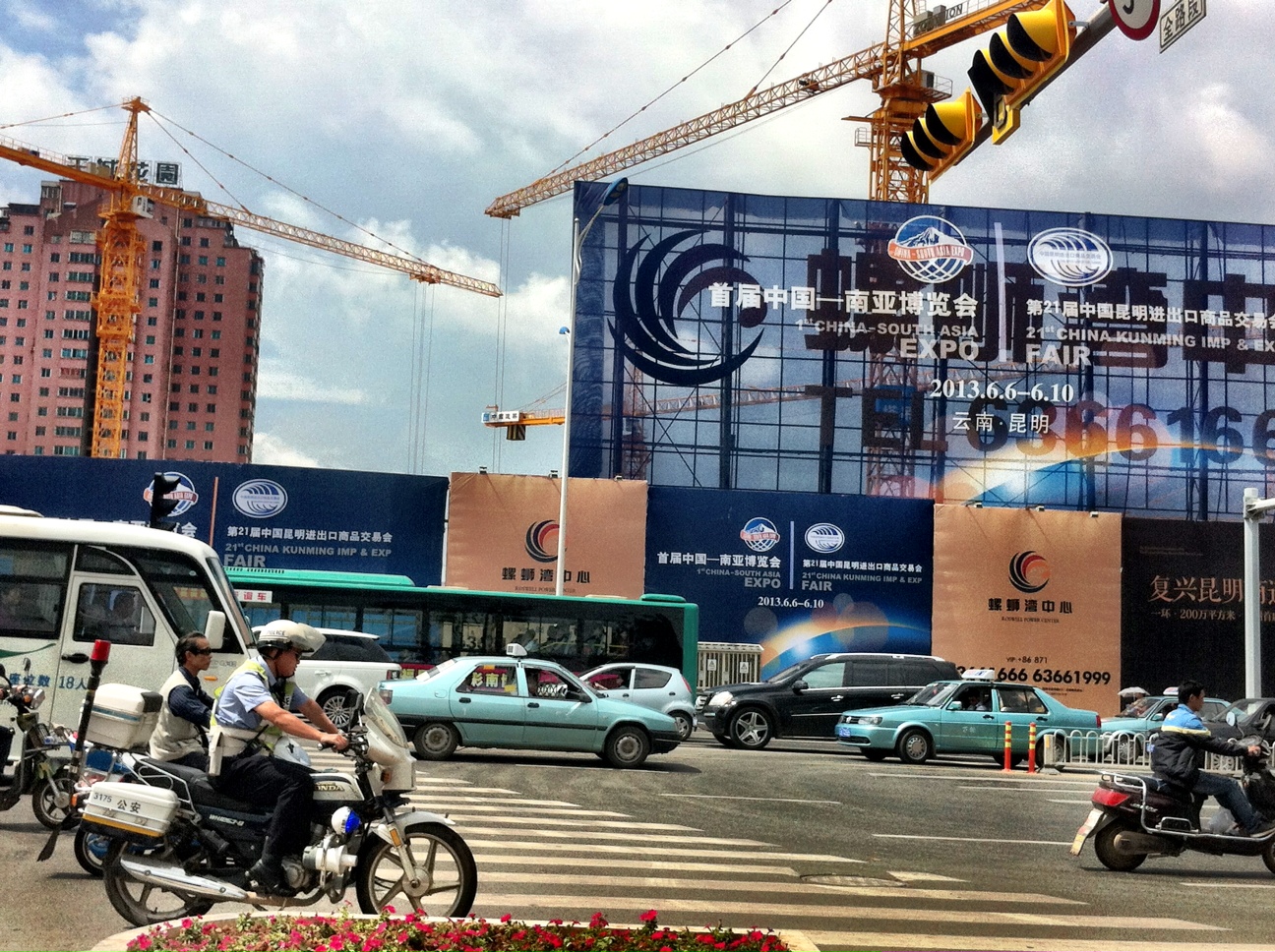
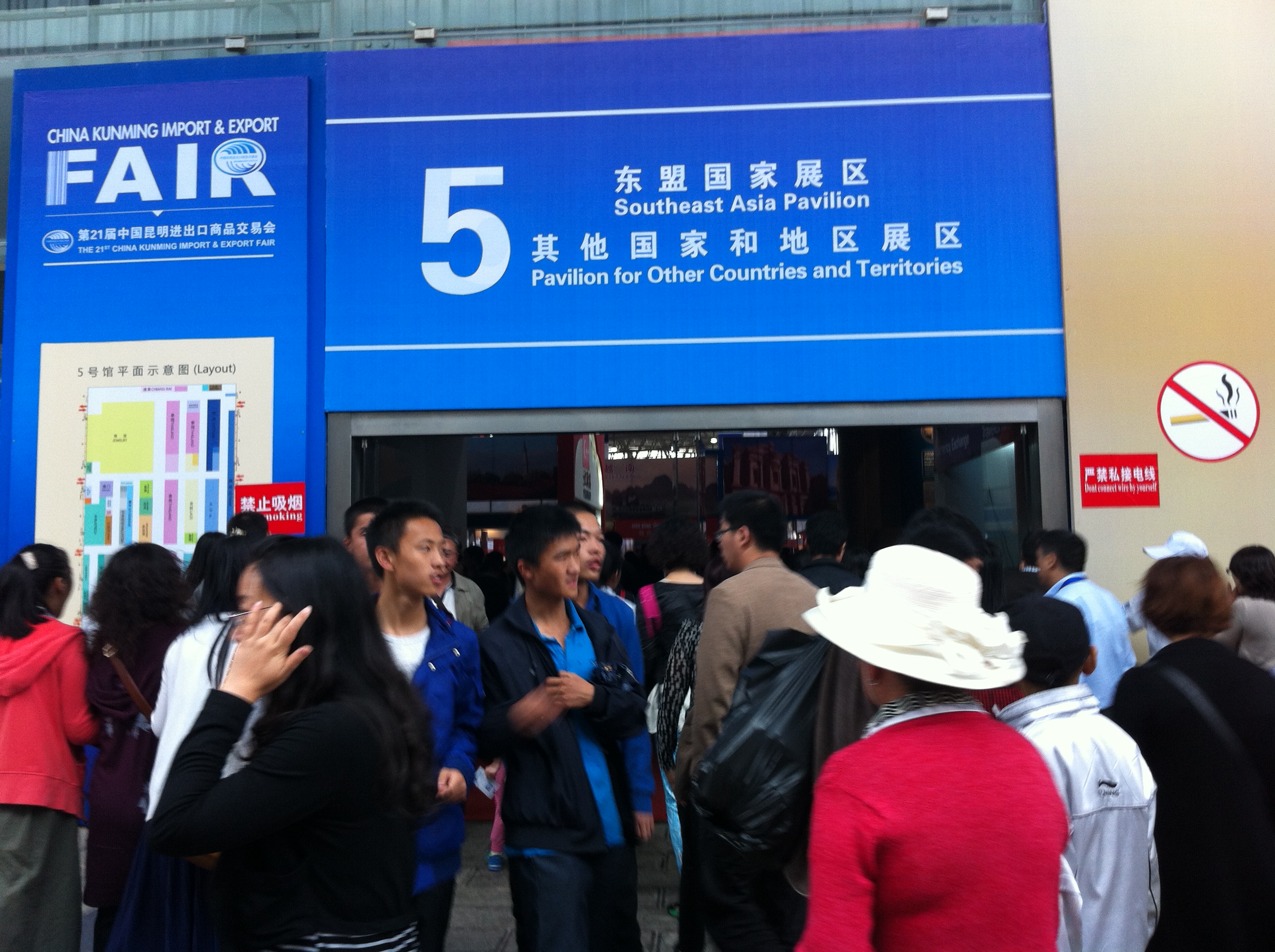
After much excitement on the part of merchants and nervous anticipation on the part of the local authorities, Kunming’s 1st Annual China-South Asia Expo came to a close on Monday. By all accounts the Expo was a great success and went off without a hitch. Fellow ExSE blogger Brian Eyler and I both attended the trade expo on Monday afternoon; the following is a record of our visit.

Monday was not only our most ideal time to attend the Expo, but it also was perfect for most other Kunmingers as they had the day off in honor of Dragon Boat Festival. Therefore, the lines were long and pavilions packed, and it took us more than 45 minutes to finally enter the Expo itself. Our first stop was the Main Hall, where the opening ceremonies were held. Flags from every country represented at the Expo and throngs of visitors taking a rest on the floor. A looped video promoting China-South Asia ties was playing in English with Chinese subtitles. However the English was worded awkwardly and sounded like it was copied directly from Google Translate. Both Brian and I agreed that future consideration towards the translation of materials might make a better impression on international visitors to the Expo given English is designated as the normative language communication between China and South Asia.  In the Main Hall we were stopped by a friendly group of local Expo volunteers who wanted us to be part of their souvenir photo collection. Continue reading →

Leave a Comment

Filed under ASEAN, Brunei, Cambodia, China, Culture, Current Events, Laos, Myanmar/Burma, Yunnan Province

Regional Roundup for Week of 6.7.13

This is has been a big week for the region, especially for China. President Xi Jinping is now at the tail end of his America’s visit, and today begin’s his much-anticipated Sunnylands Conference with US President Barack Obama. It’s being billed as the first chance for the two leaders to know each other on a personal level, and seeing the informal nature of the visit, it should give them plenty of time to talk. Hopefully some good can come out of the meetings, the Sino-US relationship could certainly use a friendly interlude.

Within China, the First Annual China-South Asia Expo began on Thursday in Kunming. ExSE’s own Brian Eyler has coverage of that event and what it means to China here.

Elsewhere, the World Economic Forum is taking place in Myanmar (Burma) this week. The developing nation will be hoping to use the hosting of this meeting of international business leaders as a showcase of their development thus far and attract investors for the future.

Continue reading →

Leave a Comment

Filed under Current Events, NEWS DIGEST

What’s at Stake for the China-South Asia Expo?

expo

The China-South Asia Expo opened without a hitch yesterday in Kunming despite online calls for a continuation of environmental protests outside of the Expo’s opening ceremony site.  It seems protesters decided to stay home due to a combination of sticks and carrots offered by local authorities.  On June 3, Kunming’s mayor announced the release of key environmental impact assessment data concerning the construction of a PetroChina oil refinery and PX chemical plant side project scheduled for construction 40 km from the city’s downtown area.  Also, the excessive presence of armed and unarmed public security officers lining the city’s streets and manning the Expo site also likely turned protesters away.

What is the rationale behind the excessive security measures?  What’s really at stake at the 1st China-South Asia Expo?

The Expo, a combination trade fair and high level forum for investment and trade promotion discussions between China, Southeast Asia, and now South Asia, is part of China’s “Bridgehead Construction” strategy to establish Kunming and Yunnan province as a gateway between China and its neighbors to the south and west.  A smoothly running Expo not only will seal multilateral agreements and high-value business deals that will streamline regional trade and investment, but it will also guarantee the continuation of soft-budget infrastructure development projects sponsored by Beijing to Kunming and Yunnan province that are part and parcel of the “Bridgehead” strategy.

Continue reading →

3 Comments

Filed under China, Current Events, Economic development, Energy, Environment and sustainability, Foreign policy, GMS, Laos, Myanmar/Burma, Vietnam

Regional Roundup for Week of 5.31.13

Just links this week.  Next week be sure to follow Xi Jinping and Barack Obama’s California Summit as well as Li Keqiang’s trip to Kunming’s China-South Asia Expo.

CHINA IN THE REGION/WORLD

The Sino-American Decade –  Council on Foreign Relations Michael Spence writes that cooperation between the United States and China on issues surrounding the environment, trade, investment, and financial stability will be critical not only for the continued well-being of the two countries, but also for the successful rebalancing of the world economy.

What Should Obama and Xi Accomplish at Their California Summit? – ChinaFile “We shouldn’t expect any major agreements or other “deliverables” to result from this meeting. The goal of the encounter is to establish the personal relationship between the two leaders and explore ways to dispel—or at least better manage—the mutual suspicions that have recently been dragging down the relationship. Both leaders are seeking to reassure one another that their intentions are not hostile.”

Frustrated Chinese send complaints to White House website – The Guardian Frustrated by censorship and Beijing’s stonewalling, bloggers and campaigners are turning to Barack Obama. The Chinese people would like President Barack Obama to stop an oil refinery from being built in southern China, endorse sweet-flavoured tofu and reopen an 18-year-old criminal probe of a poisoning case. And while he’s at it, if he wouldn’t mind mobilising US troops to liberate Hong Kong, as well as China as a whole, that would be great, too.

Asia Week Ahead: Xi’s journey to the West – Reuters Video President Obama readies the red carpet for China’s Xi Jinping, Australia faces economic pressures and Malaysia awaits crucial trade figures. Wayne Arnold gives us a preview of next week’s top stories.

China to study possibility of joining U.S.-led trade talks | Reuters China will study the possibility of joining the Trans-Pacific Partnership (TPP) trade talks, the Commerce Ministry said on Thursday, signaling its openness to the U.S.-led trade pact.

The Containment Fallacy: China and the TPP | Brookings Institution The argument that the TPP is a club that bars Chinese entry is inaccurate and unhelpful. China, like any other APEC economy, has the right to request entry into the TPP. Whether the Chinese leadership will judge TPP membership to be in their country’s national interest and whether TPP members can be persuaded that China is prepared to abide by the negotiated disciplines is a separate matter. But it is important to dispel the notion that the TPP precludes Chinese entry.

Continue reading →

1 Comment

Filed under Current Events, NEWS DIGEST

China’s media report on Kunming’s environmental protests

The English language discussion of Kunming’s ongoing environmental protests should not exclude China’s official media reports.  The translation below is of a 5/28 article from the Southern Weekend website.

Yunnan’s Anning City Retracts Notice on Face Mask Registration

from Southern Weekend (南方周末)May 28, 2013

More than 200 copies of a ‘Letter of Guarantee’ have been signed by vendors of advertising services, printing services, copy services, face masks, and t-shirts.  These vendors promise to strictly follow national laws and regulations regarding their commercial business and promise not to speak of rumors, create rumors, or spread rumors.  They promise not to participate in any form of information broadcasting, forwarding of messages, and not to participate in sit-ins, protests, or demonstrations of any kind.  They promise to not print, create, or publish things related to the Anning PetroChina Oil Refinery or the “China-South Asia “Expo or advertisements, propaganda materials, or any materials of negative influence.  This “Letter of Guarantee” goes into effect on the day of signing and is valid through June 30, 2013 and sales of all services above must also be accompanied by ID registration of the purchaser.  –Official statement from the Kunming Economic Development Zone Industry and Commerce Bureau. 

The exposure of Anning’s required ID registration of face mask purchases has stirred up considerable public debate.  On the evening of 5/25, the Anning City government’s press office issued a statement saying Anning’s Industry and Commerce Bureau will retract the notice on face mask registration.  But according to a report on 5/27, the “Procedure for registration of face mask purchases” was still in effect for much of the Kunming municipality and was not exclusive to Anning City.  Registration is still required for printing, copying, and publication services. Continue reading →

4 Comments

Filed under China, Current Events, Economic development, Energy, Environment and sustainability, Governance

Mr. Thein Sein Goes to Washington… Mr. Abe Goes to Naypidaw

This past week saw big foreign policy news from Myanmar (Burma). Just days after meeting with US President Obama in Washington, Burmese President Thein Sein returned to Naypidaw to meet with Japanese Prime Minister Shinzo Abe. Both visits saw improvements in Burma’s respective relations with the two countries, but which of the two relationships remain closer? From whom did Burma gain the most, and vice versa? The clear answer is Japan.

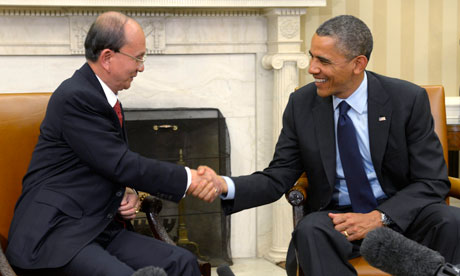
President Thein Sein visited Washington at the beginning of last week, becoming the first Burmese leader to visit the US since Ne Win in 1966. The visit was a largely symbolic one, lacking many of the tangible economic benefits that are usually associated with these sort of state visits. Aside from agreements to strengthen bilateral trade relations with two US agencies, most of Myanmar’s benefits can be found in the language of US officials. Before the President arrived, US Press Secretary Jay Carney referred to the country as Myanmar, not Burma. Myanmar is the name used by the military junta since 1989, while Burma is an appellation preferred by opponents of the regime. President Obama also referred to the country as ‘Myanmar’ and while it does not mark an official policy change, it does reflect a change in attitude.

During his meeting with President Thein Sein, Obama raised the perennial issue of human rights, but at the same time expressed strong support for the leader. Also of note, US Senator Mitch McConnell, a long-time champion of sanctions against Myanmar, said he was no longer in support of continued sanctions against the country, paving the way for smoother relations in the future. The Burmese president’s visit to the US came without multi-million dollar contracts and major US investment in the country will have to wait, but Thein Sein’s visit did represent a further thawing of the relationship, and offers hope for the future.

Continue reading →

2 Comments

Filed under China, Current Events, Economic development, Foreign policy, Myanmar/Burma, Regional Relations