Category Archives: China

A Primer to the Philippines’ South China Sea Arbitration Challenge to China

Earlier in January this year, the Philippines submitted a unilateral challenge to China on certain key aspects of their ongoing dispute in South China Sea (SCS) maritime delimitations under the United Nations Convention on the Law of the Seas (UNCLOS). This challenge will take the form of an arbitration case before the International Tribunal on the Law of the Seas (ITLOS). To the uninitiated, this move is intriguing but unclear as to its real-world implications for international maritime law or the future of SCS geopolitics. The following primer attempts to translate the dense jargon of maritime law, distill the meanings behind subtle diplomatic language of Claimant States, and untangle the intricate web of geopolitical maneuvering to provide a clearer, layman picture of this case and its implications for the SCS disputes.

Why the arbitration case?

The ongoing dispute between the Philippines and China has been simmering for many years. Ever since a joint exploration agreement (along with Vietnam) to conduct seismic review of potential hydrocarbons in the SCS region collapsed in 2007, the tone and intensity of SCS disputes have escalated.  The situation came to a head when in early 2012, Chinese Coast Guard ships came into confrontation with a Philippine naval ship over harassment of fishermen in Scarborough Shoal, a formation in the Spratlys (南沙in Chinese). The Scarborough Shoal standoff did not end well for the Philippines as China has now established an ongoing blockade of the shoal. (More discussion of this standoff and its implications to follow in a later article) In response, the Philippines moved for ASEAN to issue a unified statement to China censoring it for its actions in the South China Sea. However, other ASEAN members proved reluctant to do so for many reasons. (More discussion of this will come in a later article) Suffice it to say, by Fall 2012, the Philippines began actively exploring other options to pursue its dispute with China.

What is happening?

To the layman observer of SCS disputes, the Philippines’ move to challenge China by arbitration may have been surprising. After all, it’s generally understood that China studiedly avoids multilateral engagement on SCS disputes and/or 3rd party mediation, insisting that the SCS disputes are a regional issue that should be addressed on a bilateral basis. Questions regarding this case include:

  • Can the Philippines unilaterally bring China to arbitration? And if so, does China have to engage?
  • Regardless of China’s engagement, does the ITLOS have jurisdiction to rule on the challenges?
  • What are the points the Philippines is challenging?
  • Even if ITLOS has jurisdiction to rule on certain aspects of challenges put forth, what are the actual implications for SCS disputes?
Continue reading

2 Comments

Filed under ASEAN, China, Energy, Foreign policy, Philippines, Regional Relations, Uncategorized, water

Myanmar ethnic reconciliation: Impossible without Chinese cooperation

Just outside of Yangon lies the “National Races Village,” a park laid out as a geographical representation of Myanmar, with real-sized model minority homes dotted around the park next to miniature lakes and mountains. The park feels quite similar to the Chinese Ethnic Culture Park in Beijing; both represent slightly bizarre attempts to paper over inter-ethnic conflict, as if both countries are trying to live out some sort of “big socialist family” of yesteryear.

Unfortunately Myanmar also seems to have copied much of China’s policies towards ethnic minorities. Sixty years ago, China promised its ethnic minorities that if they cooperated with the CCP, they would be granted self-autonomy. Myanmar promised the same thing in the form of the 1947 Panglong Agreement, which called for power sharing between the majority Bamar and ethnic minority groups. Both countries failed to live up to their promises. In China, the CCP has engaged in a campaign to eradicate traditional cultures and languages, and has kept minority areas under tight control by party officials. In Myanmar, Ne Win’s military coup in 1961 gave rise to centralized, authoritarian control, and to ethnic rebel groups who fought the military for decades. Continue reading

6 Comments

Filed under China, Foreign policy, Governance, Myanmar/Burma

Myitsone: A road block for Sino-Burmese relations?

A year and half ago this past March, one of the more the surprising events in recent Sino-Burmese relations took place. With a short letter delivered to the Burmese legislature, President Thein Sein suspended the Myitsone Dam until 2015, the end of his term. The dam, a $3.6 billion project that would sit at the confluence of the Irrawaddy’s two main tributaries, was the centerpiece of a series of seven dams on the upper reaches of the river. The project was the result of a joint venture between the Burmese government and China Power Investment (CPI) beginning in 2006 and appeared to be of great importance to both sides. However, a nationwide protest campaign against the construction of the dam supported by Aung San Suu Kyi ultimately won out.

Continue reading

1 Comment

Filed under China, Current Events, Energy, Foreign policy, Myanmar/Burma, Regional Relations, Uncategorized, water

Anatomy of a Protest: Kunming citizens voice concern over chemical plant

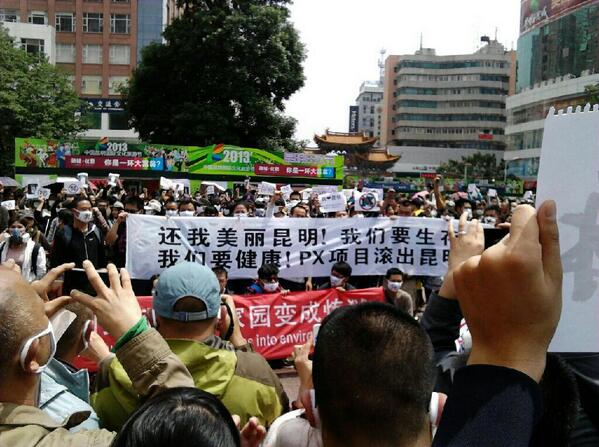
Saturday’s peaceful protest in Kunming may be the first of many against a polluting PX chemical plant slated for construction inside Kunming’s city limits. Nearly 2000 people participated in the well organized protest, and the crowd met zero resistance from the 200+ police and public security officers sent to the site to maintain order. For more than three hours, citizens wore “No PX” face masks and paraded around the protest site waving banners and posters sporting slogans like “PX project, get out of Kunming” and “I want green!” Different from other protests I’ve seen in China, the organizers divided the site into teach-in zones where crowds of hundreds could listen to those who had a message to deliver. In the end, no arrests were made and there were zero scuffles between protesters or with the police.

banners

Continue reading

4 Comments

Filed under China, Current Events, Economic development, Environment and sustainability, Myanmar/Burma

Cleaning up Kunming’s Dianchi Lake, Part 2

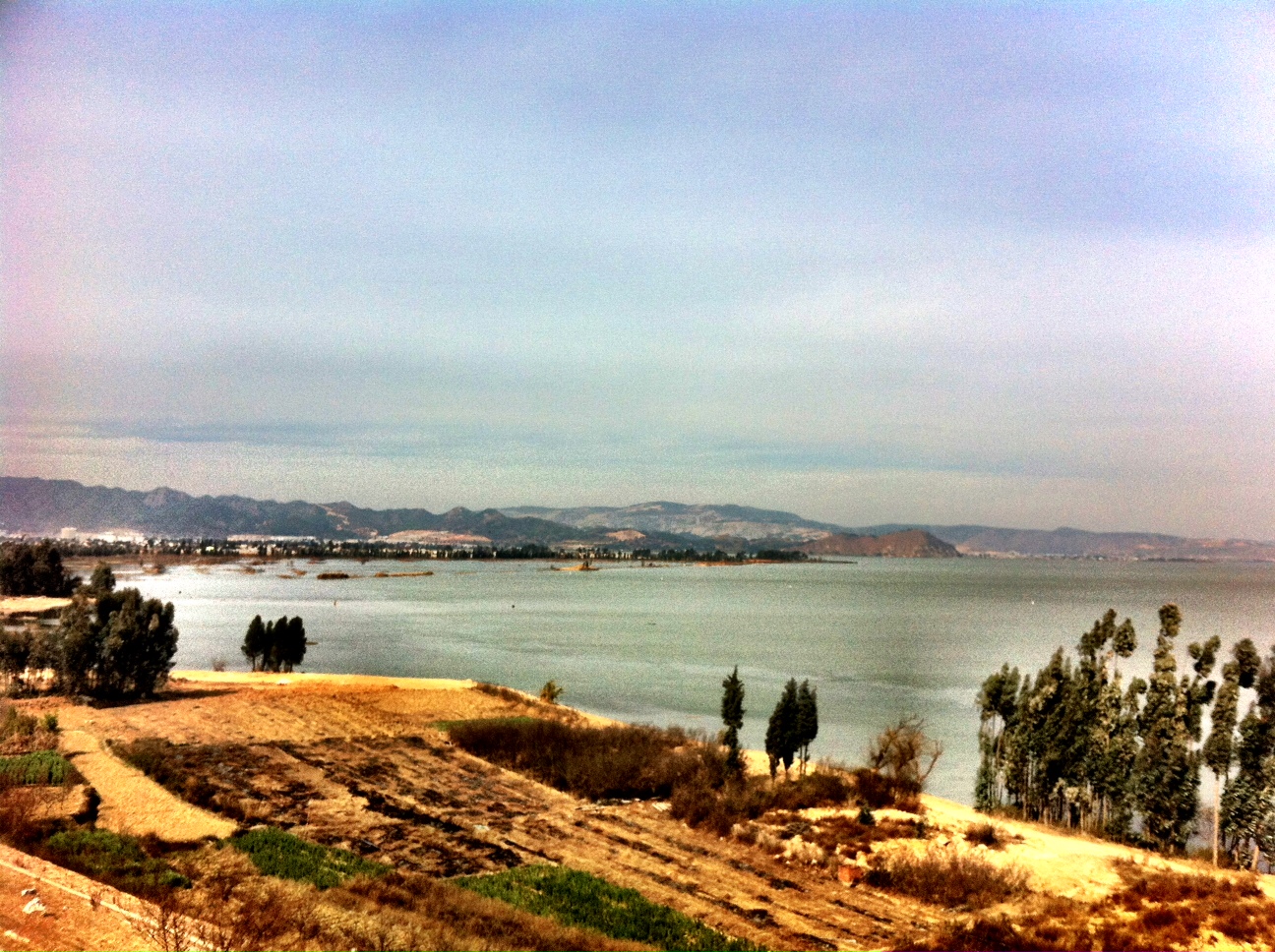
Zhou Dequn’s post, “Cleaning up Kunming’s Dianchi Lake” discussed the origins of and contributing factors to the lake’s pollution.  His post also briefly discussed a few of the measures used to raise the quality of Dianchi’s water in recent years. The marked improvement of Kunming’s groundwater quality was recently profiled in this New York Times video.

Dianchi south

PHOTO: Dianchi’s southern shoreline

Continue reading

1 Comment

Filed under China, Economic development, Environment and sustainability, Sustainability and Resource Management, water

Where have all the fish gone? Killing the Mekong dam by dam

The Mekong, a river of wildly majestic fast-flowing currents flowing through six countries, has long enchanted explorers with its rich biodiversity second only to the Amazon.

It is home to the Giant Catfish, and at least 877 fish species sustaining food security for around 65 million people which make the Mekong the world’s most important centre of freshwater fisheries.

“For the people born on the Mekong, the river is like their blood—the principle of life,” says Dorn Bouttasing, a Lao environmental researcher.

Surely it is unthinkable that man would want to endanger or destroy the basis of such extraordinary natural wealth? Such invaluable natural resources, their infinite value defies any attempt to measure with a crude price tag.

My documentary Where Have All the Fish Gone? (Eureka Films) looks at the four Chinese hydropower dams that have been already built on the Lancang (The Chinese name for the upper Mekong), but its main focus is on the Lower Mekong basin shared by Laos, Myanmar, Thailand, Cambodia and Vietnam.

Continue reading

Leave a Comment

Filed under Cambodia, China, Current Events, Economic development, Energy, Environment and sustainability, Food, Foreign policy, GMS, Governance, Laos, Mekong River, Sustainability and Resource Management, Thailand, Vietnam, water

Eating Insects in Southwest China

A plate of assorted bugs at Simao Yecai Guan.

A plate of assorted bugs at Simao Yecai Guan.

Simao Yecai Guan, a small Jingpo minority restaurant in the southern part of Kunming, has been made famous by its menu of local wild foods. In addition to serving up odd delicacies like bamboo rat, giant Mekong catfish, ferns, fungi and all sorts of wild vegetables, the restaurant also offers a variety of edible insects.

“We grew up eating these,” one woman says holding up a fried grasshopper. “Sure, when you think about what you’re eating, it can seem kind of gross. But they are tasty.” She sits at just one of the 15 large tables of a wedding party where everyone is chowing down on the little crispy critters.

Grasshoppers aren’t the only bugs on the menu. Simao Yecai Guan also fries up cicadas (legs and wings still attached), giant coconut tree grubs and black armored insects about the size of a thumb, called chestnut bugs. With prices ranging from 48-68 yuan ($8-$11) per dish, the restaurant claims to sell more than 1000 yuan ($160) per day in insects alone.

Although many of us may cringe at the thought, nearly one in three people on the planet eats insects as a part of their diet. As food prices continue to soar and many parts of the world face starvation, more people are starting to agree that insects can be a viable food source. With more than 1,900 known edible insect species, and an estimated 40 tons of insects to every person, it’s difficult to deny that it just might be worth getting past our squeamishness when it comes to eating bugs. Continue reading

3 Comments

Filed under China, Environment and sustainability, Food, Sustainability and Resource Management

Regional Roundup for Week of 4.18.2013

Just the news this week. Continue reading

Leave a Comment

Filed under ASEAN, China, Cold War, Current Events, Economic development, Energy, Environment and sustainability, Foreign policy, Governance, Health, Laos, Mekong River, Myanmar/Burma, NEWS DIGEST, Thailand, Vietnam, water

The logic of China’s economic strategies in Southeast Asia

In so many ways, China’s strategies for its involvement in Southeast Asia are much more pragmatic, more predictable, and considerably less nefarious than any other rising global power that previous laid sight on region.  Moreover, those strategies, born in the 1990s, make even more economic sense now than at the time of their inception due to the current needs of its development trajectory.

Energy consumption and the speed of urbanization in China are rising at ever-increasing rates.  To keep pace, the central government must secure energy resources and safe, low-cost agricultural goods. Southeast Asian states, in a complementary fashion, have robust food export markets, as in the case of Thailand or Malaysia, or as in Laos and Myanmar, have abundant endowments of energy resources.  Chinese state owned enterprises and private business interests seek to access and integrate into these markets and new infrastructure linkages such as highways and high-speed railways are indicators of deeper market integration abroad. Continue reading

Leave a Comment

Filed under China, Current Events, Economic development, Energy, Foreign policy, Governance, Laos, Malaysia, Myanmar/Burma, Singapore, Thailand, Uncategorized, Vietnam

Biodiversity in China’s Rivers Under Extreme Threat

As a result of decades of unchecked development and poor decision making, China’s inland rivers are suffering a crisis and are in the midst of severe losses of biodiversity.  Currently there is a serious lack of conservation measures and a shortage of funding to protect endangered aquatic species.

According to an expert from Changjiang Fishery Resources Managing Committee, there used to be more than 1,100 species in the Yangtze River, including more than 370 fish species, over 220 zoobenthos (organisms which live on the riverbed), and hundreds of aquatic plants. The rapid development of economic zones in the Yangtze River basin has caused a rapid decline in aquatic biological resources. Now many species like the Chinese river dolphin and the Chinese paddlefish face extinction.  The famous Reeves’ Shad, once important to local fisheries, has not been seen for many years. “Living fossils” such as the Chinese sturgeon have also rapidly decreased in numbers and at an even faster pace.

It is baffling to me that when we were initially constructing the Three Gorges Dam, we didn’t learn from the experiences of developed countries that built fish ladders for migratory fish. Even Vietnam and Laos, our neighbors to the south are installing fish ladders in their new hydropower projects.  Since the formation of the Three Gorges Reservoir, the dam has blocked the migratory routes that the fish need in order to reproduce.  The “transform rivers into lakes” strategy seeks to inundate rapids and exposed shoals in the river to promote for the safe passage of ships, but many fish that are used to living in the rapids are gradually migrating upstream resulting in a reshuffling of river basin ecosystems.  The dam has also had a major impact on yearly fish catches. During this year’s rare summer droughts, thousands of fishermen along the water basin were left with empty nets. Continue reading

4 Comments

Filed under China, Energy, Environment and sustainability, Governance, water