Author Archives: William Feinberg

About William Feinberg

William Feinberg is a budding Southeast Asia scholar based in Kunming, Yunnan. His focus is on issues of human migration in Southeast Asia, but writes on everything from agriculture to infrastructure. Outside of East by Southeast, his hobbies include hiking, piano and Northern Thai cuisine.

Mekong study tour update: 7.19.2013

Other than top-notch commentary on China and SE Asia, ExSE isn’t known for too much and it’s quite clear now that keeping promises isn’t a strongpoint of ours. If you were expecting regular updates on our excursion to Thailand and Laos, we deeply apologize for not delivering. However, if there’s any worthy excuse, it’s that Brian, Dequn, Tai and I have been too busy learning. The following is simply a recap of what’s been going on so far; the true implications of the things that we’ve learned are too much for me to explore in any one post.

Our first two days were spent rather relaxingly, and thankfully far away from a 3G or broadband connection, taking a cruise down the Chao Praya River with Traidhos Three Generations Barges. On the cruise, we learned the river’s watershed, conservation efforts on the river and its significance to Thailand. It was a wonderful introduction to the country through its principal waterway.

The next morning, we met with Pete Cutter at the World Wide Fund for Nature Greater Mekong Office in Bangkok. The WWF Bangkok Office is involved in some very important efforts to preserve more than a half-dozen endangered species in the region and coordinates often with other NGO’s and governments in the GMS.

Our two days in Chiang Mai, where I’m writing from now, have been our most fruitful. Thanks to our friend and ExSE team member Tom Fawrthrop, we were able to meet with many of the top journalists, NGO heads and scholars in northern Thailand. On the 16th we had a lunch talk with Tom himself and learned a ton on the region in general, and specifically the dangers of the 1250MW Xayabouri Dam in the Lao Mekong and the movement to resist its completion. We then two lectures by Professor Narut and Professor Panuwat from the Chiang Mai University Political Science Department on Thailand’s economic role in the GMS and democracy in Thailand, respectively. Afterwards, we met with the Forest Restoration Research Unit at Doi Suthep National Park and learned about their groundbreaking research on tropical forest care. Continue reading

Leave a Comment

Filed under ASEAN, Culture, Economic development, Energy, GMS, Governance, Laos, Mekong River, Myanmar/Burma, Thailand, water

Burmese Teak: Turning a New Leaf

It’s prized the world over for its durability and beauty and has long been a status symbol; to own something made from teak really means something. But what is teak and why does it matter today?

Teak, or Tectona Grandis, is a large, deciduous, hardwood species found throughout Southeast Asia in environments under 900m in elevation that receive over 500mm of annual rainfall. Teak is known is primarily known for its durability; it is naturally water-resistant and contains resins that repel and termites and slows rot. Because of these qualities, teak wood is valued for its ability to resist the natural elements and is often used in outdoor furniture and yacht and sailboat building.

Teak is native only to India, Indonesia, Lao PDR, Malaysia, Myanmar and Thailand. Of the estimated 29 million hectares of naturally occurring teak forests, almost half are found in Myanmar. It is important to note that only Myanmar does not enforce a logging or export ban on teak, so all legally-harvested natural teak on today’s market is Burmese. The cost of this Burmese teak can be quite high – the market price for some wood can reach than $4,000/m3. This represents the most expensive teak, as natural teak is valued higher than its planted counterpart. There are several reasons for this disparity. First, plantation teak has smaller dimensions than natural teak and rarely reaches the size of a natural tree. Secondly, there is a perception among many buyers that plantation teak is less dense than natural timber and thus is of a lower quality. In addition, natural teak is a rare resource. As mentioned, Myanmar is currently the only country exporting natural teak and its forests are decreasing every year, making prized Burmese wood rarer and more expensive.

teak 1 Continue reading

2 Comments

Filed under China, Economic development, Environment and sustainability, Indonesia, Laos, Malaysia, Myanmar/Burma, Sustainability and Resource Management, Thailand

Regional Roundup for week of 6.21.2013

CHINA IN THE REGION/WORLD

Ben Bernanke and China: have the markets over-reacted? The Guardian – Stock markets worldwide plummeted on Thursday after the Federal Reserve chairman signalled an end to quantitative easing and fears grew of problems in China’s banking sector

China worsens credit squeeze as manufacturing output declines The Guardian – Credit default swaps (CDS) on five-year bonds rose by 33 basis points to 133bps, according to financial data firm Markit. The cost of insuring against a default on Chinese sovereign debt soared on Thursday as China’s central bank worsened a credit squeeze by refusing to inject cash into the financial system. Credit default swaps (CDS) on five-year bonds rose by 33 basis points to 133bps, according to financial data firm Markit, as Chinese officials signalled a determination to rein in risky lending practices.

Caution Can Avert Downward Spiral in Sino-EU Trade Ties Carnegie Endowment for International Peace – China’s strategic turn to moving upmarket and pursuing sustainability has presented a significant challenge to Europe’s renewable energy market dominance.

Chinese industry: Ambitions in excess – FT.com For global manufacturers, the China effect over the past decade has been fearsome. It has destroyed jobs and capacity all over the world, shuttering factories in competitor nations. But in almost every sector where China’s low-cost goods have come to dominate, something strange has happened. Once the bulk of global manufacturing in a given industry has moved to China, overcapacity quickly follows and these sectors begin to cannibalise themselves.

Violent sell-off in world markets after Federal Reserve signals end to QE The Guardian – Ben Bernanke’s comments spark a global fall in stock markets and commodities, and strong rise in government bond yields. Stock markets worldwide plummeted on Thursday, after the Federal Reserve chairman, Ben Bernanke, rattled investors by signalling an end to America’s drastic recession-busting policy of quantitative easing.

Myanmar’s old friend China is left wondering where it went wrong – FT.com As President Thein Sein gave the opening address to the forum, the word in the halls of the Chinese-built convention centre was that he personally despises Beijing’s influence over its smaller, poorer neighbour. And on the second day of the forum news broke that state telecom giant China Mobile had dropped a joint bid with Vodafone to expand the country’s mobile phone network – apparently after being told the Chinese company had no hope of winning. In Beijing and Naypyidaw there is recognition that China handled the bilateral relationship badly thanks to a toxic mix of arrogance, neglect and meddling by elements of China’s People’s Liberation Army.

How Chinese Strategists Think The Diplomat – Toshi Yoshihara joins me (or I join him) over at Investor’s Business Daily to refocus attention on the human dimension of the U.S.-China strategic competition. Followers of these pages pixels know that Toshi and I are true believers in the idea that competition is a human enterprise. As Colonel John Boyd liked to say, people, ideas, and hardware — in that order — are the determinants of competitive endeavors like power politics. Continue reading

Leave a Comment

Filed under Current Events, NEWS DIGEST

A Day at the Fair: Impressions from the China-South Asia Expo

IMG_6432

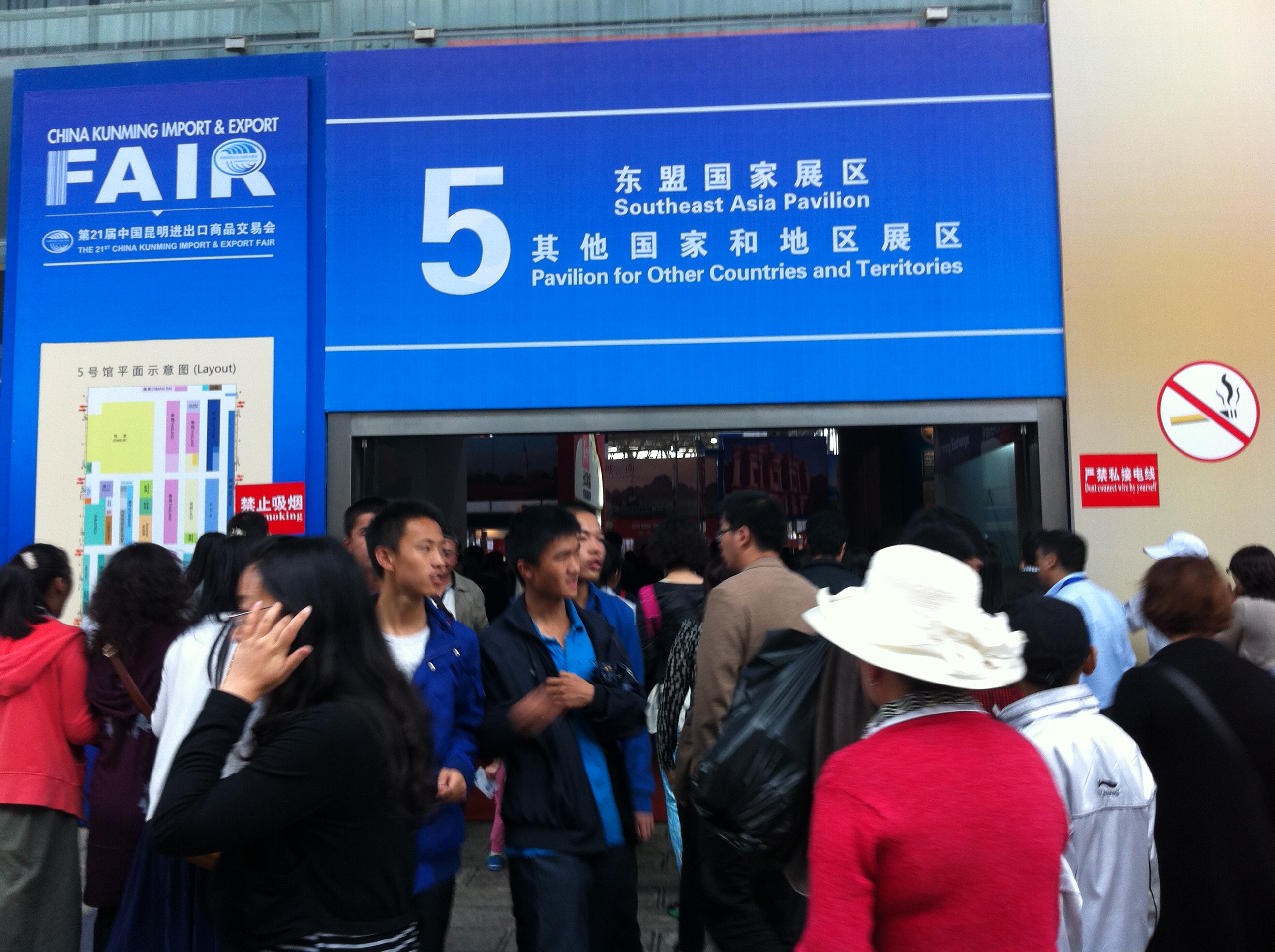
After much excitement on the part of merchants and nervous anticipation on the part of the local authorities, Kunming’s 1st Annual China-South Asia Expo came to a close on Monday. By all accounts the Expo was a great success and went off without a hitch. Fellow ExSE blogger Brian Eyler and I both attended the trade expo on Monday afternoon; the following is a record of our visit.

Monday was not only our most ideal time to attend the Expo, but it also was perfect for most other Kunmingers as they had the day off in honor of Dragon Boat Festival. Therefore, the lines were long and pavilions packed, and it took us more than 45 minutes to finally enter the Expo itself. Our first stop was the Main Hall, where the opening ceremonies were held. Flags from every country represented at the Expo and throngs of visitors taking a rest on the floor. A looped video promoting China-South Asia ties was playing in English with Chinese subtitles. However the English was worded awkwardly and sounded like it was copied directly from Google Translate. Both Brian and I agreed that future consideration towards the translation of materials might make a better impression on international visitors to the Expo given English is designated as the normative language communication between China and South Asia.  In the Main Hall we were stopped by a friendly group of local Expo volunteers who wanted us to be part of their souvenir photo collection. Continue reading

Leave a Comment

Filed under ASEAN, Brunei, Cambodia, China, Culture, Current Events, Laos, Myanmar/Burma, Yunnan Province

Southeast Asian Football: The Long Game

When one thinks of great football (soccer) nations, countries like Brazil, England and Germany quickly come to mind. And turning to Asia, South Korea and Japan are perennial challengers at the all the big tournaments and veritable football powerhouses. Southeast Asian countries, on the other hand, are not known for their prowess at the beautiful game, which is why it came as a shock when the ASEAN Football Federation (AFF) announced last month that they would bid for the 2034 World Cup.

For those thinking that 20 years is a long time to plan ahead for a World Cup, it is. The formal bidding for the tournament won’t even start until 2026 and most other hopeful hosts won’t begin the planning stages for some years. But ASEAN states aren’t France or Argentina when it comes to football, and considering the amount of work ahead of the AFF, 20 years might actually be necessary for a successful World Cup bid.

Continue reading

1 Comment

Filed under ASEAN

Mr. Thein Sein Goes to Washington… Mr. Abe Goes to Naypidaw

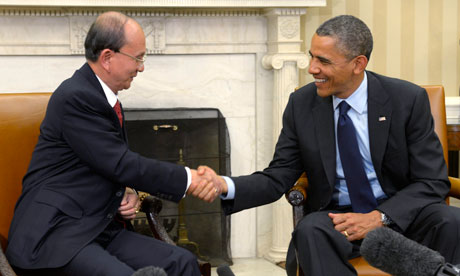
This past week saw big foreign policy news from Myanmar (Burma). Just days after meeting with US President Obama in Washington, Burmese President Thein Sein returned to Naypidaw to meet with Japanese Prime Minister Shinzo Abe. Both visits saw improvements in Burma’s respective relations with the two countries, but which of the two relationships remain closer? From whom did Burma gain the most, and vice versa? The clear answer is Japan.

President Thein Sein visited Washington at the beginning of last week, becoming the first Burmese leader to visit the US since Ne Win in 1966. The visit was a largely symbolic one, lacking many of the tangible economic benefits that are usually associated with these sort of state visits. Aside from agreements to strengthen bilateral trade relations with two US agencies, most of Myanmar’s benefits can be found in the language of US officials. Before the President arrived, US Press Secretary Jay Carney referred to the country as Myanmar, not Burma. Myanmar is the name used by the military junta since 1989, while Burma is an appellation preferred by opponents of the regime. President Obama also referred to the country as ‘Myanmar’ and while it does not mark an official policy change, it does reflect a change in attitude.

During his meeting with President Thein Sein, Obama raised the perennial issue of human rights, but at the same time expressed strong support for the leader. Also of note, US Senator Mitch McConnell, a long-time champion of sanctions against Myanmar, said he was no longer in support of continued sanctions against the country, paving the way for smoother relations in the future. The Burmese president’s visit to the US came without multi-million dollar contracts and major US investment in the country will have to wait, but Thein Sein’s visit did represent a further thawing of the relationship, and offers hope for the future.

Continue reading

2 Comments

Filed under China, Current Events, Economic development, Foreign policy, Myanmar/Burma, Regional Relations

Myitsone: A road block for Sino-Burmese relations?

A year and half ago this past March, one of the more the surprising events in recent Sino-Burmese relations took place. With a short letter delivered to the Burmese legislature, President Thein Sein suspended the Myitsone Dam until 2015, the end of his term. The dam, a $3.6 billion project that would sit at the confluence of the Irrawaddy’s two main tributaries, was the centerpiece of a series of seven dams on the upper reaches of the river. The project was the result of a joint venture between the Burmese government and China Power Investment (CPI) beginning in 2006 and appeared to be of great importance to both sides. However, a nationwide protest campaign against the construction of the dam supported by Aung San Suu Kyi ultimately won out.

Continue reading

1 Comment

Filed under China, Current Events, Energy, Foreign policy, Myanmar/Burma, Regional Relations, Uncategorized, water

Book: River of Lost Footsteps

River of Lost Footsteps

Thant Myint-U (Farrar, Straus and Giroux)

Since the beginning of political and economic reforms in 2010, Burma has become a regular topic inthe news. Anyone who regular reads publications like the New York Times or the Economist would beable to consider themselves relatively well-informed about the rapidly changing situation in the Golden Land. However, much of the coverage of Burma is often ahistorical, and there is little public discussion about Burma before 2010, let alone before Aung San Suu Kyi. In River of Lost Footsteps, Thant Myint-U provides a detailed history of Burma over the past four centuries, all the while weaving in the story of his own family in Burma.

Indeed, Thant Myint-U is uniquely positioned to write such a history. Born in New York, his grandfather U Thant was the Secretary-General of the UN in the 1960s. Educated at Harvard, the Paul H. Nitze School of Advanced International Studies and Cambridge, the author has lectured extensively on Asian and British imperial history. In the book, his mastery of the subject is quite evident, but also is a certain objectivity. Being Burmese himself and having spent summers there while growing up, he has an obvious intimacy with the country and passion for it but at the same time, he lacks the nationalistic bias that some native Burmese writers might carry. Continue reading

Leave a Comment

Filed under Cold War, Current Events, Foreign policy, Governance, Myanmar/Burma, Reviews

The Kachin Conflict and China: No More Non-Interference?

While peace hasn’t been an easy thing to come by in Kachin State these past few years, peace talks actually have. Since tensions between the Kachin Independence Army (KIA) and the Burmese military erupted again in 2011, the two sides have held multiple rounds of informal talks, often to no avail. Last month’s talks, while not bringing an end to the conflict, were still important for another reason – they weren’t held in Myanmar, but instead in the border town of Ruili, China. This was the first time such talks have been hosted by China and raises questions about what significance they could have for the future of Chinese diplomacy.

As is already well known by now, China claims non-interference in other states’ domestic affairs as a guiding principle of its foreign policy. With this recent round of talks between the KIA and the Burmese government, however, we seem to see something different. Is China willingly taking up the mantle of responsibility associated with being a “global power” or is there a different motivation behind hosting these talks?

From my perspective, the latest round of negotiations has much more to do with China’s national security than any grand policy shift. China hosted these talks, which some might see as an involvement in Burmese domestic affairs, because they have a significant interest in seeing the Kachin conflict come to an end. China’s interests are intertwined in two ways. Continue reading

1 Comment

Filed under China, Current Events, Energy, Foreign policy, Myanmar/Burma, water

Plugin by Social Author Bio