Author Archives: GoKunming

About GoKunming

GoKunming.com is Kunming's premier website for English language news, upcoming community events, reviews, and local listings.

Three sentenced to death for Kunming Train Station attack

The Intermediate Court of Kunming has found four defendants guilty of carrying out a deadly knife attack that claimed the lives of 31 civilians and injured 141 in March of this year. Three of the defendants, all men, received the death penalty, while the lone female suspect was sentenced to life in prison.

The one-day trail, held on September 12, lasted only a few hours. Video shows the three men, Iskandar Ehet, Turgun Tohtunyaz and Hasayn Muhammad seated in court with shaved heads, wearing matching blue prison uniforms. They were all found guilty of “premeditated murder and leading and organizing a terrorist group”. The fourth defendant, Patigul Tohti, will spend the rest of her life behind bars after being found guilty of “intentional homicide and joining a terrorist group”.

None of the men on trial participated directly in the train station attack, according to a BBCreport. Instead, they coordinated the assault from afar — making plans beforehand and then directing five of their associates. Court documents made public following the trial say the three men were all captured by police two days before the attacks occurred.

This narrative directly contradicts previous official accounts claiming the suspects were apprehended March 4 following a 36-hour manhunt in Kunming and beyond. It remains unclear when or where the men were actually captured, as no details of their arrests have ever been made public. Conversely, the story surrounding female assailant Tohti has remained consistent since March.

She was arrested following a bloody rampage wherein she and four others indiscriminately stabbed dozens of people who were queueing to buy tickets at the Kunming Train Station. Tohti was eventually subdued by police and arrested, while her four co-conspirators were all reportedly shot dead in a span of 15 seconds by a SWAT team sniper.

The trial in Kunming was uncharacteristically open to the public, and 300 people, including victims and their families, attended the proceedings. Security at the courthouse was increased noticeably, with armed guards posted both inside and outside the courtroom.

China has significantly ramped up law enforcement and ‘anti-terror’ efforts following the bloodshed in Kunming. In many cities around the country, police officers are now permitted to carry sidearms for the first time in decades. Trials involving suspected militants have also increased, and hundreds of people have been jailed for terrorism-related crimes by Xinjiang police as violence escalated over the summer.

This article was written by Patrick Scally and originally published on GoKunming. 

Leave a Comment

Filed under China, ethnic policy, Kunming Train Station Attack, SLIDER, Yunnan Province

China forbids some rice imports from Vietnam

Roger Hamilton via The Baltimore Sun

Roger Hamilton via The Baltimore Sun

Beijing has banned what trade authorities are calling “unofficial rice imports” from neighboring Vietnam. The move, ostensibly announced as closing a previously existing tax loophole, appears to be specifically targeted at Hanoi and does not affect other Southeast Asian countries sharing a border with China.

The prohibition specifically addresses the overland, cross-border traffic of rice into Guangxi Zhuang Autonomous Region and Yunnan province, both of which share lengthy southern borders with Vietnam. These shipments are often brokered and carried out by individual Chinese brokers who often skirt paying national import levies, according to Vietnamese press reports.

By centralizing bulk purchases of rice, Beijing could stand to generate substantial tax revenues.Two million tons of Vietnamese rice worth an estimated US$800 million were expected to imported through unofficial channels this year before the proscription went into affect. This number represents more than 30 percent of Vietnam’s total worldwide rice exports from 2013.

Although billed as a tax collecting endeavor, the Chinese ban has obvious political undertones. Once-strong ties between the two countries have been markedly strained since the deployment of a Chinese oil platform in international waters sparked deadly anti-China riots in Vietnam this summer. Although the oil rig has since been removed, relations have not thawed and the rice import ban may be a way for Beijing to subtly punish Hanoi.

China, which has announced it is attempting to expand its rice import portfolio, announced on Tuesday an agreement to buy 100,000 metric tons of rice from Cambodia. The contract, which went into affect immediately, states the rice must be purchased over the next year. A Cambodian businessman involved in the deal, surnamed Van, told the Phnom Penh Post that Vietnam’s loss was Cambodia’s gain:

The South China Sea dispute lately may have also played [an indirect] part in China wanting to diversify its rice import base as imports from Vietnam hit a substantial figure. China [received] over 66 percent of its total rice imports from Vietnam in 2013, while only one percent came from Cambodia.

For its part, Vietnam appears nonplussed by the import ban. Sales of rice to other countries such as Indonesia, Malaysia and the Philippines are expected to rise and make up for any money lost because of the new Chinese law. The situation, in some people’s eyes, might actually benefit the county’s agricultural market. According to Huynh The Nang, general director Vietnamese company Vinafood 2, “The demand from countries other than China for Vietnam’s rice is very high now, while the domestic supply is declining.”

This article written was by Patrick Scally and first published 8/13 here on the GoKunming website.

Leave a Comment

Filed under Agriculture, China, Current Events, Economic development, Regional Relations, SLIDER, Vietnam

Yunnan to Spend 70 Billion on Infrastructure Development

8420

Yunnan lawmakers were busy over the past seven days, earmarking billions of yuan for building projects across the province. The vast majority of the money will be used to fund the ongoing construction of 26 major highways. Other money has been set aside for waterway maintenance and “disaster mitigation” projects.

The Provincial Highway Bureau expects to initiate or continue work on 1,500 kilometers of highways in the next two years, it announced in a July 14 press release. In total, the new roadways will cost 100 billion yuan (US$16.1 billion), spaced out in annual 50 billion increments over the next two years.

Stretches of road scheduled for completion this year include highways connecting Lijiang toShangri-La, Ruili to Longling and Huaping to Lijiang — which is a segment of the road linking Lijiang to Chengdu.

Obtaining loans for massive infrastructure ventures has become increasingly difficult as China’s once-humming economy continues to slow. Statistics published by news outlet Kunming Information Hub show that in 2011, the province experienced a two billion yuan shortfallbetween toll road revenue and what it owed in loans for highway construction.

To avoid a repeat of that deficit, provincial planners voted to implement tolls on many of the new roads, effectually passing the bill on to automobile owners. People traveling by bus will also pay a share of the costs. Currently, a 0.5 yuan surcharge is attached to the price of every long-distance bus ticket purchased in Yunnan. That fee will now be raised to 0.9 yuan to help fund highway expansion. Long-distance transport trucks will also face higher fees based on load tonnage and distance traveled.

An additional twenty billion was pledged for waterway upgrades. Details have not been fully disclosed, but some monetary allocations will fund canals connecting rivers to reservoirs as well as maintenance on dams and hydropower stations across the province.

Although highways and water infrastructure projects comprise the lion’s share of the recently allocated money, two billion yuan (US$322 million) was also designated for the prevention of ecological disasters. Surveyors have identified thousands of “hazard points” in Yunnan — places where roadside cliffs are prone to rockslides or where villages are threatened by mudslides due to deforestation. Over the past fifteen years, Yunnan has suffered a reported 17,258 geological disasters. These claimed the lives of 1,394 people and led to more than seven billion yuan in economic losses.

This article written by Patrick Scally was first published here on 7/15 on GoKunming.

Leave a Comment

Filed under China, Economic development, Environment and sustainability, Governance, SLIDER, Yunnan Province

Burmese Hardwoods Logged to the Brink of Extinction

burmese logging

While swaths of virgin rainforests have been cleared to feed China’s growing appetite for luxury wood, there are some regions, like Myanmar’s remote northern forests, that have remained heretofore intact. This is about to change, predicts a new study, as loggers advance on the “final frontier” for tropical hardwoods in Southeast Asia.

A report from the Environmental Investigation Agency (EIA), published July 4, warns that soaring demand in China for valuable, endangered rosewood trees — known in Chinese as hongmu (红木) — is “completely unsustainable”. Based on current trends, the two most coveted rosewood species in Myanmar — Dalbergia oliveri/bariensis and Pterocarpus macrocarpus — could be “logged to commercial extinction in as little as three years”.

Recent demand for hongmu timber has spiked due to its use in high-value reproduction Qing and Ming Dynasty furniture. In 2013, China imported 237,000 cubic meters of rosewood logs from Myanmar at a value of two billion yuan (US$324 million), tripling the intake from the previous year. “Virtually overnight,” reports the EIA, “Myanmar has become the biggest log supplier to China worldwide.”

Seventy-eight percent of China’s hongmu imports come through Yunnan, although Myanmar has banned land-border exports of raw timber. Illegal logging, however, reportedly accounts for nearly three-fourths of the country’s wood exports. Financial rewards for smuggling the timber dwarf traditional incomes, and one trip, carrying up to 15 tons of timber, can reportedly earn a truck driver as much as nine million Burmese kyat (US$300,000).

A hongmu-made tea table can fetch 30,000 yuan (US$5,000) in China, where rumors of stricter import bans have led to sizable price spikes. In Kunming, where four-fifths of hongmu timber arrives from Myanmar, prices for the raw wood have risen 90 percent since this time last year. Interpreting Myanmar’s export ban as an economic move, commercial website Huaxia explained:

There is an important reason why Myanmar restricts the export of raw hongmu — they are asking foreign companies to invest in Myanmar, build wood-processing factories in the country, and export finished goods, thus adding value to their timber industry.

The EIA report urges the Convention on International Trade in Endangered Species (CITES) to assist Myanmar in protecting its remaining hongmu forests. An international treaty tasked with protecting more than 35,000 plants and animals, CITES enjoys some legitimacy with the Chinese government. To save the hongmu from imminent depletion, the EIA advises CITES to take action, and upgrade the species’ status to reflect that they “may become threatened with extinction unless trade is regulated”.

This article by Cissy Yu, was first published here on the GoKunming website  on 7/9/2014.

Leave a Comment

Filed under China, Environment and sustainability, Myanmar/Burma, Regional Relations, SLIDER, Sustainability and Resource Management, Yunnan Province

Scores of Kunming officials investigated for corruption

Image: The Irrawaddy

Image: The Irrawaddy

Graft is becoming an increasingly risky business for corrupt Kunming officials and those who enjoy their favors. Last year, the city charged 52 county-level cadres with corruption-related crimes. This year, however, The People’s Procuratorate of Kunming has already investigated three times that number, including several high-ranking bureaucrats.

From January to May of this year, provincial prosecutors opened inquiries involving 154 public officials suspected of corruption and bribery, newspaper Legal Daily is reporting. In a vague briefing, a representative from the Procuratorate described the vast majority of cases as “serious”, classifying eight as “highly serious” and seven others as “extremely serious”.

One of the “extremely serious” cases involves Wang Baoji (王宝基), former deputy inspector of the Yunnan Department of Transportation. Wang is charged with accepting 2.8 million yuan (US$450,000) in bribes from construction companies to develop highway projects from 2011 to 2013. In the same week, the Procuratorate sentenced Kang Xiaodong (康晓东), eight-year deputy director of the Yunnan Department of Justice, to fifteen years in prison for accepting five million yuan (US$806,000) in bribes.

The Legal Daily report made no mention of what punishment the other 152 officials may face if found guilty. However, penalties for bribe-taking and corruption can often be harsh. Previous high-profile Yunnan administrators convicted of such crimes have routinely faced long periods of incarceration, or worse. In 2007, a former Kunming deputy mayor was sentenced to life in prisonfor accepting kickbacks. Four years earlier, one-time governor Li Jiating was sentenced to death for taking bribes.

The current crackdown on official corruption can be traced back to Xi Jinping’s first speech as president of China, in which he pointedly said the Communist Party must adhere to “strict discipline”. In the wake of Xi’s comments, Beijing has reprimanded thousands of government officials around the country for lavish spending, fraud and taking payoffs.

Xi’s remarks have also led China’s central government to carry out a nationwide audit of towns and municipalities in all provinces. Although unfinished, the accounting inspection has uncovered wide-ranging and serious financial misdeeds, some of them in Yunnan. Last year in Luliang County (陆良县), it was discovered that officials had faked financial data to the tune of 5.2 billion yuan (US$850 million).

Click here to link to this article first posted on GoKunming on 6/30 and written by Cissy Yu.

Leave a Comment

Filed under China, Current Events, Economic development, Governance, SLIDER, Uncategorized, Yunnan Province

Kunming railway station attackers charged in mass stabbings

Image: CCTV

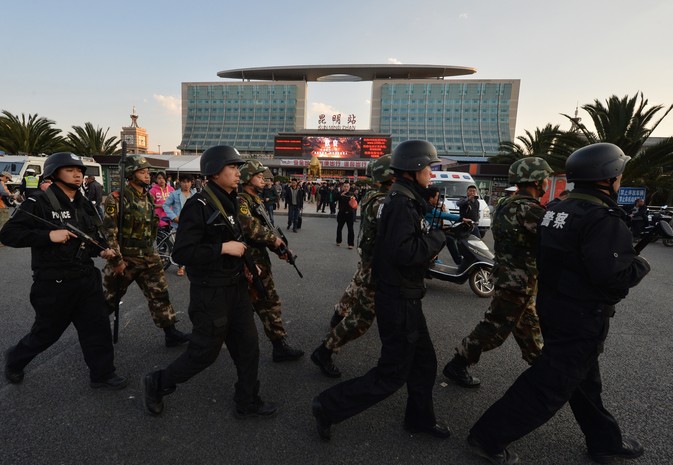
A SWAT team patrols the Kunming train station. Image: CCTV

In March of this year, a group of men and women armed with knives descended on the crowded Kunming Railway Station. Their ensuing rampage left 29 civilians dead and 143 injured in what is one of the most violent coordinated attacks to occur in China in recent memory. Four people accused of perpetrating the violence have been formally charged and will soon stand trial, Xinhuais reporting.

Official accounts of the attack state that six men and two women participated in the train station assault. Of those, four were shot and killed at the scene by police. One woman was subdued and arrested at the station, while three other suspects remained at large for 36 hours before being captured. No details of the manhunt or exactly how, where and when the fugitives were caught have ever been made public.

The four defendants stand accused of multiple crimes and will presumably face the death penalty if convicted. They have each been charged by the Kunming People’s Procuratorate, the city’s highest court, with participating in a terrorist organization, carrying out violent terrorist activities and premeditated homicide. No date has been publicly announced for a trial.

The outcome of the case is likely a foregone conclusion. Defendants tried by the government, especially in high-profile proceedings such as this, are generally found guilty following extremely short, closed-door judicial proceedings. A short, terse statement by prosecutors trying the four defendants appears to confirm this. It read, “The facts are clear and the evidence is ample. The four [suspects] should be investigated for criminal responsibility according to law and then prosecuted according to law.”

The defendants are all ethnic Uighurs from China’s Xinjiang Autonomous Region and prosecutors maintain the March 1 attack was religiously and politically motivated. In a statement made shortly after the suspects were apprehended, Yunnan Party Secretary, Qin Guangrong,characterized the captured men and woman as Muslim terrorists, adding one had confessed to the crime and admitted the group wanted “to join jihad”.

China has significantly ramped up law enforcement and ‘anti-terror’ efforts following the bloodshed in Kunming. In many cities around the country, police officers are now permitted to carry sidearms for the first time in decades. Trials involving suspected militants have also increased, and 113 people were recently jailed for terrorism-related crimes by Xinjiang courts.

Click here to link to this article written by Patrick Scally, first published on July, 1 on the GoKunming website.

Leave a Comment

Filed under China, Current Events, ethnic policy, Governance, Kunming Train Station Attack, SLIDER, Yunnan Province

Laos extradites drug suspects to Yunnan

Editors note: This article was originally written by Cissy Yu and published on Go Kunming. It is reprinted on Exse in its entirety. 

Yunnan has long been the country’s main entry point for illegal drugs. Despite increased interdiction efforts, international law enforcement cooperation and recent large-scale busts, it appears the province’s ‘Drug War‘ is becoming more costly and having only a small effect on the overall flow of narcotics across the border.

Last week, Lao police transferred five suspected members of a drug ring to Kunming in a display of cooperation between the two countries. Authorities originally detained the suspects in a joint police raid conducted on March 19, 2013, when a naval patrol seized more than 500 million yuan (US$82.3 million) worth of methamphetamines on the Mekong River.

China has been conducting patrols such as this with the help of Thailand, Laos and Myanmar since the “Mekong River Massacre” of October 2011. The attack, which killed 13 Chinese sailors, spurred Beijing to begin interdiction patrols along the river. Institution of the policy, although sanctioned by neighboring Southeast Asian countries, was the first time in three decades that Chinese forces have operated outside the nation’s borders without a United Nations mandate.

Although the drug lord responsible for the killings, Naw Kham, was sentenced and publicly executed in Kunming last year, illegal drug trafficking continues to run rampant in the border regions between Yunnan, Laos, Myanmar and Thailand. Known as the Golden Triangle, the area supplies an estimated 60 to 70 percent of all drugs consumed in China. A United Nations surveyconducted last year reported that opium cultivation in the Triangle rose by 22 percent in 2013, largely driven by mounting demand from the mainland.

Yunnan’s 4,060-kilometer border with Golden Triangle nations presents a grim challenge for anti-drug personnel. According to Yunnan Net, 70 percent of methamphetamines confiscated in China last year were seized in Yunnan. Currently, there are 1.7 million registered drug addicts in the province, although the government acknowledges the actual numbers are much higher.

While heroin remains the most commonly smuggled drug on the border, methamphetamines — also known as ‘ice’ — are a fast-growing second. In Ruili, a border town infamous in the past for its heroin trade, methamphetamines now dominate the market. One dose of the crystals — known as bingdu (冰毒) in Chinese — reportedly costs as little as five yuan.

Yunnan’s narcotics officials, meanwhile, claim they have redoubled efforts to combat the drug trade. Provincial courts sentenced more than 5,020 suspects for drug crimes in 2013. Yet some officials have complained that the record numbers on trial have led to more lenient judgments. “A suspect who would get the death penalty elsewhere [in China] only gets several years of jail in Yunnan,” said a National People’s Congress deputy. “The judicial system should be punishing these people with an iron hand.”

Image: China Radio International

Leave a Comment

Filed under China, GMS, Health, Laos, Mekong River, Regional Relations, SLIDER, Yunnan Province

Hekou’s 600 million yuan “boondoggle”

Editor’s note: The following article was written by Patrick Scally and originally published on the website Go Kunming. It is reprinted here in its entirety.

The media in Yunnan, and around the country, is often overly fond of splashy headlines containing enormous investment figures. The articles that follow are generally paeans to a modernizing society and the wonders of Chinese-style capitalism. Failure is rarely chronicled. That is far from the case in Hekou (河口), which is currently receiving plenty of negative journalistic buzz due to a development project provincial officials have deemed an embarrassing and costly “boondoggle”.

At issue is a 270 million yuan (US$43 million) construction project on the banks of the Honghe River (红河). The China-Asean International Tourist Cultural Scenic Corridor had been under construction since 2011, when the government approved development on the site, a kilometer-long stretch of uninhabited land.

Designed to be a showpiece of the city’s economic growth, the enterprise has become an object of public scorn and a symbol of miserable urban planning. The entire riverside development is now slated to be torn down at a cost surpassing that of its construction. Conservatively estimated at 300 million yuan (US$48 million), demolition costs include the projected expenses of paying back investors and cleaning up the site.

Although the corridor was nearly finished, its 150 mixed-use shopping and business venues are currently being razed and will eventually be converted into public green space. The decision to halt and ultimately destroy the venture is a “policy adjustment” by the local government, according to a South China Morning Post (SCMP) report.

Concerns over poor planning and improper waste disposal were raised by local residents as the project neared completion. Complaints increased and the endeavor, which was hoped to complement and augment natural scenery, became a blight that authorities describe as a “negative influence” on the riverside.

Investors, shop owners and even low-level government planners were apparently surprised when the announcement came to dismantle the corridor. “It never occurred to us that a new order [for demolition] would come so soon,” an unnamed city planner told the SCMP. Locals have taken things more in stride, using a still-standing plaza for ballroom dancing in the evenings.

Hekou sits on the shore of the Honghe River and is joined with the Vietnamese city of Lào Cai by bridge. For most of the past decade, provincial developers have been throwing money at the area in hopes of turning the city into a major trade depot connecting China, Vietnam and other Southeast Asian countries.

In 2008, a highway connecting Hekou County to major cities in neighboring countries was completed and work is well underway on a railway project linking Kunming to Hekou and, eventually, Hanoi. For now, however, it appears the 80,000 residents of Hekou will have to wait to see a venue that properly expresses their town’s importance as a regional trade hub.

Images: Xinhua

Leave a Comment

Filed under China, Economic development, SLIDER, Vietnam, Yunnan Province

Plugin by Social Author Bio