Author Archives: East by Southeast

Law of large numbers: The growing gravity of Kunming’s environmental protests

Kunming’s ongoing protest against the construction of a 10mn ton petroleum refinery 40km from the city center continues to gather attention in China’s domestic media and in the international media.  Yet despite continuous coverage of the protest in China’s Global Times, South China Morning Post, the Telegraph, the Guardian, and most recently the Atlantic (among many other media outlets), questions concerning the gravity of the protests continue to pop up in online chat forums: Does a protest of 1000+ Chinese citizens in a city of 7 million have impact?  Given the numbers, does the average Kunming citizen know about this issue?  Can protests of this scale force changes to policy agendas?

ExSE’s answer to all three of those questions is an unequivocal YES.  Kunming mayor Li Wenrong would have not made an impromptu engagement with protesters last Thursday if he didn’t see the movement as a legitimate challenge to the status quo.  He followed through on his promise to open a Sina Weibo account by noon on 5/18 and since then he’s gathered more than 75000 followers.  Further, an online poll created after the initial 5/4 protest exceeded its limit of 100,000 responses within three days.  The poll asked a simple yes or no question: Should there be a PX plant in Anning? An overwhelming majority of 80% ticked “no.”  It’s no surprise that the poll’s weblink was eradicated last week.  Admittedly, there is no way of knowing whether Li Wenrong’s 75k followers are mostly from Kunming, and online polls are never without bias; but the large numbers undeniably say something and suggest that the 2000+ protesters are representative of a much larger group of concerned citizens. Continue reading

3 Comments

Filed under China, Current Events, Economic development, Energy, Environment and sustainability, Governance, Myanmar/Burma, Yunnan Province

Unstoppable: Kunming’s environmental protest movement takes a powerful turn


protest view

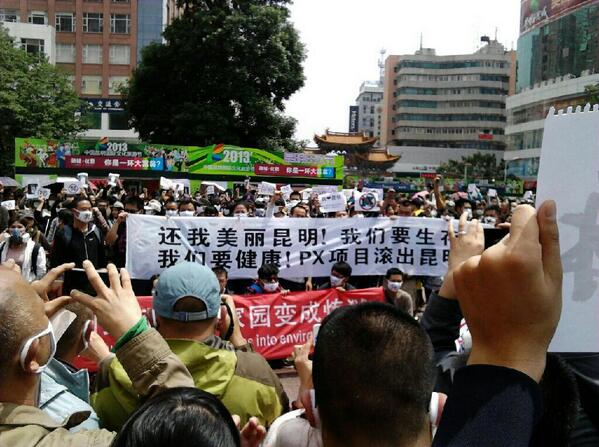
Kunming’s anti-PX protest movement broke through to new heights on Thursday as more than 2500 protesters took to the city’s downtown streets.  The unexpected success of this impressive NIMBY movement has empowered protesters to shift targets – what began two weeks ago as a movement opposing the construction of a polluting chemical plant attached to a PetroChina oil refinery 40km from the city center has evolved into a full blown protest against the entire 10mn ton oil refinery project.  Throughout the morning the protesters worked a powerful and persistent ground game breaking through rank after rank of public security forces to gain total control of Kunming’s downtown streets by noon.  Protesters marched in peaceful and non-violent demonstration for more than five hours under the intense Kunming sun and prompted an engaging appearance of Kunming mayor Li Wenrong who sympathized with protesters and promised immediate change – another breakthrough victory for this growing social movement. Continue reading

5 Comments

Filed under China, Current Events, Economic development, Energy, Environment and sustainability, Myanmar/Burma, Uncategorized

Mixed signals and smokescreens: Kunming’s government responds to Anti-PX protests

On Saturday, 5/11 anyone with cellular service registered to the Kunming municipality received two brief text messages concerning the city’s recent anti-PX protests.  Sent from the Kunming’s official propaganda offices, the messages when read separately state the key decision makers deciding the fate of the polluting PX plant are willing to increase transparency and engage with the public on this issue. However, when read together, the messages send mixed signals and suggest decision makers are creating a smoke-screen to stem a planned protest scheduled for later this week and buy time for the safe passage of the PX plant.

The first text message reads:

“Kunming Mayor Li Wenrong expresses that after the ‘By-products projects attached to the PetroChina Oil refinery feasibility study’ is finished at the end of July, he will use democratic decision making processes and stringently act on this issue in accordance to the needs of majority of the masses.”

This message suggests the mayor could follow China’s environmental law by conducting an environmental impact assessment (EIA) on the PX plant (the by-product project he mentions) and releasing the findings to the public.  It also suggests he could hold a public hearing before approval for the PX project is granted – another legal requirement.  Both of these measures were directly demanded at last week’s protests attended by more than 2000 participants in downtown Kunming, so perhaps the city government is willing to play ball AND more importantly,  follow the law.

The second text message reads:

“The CEO of Yunnan PetroChina expresses that the Kunming Anning Oil Refinery project is a fuel processing plant that producing State 5 Grade gasoline, diesel, and jet fuel.  This project will not include PX processing equipment and will not produce PX.”

Read separately, this message suggests the issue has concluded, and Kunmingers can put down their protest posters.  With no PX plant in the works, why show up for this week’s protest, right? Continue reading

Leave a Comment

Filed under China, Current Events, Energy, Environment and sustainability, Uncategorized

Anatomy of a Protest: Kunming citizens voice concern over chemical plant

Saturday’s peaceful protest in Kunming may be the first of many against a polluting PX chemical plant slated for construction inside Kunming’s city limits. Nearly 2000 people participated in the well organized protest, and the crowd met zero resistance from the 200+ police and public security officers sent to the site to maintain order. For more than three hours, citizens wore “No PX” face masks and paraded around the protest site waving banners and posters sporting slogans like “PX project, get out of Kunming” and “I want green!” Different from other protests I’ve seen in China, the organizers divided the site into teach-in zones where crowds of hundreds could listen to those who had a message to deliver. In the end, no arrests were made and there were zero scuffles between protesters or with the police.

banners

Continue reading

4 Comments

Filed under China, Current Events, Economic development, Environment and sustainability, Myanmar/Burma

About East by Southeast

WRITE FOR US!  JOIN THE ExSE TEAM, contact us at eastbysoutheastmail@gmail.com

The East by Southeast team is made up of scholars, development professionals, logistics experts, environmentalists, green entrepreneurs, and policy makers. We all live and work in the region – some were born here and some are implants. It is in the framework of the wide variety of our opinions that we seek to promote a deeper discussion of regional challenges. Some of us write under pen names to allow discussion to flow freely.

In addition to blog posts, look forward to weekly new digests, book reviews, and data that will help better inform your understanding of this dynamic region.


WHY WE WRITE:

There are many good blogs about China and many from Southeast Asia, but it is surprising that there are few blogs looking at the connections between China and Southeast Asia given shared development challenges, centuries of historical and cultural interaction, and rising volumes of trade and people movement between China and Southeast Asia.

In the 1990s, nations and ethnic groups that were cut off from cross-border interaction during the Cold War began to reunite as peace spread throughout the region, and arguably, China’s rise has reinforced stability within the region to deliver deepened integration.  Fast forward twenty years, the region is home to some of the fastest growing economies in the world and rapidly changing urban spaces. It is also known for its abundance in natural resources and biodiversity, and development trajectories are converting those resources into cash crops and energy commodities for trade and consumption. On mainland Southeast Asia, a lack of policy coordination and communication between governments and stakeholders has already created a variety of trans-boundary issues like fisheries depletion in the Mekong watershed.  As a result, for the first time, the region faces threats to food security and a potentially gross mismanagement of its resource endowment.

In addition to the growing connections between China and Southeast Asia, the East by Southeast blog team will examine China’s footprint across its southern borders to provide answers to some of the big questions surrounding China’s global rise. We seek to understand the effect and return of China’s outpouring of aid and investment to its Southeast Asian neighbors and monitor changes in China’s approach to foreign policy as its interests spread across the region. We want to know how China’s neighbors are adapting to its rise and how effectively China’s soft power is spreading. There is much room for discussion and exploration of the gaps between China’s rhetoric on its peaceful rise in the region and its ability to continue expanding its resource base to feed the needs of a rapidly growing economy. Lastly, we are concerned with China’s adaptation and response to a new and concerted US foreign policy toward Southeast Asia.

From a different perspective, the blog team will look at how the space between China and its Southeast Asian neighbors is decreasing at a rapid rate as transportation infrastructure, advances in information transfer, and trade linkages reach across borders and states use what Yale scholar James C. Scott calls in his 2009 watershed work The Art of Not Being Governed, “distance demolishing technologies” to connect areas that were once the frontiers beyond all frontiers. For example, energy from hydropower plants is sent from Laos to the China’s east coast development zones, you can now drive a container truck from Kunming to Bangkok in less than a day on what was once previous non-navigable terrain, and in 2015 the ASEAN Economic Community promises to drop the barriers to the movement of labor and goods through the region. In addition to understanding the trajectory and obstacles of regional integration,
we want to explore how rapid and sudden improvements in connectivity reshape individual livelihoods, communities, and regional relationships.

There are so many stories to tell of the people who are shaping the region for better or for worse and of the people who are affected
by regional decision making. Narratives from the varied and violent histories of the Cold War, colonial, and pre-colonial eras can help demonstrate how history can inform the present challenges. In addition, the blog will expore many regional question marks such as the tenuous path to democratization in Myanmar (and Thailand and Cambodia), Kunming’s rise as the Bangkok of the north, a high-speed rail system through Laos, and the effects of salinization in the Mekong Delta.  Can cities and rural areas in the region learn how to provide each other with sustainable solutions to development challenges? Are there lessons to be taught as countries like Thailand, China, and Indonesia seek to escape the middle income trap?

The East by Southeast team is made up of scholars, development professionals, logistics experts, environmentalists, green entrepreneurs, and policy makers. We all live and work in the region – some were born here and some are implants. It is in the framework of the wide variety of our opinions that we seek to promote a deeper discussion of regional challenges. Some of us write under pen names to allow discussion to flow freely.

In addition to blog posts, look forward to weekly new digests, book reviews, and data that will help better inform your understanding of this dynamic region.

If you’d like to join the discussion, feel free to leave a comment after our posts, or if you’d like to contribute to the blog by becoming a team member, send us a message to eastbysoutheastmail@gmail.com.

1 Comment

Filed under ASEAN, China, Cold War, Current Events, Economic development, Energy, Environment and sustainability, Foreign policy, Governance, water

Plugin by Social Author Bio