Category Archives: water

Why Can’t We Protect China’s Cleanest Freshwater Lake?

4109718

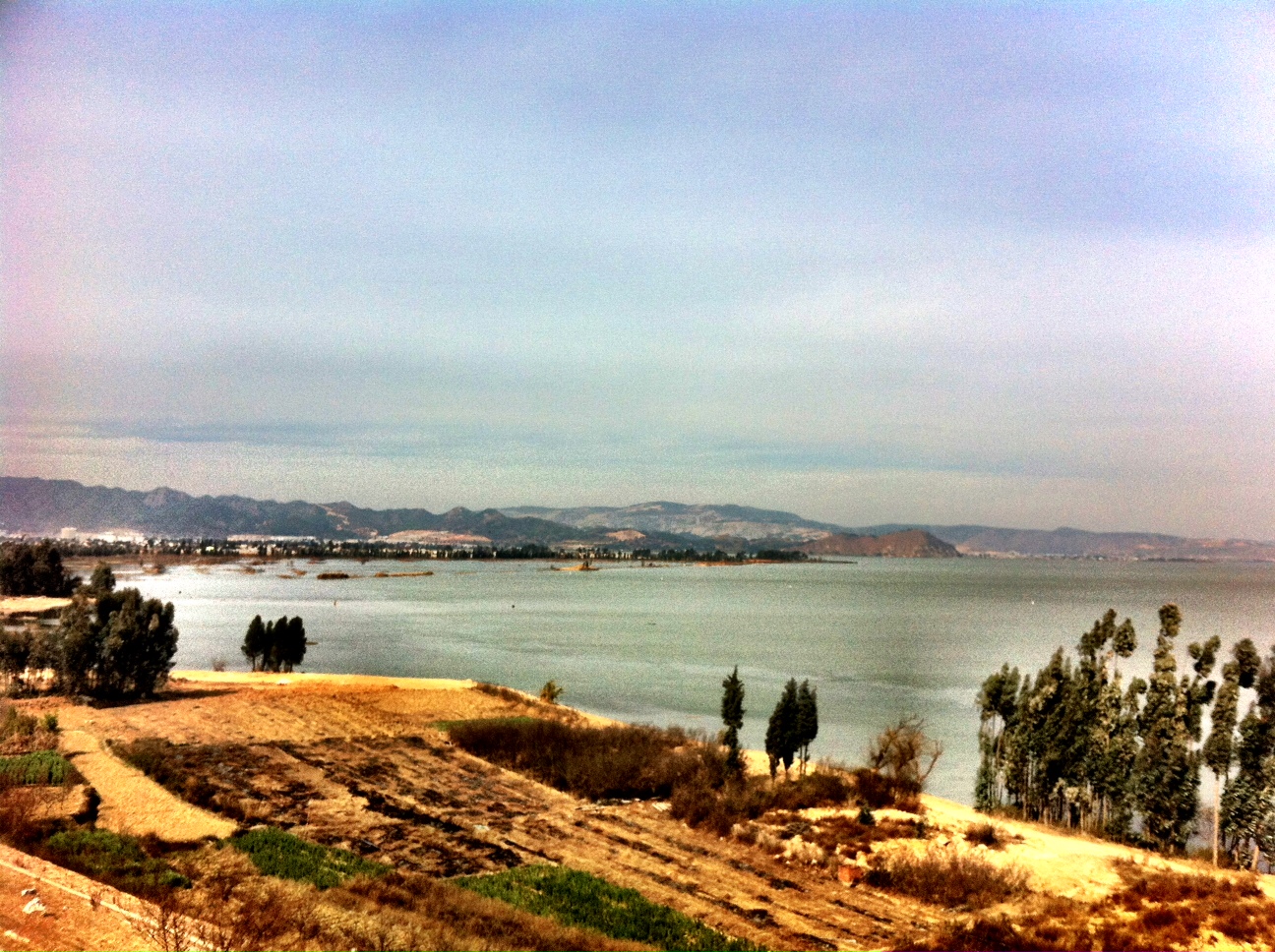
Fuxian Lake, located in Yunnan Province’s Yuxi municipality sixty kilometers southeast of Kunming, sits at the headwaters of the Pearl River, China’s third longest river. It is the largest alpine freshwater lake in China, and its water storage capacity accounts for nearly 10% of all freshwater lakes in China.  Fuxian is twelve times larger than the water volume of its western neighbor, Kunming’s Dianchi Lake. Most importantly, the lake’s water quality is rated at Class I meaning it is directly drinkable.

In order to protect Fuxian Lake’s water quality and local ecosystem, the Yunnan Provincial Government issued a set of “Protection Regulations on Fuxian Lake of Yunnan Province” on September 1, 2007. It declares the entire lake, its watershed, and adjacent lakeside area extending 100m range from the shore are within the first protection zone, a red line under strict protection and monitoring. In accordance with the local regulations, washing clothes and bathing in the lake are strictly prohibited. Even motor-driven boats have been replaced with manpower-driven pedal ones. Furthermore, conditions on the use of cultivated land, shoals and vegetation around the lake are also defined by the regulations.

Also, clearly banned are “the unauthorized expansion or alteration or creation of new buildings or structures; unauthorized pumping of water from the lake or violation of water permit provisions for pumping water; other destructive practices to the ecological system and pollution behavior.”

Since 2005, August 26th of every year has been designated by Yuxi City as the Fuxian Lake Protection Action Day. All of these measures seem to favor the lake’s protection and its aquatic ecosystem. But in practice, is it really true?

A June 7 China Central Television (CCTV) report disclosed the unregulated construction of eleven real estate projects around the lake that threaten to destroy its aquatic ecosystem and degrade its water quality.  The numerous luxury lake-view villas, five stars hotels such as Hilton Hotel, and golf courses were built or under construction within Fuxian Lake protection area. For sales promotion, these ‘Big Mac’ projects were crowned as resorts, sports parks, among other flashy names.

For example, Longhu Lake Park project is located in Mackerel Bay with an area of 147 hm2 size and an investment footprint of USD 730 million. A realtor for the project boasted that its size is as big as one-fifth of Kunming metropolitan area. To my surprise, this project even passed its environmental impact assessment. The EIA report said “impact of the project construction on the environment is slight and controllable. The project meets the regulations and the environmental management standards of construction project of the national construction projects in listed in Yunnan Province’s environmental regulations. The project location is feasible.”

A further embarrassing fact is that some projects broke ground before their EIAs were processed. The Kowloon Bay, Kowloon Sheng Jing Project is located in the upper reaches of lake’s western banks.  In its promotional materials, the developer dared to say “the project site offers the nearest resort-style apartments to Fuxian Lake so far. It is only 50m away from the shoreline.” Most of these European style villas come with a lake view. The project includes luxury hotels, lake view hotel apartments and villas.

In September 2009, Yuxi Municipal Party Committee and Government issued “A Decision for Accelerating Tourism and Cultural Industries Development.” Citing “from 2010 onwards, the municipal government will invest 30 million RMB to promote tourism development…. Each subordinate district and county should set up special budget for tourism development.” The cited purpose of the decision is to “encourage the introduction of high-star hotel projects” and “local governments will be awarded with 10 million RMB for the successful introduction of well-known international brand five-star hotel projects exceeding investment levels 300 million RMB after the project’s completion.”

In this decision, the projects mentioned above were highlighted one by one. The Yuxi municipal government vowed to “create conditions to facilitate the projects’ construction as soon as possible”.

Around Fuxian Lake, many developers promote new commercial buildings and hotels connecting project names to the beauty and quality of the lake. For instance, “Holy Water Lake Phase II” advocated that they built a “wetland park” in Fuxian Lake, exclusively open to the residence owners and the hotel guests.

Locals from surrounding villages told a CCTV reporter that the residential developments were discharging excessive levels of black, smelly sewage directly into the lake! The local villagers angrily said that protecting the Fuxian Lake was merely spoken of on the lips of leaders and the regulations were useless.

The CCTV report further pointed out that although the country already banned golf course construction in national level water resource protection zones, golf courses were being constructed around the lake. It also mentioned that most real estate projects were initiated via oral permission from the local governmental leaders without environmental impact assessment.

Naturally one cannot help asking the following questions regarding the protection of Fuxian Lake:

  • Which is really more powerful and effective, the political agendas of leaders OR the rule of law when a collision between environmental conservation and economic development occurs?
  • Why do we often repeat these inane practices, namely sacrificing environmental quality for economic development? Do these mistakes really pay off?
  • Why do not we try best to maintain our blue skies, clean water and a hygienic environment for ourselves and also for our next generations? Do we fear our next generations will rebuke us if we are too selfish?
  • Is it fair to dirty the environment dirty leave the bill for our next generations?
  • Despite the CCTV report which by the nature of its broadcast, passed muster of national censors and by the eyes of national leaders, why do local environmental protection agencies continue to maintain silence about the Fuxian Lake case?

After the CCTV report, Yuxi government issued a moratorium on the processing of new real estate development projects around Fuxian lake.
1 Comment

Filed under China, Environment and sustainability, Sustainability and Resource Management, water

Taiwan: The most important R.O.C. in the South China Sea

Events over the last couple weeks have re-drawn attention, rightfully, to an oft-overlooked player in the South China Sea disputes, Taiwan (aka. Republic of China). SCS analyses often dismiss Taiwan’s claims as a marginal issue and is only mentioned in the context of mainland China’s claims, however as the most recent incidents with the Philippines demonstrate, Taiwan’s strategic importance to the South China Sea (and East China Sea) is actually woven into the very core of disputes.

Fishermen Wars

On May 9, a 65 year old Taiwanese fishermen named Hung Shih-cheng was shot and killed by the Philippine Coast Guard in a standoff. The PH Coast Guard claims that they shot at Mr. Hung’s vessel  to disable the engine as a self-defense mechanism because the fishing boat was attempting to ram-and-run. Eye-witness accounts through Taiwanese media however, report that the boat was struck by 30-40 bullets, which seems excessive. Mr. Hung was unarmed, accompanied on the boat by his son and two other sailors.

On May 10th, the news broke and Philippine officials acknowledged the incident and indicated investigations have began. Coast guard commander Rodolfo Diwata Isorena indicated that the 11 officers involved have been suspended from duty. On May 12, with tensions running high on both sides, Taiwan issued a 72 hour ultimatum to the Philippine authorities, demanding formal apology from the President, appropriate reparations to the fishermen’s family, and extradition of perpetrators to Taiwan for investigation to ensure “justice”. On May 15th, just minutes before the deadline, the Philippines announced that it would send its representative to Taiwan to apologize but that no extradition will occur and was unclear with regards to reparations. Taiwan subsequently rejected this apology declaring it insincere and insufficient. It announced a series of retaliatory actions, including withdrawing its diplomatic representative, conducting elevated sea patrols, and sanctions on work permits for the nearly 87,000 Filipinos working in Taiwan. The last action would prove to be costly to the Philippines which sends over a million workers overseas each year and is heavily reliant on remittances.

On May 17, Taiwan carried through with its threat to conduct joint Naval – Coast Guard drills in the SCS, the first time ever crossing the 20* latitude “temporary enforcement line” since the Taiwanese government established it in 2003. Taiwan indicated that these drills, along with heightened patrols (increase of 1-2 ships to 3-4 ships) are not a one-off occurance but will continue indefinitely, in order to ensure the safety of its fishermen. Continue reading

Leave a Comment

Filed under China, Culture, Current Events, Energy, Environment and sustainability, Foreign policy, Philippines, water

A Primer to the Philippines’ South China Sea Arbitration Challenge to China

Earlier in January this year, the Philippines submitted a unilateral challenge to China on certain key aspects of their ongoing dispute in South China Sea (SCS) maritime delimitations under the United Nations Convention on the Law of the Seas (UNCLOS). This challenge will take the form of an arbitration case before the International Tribunal on the Law of the Seas (ITLOS). To the uninitiated, this move is intriguing but unclear as to its real-world implications for international maritime law or the future of SCS geopolitics. The following primer attempts to translate the dense jargon of maritime law, distill the meanings behind subtle diplomatic language of Claimant States, and untangle the intricate web of geopolitical maneuvering to provide a clearer, layman picture of this case and its implications for the SCS disputes.

Why the arbitration case?

The ongoing dispute between the Philippines and China has been simmering for many years. Ever since a joint exploration agreement (along with Vietnam) to conduct seismic review of potential hydrocarbons in the SCS region collapsed in 2007, the tone and intensity of SCS disputes have escalated.  The situation came to a head when in early 2012, Chinese Coast Guard ships came into confrontation with a Philippine naval ship over harassment of fishermen in Scarborough Shoal, a formation in the Spratlys (南沙in Chinese). The Scarborough Shoal standoff did not end well for the Philippines as China has now established an ongoing blockade of the shoal. (More discussion of this standoff and its implications to follow in a later article) In response, the Philippines moved for ASEAN to issue a unified statement to China censoring it for its actions in the South China Sea. However, other ASEAN members proved reluctant to do so for many reasons. (More discussion of this will come in a later article) Suffice it to say, by Fall 2012, the Philippines began actively exploring other options to pursue its dispute with China.

What is happening?

To the layman observer of SCS disputes, the Philippines’ move to challenge China by arbitration may have been surprising. After all, it’s generally understood that China studiedly avoids multilateral engagement on SCS disputes and/or 3rd party mediation, insisting that the SCS disputes are a regional issue that should be addressed on a bilateral basis. Questions regarding this case include:

  • Can the Philippines unilaterally bring China to arbitration? And if so, does China have to engage?
  • Regardless of China’s engagement, does the ITLOS have jurisdiction to rule on the challenges?
  • What are the points the Philippines is challenging?
  • Even if ITLOS has jurisdiction to rule on certain aspects of challenges put forth, what are the actual implications for SCS disputes?

Continue reading

2 Comments

Filed under ASEAN, China, Energy, Foreign policy, Philippines, Regional Relations, Uncategorized, water

Myitsone: A road block for Sino-Burmese relations?

A year and half ago this past March, one of the more the surprising events in recent Sino-Burmese relations took place. With a short letter delivered to the Burmese legislature, President Thein Sein suspended the Myitsone Dam until 2015, the end of his term. The dam, a $3.6 billion project that would sit at the confluence of the Irrawaddy’s two main tributaries, was the centerpiece of a series of seven dams on the upper reaches of the river. The project was the result of a joint venture between the Burmese government and China Power Investment (CPI) beginning in 2006 and appeared to be of great importance to both sides. However, a nationwide protest campaign against the construction of the dam supported by Aung San Suu Kyi ultimately won out.

Continue reading

1 Comment

Filed under China, Current Events, Energy, Foreign policy, Myanmar/Burma, Regional Relations, Uncategorized, water

Cleaning up Kunming’s Dianchi Lake, Part 2

Zhou Dequn’s post, “Cleaning up Kunming’s Dianchi Lake” discussed the origins of and contributing factors to the lake’s pollution.  His post also briefly discussed a few of the measures used to raise the quality of Dianchi’s water in recent years. The marked improvement of Kunming’s groundwater quality was recently profiled in this New York Times video.

Dianchi south

PHOTO: Dianchi’s southern shoreline

Continue reading

1 Comment

Filed under China, Economic development, Environment and sustainability, Sustainability and Resource Management, water

Where have all the fish gone? Killing the Mekong dam by dam

The Mekong, a river of wildly majestic fast-flowing currents flowing through six countries, has long enchanted explorers with its rich biodiversity second only to the Amazon.

It is home to the Giant Catfish, and at least 877 fish species sustaining food security for around 65 million people which make the Mekong the world’s most important centre of freshwater fisheries.

“For the people born on the Mekong, the river is like their blood—the principle of life,” says Dorn Bouttasing, a Lao environmental researcher.

Surely it is unthinkable that man would want to endanger or destroy the basis of such extraordinary natural wealth? Such invaluable natural resources, their infinite value defies any attempt to measure with a crude price tag.

My documentary Where Have All the Fish Gone? (Eureka Films) looks at the four Chinese hydropower dams that have been already built on the Lancang (The Chinese name for the upper Mekong), but its main focus is on the Lower Mekong basin shared by Laos, Myanmar, Thailand, Cambodia and Vietnam.

Continue reading

Leave a Comment

Filed under Cambodia, China, Current Events, Economic development, Energy, Environment and sustainability, Food, Foreign policy, GMS, Governance, Laos, Mekong River, Sustainability and Resource Management, Thailand, Vietnam, water

Regional Roundup for Week of 4.18.2013

Just the news this week. Continue reading

Leave a Comment

Filed under ASEAN, China, Cold War, Current Events, Economic development, Energy, Environment and sustainability, Foreign policy, Governance, Health, Laos, Mekong River, Myanmar/Burma, NEWS DIGEST, Thailand, Vietnam, water

Biodiversity in China’s Rivers Under Extreme Threat

As a result of decades of unchecked development and poor decision making, China’s inland rivers are suffering a crisis and are in the midst of severe losses of biodiversity.  Currently there is a serious lack of conservation measures and a shortage of funding to protect endangered aquatic species.

According to an expert from Changjiang Fishery Resources Managing Committee, there used to be more than 1,100 species in the Yangtze River, including more than 370 fish species, over 220 zoobenthos (organisms which live on the riverbed), and hundreds of aquatic plants. The rapid development of economic zones in the Yangtze River basin has caused a rapid decline in aquatic biological resources. Now many species like the Chinese river dolphin and the Chinese paddlefish face extinction.  The famous Reeves’ Shad, once important to local fisheries, has not been seen for many years. “Living fossils” such as the Chinese sturgeon have also rapidly decreased in numbers and at an even faster pace.

It is baffling to me that when we were initially constructing the Three Gorges Dam, we didn’t learn from the experiences of developed countries that built fish ladders for migratory fish. Even Vietnam and Laos, our neighbors to the south are installing fish ladders in their new hydropower projects.  Since the formation of the Three Gorges Reservoir, the dam has blocked the migratory routes that the fish need in order to reproduce.  The “transform rivers into lakes” strategy seeks to inundate rapids and exposed shoals in the river to promote for the safe passage of ships, but many fish that are used to living in the rapids are gradually migrating upstream resulting in a reshuffling of river basin ecosystems.  The dam has also had a major impact on yearly fish catches. During this year’s rare summer droughts, thousands of fishermen along the water basin were left with empty nets. Continue reading

4 Comments

Filed under China, Energy, Environment and sustainability, Governance, water

The Kachin Conflict and China: No More Non-Interference?

While peace hasn’t been an easy thing to come by in Kachin State these past few years, peace talks actually have. Since tensions between the Kachin Independence Army (KIA) and the Burmese military erupted again in 2011, the two sides have held multiple rounds of informal talks, often to no avail. Last month’s talks, while not bringing an end to the conflict, were still important for another reason – they weren’t held in Myanmar, but instead in the border town of Ruili, China. This was the first time such talks have been hosted by China and raises questions about what significance they could have for the future of Chinese diplomacy.

As is already well known by now, China claims non-interference in other states’ domestic affairs as a guiding principle of its foreign policy. With this recent round of talks between the KIA and the Burmese government, however, we seem to see something different. Is China willingly taking up the mantle of responsibility associated with being a “global power” or is there a different motivation behind hosting these talks?

From my perspective, the latest round of negotiations has much more to do with China’s national security than any grand policy shift. China hosted these talks, which some might see as an involvement in Burmese domestic affairs, because they have a significant interest in seeing the Kachin conflict come to an end. China’s interests are intertwined in two ways. Continue reading

1 Comment

Filed under China, Current Events, Energy, Foreign policy, Myanmar/Burma, water

About East by Southeast

WRITE FOR US!  JOIN THE ExSE TEAM, contact us at eastbysoutheastmail@gmail.com

The East by Southeast team is made up of scholars, development professionals, logistics experts, environmentalists, green entrepreneurs, and policy makers. We all live and work in the region – some were born here and some are implants. It is in the framework of the wide variety of our opinions that we seek to promote a deeper discussion of regional challenges. Some of us write under pen names to allow discussion to flow freely.

In addition to blog posts, look forward to weekly new digests, book reviews, and data that will help better inform your understanding of this dynamic region.


WHY WE WRITE:

There are many good blogs about China and many from Southeast Asia, but it is surprising that there are few blogs looking at the connections between China and Southeast Asia given shared development challenges, centuries of historical and cultural interaction, and rising volumes of trade and people movement between China and Southeast Asia.

In the 1990s, nations and ethnic groups that were cut off from cross-border interaction during the Cold War began to reunite as peace spread throughout the region, and arguably, China’s rise has reinforced stability within the region to deliver deepened integration.  Fast forward twenty years, the region is home to some of the fastest growing economies in the world and rapidly changing urban spaces. It is also known for its abundance in natural resources and biodiversity, and development trajectories are converting those resources into cash crops and energy commodities for trade and consumption. On mainland Southeast Asia, a lack of policy coordination and communication between governments and stakeholders has already created a variety of trans-boundary issues like fisheries depletion in the Mekong watershed.  As a result, for the first time, the region faces threats to food security and a potentially gross mismanagement of its resource endowment.

In addition to the growing connections between China and Southeast Asia, the East by Southeast blog team will examine China’s footprint across its southern borders to provide answers to some of the big questions surrounding China’s global rise. We seek to understand the effect and return of China’s outpouring of aid and investment to its Southeast Asian neighbors and monitor changes in China’s approach to foreign policy as its interests spread across the region. We want to know how China’s neighbors are adapting to its rise and how effectively China’s soft power is spreading. There is much room for discussion and exploration of the gaps between China’s rhetoric on its peaceful rise in the region and its ability to continue expanding its resource base to feed the needs of a rapidly growing economy. Lastly, we are concerned with China’s adaptation and response to a new and concerted US foreign policy toward Southeast Asia.

From a different perspective, the blog team will look at how the space between China and its Southeast Asian neighbors is decreasing at a rapid rate as transportation infrastructure, advances in information transfer, and trade linkages reach across borders and states use what Yale scholar James C. Scott calls in his 2009 watershed work The Art of Not Being Governed, “distance demolishing technologies” to connect areas that were once the frontiers beyond all frontiers. For example, energy from hydropower plants is sent from Laos to the China’s east coast development zones, you can now drive a container truck from Kunming to Bangkok in less than a day on what was once previous non-navigable terrain, and in 2015 the ASEAN Economic Community promises to drop the barriers to the movement of labor and goods through the region. In addition to understanding the trajectory and obstacles of regional integration,
we want to explore how rapid and sudden improvements in connectivity reshape individual livelihoods, communities, and regional relationships.

There are so many stories to tell of the people who are shaping the region for better or for worse and of the people who are affected
by regional decision making. Narratives from the varied and violent histories of the Cold War, colonial, and pre-colonial eras can help demonstrate how history can inform the present challenges. In addition, the blog will expore many regional question marks such as the tenuous path to democratization in Myanmar (and Thailand and Cambodia), Kunming’s rise as the Bangkok of the north, a high-speed rail system through Laos, and the effects of salinization in the Mekong Delta.  Can cities and rural areas in the region learn how to provide each other with sustainable solutions to development challenges? Are there lessons to be taught as countries like Thailand, China, and Indonesia seek to escape the middle income trap?

The East by Southeast team is made up of scholars, development professionals, logistics experts, environmentalists, green entrepreneurs, and policy makers. We all live and work in the region – some were born here and some are implants. It is in the framework of the wide variety of our opinions that we seek to promote a deeper discussion of regional challenges. Some of us write under pen names to allow discussion to flow freely.

In addition to blog posts, look forward to weekly new digests, book reviews, and data that will help better inform your understanding of this dynamic region.

If you’d like to join the discussion, feel free to leave a comment after our posts, or if you’d like to contribute to the blog by becoming a team member, send us a message to eastbysoutheastmail@gmail.com.

1 Comment

Filed under ASEAN, China, Cold War, Current Events, Economic development, Energy, Environment and sustainability, Foreign policy, Governance, water