Category Archives: SLIDER

Bottlenecks to Development: Challenges in the Mekong Delta

Last week, ExSE took a hard look at the environmental challenges facing the Mekong Delta region and found that the prospects are not good. Due to unenviable geography and global warming, rising sea levels, higher average temperatures and irregular precipitation patterns will all converge in the next 50 years to change the face of the Mekong Delta (MKD). That’s to say nothing of salinity intrusion, flooding and tropical storms. However, the MKD’s problems are not only environmental in nature; the region’s economy also faces a host of challenges, many of them tied to the Delta’s environmental changes.

Issues in the Mekong Delta are of course significant for its residents, but they also carry great importance for those outside the region because of the MKD’s role in national and regional food security. The statistics on the Delta are incredible. In an area taking up just 36,000 square kilometers (12 % of Vietnam’s total area), the Delta’s 22 million inhabitants plant 2.6 rice crops per year totaling 25 million tons of rice. The MKD’s rice production accounts for over half of Vietnam’s total and the seven million tons rice that the Delta exports has helped Vietnam become the world’s second largest rice exporter after Thailand. In addition, the Delta accounts for 70% of Vietnam’s fruit production and three-quarters of its fish catch.

The Delta’s massive agricultural output is no accident. The region is perfectly situated to receive large amounts of water and sediment from the three main stems of the Mekong Delta and the many thousands of canals that intersect them and a tropical temperature allows for farming year-round. What’s more, concerted efforts in the past 30 years to improve the region’s water infrastructure have doubled arable land in the MKD. Combined with advances in genetically modified rice strains, yields in the Delta have increased by 30% and total production has doubled, all within the past 20 years.

Incomes have also increased. According to the General Statistics Office of Vietnam (GSO), the average income of Delta residents has gone from 50 cents USD/day in 1999 to $2/day in 2010 and the region reached it Millennium Development Goals in 2006. However, despite impressive improvements in agricultural output and per capita income, the Delta has lost ground to other regions of Vietnam and now lags behind in important measurements of human and economic development.

Source: Dr. Ho Long Phi, processed from data of General Statistics Office of Vietnam.

Source: Dr. Ho Long Phi, processed from data of General Statistics Office of Vietnam.

In the late 1990’s, the Delta was actually 20% above the national average in per capita income. However more than 10 years later, the number stands at a little more than 80%. In the first decade of the new millennium, Vietnam underwent a period of intense economic growth through industrialization and people all over the country got richer as a result. The benefits of economic growth were not felt equally by everyone, however. Due to development bottlenecks, some regions, including the Mekong Delta, did not industrialize like others

One of these bottlenecks is a lack of infrastructure. The proportion of waterways, intra-provincial roads and inter-provincial roads per thousand people are all behind the national average. Of these three measures, the proportion of inter-provincial roads stands out. For one, there are only 0.34km of them per 1000 people in the Delta, standing at only half of the national average. This is especially important because of the nature of the Delta’s economy. The MKD, because its economy is so heavily concentrated in agriculture, lacks many necessary products and thus has a long history of importing and exporting nearly everything. While this may be good for enterprising middlemen, it is not good for the region’s economic development. With so few avenues for importing and exporting goods, the logisitical cost rises and because the MKD lacks so many raw materials, industrial development becomes disadvantageous. In fact, unless an investor is interested in agricultural processing, building a factory closer to Ho Chi Minh City is probably a better business plan in many cases.

Source: Dr. Ho Long Phi, processed from data of General Statistics Office of Vietnam

Measure of waterway, inter-provincial roads and intra-provincial roads in the Delta. Source: Dr. Ho Long Phi, processed from data of General Statistics Office of Vietnam

A second bottleneck, and another reason a potential investor might not consider the Delta, is a lack of skilled labor. Like the region’s road density, the MKD’s percentage of trained labor lags behind the national average; according to data collected by GSO (General Statistics Office of Vietnam) the Delta’s percentage of trained labor stood at just over half of the national average. In addition, the proportion of Delta residents with some sort of higher education stood at less than 1%, or in other words, just a fifth of the national average. With a workforce that is so poorly trained and educated, the Delta becomes an even less attractive region for investment, especially when compared to the populations near the Red River Delta (Hanoi and its environs) or Ho Chi Minh City.

What’s more, those Delta residents that have some technical training and/or higher education do not stay in the Delta for long. As the region’s economy falls farther behind the rest of Vietnam, more and more Delta residents are moving to urban centers to look for work. One of the main destinations for these people is Ho Chi Minh City, where over half of the city’s migrant workers come from the Mekong Delta. What trained labor the MKD might have ends up leaving the region for greener pastures, thus widening the gap between the Delta and places like Ho Chi Minh City.

Source: Dr. Ho Long Phi, processed from data of General Statistics Office of Vietnam

Source: Dr. Ho Long Phi, processed from data of General Statistics Office of Vietnam

One reason that the MKD has such a low percentages of trained labor and educated inhabitants is that in the past there was no need for supplementary education of any form. In an environment where the annual rice yields are stable and prices are good enough, investing time and money for a new career is an unnecessary risk and one that Delta residents have not taken. Paddy rice cultivation requires little technical skill yet provides a modest, usually stable income. However, the income provided from rice is rarely enough to invest in the expansion of other industries and in the Delta’s case, the lack of infrastructure makes such an investment an even more expensive proposition.Unfortunately for the farmers of the Mekong Delta, rice cultivation is becoming a less and less stable enterprise. For one, the price of rice has dropped in the past decade. As more and more rice is produced worldwide, the seven tons of rice the Delta exports annually decreases in value and farmers lose out.

However, shifts in the world rice market are nothing compared to problems farmers face due to global warming. As detailed here, rising temperatures, sea level rise, an erratic precipitation and flood schedule and more frequent tropical storms all threaten to radically alter the Mekong Delta in the next century. The region already has enough impediments to development with its lack of infrastructure and trained labor; its environmental issues only add to the severity of the situation. The Delta, now more than ever, is in acute need of solutions. However, who’s coming up with these solutions, if there are any to begin with, is another question unto itself and one that needs to be answered before any future for the Mekong Delta can be imagined.

Leave a Comment

Filed under Agriculture, Economic development, Environment and sustainability, Mekong River, SLIDER, Sustainability and Resource Management, Vietnam

China and South Asia: Contention and Cooperation Between Giant Neighbors

Are China and India allies or enemies in the South Asian economy? Well, it seems they are both; working together in healthy and profitable partnerships while maintaining armies in the contested China-India borders. This article explains the paradoxical nature of the China-India relationship and its impact and implications for the smaller countries in South Asia and neighboring Southeast Asia.

The rise of China and India over the last two or three decades continues to make global news headlines. Competition between these two global powers in economic, political and diplomatic domains has garnered scholarly and media attention. Yet we know much less about China’s growing ties and contention with India that are also spreading across the South Asia subcontinent and beyond. As China-India trade has grown, India in 2006 opened the historical trade route, Nathula Pass, which had remained closed for almost 50 years as a result of a border war with China in 1962. Today in the presence of several persistently disputed border zones in South Asia (see Map 1), China is beginning to build dams on the rivers in the Tibetan Plateau, including the upper Brahmaputra (yarlung tsangpo or Yarlung River), which could impact populations living downstream in India and Bangladesh (see Map 1). China has taken over the construction of Gwadar Port in the Pakistani province of Baluchistan, on the Arabian Sea. China has also begun building the Gwadar road corridor all the way north to Xinjiang. Continue reading →

Leave a Comment

Filed under China, Economic development, Energy, Foreign policy, GMS, Mekong River, Myanmar/Burma, Regional Relations, SLIDER, Uncategorized, Yunnan Province

Yunnan to Spend 70 Billion on Infrastructure Development

8420

Yunnan lawmakers were busy over the past seven days, earmarking billions of yuan for building projects across the province. The vast majority of the money will be used to fund the ongoing construction of 26 major highways. Other money has been set aside for waterway maintenance and “disaster mitigation” projects.

The Provincial Highway Bureau expects to initiate or continue work on 1,500 kilometers of highways in the next two years, it announced in a July 14 press release. In total, the new roadways will cost 100 billion yuan (US$16.1 billion), spaced out in annual 50 billion increments over the next two years.

Stretches of road scheduled for completion this year include highways connecting Lijiang toShangri-La, Ruili to Longling and Huaping to Lijiang — which is a segment of the road linking Lijiang to Chengdu.

Obtaining loans for massive infrastructure ventures has become increasingly difficult as China’s once-humming economy continues to slow. Statistics published by news outlet Kunming Information Hub show that in 2011, the province experienced a two billion yuan shortfallbetween toll road revenue and what it owed in loans for highway construction.

To avoid a repeat of that deficit, provincial planners voted to implement tolls on many of the new roads, effectually passing the bill on to automobile owners. People traveling by bus will also pay a share of the costs. Currently, a 0.5 yuan surcharge is attached to the price of every long-distance bus ticket purchased in Yunnan. That fee will now be raised to 0.9 yuan to help fund highway expansion. Long-distance transport trucks will also face higher fees based on load tonnage and distance traveled.

An additional twenty billion was pledged for waterway upgrades. Details have not been fully disclosed, but some monetary allocations will fund canals connecting rivers to reservoirs as well as maintenance on dams and hydropower stations across the province.

Although highways and water infrastructure projects comprise the lion’s share of the recently allocated money, two billion yuan (US$322 million) was also designated for the prevention of ecological disasters. Surveyors have identified thousands of “hazard points” in Yunnan — places where roadside cliffs are prone to rockslides or where villages are threatened by mudslides due to deforestation. Over the past fifteen years, Yunnan has suffered a reported 17,258 geological disasters. These claimed the lives of 1,394 people and led to more than seven billion yuan in economic losses.

This article written by Patrick Scally was first published here on 7/15 on GoKunming.

Leave a Comment

Filed under China, Economic development, Environment and sustainability, Governance, SLIDER, Yunnan Province

Regional Roundup for the week of 7.18.14

The top stories this week included the formation of a $100 billion BRICs development bank in a major play to reshape investment in Asia and challenge Western-dominated financial institutions like the World Bank. It will be based in Shanghai and managed by India for the first five years, followed by Brazil and Russia.

In Cambodia, opposition politicians were detained and charged with insurrection following an altercation between protestors and security forces on Tuesday. The arrests come just before the anniversary of disputed elections.

Thailand has allowed former prime minister Yingluck Shinawatra to leave the country on the premise of joining her brother Thaksin Shinawatra (another ousted prime minister living in exile) in Paris for his birthday.

China has moved a contentious oil rig from disputed waters in the South China Sea, although tensions remain high in the region. See Brian Eyler’s analysis of how trade between China and Vietnam is likely to decrease in the coming months as an impact of these tensions.

ExSE FOCUS

Brics countries create $100bn bank to ease western grip on global finances | Guardian –The leaders of the Brics emerging market countries have launched a $100bn (£58.3bn) development bank and an emergency reserve fund in their first major step towards reshaping the western-dominated international financial system. The Brics group comprises Brazil, Russia, India, China and South Africa. The bank, aimed at funding infrastructure projects in developing nations, will be based in Shanghai, and India will preside over its operations for the first five years, followed by Brazil and then Russia.

Cambodia: Opposition Politicians Are Charged With Insurrection | NYT — Six Cambodian opposition politicians were charged Wednesday with leading an insurrection movement after a clash with security forces who prevented their followers from rallying in a public park.

Cambodia: Protest Turns Violent | NYT — Opposition demonstrators disarmed Cambodian security forces and beat them with batons and flagpoles on Tuesday, two weeks before the anniversary of a disputed general election.

What Does Indonesia’s Election Standoff Mean for Indonesia’s Next President? | Asia Unbound — As I have previously blogged, unless Prabowo Subianto is able to steal four to six million votes in the days before the official vote tally is released, an unlikely possibility, Jakarta governor Joko Widodo will be declared the winner of the presidential election sometime next week. However, Prabowo is not going to go quietly.

Thai junta allows ex-PM Yingluck Shinawatra to leave country | Guardian — Thailand’s junta has given permission to ousted former prime minister Yingluck Shinawatra to leave the country for the first time since the 22 May coup, a military spokesman said on Thursday. Yingluck is expected to travel to Paris next week to attend the 65th birthday party of her elder brother, the fugitive former premier Thaksin Shinawatra.

Chinese Oil Rig Near Vietnam to Be Moved | NYT — A Chinese energy company said it would move a giant oil rig from disputed waters off the coast of Vietnam, two months after its arrival raised tensions.

Stronger than the bullet | SEA Globe — Southeast Asia is a vast and complex region, comprising countries with remarkably diverse histories and cultures. Against the backdrop of rapid economic development and social transformation in several countries, some nations have adopted democratic institutions, while others have maintained stable authoritarian systems or accepted communist regimes./Great infographic of registered voters, political turnout and number of political parties across ASEAN nations./

Yunnan to spend 70 billion on infrastructure in 2014 | GoKunming — Yunnan lawmakers were busy over the past seven days, earmarking billions of yuan for building projects across the province. The vast majority of the money will be used to fund the ongoing construction of 26 major highways. Other money has been set aside for waterway maintenance and “disaster mitigation” projects.

Typhoon Kills at Least 38 in the Philippines, Heads for China | Irrawaddy — Typhoon Rammasun, the strongest storm to hit the Philippines this year, was heading towards China after cutting a path across the main island of Luzon, shutting down the capital and knocking down trees and power lines, causing widespread blackouts.

CHINA

Russian Reliance on Chinese Loans May Blunt the Impact of U.S. Sanctions | NYT — Energy companies form the backbone of the Russian economy, and they increasingly turn to China when they need cheap capital.

Star Anchor’s Real Sin May Have Been Hypocrisy | NYT — Liberal intellectuals are offended by the detained CCTV anchor Rui Cheng’s grandstanding manner of touting the Chinese system while cozying up to Westerners.

In Expansion, BMW to Make China-Only Models | NYT — The carmaker plans to double the number of models produced in China, for a total of six, and increase capacity in the country, its biggest market.

Note to Cadres: Hands Off the Black Audi and Chauffeur | NYT — As part of its drive against corruption and waste, the Chinese Communist Party said it would stop allowing dedicated official vehicles for all but the highest-ranking government staff.

Chinese Company Wins Court Case Against Obama | Diplomat — The case sets an important precedent for Chinese companies interested in investing in the United States.

Report: China ‘hungry for drones’ | GoKunming — The United States’ extensive use of drones may capture headlines around the world, but many other countries are aggressively looking to develop their own, domestic forms of the technology. China is no exception, encouraging and increasingly funding small start-up companies in an attempt to foster innovation, China Daily is reporting.

Education in China | ChinaFile — This week on Sinica, Kaiser Kuo and David Moser are joined by Jiang Xueqin, deputy principal of Tsinghua Fuzhong Affiliated High School and author of Creative China, for a discussion of the education system in China.

Soccer on the Silk Road | ChinaFile — As the World Cup draws to a close, we present a photo essay by Chinese photographer Zhang Xinmin exploring the game of soccer along the Silk Road in Xinjiang, where it has a special place in Uighur education and culture. China’s forays into international soccer competition have been disappointing, at best. But, as Zhang explains below, a new generation of Uighur players traces its passion for the sport to forebears.

The 2008 Milk Scandal Revisited | Asia Unbound — Six years ago today, sixteen infants in China’s Gansu Province were diagnosed with kidney stones. All of them had been fed milk powder that was later found to have been adulterated with a toxic industrial compound called melamine. Four months later, an estimated 300,000 babies in China were sick from the contaminated milk, and the kidney damage led to six fatalities. The Sanlu Group, one of the largest dairy producers in China, was identified as the chief culprit. But as the scandal unfolded, more Chinese dairy firms became implicated.

Chinese farmers quit fields to build giant Transformers models | Guardian — The success of the new Transformers film in China has been staggering, becoming the country’s highest-grossing film ever in a matter of days. And with that success comes a thriving cottage industry: a group of farmers who have exchanged ploughs for welding equipment in order to build gigantic models of the robots from the film./Weird headline of the week./

REGION

Kerry Assures China That the U.S. Can Have Many Allies in Asia | NYT — The secretary of state sought to highlight commonalities between China and the United States after the Chinese dismissed assertions that hackers had infiltrated federal computer systems.

Vietnam’s Overdue Alliance With America | NYT — Ho Chi Minh always wanted a close relationship with Uncle Sam.

Despite oil rig removal, China and Vietnam row still simmers | Guardian — Withdrawal of rig welcomed by Hanoi and Washington, but observers still fear escalation of conflict over South China Sea./See ExSE analysis of cooling of trade relationship between China and Vietnam  stemming from SCS dispute./

Thailand’s pledge to repatriate 100,000 Burmese refugees sparks concern | Guardian — Thailand’s military government is to deport 100,000 refugees who have been living in camps along the border with Burma (Myanmar) for more than two decades, a move rights groups say would create chaos at a tense time for both countries.

Bit by bit | SEA Globe — Southeast Asia sprints toward economic unification with the highly anticipated Asean Economic Community (AEC) next year, there is little in the way of monetary policy that binds its respective member countries together. However, entrepreneurs posit that in lieu of a single legal tender, there is a new system that could make cross-border exchanges cheaper and easier than ever – digital currency.

Pakistan and China: A Precarious Friendship? | Diplomat — In contrast to the public posturing, the relationship on the ground is more complex and multilayered.

China’s Role in the Middle East | Diplomat — Dr. John Calabrese on what’s at stake for China in Iraq and Beijing’s strategy for Middle East engagement.

China-Africa relations hurt by bad Chinese behaviour, says ambassador | Guardian — China’s foreign ministry has condemned the behaviour of some Chinese citizens in Africa following its ambassador to Tanzania giving an uncommonly frank newspaper interview in which he decried the “bad habits” of his compatriots.

CAMBODIA

Cambodia’s politics: The vision thing | Economist — A YEAR after a general election which the opposition said was stolen, the stand-off continues. On July 15th protests turned violent when demonstrators against the government of Cambodia’s strongman, Hun Sen, attacked security forces. Three leaders from the opposition Cambodian National Rescue Party (CNRP) were arrested and denied bail. They face charges of insurrection.

Will Adidas garment workers share in its World Cup profit? | Guardian — With Adidas set to make 2bn from football related sales, the Cambodian garment workers behind its merchandise are still fighting for a fair wage.

Roll out the red carpet | SEA Globe — Southeast Asia’s rapid economic development has generated a wealthy elite with an appetite for high-end luxury products. These hungry consumers exist even in Cambodia – one of the world’s poorest countries. “Why Cambodia? We had this inherent demand that already existed here for Rolls-Royce and it got to a scale where it was so big that we had to act,” said Paul Harris, Asia-Pacific regional manager for Rolls-Royce Motor Cars. “Otherwise, we would have dissatisfied our clients,” he added./The base model retail price starts at $450,000, including taxes./

INDONESIA

Indonesia’s election: The quick count and the long | Economist — On July 9th, for just the third time in the country’s history, voters directly chose their president, in the world’s largest single-day election. […] In the end, however, nothing is certain until the election commission releases the official results. The process could stretch out even beyond July 22nd, if the election is challenged the court has until August 22nd to announce its ruling.

MYANMAR/BURMA

Daily Report: A Tech Scene Develops in Myanmar, Using the Cellphone Grid | NYT — Limited telephone and Internet infrastructure, and decreasing smartphone costs, mean most of Myanmar’s 60 million people will experience the Internet first through cellphones.

Mandalay’s Chinese Muslims Chilled by Riots | NYT — The historical tolerance shown by bygone Buddhist rulers is unraveling in Mandalay, Myanmar’s second largest city, as antipathy between Buddhists and Muslims continues to spread.

Myanmar Court Sentences Journalists to Prison and Hard Labor | NYT — Burmese journalists said the jail terms in connection with an article about possible chemical weapons production were a blow to recently won freedoms.

THAILAND

Thailand: Celebrated Elephant Killed | NYT — Poachers have killed and sawed the tusks off a 50-year-old elephant that performed in Thai royal processions and was featured in Oliver Stone’s 2004 movie “Alexander.”

VIETNAM

Strategic Trust, an Oil Rig and Vietnam’s Dilemma | Diplomat — Vietnam is forced to decide between territorial integrity and its relationship with China.

World Cup Postcard From Hanoi | NYT — In Hanoi, a government-imposed midnight curfew made it difficult to find a place to catch the day’s action as it began to unfold in Brazil, where it is 10 hours earlier. But the curfew could not deter die-hard fans, and bettors.

Here is da news: how rappers hope to switch on Vietnam’s young generation | Guardian — Despite government suspicions, a Hanoi-based hip-hop band is taking a novel approach to broadcasting current affairs bulletins.

Leave a Comment

Filed under NEWS DIGEST, SLIDER

Burmese Hardwoods Logged to the Brink of Extinction

burmese logging

While swaths of virgin rainforests have been cleared to feed China’s growing appetite for luxury wood, there are some regions, like Myanmar’s remote northern forests, that have remained heretofore intact. This is about to change, predicts a new study, as loggers advance on the “final frontier” for tropical hardwoods in Southeast Asia.

A report from the Environmental Investigation Agency (EIA), published July 4, warns that soaring demand in China for valuable, endangered rosewood trees — known in Chinese as hongmu (红木) — is “completely unsustainable”. Based on current trends, the two most coveted rosewood species in Myanmar — Dalbergia oliveri/bariensis and Pterocarpus macrocarpus — could be “logged to commercial extinction in as little as three years”.

Recent demand for hongmu timber has spiked due to its use in high-value reproduction Qing and Ming Dynasty furniture. In 2013, China imported 237,000 cubic meters of rosewood logs from Myanmar at a value of two billion yuan (US$324 million), tripling the intake from the previous year. “Virtually overnight,” reports the EIA, “Myanmar has become the biggest log supplier to China worldwide.”

Seventy-eight percent of China’s hongmu imports come through Yunnan, although Myanmar has banned land-border exports of raw timber. Illegal logging, however, reportedly accounts for nearly three-fourths of the country’s wood exports. Financial rewards for smuggling the timber dwarf traditional incomes, and one trip, carrying up to 15 tons of timber, can reportedly earn a truck driver as much as nine million Burmese kyat (US$300,000).

A hongmu-made tea table can fetch 30,000 yuan (US$5,000) in China, where rumors of stricter import bans have led to sizable price spikes. In Kunming, where four-fifths of hongmu timber arrives from Myanmar, prices for the raw wood have risen 90 percent since this time last year. Interpreting Myanmar’s export ban as an economic move, commercial website Huaxia explained:

There is an important reason why Myanmar restricts the export of raw hongmu — they are asking foreign companies to invest in Myanmar, build wood-processing factories in the country, and export finished goods, thus adding value to their timber industry.

The EIA report urges the Convention on International Trade in Endangered Species (CITES) to assist Myanmar in protecting its remaining hongmu forests. An international treaty tasked with protecting more than 35,000 plants and animals, CITES enjoys some legitimacy with the Chinese government. To save the hongmu from imminent depletion, the EIA advises CITES to take action, and upgrade the species’ status to reflect that they “may become threatened with extinction unless trade is regulated”.

This article by Cissy Yu, was first published here on the GoKunming website  on 7/9/2014.

Leave a Comment

Filed under China, Environment and sustainability, Myanmar/Burma, Regional Relations, SLIDER, Sustainability and Resource Management, Yunnan Province

The Coming Downturn of China-Vietnam Trade Relations

IMG_1040small

I recently had a conversation with a high ranking officer in Vietnam’s Ministry of Industry and Trade whose work responsibilities include promoting and facilitating border trade and investment between Vietnam and China.  We have been meeting for years and despite past flareups in the South China Seas and the occasional anti-China rally in Hanoi, he has always expressed optimism toward the future of the China-Vietnam relationship. He has believed that cooler heads will always prevail at the upper levels of government and that the increasing flows in border trade and investment overland between China and Vietnam do much to alleviate the tensions brewing on the seas.  But in my recent meeting, the officer expressed a 180 degree interpretation of the future of trade relations between China and Vietnam.  He fears that as a result of China’s aggressive movements in the South China Sea, the two countries will soon adopt isolationist and protective trade policies toward each other, and the goodwill provided by decades of border trade and shared investment projects will soon become undone. Continue reading →

2 Comments

Filed under China, Current Events, Economic development, Energy, Regional Relations, SLIDER, South China Seas, USA, Vietnam

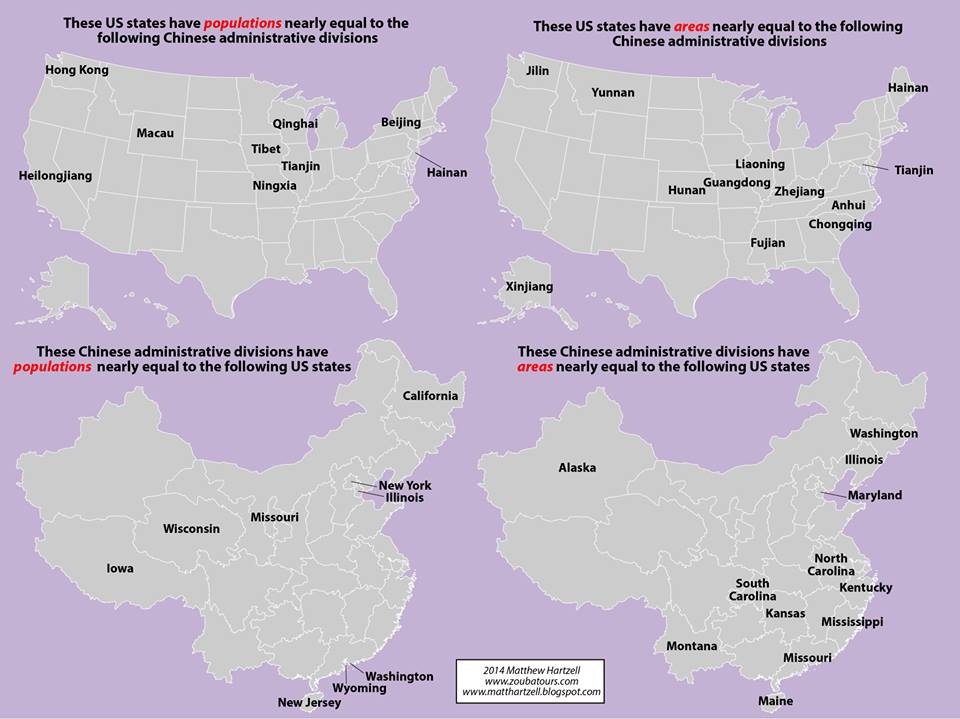
Comparing populations and areas of US states & China’s provinces

Which US states and Chinese provinces have similar areas?

Which US states and Chinese provinces have similar areas and populations?

Which Chinese provinces and US states have similar areas and populations?


1 Comment

Filed under China, GRAPHIC, SLIDER, USA

Regional Roundup for the week of 7.9.14

Indonesians go to the polls today to elect a new president, choosing between populist governor Joko Widodo and former army general Prabowo Subianto to lead the world’s 3rd largest democracy.

China has detained 3 Vietnamese fisherman in the South China Sea, further souring relations this summer. China has also attempted to gain leverage with Myanmar, the current chair of ASEAN, ahead of a planned meeting  this month with ASEAN and Chinese diplomats.

Xi Jinping visited South Korea this past week in a state visit regarded as a move to counterbalance American influence and further distance South Korea’s relationship with Japan.

ExSE FOCUS

All aboard | SEA Globe — The planned high-speed railway between Singapore and Kunming in China could be the catalyst for even greater Chinese influence in the region.

China Reaches Out to Myanmar on Maritime Dispute | NYT — Myanmar is enjoying some new diplomatic clout, leading China to court the country as Beijing presses its territorial claims in the South China Sea.

Burmese hardwoods logged to brink of extinction | GoKunming — While swaths of virgin rainforests have been cleared to feed China’s growing appetite for luxury wood, there are some regions, like Myanmar’s remote northern forests, that have remained heretofore intact. This is about to change, predicts a new study, as loggers advance on the “final frontier” for tropical hardwoods in Southeast Asia.

The Victims of China’s Soil Pollution Crisis | ChinaFile — Soil pollution has received relatively little public attention in China. Despite the fact that it poses as big a threat to health as the more widely covered air and water pollution, data on soil pollution has been so closely guarded that it has been officially categorized as a “state secret.”

Shadow of Brutal ’79 War Darkens Vietnam’s View of China Relations | NYT — Memories of a short but ferocious conflict between Vietnam and China in 1979 permeate the current sour relations between the two Communist countries now at odds over contested waters in the South China Sea.

An Online Shift in China Muffles an Open Forum | NYT — A turn from the microblogging service Sina Weibo to the Facebook-like WeChat has reoriented the nation’s social media landscape from public to semiprivate communication.

China’s Fallen Mighty | ChinaFile — The fallen are sorted into three levels based on their positions within the Politburo—the highest leaders, including Hua Guofeng, Hu Yaobang, and Zhao Ziyang; members of the Politburo Standing Committee, including Wang Dongxing and Hu Qili; and ordinary members of the Politburo, including Wu De, Chen Xilian, Ji Dengkui, Chen Yonggui, Chen Xitong, Chen Liangyu, and Bo Xilai. Skip to the interactive timeline

The final countdown | SEA Globe — After ten years of stability, including President Susilo Bambang Yudhoyono’s two terms in office, voters in the world’s third-largest democracy will head to the polls on July 9 for a single-round presidential election that will decide Indonesia’s next leader.

Indonesia: A Bigger Role in the South China Sea? | Diplomat — As Indonesia goes to the polls, the expectations of its international partners are growing.

ISIS: A Threat Well Beyond the Middle East | Diplomat — The success of militants in Iraq may be inspiring radicals in Southeast Asia.

Kunming Railway Station attackers charged in mass stabbings | GoKunming — In March of this year, a group of men and women armed with knives descended on the crowded Kunming Railway Station. Their ensuing rampage left 29 civilians dead and 143 injured in what is one of the most violent coordinated attacks to occur in China in recent memory. Four people accused of perpetrating the violence have been formally charged and will soon stand trial, Xinhua is reporting.

CHINA

Peripheral diplomacy: Balancing act | Economist — CHINA’S dilemma in Asia is how to balance the peaceful rise it says it wants with its desire for more regional influence.

Scorn for ‘Tiger Xu,’ From Official and Unofficial Sources | NYT — Chinese state-run newspapers and social media users alike are expressing contempt for Xu Caihou, a retired senior general expelled from the Communist Party over corruption allegations

China Expels 3 Officials in Corruption Inquiry | NYT — The expulsions of the three men, who had ties to the former Politburo Standing Committee member Zhou Yongkang, were the latest sign that officials may announce charges against Mr. Zhou himself.

What About China’s Selfless Officials? | Diplomat — The same system that fostered heroically selfless Chinese officials also creates an atmosphere for corruption.

US academic barred from China after speaking out over detained scholar | Guardian — Elliot Sperling, a Tibetologist at the University of Indiana, was turned back on arrival at Beijing airport this weekend and ordered to board a flight returning to the US. No reason was given for the cancellation of his 90-day tourist visa, but he believes his vocal support for Tohti was responsible.

World Briefing: China Sentences 113 to Prison in Xinjiang Region | NYT — Courts in the western region of Xinjiang sentenced the defendants for a wide range of crimes, including organizing and taking part in terrorist organizations, state media reported.

Ramadan, Beijing style | Economist — In China Ramadan this year comes against the backdrop of increased violence perpetrated by Uighurs and a government line which more strongly than ever attributes it to radical Islam and international jihadism. In Xinjiang, authorities have reportedly taken steps, as they have in years past, to discourage Ramadan fasting among ordinary people and ban it outright for many party members, government workers and school children.

China’s Christians fear new persecution after latest wave of church demolitions | Guardian — Once a hub of Christianity, worshippers in Wenzhou fear their faith is facing its biggest threat since the Cultural Revolution.

China Takes Step Toward Freeing Currency from State Control | NYT — Beijing has let banks set their own exchange rates for the renminbi in over-the-counter transactions.

Memo From Hong Kong: Uphill Fight for a Territory’s Democracy Movement | NYT — Hong Kong’s huge pro-democracy march underscored the determination of many of its residents to preserve their freedoms but also brought some challenges to light.

Hard Choices for Family Planners and Parents | ChinaFile — As the adjustments take full effect and the nation’s dandu—the Mandarin word meaning “family in which either parent is an only child”—exercise their newly acquired freedom of choice, unexpected challenges to the government’s family-control policies are starting to emerge.

Why Are Chinese Cyberspies Targeting US Think Tanks? | Diplomat — Chinese hackers broke into U.S. think tanks to access information about U.S. plans for Iraq.

Economic Scene: China’s Hurdle to Fast Action on Climate Change | NYT — The existential question in Beijing remains whether China can simultaneously cut carbon emissions while pursuing strong economic growth.

Pangolin and porcupines on sale in Chinese market despite jail threat | Guardian — Porcupines in cages, endangered tortoises in buckets and snakes in cloth bags are among the rare wildlife on open sale at a Chinese market, despite courts being ordered to jail those who eat endangered species.

REGION

China Detains 6 Vietnamese Fishermen | NYT — The detention of the six fishermen in waters claimed by China and Vietnam comes as tensions continue to be high over the disputed waters.

Q. and A.: Lyle Goldstein on China and the Vietnamese Military | NYT — With friction rising in the South China Sea, Professor Goldstein, of the China Maritime Studies Institute at the Naval War College in Rhode Island, discusses the current state of Vietnam’s military and Chinese perceptions of it.

Chinese President’s Visit to South Korea Is Seen as Way to Weaken U.S. Alliances | NYT — The visit to Seoul by President Xi Jinping of China appears to be aimed at disrupting the alliances the United States has developed in the region.

China Woos South Korea With Pandas | Diplomat — Two pandas accompanied Xi Jinping on his visit to South Korea.

China’s Charm Offensive Toward South Korea | Diplomat — China’s charm offensive toward South Korea could have implications for the U.S.-ROK alliance.

Brides for sale: trafficked Vietnamese girls sold into marriage in China | Guardian — When Kiab turned 16, her brother promised to take her to a party in a tourist town in northern Vietnam. Instead, he sold her to a Chinese family as a bride. The ethnic Hmong teenager spent nearly a month in China until she was able to escape from her new husband, seek help from local police and return to Vietnam.

CAMBODIA

Virginity for sale: inside Cambodia’s shocking trade | Guardian — On the margins of the sex industry, an ugly market in virginity has emerged in Cambodia in which rich and powerful men coerce desperate mothers into selling their daughters’ innocence.

Cambodia Heads Upmarket with Style and Hun Sen | Diplomat — The threat of losing access to designer retail is not enough to win back Cambodia’s voters for the prime minister.

Stuck in the middle with you | SEA Globe — Cambodia’s struggle for self-assertion is a balancing act, with parallels to the 1960s when Prince Sihanouk tried to safeguard his nation’s neutrality in the Vietnam War.

Second fiddle: Kem Sokha | SEA Globe — Kem Sokha has been a prominent human rights activist and head of his own party, but will his biggest challenge be as second-in-command to his former political rival?

INDONESIA

Indonesian Candidate Masters a System He Is Said to Disdain | NYT — For a candidate accused of questioning the value of democracy, Prabowo Subianto appears to be a highly efficient campaigner.

After Barrage of Personal Attacks, Indonesian Presidential Election Tightens | NYT — As voters prepare for Wednesday’s election, the race between a populist governor and a former army general is considered too close to call.

World Briefing: Indonesia: Life Sentence for Ex-Justice | NYT — The former chief justice of the Constitutional Court was sentenced to life in prison for corruption, the heaviest sentence ever for graft in one of the most corrupt countries in the world.

LAOS

Rocket Festival of Laos | Diplomat — The annual Laotian Rocket Festival is colorful, explosive, and occasionally dangerous.

MALAYSIA

Malaysia Is Sending More Ships to Search for Jetliner | NYT — The Malaysian government said Sunday that it would step up efforts to search the southern Indian Ocean for Malaysia Airlines’ missing Flight 370.

MYANMAR/BURMA

In Myanmar, the Euphoria of Reform Loses Its Glow | NYT — More than three years after Myanmar’s ruling generals propelled the country on an ambitious journey toward democracy, security forces are back on the streets.

Buddhist-Muslim Mayhem Hits Myanmar’s No. 2 City | NYT — The authorities in Mandalay imposed a curfew after a surge in religious violence, incited by reports that a Muslim man had raped a Buddhist woman.

Expect Skepticism as Thein Sein Pledges to Act Against Riot Instigators | Irrawaddy — In a speech broadcast on state radio Monday night, Burmese President Thein Sein vowed to take action against the instigators of recent riots in Mandalay, but the pledge will be met with a cautious reception. This skepticism is understandable as the president and government failed to take action after previous violence that rocked major Burmese cities Meiktila, Lashio, Pegu and Sittwe.

Jade Mines to Resume Operations in Kachin State: Burmese Govt | Irrawaddy — In northern Burma, where the vast majority of the world’s jade is produced, mining companies will soon be allowed to resume operations, following a two-year hiatus due to armed conflicts.

PHILIPPINES

Aquino: The First Filipino Nobel Laureate? | Diplomat — The Philippine president has been nominated for the Nobel Peace Prize. Not everybody is happy about it.

THAILAND

Leaning on Thailand’s Junta | NYT — Sanctions against the junta could prove surprisingly effective in the push to restore democracy.

VIETNAM

Agent Orange Legacy Scourges Vietnam | Diplomat — Decades after the Vietnam War, victims wither away with scant efforts being made to tackle the deadly chemicals.

Leave a Comment

Filed under Current Events, NEWS DIGEST, SLIDER

Scores of Kunming officials investigated for corruption

Image: The Irrawaddy

Image: The Irrawaddy

Graft is becoming an increasingly risky business for corrupt Kunming officials and those who enjoy their favors. Last year, the city charged 52 county-level cadres with corruption-related crimes. This year, however, The People’s Procuratorate of Kunming has already investigated three times that number, including several high-ranking bureaucrats.

From January to May of this year, provincial prosecutors opened inquiries involving 154 public officials suspected of corruption and bribery, newspaper Legal Daily is reporting. In a vague briefing, a representative from the Procuratorate described the vast majority of cases as “serious”, classifying eight as “highly serious” and seven others as “extremely serious”.

One of the “extremely serious” cases involves Wang Baoji (王宝基), former deputy inspector of the Yunnan Department of Transportation. Wang is charged with accepting 2.8 million yuan (US$450,000) in bribes from construction companies to develop highway projects from 2011 to 2013. In the same week, the Procuratorate sentenced Kang Xiaodong (康晓东), eight-year deputy director of the Yunnan Department of Justice, to fifteen years in prison for accepting five million yuan (US$806,000) in bribes.

The Legal Daily report made no mention of what punishment the other 152 officials may face if found guilty. However, penalties for bribe-taking and corruption can often be harsh. Previous high-profile Yunnan administrators convicted of such crimes have routinely faced long periods of incarceration, or worse. In 2007, a former Kunming deputy mayor was sentenced to life in prisonfor accepting kickbacks. Four years earlier, one-time governor Li Jiating was sentenced to death for taking bribes.

The current crackdown on official corruption can be traced back to Xi Jinping’s first speech as president of China, in which he pointedly said the Communist Party must adhere to “strict discipline”. In the wake of Xi’s comments, Beijing has reprimanded thousands of government officials around the country for lavish spending, fraud and taking payoffs.

Xi’s remarks have also led China’s central government to carry out a nationwide audit of towns and municipalities in all provinces. Although unfinished, the accounting inspection has uncovered wide-ranging and serious financial misdeeds, some of them in Yunnan. Last year in Luliang County (陆良县), it was discovered that officials had faked financial data to the tune of 5.2 billion yuan (US$850 million).

Click here to link to this article first posted on GoKunming on 6/30 and written by Cissy Yu.

Leave a Comment

Filed under China, Current Events, Economic development, Governance, SLIDER, Uncategorized, Yunnan Province

Kunming railway station attackers charged in mass stabbings

Image: CCTV

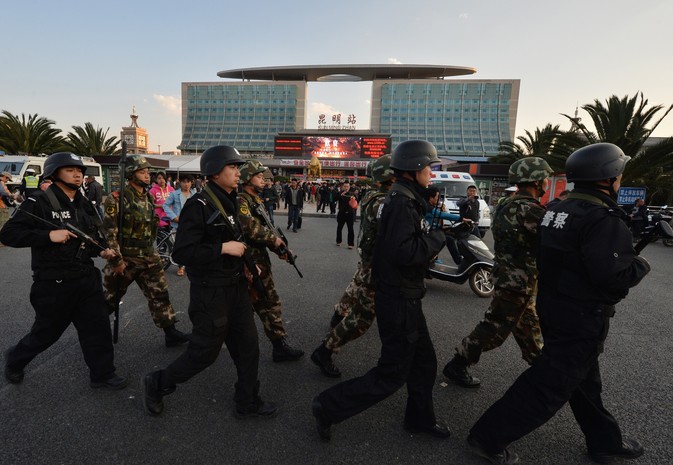
A SWAT team patrols the Kunming train station. Image: CCTV

In March of this year, a group of men and women armed with knives descended on the crowded Kunming Railway Station. Their ensuing rampage left 29 civilians dead and 143 injured in what is one of the most violent coordinated attacks to occur in China in recent memory. Four people accused of perpetrating the violence have been formally charged and will soon stand trial, Xinhuais reporting.

Official accounts of the attack state that six men and two women participated in the train station assault. Of those, four were shot and killed at the scene by police. One woman was subdued and arrested at the station, while three other suspects remained at large for 36 hours before being captured. No details of the manhunt or exactly how, where and when the fugitives were caught have ever been made public.

The four defendants stand accused of multiple crimes and will presumably face the death penalty if convicted. They have each been charged by the Kunming People’s Procuratorate, the city’s highest court, with participating in a terrorist organization, carrying out violent terrorist activities and premeditated homicide. No date has been publicly announced for a trial.

The outcome of the case is likely a foregone conclusion. Defendants tried by the government, especially in high-profile proceedings such as this, are generally found guilty following extremely short, closed-door judicial proceedings. A short, terse statement by prosecutors trying the four defendants appears to confirm this. It read, “The facts are clear and the evidence is ample. The four [suspects] should be investigated for criminal responsibility according to law and then prosecuted according to law.”

The defendants are all ethnic Uighurs from China’s Xinjiang Autonomous Region and prosecutors maintain the March 1 attack was religiously and politically motivated. In a statement made shortly after the suspects were apprehended, Yunnan Party Secretary, Qin Guangrong,characterized the captured men and woman as Muslim terrorists, adding one had confessed to the crime and admitted the group wanted “to join jihad”.

China has significantly ramped up law enforcement and ‘anti-terror’ efforts following the bloodshed in Kunming. In many cities around the country, police officers are now permitted to carry sidearms for the first time in decades. Trials involving suspected militants have also increased, and 113 people were recently jailed for terrorism-related crimes by Xinjiang courts.

Click here to link to this article written by Patrick Scally, first published on July, 1 on the GoKunming website.

Leave a Comment

Filed under China, Current Events, ethnic policy, Governance, Kunming Train Station Attack, SLIDER, Yunnan Province