Category Archives: Environment and sustainability

The 3rd Annual ICIRD Conference, Part I

With the ASEAN Economic Community set to launch in 2015, it’s not surprising to see a heightened level of uncertainty, concern, and even apprehension about what this enhanced sphere of regional integration will mean for Southeast Asian nations.

Holding this backdrop firmly in mind, the 3rd Annual International Conference on International Relations and Development (ICIRD) recently commenced at Chulalongkorn University in Bangkok, on August 22-23, 2013. This year’s timely theme, “Beyond Borders: Building a Regional Commons in SE Asia,” showcased established voices, civil society organizations, and a new generation of scholars rising to the challenges of this historical moment. Over forty panels traversed diverse but interrelated topics from environmental justice and human rights, to sustainable economic growth.

While few would deny the problems of development in Asia as they have manifested so far (e.g., environmental degradation, growing income disparity, and resettlement), finding a consensus on a way forward proves much more difficult. As Dr. Siriporn Wajjwalku (Assoc. Prof., Thammasat University) noted with some urgency in the opening remarks, “2015 for us in the region is approaching… It’s extremely important for us to think about the commons and go beyond the borders that we are facing now.”

Dialogue and discussion are a good place to start. Thus Dr. Carl Middleton (Lect., Chulalongkorn University), a member of the ICIRD Executive Committee that organized the event, proclaimed the conference “a success in that there was plenty of sharing of knowledge, experience and ideas amongst the participants, and a wide range of examples of the commons and how they support peoples well-being and create public space were discussed.” Continue reading

1 Comment

Filed under ASEAN, China, Current Events, Economic development, Environment and sustainability, Governance, Mekong River, Thailand, water

China needs to change its energy strategy in the Mekong region

This op-ed was first published at ChinaDialogue and thethirdpole.net on 7/16.

 Mekong bridge

At the end of this year cars and container trucks loaded with goods from China and Thailand will finally be able to drive across a multi-lane bridge spanning the Mekong River (known as the Lancang in China). The bridge will connect Chiang Rai province in Thailand to Bokeo province in Laos, effectively linking China’s highways stretching south from Beijing and Shanghai to those coming north from Singapore, Kuala Lumpur and Bangkok.

Funded by equal investment from the Chinese and Thai government, the completion of the bridge, which took ten years of planning and two years to build, is not without controversy. For many years Thailand held back investment due to an uneven distribution of benefits between China, Laos and Thailand. Also on the Thai side, the NGO Rak Chiang Khong claim the bridge negatively impacts the local Golden Triangle economy and will ruin Mekong fisheries.

The Golden Triangle Bridge serves to highlight the challenges facing China, as the country’s new leadership attempts to balance its slowing and volatile economy and deliver domestic stability by maintaining peaceful economic relations with its neighbours.

China’s regional strategy

“In 2012 China’s growth in trade and outward investment with the five other Mekong countries of Myanmar, Laos, Thailand, Cambodia, and Vietnam surpassed its trade and investment growth in ASEANcountries,” said Xu Ningning, chairman of the Greater Mekong Subregion (GMS) Business Council. “Greater growth rates will continue with increases in regional cooperation and win-win investment opportunities.”

For the past three years China’s GMS provinces of Yunnan and Guangxi have posted growth rates of 12-15%, the highest of China’s localities, and arguably China’s economic rise has also helped deliver high growth rates among Mekong countries.

The end of the Cold War in the 1990s created a favourable environment for China to develop its economic cooperation strategies toward the Mekong region. The blurring and opening of once inviolable borders encouraged traders on both sides of the China-Southeast Asia frontier to appeal to local and national governments for better conditions for trade and migration. The Chinese government responded with twenty years of state-led trade liberalisation and investment policies to promote regional cooperation in state and private sectors.

China’s economic cooperation strategies towards its four Mekong neighbours has dovetailed nicely into a strategy that fits China’s current development needs. Liu Jinxin, a policy analyst and logistics expert says, “Unlike the US which leads the world in finance and IT, both high-value service-oriented industries, China is the world’s factory, producing goods to drive the growth of its growing middle class and serving export markets around the world. To survive, the Chinese ‘factory’ needs inputs like energy and raw materials.” Continue reading

1 Comment

Filed under ASEAN, China, Current Events, Economic development, Energy, Environment and sustainability, Food, Foreign policy, GMS, Governance, Laos, Mekong River, Myanmar/Burma, Sustainability and Resource Management, Thailand, Vietnam, water

Burmese Teak: Turning a New Leaf

It’s prized the world over for its durability and beauty and has long been a status symbol; to own something made from teak really means something. But what is teak and why does it matter today?

Teak, or Tectona Grandis, is a large, deciduous, hardwood species found throughout Southeast Asia in environments under 900m in elevation that receive over 500mm of annual rainfall. Teak is known is primarily known for its durability; it is naturally water-resistant and contains resins that repel and termites and slows rot. Because of these qualities, teak wood is valued for its ability to resist the natural elements and is often used in outdoor furniture and yacht and sailboat building.

Teak is native only to India, Indonesia, Lao PDR, Malaysia, Myanmar and Thailand. Of the estimated 29 million hectares of naturally occurring teak forests, almost half are found in Myanmar. It is important to note that only Myanmar does not enforce a logging or export ban on teak, so all legally-harvested natural teak on today’s market is Burmese. The cost of this Burmese teak can be quite high – the market price for some wood can reach than $4,000/m3. This represents the most expensive teak, as natural teak is valued higher than its planted counterpart. There are several reasons for this disparity. First, plantation teak has smaller dimensions than natural teak and rarely reaches the size of a natural tree. Secondly, there is a perception among many buyers that plantation teak is less dense than natural timber and thus is of a lower quality. In addition, natural teak is a rare resource. As mentioned, Myanmar is currently the only country exporting natural teak and its forests are decreasing every year, making prized Burmese wood rarer and more expensive.

teak 1 Continue reading

2 Comments

Filed under China, Economic development, Environment and sustainability, Indonesia, Laos, Malaysia, Myanmar/Burma, Sustainability and Resource Management, Thailand

Why Can’t We Protect China’s Cleanest Freshwater Lake?

4109718

Fuxian Lake, located in Yunnan Province’s Yuxi municipality sixty kilometers southeast of Kunming, sits at the headwaters of the Pearl River, China’s third longest river. It is the largest alpine freshwater lake in China, and its water storage capacity accounts for nearly 10% of all freshwater lakes in China.  Fuxian is twelve times larger than the water volume of its western neighbor, Kunming’s Dianchi Lake. Most importantly, the lake’s water quality is rated at Class I meaning it is directly drinkable.

In order to protect Fuxian Lake’s water quality and local ecosystem, the Yunnan Provincial Government issued a set of “Protection Regulations on Fuxian Lake of Yunnan Province” on September 1, 2007. It declares the entire lake, its watershed, and adjacent lakeside area extending 100m range from the shore are within the first protection zone, a red line under strict protection and monitoring. In accordance with the local regulations, washing clothes and bathing in the lake are strictly prohibited. Even motor-driven boats have been replaced with manpower-driven pedal ones. Furthermore, conditions on the use of cultivated land, shoals and vegetation around the lake are also defined by the regulations.

Also, clearly banned are “the unauthorized expansion or alteration or creation of new buildings or structures; unauthorized pumping of water from the lake or violation of water permit provisions for pumping water; other destructive practices to the ecological system and pollution behavior.”

Since 2005, August 26th of every year has been designated by Yuxi City as the Fuxian Lake Protection Action Day. All of these measures seem to favor the lake’s protection and its aquatic ecosystem. But in practice, is it really true?

A June 7 China Central Television (CCTV) report disclosed the unregulated construction of eleven real estate projects around the lake that threaten to destroy its aquatic ecosystem and degrade its water quality.  The numerous luxury lake-view villas, five stars hotels such as Hilton Hotel, and golf courses were built or under construction within Fuxian Lake protection area. For sales promotion, these ‘Big Mac’ projects were crowned as resorts, sports parks, among other flashy names.

For example, Longhu Lake Park project is located in Mackerel Bay with an area of 147 hm2 size and an investment footprint of USD 730 million. A realtor for the project boasted that its size is as big as one-fifth of Kunming metropolitan area. To my surprise, this project even passed its environmental impact assessment. The EIA report said “impact of the project construction on the environment is slight and controllable. The project meets the regulations and the environmental management standards of construction project of the national construction projects in listed in Yunnan Province’s environmental regulations. The project location is feasible.”

A further embarrassing fact is that some projects broke ground before their EIAs were processed. The Kowloon Bay, Kowloon Sheng Jing Project is located in the upper reaches of lake’s western banks.  In its promotional materials, the developer dared to say “the project site offers the nearest resort-style apartments to Fuxian Lake so far. It is only 50m away from the shoreline.” Most of these European style villas come with a lake view. The project includes luxury hotels, lake view hotel apartments and villas.

In September 2009, Yuxi Municipal Party Committee and Government issued “A Decision for Accelerating Tourism and Cultural Industries Development.” Citing “from 2010 onwards, the municipal government will invest 30 million RMB to promote tourism development…. Each subordinate district and county should set up special budget for tourism development.” The cited purpose of the decision is to “encourage the introduction of high-star hotel projects” and “local governments will be awarded with 10 million RMB for the successful introduction of well-known international brand five-star hotel projects exceeding investment levels 300 million RMB after the project’s completion.”

In this decision, the projects mentioned above were highlighted one by one. The Yuxi municipal government vowed to “create conditions to facilitate the projects’ construction as soon as possible”.

Around Fuxian Lake, many developers promote new commercial buildings and hotels connecting project names to the beauty and quality of the lake. For instance, “Holy Water Lake Phase II” advocated that they built a “wetland park” in Fuxian Lake, exclusively open to the residence owners and the hotel guests.

Locals from surrounding villages told a CCTV reporter that the residential developments were discharging excessive levels of black, smelly sewage directly into the lake! The local villagers angrily said that protecting the Fuxian Lake was merely spoken of on the lips of leaders and the regulations were useless.

The CCTV report further pointed out that although the country already banned golf course construction in national level water resource protection zones, golf courses were being constructed around the lake. It also mentioned that most real estate projects were initiated via oral permission from the local governmental leaders without environmental impact assessment.

Naturally one cannot help asking the following questions regarding the protection of Fuxian Lake:

  • Which is really more powerful and effective, the political agendas of leaders OR the rule of law when a collision between environmental conservation and economic development occurs?
  • Why do we often repeat these inane practices, namely sacrificing environmental quality for economic development? Do these mistakes really pay off?
  • Why do not we try best to maintain our blue skies, clean water and a hygienic environment for ourselves and also for our next generations? Do we fear our next generations will rebuke us if we are too selfish?
  • Is it fair to dirty the environment dirty leave the bill for our next generations?
  • Despite the CCTV report which by the nature of its broadcast, passed muster of national censors and by the eyes of national leaders, why do local environmental protection agencies continue to maintain silence about the Fuxian Lake case?

After the CCTV report, Yuxi government issued a moratorium on the processing of new real estate development projects around Fuxian lake.

1 Comment

Filed under China, Environment and sustainability, Sustainability and Resource Management, water

What’s at Stake for the China-South Asia Expo?

expo

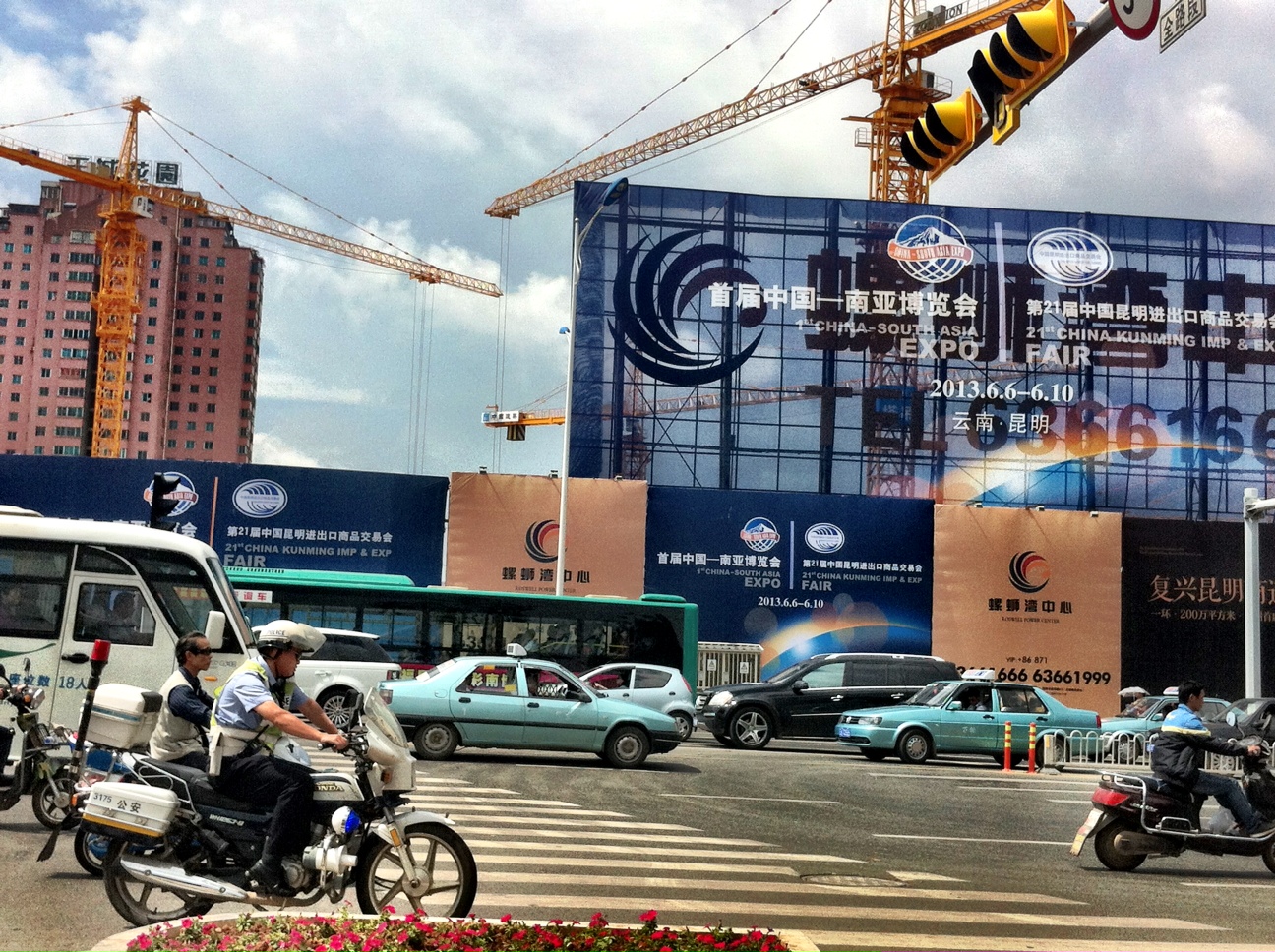
The China-South Asia Expo opened without a hitch yesterday in Kunming despite online calls for a continuation of environmental protests outside of the Expo’s opening ceremony site.  It seems protesters decided to stay home due to a combination of sticks and carrots offered by local authorities.  On June 3, Kunming’s mayor announced the release of key environmental impact assessment data concerning the construction of a PetroChina oil refinery and PX chemical plant side project scheduled for construction 40 km from the city’s downtown area.  Also, the excessive presence of armed and unarmed public security officers lining the city’s streets and manning the Expo site also likely turned protesters away.

What is the rationale behind the excessive security measures?  What’s really at stake at the 1st China-South Asia Expo?

The Expo, a combination trade fair and high level forum for investment and trade promotion discussions between China, Southeast Asia, and now South Asia, is part of China’s Bridgehead Construction strategy to establish Kunming and Yunnan province as a gateway between China and its neighbors to the south and west.  A smoothly running Expo not only will seal multilateral agreements and high-value business deals that will streamline regional trade and investment, but it will also guarantee the continuation of soft-budget infrastructure development projects sponsored by Beijing to Kunming and Yunnan province that are part and parcel of the “Bridgehead” strategy.

Continue reading

3 Comments

Filed under China, Current Events, Economic development, Energy, Environment and sustainability, Foreign policy, GMS, Laos, Myanmar/Burma, Vietnam

China’s media report on Kunming’s environmental protests

The English language discussion of Kunming’s ongoing environmental protests should not exclude China’s official media reports.  The translation below is of a 5/28 article from the Southern Weekend website.

Yunnan’s Anning City Retracts Notice on Face Mask Registration

from Southern Weekend (南方周末)May 28, 2013

More than 200 copies of a ‘Letter of Guarantee’ have been signed by vendors of advertising services, printing services, copy services, face masks, and t-shirts.  These vendors promise to strictly follow national laws and regulations regarding their commercial business and promise not to speak of rumors, create rumors, or spread rumors.  They promise not to participate in any form of information broadcasting, forwarding of messages, and not to participate in sit-ins, protests, or demonstrations of any kind.  They promise to not print, create, or publish things related to the Anning PetroChina Oil Refinery or the “China-South Asia “Expo or advertisements, propaganda materials, or any materials of negative influence.  This “Letter of Guarantee” goes into effect on the day of signing and is valid through June 30, 2013 and sales of all services above must also be accompanied by ID registration of the purchaser.  –Official statement from the Kunming Economic Development Zone Industry and Commerce Bureau. 

The exposure of Anning’s required ID registration of face mask purchases has stirred up considerable public debate.  On the evening of 5/25, the Anning City government’s press office issued a statement saying Anning’s Industry and Commerce Bureau will retract the notice on face mask registration.  But according to a report on 5/27, the “Procedure for registration of face mask purchases” was still in effect for much of the Kunming municipality and was not exclusive to Anning City.  Registration is still required for printing, copying, and publication services. Continue reading

4 Comments

Filed under China, Current Events, Economic development, Energy, Environment and sustainability, Governance

Air pollution and Kunming’s prevailing rainy season wind patterns

Anning PetroChina

Click to enlarge image.

This image shows prevailing wind patterns during Kunming’s rainy season which runs roughly from May to October.  Strong southwesterly winds bring monsoons from the Bay of Bengal over the Burmese landmass into Yunnan province.

The red rectangle in the southwest corner is the site of the PetroChina oil refinery, the focus of a series of recent environmental protests by concerned Kunming residents.  GoogleMaps has detailed imagery of construction site’s layout.  The purple area to the north is Kunming’s city center, determined by the area inside of Kunming’s 2nd ring road and home to a population of approximately 2.5mn.

Winds passing over the 10 million ton PetroChina oil refinery will send toxic pollutants directly over Anning city and Kunming’s most populated urban districts.  Anning is Kunming’s largest satellite city with an urban population of 100,000.  Kunmingers often drive to Anning to soak in its famous hot springs (also predictably in the pollution path), but in the last 10 years, most of Kunming’s heavy industry moved to Anning in an attempt to reduce pollution in the Dianchi Lake watershed.

After passing over Anning, winds become more concentrated and pick up speed to shoot through three passes in the Xishan (Western Hills) mountain range.  The solid line represents the most voluminous wind channel.  It doesn’t take an expert to see that the oil refinery site was chosen at the most optimal point for dumping pollution onto Kunming.  Perhaps this is why city officials are reluctant to release data from the project’s legally mandated environmental impact assessment.

To make matters worse, a strong southerly lake effect wind, constrained by Kunming’s eastern hills, pushes all westerly winds northward into the city center as they break over Xishan mountain range.  This guarantees that nearly all winds that pass over the oil refinery site through Kunming’s downtown and finally into the city’s north district, home of an additional 1.5mn residents.  Kunming’s north district, currently undergoing a major urban facelift, is planned as one of the city’s new core urban centers with a projected population of 3 to 4 million residents by 2020.

3 Comments

Filed under China, Current Events, Economic development, Energy, Environment and sustainability, Uncategorized, VISUALS

Law of large numbers: The growing gravity of Kunming’s environmental protests

Kunming’s ongoing protest against the construction of a 10mn ton petroleum refinery 40km from the city center continues to gather attention in China’s domestic media and in the international media.  Yet despite continuous coverage of the protest in China’s Global Times, South China Morning Post, the Telegraph, the Guardian, and most recently the Atlantic (among many other media outlets), questions concerning the gravity of the protests continue to pop up in online chat forums: Does a protest of 1000+ Chinese citizens in a city of 7 million have impact?  Given the numbers, does the average Kunming citizen know about this issue?  Can protests of this scale force changes to policy agendas?

ExSE’s answer to all three of those questions is an unequivocal YES.  Kunming mayor Li Wenrong would have not made an impromptu engagement with protesters last Thursday if he didn’t see the movement as a legitimate challenge to the status quo.  He followed through on his promise to open a Sina Weibo account by noon on 5/18 and since then he’s gathered more than 75000 followers.  Further, an online poll created after the initial 5/4 protest exceeded its limit of 100,000 responses within three days.  The poll asked a simple yes or no question: Should there be a PX plant in Anning? An overwhelming majority of 80% ticked “no.”  It’s no surprise that the poll’s weblink was eradicated last week.  Admittedly, there is no way of knowing whether Li Wenrong’s 75k followers are mostly from Kunming, and online polls are never without bias; but the large numbers undeniably say something and suggest that the 2000+ protesters are representative of a much larger group of concerned citizens. Continue reading

3 Comments

Filed under China, Current Events, Economic development, Energy, Environment and sustainability, Governance, Myanmar/Burma, Yunnan Province

Taiwan: The most important R.O.C. in the South China Sea

Events over the last couple weeks have re-drawn attention, rightfully, to an oft-overlooked player in the South China Sea disputes, Taiwan (aka. Republic of China). SCS analyses often dismiss Taiwan’s claims as a marginal issue and is only mentioned in the context of mainland China’s claims, however as the most recent incidents with the Philippines demonstrate, Taiwan’s strategic importance to the South China Sea (and East China Sea) is actually woven into the very core of disputes.

Fishermen Wars

On May 9, a 65 year old Taiwanese fishermen named Hung Shih-cheng was shot and killed by the Philippine Coast Guard in a standoff. The PH Coast Guard claims that they shot at Mr. Hung’s vessel  to disable the engine as a self-defense mechanism because the fishing boat was attempting to ram-and-run. Eye-witness accounts through Taiwanese media however, report that the boat was struck by 30-40 bullets, which seems excessive. Mr. Hung was unarmed, accompanied on the boat by his son and two other sailors.

On May 10th, the news broke and Philippine officials acknowledged the incident and indicated investigations have began. Coast guard commander Rodolfo Diwata Isorena indicated that the 11 officers involved have been suspended from duty. On May 12, with tensions running high on both sides, Taiwan issued a 72 hour ultimatum to the Philippine authorities, demanding formal apology from the President, appropriate reparations to the fishermen’s family, and extradition of perpetrators to Taiwan for investigation to ensure “justice”. On May 15th, just minutes before the deadline, the Philippines announced that it would send its representative to Taiwan to apologize but that no extradition will occur and was unclear with regards to reparations. Taiwan subsequently rejected this apology declaring it insincere and insufficient. It announced a series of retaliatory actions, including withdrawing its diplomatic representative, conducting elevated sea patrols, and sanctions on work permits for the nearly 87,000 Filipinos working in Taiwan. The last action would prove to be costly to the Philippines which sends over a million workers overseas each year and is heavily reliant on remittances.

On May 17, Taiwan carried through with its threat to conduct joint Naval – Coast Guard drills in the SCS, the first time ever crossing the 20* latitude “temporary enforcement line” since the Taiwanese government established it in 2003. Taiwan indicated that these drills, along with heightened patrols (increase of 1-2 ships to 3-4 ships) are not a one-off occurance but will continue indefinitely, in order to ensure the safety of its fishermen. Continue reading

Leave a Comment

Filed under China, Culture, Current Events, Energy, Environment and sustainability, Foreign policy, Philippines, water

Unstoppable: Kunming’s environmental protest movement takes a powerful turn


protest view

Kunming’s anti-PX protest movement broke through to new heights on Thursday as more than 2500 protesters took to the city’s downtown streets.  The unexpected success of this impressive NIMBY movement has empowered protesters to shift targets – what began two weeks ago as a movement opposing the construction of a polluting chemical plant attached to a PetroChina oil refinery 40km from the city center has evolved into a full blown protest against the entire 10mn ton oil refinery project.  Throughout the morning the protesters worked a powerful and persistent ground game breaking through rank after rank of public security forces to gain total control of Kunming’s downtown streets by noon.  Protesters marched in peaceful and non-violent demonstration for more than five hours under the intense Kunming sun and prompted an engaging appearance of Kunming mayor Li Wenrong who sympathized with protesters and promised immediate change – another breakthrough victory for this growing social movement. Continue reading

5 Comments

Filed under China, Current Events, Economic development, Energy, Environment and sustainability, Myanmar/Burma, Uncategorized