Category Archives: Current Events

In Cambodia Racist Rhetoric Brings Death Threats to Human Rights Activist

Opposition protesters from Cambodia's National Rescue Party gather in downtown Phnom Penh, December 2013.  Image: Vicky Han

Opposition protesters from Cambodia’s National Rescue Party gather in downtown Phnom Penh, December 2013. Image: Vicky Han

PHNOM PENH – Cambodia, a nation once traumatised by the ‘Killing Fields’ of the Pol Pot regime in the 1970s, has come a long way since then in rebuilding  the nation from year zero including the holding of elections, and the  creation of a multi-party system.

But the recent flood of hate-mail and death-threats sent to Mr Ou Virak, the president of CCHR (The Cambodian Centre for Human Rights) in the capital Phnom Penh, points to a society still dangerously divided over ethnic and racial issues.

 Attacks on human rights activists in Cambodia and around the world mostly come from the agents and the guardians of the status quo – the police, army, militias, and from private security companies deployed by major corporations seeking to block workers rights. Continue reading →

1 Comment

Filed under Cambodia, Current Events, Foreign policy, GMS, Governance, SLIDER, Vietnam

The Kunming-Bangkok Highway’s Final Link Opens over the Mekong

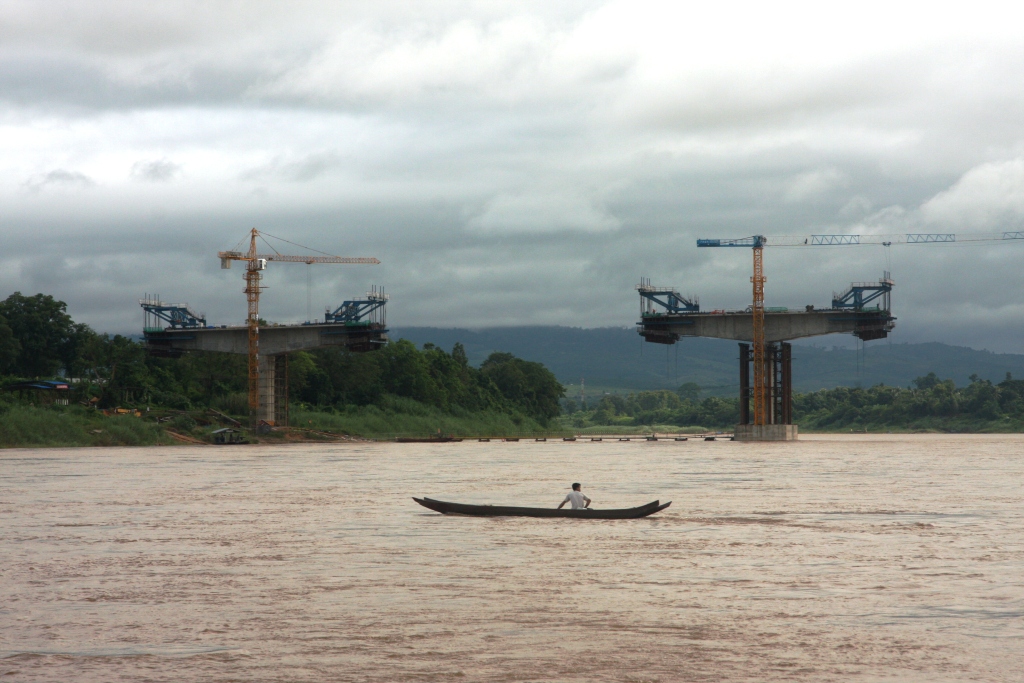
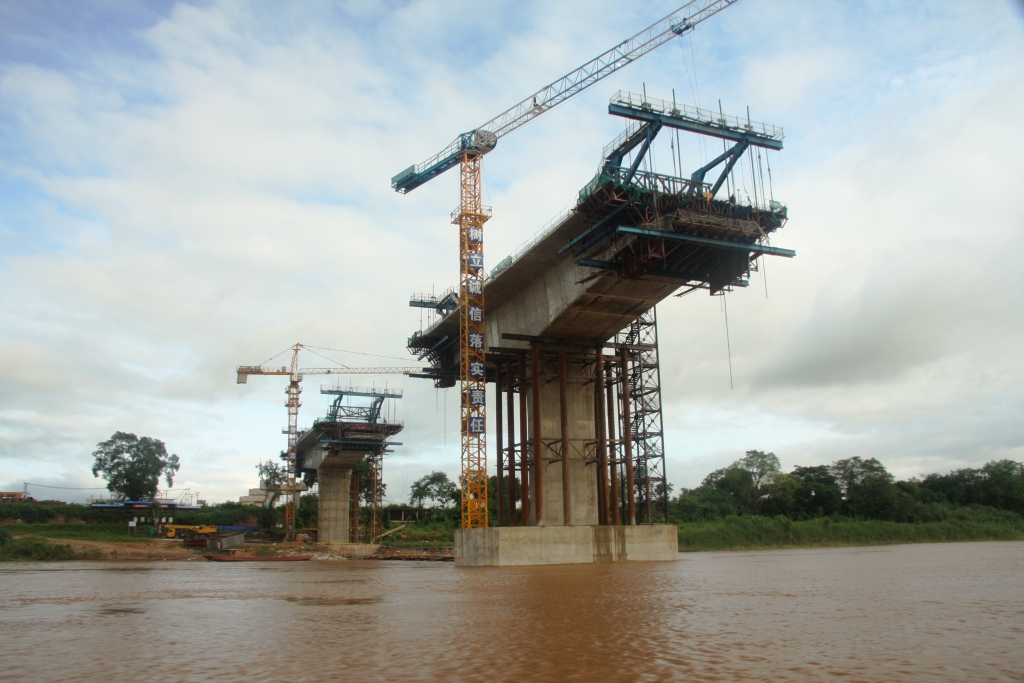
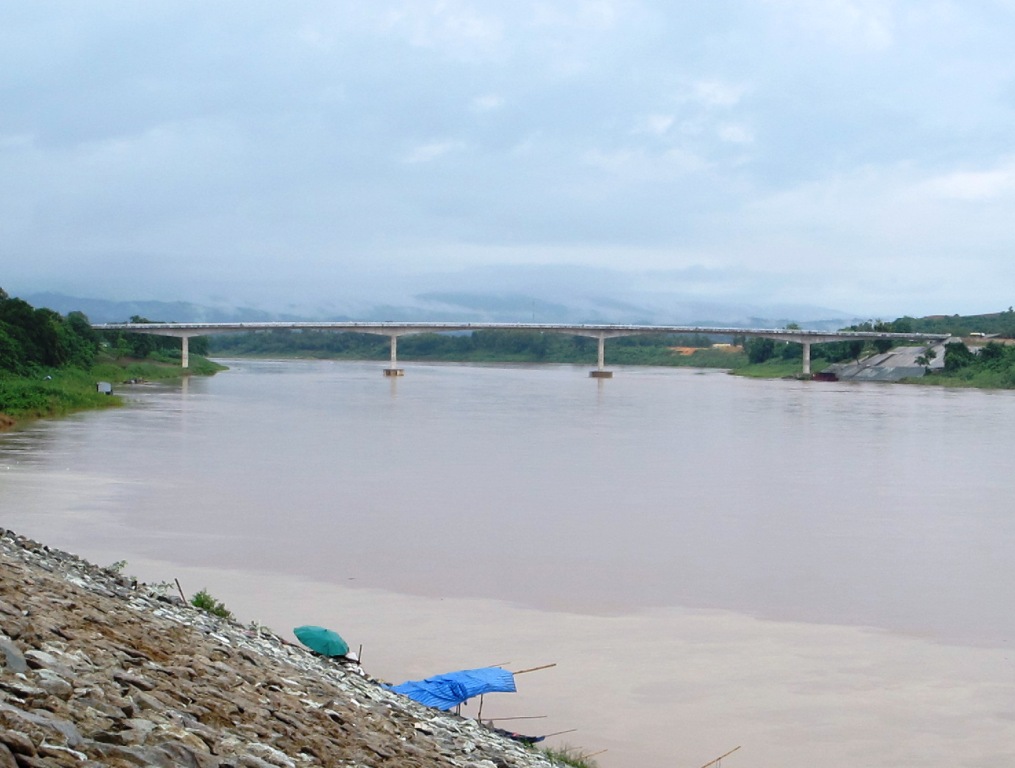
The Fourth Thai-Lao Friendship bridge which connects Thailand’s Chiang Rai province to Lao PDR’s Bokeo province officially opened for business yesterday.  Although the bridge, which stretches 400 meters across the Mekong river, and surrounding customs and inspection infrastructure have been completed for a few months, the two countries set the auspicious date of December 11, 2013 or 11/12/13 as written in the international form for the bridge’s opening ceremony conducted by Thailand’s highly respected Princess Sirindhorn.


A local fisherman navigates the Mekong downstream of the new bridge (July 2012)

A local fisherman navigates the Mekong downstream of the new bridge (July 2012)

The prime benefactor from the bridge’s opening is not Thailand or Laos, but rather China as the bridge serves as the final link in the Kunming-Bangkok highway, a 1900km series of connected highways that will facilitate significant increases in container shipping trade between China and Thailand.  Six years ago overland transport between Kunming and Bangkok for container shipping was virtually impossible due to the poor quality of roads.  In China’s southwestern Yunnan province, a drive from Kunming to Jinghong, the Dai cultural capital of Sipsongpanna (Xishuangbanna) prefecture took up to 24 hours and another six hours to the Lao PDR border at Boten.   China completed its portion of the highway to in late 2007.

The Lao PDR segment of the highway connects Boten to the 4th Friendship bridge in Huayxai and cuts through 180km of the most remote parts of Laos.  In the summer rainy season of 2004 I hitched a ride on a pickup truck to travel the 180km segment which then was a single lane mud track.  We completed the tiresome 10 hour drive only after averting a serious accident and certain death when the truck spun out of control nearly pitched over a 400 meter cliffside.    China, Thailand, and the Asian Development Bank invested equal thirds in the Laos portion of the highway which opened in 2010 and dropped transportation time to three hours.

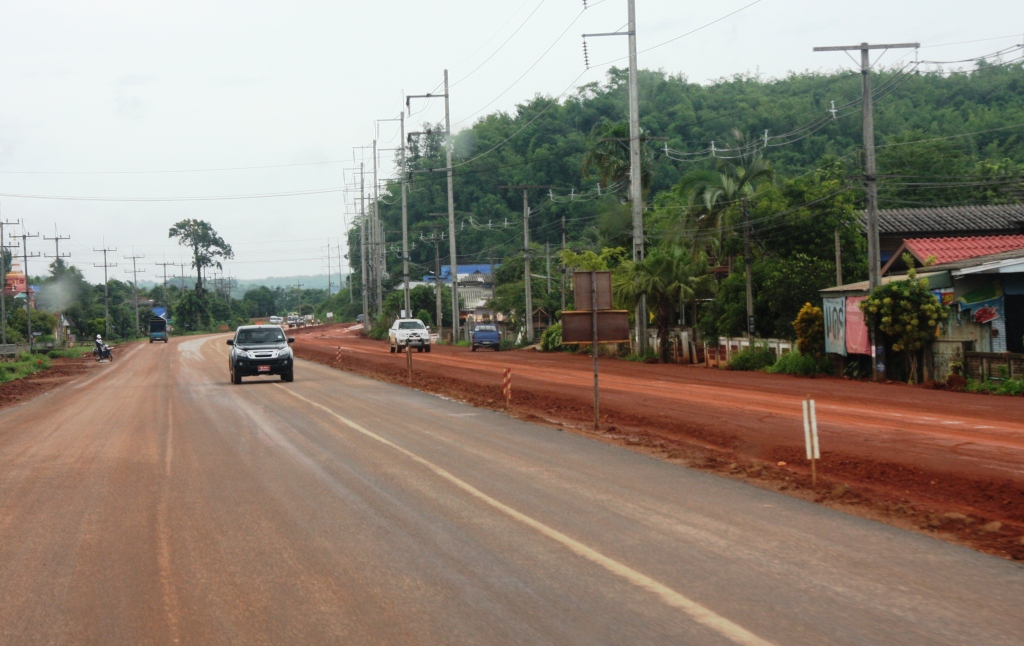
By design, the highway system links the friendship bridge to Bangkok, but despite being the strongest economy on mainland Southeast Asia, Thailand’s highway system lags behind in quality compared to China and the stretch running through northern Laos.  Improvements to Thailand’s R3 highway system which will link Chiang Rai province to all points in Thailand is ongoing but far from complete.  Thailand has promised to upgrade its national transportation and highway infrastructure but political roadblocks, corruption, and a perceived lack of momentum for regional integration at many levels of Thai government and society has discouraged those plans from synching up with China’s outwardly stretching infrastructure linkages.   When the Thai roads are finished, a container truck will be able to travel from Kunming to Bangkok in less than 18 hours.

Road widening construction on Thailand's R3 in Chiang Rai province

Road widening construction on Thailand’s R3 in Chiang Rai province

The 14 hour drive from Kunming to the friendship bridge feels like a leapfrog journey from bridge to tunnel and tunnel to bridge as the road makes its 1800 meter descent.  These two roads cut through some of the most difficult terrain on the planet and link the Chinese state to the Thai state while passing through the most ethnically diverse region in Asia.

The roads not only to build regional commercial connections between China, Thailand, and Laos through the increases of trade and investment but they also assist in expanding each of these state’s interests and systems into the once impenetrable regions of upland southeast Asia by introducing national education systems, agricultural techniques that promote mono-cropping over traditional subsistence farming, and creating avenues for ethnic and rural peoples to leave their homes and link up to national labor markets.   The opening of the bridge will increase trade in the region and will intensify and quicken the pace of social change in upland Southeast Asia and reshuffle the cultural milieu of peoples who have sought refuge from the expansionary Chinese and Thai states for centuries.

Under construction, July 2012

Under construction, July 2012

Bridge completion, December 2013

Bridge completion, December 2013

The bridge’s construction has also caused an influx of Chinese investment in Chiang Rai province mostly in real estate development, speculation on future industrial estates for manufacturing of intra-industry goods passing between China and Thailand, and the buying up of agricultural lands.  While this investment is encouraged and welcomed at the national level and by the Chiang Rai Chamber of Commerce, locals are wary of the fast and growing levels of investment in the Golden Triangle Area by Chinese firms and often cite a “Chinese invasion.”  The mayor of Pak Ying Tai village, a small fishing community of 100 households located less than one kilometer south of the bridge has lamented to me on several occasions about China’s footprint in Chiang Rai as he observes year on year decreases in freshwater fish catches and sends more and more of his villagers looking for work in urban areas.

A local farmer from Pak Ying Tai village discusses his worries about community impacts of economic development

A local farmer from Pak Ying Tai village discusses his worries about community impacts of economic development

In many ways the bridge and its construction serve to represent the challenges of regional cooperation between China, Thailand, and the rest of mainland Southeast Asia.  From its conception in the late 1990s to its completion yesterday, the bridge has gone through stalled and failed rounds of negotiation and has not lacked controversy.  Groundbreaking for the 1 billion Thai baht project which is equally invested by China, Laos, and Thailand did not occur until 2010 despite a scheduled start for as early as 2006. In May 2011 Thailand pulled its portion of the construction team in order to settle a land dispute with the local Thai government accusing Chinese commercial interests of illegally purchasing land on the Thai side of the bridge.

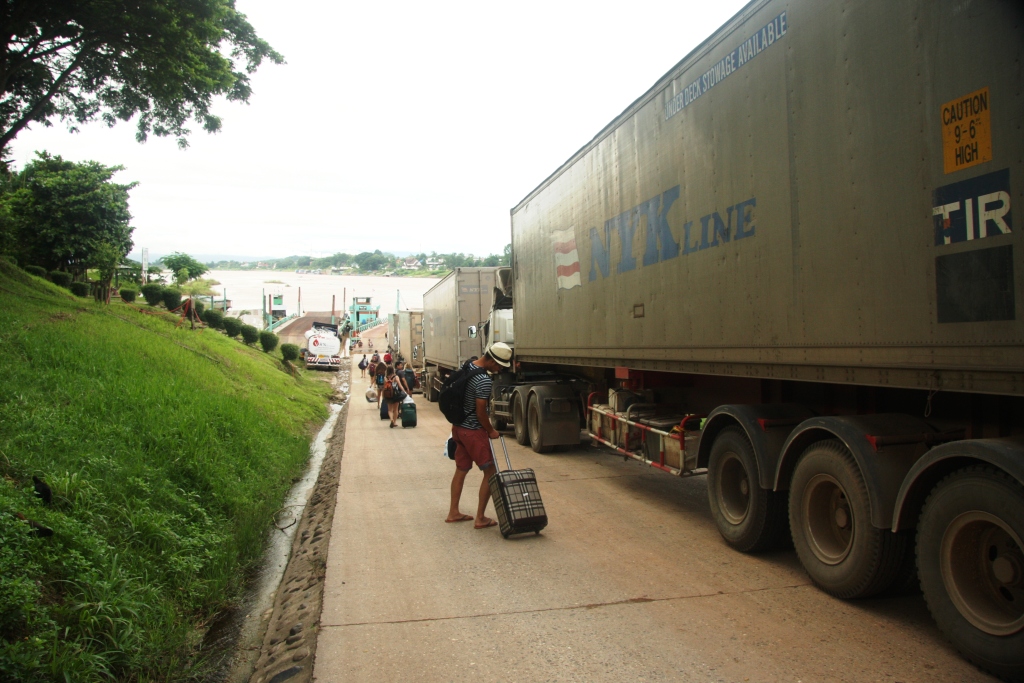
Container trucks will no longer have to wait in line for the Mekong ferry at Huayxai in Laos.

Container trucks will no longer have to wait in line for the Mekong ferry at Huayxai in Laos.

Another obstacle to regional cooperation demonstrated by the bridge is the ease of passage through customs and inspection for both container trucks and individual travelers or tourists to the region.  Chinese trucks are not permitted to drive in Thailand, nor are Thai trucks allowed to travel through China; thus the speed of transport is slowed by the need to repackage goods at one of the border crossing points. Despite efforts of the ADB in to facilitate a shared cross border trade and transport protocol to streamline logistical flows at regional border checks in China and mainland Southeast Asia, states have been slow to adopt the measures in order to protect national markets and logistics industries.  New customs and inspections facilities at the bridge are fitted to increase the speed of transport and ease of people movement and will serve as a testing ground for these promised increases in logistical efficiencies.

Looking forward to the first six months after the bridge’s opening, the verdict will be clear on whether the bridge will serve as a strategic choke point, a gateway for win-win trade and economic development between two regional powers , or a conduit that will further challenge the structure of rural livelihoods in upland Southeast Asia.

Looking upstream at the completed bridge from Pak Ying Tai village.

Looking upstream at the completed bridge from Pak Ying Tai village.

Leave a Comment

Filed under China, Current Events, Economic development, GMS, Mekong River, Regional Relations, SLIDER, Thailand, Uncategorized, Yunnan Province

Space and Spectacle in the Bangkok Protests

Part of the spectacle at Democracy Monument.


Bangkok has been rocked with the largest political demonstrations since 2010, with protests escalating into isolated pockets of violence.

Yesterday’s D-Day is part of the “final battle” by the anti-government protesters, with morning marches from all major rally sites converging at Government House. Prime Minister Yingluck announced that she would dissolve the lower house of Parliament, as a reported 100,000-150,000 protesters flooded the streets of Bangkok and members of the Democrat party resigned.

Clashes on so-called V-Day last Sunday left a reported five people dead and 64 injured in the confrontation between anti-government and pro-government protesters, including one who died when a bus was attacked.

Over the last two weeks, anti-government protesters occupied key ministries, government complexes and police headquarters.

The police attempted to alleviate tensions after the worst of the clashes, as they opened up barricades to major government offices – even offering roses to protesters in a symbolic gesture just days after taunting protesters and firing tear gas at crowds.

These protests showcase the complicated intersection of history, social changes, and legitimacy in current Thai politics.

And the very spaces of the rallies themselves become entry points into these deep, complex waters. What do the protests and occupied sites in the city reveal about the myriad of claims and competing political aims among the factions? What can the symbols and aesthetics of this protest tell us about what is happening and why? Continue reading →

Leave a Comment

Filed under Culture, Current Events, Governance, SLIDER, Thailand

Gary Locke, US Ambassador to China visits Kunming one day after announcing resignation

photo 1

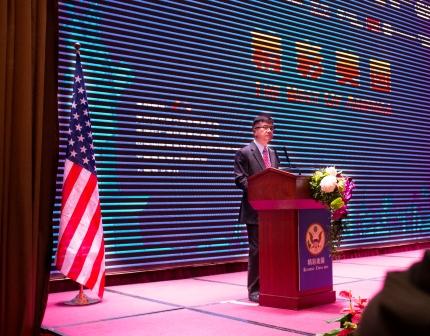
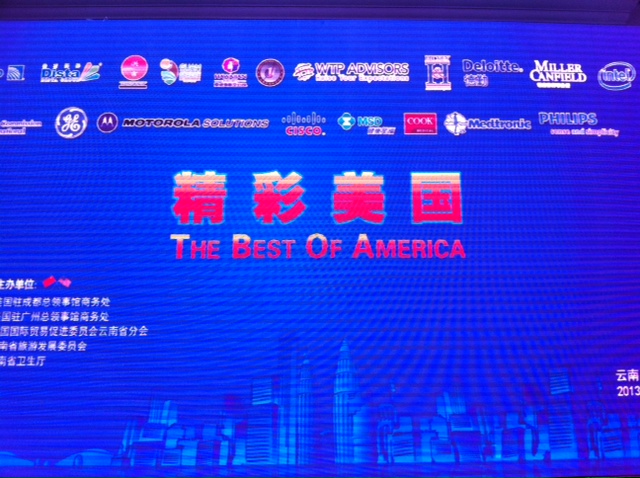
US Ambassador to China Gary Locke paid his third visit to Yunnan province on Thursday, November 21, one day after the announcement of his unexpected resignation.  His visit was part of an investment promotion roadshow entitled “The Best of America” traveling around China’s southwestern provinces and organized by the US consulates in Chengdu and Guangzhou.  The event was hosted by provincial vice-governor Gao Feng and attended by Yunnanese business interests and officials from the provincial international trade promotion department, tourism department and public health departments.   Core economic strengths of the US were represented by CEOs and officers of Deliotte, GE, Motorola, CISCO systems, Intel, and Miller Canfield Law firm in addition to other firms.  United Airlines was also in attendance and eager to promote its new direct flight from Chengdu-San Francisco opening early 2014.

Opening remarks were given by both Ambassador Locke and Vice Governor Gao. Both speeches highlighted the United States’ and Yunnan’s shared history of cooperation through the Flying Tigers, as well as the need for present day economic cooperation. In his remarks, Ambassador Locke boasted of the increase of China-to-US FDI under his tenure. In the past 21 months, investments from China totaled USD 18 billion, more than the past 10 years combined, an accomplishment Locke can only take partial credit for, as larger macroeconomic trends in the US and China were also important factors. Locke was also able to highlight the increase of Chinese students in the US in recent years. According to the ambassador, the number of Chinese students in the US reached 280,000 in 2012. In addition, Ambassador Locke was also able to point to decrease in wait time for US visas and a new, expanded visa office at the Chengdu consulate as notable achievements under his tenure.  Aside from pushing investment in America, Locke also promoted core American values like legal transparency, free trade and intellectual property rights, issues that have been divisive for the two countries in past years.

Photo courtesy of Allie Horick

Photo courtesy of Allie Horick

Speaking directly after Ambassador Locke, Yunnan’s Vice Governor Gao Feng also promoted bilateral trade and cooperation. In his remarks, Vice Governor Gao emphasized Yunnan’s role as China’s gateway to South Asia and Southeast Asia and its fast pace of the its economic growth. Gao pointed to the recent China-South Asia Expo as a marker of Yunnan’s rise in national and regional importance. The US delegation noted that Locke’s visit to Yunnan went very smoothly and all requests for visits to companies and government ministries were granted, including a visit to Yunnan University, where the Ambassador met with students and professors. This is in contrast to the difficulty encountered when US delegations request access in other provinces and autonomous regions in southwest China, particularly Tibet.

The roadshow was planned with the specific purpose of promoting Chinese FDI to the US, the export of medical technology to Yunnan’s developing healthcare sector, and tourism to the US.  After the Green Lake Hotel event, the delegation met mostly with potential investors from the agriculture and mining sectors reflective of these two sectors as two core pillars of Yunnan’s economy – tourism.  Locke also encouraged US investment in Yunnan tourism management systems – something sorely needed in Yunnan, and China at large, as localities struggle to protect cultural capital bases and natural endowments from the damaging onslaught of mass Chinese tourism.

photo 2

The inability of Yunnan’s medical infrastructure to keep up with the demand for medical services was apparent when the delegation was shown MRI scanner purchased from the US that had been use for 10 years at the Kunming Number One Hospital.  The machine was being used 70-80 times per day non-stop for seven days per week.  Cumulative cost of parts and supplies maintenance, all imported from the US, had greatly exceeded the original cost of the machine.

Lastly, Chinese tourism to the US was high on the list of promotion for the delegation.  In 2012, tourism to the US was the US’s top service sector export with Chinese tourists leading the way in number of tourists visiting the US in a by country breakdown.  In international trade accounting, foreign tourist visits are counted as an export due to the positive accumulation of foreign income.

Locke’s visit is recognition of the fruits of the China’s Western development program – namely economic progress to the degree that US investors are now drawn to the fast growth rates coming out of China’s southwestern provinces.  And as a result of that economic progress, Yunnanese investors have reached levels of wealth garnering capabilities to invest in the US, half a globe away.  His visit is also reinforcement of Yunnan’s strategic location as a gateway for regional investment to Southeast Asia and South Asia – a key point mentioned by both the US delegation and the provincial hosts.

Later in the day, Locke’s diplomatic rock star status was confirmed by an exuberant crowd of students at Yunnan University proud of their shared heritage with the US ambassador.  Locke returned that exuberance with hugs.   With Locke stepping down it may be a while until another US ambassador to China receives the kind of welcome received in Thursday in Yunnan.

Consensus among some of the ExSE members is that Locke may be stepping down in preparation for a high appointment related to the 2016 presidential election.  He is an extremely successful career politician with experience managing Americans’ most important bilateral relationship, domestic economic and international trade relations as US Commerce Secretary, and a successful run as governor of Washington State.  This portfolio positions Locke as a strong candidate for VP or Secretary of State under a future Democratic presidency.  Gary Locke will step down as US Ambassador to China early 2014 after taking up the post in August, 2011.


Leave a Comment

Filed under China, Current Events, Economic development, Regional Relations, SLIDER, Uncategorized, USA, Yunnan Province

Fire, Spirits and Ritual Self-Injury in Phuket: The Vegetarian Festival

Photograph by Amy Devlin (2013).

Fireworks explode in a loud cascade in the middle of the street, but no one flinches. I watch as a young barefooted man passes me – a pair of guns are impaled in his face, the barrels poking into the open flesh of his cheeks and out of his open mouth. He’s dressed in a black costume embroidered with Chinese symbols.

He is a mah song, a spirit medium, and he’s not the only one. Throngs of men and women are parading down the street, with metal skewers, needles, and even weapons inserted into their cheeks, arms, torsos and elsewhere on their bodies. They are in trances – their heads are twitching rhythmically, eyes rolled back, and their hands are clenched. Groups of devotees reverently carry statues of the gods. As far as the eye can see, everyone is clad in white. Continue reading →

Leave a Comment

Filed under China, Culture, Current Events, Reviews, SLIDER, Thailand

Regional Roundup for Week of 11.15.13

The devastation of Typhoon Haiyan upon the Philippines made major headlines this week. The Third Plenum also concluded this week with somewhat tepid responses from the media concerning lack of clarity over proposed reforms. Among expected  measures included changes to China’s one-child policy, however the full details of Third Plenum reforms have yet to be released.

ExSE FOCUS

Asia Rivalries Play Role in Aid to the Philippines | NYT — The outpouring of foreign assistance for the hundreds of thousands left homeless and hungry by Typhoon Haiyan is shaping up to be a monumental show of international largess — and a not-so-subtle dose of one-upmanship directed at the region’s fastest-rising power, China. /China upped its initial donation of approximately $100,000 USD to $1.6 million after criticism of stinginess even within state media…offering aid and relief assistance could have been an opportunity to promote Chinese soft power and improve the relationship between China and Philippines, especially in light of recent South China Sea disputes. It’s still less aid than Swedish retailer IKEA pledged ($2.7 million through a charitable foundation)./

Lessons from the Haiyan Typhoon Tragedy | The Diplomat — Haiyan proved once more that the Philippines are extremely vulnerable to the harsh impact of climate change. But it also exposed the sorry state of the country’s infrastructure, chaotic land zoning system, pre-modern weather facilities, unreliable communication facilities, and inadequate disaster preparedness programs.

Disappointment With Third Plenum Is Premature | The Diplomat — Most of the disappointment over the Third Plenum is over the lack of specifics contained in the Third Plenum’s communiqué (English translation here, courtesy of China Copyright and Media). For example, the Wall Street Journal article cited above notes of the communiqué, “the details [about how China will reform] were almost completely missing, even though the document ticked off many of the items that appear on standard lists of reform objectives for China.” But this opinion, which has been widespread since the Plenum ended, seems to have a mistaken view of what the purpose of the communiqué is.

China Tackles One-Child Policy, Death Penalty, & Labor Camps | The Diplomat — China has released the resolution detailing the CCP Central Committee’s major decisions at the Third Plenum, which was held from Saturday to Tuesday. Interestingly, initial reports from the state media highlight mostly social reform issues, some expected some less so. One of the expected decisions is that China has decided to ease its one-child policy, which since the early 1980s has restricted urban couples to one child while allowing some rural couples have two children.

JPMorgan’s Fruitful Ties to a Member of China’s Elite | NYT — A contract between JPMorgan Chase and a consulting firm run by the daughter of the former prime minister points to the bank’s strategy to build its influence in China. /A story to watch, coverage so far has been very careful to note that J.P. Morgan has not been accused of any wrongdoing (yet) but is part of a wider bribery investigation…/

CHINA

China Elected to United Nations Human Rights Council | NYT — Saying it would “oppose pressure and confrontation” on the United Nations Human Rights Council and advance the cause of human rights, China was elected to it for a three-year term along with Cuba, Saudi Arabia and Russia. /Saudi Arabia actually rejected its seat, a surprising move that has been interpreted as an expression of anger at the United States./

Israel Increasingly Courting China as an Ally | NYT — Israeli officials hope to win China to their side in dealings with Iran, Syria and the Palestinians. /Prompts speculation on China’s increased international role beyond strong regional presence in Asia…although Iran’s relationship with China as its third-largest supplier of crude oil could very likely complicate Sino-Israeli relations./

Colorful History of a Power Hotel in Beijing | NYT — The Jingxi Hotel, where Chinese leaders met this week, has a colorful history hosting some of the most important gatherings in modern Chinese history. /Adds another layer to a Chinese joke that there’s no “people” in the Great Hall of the People — major policy decisions are made in the conference rooms of hotels like the Jingxi, which hosted the recent 3rd Plenum./

China’s One-Day Shopping Spree Sets Record in Online Sales | NYT — On Monday, China’s biggest online shopping company processed more than $5.75 billion in its online payments system — a record for a single day anywhere in the world, surpassing by two and a half times the total for American retailers last year on so-called Cyber Monday.

China’s children may become the drivers of environmental change | The Guardian — With growing media coverage of the harmful effects of PM2.5, personal attitudes to its impact are also rapidly changing, and many are taking the necessary precautions. Well-to-do families, young white-collar workers and those who are internationally minded are becoming increasingly unsettled about the long-term effects of living in such an unhealthy environment, and at the heart of these concerns is often the lasting damage to children’s health. Many are questioning how viable it is to raise a family in heavily polluted cities, and people speak of “hatching plans to escape Beijing” by emigrating abroad for the sake of their offspring.

Would You Like Fries With Those Spicy Pork McBites? | NYT — With competition heating up in China’s $174 billion dollar fast-food market, McDonald’s is seeking to up its game by capitalizing on the country’s increasingly voracious appetite for pigs. The result? Spicy Pork McBites. The new pork treat is in line with the overall global strategy of Western chains tailoring their menus to local tastes. 

REGION

Cyclones and climate change: The new normal? | The Economist — Regardless of its precise position in the historical hierarchy, Haiyan—like Katrina—has provoked discussion about the effects of global warming on tropical storms. Naderev Sano, the Philippines’ representative at a climate summit in Warsaw, was unequivocal, daring doubters to visit his homeland. “The trend we now see is that more destructive storms will be the new norm,” he said.

Can Myanmar and North Korea Say Goodbye? | The Diplomat — Myanmar and North Korea were long the Asia-Pacific’s odd couple. Prior to Thein Sein’s era of reform in Myanmar, the two states shared a close diplomatic relationship, often finding common ground in their shared status as militarized pariah states in the greater Asia-Pacifc region. With Myanmar having taken concrete steps away from its isolated past and towards greater global integration, will their bilateral relationship survive? Will North Korea and Myanmar continue to cooperate?

UN court awards Cambodia sovereignty in border dispute | The Guardian —  Cambodia, not Thailand, has sovereignty over a disputed promontory around a 1,000-year-old temple, the UN’s highest court ruled on Monday in a unanimous decision on a long-simmering border dispute. The international court of justice said a 1962 ruling by its judges gave Cambodia sovereignty over the Preah Vihear promontory. Thailand will have to withdraw any military or police forces stationed there.

Maid in Singapore: will Cambodian domestic workers be better protected? | The Guardian —  400 women are taking part in a pilot scheme that is sending Cambodian domestic workers to Singapore. There are more than 200,000 foreign domestic workers on the island, and if the trial goes well it could open the way for a new source of labour to sate the affluent city-state’s appetite for household help. Cambodia’s government says its workers will be shielded from abuse, but doubts linger over key welfare issues.

BRUNEI

Brunei to Release First Commercial Film | The Diplomat — With live music and alcohol banned, there’s not much to do in the tiny sultanate – except to visit one of its five movie theaters. Hollywood blockbusters, as well as films produced in Indonesia and Malaysia, dominate the screens – but that could change in 2014 with the release of Brunei’s first commercial feature film. The country’s last film, made in the 1960s, was a guide on how to be a good citizen produced by the Ministry of Religious Affairs.

CAMBODIA

Global Fund halts contracts over bribes for bednets in Cambodia | The Guardian — Investigation finds two international companies paid Cambodian officials for deals to supply anti-malaria bednets.  The Global Fund to Fight Aids, Tuberculosis and Malaria has suspended contracts with two international firms that supplied mosquito bednets over “serious financial wrongdoing” in Cambodia.

LAOS

U.S. Offers Reward in Wildlife-Trade Fight | NYT — Taking a page from the battle against international drug cartels, the United States announced on Wednesday a $1 million reward for information to help dismantle one of Asia’s largest wildlife-trafficking syndicates. In what officials said was the first time such a reward had been offered, the State Department said it was targeting a syndicate based in Laos. Investigators say the syndicate is headed by a Laotian businessman, Vixay Keosavang, who was the subject of an article in The New York Times in March.

MYANMAR/BURMA

Naypyidaw Authorities Block NLD Poll on Constitutional Reform | Irrawaddy — Authorities in Burma’s capital Naypyidaw are preventing Aung San Suu Kyi’s National League for Democracy (NLD) from conducting a public opinion poll on the need for constitutional reform, a NLD lawmaker said on Friday.

Police Open Fire, Injure 7 Protesters at Burma’s Letpadaung Mine | Irrawaddy — Seven protesting farmers were injured Thursday evening as police opened fire into a crowd at the controversial Chinese-backed copper mining project in Letpadaung, Sagaing division, witnesses said. Villagers say they were attempting to set up a second protest camp to oppose the restarted mining project, which they fear will cause damage a Buddhist structure in the same area.

Myanmar: 69 Political Prisoners Freed | NYT — Myanmar’s president on Friday pardoned 69 political prisoners as part of a promise to free all such detainees by the end of the year. Most of those newly freed are members of ethnic minorities, said Ye Aung, who is on the government’s political prisoner scrutiny committee.

PHILIPPINES

The horror after Haiyan | The Economist — A picture of the amount of death and destruction caused began to emerge only after the storm had swept out over the South China Sea, heading towards Vietnam. Witnesses spoke of corpses littering the wrecked city of Tacloban, on the east coast, which felt the full force of the storm. They spoke of dazed survivors wandering streets strewn with debris, begging for help. “From the shore and moving a kilometre inland, there are no structures standing. It was like a tsunami,” said the interior secretary, Manuel Roxas, after inspecting the destruction from a helicopter. “I don’t know how to describe what I saw.”

Death After the Typhoon: ‘It Was Preventable’ | NYT — During five days in a Philippine hospital, a 27-year-old farmer and family breadwinner received virtually no care and died, in essence, of a broken leg.

SINGAPORE

Anonymous Could Be Caned in Singapore | The Diplomat — Six members of Anonymous face hefty fines, jail and in some cases a possible caning after being arrested and charged in Singapore for defacing websites, including one linked to Prime Minister Lee Hsien Loong, and spray-painting graffiti identifying the international hacking and protest group.

THAILAND

Banyan: Blowing the whistle | The Economist — To the shrill peeps of ubiquitous whistles, protesters have yet again crowded Bangkok, the capital, brandishing portraits of Bhumibol Adulyadej, Thailand’s long-serving king, revered but frail. What has so far been a peaceful movement earlier this month seemed to threaten the survival of the government of Yingluck Shinawatra, the prime minister. Her tactical retreat has probably saved it. But the political divide looks as unbridgeable as ever, and as dangerous to Thailand’s stability.

Jammin’ in the Jungle: An “Elephant Orchestra” Performs in Thailand | The Diplomat — At a conservation center in Lampang, Thailand, one American musician has taken the role of conductor for a very special musical ensemble – an “elephant orchestra” that makes music with specially designed instruments tailored to their large size. The elephants play a variety of instruments using their trunks – from giant drums and xylophones to customized harmonicas.

VIETNAM

Vietnam’s Disappointing New Constitution | The Diplomat — The repercussions of poor governance in Vietnam are such that the system of governance and constitutional structure need to be fundamentally changed. The challenge is great, and any transformation will depend entirely on the political willingness of the Communist Party of Vietnam (CPV).

First Wild Saola Sighting in 15 Years Gives Conservationists Hope | The Diplomat — One of the world’s rarest animals was caught on camera in Vietnam earlier this week, sparking excitement and optimism in conservation circles around the world. The saola, which resembles an antelope despite being more closely related to oxen, wasn’t discovered until 1992. Until this week, a living specimen hadn’t been spotted in the wild in 15 years.

Leave a Comment

Filed under Current Events, NEWS DIGEST, SLIDER, Uncategorized

Regional Roundup for Week of 10.31.2013

October 28 Tiananmen Square Incident

China blames East Turkestan Islamic Movement for Beijing attack | The Guardian – China’s top security official has blamed the East Turkestan Islamic Movement for organising the suicidal vehicle attack that killed five people in the heart of Beijing this week.

Meng Jianzhu, chief of the commission for political and legal affairs of the ruling Communist party, named the group in an interview with Hong Kong-based Phoenix Television when he was in the capital of Uzbekistan attending a regional security summit and seeking co-operation on counter-terrorism.

“The violent terrorist incident that happened in Beijing is an organised and plotted act. Behind the instigation is the terrorist group East Turkestan Islamic Movement entrenched in central and west Asian regions,” Meng said, in video footage aired on Thursday by Phoenix.

Meng gave no further detail, and the alleged terrorist group has not claimed responsibility.

Q. & A.: Philip Potter on the Growing Risk of Terrorism in China |NYTimes – In a forthcoming paper for Strategic Studies Quarterly, Philip Potter, an assistant professor at the University of Michigan’s Ford School of Public Policy, writes that the dichotomy between China’s tough security posture in Xinjiang and the comparatively open society of the country’s east has created an incentive for attacks in cities like Beijing. In an email interview, he analyzed the history of separatist violence, the divide between the “two Chinas” and the likelihood that further crackdowns would exacerbate resentment in Xinjiang.

Seeing a Turning Point for China’s Thinking on Terrorism | Sinosphere – One of China’s leading experts on counterterrorism and foreign policy predicted on Thursday that the fiery crash of a vehicle three days earlier near the Chinese leadership’s compound at the edge of Tiananmen Square would lead to a broad reassessment of domestic security and China’s diplomacy.

Yang Jiemian, the president emeritus of the prestigious, government-financed Shanghai Institutes for International Studies, said the attack was an important moment for Chinese domestic and foreign policy.

“It will be quite a big impact on China — China will rethink its actual institutions and measures against terrorism,” he said Thursday in brief remarks after delivering a speech and taking questions in Hong Kong. “Tiananmen is symbolic, so this incident is symbolic.”

The Strangers | ChinaFile – If Xinjiang’s troubles seemed remote to residents of Beijing, the October 28 attack brought them much closer to home. “This is the first time that I’ve ever felt so close to a terrorist attack,” remarked one user of Sina Weibo, China’s Twitter. Another tweeted, “My God, they can do this in front of Tiananmen? I’m very worried all of the sudden, how do they prevent this type of attacks in the future? Vehicle inspections?”

Uighurs, mostly Turkic-speaking Muslims living in Northwest China, are one of the country’s fifty-five officially recognized ethnic minorities. Anestimated 10 million Uighurs live in Xinjiang, making up approximately forty percent of its population, and bristle under heavy-handed restrictionsplaced on their language, religion, and way of life. Han officials there often fail to learn functional Uighur, and traditional Uighur male gatherings calledmeshrep are often banned as “illicit” or dispersed by police. // Excellent longform profile on Uighur/Han tension with nuanced explanations of historical conflicts and cultural differences.

ExSE FOCUS

Kunming Environmental Court toiling in obscurity|GoKunming  – A Kunming court established to try cases exclusively regarding the environment is still struggling to make a name for itself five years after being founded. In a story originally published by newspaper City Times, the Kunming Environmental Court is characterized as understaffed and largely unknown to the general public.

The idea to create the Kunming Environmental Court was originally proposed in September 2008 as news of heavy arsenic contamination in Yangzonghai (阳宗海) was breaking. The court is now subsidiary to the Kunming Intermediate People’s Court.

At the time of the Yangzonghai scandal, legal experts bemoaned the fact that Yunnan had no institutional body to deal with crimes against the environment. The China Environmental Law Blog characterized the Yangzonghai case as symptomatic of an enforcement problem:

[quote]…this wasn’t a case of turning a blind eye to polluters, it was a failure of the regulatory system to provide sufficient disincentives to pollution. In other words, the lake is polluted with arsenic because even maximum penalty amounts are so “trivial” that it makes economic sense to “pay to pollute.”[/quote]

Report: Yunnan drug war “extremely dangerous”|GoKunming – Yunnan has long had trouble policing its 966-kilometer border with Myanmar. Stemming the flow of drugs out of the Golden Triangle into the province is costly, time-consuming and has, in the past, been confused by a tangle of legal issues.

Increased international cooperation began in 2011 between the drug enforcement agencies of China, Laos, Myanmar and Thailand following the murders of 13 Chinese sailors on the Mekong River. Cross-border police collaboration has been credited with multiple high-profile seizures. Despite such successes, drugs continue to flow across Yunnan’s border, and by the size of recent busts, appear to be arriving in record quantities.

Drug-resistant malaria spreading through SE Asia | GoKunming – The World Health Organization (WHO) has announced a drug-resistant disease has the potential to imperil millions unless immediate international action is taken. Although not new to science, the virulence of the strain has surprised health officials, who now say hundreds of millions of dollars are necessary to contain and combat further spread of the disease.

Malaria prevention efforts in the Greater Mekong Subregion (GMS) have made significant strides in the past 15 years. The area, which is made up of Cambodia, Lao, Myanmar, Thailand, Vietnam and China’s Yunnan province, have seen the incidence rate of malaria decline by 80 percent since 1998. This is due largely to increased cooperation between the seven countries, as well as an influx of money from international donors.

The WHO is now warning a strain of malaria resistant to artemisinin-based drugs — the standard prophylaxis used worldwide in the treatment of the disease — has developed in Thailand and Cambodia. If the spread of such a strain is left uncontained it could endanger the lives of millions in the GMS, Micronesia and sub-Saharan Africa.

Gearing Up for an Ultramarathon in Southwest China | Sinosphere – Long-distance running is increasingly popular in China, and 42-kilometer marathons in the big cities draw many participants. On Saturday, runners of the Dali 100, an ultramarathon of 100 kilometers, or 62 miles, would pass through the lush heart of the Cangshan. More than 60 runners had signed up to run 100 kilometers and more than 80 to run 50 kilometers, [on a course] up to 4,092 meters, more than 13,400 feet, above sea level, equal to the heights of some of the highest peaks in the continental United States.

China

Chinese Communism and the 70-Year Itch |The Atlantic – China’s government is approaching an age that has often proven fatal for other single-party regimes. Will Xi Jinping make the necessary reforms to avoid a crisis?

The Seven Year Itch fashioned a classic American romantic comedy around the notion that after seven years of marriage, a spouse’s interest in a monogamous relationship starts to wane. There is an interesting parallel in politics; specifically, the life span of one-party regimes, though in this case we might call it the “70-year itch.” When the Soviet Union collapsed in 1991, the Communist Party had been in power for a little more than 70 years. Similarly, the Institutional Revolutionary Party (PRI) ruled in Mexico from its founding in 1929 until its defeat in the 2000 elections—71 years.  Several of today’s remaining one-party authoritarian regimes have been in power 50 to 65 years, and there is good reason to think that they, too, are now facing the “70 year itch.” Part of the problem is that revolutionary one-party regimes like those in China, Vietnam, and Cuba cannot survive forever on the personal charisma of their founding leaders.

China’s Clean-Air Drive Likely to Take a Long Time | NYTimes – China’s pollution, while extremely severe, is not unique, and efforts by other countries, like Britain and the United States, to conquer dirty air may hold lessons for China’s future.

The Chinese government is working on the problem and recently announced new limits on pollutants along with a promise of increased monitoring. Public awareness has spiked, a necessary step toward ending the crisis. But the overriding message from other nations is a discouraging one: Serious change can take decades, especially when pollution is a byproduct of economic growth.

Another Look at the Empress Dowager Cixi, This Time as the Great Modernizer | Sinosphere  – Jung Chang presents the subject of her biography as neither the cruel despot nor the easily manipulated ruler that the Chinese Communist Party and other critics have long portrayed.

Changing the economy: The long weekend |The Economist – Running the world’s biggest country requires sacrifice. For the Communist Party’s top 376 officials on its central committee, the sacrifice includes the occasional weekend. From Saturday November 9th until the following Tuesday, they will gather in Beijing for the third time since Xi Jinping became head of the party nearly a year ago. The “third plenum”, as this meeting will be called, is the new leadership’s chance to lay out its stall on economic reform. In the past similar gatherings have shaken the world. The third plenum in 1978, for example, sealed Deng Xiaoping’s authority over the party, allowing his vision of “reform and opening up” to prevail. Another third plenum, in 1993, set the stage for a ruthless shake-out of loss-making state-owned enterprises (SOEs).

Hopes of Market Reforms in China Tempered by Political Realities | Sinosphere – China’s leaders head toward a major policy-setting conference next month bearing heady expectations that they have encouraged, and a proposal from a prominent government research organization has magnified speculation that they will embrace bold pro-market overhauls. The grinding realities of politics, however, are likely to force proponents of such overhauls to settle for more modest changes, experts said.

Trial By TV: What Does a Reporter’s Arrest and Confession Tell Us About Chinese Media? | ChinaFile – The latest ChinaFile Conversation focuses on the case of Chen Yongzhou, the Guangzhou New Express journalist whose series of investigative reports exposed fraud at the Changsha, Hunan-based heavy machinery maker Zoomlion. Chen later was arrested and then, last weekend, exposed himself (and his newspaper) in a nationally televised confession as a recipient of bribes from unidentified third parties paying him for his reports on Zoomlion. Ever since Chen admitted his wrongdoing, Chinese netizens’ discussion of Chen’s case has included speculation [Chinese link] that Chen was targeted by the company he exposed. But who was paying him? Was it Zoomlion’s chief competitor, Sany? What do we make of confessions given on state television rather than in a court of law?

Bo Xilai May Have Gotten Off Easy |ChinaFile – Given the patterns of sentencing of other officials convicted of taking similarly large sums of money through bribes and graft, Bo Xilai’s sentence was comparatively light. Hu Jintao removed more officials from office for corruption—both in absolute numbers and on a yearly basis—than did his predecessor, Jiang Zemin. The officials who fell during Hu’s era were subject to stiffer penalties than their Jiang-era counterparts.

Innovation in China |ChinaFile – In China, innovation has become one of those political buzzwords which—like harmony—seems to mean anything and everything to the Central Propaganda Department. So much so that we find it difficult to walk down the streets in Beijing now without getting accosted by giant character banners encouraging us to economic feats of creative daring. But how much of what passes for innovation in China is actually the least bit innovative?

Gaming China’s Art Market With Expert Forgeries | Sinosphere – All over China, hundreds, if not thousands, of workshops are producing replicas of ancient relics and artifacts, in bronze, ceramics, jade and silver. Some workshops specialize in paintings made in the style of an ancient master, using old paper, inks and seals. While many objects are marketed for what they are — high-quality replicas, or imitations of old works — experts say the most sophisticated pieces are good enough to fool connoisseurs and often sell at Chinese auction houses, helping fuel this country’s booming art market.

Popular pastimes: Dancing queens | The Economist – A man in Changping, on the edge of the capital, had allegedly fired a shotgun into the air and set loose three Tibetan mastiffs to scare away a group of women whose public dancing annoyed him. The man was arrested, but received much sympathy online. Groups of people, often older women, dancing in public, are an increasingly common sight in Chinese cities. In the early morning and evening they set up loudspeakers in parks or squares to exercise, gossip and show off a little. They call it guangchangwu, or “square dancing”, after the venues where they meet. Many people grumble about the grannies and their throbbing music. Altercations often break out.

Don’t Expect Golf to Catch On in China | Asia Life – Both Chinese and Western entrepreneurs have spent at least a decade now trying to give golf some momentum in the world’s most populous nation. There are more major golf events held in China than ever before. The biggest stars are dropping by to play exhibitions annually, and a handful of Chinese golfers are making appearances in the sport’s biggest tournaments.  But despite the brilliance of Liang Wen-Chong, Guan Tianlang and a few other up-and-coming stars, golf is not catching on as either a spectator sport or, especially, a participatory sport in China.

Region

Australia Said to Play Part in N.S.A. Effort | NYTimes – Australia, a close ally of the United States, has used its embassies in Asia to collect intelligence as part of the National Security Agency’s global surveillance efforts, according to a document leaked by the former agency contractor Edward J. Snowden and published this week in the German newsmagazine Der Spiegel.  The Chinese Foreign Ministry reacted angrily on Thursday to the assertions in the document, which also said that the American Embassy in Beijing and consulates in Shanghai and Chengdu operated special intelligence gathering facilities, and it demanded an explanation from the United States.

A Game of Shark and Minnow |NYTimes Multimedia – Ayungin Shoal lies 105 nautical miles from the Philippines. There’s little to commend the spot, apart from its plentiful fish and safe harbor — except that Ayungin sits at the southwestern edge of an area called Reed Bank, which is rumored to contain vast reserves of oil and natural gas. And also that it is home to a World War II-era ship called the Sierra Madre, which the Philippine government ran aground on the reef in 1999 and has since maintained as a kind of post-apocalyptic military garrison, the small detachment of Filipino troops stationed there struggling to survive extreme mental and physical desolation. Of all places, the scorched shell of the Sierra Madre has become an unlikely battleground in a geopolitical struggle that will shape the future of the South China Sea and, to some extent, the rest of the world. // Excellent multimedia presentation highlighting the complexities of South China Sea dispute.

Claws and fire | Southeast Asia Globe Magazine – With the global shift of power continuing its easterly migration, India is attaching greater importance to its historical relations with Vietnam, a gateway to one of the world’s most promising trading blocs: ASEAN.

The Curious Case of India and China | India Ink – During his recent visit to China, Prime Minister Manmohan Singh of India said that when the two Asian giants shake hands, the world takes notice. Although the statement stands true, the real question to ask is whether the media and the security and diplomatic community in the two countries make much of this handshake. It can be argued India-China relations comprise a slew of missed opportunities, and these two have added yet another chapter to this narrative.

Wikipedia China Becomes Front Line for Views on Language and Culture | NYTimes – Even innocuous topics have become controversial for Wikipedia editors from China, Taiwan and Hong Kong, and compounding the issue are language differences. Wikipedia editors, all volunteers, present opposing views on politics, history and traditional Chinese culture — in essence, different versions of China. Compounding the issue are language differences: Mandarin is the official language in mainland China and Taiwan, while the majority in Hong Kong speak Cantonese. But mainland China uses simplified characters, while Taiwan and Hong Kong use traditional script.That has led to articles on otherwise innocuous topics becoming flash points, and has caused controversial entries to be restricted.

Brunei

Brunei Becomes First East Asian State to Adopt Sharia Law |ASEAN Beat – This week, Brunei made waves across Southeast Asia when Sultan Hassanal Bolkiah announced that he would move his nation towards implementing Islamic Sharia law into its national penal code. The Sultan has ruled Brunei since 1967 and possesses absolute executive authority as head of state. While Sharia had previously existed in Brunei in the form of an Islamic court, its role was mainly restricted to dealing with family law and disputes. Notably, the new penal code will only be applicable to Muslims–about two-thirds of Brunei’s 420,000 residents. Under the new penal code, violators will be subject to brutal capital punishment including having their limbs severed for theft and stoning for adulterers.

Cambodia

Cambodian Protests Continue, Hun Sen Open to Talks | ASEAN Beat – Cambodia’s political opposition has wrapped-up three days of peaceful protests and marches on foreign embassies, demanding international support for its push to have an independent inquiry conducted into the controversial results of the July 28 elections. The Cambodian National Rescue Party (CNRP) insists the ruling party of Prime Minister Hun Sen cheated at the poll, which gave opposition leader Sam Rainsy 55 seats in the 123-seat National Assembly, still a sharp improvement over its previous standing.

Last Words From the Khmer Rouge as Tribunal End Nears | ASEAN Beat – Ever since Prime Minister Hun Sen asked the United Nations for help in constructing a legal process capable of putting surviving leaders of the dreaded Khmer Rouge in the dock, Cambodia’s war crimes tribunal has never been far from controversy. In closing arguments on the final day of the current Khmer Rouge trial, former Brother Number Two and the communist party chief ideologue Nuon Chea, 87, blamed the government in Hanoi, as well as Vietnamese and American infiltrators, for atrocities committed here during their 1975-79 rule and the period that followed, when the country was occupied by Vietnamese troops. Nuon Chea said that he and the Khmer Rouge were not responsible for the killings, nor deaths attributed to starvation and forced labor.

Indonesia

In Indonesia, a Push for Prohibition Strikes Fear | NYTimes – A draft bill submitted to Indonesia’s Parliament earlier this year that called for a ban on alcohol in the world’s largest Muslim-majority country has stirred unease among the country’s predominantly moderate Muslims and fear among those who make their living in tourism, from upscale hotels in the capital, Jakarta, to beach bars and theme restaurants on the resort island of Bali.

Indonesia Accused of Using Australian Helicopters in West Papua ‘genocide’ | The Guardian – Helicopters supplied by Australia were used by Indonesia in a “genocidal” crackdown on civilians in West Papua in the 1970s, a new report has claimed. The report, conducted by the Hong Kong-based Asian Human Rights Commission, says two Iroquois helicopters from Australia were among the aircraft deployed by the Indonesian military in the central highlands of Papua in 1977 and 1978.

Laos

Letter from Laos: river reverie | The Guardian – A brief moment during a journey on the Mekong river brings together women from two different worlds.

Malaysia

Malaysian University Lauds North Korean Economic Policy | ASEAN Beat – A Malaysian university has doffed its cap to North Korea and awarded its latest dear leader, Kim Jong-un an honorary doctorate in economics. A simple ceremony was held earlier this month to confer the title, which raised more than a few eyebrows in academia and on the diplomatic circuit. Privately-run HELP University made the conferment. It’s President, Paul Chan, said the decision was all about building a bridge to reach the North Korean people with “a soft constructive approach” when dealing with leaders of the hermit kingdom. Predictably, the government’s mouth piece, the Korean Central News Agency (KCNA) lauded the PhD while ignoring the plight of its own people and the economic policies that saddled them among the poorest in world – earning less than $1,300 a year each.

Public enemies | SEA Globe Editorial – Gang warfare has gripped Malaysia, and while authorities have upped their game against organised crime, little is being done to address the roots of the problem. Statistics released by the police show that there were 15,098 murders and robberies in the first half of this year, fanning the flames of public fear over organised crime.“A large portion of violence is related to organised groups,” said Teoh El Sen, a Malaysia-based journalist at Astro Awani television news channel, who has been following the gang issue for years. “Gang fights occur on a daily basis. The objectives of unorganised groups are simple and their capabilities are limited compared to gangs.”

Myanmar/Burma

Military MP Says Army Chief Could Become Candidate for President |Irrawaddy News Magazine – The leader of Burma’s military lawmakers has said the group wants to nominate current Commander-in-Chief Min Aung Hlaing for president following the 2015 elections. The plan is possible because the country’s president is elected by Parliament, where military officers hold a quarter of the seats.

Burma’s Ethnic Groups Split Over Constitutional Reform | Irrawaddy News Magazine – The question of what to do about the nation’s military-drafted Constitution is dividing Burma’s ethnic minority groups, with some in favor of completely scrapping the charter and drafting a new one from scratch, while others would like to see the existing Constitution amended.

Burma’s Treasure Hunt: $10M Expedition to Recover World’s Largest Bell | ASEAN Beat – A Burmese businessman and politician has announced that he will pay $10 million for an expedition to recover the Dhammazedi Bell – a legendary bell that has been missing for more than 400 years, thought to be at the bottom of the Yangon (Rangoon) River. Khin Shwe, the owner of one of Burma’s largest construction and real estate firms – as well as a member of the Upper House of parliament – follows a long line of “treasure hunters” who have failed to locate the 270-ton bell, said to be the largest in the world.

Singapore

Why Singapore Doesn’t Count the Poor | ASEAN Beat – Singapore, one of the richest countries in the world, has 20 billionaires and 188,000 millionaires. But curiously, the government doesn’t know the exact number of its poor households. Maybe Kishore Mahbubani, a former diplomat, was correct when he wrote in 2001 that poverty has already been eradicated and that there were no longer “homeless, destitute or starving people” in Singapore. But this seems a bold claim to make in light of the recently documented hardships faced by many ordinary Singaporeans. Perhaps it’s more accurate to mention that the lack of poverty data is related to the government’s refusal to define the country’s poverty line.

Thailand

Thai Amnesty Paves Way for Thaksin’s Return | ASEAN Beat – Controversial legislation that will grant an amnesty for thugs, politicians, protesters and military personnel caught up in the anti-government demonstrations of recent years has been passed by the Thai parliament. The bill will also allow for the return home of former Prime Minister Thaksin Shinawatra.

Thailand Tops Foreign Worker Satisfaction Survey | ASEAN Beat – Expats have heaped praise on Thailand, ranking the country number one in a survey of the overall “experience” for foreign workers. The survey, conducted by HSBC, contains feedback from more than 7000 expatriates living in nearly 100 countries. Thailand was said to be the easiest country for a foreign worker to set up, integrate and make friends.Thailand was also named as the most cost-effective country, due to the low cost of living but generally higher earning potential. About 60 percent of respondents added that Thai food and culture contributed to a healthier lifestyle.

Wanted: wealthy tourists | SEA Globe –  Thailand’s tourism authority is now eager to attract credit card-toting tourists, rather than the guidebook-bearing travellers who have frequented the Kingdom for the past two decades. The tourism and services sector currently represents 50.3% of national GDP and 44.5% of total employment, according to the finance ministry, although Thailand’s appeal has varied little in the past 20 years.


Leave a Comment

Filed under Current Events, NEWS DIGEST

Regional Roundup for Week of 10.26.13

ExSE FOCUS

China sweeps aside civilians in rush for hydropower – The Guardian  European expertise is helping China expand its hydroelectric capacity on a scale that dwarfs similar global initiatives. The great grey wall cuts across the valley of the Jinsha river, a tributary of the Yangtze. Downstream from the dam, the yellow water gushes down the spillway from China’s third most powerful hydroelectric plant. It races on past the city of Xiangjiaba, on the border between the Sichuan and Yunnan provinces, a featureless place with a maze of factories and chimneys built into the urban fabric. Its only claim to fame is the wall 200 metres high that now overshadows it.// Great overview of the immediate human cost of hydropower. 

Remembering, and Forgetting, the Flying Tigers – NYT An neglected graveyard in south China has reopened a debate over how the country remembers its World War II veterans.  Few of my Chinese friends in Kunming know much about about the Flying Tigers… A ‘Flying Tigers Trail’ tour from Kunming to Mandalay would be a great trip.

Hoy Fong’s Sriracha Hot Sauce: How It Earned a Place Beside Ketchup and Mustard – The Diplomat David Tran came to the United States in 1980, fleeing the arrival of North Vietnamese forces into his native South Vietnam. A South Vietnamese army major, Tran loaded his family onto a Taiwanese freighter, called the Hoy Fong, and embarked for a new life in Los Angeles. That ship would one day become his company’s namesake, and Tran would become the reluctant founder of a multi-million-dollar hot sauce empire, realizing the American dream without ever searching for it.// A wonderful piece on a sauce everyone uses. Tran’s story is fascinating, certainly not your normal millionaire.

China and Iran: Destined to Clash? – The Diplomat Even as the U.S. considers Iran’s nuclear program as its most immediate threat, a consensus has emerged in the U.S. foreign policy establishment that China’s rise poses the biggest long-term strategic challenge to the country. There is little indication that a similar consensus has taken hold among Iranian elites. It will.

The future of Laos: A bleak landscape – The Economist THE Airbus A320 was ordered by Colonel Muammar Qaddafi, but somehow ended up as the prized possession of Lao Airlines. From a window seat flying above Laos a visitor gets a sense of the state’s weaknesses. Deforestation stretches all the way to the Chinese border. It is so recent and so extreme that scientists from Sweden’s Lund university picked Laos as a testing ground for a new method of monitoring economic activity from space.

Banyan: Across the party wall – The Economist IF THE following pressing themes remind you of China, spare a thought for Vietnam: a debate over the constitution; efforts to curb the privileges of state-owned enterprises; fury over official corruption; poorly compensated land-grabs; new restrictions on online dissent; a recognition that further economic reform is not just desirable but essential; and, in politics, evidence of fierce factional struggles among high leaders.China and Vietnam have two of the few Communist Parties still in power, so it is hardly surprising that they face many of the same problems.//Most of Vietnam’s political system modeled after China’s. Too bad they decided borrow corruption and crackdowns on dissent.

Journalist’s Call for ‘de-Americanized World’ Provokes Alarm in U.S., Fart Jokes in China – Tea Leaf Nation As fears mounted this week about a possible (and now, it seems, averted) U.S. government default, the U.S. press stumbled upon an October 13 editorial in Xinhua, China’s largest news agency, calling for a “de-Americanized world” in light of Washington’s fiscal dysfunction. News outlets including CBS, USA Today, and Bloomberg picked up the editorial, while the Los Angeles Times ran a story with the headline “Upset over U.S. fiscal crisis, China urges a ‘de-Americanized world.’

The United States Is Quietly Losing Its Innovation Edge to China – CFR  I am not a supporter of the faddish idea that America is in decline. Despite all the hullabaloo about the rise of China, the United States still boasts the most formidable military force and the largest, most innovative economy. But as a student of international studies, I am keenly aware that the rise and fall of great nations are often associated with significant historical events.//America may be losing its innovation edge but the world isn’t always a zero-sum game between China and the US. Would be interesting to see who else is taking away from the US’s innovation edge  other than China.

CHINA

Court Upholds Life Sentence for Bo Xilai – NYT Though the fallen Chinese politician’s story has been full of twists, the High People’s Court in the city of Jinan did exactly what everyone expected it would do.

Response to a City’s Smog Points to a Change in Chinese Attitude – NYT Rising concern about pollution in China and a more active response signal that some officials are serious about tackling the chronic problem.

China hit by another airpocalypse as air pollution cancer link confirmed | Jennifer Duggan – The GuardianCityscapes shrouded in thick smog have become a common scene in China. Last winter, Beijing’s ‘airpocalypse‘ garnered headlines worldwide and generated much anger and debate within China. But this week, air pollution levels in the northeastern city of Harbin surpassed the previous record levels in Beijing.

Xi sets out priorities for foreign policy – The Economist President Xi Jinping called for a comprehensive strategy to engage China’s neighbours as he laid down foreign policy directions at a two-day conference that ended yesterday.

China’s PLA Marines: An Emerging Force — The Diplomat As part of its Pacific pivot, the United States has been making substantial increases in its Asia-based forces, including a bolstering of the U.S. Marine Corps amphibious combat capabilities. One hypothetical scenario that the Navy and Marine Corps train for would be a strike against Taiwan and a possible amphibious combined force invasion carried out by China’s People’s Liberation Army Navy (PLAN). A key spearhead of any such action would be the PLA Marines.

Expanded force supports US ‘pivot’ to Asia, says admiral – The Economist The United States has significantly increased its warship and aircraft deployments in Asia despite Washington’s budget woes, adding punch to its “pivot” to the region, a senior naval commander said.

China’s Arms Industry Makes Global Inroads – NYT From drones to frigates to fighter jets, Chinese companies are aggressively pushing sales of high-tech hardware, mostly in the developing world.

Outspoken Chinese Professor Says He Was Dismissed – NYT Xia Yeliang, an economist, believes Peking University made its decision because of his public support for democratization and criticism of the Communist Party.

Michael Sullivan obituary – The Guardian The art historian Michael Sullivan, who has died aged 96, was one of the most distinguished experts in the field of Chinese art. He had a matchless personal experience of the civilisation that became his life’s work, and amassed the leading private collection of modern Chinese art outside the country.

Author bows to Chinese censorship of his Deng Xiaoping biography – The Guardian Ezra F Vogel says it was ‘better to have 90% of the book available there than zero’ A Harvard professor and scholar of Chinese history has bowed to state censors in return for having his book distributed in China, as the gradual opening up of the country’s book market raises such issues for growing numbers of western authors.

P2P Companies: The Movers and Shakers of China’s Shadow Banking — The Diplomat Credit in China is like a leaky spigot–impossible to turn off all the way. When major banks were told to stop or slow lending this spring, shadow banking emerged to fill in the gaps.

To Save or Not to Save – Tea Leaf Nation China is known for saving money, and as the country has become wealthier, the household saving rate has increased. China’s personal saving rate has risen steadily since the mid-90s and now exceeds 50%, much higher than Germany’s 10%—considered high among developed countries—and more than ten times the United States’ saving rate (which is falling) of 4.6%.

Kunming’s illegal street racing scene – GoKunming The ongoing obsession with car ownership in Kunming has given rise to many previously uncommon occurrences. These include daily rush hour traffic jams and epic weekend gridlock along highways feeding into central Kunming. Despite the attendant inconveniences, owning a vehicle in the city has become synonymous with status.


REGION

‘A’ is for effort – SEA Globe Literacy and enrolment rates have improved, but Asean now faces a tougher challenge – developing quality education

Philippines and Vietnam in the South China Sea – The Diplomat Among the claimants and littoral states of the South China Sea (SCS), the Philippines and Vietnam have been the most vocal in expressing their alarm and concern over growing Chinese assertiveness in this strategic and resource-rich regional commons

Indian foreign affairs: Eastern promise – The Economist THE more embattled a leader is at home, the brighter the lure of foreign horizons. Manmohan Singh’s growing collection of air miles makes the point. His trip early this week to Russia, his ninth as India’s prime minister, was followed on October 22nd by one to China.

Beijing pushes India’s Singh on trade corridor – GoKunming Thursday marked the end of Indian Prime Minister Manmohan Singh’s trip to Beijing. He visited the Chinese capital for three days of high-level meetings with Chinese Premier Li Keqiang (李克强) and President Xi Jinping (习近平) that representatives of both governments characterized as “historic”.

The big freeze – SEA Globe A cool breeze is drifting across the tropics as ice skating rinks become increasingly popular in the region. Cold air gushes into the elevator as the doors open at the tenth floor. It is a welcome respite in Cambodia, a country more familiar with the hot and humid than with the crisp and fresh.

 The lady of lost cities – SEA Globe Famed archaeologist Patrizia Zolese has already saved ancient sites in Laos and Vietnam. Now she is turning her attention to one of Myanmar’s greatest lost civilisations

Regional Cooperation in Central Asia: 12 Things to Know ADB In an increasingly integrated world, regional cooperation is key to the long-term prosperity of nations. Here are 12 things to know about regional cooperation among the countries in Central Asia and between Central Asia and its neighbors.

ADB Invests to Help Drive Energy Efficiency in Southeast Asia – ADB Hospitals, hotels, shopping malls, and many other businesses in Southeast Asian countries are expected to adopt cost-effective, energy-saving solutions once positive results are demonstrated through pioneering energy efficiency projects funded by ADB

Canadian Weed Finds Export Market in Asia —  The Irrawaddy For the young Vietnamese dope smokers rolling up outside a smart Hanoi cafe, local cannabis is just not good enough. As with their Adidas caps, IPhones and Sanskrit tattoos, so with their choice of bud: Only foreign will do. Potent marijuana grown indoors in Canada and the United States is easy to buy in Hanoi and Ho Chi Minh City, say regular smokers, and it sells for up to 10 times the price of locally grown weed. That’s perhaps surprising given that marijuana is easy to cultivate regionally, and bringing drugs across continents is expensive and risky.

Erickson and Strange: Pragmatic Partners, the Unsung Story of U.S.-China Anti-Piracy Coordination – CFR  U.S.-China maritime engagement, particularly in China’s nautical periphery, remains rife with mistrust, overlapping interests, and uncertainty. Strong official statements and emotionally charged saber rattling characterize much of the discourse in this region. In August 2012, for example, PLAN Rear Admiral and frequent CCTV commentator Zhang Zhaozhong declared that the United States would “run like rabbits” in the event of Sino-Japanese conflict over East China Sea territorial disputes. Indeed, the two maritime powers are arguably primarily competitors, as opposed to partners, in the contested Near Seas.

South Korea and Vietnam Between Beijing and Washington – CFR One of the most dramatic effects of China’s economic rise has been the potential strategic dilemma facing South Korea (and the other countries in East Asia), as it depends on relations with China as a major source of economic growth while it still relies on Washington for security. As reflected in President Park Geun-hye’s discussion of the “Asian paradox” and her Northeast Asian cooperation proposals, South Korea’s strategic preference is to avoid having to make a choice between Washington and Beijing.


CAMBODIA

Cambodian Flood Victims Drowning in Debt – The Diplomat With tears streaming down her face, 36-year-old El Sarifat describes how she is “terrified” of losing the modest wooden two-tier home she shares with 13 relatives. She returned to the house that perches on stilts over the Sangkae River, Battambong province last Friday after it was completely submerged by this year’s month-long flooding, which to date has left 134 confirmed dead.


MALAYSIA

Malaysian PM Shores-Up Support — The Diplomat Internal elections within the United Malays National Organization (UMNO) have resulted in Prime Minister Najib Razak shoring-up his support base amid increased competition from old party stalwarts and despite a poor showing at the May national poll. Among those who attempted to stamp themselves as potential future leaders were Mukhriz Mahathir, 48. The son of Malaysia’s longest serving leader Mahathir Mohammad, his political maneuvers have been widely viewed as an attempt protect his father’s controversial legacy.


MYANMAR/BURMA

President Thein Sein Will Not Seek Second Term: Shwe Mann – The Irrawaddy Burma President Thein Sein, who has steered a wave of reforms since the end of military rule, will not be seeking a second term at the next election in 2015, the leader of his party said on Thursday.

Myanmar’s Lawless Land — The Diplomat There’s no doubt that Myanmar is a country in transition. Even its harshest critics admit that the government is initiating reforms. Laws have been passed that allow participation in politics and increased media freedom. Many political prisoners have been freed, travel restrictions have been eased and ceasefire agreements have been brokered with ethnic armed groups.

Burma sectarian violence motivated by fear, says Aung San Suu Kyi – The Guardian Burmese opposition leader stops short of condemning anti-Muslim violence and insists no ethnic cleansing is taking place in Radio 4 interview. Burma’s opposition leader, Aung San Suu Kyi, has stopped short of directly condemning anti-Muslim violence in the country and said that it was motivated by fear.

UN warns of ‘profound crisis’ in Arakan state – DVB The Burmese government is responsible for fuelling a “profound crisis” in Arakan state, where several bouts of Muslim-Buddhist clashes have claimed hundreds of lives since last year, according to a damning UN report released on Wednesday.

Myanmar Air Services Grow Rapidly Despite Safety Record – Reuters Passenger numbers are surging as new airlines spring up and foreign carriers rush in. Some officials and executives talk of turning Myanmar into a regional hub.

Myanmar: Police Have Theory for Blasts – AP A series of bombings in Myanmar was aimed at scaring away foreign investors, the national police chief said Friday.

Fresh protests erupt near Latpadaung copper mine – DVB Over 150 locals in central Burma’s Monywa staged another round of protests against the controversial China-backed Latpadaung copper mine on Wednesday after police and security guards began bulldozing their farms on the project site.

Karenni army signs seven-point agreement with Burmese govt – DVB The Karenni National Progressive Party (KNPP) has signed a seven-point agreement with the government aimed at reaching a nationwide ceasefire in Burma.

Punishments Reduced, But Burma’s Harsh Online Law Remains – The Irrawaddy Burma’s restrictive Electronic Transactions Law, under which political dissidents were in the past imprisoned for sending or receiving “detrimental” e-mails, remains in place for now, though work continues to have the code revised or replaced.


SINGAPORE

Singapore’s ‘Tuition Industrial Complex’ – The Diplomat Policymakers are debating the social impact of private tuition or tutoring classes which have proliferated in recent years. The numbers are simply staggering: More than 90 percent of primary students are enrolled in after-school tuition centers while parents spend an estimated $680 million annually on tutoring services. Soon, it will be a billion-dollar industry.


THAILAND

Nation in mourning— The Nation Thirty-day period of mourning; thousands pay obeisance as Supreme Patriarch’s body is taken to Wat Bowonnives Vihara

Talks With Thai Insurgents Stall – CFR The Thai government recently announced that its peace talks with several representatives of the southern Thai insurgents have been postponed indefinitely. As Anthony Davis notes in an excellent piece on Asia Times, this step was hardly a surprise; since Ramadan, when there was supposed to be a temporary cease-fire, violence has once again surged in the south, while Army Commander in Chief Prayuth Chan-ocha has ordered forces in the south to take more aggressive measures.

Left to Languish, Costly Fire Trucks Present a Reminder of Thai Dysfunction – NYT As millions of dollars in never-used fire equipment decays in a parking lot, justice against two former officials convicted of malfeasance and bid-rigging remains elusive and questions of bribery remain.


VIETNAM

In Vietnam, the Skies Are Filling – REUTERS As local competition heats up with fleet expansions, new routes and planned share offerings, the country’s airline industry is poised for a boom.
State capitalism in Vietnam: Blowing in the trade winds – The Economist BY SOME measures, Vietnam’s economy is moving at a brisk clip. The double-digit inflation that prevailed in 2011 has subsided, and exports of textiles and electronics are booming. Foreign direct investment is up by 36% year-on-year, according to Fitch, a ratings agency.Yet GDP growth is rumbling along slowly: just 5% last year, the slowest pace since 1999.


Leave a Comment

Filed under Current Events, NEWS DIGEST

Regional Roundup for Week of 10.19.2013

Just links this week.

ExSE Focus

China may be in much better shape than it looks – FT.com But what if the official data were wrong? That is the intriguing claim by two academics, Jun Zhang and Tian Zhu, respectively of Fudan University and China Europe International Business School, who argue that consumption has been consistently underreported. In a recent paper they find three important areas of undercounting. One is housing…Second, they say, a lot of private consumption shows up in statistics as corporate expenses…Third, and most important, they argue, GDP surveys underrepresent high earners, who may not relish the idea of officials with clipboards noting down their every expenditure…Taking these three factors together, the two academics calculate that China underestimates consumption by 10-12 percentage points.// Interesting article, even more so if true, although 12 percentage points seems a little high.

Chinese Reaches Out Again – This Time to Vietnam – China Real Time Report – WSJ Mr. Li’s Vietnam visit to Hanoi follows his visit to Thailand last week, where he signed memoranda of understanding covering trade, infrastructure development and energy. Earlier this month, ahead of major international summits in Brunei and Bali, Indonesia, Chinese President Xi Jinping signed business cooperation agreements worth a potential $5 billion with Malaysia, and $28 billion with Indonesia.//As expected, APEC conference spurs a new set of business deals for SEA states and China. Li’s visit to Vietnam, however, more about South China Sea Issue than trade. 

Chinese state media calls for ‘de-Americanised’ world after US shutdown | South China Morning Post As US politicians of both political parties (fail to find a) viable deal to bring normality to the body politic they brag about, it is perhaps a good time for the befuddled world to start considering building a de-Americanised world,” the commentary on state news agency Xinhua said… In a lengthy polemic against American hegemony since the second world war, it added: “Such alarming days when the destinies of others are in the hands of a hypocritical nation have to be terminated. //This article is getting a lot of play abroad. People shouldn’t conflate “de-Americanized” with “un-Americanized. Can’t say I disagree with the premise however. 

Laos plane crash leaves dozens dead| The Guardian An aircraft has crashed into the Mekong river in Laos, killing 39 people. A Lao Airlines official said the plane had crashed at about 4pm local time near Pakse, Champasak province, which is on the borders of both Thailand and Cambodia. Thai television showed a photograph of the ATR 72 turboprop plane partly submerged in shallow water on a stretch of the Mekong, the tail severed. Another television channel showed what appeared to be several bodies on the bank of the river. A television station in neighboring Thailand said 39 people had been killed. Lao Airlines is the national carrier of the communist state and has operated since 1976. Its aircraft carried 658,000 passengers last year and it has a fleet of just 14 planes, mostly propeller-driven. It operates on seven domestic routes and has international flights to China, Cambodia, Thailand, Vietnam and Singapore.// Terrible accident, ExSE wishes to express its condolences to the victims’ families and friends.

Infrastructure spending in Thailand: Fast train coming | The Economist The centrepiece of the spending plan is a network of high-speed railway lines to connect the country’s four main regions with Bangkok. (Smaller dollops of cash are to be earmarked for roads and ports.) Two of the lines are part of a broader plan to link China’s Yunnan province with Singapore…China has been looking for reassurances from Ms Yingluck’s government that Thailand’s future really can be expected to pull into the station by 2020. That is when China plans to connect Vientiane, the capital of Laos, to Thailand. In the meantime China plans to sink $6.2 billion into a passenger and freight railway that will run from Kunming to Vientiane, tunnelling through 196km of mountains to get there.//Controversial project in both Thailand and Laos. If completed it would completely transform the region, and if not, could sink the Lao economy. Good primer for those interested.  

China

China Consumer Prices Rise 3.1% as Factory-Gate Deflation Eases – Bloomberg The consumer price index rose 3.1 percent from a year earlier, the bureau said. That exceeded the 2.8 percent median estimate of 44 analysts surveyed by Bloomberg News and compared with a 2.6 percent gain in August. Producer prices fell 1.3 percent from a year earlier. The median projection of analysts was for a decline of 1.4 percent after a 1.6 percent drop the previous month

Alibaba to transform China’s ‘e-conomy’ with $500 billion marketplace | Reuters CEO Jonathan Lu says Alibaba expects to nearly triple the volume of transactions on its marketplaces to about 3 trillion yuan ($490 billion) by 2016, overtaking Wal-Mart Stores Inc as the world’s biggest retail network. …”The old companies that aren’t willing to transform will be wiped out by competition,” said Zeng Ming, Alibaba’s chief strategy officer. “Most traditional retailers now understand if they don’t move online, their time is limited.” Analysts predict e-commerce will account for a fifth of total retail sales in China within 5 years, up from just 6 percent last year.

China May Allow Foreign Firms to Sell Shares in Free-Trade Zone – WSJ.com The proposed platform, effectively an over-the-counter market, is likely to serve as a test for the Shanghai Stock Exchange’s international board, which would allow foreign companies to sell shares via initial public offerings ahead of listings in China. Shanghai Equity Exchange, in which Shanghai Stock Exchange owns 29%, is considering developing a platform that would enable foreign companies registered in the free-trade zone to sell shares, the second person said. A time frame hasn’t been specified.

Guangdong Eyes a Huge Free Trade Zone of Its Own – Caixin The government of Guangdong Province is mulling a free trade zone that would include its special economic zones, Hong Kong and Macau, an official in Shenzhen says. Tao Peng, director of the trade promotion department of the Shenzhen Qianhai Administration Bureau, said Guangdong will propose a plan to the central government. The plan involves a free trade area that links the Shenzhen Qianhai Special Economic Zone, the Guangzhou Nansha Special Economic Zone, the Zhuhai Hengqin Special Economic Zone, Hong Kong and Macau.

Can Wuhan, With Its Auto Factories, Become the Detroit of China? – China Real Time Report – WSJBut in its quest to become the Chinese auto capital, this city on the front line of China’s manic drive to rapid urbanization is also learning that the combination of too many cars and too many people can be toxic. “Congestion is everywhere. Subways and elevated highways are being built along the vital streets, narrowing the four-lane roads into two-lane ones, while electric bicyclists always intrude into the motorways,” said Li Fuyuan, a 33-year-old taxi driver in Wuhan. Even compared with other cities in the midst of their own construction boom such as Xian, the scale of building in Wuhan is staggering.

Why Xi’s APEC Summit Remarks Are Being Misinterpreted – Caixin–Hu Shuli Unfortunately, some commentators took their analysis of Xi’s words too far, and concluded that they were in fact anti-reform and anti-West. What is the cause and intention of such misinterpretation? At heart, it reflects people’s doubts that reform and opening up is the right path for China. At every step of the road to opening up, interest groups have opposed such efforts and seized on people’s fear of change to create a false mood of nostalgia for the “good old days.” As a result, many people have begun to doubt if reforms are truly needed, and if the government’s resolve to undertake them is truly firm. Xi’s speech in Bali will help to dispel some of these doubts.

China: Urbanization and Hukou Reform | The Diplomat However, genuine and substantive change will only come if hukou reform is pursued as part of a comprehensive and coherent urbanization strategy that addresses rather than ignores many of the related but highly contentious issues. It seems whether this will happen is currently the subject of fierce debate inside the Communist Party. If agreement can be forged and hukou reform is tackled alongside much-needed changes to land and fiscal policy then it looks likely China’s new urbanization strategy will play an important part in shifting the country to a more sustainable development path. If not, further urbanization will in all likelihood only exacerbate many of the already serious problems facing China.

Religion as the Solution to China’s Moral Decline Hard Pill to Swallow for Communist Party – China Real Time Report – WSJ As longtime China watcher Karla Simon notes in an impressive new book, “Civil Society in China: The Legal Framework from Ancient Tiems to the ‘New Reform Era,’” China has already begun to see a proliferation of nonprofit, nongovernmental organizations that  express values based on ethical, cultural, scientific, religious and philanthropic principles.  By the end of 2012, Simon writes, there were about 460,000 social organizations registered with the Ministry of Civil Affairs. Some are closely linked to government agencies, while others have greater autonomy. But she estimates there are probably around “ten times that many” in existence.

Yet Another Way to Mock China’s New Rich – NYTimes.com Tuhao isn’t a new term. Combining the character tu, which means dirt or soil, with the character hao, which can mean despotic or bullying, it is translated in many dictionaries simply as “local tyrant.” Until recently, the phrase had been most commonly associated with a popular slogan used by the Communists during the 1930s: da tuhao, fen tian di (打土豪、分田地), meaning “overthrow the local tyrants and divide the land.” But in a bit of clever wordplay — a national pastime in China — Internet users have managed to deploy this traditional term with Marxist overtones against the new class of wealthy businessmen and officials, and their relatives, who are thriving in what is still supposed to be a socialist nation marching toward an egalitarian utopia. The tu now draws on its colloquial use as a synonym for unrefined or vulgar, and hao picks up a new tone from the Chinese phrase fuhao (富豪), which means rich and powerful.

New Report Says 15% of Corruption Accusations Against China’s Officials Are Made by Mistresses – China Real Time Report – WSJ China’s official Xinhua news agency reported Tuesday that mistresses served as accusers in 15% of corruption cases recently exposed online. The Xinhua report was based on a study conducted by the Center for Public Opinion Monitoring at the government-backed Legal Daily newspaper and was based on an analysis of 26 allegations of corruption made online between January and September. The study found that merchants made up the biggest share of accusers at nearly 27%. Others included businessmen, journalists, other officials and ordinary Internet users. The study didn’t say how many of the allegations were proven to be true.

A Muzzled Chinese Artwork, Absent but Speaking Volumes – NYTimes.com The Ullens Center decided that the current chill on expression in China — most obvious in the detentions in recent months of freewheeling commentators on China’s microblog sites — made it unlikely that “Silence” would be accepted, said the director of the center, Philip Tinari. The entire show would have been put at risk if “Silence” were submitted for approval, he said. Similarly, the organizers of a current show of Andy Warhol’s works at the Central Academy of Fine Arts in Beijing said they decided in advance not to hang Warhol’s well-known depiction of Mao.

China’s red tape goes under the knife – Xinhua The discipline watchdog of the Communist Party of China (CPC) has begun the second stage of its campaign to cut red tape in its system. The second wave will run until June next year, and target regulations or normative documents from the founding of the New China in 1949 to 1978, according to a statement by the CPC’s Central Commission for Discipline Inspection (CCDI) on Sunday. The move will give the commission a clear picture of the existing regulatory situation and clarify the fight against corruption using legal weapons.

Govt offers 5b yuan to fight pollution |Society |chinadaily.com.cn The central government said on Monday it is offering a total of 5 billion yuan ($818 million) in financial rewards to Beijing and its neighboring provinces to fuel their fight against air pollution. The Ministry of Finance announced that the special budget is up for grabs among Beijing, Tianjin and the surrounding areas of Hebei, Shanxi and Shandong provinces as well as the Inner Mongolia autonomous region, where the air quality did not meet national standards for nearly two-thirds of August.

Yunnan awash in hydropower| GoKunming A decade of frenzied dam building in Yunnan is beginning to serve its intended purpose, at least in terms of electricity generation. The province has been aggressively pursuing a plan to position itself as a renewable energy provider not only internally but for other regions of China and now neighboring Southeast Asian countries.

Middle East Oil Fuels Fresh China-U.S. Tensions – WSJ.com China’s rise as a dominant buyer of Middle East oil presents a conundrum for it and the U.S. For China, it means its economy depends in part on oil from a region dominated by the U.S. military. When tankers depart Persian Gulf terminals for China, they rely in significant part on the U.S. Fifth Fleet policing the area. For Washington, China’s oil thirst means justifying military spending that benefits a country many Americans see as a strategic rival and that frequently doesn’t side with the U.S. on foreign policy.

Turkey missile deal shows China’s growing Mideast clout | ReutersMixing commerce and geopolitics, experts say, is at the heart of Beijing’s approach. Chinese officials have become regular visitors to most Mideast states while a range of regional leaders including Turkey’s Tayyip Erdogan, Israel’s Benjamin Netanyahu, Palestinian leader Mahmoud Abbas and Jordan’s King Abdullah have all visited China. The aftermath of the “Arab Spring” and Washington’s abandonment of longtime proxies such as Egypt’s Hosni Mubarak, some analysts say, has left some governments keen to find alternative allies. Even longtime U.S. partners feel the draw.

China and Iran: Destined to Clash?| The Diplomat Even as the U.S. considers Iran’s nuclear program as its most immediate threat, a consensus has emerged in the U.S. foreign policy establishment that China’s rise poses the biggest long-term strategic challenge to the country. There is little indication that a similar consensus has taken hold among Iranian elites. It will. Indeed, as Iran has been preoccupied with the U.S. and its allies over the past decade, China has quietly established a growing presence along all of Iran’s borders. In none of these places are Iran and China’s interests perfectly aligned. In some cases, particularly the Middle East, they are starkly at odds. Consequentially, should Iran avoid a conflict with the U.S. in the next few years, it’s likely to find China to be its most menacing threat in the future.

Region

China’s Charm Offensive Signals a New Strategic Era in Southeast Asia | Center for Strategic and International Studies Developments in Asia over the past week show that the trade agenda will forge ahead, with or without the presence of a U.S. president. Negotiations for the 16-member RCEP are getting under way, while China has its own mechanisms for expanding commerce with major ASEAN economies. In this context, it becomes more necessary than ever for the United States and the other 11 negotiating parties of the Trans-Pacific Partnership to conclude their agreement by the year-end target and for Washington to deliver on its intention to make trade the building block of its engagement in Asia.

Chinese Reaches Out Again – This Time to Vietnam – China Real Time Report – WSJ Mr. Li’s Vietnam visit to Hanoi follows his visit to Thailand last week, where he signed memoranda of understanding covering trade, infrastructure development and energy. Earlier this month, ahead of major international summits in Brunei and Bali, Indonesia, Chinese President Xi Jinping signed business cooperation agreements worth a potential $5 billion with Malaysia, and $28 billion with Indonesia.

Premier seeks talks over dispute |China-Vietnam Ties |chinadaily.com.cn Premier Li Keqiang said in Hanoi on Monday that peacefully handling the South China Sea issue matters in the big picture of economic cooperation between China and Vietnam. Observers said Li has sent a clear signal during his three-day visit to Vietnam that bilateral negotiation is the “only worthy way” for resolving disputes, and worsening the situation will only harm the interests of Vietnam itself. “Whether the South China Sea issue is properly handled or not is not only an emotional matter between the two peoples, but also a matter of politics and security circumstances for expanding large-scale cooperation, including infrastructure investment,” Li told General Secretary of the Communist Party of Vietnam Nguyen Phu Trong.

China, Thailand translate “familial affection” into concrete cooperation – Xinhua The Chinese premier called for full play of the mechanism of an economic and trade committee between the two countries, and closer cooperation in such areas as economy, trade, investment, agricultural trade and processing, and electricity. China is also willing to actively participate in the construction of high-speed railways in Thailand and promote regional inter-connectivity. In order to deepen financial cooperation, Li encouraged the enterprises of the two countries to settle bilateral trade in RMB, and explore the increase in the size of bilateral currency swap, saying that China will consider the establishment of RMB clearing banks in Thailand…China is now the largest trading partner of Thailand, with bilateral trade reaching nearly 70 billion U.S. dollars last year and targeting 100 billion dollars by 2015.

Brunei Caps Off a Solid Year at ASEAN’s Helm| The Guardian The ASEAN Summit ended in Brunei on a high note with leaders of the 10-nation trading bloc striking the right note with China over conflicting territorial claims in the South China Sea and reaching an agreement on how best to combat the dreaded haze and promises to forge deeper ties.

Will There Be Another Asian Economic Meltdown?| Asia Unbound Since the middle of this summer, emerging markets, particularly in Asia, have witnessed massive sell-offs of their bonds, enormous slides in their stock markets, and investors dumping their currencies as fast as they can. Many Asian and foreign analysts of Asian nations now worry that the easy credit masked huge problems in the foundations of emerging economies, and that Asia could witness an economic and financial crisis similar to the devastating meltdown that crushed the region in the late 1990s. This time, such a crisis would be even tougher for the world to withstand: emerging markets are far larger than they were 15 years ago, and a crisis in Asia could take down the entire international economy.

Malaria in Asia and the Pacific by the Numbers| ADB The Asia Pacific Leaders Malaria Alliance, for which ADB is hosting the secretariat, is being launched in response to the urgent need to reduce the burden of this disease in the region. Here’s a by-the-numbers look at the status of malaria in Asia and the Pacific.

0.3% of GDP Would Protect East Asia from Climate Change – ADB Report| ADB About 12 million people in 23 East Asian cities are at risk from rising sea levels, severe storms, and more intense drought caused by climate change that could jeopardize $864 billion in assets, a new report from ADB warns.

Why should the US be involved in Asia? | The Jakarta Post On regional security, Washington will be better off negotiating a new power sharing arrangements with Beijing, instead of seeking to contain the rise of China by rounding up its allies and friends in the region. One forum these two giants can use to prevent the polarization of Asia into two camps is the annual East Asia Summit, where they can address security concerns jointly with other medium powers in Asia, including ASEAN. For their part, ASEAN countries could help ease the escalating tension in the South China Sea by resolving their overlapping territorial claims with one another. Asia would welcome a US policy that will, of necessity, be vastly different from the 2011 pivot, and one that is more realistic and less gung-ho.–The writers are senior editors of The Jakarta Post and former editors-in-chief of the newspaper. They are Class 1979 and Class 2004 of the Nieman Fellowship program for journalists at Harvard University. Siagian was formerly Indonesia’s ambassador to Australia.

India-China visa row erupts ahead of PM Singh’s visit to Beijing | Reuters Two teenage female archers from Arunachal Pradesh, who were due to participate in the World Archery Youth Championships in Wuxi, were barred from boarding a Guangzhou-bound flight late on Thursday. China refuses to stamp visas on Indian passport holders from disputed territories, but staples them instead, a practice that infuriates India. At times, even Chinese companies, like China Southern Airlines involved in Thursday’s incident, reject such visas.

U.S. gives tacit backing to Philippines in China sea dispute | Reuters “All claimants have a responsibility to clarify and align their claims with international law. They can engage in arbitration and other means of peaceful negotiation,” Kerry told leaders at the East Asia Summit in Brunei, including Chinese Premier Li Keqiang.

China, India look to Burma’s abundant rice fields| DVB Burma is aggressively looking for foreign investment in its rice sector to help the country regain its status as a prominent rice exporter. Currently, rice production in Burma is below potential partly due to fluctuating prices and constant farmer debts. The Irrawaddy Delta in Burma is larger than Vietnam’s Mekong Delta, and foreign investment in the region could boost Burma’s rice production and exports significantly.

Malaysia to establish marine corps, naval base close to James Shoal – IHS Jane’s 360 According to the statement, the Royal Malaysian Navy (RMN) base will be established at Bintulu on the South China Sea (SCS) to protect the surrounding area and oil reserves. Unstated by the minister is the base’s proximity to James Shoal, which is 60 n miles away and was the location for the People’s Liberation Army Navy (PLAN) exercises on 26 March that were the most recent example of China asserting its claims to most of the SCS.

Asia’s Lands of Charm and Cruelty|NYT Close calls, lessons learned: Tales from two decades of traveling and listening.

Reforming the Cambodian People’s Party| The Diplomat Although the challenges are tremendous, the CPP has avenues by which it can win back what it lost in the recent election. The good news for the party is that some of those who have switched their allegiance to the CNRP simply want to punish the CPP for its failure to deliver on its past promises. They are less interested in an actual change of government. People are outraged by the fact that many are struggling to live even at a subsistence level, while party elites enjoy glamorous lifestyles. They just don’t see the benefits of the so-called double-digit economic growth trickling down to them; what they see instead is growing inequality. Worse, the CPP seems to have lost touch on this issue: its leaders frustratingly argue that they have achieved much during their time in government, contrary to the evidence in front of many voters.

Cambodia

Cambodian Hero and Socialite “Fabricated” Sex Trafficking Stories| The Guardian Illegal orphanages that beef-up numbers by accepting children who are in fact not orphans, the bribing of witnesses to testify in their favor in relevant court cases, allegations of bribing officials and turning charities into industries with expats funded by exorbitant pay packages are all common complaints. Then came Afesip – an NGO that rescues children who have been trafficked for sex. Its president is Somaly Mam, whose celebrated work has won international awards. Afesip initially entered the public spotlight and attracted enormous financial and celebrity support largely on the strength of the testimony of a young woman called Meas Ratha. Somaly Mam’s problem – according to a special report by the Cambodian Daily – is that Meas Ratha has now come forward and admitted that as a 14-year-old she was coached into making up the story for a documentary designed to help win Afesip support among the foreign financial donor community.

Laos

Laos air crash: rescuers lack equipment to find bodies| The Guardian Only 17 victims have been retrieved from the Mekong river as divers search in vain for plane’s fuselage

Lao PDR submits notification on Don Sahong Hydropower Project| MRC The Lao Government has notified the Mekong River Commission (MRC) of its decision to proceed with the development of the Don Sahong Hydropower Project in the Siphandone area of Southern Laos.

Malaysia

Soaring Crime Rate Takes a Growing Malaysia by Surprise| NYT Once one of Asia’s safest cities, Kuala Lumpur now finds that most residents have a story about a purse snatching, a burglary or worse.

In Malaysia, It’s Two Words for One God|The Guardian “They are allowed to use the word ‘Allah,’ also in our worship, prayers, we use the word ‘Allah’ without any difficulty, as much as in the Middle East,” Father Lawrence Andrew, the editor of The Herald, told a regional broadcaster. He has vowed to appeal the decision in Malaysia’s High Court arguing a ban on the word in his Catholic publication was unconstitutional.

Myanmar/Burma

Chinese president meets Myanmar defense chief – Xinhua Chinese President Xi Jinping met with Min Aung Hlaing, commander-in-chief of Myanmar’s Defense Services, on Wednesday in Beijing. Xi, also chairman of the Central Military Commission, hailed the bilateral relationship and described China and Myanmar as “good neighbors, good friends and good partners.”

World Briefing | Asia: Myanmar: More Mysterious Explosions| NYT Three bombs went off in eastern Myanmar, killing one person and wounding six, the latest in a series of unexplained explosions. The police have arrested four people, but it is unclear who is responsible for the blasts. style=’orphans: auto;text-align:start;widows: auto;-webkit-text-stroke-width: 0px; word-spacing:0px’ v:shapes=”_x0000_i1027″>

World Briefing | Asia: Myanmar: Police Have Theory for Blasts| NYT A series of bombings in Myanmar was aimed at scaring away foreign investors, the national police chief said Friday. v:shapes=”_x0000_i1026″>

Hold fire, if not ceasefire| Banyan Aung Min, the gung-ho minister in charge of all the negotiations with Myanmar’s various ethnic rebels on the fringes of the country, has managed to sign ceasefire agreements with 14 of the relevant ethnic groups, leaving only two outstanding: the Kachins and the Palaung.

U Sein Win, Champion of Myanmar Press Freedom, Dies at 91|AP Mr. Sein Win, who was the Associated Press’s Yangon correspondent from 1969 to 1989, was jailed three times during his career but lived long enough to see censorship lifted.

The Philippines

Death toll in Philippines quake reaches 110| The Nation Cebu – The death toll from a 7.2-magnitude earthquake that struck the central Philippine island of Bohol reached 110 Wednesday with only three people pulled alive from rubble.

Singapore

Singapore and the F-35B Joint Strike Fighter| The Diplomat A densely populated island nation sitting at the southern tip of the Malay Peninsula, Singapore sits at a choke point along the vital sea lines of communications between the economic powerhouses of East Asia with the Middle East and, further afield, Europe. Its deepwater port is the lifeblood of a booming economy, while world-renowned Changi International Airport serves as a vital Asian air hub for travellers throughout the globe. With so much to defend and so little strategic depth (the main island measures just 723 square kilometers or approximately 277 square miles), Singapore has responded by building a powerful military, widely regarded as among the best in Asia. Singapore joined the F-35 program in February 2003 as a Security Cooperative Participant (SCP). As an SCP, Singapore is believed to be able explore configurations of the JSF to meet its unique operational needs and form its own program office. However, the island nation’s interest in the STOVL variant started to catch the eye only in 2011, when Rolls-Royce revealed that Singapore had launched studies aimed at considering the F-35B.

Thailand

Rihanna’s sex show tweet leads to third Thai arrest| The Guardian “Authorities found out about this bar the morning after Rihanna tweeted about it, but we were not able to catch them violating the law until Saturday night,” the local district chief Weera Kerdsirimongkon said. “We had been waiting for them and finally caught them red-handed.”

Floods in East ‘will last 6 weeks’| The Nation Flooding in the eastern provinces looks likely to drag on till the end of November.

Bringing peace home in the deep South| The Nation REPORTING TO Thai authorities under a new peace initiative called “Bring People Home”, men subject to security-related arrest warrants in Yala province – in areas where insurgents are active – could see their lives return to normal, with the opportunity to travel freely, both domestically and abroad.

US Budget Crisis Hits Home for Burma-Thai Border Refugees| The Irrawaddy Though Washington has sent its federal employees back to work after a 16-day crisis of governance, Burmese refugees in Thailand who were preparing to resettle in the United States are still finding those plans put on hold a day after most US government services resumed. Vivian Tan, spokeswoman for the UN High Commissioner for Refugees (UNHCR) in Bangkok, confirmed to The Irrawaddy that resettlement flights have been temporarily suspended due to developments in Washington. “Our partners working in the resettlement program in Thailand have been informing the affected refugees. Everything should resume once the shutdown is resolved,” Tan said on Thursday. “Should” being the operative word. As of Friday, an official at the US Embassy in Rangoon said the program for refugees in camps along the Thai border remained on hold, despite the resumption of most federal government services on Thursday.

Vietnam

State capitalism in Vietnam: Blowing in the trade winds| The Economist Yet the government’s legitimacy hinges on making life better for the country’s 90m people. In recent months, officials have started to plan substantial economic reforms. Encouraging signs include an April resolution by the party’s Politburo that made economic integration its top priority, and recent debates among Vietnamese lawmakers over how to “equitise”, or partially privatise, SOEs. Nguyen Tan Dung, the prime minister, also pledged in September to treat the country’s 1,300 SOEs like private companies and raise from 30% to 49% the share in any local bank that foreign investors may own.

Mourning a People’s Hero| NYT General Giap was honored as a symbol of decency, dignity and rectitude that no longer exist in the ranks of Vietnam’s leaders.

Leave a Comment

Filed under Current Events, NEWS DIGEST

Regional Roundup for Week of 10.12.13

The big news this week was the media coverage of the China’s influence and the Barack Obama’s absence at the APEC and ASEAN meetings.  The media’s approach called for some soul-searching in understanding China’s and the US’s role in the region, but what actually happened at the meetings got buried beneath the tabloids.  Look for ExSE’s analysis of last week’s happenings later this week.

We launched ExSE 2.0 this week to a good deal of fanfare.  Thanks for your support.  Be sure to check out the features on the new site menu.  We’ve added organization profiles, trade data, and more visuals.  Enjoy exploring the new site.

ExSE FOCUS – This new section recommends essential articles and highlights top issues unfolding in the region.

With Obama MIA, China Touts Multipolar World – The Diplomat While the cat’s missing, the mice will build economic and political ties to hinder U.S. interests in Asia. The APEC summit in Bali and the East Asia Forum meeting in Brunei went Obama-less due to a Republican-led hissy fit that shut down the US government a week ago. In the meantime, China is pushing its economic interests and pushing back against the Trans-Pacific Partnership (TPP) agreement.// Multi-polarity will not happen without major restructuring

Obama’s Canceled Trip to Asia: How Much Did It Matter? | ChinaFile A ChinaFile Conversation

Obama: China benefits from missed trip, U.S. credibility suffers | Reuters At a news conference on Tuesday, Obama said he should have been able to make the trip to help advance a trade agreement and present a counterweight to China. “I’m sure the Chinese don’t mind that I’m not there right now,” he said. “There are areas where we have differences and they can present their point of view and not get as much push back as if I were there.” //How does US credibility suffer? Beware of empty statements

Obama’s Absence Leaves China as Dominant Force at Asia-Pacific Meeting – NYT China’s president, Xi Jinping, made no reference to President Obama in a long, tightly scripted speech at the Asia-Pacific Economic Cooperation meeting on Monday// More unqualified modifiers *dominant*

Chinese media crow over Xi’s ‘star’ performance, Obama’s no-show – The Washington Post BEIJING — Chinese media gloated Tuesday over President Xi Jinping’s “star” performance at an Asia-Pacific trade summit in Indonesia that his American counterpart was unable to attend. //How else would a victimized state-sponsored media couch this opportunity?

Obama must make amends after Asia trip cancellation | The A-List–Kurt Campbell Despite the disappointment stemming from the president’s absence in Asia, it is important to remember that the critical advantage that the US enjoys in Asia is a collective desire, among Asians and Americans both, for an enduring American role in the region. //WISDOM

The Pivot Under Pressure – The Diplomat Senior U.S. administration officials have been at pains in recent weeks to demonstrate how Washington’s strategic focus is shifting from the military quagmires of the greater Middle East to the dynamism of Asia. It’s a tough sell, and there is reason to doubt that America’s allies and friends in the region are buying it. Even before the cancellation of President Barack Obama’s Asia trip, which would have included the APEC and East Asia summits, doubts about U.S. focus were rising.

The Pivot Lives On, With or Without Obama – The Diplomat As expected, the cancellation of U.S. President Barack Obama’s trip to Southeast Asia to attend a host of bilateral and regional meetings has been simplistically and sensationally framed as a blow to the administration’s “pivot” to Asia and a victory for an ascendant China.  There is but a grain of truth in all this. Perceptually, Obama’s absence does compound worries about the sustainability of America’s commitment to the Asia-Pacific given its fiscal irresponsibility and political dysfunction back home. And substantively, the president has missed a golden opportunity to reiterate his commitment to Asian regionalism as well as shore up key bilateral relationships, most notably with Malaysia and the Philippines.  //More wisdom

America and Asia: Not being there – The Economist It’s that silly-shirt moment, but where’s Barack? TWO regional summits in Asia this week will be remembered not for their outcomes but for Barack Obama’s failure to turn up. They are symbols of regional co-operation, but Mr Obama’s no-show turned them into symbols both of gridlocked politics in Washington and of the difficulties facing Mr Obama’s strategic “pivot” to Asia and the Pacific.

China’s Foreign Policy Debates – The Diplomat President Obama recently canceled his trips to attend the APEC Summit in Indonesia, the East Asia Summit in Brunei, and his planned visits to the Philippines and Malaysia. In contrast, Chinese President Xi Jinping has concluded visits to Indonesia and Malaysia, and attended the APEC Summit. In Obama’s absence, Xi’s presence at the summit was that much greater

Mind Your Own Business – By Shen Dingli | Foreign Policy Why America needs to fix its problems at home before messing around in Asia. //In an interconnected world fixing problems at home requires “messing around” in Asia for both China and the US.

Li Keqiang’s turn to play starring role in Obama’s absence | South China Morning Post Beijing is likely to take further advantage of the absence of US President Barack Obama from major Asian regional summits to bolster its influence in the region when Premier Li Keqiang attends the East Asia Summit in Brunei today.

Full text: Premier Li Keqiang Gives Joint Written Interview To Media from ASEAN Countries – Xinhua 

More than jihadism or Iran, China’s role in Africa is Obama’s obsession |  – The Guardian here America brings drones, the Chinese build roads. Al-Shabaab and co march in lockstep with this new imperialism. Countries are “pieces on a chessboard upon which is being played out a great game for the domination of the world”, wrote Lord Curzon, the viceroy of India, in 1898. Nothing has changed. //The colonial approach has been modified, but pitting China against US at equal status in a revitalized Great Game is a gross inaccuracy – and very dangerous.   

Like some fox hair with that? China digests latest food scandals – The Guardian Stomach-churning cases range from ring selling cooking oil made from discarded animal parts to gang selling meat products from animal waste. It’s a gourmet recipe for an indictment: take chicken anus, duck feathers and fox hair. Process it into counterfeit cooking oil. Distribute widely. Even in China, a country frequently racked by food safety scandals, this has been a bad week. On Wednesday, a court in eastern China’s Jiangsu province sentenced 16 men to prison for processing and selling 5,000 tons of recycled cooking oil made from a melange of discarded animal parts.//this moral calamity goes beyond the need for rule of law

US signs nuclear technology deal with Vietnam – The Guardian John Kerry says agreement will allow US firms to invest in energy market in Vietnam, where annual growth is at 5%. The United States and Vietnam have signed a pact allowing the transfer of nuclear technology to the south-east Asian country, opening the way for US investment in the burgeoning industry.// China builds highways, the US transfers technology – there is a clear difference in capabilities.  teach a man to fish….

River geomorphology: Divided by five – The Economist BY BUILDING dams in the Himalayas, Chinese engineers are tinkering with one of the world’s great sets of watersheds. Five great streams—the Red River, the Yangzi, the Irrawaddy, the Salween and the Mekong—flow within about 180 kilometres (110 miles) of one another from the south-eastern edge of the Tibetan plateau, separated by parallel mountain ranges, before charging off to empty eventually in different seas. Yet research suggests that before this plateau began to rise, 50m years ago, at least two of these streams, and possibly more, were one. // Perhaps there is some truth to the Lake Chiang Mai myth (all great SEA rivers originating from one lake)

Chairman of world’s largest producer of tin arrested for accepting bribes – The Guardian Authorities in China have arrested Yunnan Tin’s chairman Lei Yi in the latest example of the country’s crackdown on corruption. Chinese authorities have arrested and charged the chairman of the world’s largest producer of refined tin, Yunnan Tin Co, over allegedly accepting bribes, a provincial government said, in the latest example of the country’s crackdown on graft. President Xi Jinping wants to make fighting corruption a central plank of his new administration, saying the problem is so severe it could affect the ruling Communist party’s survival.//Yunnan once again in the international news.  Yunnan University implied as a money laundering institution.


CHINA

China: Urbanization and Hukou Reform – The Diplomat Since taking office, Chinese Premier Li Keqiang has repeatedly emphasized the role further rapid urbanization will play in China’s development strategy. Consequently, it is widely predicted that policies to spur urban growth will headline the major economic reform plan expected at November’s crucial third plenary session of the 18th Central Committee.

The new gas guzzler – FT.com The world has just passed a historic milestone: China has overtaken the US as the world’s largest oil importer. After decades as the world’s biggest market for the international oil trade, America is ceding that position, the US Energy Information Administration said this week. The implications for international relations and global security are profound.

Sip of Death Plagues Cancerous River Villages – Caixin a decades-long health calamity continues to grip Huangmengying, a Henan Province community of about 2,500 straddling the Huai River, where Dr. Wang practices and researchers have been monitoring conditions for at least eight years. Despite tangible evidence of progress in cleaning up the polluted water blamed for countless deaths and disease, Huangmengying’s name is still on a grim list of so-called “cancer villages” in the river basin region.

Xinhua president meets foreign news media leaders – Xinhua The first WMS, held from Oct. 8 to 10 in 2009, was co-launched by Xinhua and eight other media organizations including the News Corporation, The Associated Press, Thomson Reuters, ITAR-TASS, Kyodo News, the BBC, Turner Broadcasting System, Inc. and Google Inc. The Al Jazeera Network and the New York Times Company joined the presidium in 2010 and 2011, respectively. Li introduced the agendas for the upcoming Presidium Meeting and outlined ideas for the future development of the WMS. Foreign media leaders lauded the WMS as an important platform for exchange and cooperation among world media outlets and hailed Xinhua’s contribution to this mechanism.

China Shadow Banking Sector may Hit $3.35Trl, Says Govt. Think Tank-Caijing China’s shadow banking sector could be valued at 20.5 trillion yuan ($3.35 trillion) at the least at the end of last year, compared with an official figure of 14.6 trillion yuan ($2.39 trillion), according to a government think tank report. The size of the shadow banking sector has been expanding quickly since 2010, said the report, released by the Chinese Academy of Social Sciences on Tuesday.

IMF’s Zhu Says China Has Tools to Deal With Debt Levels – Bloomberg The Chinese government has room to deal with rising debt levels, which has become a “serious concern,” according to Zhu Min, a deputy managing director at the International Monetary Fund. While debt accumulation by companies and local government is “way too high,” the government has a lot of “policy buffer,” including $3.5 trillion foreign reserves, to resolve the problems, Zhu, a former deputy governor at People’s Bank of China, said at a panel during the IMF meeting in Washington yesterday. The government has already taken actions to curb borrowing, reducing the chances for an economic “hard landing,” he said.

China raises hurdles for foreign banks – FT.com China is raising the hurdles for foreign banks, more than tripling the amount of capital that new entrants to the country must post and limiting the derivatives operations of those already on the ground. But at the same time, the Chinese regulator also has offered foreign lenders much-desired clarification about how they can sell bonds in the domestic market, issue credit cards and offer overseas investment products to their clients on the mainland.

American Execs Say China is Getting Expensive, and Profitable – Corporate Intelligence – WSJ More than 90% of respondents said their China business is profitable, the highest level since the survey was started. Overall, though, sentiment hasn’t changed much from the “tempered optimism” of recent years. Companies say that a range of longstanding problems – such as delays in licensing and other market barriers – generally have not improve

Jiangsu court jails sellers of ‘cooking oil’ made from gutter waste | South China Morning Post A Chinese court on Wednesday jailed one man for life and sentenced more than a dozen to up to 15 years in jail for producing and selling cooking oil made from gutter waste, the latest food safety scandal to fuel public mistrust.

Wooing China’s Princelings by Minxin Pei – Project Syndicate Simply put, elite Western colleges and universities, having identified China as a top market for fund-raising and high-end network-building, regard the princelings as a valuable investment. Nurturing ties with China’s political elite is good business, and the princelings can help open doors.

Why Are Hundreds of Harvard Students Studying Ancient Chinese Philosophy? – Christine Gross-Loh – The Atlantic But the society that Michael Puett, a tall, 48-year-old bespectacled professor of Chinese history at Harvard University, is describing to more than 700 rapt undergraduates is China, 2,500 years ago. Puett’s course Classical Chinese Ethical and Political Theory has become the third most popular course at the university. The only classes with higher enrollment are Intro to Economics and Intro to Computer Science… Why are so many undergraduates spending a semester poring over abstruse Chinese philosophy by scholars who lived thousands of years ago? For one thing, the class fulfills one of Harvard’s more challenging core requirements, Ethical Reasoning.

Shanghai’s Careful Steps Forward – Caixin  The significance of this development cannot be overstated. Over the past decade, the progress of Chinese reforms has been stalled by entrenched interest groups fighting against change. This year, however, there has been a decided push to reinvigorate reforms by opening up the economy, and the top-level support for the Shanghai plan has been widely welcomed. Clearly a major plank of the leadership’s reform drive, the Shanghai free trade zone could well mark the third major milestone in the liberalization of the Chinese economy, following the establishment of the special economic zones in the 1980s, and the country’s entry into the World Trade Organization in 2001…The 28.78 square kilometer free trade zone in Shanghai is only a start. Whether or not it succeeds will have huge implications for the nation. Meanwhile, its launch alone is sure to spur many more reformers to act.

What Shanghai’s Free Trade Zone Bodes For China – Council on Foreign Relations The Shanghai Free Trade Zone, a new enterprise district that could spark wider economic reforms in China, is Beijing’s vision of a “full-blown, efficient marketplace,” says China expert Daniel Rosen. The eleven-square-mile area, which broke ground on September 29, promises convertibility of China’s currency and freer flow of capital, but many details are still unclear. Still, Rosen says that “for now, the most important element of the nascent zone is that it signals so clearly what Beijing thinks the new endpoint for regulatory conditions should look like.”

Questions Arise About Beijing Support for Free-Trade Zone – WSJ.com  Mr. Li’s no-show has raised questions about whether economic reformers in China really are back in charge again. Instead of flying down himself, Mr. Li sent his commerce minister—one of the least powerful members of his cabinet—a move that suggested to some that the zone had been effectively demoted or that it was a focus of top-level disagreement. The symbolism matters a great deal because the outlook for the world’s second-largest economy hangs partly on the free-trade zone’s success. And its opening comes just before a key Communist Party meeting in November that will set out the government’s economic agenda for the next 10 years.

Foreign banks shun China’s Shanghai free-trade zone amid uncertain rules | South China Morning Post “One concern that many foreign banks have is whether we really need to make the free-trade zone branch completely separate from our existing branches in China,” said one banker, referring to the CBRC requirement that foreign banks in the zone have completely distinct systems of internal compliance, risk management and human resources from their operations in the rest of the mainland.

China’s Bo Xilai Formally Appeals Corruption Conviction – WSJ.com Bo Xilai, the former Communist Party heavyweight sentenced to life in prison last month, has formally filed an appeal against his conviction for bribery, embezzlement and abuse of power, according to a person with direct knowledge of the case. An appeal had been widely expected as Mr. Bo vigorously denied all charges during his trial in August. It is unlikely to affect the outcome, which is almost certain to have been decided by the party’s top leadership, according to lawyers and party insiders.

Three Sage Points About China – James Fallows – The Atlantic Earlier this year I had the pleasure of interviewing Sidney Rittenberg, in Seattle, about his six-plus decades of involvement in U.S.-Chinese affairs, including the 16 years he spent in solitary confinement in prisons of Mao’s China. This week, also in Seattle, he received at age 92 a “Lifetime Achievement” award from the Washington State China Relations Council . In a terse four minutes, from time 17:00 to 21:00 below, he offers what I consider several sage points for stable and productive relations between the countries.

China’s Economy, Back on Track – NYT Momentum for reform is growing. So is the leadership’s will.

The challenge of China as a science and technology superpower | The Guardian The US must press Beijing on anti-competitive practices and espionage, but it also needs to get its own house in order. The United States-China science and technology relationship is shaped by a central paradox. Reducing climate change, preventing pandemics, and developing new energy sources are all challenges that require global solutions. Moreover, the science that will be the foundation of any technological fixes is increasingly collaborative, spanning different disciplines, institutions, and geographical locations. At the same time, science and technology are an essential component of national economic competitiveness and military power.

China’s South-North water diversion middle route – in pictures – The Guardian A year from now, the middle section of the South-North water diversion is expected to begin operation, channelling water from the south to the arid northern region

Ma Jun: China needs to do its bit to combat climate change – The Guardian The well-known environmentalist talks about the links between local pollution and global warming, and how China is a contributor, but also vulnerable to impacts. The same day that the latest report from the Intergovernmental Panel on Climate Change (IPCC) concluded that human activity is dominant cause of climate change, a cloud of grey smog shrouded the view from the window of the office of Ma Jun, one of China’s most well-known environmentalists and director of the Institute of Environmental and Public Affairs (IPE).


REGION

Kerry, in Asia, Urges Focus on Law in China Disputes – NYT In Brunei, the secretary of state said maritime disputes with China should be solved according to international legal principles, not by making individual deals.

Kerry to push China, SE Asia to discuss sea dispute | Reuters U.S. Secretary of State John Kerry will press Southeast Asian leaders and China to discuss the South China Sea dispute at an Asian summit, a senior U.S. official said on Wednesday, despite Beijing’s reluctance to address the issue in public forums. Kerry arrived in Brunei on Wednesday for an annual East Asia Summit (EAS) and talks with leaders of Southeast Asian nations and, separately, met Chinese Premier Li Keqiang on the sidelines of the summit.

What’s in a Name? In the South China Sea, it Seems, Quite a Lot – Southeast Asia Real Time – WSJ Philippine President Benigno Aquino III, however, opted to call it “this sea known by many names” in remarks on Wednesday to other Association of Southeast Asian Nations leaders in Brunei. In case no one was clear on what he meant, he added a geographic descriptor placing it, “west of the Philippines, east of Vietnam, north of Malaysia, south of China.”

Brunei Caps Off a Solid Year at ASEAN’s Helm – The Diplomat The ASEAN Summit ended in Brunei on a high note with leaders of the 10-nation trading bloc striking the right note with China over conflicting territorial claims in the South China Sea and reaching an agreement on how best to combat the dreaded haze and promises to forge deeper ties. A new system to deal with the annual haze will involve the sharing of digitized land-use maps and concession maps of fire-prone areas that cause haze. The data will be shared among the governments of Singapore, Malaysia, Indonesia, Brunei and Thailand.

Myanmar in Lead Role at a Regional Meeting – NYT At the close of the East Asia Summit, Myanmar’s president, Thein Sein, formally assumed responsibility for hosting the meeting a year from now.

Pacific Rim Leaders Urge New Focus on Global Trade Talks – NYT In a strongly worded statement, leaders at the Pacific Rim economic summit meeting suggested that the global trade talks known as the Doha round risked

Fast train coming – The Economist IN THE grand concourse of Bangkok’s main train station, Hua Lamphong, the future is on display. Hulking billboards announce the impending arrival of high-speed trains and an age of international connectedness. For those who happen not to pass through the capital, a two-month road show called “Building the Thai Future 2020” is touring the provinces to keep people abreast of the government’s plans for the country’s railways and other infrastructure.

United States Makes Right Decision to go Slow on Military Cooperation with Myanmar – CFR Asia Unbound Last week, the Obama administration announced that, despite the rapid warming of ties between the United States and Myanmar, the former military dictatorship would not get any American military assistance in the fiscal year 2014. (Of course, as it stands now, there will be no U.S. budget in the fiscal year 2014!) As the Irrawaddy reports, the administration has taken this step because the Myanmar military allegedly still uses child soldiers, which makes it ineligible for U.S. military aid.


INDONESIA

In Indonesia, Environmentalists See a Disaster in the Making – NYT  Conservationists say rapid clearing of virgin forest in Aceh Province, which had one of the world’s richest ecosystems, threatens endangered species and could trigger flooding.


MYANMAR/BURMA

ADB, Norway to Help Draw Up Rules for New Electricity Era in Myanmar – ADB ADB and Government of Norway will help Myanmar overhaul its ageing electricity regulations, clearing the way for sector reforms and a new era in power supply


SINGAPORE

Singapore Plans ASEAN Bid for 2030 World Cup – The Diplomat Singapore is planning to lead an ASEAN bid and host the 2030 World Cup. Given the extraordinary support soccer enjoys among 600 million people in Southeast Asia and the advanced plans to forge a single economic and cultural bloc in the region, such a plan should enjoy widespread support. Zainudin Nordin, President of the Football Association of Singapore (FAS), said Singapore has set the target for hosting the World Cup as part of a combined bid for the 10 members of the Association of Southeast Asian Nations (ASEAN).


THAILAND

Life lessons: taking on Thailand’s shocking drowning statistics – The Guardian Nearly 2,650 children drown in Thailand per year. At our school on the Cambodian border, we decided things had to change. The leading cause of death in children aged one year and over in Thailand is drowning. Nearly 2,650 children a year die this way, and it was on learning of these statistics that staff at our school, the Triam Suksa school in Soi Dao on the Thai-Cambodian border, decided things had to change.

Getting away: Chiang Mai’s Queen Sirikit Botanical Garden – GoKunming When many tourists think of Thailand their eyes immediately glass over as they imagine white sand beaches and azure blue seas. But the country has more to offer for those not hell-bent on attending full moon parties or diving with whale sharks. As an ever-increasing number of Chinese tourists are discovering, northern Thailand, devoid of seaside resorts and so far immune to all-night rave culture, has its own considerable charms. In the mood for mountains and forests as opposed to sea and sand, we again found ourselves in Thailand’s former Lanna capital, Chiang Mai. Only a 90-minute flight from Kunming, the city offers visitors a host of sightseeing options. Many of these, such as tiger petting zoos and trips to see “long neck” Kayan villagers, are of dubious provenance and yet often packed to capacity.


VIETNAM

Op-Ed Contributor: For America, Life Was Cheap in Vietnam – NYT The Vietnamese general Vo Nguyen Giap is remembered for his acceptance of enormous casualties. But American commanders were no less brutal.

Leave a Comment

Filed under Current Events, NEWS DIGEST